Any budding authors might be interested in Happy Meerkat’s news
Calling all new writers/authors looking to publish their work…
26 Tue Jan 2016
Posted in Uncategorized
26 Tue Jan 2016
Posted in Uncategorized
Any budding authors might be interested in Happy Meerkat’s news
22 Fri Jan 2016
Posted in churches, plants, Rural Diary, trees, weather
Tags
Aram Khachaturian, buds, flowers, frost, hoarfrost, ice, Masquerade Suite, moss, music, snow, winter
After the warmest December on record and a mild New Year we have, at last, had a little cold winter weather. Some of the flowers that were blooming in the mild weather have been frosted and turned brown. Others don’t seem to have been bothered by the frost and ice and have continued to flower.
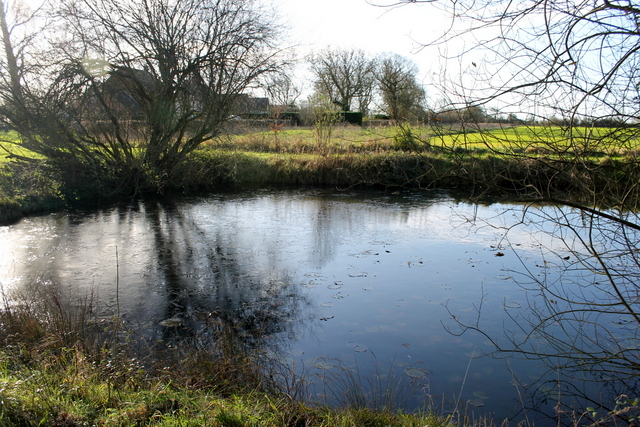
The first ice starting to form on the big pond
We have snowdrops in the garden that don’t look anywhere near being ready to flower but some in tubs have buds that may open in a couple of days. Strangely, a golden crocus which usually flowers in March has appeared in the grass near the end of the drive. The garden is unusually colourful for this time of year.
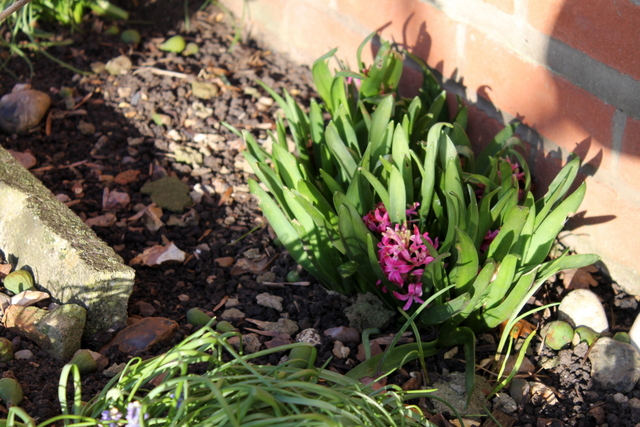
Slightly stunted pink Hyacinths.
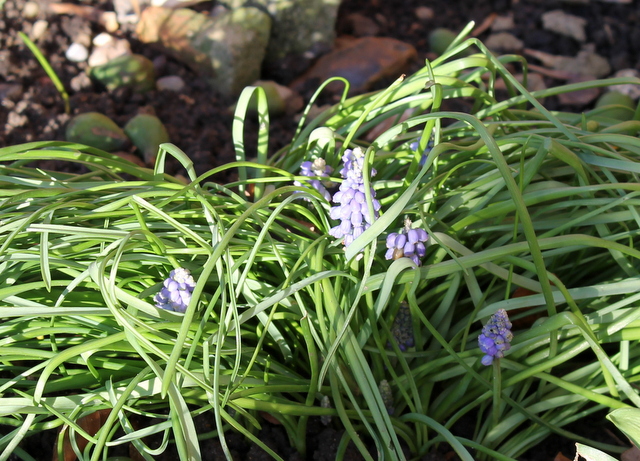
Grape Hyacinths.
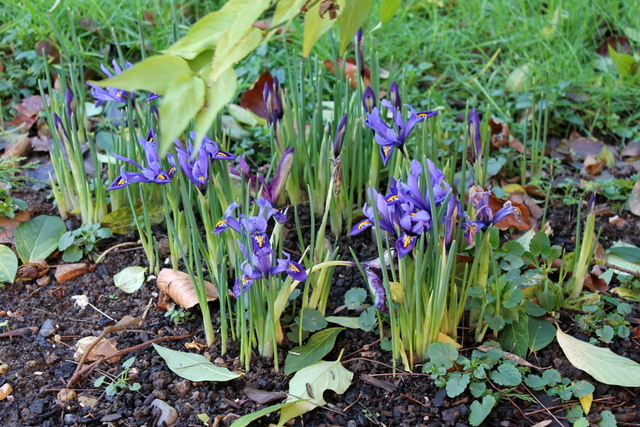
Miniature iris
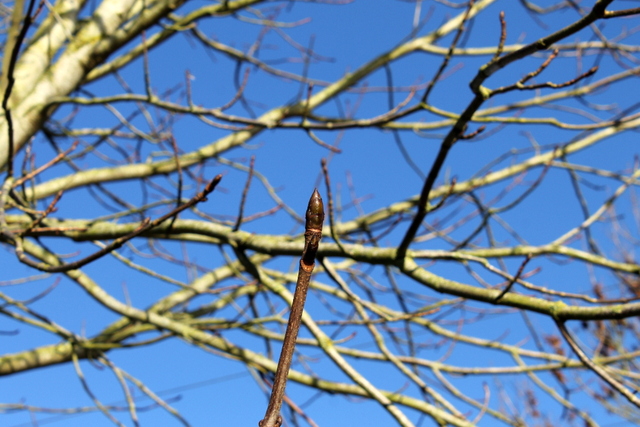
The ‘sticky-buds’ are swelling on the Horse Chestnut tree.
Those four photos were taken the morning after a severe gale when lots of rain, then sleet and wet snow fell. The snow settled for a while but most of it disappeared the next day when the sun came out. The wind had blown the snow almost horizontally and when I went out the following morning I saw walls and tree trunks with snow and ice stuck to them but hardly any snow on the ground.
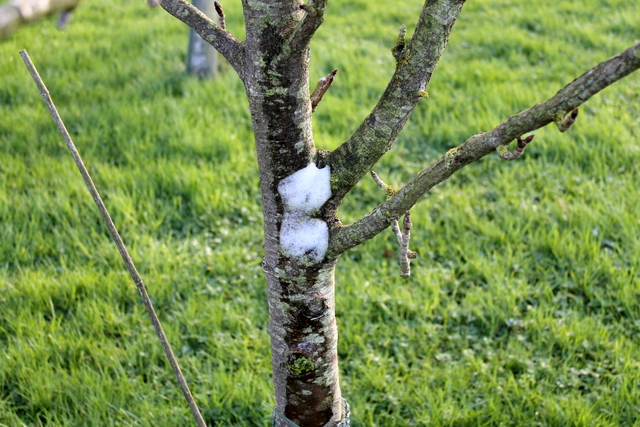
Small amount of ice on an apple tree.
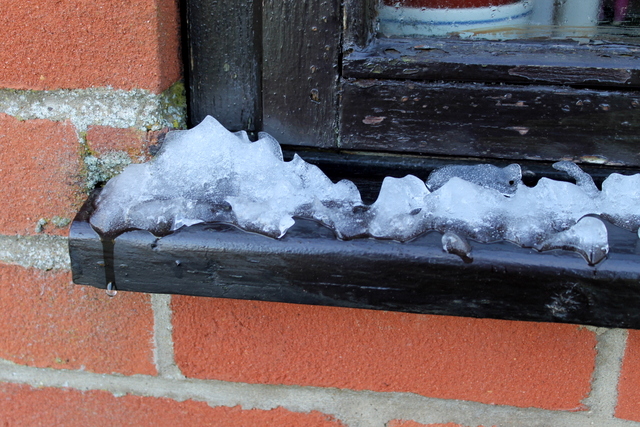
Melting ice on a window sill
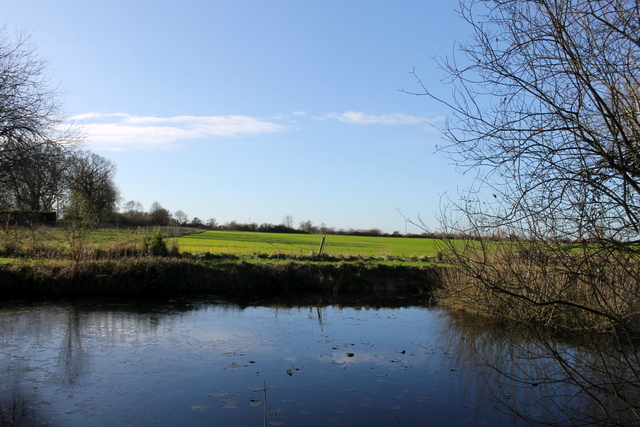
It was a beautiful day
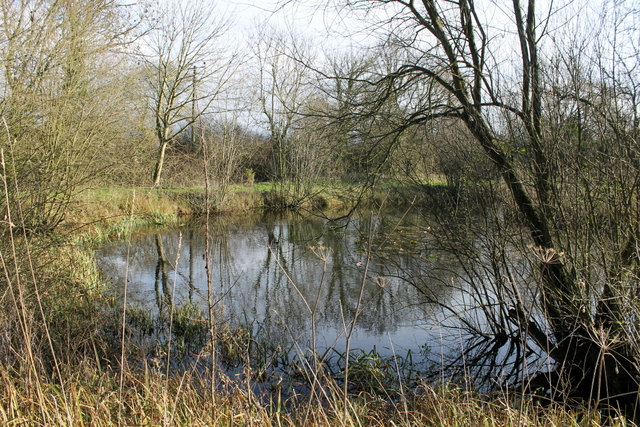
The water-level in the pond has risen quite a lot recently but not as much as we’d expected. Probably ditch clearing and drainage works done locally have meant less water entering our garden. The reeds and brambles need to be cut back here!

Colourful fungi on a dead log.
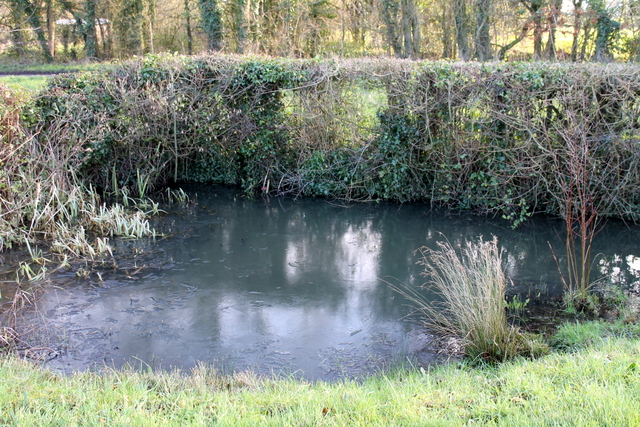
Even the pond at the front of the house had some ice on it
We continued to get hard frosts at night and then a light sprinkling of beautiful powdery snow on Saturday night.
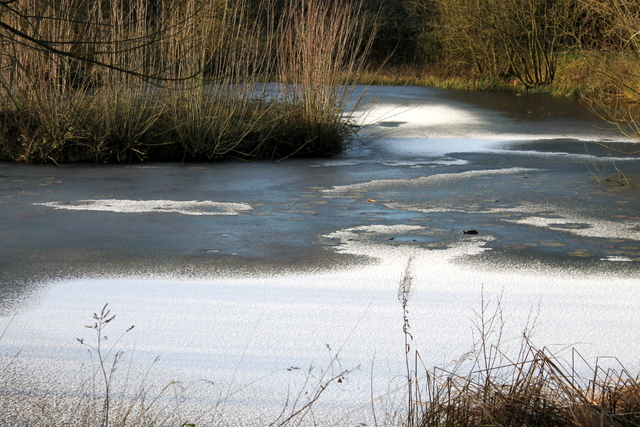
The big pond
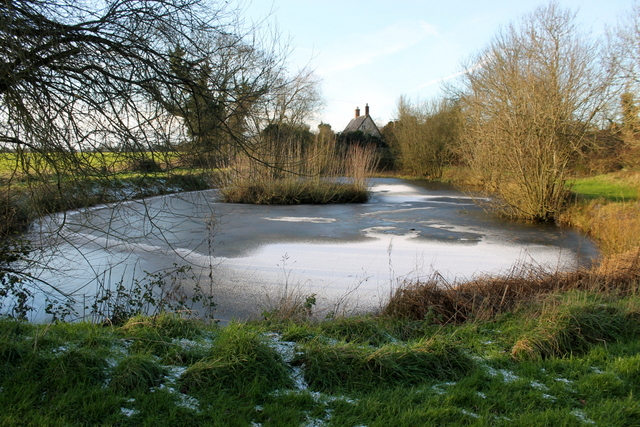
I like the patterns the snow made on the icy pond
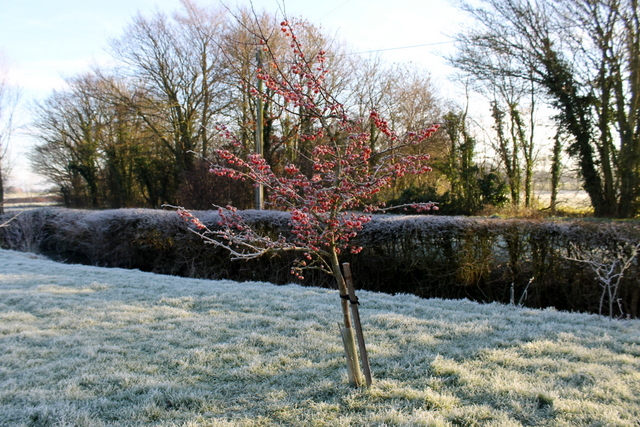
We had a hoarfrost yesterday morning but the sun soon came out and the frost melted. I wish I could have got outside earlier!
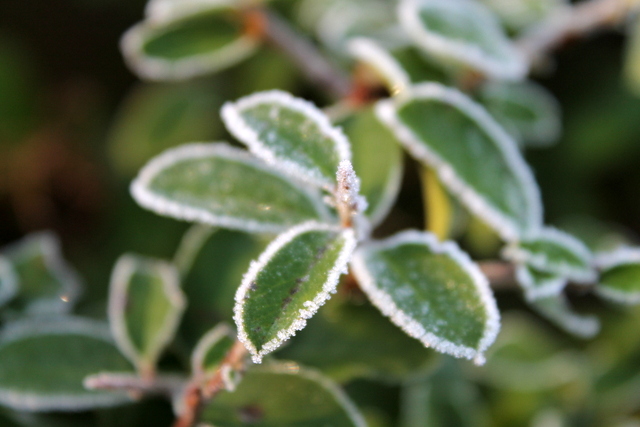
Pyracantha leaves
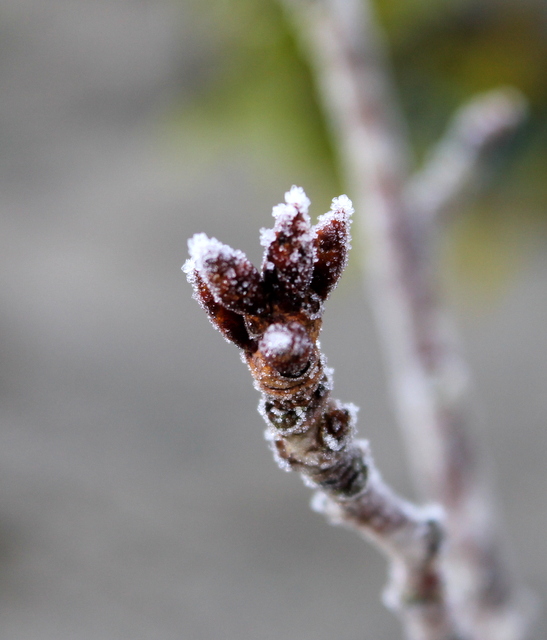
Cherry tree buds
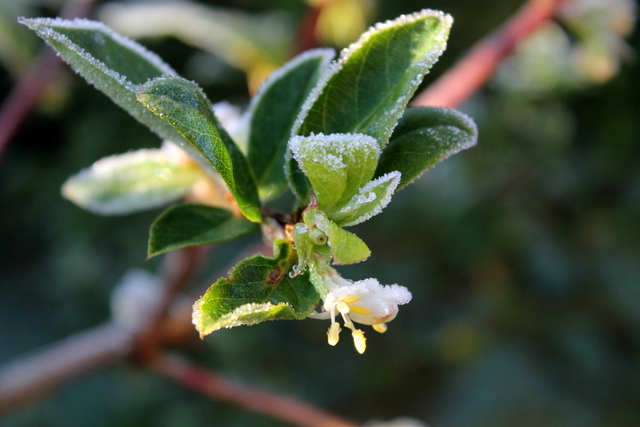
Winter-flowering Honeysuckle
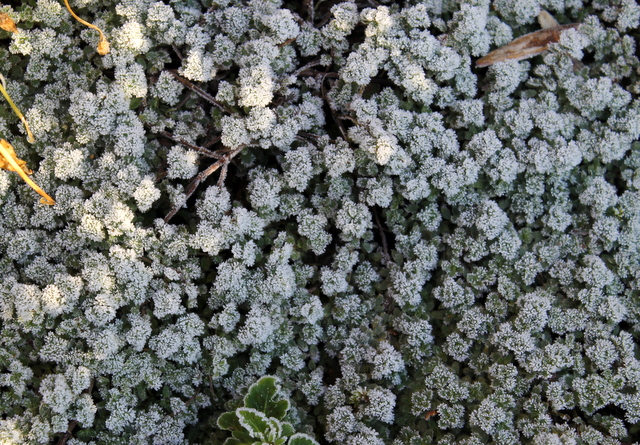
Thyme
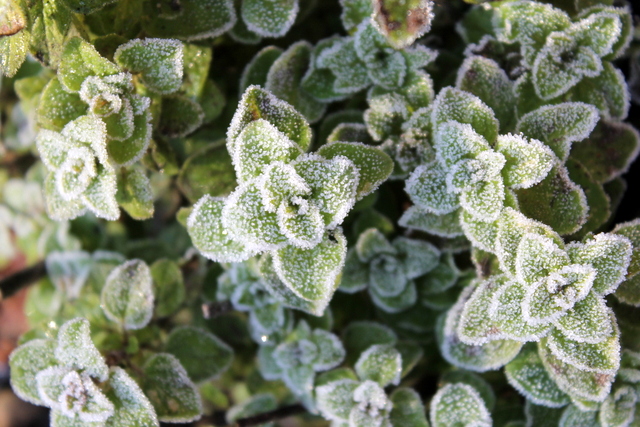
Marjoram/Oregano
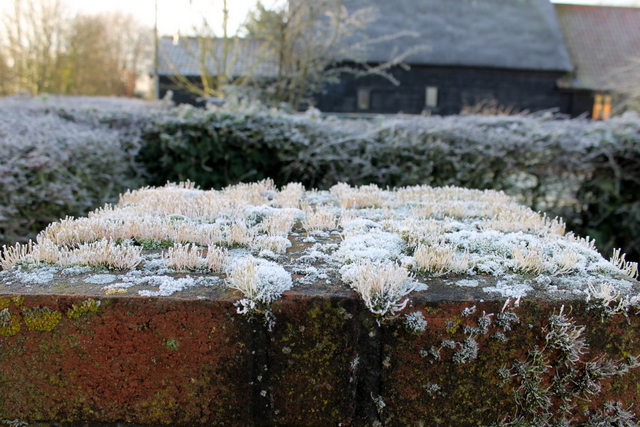
The moss and lichen garden on top of the brick pillar at the end of the drive
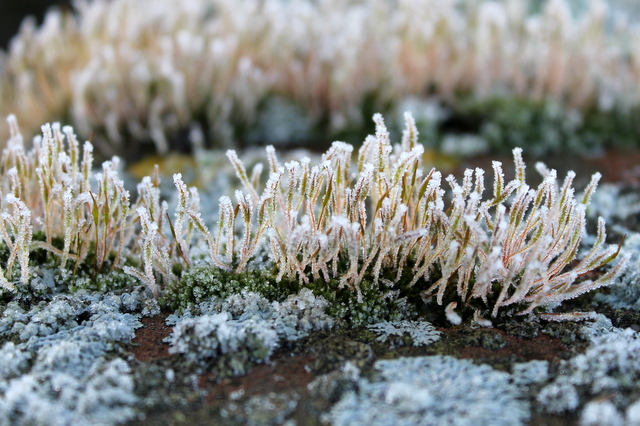
A close-up of the moss with its frosted capsules
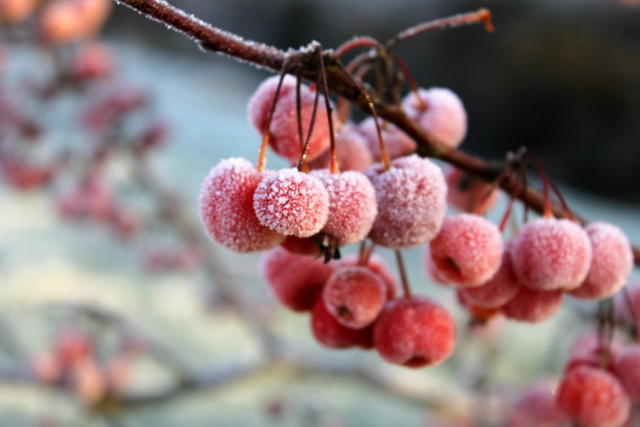
Crabapples.
I am pleased we have had a few frosts because the birds will only eat the crabapples once they have been frosted.
Richard went to a PCC (Parochial Church Council) meeting on Wednesday evening and came home with two pieces of good news. The first is that we are a stage nearer to getting the screen put in between the Tower Room and the main body of the church at Rumburgh and the second is that when our Rector retires in 2017 we will (eventually) be getting a replacement for him. For some time now, we have thought that we would have to do without a priest when Richard (the Rector) goes. We have a large but sparsely populated benefice and even though we would have tried to keep things going on our own and with the help of retired clergy and the priest from our neighbouring benefice, it would have been very difficult and might have meant that some, at least, of the churches would have had to close. We will have to put up with at least a year’s interregnum before the replacement priest arrives but if we know that we will get a Rector eventually we will cope better.
The piece of music today is a great favourite of mine and very romantic in style. It is quite long (just over 16 minutes) but is in five short movements so you don’t have to listen to it all in one go! This music makes me happy – I really don’t think anyone could help being cheered by it! It goes from a fast ‘Waltz’ to a very romantic interlude – ‘Nocturne’; then to another fast movement – ‘Mazurka’ followed by a slower ‘Romance’. The piece ends with a ‘Galop’. It was originally written in 1941 by Aram Khachaturian as incidental music for a new production of a play called ‘Masquerade’ by the Russian poet and playwright Michail Lermontov. The satirical-romantic play was written in 1835 and has a similar storyline to ‘Othello’. The run in 1941 had to be cut short because of the invasion of the USSR by Germany. Khachaturian later (in 1944) turned the incidental music into a Suite.
Thanks for visiting!
14 Thu Jan 2016
Posted in art, churches, Days out, Norwich, Rural Diary
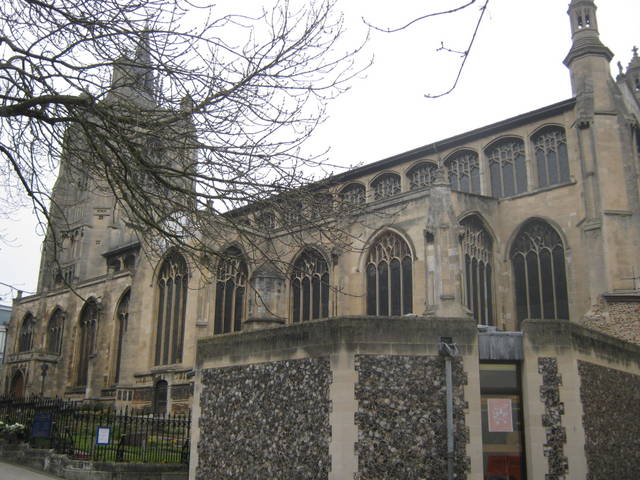
St Peter Mancroft Church
This large church is close to Hay Hill where my last Norwich post came from. It is the largest of the thirty-one Church of England churches in Norwich and is often mistaken for one of the two cathedrals.
The building was begun in 1430 and was consecrated in 1455, a twenty-five year single phase of construction which gives the church its unity of style. There have been only a few additions to the exterior of the building since then, notably the little spire on top of the tower (a fleche), the parapet round the top of the tower and the ‘pepperpots’ on the corners added by the architect A E Street in 1895.
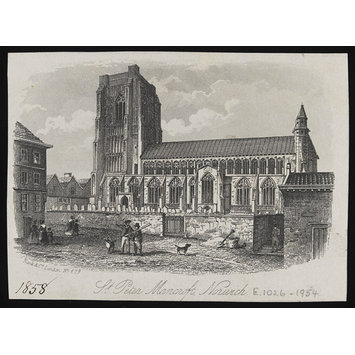
St Peter Mancroft before the Victorian additions to the tower.

St Peter Mancroft Church. Beyond it on the left of the photo you can see The Guildhall featured in a recent post of mine.
This church wasn’t the first to be built on this site. One of William the Conqueror’s barons, Ralph de Guader, Earl of Norwich, had had a church built there in 1075 but shortly afterwards he lost everything he had after rebelling against the Conqueror. Fortunately he had already bestowed the church on one of his chaplains, Wala, who fled to Gloucester after the rebellion. Wala passed the church on to the Abbey of St Peter in Gloucester and so for 300 years this church was known as ‘St Peter of Gloucester in Norwich’ – quite a mouthful! After pressure from the citizens of Norwich in 1388, the church was passed to the Benedictine Community of St-Mary-in-the-Fields in Norwich whose church (long since destroyed) was where the Assembly Room and the Theatre Royal are now. The Dean and Chapter of St Mary’s found the old church dilapidated and in very poor condition and so decided to re-build. It took them 42 years to save enough money through gifts, legacies and donations to be able to start the construction work.
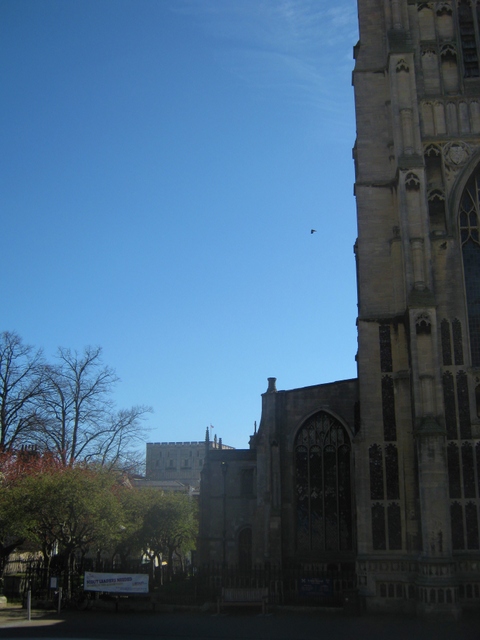
Norwich Castle can be seen beyond St Peter Mancroft church
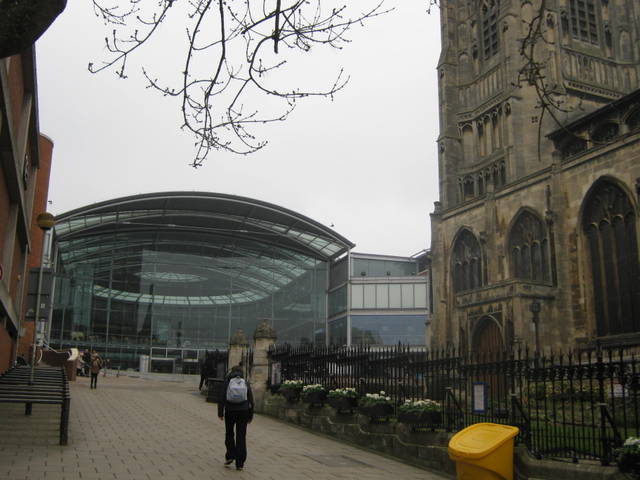
St Peter Mancroft on the right and the Forum ahead
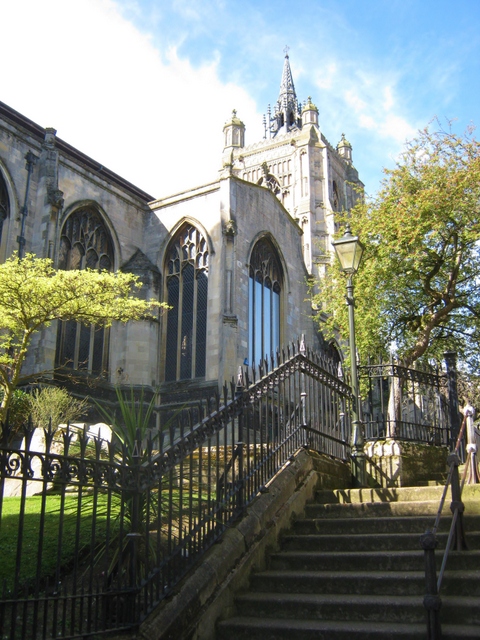
St Peter Mancroft
I include here a link to an aerial map of St Peter Mancroft (marked in purple).
During the Reformation the College of St-Mary-in-the-Field was suppressed and the patronage of St Peter Mancroft was passed through several families until 1581 when it was acquired by trustees on behalf of the parishioners. The church was originally the church of St Peter and St Paul but the name was shortened to St Peter after the two saints were given independent saints days during the Reformation. ‘Mancroft’ probably came from the ‘Magna Crofta’ (great meadow) on which it was built.
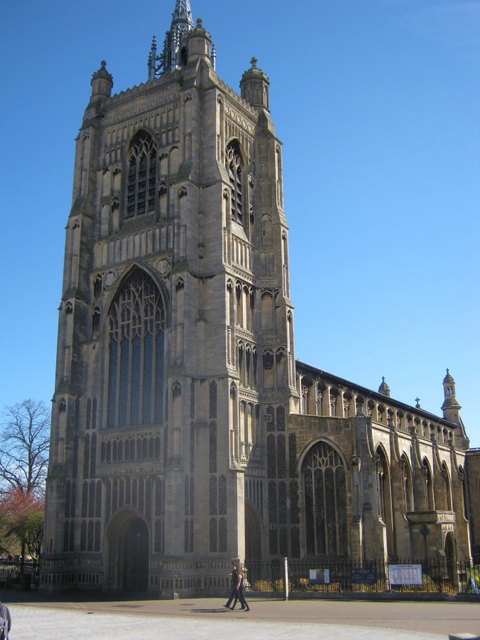
St Peter Mancroft – the tower is 146′ high
The church is almost completely faced with limestone which was brought many miles over land and sea at great expense. (There is no local free-stone in Norfolk). It was a deliberate display of wealth on the part of the 15th century citizens of Norwich. There is some knapped flint flushwork decoration most notably on the tower which is well buttressed and was probably intended to carry another lantern stage The tower also carries a peal of 14 bells.
There are two fine porches to the church on the north and south sides. The North Porch has a parvaise (a room over the porch).
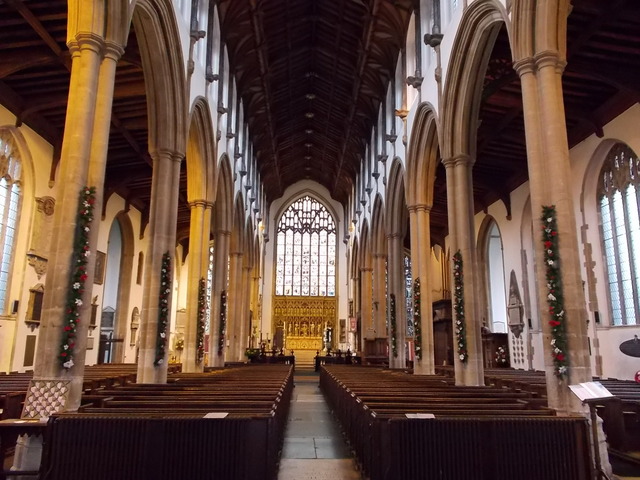
This is a view of the interior of the church from the back looking towards the East window.
It is 60′ from floor to roof and has eight arched bays with slender columns. The church is also very long at 180′.
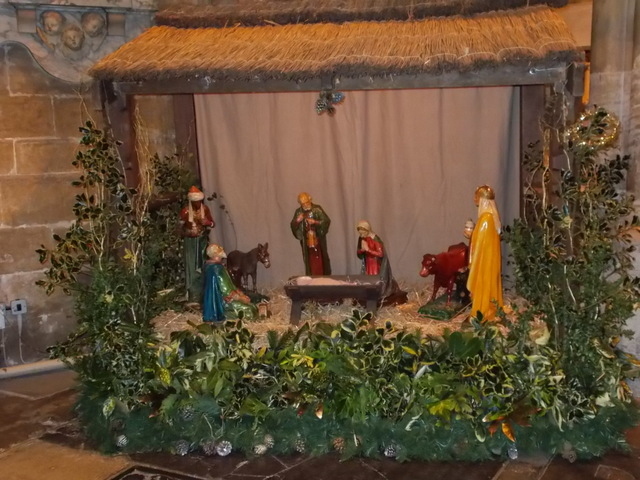
The Crib was about 5′ tall and 5′ wide. I could have got into it easily – if I had so wished!
Richard, Elinor and I visited the church on a very rainy day last week. Amazingly, the church was warm inside! Even the cathedral doesn’t get as cosy as St Peter Mancroft.
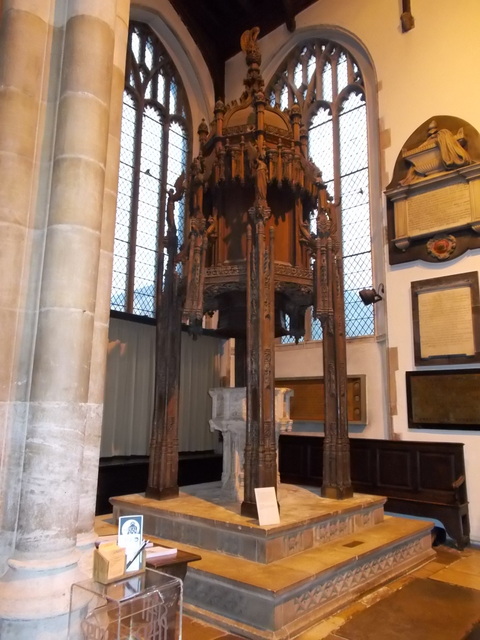
Font and Font Canopy in the Baptistery
The font was a gift to the church in 1463 by John Cawston, a grocer from Norwich. The Seven Sacraments were carved on panels round the font basin and an eighth panel showed the ‘Sun in Splendour’, the badge of Henry IV. Eight saints were carved on the shaft of the font. Sadly, the Puritans hacked off all the images, plastered the font with lime and daubed it with black paint. It was found in the crypt with other rubbish in 1926 and was cleaned and put in its present position. The four pillars and the base of the canopy over the font were made in the 15th century but the upper part of the woodwork is 19th century Victorian work.
I apologise for the poor quality of the photos in the slideshow but all of the objects were in glass cases in the St Nicholas Chapel. These objects are just a few of the many treasures owned by the church and known as the Mancroft Heritage.
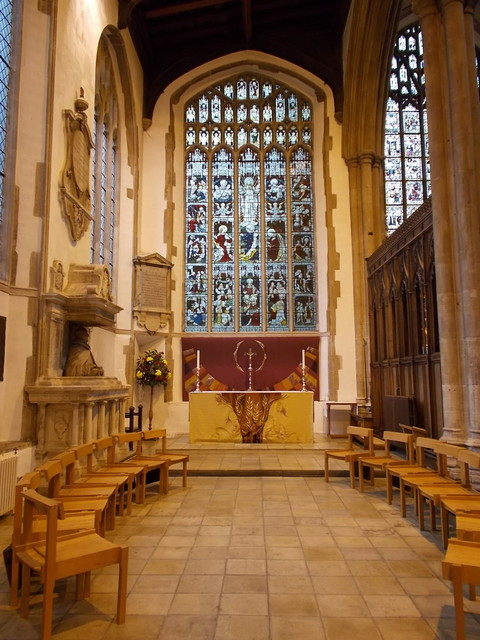
The Jesus Chapel.
This chapel is normally used for weekday services.
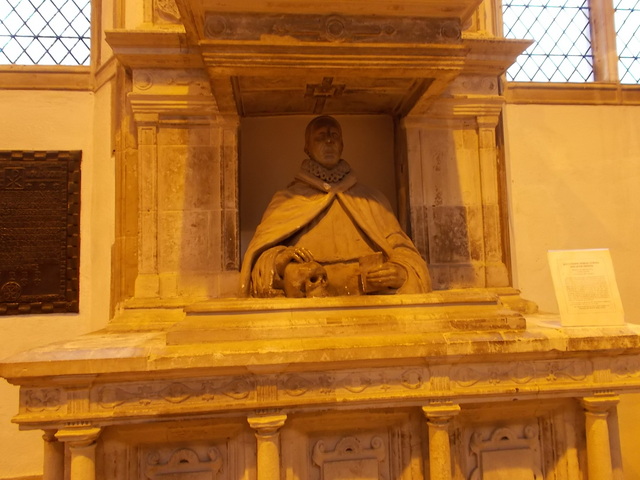
The tomb of Francis Windham, Recorder of Norwich in the reign of Elizabeth I
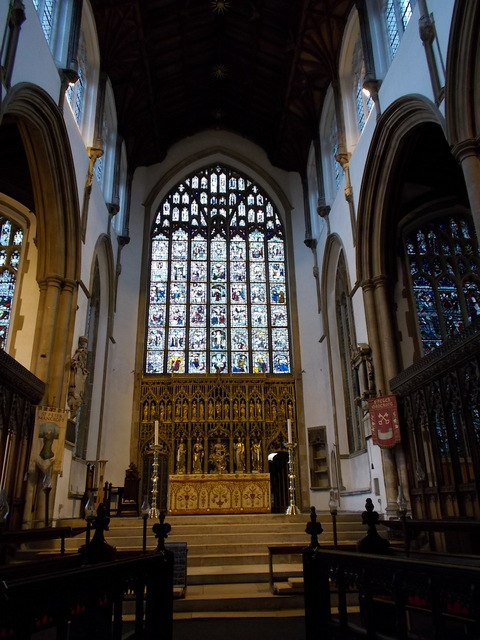
The Chancel or Choir
The Reredos (the panel behind the High Altar) has some beautiful carved figures made in 1885 and gilded in 1930 to mark the 500th anniversary of the beginning of the building of the church. At the same time the lower line of larger figures were added by Sir Ninian Comper.
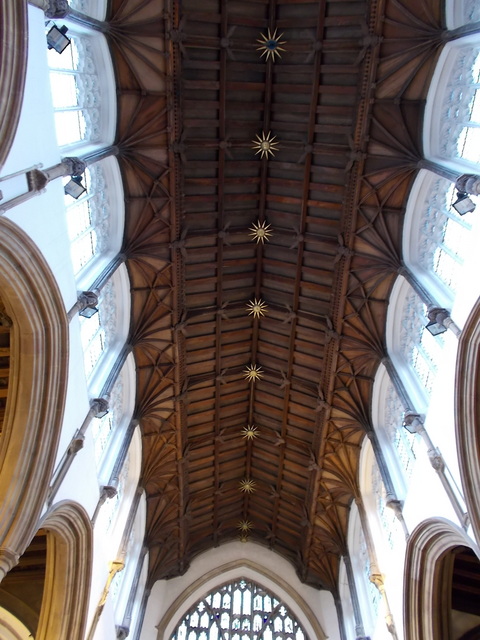
The Chancel roof
This roof (and the roof of the Nave) is of open timbered construction supported by hammer beams. Most hammer beam roofs are ornamented and uncovered but this one is covered by fan tracery or vaulting in wood. Most fan traceries are made from stone so this roof is very rare. It is also an angel roof – there is a single row of small angels on either side of the Nave roof but a double row on either side of the Chancel. There are also gilded suns in splendour on the ridge bosses. The roof was restored in 1962 -64. Some amazing work was done then by the restorers who raised the roof on jacks and then pulled the walls straight which had been driven outwards by the weight of the roof over the centuries.
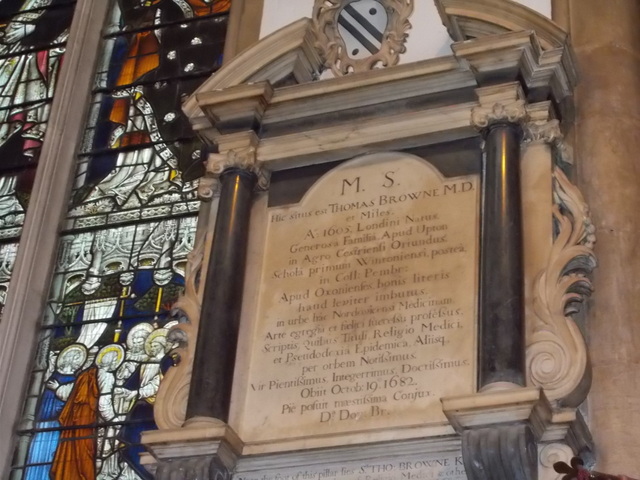
Here is the memorial to Sir Thomas Browne, the subject of my previous Norwich post
I have discovered a quote of Sir Thomas Browne’s from his treatise ‘Urn-Burial’ at the beginning of Edgar Allen Poe’s ‘The Murders in the Rue Morgue’.
The most memorable sight in the church is that of the Great East Window.
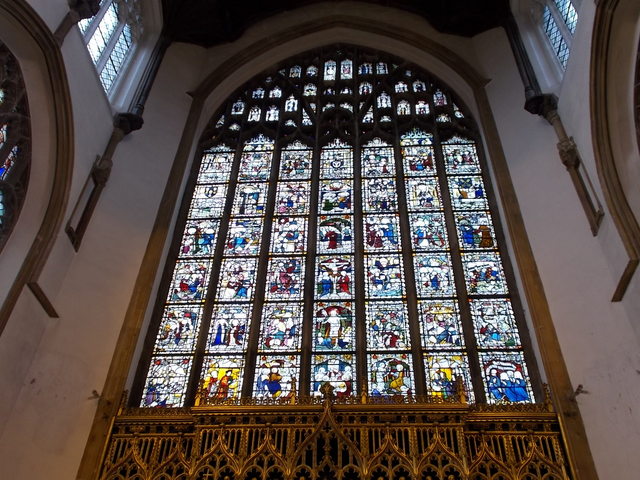
The East Window
It has 39 tracery lights (windows/panes of glass) and 42 main lights, all of which are 15th century except seven main lights which are Victorian. The Victorian ones are the lower five in the centre colomn and the two bottom ones either side of the centre colomn. This window contains some of the finest work by the 15th century School of Norwich Glass Painters. Most of the church would have originally been full of glass like this but during rioting between Puritans and Royalists in 1648 there was a gunpowder explosion nearby in a house in Bethel Street which left many people dead and much of the glass in the church blown in. It wasn’t until four years later that the glass was gathered together from around the church and most put into this window.
Please click on this link to see each light in detail.
I am obliged and indebted to the Church Guide I purchased in St Peter Mancroft for some of the information in this post.
Thanks for visiting!
06 Wed Jan 2016
Posted in churches, Days out, family, literature, plants, Rural Diary, trees, walking
Tags
bare trees, birch, corsican pine oak, Harleston, hedgehog, honeysuckle, pinks, primulas, Robert Louis Stevenson, Scots Pine, St Cross South Elmham, St Georges church, The Black Arrow, Tunstall Forest, viburnum bodnantense, walking, winter-flowering honeysuckle
I had a lot of difficulty trying to think of a title to this post as it is made up of a mishmash of lots of different photos taken from the beginning of December up to New Year’s Day and at a number of locations.
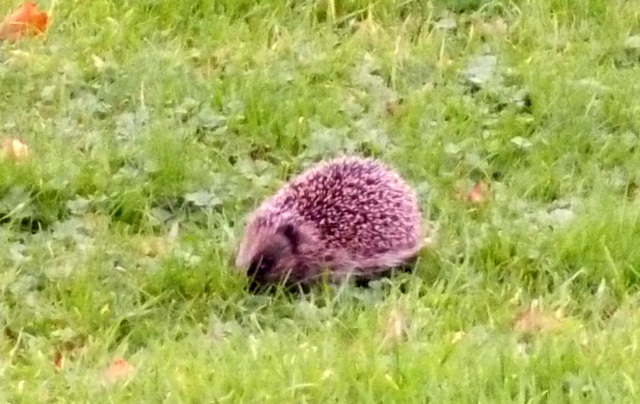
A young hedgehog I saw wandering about the garden during the day at the beginning of December.
This little creature looked healthy enough, though still not quite full-grown. It seemed unbothered by my presence and was trotting about looking for and finding things to eat in the garden. The photo is a little blurred because it didn’t keep still long enough for me to take a good picture of it. Hedgehogs are normally nocturnal mammals and only emerge during the daytime if disturbed or hungry. They hibernate during the winter but emerge during mild spells of weather to feed.
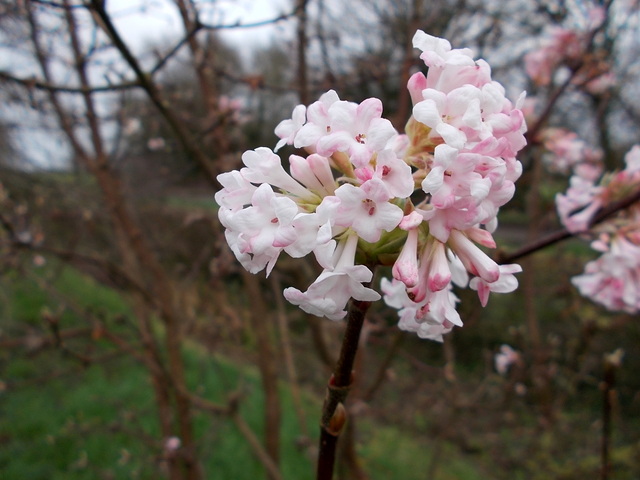
The Viburnum bodnantense is in full flower and smells divine!
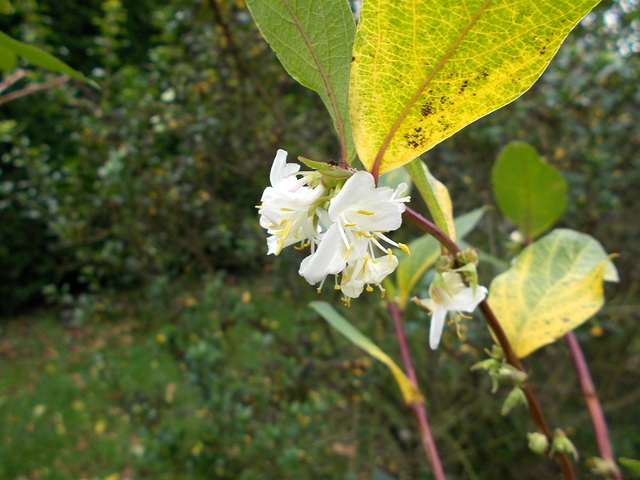
The Winter-flowering Honeysuckle is also flowering and its scent is beautiful.
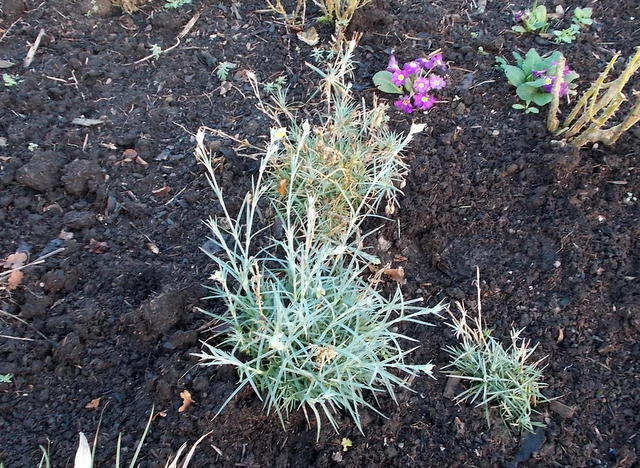
The Primulas in Richard’s border are in flower and his Pinks are covered in flower-buds.
Not only do we have all these flowers but also miniature Iris, Grape Hyacinths and Hyacinths are in flower. On my travels I have seen Daffodils, Snowdrops and Winter Aconites. My mother’s garden has Hardy Geraniums still in flower from the autumn and also the bright red flowers of Ornamental Quince. We have had a lot of rain (though much less than in the north and north-west of the country) – the ditches are filling fast, the roads are thick with mud and have standing water on them and parts of our garden are like a quagmire. The grass hasn’t stopped growing but it is too wet for it to be cut. I spent some time a few days ago pulling out Stinging Nettle runners from under our Crabapple tree.
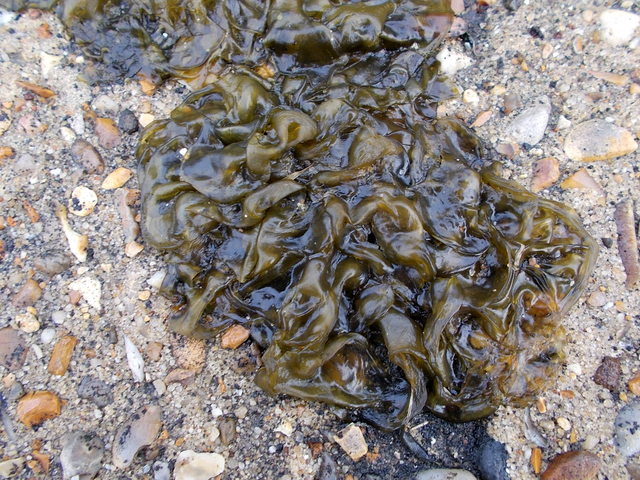
This seaweed-like algae has started growing out from the edge of the grass onto our driveway.
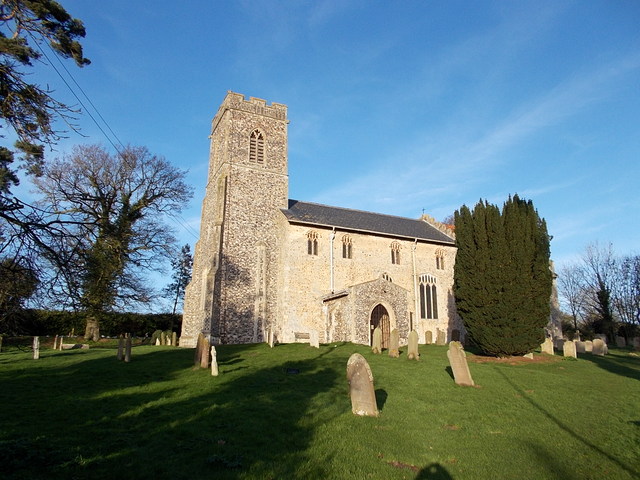
This is St George’s church at St Cross South Elmham – another of the churches in our benefice.
I had reason to call in to this church a couple of days before Christmas and while there I thought I’d take a few photos. I didn’t have much time to spare so only took a few pictures – I hope to return there again soon and finish the job.
The church is large and seems very tall especially as one approaches it from the bottom of the valley. I didn’t have time to walk round the outside of the church or visit the grave of the Canadian poet and writer, Elizabeth Smart.
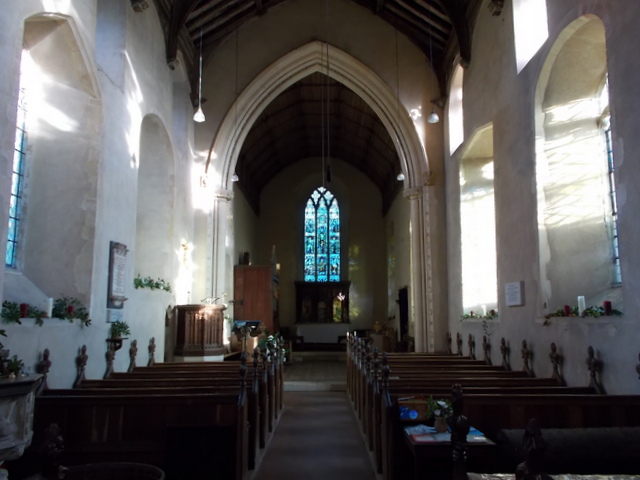
Inside the church
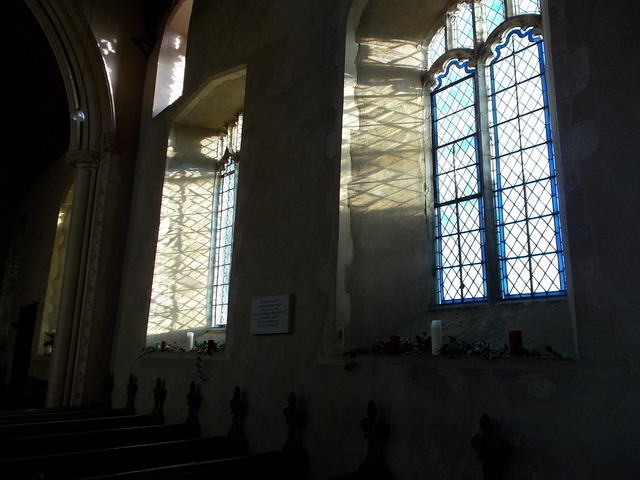
Sunlight entering through the clear windows
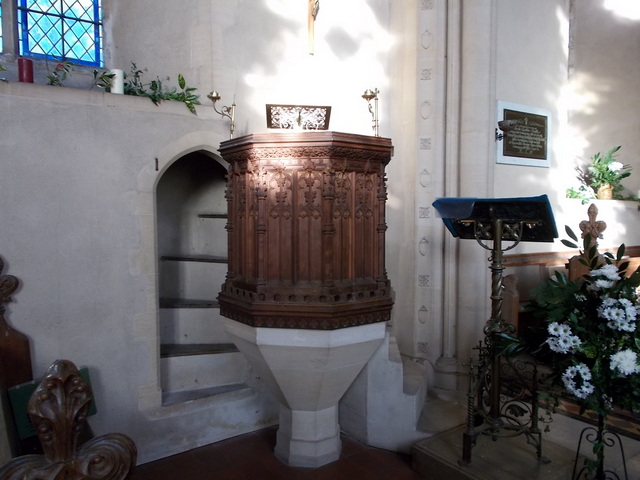
A very attractive pulpit and the tiny staircase that used to climb up to the rood loft
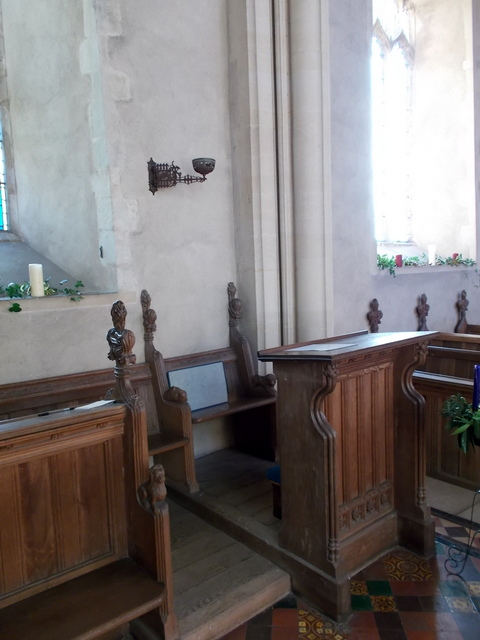
I like the little bracket on the wall above the reading desk.

The altar with its painted reredos. The picture on the left is of St George.
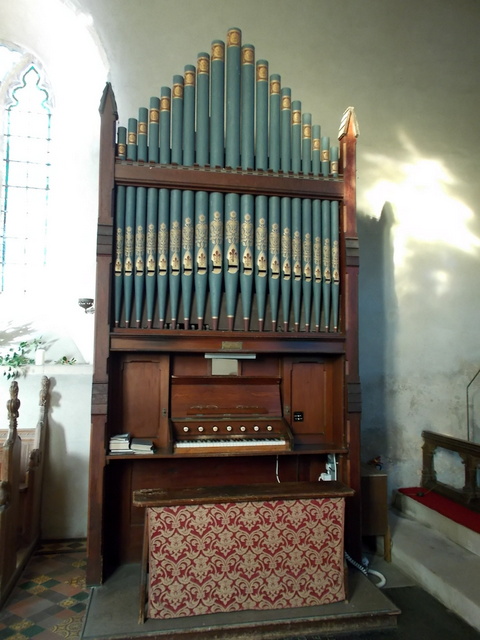
The pretty pipe-organ.
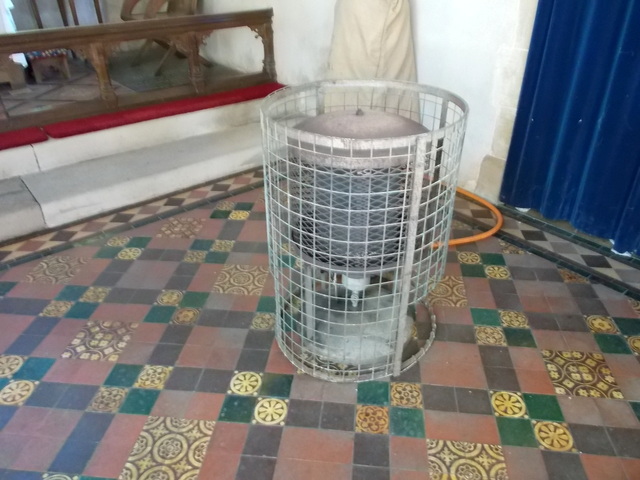
The heater – a venerable one!
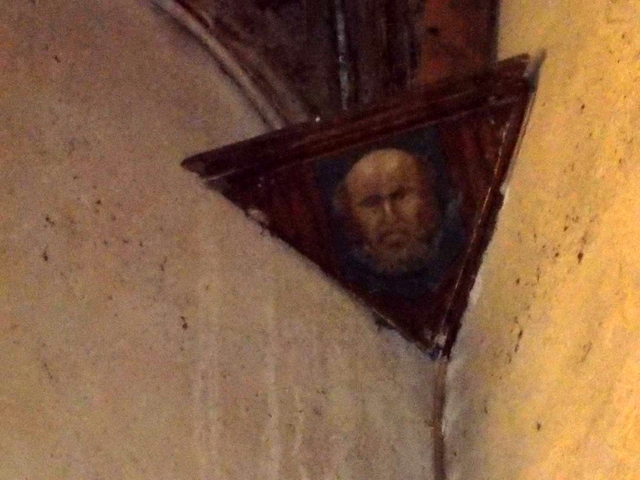
A watcher from up in the roof.
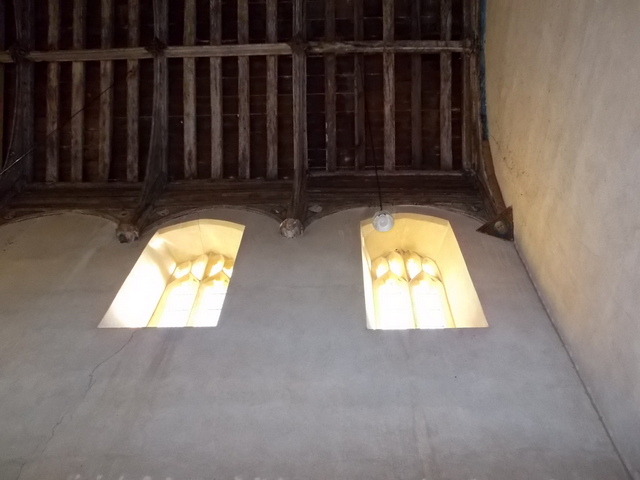
In this photo you can see where the face is. There are others elsewhere in the church.
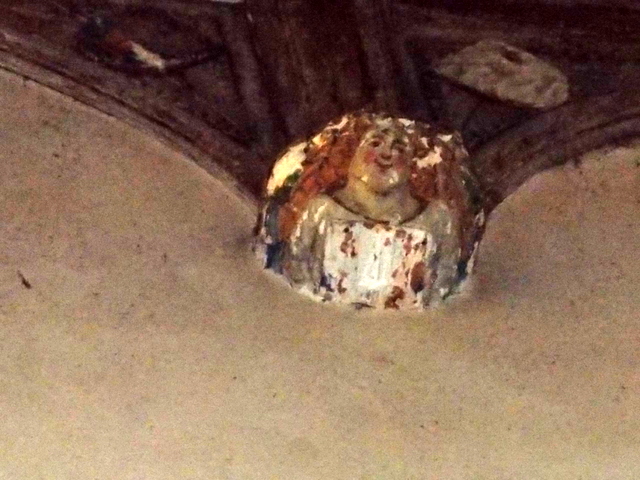
This person with the jolly face, long auburn hair and white shirt is up in the roof too.
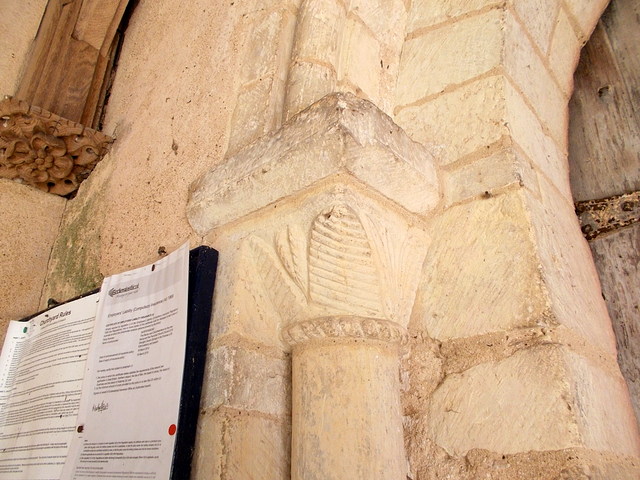
This carving round the door is in the porch.
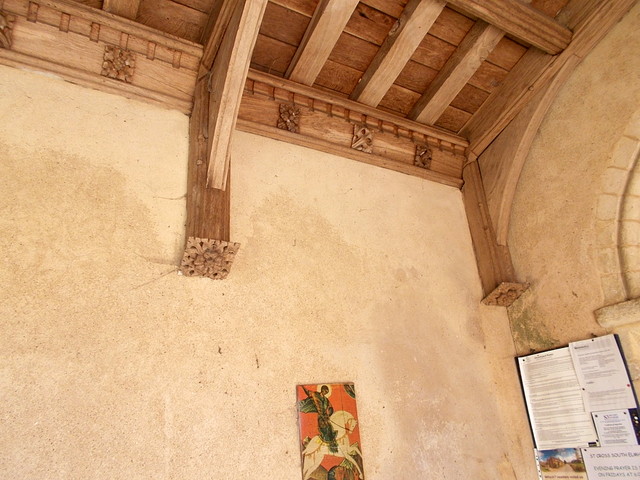
This is part of the wooden ceiling to the porch.
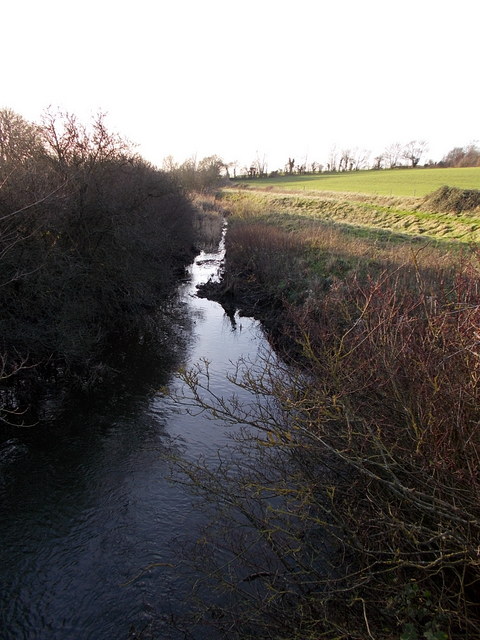
This is The Beck flowing through St Cross.
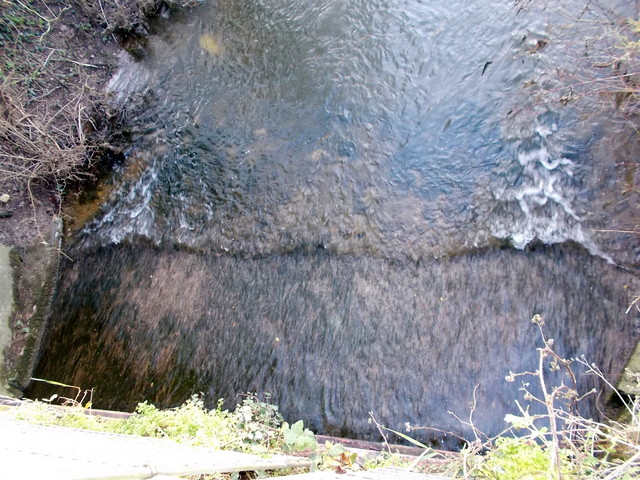
The road crosses The Beck by a bridge which I looked over to watch the water racing through underneath.
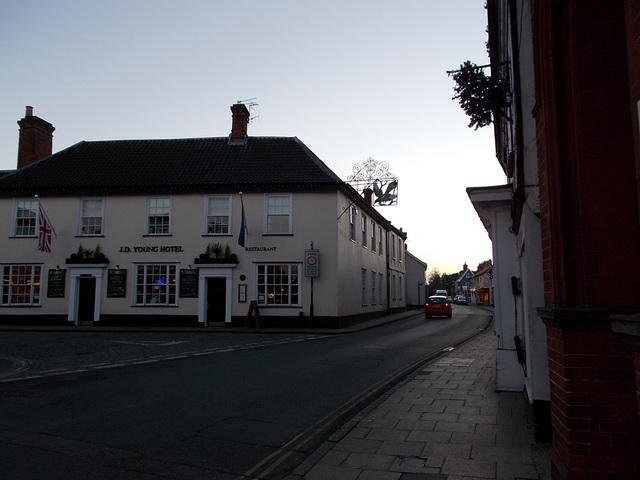
The Magpie (or as it’s now known, the JD Young Hotel – so boring!) in Harleston.
We stopped off in Harleston on our way back home after taking Alice to the station on New Year’s Eve. Harleston is a town on the north side of the River Waveney and in Norfolk. The Waveney is the border between Suffolk and Norfolk.
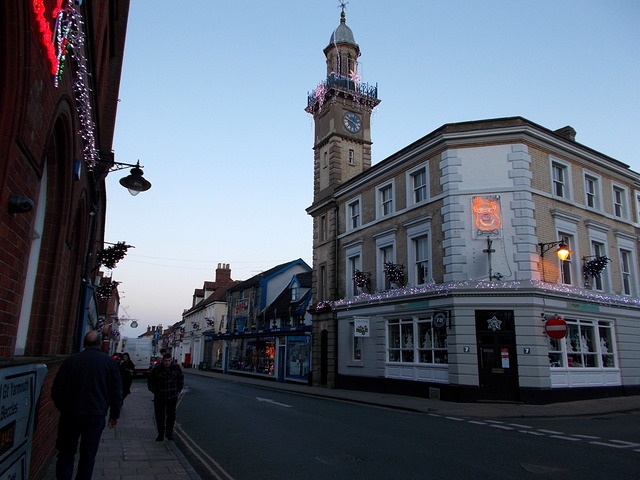
This is another view of the town from the same spot – outside the bank where Richard was withdrawing some money. By the time I had taken this photo he had finished the transaction and had walked off, as you can see.
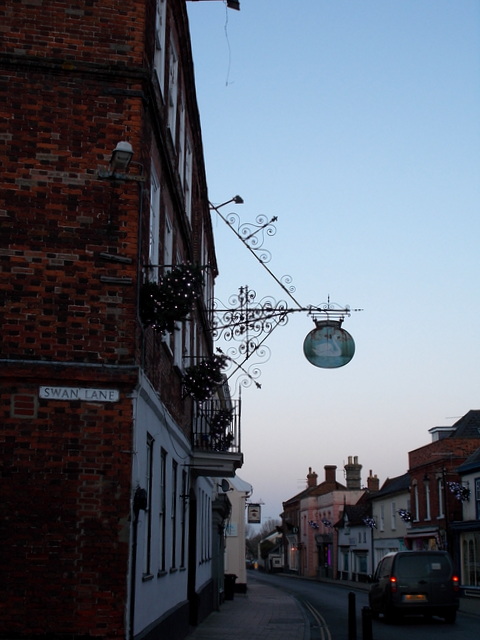
The Swan. Another of the inns in Harleston
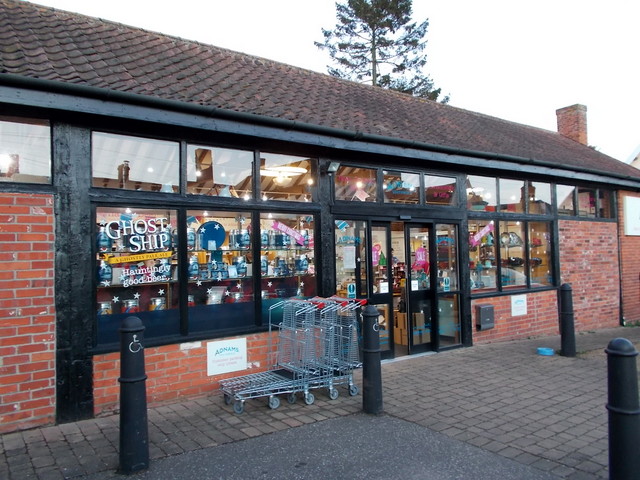
The Adnam’s Shop, Harleston.
After we had finished our shopping we treated ourselves to a wander round this shop. Adnam’s is a local brewery based in Southwold. They brew many different types of beer and ale and recently have started to produce wines and spirits as well. They opened a very large store selling their beers and spirits and also cooking utensils, china and glassware in Southwold. This shop in Harleston is a much smaller version of their main store.
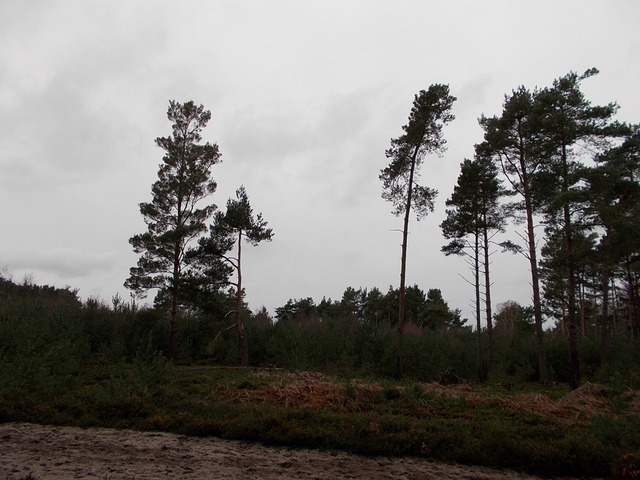
Tunstall Forest
On New Year’s Day, Richard, Elinor and I went for a walk in Tunstall Forest. The forest is managed by The Forestry Commission and is about 20 miles to the south of where we live.
One of my favourite books when I was a girl (and I still enjoy reading it now) was The Black Arrow by Robert Louis Stevenson. I was overjoyed to find that I was living near the Tunstall Forest of the book when I moved to Suffolk in 1988. Surprisingly, this walk was the first time I had visited the place.
The day was very dull and the ground was muddy from the quantities of rain we had had recently. It was difficult getting decent photos of the walk and there wasn’t much to see of special interest. However, the walk in the fresh air and in good company was good in itself.
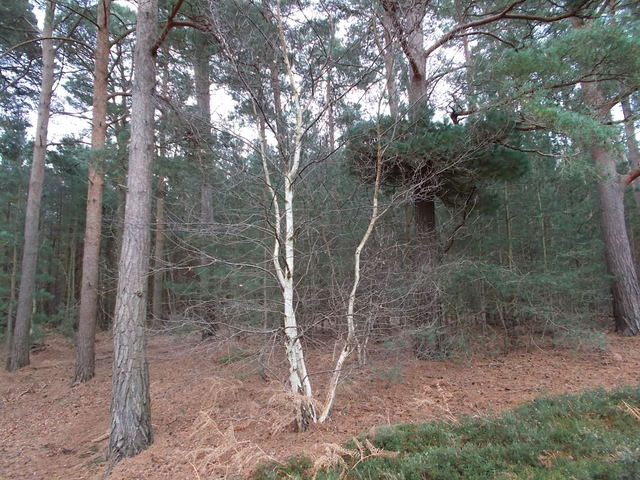
The forest is predominantly Scots Pine and Corsican Pine used as a crop but since the Great Storm of 1987 when many of the trees were lost, it has been replanted with mixed woodland.
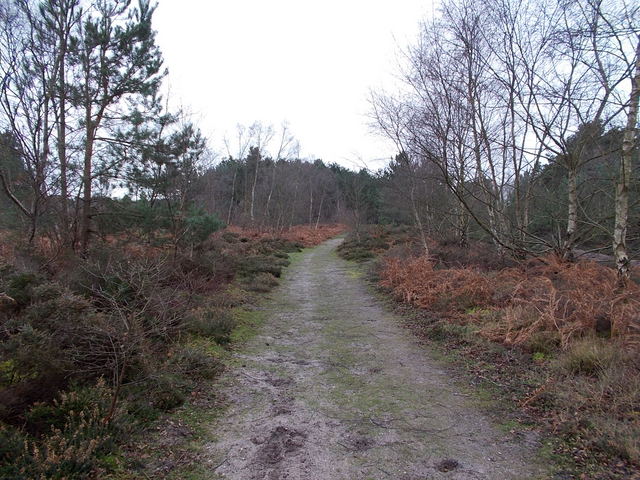
The rides through the forest are wide and sandy and I look forward to returning here in the spring and summer.
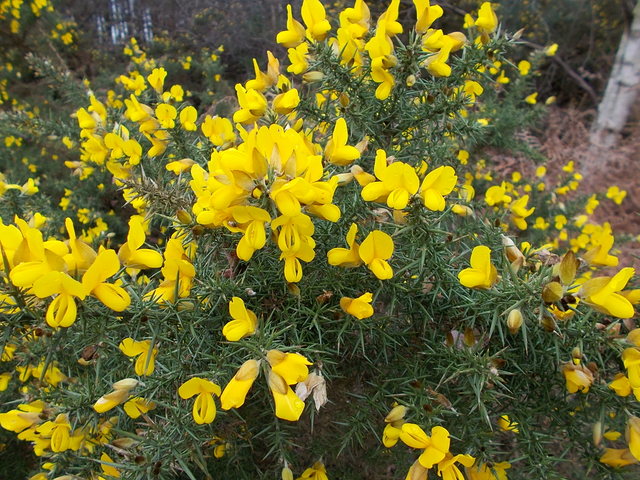
The Gorse was in flower and the bright yellow flowers were a welcome sight.
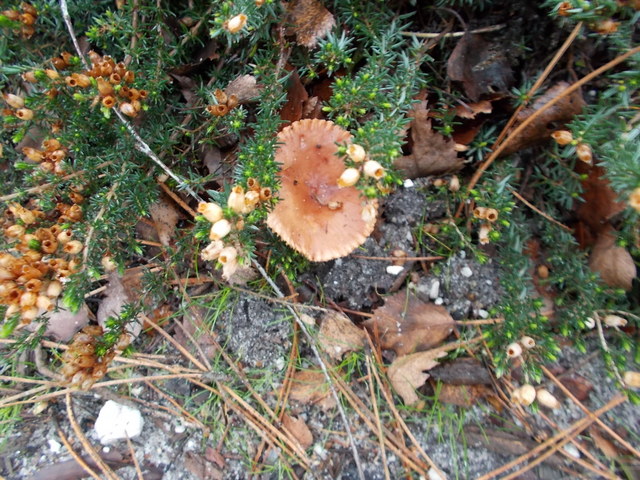
I noticed this toadstool at the edge of the path.
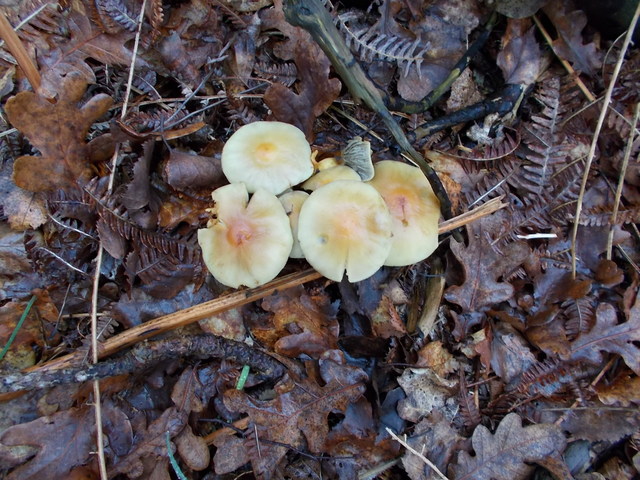
More fungi.


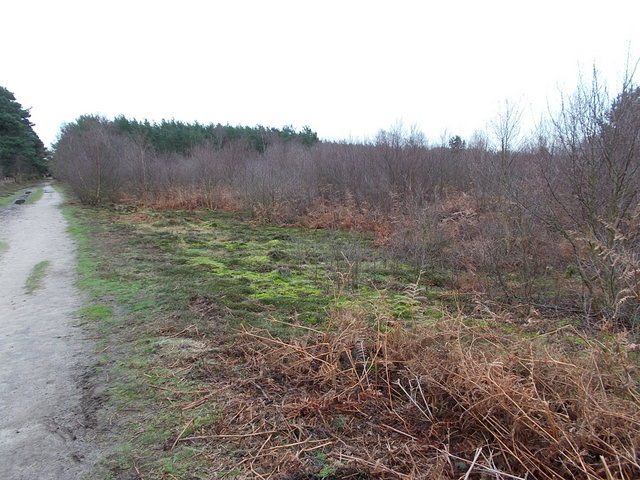
Another view from our walk
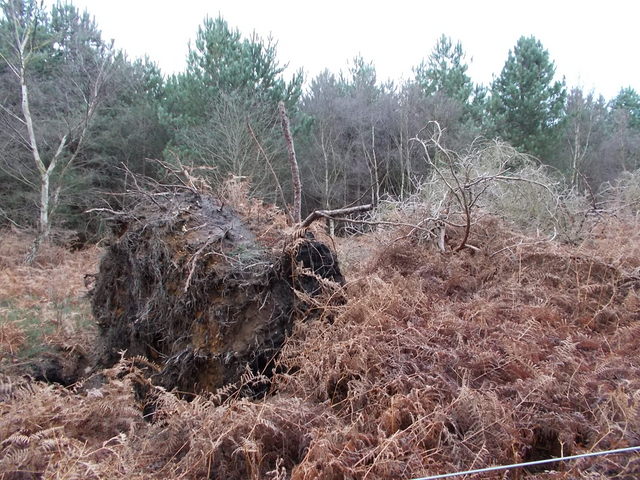
A fallen tree with its roots in the air.
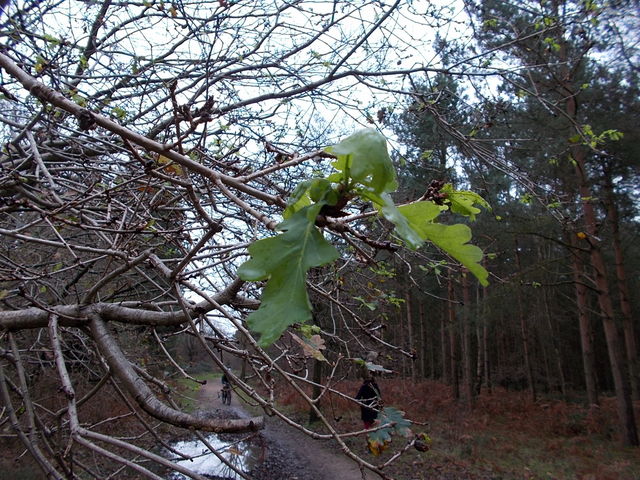
I was surprised to see these new Oak leaves
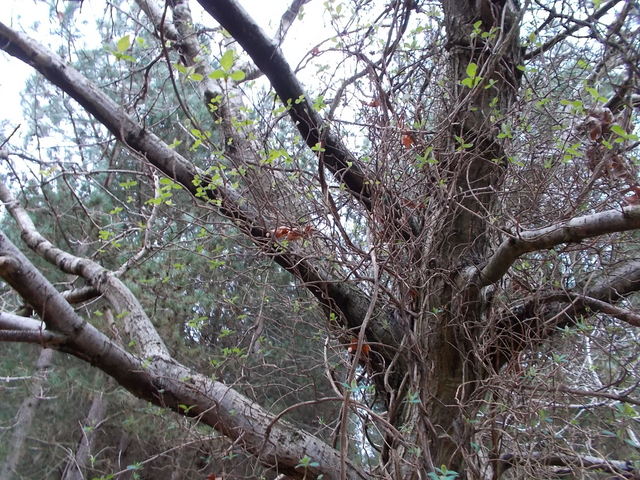
New Honeysuckle leaves
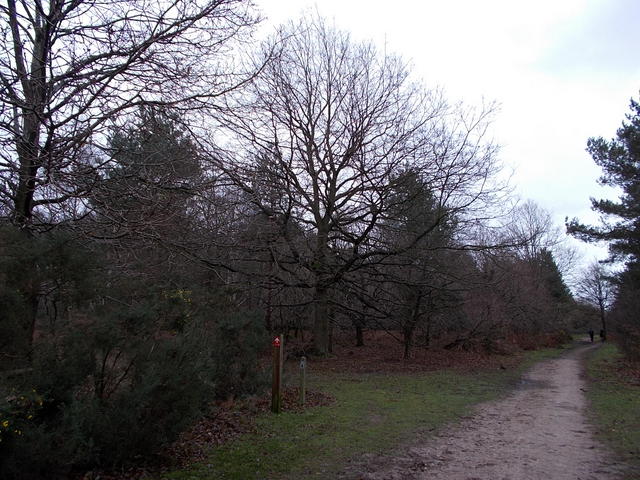
A fine tree next to the ride.
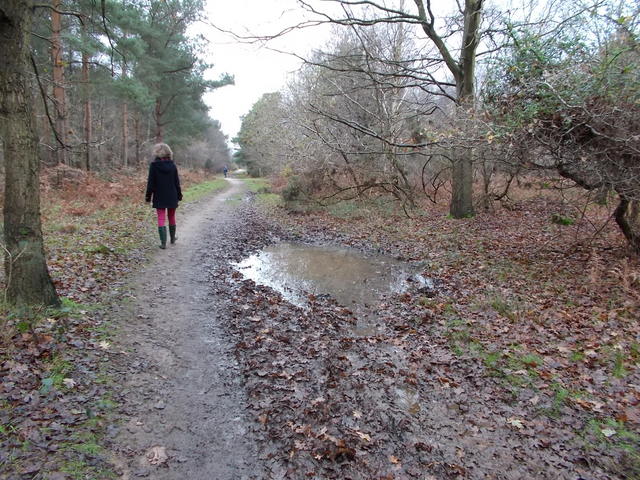
Proof that I didn’t walk alone. Elinor in the foreground and Richard in the distance.
And now for my music choice.
Thanks for visiting!
02 Sat Jan 2016
Posted in family, Rural Diary, theatre
December was very busy with few opportunities for taking photographs and fewer for taking walks!
All the things we hoped to do before Christmas that I mentioned in my Advent post were done, with the exception of taking my mother Christmas shopping. She gave me a few shopping lists of things I could more easily get for her and we did a big shop for her at the supermarket on the day before Christmas Eve. She decided to give everyone some money for Christmas instead of buying gifts and we were all very content with that.
I did spend a lot of time shopping in December but mainly for food items and ingredients for Mum and me. Most of the presents were ordered on-line – this is the easiest option for us as we live some miles from the nearest shops.
I spent a whole morning away from home at the doctor’s surgery followed by an appointment with the optician. Elinor had a doctor’s appointment to discuss a couple of problems she has and then I went for my regular blood test. At the optician’s, Elinor was told that she needed yet more new glasses and we made an appointment to return the following week to collect the new prescription.
Elinor’s last couple of weeks at college went well. We attended the parent’s evening, viewed her work and listened to the wonderful things her tutors had to say about her. They predict very good marks for her at the end of the year. We went to see her artwork on display in a gallery in Norwich.
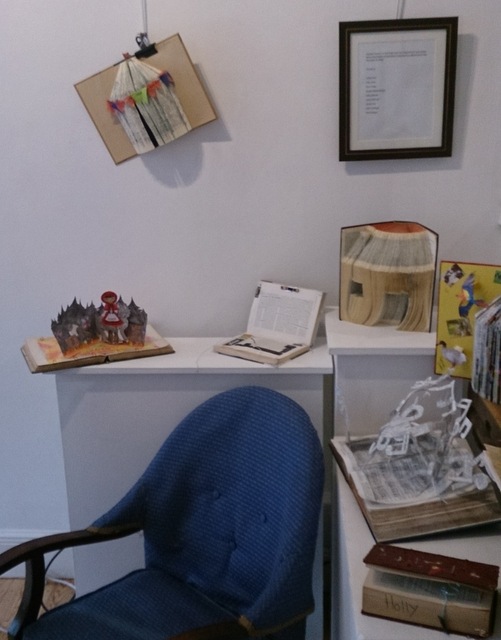
Elinor’s Red-Riding-Hood design in her ‘altered book’ is on the left on the shelf behind the chair.
The gas boiler was serviced and we discussed having a new boiler installed in the summer. A representative from the firm that will be replacing our garage doors visited us to talk about the work to be done and we were told the fitters will be installing the doors in a couple of weeks time. We had to have a water pipe moved to make way for the new garage doors.
The flush on our downstairs toilet kept going wrong and has now given up for good. The whole contents of the cistern will need replacing I think. We will have to call the plumber back yet again.
I got a puncture in one of my car tyres but fortunately it was repairable.
We attended the December Coffee Morning at the Rector’s house and also helped host two Carol Services at our church in Rumburgh.
I baked more than six dozen mince pies.
I wasn’t able to attend church on the 3rd Sunday in Advent as we were returning from our trip to Manchester that day. We had a lovely meal with members of Richard’s family in Manchester and exchanged presents with them. Our hotel was comfortable and for the first time ever on a Manchester visit, I managed to sleep well and for most of the night too!
We had a delicious lunch out with my brother Andrew and we exchanged Christmas presents with him as well. He was expecting both his children to stay with him for Christmas.
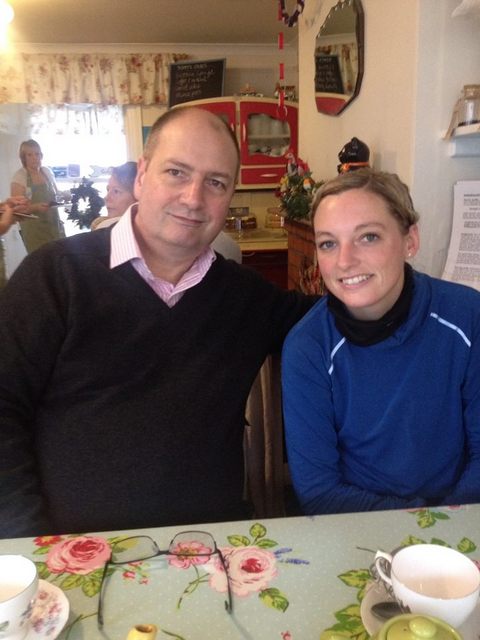
A photo I filched from Facebook. This is my brother Andrew and my niece, Natalie
He gave us his presents for my sister and her children as we were to visit her in Kent the following day. Our car was full of gifts on our 150 mile journey south to Francesca’s house and we brought a different lot home with us again that evening. Francesca made us very welcome on one of her very few days off work this Christmas. She had already worked 80 hours that week! Over-worked, under-paid and under-appreciated she spends her life as a paramedic practitioner saving the lives of others and looking after the welfare of her staff and colleagues. I am so proud of her.
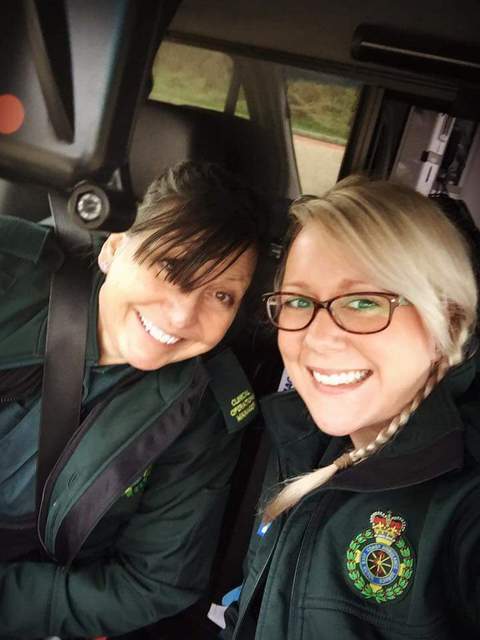
Here she is (on the left) at work yesterday. I appropriated this photo from Facebook too.
We wrapped countless presents and sent off a number of parcels to people we couldn’t manage to visit. Many, many cards were written and posted or delivered by hand. A number of letters and e-mails were written to friends and relatives and some phone calls were made and received. I also managed to keep up with all the housework and the washing and ironing.
I had a book of daily readings for Advent recommended to me by Rachel from Could Do Worse . I found them very useful and was able to spend at least 15 minutes each day in quiet contemplation and prayer.
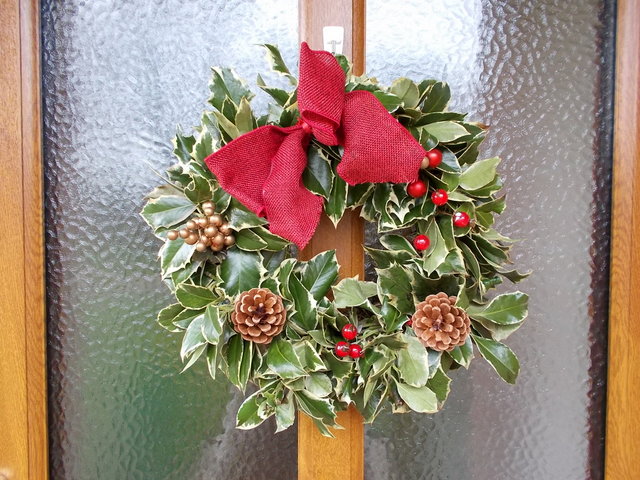
The Christmas wreath on our front door
We attended the local theatre at The Cut to see Richard Durrant’s Candlelit Christmas concert on the evening of the day we had lunch with my brother. We enjoyed the concert very much. Here is one of the pieces of music we listened to.
The house was decorated a couple of days before Christmas and Richard put some lights up outside the house.
Alice was coming home on Christmas Eve but as she was working that day her train wasn’t due in to Diss station until well after 9.00 pm. Unfortunately the train was delayed because of signalling faults before it got to Sheffield and was 45 minutes late. This meant that Alice was unable to catch her connections and there were worries that she might not be able to get home at all that night. Fortunately, the train she was on eventually arrived very late at Norwich so that is where Richard went to collect her. After I had given her a cup of tea and something to eat she had some present-wrapping to do and unpacking so she didn’t join us at Midnight Mass at St Margaret South Elmham church.
Mum joined us for Christmas lunch the following day and brought the Christmas Pudding with her. We went to her house on Boxing day for a buffet evening meal.
Richard and I went to church on Sunday morning at St Peter’s church and celebrated the Feast Day of St John.
The following day we were all going to go out for a walk together but I spent the day in bed with a migraine instead. Richard, Alice and Elinor went to Walberswick Woods.
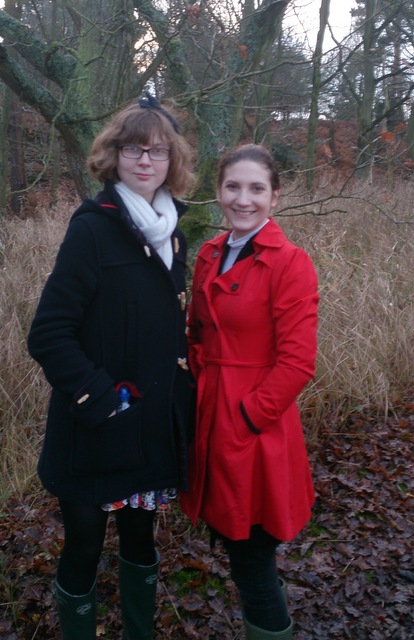
Alice and Elinor in Walberswick Woods
On Wednesday, my mother had a 9.40 am appointment to attend at the Eye Clinic at Norfolk and Norwich Hospital so I picked her up at 8.15 am and drove to Norwich. The appointment went well and she only had to wait twenty minutes after her appointed time before being seen! We did some shopping for her on the way home and after taking her to her house and having some coffee I was back at home by 1.30 pm.
All too soon, it was New Year’s Eve and Alice had to take the train back to Sheffield.
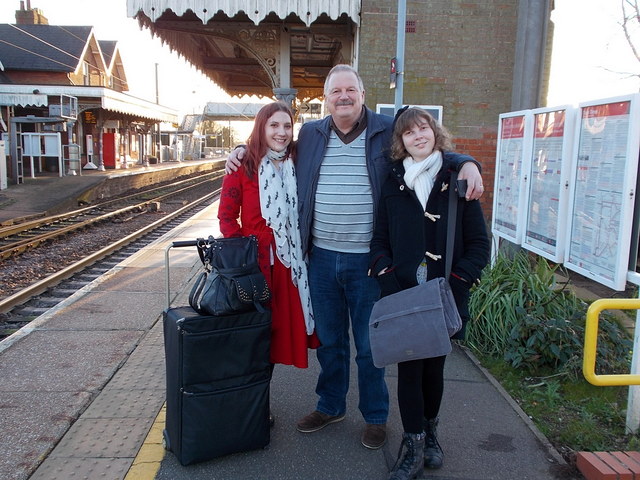
Alice, Richard and Elinor on Diss station.
I managed to take a couple of photos of the flowerbeds at the station to take my mind off my sadness at saying goodbye to Alice.


I leave you with another of my favourite tunes.
Thanks for visiting!
Reviews, news, features and all things books for passionate readers
A blog about life in the country in the past and present
Poetry and what-not
Ein Tagebuch unserer Alltagsküche-Leicht zum Nachkochen
TAMARA JARE Tamara Jare: Contemporary Figurative Painting Oil on Canvas Artist Art Studio
Documenting a Dream
Rambling Journeys in Britain, Countryside Matters and campaigning for the Right to Roam
Here to Entertain, Educate & Inspire!
an ongoing experiment in the dirt, 35 plus years
Celebrating God's creatures, birds and plants...
Writer
Developing a more sustainable lifestyle in SW Wales
Exploring the Lake District and beyond
Wandering trails around the coast of Wales
An English persons experience of living and gardening in Ireland
A Journal Of Everyday Life
Rambling Journeys in Britain with John Bainbridge. Fighting for the Right to Roam. Campaigning to Protect Our Countryside.
Waking the Writer Side...and keeping it "Up!"
Travel, thank you notes and other stories
Music and the Thoughts It Can Inspire
Simply Living Well
Historic watermill in the beautiful Suffolk countryside
Retired, not expired: words from the after(work)life. And music. Lots of music!
By Olive Oyl
#TBGO
Twitter: @frankpleszak @PolishIICorps
Indie Writer and Publisher
Life in a flash - a bi-weekly storytelling blog
Rambling in the British Countryside
thoughts on social realities
Jottings from Skye
embracing my inner homemaker
Just another WordPress.com weblog
Flash Fiction, Book Reviews, Devotionals and other things.
Smile! You’re in Barnier World......
the things that come to hand
Author of "A Past Worth Telling"
Poetry, Other Words, and Cats
A genealogical site devoted to the history of the DeKorn and Zuidweg families of Kalamazoo and the Mulder family of Caledonia
 A Suffolk Lane