• About my Blog
  • GDPR (General Data Protection Regulations) and This Site
  • My Life in a Suffolk Lane

A Suffolk Lane

~ A diary of my life in rural north Suffolk.

A Suffolk Lane

Category Archives: churches

November

22 Sat Nov 2014

Posted by Clare Pooley in churches, Rural Diary, weather

≈ 21 Comments

Tags

Christ the King, November, Rumburgh Church, Stir-up Sunday, Thomas Hood

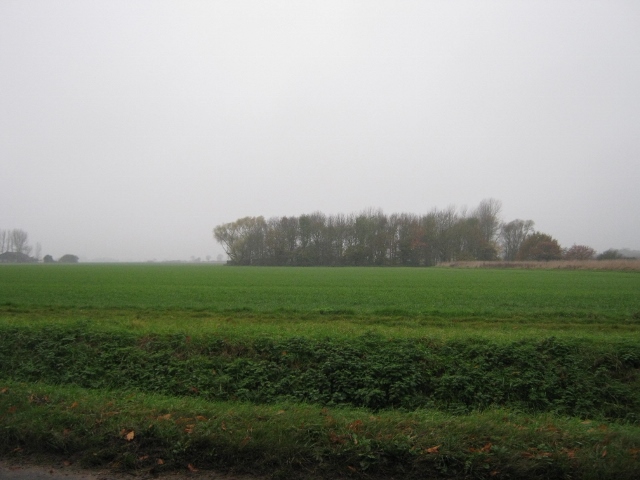
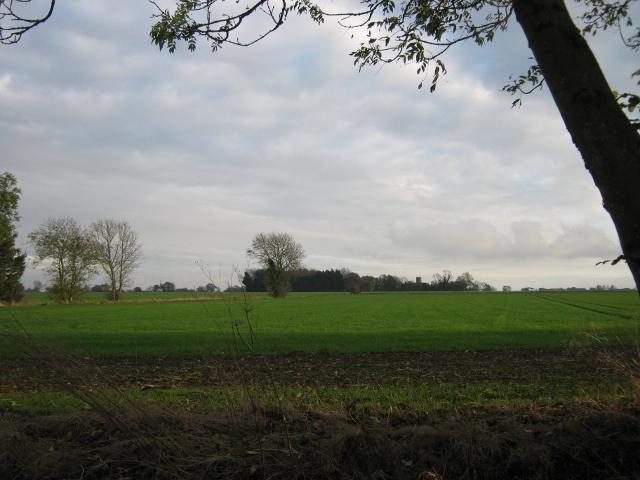
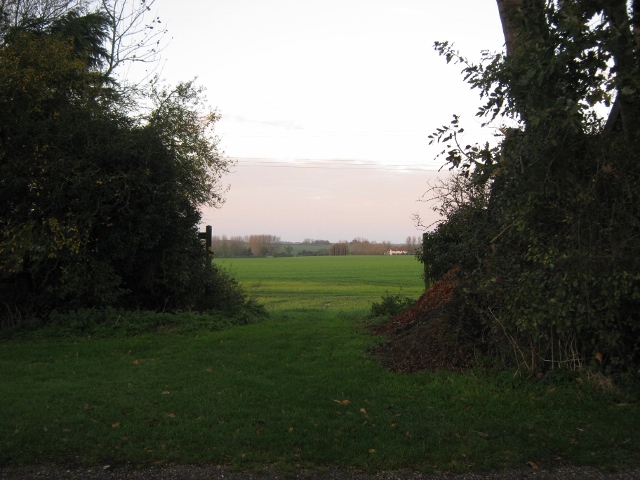
005View across fields (640x480)

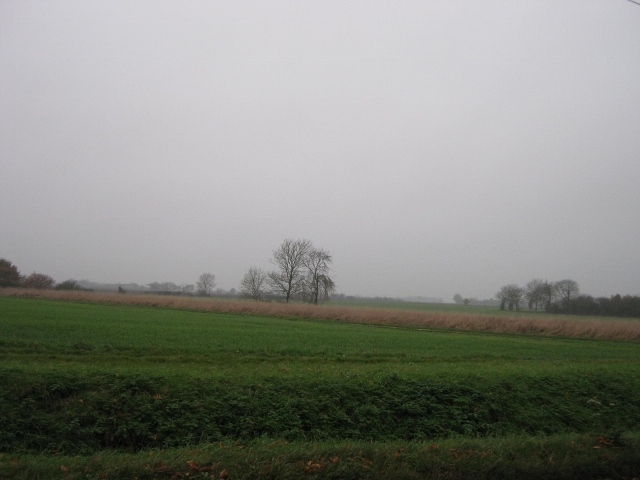
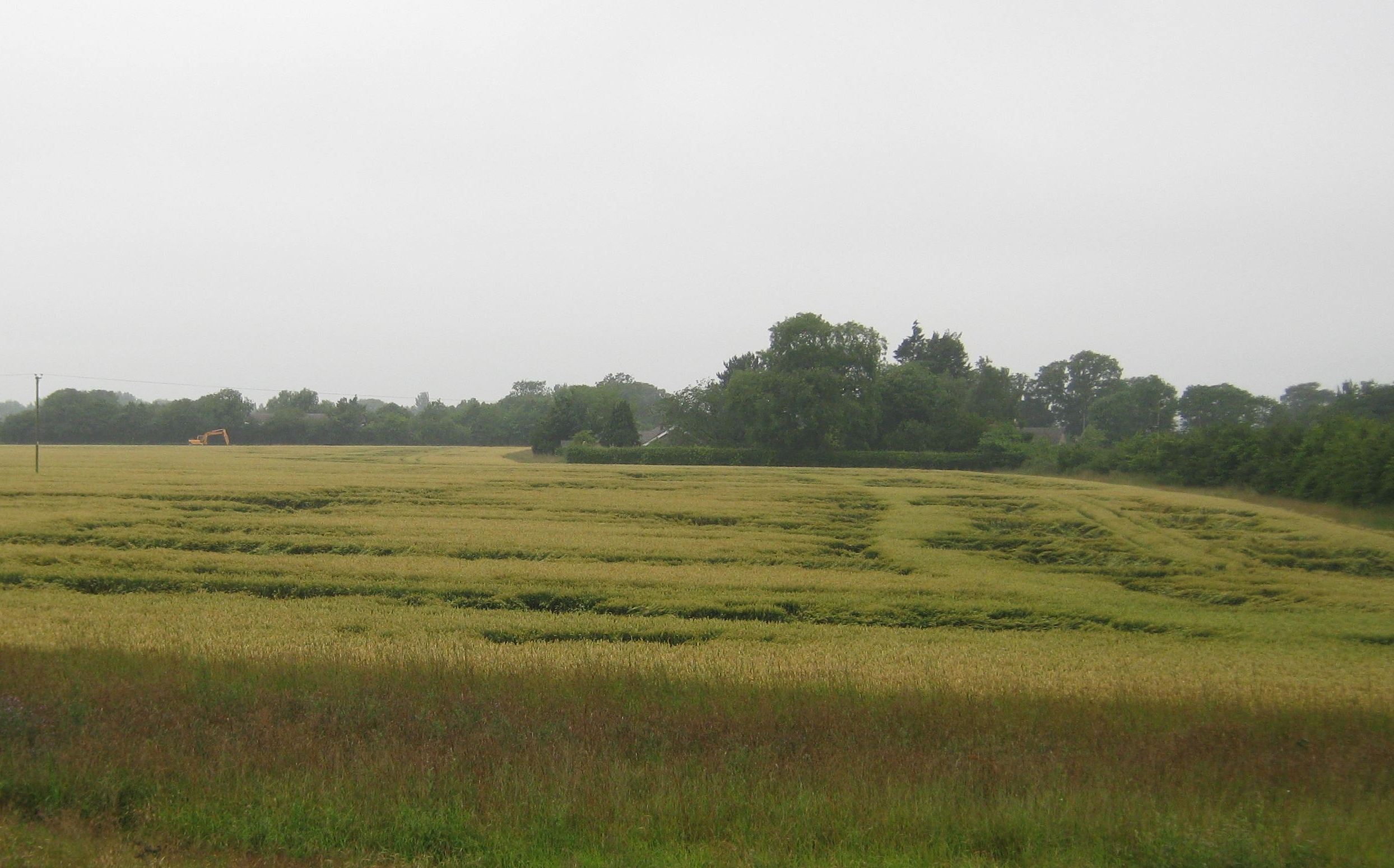
It has been a typical November day today (to look at) but as it is 11 degrees Centigrade it is still unnaturally warm for the time of year.  There are also still some leaves on the trees and a few flowers blooming!  The downside is that we have had a lot of rain and mud is everywhere.  R kindly washed my car earlier which was extremely noble of him as it has been drizzling, then raining, all day.

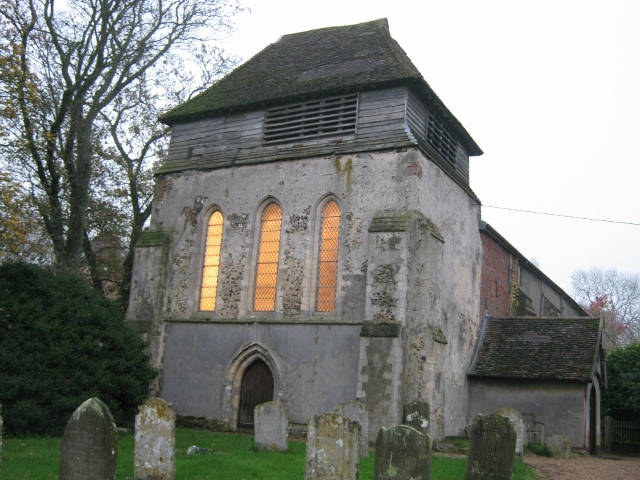
004Rumburgh Church - November (640x480)

We went to the church this afternoon to make sure all was clean and tidy as we have a service there tomorrow.  We will be celebrating Christ the King – ‘the all-embracing authority of Christ’ (Oxford Concise Dictionary of the Christian Church).

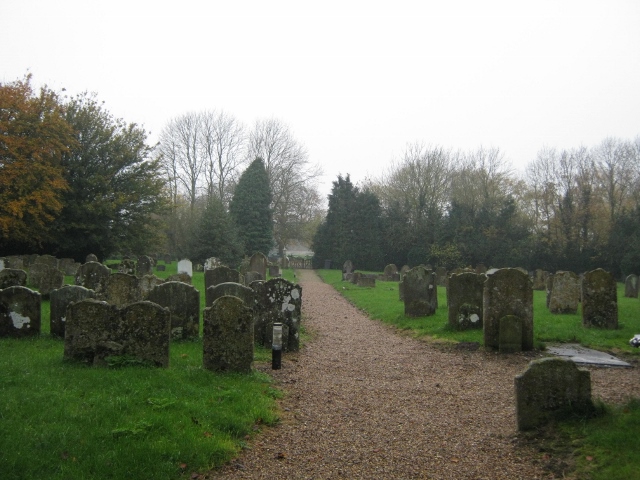
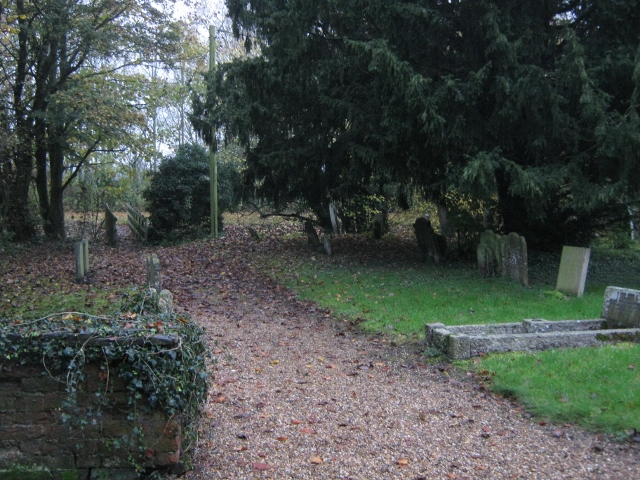
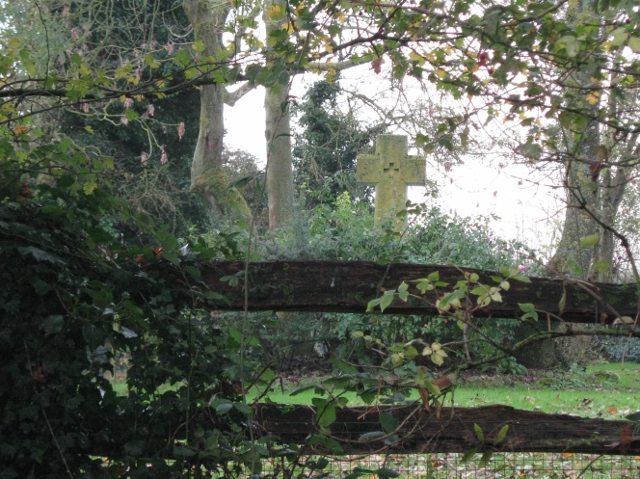
002Churchyard in November (640x480)

I find this service uplifting and it is good to celebrate before we enter Advent next Sunday, which is a quiet time of meditation and preparation.

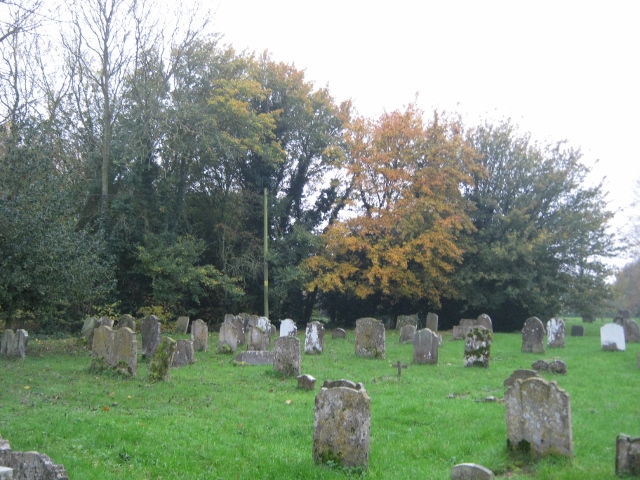
001Churchyard in November (640x480)

This Sunday – the last before Advent – used to be known as ‘Stir-up Sunday’ which comes from the Collect prayer for the 25th Sunday after Trinity.  ‘Stir up, we beseech thee, O Lord, the wills of thy faithful people; that they, plenteously bringing forth the fruit of good works, may of thee be plenteously rewarded’.  Many thought this was the time to be’ stirring up’ their Christmas puddings, though of course, the best time to prepare a good Christmas pudding is in October.  It needs to mature thoroughly!

003Churchyard in November (640x480)

R was reminded of the famous poem by Thomas Hood, written in 1844.

‘No sun – no moon!

No morn – no noon –

No dawn – no dusk – no proper time of day.

No warmth, no cheerfulness, no healthful ease,

No comfortable feel in any member –

No shade, no shine, no butterflies, no bees,

No fruits, no flowers, no leaves, no birds! –

November!’

006View across fields (640x480)

Share this:

  • Share on X (Opens in new window) X
  • Share on Reddit (Opens in new window) Reddit
  • Share on Pinterest (Opens in new window) Pinterest
  • Share on Facebook (Opens in new window) Facebook
  • Email a link to a friend (Opens in new window) Email
  • Share on Tumblr (Opens in new window) Tumblr
  • Print (Opens in new window) Print
  • Share on LinkedIn (Opens in new window) LinkedIn
Like Loading...

Sunday Walk

11 Tue Nov 2014

Posted by Clare Pooley in churches, domestic animals, plants, Rural Diary, trees, Uncategorized, walking

≈ 15 Comments

Tags

All Saints church, autumn leaf colour, barn owl, bryony berries, field views, guelder rose, hawthorn berries, Lowestoft, muddy lanes, Remembrance Day, spindle berries, St Margaret South Elmham, St Nicholas South Elmham church, stress, stress management, walking

Stressed!

Yesterday evening E and I went to Lowestoft to attend a stress management course.  Stress in all it manifestations was described, its causes and what keeps it going.  We were told how it affects our thoughts, actions and body and why it affects people in different ways.  We have been given a relaxation CD and a little homework to do for next week.  This is a rolling course; as soon as this one finishes it starts all over again with a different set of people.  There is a day-time course running at the same time as this in Great Yarmouth on a Thursday morning.  There are courses like this being run all over the country all the time.  The room we were in was full of people of different ages – a few had brought companions like me – but most of us there were sufferers from stress of one type or another.  Research done a few years ago states that in this country 4 out of 10 people suffer from stress.  This figure is already out of date – anxiety and stress are on the rise.

Lowestoft is affected, like most British seaside towns, by high unemployment especially in the winter.  The recent down-turn in the economy has made a bad situation worse.   Shops have had to shut and the buildings are still empty or ‘pound shops’ and pawn shops have replaced them.  However, it looks better cared-for than Great Yarmouth and a lot has been done recently to brighten it up and improve the road system.  As well as being a traditional seaside resort Lowestoft developed firstly as a fishing port, mainly herrings, and when that declined it became, with Great Yarmouth, the base of the oil and gas exploitation industry in the southern North Sea.  This has now declined too but Lowestoft has begun to develop as the centre of the renewable energy industry within Eastern England.   Parts of the North Town are very attractive and the old Scores are still there – the steep narrow lanes with steps up from the beach that were used by fishermen and smugglers.  The Scores are now the site of an annual race which raises money for charity.

Lowestoft is the most easterly point in Great Britain and is on the edge of the Broads which is a series of connected rivers and lakes and Britain’s largest protected wetland and 3rd largest inland waterway.  Some of the earliest evidence of settlement in Britain has been found in the town – flint tools dating back 700,000 years.  I will try to make a post about Lowestoft at a future date.

As sunset is now about 4 o’clock in the afternoon we drove there and back in the dark.  We parked on the sea front and, returning to the car at 7.30 pm we could hear the waves crashing on the beach – the tide must have been in.  I was glad to see on our drive back along the Front, with its rows of hotels, bed-and-breakfast establishments and restaurants, that the Beau Thai Restaurant is still open.  I’ve never been in there, but a place with such a terrible name deserves to survive!

Remembrance Day

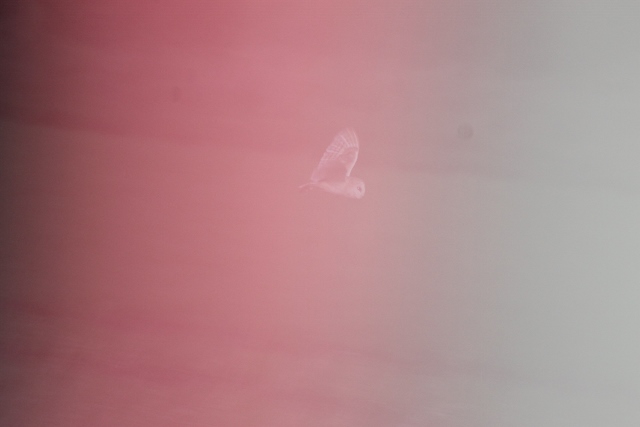
I looked out of a bedroom window this morning at dawn (about 7.00 am) and saw one of our local Barn Owls flying round the field behind the house.  It perched for a while on a fence post but the photograph I took of it there never came out.  However, I have included the following picture which I took at the same time, strange as it is, as a record of the owl’s presence.

001Barn owl (640x427)

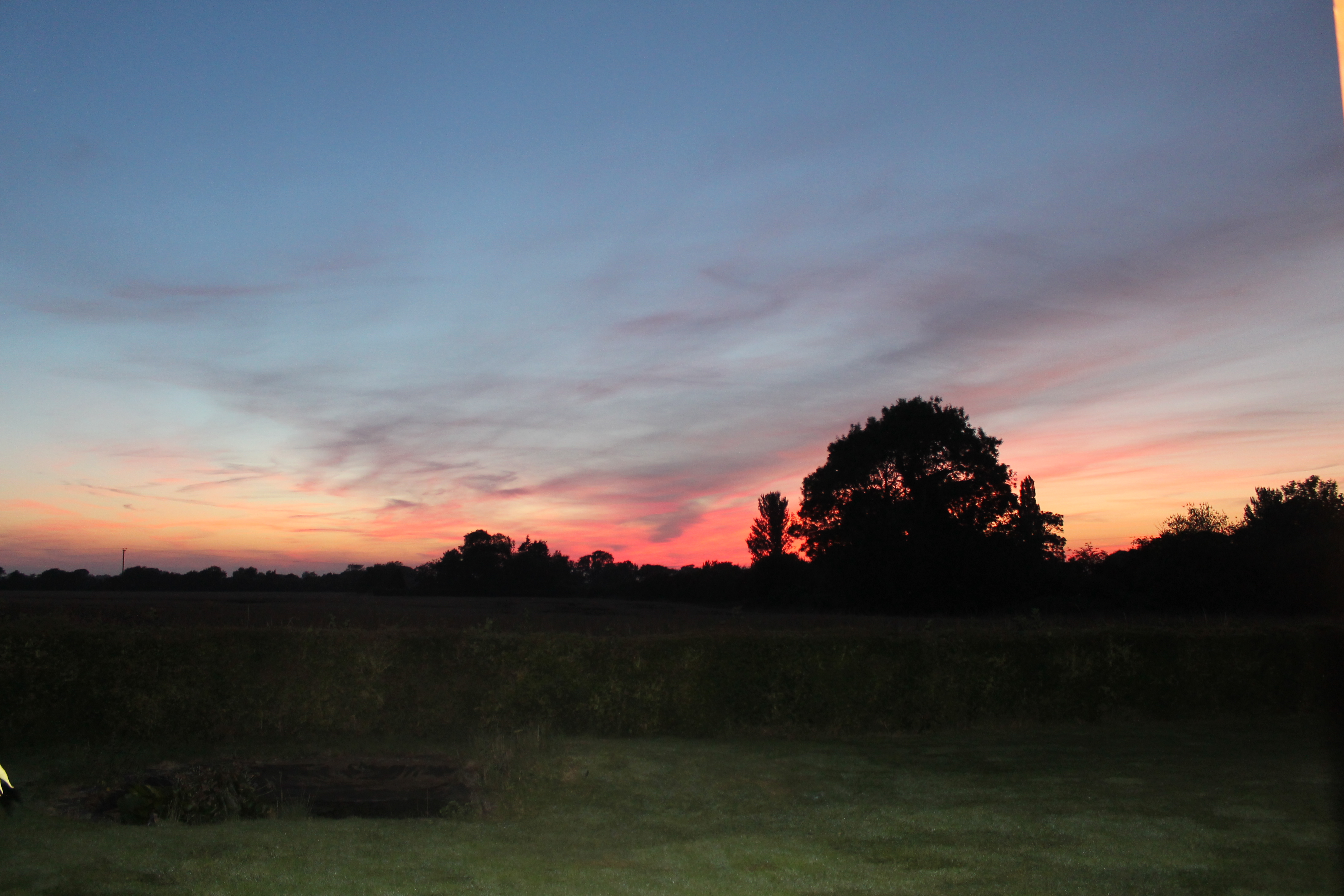
Why this happened I have no idea! I was looking westward and it was fairly bright and cloudy. No pink anywhere! The sun hadn’t risen yet and would be on the other side of the house anyway.

At 11.00 am this morning I listened on the radio to Big Ben striking the hour and I kept the two minutes silence, praying for all those who have lost their lives in war and for those who have been damaged and injured by war and also for their loved ones.  I am finding this more and more affecting as the years go by.

An Afternoon Walk

We have had so much rain recently that the garden and fields are sodden.  R and I were in need of a little exercise and fresh air on Sunday afternoon so we decided to do our circuit walk round the lanes, which were less muddy and wet than the footpaths.

007View to All Saints (640x480)

View from the lane across the field to All Saints church, just visible sticking out of the group of trees in the distance.

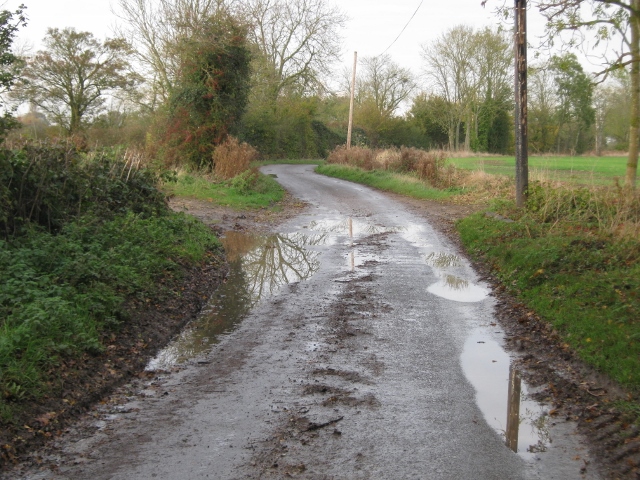
008Muddy lane (640x480)

Our lane is fairly muddy as you can see!

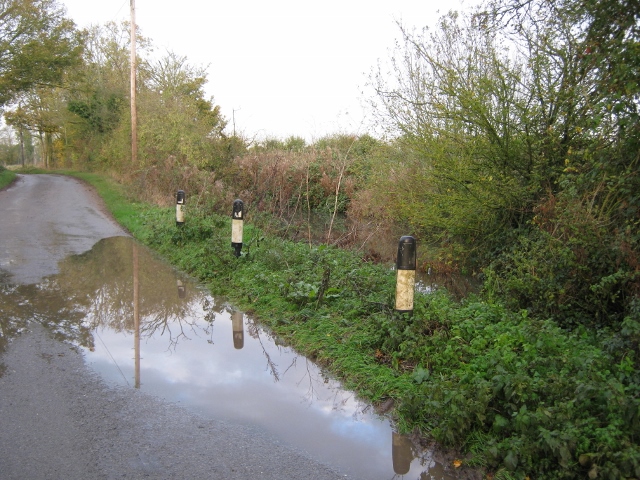
009Muddy lane with pond (640x480)

There is a natural pond full of fish just to the right of these bollards. It is so full that it is close to overflowing onto the road.

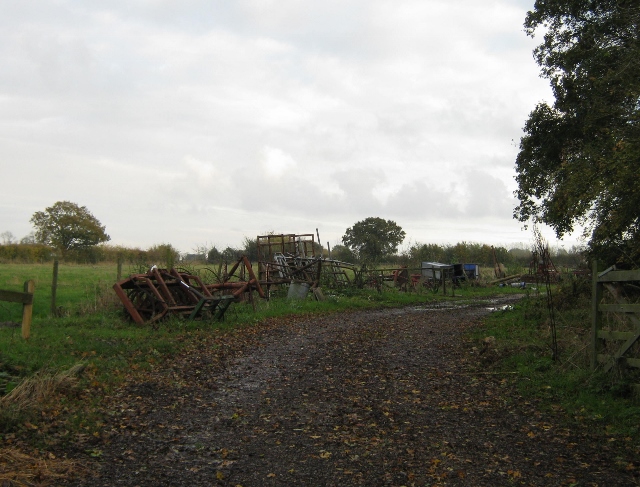
010Collection of old metal (640x487)

Farmers round here cannot bear to get rid of old implements, tools and scrap metal. I think it gives them a sense of pride to survey this old stuff.  ‘It may come in handy some day! It’s worth a lot of money, scrap metal is!’

011Site of St Nicholas church (640x479)

St Nicholas church was demolished many hundreds of years ago. This is the site where it once stood – the cross is in a garden.

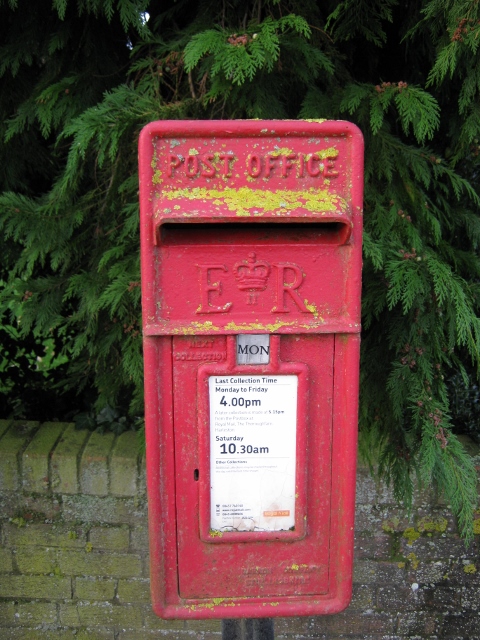
012Lichen covered post box (480x640)

This is our nearest post-box. The lime-green lichen is happy to grow on it.

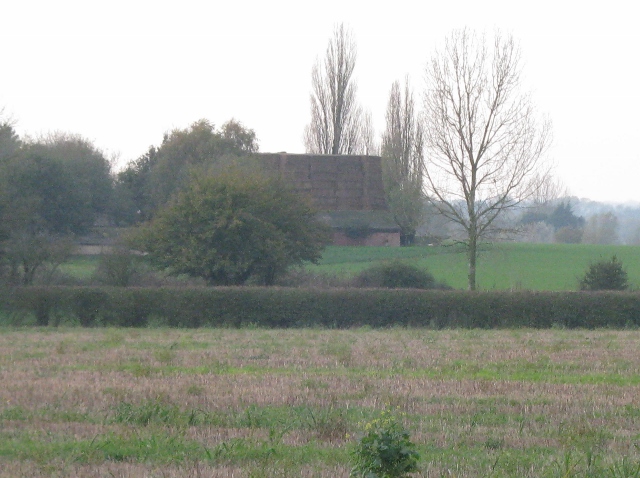
014Mountain of straw bales (640x478)

Just beyond the low pink barn in the distance is the largest tower of straw bales I have seen so far this year. Not a good picture I’m afraid – the light was already fading.

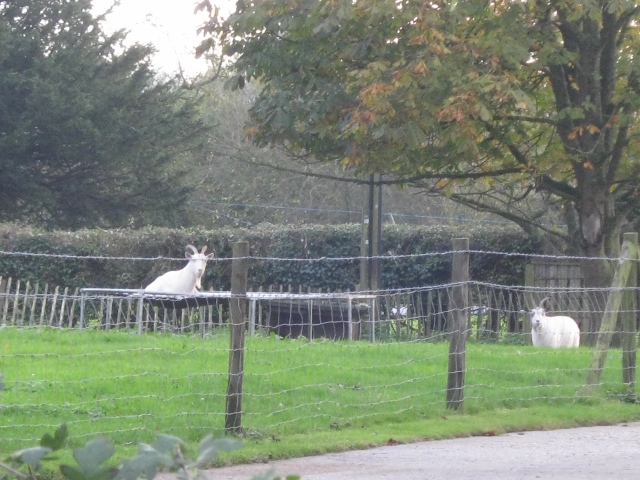
015Goats (640x480)

The goat on the left is keeping itself dry by lounging on a trampoline!

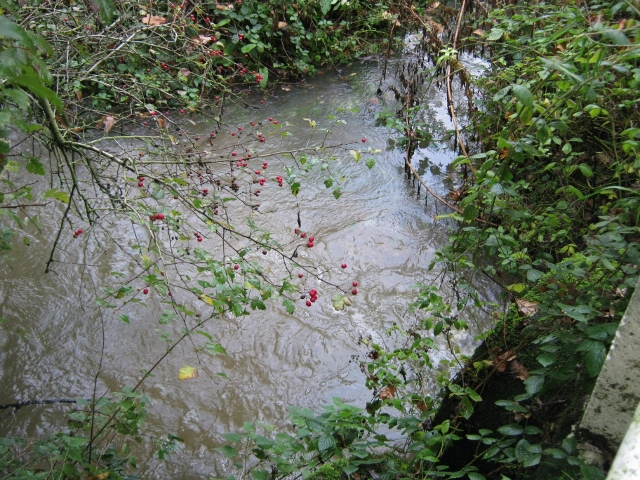
017Flowing water in ditch (640x480)

Water flowing fast in this ditch.

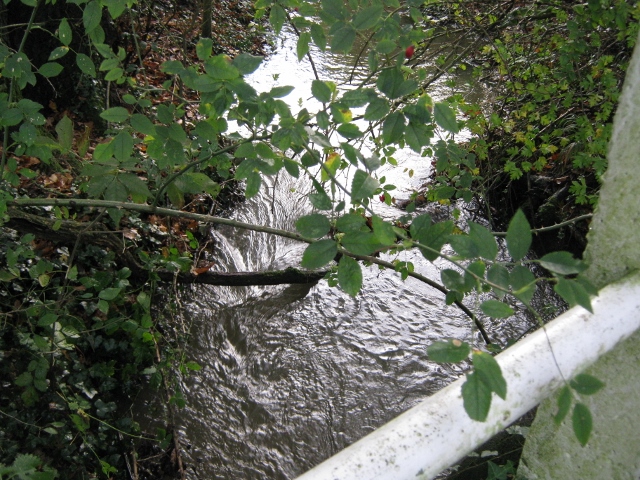
019Flowing water (640x480)

This is the other side of the bridge.

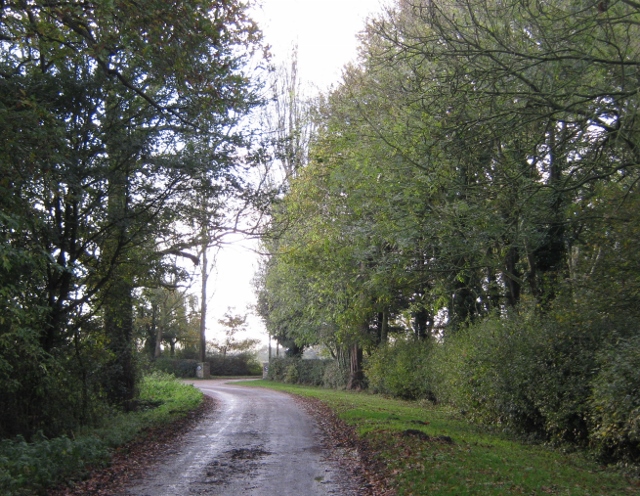
020Green lane (640x496)

There is still a lot of green about. Many of the leaves have dropped from the trees while still green.

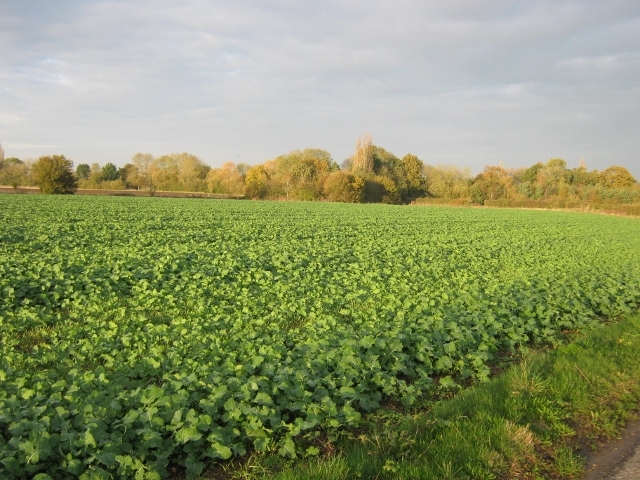
021Field of Rape (640x480)

This is a field of oil-seed rape which is growing very well in our mild, wet autumn. Only a few weeks ago it seems, I was posting photographs of rolls of straw on these fields after the wheat harvest.

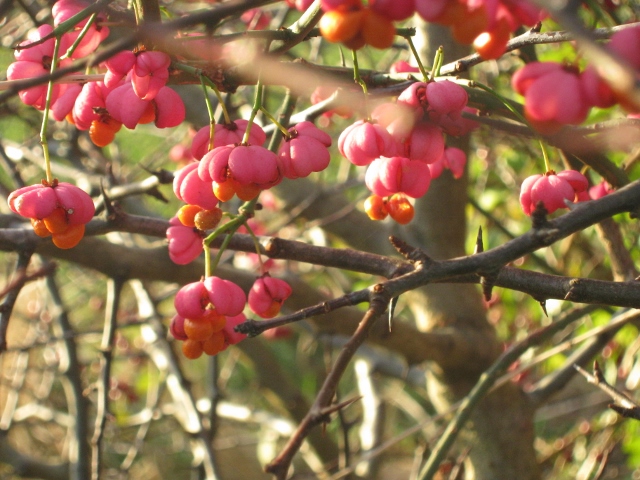
023Spindle berries (640x480)

These are beautiful spindle berries.  Only nature could make orange seeds emerge from shocking pink seed cases!

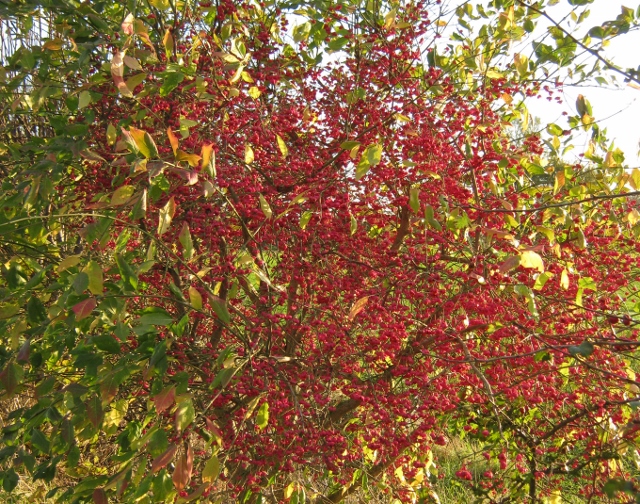
024Spindle berries (640x504)

This is a spindle bush in the hedge. It was glowing in the light of the setting sun.

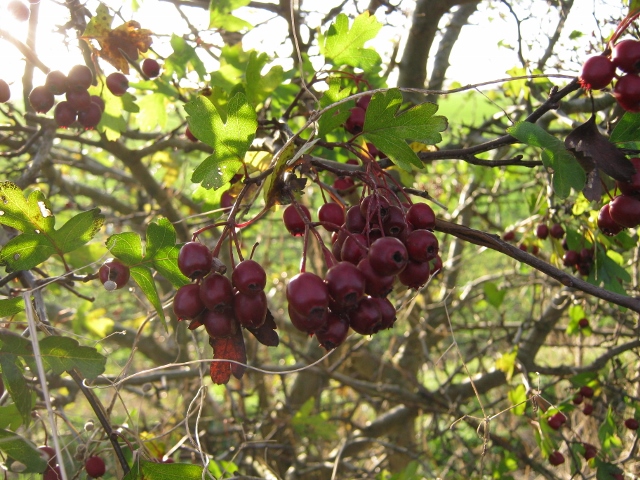
025Haws (640x480)

These are gorgeous dark-red haws from a hawthorn bush in the hedge.

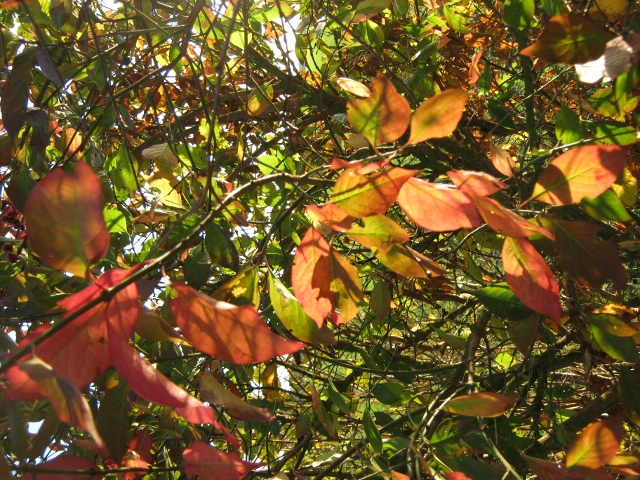
026Autumn leaves (640x480)

Some leaves are beginning to show some colour.

030Sugar Maple leaves (640x480)

These leaves caught my eye. I think this is a Sugar Maple – not a native tree.

031View across fields (640x480)

Another view across the fields.

034Guelder Rose leaves (2) (480x640)

These are Guelder Rose leaves (Viburnum opulus)….

042Guelder rose with berry drupes (640x480)

…and this is another Guelder Rose with mainly green leaves and also bunches of berries or ‘drupes’.

036Dead oak (480x640)

A dead oak tree. I am pleased that landowners are not in as much of a hurry as they used to be to remove dead wood from fields and hedgerows. A dead tree supports more life than a living one.

038Bryony berries (640x480)

These poisonous bryony berries are like shiny beads.

037Bryony berries (480x640)

They are everywhere to be seen now the leaves are disappearing from the hedges.

044Path through churchyard (640x480)

The path through St Margaret’s churchyard is an attractive one….

045Sheep (640x486)

…especially as one can see these sheep from there.

047Village hall entrance (640x480)

I thought the entrance to the car park outside the village hall was looking inviting.

049View across fields (640x480)

I also liked this entrance to a field further along the lane.

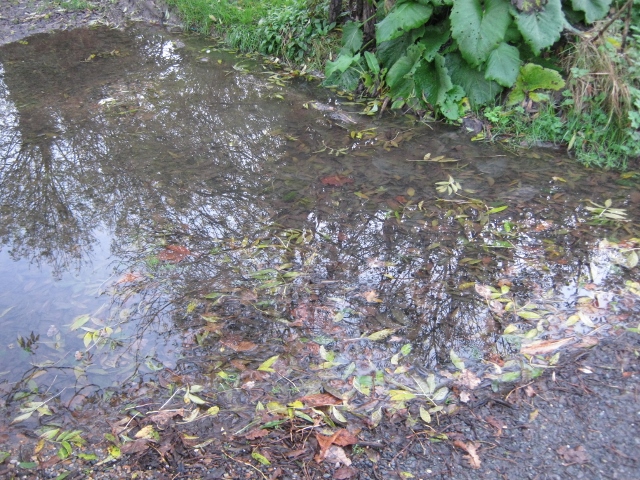
048Leafy puddle (640x480)

A leafy puddle,

050Toadstools (480x640)

some tiny yellow toadstools…

051Autumn leaves (640x480)

and some more autumn shades and our walk was over.


Share this:

  • Share on X (Opens in new window) X
  • Share on Reddit (Opens in new window) Reddit
  • Share on Pinterest (Opens in new window) Pinterest
  • Share on Facebook (Opens in new window) Facebook
  • Email a link to a friend (Opens in new window) Email
  • Share on Tumblr (Opens in new window) Tumblr
  • Print (Opens in new window) Print
  • Share on LinkedIn (Opens in new window) LinkedIn
Like Loading...

Peak District Holiday 1st to 9th July. Day 4 Part 2

19 Sun Oct 2014

Posted by Clare Pooley in churches, Rural Diary, Uncategorized

≈ 19 Comments

Tags

ante-room, Bakewell, banqueting hall, chapel, courtyard, Earl's bedroom, fresco seccoes, gardens, great chamber, Haddon Hall, Jane Eyre film-set, kitchen, long gallery, Manners family, Medieval hall, parlour, Renaissance, state bedroom, Tudor hall, Vernon family

022Haddon Hall (640x480)

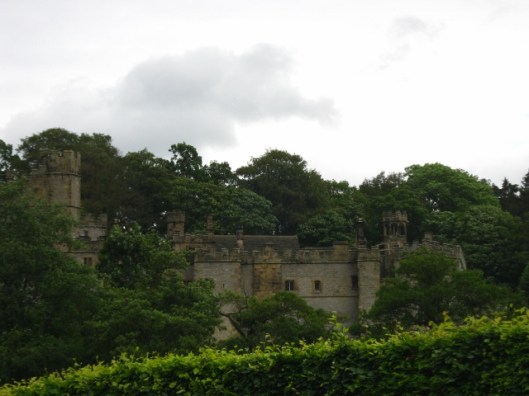
Haddon Hall

Haddon Hall is about two miles from Bakewell and we were visiting it for the second time.  It is a fortified manor house with Medieval and Tudor architecture and is quite special in that the last building and improvements made to it were done at the end of the 16th century.  The family moved to Belvoir Castle (pronounced ‘beaver’) in Grantham, Leicestershire in 1703, the main home of the Manners family, and left Haddon Hall empty for 200 years.  The 9th Duke and Duchess of Rutland decided at the start of the 20th century to restore the Hall and this work is continuing to this day.  It is now the home of Lord Edward Manners who is the younger brother of the current Duke of Rutland.  He lives in a part of the Hall which is not open to the public.
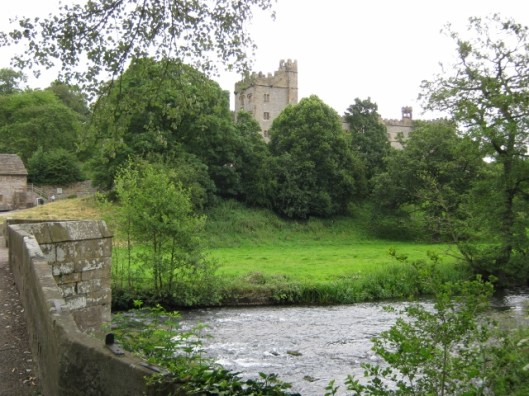
025H H from bridge over R Wye (640x480)

Haddon Hall from the bridge over the R. Wye
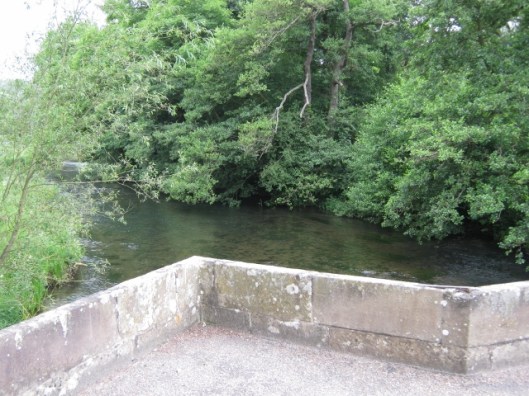
026Parapet passing place on bridge (640x480)

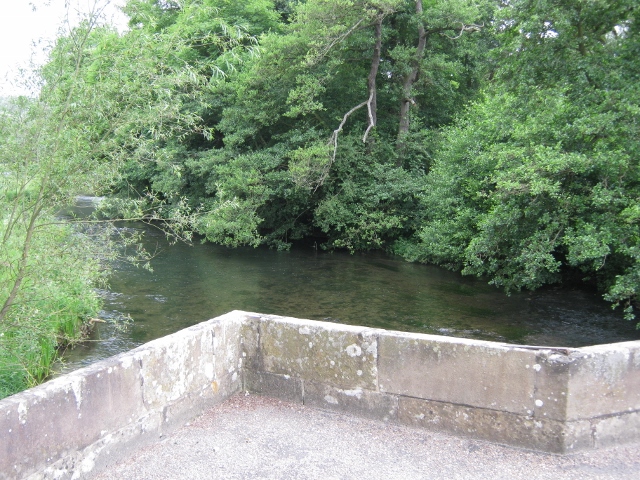
A view of the R. Wye from the bridge. These little triangular areas at the side of the bridge are safe places to stand when there is traffic on the bridge. If you look at Bakewell Bridge in my previous post you’ll see the same thing there.

The Hall has been used many times by film companies so some of you will have seen it already.  A couple of the most famous films in which it is featured are ‘Jane Eyre’ with Mia Wasikowska and Michael Fassbender (2011) and Franco Zefferelli’s version of ‘Jane Eyre’ with Charlotte Gainsbourg and William Hurt (1994).  It had a cameo role in ‘Pride and Prejudice’ with Keira Knightley (2004) and also ‘Elizabeth’ with Cate Blanchett (1998).  The BBC’s most recent version of ‘Jane Eyre’ with Ruth Wilson and Toby Stephens (2006) was also filmed here.
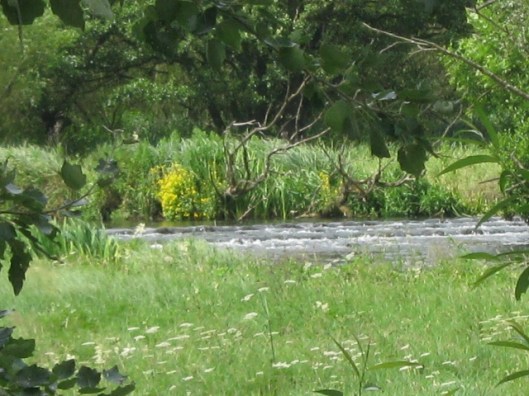
128R Wye (640x480)

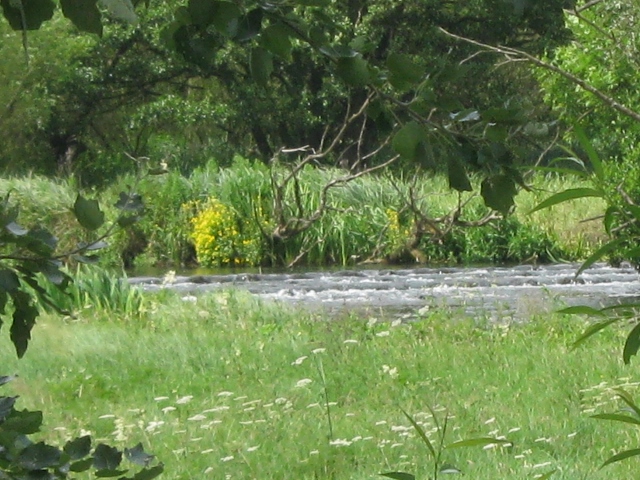
The River Wye

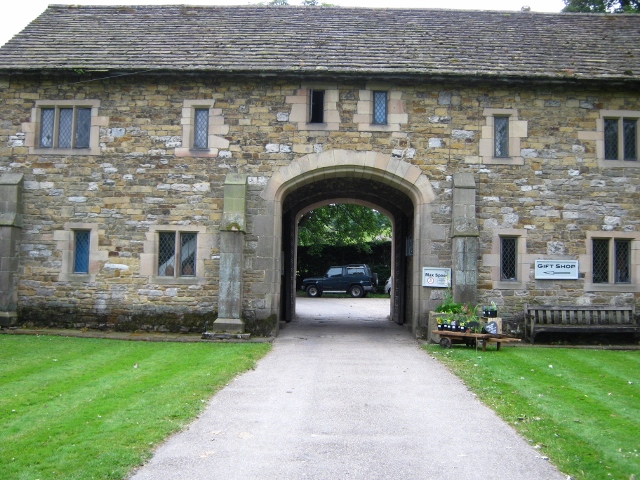
023Gate house (640x480)

Looking back at the Gate House through which we had just passed
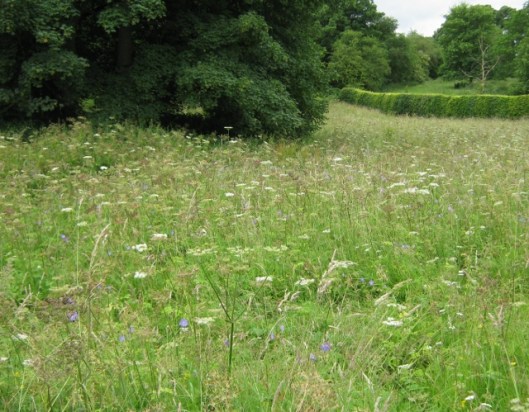
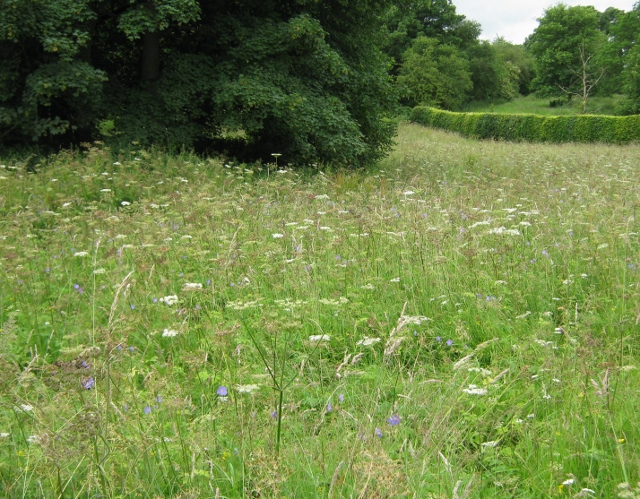
024Wildflower meadow (640x499)

A wildflower meadow on the approach to the Hall

Topiary in the garden next to the old stables
More topiary

These topiary yew trees are clipped into the shapes of a boar’s head and a peacock, the arms of the Vernon and Manners families to whom the Hall still belongs.  The Hall passed to the Manners family in the 16th century as the heir to the estate, Dorothy Vernon, had married Sir John Manners.  There is a story that Dorothy and John eloped in 1563 which may be true but Sir John Manners came of a rich and noble local family and I cannot think that Dorothy’s father would have objected to him.
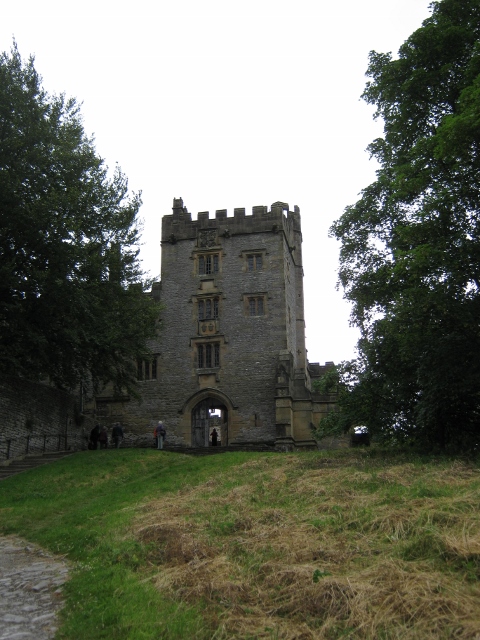
027NW tower (480x640)

The North-West Tower

The path ascends to the North-West Tower which became the main entrance to the hall in the 16th century.  Going through the entrance we found ourselves in the Lower Courtyard.

Looking back to the entrance through the NW Tower
Rooms off the Courtyard
Octagonal bell tower next to the chapel

Stairs up to the oldest part of the Hall – King John’s Wall
Rooms off the Courtyard
Entrance to the Hall from the Courtyard

Richard de Vernon, in 1193, was granted a licence to build a wall of not more than 12 feet in height to enclose the Chapel, the Watch Tower and some timber buildings.  12 foot walls were only sufficient to deter marauders and would have proved no barrier to a full-blown attack.  The man granting the licence was John, Count of Mortain who was to become King John four years later on the death of his brother, Richard I ‘the Lionheart’.  This wall is still standing and has been incorporated into the Hall buildings.

17th century doorway
Gargoyle and lead drain pipes

Gargoyle and lead drain pipes
Battlements were only for show and added in the 14th century

The Courtyard slopes upwards, from the entrance under the tower, to the main buildings.  The Hall evolved over a few hundred years with little or no planning but as it is all built using the same type of material, grey limestone and yellow gritstone, it somehow looks just right.
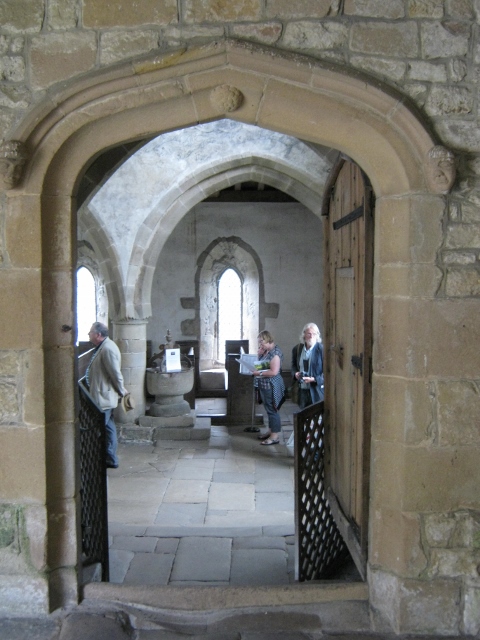
029Entrance to chapel (480x640)

Entrance to the Chapel

The Chapel was one of the first parts of the Hall to be built.  It is dedicated to St Nicholas and is decorated inside with fresco seccoes depicting the life of St Nicholas and of St Anne.  There is a large image of St Christopher the patron saint of travellers and also a picture of three skeletons which were part of a larger painting illustrating a medieval Morality of earthly vanity.

Fresco secco
Fresco secco

St Christopher
Three Skeletons

The frescoes were probably commissioned in the early 15th century when other changes were being carried out.  Fresco seccoes do not last as long as buon frescoes as they are painted onto dry plaster not wet.  They were also damaged during the Reformation.

Stained glass window

As I mentioned, the Hall was left empty for 200 years and in 1828 the faces of the saints in the glass were stolen.  A reward of one hundred guineas was offered for their return but to no avail.

The chapel is filled with wonderful things – a musician’s gallery, lots of box-pews, a beautiful marble effigy of the 9 year old Lord Haddon who died in 1894, an alabaster reredos.  I found it difficult to photograph the chapel as a whole with my small camera as it was so full of furniture.   There were also a number of people like us wandering about and admiring and they always seemed to be standing in the wrong place!

Alabaster reredos
Stairs to musician’s gallery

Six sided pulpit with box pew in front
Box pew with effigy to Lord Haddon in front

We then crossed the Courtyard and entered through the porch to the Banqueting Hall.
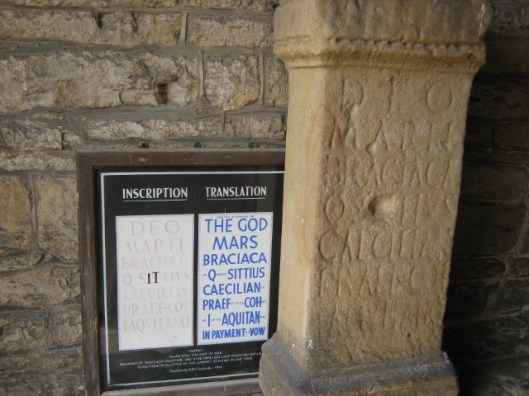
125Roman altar (640x480)

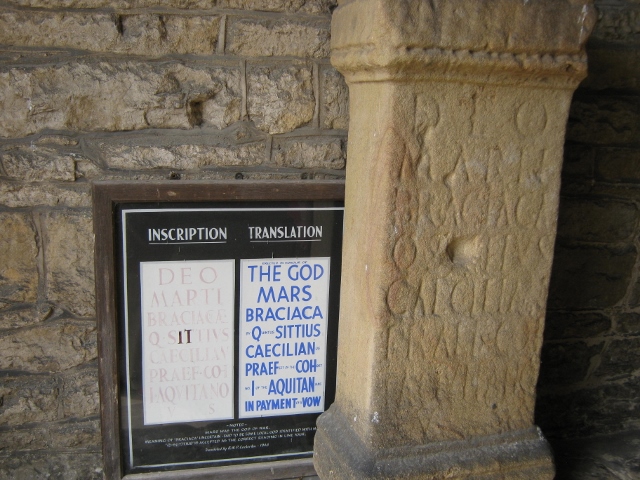
A Roman altar found in the fields of the estate is displayed just inside the porch.
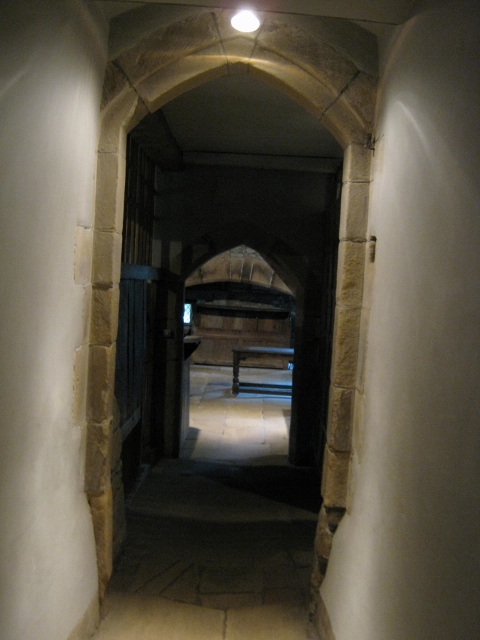
060Passage (480x640)

Passageway to kitchen

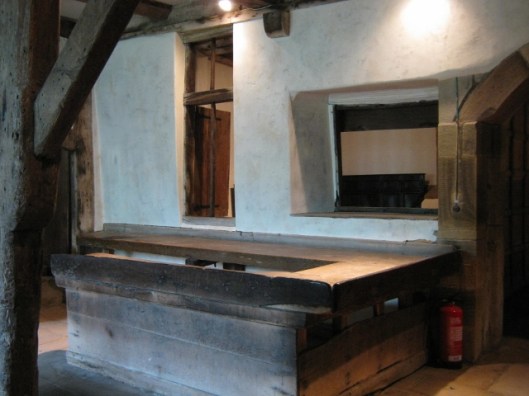
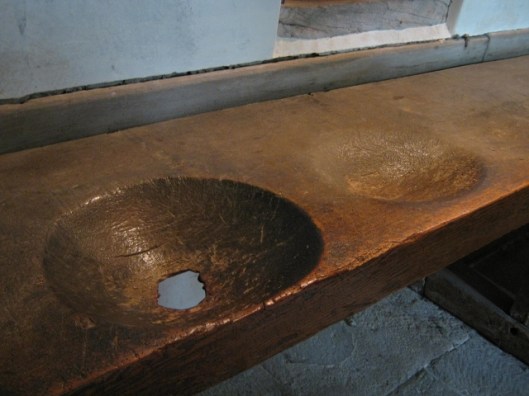
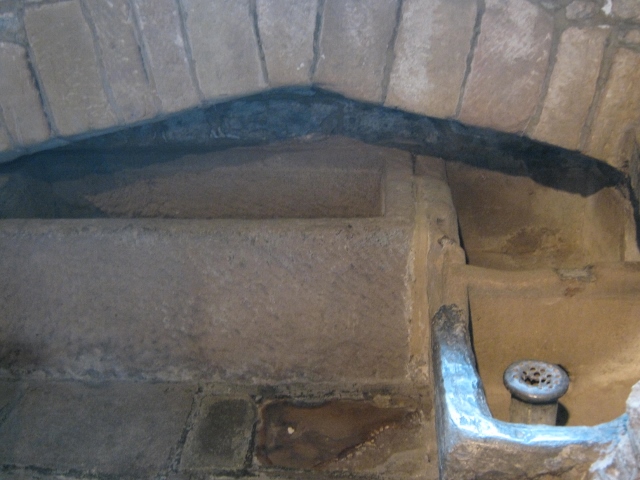
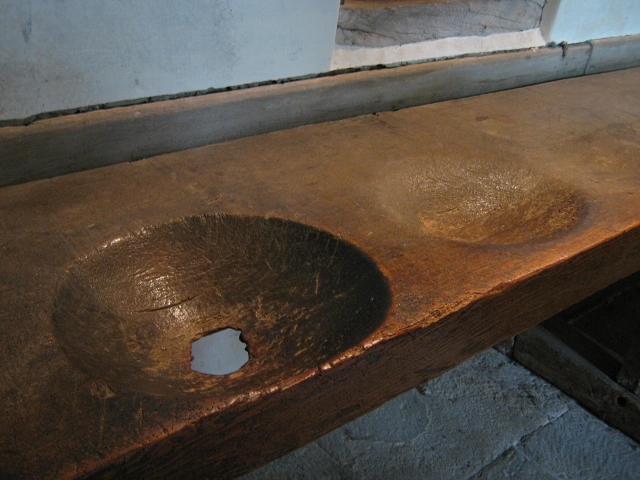
The Kitchen is a fine example of a Tudor kitchen.  Originally it was a separate building to reduce the risk of fire spreading to the main house and the passageway was added much later.  The kitchen is in fact a set of rooms all with different uses.  The main room has a fire heated water boiler and a stone trough fed by the one and only water system to the Hall.   The trough is divided into three to hold water of varying degrees of cleanliness.
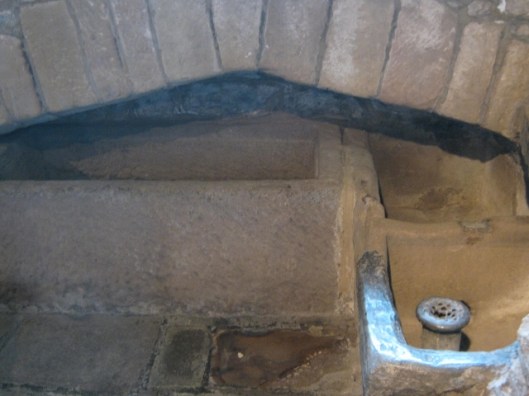
064Stone trough (640x480)

Stone trough

074Fire place (640x480)

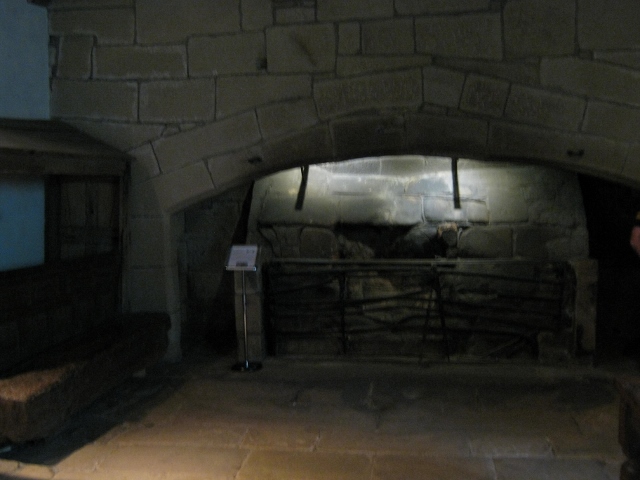
Kitchen fireplace with a log box on the left and in front of that is a wood block for chopping firewood
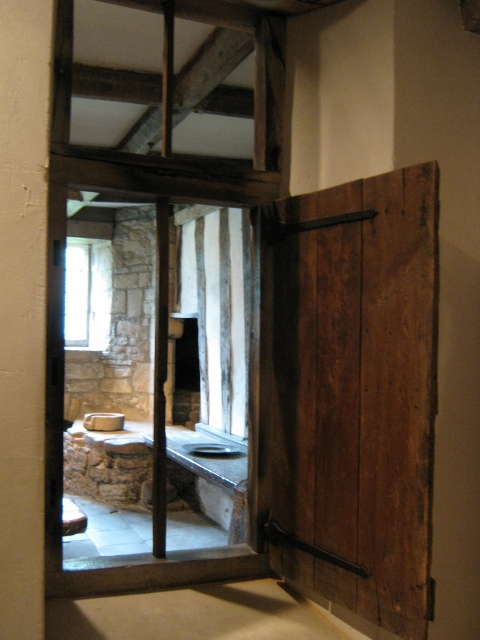
062Kitchen (480x640)

Looking through to the bakery from the kitchen
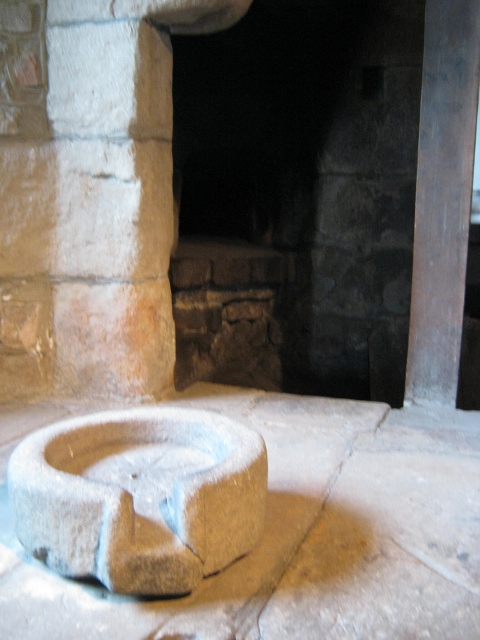
063Bakery (480x640)

Bakery

070Paddles (480x640)

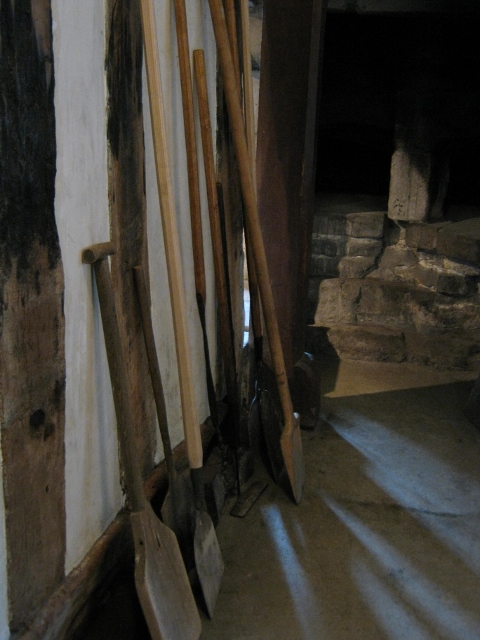
A collection of paddles used for putting bread etc into the ovens
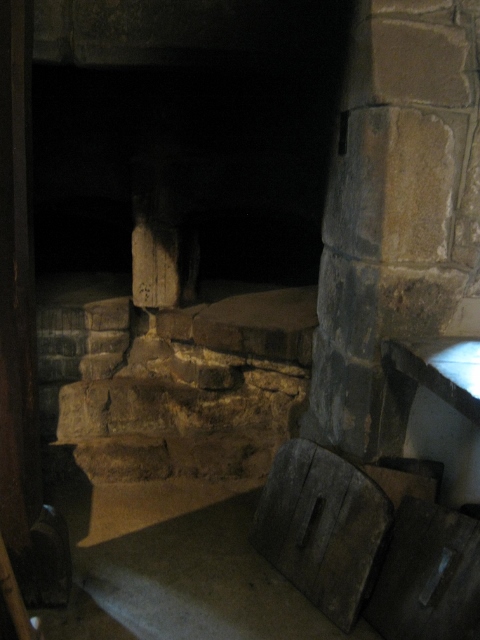
071Pastry ovens (480x640)

Pastry ovens

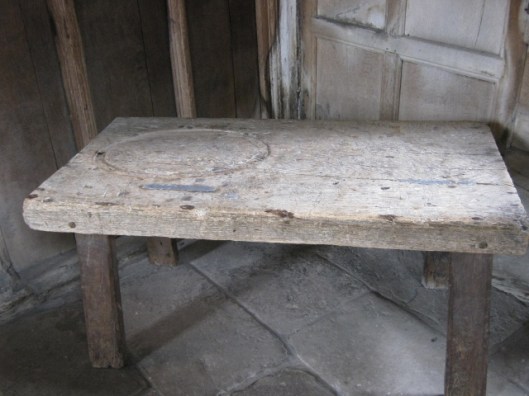
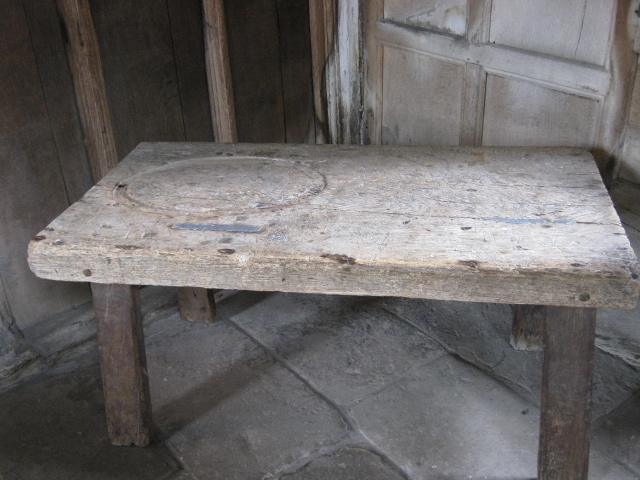
065Carving table (640x480)

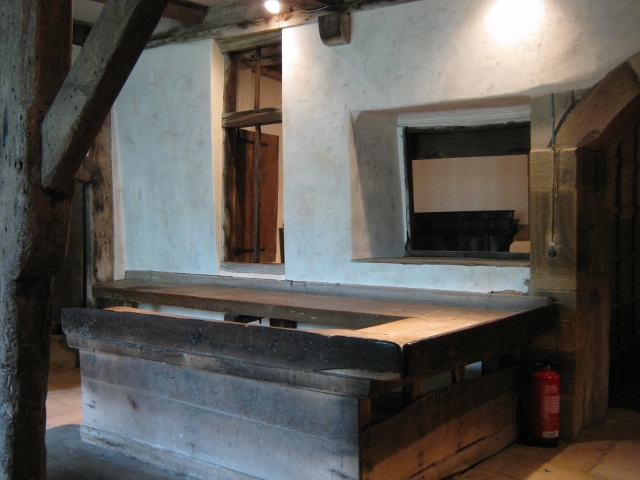
Carving table

067Food preparation table (640x480)

Food preparation table

076Carving table (640x480)

Another carving table

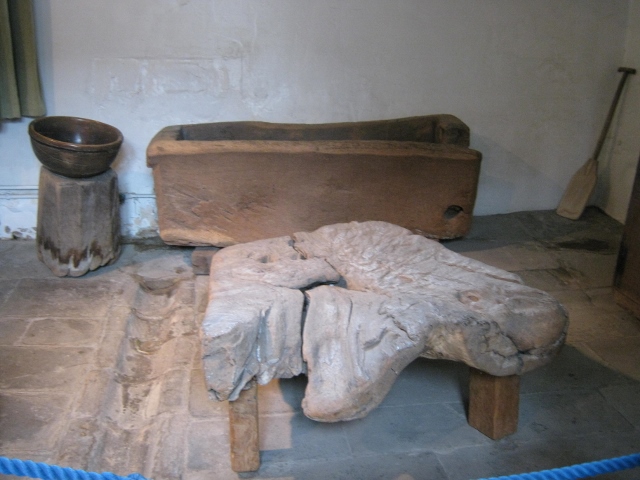
069Butchery (640x480)

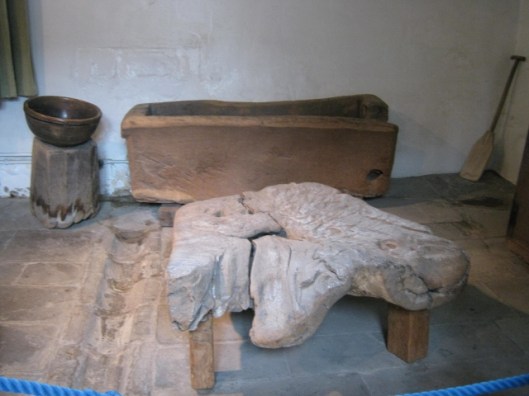
Butchery. The odd object in the foreground is a 15th century oak block on three short legs that was used for jointing meat. The object behind is a salting trough.
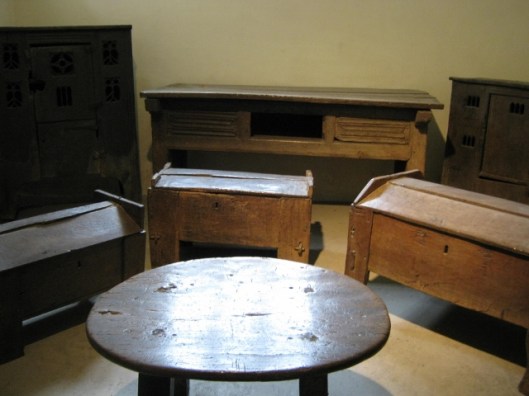
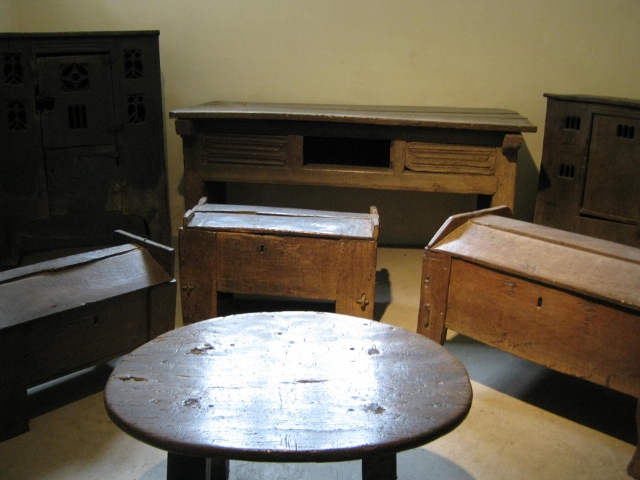
068Dole cupboards (640x480)

A collection of ‘dole’ cupboards and hutches or meal arks are in the original Milk Larder

‘Dole’ cupboards were put outside houses like Haddon Hall for passing traders or Estate workers and filled with food and left-overs from the kitchen.  Most ‘dole’ cupboards haven’t survived as they were exposed to the elements so these are very rare.  The ‘dole’ cupboards have ornate panels in their doors.  Hutches or meal arks were used for the storage of grain or bread.  These are the smaller chest-shaped boxes.  The table (centre back) is a 15th century oak side-table or buffet.
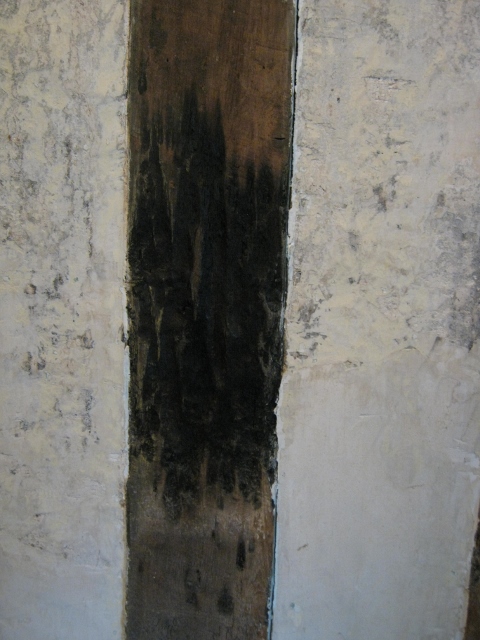
072Scorch marks (480x640)

Scorch marks on the timber of the wall show where candles were placed for illumination.
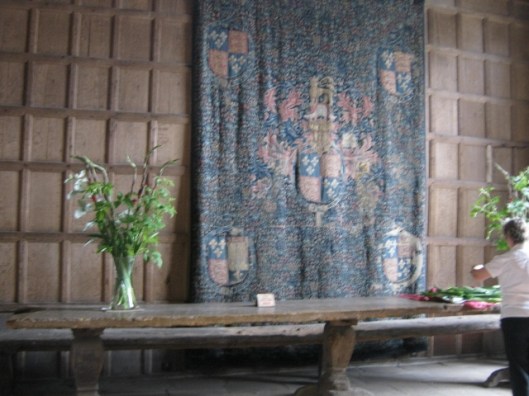
055High table bench & tapestry (640x480)

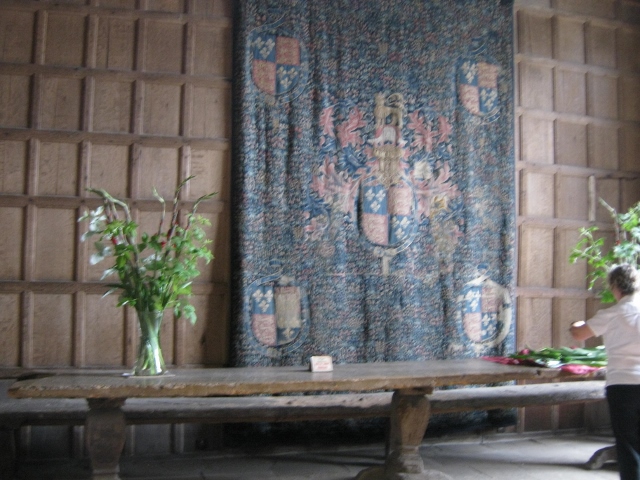
The high table and bench in the Banqueting Hall.

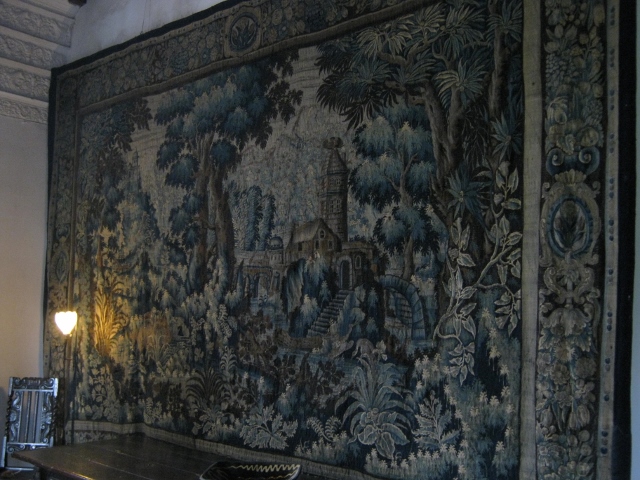
When the hall was built in the 14th century this room would have been the communal living space with a central hearth and vents in the roof to let the smoke out.  It was then known as the Great Hall.  By the beginning of the next century the family would have started to eat, sleep and spend leisure time in their private apartments so the Great Hall became a place for entertaining guests and was re-named the Banqueting Hall.  The walls are panelled which not only helped to insulate the room but was also a status symbol too.  The long table has a top made of two elm planks resting on three square pillars with splayed feet.  The bench is the same age as the table (c.1400) and is one plank on square legs.  The table top is not attached to the base which meant that it could be turned over and both sides used.  The bench and table are on a raised platform at one end of the room.  The tapestry behind the table is French and was made during King Edward IV’s reign (1461-1483).  It shows the Royal Arms of England and is supposed to have been presented to the Vernon family by King Henry VIII whose older brother Prince Arthur spent some time at Haddon Hall.
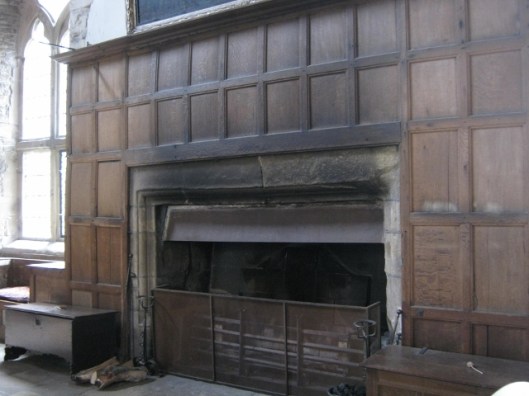
053Fireplace (640x480)

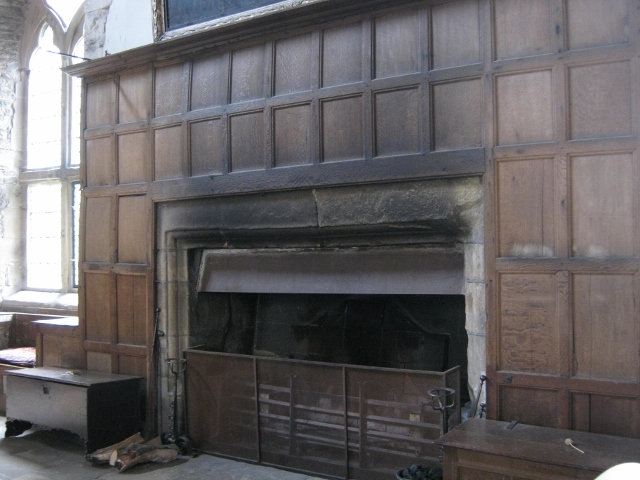
The fireplace. The chimney was added in the mid 15th century.

On entering the Hall you can smell wood smoke even when there is no fire.
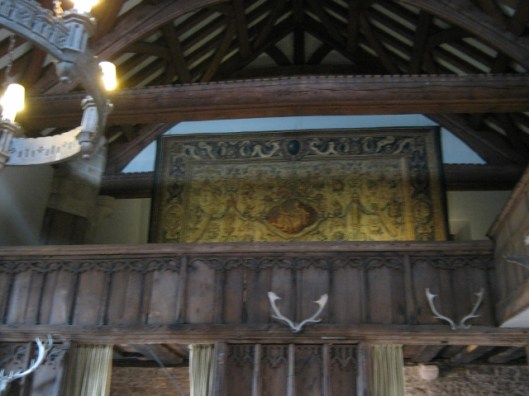
058Minstrel's gallery (640x480)

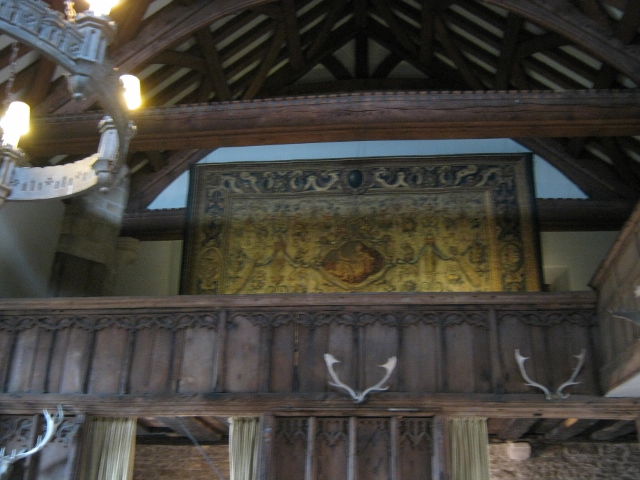
The Minstrel’s Gallery is opposite the High Table

The screen which can be seen at the bottom of the photo is 14th century and is a fine example of Gothic tracery.  Attached to the screen is an iron manacle and lock.  If a guest ‘did not drink fayre’ – either too little or too much – he was punished by having his wrist locked in the manacle and the rest of his drink poured down his sleeve.   The antlers are mid 17th century and the tapestry which hangs above the Minstrel’s Gallery was produced at the beginning of the 17th century.
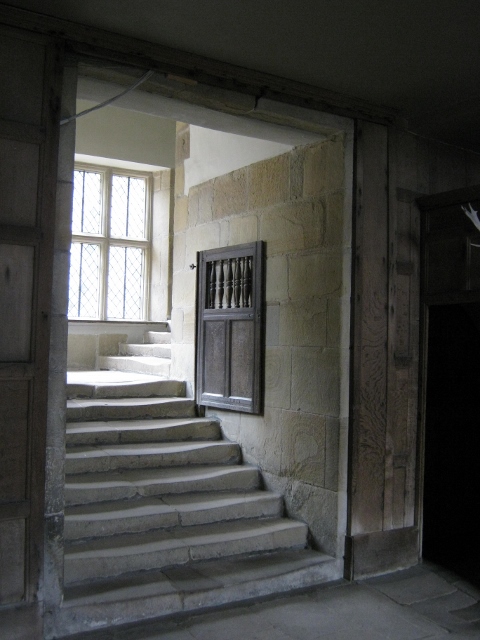
056Stairs (480x640)

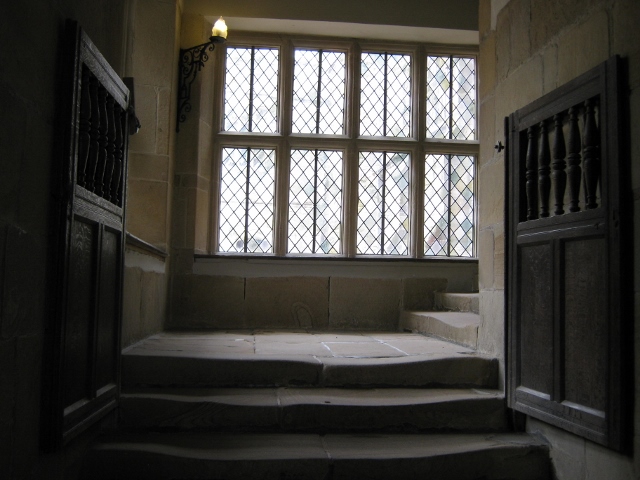
Steps to the upper floor

077Stairs (640x480)

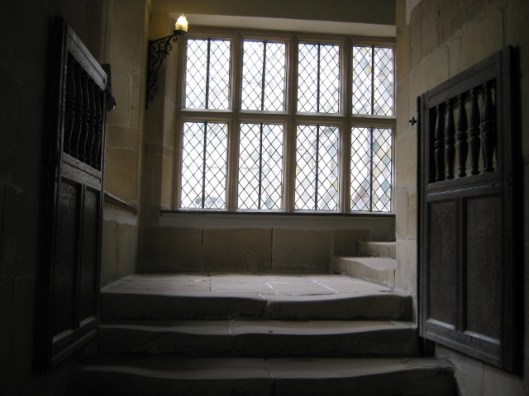
Steps showing the 17th century dog gates.

We then went through a door off the Banqueting Hall and entered the Parlour or Dining Room.  This was the room the family used as private quarters and it is still used as a dining room.
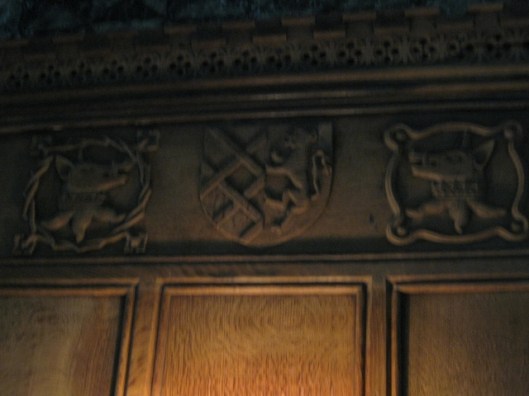
122Wood panelling (640x480)

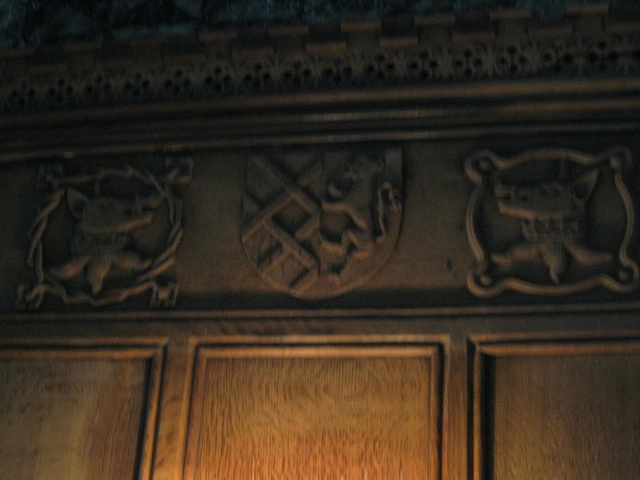
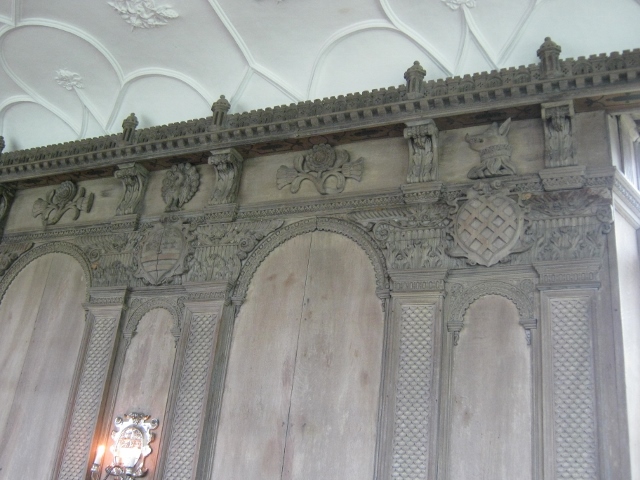
Carved oaken panelling. This is just a part of a frieze around the room showing the armorial shields of the Vernons and the families with whom they had intermarried.
117Carved figures (640x480)

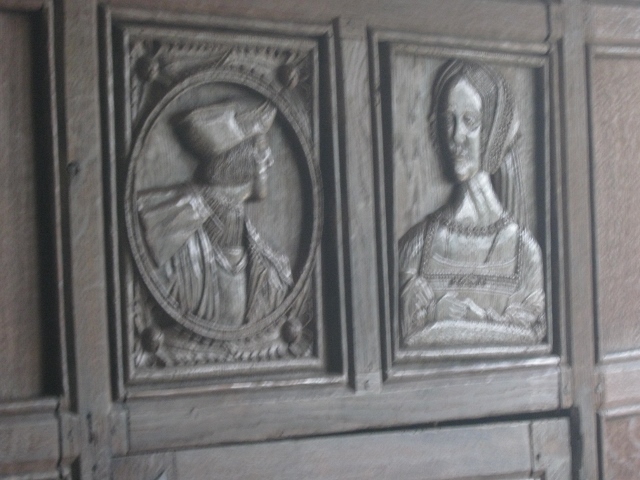
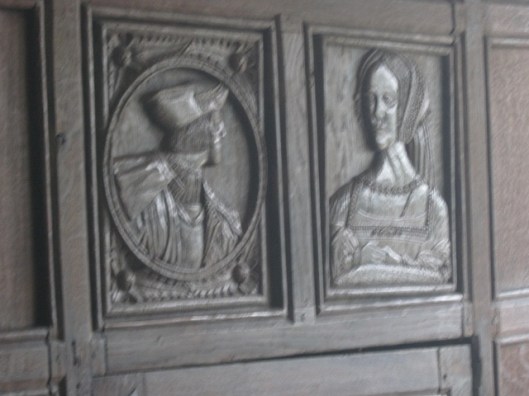
I apologise for the poor quality of this photo but I didn’t wish to leave it out. It is believed that these two figures are those of King Henry VII and his wife Queen Elizabeth of York
118Carving (640x480)

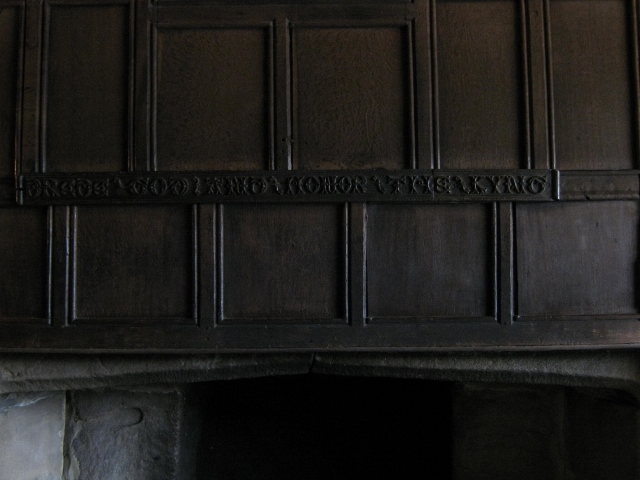
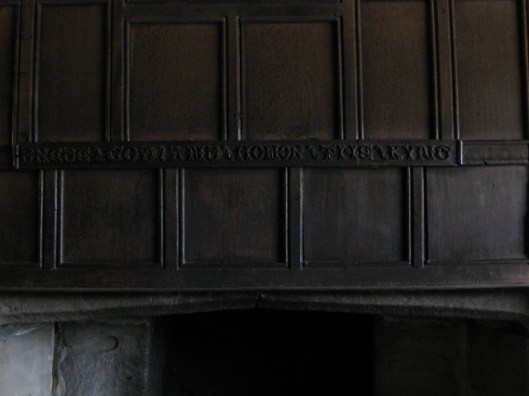
This carving over the fireplace says ‘Drede God and Honour the Kyng’. The text is based on Wycliffe’s translation of the Bible (c.1395) of 1 Peter 2 v.17.
119Window (640x480)

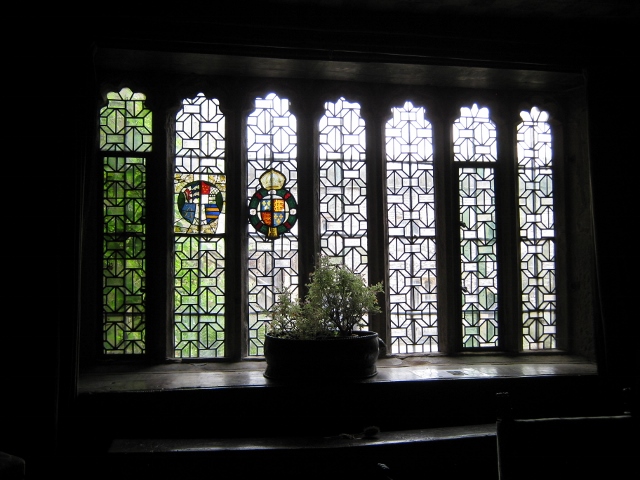
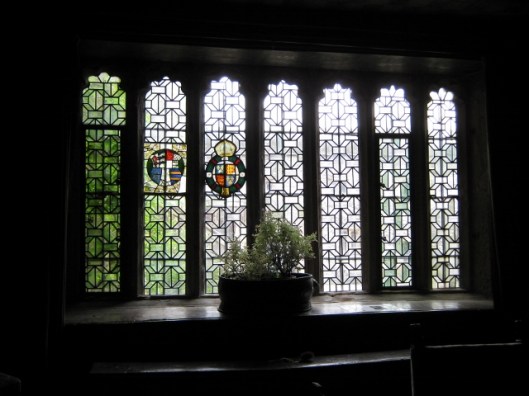
Attractive window in the Parlour

120Ceiling (640x480)

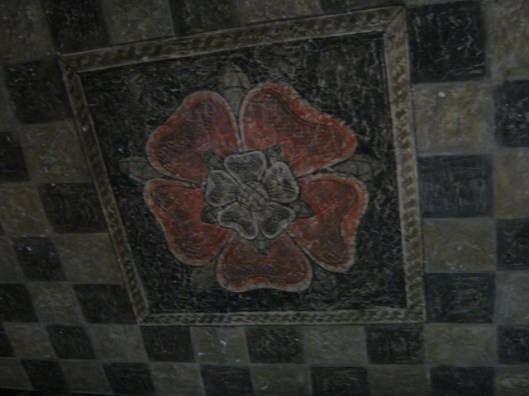
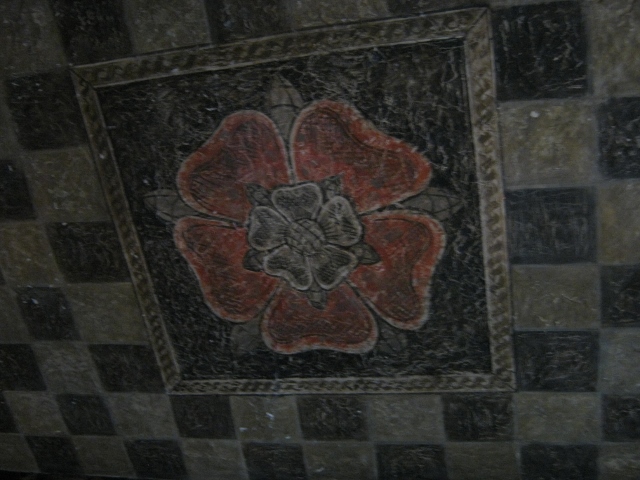
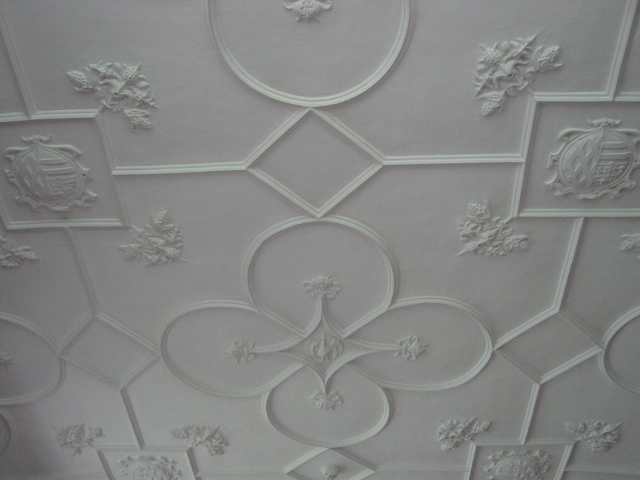
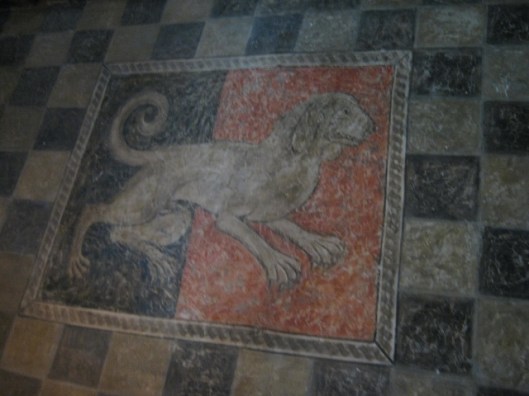
Plaster ceiling installed in the early 1500s. This is a Tudor rose.
121Ceiling (640x480)

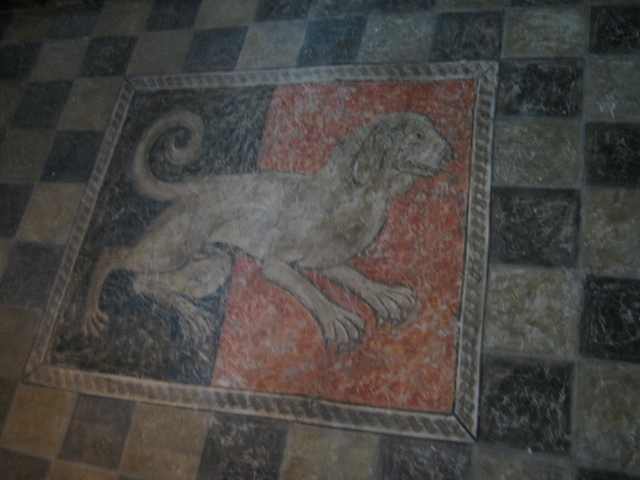
And this is a Talbot dog. Sir Henry Vernon (who installed the ceiling) married Anne Talbot daughter of the Earl of Shrewsbury

We then went up the stairs to the first floor and entered the Great Chamber.  This was re-roofed and remodelled at the same time as the Parlour below.
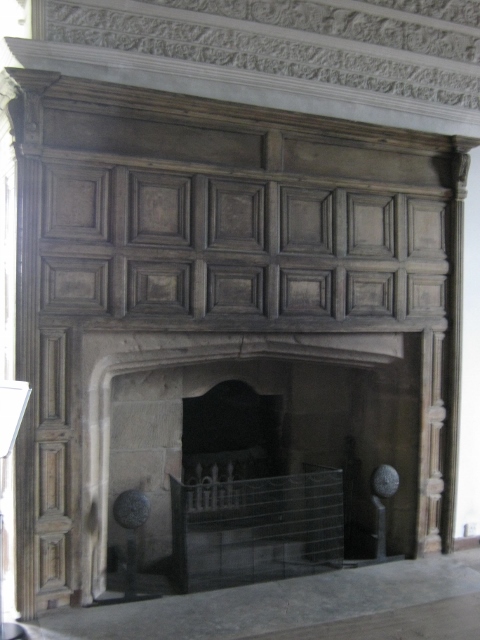
078Fireplace (480x640)

The fireplace. The 17th century oak panelling shows traces of gold and green paint. It must have been beautifully decorated when new.
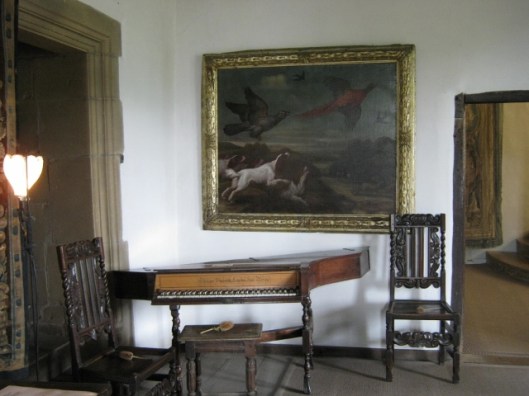
079Furniture (640x480)

Some of the furniture in the room

083Frieze (640x480)

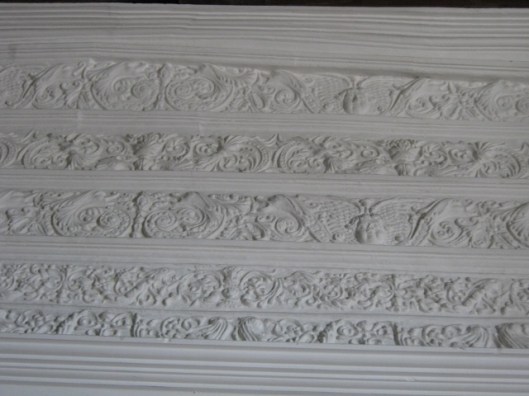
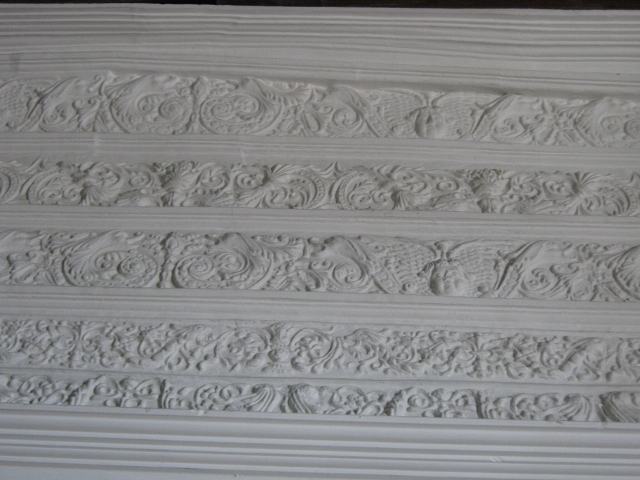
This plaster frieze around the room is beautiful and an early example of 17th century English Renaissance decoration
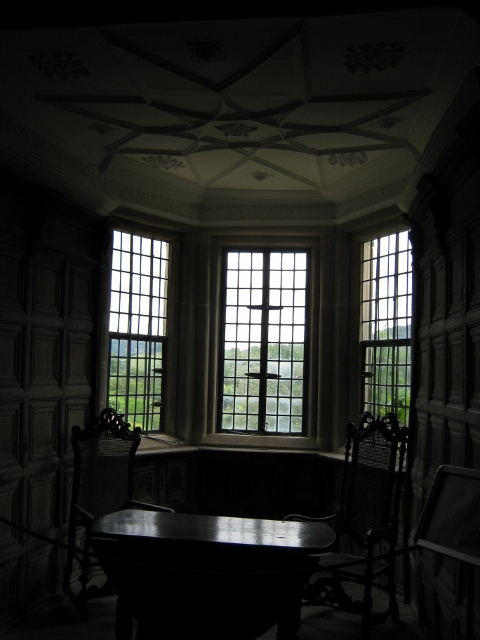
080Bay window (480x640)

The plaster ceiling in this oriel bay window is also of the same date and quality.
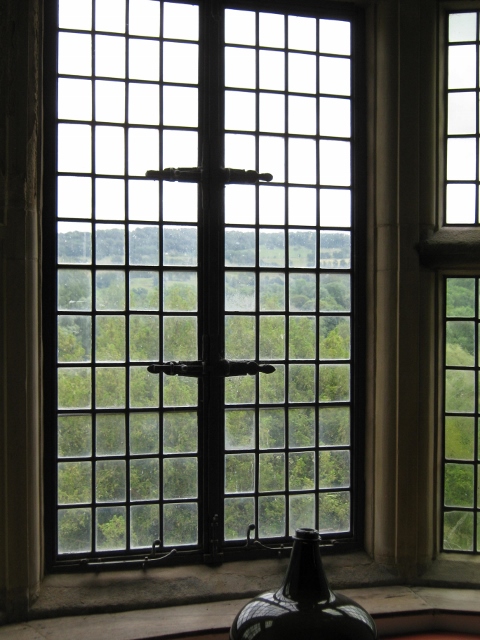
084Window (480x640)

Windows at the opposite end of the room. This room would have originally been the Solar – the private quarters of the family – and Solars were always well provided with windows to make the most of natural light
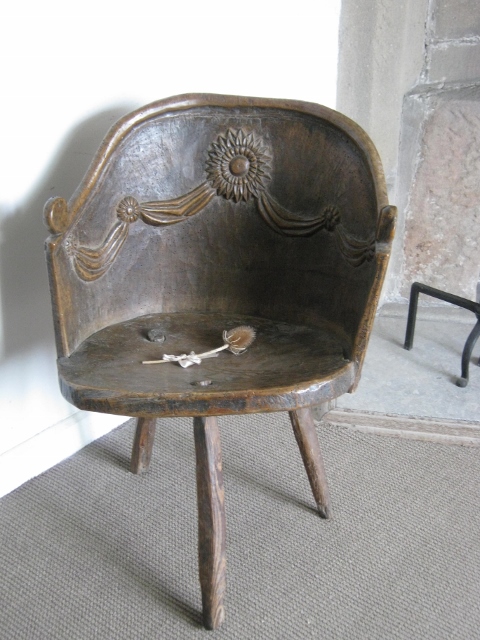
085Chair (480x640)

I loved this chair. The teasel is to stop people from sitting on it. I don’t think it would take the weight of many modern-day adults!
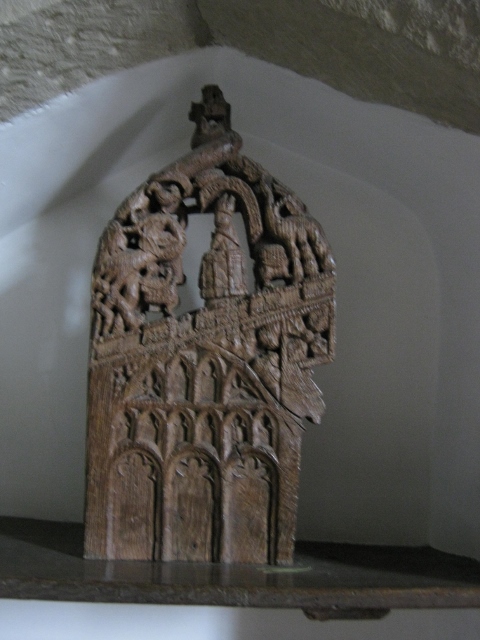
082Pew end (480x640)

This is a 14th century pew end that is displayed in the room. The carving is satirical and depicts the rapacity of the clergy!
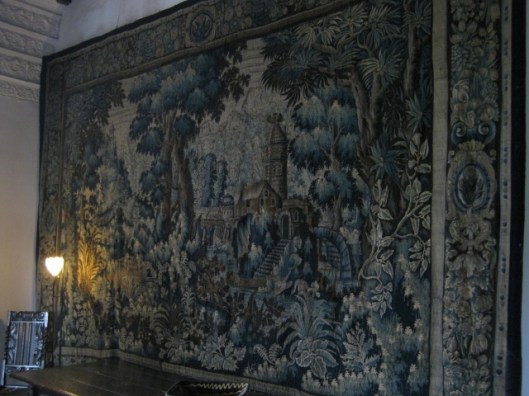
081Tapestry (640x480)

One of the tapestries that hang in the room. They were thought to be Flemish but are now thought to be French and woven in Paris sometime before 1650.

We passed through a small ante-chamber which was once used as a dressing room and entered the Earl’s Apartment.  This was originally two chambers and there are stairs leading to the Chapel below so maybe one of the rooms was used by the clergy.  There are two fireplaces in this room as well.  After the partition was removed it was used as a gallery at first and then when a larger gallery was built the room was used as a bedchamber.
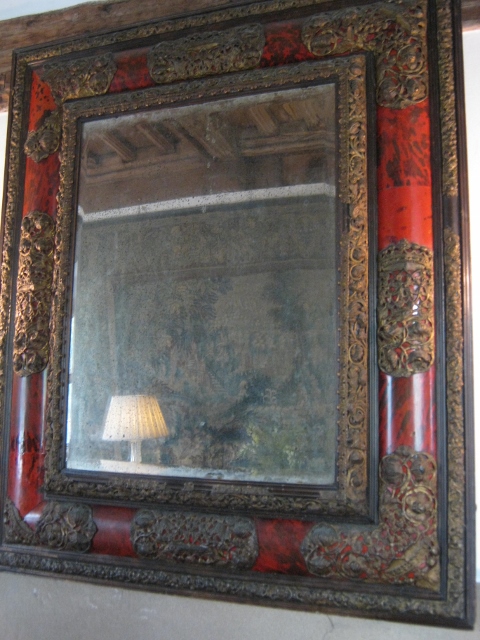
087Mirror (480x640)

A Charles II tortoiseshell looking-glass
086Signatures (640x480)

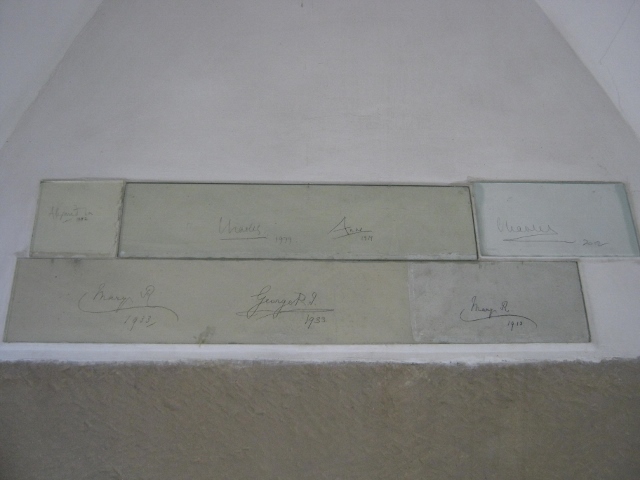
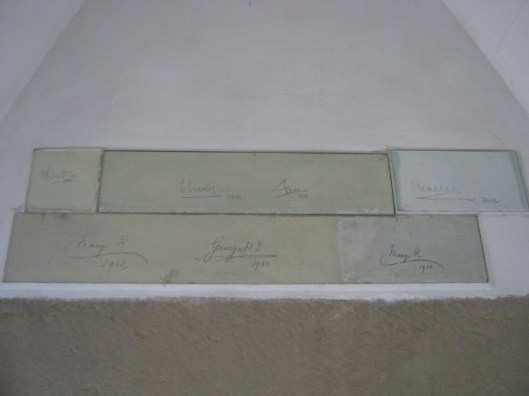
Above the smaller fireplace are signatures in the plaster of visiting members of the Royal Family.  Can you spot Prince Charles’, Princess Anne’s and George V’s signatures?
089Spinning chair (480x640)

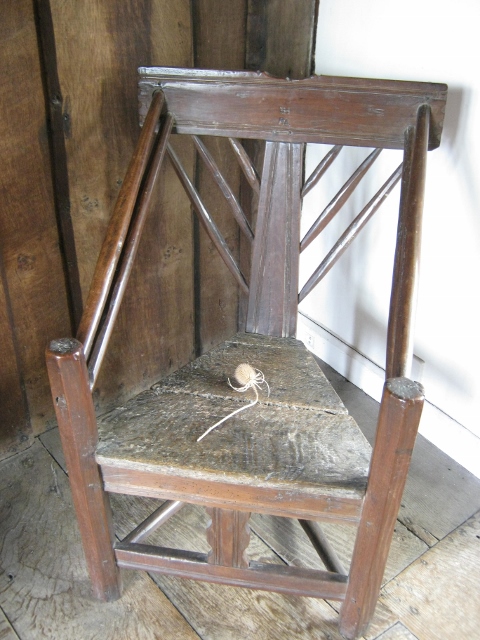
An English early 17th century spinning chair.
090Long gallery (480x640)

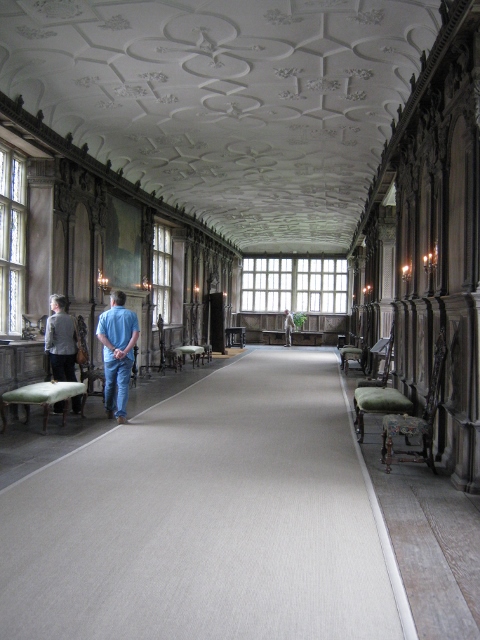
The Long Gallery

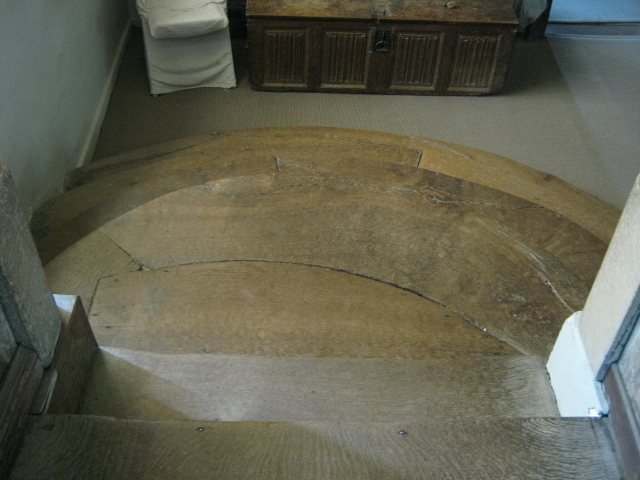
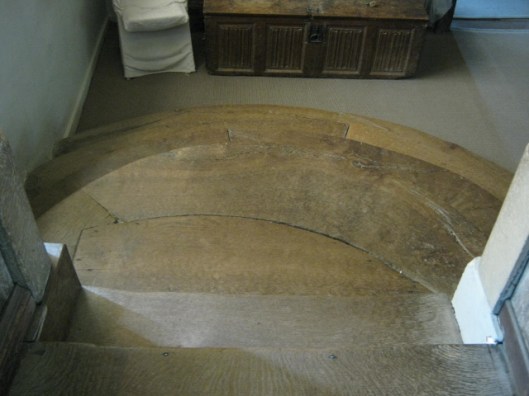
On the opposite side of the landing to the Great Chamber is the Long Gallery.  It is 110 feet long and 17 feet wide.  The entrance to the gallery is up some semi-circular steps said to have been cut from the roots of a single oak.
092Steps (640x480)

Looking down at the steps from inside the Long Gallery
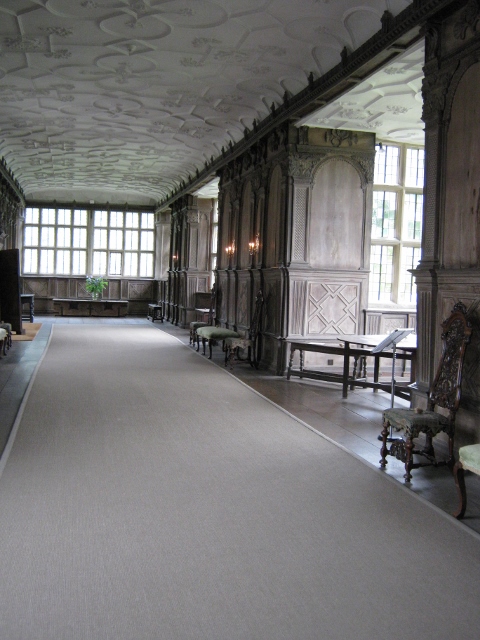
094Long gallery (480x640)

The Long Gallery

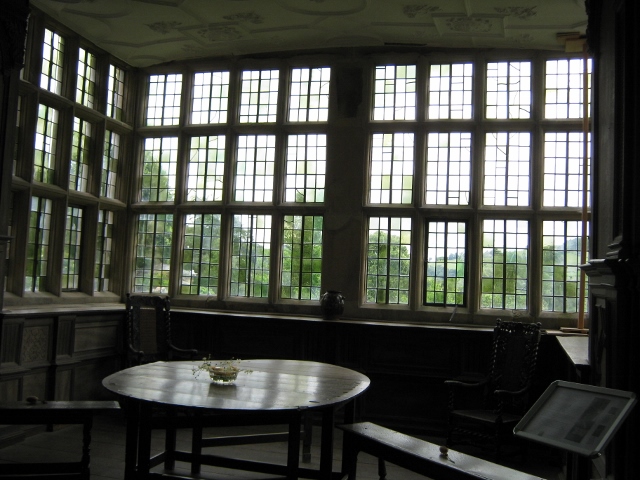
The room is full of light and space.
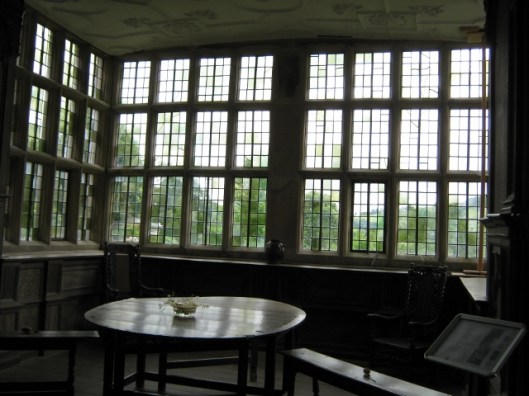
096Long gallery (640x480)

One of the window embrasures. They face south to make the most of the sunlight.

Long Galleries were used as indoor promenades so that the family could take exercise if the weather was too bad to go outside.  There are wonderful views of the gardens and surrounding countryside from the windows.
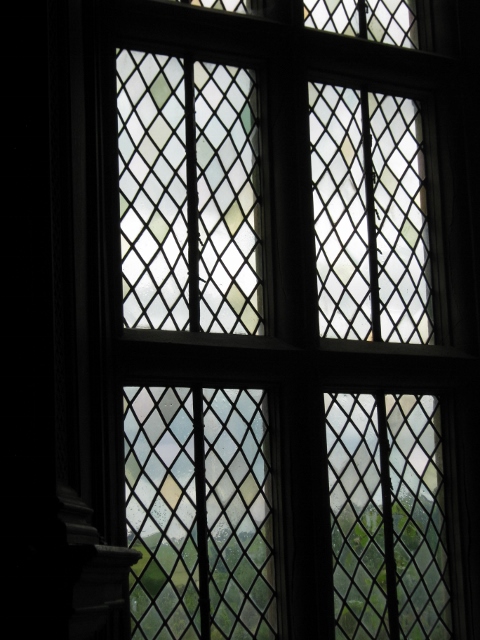
095Glass (480x640)

The diamond-shaped panes are set at different angles which also maximises the use of daylight. It is also very attractive.
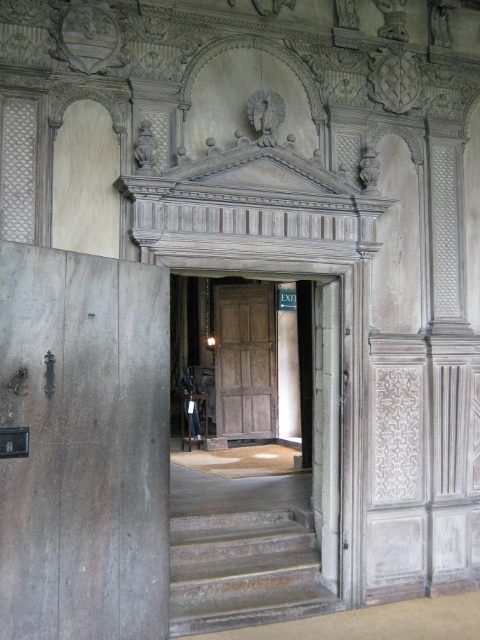
098Carved door frame (480x640)

A doorway surmounted by the Manners’ family crest.

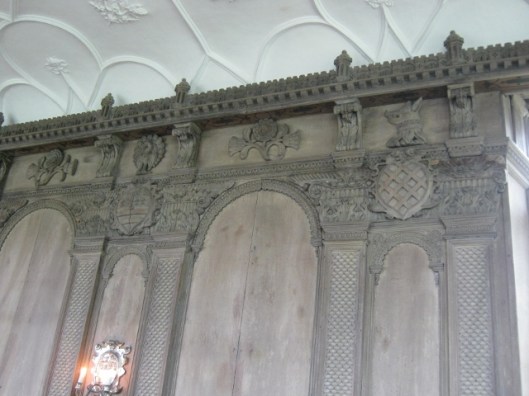
Th panelling is made of oak which was probably originally sized by being lime-washed.  It was then painted with designs in a foxy-red colour.
102Carving (640x480)

Oak panelling

103Ceiling (640x480)

Ornate plaster ceiling

The State Bedroom leads off the Long Gallery.  There is no bed in it because when the Hall was being restored the state bed was moved to Belvoir Castle where it still remains.
104Orpheus taming the animals (640x480)

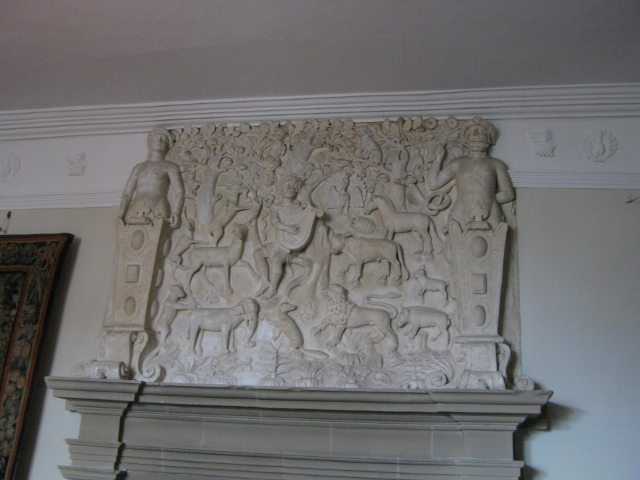
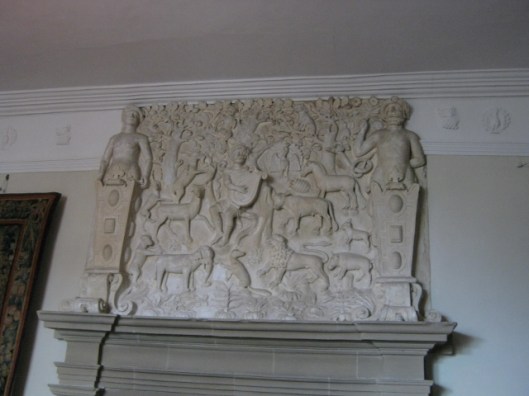
Plaster relief above the fireplace shows Orpheus taming the animals. This dates from the mid 1500s and there is no attempt at realism in the sizes of the animals. There is a very small elephant at the bottom left of the relief.
106Tapestry (640x480)

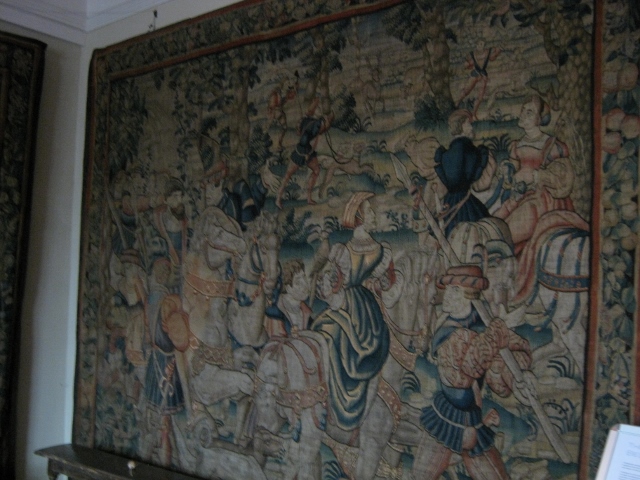
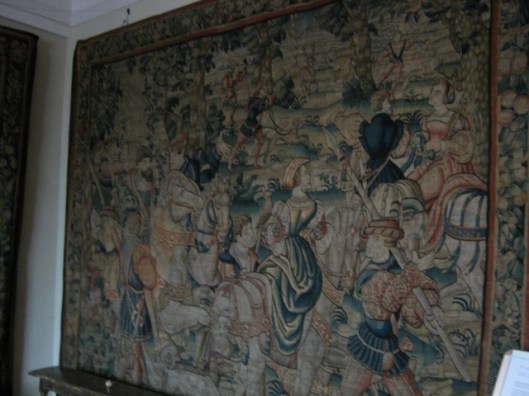
Tapestry in the State Bedroom


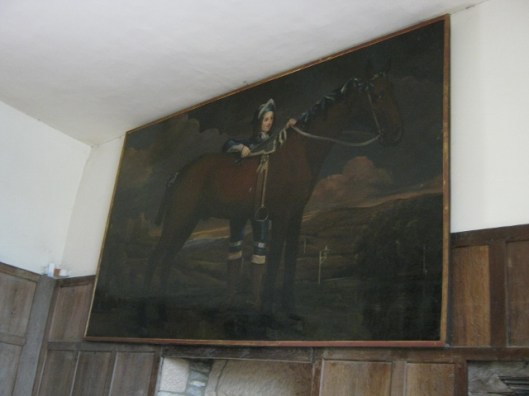
The final room is the Ante-room in which there is one of the earliest racing pictures in existence.
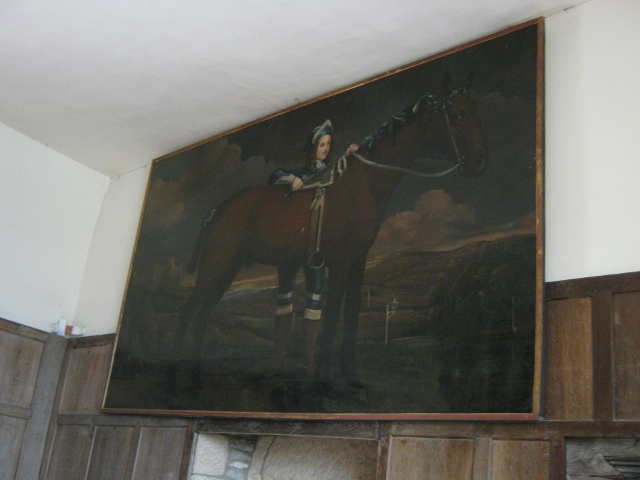
108Early racing picture (640x480)

This painting depicts a pre-Arabian English bay racehorse with his jockey in a landscape. It is attributed to the German-born painter John Baptist Closterman (died 1713).
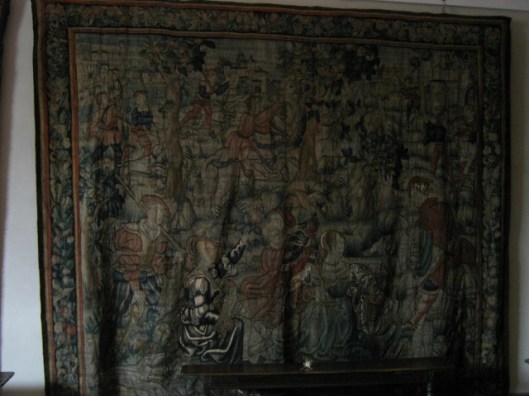
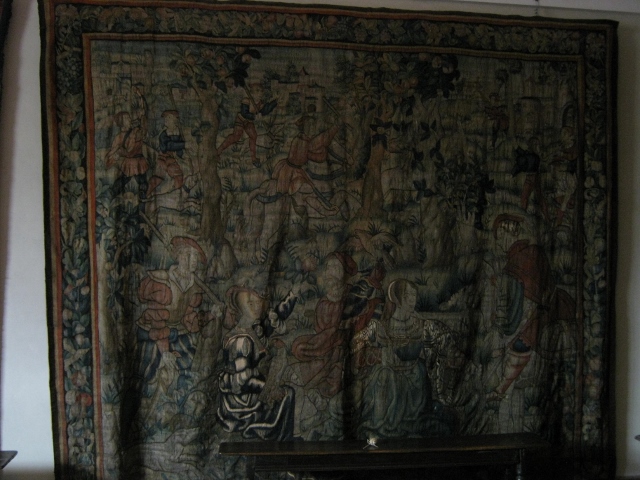
107Tapestry (640x480)

Tapestry in the Ante-room.

There is a flight of worn steps from the Ante-room to the garden but we didn’t go that way but back through the house.

109Gardens (640x480)
110Gardens (640x480)
View of the Hall from the garden
The windows of the Long Gallery
116Garden (640x480)

The main structure of the garden was laid out in the middle of the 17th century.  It has a series of descending terraces – the topmost and the lower garden are closed to the public.  It is a fine example of an English Renaissance garden and avoided being made-over in the 18th century because no-one was living there at the time.

I must apologise for the length of this post and the amount of photographs in it.  I have spent some considerable time trying to shorten it and to delete most of the photos but I find I can’t do either.  I love this Hall very much – I think it is the most beautiful place I know and I wished to have a record of my visit for myself as much as wishing to share it with you.  Thank-you for your patience.


Share this:

  • Share on X (Opens in new window) X
  • Share on Reddit (Opens in new window) Reddit
  • Share on Pinterest (Opens in new window) Pinterest
  • Share on Facebook (Opens in new window) Facebook
  • Email a link to a friend (Opens in new window) Email
  • Share on Tumblr (Opens in new window) Tumblr
  • Print (Opens in new window) Print
  • Share on LinkedIn (Opens in new window) LinkedIn
Like Loading...

Harvest Festival

02 Thu Oct 2014

Posted by Clare Pooley in churches, Rural Diary, Uncategorized, weather

≈ 18 Comments

Tags

bats, church, church decorations, Evensong, flowers, Harvest, hot-air balloon, Rumburgh, sowing

007Rumburgh church (640x480)

Rumburgh Church

Here is an autumn photograph of my church taken on Sunday as we were on our way to get it ready for the Harvest Evensong service.  R is one of the Churchwardens and so we got there early to make sure all was tidy (no bat poo on the pews) and to turn on the lights and take the plastic covers off everything.  As I have said before, our poor church is damp and has a colony of bats living in it and to protect the furniture etc. we have to cover what we can with bits of plastic sheet.  No money to repair the church, no money to buy proper protective covers, not enough money for anything, unfortunately.  I like bats and am very pleased that we have two resident pipistrelle bats that fly round our house every evening.  However, I am not happy about the bats that live in our church because of the damage their urine and faeces do.  The urine especially is so acidic it etches into all the furniture, pictures and flooring.  We have to be so careful when serving refreshments after service in case food and drinks are contaminated.  Bats are protected and it is virtually impossible to get them moved elsewhere.

Our benefice is made up of eleven parish churches and one redundant church which we use once or twice a year.  We have one over-worked priest who has recently acquired an assistant (actually the priest in the next-door benefice who does holiday and sickness cover which is reciprocated), a couple of retired priests who step in when needed, one reader and two elders who take services without communion.  All of the churches in the benefice like to have their own harvest festivals, so for weeks on end there are one or two harvest services on most Sundays.  Last Sunday was the third consecutive week of harvest and our service was taken by Maurice, one of the Benefice Elders.  Next Sunday and the following one there are no Harvest services but then they start up again and we have another three consecutive weeks of ‘We Plough the Fields and Scatter’ right through until the end of October.

004Flowers on pulpit (480x640)

Decorated pulpit. Our talented flower arrangers make the church look so bright and festive.

Any harvest contributions of food, fruit and vegetables at our church go to Adele House, a nursing home run by the convent at All Hallows.  Other churches in the benefice send their contributions to a local food bank which provides food parcels for the needy.

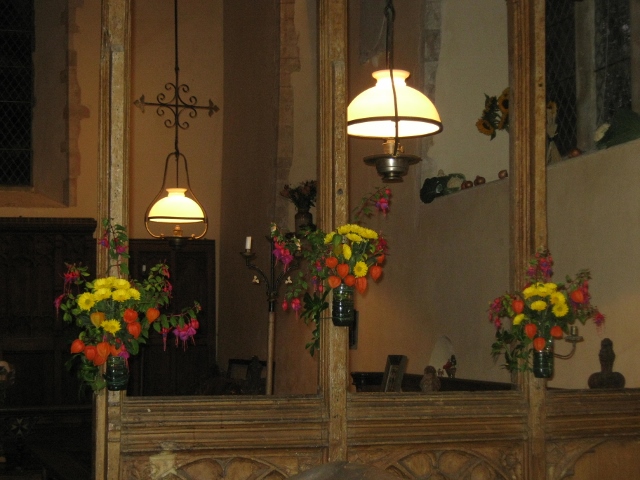
005Flowers on rood screen (640x480)

Decorated Rood Screen.

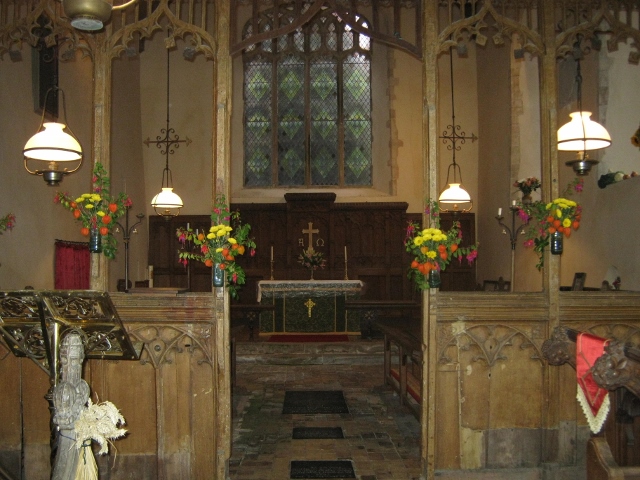
008Chancel (640x480)

The Chancel

009The font (480x640)

The Font

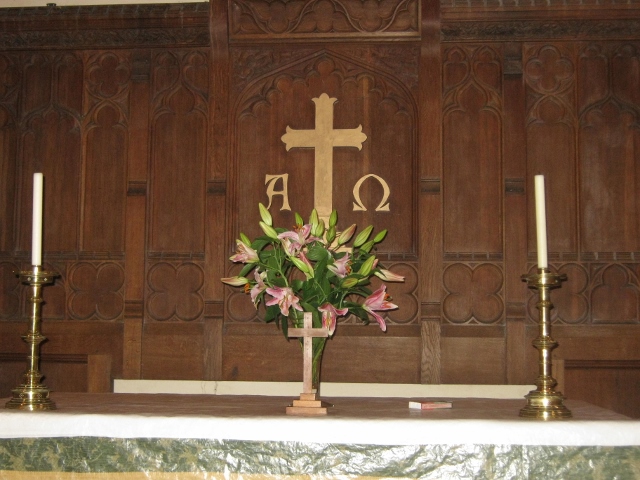
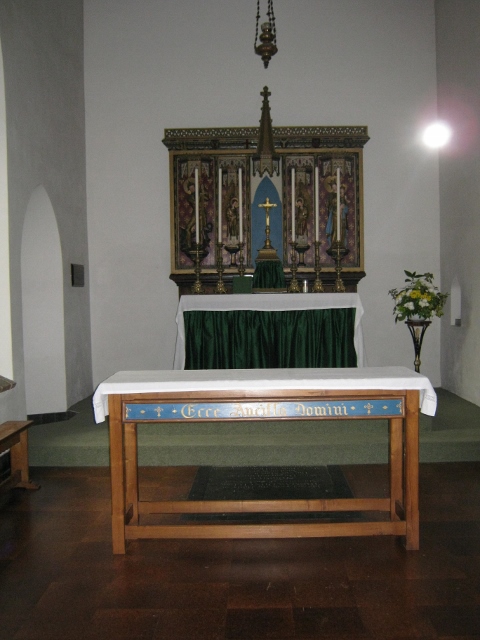
017The Altar (640x480)

The Altar

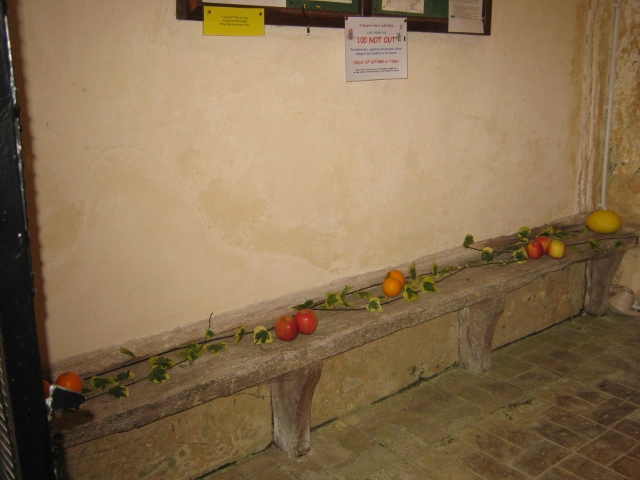
020The porch (640x480)

The Porch

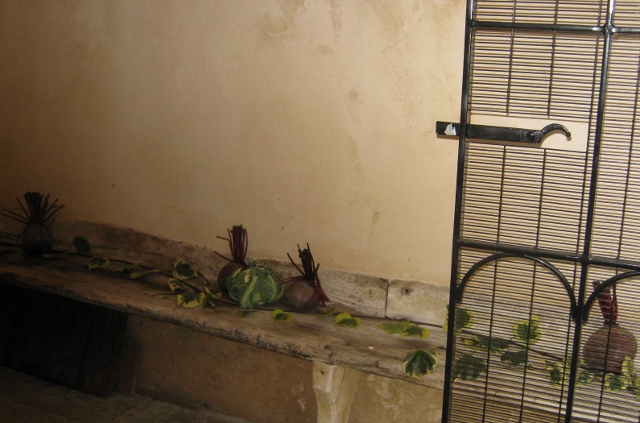
021The porch (640x423)

The Porch. Look at the enormous beetroot!

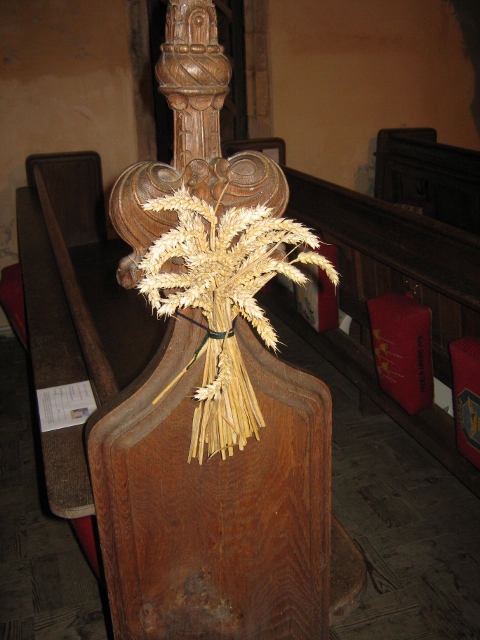
006Bunches of wheat on pew ends (480x640)

Bunches of wheat tied to the pew ends.


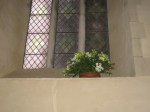
One of these window sills was decorated by me.

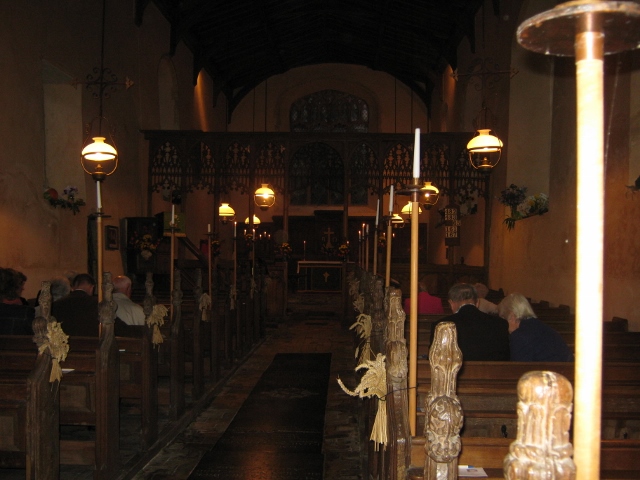
022The church (640x480)

The church just before the service started.

Maurice plays the organ so he gets plenty of exercise, walking up and down the aisle from the front of the church to the back where the organ is then back to the front again then up the steps to the pulpit.

We were very lucky to get 23 people at our Evensong service – no children sadly.

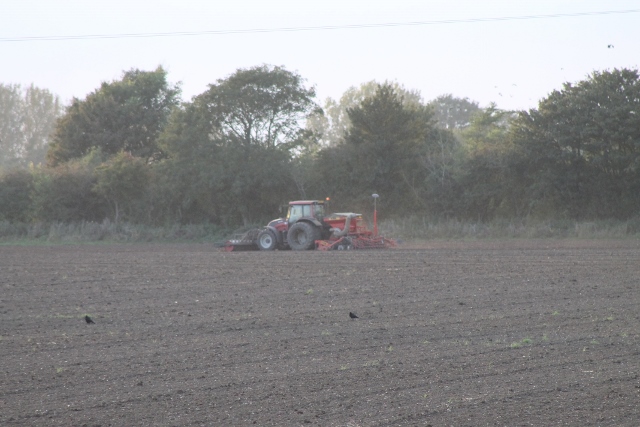
Today, I noticed that the field at the back of the house was being worked on again.

002Sowing (640x427)

Sowing the seed. I apologise for the poor quality photo. The sun was setting and it was a little hazy too.

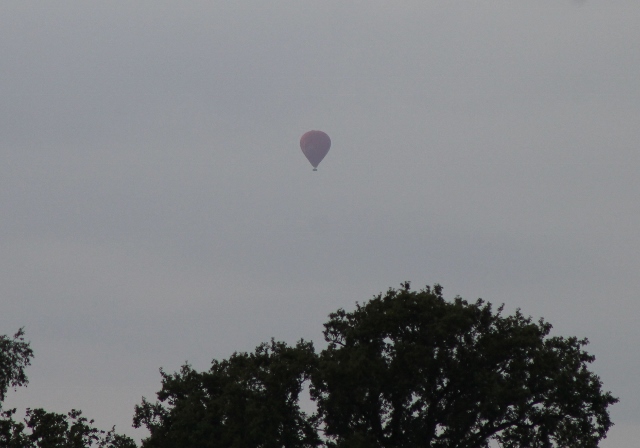
After the coldest August in many, many years we have had a very warm and fairly dry September.  There has been mist and fog in the morning occasionally which has made driving to Norwich difficult.  It is all set to change this weekend with a storm coming in off the Atlantic which will get to us in the East sometime on Saturday.  When it has passed through the temperature will drop considerably, so we are told.  Yesterday evening I noticed a hot-air balloon in the sky – a Virgin sponsored one.  The thermals must have been just right.

009Hot air balloon (640x448)

E used to call them ‘hot hair balloons’.

Thank-you for visiting my blog.


Share this:

  • Share on X (Opens in new window) X
  • Share on Reddit (Opens in new window) Reddit
  • Share on Pinterest (Opens in new window) Pinterest
  • Share on Facebook (Opens in new window) Facebook
  • Email a link to a friend (Opens in new window) Email
  • Share on Tumblr (Opens in new window) Tumblr
  • Print (Opens in new window) Print
  • Share on LinkedIn (Opens in new window) LinkedIn
Like Loading...

More Norwich Knowledge

19 Fri Sep 2014

Posted by Clare Pooley in churches, plants, Rural Diary, walking

≈ 27 Comments

Tags

'The Revelations of Divine Love', All Hallows Convent, All Hallows House, anchorage, bailey, bomb damage, Castle Gardens, Cell, chickory, Dame Julian, EDP Newspaper Group, Father Raybould, fortified bridge, Julian, Julian Centre, keep, Lady Julian, lady's bedstraw, moat, motte, Norwich Castle, Norwich Museum, St Julian's Church, Whiffler Theatre, wild flowers

Because I am taking E to college each day my routines have had to change to suit her time-table.  Up til now I have taken Mum shopping on a Wednesday but on Wednesdays E has a two hour Psychology class and that is all.  No time to take Mum shopping, so we have changed to Tuesdays when E is at college til 5 pm.  Eventually, we hope that E will be able to spend the rest of  Wednesday at college – with friends and working in the library – but as yet she doesn’t have much work to do and wants to come home again fairly quickly.  It is not worth my while doing anything other than stay on in Norwich after dropping her off at college – I would hardly get home before having to set off again.

Last Wednesday I had yet more college equipment to get for her and then a visit to the Body Shop was in order to purchase shower gel and other lusciously-scented products.  After doing my shopping I still had over an hour to go before I needed to meet E so decided to have another walk-about.

001Norwich Castle (480x640)

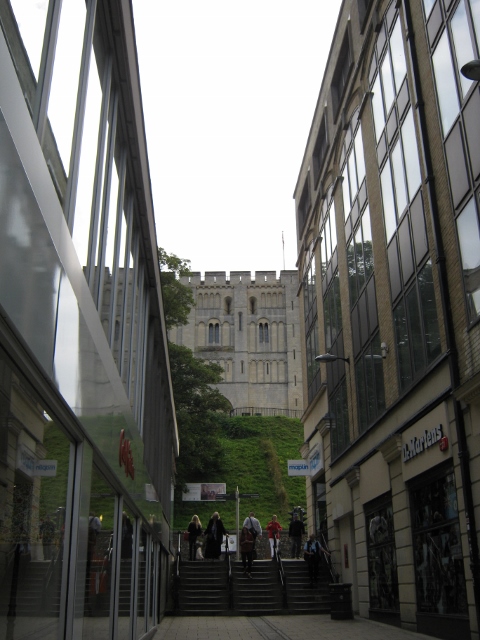
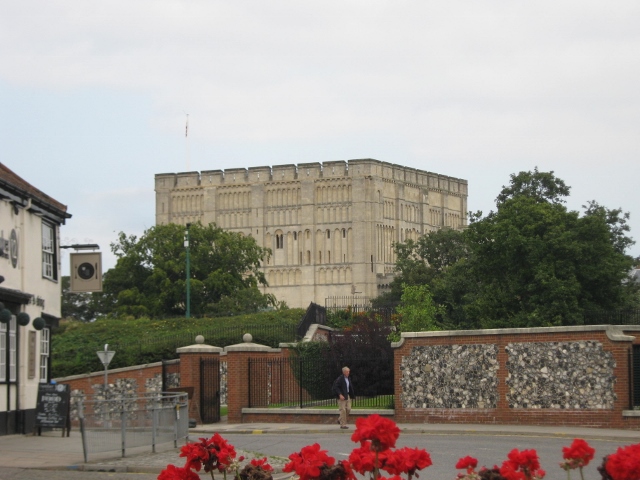
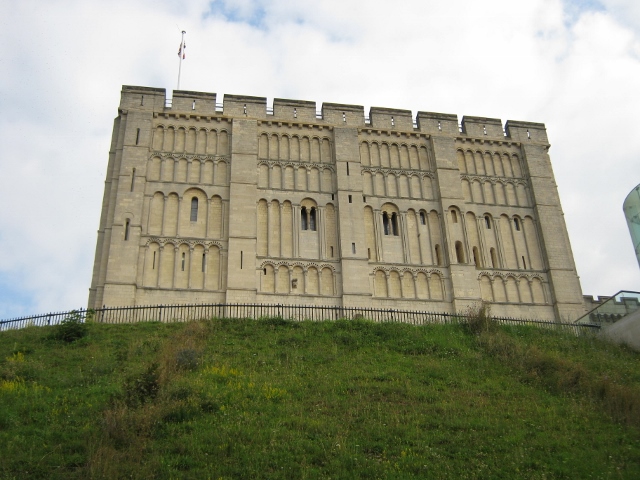
Norwich Castle is an enormous and imposing building.  It is built on a large mound or motte and looks so clean and undamaged it could have been built yesterday.

029Norwich Castle (640x480)

In fact, it was one of the first castles to be built after the Norman Conquest in 1066.

002Norwich Castle (640x480)

At least 98 Saxon homes were demolished from about 1067 onwards so that the earthworks could be dug within which they built a wooden fort (the Bailey).  The fort was surrounded by deep defensive dry ditches.  Once the land had settled they began building the stone keep in 1094 during the reign of William ‘Rufus’ II and, following his death in 1100, his brother Henry I completed the building in 1121.  It was built as a Palace rather than a fortification but no Norman King ever lived in it.  The only time Henry I is known to have stayed in it was at Christmas 1121.  The keep is constructed out of limestone imported from Caen in France.  Originally, the ground floors were faced in flint which would have been such a contrast to the almost white upper floors.

007Norwich Castle (480x640)

The grass mound has been planted with wild flowers – the blue ones here are chickory. The strange blue-topped structure on the right is the lift (non-Norman!) that transports to the top, those not able or wanting to ascend the slope by foot.

003Wild flowers at cstle (640x480) (2)

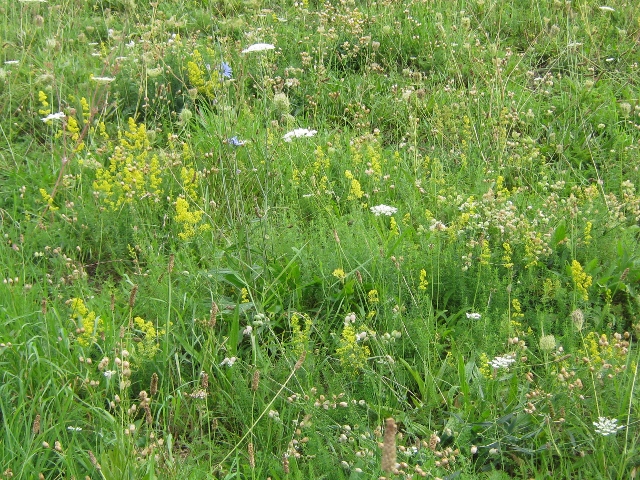
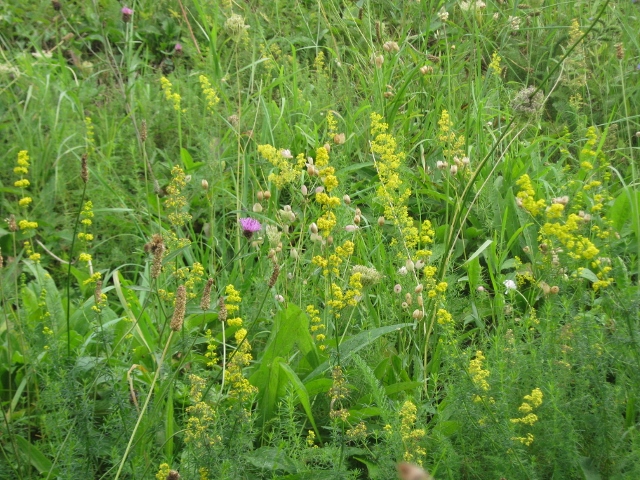
More wild flowers – the yellow ones are Lady’s Bedstraw

Wild Carrot and Bladder Campion grow there amongst many others.

005Wild flowers at castle (640x480)

The keep was used as the County Gaol from the 14th century onwards.  A new gaol designed by Sir John Soane was constructed in and around the keep in 1792-93 but this was soon found to be too small and outdated.  The outside block of Soane’s gaol was demolished between 1822-27 and re-designed by William Wilkins.  When the County Gaol was moved to Mousehold Heath near Norwich in 1883, work began to convert the castle into a museum which it still is to this day.  All the gaol building was demolished leaving the original keep.

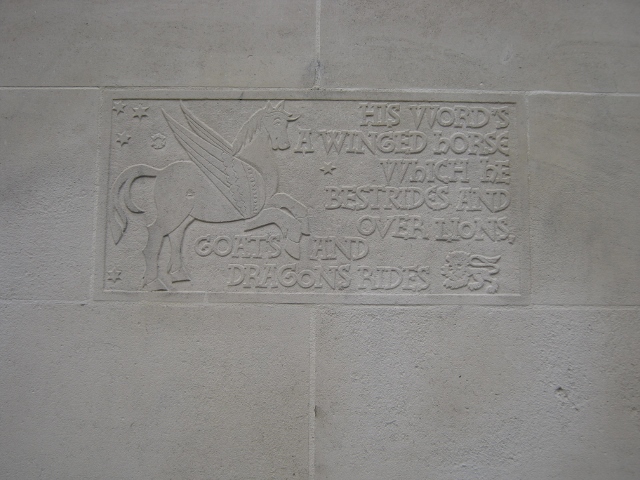
009Quote carved on wall (640x480)

I found this on the wall near the bottom of the lift shaft. Who can tell me where this quote comes from?

I walked through the Castle Gardens which are in the bottom of the dry moat.

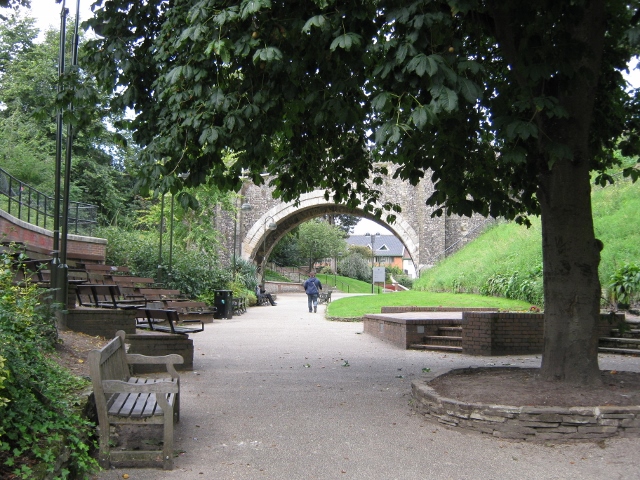
010Castle garden (640x480)

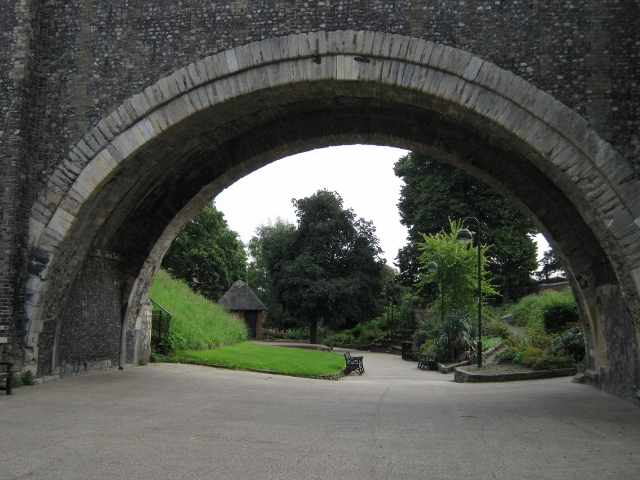
This bridge is the original Norman fortified bridge over the moat but it has been refaced and has a 19th century inner brick arch.

011Outdoor theatre (640x480)

The Whiffler Theatre

This is a small, simple open-air theatre in the Castle Gardens and was given to the people of Norwich by the Eastern Daily Press Newspaper Group.  Next to the performing platform is a small thatched building that is used as dressing rooms.  If you look at the first photo of the bridge, the dressing room building can be seen beyond the bridge on the left.  There is a Whiffler Road in Norwich as well, but I cannot find out anywhere if the road and theatre are named after a specific person.  The word ‘whiffler’ has a number of meanings according to the dictionary.

1.  One who whiffles or frequently changes his opinion or course.  One who uses shifts and evasions in argument, hence a trifler.

2.  One who plays on a whiffle; a fifer or piper.

3.  The Goldeneye duck is also known as the Whiffler probably because of the whistling sound its wings make in flight.

4.  An officer who went before a procession to clear the way by blowing a horn.  Any person who marched at the head of a procession.  A harbinger.  In the 16th century the whiffler was armed with a javelin, battle-axe, sword or staff.  An early form of steward involved in crowd control.

Shakespeare’s Henry V:  ‘…the deep-mouthed sea, which like a mighty whiffler ‘fore the King seems to prepare his way.’

The ‘Whiffler’ pub in Norwich is named after the ceremonial character so perhaps the road and theatre are too.

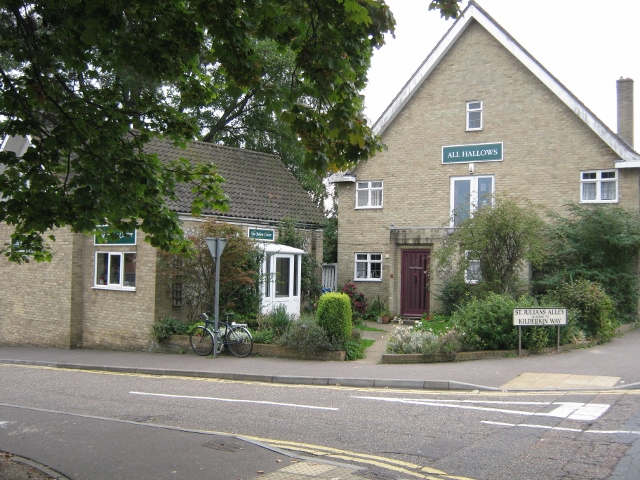
012All Hallows & Julian Centre (640x480)

All Hallows and Julian Centre

I left the Castle grounds and walked down Rouen Road to St Julian’s Alley, on the corner of which is the Julian Centre where books, cards and other merchandise associated with Dame Julian are sold.  There is also a reference library which keeps the main books and articles published about her and also a Christian lending library.   All Hallows House, also on the corner of the road is a small guest house belonging to All Hallows Convent, Ditchingham which is fairly near to where I live.  I went to Ditchingham for a day retreat a number of years ago and it was such a peaceful day.  All Hallows House in Norwich is somewhere else to stay for a retreat, as well as a place of study or just somewhere to stay to be near St Julian’s church.

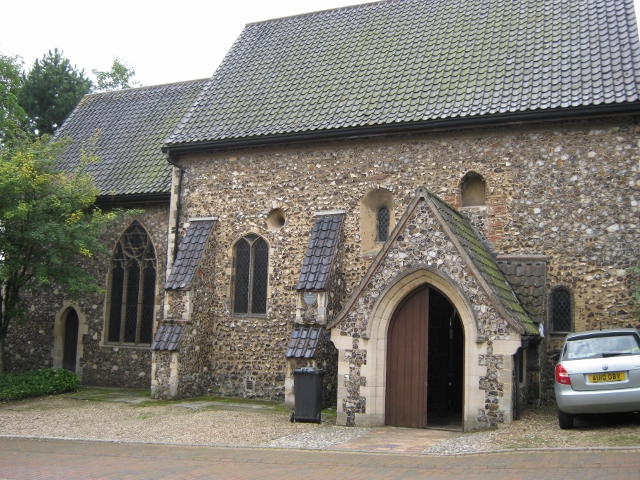
013St Julian's church (640x480)

St Julian’s church

The first time I came here was with A, my eldest daughter and at the time they were preparing for something in the church and had had all the pews removed.  A nun was in the church and welcomed us in saying how much she liked the large space left once the seating had been taken out.  She said it made her want to dance and she then proceeded to dance round the church.  I thought she was wonderful!

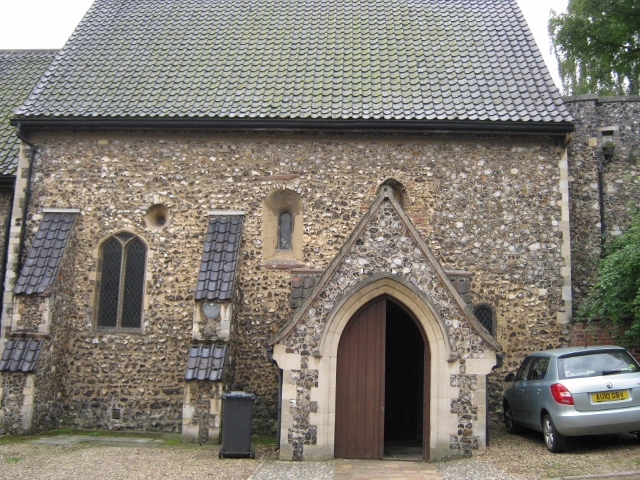
014St Julian's church (640x480)

St Julian’s church

To explain who Dame Julian was I will quote from the information leaflet I picked up from the church.

‘Julian of Norwich was the first woman to write a book in English.  She wrote it while she was an ‘anchoress’ (a hermit) living in a small room attached to St Julian’s church.

It was quite normal for people to live like this in Julian’s day.  Some were monks and nuns, but many were just ordinary men and women who took vows to live a solitary life of prayer and contemplation.  They lived in a room beside the church and many people came to them for comfort and advice.

On 8th May 1373, when she was thirty years old, Julian suffered a severe illness from which she almost died.  During that illness she received a series of visions of the Passion of Christ and the love of God.  When she recovered, she wrote down what she had been taught – perhaps having to learn to read and write in order to do so.

Her book, ‘The Revelations of Divine Love’, took her over 20 years to complete and is today regarded as a spiritual classic throughout the world.  Her clear thinking and deep insight speak directly to today’s troubled world.

Her perception that there is no wrath in God, but that this is a projection of our own wrath upon him, is centuries ahead of her time.  And her understanding that God’s love is like that of a tender loving mother, as well as that of a father, is also one we can respond to today.’

015Door into Julian's cell (480x640)

The doorway into Julian’s cell from the church

The church is not what it seems.  During the Reformation the cell was totally destroyed by reformers who wanted to get rid of anything that reminded them of Papism – the Roman Catholic faith that England’s leaders had given up.  The church fell into disrepair during the 19th century and was on the verge of being pulled down.  The parishioners began to put money into a restoration fund in 1845 which saved the fabric but the money ran out quickly.  More work was done on the church in 1871 and 1901.  In 1942 the church was badly damaged in an air raid during World War II and again there was talk of pulling it down.  There are four other churches within less than quarter of a mile from St Julian’s and after the War the whole area was redeveloped.  It was awareness of the importance of Julian’s writing that led the rector, Father Raybould, with the support of the Community of All Hallows, to encourage the community and other interested bodies to get on with the restoration of the church as a place of prayer and pilgrimage.  The architect has done such a good job in creating this little church and re-cycling a number of features from the old church and others damaged at the same time.  The recreation of Julian’s cell is such a wonderful result of the terrible war damage.

The Norman doorway into the cell came from the church of St Michael at Thorn which stood nearby in Ber Street and was destroyed at the same time as St Julian’s.  There was no door here when the Cell was used as an anchorage.

016Dish of hazelnuts (640x480)

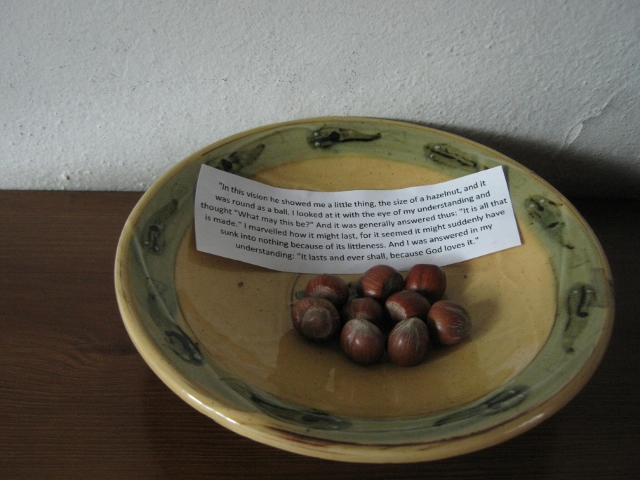
A dish of hazelnuts with the quote from Julian’s writing. In her vision, she is shown a little tiny round thing, the size of a hazelnut and is told that it represents all that has been made. She thought it was so small that it would be destroyed easily but she was told that it never would be because it was loved.

I have read Julian’s book a few times and each time I read it I understand it more, I love it more and I marvel more at this woman, who lived so long ago, being able to write and think so profoundly and able to speak so clearly to me today.  The best translation I have found so far is that done by Father John-Julian, an Episcopal priest and monk.  According to the blurb on the back of my copy, he has been a parish priest in Wisconsin, New Hampshire and Connecticut, was the founding Dean of the Seminary of the Streets in New York and has taught at the University of Rhode Island and Hampshire College.  In 1985 he founded the Wisconsin-based contemplative, semi-enclosed monastic Order of Julian of Norwich.  He has read and studied Julian of Norwich each day for over a quarter of a century.  After much research he believes that Dame Julian was Julian Erpingham, the elder sister of Sir Thomas Erpingham, friend of the King, Lord Warden of the Cinque Ports and who fought at Agincourt.  This Julian married a Roger Hauteyn and was widowed in 1373 (the same year as the ‘Revelations’) when her husband was killed, presumably in a duel.  She re-married in 1376 a Sir John Phelip of Dennington in Suffolk.  They had three children, the last of which was born the same year that her second husband died in 1389.  John-Julian believes that if this was the Dame Julian of the ‘Revelations’, she wrote the book before she became an anchorite and in about 1393 she fostered out her youngest child, dictated the Long Version of the book and then entered her anchorhold.  It is possible.

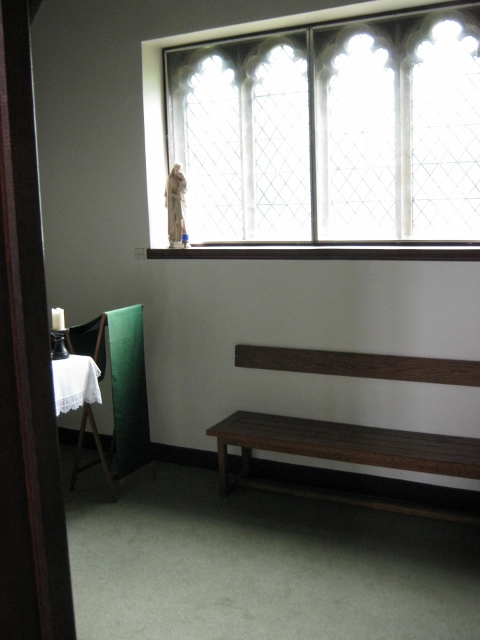
017The cell from doorway (480x640)

The cell, photographed from the doorway

The cell had been used by solitaries before Julian and also by others after her.  When she lived there, there would have been a window onto the street so that she could counsel people, a window into the church and a window or door into an adjacent room where a servant would live.  The servant would remove rubbish etc and bring food from the market and do any other tasks for Dame Julian.

019In the cell (480x640)

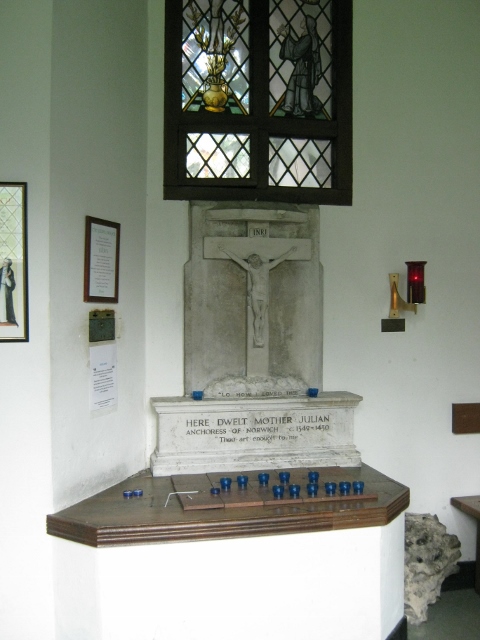
The shrine in the cell

The wooden platform marks the original floor-level and the stone memorial above it used to be on the outside wall of the church before the Cell was rebuilt.  The window above that is in the place where Julian’s window into the church would have been.  She would hear Mass through the window and receive Holy Communion there.  She would have been able to see the Sacrament (the consecrated Bread) hanging in a Pyx (a special vessel/container) before the High Altar.  There are two pieces of flintwork near the ground which formed part of the early foundations, one of which can be seen in this photo.

018Glass in window of cell (480x640)

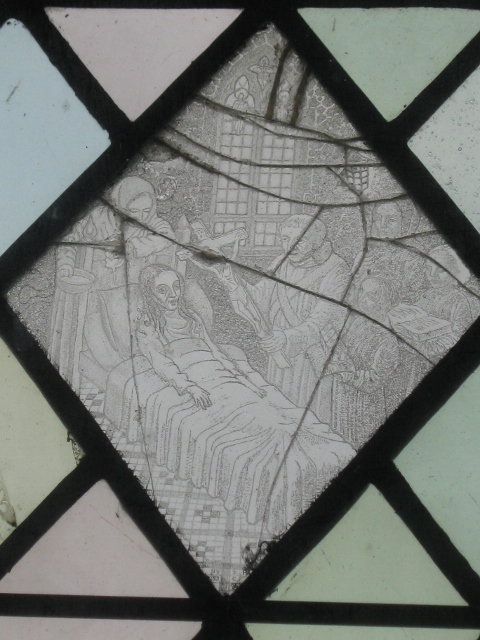
This glass is in a window opposite the shrine and is a memorial to Father Raybould

021High Altar in church (480x640)

This is the High Altar in the Church

The High Altar Reredos (the ornamental screen covering the wall behind the Altar) was made in Oberammergau, Germany and dates from 1931 and was a gift.  It survived the bombing.

026Font (480x640)
027Font (480x640)
028Font (480x640)

The font is the finest thing in the church and one of the great architectural treasures of the City of Norwich.  It used to belong to All Saints Church and when it was declared redundant in 1977 the font was brought to St Julian’s as both churches had been pastorally linked at various times.

The church is dedicated to Saint Julian bishop of Le Mans.  Lady Julian has never been declared a ‘saint’ although she is now included in the Church Calender of 1980.  Many people think that Lady Julian took her name from the building where she had her anchorage when she entered her Cell.

Share this:

  • Share on X (Opens in new window) X
  • Share on Reddit (Opens in new window) Reddit
  • Share on Pinterest (Opens in new window) Pinterest
  • Share on Facebook (Opens in new window) Facebook
  • Email a link to a friend (Opens in new window) Email
  • Share on Tumblr (Opens in new window) Tumblr
  • Print (Opens in new window) Print
  • Share on LinkedIn (Opens in new window) LinkedIn
Like Loading...

Norwich Knowledge

06 Sat Sep 2014

Posted by Clare Pooley in churches, Rural Diary, trees, Uncategorized, walking

≈ 24 Comments

Tags

Augustine Steward house, beguinage, Blackfriar's Hall, Briton's Arms, Christian Resource Centre, City College, Edith Cavell, Edith Cavell Monument, Elm Hill, elm trees, Erpingham Gateway, Forget-Me-Not Café, Fye Bridge, hair appointments, Norwich, Norwich Cathedral, Norwich Hippodrome, Paston family, Princes Street, Quayside, River Wensum, St Andrew's Hall, St Giles, St Giles car-park, St Michael at Plea, Stranger's Club, timber-framed buildings, Tombland, Tombland Alley, walking

Norwich is a very beautiful city and we always look forward to visiting it.  (Norwich is pronounced ‘Norridge’ or, if you are a local, ‘Narge’).  For the next few months I will be going there every day of the week so perhaps the shine may wear off a little, though I don’t think it likely.

On Tuesday E and I had to be at City College Norwich at 8.30 in the morning so that E could meet her mentor before her ‘taster day’ began at 9.00 am.  I had a hair appointment at 9.45, my second one with my new hairdresser.  When my local hairdresser went on maternity leave and I found the replacement hairdresser wasn’t to my liking I decided to look for a new one in Norwich where I would be spending some time each day.  I rather like the young woman who now does my hair.  ‘Oh Clare!’, she said the last time I saw her, ‘Don’t start colouring your hair again.  Your shade of grey is really lovely!’.  There aren’t many women who wouldn’t fall for that one.

So, after leaving E at the college I drove to the city centre and parked my car in my usual car-park at St Giles.  This is rather an ugly multi-storey car-park built in the 1960’s so is quite difficult to park in if you have a modern car – it’s very narrow and full of pillars.  The car-park is on the site of the Norwich Hippodrome, an extremely ornate theatre built in 1903 and demolished in 1964.  Apparently many inter-war stars performed there – Charlie Chaplin, Marie Lloyd, Gracie Fields, George Formby and even Archibald Leach (Cary Grant) made his acting debut there at the age of twelve.  After the Second World War it continued to be popular for a while with acts like Laurel and Hardy visiting in 1954.

I had about an hour to kill before my appointment and, as the morning was bright and sunny I decided to have a short walk and visit some of my favourite places.

I walked up past my hairdressers in London Street to the junction at the top of the hill.  On the corner of Redwell Street and Queen Street is the redundant church of St Michael at Plea.

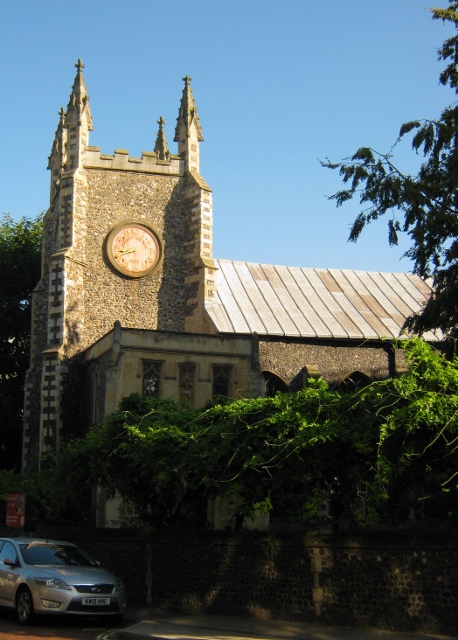
001St Michael's at Pleas church (2) (458x640)

St Michael at Plea church

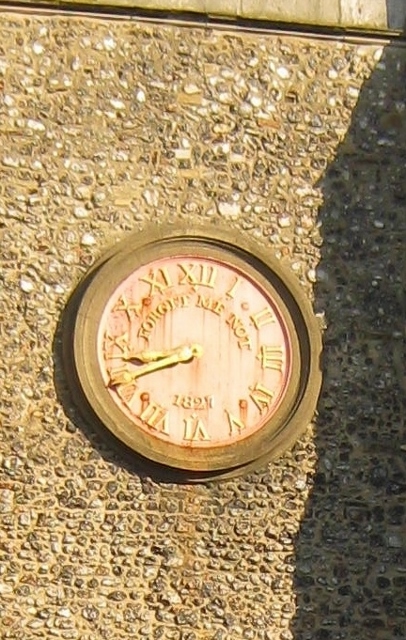
The church ceased to be a place of worship in 1973 and opened in 2008 as a Christian Resource Centre.  Before that it had been used as an antiques market.  We call in quite often as we buy things for our church here – candles, communion wafers etc – and it is a good place for Easter and Christmas gifts.  The bookshop is very good and stocks new and second-hand books.  There is also a really nice café in what was the chancel, with extremely tasty and cheap food, all supplied by volunteers.  The café is called the Forget-Me-Not Café after the wording on the clock on the tower.

001St Michael's at Pleas church (406x640)

The Forget-Me-Not clock

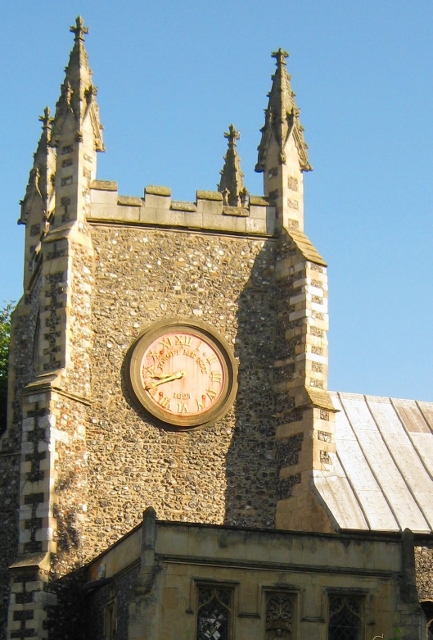
The battlements and spirelets were put on the top of the tower during a 19th Century restoration.  The tower had been lowered for safety reasons some time before that.  I think it had been much taller with bells.

001St Michael's at Pleas church (3) (433x640)

The rather truncated tower with its pretty pinnacles

The porch is probably early 16th Century and rather strangely gives access to the base of the tower rather than the Nave.  Most of the church’s furniture and valuable decorations were removed when it was made redundant but it still has a beautiful memorial in it, some medieval glass high in the east window and some carved angels in the roof.

I then went down Elm Hill, one of the most lovely streets in the country.

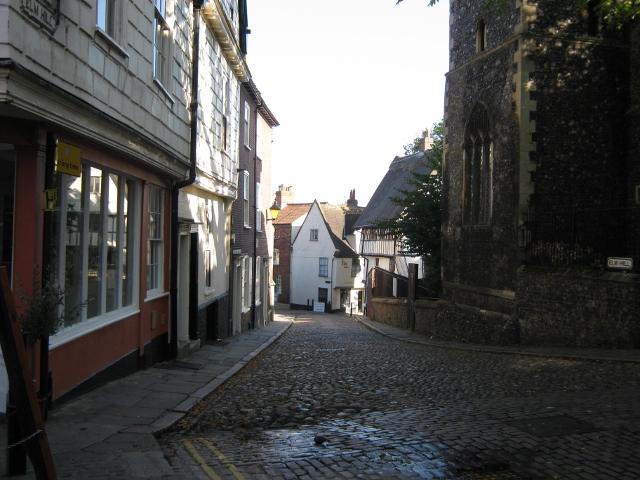
002Elm Hill (640x480)

Elm Hill. Blackfriars Hall is on the corner of the street on the right of the photo.

Elm Hill is a cobbled street full of timber-framed buildings and virtually unaltered since the 16th Century.  There have been people living in this area since at least 1200.  (Probably before that time, as it is close to the river and to Tombland, the site of the Anglo-Saxon market.)  It is called Elm Hill after the elm trees that used to grow there next to the Briton’s Arms, all of them killed by Dutch Elm disease.  This was a wealthy street in medieval times where many merchants lived.  By the 20th Century it had seen better days and there were plans to sweep it all away.  Fortunately, the authorities thought better of this idea and now most of the buildings have been restored and look wonderful.

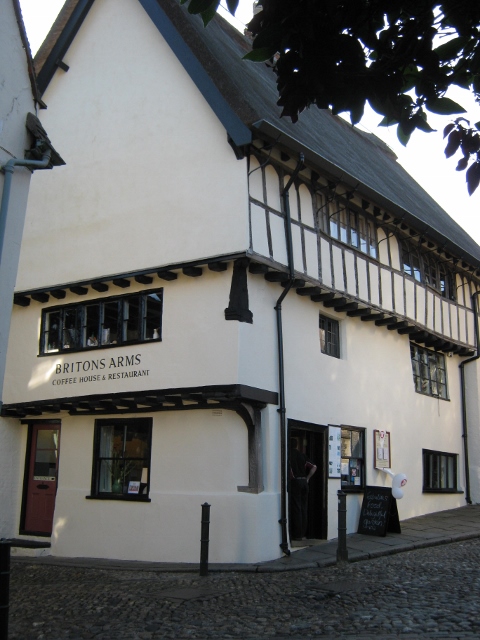
003Briton's Arms (480x640)

Briton’s Arms, now a restaurant and coffee house.

The Briton’s Arms was built in 1347 and became an ale house in 1760.  It is three storeys high and was the only house on Elm Hill to survive a fire in 1507.  It stands in the corner of the old churchyard of St Peter Hungate and the only reason it survived the fire was because it stood apart from the rest of the houses.  The fire destroyed 300 houses and shops.  There are two rooms per storey of the Briton’s Arms and each floor is reached by a side staircase.  The top floor is jettied out on three sides and it also has an attic – a rarity in Medieval buildings.  It is perhaps one of the oldest inhabited attics in England.  It began life as a beguinage associated with St Peter’s church.  A beguinage was the home of a group of single women who devoted their lives to prayer and community work, like a nunnery.  However, unlike a nunnery which accepted the daughters of wealthy parents, beguines were usually from poor backgrounds.  They earned a little money from spinning and begging for alms and did charity work in the city but their main work was regular worship in the church next door which was reached through a stone arched door in the rear wall of the building.  Beguinages were common in Europe but there are no known other examples elsewhere in Britain.

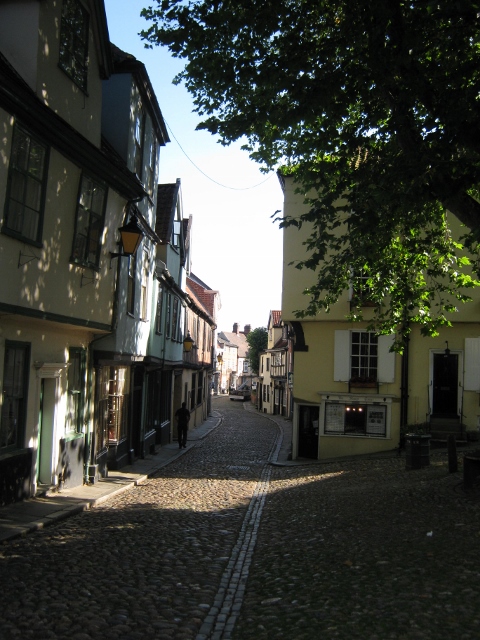
004Elm Hill (2) (480x640)

Looking further down Elm Hill from outside the Briton’s Arms.

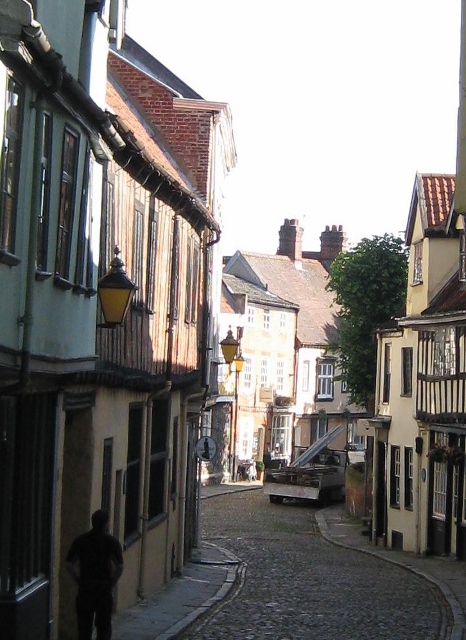
004Elm Hill (3) (466x640)

I cropped the photo above to make it easier for you to see the pink house on the left.

The house just in front of the man in the photo is the Strangers’ Club built on the site of the Paston’s House which was destroyed by the fire.  The Club is said to be haunted by a man who died in the fire of 1507.  Queen Elizabeth I stayed here and watched a pageant in her honour from one of the upstairs windows.

The Pastons rose from peasantry to aristocracy in two generations.  They also left a record of private correspondence (The Paston Letters) which is the first example of such correspondence to survive in Britain.  To quote my on-line source ‘The letters show first hand testimony of the social benefits of the plague brought to the peasantry, the chaotic effects of the War of the Roses on the general populace and the individual impact that the Black Death could have on a family’.  I have a copy of the letters and they are a really good read especially the letters from Margaret Paston to her two sons and theirs to her.  Her husband had managed to be bequeathed Caister Castle by John Fastolf who was a knight during the Hundred Years War, became a loyal servant of Henry V and fought in the Battle of Agincourt.  He was also the knight that Shakespeare based his John Falstaff on.

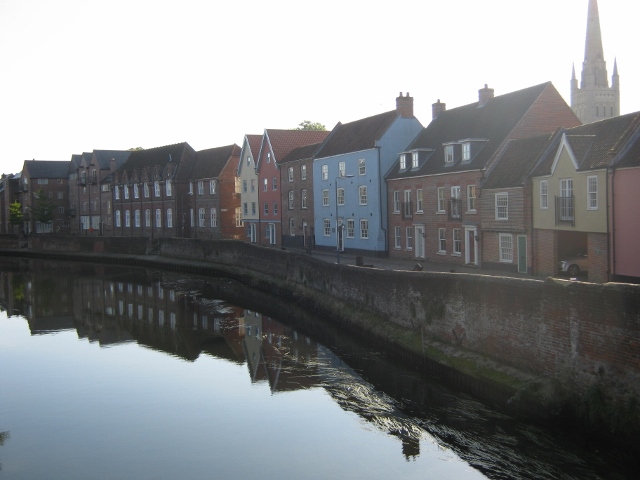
005Quayside from Fye Bridge (640x480)

Quayside from Fye Bridge

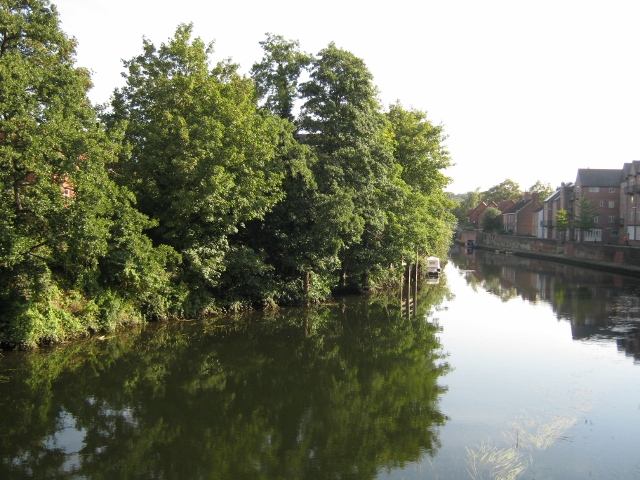
At the bottom of Elm Hill I turned left along Wensum Street and crossed halfway over Fye Bridge so I could look at the River Wensum.  Wensum comes from the Anglo-Saxon word for ‘winding’ – wandsum or wendsum.  The river winds in two large loops through the city and is a tributary of the River Yare despite being the larger of the two rivers.  It is chalk-fed and the whole river is a Site of Special Scientific Interest and a Special Area of Conservation.  Fye Bridge is built over the oldest river crossing in Norwich and is the gate to the North of the city known as Norwich Over the Water.  The bridge is also the site of a former ducking stool.

006The Wensum from Fye Bridge (640x480)

The River Wensum

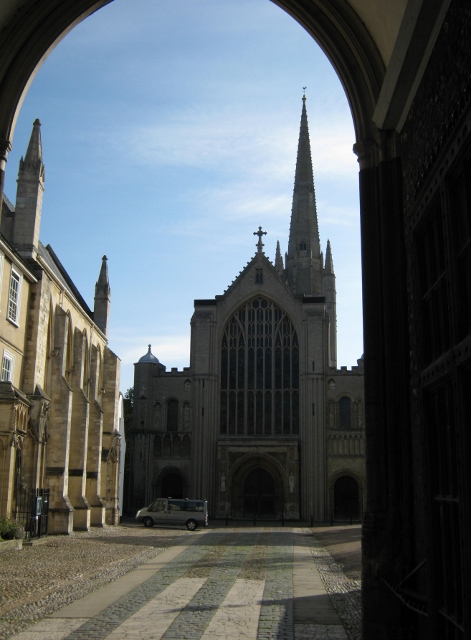
007Norwich Cathedral from Erpingham Gate (471x640)

Norwich Cathedral seen from the Erpingham Gate

I didn’t cross right over the bridge but returned to Wensum Street and walked along it to Tombland and stood by the Erpingham Gate so I could look at the Cathedral.  Though it doesn’t look it from this angle the cathedral is immensely long (407 feet) and the top of its spire is 315 feet from the ground.  The construction of it was begun in 1096 and finished in about 1145.  The Cathedral was also a Benedictine Priory.  The Erpingham Gateway was built in 1420 by Sir Thomas Erpingham who was the commander of Henry V’s archers at the Battle of Agincourt.

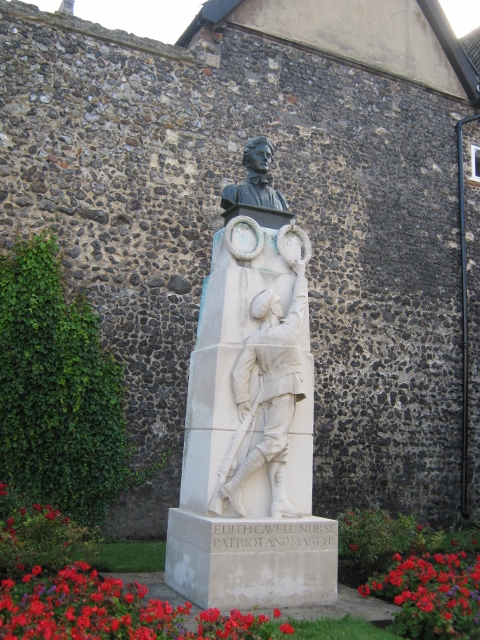
009Edith Cavell Memorial (480x640)

Just to the right of the Erpingham Gateway is the Edith Cavell Memorial.

Edith Cavell is buried near the east end of the Cathedral.  She was born in 1865 and grew up in Swardeston, south of Norwich and was a vicar’s daughter.  She became a Matron of an English teaching hospital and was also an influential pioneer of modern nursing in Belgium.  She was in England visiting her mother when World War I broke out but returned to Belgium as she felt it was her duty so to do.  Her hospital became a Red Cross hospital and so wounded soldiers from all nations were treated there.  She was a devout Christian and this motivated her to help all those in need, both German and Allied soldiers.  When a group of wounded British soldiers arrived who had been cut off from their comrades she decided to help them despite knowing that that she was putting at risk the neutrality of the Red Cross and endangering others working with her.  She then joined a Belgian underground movement and helped more than 200 Allied soldiers to escape to neutral territory.  The network was betrayed, she was arrested, tried by a court martial, found guilty of treason and sentenced to death.  Her execution was carried out at dawn by a firing squad on 12th October 1915.  She was still wearing her nurses uniform.  On the eve of her execution she said, “I am thankful to have had these ten weeks of quiet to get ready.  Now I have had them and have been kindly treated here.  I expected my sentence and I believe it was just.  Standing as I do in view of God and Eternity, I realise that patriotism is not enough.  I must have no hatred or bitterness towards anyone.”

008Medieval buildings and Tombland Alley (640x480)

Augustine Steward house

Opposite the Erpingham Gateway in Tombland is this rather lop-sided medieval building.  This is Augustine Steward house which was built in 1530 by Augustine Steward, a cloth merchant.  A merchant’s mark can be found in the passage next to the house.  A merchants mark is a symbolic sign or design used by artisans, merchants and townspeople to identify themselves and authenticate their goods.  The alleyway next to the house is called Tombland Alley and in the alley is the burial ground for the adjacent church of St George.  The high-walled churchyard contains mainly victims killed by the plague.  The name ‘Tombland’ has nothing to do with tombs but comes from an Old Scandinavian word for ‘open space’.  It was the area used for the Anglo-Saxon market and the administrative centre of Norwich before the Norman Invasion.

010Medieval buildings in Tombland (2) (480x640)

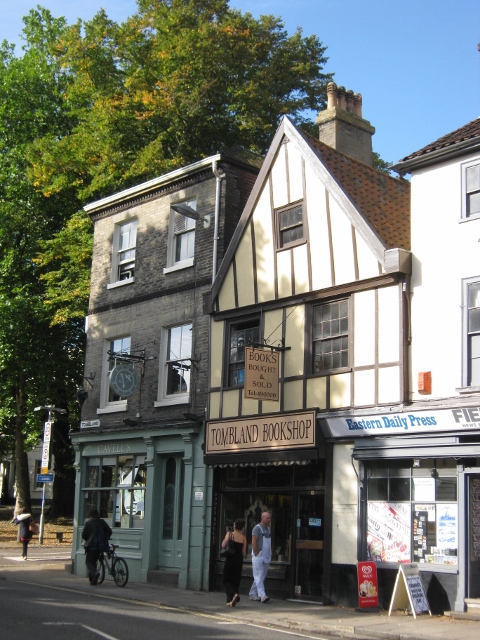
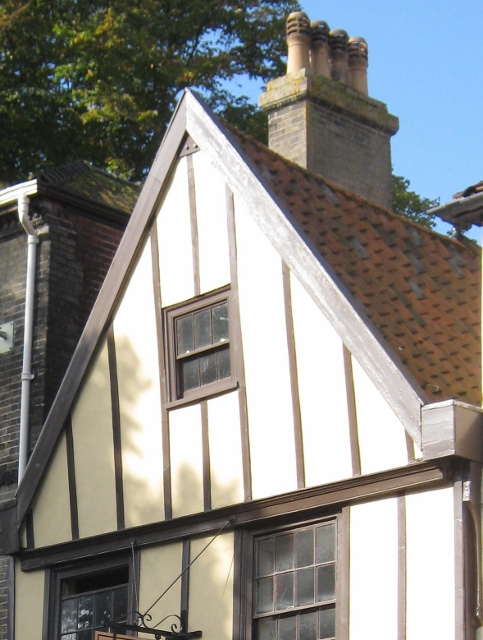
Another ancient building and the best antiquarian bookshop in Norwich.

This is a 15th Century timber-framed building also in Tombland.  I like the way the gable-end of this house leans outwards.

010Medieval buildings in Tombland (483x640)

It isn’t as easy to see how much it leans out in a photo as it is in real life.

011Princes Street (640x480)

Princes Street

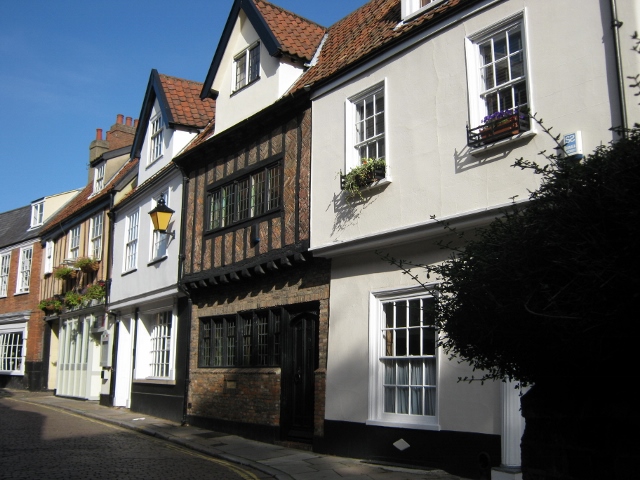
I turned off Tombland into Princes Street.  Again, this street is cobbled and is full of a mix of beautifully restored 16th and 17th Century buildings with some modern offices and homes.

012St Andrew's Hall (640x480)

St Andrew’s Hall

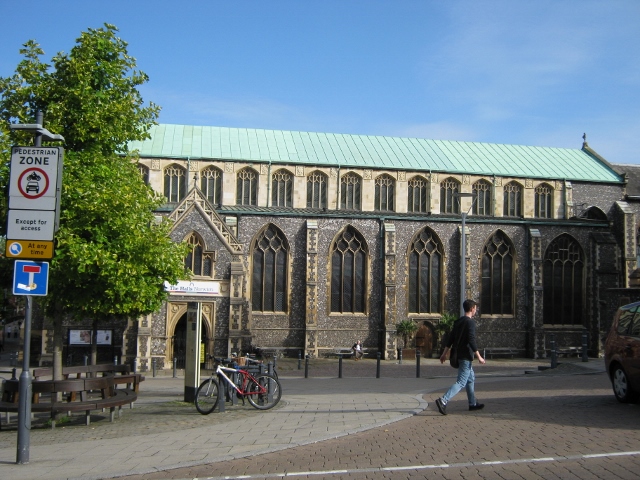
Princes Street becomes Hall Plain after passing the top end of Elm Hill.  St Andrew’s Hall is in Hall Plain.  It and Blackfriar’s Hall at the top of Elm Hill are part of the most complete medieval friary complex surviving in this country.  In 1538 during the reign of Henry VIII they passed into civic hands.  The roof beams for Blackfriars and the hammerbeams in St Andrew’s roof were the gift of the Paston family together with superb 15th Century doors bearing the Arms of the Pastons and Mautbys in the South Porch.  The nave of St Andrew’s Hall was repaired and renamed The New Hall and has been used for civic ceremonies ever since.  The first recorded event was the mayor’s feast for Henry Fuller in 1544.  The Hall has been used for many things – Guild meetings, an assize court, a corn exchange and a corn hall.The Earl of Warwick stabled his horses here when he came to crush Kett’s Rebellion in 1549.  Sir Thomas Browne, the physician and polymath, was knighted here in 1671 by Charles II.  The Norfolk and Norwich Festival was started here in 1824 and still continues. The largest regional Beer Festival in Great Britain was started here in 1978.  I believe the Blackfriar’s Hall is used as a museum and art gallery.  The old east and west ranges of cloisters have also had many uses – granaries to store corn for Poor Relief, places of worship for Presbyterians and Baptists, a mint where £259,000 of coins were produced in 1695, the City Workhouse, schools and colleges.  They are now part of the Norfolk Institute of Art and Design.

I was now in time for my hair appointment and when that was finished I made my way home via Bungay where I bought some bird seed for my mother.

May I thank everyone for their kind thoughts and wishes.  My husband is in good heart though not looking forward to brain surgery.  My mother seems a little better too.  We will see how E gets on on Monday and the rest of next week.  I will keep you informed when I can.  God Bless you all.


Share this:

  • Share on X (Opens in new window) X
  • Share on Reddit (Opens in new window) Reddit
  • Share on Pinterest (Opens in new window) Pinterest
  • Share on Facebook (Opens in new window) Facebook
  • Email a link to a friend (Opens in new window) Email
  • Share on Tumblr (Opens in new window) Tumblr
  • Print (Opens in new window) Print
  • Share on LinkedIn (Opens in new window) LinkedIn
Like Loading...

Centenary of the start of World War I and Harvest

03 Sun Aug 2014

Posted by Clare Pooley in churches, Rural Diary, Uncategorized

≈ 17 Comments

Tags

combine harvester, dust, First World War, flies, Harvest, noise, requiem eucharist, St Michaels church, thankful village, WWI centenary

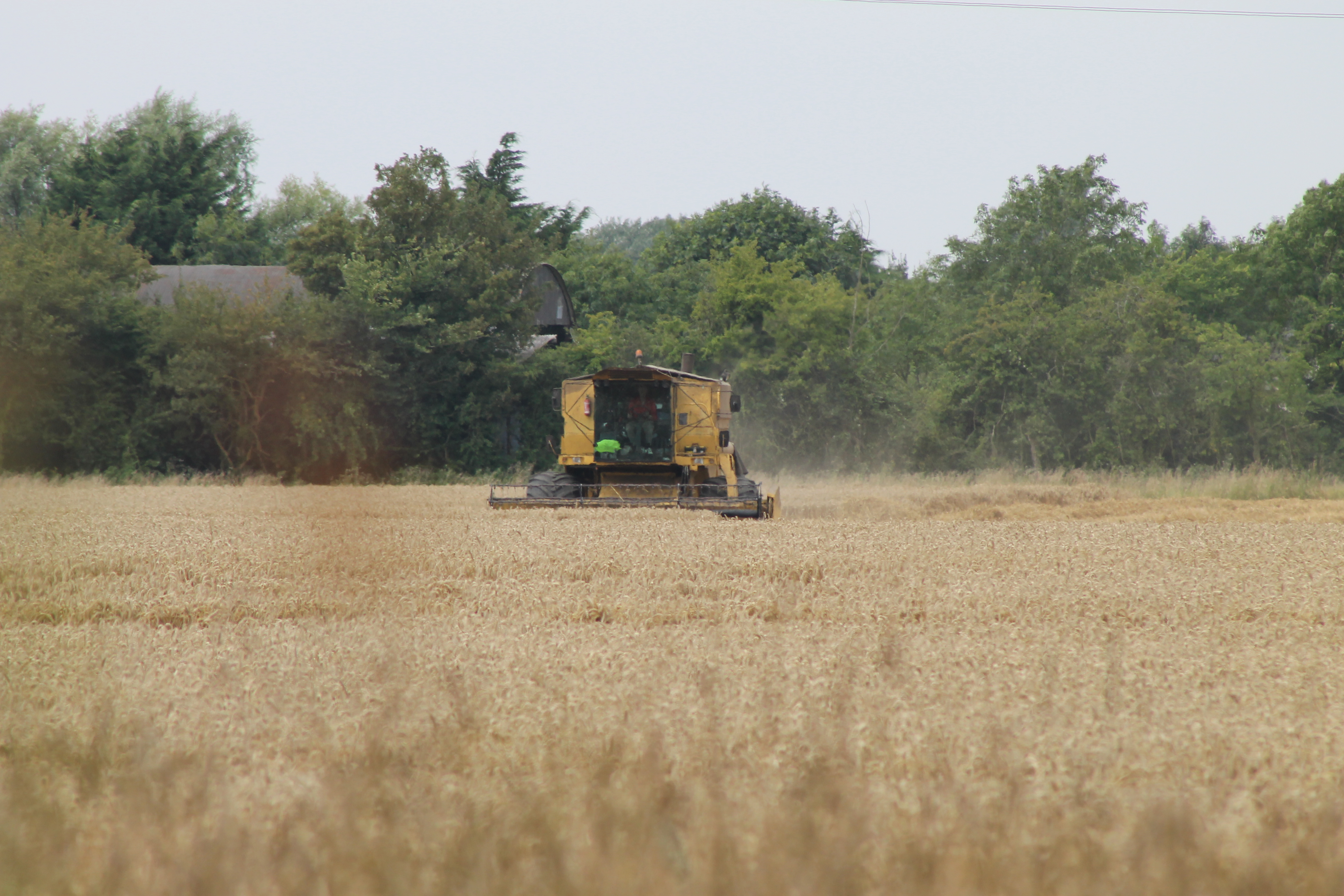
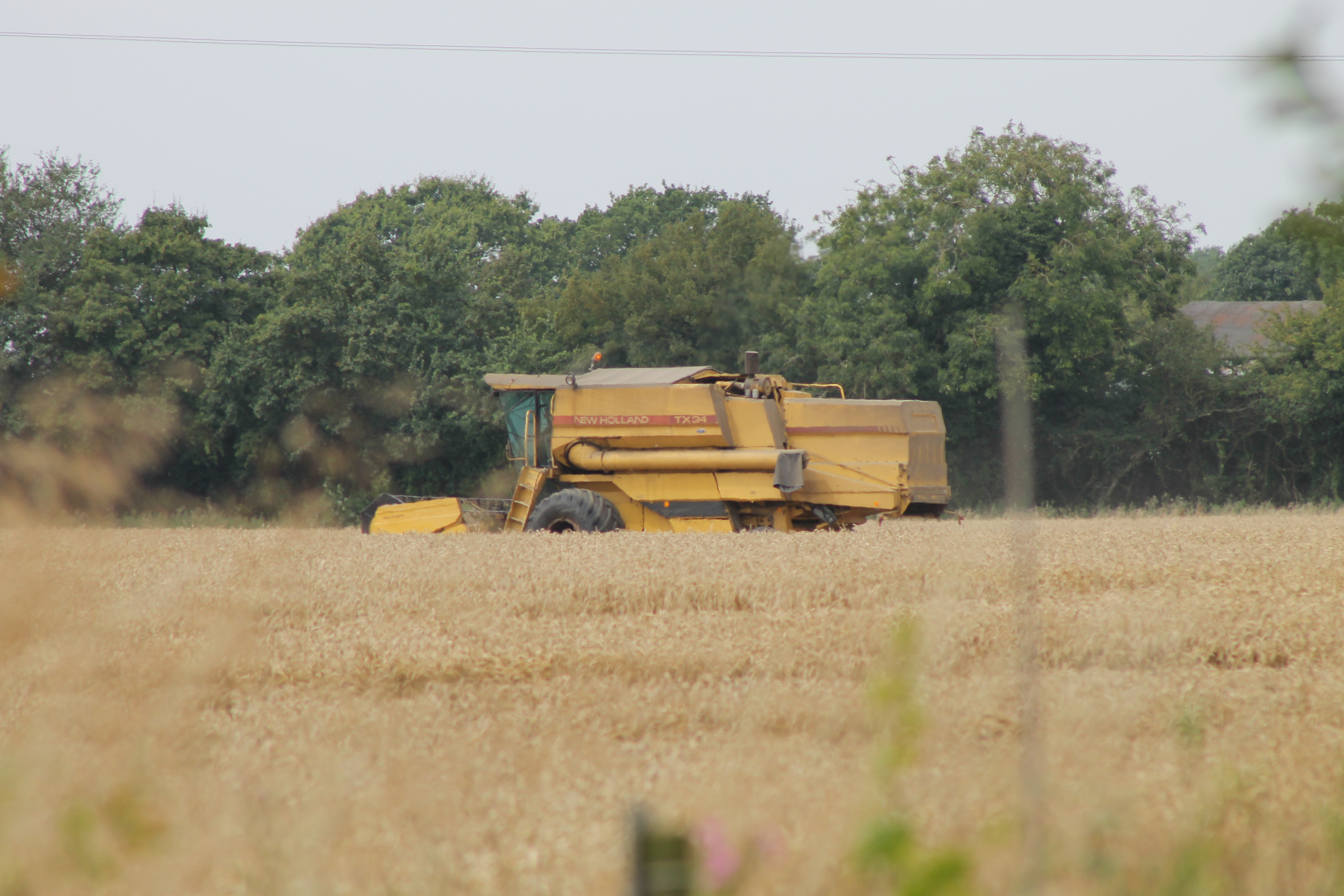
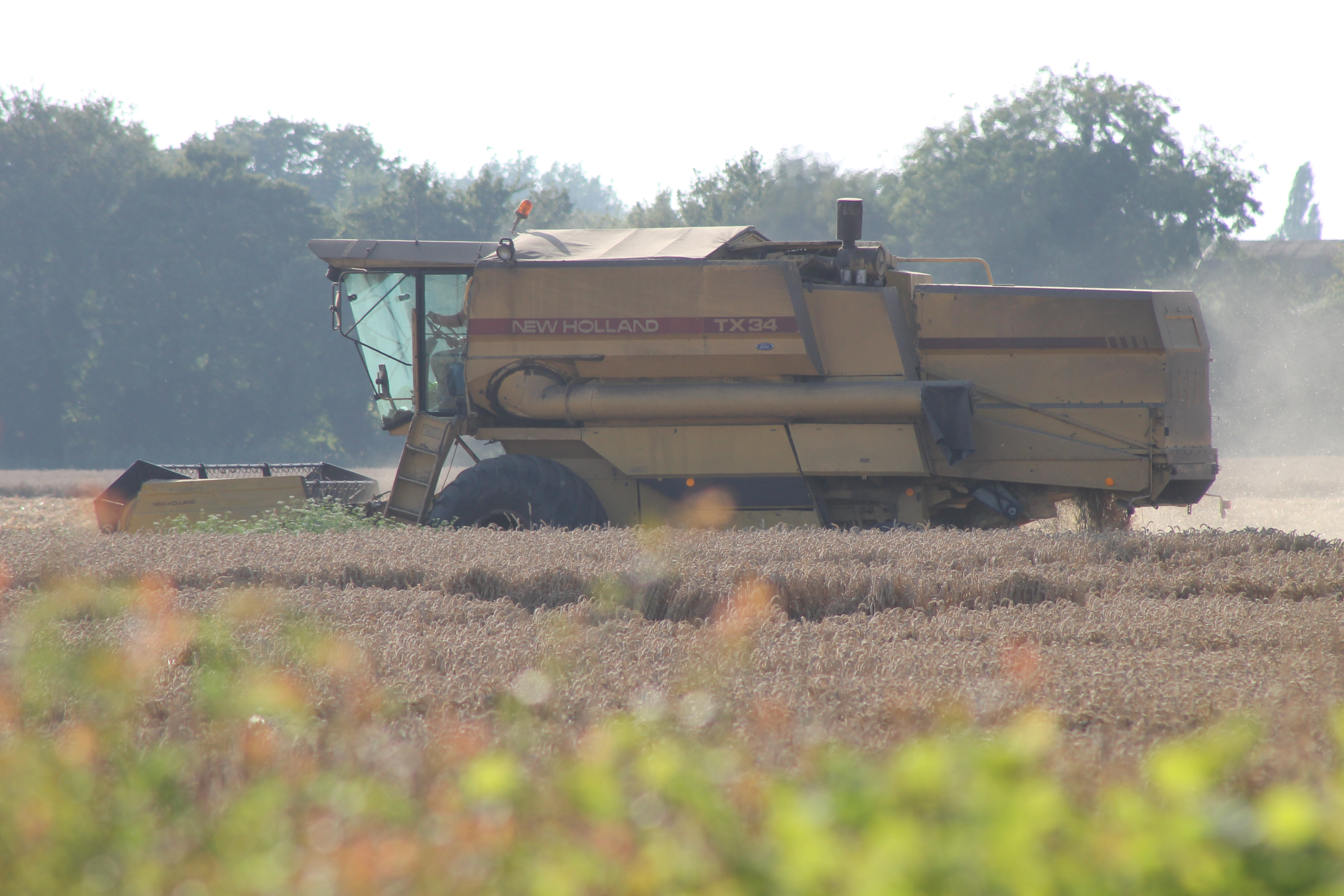
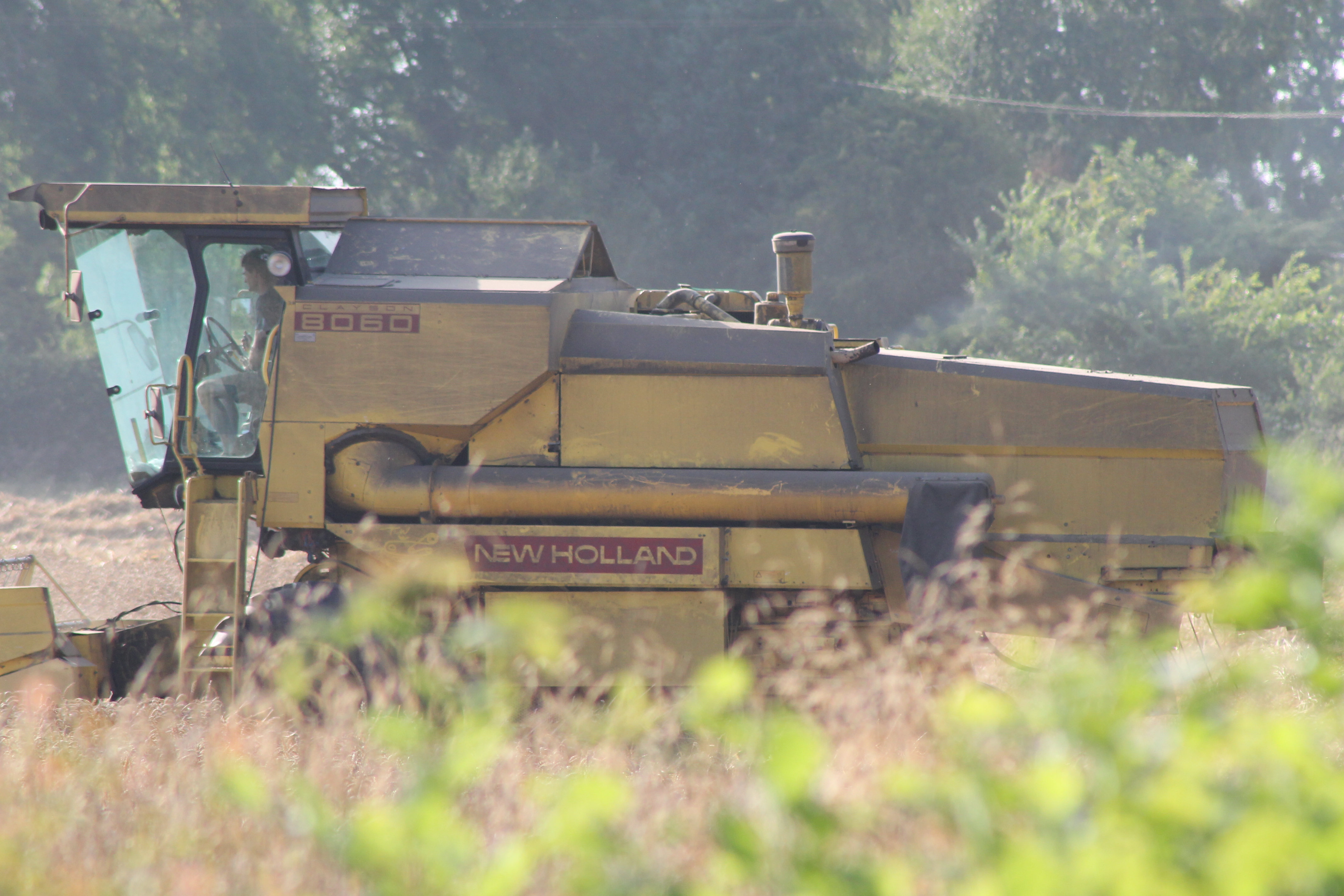
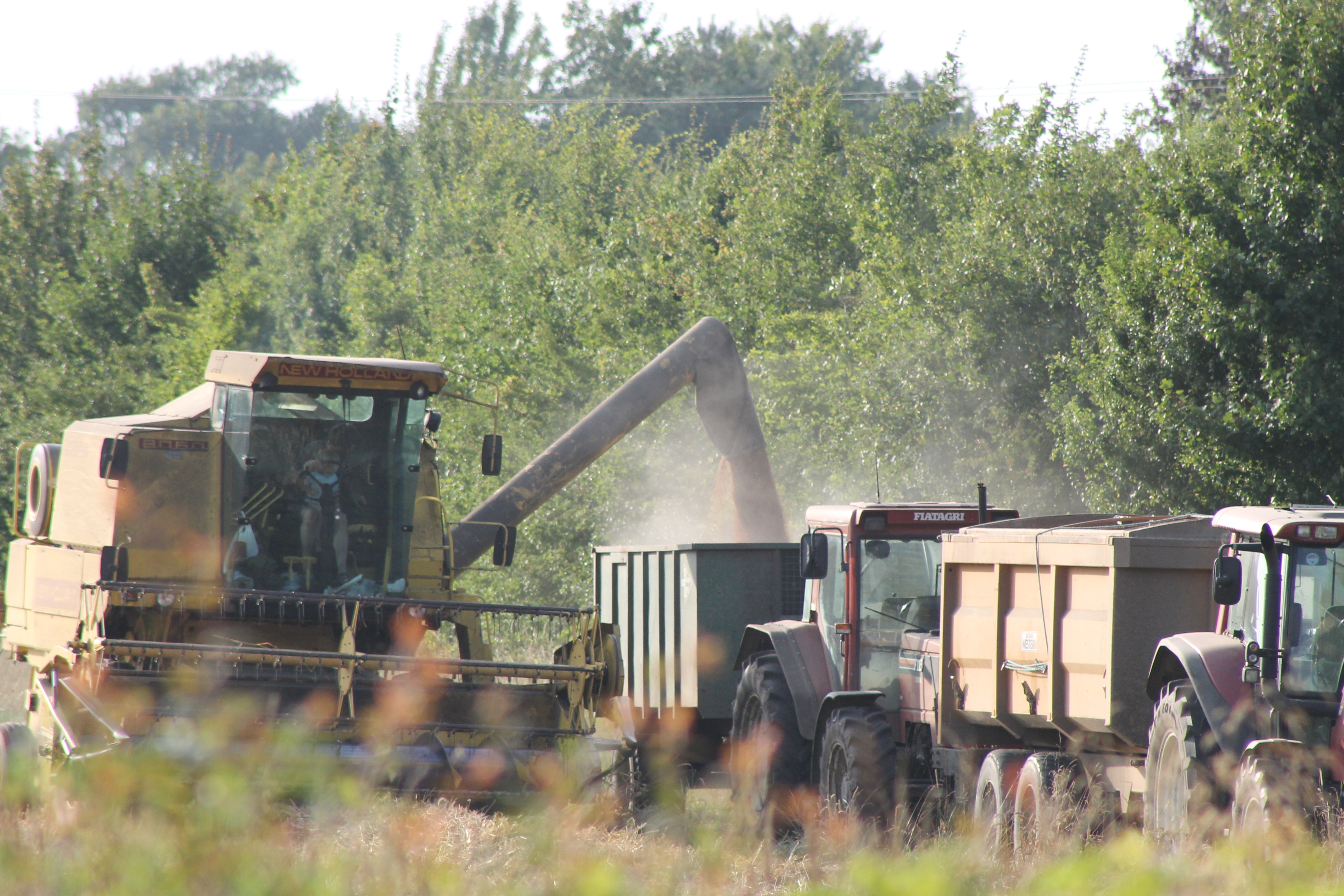
001Combining

It is that time of year again already.  We are surrounded by dust and the almost continuous noise of farm machinery.  Since our return from our holiday at the beginning of July the fields have been systematically stripped of their crop which has then been transported to silos or barns.

The first places to be worked on were the commons and strips of common land at the sides of the lanes.  All the grasses and seeded wild flowers, as well as a few plants just coming into flower, to my disappointment, were cut and baled up for hay.  The verges to the lanes were cut and the hedges and trees were cut back with great slashers.  The fields of oil-seed rape were harvested and then the barley.  And now the wheat fields, including the one at the back of our house.

003Combining

009Wheat

Good-bye, wheat!

058Combining

059Combining

060Combining

Once the fields are harvested the straw is baled and transported away to be stored, muck is spread on the fields and then they are ploughed.  With nowhere to live once the grain has been cut the flies are homeless – for a while – until they discover our house!  We have a choice; either keep the windows and doors shut and boil or open them and let the flies in.  We have a rudimentary fly-screen on the conservatory door but none anywhere else.  Netting can be attached to windows but that makes opening and shutting them difficult and the rooms gloomy.  Houses in this country do not come with proper fly-screens on doors or windows as a matter of course and I wish they did.

This now brings me to the centenary of the start of the First World War.  That mowing down of men and the harvest of souls.

Today, the 3rd of August, R and I attended a Requiem Eucharist at St Michael’s church to mark the centenary of the outbreak of the Great War.  I will quote the introductory address made by our rector this morning.  He wishes me to point out that his point of reference for the general facts and figures was a speech made by the Prime Minister recently.  The East Anglian information was from his own research.

‘One hundred years ago, on 3rd August 1914, the Foreign Secretary, Sir Edward Grey, explained to the House of Commons why Britain was obliged to go to war with Germany.  His speech, with its heavy heart and its clear argument, was greatly admired.  Then he returned to the Foreign Office, and worked til dusk.  He looked up from his desk and saw the man lighting the gas lamps in St James’s Park below.  “The lamps are going out all over Europe,” Grey said to his companion, “We shall not see them lit again in our lifetime.”  At 11.00 p.m. the following day Britain declared war on Germany.

When they set out, with the blessings of their respective Churches, none of the armies had any idea of the length and scale of the trauma that was going to enfold.  For many, going off to war was a rite of passage, and in East Anglia “patriotism” was low on the list of reasons for the boys and men to leave their villages.  Agriculture was going through a deep depression that had been set in motion at the start of the century by endless rain and huge grain imports form the prairie farms of North America and Canada.  Many people had already fled to the towns to seek work, and consequently family farms had collapsed and fields were empty.  To those who remained, the War offered a golden opportunity to get off the hated land.  And so they enlisted in a state of excitement.  They would now eat better and have access to free medical care, and many thought they’d be home by Christmas, anyway.

Four months later, one million had died in the heavy artillery battles that presaged the digging of the trenches.  Four years later, the death toll of military and civilians stood at over 16 million, nearly 1 million of them Britons.  20,000 were killed on one day of the Battle of the Somme.  The death and the suffering was on a scale that outstrips any other conflict, and for evidence of that we only have to look at the Great War memorials in our villages, our churches, our railway stations, schools and universities.

Out of more than 14,000 parishes in the whole of England and Wales, there are only 51 so-called ‘thankful parishes’, which saw all their soldiers return.  Every single community in Scotland and Northern Ireland lost someone, and the death toll for Commonwealth personnel was similarly catastrophic.  The then Indian empire lost more than 70,000 people; Canada lost more than 60,000, so did Australia; New Zealand lost 18,000.  And as part of the UK at the time, more than 200,000 Irishmen served in the British forces during the war, with more than 27,000 losing their lives.

This was the extraordinary sacrifice of a generation, and it is right that we should remember them.’

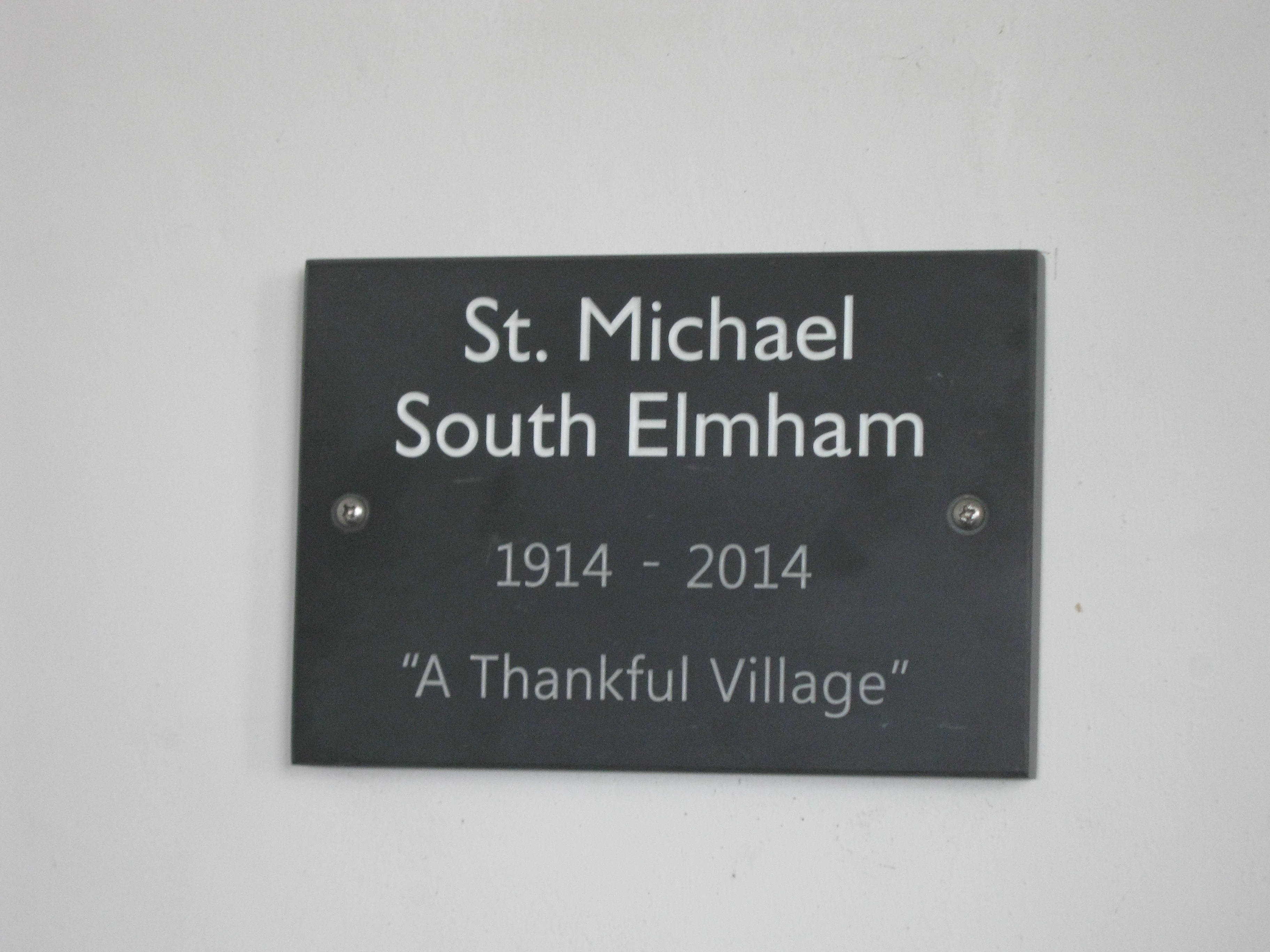
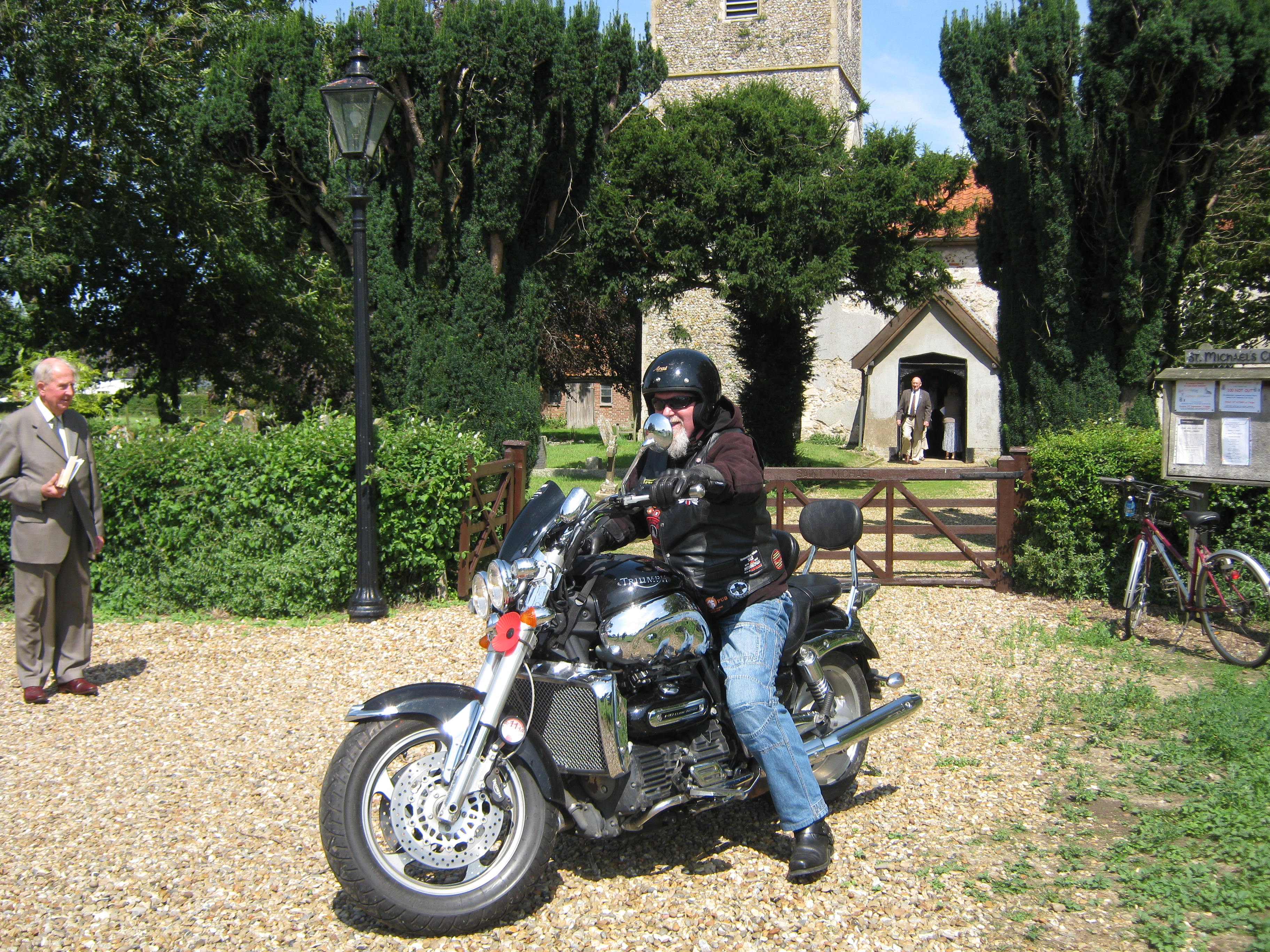
Last year a couple of men journeyed around England and Wales on their motorbikes, visiting all the Thankful villages.  They contacted the Rector to let him know of their intention of visiting the church of St Michael and the date when we were to expect them.  They kindly had a slate plaque made for all the villages they visited and today this was unveiled during the service.  One of the bikers attended the service along with the local Councillor and the descendants of two of the returning soldiers.  All of the parishes in our Benefice were represented at the service and there were so many in the church there was standing room only.

001St Michael's slate plaque

The new slate plaque

As the plaque was unveiled by Dolly, who is one of the church wardens at St Michael and also a descendant of two of the people on the Roll of Honour, the biker who had presented the plaque  Councillor Colin Law read a poem by Anthony Devanny.

We are indeed the lucky and unlucky ones,

As we are the ones who have lived

to tell the tales of those we once knew

We are the ones who carry those scars

of things seen, done and lost

We are the ones who must never let those who are not here

be forgotten by the new


We are the ones who will never need to be reminded

that “We will Remember Them”

as we are the ones who will always remember

those we forever call friend

The Rector had also compiled Roll of Honour folders for all the parishes in his benefice, detailing all that can be discovered about the men who died and all that can be found out about the men who returned to St Michael’s.  After all the parish representatives had collected their folders, together we all quoted the poem by John McCrae.

We are the Dead.  Short days ago

We lived, felt dawn, saw sunset glow,

Loved and were loved, and now we lie

In Flanders fields.

The whole service was very moving and I was so glad to have been there and to have taken part in it.

008The congregation
007The congregation
004The congregation
005The congregation
006The congregation
002The congregation
003The congregation

Photos of the guests and congregation chatting over coffee and biscuits after the service.  We also sang ‘Happy Birthday’ to the Rector and wished him many happy returns for which he excommunicated us.  But not really.  I hope!

We said cheerio to the biker outside and admired his bike.

010The car park


The field next to the church had been borrowed to use as a car park.


It was definitely needed!


029Poppies in the wheat


   We will remember them


Share this:

  • Share on X (Opens in new window) X
  • Share on Reddit (Opens in new window) Reddit
  • Share on Pinterest (Opens in new window) Pinterest
  • Share on Facebook (Opens in new window) Facebook
  • Email a link to a friend (Opens in new window) Email
  • Share on Tumblr (Opens in new window) Tumblr
  • Print (Opens in new window) Print
  • Share on LinkedIn (Opens in new window) LinkedIn
Like Loading...

Having a Sundowner

20 Sun Jul 2014

Posted by Clare Pooley in churches, Rural Diary, Uncategorized, weather

≈ 18 Comments

I have been having such trouble this last week trying to write a post for my blog.  I have plenty of photos and I’ve always lots to say as you all know but, either WordPress, or my computer, or both is causing the site to crash.  I save my draft and just get to near where I left off and crash! .. it all disappears.  R thought at first it was because I use a netbook to post and it doesn’t have a lot of memory space.  So, I put all my photos on a memory stick and went upstairs to the old computer in the spare room and tried again and crash!  He now thinks that either there is a limit to the amount of photos allowed on each post or a limit on how many gigabytes allowed ( surely not?) or I have included something that has caused problems.  As the post I was trying to finish was lots of photos of wildlife in my garden interspersed with my usual waffle I am at a loss as to why.  I am leaving the draft post as a draft for the time being and will see if this one causes trouble.  If anyone can think why I have had these problems please let me know.  I am a bit of a duffer when it comes to computers so words of one syllable, please.

This summer the weather has been quite changeable and in East Anglia where I live we haven’t been as dry as usual.  I have my own personal weather gauge and according to that it has been the dampest for many years.  My weather gauge is the amount of times I have been able to dry towels outside on the washing line and this year I have only managed it twice.  I only ever wash towels on a Monday and I only hang them out during the afternoon but even so, during most summers I am able to dry towels outside almost every week from May until October.  I often dry them outside overnight which means they don’t end up like sandpaper.

The weather this week has been hot and humid and we have had a lot of thunder and lightening and very heavy rain.  A couple of nights ago the lightning flickered non-stop for an hour and a half.   R tells me the weather is the fault of the ‘Spanish Plume’.  Because of the noise of the rain drumming on the roof and the whirr of the fans going full blast I thought he said ‘Spanish flu’ and became quite confused for a while.  I questioned him saying, ‘Spanish flu?’ and he said ‘Yes’  which made things worse.  We eventually understood each other and he explained that it is a weather system – from Spain.

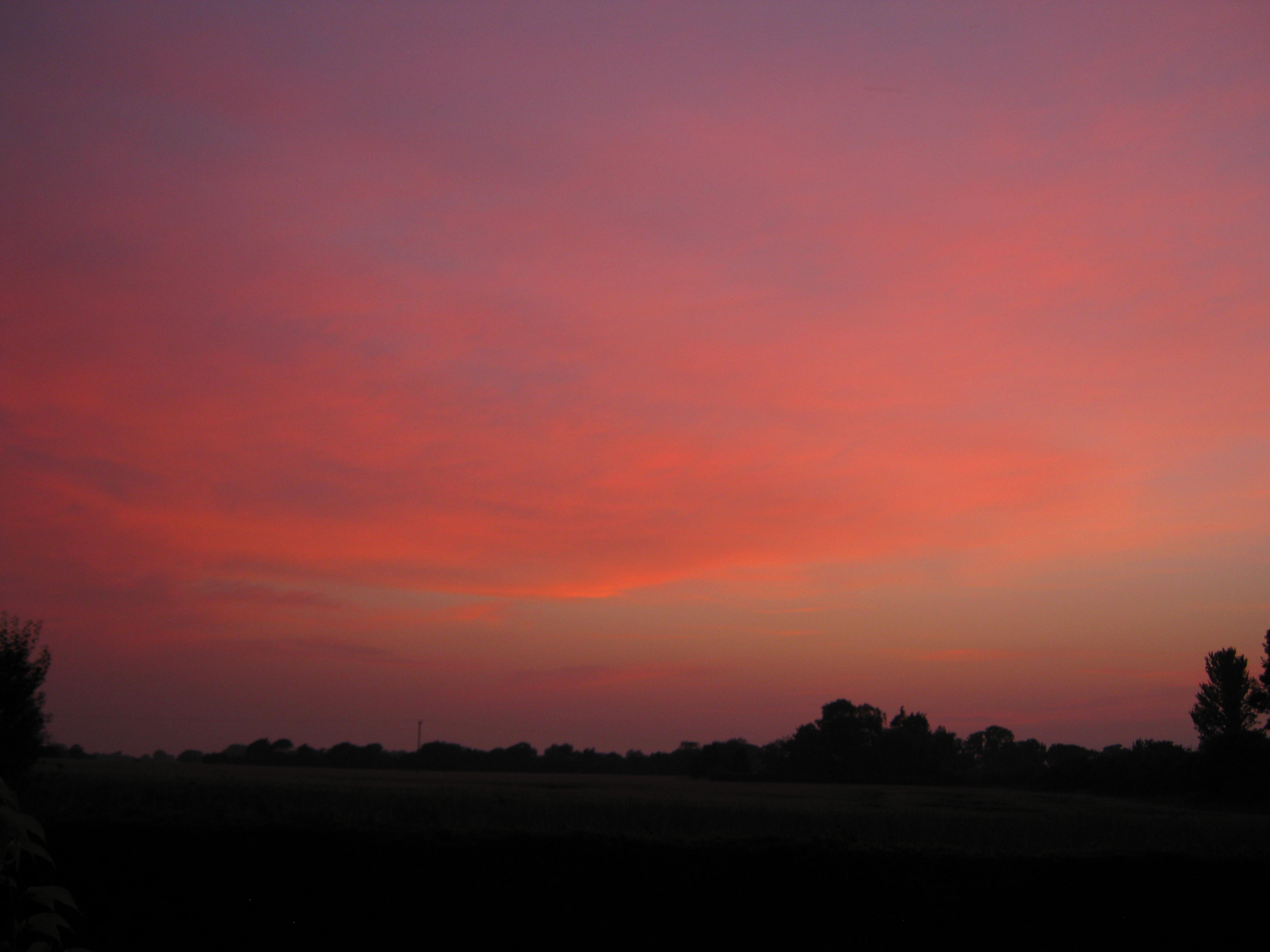
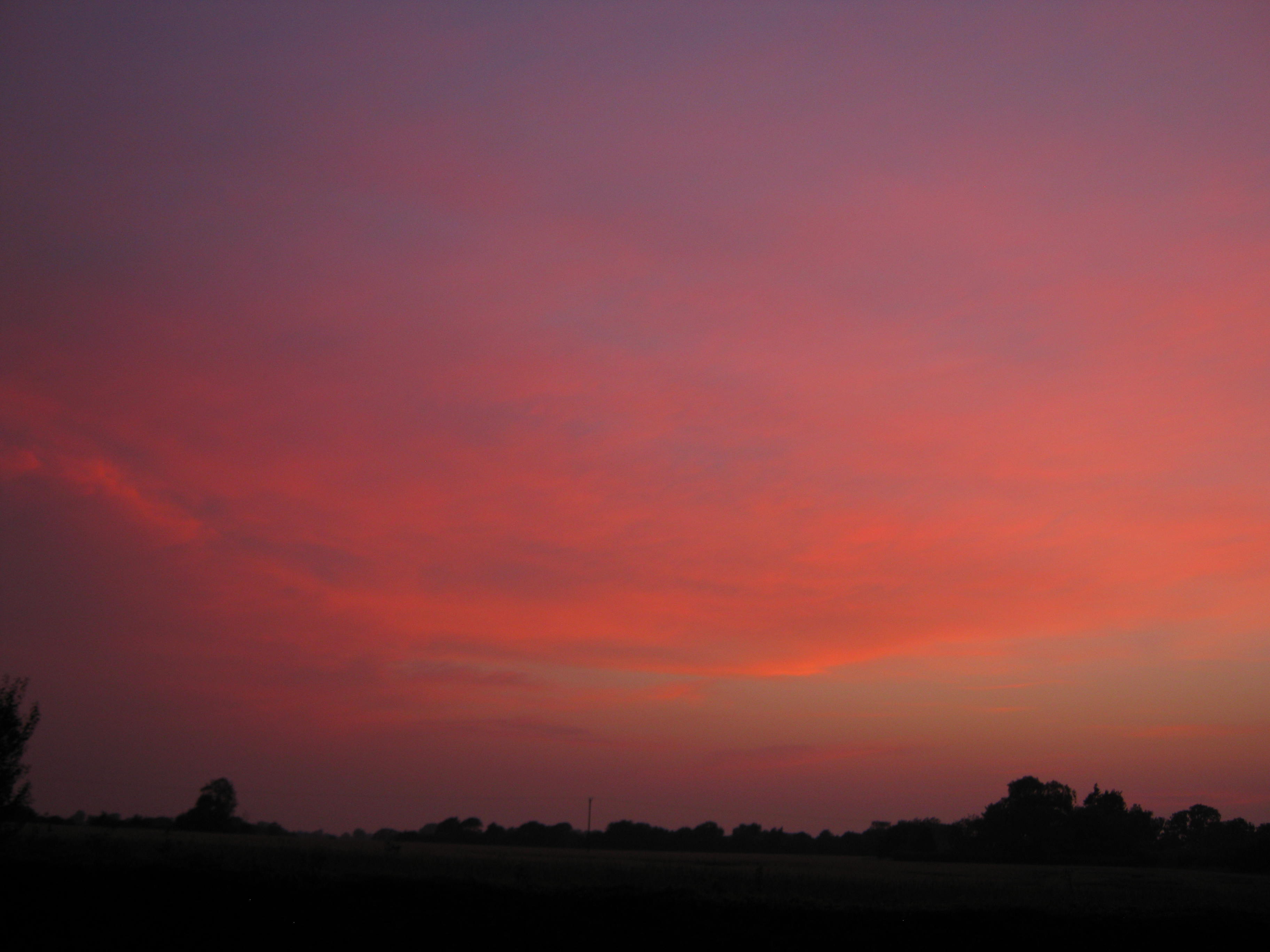
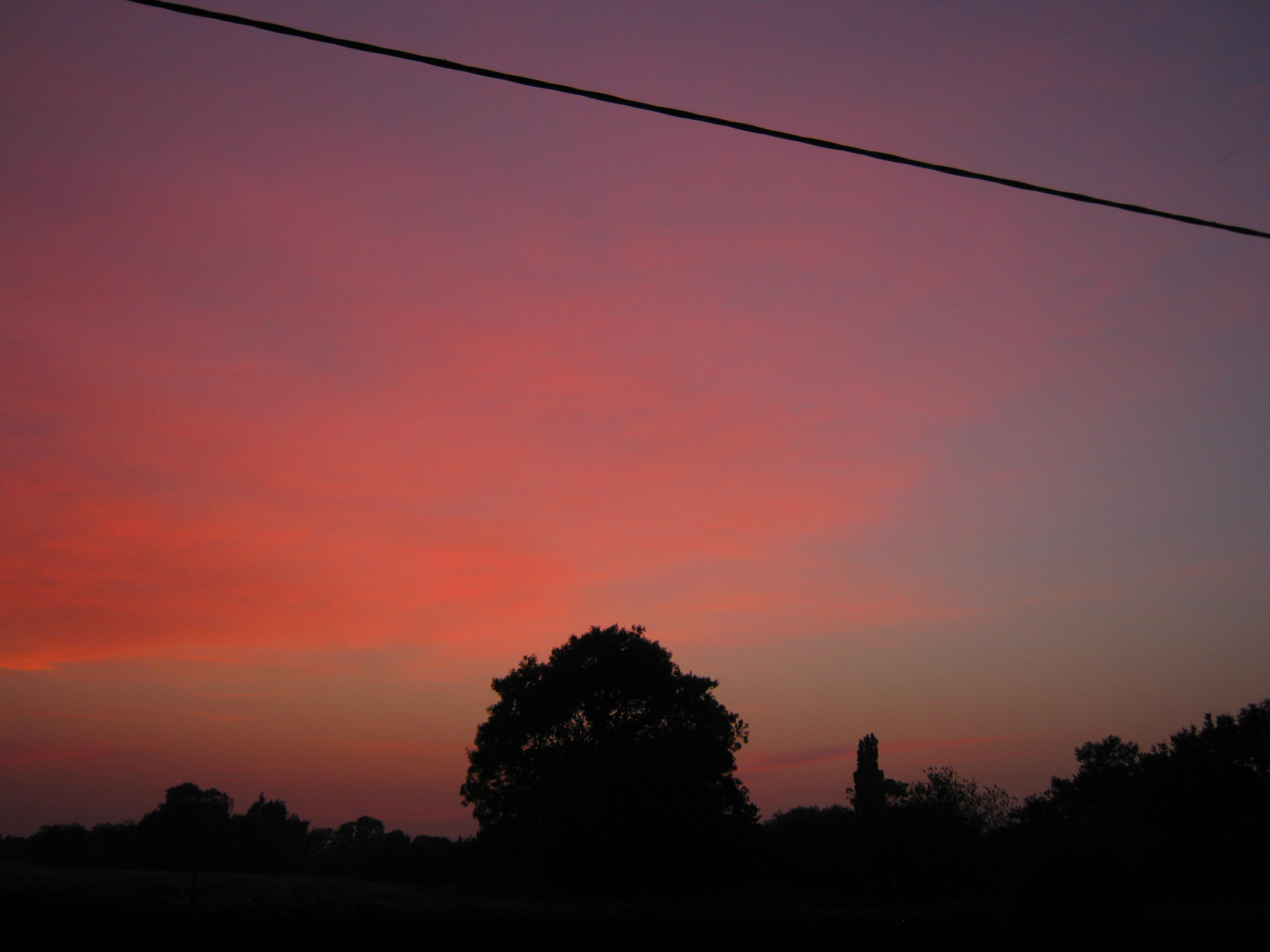
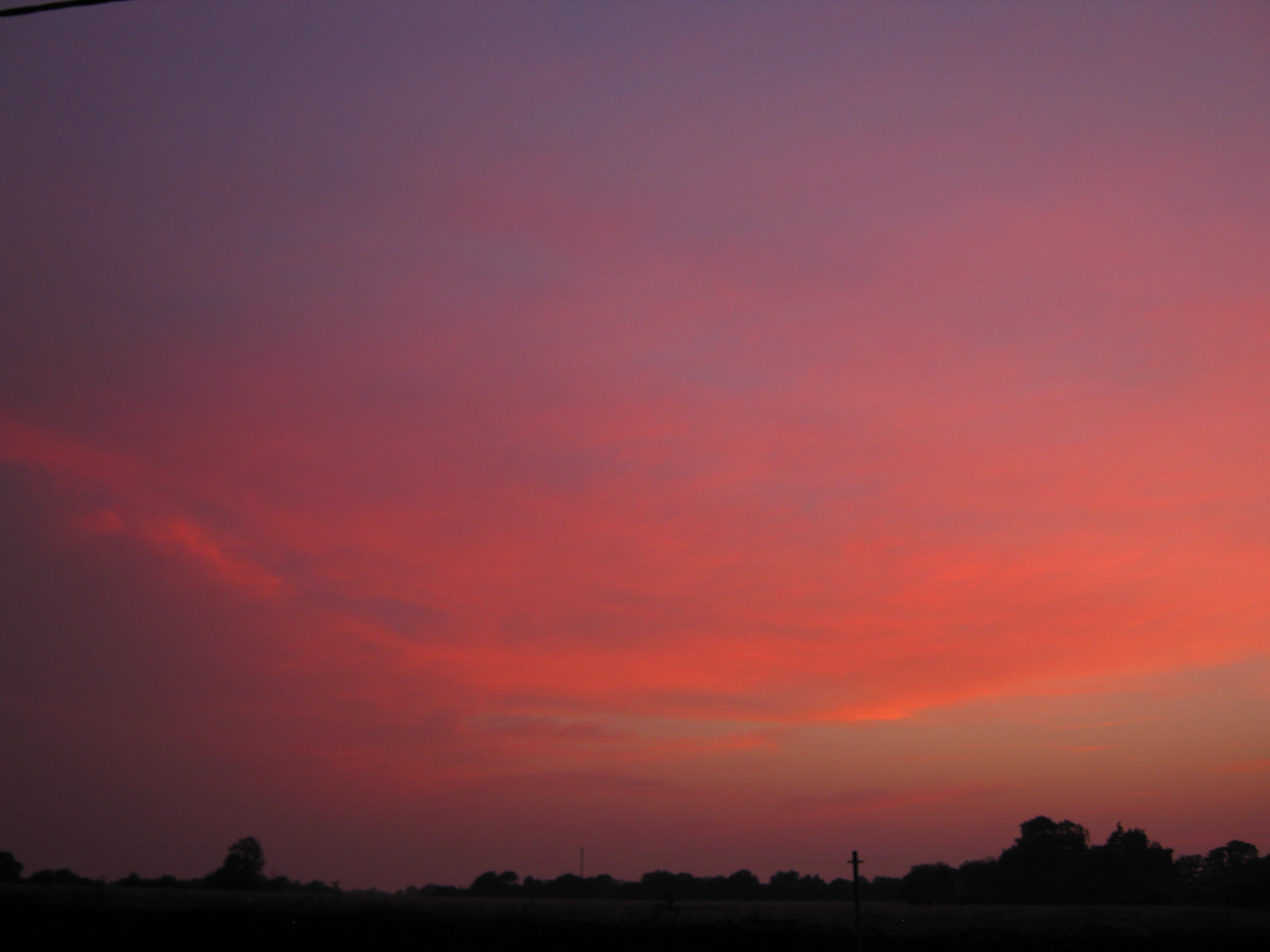
Despite all the dodgy weather we have had a plethora of beautiful sunsets recently so to end this post sooner rather than later and risk a crash again, these are the recent photos I have taken.001Sunset 28.06.14 006Sunset 28.06.14

Sunset on 28th June

005Sunset 006Sunset 007Sunset

Sunset on 13th July

023SSunset

Sunset on 17th July

047Sunset 048Sunset 050Sunset 051Sunset

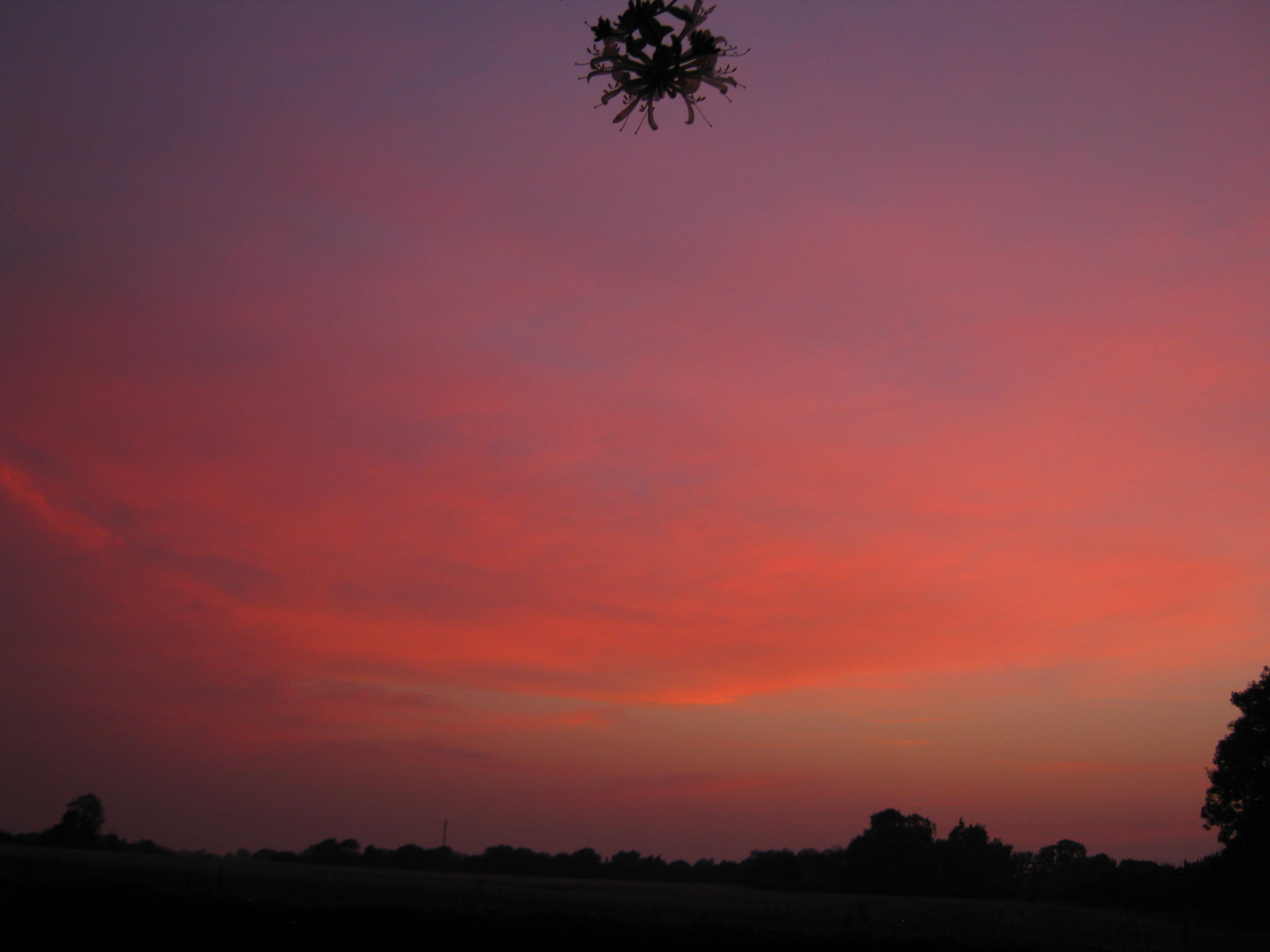
049Sunset

The strange object at the top of the photo is a honeysuckle flower which photo-bombed the sunset picture

Sunset on 18th July

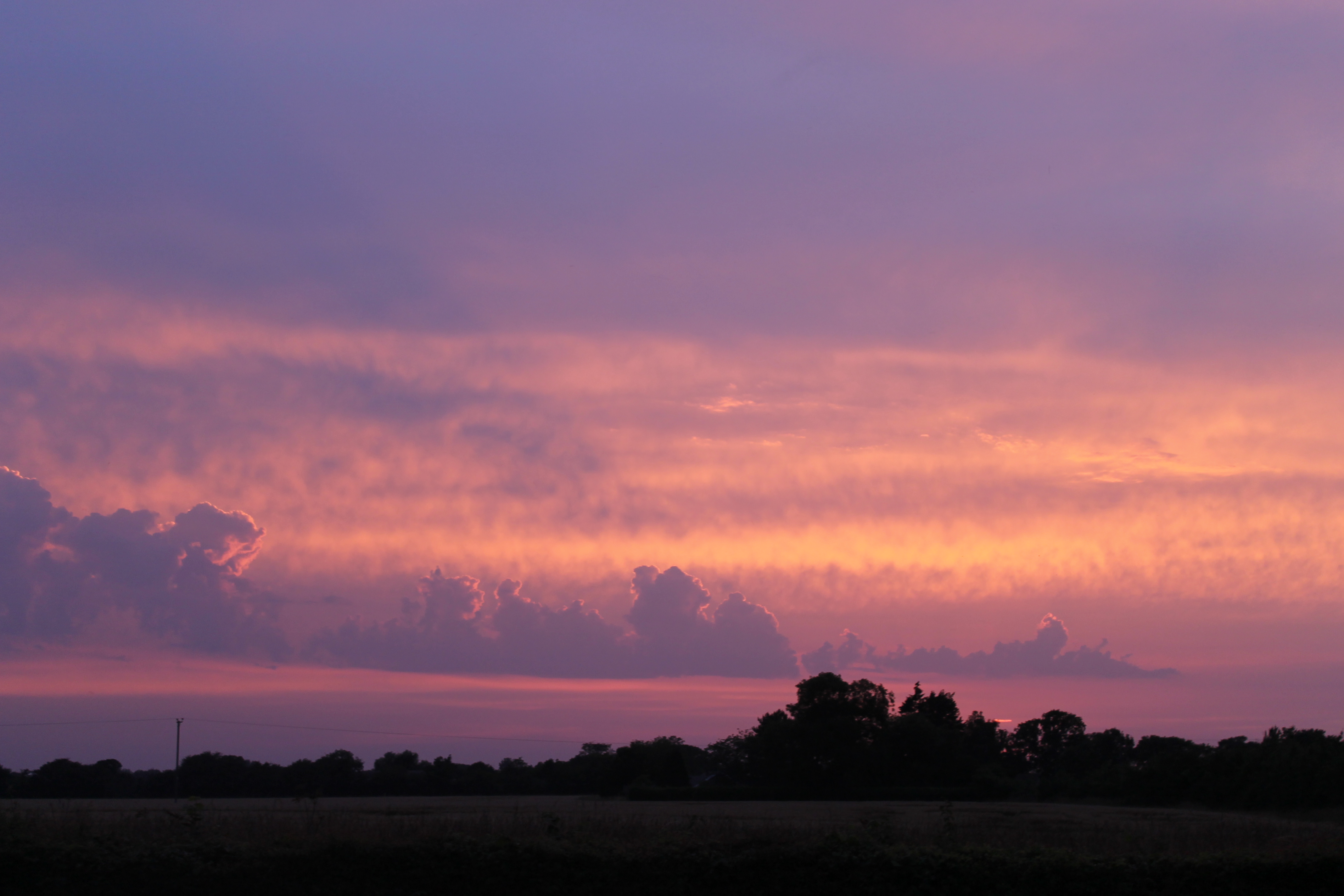
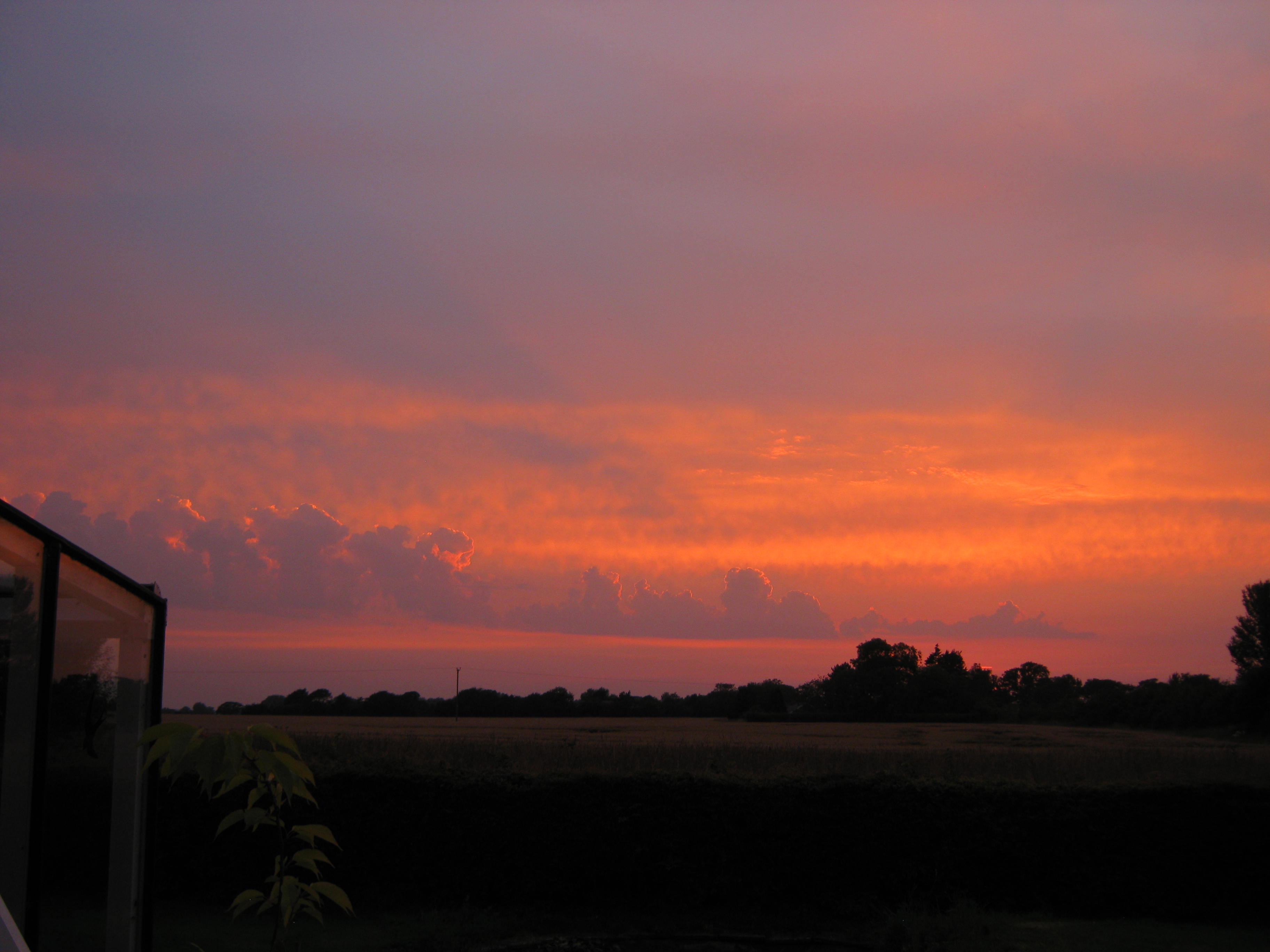
014Sunset 032Sunset 033Sunset 034Sunset 035Sunset 036Sunset 040Sunset

Sunset on 19th July

Half way through writing this post R and I had to go off to evensong at Rumburgh church.  After the service all the talk was about the amount of rain we have had in the last twenty-four hours and the thunder this afternoon which was a continuous rumble with not a pause.  One gentleman said he had two soak-aways in his front garden, neither of which were working.  The heavy boulder clay just under the top soil can be a trial sometimes.  The Rector was having the same trouble in his garden too.  One person was told we had 9ml of rain last night and someone else said we had 17ml of rain this afternoon.  In all, about 2″ of rain in a day. 

Share this:

  • Share on X (Opens in new window) X
  • Share on Reddit (Opens in new window) Reddit
  • Share on Pinterest (Opens in new window) Pinterest
  • Share on Facebook (Opens in new window) Facebook
  • Email a link to a friend (Opens in new window) Email
  • Share on Tumblr (Opens in new window) Tumblr
  • Print (Opens in new window) Print
  • Share on LinkedIn (Opens in new window) LinkedIn
Like Loading...

A Visit to Sheffield

10 Thu Jul 2014

Posted by Clare Pooley in churches, plants, Rural Diary, trees, Uncategorized

≈ 14 Comments

Tags

'The Company', abutilon, architecture, Botanical Gardens, canna, chapels, copper beech, Drama Studio, Ely Cathedral, eringium, George Etherege, HMS Sheffield, Man of Mode, memorial, Mrs Loveit, pavilions, pelargonium, review, Sheffield, Sheffield cathedral, Sheffield Star, Tour de France, water feature, Windy wet weather

We were away from home on holiday from Tuesday 1st July until Wednesday 9th July.  As we neared home on Wednesday the weather deteriorated – the sun disappeared, the wind picked up and the temperature dropped.  While we had been away the weather at home had been quite warm with a little sun but a lot of cloud according to my mother.  I took Mum out shopping yesterday and we were fortunate to be able to do it in the dry.  Shortly after getting home at 2.00pm the heavens opened and it rained for hours with some thunder and lightning.  I went for my monthly blood test this morning and chatted to my friend who is the phlebotomist at the medical centre.  Her daughter and my younger daughter E are the same age and were friends when E was able to go to school.  The Sixth Form Centre that Katrina attends was flooded yesterday and the roof was blown off the maths block so Katrina was enjoying a day off school.  My friend keeps horses and a tree had blown down in her paddock yesterday too.  The weather is quite autumnal at present.

001Wheat field

Wheat field behind our house

The wind and rain has done considerable damage to the fields of crops in the area.  Please note the overwhelming grey sky!

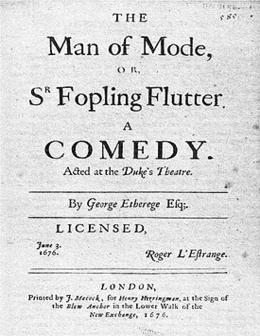
My last post ended with me about to visit my eldest daughter in Sheffield to watch her perform in George Etherege’s play ‘Man of Mode’.  The few times I have visited her I have only stayed for one night so this time I booked two nights in a hotel and hoped I would be less rushed and tired and would be able to see more of my daughter and more of the city as well.

The journey was virtually uneventful and there were no delays.  The air conditioning wasn’t working on the train and I was amused by a young man becoming hot and somewhat bothered trying to force open a locked window.  The conductor eventually wandered through the carriage and asked if we would like the window opened.  We were very pleased to see him open it with a key  – fresh air is a wonderful thing!

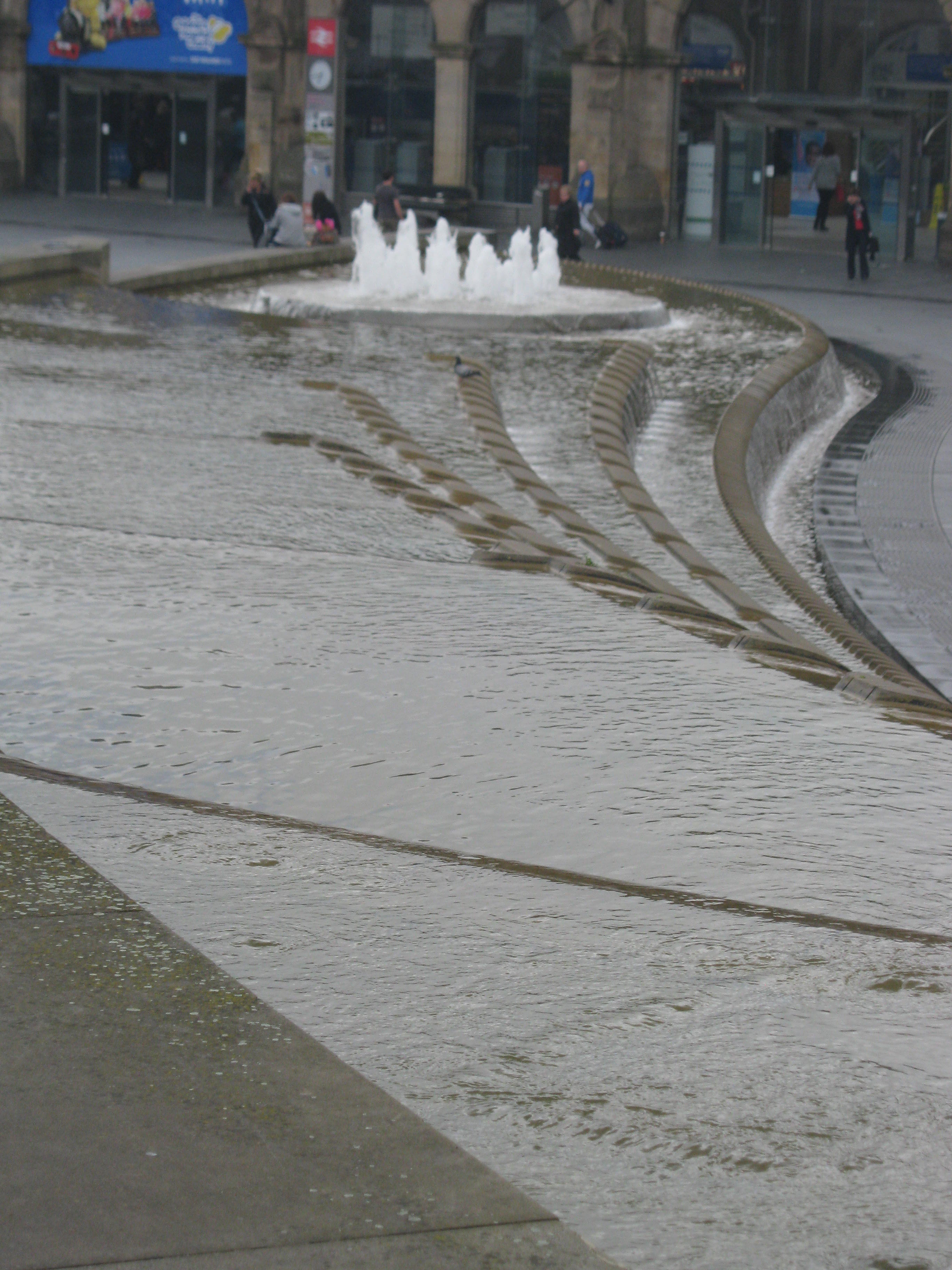
1479224Sheffield station approach

The approach to Sheffield station seen from the station  Google image

I have had to supplement my photos with some from the internet as not all of mine came out well.

I decided to walk to my hotel in the city centre as it was a fine afternoon and made myself a refreshing cup of tea.  After a short rest I went out shopping and bought some food for our early evening meal and took a taxi to A’s house. The taxi driver was friendly and told me all about his daughters and what he planned to have for his evening meal.  He was just about to finish work for the day.  I had arranged with A that she would be standing at the end of her driveway as I probably wouldn’t recognise her house.  I pointed her out to the taxi driver who waved at her.  He was surprised that she didn’t wave back but of course I told him she had been brought up well and didn’t wave to strange men in cars.

A made us a cup of tea and then we ate our meal and I enjoyed our chat.  I walked with her to the Drama Studio and while she got changed ready for the performance I waited outside for the doors to open.  I had plenty of time to re-acquaint myself with the view from the top of the steps.

019View from steps

Houses opposite the studios

018View from steps

Shops opposite the studios

I had plenty of time to stare at the door too…..

016Drama studio entrance

The entrance to the drama studios

and at some of the carved detail.

017Detail on entrance

I took a photograph of the studios the next day and looking at the resultant picture I see that either I wasn’t standing up straight or the building is leaning backwards.

051Drama studios

Drama Studios

I think it was me!

The building looks like a former church and from a photograph on display inside, I found that it had been used at one time as a synagogue.

I enjoyed the play immensely and was sorry that there were so few people in the audience.  A played the part of Mrs Loveit, a spurned mistress –  a jealous, bitter woman out for revenge.
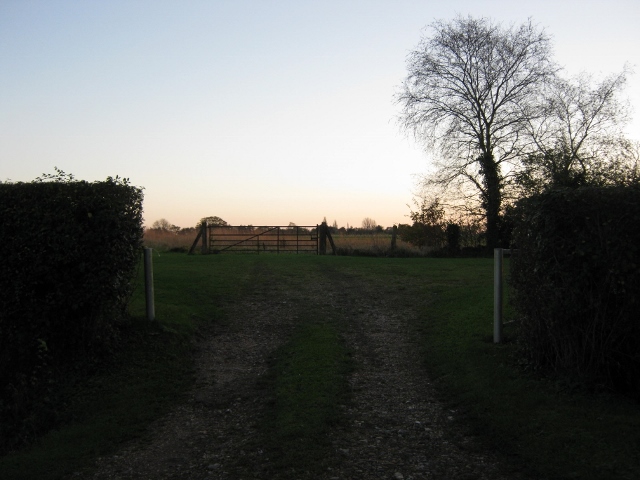
unnamed unnamedd

These are photos of A taken by a friend in the dressing room.  They do not quite show how beautiful she is or how good she looked in her costume.

I waited for her afterwards and we walked back to my hotel together and had a drink in the bar before she got the bus back to her house.

The next day we met mid-morning and she took me to see the Cathedral.

sheffield cathedral

Sheffield Cathedral Google images

It was formerly a parish church dedicated to St Peter and St Paul but was made a cathedral one hundred years ago in 1914.  There has been a church on the site for a thousand years but the oldest part of the present building dates from 1430.  Chapels were added over the years – for example in 1520 the 4th Earl of Shrewsbury built the Shrewsbury Chapel where he and his two wives have their tomb and there is a grand monument to the 6th Earl who was guardian to Mary Queen of Scots when she was imprisoned in Sheffield  from 1570-1584.

020Sheffield cathedral chancel

Chancel ceiling with golden angels

021Ceiling

Another ceiling


But by the 19th century it had also become very dilapidated.  A diarist of the time said that the church was ‘one of the most gloomy places of worship in the kingdom.’  This is no surprise as Sheffield is also known as ‘Steel City’ and in the 19th century the place was full of steel and iron foundries with furnaces blazing all day and night.  The dirt, soot and smoke must have been terrible.   The nave had to be demolished and rebuilt, the church was enlarged and the interior was modernised.

022Banners

Ancient banners hanging in one of the chapels

024Statue

Memorial


This lovely statue is a memorial to commemorate the special relationship between the city of Sheffield and ships of the Royal Navy bearing the city’s name.  It was placed in the cathedral on 17th April 2000 by His Royal Highness the Duke of York CVO ADC.  It is a tribute to all those who gave their lives in the service of their country.  British people remember that HMS Sheffield, a 4,100 tonne destroyer with a crew of 300 on board was hit by an Argentinian Exocet missile on 4th May 1982.  Twenty died and twenty-six suffered blast and burn injuries.  It was the first ship to be lost in enemy action since the Second World War.  Prince Andrew took part in the Falklands War.

027Chapel

A Chapel

031Chapel

A Chapel

The church was made a cathedral when the new diocese of Sheffield was formed.  Yet more plans were made to enlarge the cathedral but only some of the building works were carried out.  In the early 1960s more extensions were made including the narthex entrance and the west end was extended with a lantern tower.  The latter was repaired and new glass put in in 1998-1999.  Work is continuing to this day.

034The lantern

The Lantern

After admiring the Cathedral we walked up through the city to the Botanical Gardens  This was originally laid out in 1836 in the ‘Gardenesque’ style which featured winding paths and scattered plantings among tree-planted mounds.  The Gardens are listed by English Heritage as a Grade II site of special historic and architectural interest.  A major restoration programme was completed in 2005.

images Sheffield Botanical Gardens

Sheffield Botanical Gardens Google images

We wandered about the grounds admiring the plants and sat for a while on a bench.  I didn’t manage to take many photos unfortunately as both A and I were bothered by sore feet!

036Copper beech leaves (2)

Copper Beech leaves

039Eringium

Eringium

037Eringium

Eringium

040Glass house clock

A modern clock on the glass pavilion

The pavilions contain plants from the temperate regions of the world.  They are 90 metres long and contain thousands of panes of hand-blown glass.

045New plants on old

046Arbutus

Abutilon

047Canna

Canna

050Pelargonium

Pelargonium

043Unknown

048Unknown

Abutilon

We had lunch – a cream tea (scone, jam, clotted cream, cup of tea) in the restaurant and then went our separate ways – A back to her house to do some more writing and me to traipse all the way back to my hotel for another rest and then more shopping for food.

I decided to walk back to A’s house instead of taking the bus or going by taxi but half way there I almost regretted my decision as it was all uphill, quite warm and my shopping was heavy.  However, I managed it and felt very pleased with myself once I had got my breath back.  We ate together as we had done the day before and again I walked to the Studio with her and waited outside  for the doors to open.  There was a larger audience this evening and I enjoyed the performance as much as I had done the evening before.  I met A after the performance and said good-bye to her there as she was seeing friends after the show.  I walked back to my hotel quite exhausted having walked some miles in the past couple of days.  It had rained while we had been in the theatre but stayed dry for my walk back to the city centre.

053Steep hill down to station

Steep hill down to the station

The following morning I returned to the railway station.  Sheffield was getting itself ready for the Tour de France with banners and posters everywhere.

052Welcome to Sheffield

The water feature outside the station didn’t look so attractive on a cloudy day.

055Water feature

056Water feature

The train journey home went quite quickly and I enjoyed it more as I had a window seat this time.  We passed through lots of showers of rain and I managed to take a photo of Ely Cathedral as we pulled out of the station.

063Ely cathedral

066Ely cathedral

It is easier to see in the winter when the trees are bare!

A told me her play had been reviewed in the Sheffield Star so I looked it up on the internet.  A was described as ‘the excellent A S’ – but I could have told them that!


Share this:

  • Share on X (Opens in new window) X
  • Share on Reddit (Opens in new window) Reddit
  • Share on Pinterest (Opens in new window) Pinterest
  • Share on Facebook (Opens in new window) Facebook
  • Email a link to a friend (Opens in new window) Email
  • Share on Tumblr (Opens in new window) Tumblr
  • Print (Opens in new window) Print
  • Share on LinkedIn (Opens in new window) LinkedIn
Like Loading...

Here be Dragons!

24 Tue Jun 2014

Posted by Clare Pooley in churches, Insects, music, plants, Rural Diary, Uncategorized

≈ 19 Comments

Tags

Aldeburgh Festival, Banded Demoiselle, Black-tailed Skimmer, bouquet, Broad-bodied Chaser, butterflies, damselflies, dentist, dragonflies, Four-spotted Chaser, Greater Bindweed, Hedge Brown, Ian Bostridge, Large Skipper, lavender, moths, Schubert's 'Winterreise', Six-spot Burnet, Small Tortoiseshell, Snape Maltings, Suffolk Punch, The Man of Mode by George Etherege, Thomas Ades, wedding, wedding anniversary


Image

Four-spotted Chaser

Our garden is full of dragonflies and damselflies.

Most of the UK was basking in warm sunshine last week; Suffolk was one of the areas which wasn’t.  We spent most of the time under a thick pall of cloud.  There was a strong northerly breeze and some rain, though not much; certainly not enough.  The butterflies and dragonflies only flew when a watery sun appeared through a crack in the cloud, which wasn’t often.  The highest temperature I recorded was 16 degrees centigrade.  The weather started to improve towards the end of the week with the wind changing direction from northerly to a warmer south-westerly.  The clouds then began to disperse.  The weekend was really quite fine and Monday morning was too.  Unfortunately, we had a couple of heavy showers of rain in the afternoon and more of the same overnight.  Today started with thick mist and then it wasn’t too bad until this afternoon when we have had torrential rain and thunder storms.  At least today we have had a good amount of rain which has freshened things up nicely.

Image

Lavender covered in butterflies (mainly Small Tortoiseshells)

Monday 16th was cool and showery and I had to visit the dentist because of a painful tooth.  I had made the appointment a week before when my tooth had been aching for some days.  It continued to hurt until a couple of days before the appointment and then suddenly felt better.  I thought I’d better keep the appointment just in case there was really a problem.  My dentist did her best to find something wrong with my tooth – she x-rayed it and bruised my gum with the x-ray plate.  She poked and prodded it very hard a number of times with that sharp spiky thing dentists use.  She gripped it very hard between finger and thumb and tried to wriggle it and pull it out.  She hit it hard a few times with a blunt metal object but fortunately for me there didn’t appear to be anything wrong.  I left the surgery feeling as though someone had punched me in the face.
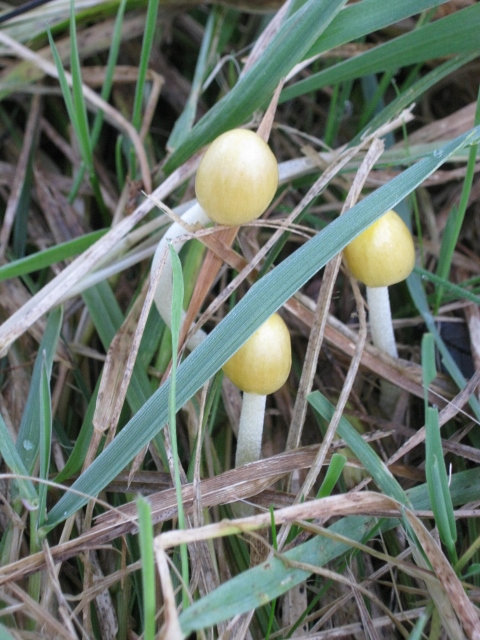
Tuesday 17th was a much better day – some sunshine and a strong breeze which dried my washing.

Wednesday 18th was another busy shopping day – firstly with Mum who hadn’t been feeling too well and then some shopping for us. I also collected a quantity of medication from the doctors’ surgery.  Wednesday was also our 20th wedding anniversary and R was due home from working in Gloucestershire that evening.  Quite often he is away from home on our anniversary but this year was nicely different.  He brought me home a bouquet of flowers which was very kind and thoughtful of him.

Image

In recent years we haven’t bought each other gifts but have gone somewhere nice together – a stately home, a beautiful garden – or we have bought something we both wanted – a garden bench, a favourite film to watch together.  This year R suggested we go out for a meal to the place we went to on our first date.  Of course I agreed.  We decided not to go out on the anniversary itself as R would have spent some hours driving and would be tired (as he was).  We booked a table for Friday evening and invited E to come with us.  She is the daughter of our marriage and should therefore be with us to celebrate.  She agreed to come too.
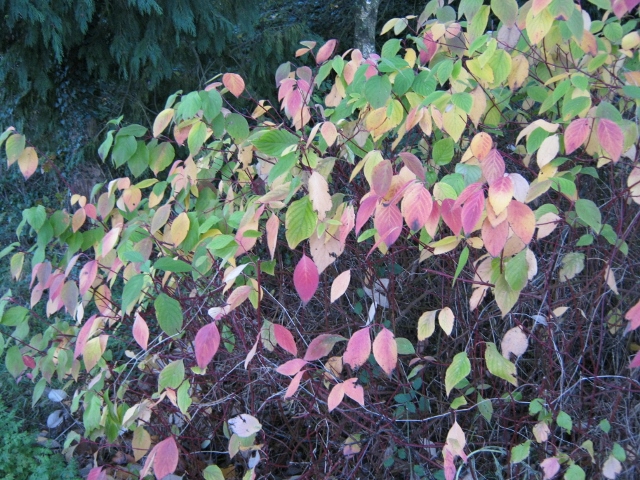
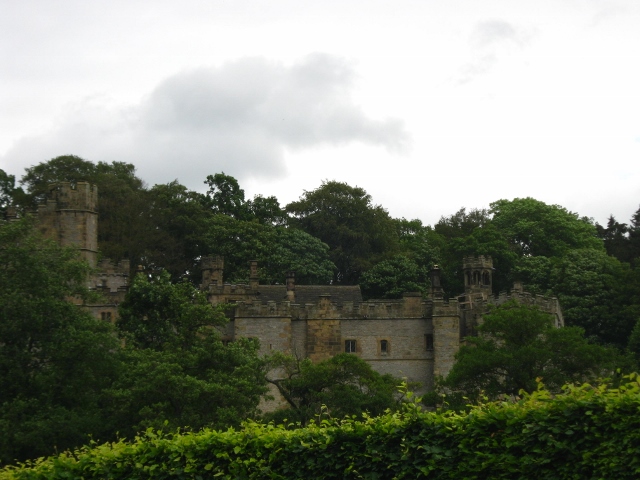
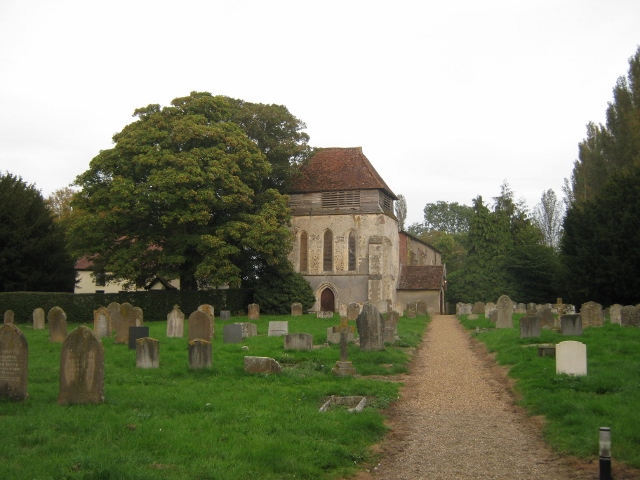
Thursday 19th, Corpus Christi, and though there was a service at church at 9.00a.m. I wasn’t able to go as E had an interview that morning at City College Norwich.  Surprisingly, E was fairly calm and even managed to eat some breakfast before we set off.  I parked in the city centre again and we walked to the college from there as before.  By the time we got to the college E was starting to feel very apprehensive and when I left her outside the interview room she was very frightened and extremely pale.

She re-appeared an hour and a half later having had an interview and done a short maths and English test.  I was so proud of her and pleased that she had been able to go through with the interview and test.

E has had many problems to deal with in her seventeen years.  She has scoliosis (curvature of the spine) and has had problems with her feet.  Both of these problems are now well under control but getting help initially was very difficult.  E had to contend with a lot of bullying at school too.  Always of a nervous disposition and insecure she developed chronic anxiety which brought on panic attacks.  She was helped extremely well in her Middle School but when she went up to High School the problem got so bad that eventually she was unable to attend school and wasn’t able to take her GCSE exams last summer.  Eventually we found a really good therapist who taught her how to control her anxiety.  She still has a long way to go but she has started to make a life for herself.  The City College has a course for young people who have had interrupted education and they know exactly how to treat these young people with kindness and understanding.  Their dignity is preserved and they are not made to feel guilty or odd.  You can understand now why I was so proud of my dear daughter.

R and I spent an hour or so cleaning the church again that evening.  There was to be a large wedding there on Saturday and the florist was coming to decorate the church on Friday so we had to do the cleaning first.  We decided to buy take-away fish and chips for our evening meal to save having to cook.  A real treat!

Friday 20th was a brighter day and got gradually warmer until the afternoon was quite summery.  I had a blood test in the morning then did yet more shopping.  The afternoon was spent doing housework – very tedious.  Our anniversary meal was very pleasant.  The inn looks very different from how it was when R and I went there in January 1993.  A large dining area with plenty of glass in the roof and large floor to ceiling glass windows has been added on at the back.

Saturday 21st.  A lovely summers day at last.  We were so pleased for the couple getting married today.  I went to collect some supplies from the chemist and R did some gardening – mainly hedge-cutting – and then went off on his bike to perform his Church Warden duties at the wedding.   The bride had arrived in an open carriage drawn by two Suffolk Punch horses.

Image

The church had been beautifully decorated with flowers.

Image

Image

Image

Sunday 22nd was another fine day and R and I went to church at St. James’ church.  I cooked our main meal as soon as we got home instead of in the evening as we usually do.  This was because I was going with my mother to a concert at Snape Maltings in Aldeburgh.  The Aldeburgh Festival is taking place at the moment and this year is its 67th since it was started by the composer Benjamin Britten and his partner Peter Pears.

Snape

Snape Maltings. Photo courtesy of The Daily Telegraph

Tickets for concerts at Snape are not that expensive but it is almost impossible to get them.  If one has enough money to be able to afford to become a Friend of Snape,  and the cheapest annual payment to become a Friend is £300, one can buy tickets earlier by weeks than the hoi-polloi like me.  All the best tickets are snapped up very quickly and us poor commoners are left with the crumbs.  I have decided to pay £15 a year so that I am e-mailed the programme of concerts.  This means I get to see the list of concerts a day before the people who receive the programme by post.  £15 for an e-mail!!

The concert that Mum and I attended was very good and I feel very lucky to have been there.  Ian Bostridge, tenor, accompanied by Thomas Ades on the piano performed Schubert’s song cycle ‘Winterreise’.  We have been to hear both these wonderful musicians before so knew that we were going to have a good concert.  I studied ‘Winterreise at school and grew to love it then so was really looking forward to the evening.  The concert started at 8.00p.m. and the whole cycle was sung without an interval.  We set off for home just after sunset and were home before dark.

Monday23rd was a busy day with lots of washing and shopping.

I took Mum out shopping today instead of on Wednesday as I am going to see A in Sheffield tomorrow and will be staying there for two nights, coming back home on Friday.  A is performing in another play and I am looking forward to seeing her in it.  I decided it might be nice to stay in Sheffield a little longer than usual as I would like to see the Botanical Garden which A says is very pleasant.  I might also do a little shopping!  A is still trying to finish her PhD but everything seems to be conspiring against her.  She recently had a fall and broke one of her fingers which has not made her PhD typing marathon easy.  She is unemployed again and has no income which is very worrying for her.  The play she will be performing in is ‘The Man of Mode’, a Restoration comedy written by George Etherege.

275px-George_Etherege_The_Man_of_Mode_frontspiece_1676

As I said at the beginning of this post, the garden is full of dragonflies and damselflies.  The garden is also full of Small Tortoiseshell butterflies especially, and a few other butterflies and insects.

010Skipper

Skipper butterfly

I think this is a Large Skipper.

011Tortoiseshell

Small Tortoiseshell

070Tortoiseshell butterfly

Small Tortoiseshell

I have included two photos of these butterflies to show the difference between a newly emerged butterfly and one that has been flying for a few days.  The second one is so bright!

002Six-spot Burnet on lobelia

Six-spot Burnet moth on lobelia

050Dragonfly

Dragonfly

051Four-spotted chaser

Four-spotted Chaser

045LLavender with butterflies

Meadow Brown butterfly

056Female banded demoiselle

Female Banded Demoiselle

057Greater bindweed flower with pollen beetle and micro moth

Greater Bindweed flower with unidentified micro-moth and pollen beetle

The Greater Bindweed flower is the largest of our native flowers.

058Male broad-bodied chaser

Male Broad-bodied Chaser

060Male black-tailed skimmer

Male Black-tailed Skimmer

The last photos I am including are of Small Tortoiseshells again.

069Lavender with butterflies (cartoon) (2)

The reason I am including this photo is because…..

069Lavender with butterflies (cartoon)

….of this!!

Share this:

  • Share on X (Opens in new window) X
  • Share on Reddit (Opens in new window) Reddit
  • Share on Pinterest (Opens in new window) Pinterest
  • Share on Facebook (Opens in new window) Facebook
  • Email a link to a friend (Opens in new window) Email
  • Share on Tumblr (Opens in new window) Tumblr
  • Print (Opens in new window) Print
  • Share on LinkedIn (Opens in new window) LinkedIn
Like Loading...
← Older posts
Newer posts →
Follow A Suffolk Lane on WordPress.com

Enter your email address to follow this blog and receive notifications of new posts by email.

Join 718 other subscribers.

Unknown's avatar

I talk about what it's like living in a quiet part of Suffolk. I am a wife, mother and daughter, a practising Christian and love the natural world that surrounds me. I enjoy my life - most of the time!

My Posts

Mar 2026
M T W T F S S
 1
2345678
9101112131415
16171819202122
23242526272829
3031  
« Feb    

Pages

  • About my Blog
  • GDPR (General Data Protection Regulations) and This Site
  • My Life in a Suffolk Lane

Archives

Blogs I Follow

Unknown's avatar
Unknown's avatar
Unknown's avatar
Unknown's avatar
Unknown's avatar
Unknown's avatar
Unknown's avatar
Unknown's avatar
Unknown's avatar
Unknown's avatar
Unknown's avatar
Unknown's avatar
Unknown's avatar
Unknown's avatar
Unknown's avatar
Unknown's avatar
Unknown's avatar
Unknown's avatar
Unknown's avatar

Posts I Like

  • Talkmore's avatar
  • Unknown's avatar
  • Schnippelboy's avatar
  • Unknown's avatar
  • Kathleen's avatar
  • Unknown's avatar
  • Amin Academy's avatar
  • Unknown's avatar
  • jonathonbhoyt's avatar
  • Unknown's avatar
  • Unknown's avatar
  • Unknown's avatar
  • Unknown's avatar
  • Matthew Paul's avatar
  • Unknown's avatar
  • East of Elveden's avatar
  • Unknown's avatar
  • John’s Postcards's avatar
  • Unknown's avatar
  • Unknown's avatar
  • John Hric's avatar
  • Stephen G. Hipperson's avatar
  • Unknown's avatar
  • Unknown's avatar
  • Unknown's avatar
  • Unknown's avatar
  • Unknown's avatar
  • Unknown's avatar
  • Martha's avatar
  • Unknown's avatar
  • Resa's avatar
  • JAM's avatar
  • Unknown's avatar
  • sietchjameseguin's avatar
  • Unknown's avatar
  • Unknown's avatar
  • Unknown's avatar
  • santable's avatar
  • Unknown's avatar
  • Unknown's avatar
  • wholelottarosie's avatar
  • Carolina Cuisine Network's avatar
  • Unknown's avatar
  • Unknown's avatar
  • Unknown's avatar
  • Unknown's avatar
  • Unknown's avatar
  • cindy knoke's avatar
  • Unknown's avatar
  • Julian Summerhayes's avatar

amphibians architecture art Arts and Crafts churches cooking Days out domestic animals family fish Folk Traditions Gardening Historic Buildings holidays Insects Landscaping literature music Norwich plants Rural Diary seashore theatre trees Uncategorized walking weather wild animals wild birds wild flowers

Tags

architecture autumn birds blackbird blackthorn Bungay butterfly church clouds common knapweed cow parsley crocus daffodils Diary dogwood family field maple flowers fungus garden gardening geese greylags ground-ivy Halesworth Hawthorn heather holiday Holly Holy Week horse chestnut Hoverfly insects ivy Lake District Lent lesser celandine lichen Lords and Ladies Mallard mallards Minsmere moorhen moss music Norwich Peak District pheasant plants pond ponds primrose primroses Rain rooks Rumburgh Rumburgh Church sheep Sheffield snow snowdrops Southwold spring Suffolk Suffolk Wildlife Trust sunset the Beck trees viburnum bodnantense walking weather wild cherry wild flowers winter-flowering honeysuckle witch-hazel

Meta

  • Create account
  • Log in
  • Entries feed
  • Comments feed
  • WordPress.com

Goodreads

Blog at WordPress.com.

Book Jotter

Reviews, news, features and all things books for passionate readers

Country Life Blog -

A blog about life in the country in the past and present

Matthew Paul: Poetry & Stuff

Poetry and what-not

Schnippelboy

Ein Tagebuch unserer Alltagsküche-Leicht zum Nachkochen

TAMARA JARE

Tamara Jare Contemporary Figurative Art – Bold Colors, Resilient Souls

A Taste of Freedom

Documenting a Dream

Country Ways

Rambling Journeys in Britain, Countryside Matters and campaigning for the Right to Roam

The Strawberry Post

Here to Entertain, Educate & Inspire!

a north east ohio garden

an ongoing experiment in the dirt, 35 plus years

naturechirp

Celebrating God's creatures, birds and plants...

Sophie Neville

Writer

Going Batty in Wales

Developing a more sustainable lifestyle in SW Wales

Our Lake District Escapades

Exploring the Lake District and beyond

Short Walks Long Paths

Wandering trails around the coast of Wales

The Biking Gardener

An English persons experience of living and gardening in Ireland

Nan's Farm

A Journal Of Everyday Life

Walk the Old Ways

Rambling Journeys in Britain with John Bainbridge. Fighting for the Right to Roam. Campaigning to Protect Our Countryside.

Writer Side UP!

Waking the Writer Side...and keeping it "Up!"

Meggie's Adventures

Travel, thank you notes and other stories

amusicalifeonplanetearth

Music and the Thoughts It Can Inspire

lovefoundation.co.uk

Traveling Tortuga

Simply Living Well

Pakenham Water Mill

Historic watermill in the beautiful Suffolk countryside

Take It Easy

Retired, not expired: words from the after(work)life. And music. Lots of music!

Secret Diary Of A Country Vicar's Wife

By Olive Oyl

thanksfortheadventureorg.wordpress.com/

The Beat Goes On

#TBGO

Frank Pleszak's Blogs

Twitter: @frankpleszak @PolishIICorps

John Bainbridge Writer

Indie Writer and Publisher

roughwighting

Life in a flash - a bi-weekly storytelling blog

Walking the Old Ways

Rambling in the British Countryside

CapKane

thoughts on social realities

SkyeEnt

Jottings from Skye

jodie richelle

embracing my inner homemaker

Skizzenbuch/Blog

Just another WordPress.com weblog

Have Bag, Will Travel

The Call of the Pen

Flash Fiction, Book Reviews, Devotionals and other things.

John's Postcards

Art in Nature

You dream, I photographe it !

Smile! You’re in Barnier World......

theinfill

the things that come to hand

Dr. Mary Ann Niemczura

Author of "A Past Worth Telling"

Provincial Woman

The Pink Wheelbarrow

Luanne Castle: Poetry and Other Words (and cats!)

Poetry, Other Words, and Cats

The Family Kalamazoo

A genealogical site devoted to the history of the DeKorn and Zuidweg families of Kalamazoo and the Mulder family of Caledonia

everythingchild

The Book Owl

Canberra's Green Spaces

Paul Harley Photographer

  • Subscribe Subscribed
    • A Suffolk Lane
    • Join 718 other subscribers.
    • Already have a WordPress.com account? Log in now.
    • A Suffolk Lane
    • Subscribe Subscribed
    • Sign up
    • Log in
    • Report this content
    • View site in Reader
    • Manage subscriptions
    • Collapse this bar
 

Loading Comments...
 

    Privacy & Cookies: This site uses cookies. By continuing to use this website, you agree to their use.
    To find out more, including how to control cookies, see here: Cookie Policy
    %d