• About my Blog
  • GDPR (General Data Protection Regulations) and This Site
  • My Life in a Suffolk Lane

A Suffolk Lane

~ A diary of my life in rural north Suffolk.

A Suffolk Lane

Category Archives: Uncategorized

Peak District Holiday 1st to 9th July. Day 4 Part 3

22 Wed Oct 2014

Posted by Clare Pooley in Rural Diary, Uncategorized

≈ 18 Comments

Tags

cable cars, Heights of Abraham, Matlock Bath, petrifying well, River Derwent, thermal springs

Before I begin this post I must say thank-you to all those who made such kind remarks about my previous post.  I am sure you were all crossing your fingers behind your backs while you typed those compliments with the other hand!  I am nevertheless very grateful to you all.  (This post is much shorter you will be pleased to hear).

145Matlock Bath (640x480)

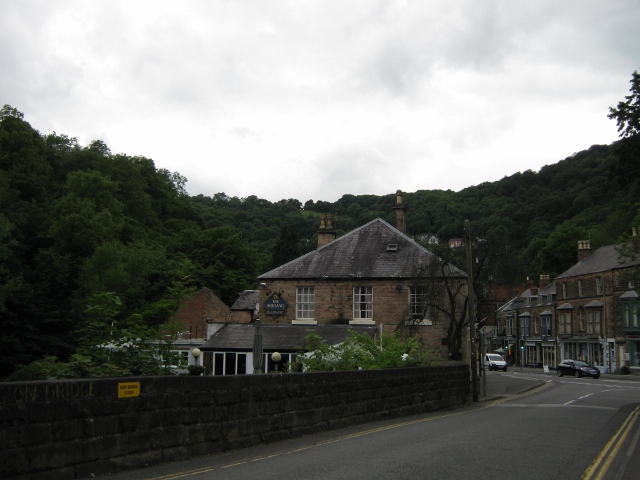
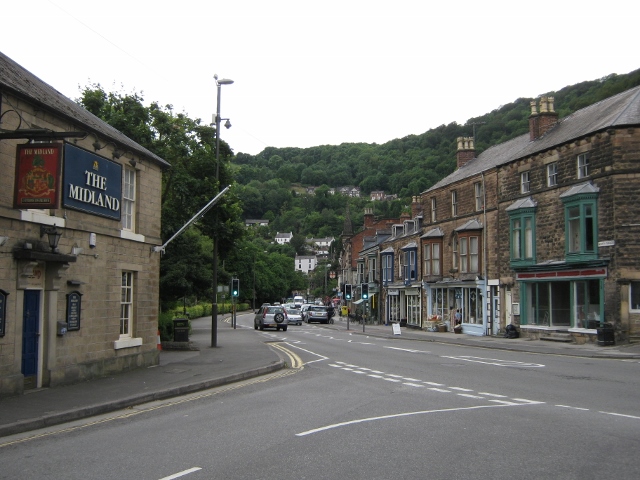
Matlock Bath village

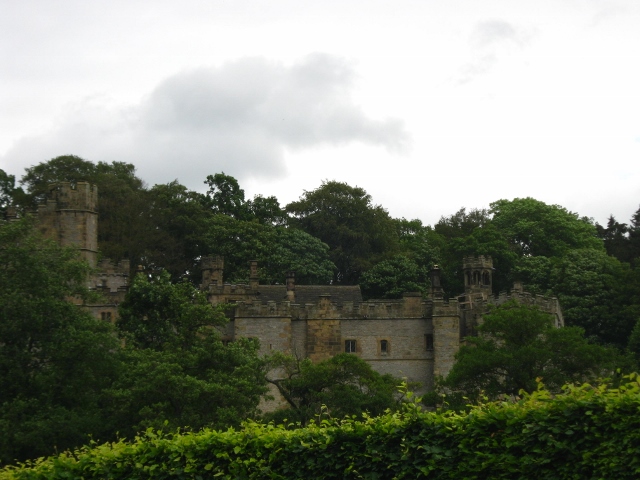
After our walk around Haddon Hall R and I had a hot drink and a little something to eat in the cafe situated in the old stables.  We then drove to Matlock Bath – somewhere we had never visited before.

146Matlock Bath (640x480)

Matlock Bath village

We found somewhere to park along the main road through the village and then wandered about looking at what there was to see.  We both thought it had the same atmosphere as many of our seaside towns – a sort of faded elegance and we felt almost as though we had gone back in time.  The amusements on offer were very similar to those available to tourists 150 years ago.  In fact, Matlock Bath was developed as one of the country’s first tourist destinations in the late 17th century when the spa waters were discovered.  The village is situated in the gorge of the River Derwent and is surrounded by rocky crags and wooded hillsides.  The poet Lord Byron described it as ‘Little Switzerland’.  There are the ‘Riverside Gardens’ to visit and ‘Lover’s Walks’ to stroll along.

We discovered The Matlock Bath Aquarium and Exhibitions building – a virtually un-modernised Victorian hall with grand doors and a little toll-booth at the entry.  We paid our entrance fee and ascended a wide staircase at the top of which were display cabinets full of curios.

134Dinosaur eggs (640x480)

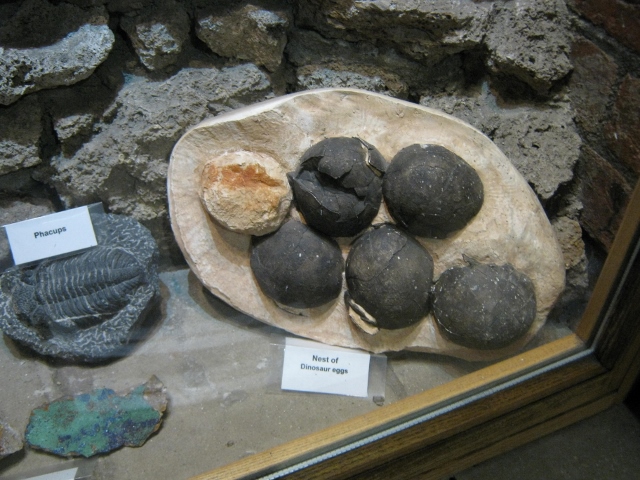
A nest of dinosaur eggs

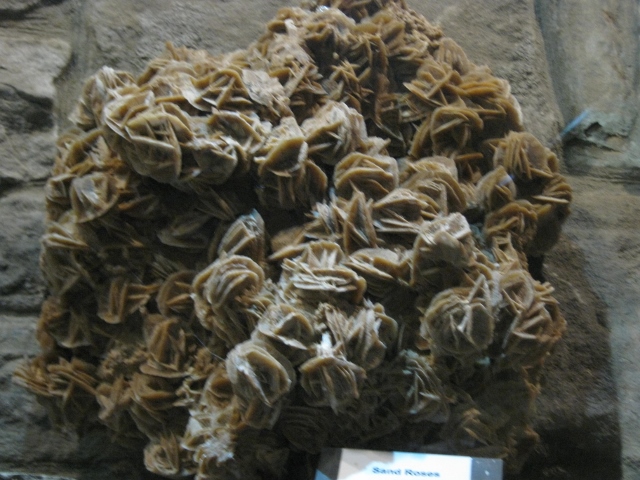
135Sand roses (640x480)

Sand Roses

These are crystal clusters of gypsum or baryte which include abundant sand grains (Wikipedia)

There was an enormous exhibition of holograms (one of the largest displays in Europe), an aquarium and a room full of Goss and Crested China.  It seemed as if we were at an old-fashioned fairground attraction – so strange.

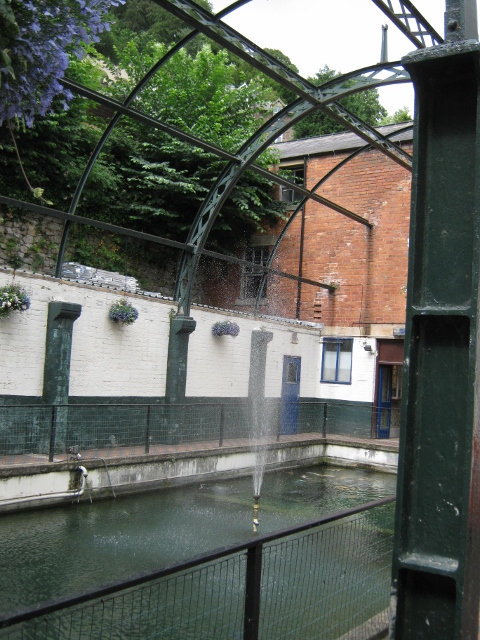
137Hydro (480x640)

Thermal Pool

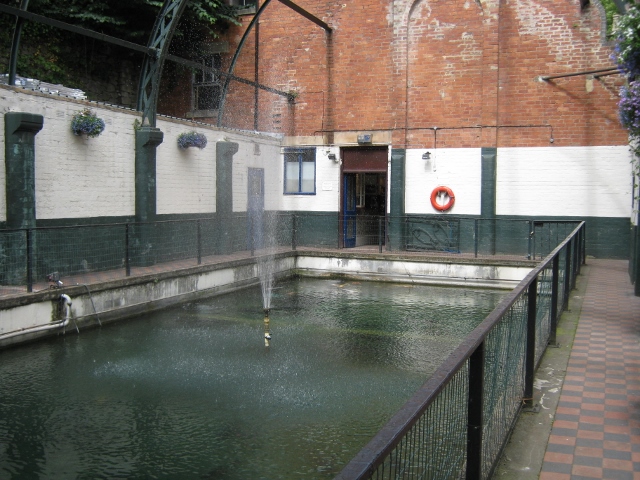
136Hydro (640x480)

Thermal Pool

The old thermal pool is now home to a large carp collection.

There was a ‘Past Times in Matlock Bath’ exhibition.

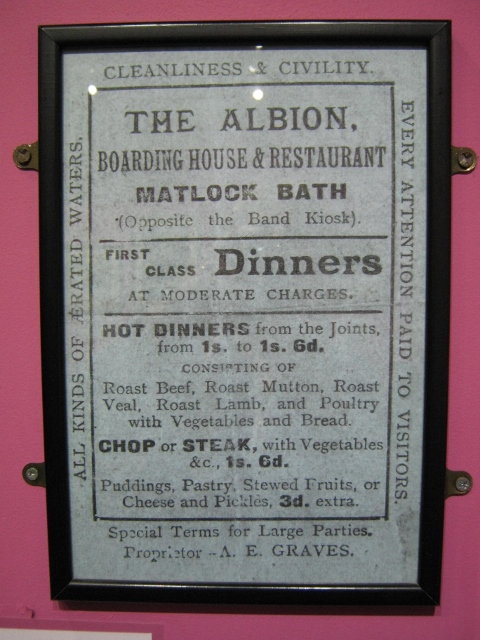
139Old Advert (480x640)

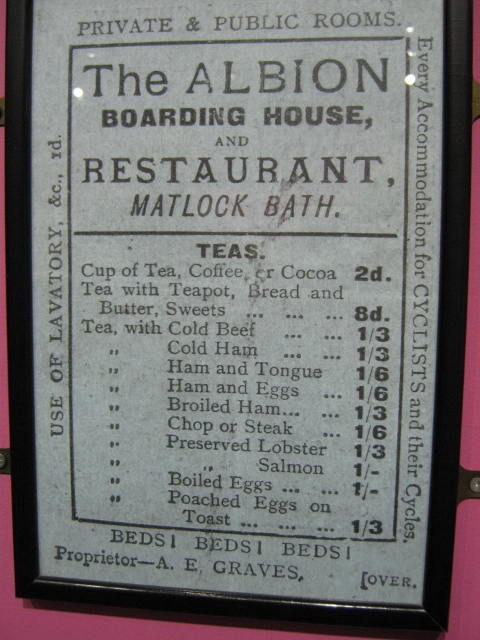
Hotel flyer

138Old advert (480x640)

Hotel flyer

I could imagine a character from one of HG Wells novels staying at this boarding house.

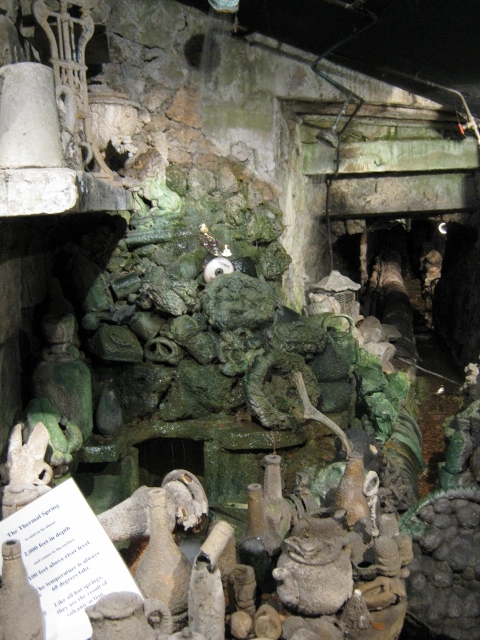
This place is the site of the only ‘Petrifying Well’ in Matlock Bath.

129Petrified objects (480x640)

Petrified objects.

I can see lots of bottles, a teapot, a jug, a shuttlecock, a basket of bread-rolls, boiled eggs in an egg holder, a telephone and a hot water-bottle.  The thermal spring is said to be about 2000 feet in depth and comes to the surface 100 feet above river level.  The temperature is a constant 68 degrees Fahrenheit/20 degrees Centigrade and the spring has a daily output of 600,000 gallons.

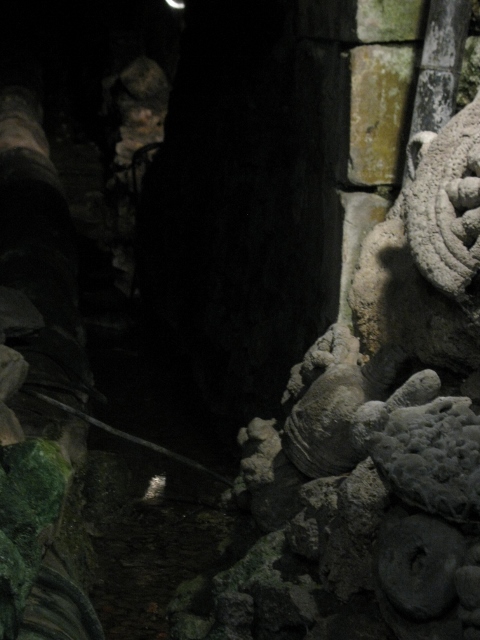
130Hot spring (480x640)

A rather dark photo of the hot spring.

This passage was built during the 1780’s to carry the thermal water from its source to the bathing pool of the fountain bath which occupied this site from 1786 until 1883.  It was then replaced by the Matlock Bath hydro and the existing thermal pool.  This area was then made into the ‘Petrifying Well’.

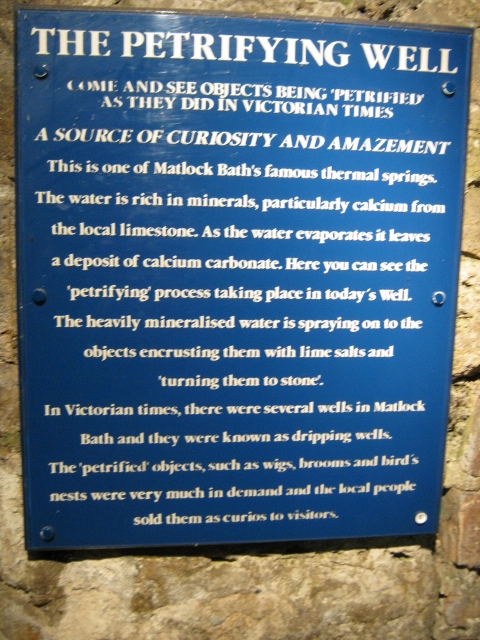
133Info (480x640)

Information board.

R and I know all about this process.  Our tap-water at home is very ‘hard’ and we spend a lot of time and money on different products trying to get rid of lime-scale.

We walked through the Riverside Gardens.

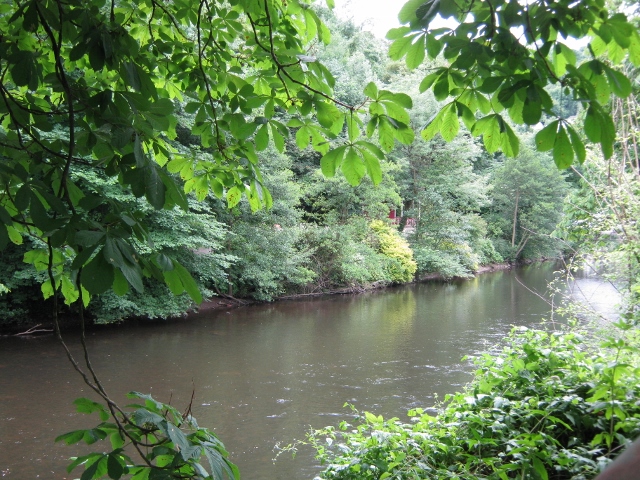
149R Derwent (640x480)

River Derwent

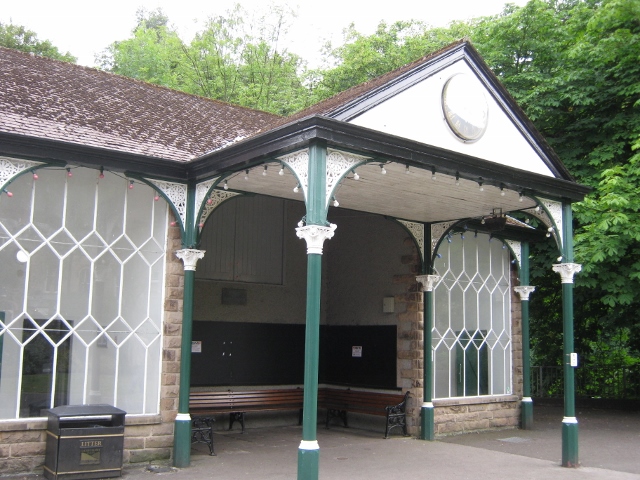
147Matlock Bath (640x480)

A very attractive shelter to sit in

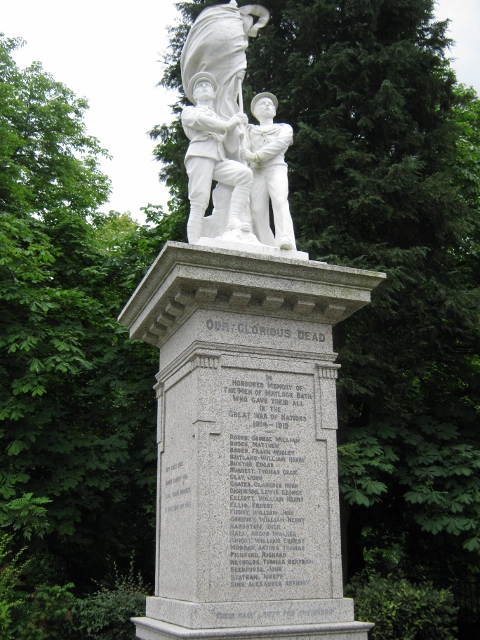
148War Memorial (480x640)

The War Memorial

We walked up towards the railway station and strolled a little way along one of the Lover’s Walks.

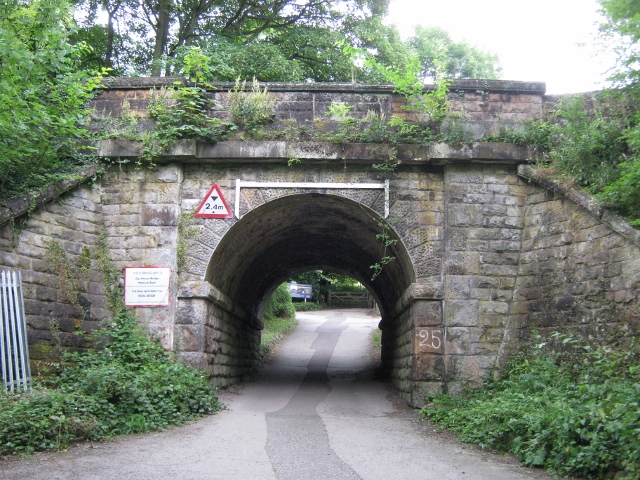
142Railway bridge (640x480)

Railway bridge

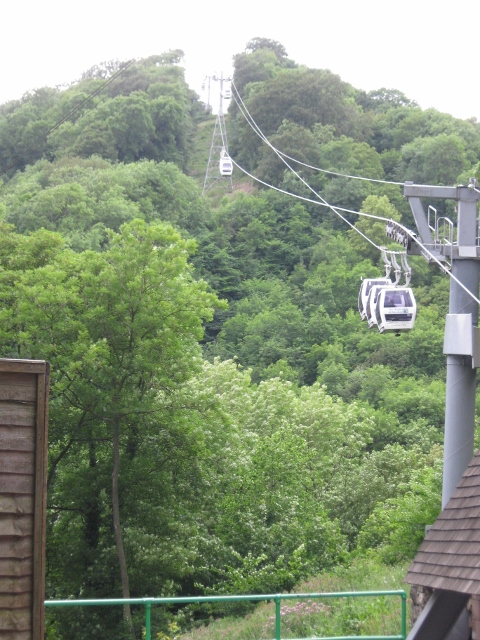
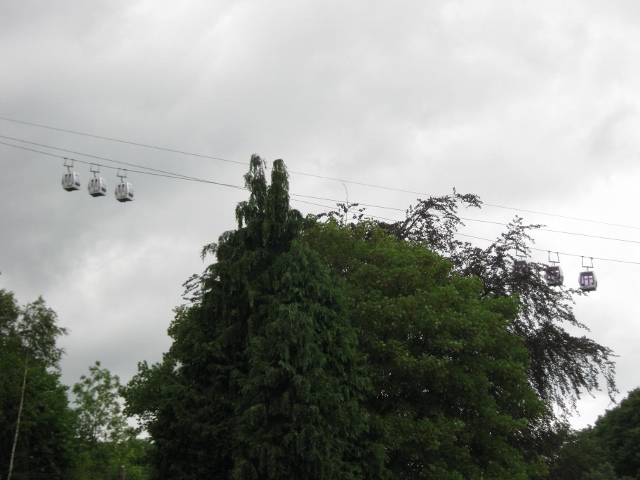
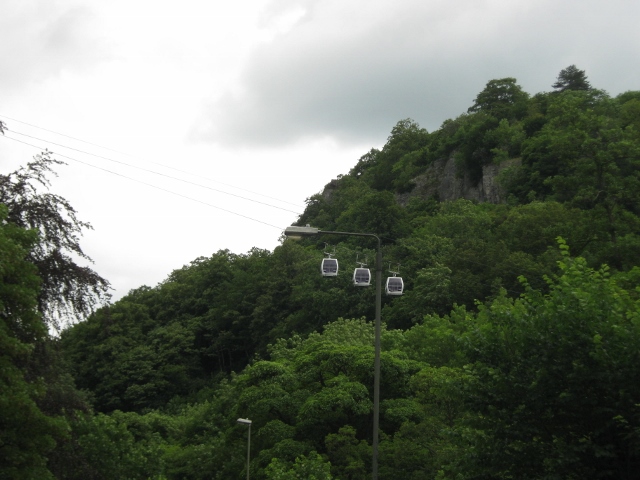
We walked to the cable-car station but as it was getting late in the afternoon we decided not to go up to ‘The Heights of Abraham’.  This is a wooded country park on the top of the peak which is crowned with the Victoria Prospect Tower.  Former lead mines have been adapted as show caves and the Grand Pavillion now houses a Tourist Point and the Peak District Mining Museum.  There is also a Theme Park for young people up there.

144Cable cars (480x640)

Cable cars

141Cable cars (640x480)

Cable cars

140Cable cars (640x480)

Cable cars

We decided it was time to return to our caravan and buy some groceries on the way.  We timed this very well as the heavens opened while we were in the supermarket.  We were very pleased to have avoided a soaking!

As I was typing this post this evening R decided to watch a favourite television programme – Great British Railway Journeys – and by coincidence Matlock Bath was visited and Haddon Hall was mentioned.  All the people questioned in Matlock Bath said the village had a seaside feel to it and Byron was quoted!  It is so good to know that I am full of original thoughts!


Share this:

  • Share on X (Opens in new window) X
  • Share on Reddit (Opens in new window) Reddit
  • Share on Pinterest (Opens in new window) Pinterest
  • Share on Facebook (Opens in new window) Facebook
  • Email a link to a friend (Opens in new window) Email
  • Share on Tumblr (Opens in new window) Tumblr
  • Print (Opens in new window) Print
  • Share on LinkedIn (Opens in new window) LinkedIn
Like Loading...

Peak District Holiday 1st to 9th July. Day 4 Part 2

19 Sun Oct 2014

Posted by Clare Pooley in churches, Rural Diary, Uncategorized

≈ 19 Comments

Tags

ante-room, Bakewell, banqueting hall, chapel, courtyard, Earl's bedroom, fresco seccoes, gardens, great chamber, Haddon Hall, Jane Eyre film-set, kitchen, long gallery, Manners family, Medieval hall, parlour, Renaissance, state bedroom, Tudor hall, Vernon family

022Haddon Hall (640x480)

Haddon Hall

Haddon Hall is about two miles from Bakewell and we were visiting it for the second time.  It is a fortified manor house with Medieval and Tudor architecture and is quite special in that the last building and improvements made to it were done at the end of the 16th century.  The family moved to Belvoir Castle (pronounced ‘beaver’) in Grantham, Leicestershire in 1703, the main home of the Manners family, and left Haddon Hall empty for 200 years.  The 9th Duke and Duchess of Rutland decided at the start of the 20th century to restore the Hall and this work is continuing to this day.  It is now the home of Lord Edward Manners who is the younger brother of the current Duke of Rutland.  He lives in a part of the Hall which is not open to the public.

025H H from bridge over R Wye (640x480)

Haddon Hall from the bridge over the R. Wye

026Parapet passing place on bridge (640x480)

A view of the R. Wye from the bridge. These little triangular areas at the side of the bridge are safe places to stand when there is traffic on the bridge. If you look at Bakewell Bridge in my previous post you’ll see the same thing there.

The Hall has been used many times by film companies so some of you will have seen it already.  A couple of the most famous films in which it is featured are ‘Jane Eyre’ with Mia Wasikowska and Michael Fassbender (2011) and Franco Zefferelli’s version of ‘Jane Eyre’ with Charlotte Gainsbourg and William Hurt (1994).  It had a cameo role in ‘Pride and Prejudice’ with Keira Knightley (2004) and also ‘Elizabeth’ with Cate Blanchett (1998).  The BBC’s most recent version of ‘Jane Eyre’ with Ruth Wilson and Toby Stephens (2006) was also filmed here.

128R Wye (640x480)

The River Wye

023Gate house (640x480)

Looking back at the Gate House through which we had just passed

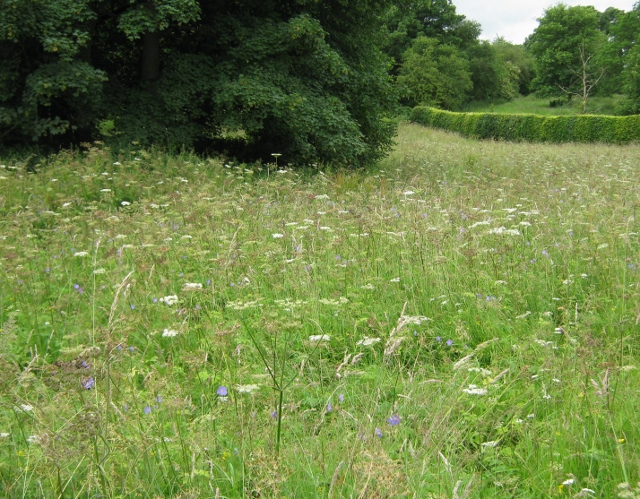
024Wildflower meadow (640x499)

A wildflower meadow on the approach to the Hall

Topiary in the garden next to the old stables
More topiary

These topiary yew trees are clipped into the shapes of a boar’s head and a peacock, the arms of the Vernon and Manners families to whom the Hall still belongs.  The Hall passed to the Manners family in the 16th century as the heir to the estate, Dorothy Vernon, had married Sir John Manners.  There is a story that Dorothy and John eloped in 1563 which may be true but Sir John Manners came of a rich and noble local family and I cannot think that Dorothy’s father would have objected to him.

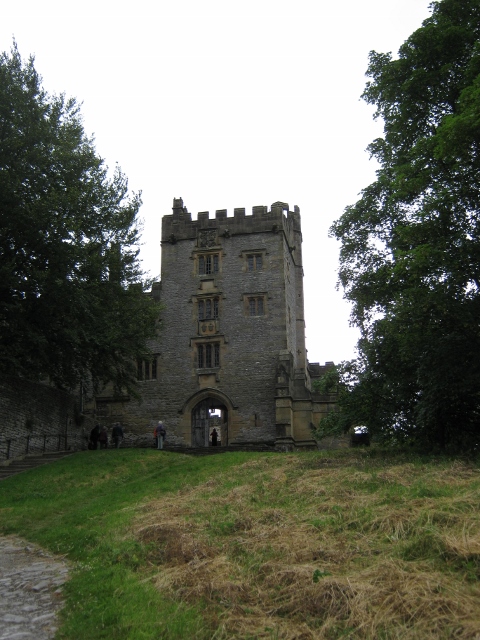
027NW tower (480x640)

The North-West Tower

The path ascends to the North-West Tower which became the main entrance to the hall in the 16th century.  Going through the entrance we found ourselves in the Lower Courtyard.

Looking back to the entrance through the NW Tower
Rooms off the Courtyard
Octagonal bell tower next to the chapel

Stairs up to the oldest part of the Hall – King John’s Wall
Rooms off the Courtyard
Entrance to the Hall from the Courtyard

Richard de Vernon, in 1193, was granted a licence to build a wall of not more than 12 feet in height to enclose the Chapel, the Watch Tower and some timber buildings.  12 foot walls were only sufficient to deter marauders and would have proved no barrier to a full-blown attack.  The man granting the licence was John, Count of Mortain who was to become King John four years later on the death of his brother, Richard I ‘the Lionheart’.  This wall is still standing and has been incorporated into the Hall buildings.

17th century doorway
Gargoyle and lead drain pipes

Gargoyle and lead drain pipes
Battlements were only for show and added in the 14th century

The Courtyard slopes upwards, from the entrance under the tower, to the main buildings.  The Hall evolved over a few hundred years with little or no planning but as it is all built using the same type of material, grey limestone and yellow gritstone, it somehow looks just right.

029Entrance to chapel (480x640)

Entrance to the Chapel

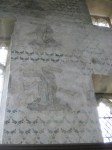
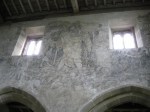
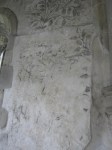
The Chapel was one of the first parts of the Hall to be built.  It is dedicated to St Nicholas and is decorated inside with fresco seccoes depicting the life of St Nicholas and of St Anne.  There is a large image of St Christopher the patron saint of travellers and also a picture of three skeletons which were part of a larger painting illustrating a medieval Morality of earthly vanity.

Fresco secco
Fresco secco

St Christopher
Three Skeletons

The frescoes were probably commissioned in the early 15th century when other changes were being carried out.  Fresco seccoes do not last as long as buon frescoes as they are painted onto dry plaster not wet.  They were also damaged during the Reformation.

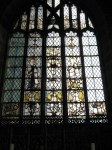
Stained glass window

As I mentioned, the Hall was left empty for 200 years and in 1828 the faces of the saints in the glass were stolen.  A reward of one hundred guineas was offered for their return but to no avail.

The chapel is filled with wonderful things – a musician’s gallery, lots of box-pews, a beautiful marble effigy of the 9 year old Lord Haddon who died in 1894, an alabaster reredos.  I found it difficult to photograph the chapel as a whole with my small camera as it was so full of furniture.   There were also a number of people like us wandering about and admiring and they always seemed to be standing in the wrong place!

Alabaster reredos
Stairs to musician’s gallery

Six sided pulpit with box pew in front
Box pew with effigy to Lord Haddon in front

We then crossed the Courtyard and entered through the porch to the Banqueting Hall.

125Roman altar (640x480)

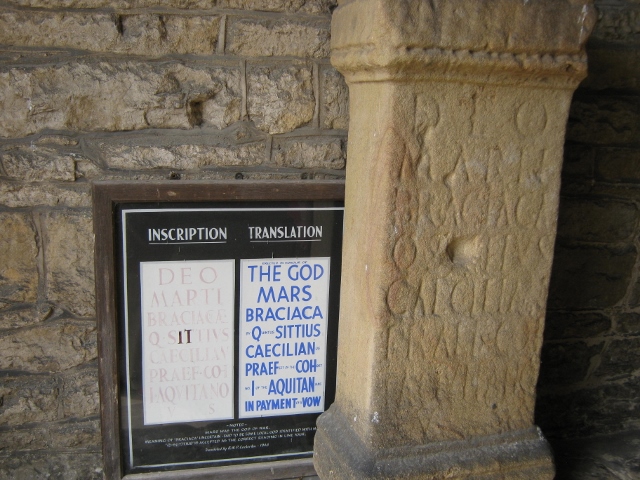
A Roman altar found in the fields of the estate is displayed just inside the porch.

060Passage (480x640)

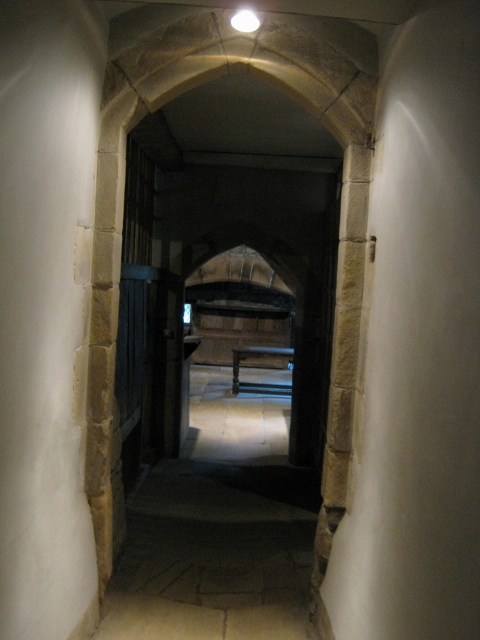
Passageway to kitchen

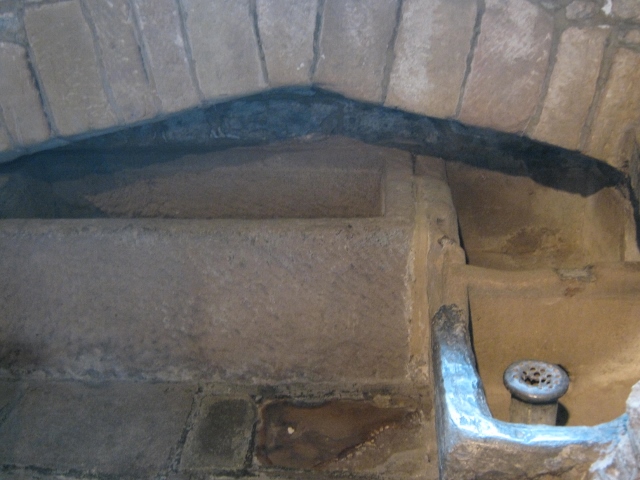
The Kitchen is a fine example of a Tudor kitchen.  Originally it was a separate building to reduce the risk of fire spreading to the main house and the passageway was added much later.  The kitchen is in fact a set of rooms all with different uses.  The main room has a fire heated water boiler and a stone trough fed by the one and only water system to the Hall.   The trough is divided into three to hold water of varying degrees of cleanliness.

064Stone trough (640x480)

Stone trough

074Fire place (640x480)

Kitchen fireplace with a log box on the left and in front of that is a wood block for chopping firewood

062Kitchen (480x640)

Looking through to the bakery from the kitchen

063Bakery (480x640)

Bakery

070Paddles (480x640)

A collection of paddles used for putting bread etc into the ovens

071Pastry ovens (480x640)

Pastry ovens

065Carving table (640x480)

Carving table

067Food preparation table (640x480)

Food preparation table

076Carving table (640x480)

Another carving table

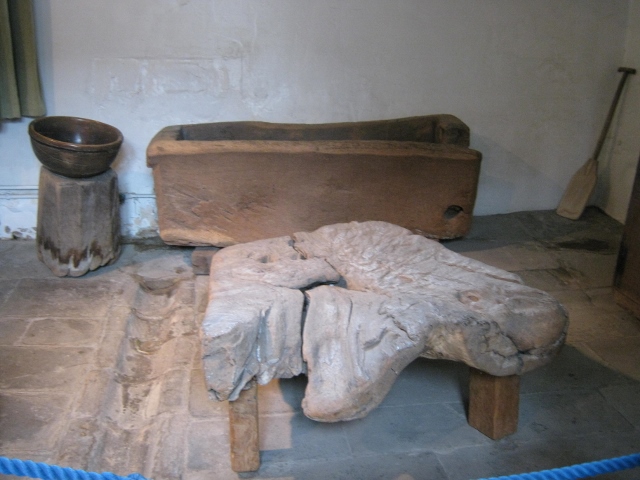
069Butchery (640x480)

Butchery. The odd object in the foreground is a 15th century oak block on three short legs that was used for jointing meat. The object behind is a salting trough.

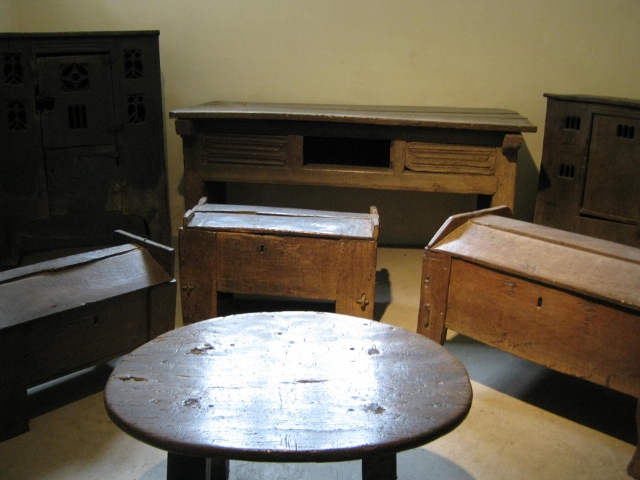
068Dole cupboards (640x480)

A collection of ‘dole’ cupboards and hutches or meal arks are in the original Milk Larder

‘Dole’ cupboards were put outside houses like Haddon Hall for passing traders or Estate workers and filled with food and left-overs from the kitchen.  Most ‘dole’ cupboards haven’t survived as they were exposed to the elements so these are very rare.  The ‘dole’ cupboards have ornate panels in their doors.  Hutches or meal arks were used for the storage of grain or bread.  These are the smaller chest-shaped boxes.  The table (centre back) is a 15th century oak side-table or buffet.

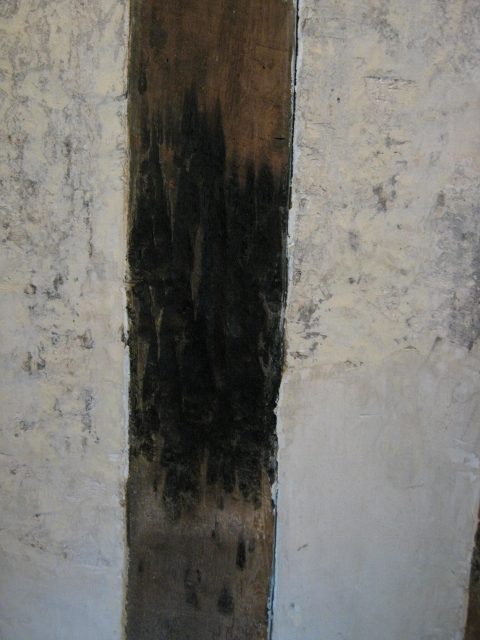
072Scorch marks (480x640)

Scorch marks on the timber of the wall show where candles were placed for illumination.

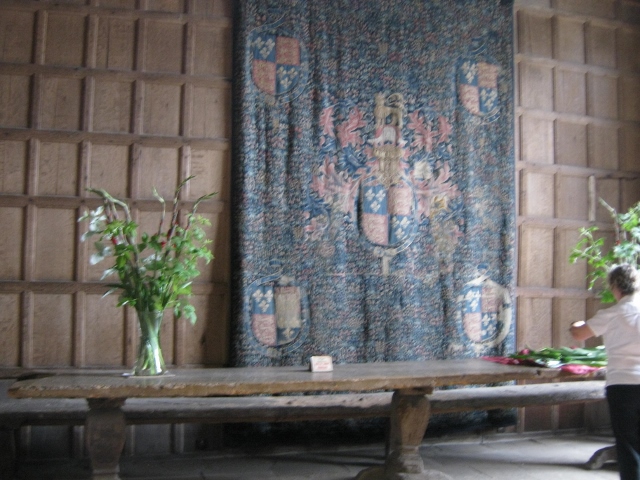
055High table bench & tapestry (640x480)

The high table and bench in the Banqueting Hall.

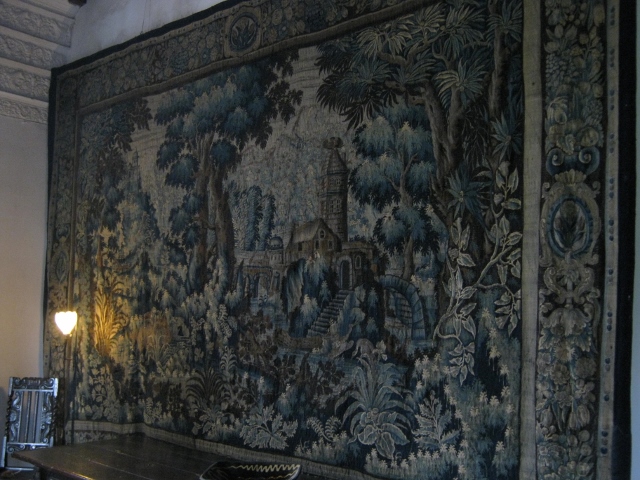
When the hall was built in the 14th century this room would have been the communal living space with a central hearth and vents in the roof to let the smoke out.  It was then known as the Great Hall.  By the beginning of the next century the family would have started to eat, sleep and spend leisure time in their private apartments so the Great Hall became a place for entertaining guests and was re-named the Banqueting Hall.  The walls are panelled which not only helped to insulate the room but was also a status symbol too.  The long table has a top made of two elm planks resting on three square pillars with splayed feet.  The bench is the same age as the table (c.1400) and is one plank on square legs.  The table top is not attached to the base which meant that it could be turned over and both sides used.  The bench and table are on a raised platform at one end of the room.  The tapestry behind the table is French and was made during King Edward IV’s reign (1461-1483).  It shows the Royal Arms of England and is supposed to have been presented to the Vernon family by King Henry VIII whose older brother Prince Arthur spent some time at Haddon Hall.

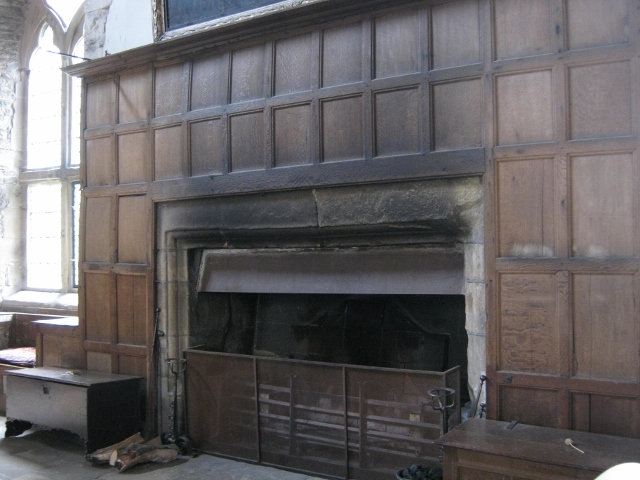
053Fireplace (640x480)

The fireplace. The chimney was added in the mid 15th century.

On entering the Hall you can smell wood smoke even when there is no fire.

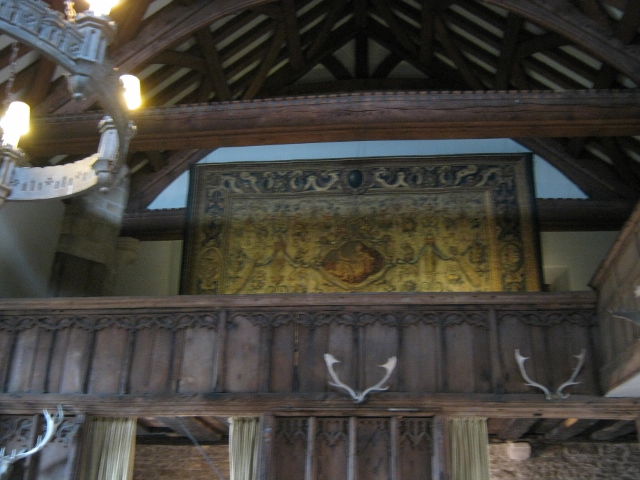
058Minstrel's gallery (640x480)

The Minstrel’s Gallery is opposite the High Table

The screen which can be seen at the bottom of the photo is 14th century and is a fine example of Gothic tracery.  Attached to the screen is an iron manacle and lock.  If a guest ‘did not drink fayre’ – either too little or too much – he was punished by having his wrist locked in the manacle and the rest of his drink poured down his sleeve.   The antlers are mid 17th century and the tapestry which hangs above the Minstrel’s Gallery was produced at the beginning of the 17th century.

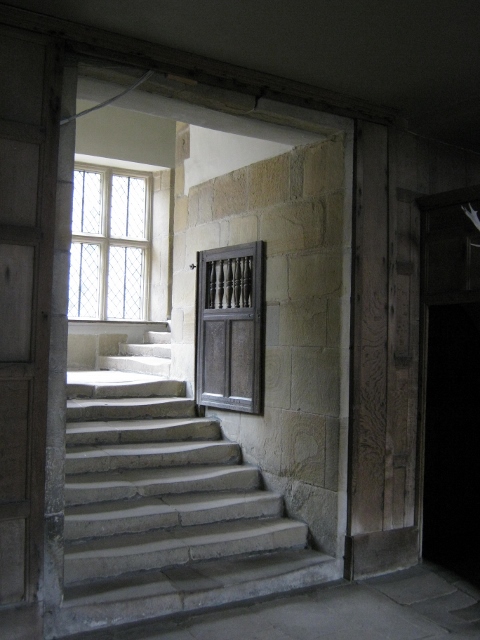
056Stairs (480x640)

Steps to the upper floor

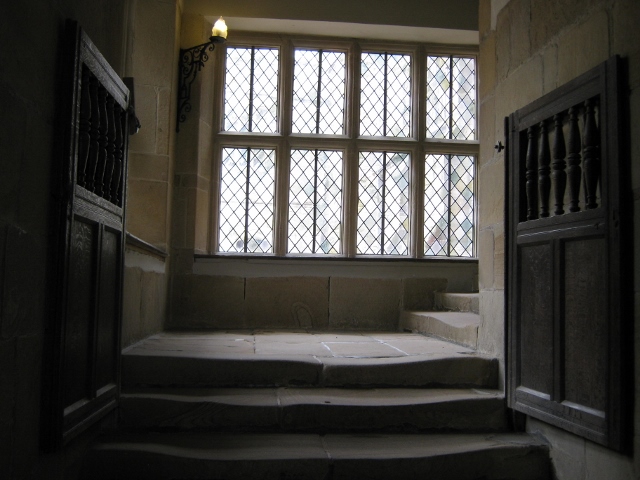
077Stairs (640x480)

Steps showing the 17th century dog gates.

We then went through a door off the Banqueting Hall and entered the Parlour or Dining Room.  This was the room the family used as private quarters and it is still used as a dining room.

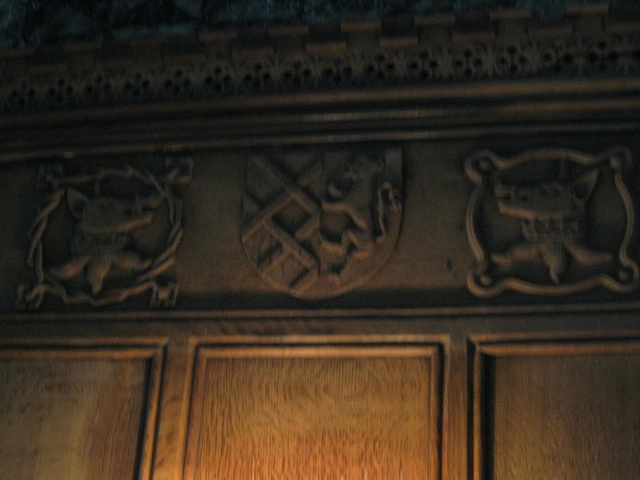
122Wood panelling (640x480)

Carved oaken panelling. This is just a part of a frieze around the room showing the armorial shields of the Vernons and the families with whom they had intermarried.

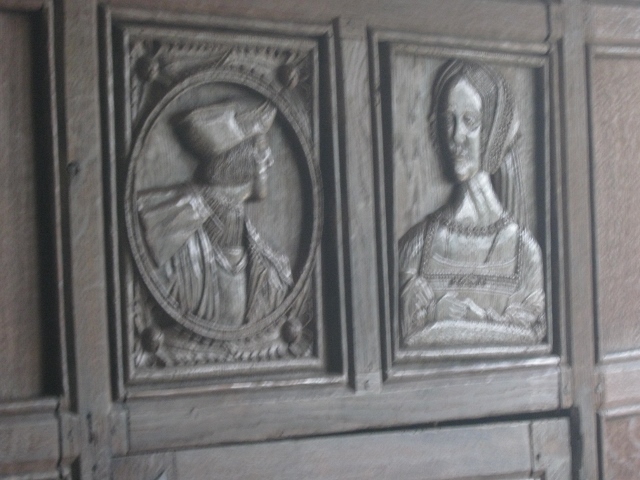
117Carved figures (640x480)

I apologise for the poor quality of this photo but I didn’t wish to leave it out. It is believed that these two figures are those of King Henry VII and his wife Queen Elizabeth of York

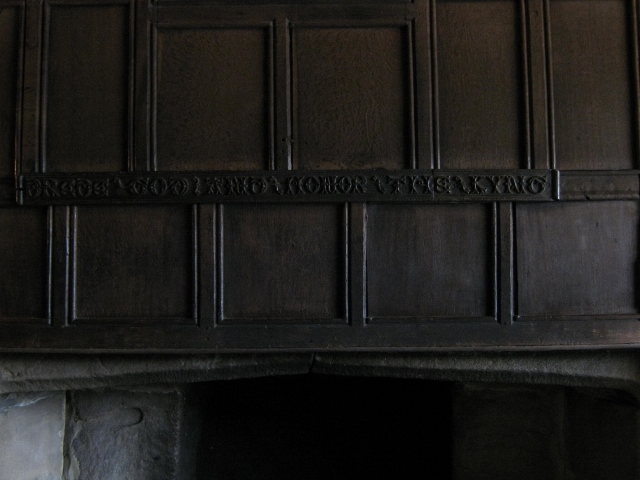
118Carving (640x480)

This carving over the fireplace says ‘Drede God and Honour the Kyng’. The text is based on Wycliffe’s translation of the Bible (c.1395) of 1 Peter 2 v.17.

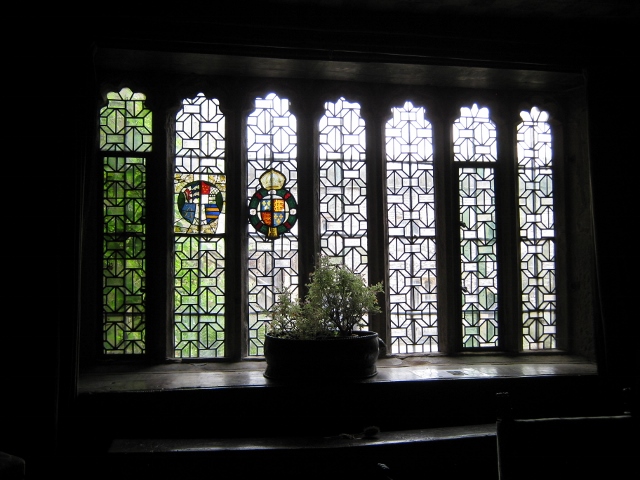
119Window (640x480)

Attractive window in the Parlour

120Ceiling (640x480)

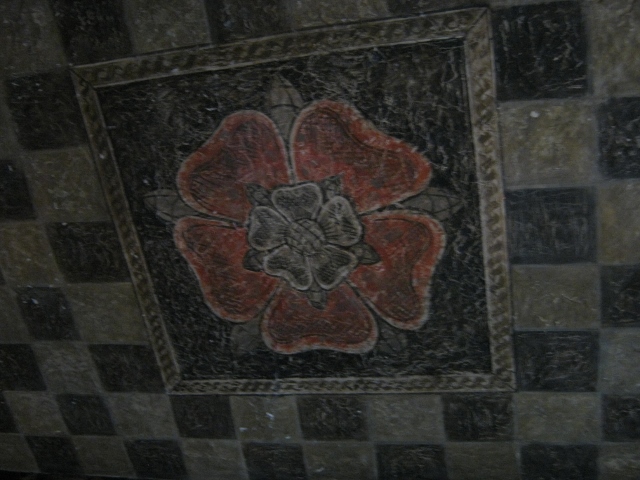
Plaster ceiling installed in the early 1500s. This is a Tudor rose.

121Ceiling (640x480)

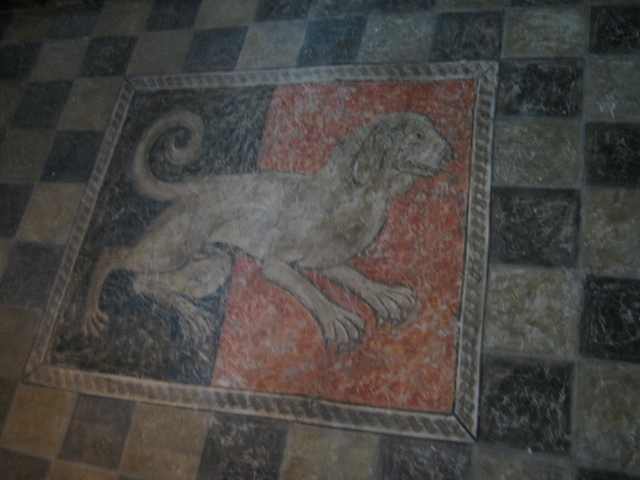
And this is a Talbot dog. Sir Henry Vernon (who installed the ceiling) married Anne Talbot daughter of the Earl of Shrewsbury

We then went up the stairs to the first floor and entered the Great Chamber.  This was re-roofed and remodelled at the same time as the Parlour below.

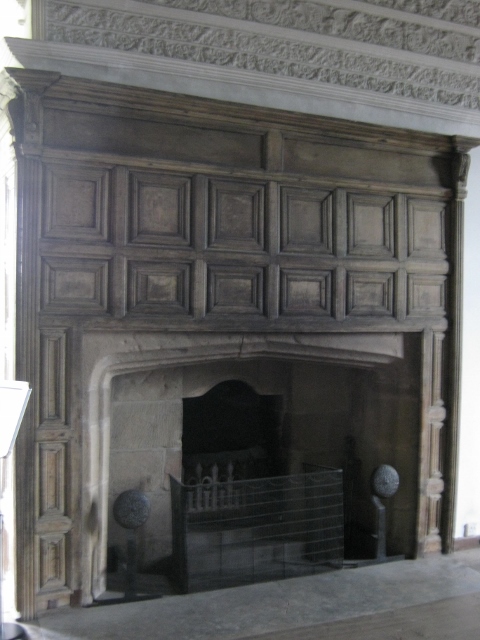
078Fireplace (480x640)

The fireplace. The 17th century oak panelling shows traces of gold and green paint. It must have been beautifully decorated when new.

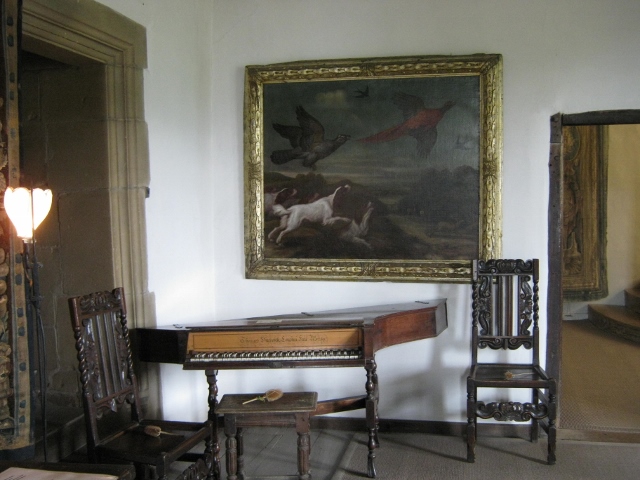
079Furniture (640x480)

Some of the furniture in the room

083Frieze (640x480)

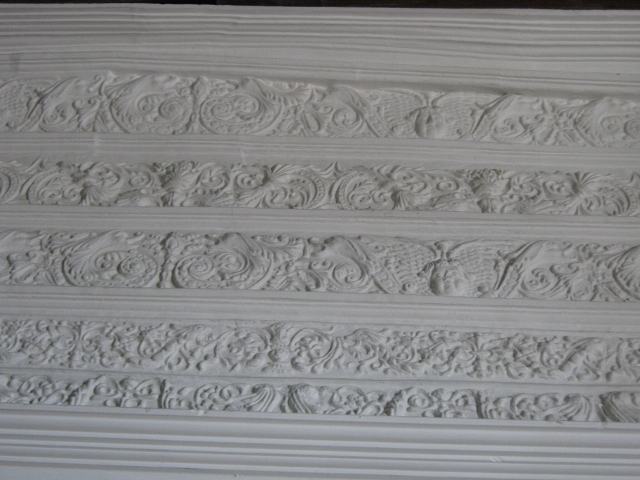
This plaster frieze around the room is beautiful and an early example of 17th century English Renaissance decoration

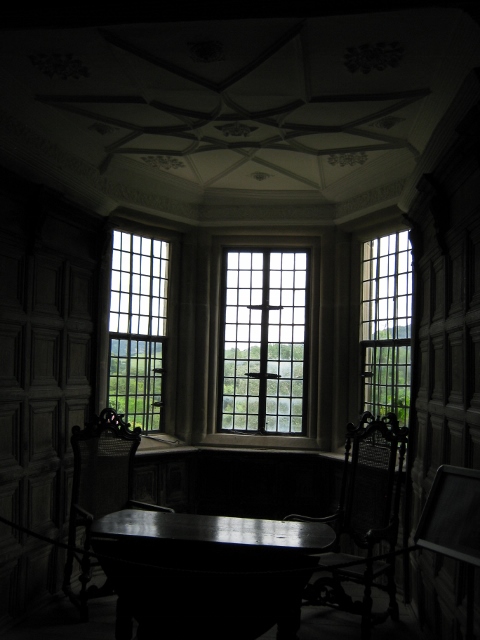
080Bay window (480x640)

The plaster ceiling in this oriel bay window is also of the same date and quality.

084Window (480x640)

Windows at the opposite end of the room. This room would have originally been the Solar – the private quarters of the family – and Solars were always well provided with windows to make the most of natural light

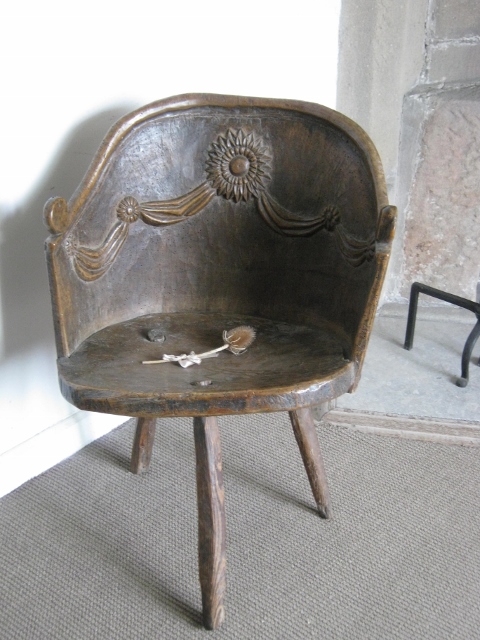
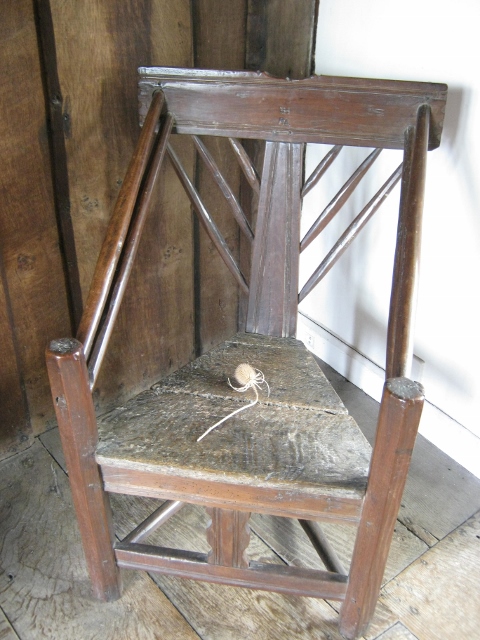
085Chair (480x640)

I loved this chair. The teasel is to stop people from sitting on it. I don’t think it would take the weight of many modern-day adults!

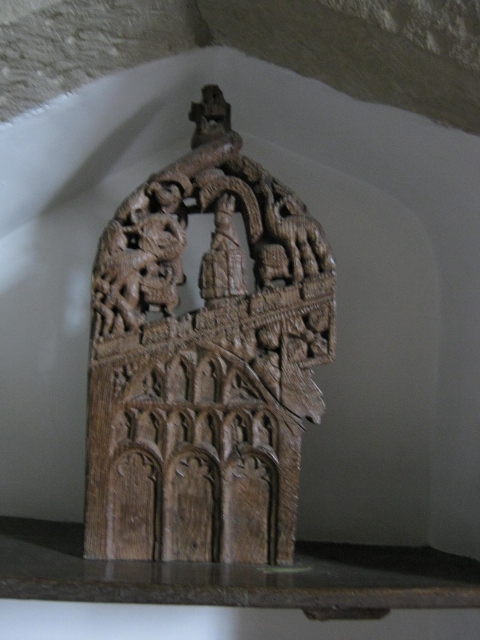
082Pew end (480x640)

This is a 14th century pew end that is displayed in the room. The carving is satirical and depicts the rapacity of the clergy!

081Tapestry (640x480)

One of the tapestries that hang in the room. They were thought to be Flemish but are now thought to be French and woven in Paris sometime before 1650.

We passed through a small ante-chamber which was once used as a dressing room and entered the Earl’s Apartment.  This was originally two chambers and there are stairs leading to the Chapel below so maybe one of the rooms was used by the clergy.  There are two fireplaces in this room as well.  After the partition was removed it was used as a gallery at first and then when a larger gallery was built the room was used as a bedchamber.

087Mirror (480x640)

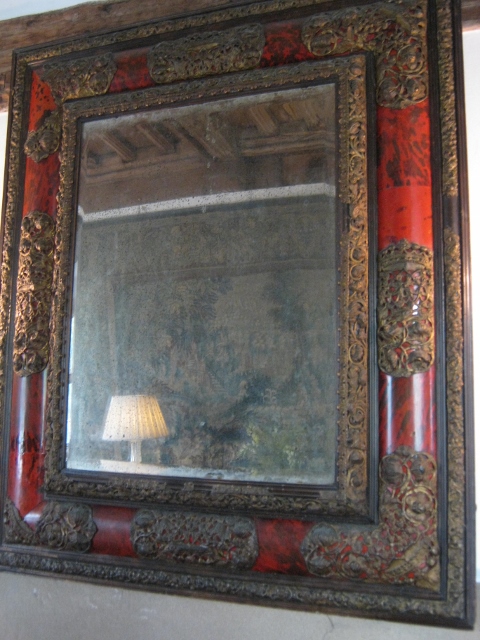
A Charles II tortoiseshell looking-glass

086Signatures (640x480)

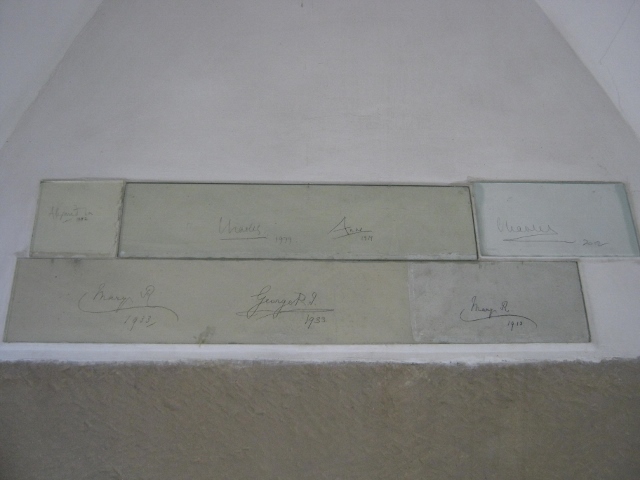
Above the smaller fireplace are signatures in the plaster of visiting members of the Royal Family.  Can you spot Prince Charles’, Princess Anne’s and George V’s signatures?

089Spinning chair (480x640)

An English early 17th century spinning chair.

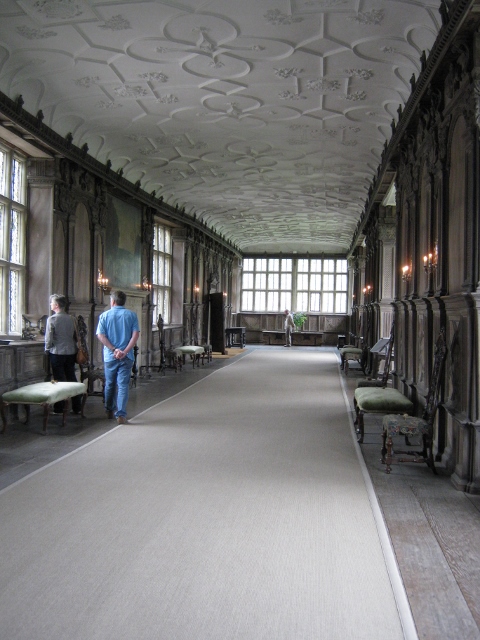
090Long gallery (480x640)

The Long Gallery

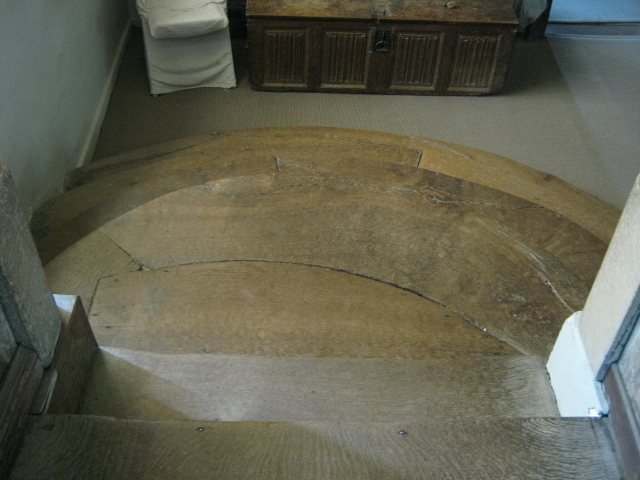
On the opposite side of the landing to the Great Chamber is the Long Gallery.  It is 110 feet long and 17 feet wide.  The entrance to the gallery is up some semi-circular steps said to have been cut from the roots of a single oak.

092Steps (640x480)

Looking down at the steps from inside the Long Gallery

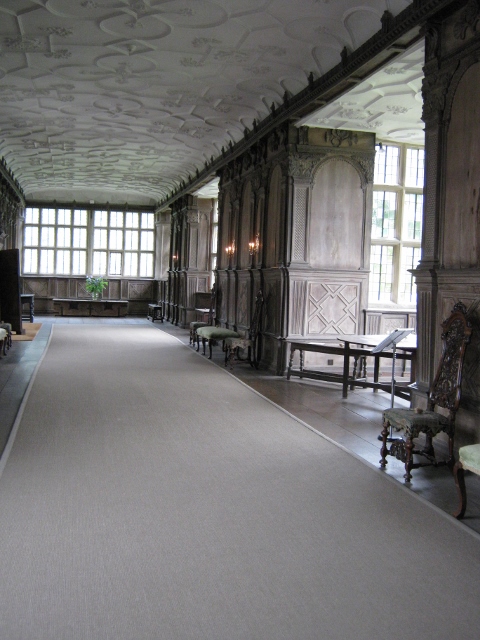
094Long gallery (480x640)

The Long Gallery

The room is full of light and space.

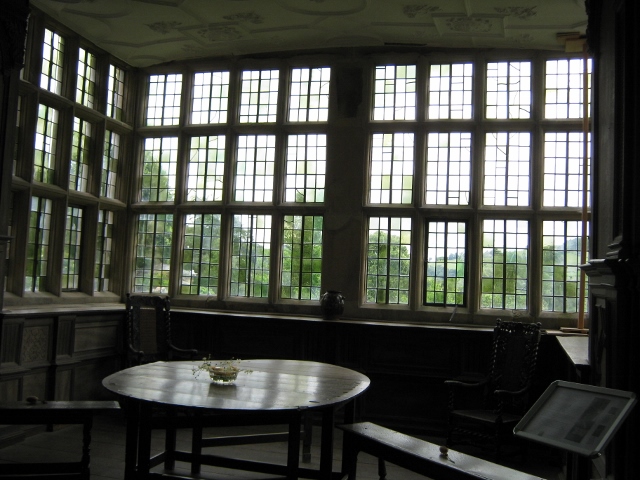
096Long gallery (640x480)

One of the window embrasures. They face south to make the most of the sunlight.

Long Galleries were used as indoor promenades so that the family could take exercise if the weather was too bad to go outside.  There are wonderful views of the gardens and surrounding countryside from the windows.

095Glass (480x640)

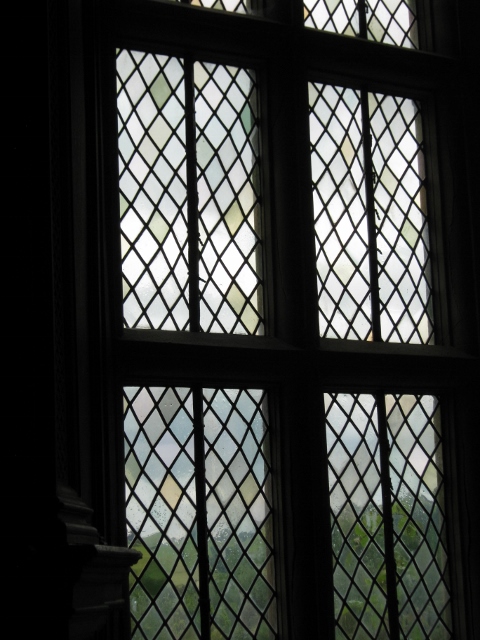
The diamond-shaped panes are set at different angles which also maximises the use of daylight. It is also very attractive.

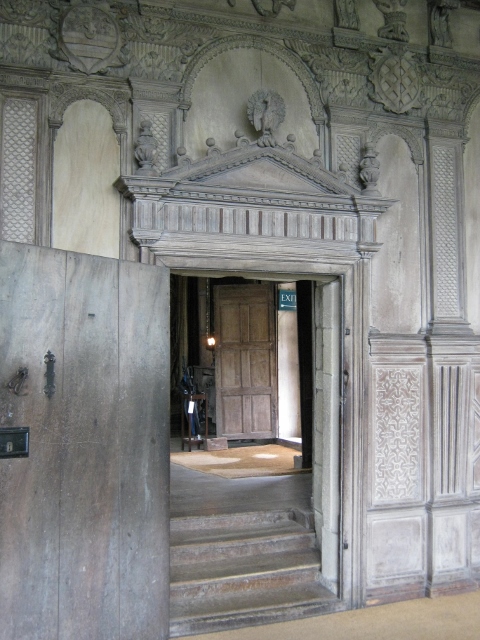
098Carved door frame (480x640)

A doorway surmounted by the Manners’ family crest.

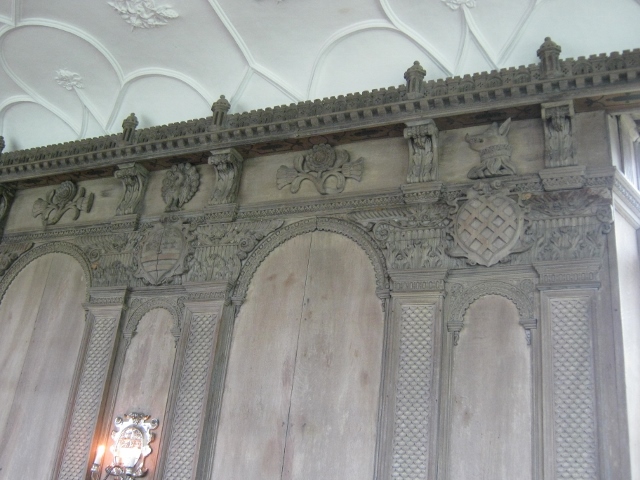
Th panelling is made of oak which was probably originally sized by being lime-washed.  It was then painted with designs in a foxy-red colour.

102Carving (640x480)

Oak panelling

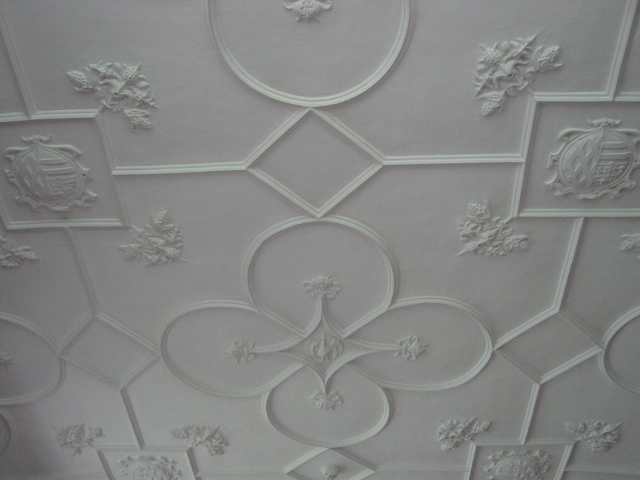
103Ceiling (640x480)

Ornate plaster ceiling

The State Bedroom leads off the Long Gallery.  There is no bed in it because when the Hall was being restored the state bed was moved to Belvoir Castle where it still remains.

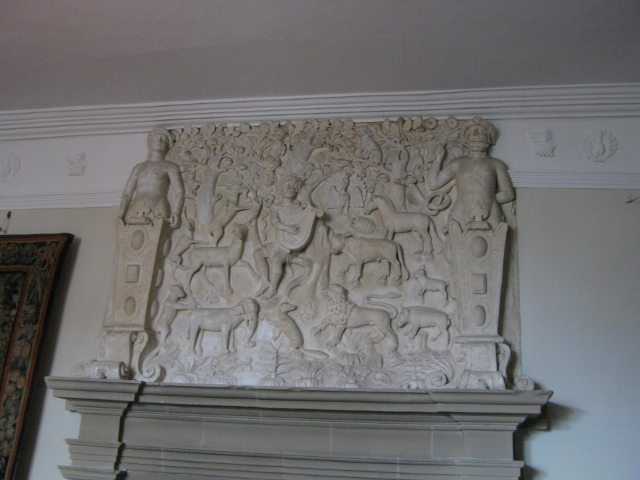
104Orpheus taming the animals (640x480)

Plaster relief above the fireplace shows Orpheus taming the animals. This dates from the mid 1500s and there is no attempt at realism in the sizes of the animals. There is a very small elephant at the bottom left of the relief.

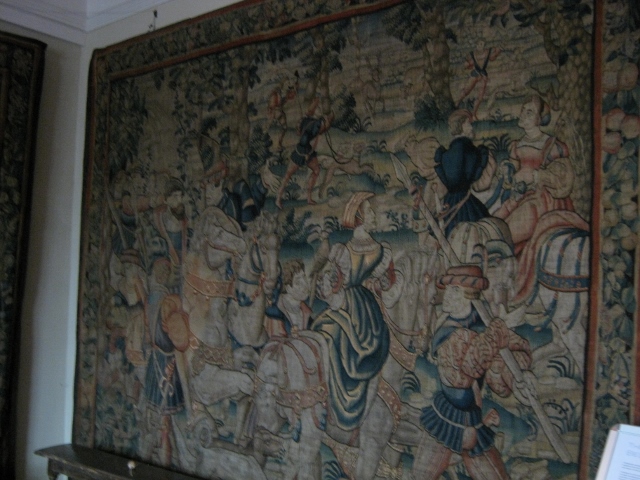
106Tapestry (640x480)

Tapestry in the State Bedroom


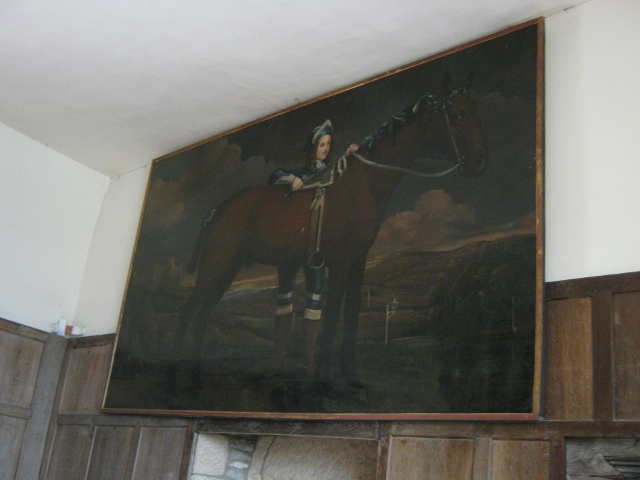
The final room is the Ante-room in which there is one of the earliest racing pictures in existence.

108Early racing picture (640x480)

This painting depicts a pre-Arabian English bay racehorse with his jockey in a landscape. It is attributed to the German-born painter John Baptist Closterman (died 1713).

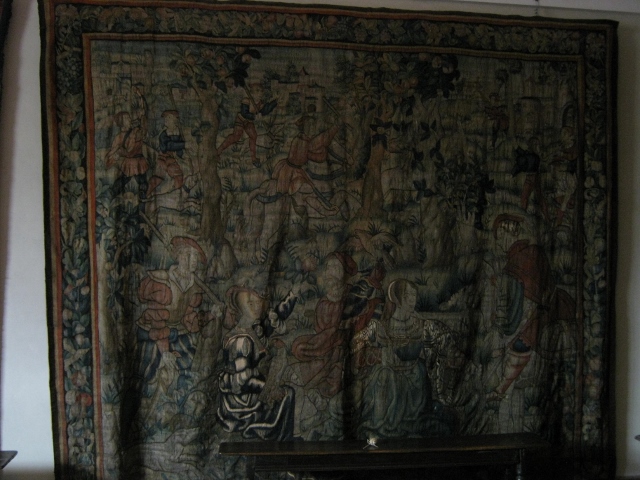
107Tapestry (640x480)

Tapestry in the Ante-room.

There is a flight of worn steps from the Ante-room to the garden but we didn’t go that way but back through the house.

109Gardens (640x480)
110Gardens (640x480)
View of the Hall from the garden
The windows of the Long Gallery
116Garden (640x480)

The main structure of the garden was laid out in the middle of the 17th century.  It has a series of descending terraces – the topmost and the lower garden are closed to the public.  It is a fine example of an English Renaissance garden and avoided being made-over in the 18th century because no-one was living there at the time.

I must apologise for the length of this post and the amount of photographs in it.  I have spent some considerable time trying to shorten it and to delete most of the photos but I find I can’t do either.  I love this Hall very much – I think it is the most beautiful place I know and I wished to have a record of my visit for myself as much as wishing to share it with you.  Thank-you for your patience.


Share this:

  • Share on X (Opens in new window) X
  • Share on Reddit (Opens in new window) Reddit
  • Share on Pinterest (Opens in new window) Pinterest
  • Share on Facebook (Opens in new window) Facebook
  • Email a link to a friend (Opens in new window) Email
  • Share on Tumblr (Opens in new window) Tumblr
  • Print (Opens in new window) Print
  • Share on LinkedIn (Opens in new window) LinkedIn
Like Loading...

Peak District Holiday 1st to 9th July. Day 4 Part 1.

11 Sat Oct 2014

Posted by Clare Pooley in fish, Rural Diary, Uncategorized, wild birds

≈ 16 Comments

Tags

Bakewell, Bakewell Bridge, Bakewell Pudding, Bakewell Pudding Shop, Black-headed Seagull, Canada Goose, Coot, Mallard, moorhen, Peak District National Park, River Wye, Trout, Tufted Duck

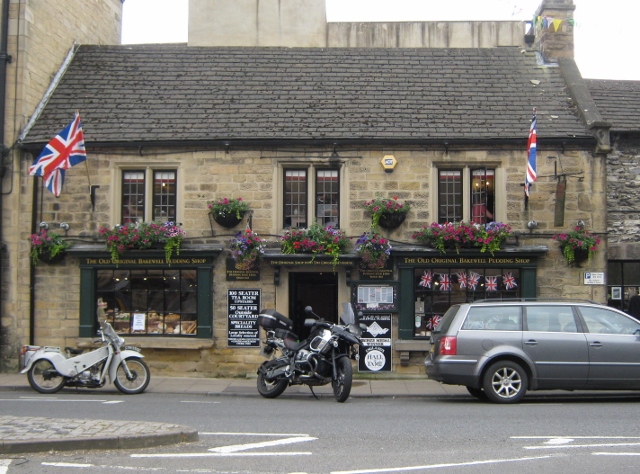
After our long walk the day before we decided to do a little gentle sight-seeing on our fourth day, revisiting a couple of favourite places and then going on to somewhere new.  Our first port of call was the town of Bakewell in Derbyshire which is very attractive but always very crowded.  We surprised ourselves by finding somewhere to park quite quickly and walked to the Bakewell Pudding Shop.

002Bakewell Pudding shop (640x474)

The Old Original Bakewell Pudding Shop

Bakewell is the only market town in the whole of the Peak District National Park.  As with many places in the Peak District, mineral springs are found there and it nearly became a spa town.  The name ‘Bakewell’ comes from ‘Badeca’s Well’ and is nothing to do with baking.  A Bath House was built by the Duke of Rutland in 1697 and it still has the 16′ x 33′ bath in the cellar.  The reason it wasn’t a success as a spa was the temperature of the water which is only 11 degrees Centigrade/52 degrees Fahrenheit – a little chilly!  This is less than half the temperature of the Buxton waters.

R and I wanted to buy a pudding as we love them and hadn’t had one for a couple of years.  We also purchased some bread and a teacloth with the recipe of the pudding printed on it and then went through to their coffee shop and had a pleasant drink while sitting in a sheltered courtyard.


Rather an unprepossessing looking pudding but really very tasty.  It can be eaten hot or cold and with or without cream or custard.  It is made with puff pastry, then a layer of jam (usually raspberry) and then covered with a mixture made of ground almonds, sugar, butter, eggs and almond essence.  This is then baked until the mixture sets.  This confection was made by mistake.  During the 19th century a cook at the Rutland Arms was baking a jam tart but somehow misunderstood the recipe and the result was this pudding.  It was an instant success, though I don’t know how anyone let alone a cook can make a mistake when making a jam tart!

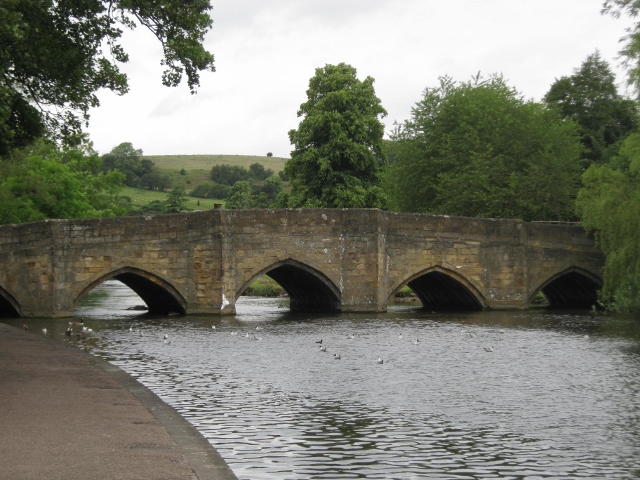
We then walked a little through the town and ended up at our favourite place – the riverside.  There is a wide promenade next to the River Wye and benches to sit on at intervals.  There is a very attractive bridge over the river which flows at a good pace.

008Bridge over R Wye (640x480)

Bakewell Bridge

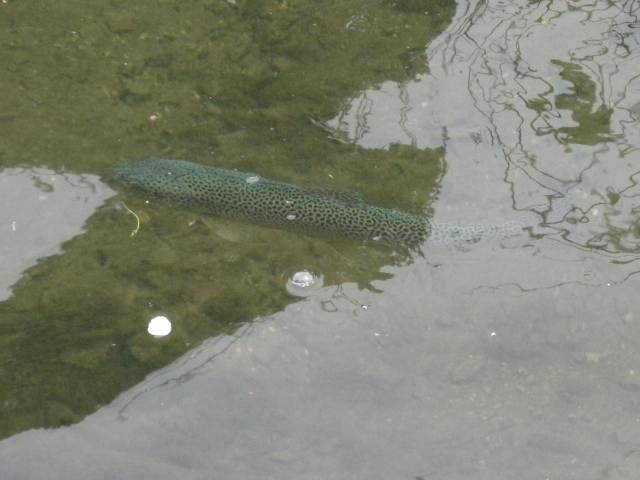
The river is full of trout and has a couple of little weirs.  There are lots of water-birds to admire and also lots of Black-headed Seagulls too.

020Trout (640x480)

A beautiful speckled trout

014Tufted ducks (640x480)

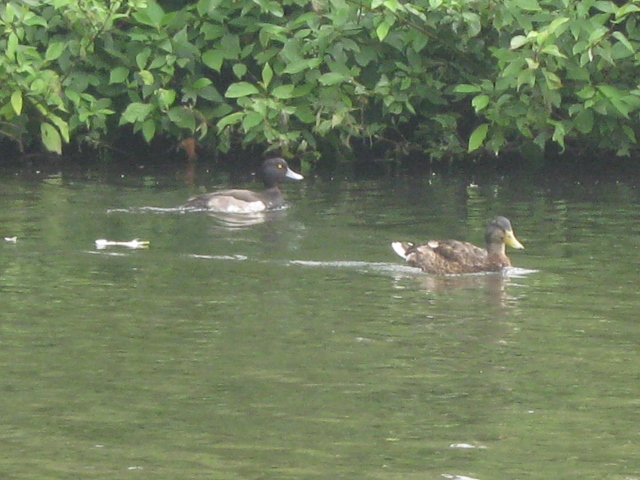
Tufted Ducks

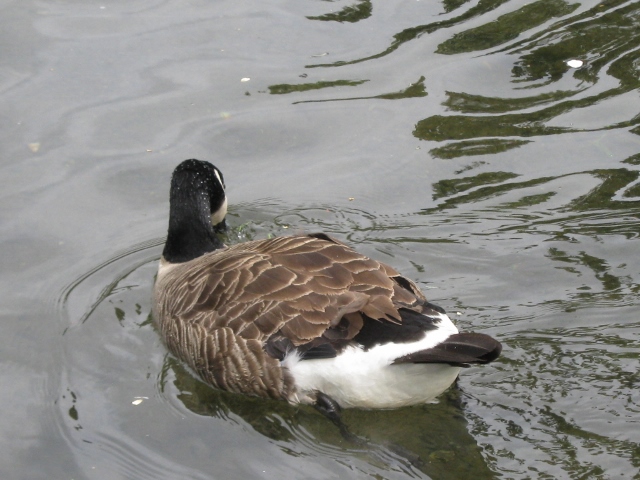
012Canada goose (640x480)

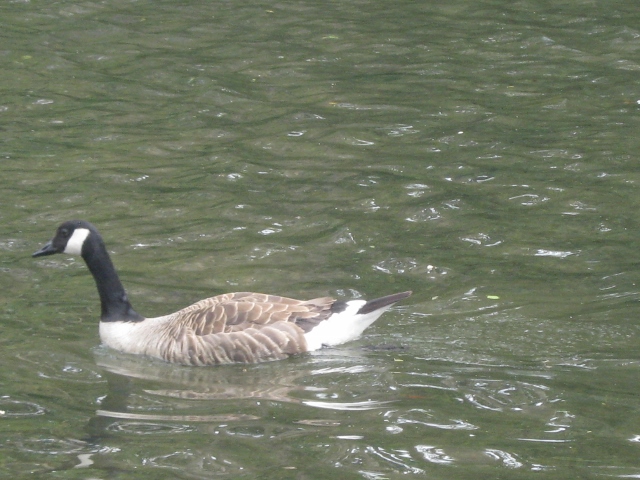
Canada Goose

019Canada goose (640x480)

Canada Goose

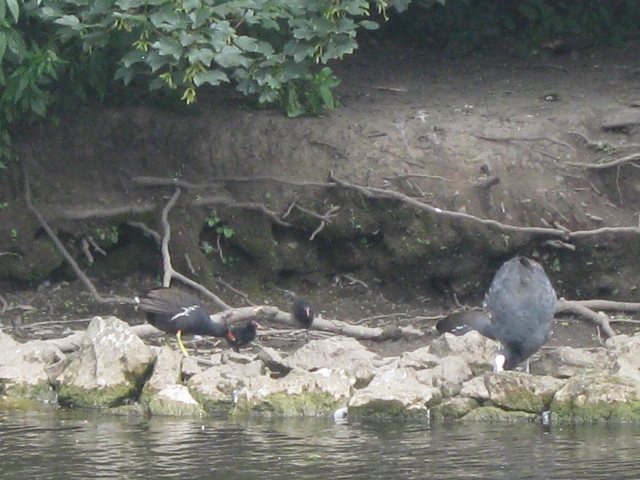
018Coot and moorhen with chicks (640x480)

Coot and Moorhen with chicks

I was fascinated by the behaviour of both the moorhen and the coot.  These birds are not often seen together although very closely related.  I find their chicks indistinguishable and am not sure if these chicks belonged to the coot or moorhen.  Coots have a pure white forehead and bill and are usually found on open water like lakes and moorhens with red bills that have a yellow tip are found on streams and ponds.  Both birds obviously felt threatened by each other and though it isn’t clear in the photo above the coot had lowered its head and had fluffed up all its feathers until it looked enormous.  It was moving very slowly too.

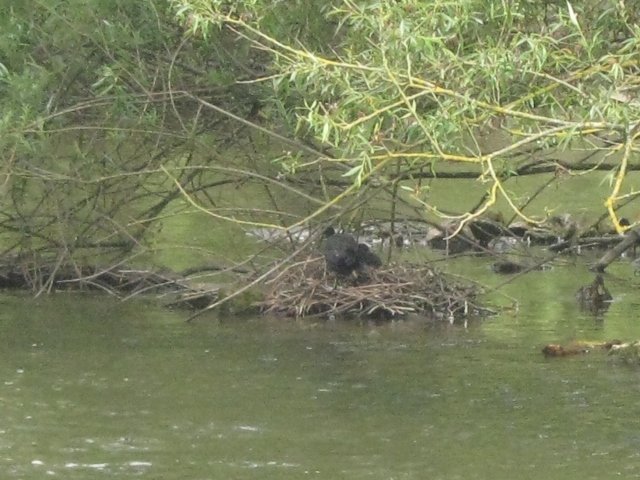
016Coot nest (640x480)

A Coot nest

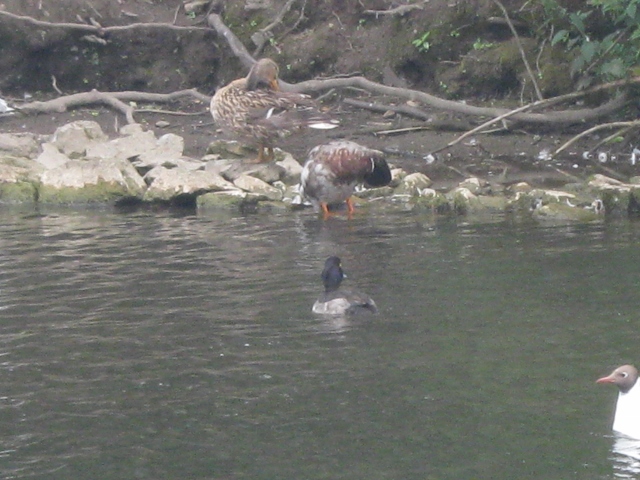
006Mallards, tufted duck & black-headed seagulls (640x480)

Mallards, Tufted Duck and a Black-headed Seagull which decided it wanted to be photographed too

After sitting by the river for a while, R and I decided we would go on to Haddon Hall which is just a few miles from Bakewell.  I will talk about that in my next post.

Share this:

  • Share on X (Opens in new window) X
  • Share on Reddit (Opens in new window) Reddit
  • Share on Pinterest (Opens in new window) Pinterest
  • Share on Facebook (Opens in new window) Facebook
  • Email a link to a friend (Opens in new window) Email
  • Share on Tumblr (Opens in new window) Tumblr
  • Print (Opens in new window) Print
  • Share on LinkedIn (Opens in new window) LinkedIn
Like Loading...

Harvest Festival

02 Thu Oct 2014

Posted by Clare Pooley in churches, Rural Diary, Uncategorized, weather

≈ 18 Comments

Tags

bats, church, church decorations, Evensong, flowers, Harvest, hot-air balloon, Rumburgh, sowing

007Rumburgh church (640x480)

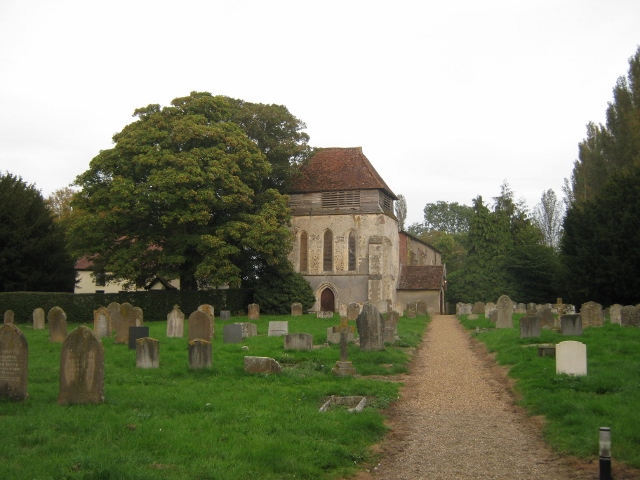
Rumburgh Church

Here is an autumn photograph of my church taken on Sunday as we were on our way to get it ready for the Harvest Evensong service.  R is one of the Churchwardens and so we got there early to make sure all was tidy (no bat poo on the pews) and to turn on the lights and take the plastic covers off everything.  As I have said before, our poor church is damp and has a colony of bats living in it and to protect the furniture etc. we have to cover what we can with bits of plastic sheet.  No money to repair the church, no money to buy proper protective covers, not enough money for anything, unfortunately.  I like bats and am very pleased that we have two resident pipistrelle bats that fly round our house every evening.  However, I am not happy about the bats that live in our church because of the damage their urine and faeces do.  The urine especially is so acidic it etches into all the furniture, pictures and flooring.  We have to be so careful when serving refreshments after service in case food and drinks are contaminated.  Bats are protected and it is virtually impossible to get them moved elsewhere.

Our benefice is made up of eleven parish churches and one redundant church which we use once or twice a year.  We have one over-worked priest who has recently acquired an assistant (actually the priest in the next-door benefice who does holiday and sickness cover which is reciprocated), a couple of retired priests who step in when needed, one reader and two elders who take services without communion.  All of the churches in the benefice like to have their own harvest festivals, so for weeks on end there are one or two harvest services on most Sundays.  Last Sunday was the third consecutive week of harvest and our service was taken by Maurice, one of the Benefice Elders.  Next Sunday and the following one there are no Harvest services but then they start up again and we have another three consecutive weeks of ‘We Plough the Fields and Scatter’ right through until the end of October.

004Flowers on pulpit (480x640)

Decorated pulpit. Our talented flower arrangers make the church look so bright and festive.

Any harvest contributions of food, fruit and vegetables at our church go to Adele House, a nursing home run by the convent at All Hallows.  Other churches in the benefice send their contributions to a local food bank which provides food parcels for the needy.

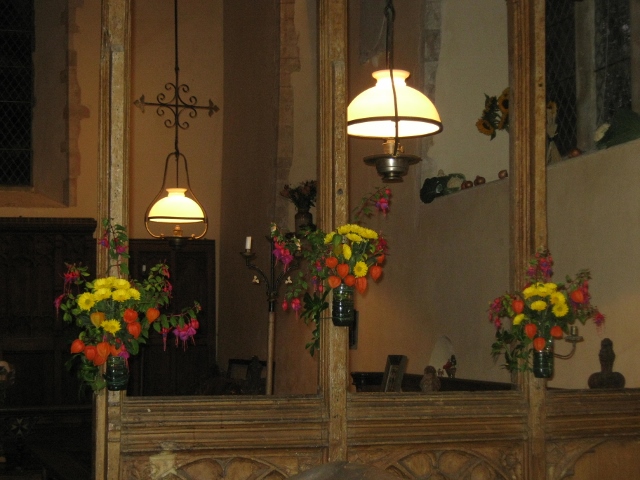
005Flowers on rood screen (640x480)

Decorated Rood Screen.

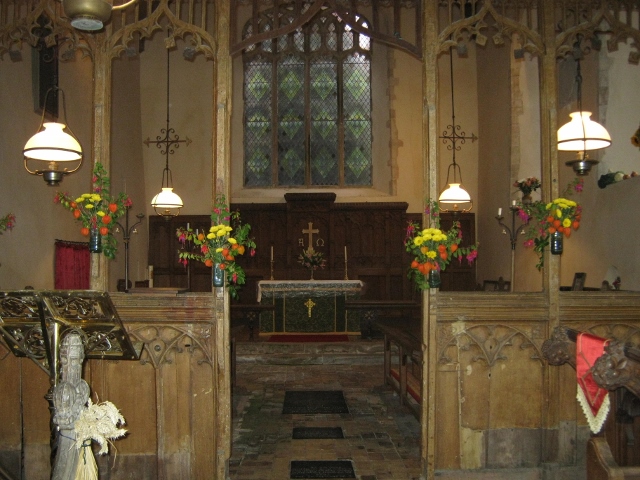
008Chancel (640x480)

The Chancel

009The font (480x640)

The Font

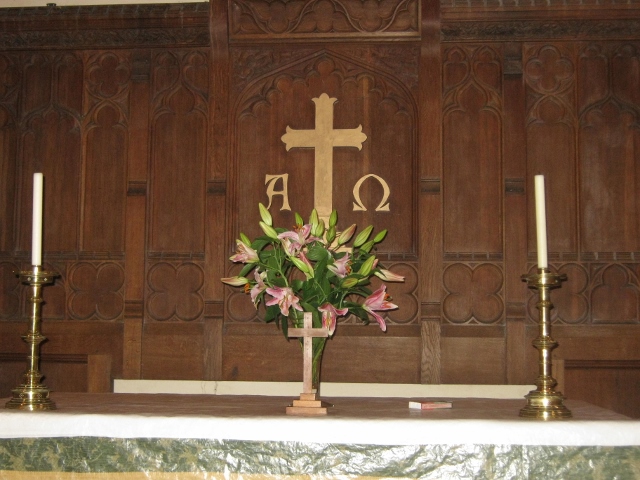
017The Altar (640x480)

The Altar

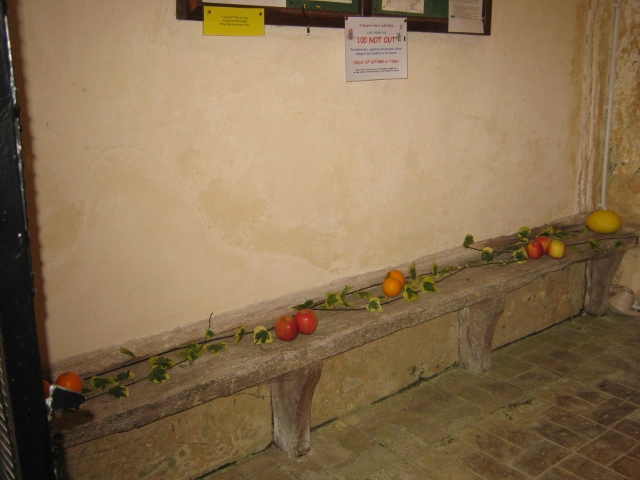
020The porch (640x480)

The Porch

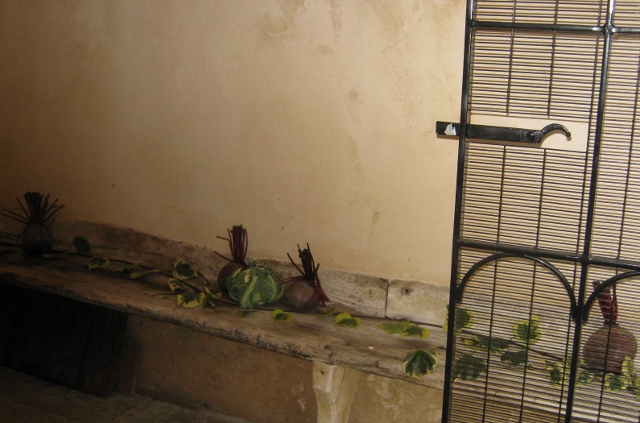
021The porch (640x423)

The Porch. Look at the enormous beetroot!

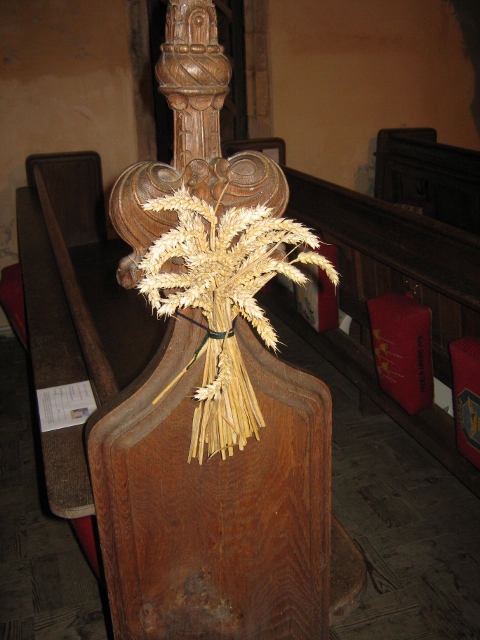
006Bunches of wheat on pew ends (480x640)

Bunches of wheat tied to the pew ends.


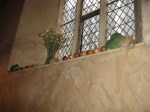
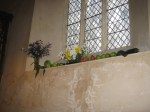
One of these window sills was decorated by me.

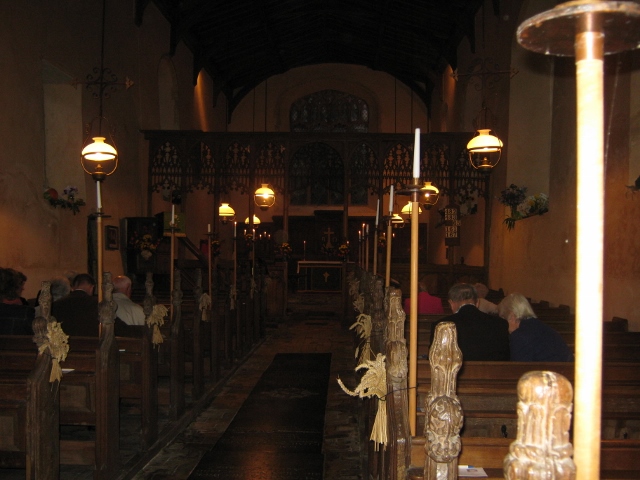
022The church (640x480)

The church just before the service started.

Maurice plays the organ so he gets plenty of exercise, walking up and down the aisle from the front of the church to the back where the organ is then back to the front again then up the steps to the pulpit.

We were very lucky to get 23 people at our Evensong service – no children sadly.

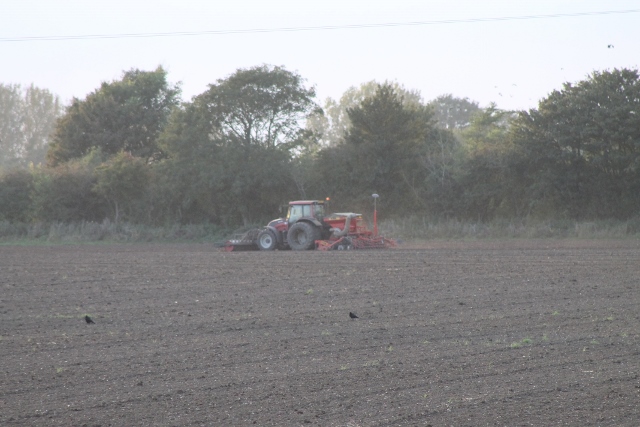
Today, I noticed that the field at the back of the house was being worked on again.

002Sowing (640x427)

Sowing the seed. I apologise for the poor quality photo. The sun was setting and it was a little hazy too.

After the coldest August in many, many years we have had a very warm and fairly dry September.  There has been mist and fog in the morning occasionally which has made driving to Norwich difficult.  It is all set to change this weekend with a storm coming in off the Atlantic which will get to us in the East sometime on Saturday.  When it has passed through the temperature will drop considerably, so we are told.  Yesterday evening I noticed a hot-air balloon in the sky – a Virgin sponsored one.  The thermals must have been just right.

009Hot air balloon (640x448)

E used to call them ‘hot hair balloons’.

Thank-you for visiting my blog.


Share this:

  • Share on X (Opens in new window) X
  • Share on Reddit (Opens in new window) Reddit
  • Share on Pinterest (Opens in new window) Pinterest
  • Share on Facebook (Opens in new window) Facebook
  • Email a link to a friend (Opens in new window) Email
  • Share on Tumblr (Opens in new window) Tumblr
  • Print (Opens in new window) Print
  • Share on LinkedIn (Opens in new window) LinkedIn
Like Loading...

Norwich Knowledge

06 Sat Sep 2014

Posted by Clare Pooley in churches, Rural Diary, trees, Uncategorized, walking

≈ 24 Comments

Tags

Augustine Steward house, beguinage, Blackfriar's Hall, Briton's Arms, Christian Resource Centre, City College, Edith Cavell, Edith Cavell Monument, Elm Hill, elm trees, Erpingham Gateway, Forget-Me-Not Café, Fye Bridge, hair appointments, Norwich, Norwich Cathedral, Norwich Hippodrome, Paston family, Princes Street, Quayside, River Wensum, St Andrew's Hall, St Giles, St Giles car-park, St Michael at Plea, Stranger's Club, timber-framed buildings, Tombland, Tombland Alley, walking

Norwich is a very beautiful city and we always look forward to visiting it.  (Norwich is pronounced ‘Norridge’ or, if you are a local, ‘Narge’).  For the next few months I will be going there every day of the week so perhaps the shine may wear off a little, though I don’t think it likely.

On Tuesday E and I had to be at City College Norwich at 8.30 in the morning so that E could meet her mentor before her ‘taster day’ began at 9.00 am.  I had a hair appointment at 9.45, my second one with my new hairdresser.  When my local hairdresser went on maternity leave and I found the replacement hairdresser wasn’t to my liking I decided to look for a new one in Norwich where I would be spending some time each day.  I rather like the young woman who now does my hair.  ‘Oh Clare!’, she said the last time I saw her, ‘Don’t start colouring your hair again.  Your shade of grey is really lovely!’.  There aren’t many women who wouldn’t fall for that one.

So, after leaving E at the college I drove to the city centre and parked my car in my usual car-park at St Giles.  This is rather an ugly multi-storey car-park built in the 1960’s so is quite difficult to park in if you have a modern car – it’s very narrow and full of pillars.  The car-park is on the site of the Norwich Hippodrome, an extremely ornate theatre built in 1903 and demolished in 1964.  Apparently many inter-war stars performed there – Charlie Chaplin, Marie Lloyd, Gracie Fields, George Formby and even Archibald Leach (Cary Grant) made his acting debut there at the age of twelve.  After the Second World War it continued to be popular for a while with acts like Laurel and Hardy visiting in 1954.

I had about an hour to kill before my appointment and, as the morning was bright and sunny I decided to have a short walk and visit some of my favourite places.

I walked up past my hairdressers in London Street to the junction at the top of the hill.  On the corner of Redwell Street and Queen Street is the redundant church of St Michael at Plea.

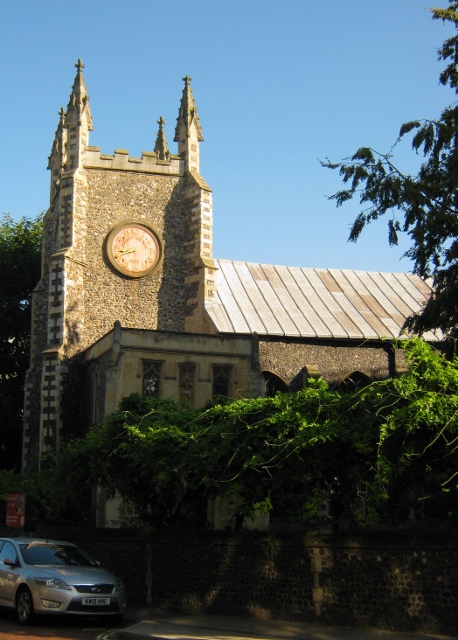
001St Michael's at Pleas church (2) (458x640)

St Michael at Plea church

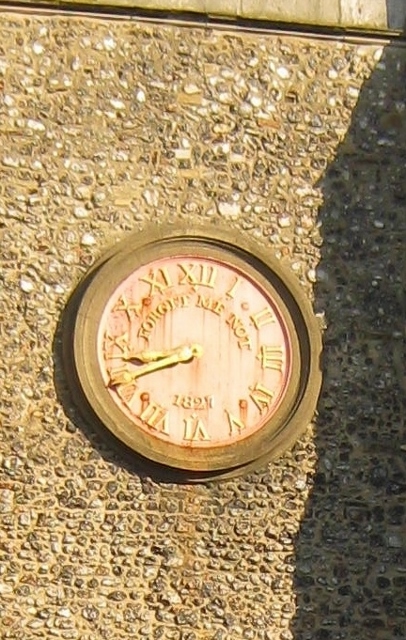
The church ceased to be a place of worship in 1973 and opened in 2008 as a Christian Resource Centre.  Before that it had been used as an antiques market.  We call in quite often as we buy things for our church here – candles, communion wafers etc – and it is a good place for Easter and Christmas gifts.  The bookshop is very good and stocks new and second-hand books.  There is also a really nice café in what was the chancel, with extremely tasty and cheap food, all supplied by volunteers.  The café is called the Forget-Me-Not Café after the wording on the clock on the tower.

001St Michael's at Pleas church (406x640)

The Forget-Me-Not clock

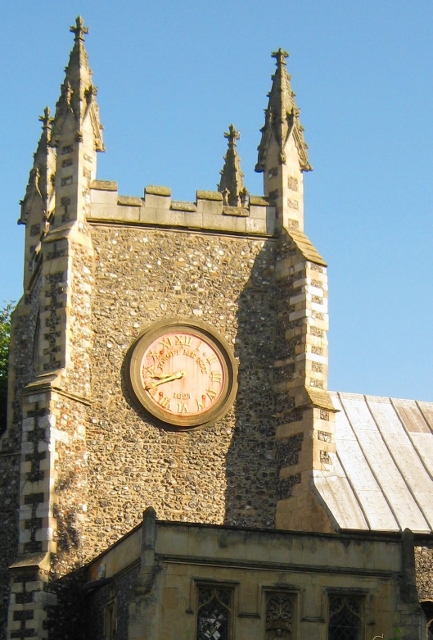
The battlements and spirelets were put on the top of the tower during a 19th Century restoration.  The tower had been lowered for safety reasons some time before that.  I think it had been much taller with bells.

001St Michael's at Pleas church (3) (433x640)

The rather truncated tower with its pretty pinnacles

The porch is probably early 16th Century and rather strangely gives access to the base of the tower rather than the Nave.  Most of the church’s furniture and valuable decorations were removed when it was made redundant but it still has a beautiful memorial in it, some medieval glass high in the east window and some carved angels in the roof.

I then went down Elm Hill, one of the most lovely streets in the country.

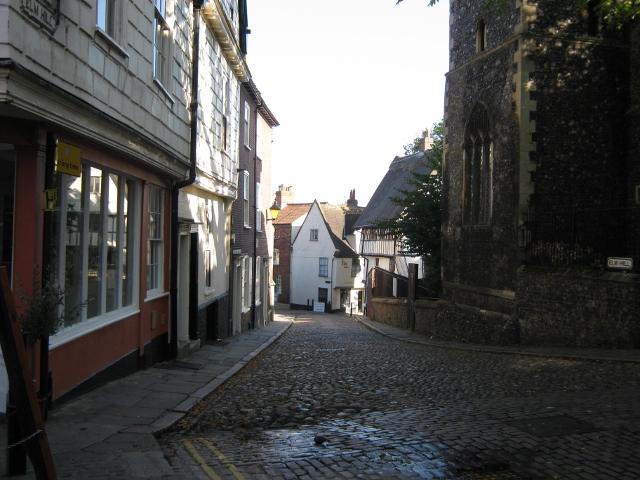
002Elm Hill (640x480)

Elm Hill. Blackfriars Hall is on the corner of the street on the right of the photo.

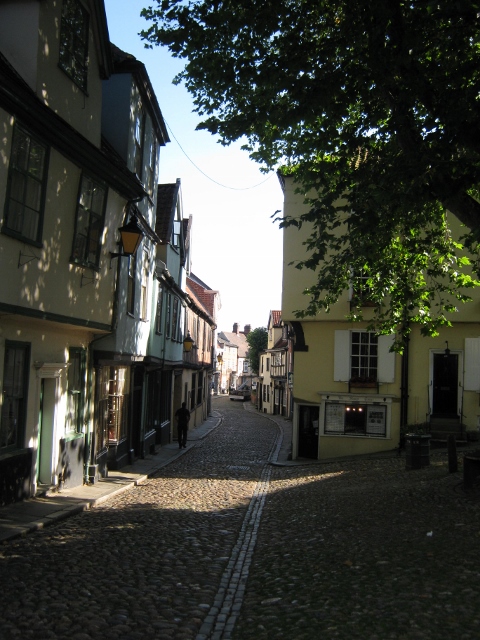
Elm Hill is a cobbled street full of timber-framed buildings and virtually unaltered since the 16th Century.  There have been people living in this area since at least 1200.  (Probably before that time, as it is close to the river and to Tombland, the site of the Anglo-Saxon market.)  It is called Elm Hill after the elm trees that used to grow there next to the Briton’s Arms, all of them killed by Dutch Elm disease.  This was a wealthy street in medieval times where many merchants lived.  By the 20th Century it had seen better days and there were plans to sweep it all away.  Fortunately, the authorities thought better of this idea and now most of the buildings have been restored and look wonderful.

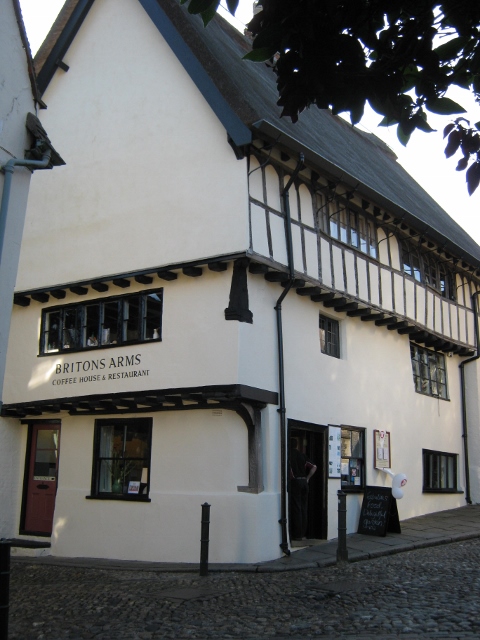
003Briton's Arms (480x640)

Briton’s Arms, now a restaurant and coffee house.

The Briton’s Arms was built in 1347 and became an ale house in 1760.  It is three storeys high and was the only house on Elm Hill to survive a fire in 1507.  It stands in the corner of the old churchyard of St Peter Hungate and the only reason it survived the fire was because it stood apart from the rest of the houses.  The fire destroyed 300 houses and shops.  There are two rooms per storey of the Briton’s Arms and each floor is reached by a side staircase.  The top floor is jettied out on three sides and it also has an attic – a rarity in Medieval buildings.  It is perhaps one of the oldest inhabited attics in England.  It began life as a beguinage associated with St Peter’s church.  A beguinage was the home of a group of single women who devoted their lives to prayer and community work, like a nunnery.  However, unlike a nunnery which accepted the daughters of wealthy parents, beguines were usually from poor backgrounds.  They earned a little money from spinning and begging for alms and did charity work in the city but their main work was regular worship in the church next door which was reached through a stone arched door in the rear wall of the building.  Beguinages were common in Europe but there are no known other examples elsewhere in Britain.

004Elm Hill (2) (480x640)

Looking further down Elm Hill from outside the Briton’s Arms.

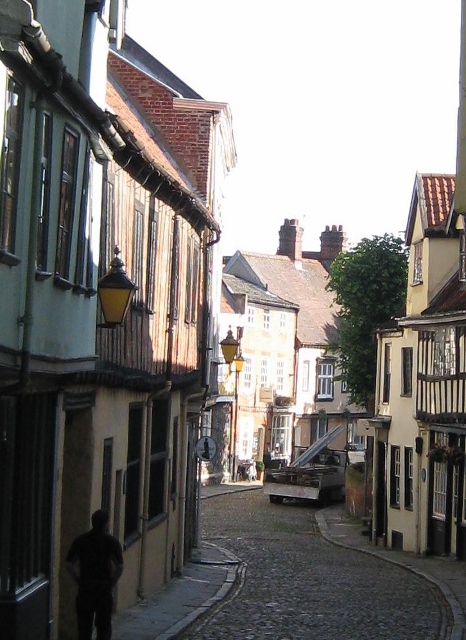
004Elm Hill (3) (466x640)

I cropped the photo above to make it easier for you to see the pink house on the left.

The house just in front of the man in the photo is the Strangers’ Club built on the site of the Paston’s House which was destroyed by the fire.  The Club is said to be haunted by a man who died in the fire of 1507.  Queen Elizabeth I stayed here and watched a pageant in her honour from one of the upstairs windows.

The Pastons rose from peasantry to aristocracy in two generations.  They also left a record of private correspondence (The Paston Letters) which is the first example of such correspondence to survive in Britain.  To quote my on-line source ‘The letters show first hand testimony of the social benefits of the plague brought to the peasantry, the chaotic effects of the War of the Roses on the general populace and the individual impact that the Black Death could have on a family’.  I have a copy of the letters and they are a really good read especially the letters from Margaret Paston to her two sons and theirs to her.  Her husband had managed to be bequeathed Caister Castle by John Fastolf who was a knight during the Hundred Years War, became a loyal servant of Henry V and fought in the Battle of Agincourt.  He was also the knight that Shakespeare based his John Falstaff on.

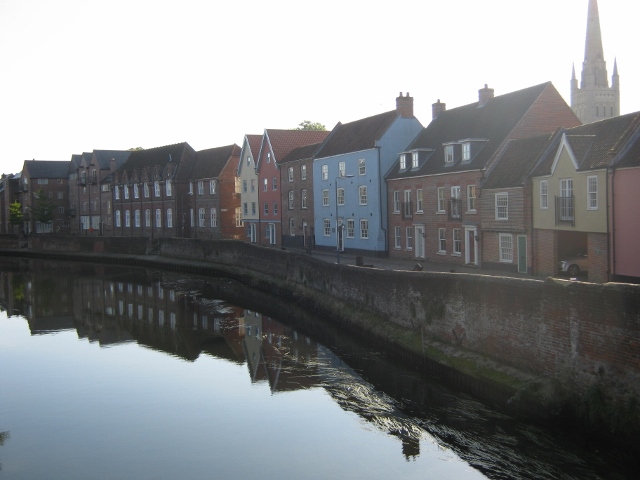
005Quayside from Fye Bridge (640x480)

Quayside from Fye Bridge

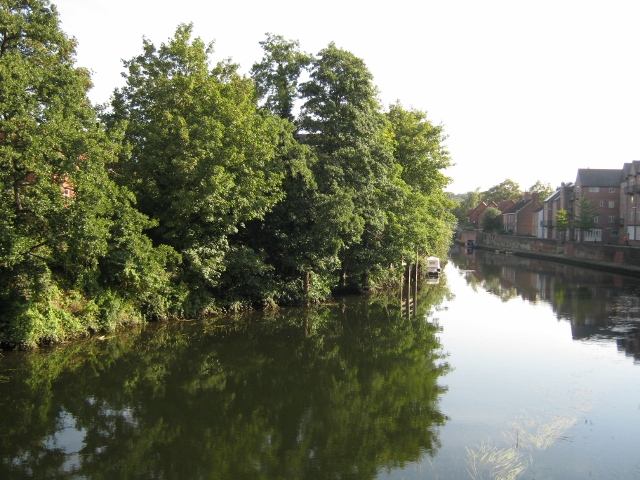
At the bottom of Elm Hill I turned left along Wensum Street and crossed halfway over Fye Bridge so I could look at the River Wensum.  Wensum comes from the Anglo-Saxon word for ‘winding’ – wandsum or wendsum.  The river winds in two large loops through the city and is a tributary of the River Yare despite being the larger of the two rivers.  It is chalk-fed and the whole river is a Site of Special Scientific Interest and a Special Area of Conservation.  Fye Bridge is built over the oldest river crossing in Norwich and is the gate to the North of the city known as Norwich Over the Water.  The bridge is also the site of a former ducking stool.

006The Wensum from Fye Bridge (640x480)

The River Wensum

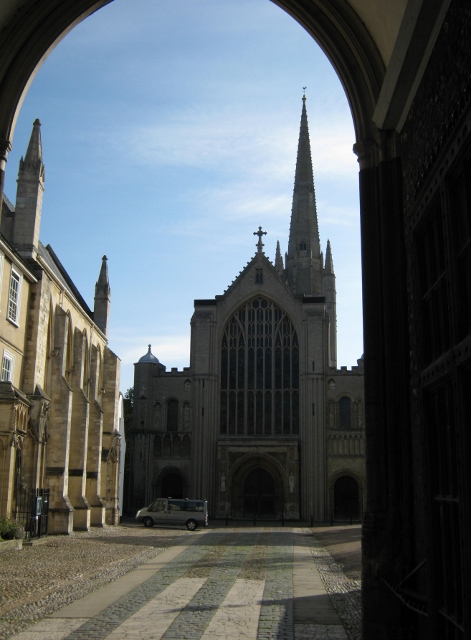
007Norwich Cathedral from Erpingham Gate (471x640)

Norwich Cathedral seen from the Erpingham Gate

I didn’t cross right over the bridge but returned to Wensum Street and walked along it to Tombland and stood by the Erpingham Gate so I could look at the Cathedral.  Though it doesn’t look it from this angle the cathedral is immensely long (407 feet) and the top of its spire is 315 feet from the ground.  The construction of it was begun in 1096 and finished in about 1145.  The Cathedral was also a Benedictine Priory.  The Erpingham Gateway was built in 1420 by Sir Thomas Erpingham who was the commander of Henry V’s archers at the Battle of Agincourt.

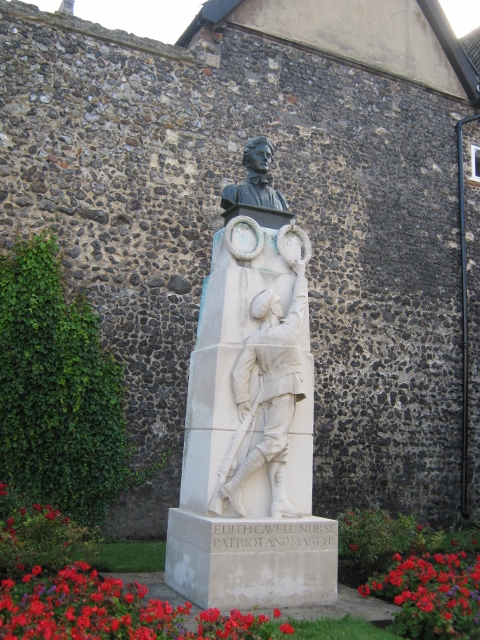
009Edith Cavell Memorial (480x640)

Just to the right of the Erpingham Gateway is the Edith Cavell Memorial.

Edith Cavell is buried near the east end of the Cathedral.  She was born in 1865 and grew up in Swardeston, south of Norwich and was a vicar’s daughter.  She became a Matron of an English teaching hospital and was also an influential pioneer of modern nursing in Belgium.  She was in England visiting her mother when World War I broke out but returned to Belgium as she felt it was her duty so to do.  Her hospital became a Red Cross hospital and so wounded soldiers from all nations were treated there.  She was a devout Christian and this motivated her to help all those in need, both German and Allied soldiers.  When a group of wounded British soldiers arrived who had been cut off from their comrades she decided to help them despite knowing that that she was putting at risk the neutrality of the Red Cross and endangering others working with her.  She then joined a Belgian underground movement and helped more than 200 Allied soldiers to escape to neutral territory.  The network was betrayed, she was arrested, tried by a court martial, found guilty of treason and sentenced to death.  Her execution was carried out at dawn by a firing squad on 12th October 1915.  She was still wearing her nurses uniform.  On the eve of her execution she said, “I am thankful to have had these ten weeks of quiet to get ready.  Now I have had them and have been kindly treated here.  I expected my sentence and I believe it was just.  Standing as I do in view of God and Eternity, I realise that patriotism is not enough.  I must have no hatred or bitterness towards anyone.”

008Medieval buildings and Tombland Alley (640x480)

Augustine Steward house

Opposite the Erpingham Gateway in Tombland is this rather lop-sided medieval building.  This is Augustine Steward house which was built in 1530 by Augustine Steward, a cloth merchant.  A merchant’s mark can be found in the passage next to the house.  A merchants mark is a symbolic sign or design used by artisans, merchants and townspeople to identify themselves and authenticate their goods.  The alleyway next to the house is called Tombland Alley and in the alley is the burial ground for the adjacent church of St George.  The high-walled churchyard contains mainly victims killed by the plague.  The name ‘Tombland’ has nothing to do with tombs but comes from an Old Scandinavian word for ‘open space’.  It was the area used for the Anglo-Saxon market and the administrative centre of Norwich before the Norman Invasion.

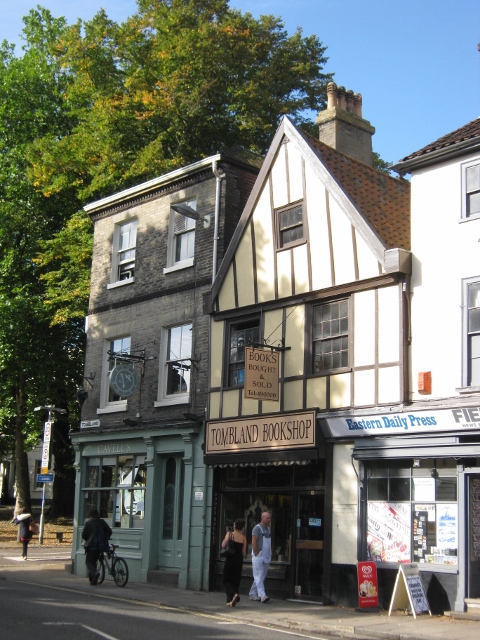
010Medieval buildings in Tombland (2) (480x640)

Another ancient building and the best antiquarian bookshop in Norwich.

This is a 15th Century timber-framed building also in Tombland.  I like the way the gable-end of this house leans outwards.

010Medieval buildings in Tombland (483x640)

It isn’t as easy to see how much it leans out in a photo as it is in real life.

011Princes Street (640x480)

Princes Street

I turned off Tombland into Princes Street.  Again, this street is cobbled and is full of a mix of beautifully restored 16th and 17th Century buildings with some modern offices and homes.

012St Andrew's Hall (640x480)

St Andrew’s Hall

Princes Street becomes Hall Plain after passing the top end of Elm Hill.  St Andrew’s Hall is in Hall Plain.  It and Blackfriar’s Hall at the top of Elm Hill are part of the most complete medieval friary complex surviving in this country.  In 1538 during the reign of Henry VIII they passed into civic hands.  The roof beams for Blackfriars and the hammerbeams in St Andrew’s roof were the gift of the Paston family together with superb 15th Century doors bearing the Arms of the Pastons and Mautbys in the South Porch.  The nave of St Andrew’s Hall was repaired and renamed The New Hall and has been used for civic ceremonies ever since.  The first recorded event was the mayor’s feast for Henry Fuller in 1544.  The Hall has been used for many things – Guild meetings, an assize court, a corn exchange and a corn hall.The Earl of Warwick stabled his horses here when he came to crush Kett’s Rebellion in 1549.  Sir Thomas Browne, the physician and polymath, was knighted here in 1671 by Charles II.  The Norfolk and Norwich Festival was started here in 1824 and still continues. The largest regional Beer Festival in Great Britain was started here in 1978.  I believe the Blackfriar’s Hall is used as a museum and art gallery.  The old east and west ranges of cloisters have also had many uses – granaries to store corn for Poor Relief, places of worship for Presbyterians and Baptists, a mint where £259,000 of coins were produced in 1695, the City Workhouse, schools and colleges.  They are now part of the Norfolk Institute of Art and Design.

I was now in time for my hair appointment and when that was finished I made my way home via Bungay where I bought some bird seed for my mother.

May I thank everyone for their kind thoughts and wishes.  My husband is in good heart though not looking forward to brain surgery.  My mother seems a little better too.  We will see how E gets on on Monday and the rest of next week.  I will keep you informed when I can.  God Bless you all.


Share this:

  • Share on X (Opens in new window) X
  • Share on Reddit (Opens in new window) Reddit
  • Share on Pinterest (Opens in new window) Pinterest
  • Share on Facebook (Opens in new window) Facebook
  • Email a link to a friend (Opens in new window) Email
  • Share on Tumblr (Opens in new window) Tumblr
  • Print (Opens in new window) Print
  • Share on LinkedIn (Opens in new window) LinkedIn
Like Loading...

A Publishing Error

04 Thu Sep 2014

Posted by Clare Pooley in Uncategorized

≈ Leave a comment

For some strange reason while trying to insert a photograph into the previous post the post was published in error.  I really don’t know how it happened.  I have finished and edited and re-published it and most of you will read the finished version.  However, those of you who are e-mail followers may find that the only version you have is the unfinished one.  If so, please re-visit my blog and read the complete post.

Clare

Share this:

  • Share on X (Opens in new window) X
  • Share on Reddit (Opens in new window) Reddit
  • Share on Pinterest (Opens in new window) Pinterest
  • Share on Facebook (Opens in new window) Facebook
  • Email a link to a friend (Opens in new window) Email
  • Share on Tumblr (Opens in new window) Tumblr
  • Print (Opens in new window) Print
  • Share on LinkedIn (Opens in new window) LinkedIn
Like Loading...

Peak District Holiday 1st to 9th July. Day 3

28 Thu Aug 2014

Posted by Clare Pooley in plants, Rural Diary, trees, Uncategorized, walking

≈ 22 Comments

Tags

Back Forest, bilberries, Cedar, Danebridge, drystone walls, enchanter's nightshade, eyebright, ferns, fir cones, foxglove, Gradbach, grasses, Hanging Stone, hart's-tongue fern, heath bedstraw, heather, JW Lees beer, landslip, Lud's Church, marsh thistle, moss, mouse-ear hawkweed, pink purslane, River Dane, sheep, Sir Gawain and the Green Knight, spear thistle, stiles, The Roaches, The Ship Inn, tormentil, walking, Welsh poppy, Wincle, Wincle Brewery, wood sorrel

After a gentle day in Buxton (see Days 1 and 2) and another good night’s sleep we felt ready for a little exercise.  We decided to go on a circular walk in Back Forest alongside the River Dane to Danebridge and then back.  We had done this walk before, a few years ago, and had gone in a clockwise direction.  This time we went anti-clockwise and it is amazing how different everything looks coming at it from the opposite direction.

We drove a few miles from where we were staying to the Peak National Park car park in Gradbach.  The day was bright and breezy with not too much strong sunshine – ideal walking weather.  The car park was full – about ten cars – which disappointed us, but once we had got past Gradbach Mill and into the forest we hardly saw a soul.  There is a short walk down the hill to the mill from the car park.  Last year the Mill had still been in use as a Youth Hostel but this year it had been taken over by Newcastle under Lyme University and a lot of renovation work was being carried out.  It is in the process of being made into a Field Study Centre and there were groups of students setting off on walks and school children on field trips having noisy picnics all over the place.  We followed a path away from the mill and down to the river going over and through a couple of stiles on the way.  One of the stiles was a squeeze stile and from a distance this looks an easier option than having to clamber over a wall or gate using wooden or stone cross bars.  Up close one can see that the gap is very narrow, in fact no more than 25cm/9.8″ wide to stop livestock escaping from fields either side of the wall.  There are stone pillars on each side of the gap to protect the structure of the wall.  The dry-stone walls are at least 4.5′ tall and as I am 5’4″ tall and not exactly skinny they are very difficult for me to manage.  I have to put my arms in the air, breathe in and force myself through inch by inch with R standing watching and smirking.  Anyone larger than me would not be able to get through at all.  R is nearly a foot taller than me at 6’3″ and takes longer strides so, though we walk the same distance, I do about two paces to his one.  I also wander about taking photos and lag behind and have to trot to catch up with him.

We crossed the river by a narrow bridge and started to climb up into the forest leaving the river some way below.
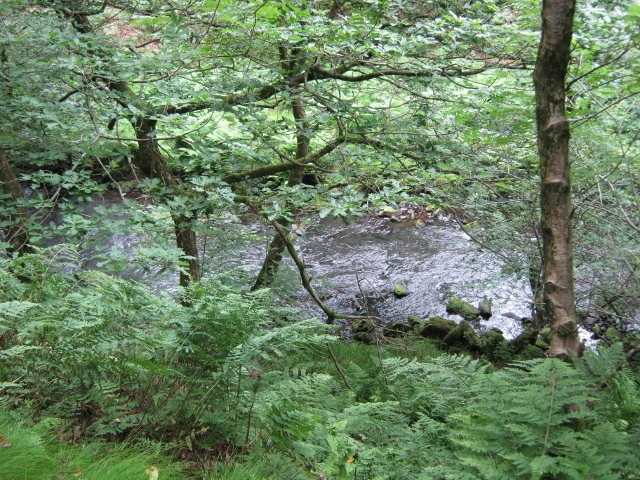
011Back Forest (640x480)

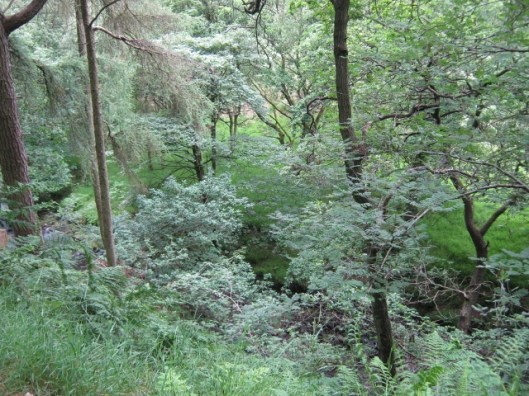
Back Forest Wood looking down from the path towards the River Dane.
012Back Forest (480x640)

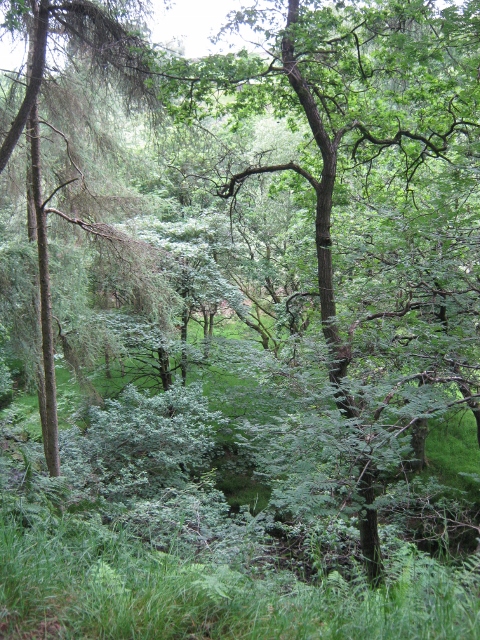
Back Forest Wood

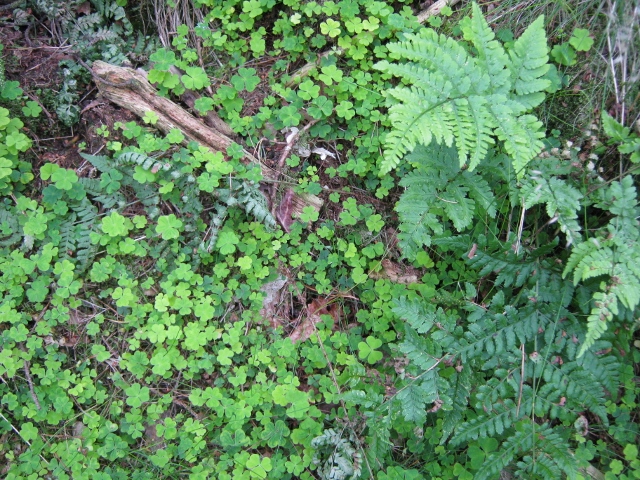
014Ferns and wood sorrel leaves (640x480)

Ferns and Wood Sorrel leaves

We walked through the woods for about three-quarters of a mile eventually descending back down towards the river again.
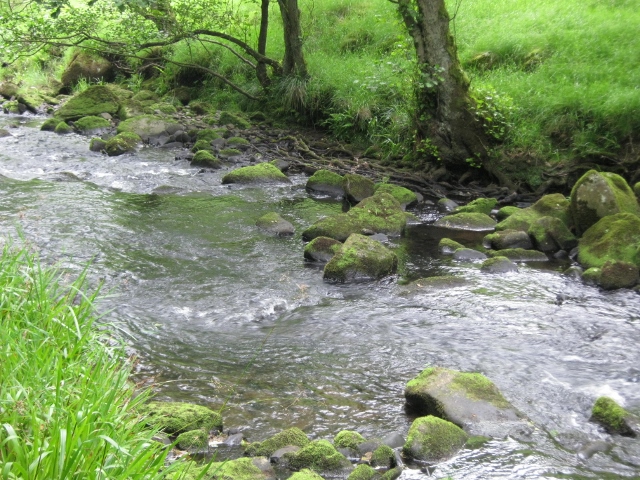
015River Dane (640x480)

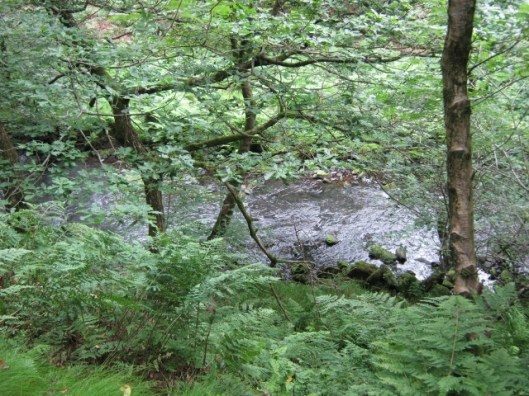
River Dane

Dane is a Celtic river-name meaning ‘trickling stream’.
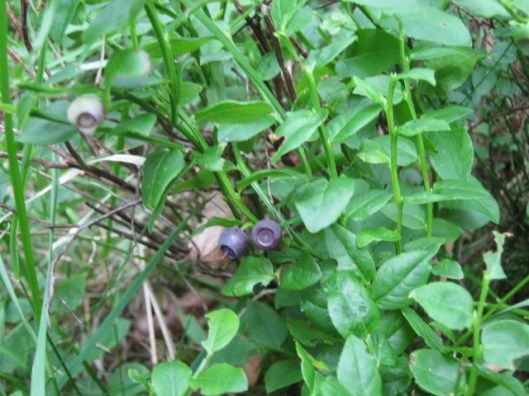
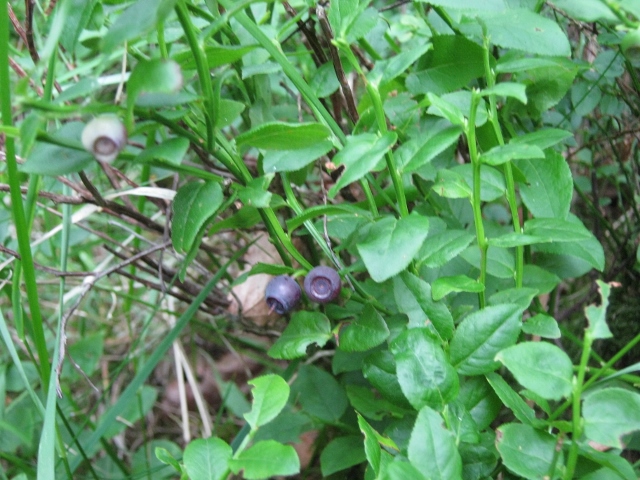
016Bilberries (640x480)

Bilberries

018Mosses (480x640)

Mosses

020River Dane (640x480)

River Dane

Walking further on we saw that there had been a landslip which may have been caused by all the rain last winter.

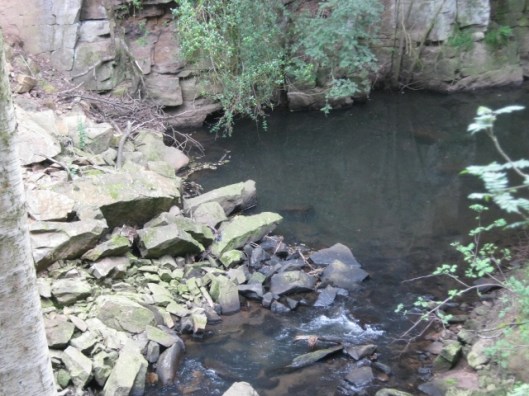
022Landslip into river (480x640)

023Pool caused by landslip (640x480)

A new pool caused by the landslip

024Tree roots on path (640x480)

Tree roots on the path

We then left the wood and started walking along a grassy path through a valley.
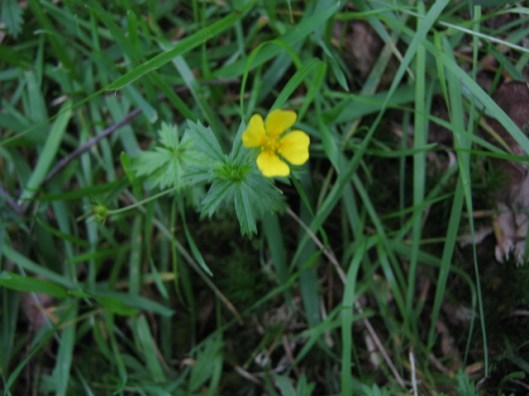
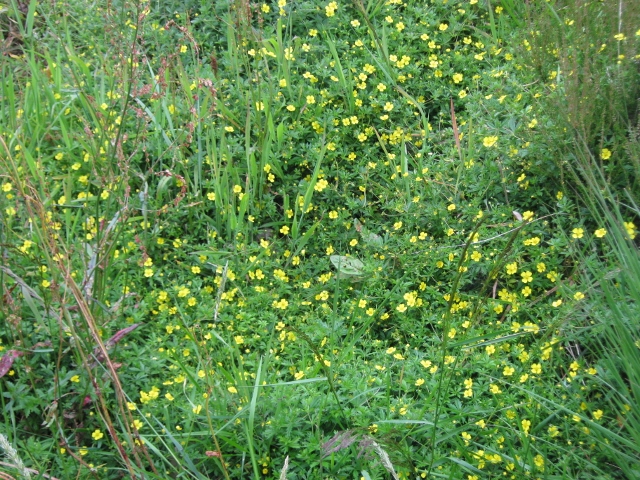
028Tormentil (640x480)

Tormentil – potentilla erecta

In wet weather or at night, when the petals close up, the tormentil flower has the ability to pollinate itself.
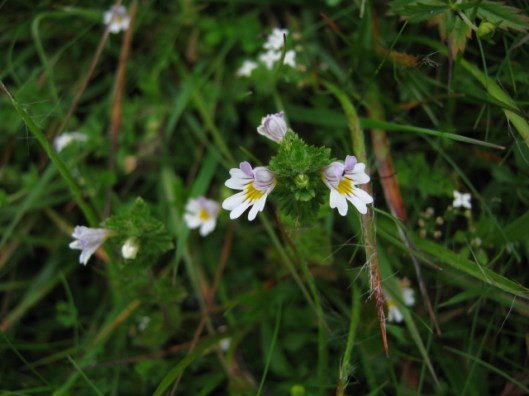
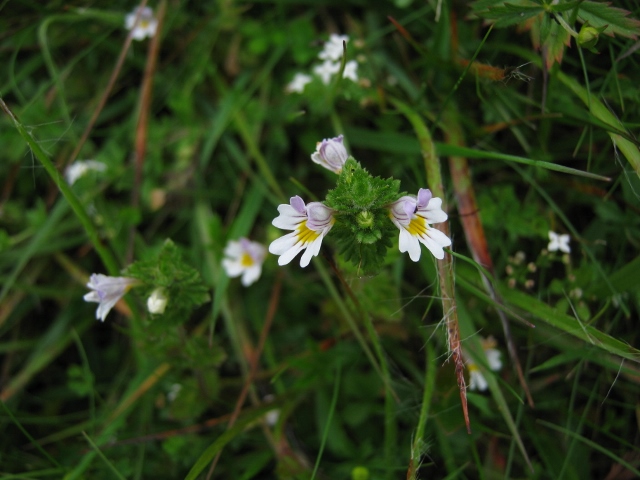
030Eyebright (640x480)

Eyebright – euphrasia nemorosa

This bright little flower was thought to be good for poor eyesight and an extract from eyebright and the herb golden seal is still used as an eye lotion.  The 17th century botanist William Cole recorded in his book ‘Adam in Eden’ that eyebright was the herb used by the linnet (a little finch) to clear its eyesight.  My source book for this information says ‘Since short-sighted linnets are not easy to identify, few could argue with Cole’s reasoning’.  It is a semi-parasitic plant, only growing where its roots can attach themselves to other plants like clover and plantain.
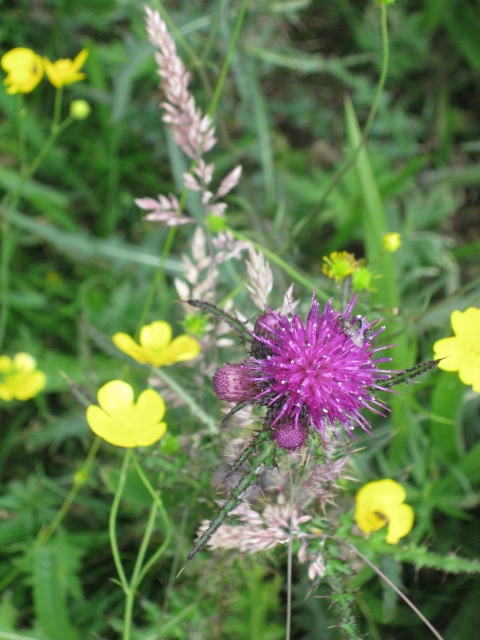
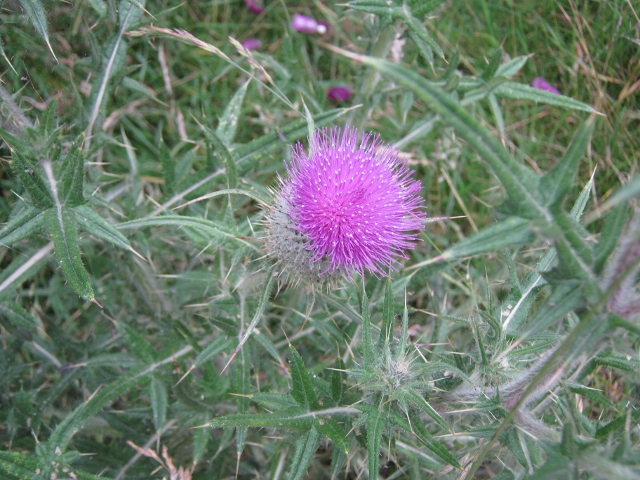
032Thistle and buttercups (480x640)

Marsh Thistle with Buttercups

We then followed the path alongside a drystone wall.
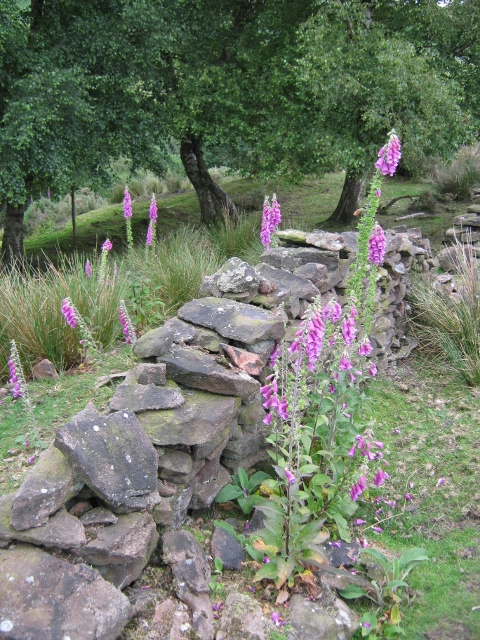
033Foxgloves and dry-stone wall (480x640)

Lots of Foxgloves were growing by the wall
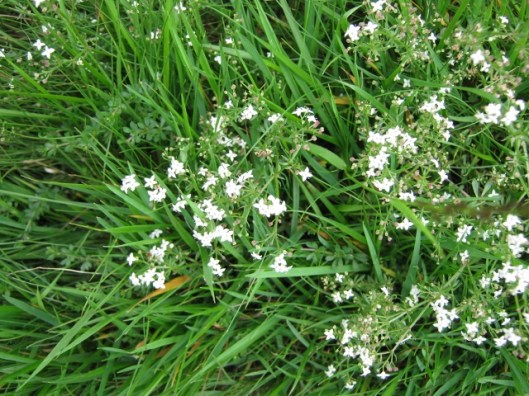
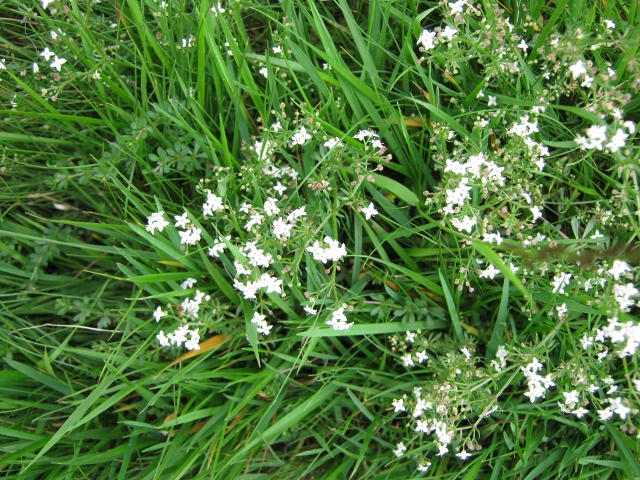
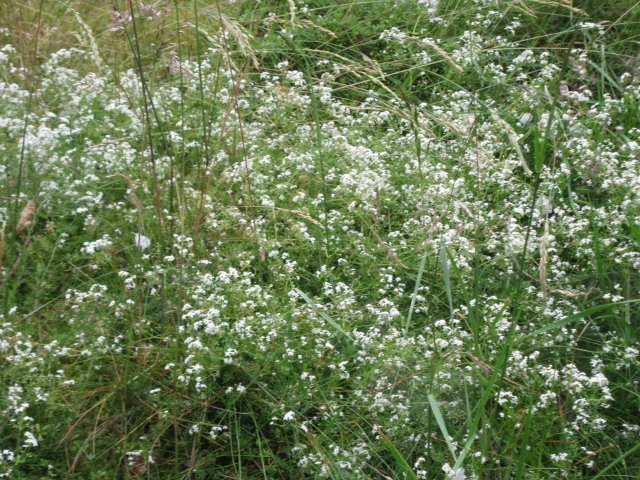
034Bedstraw (640x480)

Heath Bedstraw was growing in the grass
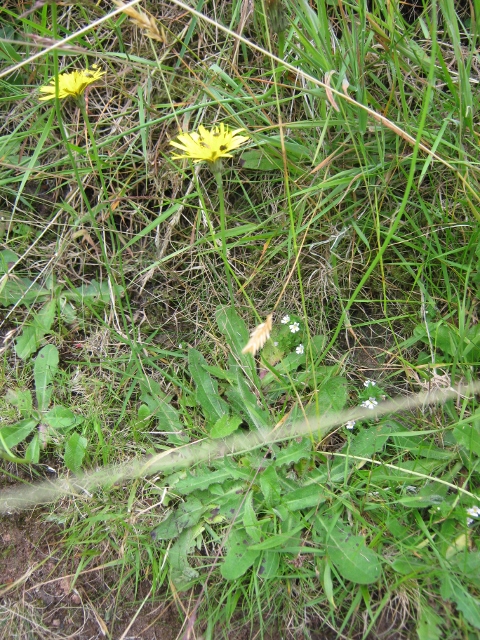
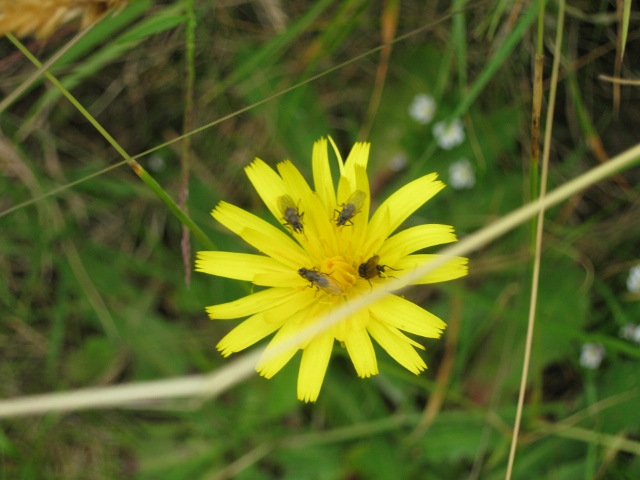
035Mouse-ear Hawkweed (480x640)

and so was Mouse-ear Hawkweed

036Mouse-ear Hawkweed with flies (640x480)

which was popular with the flies

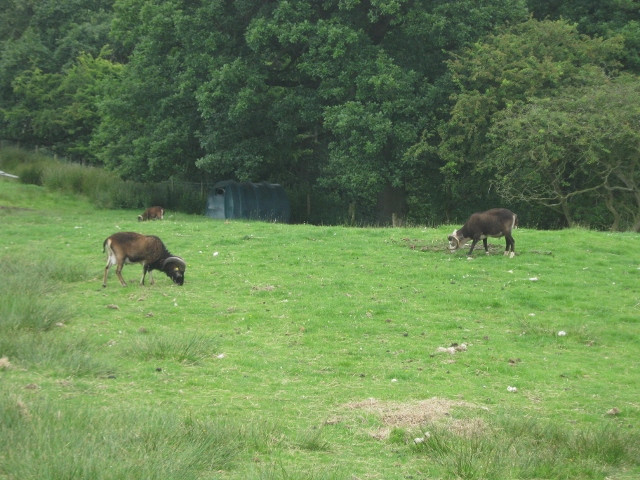
We passed by a farmhouse with some sheep.

040Sheep (640x480)

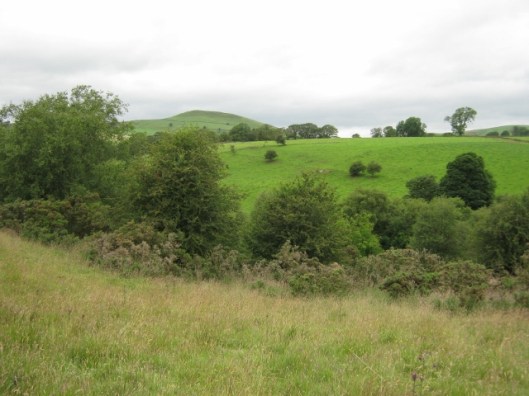
Just a little further on over the fields the views were very good.
043View (640x480)

Rolling countryside

We then re-entered woodland.
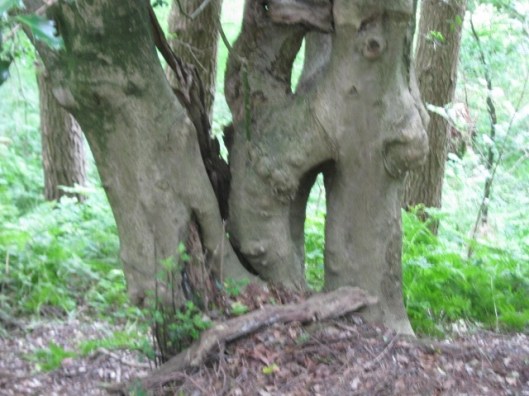
045Tree trunks (out of focus) (640x480)

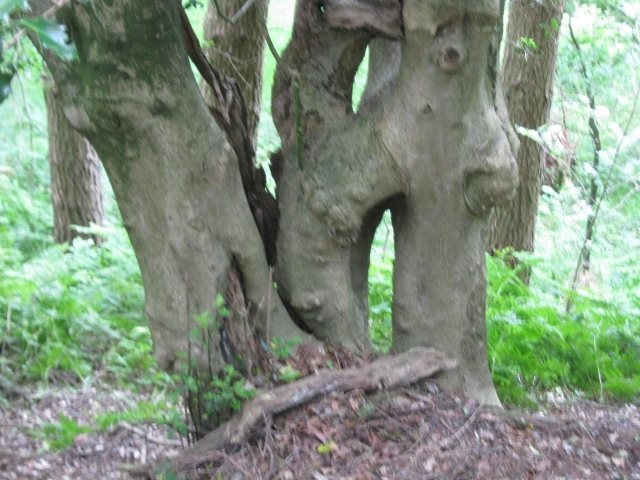
I loved these tree trunks so had to include this photo though it is terribly out of focus

By this time we were approaching Danebridge and it was lunchtime.  We climbed over a stile and joined the lane that led to the village.
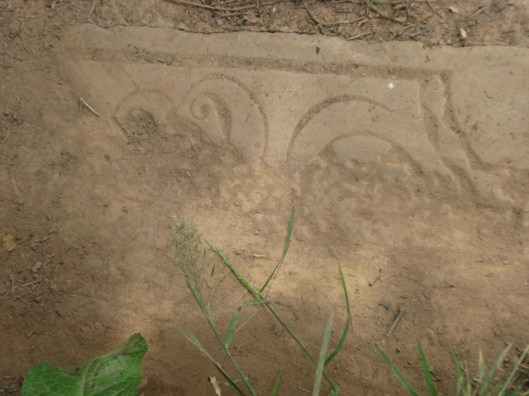
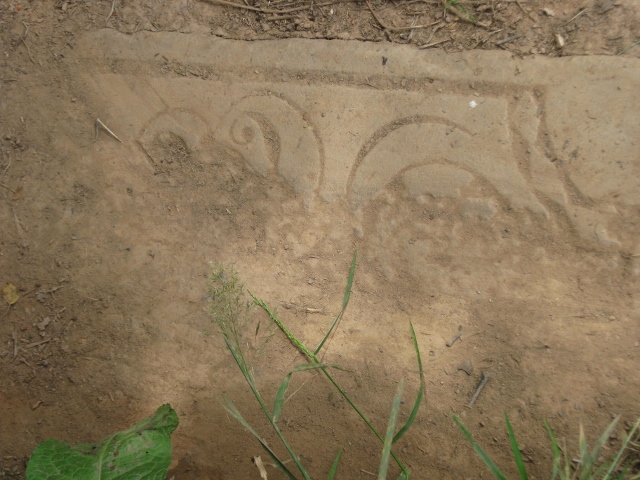
046Carved stone at stile (640x480)

This was the slab of stone we stepped onto when we got down from the stile. I wonder where it came from and what it had been in a former life.

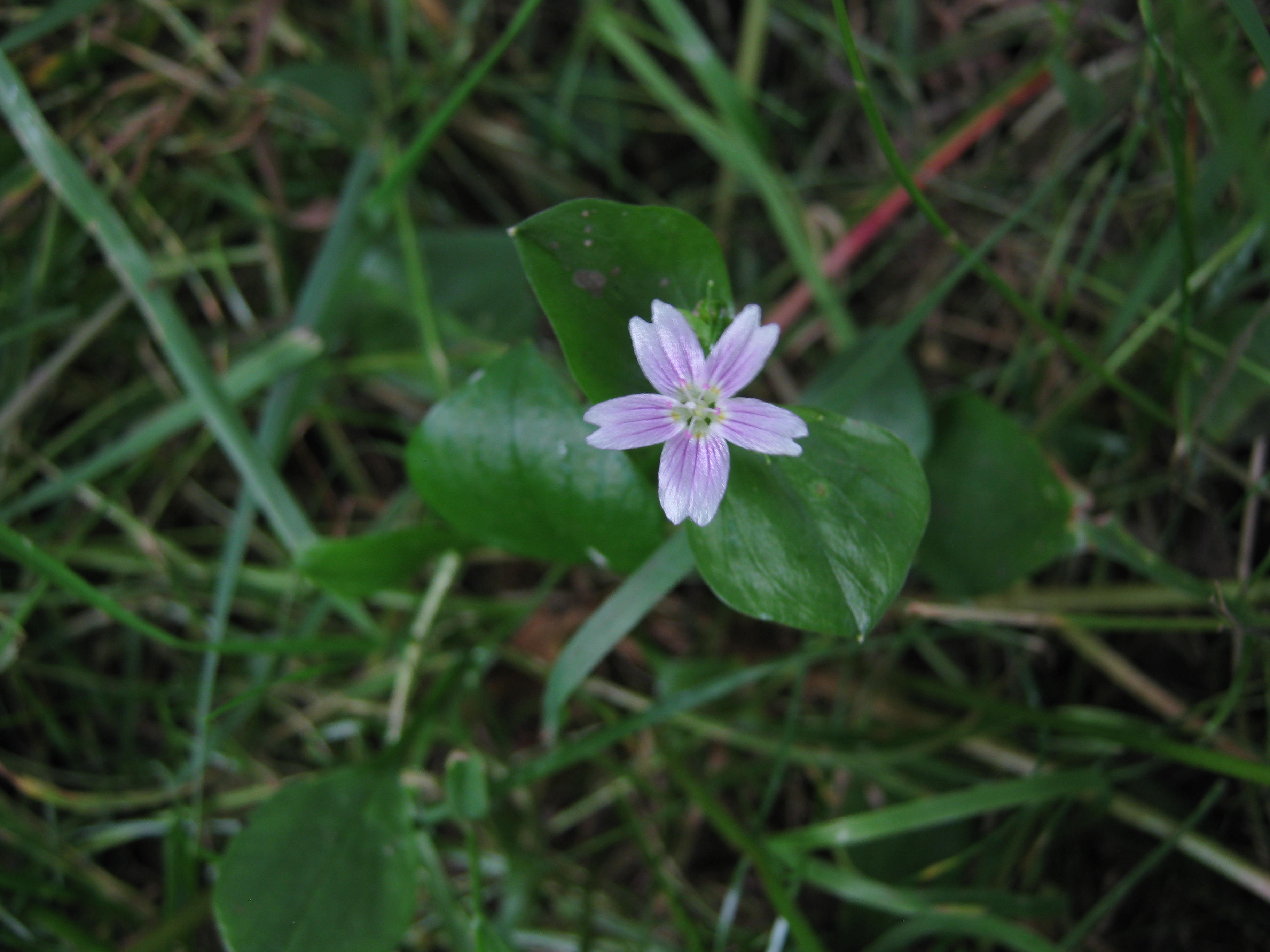
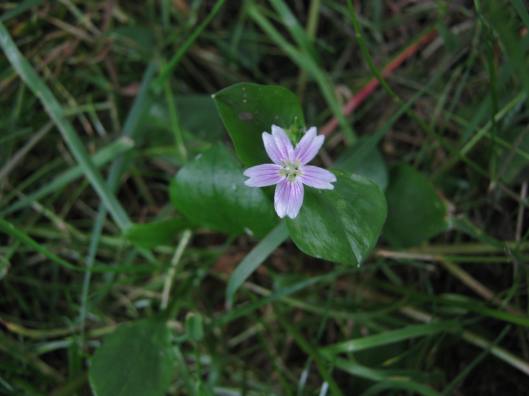
I immediately noticed a little pink flower at the side of the road.  The photo doesn’t show how pink it was.
047Pink purslane

Pink Purslane – Claytonia sibirica

This is a plant introduced from North America and is widely naturalised.

We walked down to the river thinking we would eat our sandwiches next to it but we couldn’t see anywhere suitable to sit.
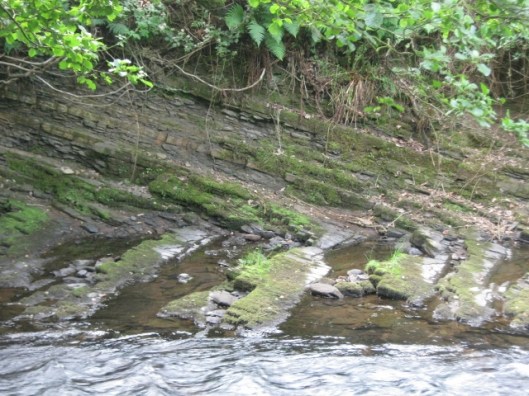
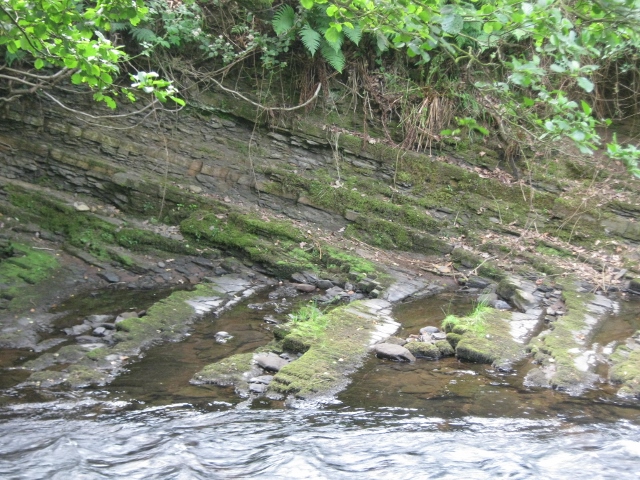
049Rock strata River Dane (640x480)

Strange rock strata at the edge of the river
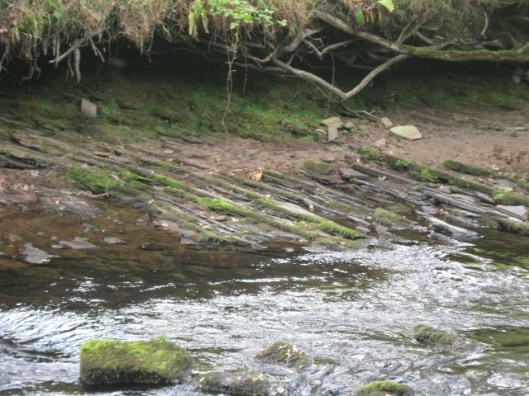
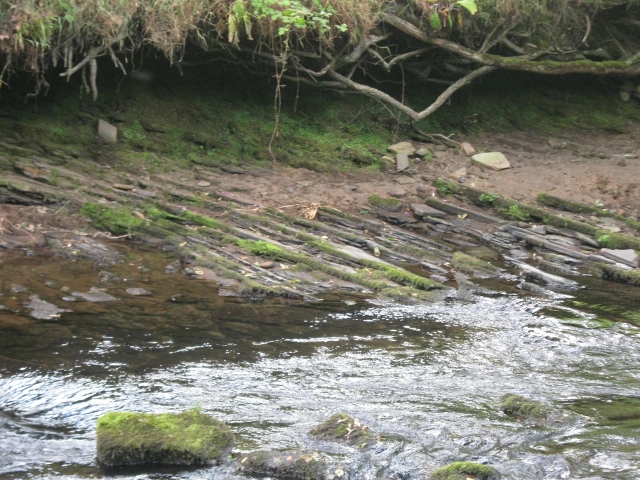
050Rock strata River Dane (640x480)

This shows it a little more clearly

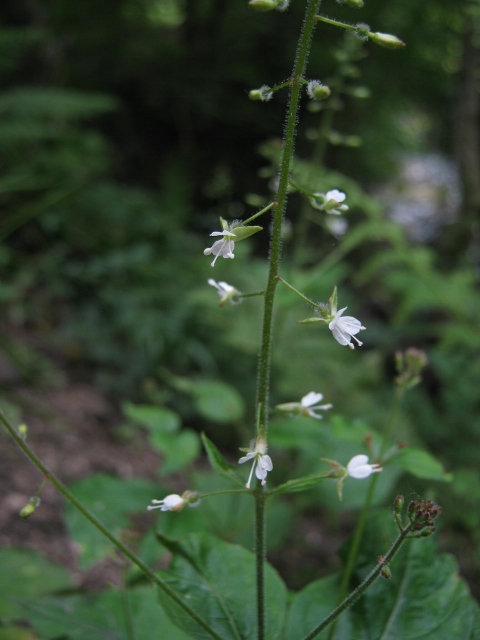
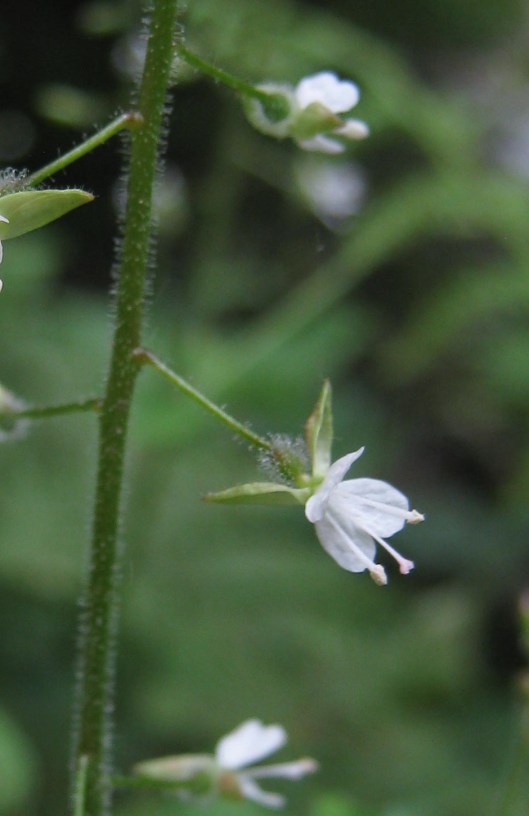
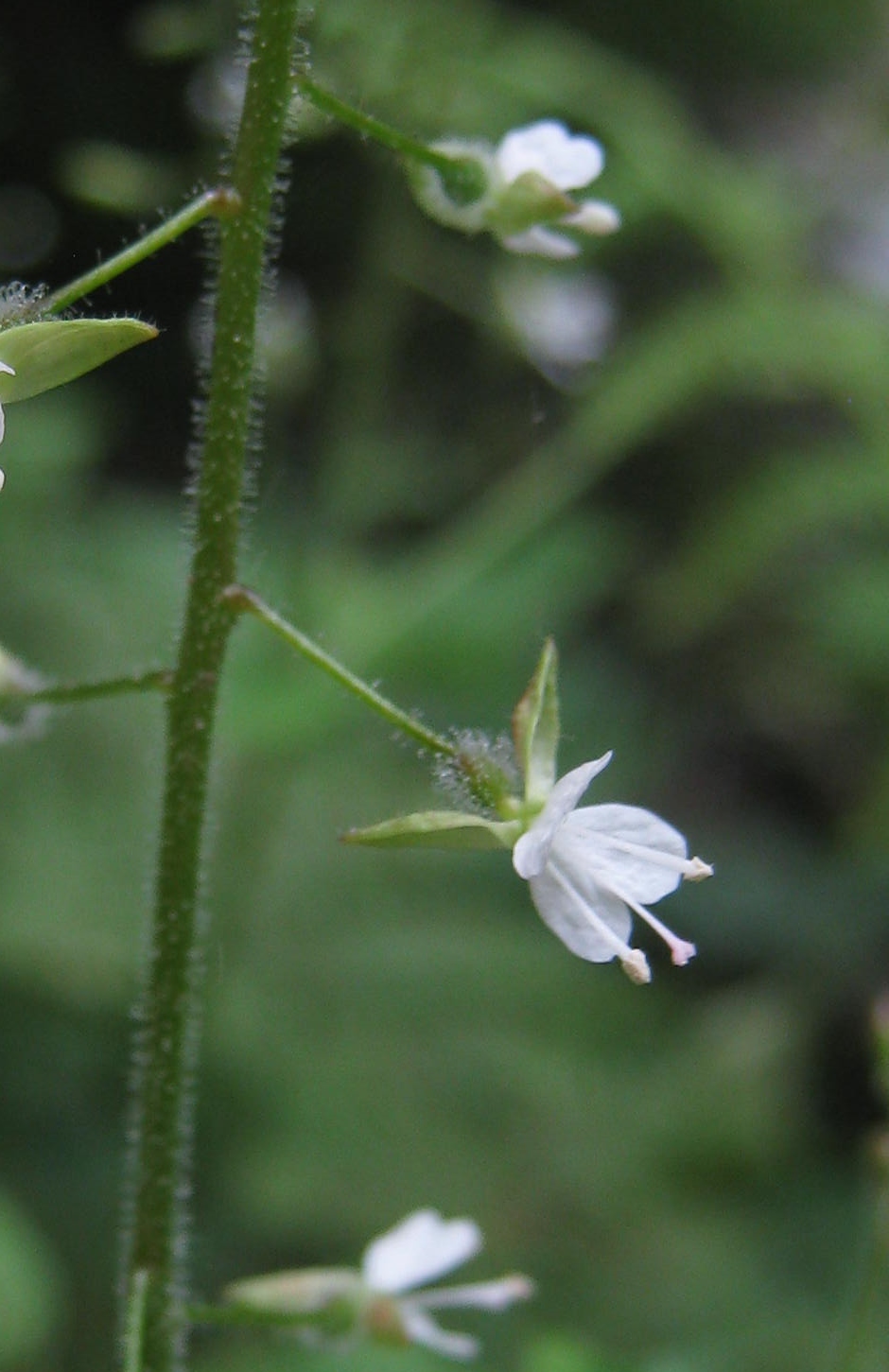
053Enchanter's Nightshade (480x640)

Enchanter’s Nightshade

053Enchanter's Nightshade

I like this plant’s name. It belongs to the same family as the Willowherbs.

Mathias De l’Obel, a 16th century Flemish botanist, in trying to identify a magical plant that Discorides (an early Greek physician) had named after the mythical sorceress Circe, eventually chose this plant.  Enchanter’s Nightshade’s botanical name is Circaea lutetiana – lutetia is the Roman name for Paris, which is where De l’Obel and other botanists worked.The Anglo-Saxons had used this plant as a protection against spells cast by elves.  Their name for it was aelfthone.  This is the only Willowherb that doesn’t disperse its fruit with the help of the wind.  Instead, it has hooks on its fruit that catch onto fur or feathers like burs.  It is pollinated mainly by small flies.  I find it fascinating that plants can adapt to their surroundings like this.
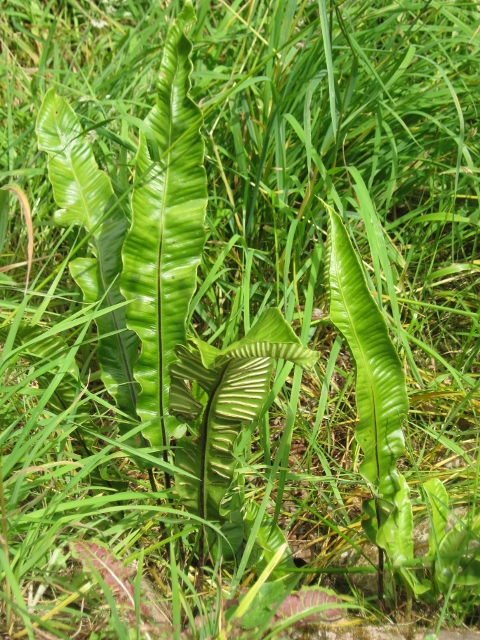
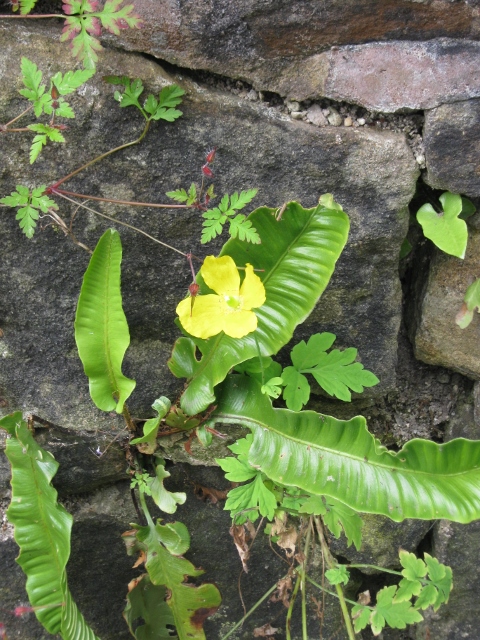
054Hart's-tongue fern (480x640)

Hart’s-tongue fern

055Yellow poppy, hart's tongue etc (480x640)

A yellow Welsh poppy has joined other plants growing out of this drystone wall

We stood on the bridge at Danebridge.
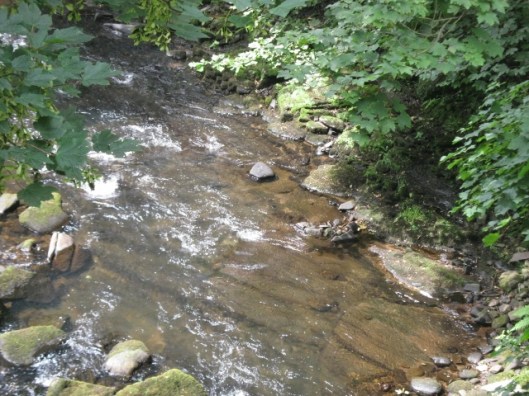
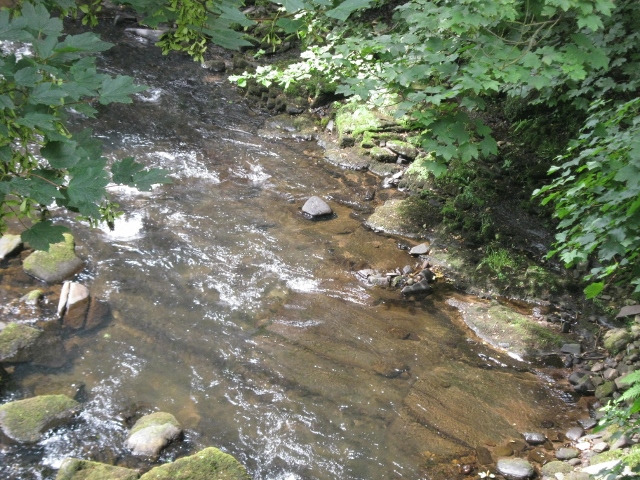
056River Dane (640x480)

River Dane

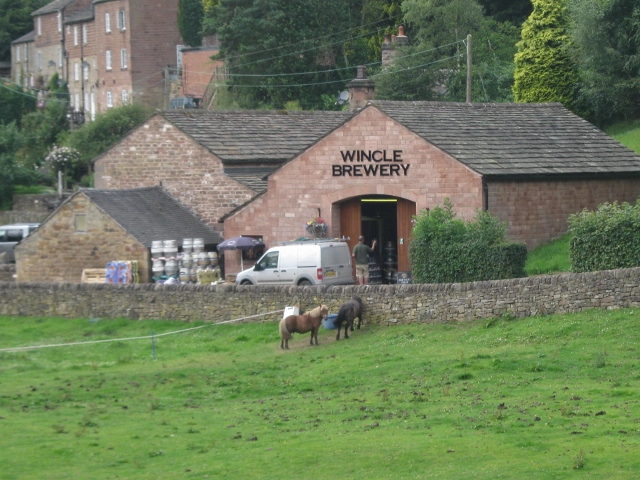
From the bridge we could see the buildings of a local micro-brewery.
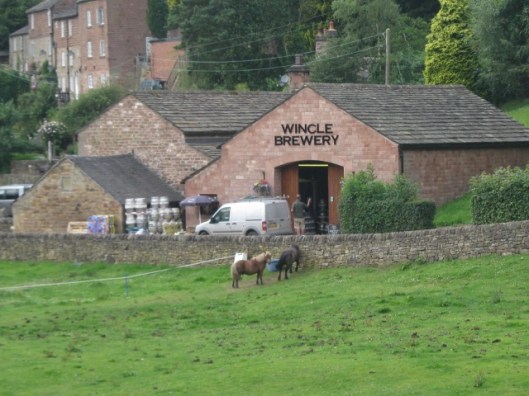
057Wincle Brewery (640x480)

Wincle brewery

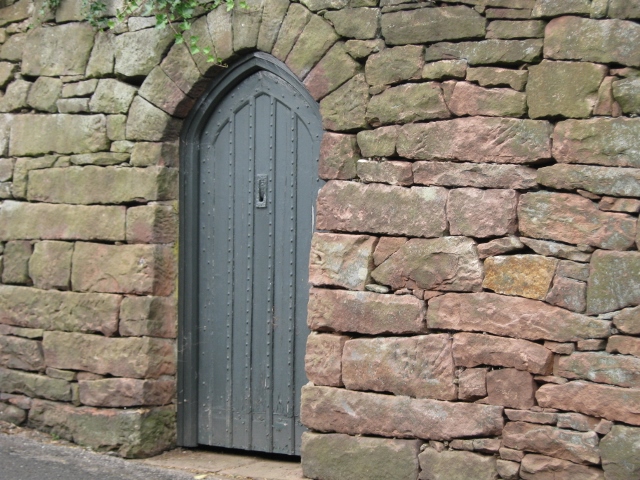
Wincle is a village just up the hill from Danebridge and a woman walking her dog informed us that there was a pub up the hill just beyond the brewery.  The word ‘pub’ worked as a clarion call to arms and R was up that hill before I or anyone else could say Jack Robinson.  As we powered up the hill I just had time to admire this door set into a wall.
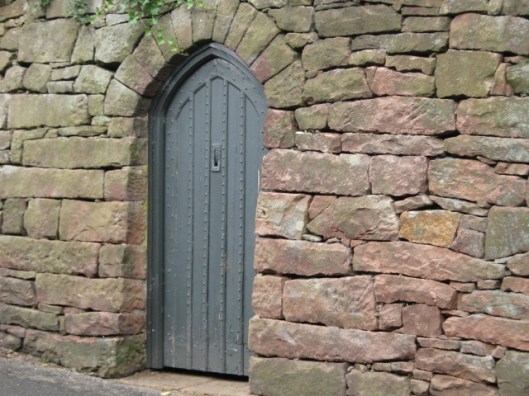
058Door in dry-stone retaining wall (640x480)

I love doors like this. I imagine such a lovely garden beyond this one with stone steps on a winding path up to the house.

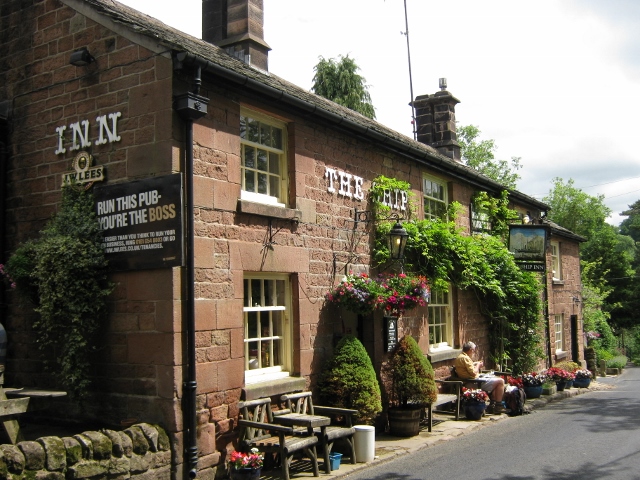
We found the pub as we neared the top of the hill.
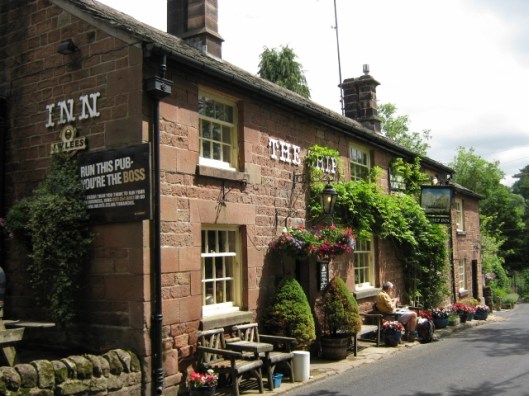
062The Ship Inn (640x480)

The Ship Inn

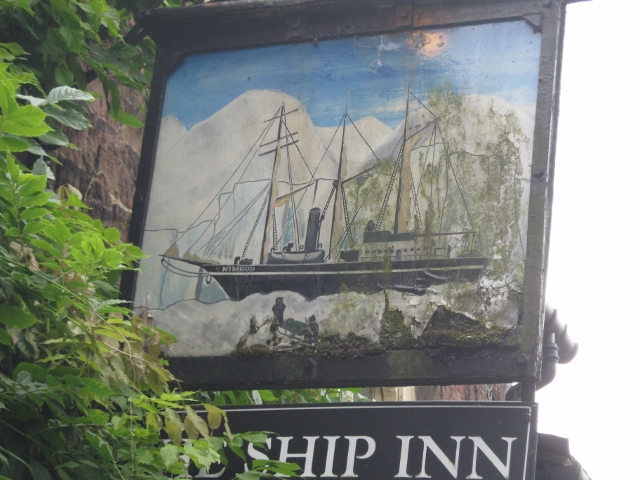
064Ship Inn sign (640x480)

The Ship Inn sign

It seemed so strange for a pub, many miles from the sea or even a navigable river, to be called ‘The Ship’.  There was a little information displayed in the pub and I have also looked on-line to find out more about this.  There is a ‘History of Wincle’ site which has been very helpful.  Sir Philip Brocklehurst of Swythamley Hall (a couple of miles away) sailed with the explorer Shackleton on one of his expeditions to the Antarctic from 1907-9.  The pub sign depicts the Nimrod in Antarctic ice ( not the more famous Endeavour of the 1914 expedition).  Shackleton was also Sir Philip’s best man when he married Gwladys Murray in 1913.

Some say The Ship is named after another vessel, ‘The Swythamley’, which was owned by a friend of the squire and sank off the Cape of Good Hope in 1862.  As the pub is also said to date back to the 17th century it is possible that the name is linked with ‘shippen’, a local word for a sheep shelter.  Or the name could be linked with a much earlier boat.  In fact, so far no-one seems to know for sure why it has this name!
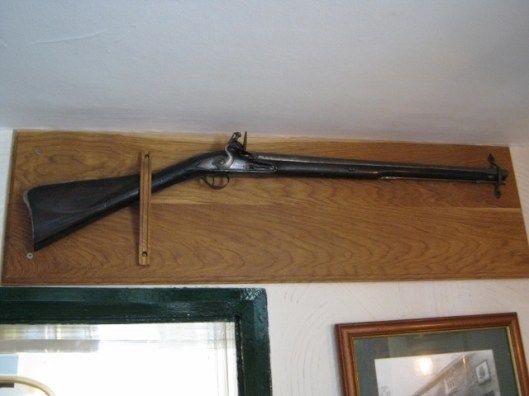
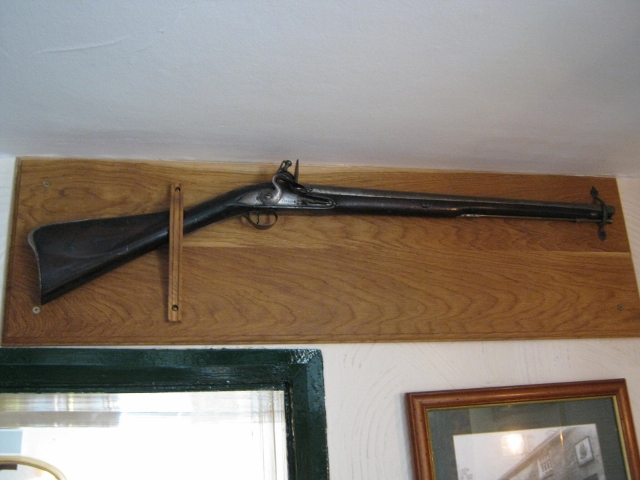
059Flintlock on wall of pub (640x480)

A flintlock displayed on the wall of the pub.

There are stories about royalist rebels visiting the pub in the 17th century and the gun belonging to one of them was displayed on the wall until fairly recently as well as a framed article from a Manchester newspaper of the day.  Both these items went missing at some point.  The flintlock now on display was acquired fairly recently and, if I remember correctly, it was discovered that it was made at the same time and by the same gunsmith as the original gun.

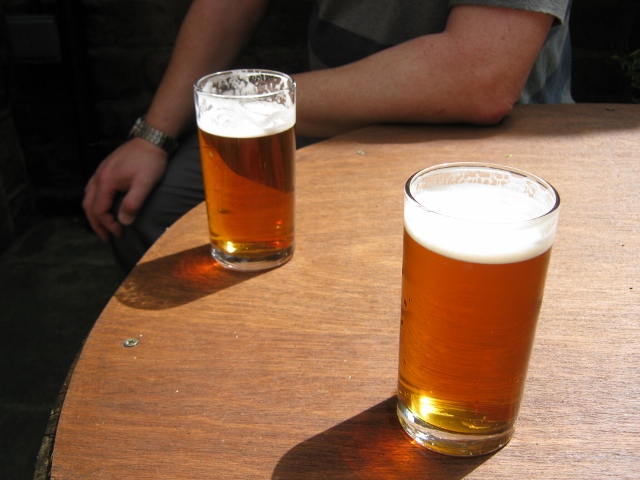
We sat outside the pub and sampled their beer.  We asked if they sold the locally brewed beer but was told they didn’t so we had some JW Lees beer instead, which was very good.
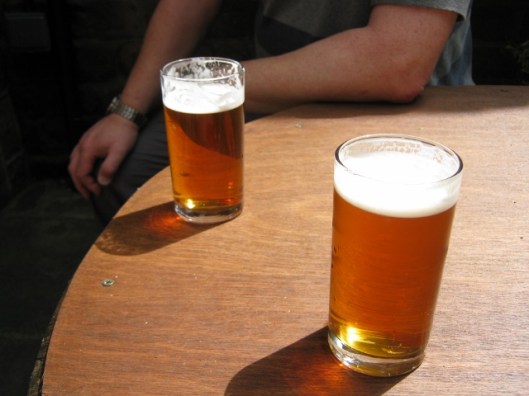
060J W Lees beer (640x480)

I only had a few sips of my beer and had to give the rest, reluctantly, to R.  I am not supposed to drink alcohol as it reacts badly with the medication I am on and anyway, I try not to drink much of anything on walks because of the lack of convenient ‘conveniences’.  I have a horror of being ‘caught short’ as the saying goes, and being discovered by walkers, with a dog…

After a pleasant rest we continued on our way.  We went back down the hill to the bridge and found the path we needed which climbed up through more woodland very steeply at times.  I remember that for most of the walk we were listening to wonderful birdsong.  At the top of the path we came out of the wood onto fields again.  Here we rested again and ate our sandwiches.
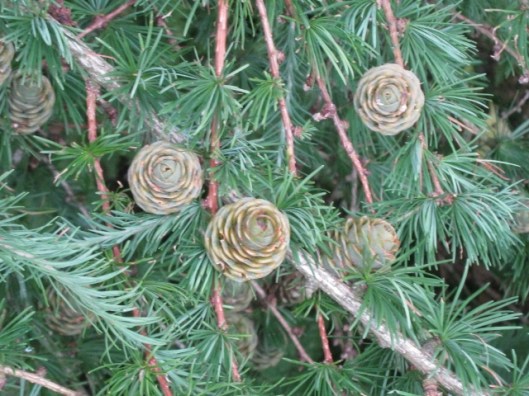
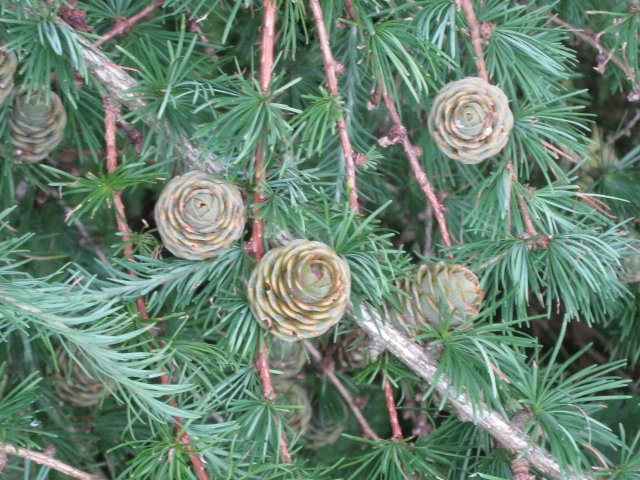
065Fir cones (640x480)

Fir cones on a tree at the edge of the wood
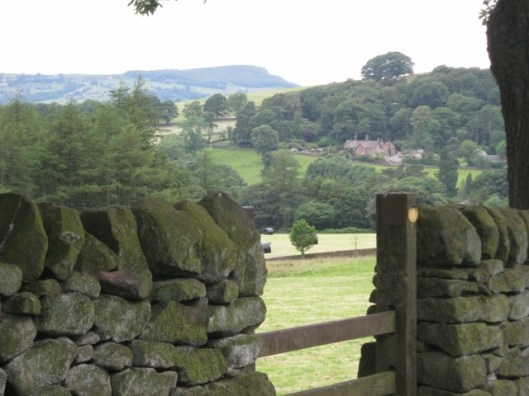
066View over stile (640x480)

View over a stile

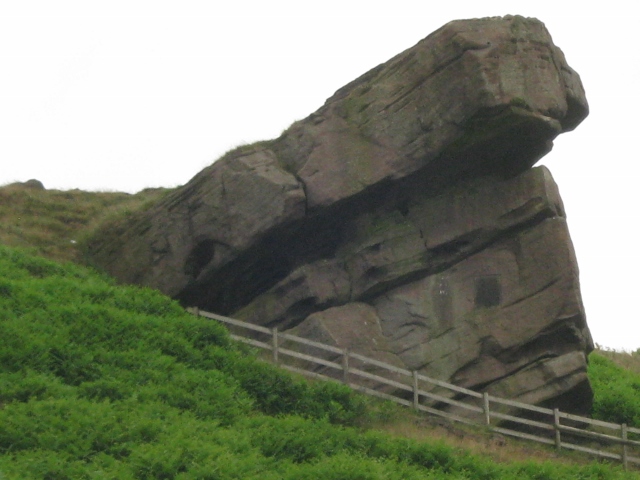
This is one of the many stiles we climbed over that day.  We followed a track by a wall belonging to Hangingstone Farm and then saw the Hanging Stone itself.
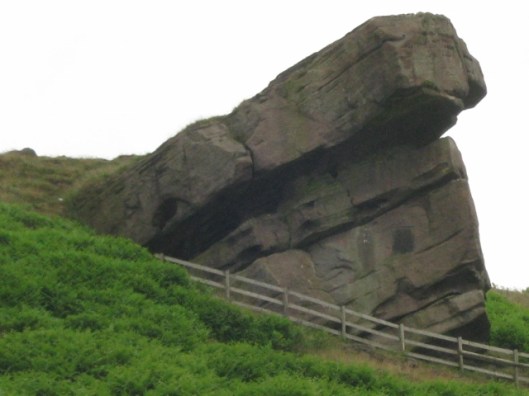
067Hanging rock (640x480)

The Hanging Rock

We didn’t have the energy to climb up to the rock to read the inscriptions there.  One plaque is dedicated to Courtney Brocklehurst, the brother of the aforementioned Philip, who was killed in the 2nd World War, and the other is to a pet hunting dog of an earlier Brocklehurst.  This dog was very well loved and when he died was buried under the Hanging Stone.  The dog’s name was Burke, because he was such a good hunting dog.  In 1828, Burke and Hare were accused of killing sixteen people and then selling the corpses to Dr Robert Knox who dissected them during his popular anatomy lectures.
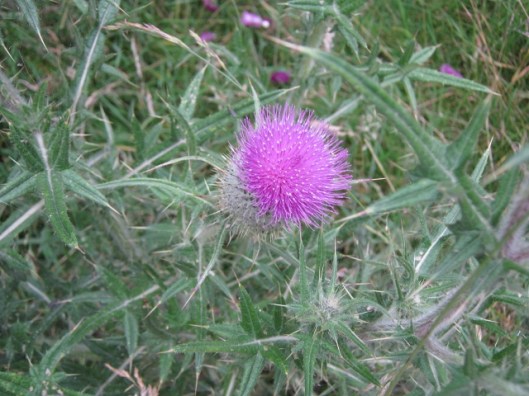
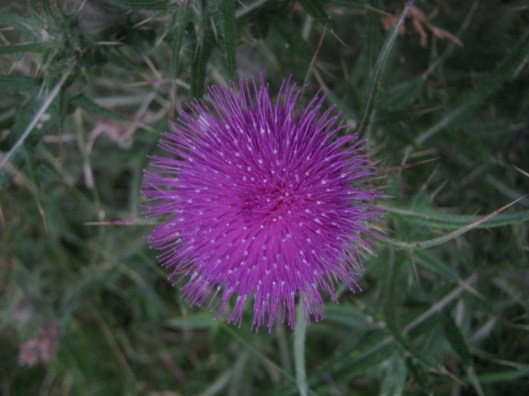
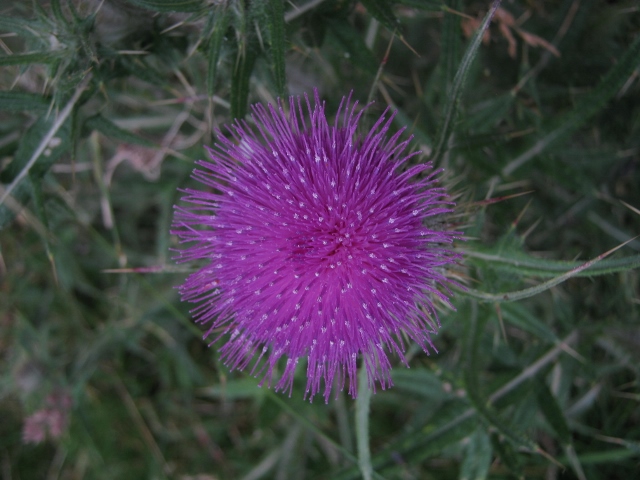
068Thistle (640x480)

A rather lovely Spear Thistle

069Thistle (640x480)

070Tormentil (640x480)

A carpet of Tormentil

072Bedstraw (640x480)

A carpet of Heath Bedstraw

075Grass (640x480)

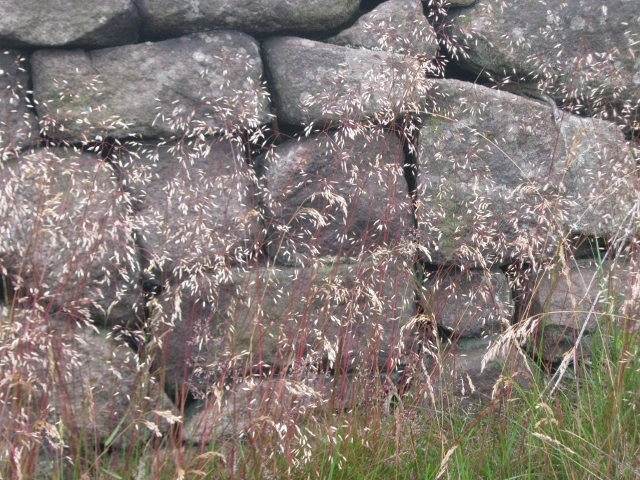
I liked the delicate grass heads with the heavy blocks of the drystone wall behind

We were now walking over more open moorland.
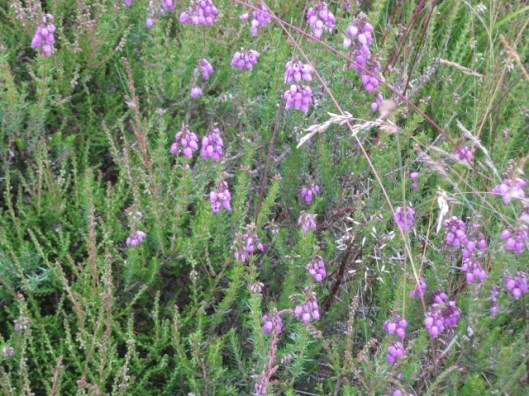
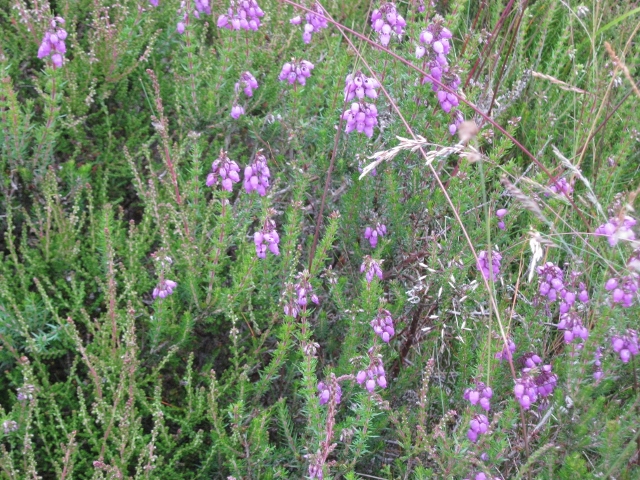
079Heather (640x480)

The Heather, or Ling as some call it, was beginning to flower
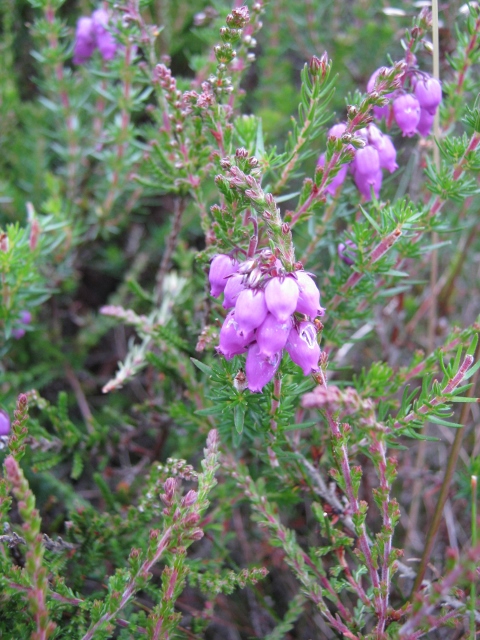
081Heather (480x640)

Little pink-purple bells

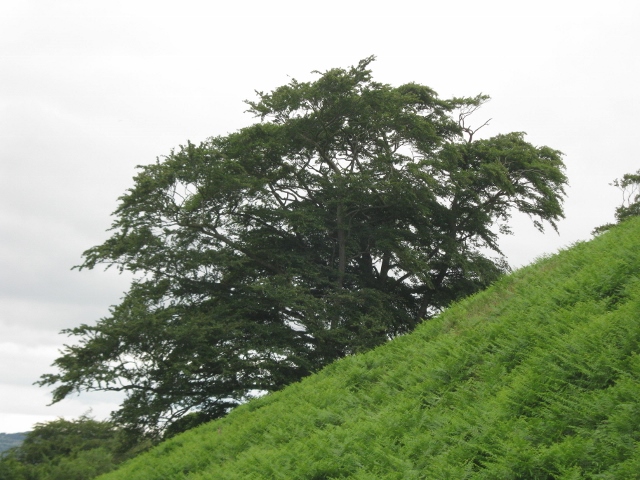
082Cedar (640x480)

A good-sized Cedar tree

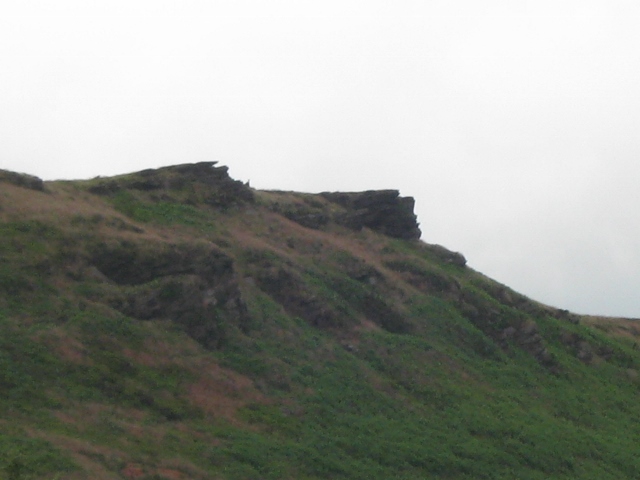
The more open terrain here meant we could now see the edge of the Roaches, a gritstone escarpment which has spectacular rock formations.  The name comes from the French ‘les Roches’.
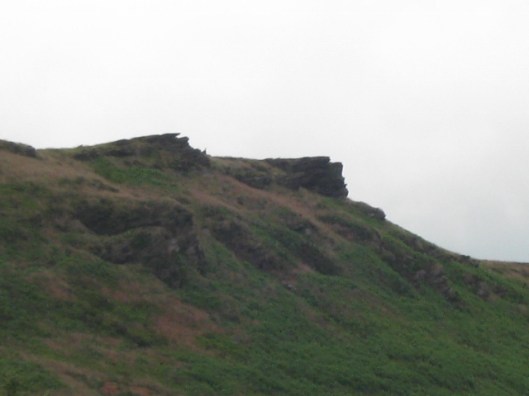
085The Roaches (640x480)

The Roaches

087View (640x480)

A gentler view.

089View (640x480)

The fields are all separated by stone walls

We then started descending slowly towards Back Forest again.
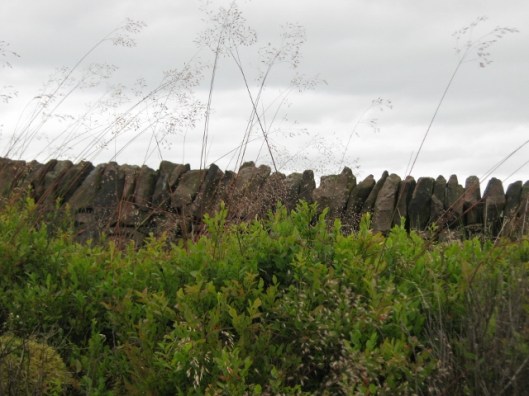
090Wall, grass, bilberries (640x480)

The walls are wonderfully constructed. Bilberry bushes are growing against this one.
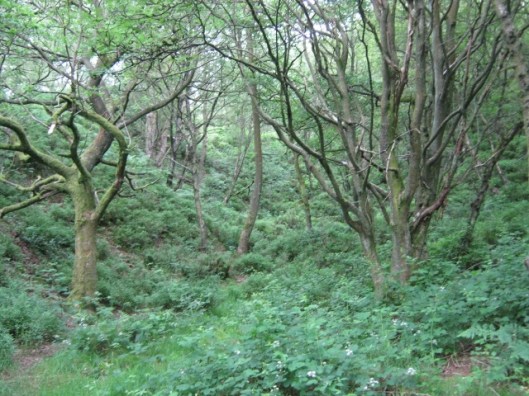
092Back Forest (640x480)

In the woods again.

We diverted a little way off the path back to Gradbach to see Lud’s Church again.  This is a natural rift which is about 200 yards in length and varies in width from 12 feet to 50 feet wide and is about 59 feet deep.  We didn’t go far along it as we were both getting very tired.  We will go again some time,  walk its length and photograph it.
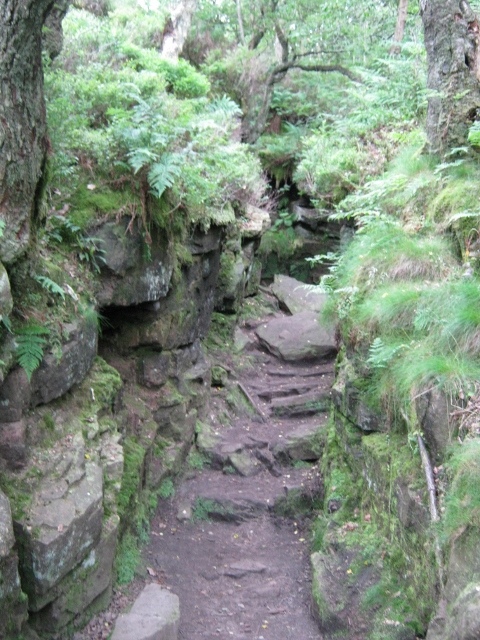
094Lud's Church (480x640)

It is a very atmospheric place; mossy,cool and quiet.
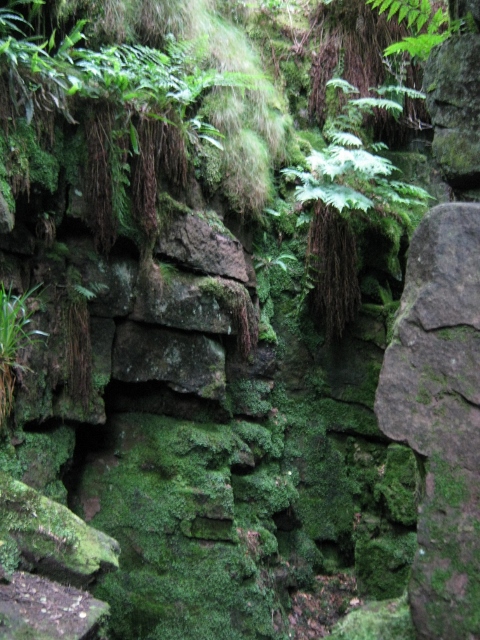
095Lud's Church (480x640)

The sides of the ravine are covered in ferns and other damp-loving plants.

During the 15th century, according to local legend, Lollards (followers of John Wycliffe, an early church reformer) used to worship here in secret during the time of their persecution.

Many researchers have identified this place as the Green Chapel in the 14th Century alliterative poem ‘Sir Gawain and the Green Knight’.  The author describes this district well.  Gawain rides off searching for the Green Chapel ….

‘Then he gave the spur to Gringolet and galloped down the path,

Thrust through a thicket there by a bank,

And rode down the rough slope right into the ravine.

Then he searched about, but it seemed savage and wild,

And no sign did he see of any sort of building;

But on both sides banks, beetling and steep,

And great crooked crags, cruelly jagged;

The bristling barbs of rock seemed to brush the sky.’

Translation by Brian Stone.

Another legend is that a hunter was killed here and that he still roams about the cleft covered from head to toe in moss and leaves.  He is known locally as the Green Man one of many ‘green men’ to be found in Britain.

We joined our path again and soon reached the bridge over the River Dane and then Gradbach mill.


Share this:

  • Share on X (Opens in new window) X
  • Share on Reddit (Opens in new window) Reddit
  • Share on Pinterest (Opens in new window) Pinterest
  • Share on Facebook (Opens in new window) Facebook
  • Email a link to a friend (Opens in new window) Email
  • Share on Tumblr (Opens in new window) Tumblr
  • Print (Opens in new window) Print
  • Share on LinkedIn (Opens in new window) LinkedIn
Like Loading...

Cloud Chasing

12 Tue Aug 2014

Posted by Clare Pooley in cooking, Insects, plants, Rural Diary, trees, Uncategorized, walking, weather

≈ 10 Comments

Tags

Bertha, black bryony, blue flax, bread-making, clouds, clover, fields, fleabane, gates, grasses, great black slug, greenbottle, hen and chicks, Kestrel potatoes, marsh ragwort, phacelia, Rain, red bartsia, René Magritte, rice, the Beck, thunder, tub-thumping priest, walking, wild radish, willow, wind

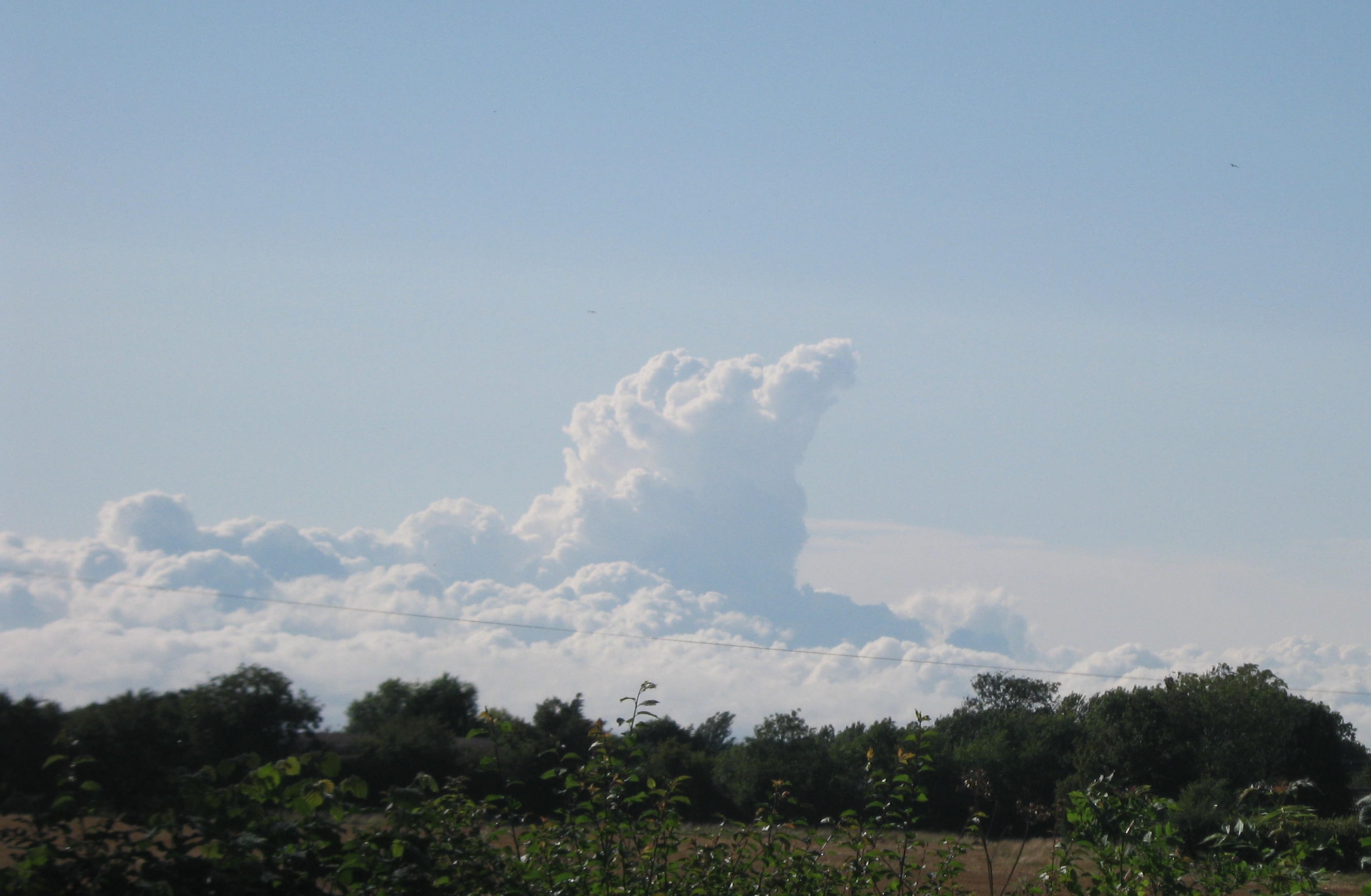
I had hoped to be able to stay at home on Saturday as the weather was so nice.  However, when I took a loaf out of our breadmaker and saw that, for the second time in a row, the bread hadn’t risen very much I realised that one of two things had happened.  I knew that I hadn’t made a mistake when measuring out the ingredients or when setting the programme.  The problem was either a faulty batch of yeast or, even worse, a faulty breadmaker.  I went into Halesworth and bought a very nice looking loaf from the health food/delicatessen shop as well as some new yeast.  I had been experimenting with a different brand-name dried yeast and thought that that may have been the problem so I bought some of the old tried-and-tested yeast.  While in town I also got some more vegetables and a couple of newspapers – The Saturday Times so that R could do the crossword (most of the rest of the newspaper usually goes straight into the re-cycling bin) and a Beccles and Bungay Journal.  This had a very nice account of our Requiem Eucharist last Sunday with a photograph and also a double-page centre-spread featuring Dolly and her memories of living in a village which is doubly thankful, in that all its people going off to war in both the Great and the Second World War came back safely. As I drove home I noticed such wonderful clouds in the sky!  The wind was picking up already so I decided to trot back down the lane and photograph them before checking round the garden to make sure all was well battened down and tied up before the high winds that had been forecast arrived. 002Clouds One of my favourite artists is René Magritte who painted clouds like these.

0421-4

La grande famille Series 1 Lithography by René Magritte

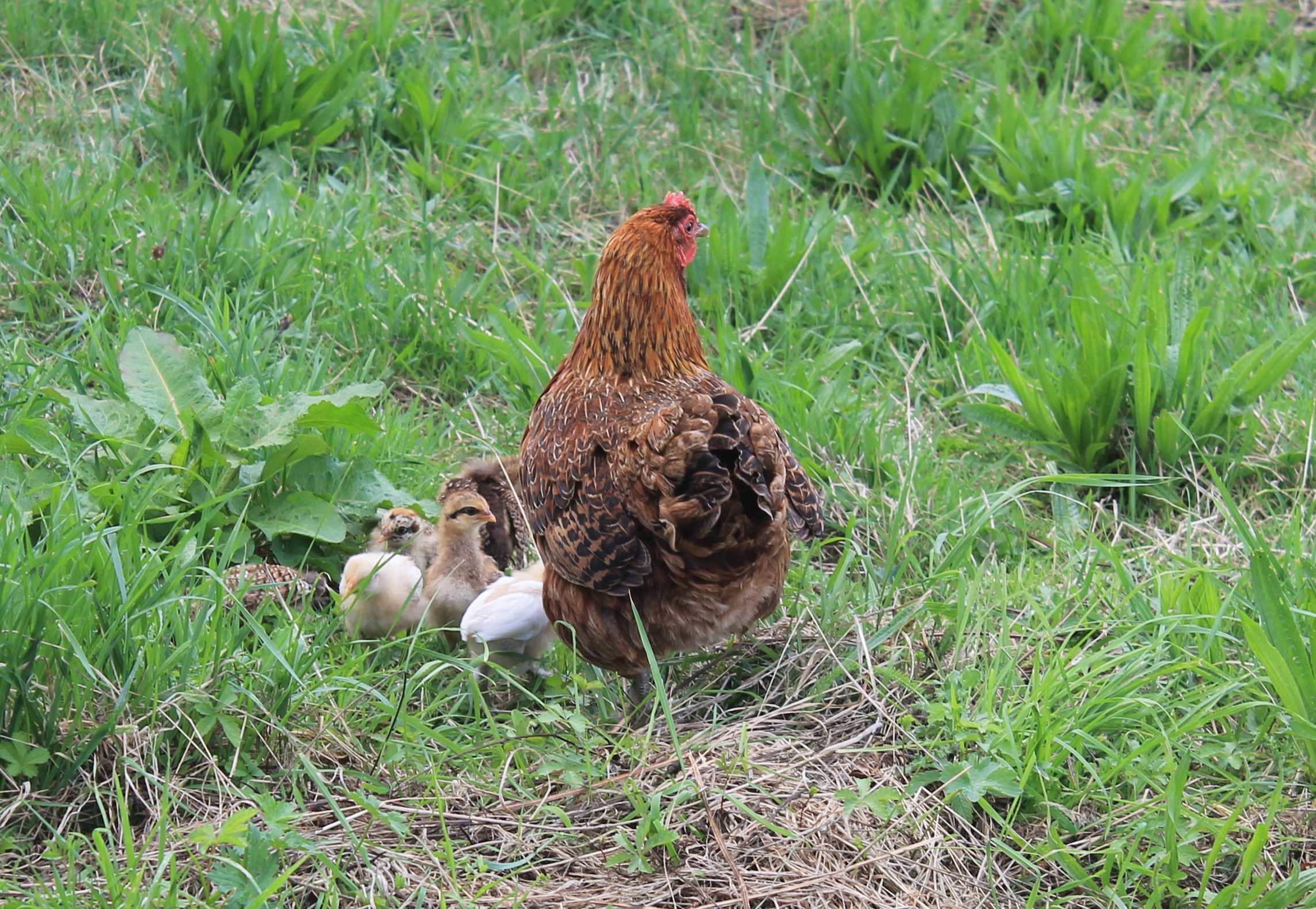
I also saw that one of next-door’s chickens had had some chicks and was taking them for a walk on the grass verge of the lane.

001Hen with chicks

There are six chicks there somewhere!

R was mowing the grass when I got home and he also made sure everything was ready for the storm so I didn’t have to.  What a kind man! We had some very heavy rain and thunder over-night and while we were in church on Sunday morning the rain came on again with more thunder.  The Rector is currently having a well-deserved, two-week break from us so the service was taken by a retired clergyman who lives in our benefice and is a great friend of ours.  The bible readings for the day were very apt – the earthquake, wind and fire from which God was absent and then the quiet whisper that was God, and the story of the disciples being tossed about in the boat on the lake and Jesus walking on water to join them and calming the storm.  I was waiting for a stormy sermon and got one though not quite the one I expected.  In fact, we all got a lecture about the current terrible situation in Gaza.  We were told that a lot of what is going on there was our (the British) fault and that we cannot wash our hands of it.  The priest even struck the edge of the pulpit with his hand!  Twice!  Our Rector might grumble and nag but I cannot remember him ever beating up the pulpit during a sermon! 006Clouds I think we have been lucky and haven’t had such bad weather as others around the country.  The rain didn’t last that long really and by mid afternoon the sun was coming out.  It was, and still is very blustery but the wind hasn’t been as damaging as we thought it would be.  We have lost a few apples and pears from our trees and some of the plants look a little sorry for themselves but on the whole, nothing to worry about. Once we saw that the rain had stopped, R and I decided to go out for a walk.  We chose one of our walks across the fields.

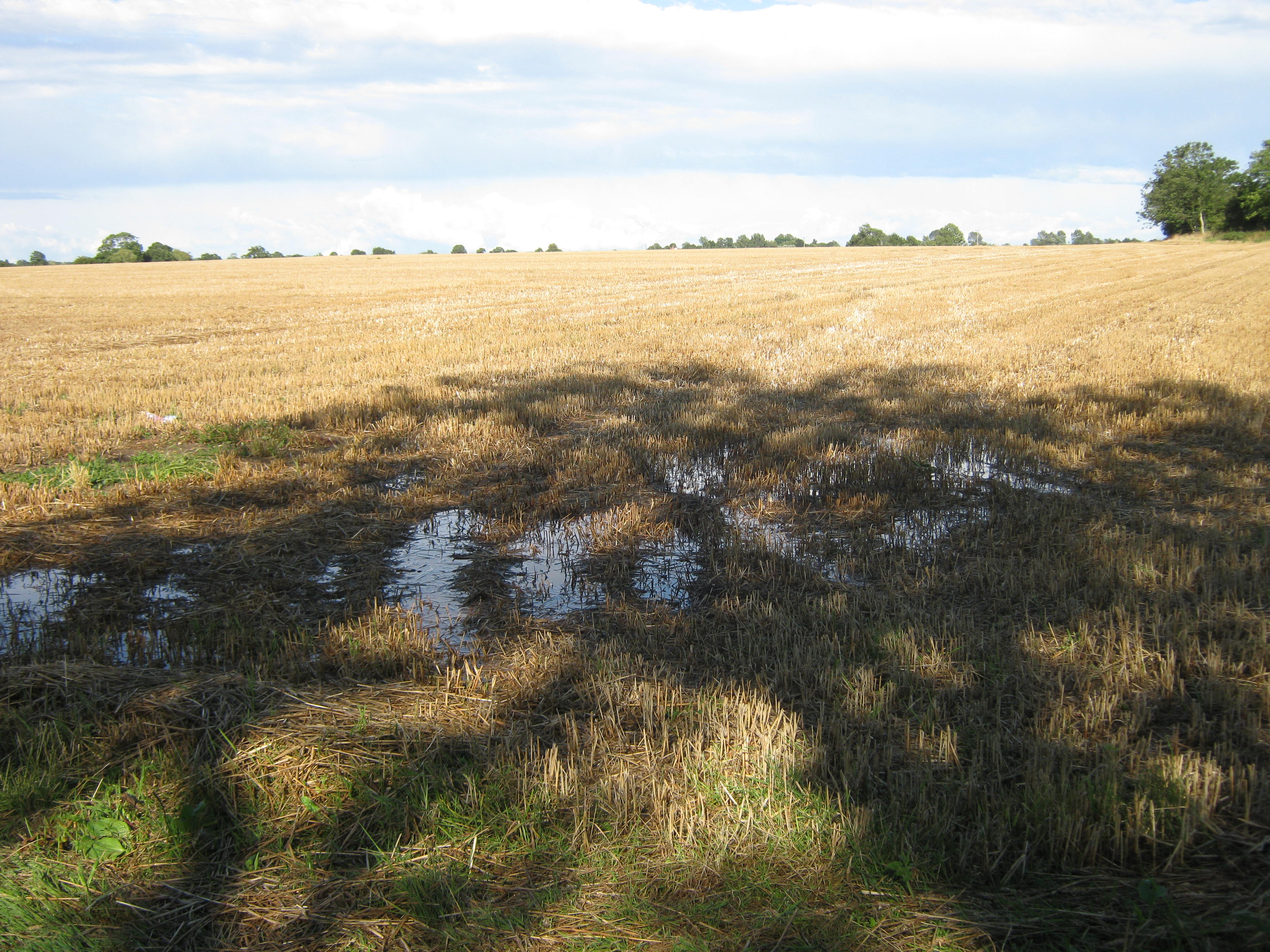
010Puddles in field

Evidence of recent rainfall

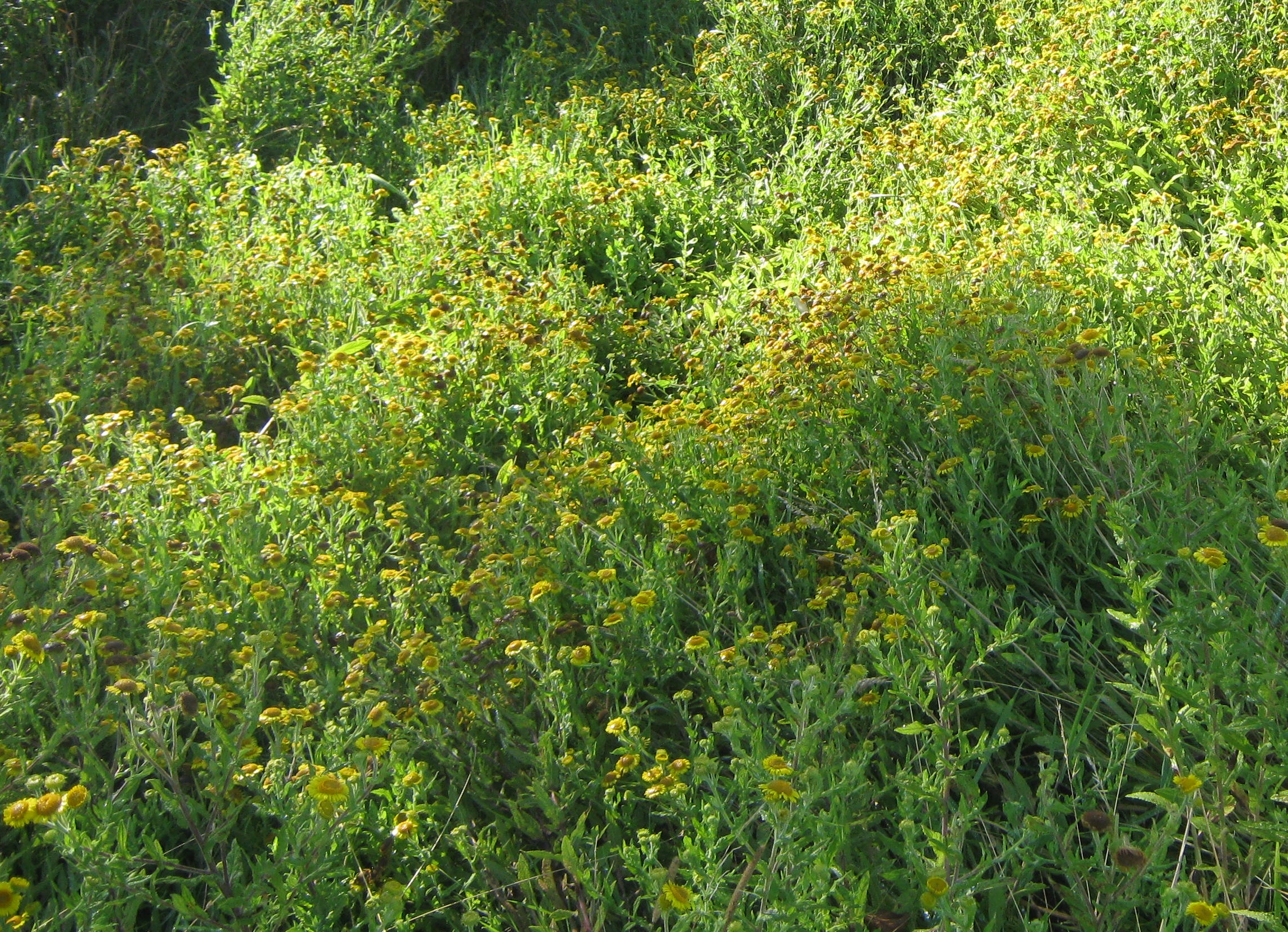
Before we had walked more than a few steps along the path we saw such a mass of fleabane! 015Fleabane

009Fleabane

Pulicaria dysenterica – Common Fleabane

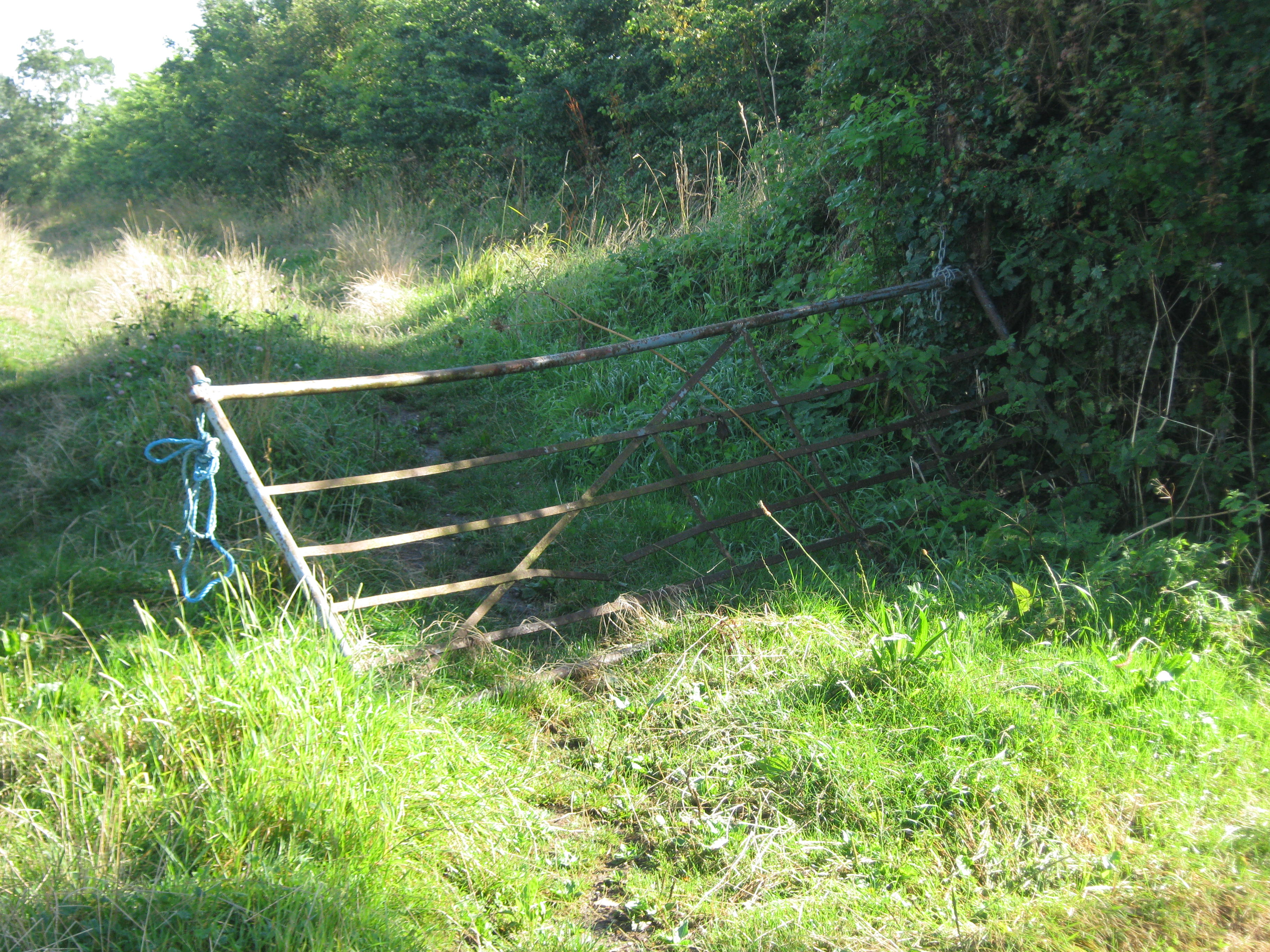
‘Pulicaria’ refers to the plant’s power against fleas (pulex = Latin for flea) and ‘dysenterica’ recalls a time when fleabane was used as a medicine against dysentery.  When dried and burned, the leaves of fleabane were said to give off a vapour which drove fleas away so the plant was highly prized when houses were plagued with them.  The plants were used in an unburned state as an insecticide too.  Culpeper, the 17th century herbalist, didn’t think much of the flower itself – ‘an ill-looking weed’, ‘the flowers are a dirty yellow’, but he commended its effectiveness against insects.  ‘The smell is supposed delightful to insects and the juice destructive to them, for they never leave it til the season of their deaths’. 014Fallen gate I believe I have photographed this gate before.  It is in an even worse state than the last time we were here.

018Eaten clover leaves

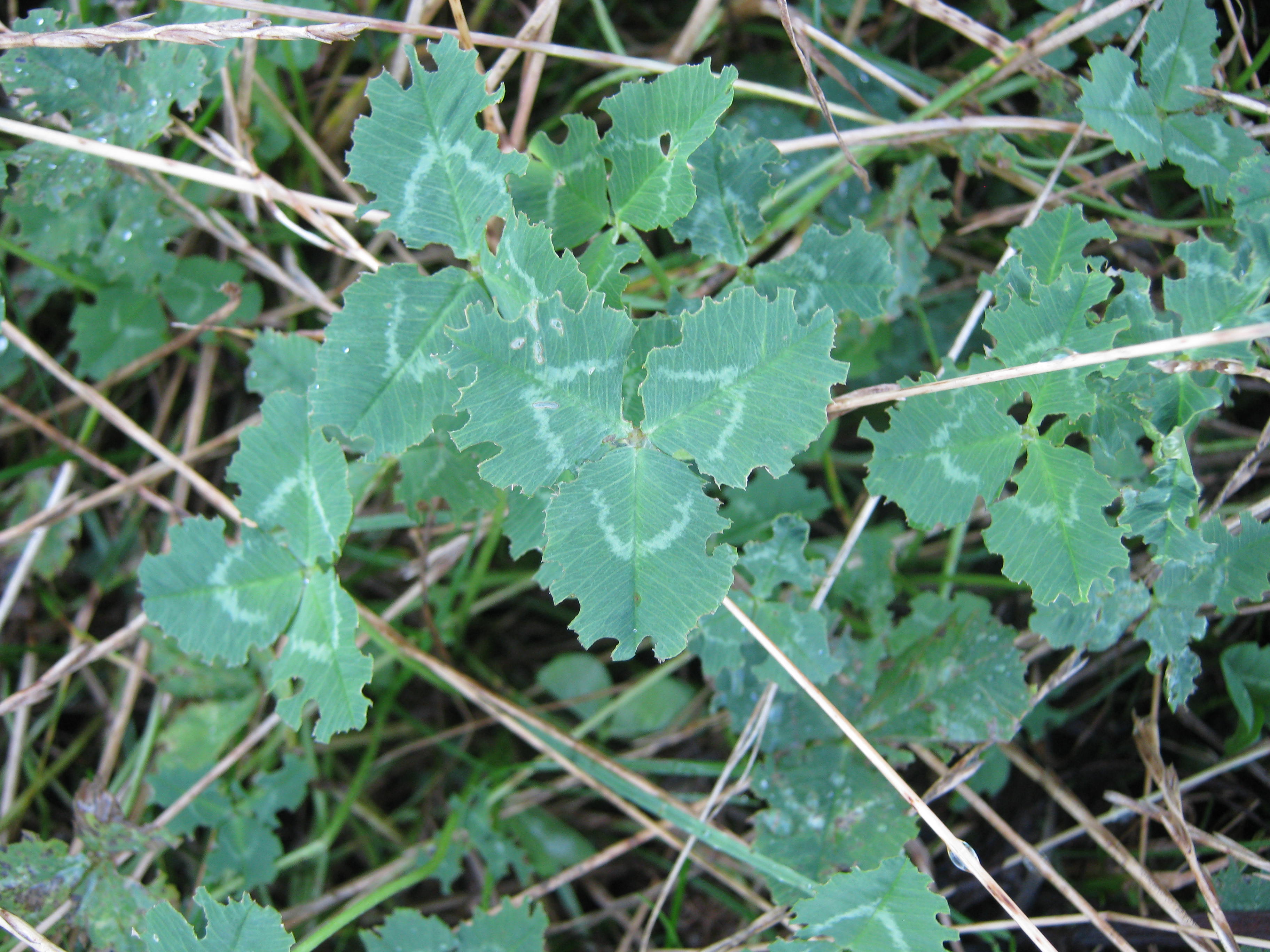
Something has been eating this clover in a crimping style.

R and I were quite surprised to see that the normally fallow field was full of plants and flowers.  We haven’t been this way for some weeks.

022Phacelia & other flowers

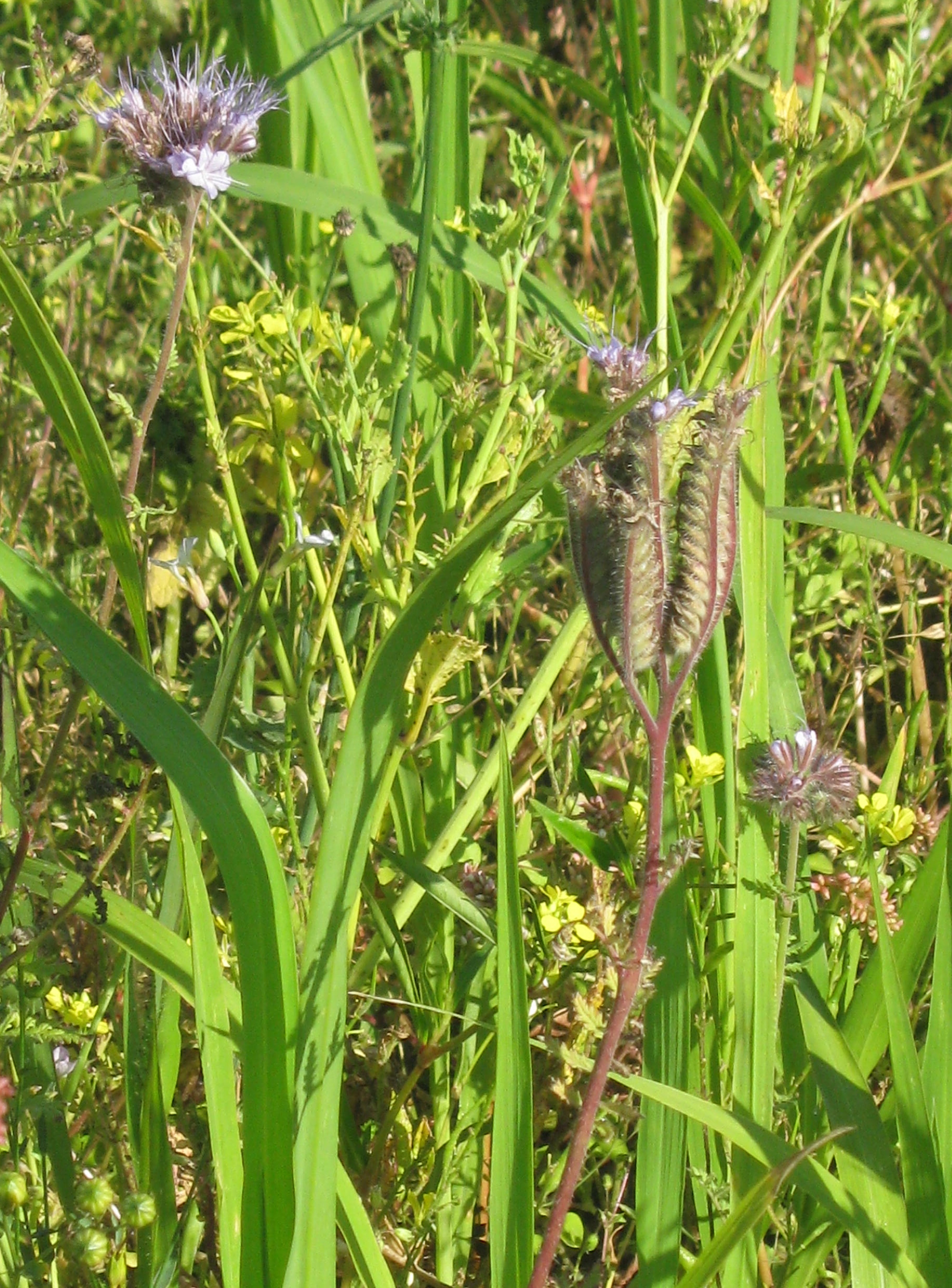
Wild flower seeds appear to have been sown here – not all native.

The purple flower, Phacelia tanacetifolia or scorpion weed, is often grown as a green compost but is dug in before it flowers.  It is also grown as a butterfly and insect magnet as the flowers are full of nectar.  It is not a native plant.  I spotted all sorts of plants that I recognised, for example…

031Blue flax

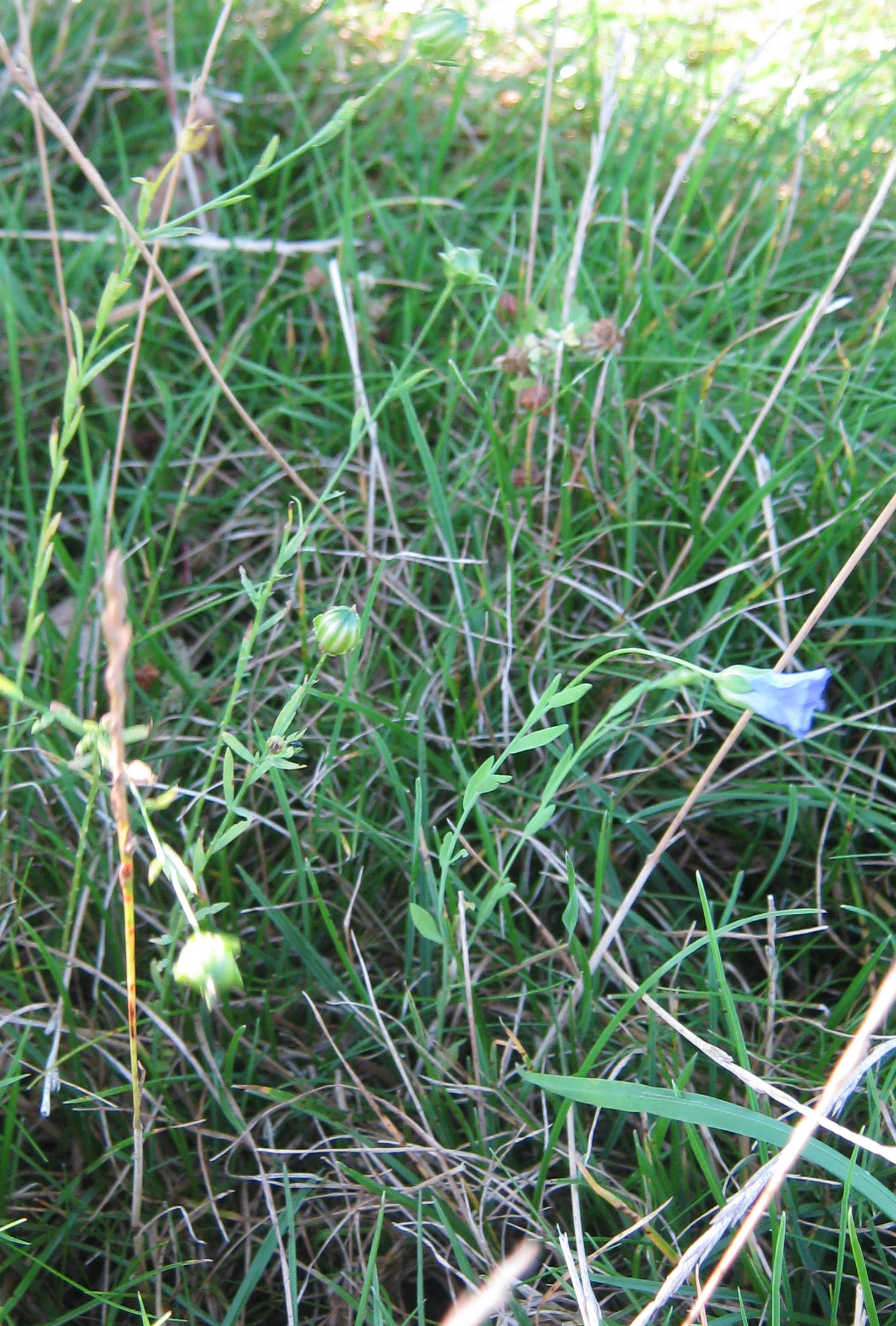
Blue flax

025poss wild radish

I think this may be wild radish

It also appeared as if a trial crop had been planted here.  We did not recognise it at all.  After some research I have decided that it may be rice.  The kind of rice – arborio – that is grown in northern Italy.

021poss rice

Is this rice?

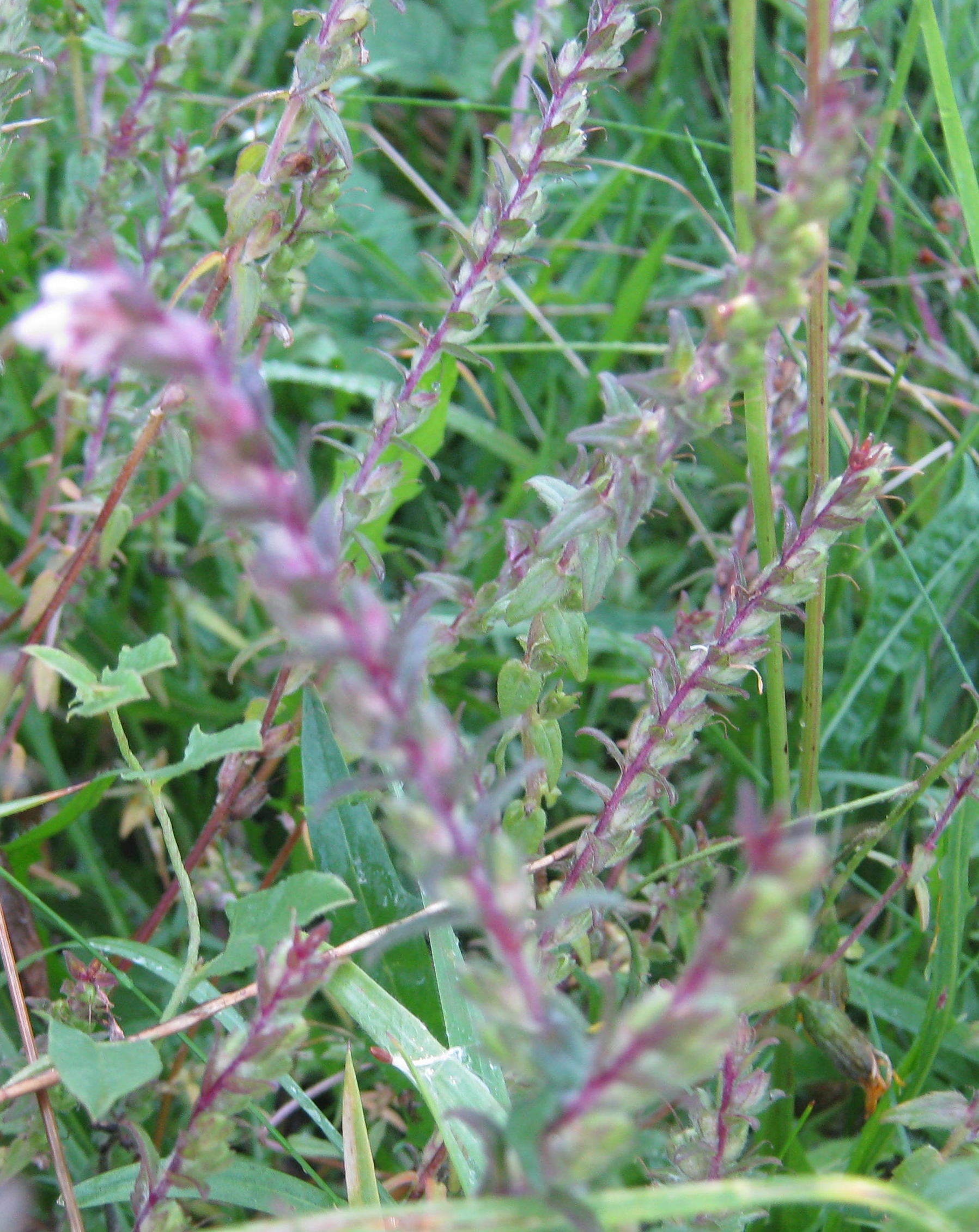
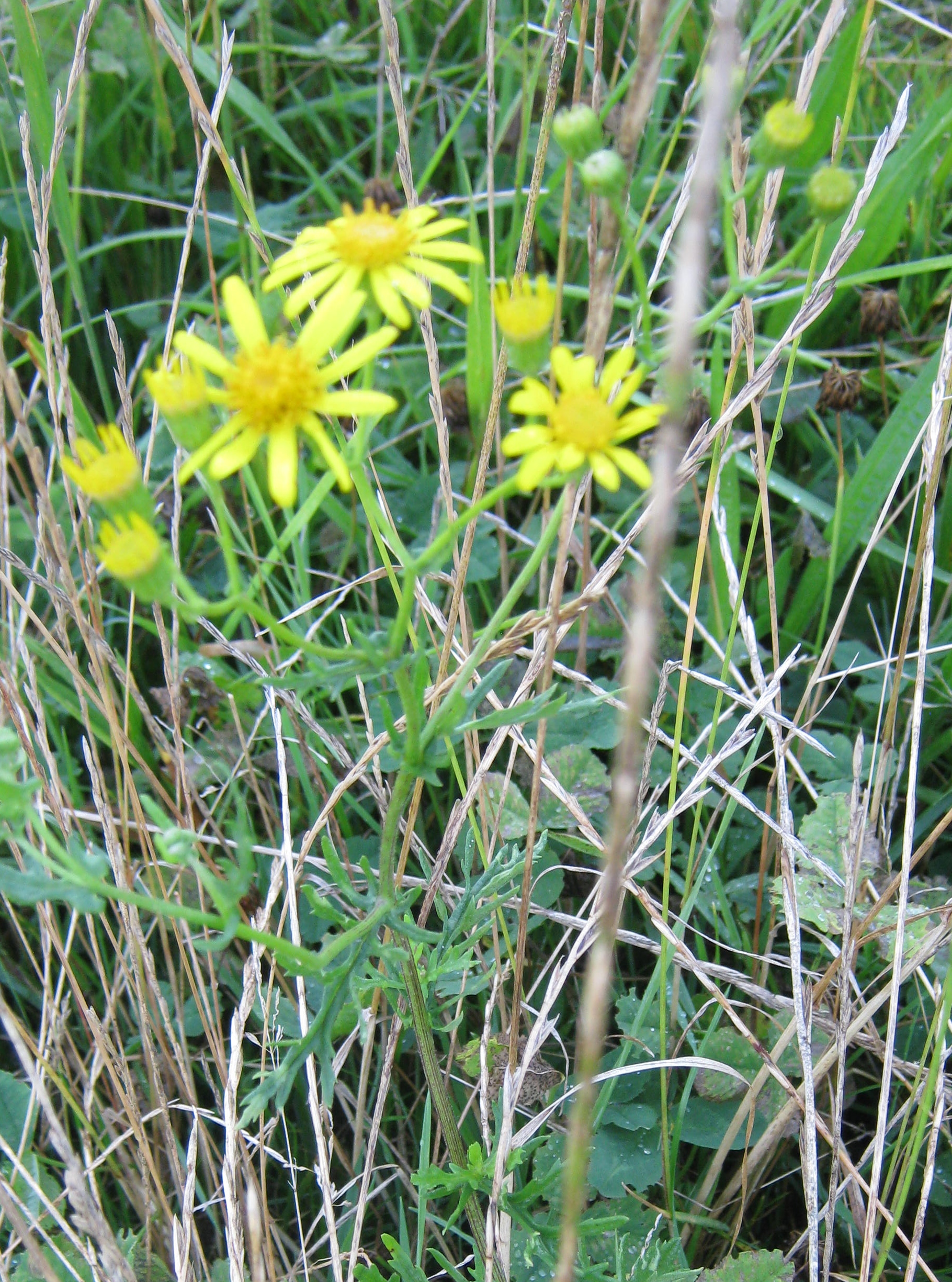
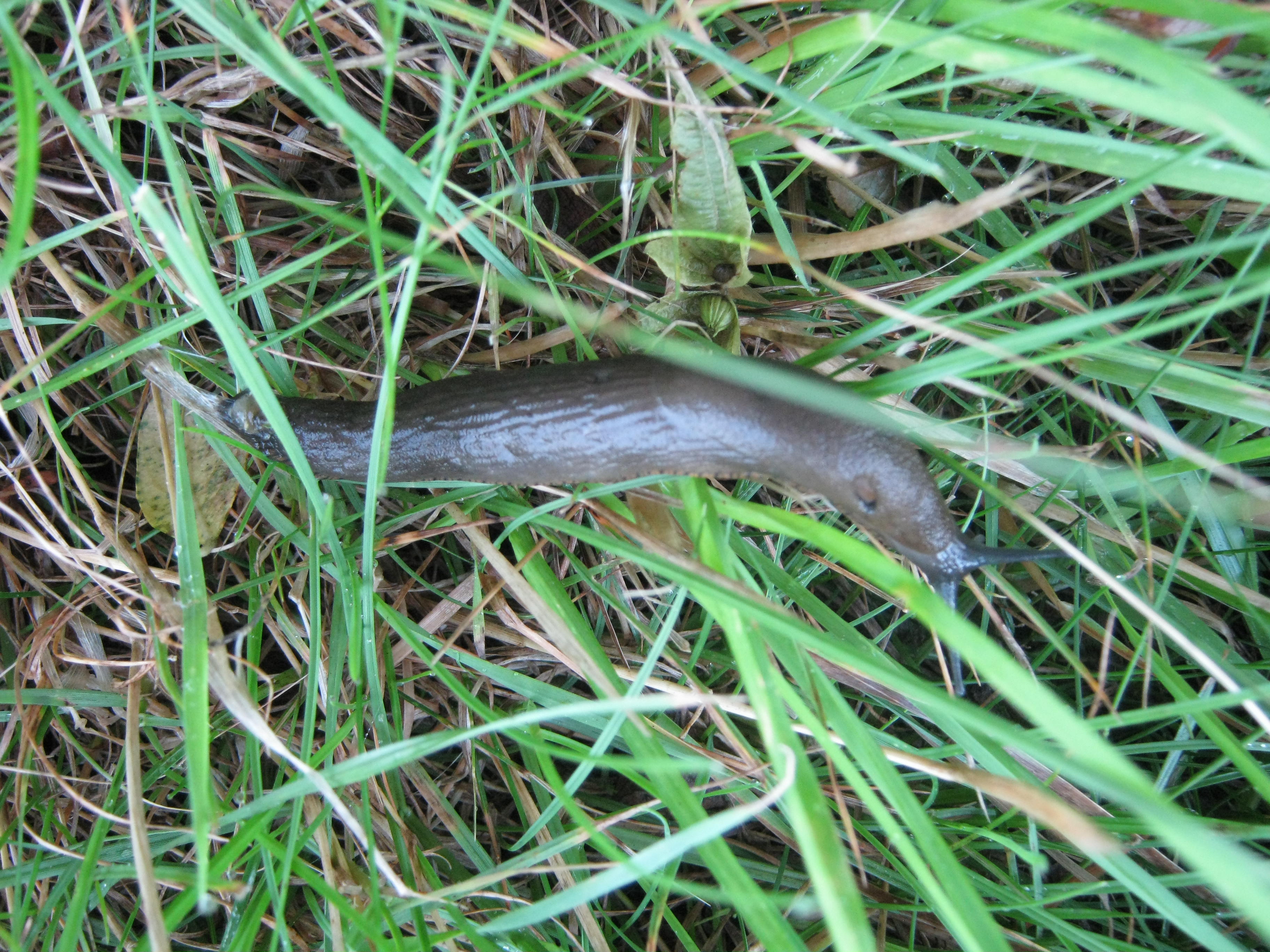
027poss rice 028poss rice I think it looks very much like it.  Can anyone confirm this for me, please? Near to the hedge we found some red bartsia but my photo is very poor as you will see. 013oof Red Bartsia I also found some ragwort which I think may be marsh ragwort. 017poss marsh ragwort We walked past another field of dried peas and continued to admire the enormous clouds on the horizon. 035Clouds We were now approaching the Beck and we could hear all the ditches and little streams that join it gurgling and bubbling. 037Great Black Slug We saw this Great Black Slug in the damp grass.

039The Beck

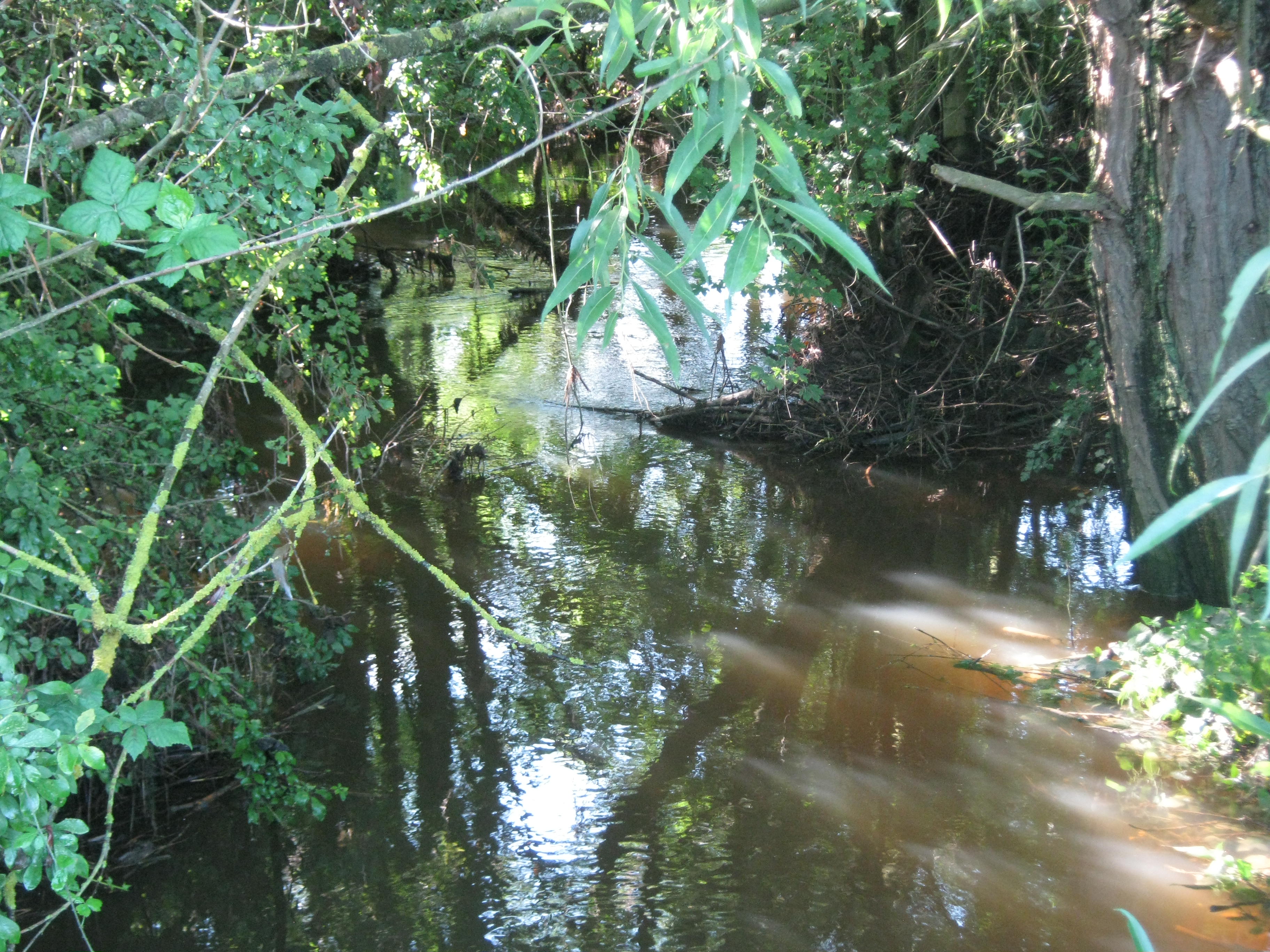
The Beck was flowing very fast

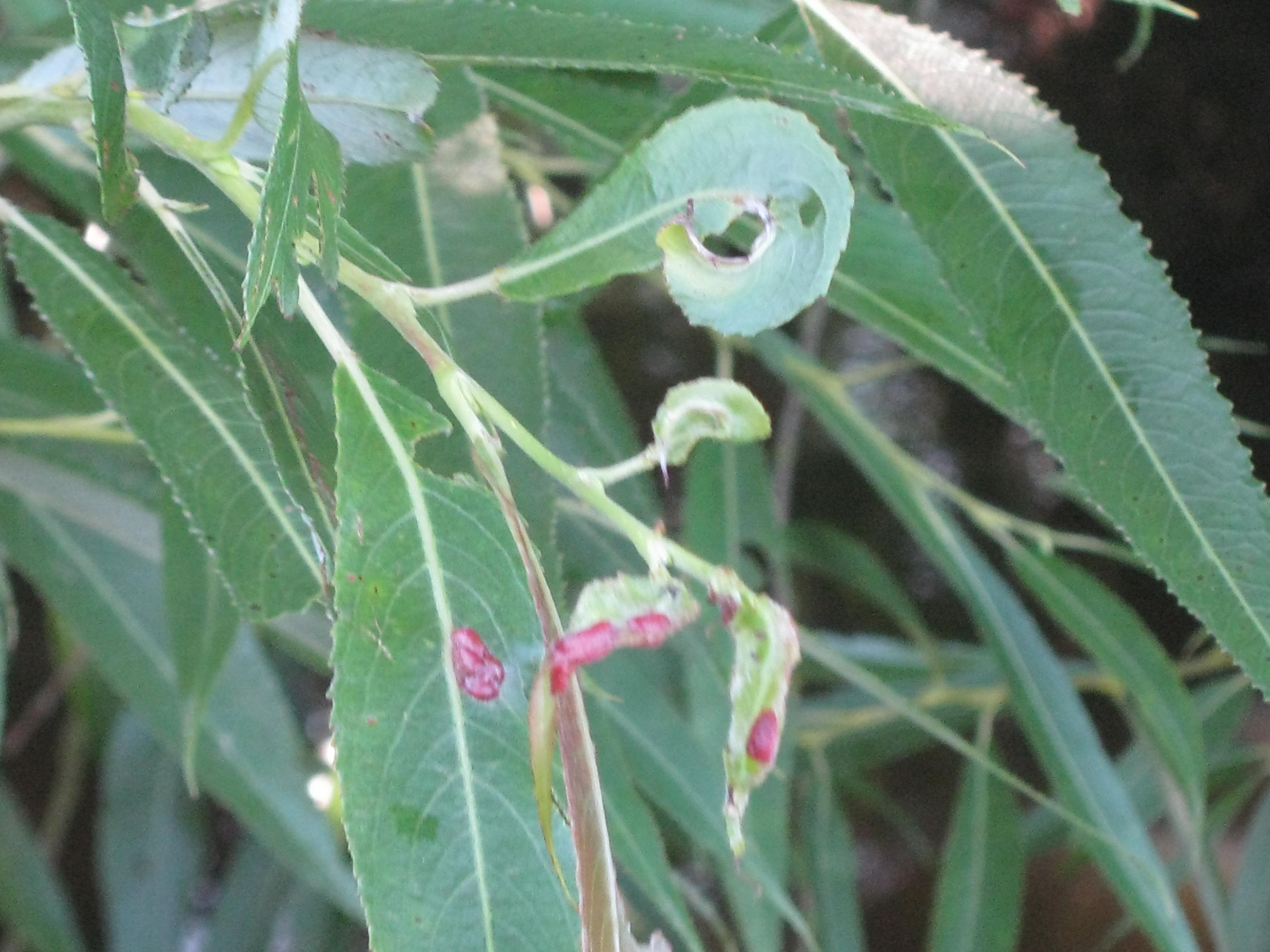
040Willow leaves

This willow has galls on it and one of its leaves is very distorted

We decided to walk a little further to the top of the hill and look at the view from there.

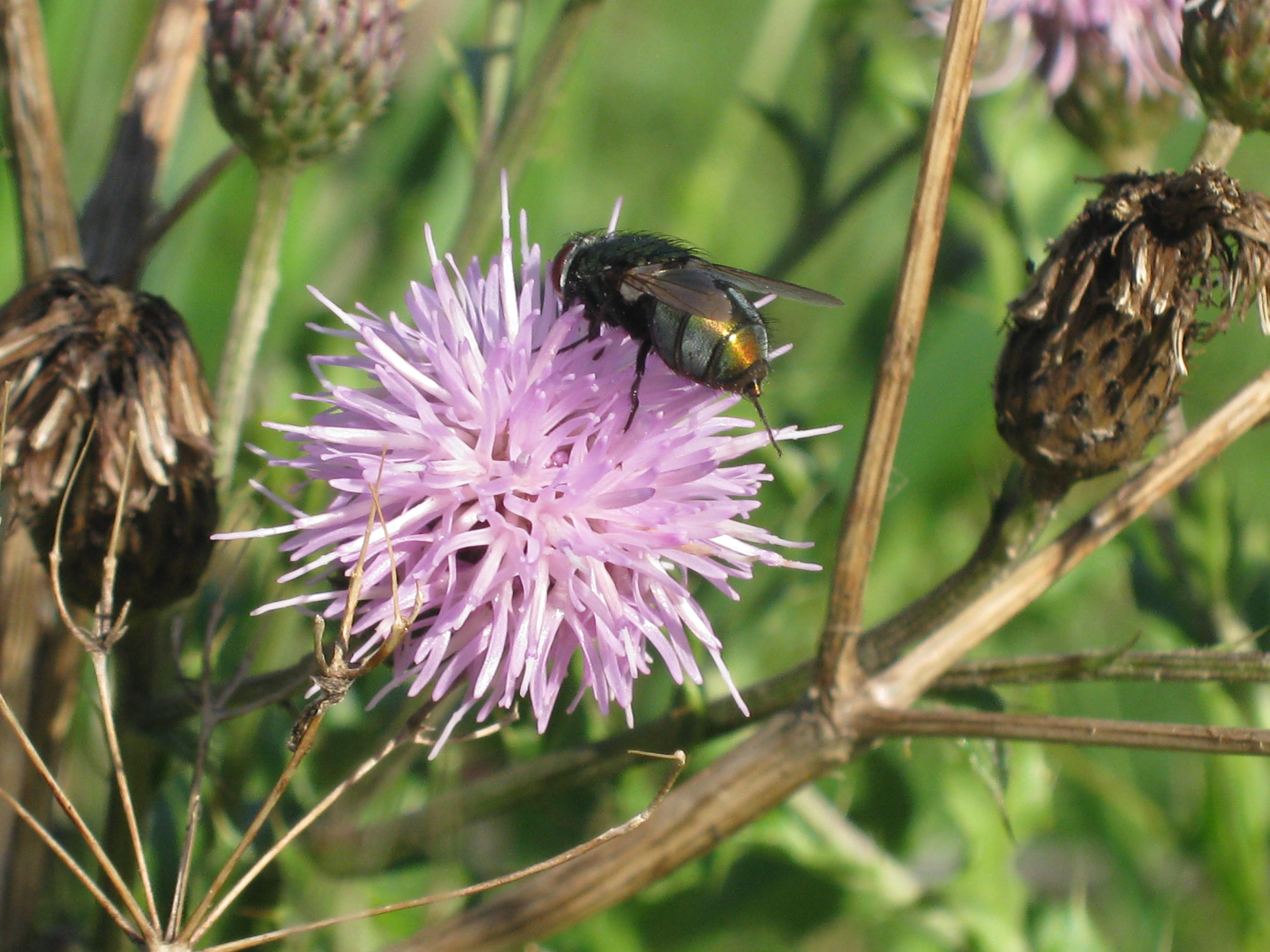
041Greenbottle

Greenbottle flies develop a coppery tinge with age

043View of field

One of our favourite views

047Signpost

The road junction at the top of the hill

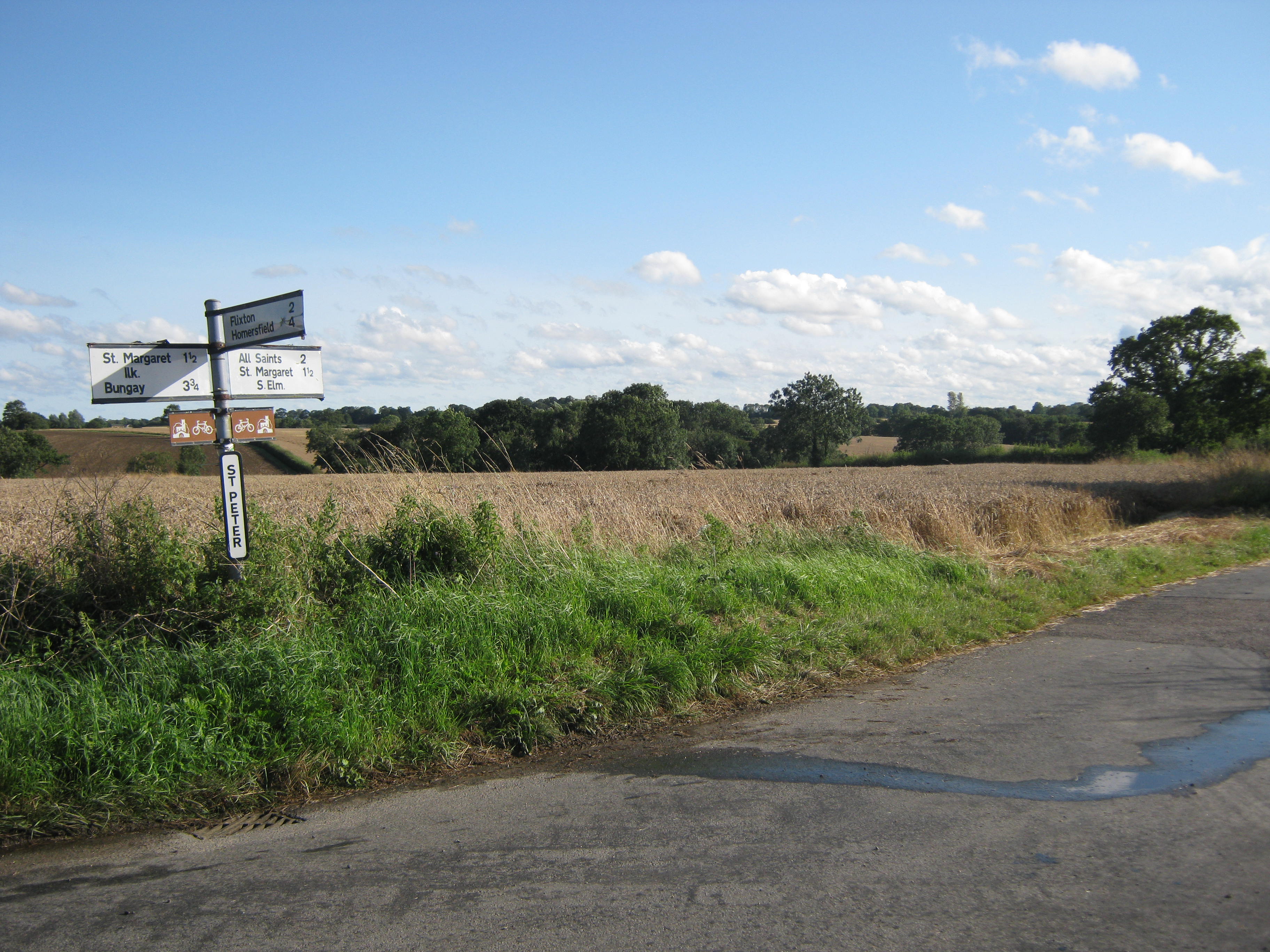
048View and clouds After all the humid weather recently it was lovely at the top of the hill with the strong wind blowing. 050Clouds   051Clouds   It looked as if we might have some more rain so we headed back down the hill. 055Black bryony On the way I noticed some shiny Black Bryony leaves in the hedgerow. 056Field, gate, clouds Another view of a field, a gate and some clouds. 060Dark clouds   The wind and rain had made patterns with the dried grasses. 061Wind-blown grass shapes We got home and I started preparing the evening meal.  I used some of our home-grown Kestrel potatoes which are very tasty indeed.
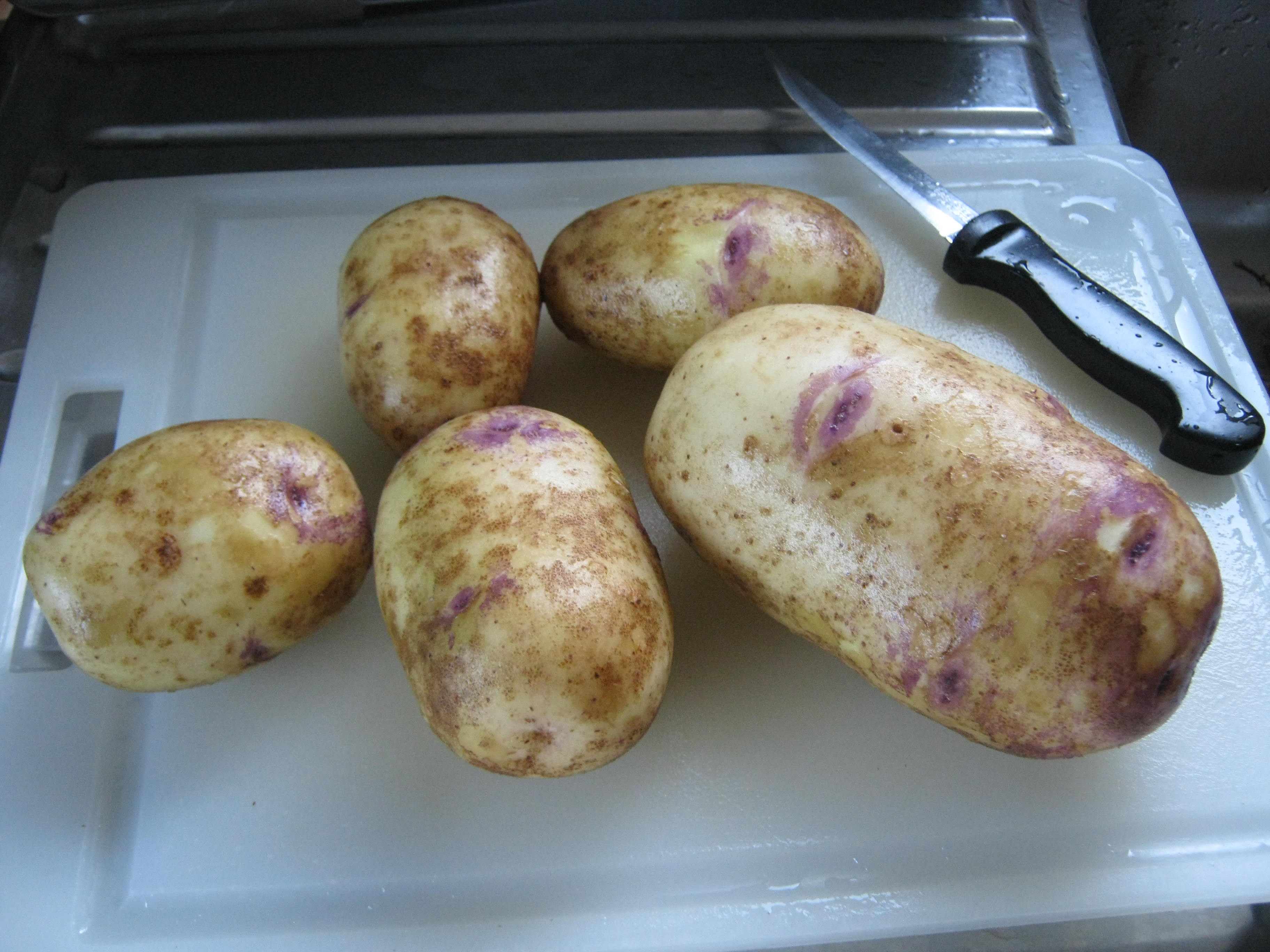
064Kestrel  pototoes

Purple patterned potatoes

In fact, the clouds passed us by without shedding a drop of rain.  The skies cleared by nightfall and we were able to see the enormous full moon as it rose and then a couple of shooting stars as well.  A beautiful end to the weekend.
Share this:

  • Share on X (Opens in new window) X
  • Share on Reddit (Opens in new window) Reddit
  • Share on Pinterest (Opens in new window) Pinterest
  • Share on Facebook (Opens in new window) Facebook
  • Email a link to a friend (Opens in new window) Email
  • Share on Tumblr (Opens in new window) Tumblr
  • Print (Opens in new window) Print
  • Share on LinkedIn (Opens in new window) LinkedIn
Like Loading...

Gallery

Storm Clouds

12 Tue Aug 2014

Posted by Clare Pooley in Rural Diary, Uncategorized, weather

≈ 12 Comments

Tags

Bertha, clouds, storm, Suffolk

This gallery contains 16 photos.

Norwich Market

09 Sat Aug 2014

Posted by Clare Pooley in Rural Diary, Uncategorized

≈ 12 Comments

Tags

Asante campaign, gutter clearing, hurricane'Bertha', market, multi-coloured tilts, Norwich, Norwich Market, parcel delivery, shopping, Sir Garnet Wolesley

I spent yesterday at home and managed to do quite a bit of gardening.  Well, not exactly proper gardening by which I mean weeding, digging, planting, pruning and the like; more like housework outside – sweeping and tidying, moving pots about and generally clearing spaces.  It was well overdue and I thoroughly enjoyed myself.

I was at home all day because I was waiting for a delivery that needed signing for – a new battery for our caravan.  A delivery company had tried to deliver it on Wednesday while I was out with Mum and had left a note to say as much.  The note asked me to contact them on-line and re-arrange a delivery time, but if they didn’t hear from me they would call again the following working day.  The website was strange and I couldn’t find anywhere on it where I could arrange a new delivery time so resigned myself to spending an enforced day at home.  I thought of it with pleasure!

It still hadn’t arrived by the time R got home from two days away in Gloucestershire.  He looked at the site and found that the battery would be delivered today, Friday.  I had hoped to go to Norwich to collect some knitting wool for Mum – she is knitting a pullover – and buy a birthday present for someone.  I also had to have my monthly blood test at the surgery.  I resigned myself to spending yet another day at home.  I thought of it with slight annoyance.  I also thought how difficult re-arranging deliveries is now for people like my mother and mother-in-law, who do not have computers.  There was no telephone number for these people to contact the company so they would wait in all next day and wonder where their parcel was.

R spent some time yesterday evening trying to clear clumps of moss and lots of ash tree keys out of the gutters.  Our ladder isn’t quite tall enough to reach the gutters so the job was very difficult for him especially as he doesn’t have a head for heights.  We are preparing for bad weather which is forecast for Sunday.  The tail-end of hurricane Bertha is coming our way and it is as well for the gutters to work properly when it arrives.

I was pleased to see a delivery van arrive this morning just before 8.00 a.m.  It reversed into the driveway and stopped outside the front door.  I waited for the man to get out, but I waited in vain. The man waited in van.  I went to the door and stood outside hoping that would get him moving.  He wound down the window and said, “Sorry, love!  I can’t deliver your parcel til eight-o-five – it’s against regulations.  I’ll knock on the door in a while”, and then wound up the window again.  Sure enough, at 8.05 a.m. a knock came at the door and I was able to sign for my parcel.  The driver told me that each delivery has an allocated time for it.  The new rules meant that instead of one hundred deliveries a day he now had seventy-five but he couldn’t get the work done any quicker.  He said he wasn’t complaining.
I wasn’t complaining either.  I went off to Halesworth surgery and had my blood test and a good chat with the phlebotomist who is a friend.  I also met another friend from church outside the surgery and had a talk with him.  Home again, home again jig-a-jig-jig and found that E was happy to come to Norwich with me.

Our first port of call was Jarrolds, a large independent department store in the city.  It has quite a good toy department on the top floor which is where I wanted to go, and it also has a good art and book department where E might have wanted to browse.  However, she was quite content looking at all the toys available now and trying to find ones she used to have.  We then went to Waterstones, the bookshop.  This is a favourite shop and gave E the opportunity to say which books she wanted and for me to ask her how much money she had brought with her and would that cover the price?

We dragged ourselves away from there after an hour and went to a coffee shop for lunch.  We walked back up the hill to the car-park passing the wool shop on the way where I collected Mum’s wool and E admired the shop-lady’s little dog, a black poodle, asleep in a chair.  We left Norwich eventually, once we had extricated ourselves from a long traffic-jam caused by road-works and then drove to Beccles where we did some supermarket shopping and arrived back home just before R got in from work.

I expect you are wondering where Norwich Market comes into all this.  Well, most of our day was spent very close to the market.

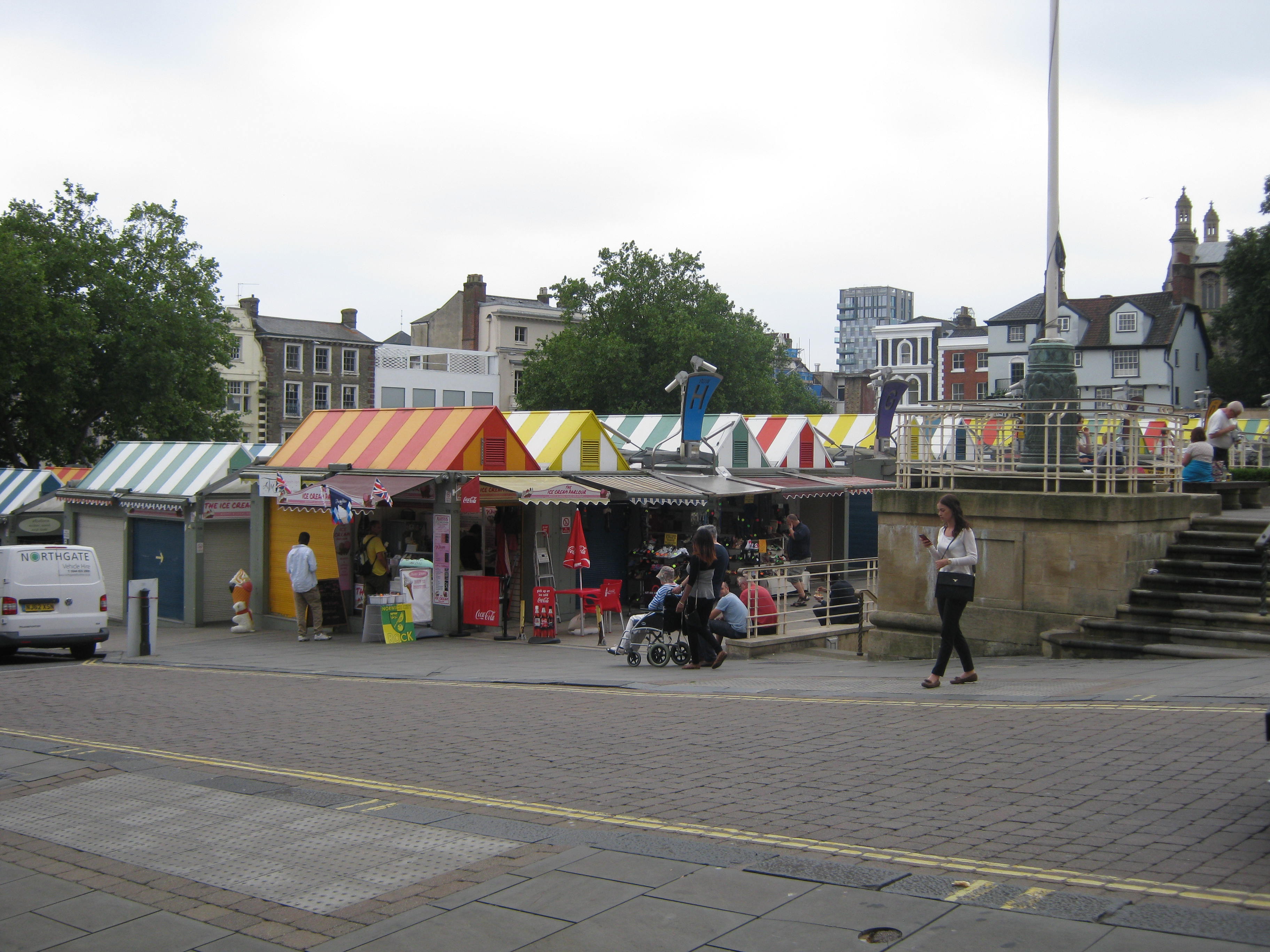
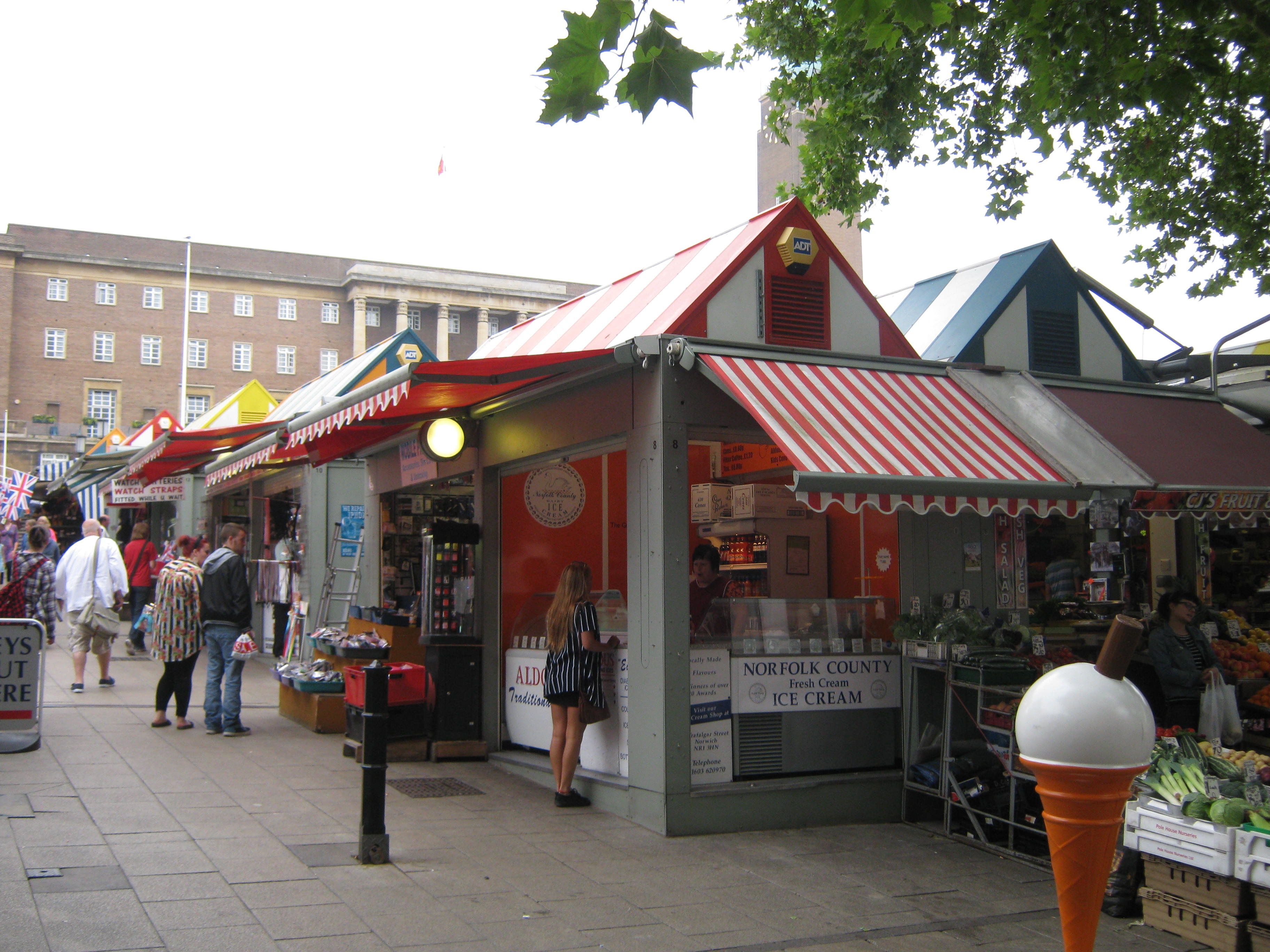
003Norwich Market

It is one of England’s oldest continuing markets having been on the same site since the 11th century.  Like most fairs and markets in the Middle Ages, it was held under license from the King, as the right to trade and receive revenues was part of the Royal prerogative.  However, in 1341 King Edward III visited Norwich for a jousting tournament just as the building of the defensive city walls had been completed “for the honour of the King”.  In gratitude, the King granted the franchise of the market to the city’s rulers in perpetuity.  The franchise still survives to this day.  I expect the person who thought to tell the King the defensive walls were built for him was feeling very pleased with himself after that! What a clever bit of crawling that was!

005Norwich Market

The market with its multi-coloured tilts is a tourist attraction now as well as part of the city landscape and a place where many people earn their livings.  All sorts of things can be bought in the market with its 187 stalls. It is open from Monday to Saturday.

006Norwich Market

The market was fully refurbished in 2005.  It looks similar to the way it did before the modernisation.  It lost quite a bit of its quaintness but it is a much more comfortable and a healthier place to work than before.

004The Sir Garnett

This is ‘The Sir Garnet’ pub.  Or to give it its full name – ‘The Sir Garnet Wolseley’.  It is one of the public houses in the Market Place and started trading as a public house in about 1861.  It was originally called ‘The Baron of Beef’, possibly because the premises was once a butcher’s shop but in 1874 it adopted the name ‘The Sir Garnet Wolseley’ in honour of Field Marshal Garnet Joseph Wolseley, 1st Viscount Wolseley.  That same year he had received accolades for the brilliantly executed Asante Campaign.  This Asante campaign was the third of four conflicts between the Asante Empire in Akan, the interior of the Gold Coast now Ghana, and the British Empire in the 19th century.  General Garnet Wolseley with 2500 British troops and several thousand West Indian and African troops was sent against the Asante.  The war was covered by war correspondents including Henry Morton Stanley (explorer and journalist (“Dr Livingstone, I presume”)) and G. A. Henty (novelist and special correspondent). The war started when the British ended slavery on the Gold Coast in 1806 causing the (British) African Company of Merchants to go bankrupt as they owned slave forts all along the coast.  The Asante economy was also affected as it was dependent on the slave trade too.  The wars then developed into the usual power struggle between the Asante Empire, the Dutch, who supported the Asante and the British Empire.  The Asante, impressively, withstood the British in some of these wars but in the end the Asante Empire became a British Protectorate in 1901. Sir Garnet Wolseley’s reputation for efficiency led to the late 19th century English phrase “everything’s all Sir Garnet”, meaning, all is in order.  This phrase was one that my grandfather used and until we came to Norwich and saw this pub we had no idea that Sir Garnet was a real person or why my grandfather used the expression.  And now we know!

Share this:

  • Share on X (Opens in new window) X
  • Share on Reddit (Opens in new window) Reddit
  • Share on Pinterest (Opens in new window) Pinterest
  • Share on Facebook (Opens in new window) Facebook
  • Email a link to a friend (Opens in new window) Email
  • Share on Tumblr (Opens in new window) Tumblr
  • Print (Opens in new window) Print
  • Share on LinkedIn (Opens in new window) LinkedIn
Like Loading...
← Older posts
Newer posts →
Follow A Suffolk Lane on WordPress.com

Enter your email address to follow this blog and receive notifications of new posts by email.

Join 719 other subscribers.

Unknown's avatar

I talk about what it's like living in a quiet part of Suffolk. I am a wife, mother and daughter, a practising Christian and love the natural world that surrounds me. I enjoy my life - most of the time!

My Posts

Mar 2026
M T W T F S S
 1
2345678
9101112131415
16171819202122
23242526272829
3031  
« Feb    

Pages

  • About my Blog
  • GDPR (General Data Protection Regulations) and This Site
  • My Life in a Suffolk Lane

Archives

Blogs I Follow

Unknown's avatar
Unknown's avatar
Unknown's avatar
Unknown's avatar
Unknown's avatar
Unknown's avatar
Unknown's avatar
Unknown's avatar
Unknown's avatar
Unknown's avatar
Unknown's avatar
Unknown's avatar
Unknown's avatar
Unknown's avatar
Unknown's avatar
Unknown's avatar
Unknown's avatar
Unknown's avatar
Unknown's avatar

Posts I Like

  • East of Elveden's avatar
  • Unknown's avatar
  • Unknown's avatar
  • Unknown's avatar
  • Unknown's avatar
  • Unknown's avatar
  • Unknown's avatar
  • Unknown's avatar
  • thesimlux's avatar
  • Unknown's avatar
  • Unknown's avatar
  • Secret Diary of A Country Vicar's Wife's avatar
  • Unknown's avatar
  • Unknown's avatar
  • Unknown's avatar
  • Unknown's avatar
  • Unknown's avatar
  • Unknown's avatar
  • Unknown's avatar
  • Limentinus's avatar
  • Unknown's avatar
  • Unknown's avatar
  • santable's avatar
  • Unknown's avatar
  • Unknown's avatar
  • Unknown's avatar
  • Unknown's avatar
  • Unknown's avatar
  • Unknown's avatar
  • sherijkennedyriverside's avatar
  • Unknown's avatar
  • Schnippelboy's avatar
  • JAM's avatar
  • Gallivanta's avatar
  • Amin Academy's avatar
  • Wayne Wolfson's avatar
  • Unknown's avatar
  • Unknown's avatar
  • Mélodie's avatar
  • Nita Panicker's avatar
  • علي الجازع's avatar
  • quietsolopursuits's avatar
  • Unknown's avatar
  • Unknown's avatar
  • Unknown's avatar
  • clivebennett796's avatar
  • Unknown's avatar
  • Unknown's avatar
  • Unknown's avatar
  • wholelottarosie's avatar

amphibians architecture art Arts and Crafts churches cooking Days out domestic animals family fish Folk Traditions Gardening Historic Buildings holidays Insects Landscaping literature music Norwich plants Rural Diary seashore theatre trees Uncategorized walking weather wild animals wild birds wild flowers

Tags

architecture autumn birds blackbird blackthorn Bungay butterfly church clouds common knapweed cow parsley crocus daffodils Diary dogwood family field maple flowers fungus garden gardening geese greylags ground-ivy Halesworth Hawthorn heather holiday Holly Holy Week horse chestnut Hoverfly insects ivy Lake District Lent lesser celandine lichen Lords and Ladies Mallard mallards Minsmere moorhen moss music Norwich Peak District pheasant plants pond ponds primrose primroses Rain rooks Rumburgh Rumburgh Church sheep Sheffield snow snowdrops Southwold spring Suffolk Suffolk Wildlife Trust sunset the Beck trees viburnum bodnantense walking weather wild cherry wild flowers winter-flowering honeysuckle witch-hazel

Meta

  • Create account
  • Log in
  • Entries feed
  • Comments feed
  • WordPress.com

Goodreads

Blog at WordPress.com.

Book Jotter

Reviews, news, features and all things books for passionate readers

Country Life Blog -

A blog about life in the country in the past and present

Matthew Paul: Poetry & Stuff

Poetry and what-not

Schnippelboy

Ein Tagebuch unserer Alltagsküche-Leicht zum Nachkochen

TAMARA JARE

Tamara Jare Contemporary Figurative Art – Bold Colors, Resilient Souls

A Taste of Freedom

Documenting a Dream

Country Ways

Rambling Journeys in Britain, Countryside Matters and campaigning for the Right to Roam

The Strawberry Post

Here to Entertain, Educate & Inspire!

a north east ohio garden

an ongoing experiment in the dirt, 35 plus years

naturechirp

Celebrating God's creatures, birds and plants...

Sophie Neville

Writer

Going Batty in Wales

Developing a more sustainable lifestyle in SW Wales

Our Lake District Escapades

Exploring the Lake District and beyond

Short Walks Long Paths

Wandering trails around the coast of Wales

The Biking Gardener

An English persons experience of living and gardening in Ireland

Nan's Farm

A Journal Of Everyday Life

Walk the Old Ways

Rambling Journeys in Britain with John Bainbridge. Fighting for the Right to Roam. Campaigning to Protect Our Countryside.

Writer Side UP!

Waking the Writer Side...and keeping it "Up!"

Meggie's Adventures

Travel, thank you notes and other stories

amusicalifeonplanetearth

Music and the Thoughts It Can Inspire

lovefoundation.co.uk

Traveling Tortuga

Simply Living Well

Pakenham Water Mill

Historic watermill in the beautiful Suffolk countryside

Take It Easy

Retired, not expired: words from the after(work)life. And music. Lots of music!

Secret Diary Of A Country Vicar's Wife

By Olive Oyl

thanksfortheadventureorg.wordpress.com/

The Beat Goes On

#TBGO

Frank Pleszak's Blogs

Twitter: @frankpleszak @PolishIICorps

John Bainbridge Writer

Indie Writer and Publisher

roughwighting

Life in a flash - a bi-weekly storytelling blog

Walking the Old Ways

Rambling in the British Countryside

CapKane

thoughts on social realities

SkyeEnt

Jottings from Skye

jodie richelle

embracing my inner homemaker

Skizzenbuch/Blog

Just another WordPress.com weblog

Have Bag, Will Travel

The Call of the Pen

Flash Fiction, Book Reviews, Devotionals and other things.

John's Postcards

Art in Nature

You dream, I photographe it !

Smile! You’re in Barnier World......

theinfill

the things that come to hand

Dr. Mary Ann Niemczura

Author of "A Past Worth Telling"

Provincial Woman

The Pink Wheelbarrow

Luanne Castle: Poetry and Other Words (and cats!)

Poetry, Other Words, and Cats

The Family Kalamazoo

A genealogical site devoted to the history of the DeKorn and Zuidweg families of Kalamazoo and the Mulder family of Caledonia

everythingchild

The Book Owl

Canberra's Green Spaces

Paul Harley Photographer

  • Subscribe Subscribed
    • A Suffolk Lane
    • Join 719 other subscribers.
    • Already have a WordPress.com account? Log in now.
    • A Suffolk Lane
    • Subscribe Subscribed
    • Sign up
    • Log in
    • Report this content
    • View site in Reader
    • Manage subscriptions
    • Collapse this bar
 

Loading Comments...
 

    Privacy & Cookies: This site uses cookies. By continuing to use this website, you agree to their use.
    To find out more, including how to control cookies, see here: Cookie Policy
    %d