
Tags
'The Revelations of Divine Love', All Hallows Convent, All Hallows House, anchorage, bailey, bomb damage, Castle Gardens, Cell, chickory, Dame Julian, EDP Newspaper Group, Father Raybould, fortified bridge, Julian, Julian Centre, keep, Lady Julian, lady's bedstraw, moat, motte, Norwich Castle, Norwich Museum, St Julian's Church, Whiffler Theatre, wild flowers
Because I am taking E to college each day my routines have had to change to suit her time-table. Up til now I have taken Mum shopping on a Wednesday but on Wednesdays E has a two hour Psychology class and that is all. No time to take Mum shopping, so we have changed to Tuesdays when E is at college til 5 pm. Eventually, we hope that E will be able to spend the rest of Wednesday at college – with friends and working in the library – but as yet she doesn’t have much work to do and wants to come home again fairly quickly. It is not worth my while doing anything other than stay on in Norwich after dropping her off at college – I would hardly get home before having to set off again.
Last Wednesday I had yet more college equipment to get for her and then a visit to the Body Shop was in order to purchase shower gel and other lusciously-scented products. After doing my shopping I still had over an hour to go before I needed to meet E so decided to have another walk-about.
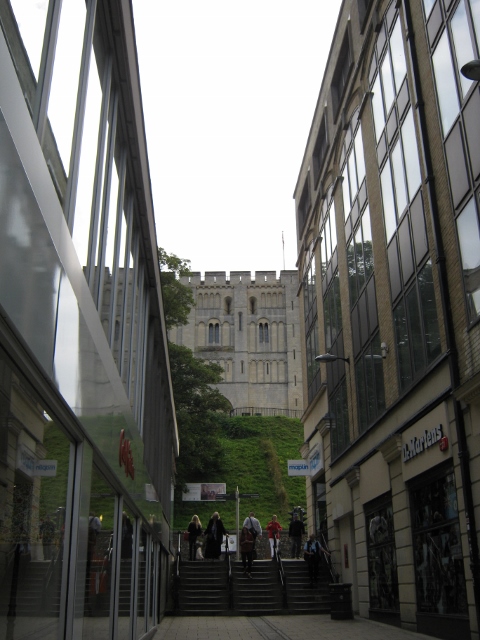
Norwich Castle is an enormous and imposing building. It is built on a large mound or motte and looks so clean and undamaged it could have been built yesterday.
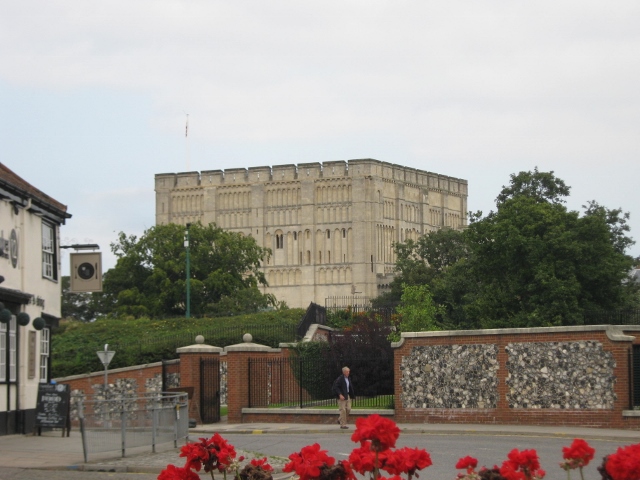
In fact, it was one of the first castles to be built after the Norman Conquest in 1066.
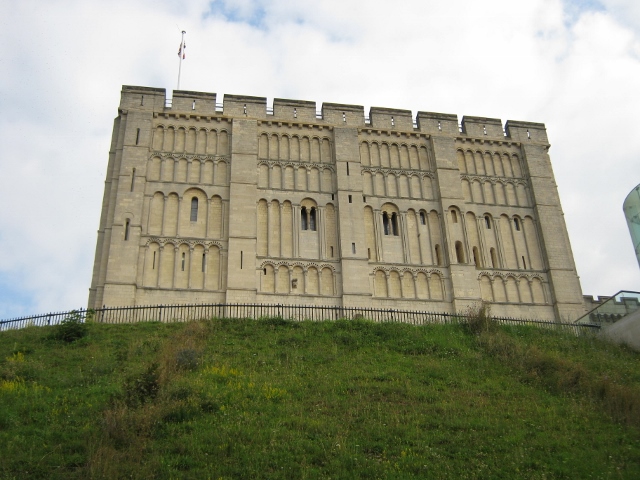
At least 98 Saxon homes were demolished from about 1067 onwards so that the earthworks could be dug within which they built a wooden fort (the Bailey). The fort was surrounded by deep defensive dry ditches. Once the land had settled they began building the stone keep in 1094 during the reign of William ‘Rufus’ II and, following his death in 1100, his brother Henry I completed the building in 1121. It was built as a Palace rather than a fortification but no Norman King ever lived in it. The only time Henry I is known to have stayed in it was at Christmas 1121. The keep is constructed out of limestone imported from Caen in France. Originally, the ground floors were faced in flint which would have been such a contrast to the almost white upper floors.

The grass mound has been planted with wild flowers – the blue ones here are chickory. The strange blue-topped structure on the right is the lift (non-Norman!) that transports to the top, those not able or wanting to ascend the slope by foot.

More wild flowers – the yellow ones are Lady’s Bedstraw
Wild Carrot and Bladder Campion grow there amongst many others.

The keep was used as the County Gaol from the 14th century onwards. A new gaol designed by Sir John Soane was constructed in and around the keep in 1792-93 but this was soon found to be too small and outdated. The outside block of Soane’s gaol was demolished between 1822-27 and re-designed by William Wilkins. When the County Gaol was moved to Mousehold Heath near Norwich in 1883, work began to convert the castle into a museum which it still is to this day. All the gaol building was demolished leaving the original keep.
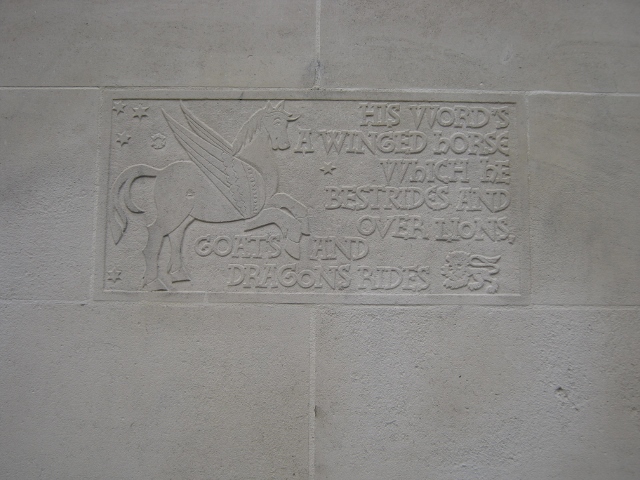
I found this on the wall near the bottom of the lift shaft. Who can tell me where this quote comes from?
I walked through the Castle Gardens which are in the bottom of the dry moat.
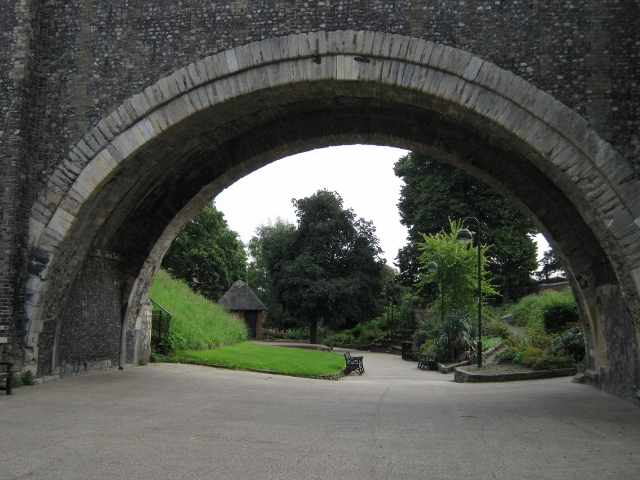
This bridge is the original Norman fortified bridge over the moat but it has been refaced and has a 19th century inner brick arch.
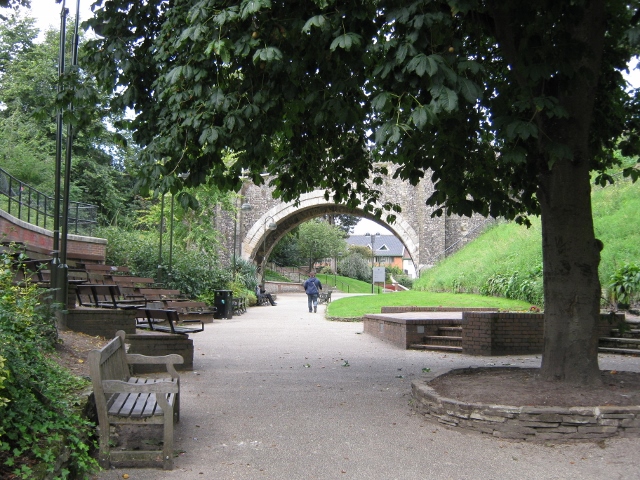
The Whiffler Theatre
This is a small, simple open-air theatre in the Castle Gardens and was given to the people of Norwich by the Eastern Daily Press Newspaper Group. Next to the performing platform is a small thatched building that is used as dressing rooms. If you look at the first photo of the bridge, the dressing room building can be seen beyond the bridge on the left. There is a Whiffler Road in Norwich as well, but I cannot find out anywhere if the road and theatre are named after a specific person. The word ‘whiffler’ has a number of meanings according to the dictionary.
1. One who whiffles or frequently changes his opinion or course. One who uses shifts and evasions in argument, hence a trifler.
2. One who plays on a whiffle; a fifer or piper.
3. The Goldeneye duck is also known as the Whiffler probably because of the whistling sound its wings make in flight.
4. An officer who went before a procession to clear the way by blowing a horn. Any person who marched at the head of a procession. A harbinger. In the 16th century the whiffler was armed with a javelin, battle-axe, sword or staff. An early form of steward involved in crowd control.
Shakespeare’s Henry V: ‘…the deep-mouthed sea, which like a mighty whiffler ‘fore the King seems to prepare his way.’
The ‘Whiffler’ pub in Norwich is named after the ceremonial character so perhaps the road and theatre are too.
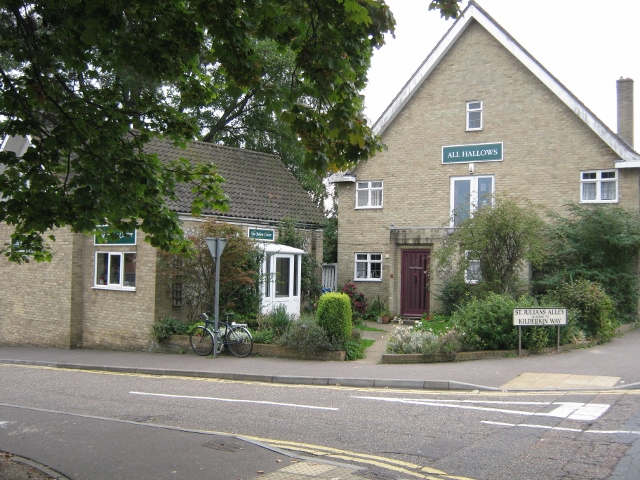
All Hallows and Julian Centre
I left the Castle grounds and walked down Rouen Road to St Julian’s Alley, on the corner of which is the Julian Centre where books, cards and other merchandise associated with Dame Julian are sold. There is also a reference library which keeps the main books and articles published about her and also a Christian lending library. All Hallows House, also on the corner of the road is a small guest house belonging to All Hallows Convent, Ditchingham which is fairly near to where I live. I went to Ditchingham for a day retreat a number of years ago and it was such a peaceful day. All Hallows House in Norwich is somewhere else to stay for a retreat, as well as a place of study or just somewhere to stay to be near St Julian’s church.
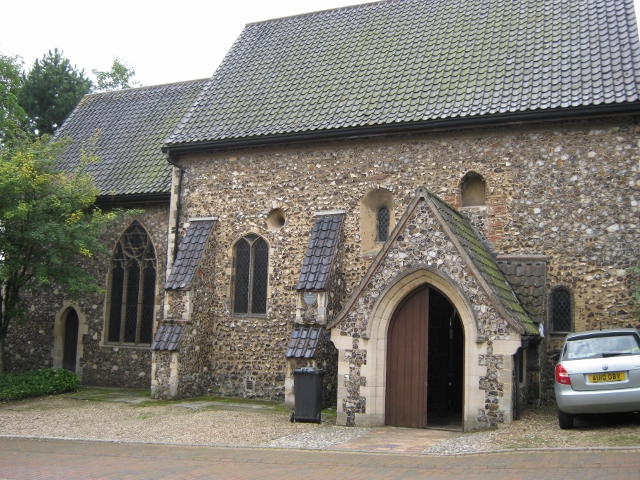
St Julian’s church
The first time I came here was with A, my eldest daughter and at the time they were preparing for something in the church and had had all the pews removed. A nun was in the church and welcomed us in saying how much she liked the large space left once the seating had been taken out. She said it made her want to dance and she then proceeded to dance round the church. I thought she was wonderful!
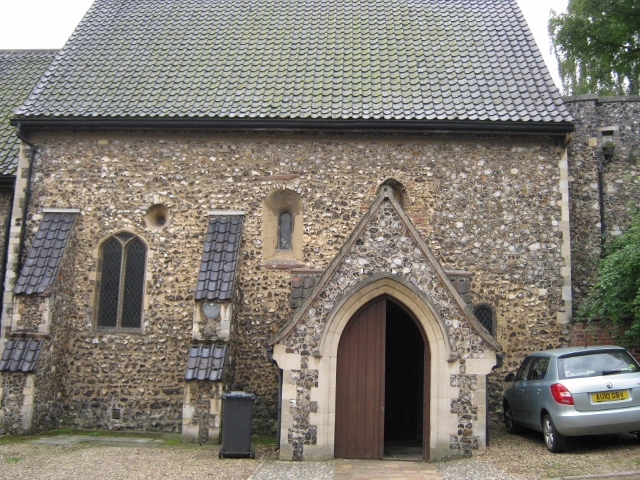
St Julian’s church
To explain who Dame Julian was I will quote from the information leaflet I picked up from the church.
‘Julian of Norwich was the first woman to write a book in English. She wrote it while she was an ‘anchoress’ (a hermit) living in a small room attached to St Julian’s church.
It was quite normal for people to live like this in Julian’s day. Some were monks and nuns, but many were just ordinary men and women who took vows to live a solitary life of prayer and contemplation. They lived in a room beside the church and many people came to them for comfort and advice.
On 8th May 1373, when she was thirty years old, Julian suffered a severe illness from which she almost died. During that illness she received a series of visions of the Passion of Christ and the love of God. When she recovered, she wrote down what she had been taught – perhaps having to learn to read and write in order to do so.
Her book, ‘The Revelations of Divine Love’, took her over 20 years to complete and is today regarded as a spiritual classic throughout the world. Her clear thinking and deep insight speak directly to today’s troubled world.
Her perception that there is no wrath in God, but that this is a projection of our own wrath upon him, is centuries ahead of her time. And her understanding that God’s love is like that of a tender loving mother, as well as that of a father, is also one we can respond to today.’

The doorway into Julian’s cell from the church
The church is not what it seems. During the Reformation the cell was totally destroyed by reformers who wanted to get rid of anything that reminded them of Papism – the Roman Catholic faith that England’s leaders had given up. The church fell into disrepair during the 19th century and was on the verge of being pulled down. The parishioners began to put money into a restoration fund in 1845 which saved the fabric but the money ran out quickly. More work was done on the church in 1871 and 1901. In 1942 the church was badly damaged in an air raid during World War II and again there was talk of pulling it down. There are four other churches within less than quarter of a mile from St Julian’s and after the War the whole area was redeveloped. It was awareness of the importance of Julian’s writing that led the rector, Father Raybould, with the support of the Community of All Hallows, to encourage the community and other interested bodies to get on with the restoration of the church as a place of prayer and pilgrimage. The architect has done such a good job in creating this little church and re-cycling a number of features from the old church and others damaged at the same time. The recreation of Julian’s cell is such a wonderful result of the terrible war damage.
The Norman doorway into the cell came from the church of St Michael at Thorn which stood nearby in Ber Street and was destroyed at the same time as St Julian’s. There was no door here when the Cell was used as an anchorage.
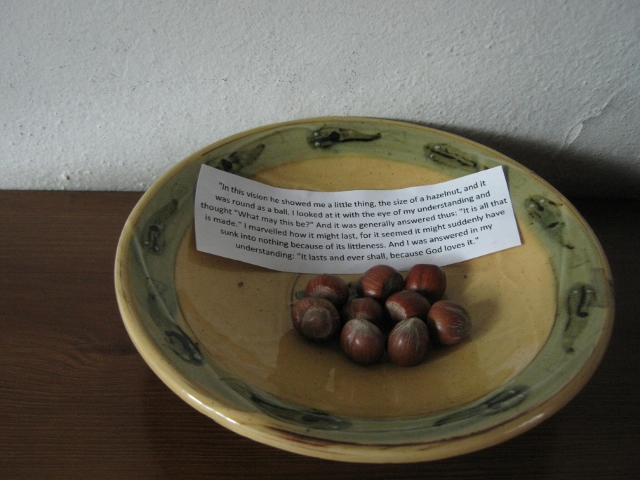
A dish of hazelnuts with the quote from Julian’s writing. In her vision, she is shown a little tiny round thing, the size of a hazelnut and is told that it represents all that has been made. She thought it was so small that it would be destroyed easily but she was told that it never would be because it was loved.
I have read Julian’s book a few times and each time I read it I understand it more, I love it more and I marvel more at this woman, who lived so long ago, being able to write and think so profoundly and able to speak so clearly to me today. The best translation I have found so far is that done by Father John-Julian, an Episcopal priest and monk. According to the blurb on the back of my copy, he has been a parish priest in Wisconsin, New Hampshire and Connecticut, was the founding Dean of the Seminary of the Streets in New York and has taught at the University of Rhode Island and Hampshire College. In 1985 he founded the Wisconsin-based contemplative, semi-enclosed monastic Order of Julian of Norwich. He has read and studied Julian of Norwich each day for over a quarter of a century. After much research he believes that Dame Julian was Julian Erpingham, the elder sister of Sir Thomas Erpingham, friend of the King, Lord Warden of the Cinque Ports and who fought at Agincourt. This Julian married a Roger Hauteyn and was widowed in 1373 (the same year as the ‘Revelations’) when her husband was killed, presumably in a duel. She re-married in 1376 a Sir John Phelip of Dennington in Suffolk. They had three children, the last of which was born the same year that her second husband died in 1389. John-Julian believes that if this was the Dame Julian of the ‘Revelations’, she wrote the book before she became an anchorite and in about 1393 she fostered out her youngest child, dictated the Long Version of the book and then entered her anchorhold. It is possible.
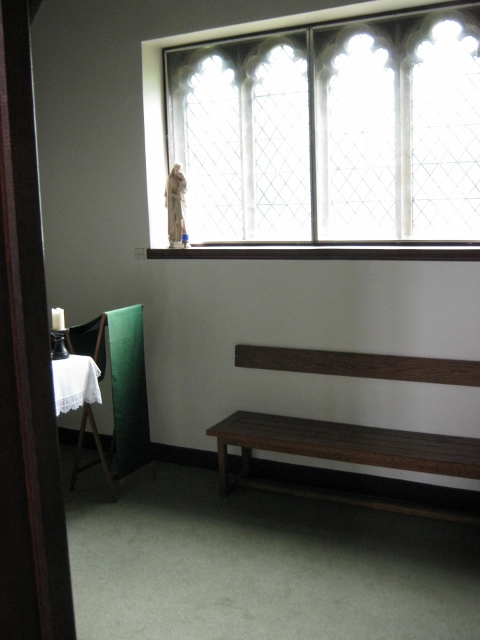
The cell, photographed from the doorway
The cell had been used by solitaries before Julian and also by others after her. When she lived there, there would have been a window onto the street so that she could counsel people, a window into the church and a window or door into an adjacent room where a servant would live. The servant would remove rubbish etc and bring food from the market and do any other tasks for Dame Julian.
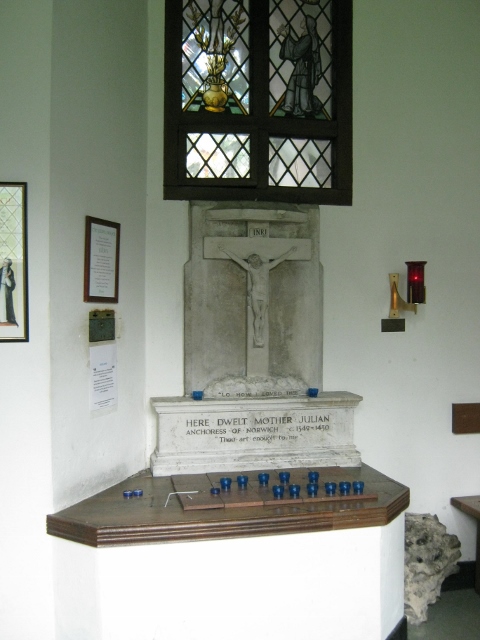
The shrine in the cell
The wooden platform marks the original floor-level and the stone memorial above it used to be on the outside wall of the church before the Cell was rebuilt. The window above that is in the place where Julian’s window into the church would have been. She would hear Mass through the window and receive Holy Communion there. She would have been able to see the Sacrament (the consecrated Bread) hanging in a Pyx (a special vessel/container) before the High Altar. There are two pieces of flintwork near the ground which formed part of the early foundations, one of which can be seen in this photo.
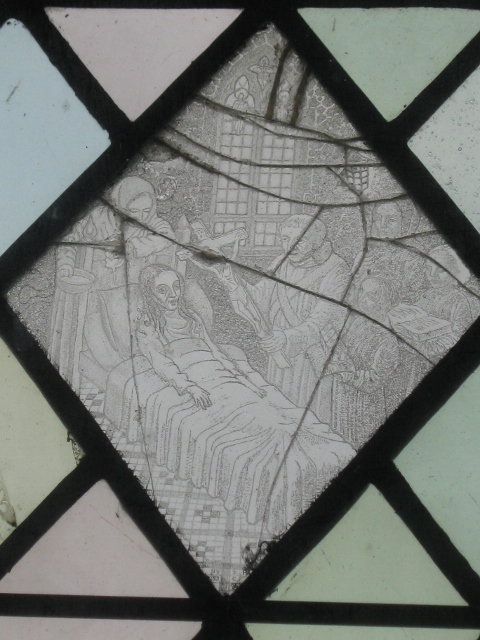
This glass is in a window opposite the shrine and is a memorial to Father Raybould
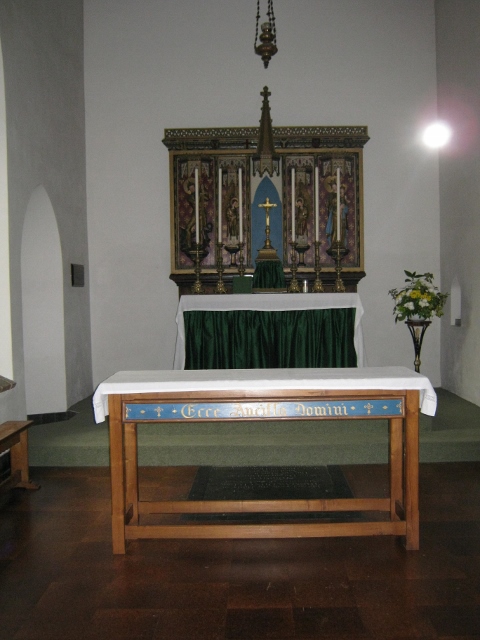
This is the High Altar in the Church
The High Altar Reredos (the ornamental screen covering the wall behind the Altar) was made in Oberammergau, Germany and dates from 1931 and was a gift. It survived the bombing.


The font is the finest thing in the church and one of the great architectural treasures of the City of Norwich. It used to belong to All Saints Church and when it was declared redundant in 1977 the font was brought to St Julian’s as both churches had been pastorally linked at various times.
The church is dedicated to Saint Julian bishop of Le Mans. Lady Julian has never been declared a ‘saint’ although she is now included in the Church Calender of 1980. Many people think that Lady Julian took her name from the building where she had her anchorage when she entered her Cell.
 A Suffolk Lane