• About my Blog
  • GDPR (General Data Protection Regulations) and This Site
  • My Life in a Suffolk Lane

A Suffolk Lane

~ A diary of my life in rural north Suffolk.

A Suffolk Lane

Tag Archives: insects

June Flowers and Insects

27 Sat Jun 2015

Posted by Clare Pooley in Insects, plants, Rural Diary, trees, weather

≈ 39 Comments

Tags

azure damselfly, Bittersweet, Black-tailed Skimmer, blue-tailed damselfly, common knapweed, Common Marsh-bedstraw, Common Sorrel, Creeping Cinquefoil, Cyperus Sedge, damselflies, dogwood, dragonflies, Elder, Four-spotted Chaser, garden, greenbottle, Hoverfly, insects, Meadow Buttercup, Oxeye Daisy, pond, Pyracantha, Suffolk, White Water Lily, wild flowers, yellow iris, Yorkshire Fog

Until this week we have had a very cool summer indeed which has meant that there have been very few insects about.  The common garden pests, greenfly and blackfly for example, seem to cope with chilly weather but the insects that eat them don’t!  Some of the flowers are continuing to flower a little late but a few are flowering at about their usual time which has made for unusual combinations.
IMG_4808All Saint's Common (640x480)

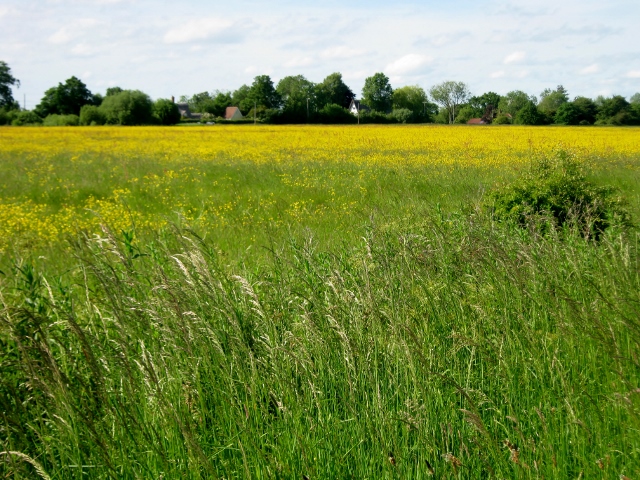
Meadow Buttercups (Ranunculus acris) on All Saints’ Common

We have a number of ‘commons’ here in East Anglia.  A common is an area of land either owned by a group of people or one person but it can be used by the general public in certain ways such as walking your dog or playing sport.  Some commons and village greens have ‘rights of common’ where it is possible to graze livestock on the land.  If you want to use the common for anything other than walking on it or having a picnic, (for instance, if you wanted to camp there), you’d have to ask permission of the land owner.

IMG_4831All Saint's Common (640x480)

This is another view of the common showing one of the unusual flower combinations.  This didn’t come out as well as I’d have liked.

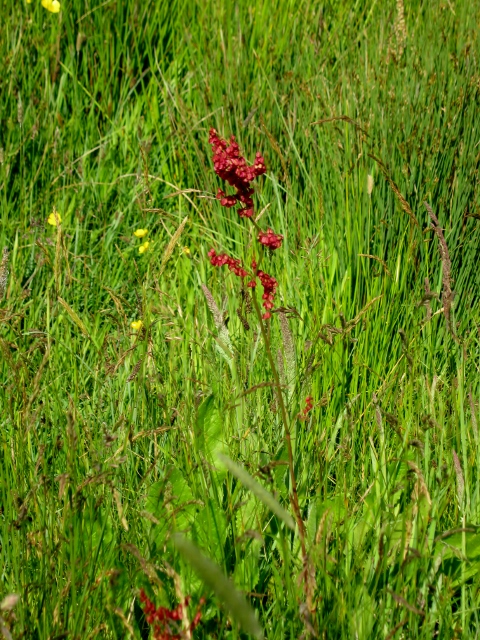
The Common Sorrel is flowering at the same time as the buttercups and for a while it looked as though the field was alight with red flames above the yellow.
IMG_4814Common Sorrel (480x640)

Common Sorrel (Rumex acetosa)

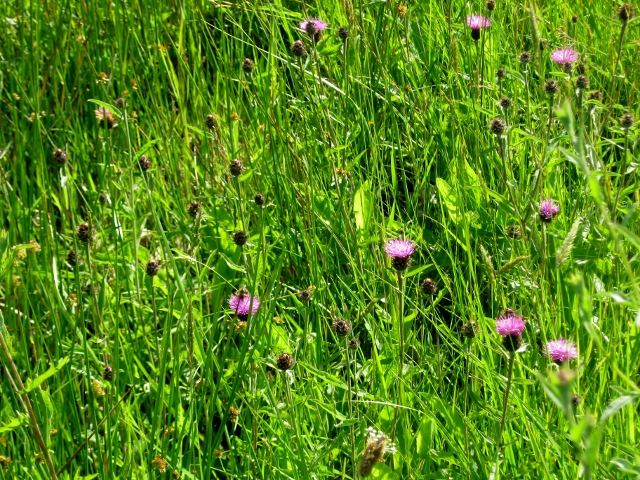
IMG_4807Common Knapweed (640x480)

Common Knapweed (Centaurea nigra) is also in flower on the common.
IMG_4810Possibly Yorkshire Fog (2) (510x640)

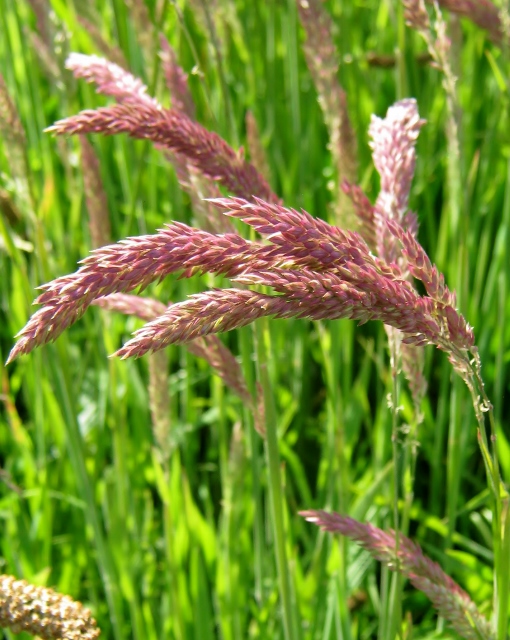
As is Yorkshire Fog (Holcus lanatus)

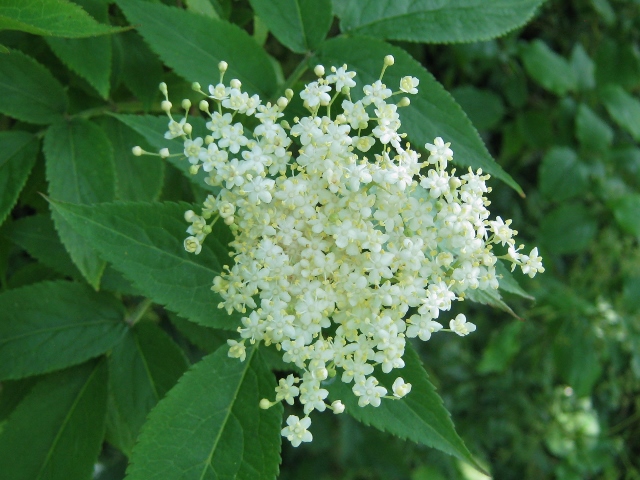
IMG_4819Elderflower (640x480)

The Elder (Sambucus nigra) is in flower.
IMG_4892Dogwood (640x480)

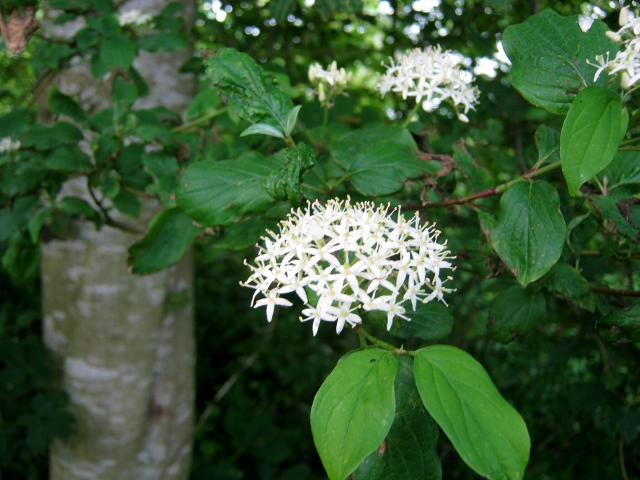
The Dogwood (Cornus sanguinea) is in flower too.

Many people dislike the scent of the Elderflower; they describe it as smelling of ‘cats’.  It isn’t a pleasant smell but it is preferable to the smell of Dogwood flowers!
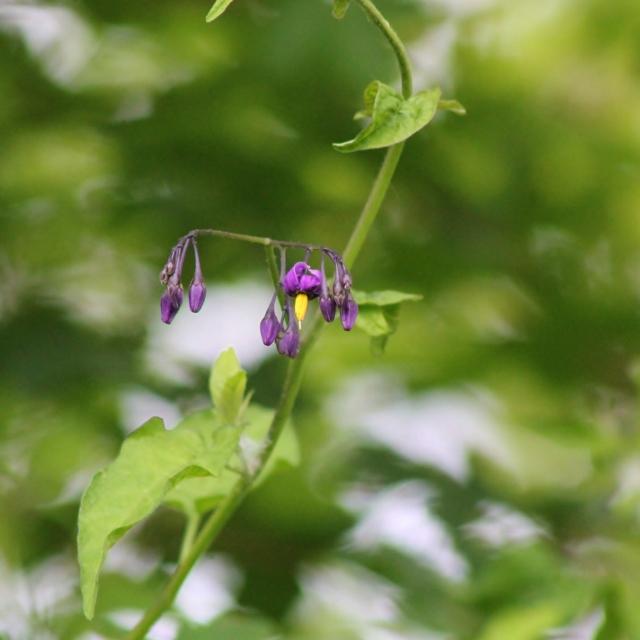
IMG_2269Bittersweet (2) (640x640)

Bittersweet (Solanum dulcamara), also known as Woody Nightshade, is flowering in the hedgerows.
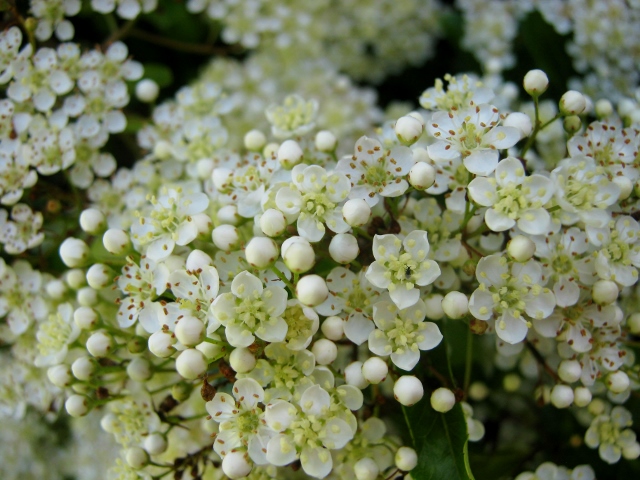
IMG_4828Pyracantha (640x480)

The Pyracantha in our garden is covered in blossom. This is another plant with a strange scent but the bees love it!
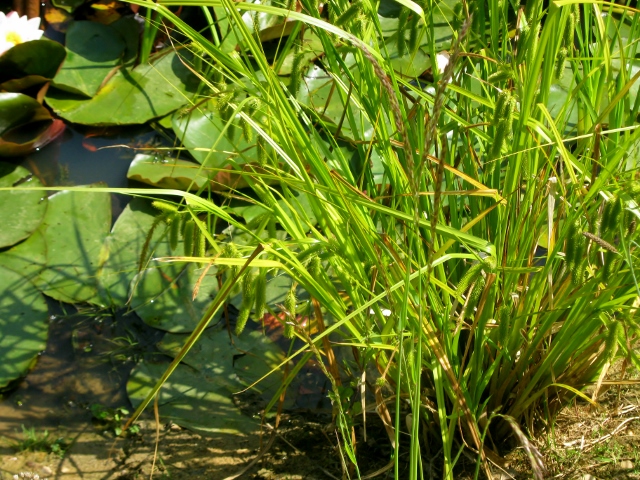
IMG_4822Cyperus sedge (640x480)

I discovered a new plant at the edge of our big pond the other day – a Cyperus Sedge (Carex pseudocyperus), also known as Hop Sedge.

The plant is quite large and must, I suppose, have been there last year without me seeing it.  Its leaves are strap-like, similar to Iris leaves, so I might have thought it was an Iris.  The flowers are unmistakable though.
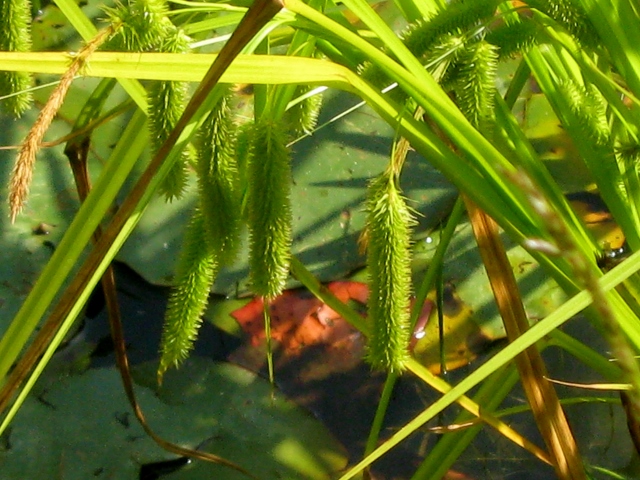
IMG_4823Cyperus Sedge (640x480)

The flowers are pendulous, like catkins.
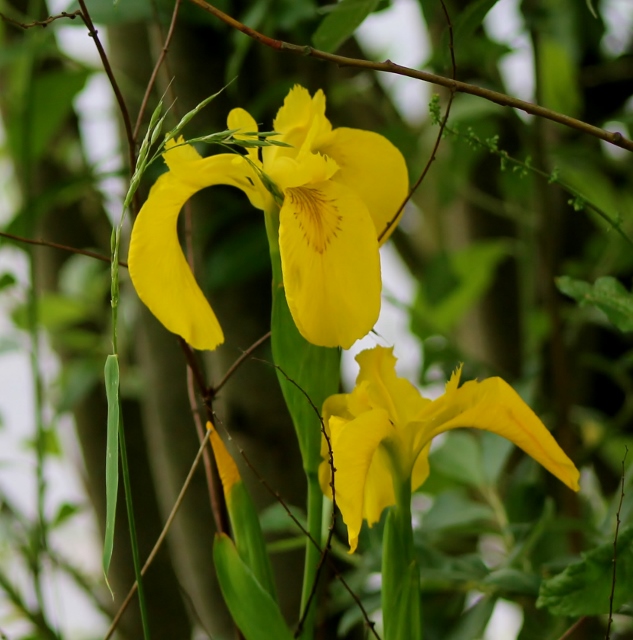
IMG_2268Yellow Iris (633x640)

Yellow Iris (Iris pseudacorus)

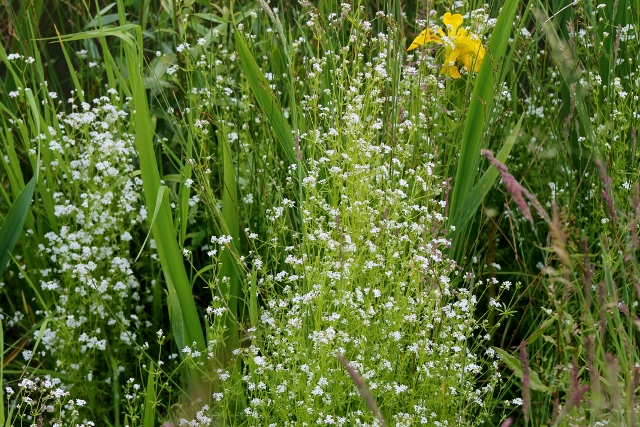
IMG_2302Common Marsh-bedstraw (640x427)

Another new plant to our garden is this Common Marsh-bedstraw (Galium palustre) growing by our corner pond.
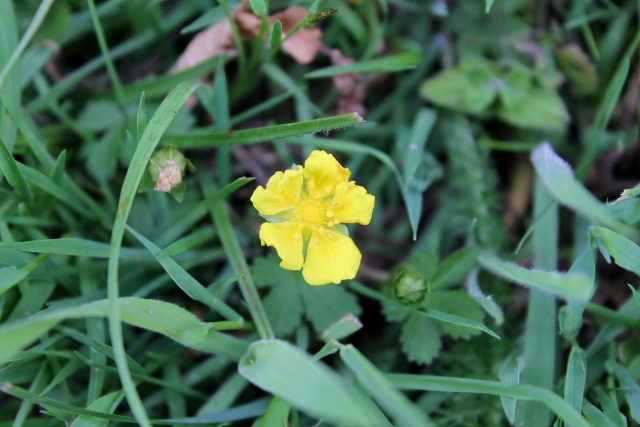
IMG_2277Creeping Cinquefoil (640x427)

One of my favourite flowers is this little one – Creeping Cinquefoil (Potentilla reptans). Its petals are heart-shaped and such a pretty shade of yellow. The creeping refers to its trailing stems that root at the nodes as it grows.
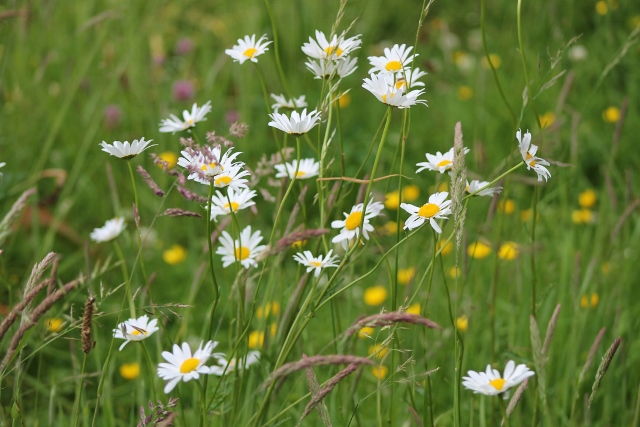
IMG_2279Ox-eye Daisies (640x427)

I love Oxeye Daisies (Leucanthemum vulgare) too.
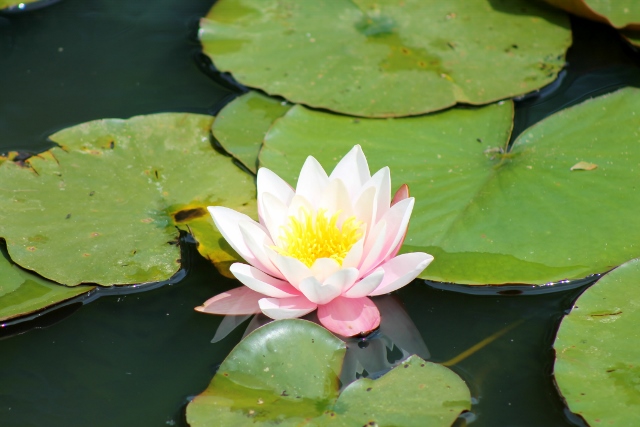
IMG_2289Water Lily (640x427)

A White Water-lily (Nymphaea alba) on our big pond.

Elinor saw the Kingfisher at the pond a couple of days ago and since yesterday we have  all heard the purring of a Turtle-dove in the trees round the pond.  The temperature has risen to 25 degrees Centigrade and I think it has been too cold up til now for the Turtle-dove.
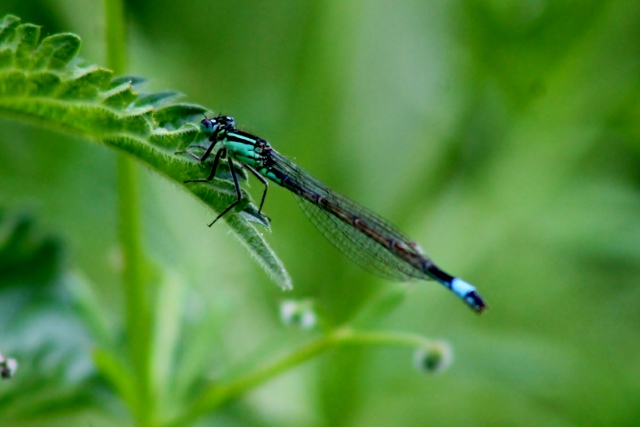
IMG_2270Female Blue-tailed Damselfly (2) (640x427)

Female Blue-tailed Damselfly (Ischnura elegans)
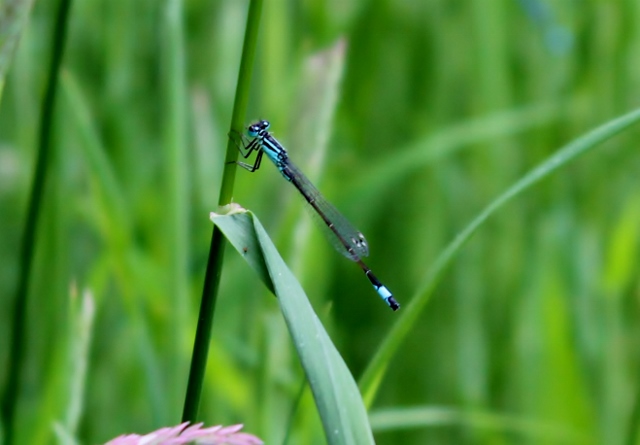
IMG_2276 (2)Male Blue-tailed Damselfly (640x445)

Male Blue-tailed Damselfly (Ischnura elegans)
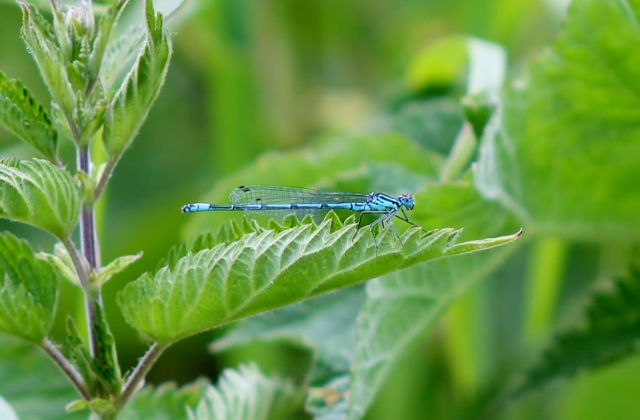
IMG_2271Male Azure Damselfly (2) (640x420)

Male Azure Damselfly (Coenagrion puella)
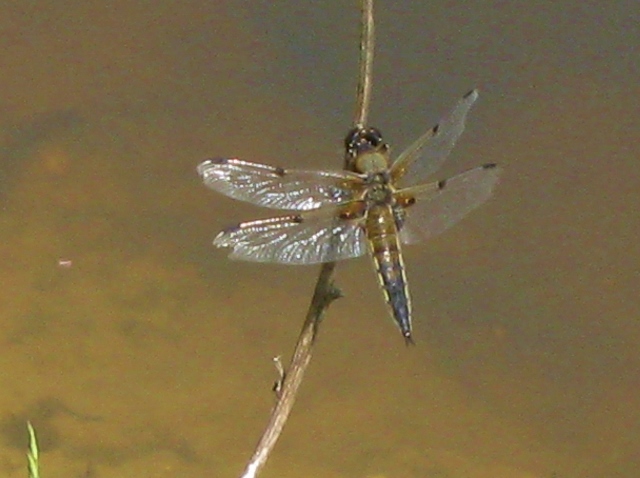
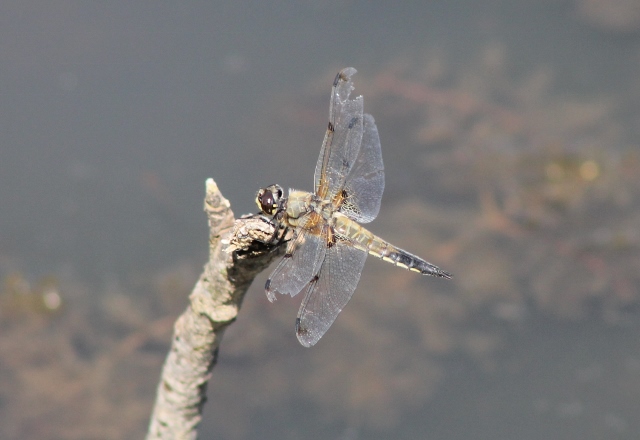
IMG_4824Male Four-spotted Chaser (640x478)

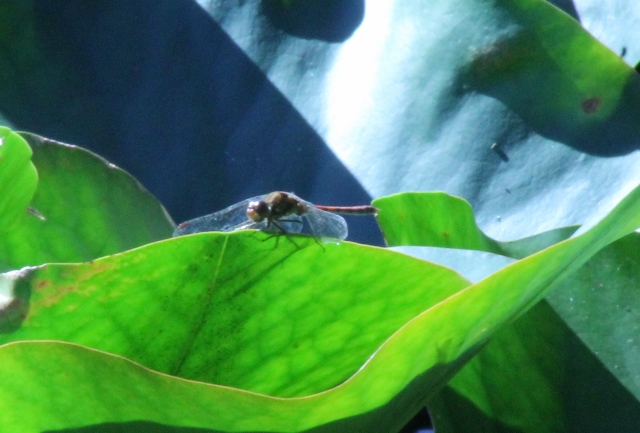
I believe this is a male Four-spotted Chaser (Libellula quadrimaculata)
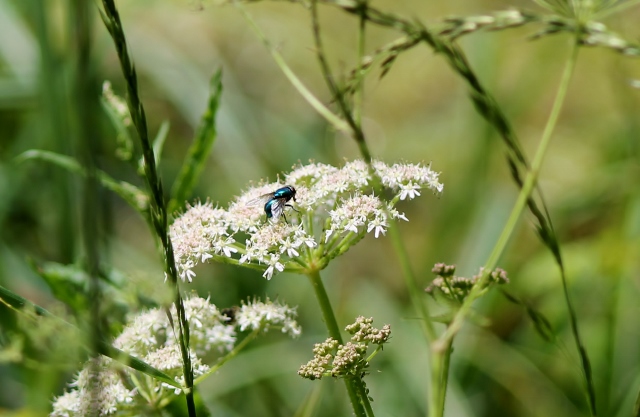
IMG_2283Greenbottle on Hogweed (2) (640x417)

Greenbottle (Lucilia caesar) on Hogweed (Heracleum sphondylium)
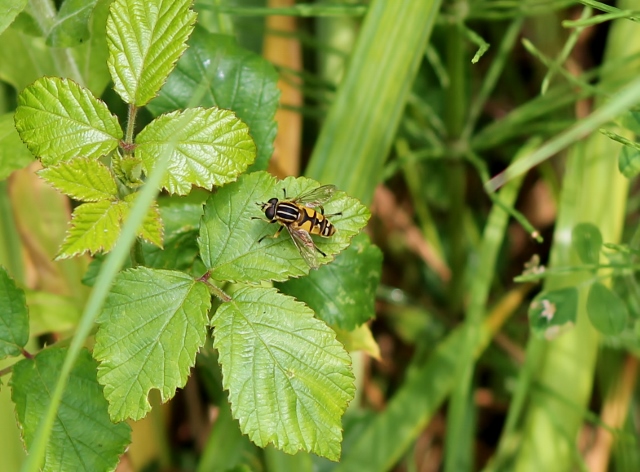
IMG_2294Helophilus pendulus Hoverfly (640x472)

A brightly-patterned Hoverfly (Helophilus pendulus)
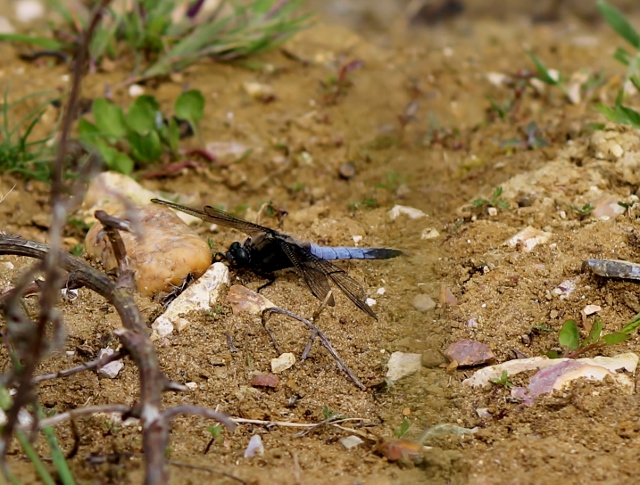
IMG_2298Male Black-tailed Skimmer (640x485)

Male Black-tailed Skimmer (Orthetrum cancellatum)

I hope to see some more insects now the weather has warmed up.

Thank-you for visiting!
Share this:

  • Share on X (Opens in new window) X
  • Share on Reddit (Opens in new window) Reddit
  • Share on Pinterest (Opens in new window) Pinterest
  • Share on Facebook (Opens in new window) Facebook
  • Email a link to a friend (Opens in new window) Email
  • Share on Tumblr (Opens in new window) Tumblr
  • Print (Opens in new window) Print
  • Share on Pocket (Opens in new window) Pocket
  • Share on LinkedIn (Opens in new window) LinkedIn
Like Loading...

Yet More Garden Visitors.

20 Fri Feb 2015

Posted by Clare Pooley in Insects, Rural Diary, wild birds

≈ 26 Comments

Tags

birds, buzzard, common darter dragonfly, Damselfly, dove, emerald damselfly, flea beetle, garden, garden spider, grey dagger caterpillar, insects, leaf beetle, long-tailed tit, moorhen, snail, spider's webs

This is the last collection of photographs I took last year of the creatures I saw in my garden.  This post starts with photos I took in mid September and continues until the beginning of November.

003Little black beetle (640x480)

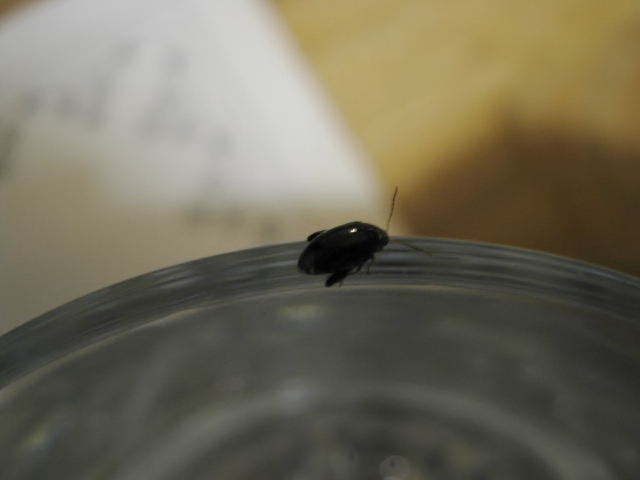
A Flea Beetle. Not a particularly desirable insect to have in the garden but I was fascinated by its shiny wing cases and the enormous rear legs used for jumping.

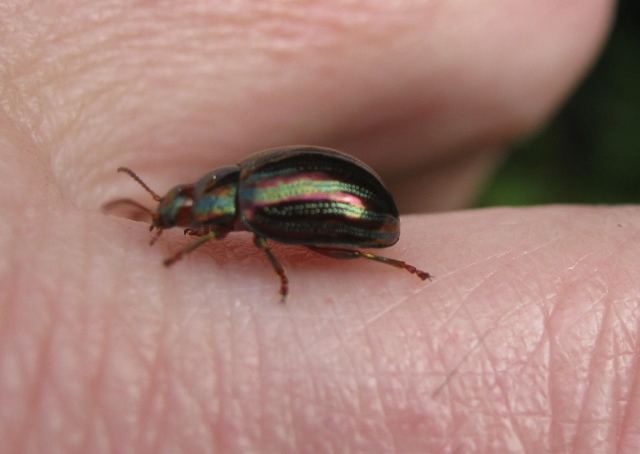
013Chrysolina varians (640x454)

A Leaf Beetle – I think this may be Chrysolina varians which lives on St John’s-wort. It was such a pretty iridescent beetle that I found on the clothes hanging on my washing line. With apologies for the horrible hand!
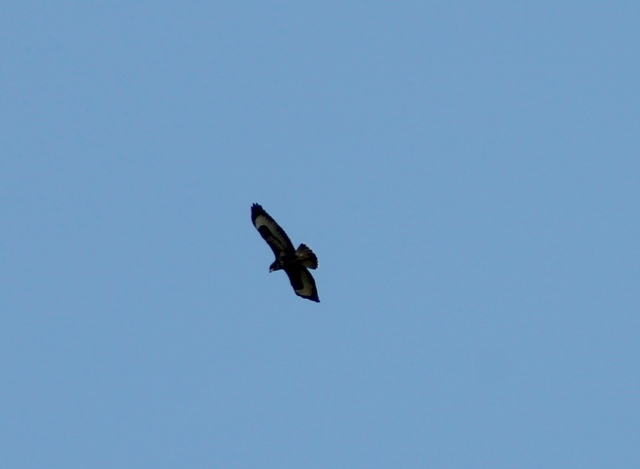
012Buzzard (640x469)

Buzzard (Buteo buteo)

I am pleased that Buzzards are returning to East Anglia.   Until eight or nine years ago I had never seen one here.

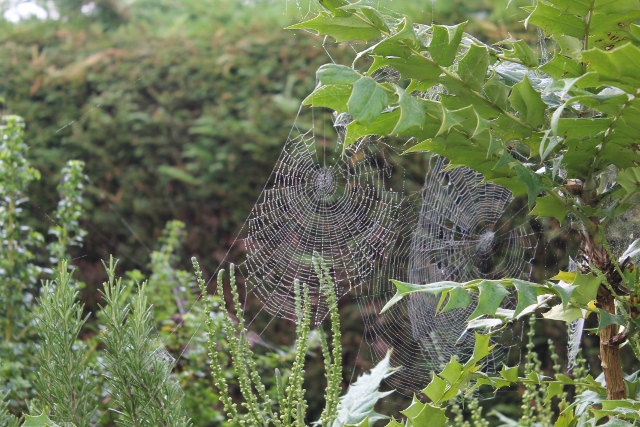
001Spiders' webs (640x427)

Some beautiful dew-covered Garden Spiders’ webs (Araneus diadematus) I saw at the beginning of October

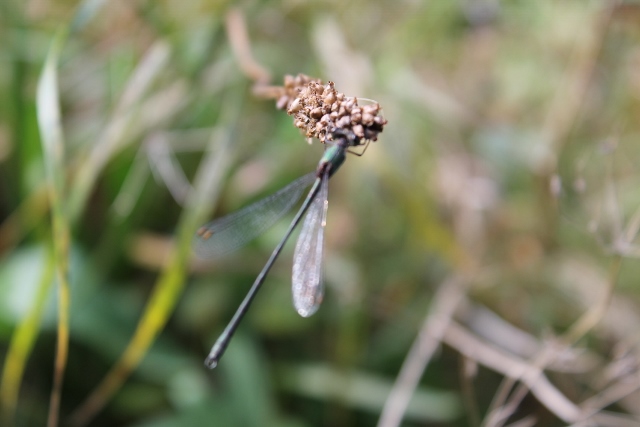
023OOF Damselfly (640x427)

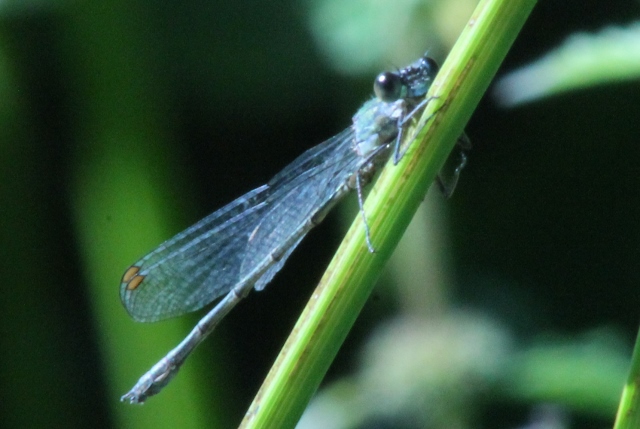
Apologies for the out of focus image. I believe this is an Emerald Damselfly (Lestes sponsa) or it might even be a Scarce Emerald Damselfly (Lestes dryas)

I spent ages following this damselfly round and round the pond until at last it settled and then of course, the camera wouldn’t focus on it!

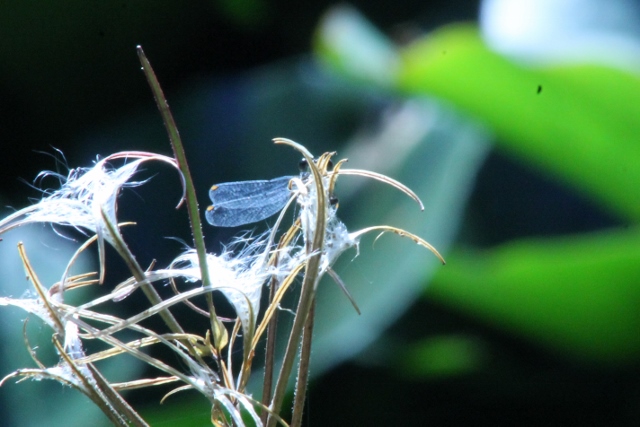
004(Scarce) Emerald Damselfly (640x427) (2)

I saw it again the following day perched on willowherb seeds.

005(Scarce) Emerald Damselfly (640x429)

This is a better photograph but still not as clear as I would like.

I had never seen one of these damselflies before.  What makes me think it is an Emerald Damselfly is (a) its green body, (b) the way it rested with its wings spread out and (c) the brown wing-spot.  What makes me think it may be a Scarce Emerald Damselfly is the size of the wing-spots which are quite wide.  (The Emerald Damselfly’s wing-spots are narrow).

002Grey Dagger caterpillar (640x480)

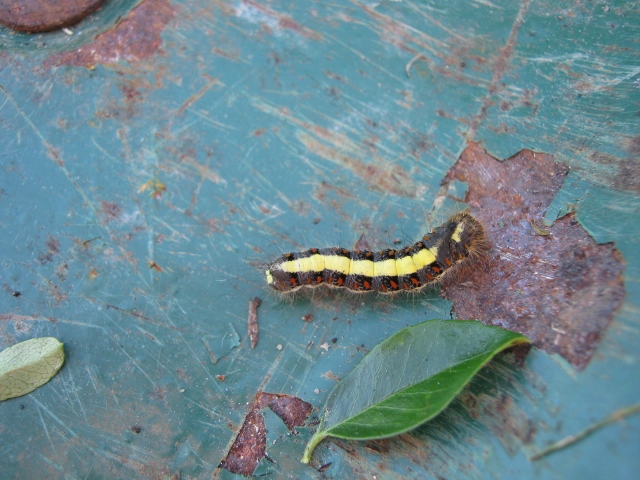
Grey Dagger moth caterpillar (Acronicta psi)

003Grey Dagger caterpillar (640x480)

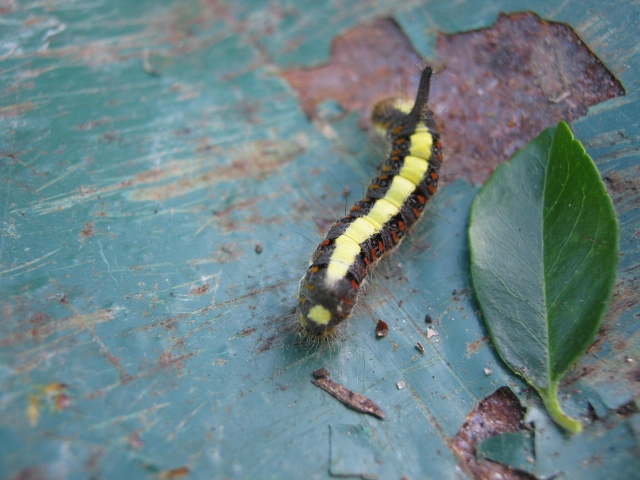
The prominent soft spike is just behind the caterpillar’s head which makes it look back-to-front. Probably a ruse to fool birds. The moth has dagger shaped markings on its wings. I found the caterpillar in the bottom of the wheelbarrow after I had taken the pyracantha prunings down to the heap at the bottom of the garden.

006Common Darter (640x433)

Common Darter Dragonfly (Sympetrum striolatum)

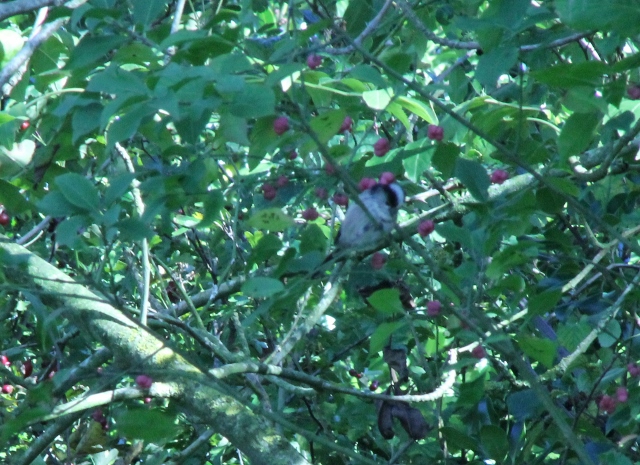
009Long-tailed Tit in Spindle (640x465)

Long-tailed Tit (Aegithalos caudatus) in Spindle tree

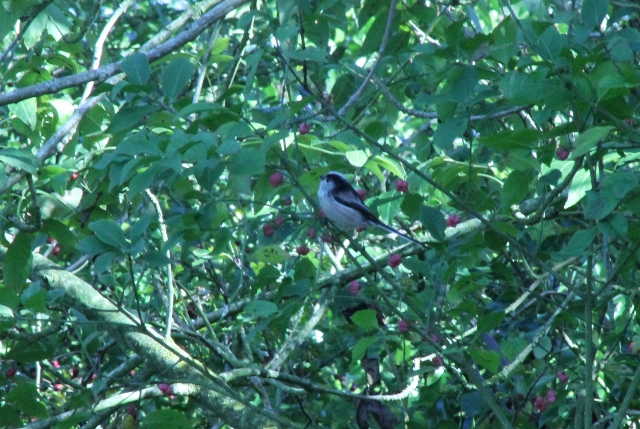
011 (2)Long-tailed Tit (640x429)

And again

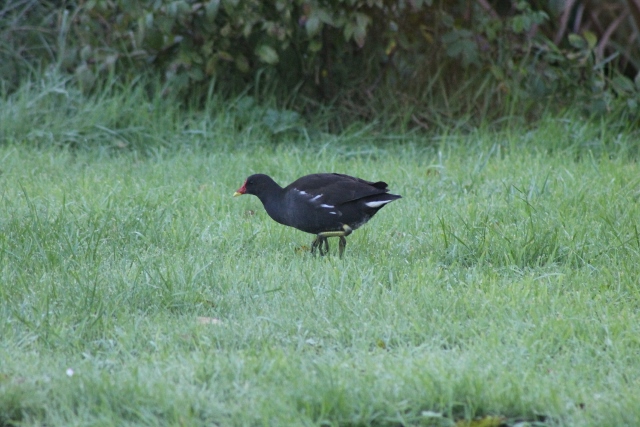
003Moorhen (640x427)

Moorhen (Gallinula chloropus)

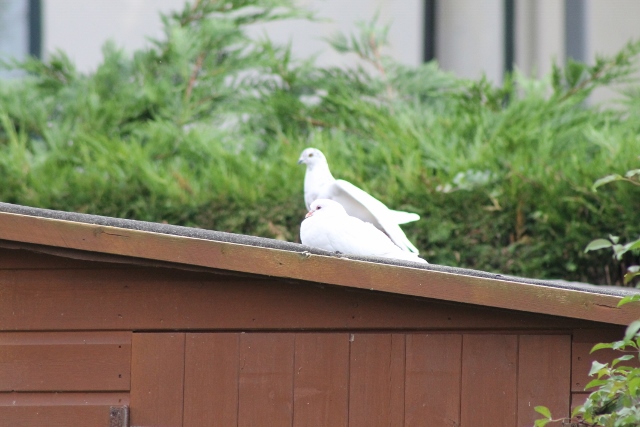
007Doves (640x427)

White doves sitting on the shed roof

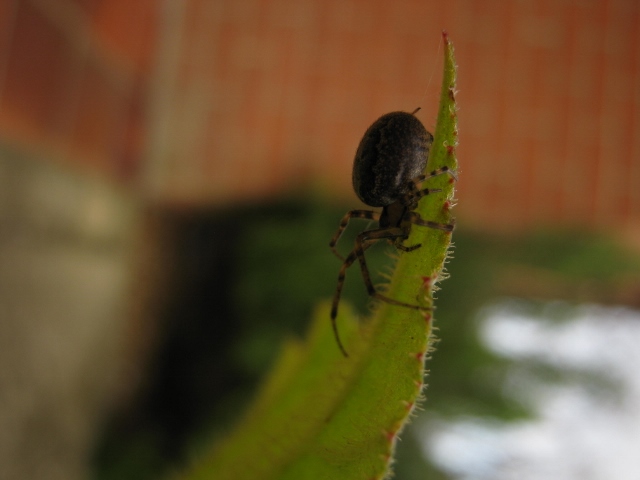
010Garden Spider (640x480)

Garden Spider (Araneus diadematus)

011Garden spider (640x480)

Spider silhouette

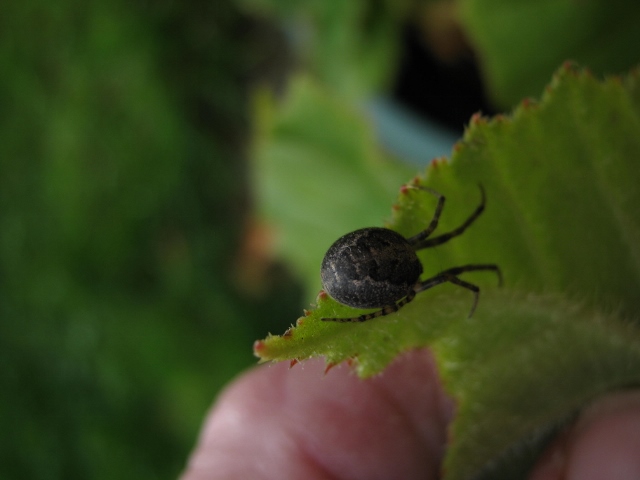
012Garden spider (640x480)

I held the begonia leaf so that I could photograph the markings on the spider’s back

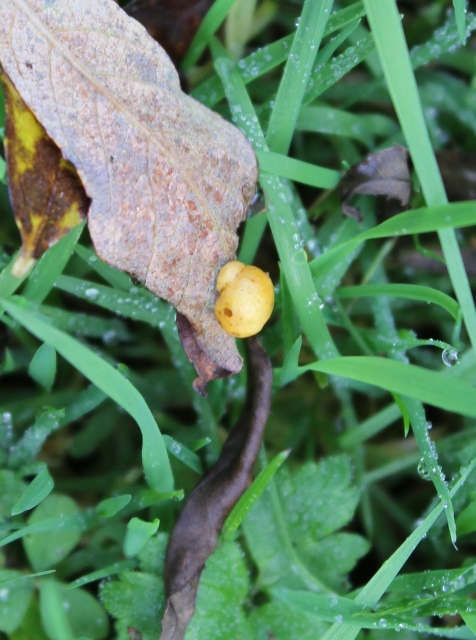
023Snail on leaf (476x640)

A tiny yellow snail on a dead leaf. I think this is a White-lipped Banded Snail (Cepaea hortensis)

I hope you have enjoyed looking at some of the things I saw in my garden last year.  Best wishes to you all!


Share this:

  • Share on X (Opens in new window) X
  • Share on Reddit (Opens in new window) Reddit
  • Share on Pinterest (Opens in new window) Pinterest
  • Share on Facebook (Opens in new window) Facebook
  • Email a link to a friend (Opens in new window) Email
  • Share on Tumblr (Opens in new window) Tumblr
  • Print (Opens in new window) Print
  • Share on Pocket (Opens in new window) Pocket
  • Share on LinkedIn (Opens in new window) LinkedIn
Like Loading...

More Garden Visitors

19 Thu Feb 2015

Posted by Clare Pooley in Insects, Rural Diary, Uncategorized

≈ 16 Comments

Tags

crane fly, digger wasp, Dragonfly, Flesh Fly, garden, Grove snail, harvestman, hawthorn shield bug, ichneumen wasp, insects, moth, ruddy darter, Suffolk, The Suspected

Another collection of photos I took last year in my garden.

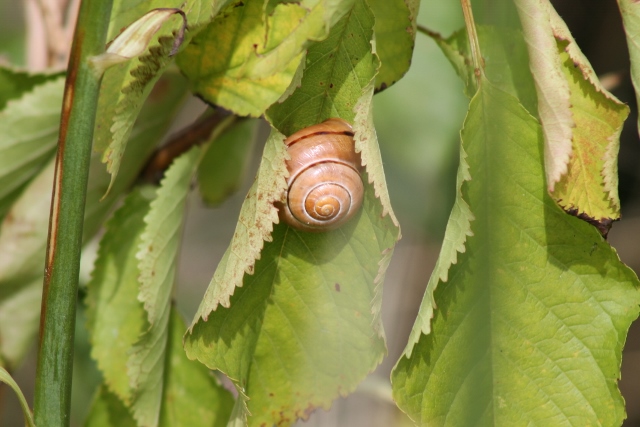
027Snail on a cherry leaf (640x427)

A Grove Snail (Cepaea nemoralis) also known as Dark-lipped Banded Snail. I saw this one on the leaves of a cherry tree sapling.

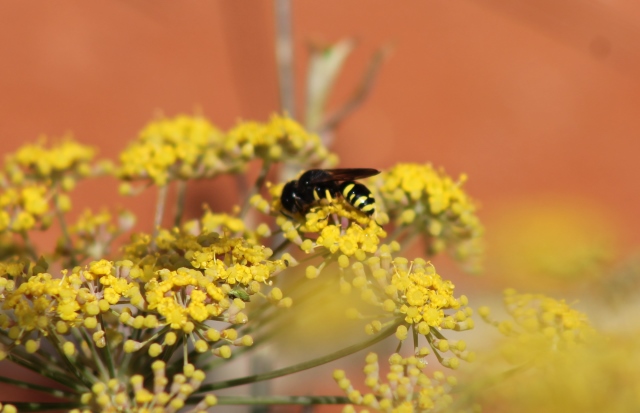
002Wasp on fennel (640x413)

This is a digger wasp, probably (Ectemnius continuus) or one of several similar species! This insect nests in rotten wood and stocks its burrow with flies.

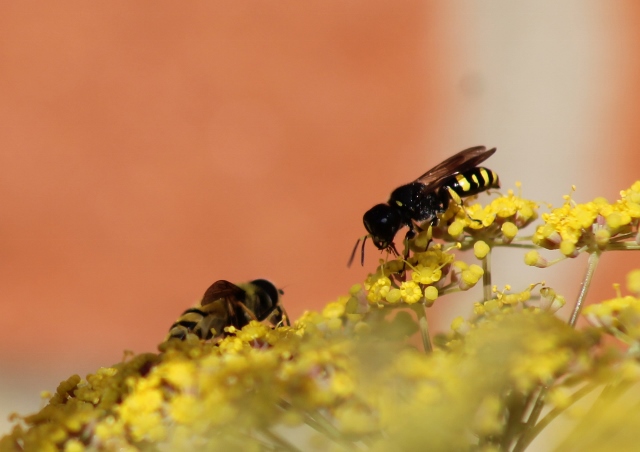
004Wasps on fennel (640x452)

The Digger Wasp on the right and another unidentified wasp on the left

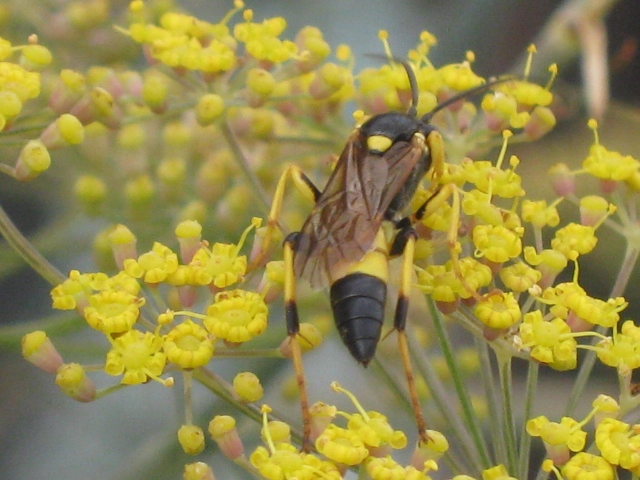
001Ichneumon wasp on fennel (640x480)

Another image of the large ichneumon wasp that visited the fennel flowers regularly

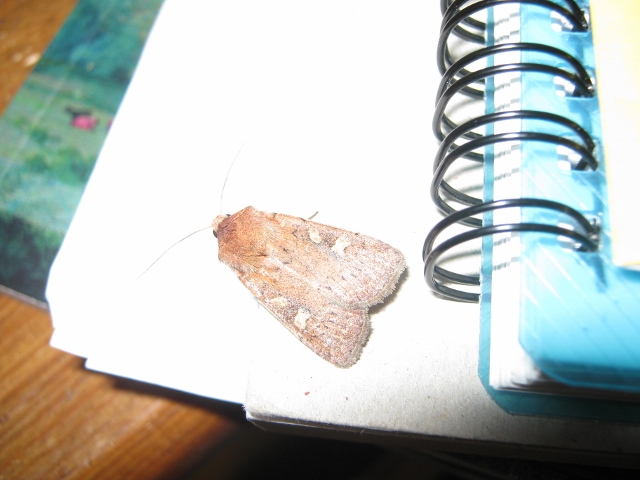
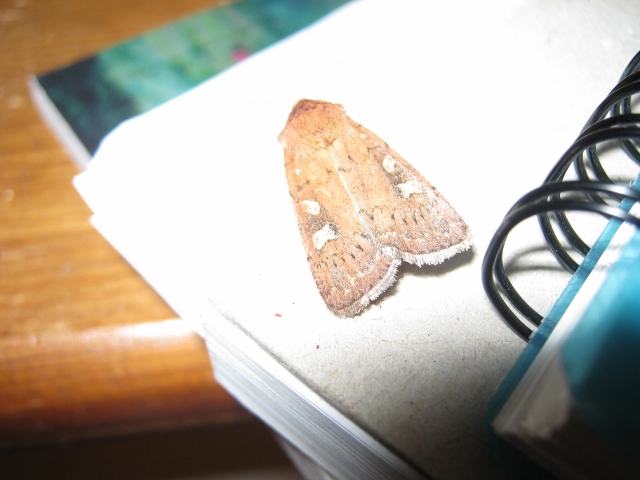
005The Suspected Parastichtis suspecta (640x480)

This moth came into the house one evening and landed on my notebook. I think it is called The Suspected (Parastichtis suspecta)

007The Suspected (640x480)

Looking at it from another angle

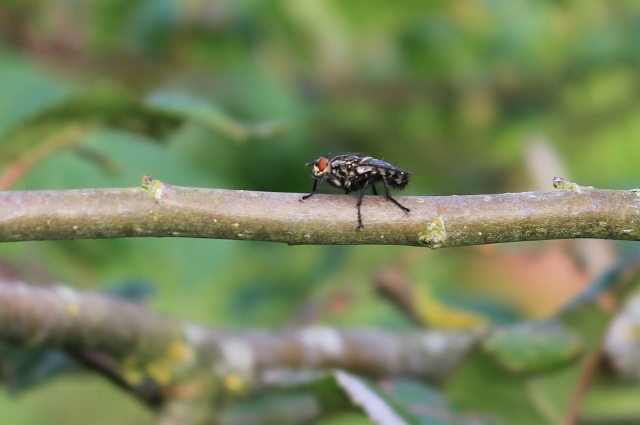
022Flesh fly (640x425)

Flesh Fly (Sarcopharga carnaria)

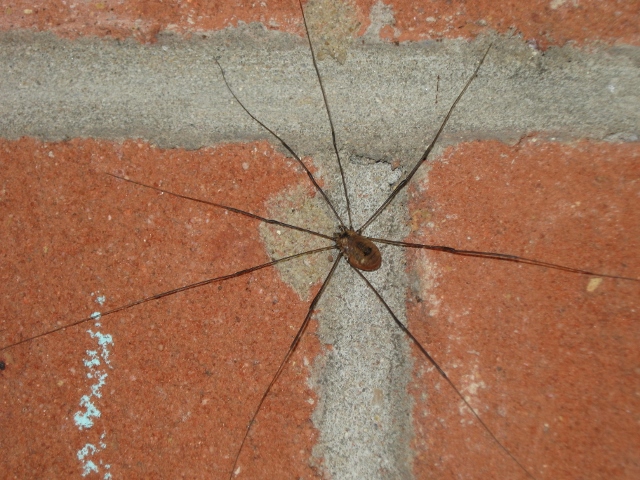
001Harvestman (640x480)

Harvestman (Leiobunum rotundum)

These creatures are closely related to spiders.  The second pair of legs, which are longer than the others, are used to feel its way about.  Unlike spiders, the harvestman has the head and thorax attached to the abdomen without a dividing waist.  There are about 26 species of harvestmen in Britain and their food ranges from small insects to decaying plant material and even bird droppings. They don’t use webs to trap their food but a few of the species use sticky hairs on their mouthparts to ensnare prey.

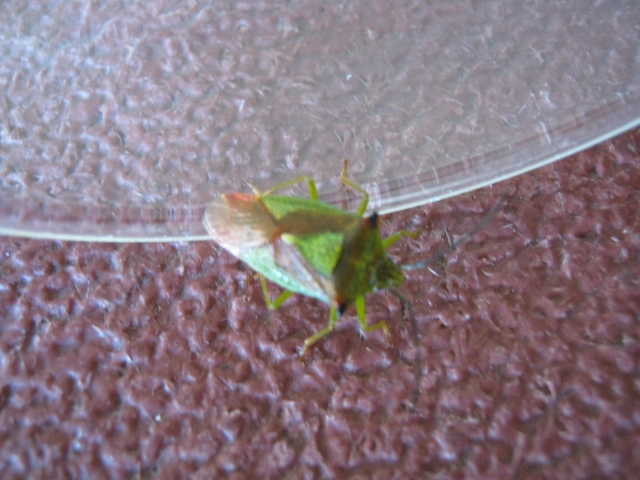
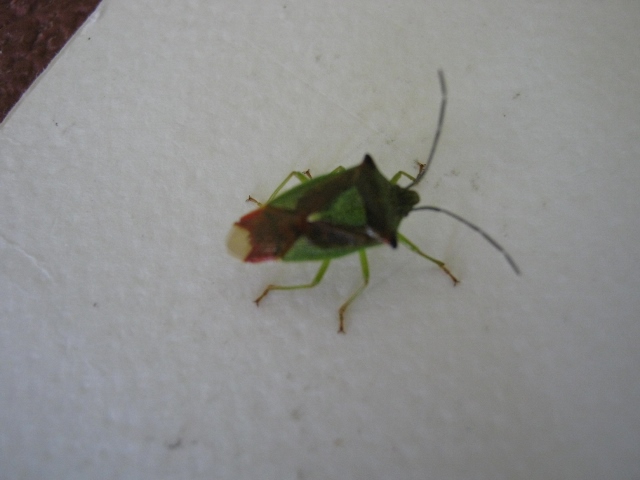
004Hawthorn Shield Bug (640x480)

Another insect that came indoors was the Hawthorn Shield Bug (Acanthosoma haemorrhoidale)

This shield bug feeds on the fruits and leaves of the hawthorn and many other trees and shrubs.  It is a ‘stinkbug’ too, because of the stinky fluid it exudes when it is alarmed.

008Hawthorn Shield Bug (640x480)

Here it is again.

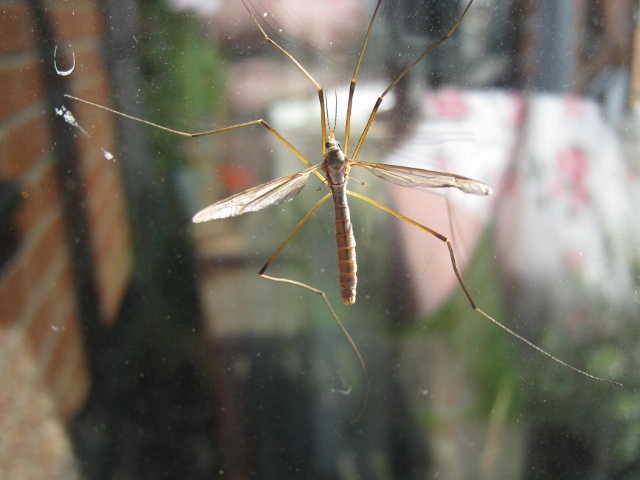
009Crane fly (640x480)

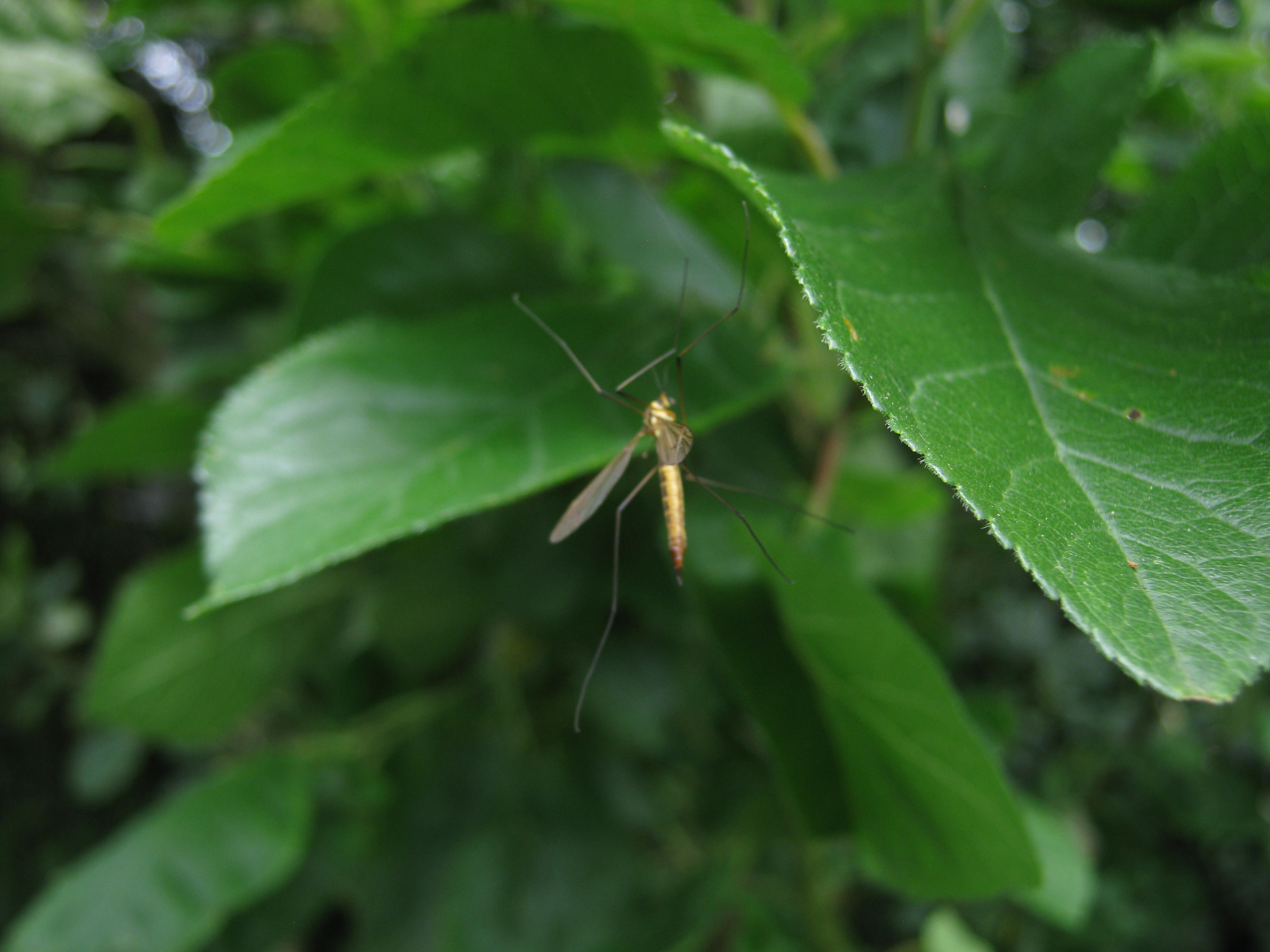
A Crane Fly – may be Tipula oleracea the Common Cranefly.  This is a male.

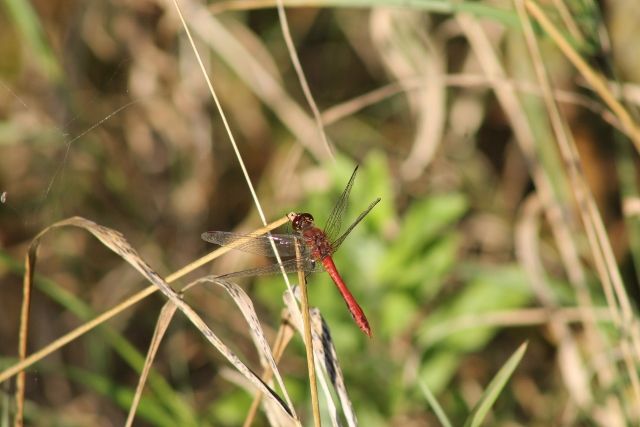
015Ruddy Darter (640x427)

Ruddy Darter (Sympetrum sanguineum)

018Ruddy Darter (640x413)

Ruddy darter again.

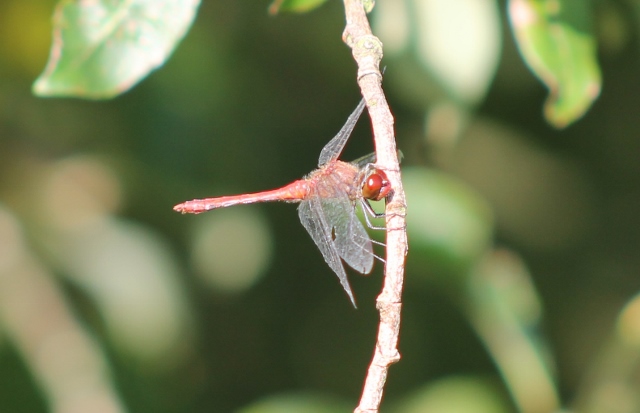
019Dragonfly (640x474)

I believe this may be a female Common Darter (Sympetrum striolatum)

020Shield Bug (640x458)

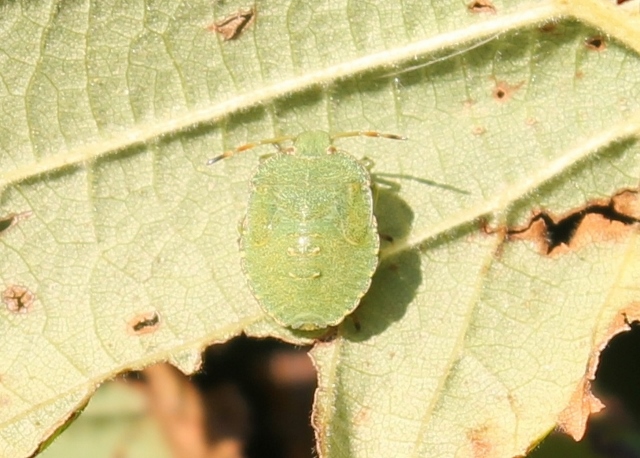
Hawthorn Shield bug nymph – 5th instar (Acanthosoma haemorrhoidale) 

That’s it for now.  I have enough photos for just one more  post.

Share this:

  • Share on X (Opens in new window) X
  • Share on Reddit (Opens in new window) Reddit
  • Share on Pinterest (Opens in new window) Pinterest
  • Share on Facebook (Opens in new window) Facebook
  • Email a link to a friend (Opens in new window) Email
  • Share on Tumblr (Opens in new window) Tumblr
  • Print (Opens in new window) Print
  • Share on Pocket (Opens in new window) Pocket
  • Share on LinkedIn (Opens in new window) LinkedIn
Like Loading...

A Suffolk Garden in July – Insects Part 2

17 Sun Aug 2014

Posted by Clare Pooley in Insects, Rural Diary

≈ 22 Comments

Tags

Black-tailed Skimmer, Broad-bodied Chaser, comma, common blue damselfly, common darter, emperor dragonfly, Four-spotted Chaser, gatekeeper, greenbottle, House Spider, insects, Large Skipper, large white butterfly, leopard slug, meadow brown, micro moth, red admiral, robber fly, Roesel's bush-cricket, ruddy darter, small white butterfly, Suffolk

At last, I am now ready to finish showing you all the insects I saw last month.  As with Part 1 of this post, all the insects shown here were photographed in my garden unless otherwise stated.

For most of the month the garden was full of these dragonflies –

047Ruddy Darter (640x427)

Ruddy Darter

003Ruddy darter (640x427)

Ruddy Darter

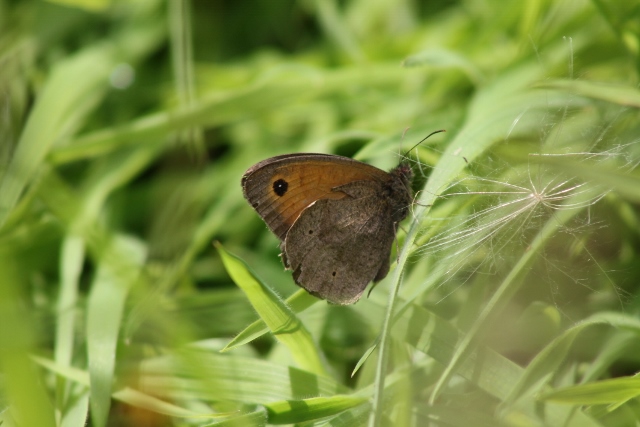
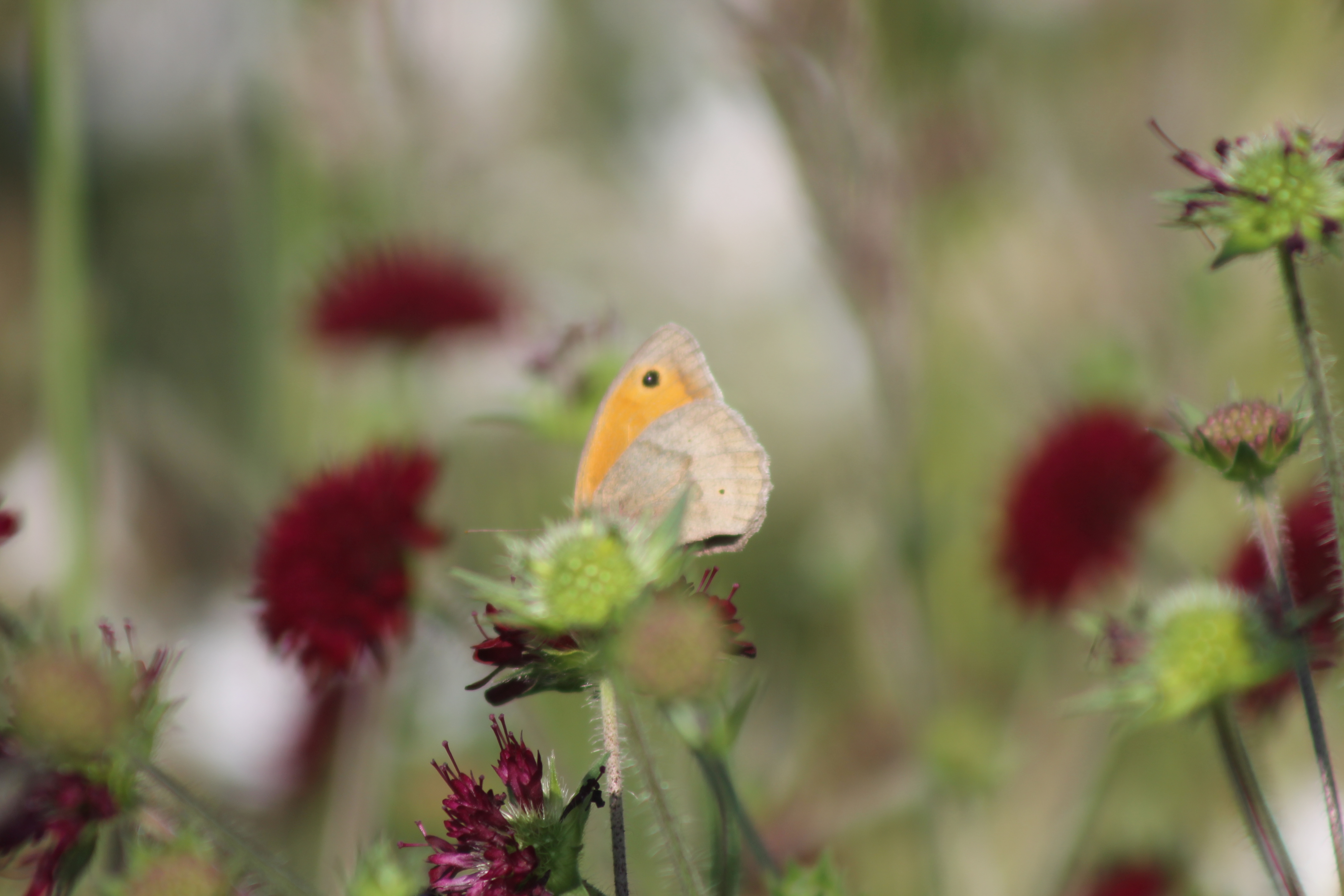
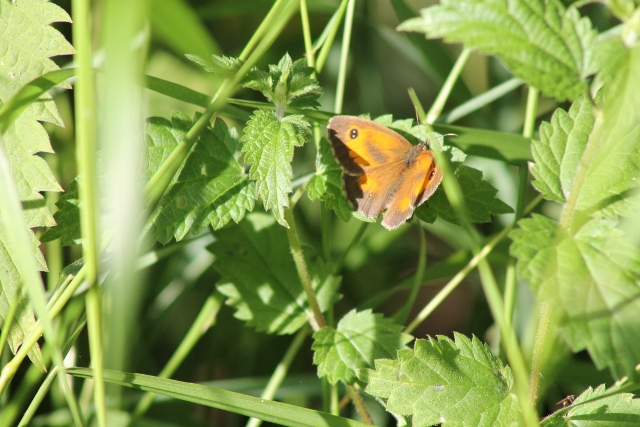
Female Meadow Brown butterflies are brighter than the males which often have no orange on them at all.  There were plenty of Meadow Brown butterflies but I never managed to get a clear photo of one with its wings open.  This photo will have to do.

048Meadow Brown (640x427)

Meadow Brown

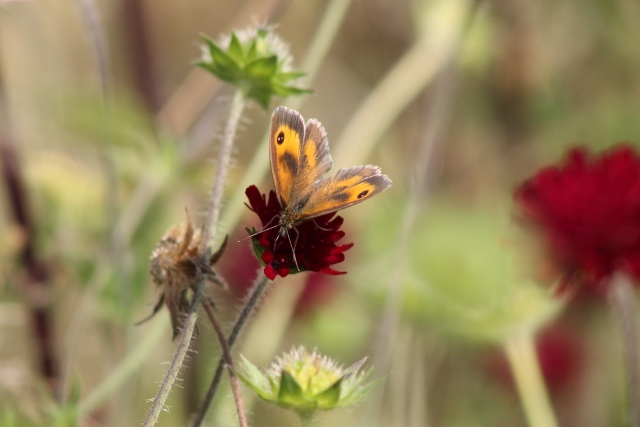
With its wings closed, the Gatekeeper butterfly can be confused with the Meadow Brown.

056Gatekeeper on scabious (640x427)

Male Gatekeeper on Scabious flower

The main difference between the two butterflies is the Gatekeeper has two white spots in the eye on the fore-wing but the Meadow Brown has only one.  The underside of the Gatekeeper’s hind-wing is slightly more patterned.

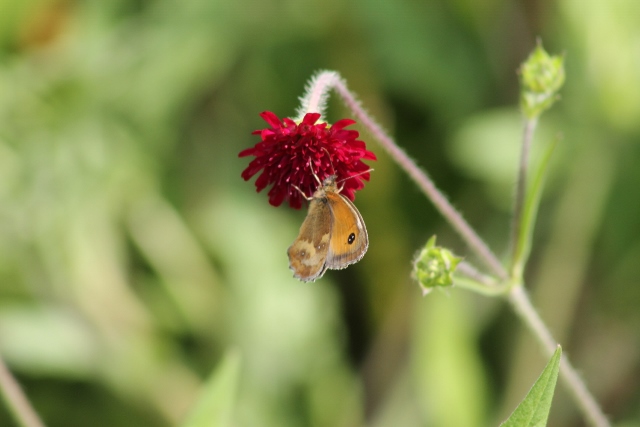
057Gatekeeper on scabious (640x427)

Gatekeeper on Scabious flower

The Gatekeeper is more orange than the Meadow Brown.  The male Gatekeeper has a central patch of dark scent scales that is lacking in the female.  Gatekeepers are very territorial and patrol their home patch, a gateway or stretch of hedgerow, seeing off any rivals.

006Gatekeeper (640x427)

Male Gatekeeper on Common Nettle

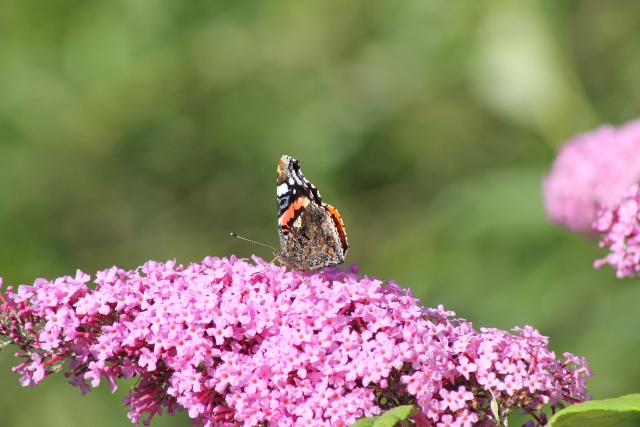
A Red Admiral butterfly is, like the Meadow Brown, difficult to photograph with its wings open.

014Red Admiral (640x427)

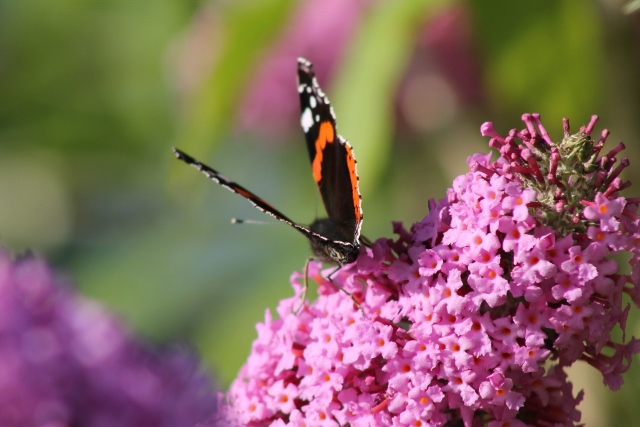
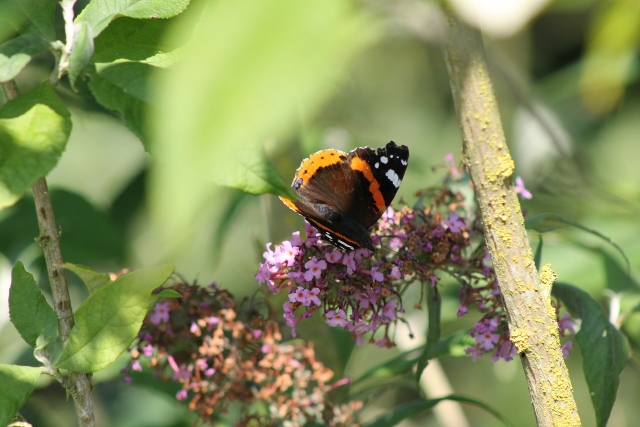
Red Admiral on Buddleia

021Red Admiral (640x427)

Red Admiral on Buddleia

018Red admiral (640x427)

Red Admiral on Buddleia

At this time of year the garden is always full of Small and Large White butterflies.   Fortunately for us, we don’t often grow brassicas and my lovely blue Chicory, which the caterpillars of both white butterflies found tasty, died a while ago.

008MSmall White (640x427)

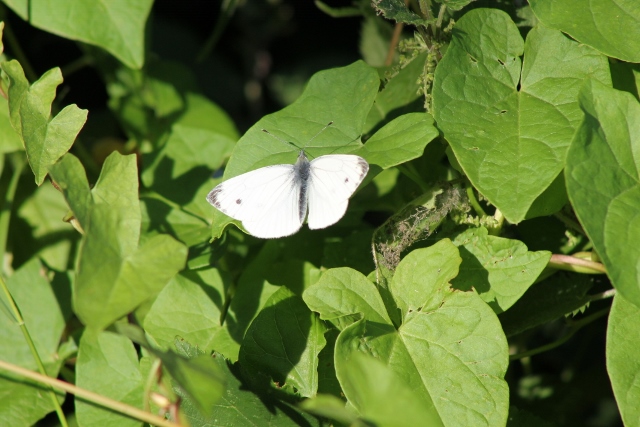
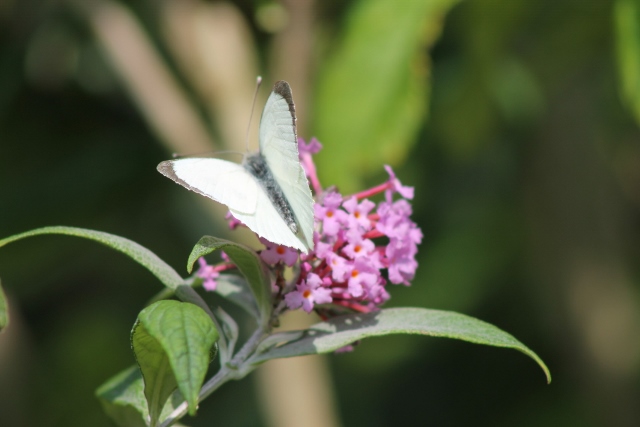
I think this is a Male Small White butterfly

008White butterfly on buddleja (640x427)

I think this is a male Large White butterfly

I often have difficulty telling the difference between the two whites.  The black patch on the Large White extends from the wing-tip to at least halfway along the outer edge of the wing but on the Small White it is less dense and doesn’t extend as far.  The female Large White has two black spots on the upper and underside of the forewing.  The male Large White has two black spots on the underside of the forewing only and none on the upperside.  The female Small White has two black spots on the upperside only of the forewing but the male only has one spot which is often faint or even missing.  This is what confuses me!  I’m glad that they  aren’t confused.

There were still plenty of Skipper butterflies during the second half of the month.

038f Large Skipper (640x427)

Large Skipper on Buddleia

I think this may be a photo of a female as I don’t think I can see any scent glands.

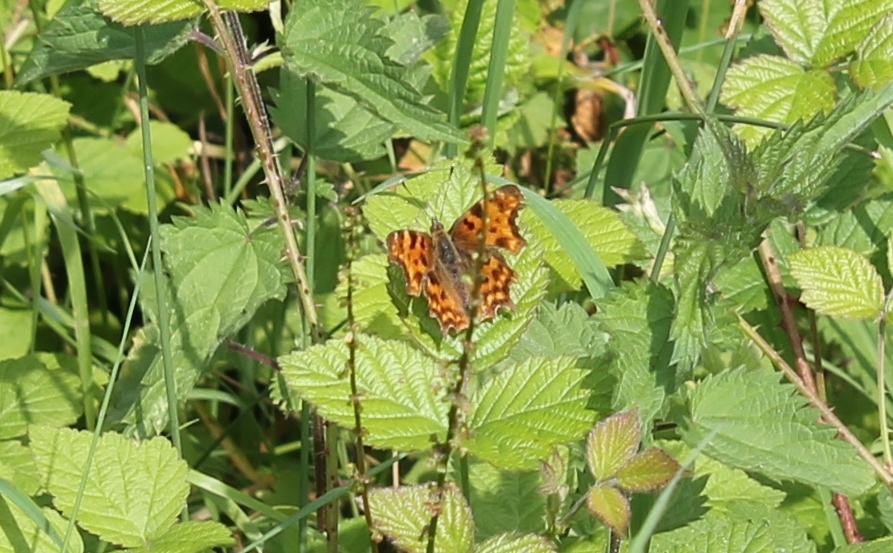
037Comma (640x427)

A Comma butterfly

These are so named because of a white comma-shaped mark on the underside of its wing.

Dragonflies continued to fly around the garden.

032Broad-bodied chaser (640x427)

Broad-bodied Chaser

036Possibly immature m. Black-tailed skimmer (640x427)

This may be an immature male Black-tailed Skimmer

003Damselfly (640x434)

A female Common Blue Damselfly

Not a very good photo, but I haven’t been able to get any other pictures of females.

007Four spotted chaser (640x440)

A Four-spotted Chaser

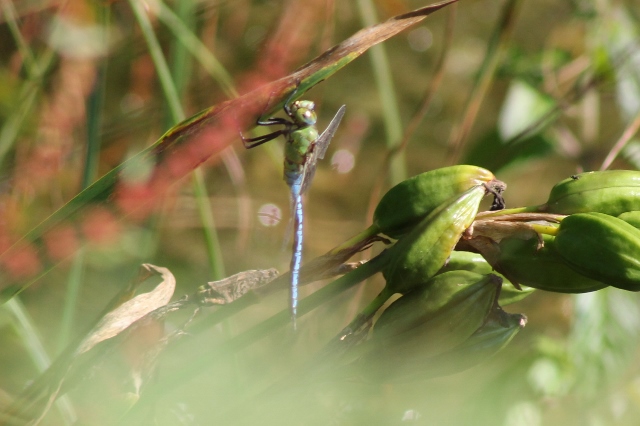
011Male emperor dragonfly (640x426)

A male Emperor Dragonfly

As you can see from the poor photo, I had great difficulty in getting a picture of this dragonfly.  The male is very large and powerful and this was the only time I saw it at rest.  I had to lean far out over the edge of the pond and I was frightened I would over-balance and fall in the water.  It hardly ever left the pond unlike other dragonflies that search for prey along the hedge and up into the trees.

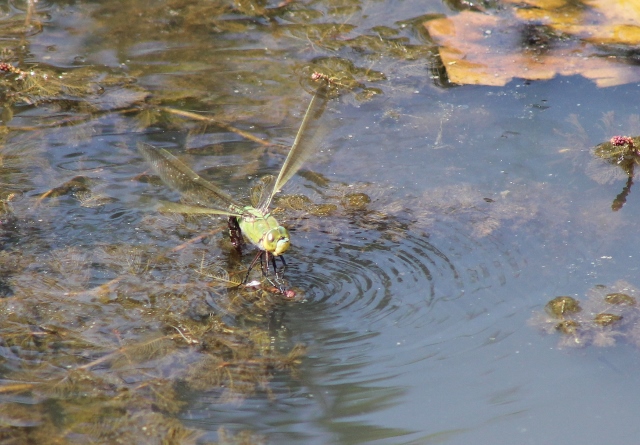
014Female emperor dragonfly (640x445)

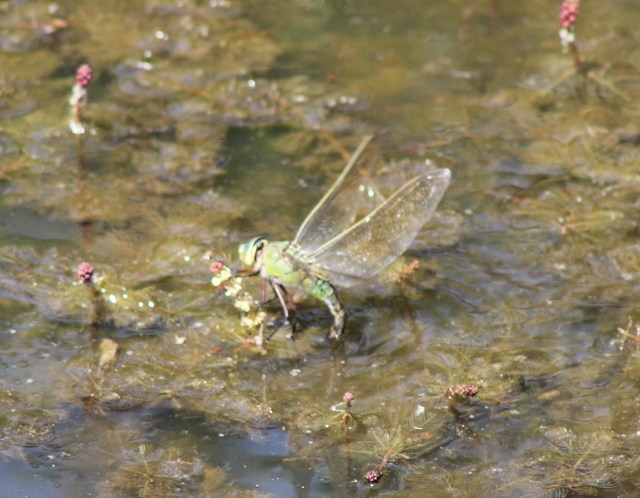
Female Emperor Dragonfly laying eggs

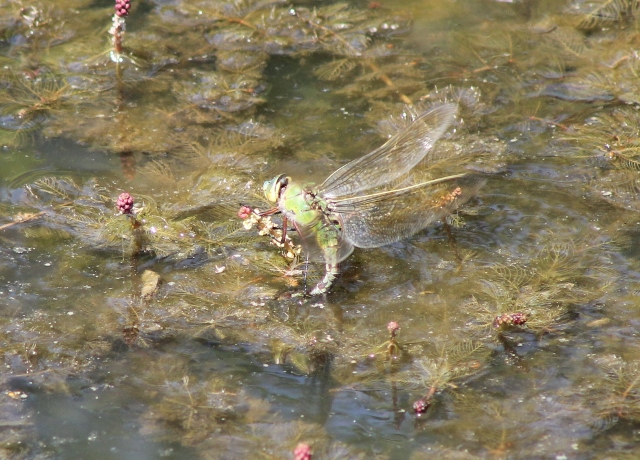
015Female emperor dragonfly (640x460)

Female Emperor Dragonfly laying eggs

016Female emperor dragonfly (640x498)

Female Emperor Dragonfly laying eggs

The female is larger than the male and is mainly green and brown.  The male has a glorious bright blue abdomen.

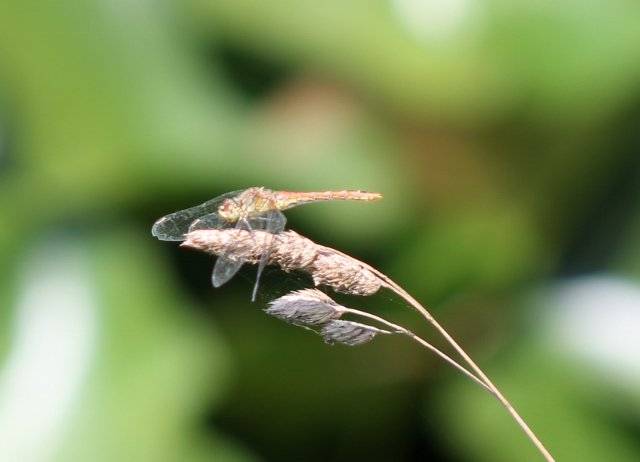
017Common darter (640x462)

A male Common Darter

These dragonflies are a paler red than the Ruddy Darter and the abdomen isn’t as constricted near the front.  The females are a yellowish brown.  In both sexes the legs are brown or black with a yellow stripe down the outside.

I have not been able to take many photos of moths this year.

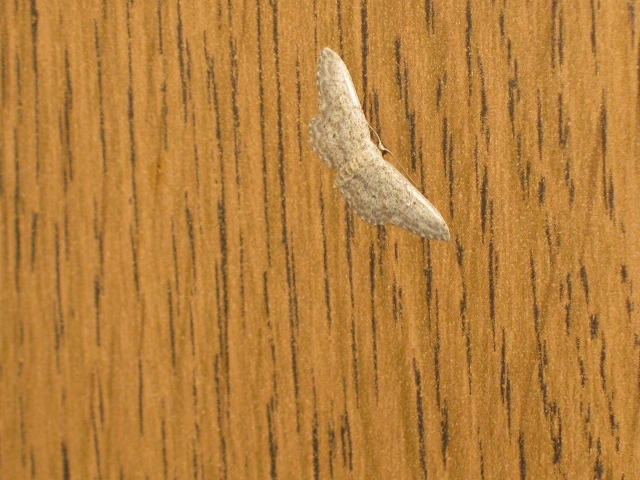
003Micro moth (640x480)

Unidentified micro moth

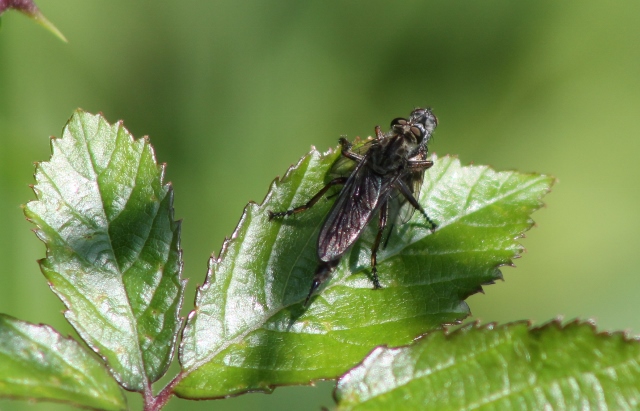
006Robber Fly with victim (640x411)

A Robber Fly (not sure which one) with a victim in its grasp

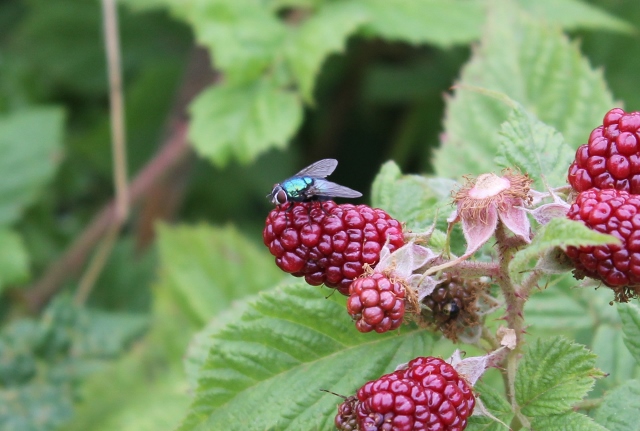
009Greenbottle on unripe blackberry (640x431)

Greenbottle on unripe blackberry

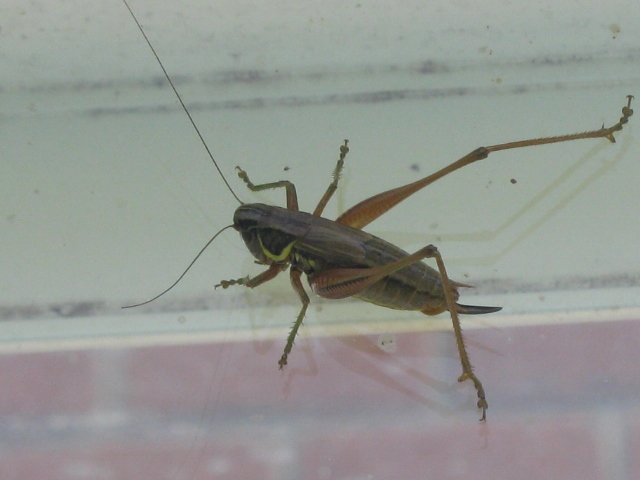
030Cricket (640x480)

A female Roesel’s Bush-Cricket

I saw this climbing up the side of the conservatory.

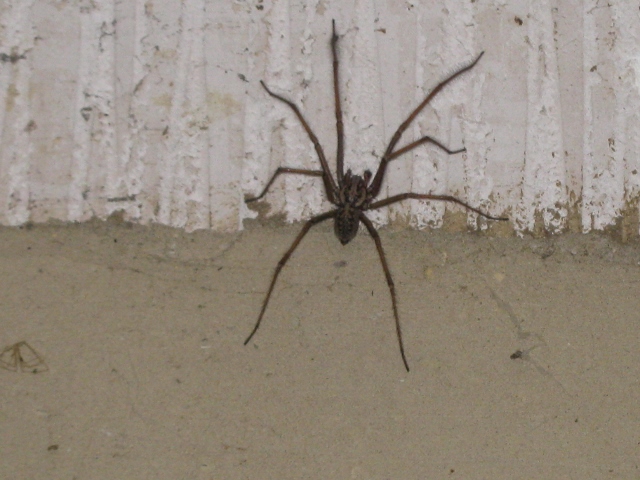
And I saw this inside the garage one evening….

010Spider (640x480)

This House Spider was as big as my hand

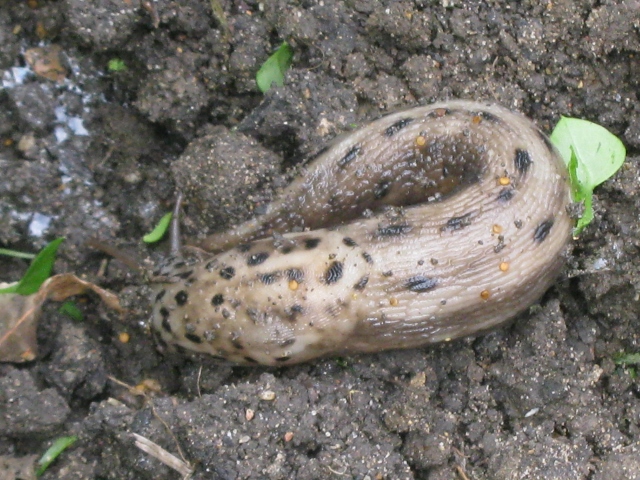
The last creature in this post, like the spider, isn’t an insect and isn’t at all attractive.  In fact it looks quite horrific but, before you rush off for your gun or other means of disposing of nasty things, stop!!  This isn’t a garden foe it is a friend.  Here it is –

002Leopard slug (640x480)

A Leopard Slug

These slugs when fully grown are about 7″ long.  They don’t damage healthy living plants but eat fungi, rotting plants and other slugs, especially those ones that do so much damage.   They have to stay damp to breathe so live in dark, damp places especially piles of rotting logs.  They can live for several years.  Like other slugs and snails they are hermaphrodites but need to mate with another individual.  To mate they climb a tree or other structure and then hang entwined from a branch on a thick strand of mucus.  Both slugs then lay eggs in damp places.  A dark horse among slugs, then.  Who would have thought it!


Share this:

  • Share on X (Opens in new window) X
  • Share on Reddit (Opens in new window) Reddit
  • Share on Pinterest (Opens in new window) Pinterest
  • Share on Facebook (Opens in new window) Facebook
  • Email a link to a friend (Opens in new window) Email
  • Share on Tumblr (Opens in new window) Tumblr
  • Print (Opens in new window) Print
  • Share on Pocket (Opens in new window) Pocket
  • Share on LinkedIn (Opens in new window) LinkedIn
Like Loading...

A Suffolk Garden in July – Insects Part 1

08 Fri Aug 2014

Posted by Clare Pooley in Insects, plants, Rural Diary

≈ 14 Comments

Tags

azure damselfly, blackfly aphid, blue-tailed damselfly, brown hawker, burnet moth, buttercup, comma butterfly, Essex skipper, feverfew, greenbottle, helicopter, ichneumon wasp, insects, July, meadow brown butterfly, migrant hawker, oedemea nobilis, peacock butterfly, Red Lily Beetle grub, rhagonycha fulva, Ringlet butterfly, robber fly' bindweed, ruddy darter, sawfly, small skipper, Small Tortoiseshell, small wolf spider, speckled wood butterfly, spotted crane fly, Suffolk, white butterfly

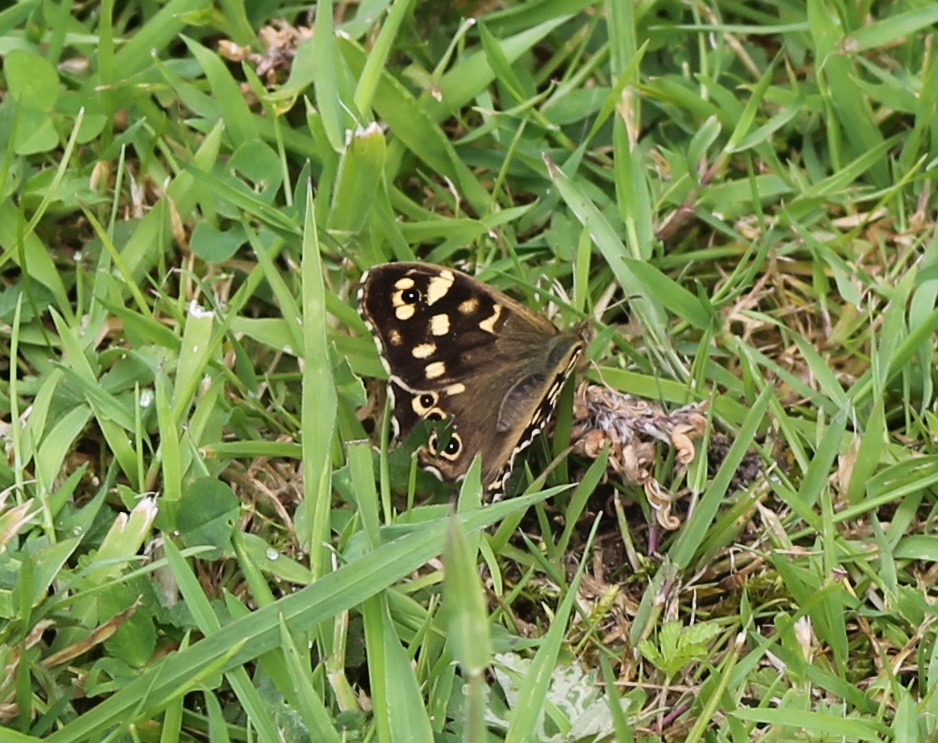
006Speckled Wood butterfly

A Speckled Wood butterfly

I realise that we are now a week into August but better late than never.  There were so many different insects about last month that I will have to make more than one post to cover them.  I have also included some photos of insects that I saw during June most of which were still about in July.  I will list the insects in the order in which I saw them or was able to photograph them.  I am not including the dragonfly, damselfly and butterfly photos that I have already posted but I may include different photos of the same type of insect.

The Speckled Wood shown above had a little bit of its wing missing but was quite a bright, new-looking insect.  The next photo is of something none of us want in our gardens.

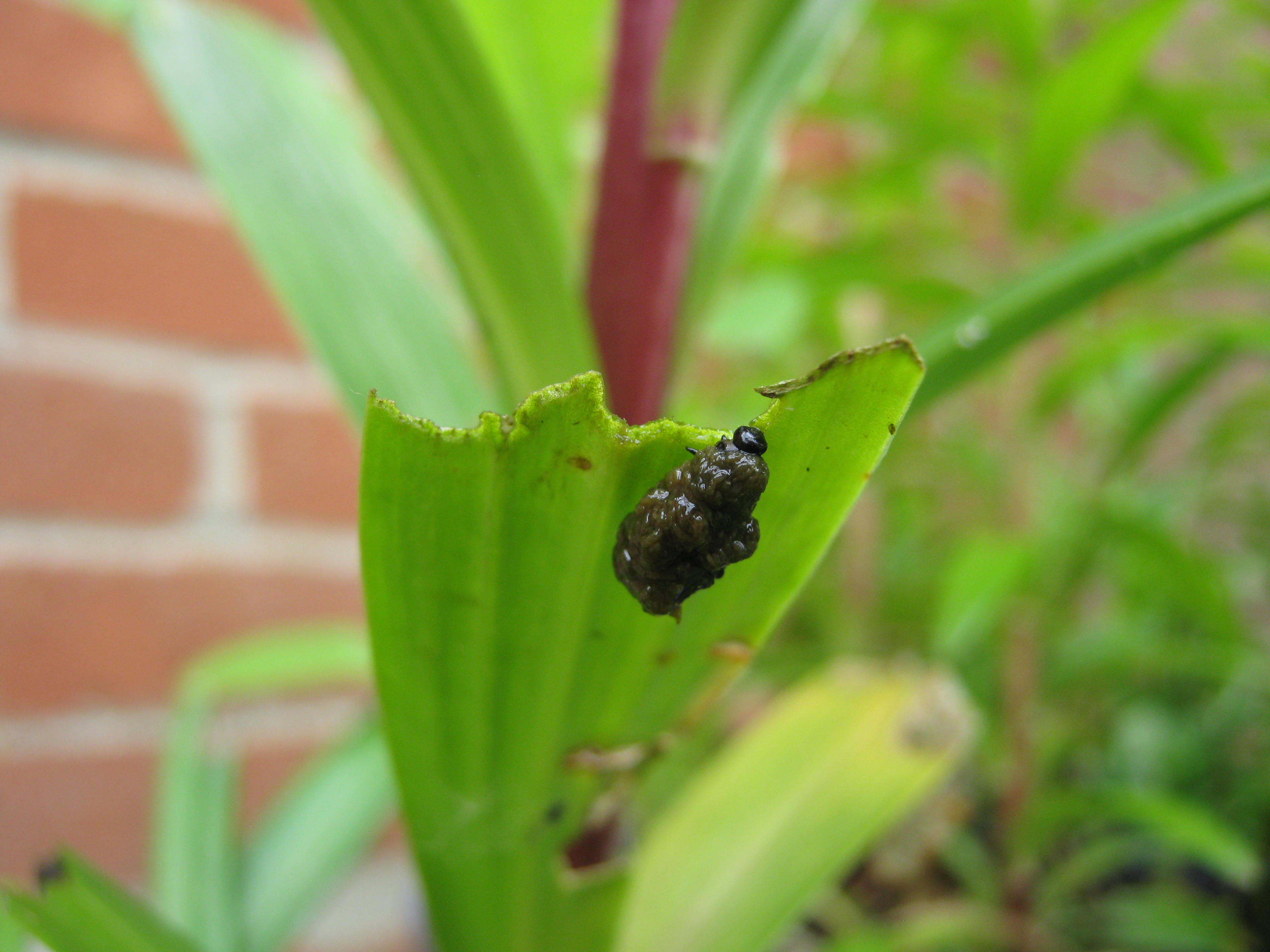
014Red Lily beetle grub

A Red Lily Beetle grub – yeuch!

These nasties chomp their way through lilies and fritillaries and do it very quickly too.  They cover themselves in their own excrement.

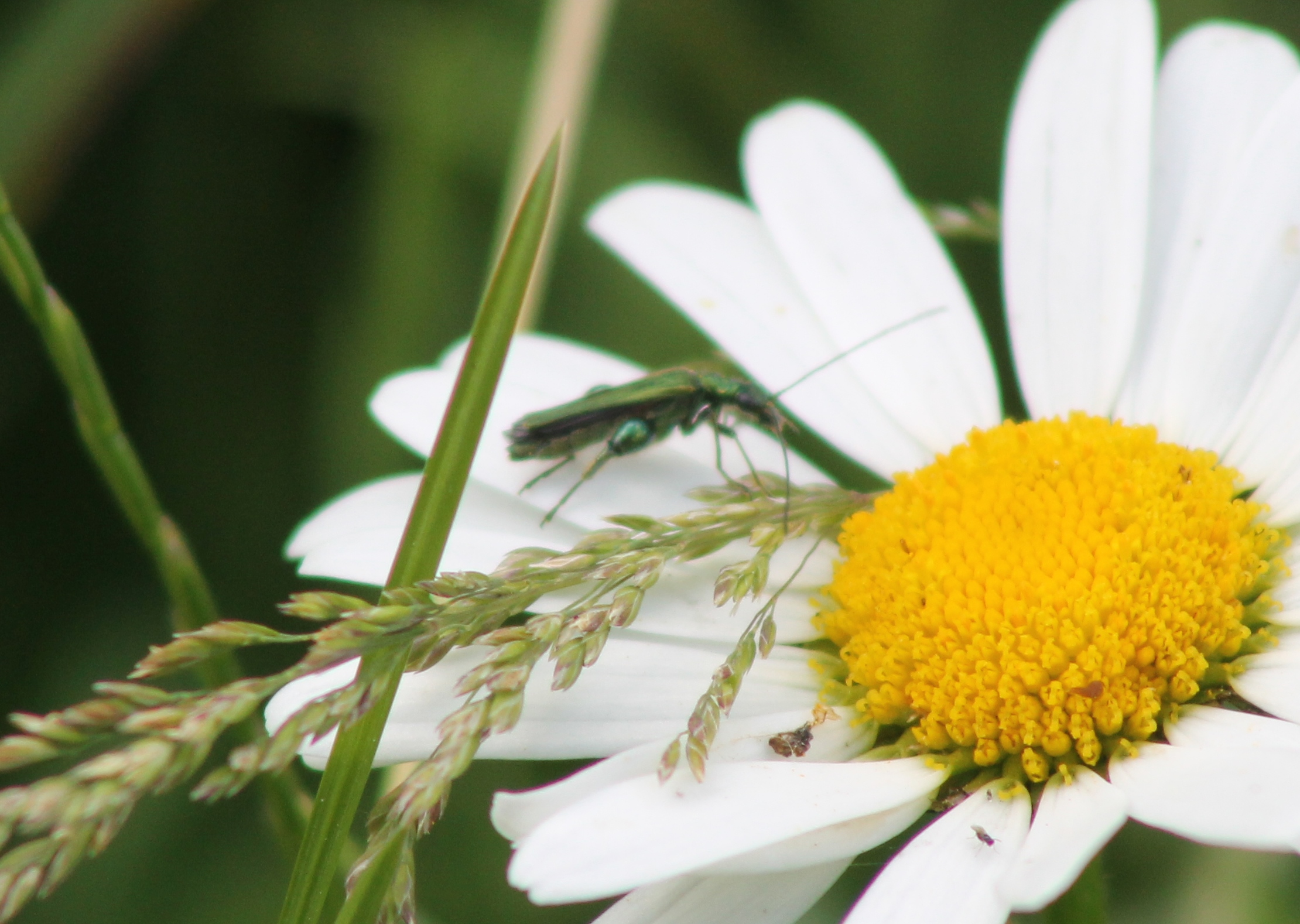
021Male oedemea nobilis

A male Oedemera nobilis – only the males have the swollen hind-legs. They feed on pollen and this one is eyeing up his next meal

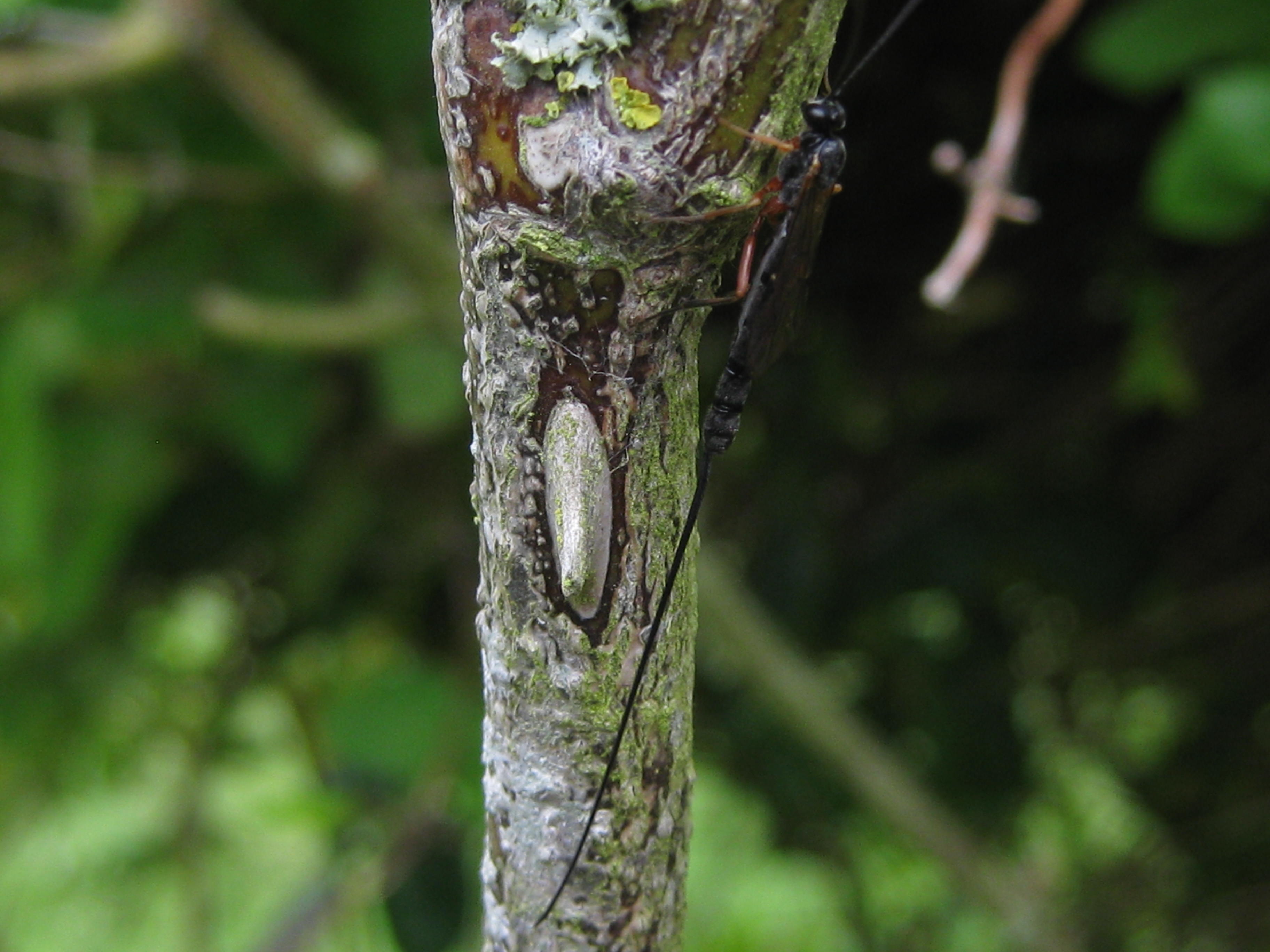
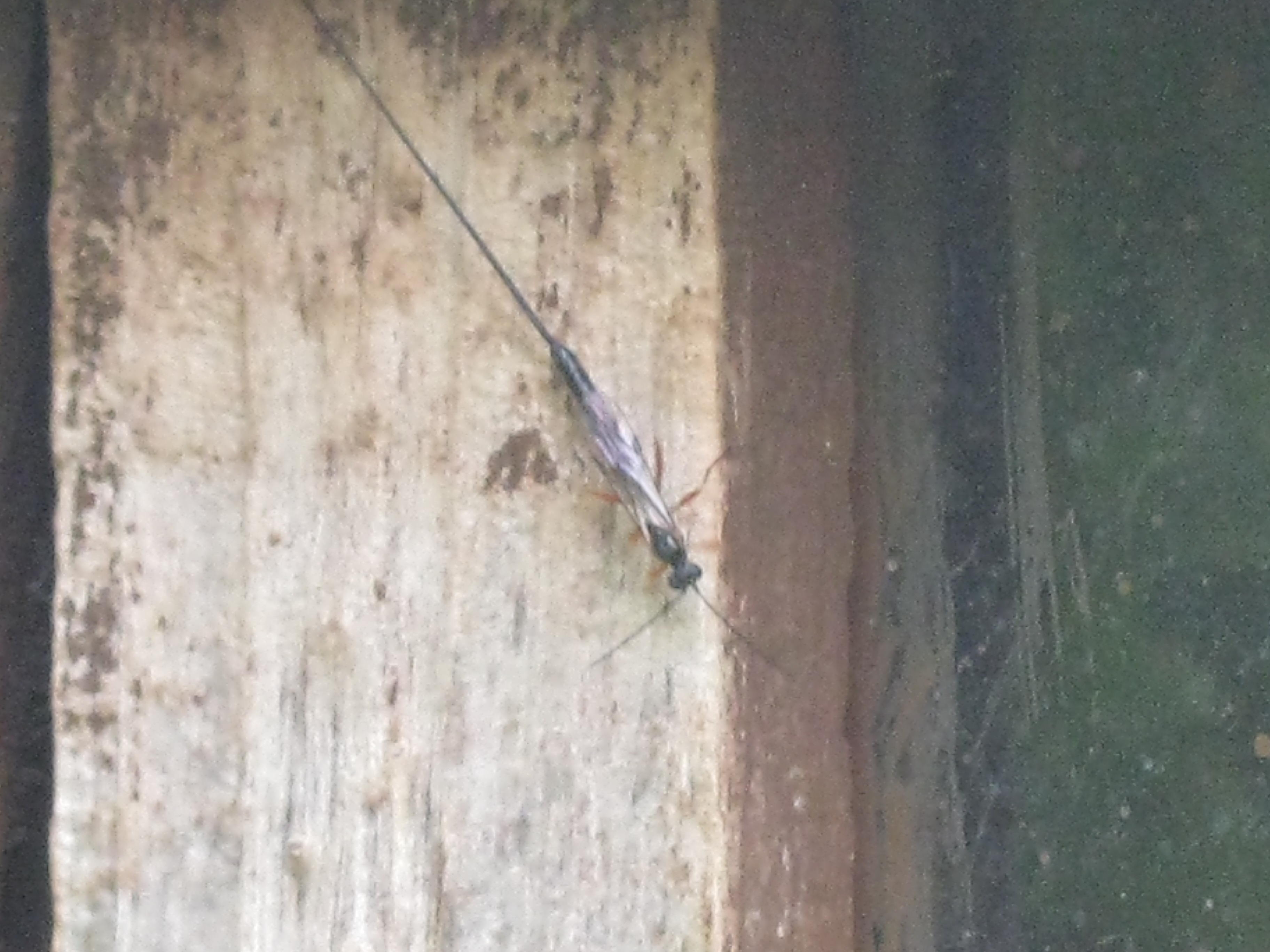
The next two photos are of the same unidentified insect and the photos aren’t that clear either.   Ichneumon wasp or sawfly?002Ichneumon wasp probably

003Ichneumon wasp probably

Note the extremely long ovipositor!

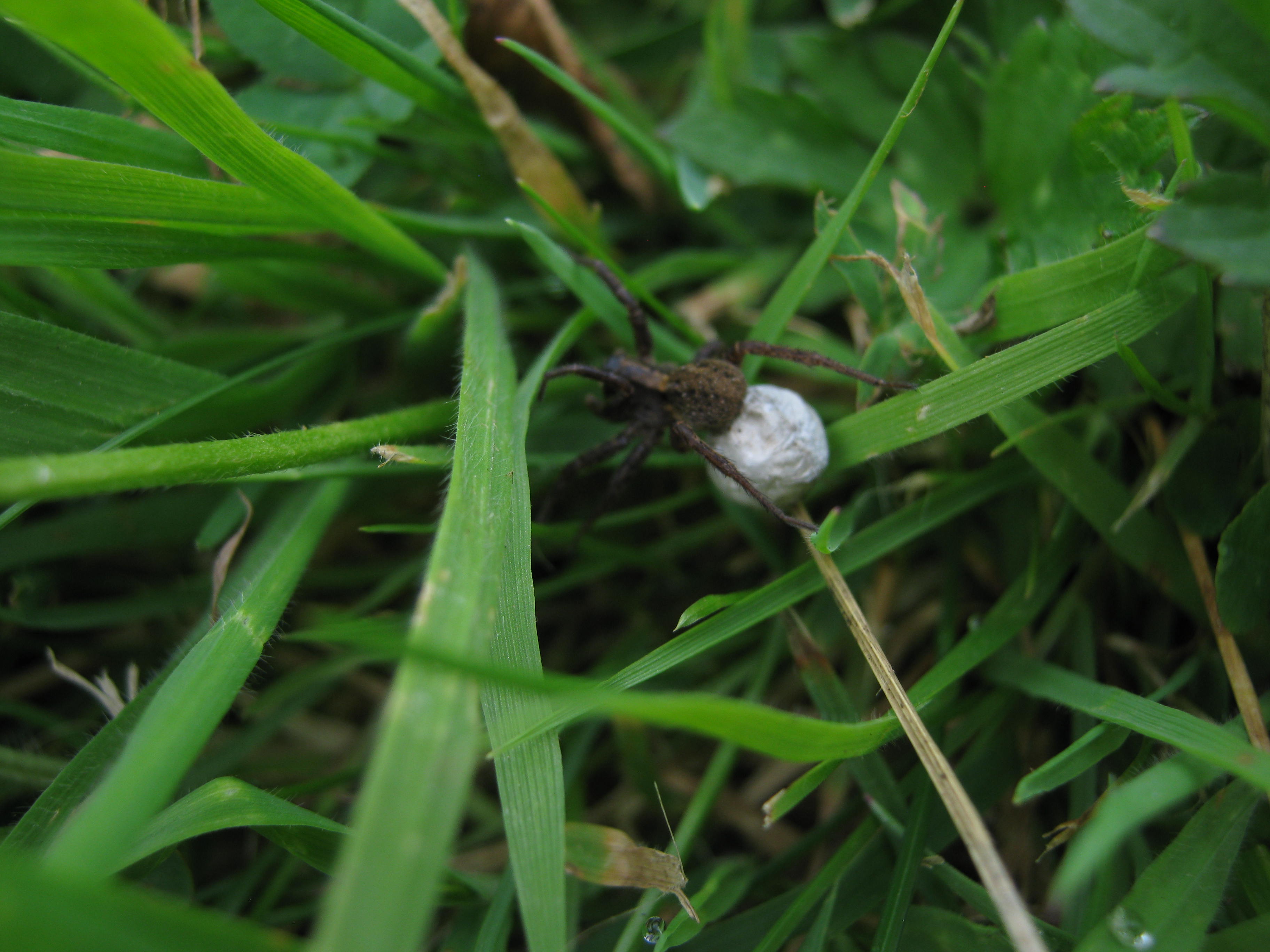
005Small wolf spider

A Small Wolf Spider carrying its eggs in a silk ball

I realise that spiders aren’t insects but I’m still including this one here nevertheless.  Because these spiders do not make webs and live a nomadic life, the female has to carry her eggs around with her.  Some wolf spiders even carry their spiderlings about with them too.  When the spiderlings are due to hatch, the female spins a large ‘nursery web’ in the vegetation and puts the egg sac there.  Wolf spiders run down their prey like their namesakes.

006Greenbottle

Greenbottle

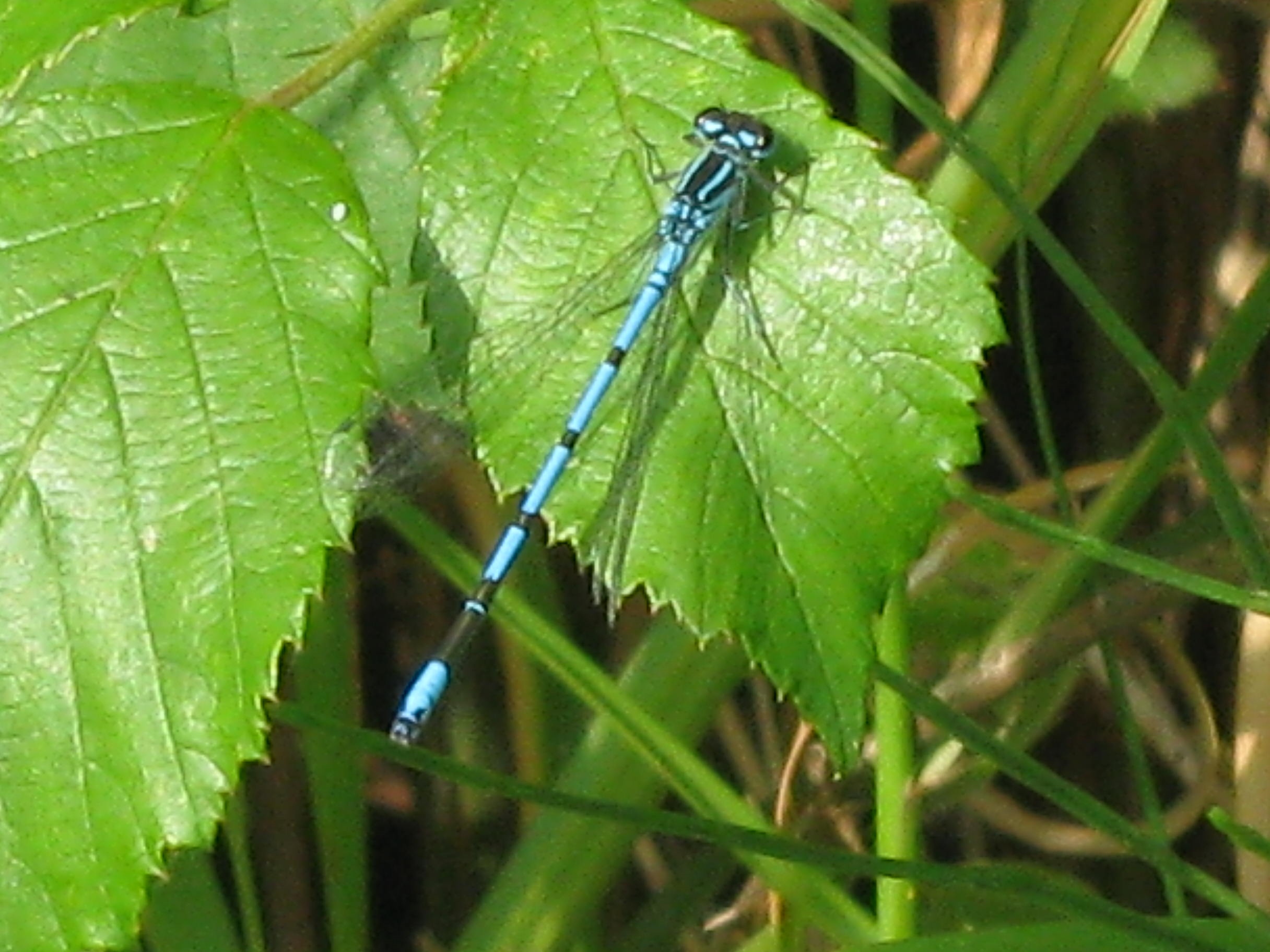
027Azure damselfly

Azure Damselfly

028Azure damselfly

Azure Damselfly

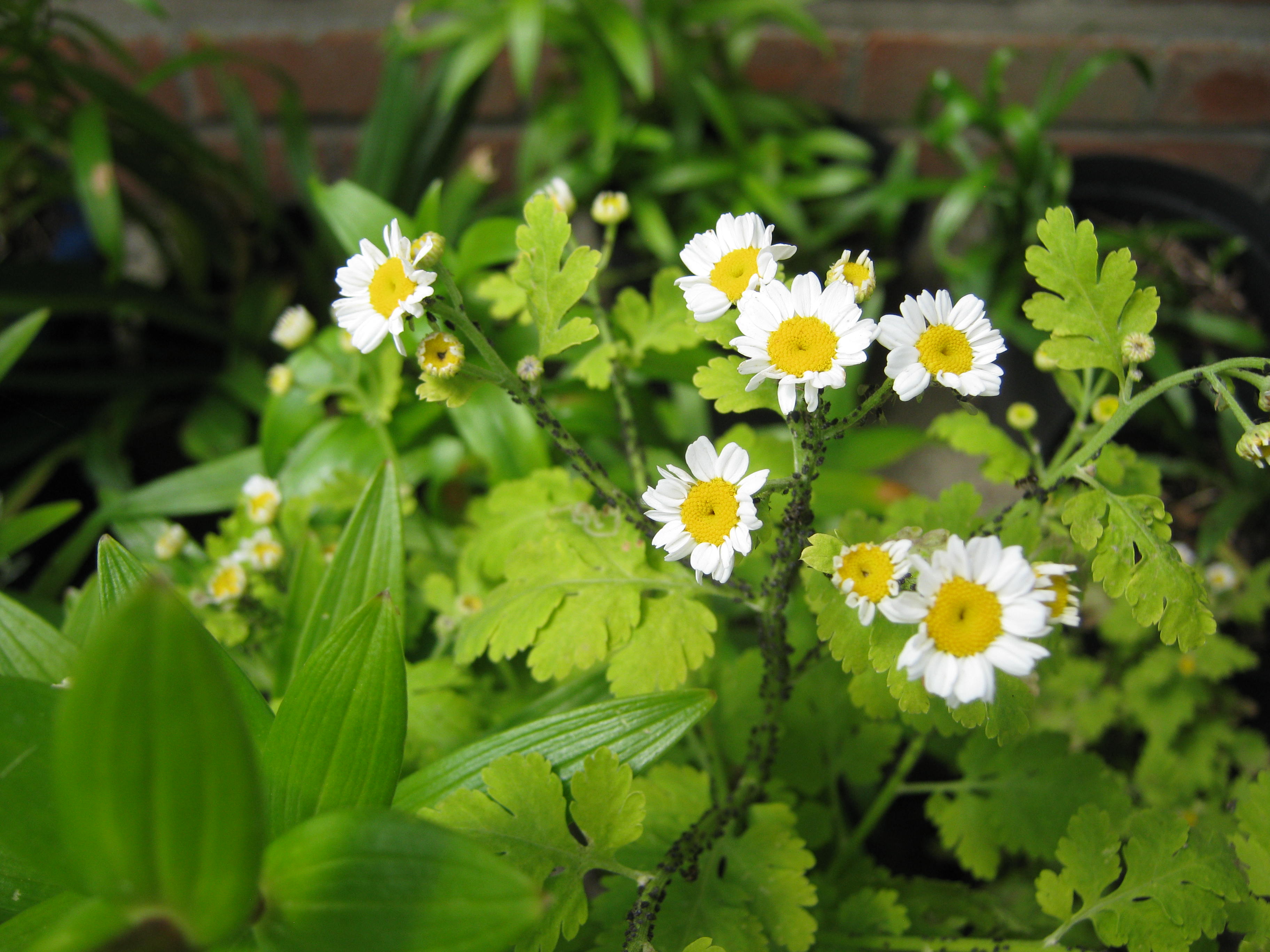
Here are some more little insects that gardeners could do without.  This photo also shows how good feverfew is at attracting them.

022Feverfew with blackfly

Blackfly aphids on Feverfew

048Spotted cranefly

Spotted Cranefly

058Buttercup with beetle

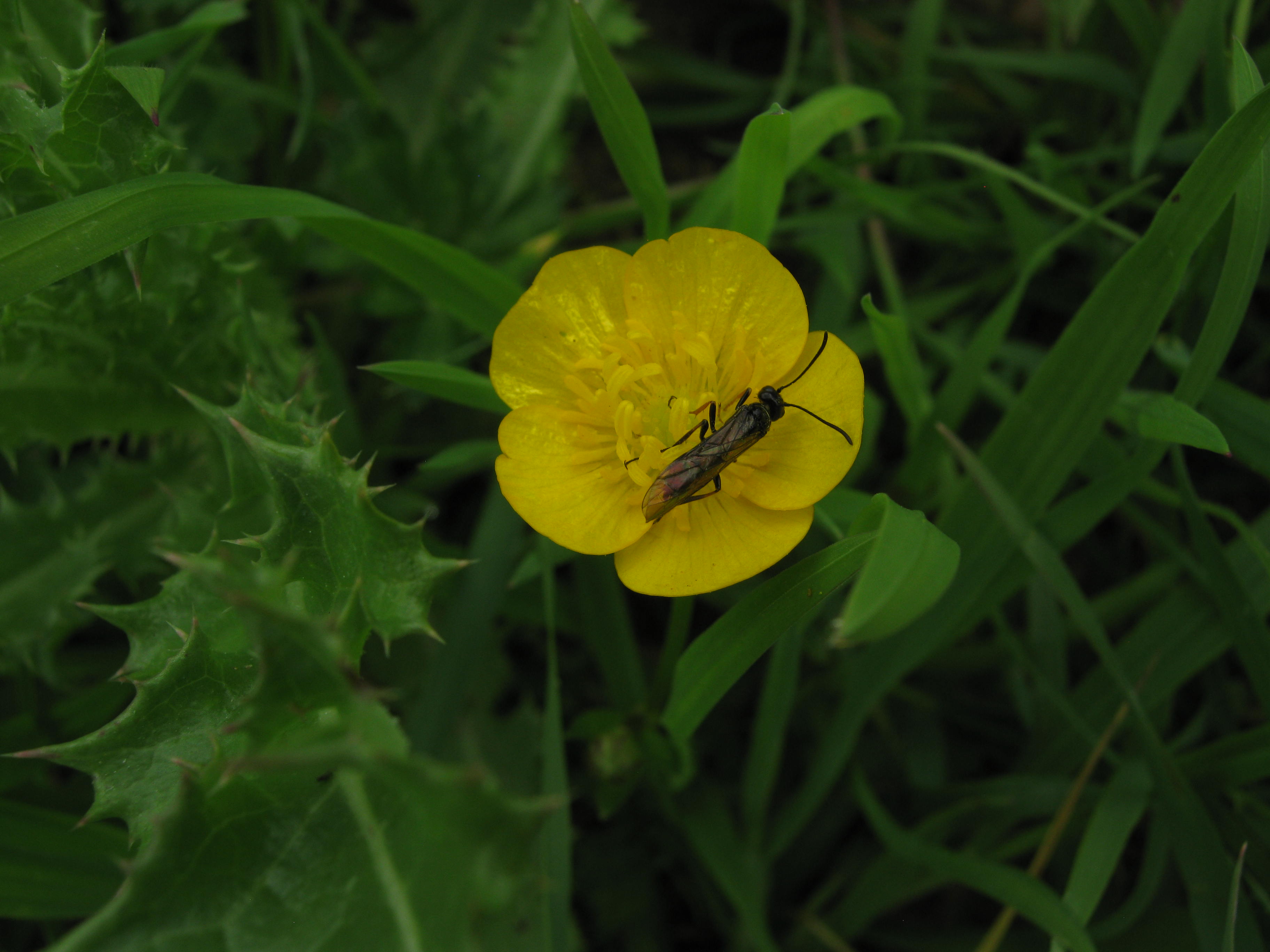
Unidentified insect (sawfly?) on a buttercup

067Small tortoiseshell sipping nectar

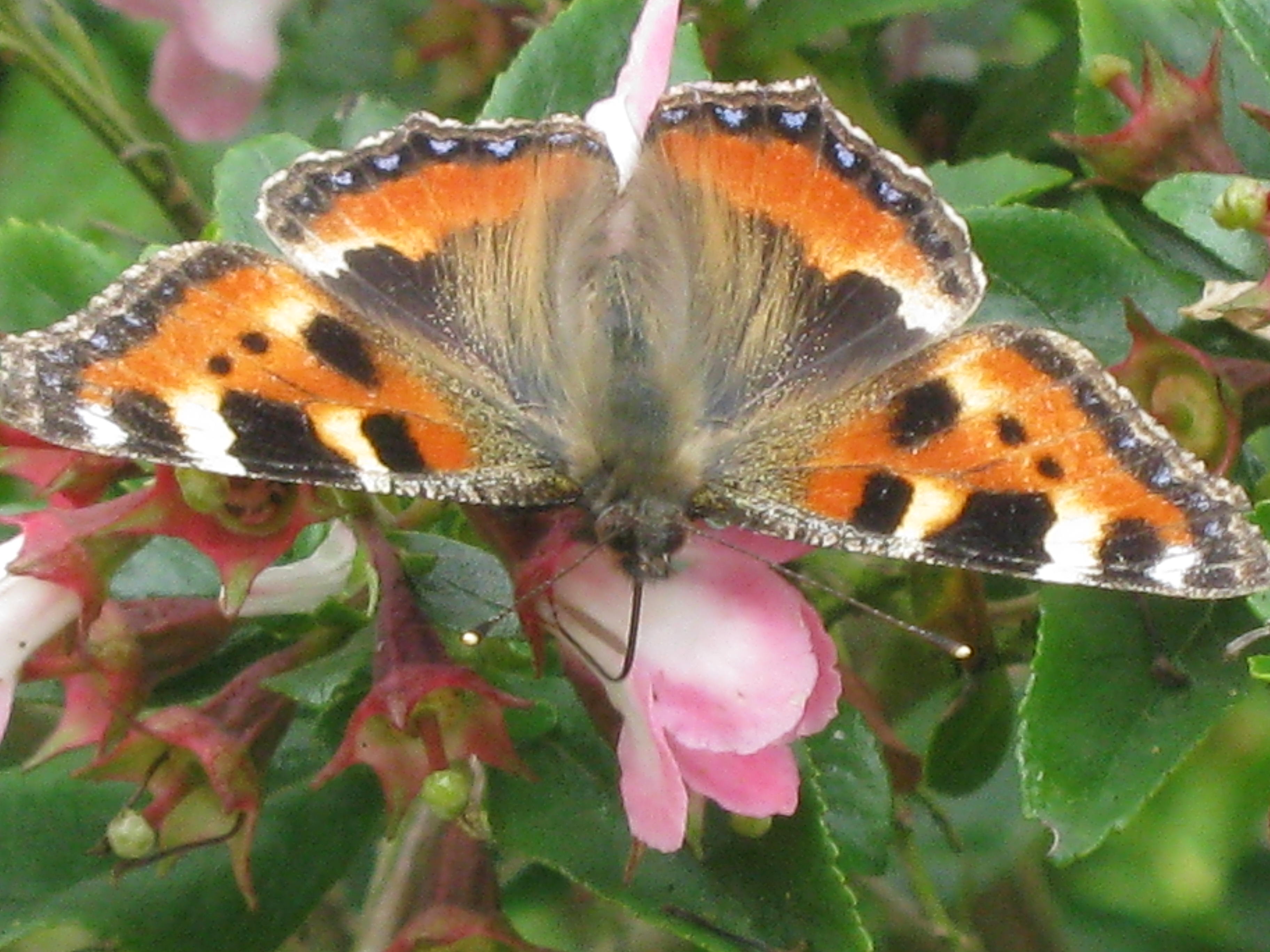
Tortoiseshell butterfly sipping nectar

015Meadow brown butterfly

A Meadow Brown butterfly on a very windy day

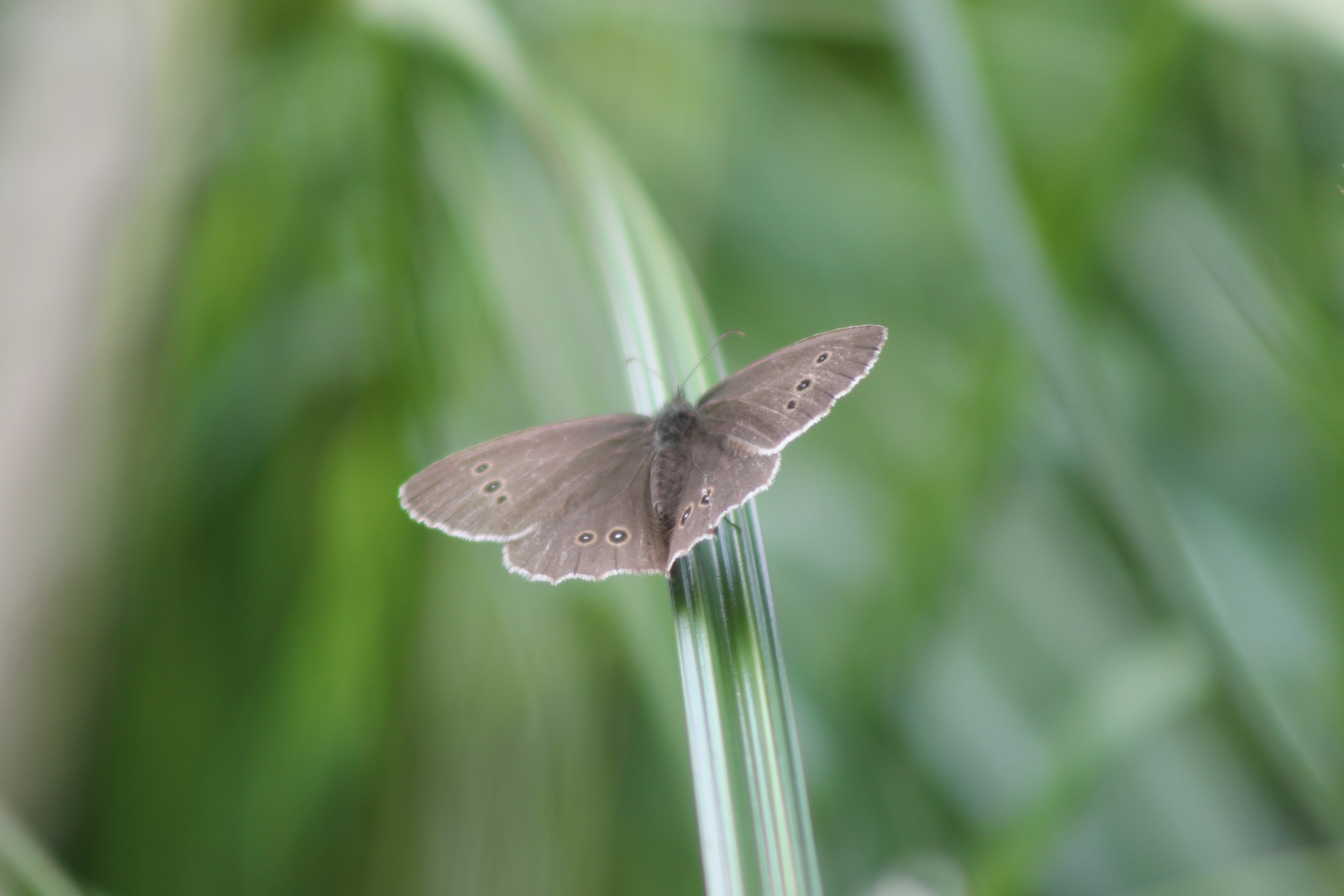
005Ringlet

A Ringlet butterfly on another windy day

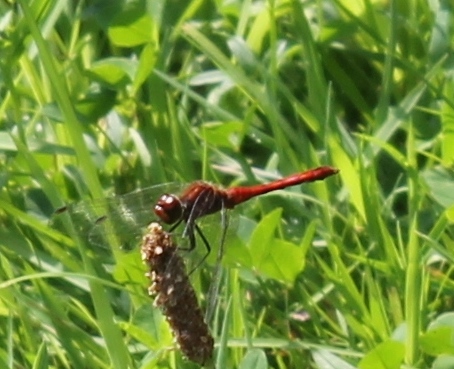
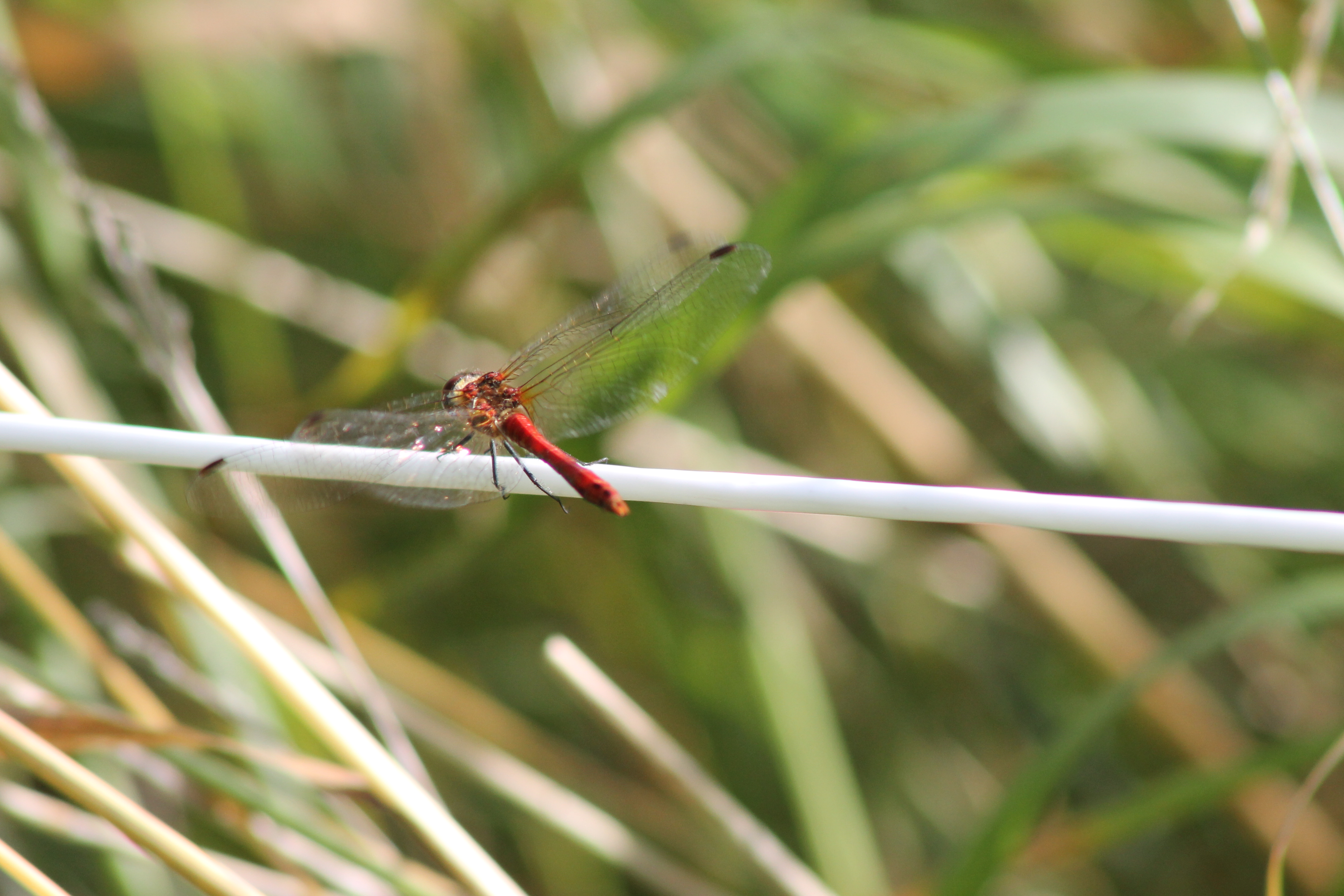
009Ruddy darter

A Ruddy Darter dragonfly

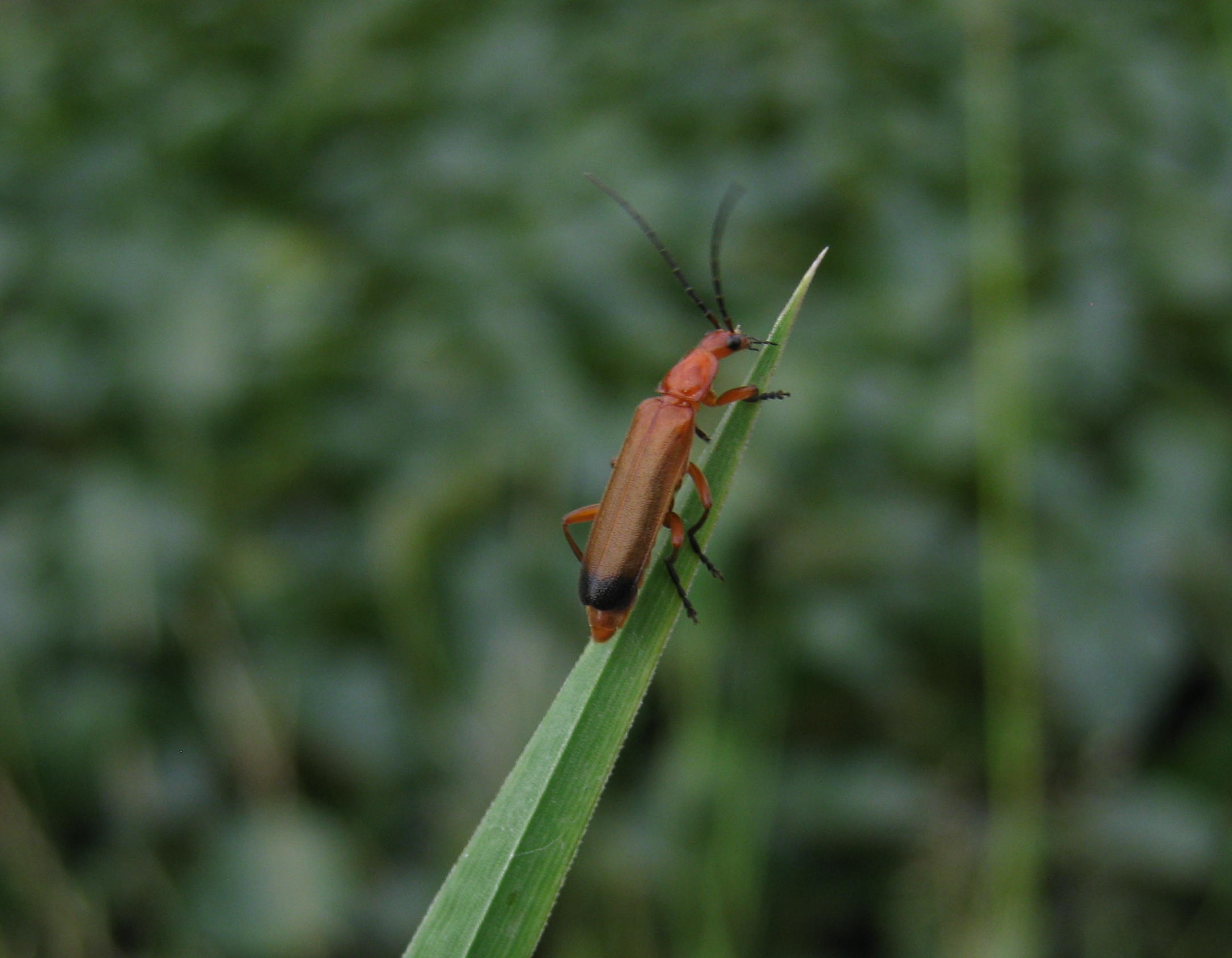
001Rhagonycha fulva

Rhagonycha fulva I thought at first that this was a Cardinal Beetle but they have different antennae and are much redder.

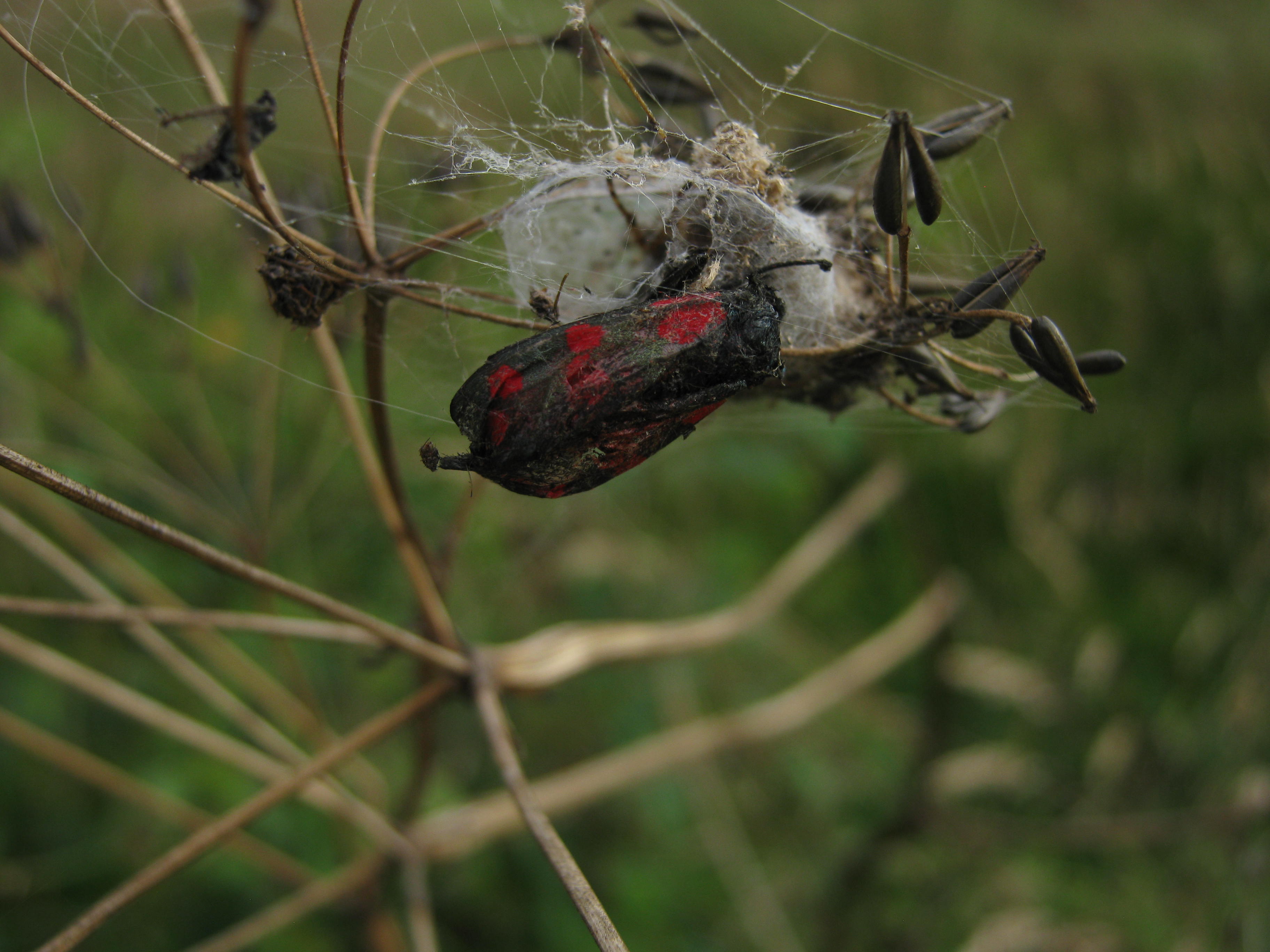
002Burnet moth caught in web

A Burnet Moth caught in a spider’s web

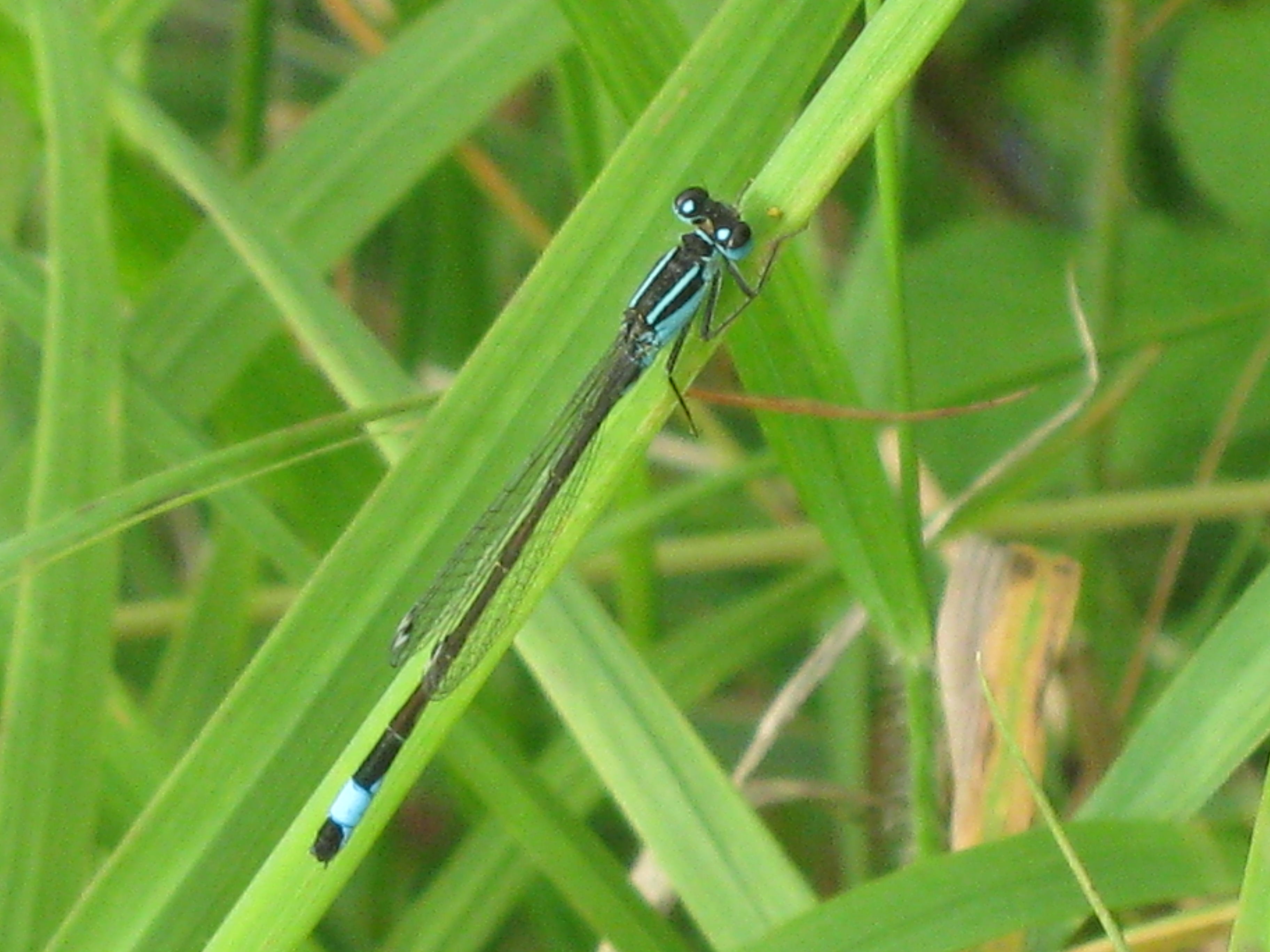
006Blue-tailed damselfly

A Blue-tailed Damselfly

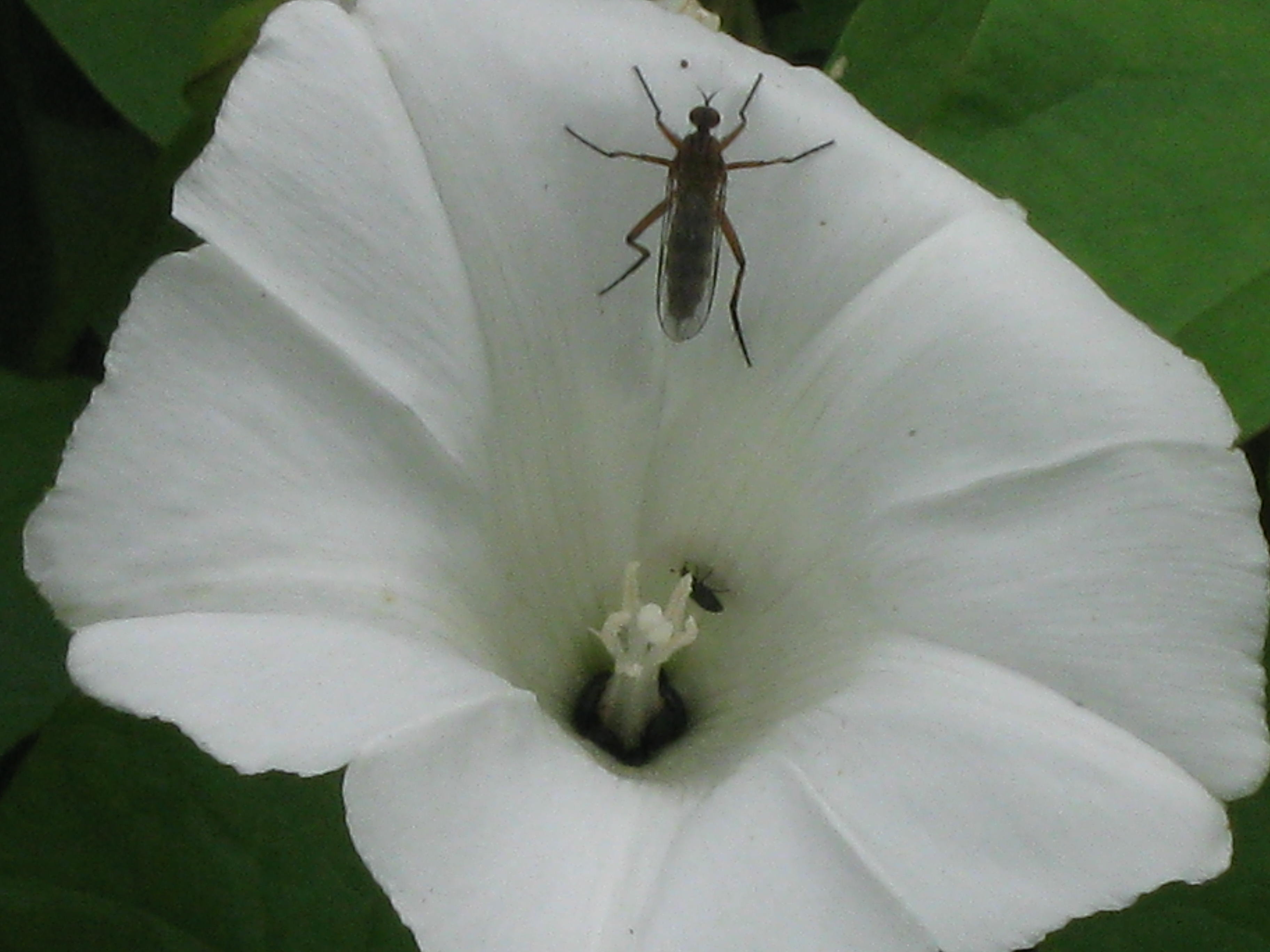
009Bindweed flower with unidentified fly and pollen beetle

An unidentified fly (robber fly?) on a bindweed flower

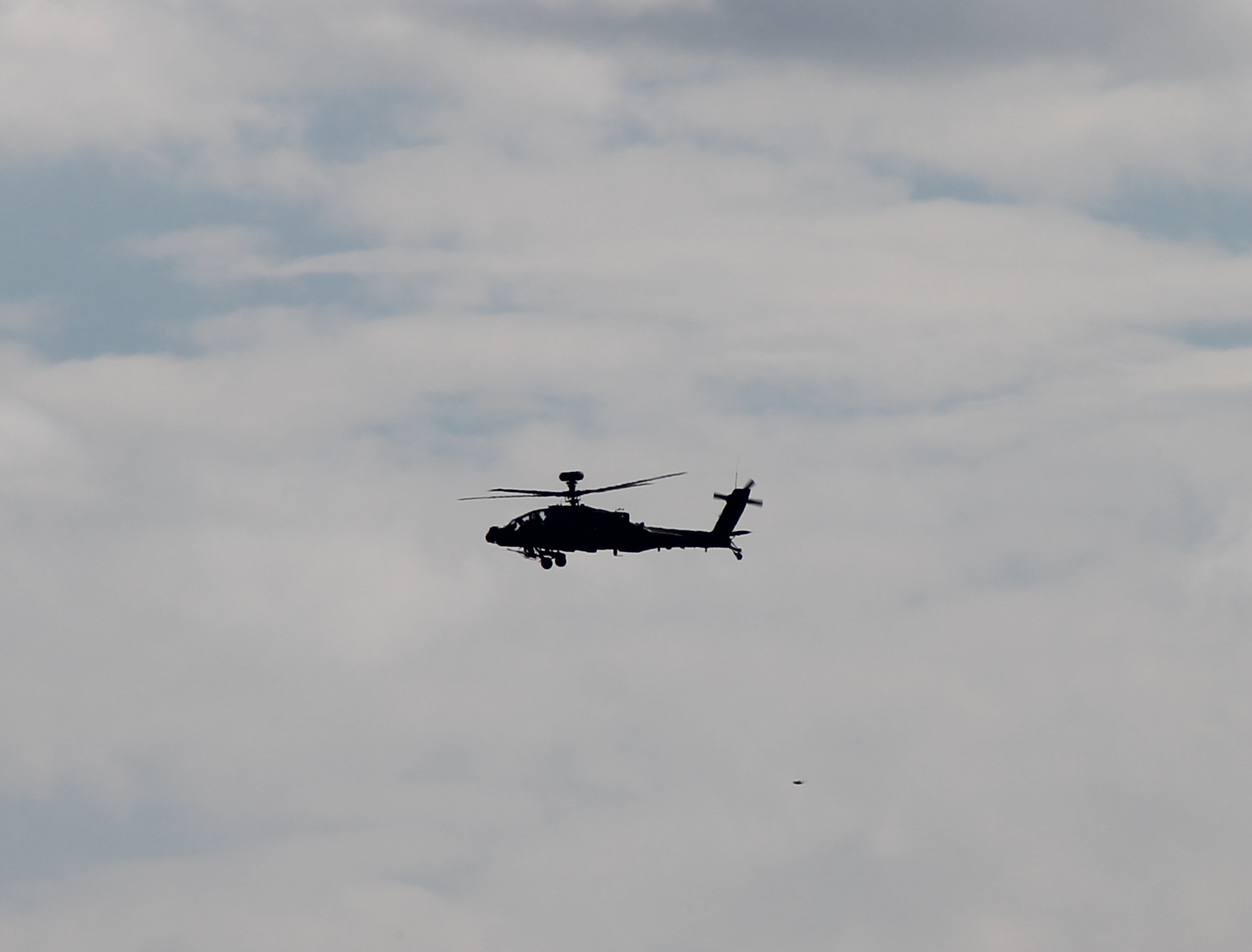
020Helicopter

A military helicopter It looks like an insect!

033Ruddy darter

Another photo of a Ruddy darter

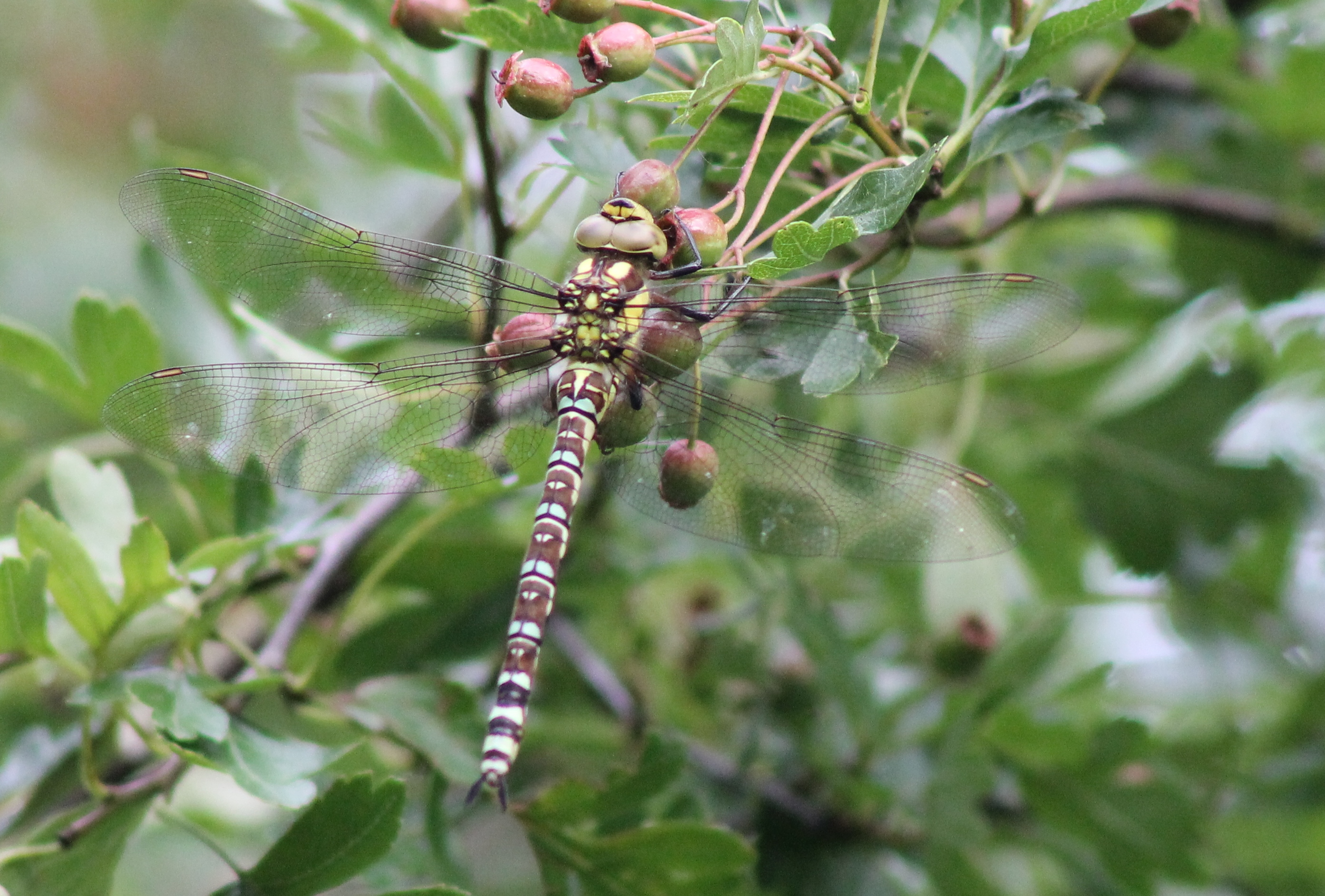
058Migrant hawker

A Migrant Hawker dragonfly


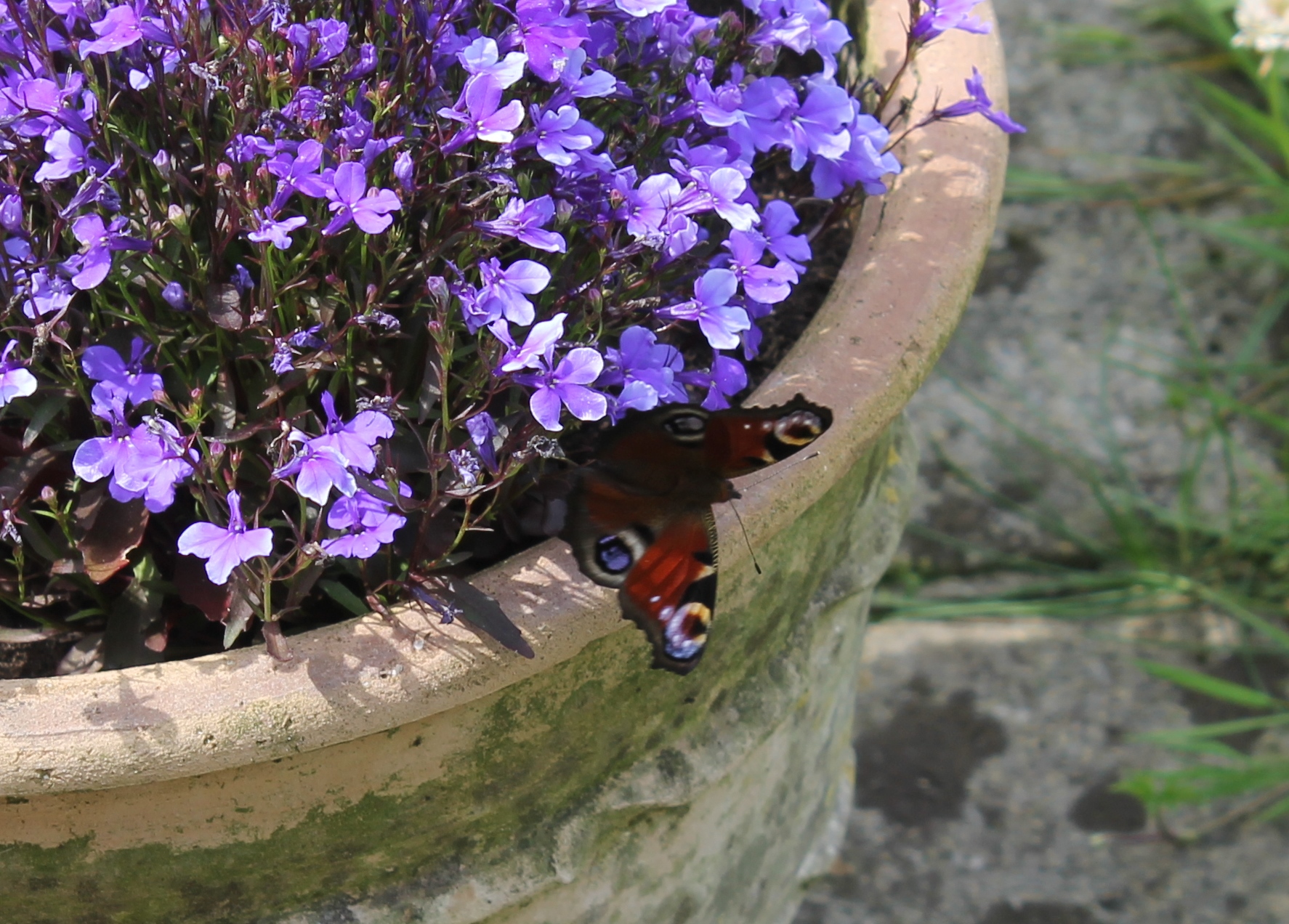
011Peacock butterfly on lobelia

Peacock butterfly on lobelia

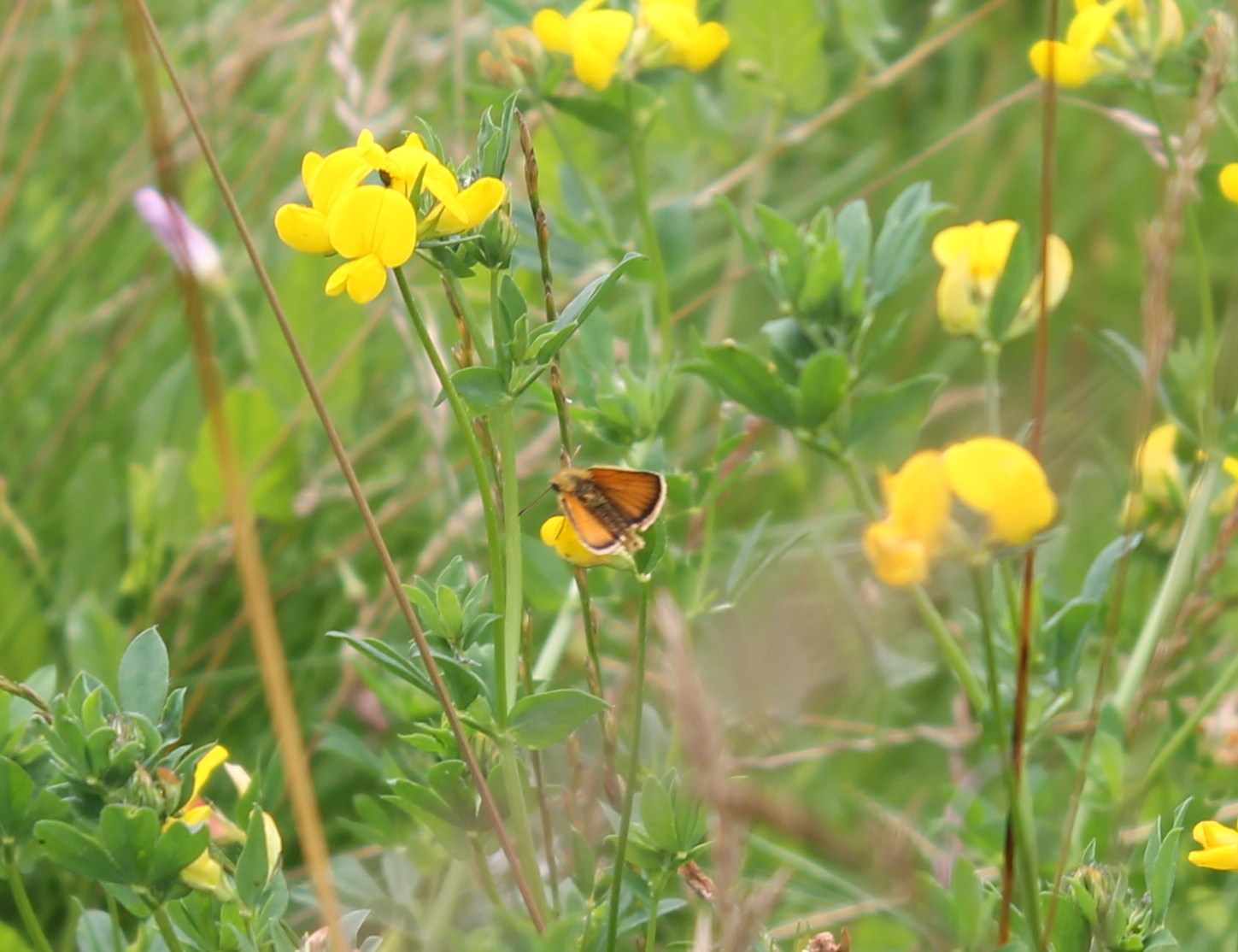
028Small or Essex Skipper on Common Bird's Foot Trefoil

Small or Essex Skipper on Common Bird’s-foot-trefoil

The Small and the Essex Skipper butterflies are very similar.  The difference is that the Essex Skipper is greyer underneath and its antennal tip is black underneath.  I don’t think I will ever be able to tell the difference.

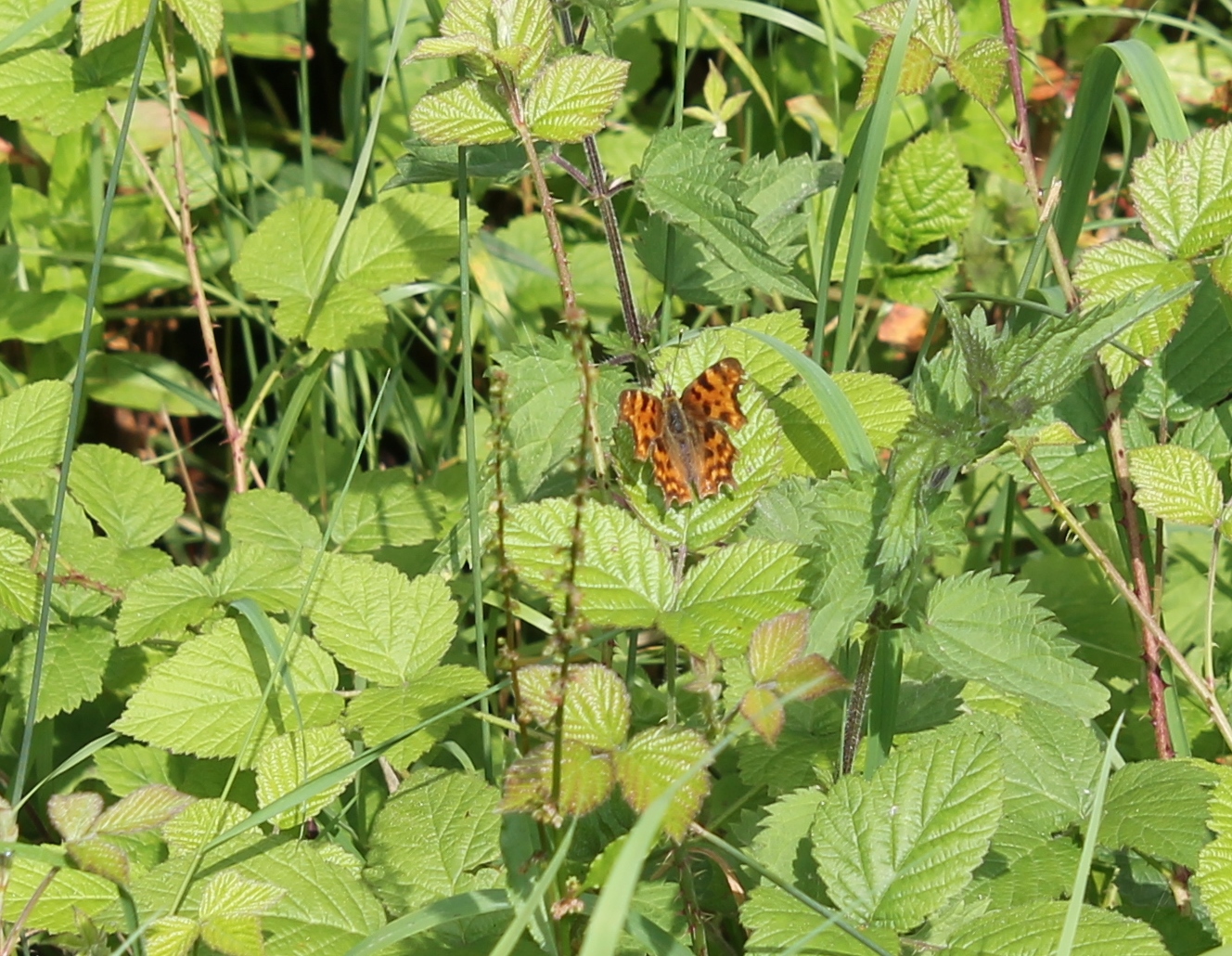
034Comma on bramble

Comma butterfly

033Comma on bramble

Comma butterfly

042Dragonfly

Spot the dragonfly! I think this is a Brown Hawker

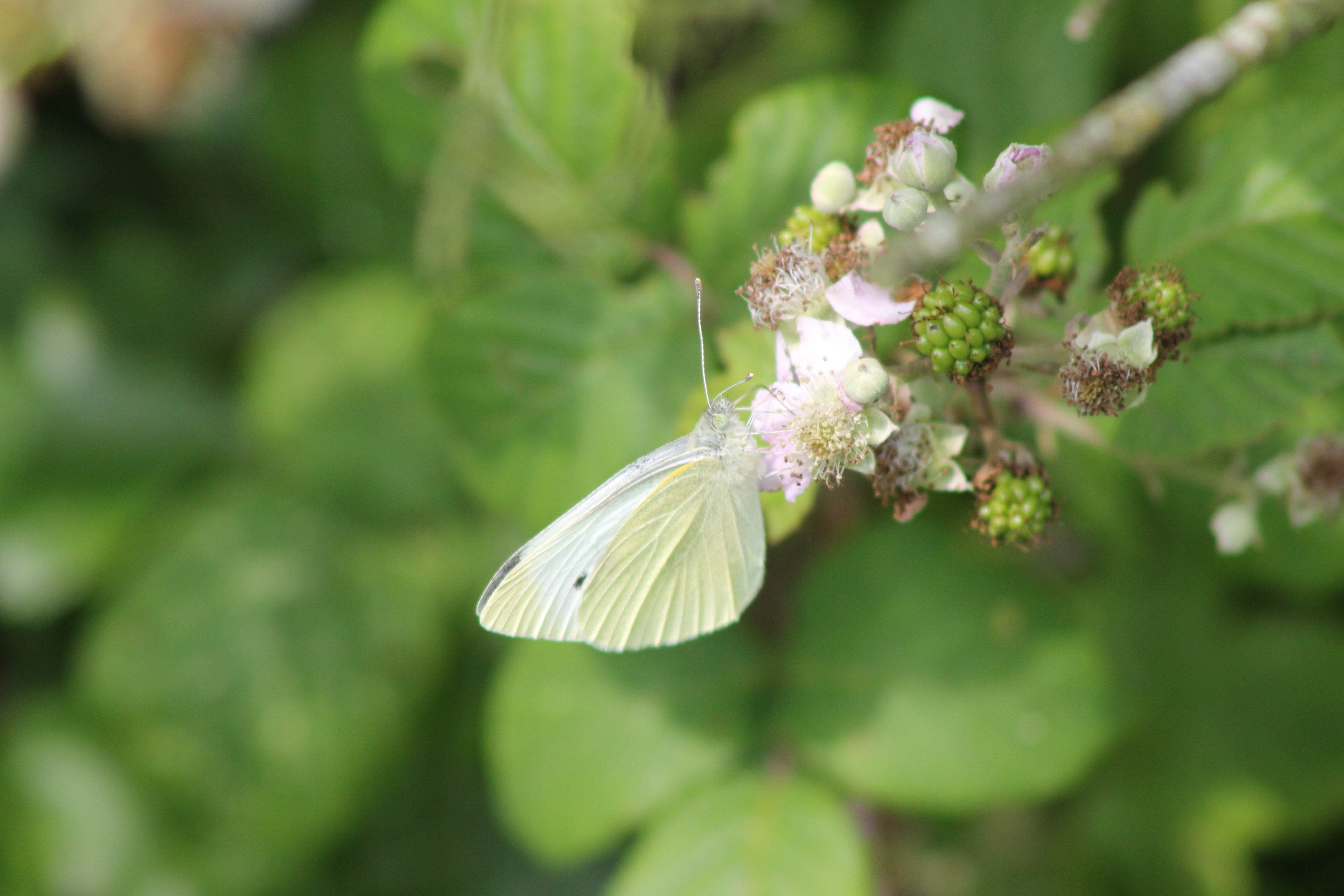
045White butterfly on bramble

An unidentified white Butterfly. I am having a lot of trouble identifying the white buttterflies

There will be more insects in the next post.

Share this:

  • Share on X (Opens in new window) X
  • Share on Reddit (Opens in new window) Reddit
  • Share on Pinterest (Opens in new window) Pinterest
  • Share on Facebook (Opens in new window) Facebook
  • Email a link to a friend (Opens in new window) Email
  • Share on Tumblr (Opens in new window) Tumblr
  • Print (Opens in new window) Print
  • Share on Pocket (Opens in new window) Pocket
  • Share on LinkedIn (Opens in new window) LinkedIn
Like Loading...

My Garden

24 Fri Jan 2014

Posted by Clare Pooley in Rural Diary

≈ Leave a comment

Tags

birds, catkins, Christmas Box.Winter Honeysuckle, Garrya, insects, Mahonia, Mild winter, rodents, spring bulbs, Viburnum, willow

The mild (so far) winter has meant that we have not, as yet, lost any of our plants. We did lose a lovely willow tree during the St. Jude’s gale but that was before winter began. Last winter was so long and harsh that all our plants suffered and I lost a number of favourites including a Garrya – a tassel bush – which had been growing so beautifully. I intend to replace it some time but I will have to think very carefully where I should put it to protect it from the prevailing south-westerly wind and also from frost. My Mahonia and Viburnum bodnantense have been flowering continuously since November and I have enjoyed their lovely scent. Last winter they had only just come in to flower when the first of the hard frost and snow came and the flowers turned black. Also in flower are the Christmas Box and Winter Honeysuckle; the Witch-hazel, in a large tub by the front door, is beginning to come into flower too. Catkins are forming on the two hazel trees near the big pond. We never get any of the nuts as the squirrels are quicker than we are in picking them. Snowdrops and miniature iris will soon be in flower and the leaves of daffodils, hyacinths and grape hyacinths are coming up. I have crocus and snowdrops in tubs and when they have flowered I intend putting them with other bulbs already under the large crabapple at the front of the house.
The mild weather has also enabled a lot of insects to survive. As usual, a large group of ladybirds has gathered to hibernate in the corner of our bedroom window frame. I presume it is pheramones which draw them back there year after year. While emptying some kitchen waste into one of the compost bins a couple of days ago I was engulfed in a large cloud of whitefly. I have left the lid off the bin to encourage them to fly away, or the frost or birds to get them. Voles are also trying to set up home in the compost bins and my husband found a mouse or vole nest made in one of his gardening trainers in the garage. We always have a wreath hanging on our front door at Christmas and this Christmas was no exception. However, we found after a couple of days that we needed to move it away from the front door as bluebottles had decided to live in the wreath and whenever we opened the front door the house became full of flies. Today I had to bury two greenfinches. One beautiful male flew into our kitchen window and died immediately – I found the other bird, a female, under the ground feeder. I have no idea why or how she died. It was very frosty this morning and the day was so lovely with hazy sunshine. I had to go to Norwich hospital for the second time this week with my mother. Tuesday’s journey was made difficult by fog but the hoar frost had iced the trees and hedges and all looked magical. Today’s journey was made in sunshine and was only marred by the large amount of tractors pulling slurry tankers and muck spreaders we encountered. I am now listening to rain against the window.

Share this:

  • Share on X (Opens in new window) X
  • Share on Reddit (Opens in new window) Reddit
  • Share on Pinterest (Opens in new window) Pinterest
  • Share on Facebook (Opens in new window) Facebook
  • Email a link to a friend (Opens in new window) Email
  • Share on Tumblr (Opens in new window) Tumblr
  • Print (Opens in new window) Print
  • Share on Pocket (Opens in new window) Pocket
  • Share on LinkedIn (Opens in new window) LinkedIn
Like Loading...
Newer posts →
Follow A Suffolk Lane on WordPress.com

Enter your email address to follow this blog and receive notifications of new posts by email.

Join 715 other subscribers.

Unknown's avatar

I talk about what it's like living in a quiet part of Suffolk. I am a wife, mother and daughter, a practising Christian and love the natural world that surrounds me. I enjoy my life - most of the time!

My Posts

Jan 2026
M T W T F S S
 1234
567891011
12131415161718
19202122232425
262728293031  
« Dec    

Pages

  • About my Blog
  • GDPR (General Data Protection Regulations) and This Site
  • My Life in a Suffolk Lane

Archives

Blogs I Follow

Unknown's avatar
Unknown's avatar
Unknown's avatar
Unknown's avatar
Unknown's avatar
Unknown's avatar
Unknown's avatar
Unknown's avatar
Unknown's avatar
Unknown's avatar
Unknown's avatar
Unknown's avatar
Unknown's avatar
Unknown's avatar
Unknown's avatar
Unknown's avatar
Unknown's avatar
Unknown's avatar
Unknown's avatar

Posts I Like

  • Carolina Cuisine Network's avatar
  • Unknown's avatar
  • Unknown's avatar
  • Unknown's avatar
  • Unknown's avatar
  • Unknown's avatar
  • (Kitty) Cat Strawberry - Meow!'s avatar
  • Unknown's avatar
  • Unknown's avatar
  • Unknown's avatar
  • East of Elveden's avatar
  • Secret Diary of A Country Vicar's Wife's avatar
  • Unknown's avatar
  • Unknown's avatar
  • aho's avatar
  • Yeah, Another Blogger's avatar
  • Unknown's avatar
  • martzkvi's avatar
  • bitaboutbritain's avatar
  • Talkmore's avatar
  • Unknown's avatar
  • womanseyeview's avatar
  • Unknown's avatar
  • Unknown's avatar
  • Unknown's avatar
  • Wayne Wolfson's avatar
  • Unknown's avatar
  • Unknown's avatar
  • Unknown's avatar
  • Unknown's avatar
  • Unknown's avatar
  • gederedita's avatar
  • Unknown's avatar
  • Unknown's avatar
  • Unknown's avatar
  • Unknown's avatar
  • Unknown's avatar
  • Unknown's avatar
  • Annika Perry's avatar
  • Unknown's avatar
  • thesimlux's avatar
  • Pilgrim's Pondering Ministry's avatar
  • Stephen G. Hipperson's avatar
  • Bernard Aybout (Virii8)'s avatar
  • Unknown's avatar
  • Unknown's avatar
  • Unknown's avatar
  • Jack Ronald Cotner's avatar
  • trulymebeingme's avatar
  • Unknown's avatar

amphibians architecture art Arts and Crafts churches cooking Days out domestic animals family fish Folk Traditions Gardening Historic Buildings holidays Insects Landscaping literature music Norwich plants Rural Diary seashore theatre trees Uncategorized walking weather wild animals wild birds wild flowers

Tags

architecture autumn birds blackbird blackthorn Bungay butterfly church clouds common knapweed cow parsley crocus daffodils Diary dogwood family field maple flowers fungus garden gardening geese greylags ground-ivy Halesworth Hawthorn heather holiday Holly Holy Week horse chestnut Hoverfly insects ivy Lake District Lent lesser celandine lichen Lords and Ladies Mallard mallards Minsmere moorhen moss music Norwich Peak District pheasant plants pond ponds primrose primroses Rain rooks Rumburgh Rumburgh Church sheep Sheffield snow snowdrops Southwold spring Suffolk Suffolk Wildlife Trust sunset the Beck trees viburnum bodnantense walking weather wild cherry wild flowers winter-flowering honeysuckle witch-hazel

Meta

  • Create account
  • Log in
  • Entries feed
  • Comments feed
  • WordPress.com

Goodreads

Blog at WordPress.com.

Book Jotter

Reviews, news, features and all things books for passionate readers

Country Life Blog -

A blog about life in the country in the past and present

Matthew Paul: Poetry & Stuff

Poetry and what-not

Schnippelboy

Ein Tagebuch unserer Alltagsküche-Leicht zum Nachkochen

TAMARA JARE

TAMARA JARE Tamara Jare: Contemporary Figurative Painting Oil on Canvas Artist Art Studio

A Taste of Freedom

Documenting a Dream

Country Ways

Rambling Journeys in Britain, Countryside Matters and campaigning for the Right to Roam

The Strawberry Post

Here to Entertain, Educate & Inspire!

a north east ohio garden

an ongoing experiment in the dirt, 35 plus years

naturechirp

Celebrating God's creatures, birds and plants...

Sophie Neville

Writer

Going Batty in Wales

Developing a more sustainable lifestyle in SW Wales

Our Lake District Escapades

Exploring the Lake District and beyond

Short Walks Long Paths

Wandering trails around the coast of Wales

The Biking Gardener

An English persons experience of living and gardening in Ireland

Nan's Farm

A Journal Of Everyday Life

Walk the Old Ways

Rambling Journeys in Britain with John Bainbridge. Fighting for the Right to Roam. Campaigning to Protect Our Countryside.

Writer Side UP!

Waking the Writer Side...and keeping it "Up!"

Meggie's Adventures

Travel, thank you notes and other stories

amusicalifeonplanetearth

Music and the Thoughts It Can Inspire

lovefoundation.co.uk

Traveling Tortuga

Simply Living Well

Pakenham Water Mill

Historic watermill in the beautiful Suffolk countryside

Take It Easy

Retired, not expired: words from the after(work)life. And music. Lots of music!

Secret Diary Of A Country Vicar's Wife

By Olive Oyl

thanksfortheadventureorg.wordpress.com/

The Beat Goes On

#TBGO

Frank Pleszak's Blogs

Twitter: @frankpleszak @PolishIICorps

John Bainbridge Writer

Indie Writer and Publisher

roughwighting

Life in a flash - a bi-weekly storytelling blog

Walking the Old Ways

Rambling in the British Countryside

CapKane

thoughts on social realities

SkyeEnt

Jottings from Skye

jodie richelle

embracing my inner homemaker

Skizzenbuch/Blog

Just another WordPress.com weblog

Have Bag, Will Travel

The Call of the Pen

Flash Fiction, Book Reviews, Devotionals and other things.

John's Postcards

Art in Nature

You dream, I photographe it !

Smile! You’re in Barnier World......

theinfill

the things that come to hand

Dr. Mary Ann Niemczura

Author of "A Past Worth Telling"

Provincial Woman

The Pink Wheelbarrow

Luanne Castle: Poetry and Other Words (and cats!)

Poetry, Other Words, and Cats

The Family Kalamazoo

A genealogical site devoted to the history of the DeKorn and Zuidweg families of Kalamazoo and the Mulder family of Caledonia

everythingchild

The Book Owl

Canberra's Green Spaces

Paul Harley Photographer

  • Subscribe Subscribed
    • A Suffolk Lane
    • Join 715 other subscribers.
    • Already have a WordPress.com account? Log in now.
    • A Suffolk Lane
    • Subscribe Subscribed
    • Sign up
    • Log in
    • Report this content
    • View site in Reader
    • Manage subscriptions
    • Collapse this bar
 

Loading Comments...
 

    Privacy & Cookies: This site uses cookies. By continuing to use this website, you agree to their use.
    To find out more, including how to control cookies, see here: Cookie Policy
    %d