• About my Blog
  • GDPR (General Data Protection Regulations) and This Site
  • My Life in a Suffolk Lane

A Suffolk Lane

~ A diary of my life in rural north Suffolk.

A Suffolk Lane

Tag Archives: Norwich

The Royal Arcade, Norwich

22 Sun Mar 2015

Posted by Clare Pooley in Rural Diary, Uncategorized

≈ 25 Comments

Tags

architecture, Art Nouveau, Colman's Mustard Shop and Museum, Digby's Chocolates, Norwich, shopping, The Royal Arcade


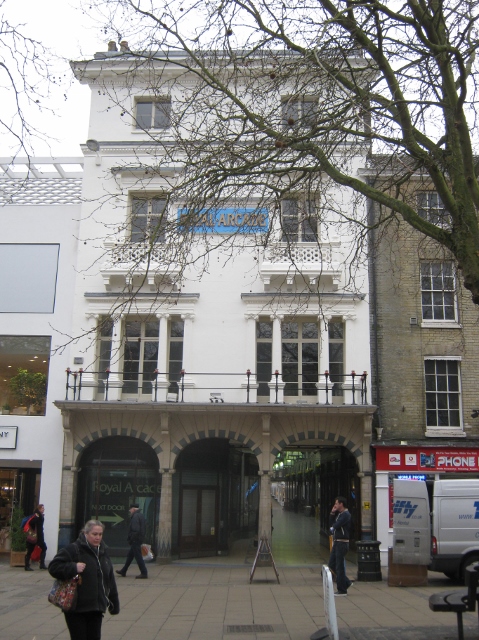
IMG_4196Entrance to Royal Arcade (479x640)

The main entrance to the Royal Arcade

This is another of my Norwich posts and this time I am just going to focus on one place, The Royal Arcade.  I usually visit it at some stage during all my walks round the city.  I have gathered together a number of pictures that I have taken at different times and have spot-lighted this very interesting and beautiful place.   Many people use and see it but don’t look at it.

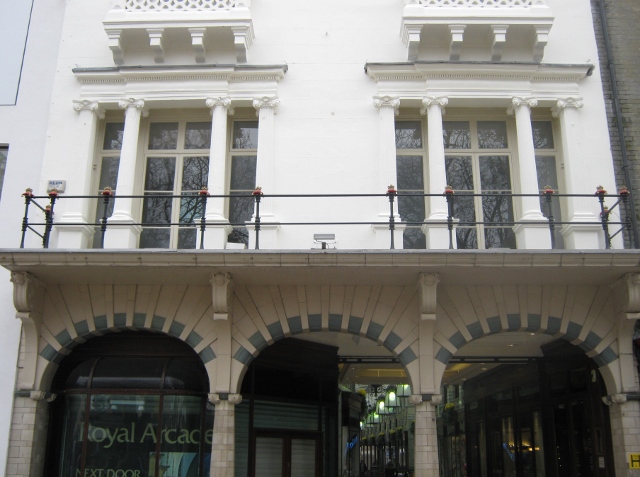
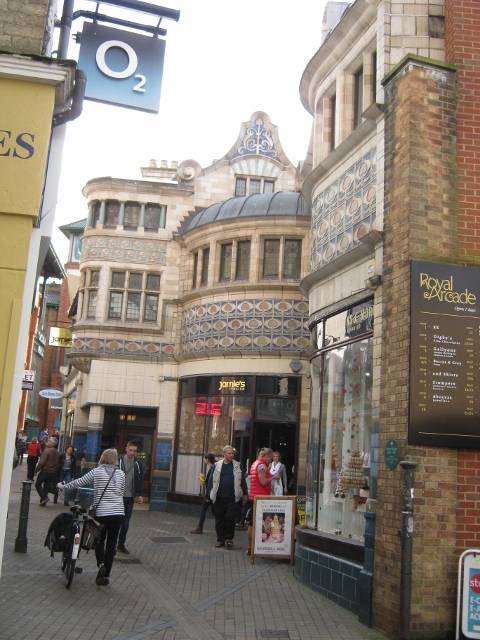
IMG_4197Entrance to Royal Arcade (640x477)

This front has just undergone some renovation and is freshly painted.

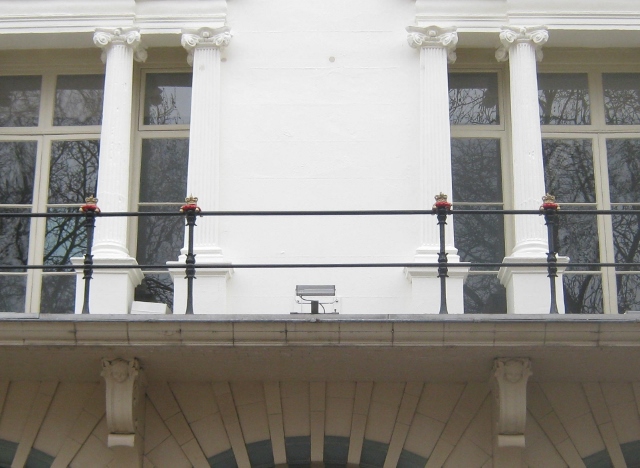
IMG_4197Entrance to Royal Arcade (2) (640x468)

I cropped the former photo to show some of the details – the carving on the pillars in front of the windows, the tiles under the canopy and the tiny little crowns on top of the railing.

The first building to occupy this site from at least the 15th century was the ‘Angel Inn’.  As well as being somewhere to eat and drink and spend the night the inn was also a place where one could be entertained.  It hosted travelling shows and ‘spectacles’ – in 1685 a pair of elephants could be seen here.  In the 1830’s it was the Headquarters of the Norwich Whigs (the fore-runners of the Liberal party) where there was once such a vicious brawl between the Whigs and their political rivals the Tories that the Mayor had to read the Riot Act and call in the militia.

The Angel was re-named and became the ‘Royal Hotel’ which occupied this site for about fifty years before moving to a newer building elsewhere.  Joseph Stannard rebuilt the entrance when it became the ‘Royal Hotel’ in 1846 and this facade remained when the Royal Arcade was constructed in 1899.

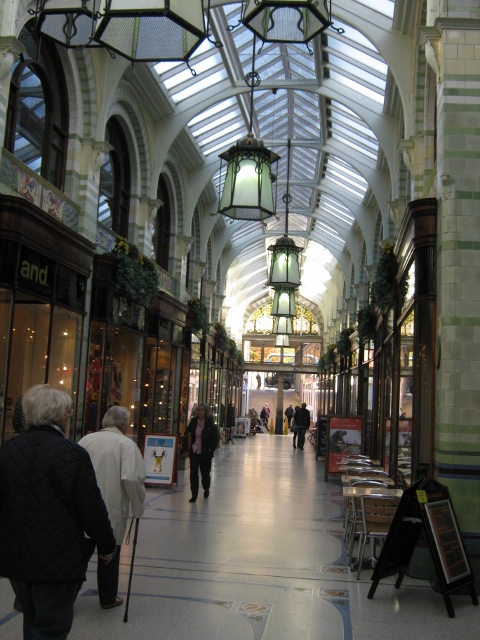
016Royal Arcade (480x640)

Inside the Arcade.

The Arcade was built where the hotel stables and yard had been and followed the shape of the yard.  It isn’t obvious when walking through the Arcade but from this angle you can see that the Arcade isn’t straight but bends slightly.

When it was first constructed it housed 24 bow-fronted shops, a pub and a clubroom.

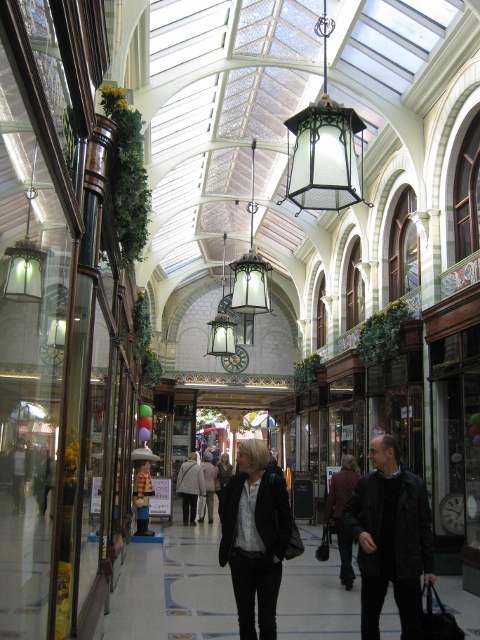
015Royal Arcade (480x640)

This photo is looking towards the main entrance 

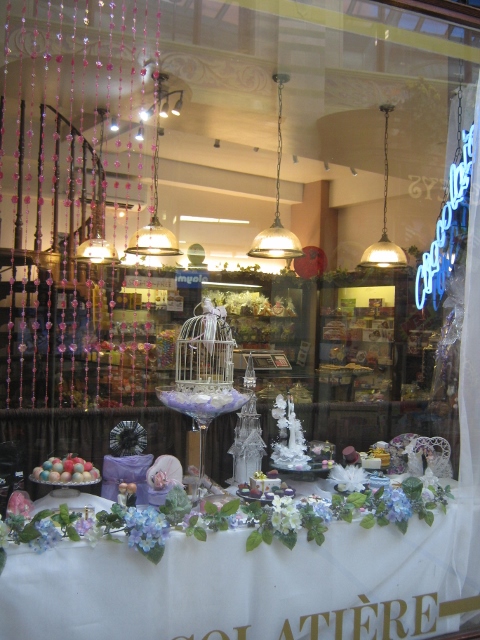
018Confectioner's shop (480x640)

This is a marvellous chocolatiere and confectioner’s shop in the Arcade.

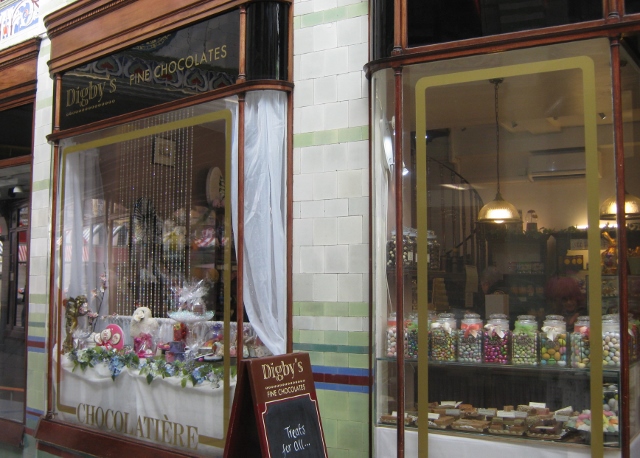
IMG_4222Digby's Chocolate Shop (640x458)

The windows are always dressed so beautifully

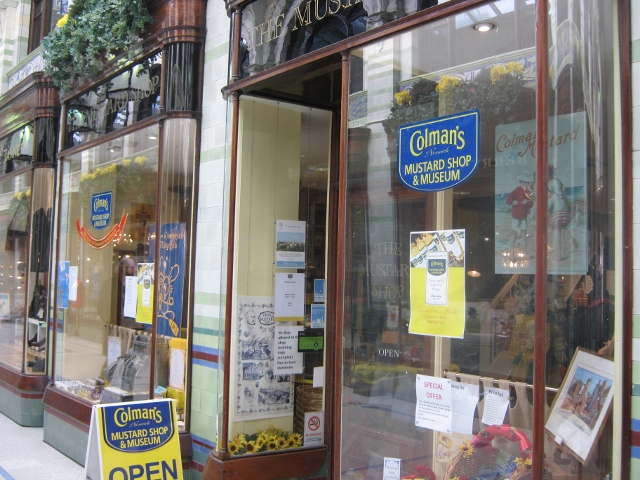
IMG_4224The Mustard Shop (640x480)

The Mustard Shop and Museum. Colman’s Mustard has been part of Norwich life for a long time and is quite an institution.  J. Colman began manufacturing mustard 200 years ago.

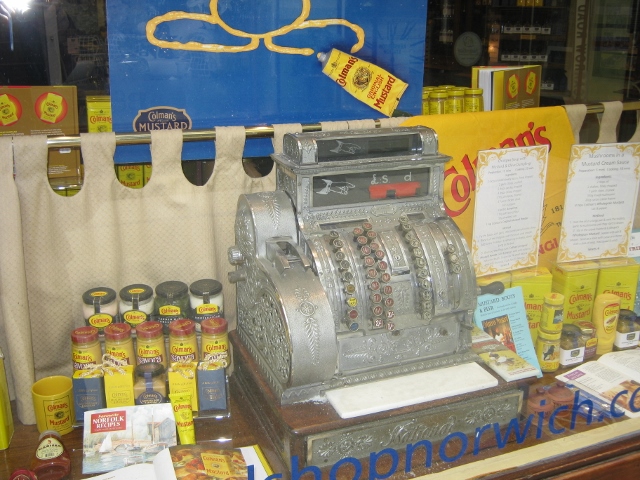
IMG_4221Old cash till in the Mustard Shop (640x480)

A beautiful old cash-till in the window.

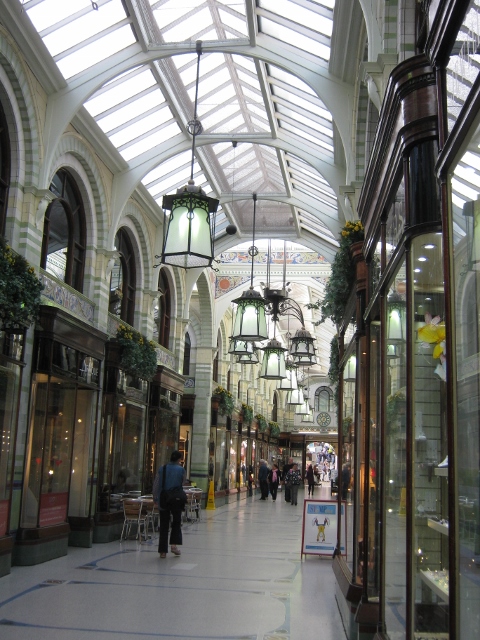
025Royal Arcade (480x640)

A longer view of the interior.

The Royal Arcade is a 247′ long covered avenue and was designed and built by Dereham-born architect, George Skipper.  It is a perfect example of Art Nouveau style.

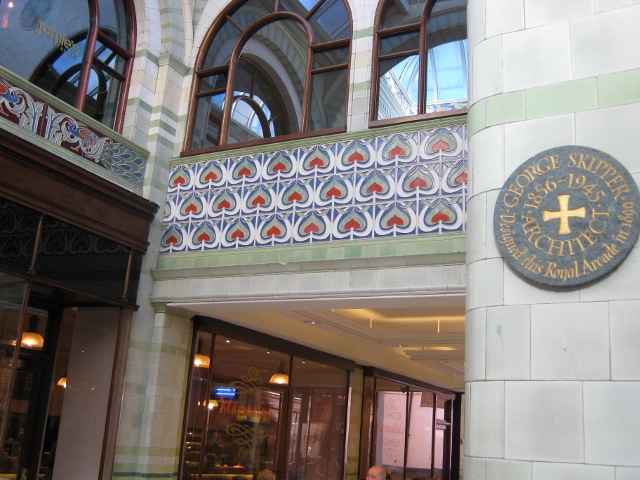
017Royal Arcade (640x480)

This photo shows a plaque commemorating the architect and some of the wonderful decorative tiles that line the first floor.

The designs are typically Art Nouveau and are inspired by nature and femininity – floral shapes and peacocks.  The tiles were designed by WJ Neatby (who also produced tiles for Harrod’s Food Hall (Harrods is a large and famous department store in London)).  The tiles were manufactured by Doulton.

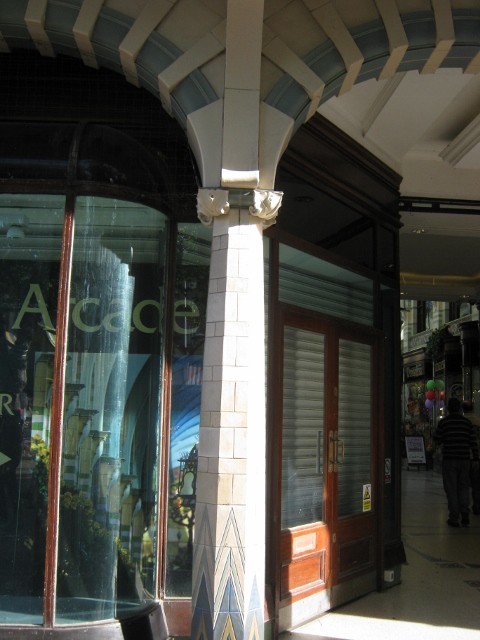
019Royal Arcade (480x640)

One of the pillars at the main entrance

023Royal Arcade (480x640)

Another entrance to the Arcade.

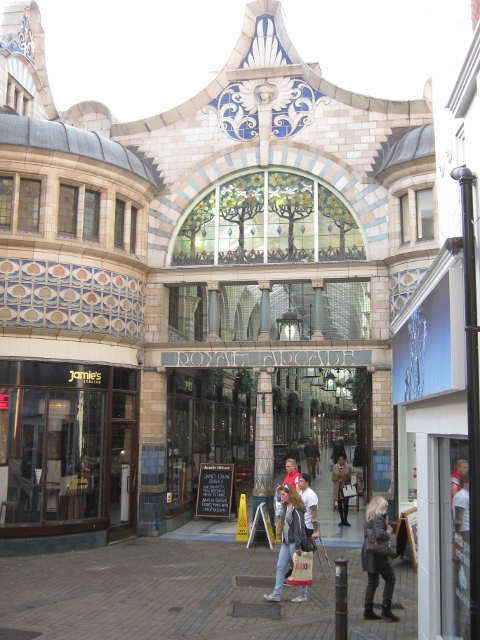
024Royal Arcade (480x640)

Here is that same entrance showing the lovely stained glass semi-circular window and the decorations on the outside of the Arcade.

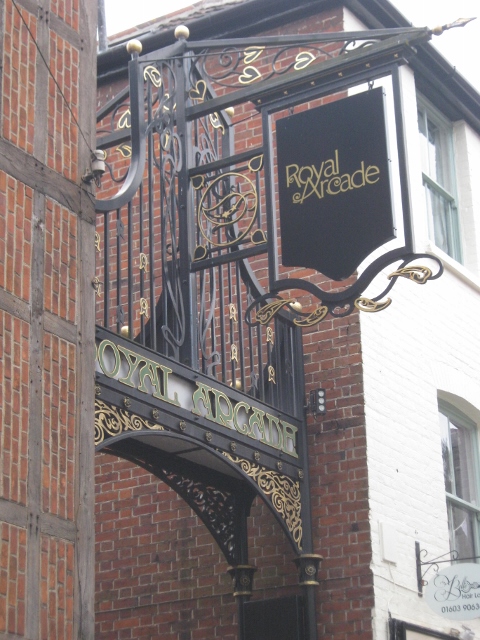
IMG_4199Royal Arcade sign (480x640)

This sign is over yet another entrance to the Arcade


This wrought-iron work along with other examples in the Arcade, the floor tiles and the beautiful lamps were added later during restoration in the 1980’s.  They are happily in keeping with the rest of the building.

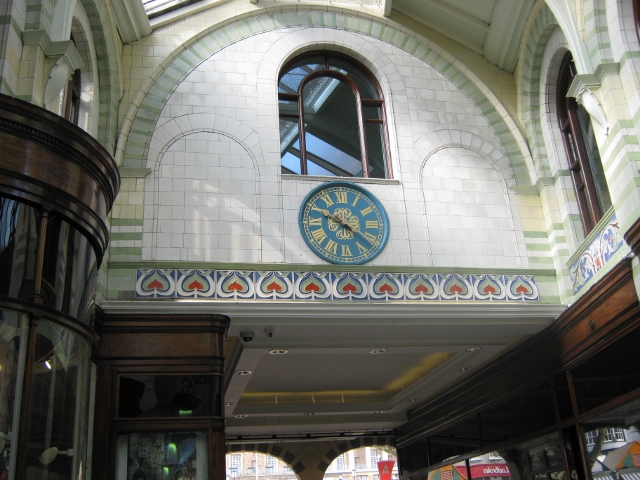
IMG_4223Royal Arcade (640x480)

A very pretty clock.

I hope you have enjoyed your visit to the Royal Arcade.


Share this:

  • Share on X (Opens in new window) X
  • Share on Reddit (Opens in new window) Reddit
  • Share on Pinterest (Opens in new window) Pinterest
  • Share on Facebook (Opens in new window) Facebook
  • Email a link to a friend (Opens in new window) Email
  • Share on Tumblr (Opens in new window) Tumblr
  • Print (Opens in new window) Print
  • Share on Pocket (Opens in new window) Pocket
  • Share on LinkedIn (Opens in new window) LinkedIn
Like Loading...

Norwich Knowledge

06 Sat Sep 2014

Posted by Clare Pooley in churches, Rural Diary, trees, Uncategorized, walking

≈ 24 Comments

Tags

Augustine Steward house, beguinage, Blackfriar's Hall, Briton's Arms, Christian Resource Centre, City College, Edith Cavell, Edith Cavell Monument, Elm Hill, elm trees, Erpingham Gateway, Forget-Me-Not Café, Fye Bridge, hair appointments, Norwich, Norwich Cathedral, Norwich Hippodrome, Paston family, Princes Street, Quayside, River Wensum, St Andrew's Hall, St Giles, St Giles car-park, St Michael at Plea, Stranger's Club, timber-framed buildings, Tombland, Tombland Alley, walking

Norwich is a very beautiful city and we always look forward to visiting it.  (Norwich is pronounced ‘Norridge’ or, if you are a local, ‘Narge’).  For the next few months I will be going there every day of the week so perhaps the shine may wear off a little, though I don’t think it likely.

On Tuesday E and I had to be at City College Norwich at 8.30 in the morning so that E could meet her mentor before her ‘taster day’ began at 9.00 am.  I had a hair appointment at 9.45, my second one with my new hairdresser.  When my local hairdresser went on maternity leave and I found the replacement hairdresser wasn’t to my liking I decided to look for a new one in Norwich where I would be spending some time each day.  I rather like the young woman who now does my hair.  ‘Oh Clare!’, she said the last time I saw her, ‘Don’t start colouring your hair again.  Your shade of grey is really lovely!’.  There aren’t many women who wouldn’t fall for that one.

So, after leaving E at the college I drove to the city centre and parked my car in my usual car-park at St Giles.  This is rather an ugly multi-storey car-park built in the 1960’s so is quite difficult to park in if you have a modern car – it’s very narrow and full of pillars.  The car-park is on the site of the Norwich Hippodrome, an extremely ornate theatre built in 1903 and demolished in 1964.  Apparently many inter-war stars performed there – Charlie Chaplin, Marie Lloyd, Gracie Fields, George Formby and even Archibald Leach (Cary Grant) made his acting debut there at the age of twelve.  After the Second World War it continued to be popular for a while with acts like Laurel and Hardy visiting in 1954.

I had about an hour to kill before my appointment and, as the morning was bright and sunny I decided to have a short walk and visit some of my favourite places.

I walked up past my hairdressers in London Street to the junction at the top of the hill.  On the corner of Redwell Street and Queen Street is the redundant church of St Michael at Plea.
001St Michael's at Pleas church (2) (458x640)

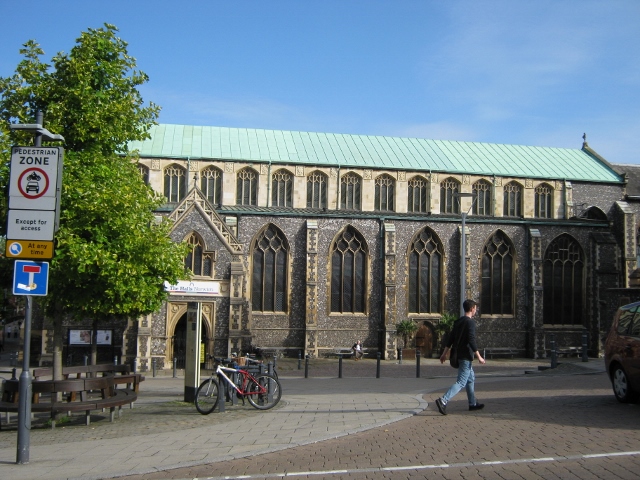
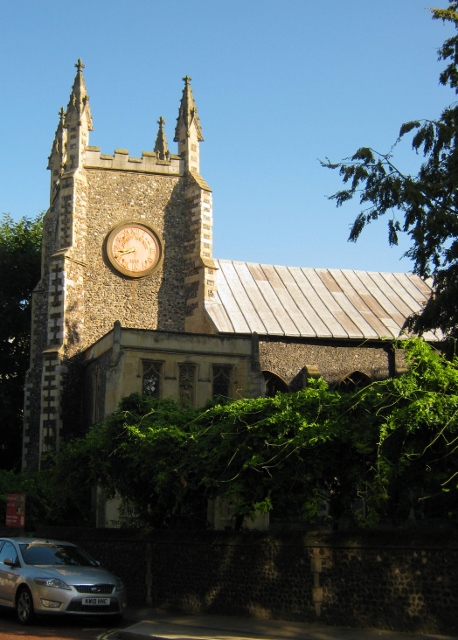
St Michael at Plea church

The church ceased to be a place of worship in 1973 and opened in 2008 as a Christian Resource Centre.  Before that it had been used as an antiques market.  We call in quite often as we buy things for our church here – candles, communion wafers etc – and it is a good place for Easter and Christmas gifts.  The bookshop is very good and stocks new and second-hand books.  There is also a really nice café in what was the chancel, with extremely tasty and cheap food, all supplied by volunteers.  The café is called the Forget-Me-Not Café after the wording on the clock on the tower.
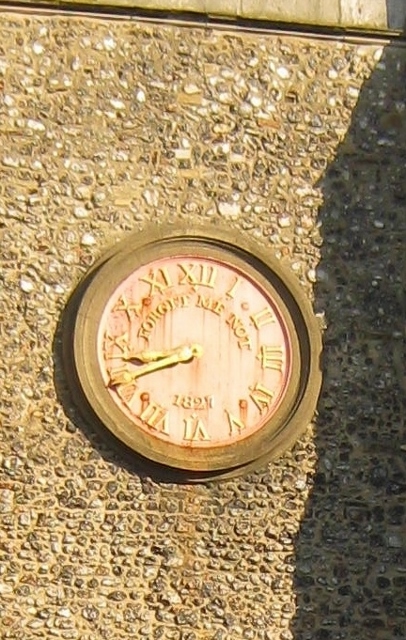
001St Michael's at Pleas church (406x640)

The Forget-Me-Not clock

The battlements and spirelets were put on the top of the tower during a 19th Century restoration.  The tower had been lowered for safety reasons some time before that.  I think it had been much taller with bells.
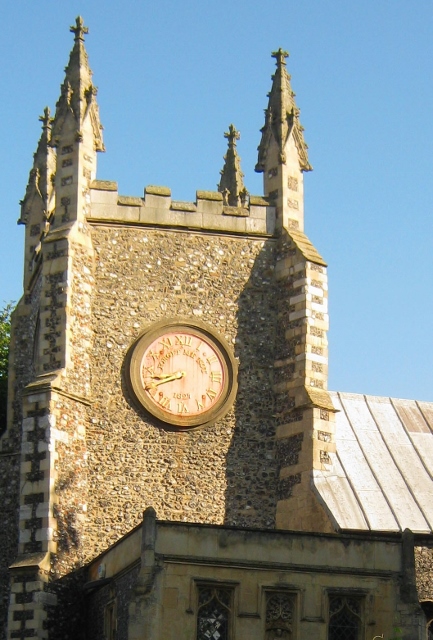
001St Michael's at Pleas church (3) (433x640)

The rather truncated tower with its pretty pinnacles

The porch is probably early 16th Century and rather strangely gives access to the base of the tower rather than the Nave.  Most of the church’s furniture and valuable decorations were removed when it was made redundant but it still has a beautiful memorial in it, some medieval glass high in the east window and some carved angels in the roof.

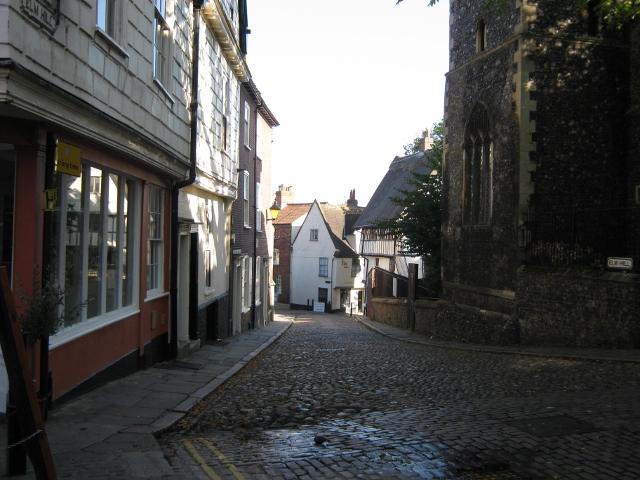
I then went down Elm Hill, one of the most lovely streets in the country.
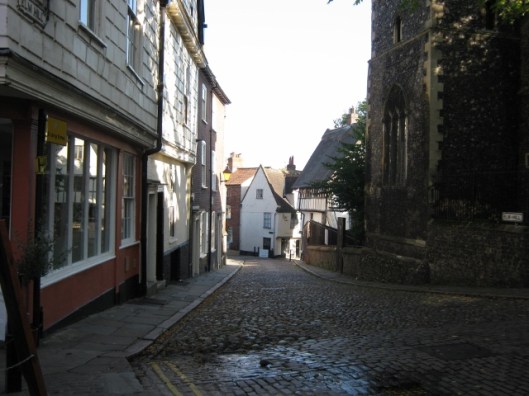
002Elm Hill (640x480)

Elm Hill. Blackfriars Hall is on the corner of the street on the right of the photo.

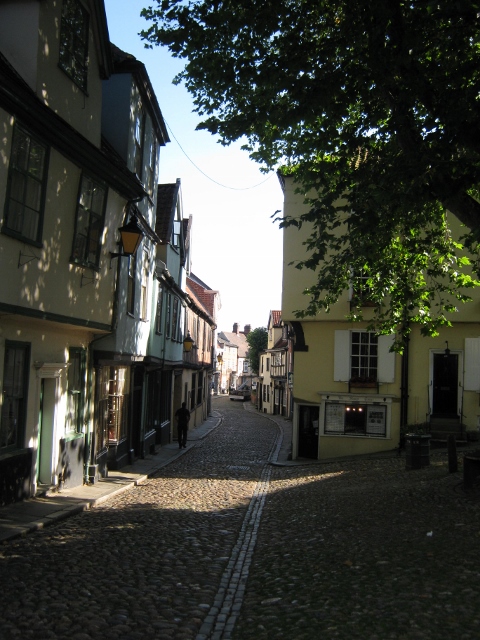
Elm Hill is a cobbled street full of timber-framed buildings and virtually unaltered since the 16th Century.  There have been people living in this area since at least 1200.  (Probably before that time, as it is close to the river and to Tombland, the site of the Anglo-Saxon market.)  It is called Elm Hill after the elm trees that used to grow there next to the Briton’s Arms, all of them killed by Dutch Elm disease.  This was a wealthy street in medieval times where many merchants lived.  By the 20th Century it had seen better days and there were plans to sweep it all away.  Fortunately, the authorities thought better of this idea and now most of the buildings have been restored and look wonderful.
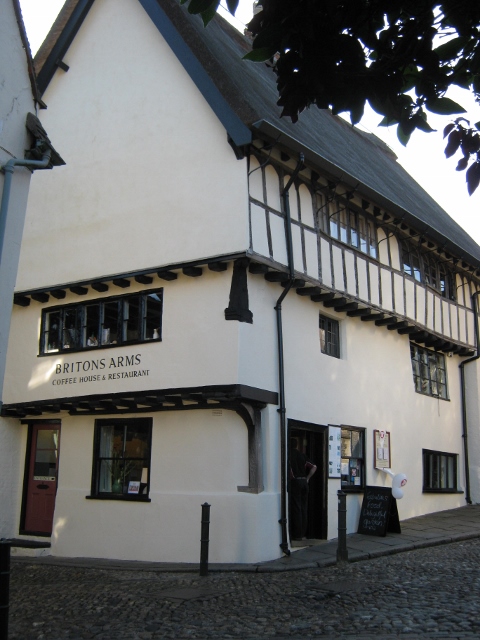
003Briton's Arms (480x640)

Briton’s Arms, now a restaurant and coffee house.

The Briton’s Arms was built in 1347 and became an ale house in 1760.  It is three storeys high and was the only house on Elm Hill to survive a fire in 1507.  It stands in the corner of the old churchyard of St Peter Hungate and the only reason it survived the fire was because it stood apart from the rest of the houses.  The fire destroyed 300 houses and shops.  There are two rooms per storey of the Briton’s Arms and each floor is reached by a side staircase.  The top floor is jettied out on three sides and it also has an attic – a rarity in Medieval buildings.  It is perhaps one of the oldest inhabited attics in England.  It began life as a beguinage associated with St Peter’s church.  A beguinage was the home of a group of single women who devoted their lives to prayer and community work, like a nunnery.  However, unlike a nunnery which accepted the daughters of wealthy parents, beguines were usually from poor backgrounds.  They earned a little money from spinning and begging for alms and did charity work in the city but their main work was regular worship in the church next door which was reached through a stone arched door in the rear wall of the building.  Beguinages were common in Europe but there are no known other examples elsewhere in Britain.

004Elm Hill (2) (480x640)

Looking further down Elm Hill from outside the Briton’s Arms.
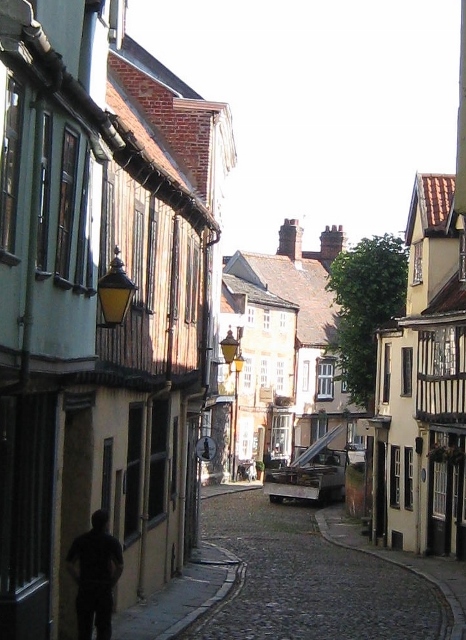
004Elm Hill (3) (466x640)

I cropped the photo above to make it easier for you to see the pink house on the left.

The house just in front of the man in the photo is the Strangers’ Club built on the site of the Paston’s House which was destroyed by the fire.  The Club is said to be haunted by a man who died in the fire of 1507.  Queen Elizabeth I stayed here and watched a pageant in her honour from one of the upstairs windows.

The Pastons rose from peasantry to aristocracy in two generations.  They also left a record of private correspondence (The Paston Letters) which is the first example of such correspondence to survive in Britain.  To quote my on-line source ‘The letters show first hand testimony of the social benefits of the plague brought to the peasantry, the chaotic effects of the War of the Roses on the general populace and the individual impact that the Black Death could have on a family’.  I have a copy of the letters and they are a really good read especially the letters from Margaret Paston to her two sons and theirs to her.  Her husband had managed to be bequeathed Caister Castle by John Fastolf who was a knight during the Hundred Years War, became a loyal servant of Henry V and fought in the Battle of Agincourt.  He was also the knight that Shakespeare based his John Falstaff on.
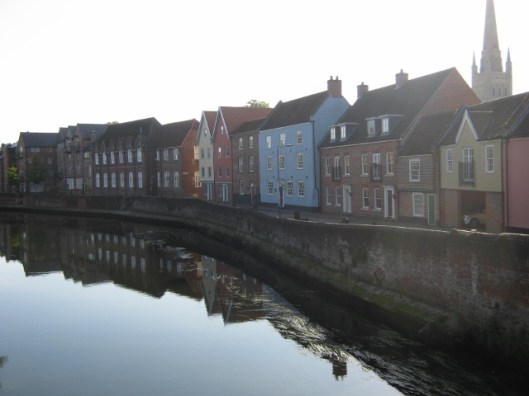
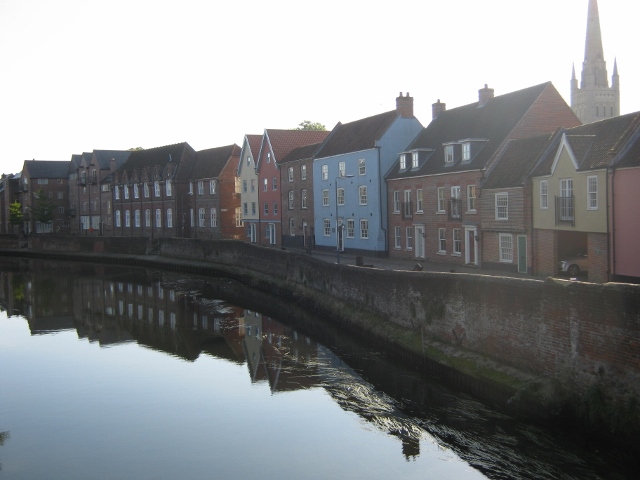
005Quayside from Fye Bridge (640x480)

Quayside from Fye Bridge

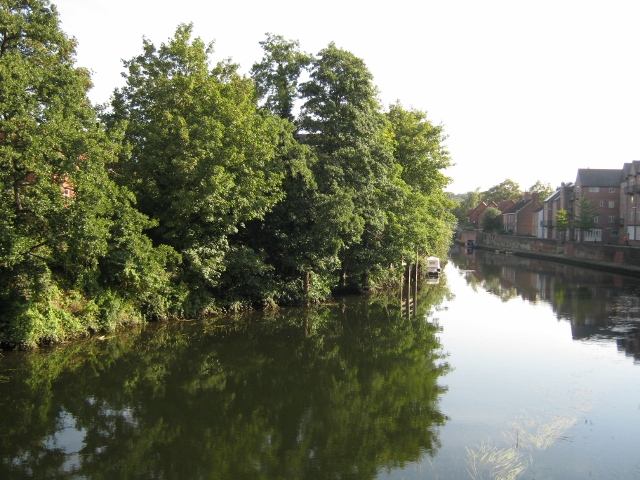
At the bottom of Elm Hill I turned left along Wensum Street and crossed halfway over Fye Bridge so I could look at the River Wensum.  Wensum comes from the Anglo-Saxon word for ‘winding’ – wandsum or wendsum.  The river winds in two large loops through the city and is a tributary of the River Yare despite being the larger of the two rivers.  It is chalk-fed and the whole river is a Site of Special Scientific Interest and a Special Area of Conservation.  Fye Bridge is built over the oldest river crossing in Norwich and is the gate to the North of the city known as Norwich Over the Water.  The bridge is also the site of a former ducking stool.
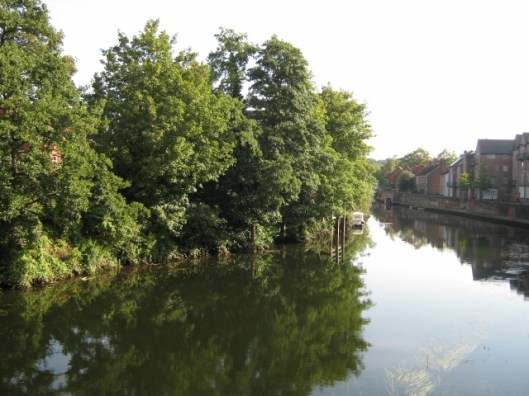
006The Wensum from Fye Bridge (640x480)

The River Wensum

007Norwich Cathedral from Erpingham Gate (471x640)

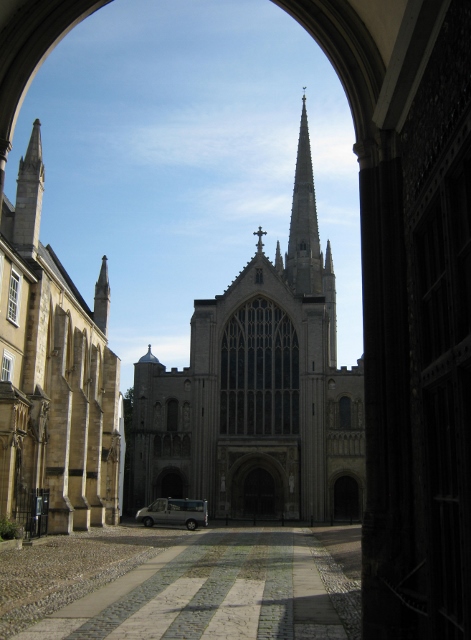
Norwich Cathedral seen from the Erpingham Gate

I didn’t cross right over the bridge but returned to Wensum Street and walked along it to Tombland and stood by the Erpingham Gate so I could look at the Cathedral.  Though it doesn’t look it from this angle the cathedral is immensely long (407 feet) and the top of its spire is 315 feet from the ground.  The construction of it was begun in 1096 and finished in about 1145.  The Cathedral was also a Benedictine Priory.  The Erpingham Gateway was built in 1420 by Sir Thomas Erpingham who was the commander of Henry V’s archers at the Battle of Agincourt.
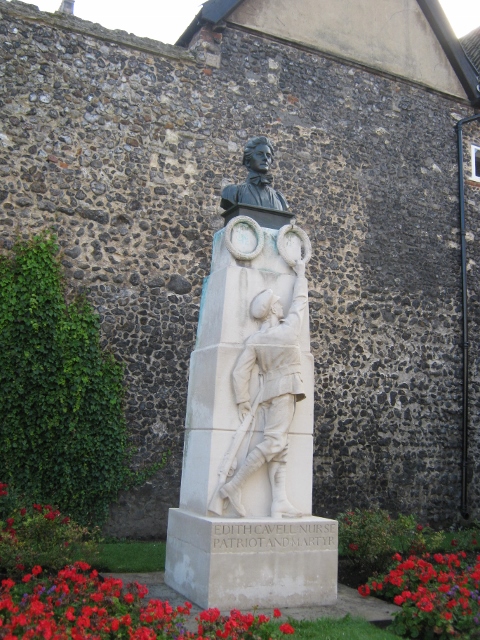
009Edith Cavell Memorial (480x640)

Just to the right of the Erpingham Gateway is the Edith Cavell Memorial.

Edith Cavell is buried near the east end of the Cathedral.  She was born in 1865 and grew up in Swardeston, south of Norwich and was a vicar’s daughter.  She became a Matron of an English teaching hospital and was also an influential pioneer of modern nursing in Belgium.  She was in England visiting her mother when World War I broke out but returned to Belgium as she felt it was her duty so to do.  Her hospital became a Red Cross hospital and so wounded soldiers from all nations were treated there.  She was a devout Christian and this motivated her to help all those in need, both German and Allied soldiers.  When a group of wounded British soldiers arrived who had been cut off from their comrades she decided to help them despite knowing that that she was putting at risk the neutrality of the Red Cross and endangering others working with her.  She then joined a Belgian underground movement and helped more than 200 Allied soldiers to escape to neutral territory.  The network was betrayed, she was arrested, tried by a court martial, found guilty of treason and sentenced to death.  Her execution was carried out at dawn by a firing squad on 12th October 1915.  She was still wearing her nurses uniform.  On the eve of her execution she said, “I am thankful to have had these ten weeks of quiet to get ready.  Now I have had them and have been kindly treated here.  I expected my sentence and I believe it was just.  Standing as I do in view of God and Eternity, I realise that patriotism is not enough.  I must have no hatred or bitterness towards anyone.”
008Medieval buildings and Tombland Alley (640x480)

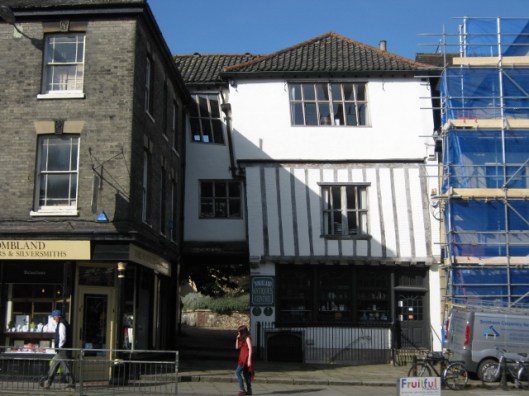
Augustine Steward house

Opposite the Erpingham Gateway in Tombland is this rather lop-sided medieval building.  This is Augustine Steward house which was built in 1530 by Augustine Steward, a cloth merchant.  A merchant’s mark can be found in the passage next to the house.  A merchants mark is a symbolic sign or design used by artisans, merchants and townspeople to identify themselves and authenticate their goods.  The alleyway next to the house is called Tombland Alley and in the alley is the burial ground for the adjacent church of St George.  The high-walled churchyard contains mainly victims killed by the plague.  The name ‘Tombland’ has nothing to do with tombs but comes from an Old Scandinavian word for ‘open space’.  It was the area used for the Anglo-Saxon market and the administrative centre of Norwich before the Norman Invasion.
010Medieval buildings in Tombland (2) (480x640)

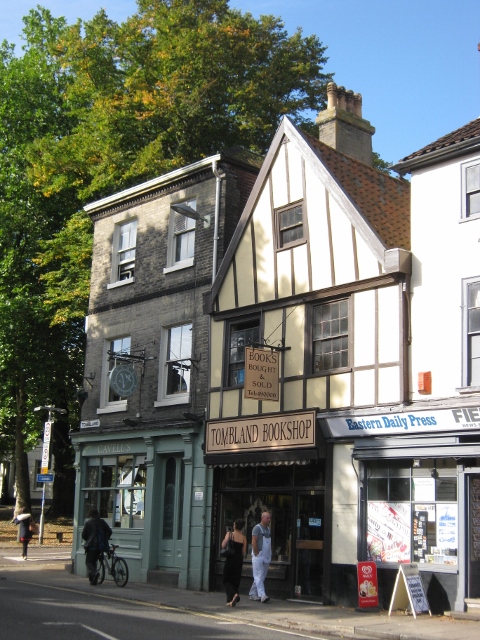
Another ancient building and the best antiquarian bookshop in Norwich.

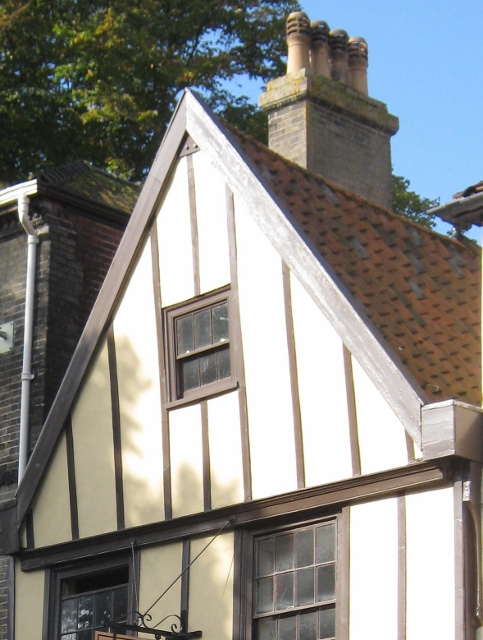
This is a 15th Century timber-framed building also in Tombland.  I like the way the gable-end of this house leans outwards.

010Medieval buildings in Tombland (483x640)

It isn’t as easy to see how much it leans out in a photo as it is in real life.
011Princes Street (640x480)

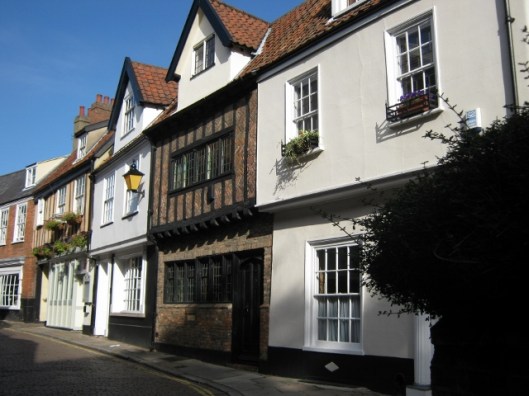
Princes Street

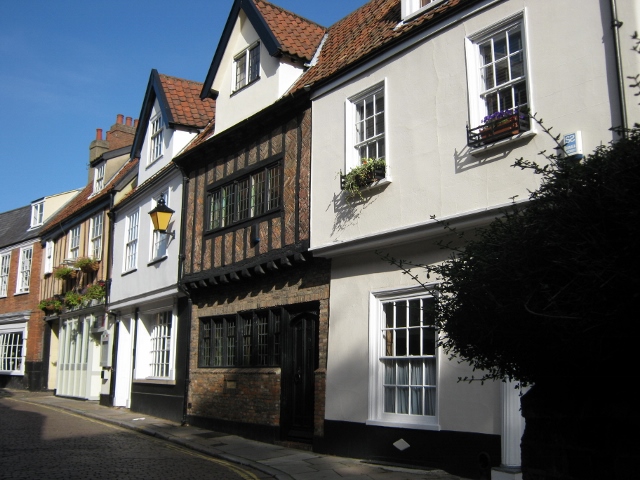
I turned off Tombland into Princes Street.  Again, this street is cobbled and is full of a mix of beautifully restored 16th and 17th Century buildings with some modern offices and homes.
012St Andrew's Hall (640x480)

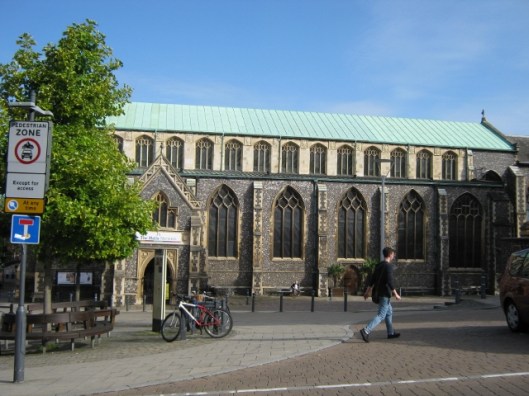
St Andrew’s Hall

Princes Street becomes Hall Plain after passing the top end of Elm Hill.  St Andrew’s Hall is in Hall Plain.  It and Blackfriar’s Hall at the top of Elm Hill are part of the most complete medieval friary complex surviving in this country.  In 1538 during the reign of Henry VIII they passed into civic hands.  The roof beams for Blackfriars and the hammerbeams in St Andrew’s roof were the gift of the Paston family together with superb 15th Century doors bearing the Arms of the Pastons and Mautbys in the South Porch.  The nave of St Andrew’s Hall was repaired and renamed The New Hall and has been used for civic ceremonies ever since.  The first recorded event was the mayor’s feast for Henry Fuller in 1544.  The Hall has been used for many things – Guild meetings, an assize court, a corn exchange and a corn hall.The Earl of Warwick stabled his horses here when he came to crush Kett’s Rebellion in 1549.  Sir Thomas Browne, the physician and polymath, was knighted here in 1671 by Charles II.  The Norfolk and Norwich Festival was started here in 1824 and still continues. The largest regional Beer Festival in Great Britain was started here in 1978.  I believe the Blackfriar’s Hall is used as a museum and art gallery.  The old east and west ranges of cloisters have also had many uses – granaries to store corn for Poor Relief, places of worship for Presbyterians and Baptists, a mint where £259,000 of coins were produced in 1695, the City Workhouse, schools and colleges.  They are now part of the Norfolk Institute of Art and Design.

I was now in time for my hair appointment and when that was finished I made my way home via Bungay where I bought some bird seed for my mother.

May I thank everyone for their kind thoughts and wishes.  My husband is in good heart though not looking forward to brain surgery.  My mother seems a little better too.  We will see how E gets on on Monday and the rest of next week.  I will keep you informed when I can.  God Bless you all.


Share this:

  • Share on X (Opens in new window) X
  • Share on Reddit (Opens in new window) Reddit
  • Share on Pinterest (Opens in new window) Pinterest
  • Share on Facebook (Opens in new window) Facebook
  • Email a link to a friend (Opens in new window) Email
  • Share on Tumblr (Opens in new window) Tumblr
  • Print (Opens in new window) Print
  • Share on Pocket (Opens in new window) Pocket
  • Share on LinkedIn (Opens in new window) LinkedIn
Like Loading...

Norwich Market

09 Sat Aug 2014

Posted by Clare Pooley in Rural Diary, Uncategorized

≈ 12 Comments

Tags

Asante campaign, gutter clearing, hurricane'Bertha', market, multi-coloured tilts, Norwich, Norwich Market, parcel delivery, shopping, Sir Garnet Wolesley

I spent yesterday at home and managed to do quite a bit of gardening.  Well, not exactly proper gardening by which I mean weeding, digging, planting, pruning and the like; more like housework outside – sweeping and tidying, moving pots about and generally clearing spaces.  It was well overdue and I thoroughly enjoyed myself.

I was at home all day because I was waiting for a delivery that needed signing for – a new battery for our caravan.  A delivery company had tried to deliver it on Wednesday while I was out with Mum and had left a note to say as much.  The note asked me to contact them on-line and re-arrange a delivery time, but if they didn’t hear from me they would call again the following working day.  The website was strange and I couldn’t find anywhere on it where I could arrange a new delivery time so resigned myself to spending an enforced day at home.  I thought of it with pleasure!

It still hadn’t arrived by the time R got home from two days away in Gloucestershire.  He looked at the site and found that the battery would be delivered today, Friday.  I had hoped to go to Norwich to collect some knitting wool for Mum – she is knitting a pullover – and buy a birthday present for someone.  I also had to have my monthly blood test at the surgery.  I resigned myself to spending yet another day at home.  I thought of it with slight annoyance.  I also thought how difficult re-arranging deliveries is now for people like my mother and mother-in-law, who do not have computers.  There was no telephone number for these people to contact the company so they would wait in all next day and wonder where their parcel was.

R spent some time yesterday evening trying to clear clumps of moss and lots of ash tree keys out of the gutters.  Our ladder isn’t quite tall enough to reach the gutters so the job was very difficult for him especially as he doesn’t have a head for heights.  We are preparing for bad weather which is forecast for Sunday.  The tail-end of hurricane Bertha is coming our way and it is as well for the gutters to work properly when it arrives.

I was pleased to see a delivery van arrive this morning just before 8.00 a.m.  It reversed into the driveway and stopped outside the front door.  I waited for the man to get out, but I waited in vain. The man waited in van.  I went to the door and stood outside hoping that would get him moving.  He wound down the window and said, “Sorry, love!  I can’t deliver your parcel til eight-o-five – it’s against regulations.  I’ll knock on the door in a while”, and then wound up the window again.  Sure enough, at 8.05 a.m. a knock came at the door and I was able to sign for my parcel.  The driver told me that each delivery has an allocated time for it.  The new rules meant that instead of one hundred deliveries a day he now had seventy-five but he couldn’t get the work done any quicker.  He said he wasn’t complaining.

I wasn’t complaining either.  I went off to Halesworth surgery and had my blood test and a good chat with the phlebotomist who is a friend.  I also met another friend from church outside the surgery and had a talk with him.  Home again, home again jig-a-jig-jig and found that E was happy to come to Norwich with me.

Our first port of call was Jarrolds, a large independent department store in the city.  It has quite a good toy department on the top floor which is where I wanted to go, and it also has a good art and book department where E might have wanted to browse.  However, she was quite content looking at all the toys available now and trying to find ones she used to have.  We then went to Waterstones, the bookshop.  This is a favourite shop and gave E the opportunity to say which books she wanted and for me to ask her how much money she had brought with her and would that cover the price?

We dragged ourselves away from there after an hour and went to a coffee shop for lunch.  We walked back up the hill to the car-park passing the wool shop on the way where I collected Mum’s wool and E admired the shop-lady’s little dog, a black poodle, asleep in a chair.  We left Norwich eventually, once we had extricated ourselves from a long traffic-jam caused by road-works and then drove to Beccles where we did some supermarket shopping and arrived back home just before R got in from work.

I expect you are wondering where Norwich Market comes into all this.  Well, most of our day was spent very close to the market.

003Norwich Market

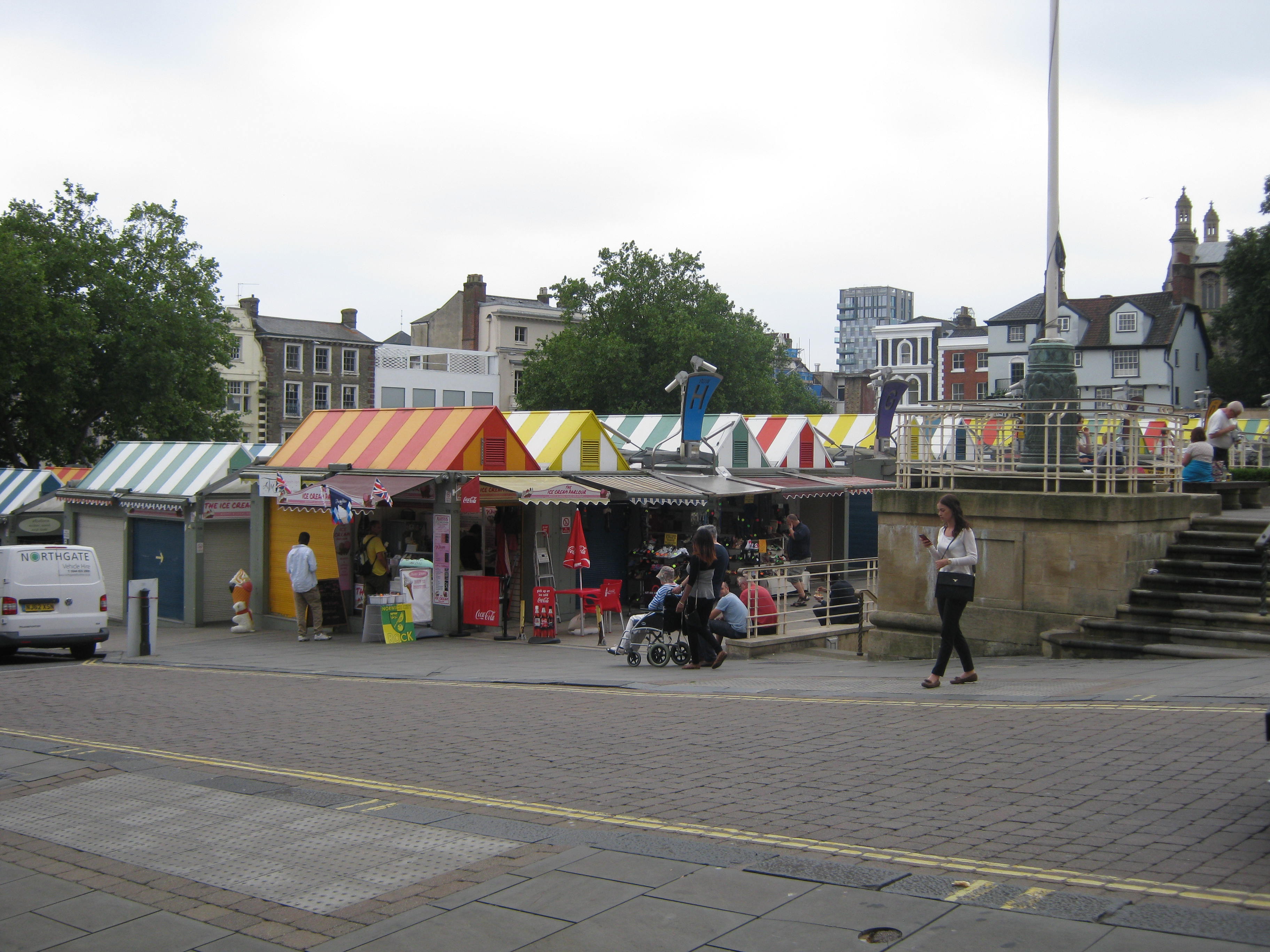
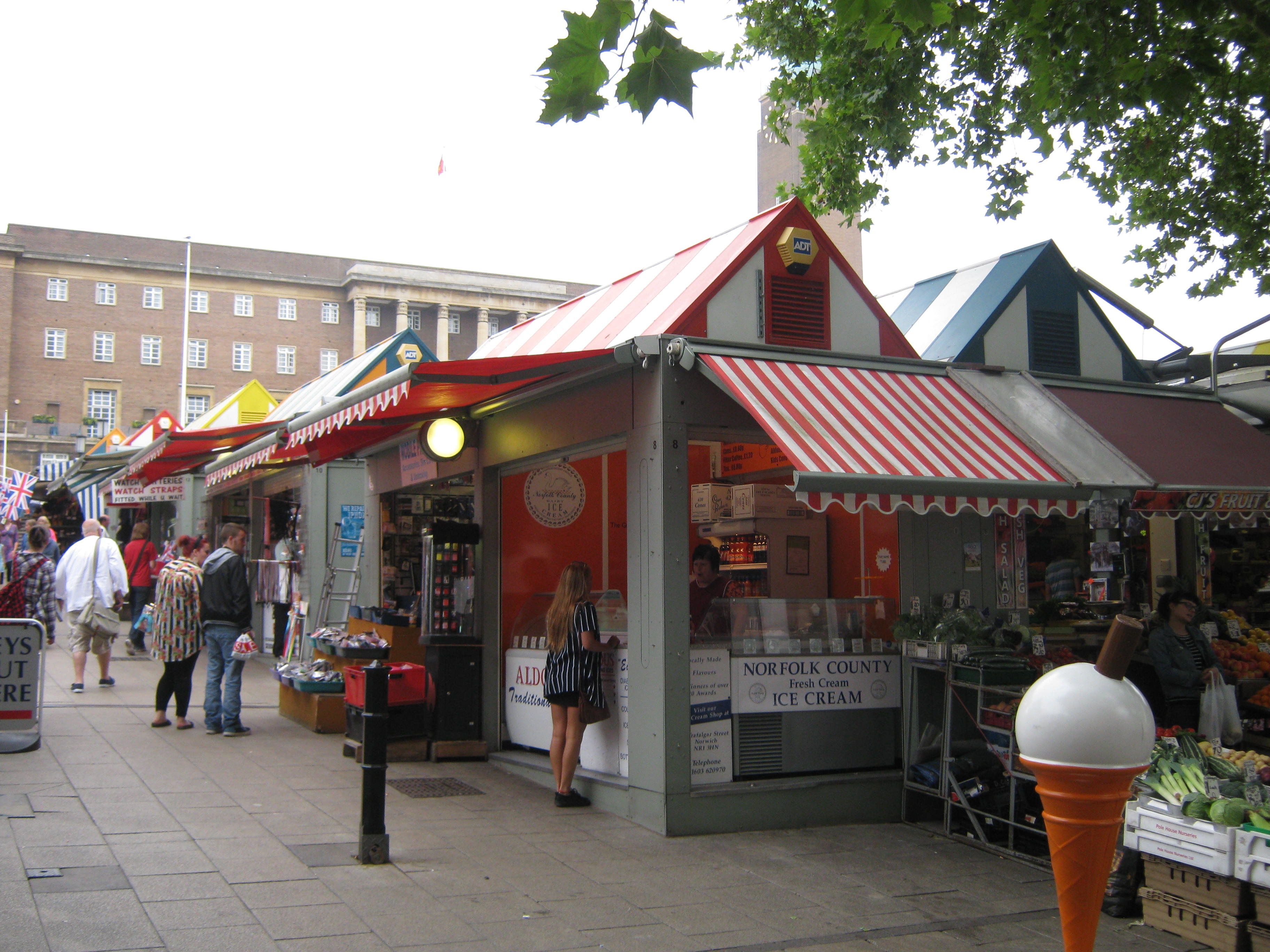
It is one of England’s oldest continuing markets having been on the same site since the 11th century.  Like most fairs and markets in the Middle Ages, it was held under license from the King, as the right to trade and receive revenues was part of the Royal prerogative.  However, in 1341 King Edward III visited Norwich for a jousting tournament just as the building of the defensive city walls had been completed “for the honour of the King”.  In gratitude, the King granted the franchise of the market to the city’s rulers in perpetuity.  The franchise still survives to this day.  I expect the person who thought to tell the King the defensive walls were built for him was feeling very pleased with himself after that! What a clever bit of crawling that was!

005Norwich Market

The market with its multi-coloured tilts is a tourist attraction now as well as part of the city landscape and a place where many people earn their livings.  All sorts of things can be bought in the market with its 187 stalls. It is open from Monday to Saturday.

006Norwich Market

The market was fully refurbished in 2005.  It looks similar to the way it did before the modernisation.  It lost quite a bit of its quaintness but it is a much more comfortable and a healthier place to work than before.

004The Sir Garnett

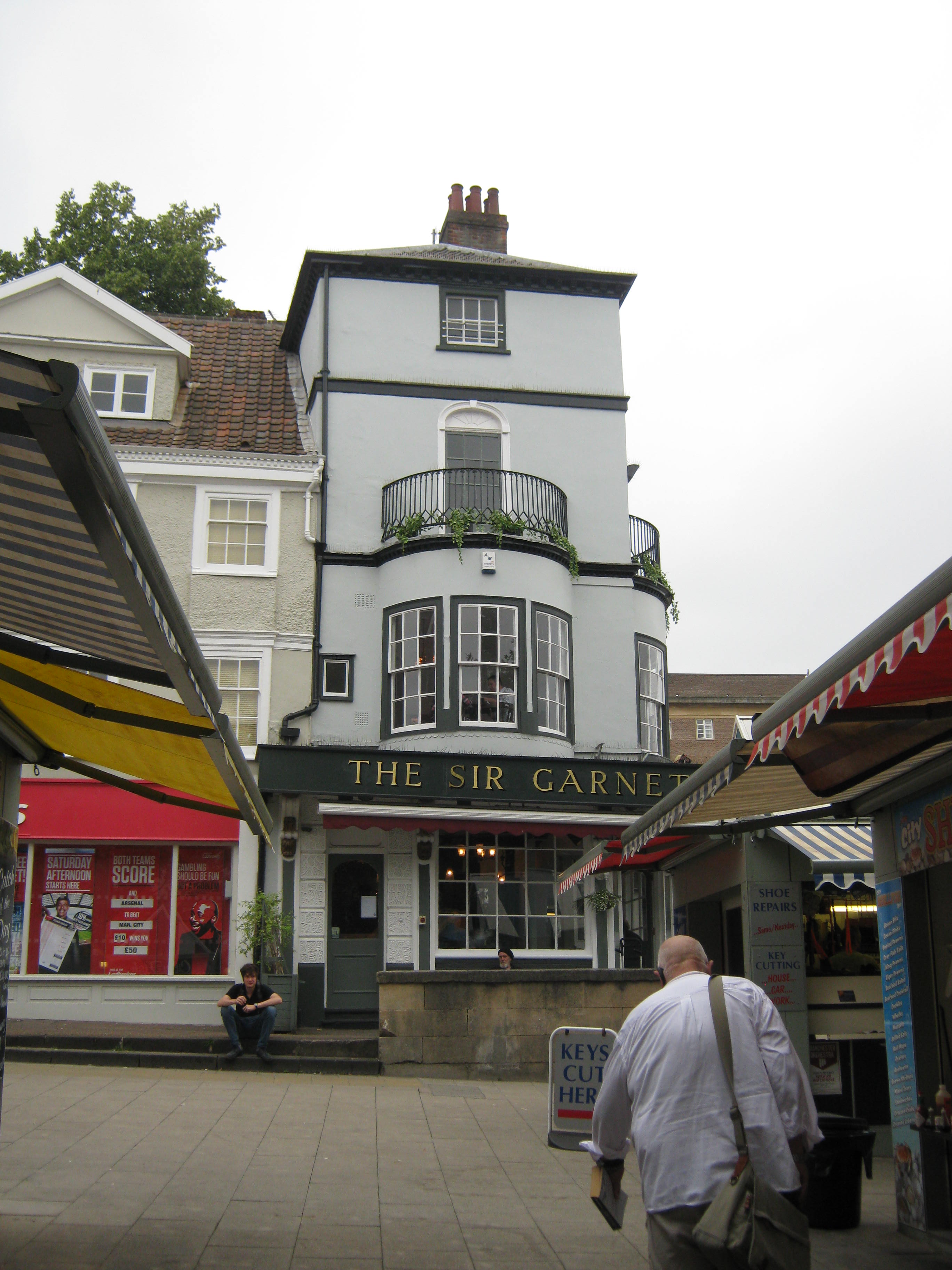
This is ‘The Sir Garnet’ pub.  Or to give it its full name – ‘The Sir Garnet Wolseley’.  It is one of the public houses in the Market Place and started trading as a public house in about 1861.  It was originally called ‘The Baron of Beef’, possibly because the premises was once a butcher’s shop but in 1874 it adopted the name ‘The Sir Garnet Wolseley’ in honour of Field Marshal Garnet Joseph Wolseley, 1st Viscount Wolseley.  That same year he had received accolades for the brilliantly executed Asante Campaign.  This Asante campaign was the third of four conflicts between the Asante Empire in Akan, the interior of the Gold Coast now Ghana, and the British Empire in the 19th century.  General Garnet Wolseley with 2500 British troops and several thousand West Indian and African troops was sent against the Asante.  The war was covered by war correspondents including Henry Morton Stanley (explorer and journalist (“Dr Livingstone, I presume”)) and G. A. Henty (novelist and special correspondent). The war started when the British ended slavery on the Gold Coast in 1806 causing the (British) African Company of Merchants to go bankrupt as they owned slave forts all along the coast.  The Asante economy was also affected as it was dependent on the slave trade too.  The wars then developed into the usual power struggle between the Asante Empire, the Dutch, who supported the Asante and the British Empire.  The Asante, impressively, withstood the British in some of these wars but in the end the Asante Empire became a British Protectorate in 1901. Sir Garnet Wolseley’s reputation for efficiency led to the late 19th century English phrase “everything’s all Sir Garnet”, meaning, all is in order.  This phrase was one that my grandfather used and until we came to Norwich and saw this pub we had no idea that Sir Garnet was a real person or why my grandfather used the expression.  And now we know!

Share this:

  • Share on X (Opens in new window) X
  • Share on Reddit (Opens in new window) Reddit
  • Share on Pinterest (Opens in new window) Pinterest
  • Share on Facebook (Opens in new window) Facebook
  • Email a link to a friend (Opens in new window) Email
  • Share on Tumblr (Opens in new window) Tumblr
  • Print (Opens in new window) Print
  • Share on Pocket (Opens in new window) Pocket
  • Share on LinkedIn (Opens in new window) LinkedIn
Like Loading...

Preparations for a Journey

05 Wed Feb 2014

Posted by Clare Pooley in Rural Diary

≈ Leave a comment

Tags

'Julius Caesar', Diss, fir tree sapling, flood warning, greylags, Halesworth, Harleston, Norwich, Sheffield

I have only spent a little time in the garden during the past two days.  I won’t be at home for the next couple of days so I have been doing housework and shopping to make sure E and R will be alright while I am gone.  I am going to Sheffield to see A, my eldest daughter and to watch her perform in her dramatic society’s production of ‘Julius Caesar’.  A is playing Portia and I am really looking forward to seeing her and watching the play.  I won’t be staying with her this time as she is now in a shared house and there isn’t the room.  I am staying in a hotel in the centre of the city close to the Cathedral.  I hardly ever go away on my own – in fact the last time I did was just over three years ago when I attended A’s M.A. graduation ceremony in Sheffield.  She has been studying for her PhD for the past three years and it is nearing completion.  She is also looking for work and running out of money!

E, my younger daughter, has been looking after a little fir tree sapling in her room for a year since my mother gave it to her.  It is growing quite well but looking a little pale.  I have been suggesting for some time that it ought to go outside and get some fresh air but she has been reluctant to let it go.  I think she remembers the ones I grew from seed a few years ago that were doing very well until I put them outside only to be eaten by something.  I have put her little tree in the greenhouse with other trees I am growing – a yew, two beeches, two oaks and a couple of laburnums.  In the spring they will go outside but somewhere where the deer and pheasants can’t get at them.  While I was in the greenhouse yesterday I checked all the plants in there – tidied them up and gave a little water to most of them.

  The geese are making themselves at home as usual.  They wander about over the garden leaving ‘little messages’ all over the place.  They join next door’s chickens in pecking up spilt seed under the feeders and bird tables.  The female especially has started following me about when I am outside in the hope that I may give them something to eat.  They were around this morning but when I got home about 3pm they had flown off somewhere less windswept.  I spent most of today with my mother helping with shopping, going to Harleston and Diss with her and then collecting her medication from the surgery.  We had a nice chat over a cup of coffee when we got back to her house and then I had some shopping of my own to do in Halesworth and my own medication to collect.  I also remembered, at last, to call in at the church and change the church colours;  the altar frontal and the cloth on the pulpit have been white since Christmas but now that we have had Candlemas the green cloth and frontal must be put up.  The colours will stay green until Ash Wednesday, the beginning of Lent, when all changes to purple.  R usually does this as he is one of the Churchwardens but he has been very busy this week so I offered to do it.  He had to take his car in for a service today at the recommended garage in Norwich.  In total he has driven about 140 miles today just for a car service!  Thirty miles to Norwich, probably over forty miles to his place of work, the same distance this afternoon back to the garage and then thirty miles home again

.  I didn’t spend long in the garden this afternoon as the weather was so wet and windy.  I saw more molehills, more wood down off the birch tree and all the ponds have risen again.  R tells me that the there is a flood warning on the Waveney and the Beck today – this does not surprise me though we have had less rain here than most other places around the country.  


Share this:

  • Share on X (Opens in new window) X
  • Share on Reddit (Opens in new window) Reddit
  • Share on Pinterest (Opens in new window) Pinterest
  • Share on Facebook (Opens in new window) Facebook
  • Email a link to a friend (Opens in new window) Email
  • Share on Tumblr (Opens in new window) Tumblr
  • Print (Opens in new window) Print
  • Share on Pocket (Opens in new window) Pocket
  • Share on LinkedIn (Opens in new window) LinkedIn
Like Loading...
Newer posts →
Follow A Suffolk Lane on WordPress.com

Enter your email address to follow this blog and receive notifications of new posts by email.

Join 715 other subscribers.

Unknown's avatar

I talk about what it's like living in a quiet part of Suffolk. I am a wife, mother and daughter, a practising Christian and love the natural world that surrounds me. I enjoy my life - most of the time!

My Posts

Jan 2026
M T W T F S S
 1234
567891011
12131415161718
19202122232425
262728293031  
« Dec    

Pages

  • About my Blog
  • GDPR (General Data Protection Regulations) and This Site
  • My Life in a Suffolk Lane

Archives

Blogs I Follow

Unknown's avatar
Unknown's avatar
Unknown's avatar
Unknown's avatar
Unknown's avatar
Unknown's avatar
Unknown's avatar
Unknown's avatar
Unknown's avatar
Unknown's avatar
Unknown's avatar
Unknown's avatar
Unknown's avatar
Unknown's avatar
Unknown's avatar
Unknown's avatar
Unknown's avatar
Unknown's avatar
Unknown's avatar

Posts I Like

  • gederedita's avatar
  • JAM's avatar
  • Unknown's avatar
  • Unknown's avatar
  • Unknown's avatar
  • quietsolopursuits's avatar
  • John’s Postcards's avatar
  • Unknown's avatar
  • Unknown's avatar
  • Unknown's avatar
  • mitchteemley's avatar
  • Unknown's avatar
  • Wayne Wolfson's avatar
  • Unknown's avatar
  • Unknown's avatar
  • Maikhel's avatar
  • Unknown's avatar
  • Unknown's avatar
  • Andrea Stephenson's avatar
  • Unknown's avatar
  • Luso Loonie — Devin Meireles's avatar
  • Unknown's avatar
  • Unknown's avatar
  • Unknown's avatar
  • M T McGuire's avatar
  • Kathleen's avatar
  • thesimlux's avatar
  • bitaboutbritain's avatar
  • East of Elveden's avatar
  • Rich's avatar
  • Unknown's avatar
  • Schnippelboy's avatar
  • Unknown's avatar
  • Unknown's avatar
  • Unknown's avatar
  • Secret Diary of A Country Vicar's Wife's avatar
  • Unknown's avatar
  • Unknown's avatar
  • Unknown's avatar
  • Limentinus's avatar
  • Unknown's avatar
  • Unknown's avatar
  • Dad's avatar
  • Unknown's avatar
  • Unknown's avatar
  • Unknown's avatar
  • Unknown's avatar
  • Unknown's avatar
  • Martha's avatar
  • martzkvi's avatar

amphibians architecture art Arts and Crafts churches cooking Days out domestic animals family fish Folk Traditions Gardening Historic Buildings holidays Insects Landscaping literature music Norwich plants Rural Diary seashore theatre trees Uncategorized walking weather wild animals wild birds wild flowers

Tags

architecture autumn birds blackbird blackthorn Bungay butterfly church clouds common knapweed cow parsley crocus daffodils Diary dogwood family field maple flowers fungus garden gardening geese greylags ground-ivy Halesworth Hawthorn heather holiday Holly Holy Week horse chestnut Hoverfly insects ivy Lake District Lent lesser celandine lichen Lords and Ladies Mallard mallards Minsmere moorhen moss music Norwich Peak District pheasant plants pond ponds primrose primroses Rain rooks Rumburgh Rumburgh Church sheep Sheffield snow snowdrops Southwold spring Suffolk Suffolk Wildlife Trust sunset the Beck trees viburnum bodnantense walking weather wild cherry wild flowers winter-flowering honeysuckle witch-hazel

Meta

  • Create account
  • Log in
  • Entries feed
  • Comments feed
  • WordPress.com

Goodreads

Blog at WordPress.com.

Book Jotter

Reviews, news, features and all things books for passionate readers

Country Life Blog -

A blog about life in the country in the past and present

Matthew Paul: Poetry & Stuff

Poetry and what-not

Schnippelboy

Ein Tagebuch unserer Alltagsküche-Leicht zum Nachkochen

TAMARA JARE

TAMARA JARE Tamara Jare: Contemporary Figurative Painting Oil on Canvas Artist Art Studio

A Taste of Freedom

Documenting a Dream

Country Ways

Rambling Journeys in Britain, Countryside Matters and campaigning for the Right to Roam

The Strawberry Post

Here to Entertain, Educate & Inspire!

a north east ohio garden

an ongoing experiment in the dirt, 35 plus years

naturechirp

Celebrating God's creatures, birds and plants...

Sophie Neville

Writer

Going Batty in Wales

Developing a more sustainable lifestyle in SW Wales

Our Lake District Escapades

Exploring the Lake District and beyond

Short Walks Long Paths

Wandering trails around the coast of Wales

The Biking Gardener

An English persons experience of living and gardening in Ireland

Nan's Farm

A Journal Of Everyday Life

Walk the Old Ways

Rambling Journeys in Britain with John Bainbridge. Fighting for the Right to Roam. Campaigning to Protect Our Countryside.

Writer Side UP!

Waking the Writer Side...and keeping it "Up!"

Meggie's Adventures

Travel, thank you notes and other stories

amusicalifeonplanetearth

Music and the Thoughts It Can Inspire

lovefoundation.co.uk

Traveling Tortuga

Simply Living Well

Pakenham Water Mill

Historic watermill in the beautiful Suffolk countryside

Take It Easy

Retired, not expired: words from the after(work)life. And music. Lots of music!

Secret Diary Of A Country Vicar's Wife

By Olive Oyl

thanksfortheadventureorg.wordpress.com/

The Beat Goes On

#TBGO

Frank Pleszak's Blogs

Twitter: @frankpleszak @PolishIICorps

John Bainbridge Writer

Indie Writer and Publisher

roughwighting

Life in a flash - a bi-weekly storytelling blog

Walking the Old Ways

Rambling in the British Countryside

CapKane

thoughts on social realities

SkyeEnt

Jottings from Skye

jodie richelle

embracing my inner homemaker

Skizzenbuch/Blog

Just another WordPress.com weblog

Have Bag, Will Travel

The Call of the Pen

Flash Fiction, Book Reviews, Devotionals and other things.

John's Postcards

Art in Nature

You dream, I photographe it !

Smile! You’re in Barnier World......

theinfill

the things that come to hand

Dr. Mary Ann Niemczura

Author of "A Past Worth Telling"

Provincial Woman

The Pink Wheelbarrow

Luanne Castle: Poetry and Other Words (and cats!)

Poetry, Other Words, and Cats

The Family Kalamazoo

A genealogical site devoted to the history of the DeKorn and Zuidweg families of Kalamazoo and the Mulder family of Caledonia

everythingchild

The Book Owl

Canberra's Green Spaces

Paul Harley Photographer

  • Subscribe Subscribed
    • A Suffolk Lane
    • Join 715 other subscribers.
    • Already have a WordPress.com account? Log in now.
    • A Suffolk Lane
    • Subscribe Subscribed
    • Sign up
    • Log in
    • Report this content
    • View site in Reader
    • Manage subscriptions
    • Collapse this bar
 

Loading Comments...
 

    Privacy & Cookies: This site uses cookies. By continuing to use this website, you agree to their use.
    To find out more, including how to control cookies, see here: Cookie Policy
    %d