• About my Blog
  • GDPR (General Data Protection Regulations) and This Site
  • My Life in a Suffolk Lane

A Suffolk Lane

~ A diary of my life in rural north Suffolk.

A Suffolk Lane

Tag Archives: St Peter’s church

Wenhaston Doom

02 Tue Dec 2025

Posted by Clare Pooley in architecture, churches, Days out, Rural Diary

≈ 43 Comments

Tags

St Peter's church, Suffolk, The Doom, The Resurrection, Wenhaston

It is strange how one can live for years near to places of beauty or interest but never get around to visiting them.  There always seem to be other things to do and of course these places will always be there, won’t they? And we will always be able to get to them whenever we like – yes?  Elinor and I decided to visit one on a very warm afternoon in June this year.
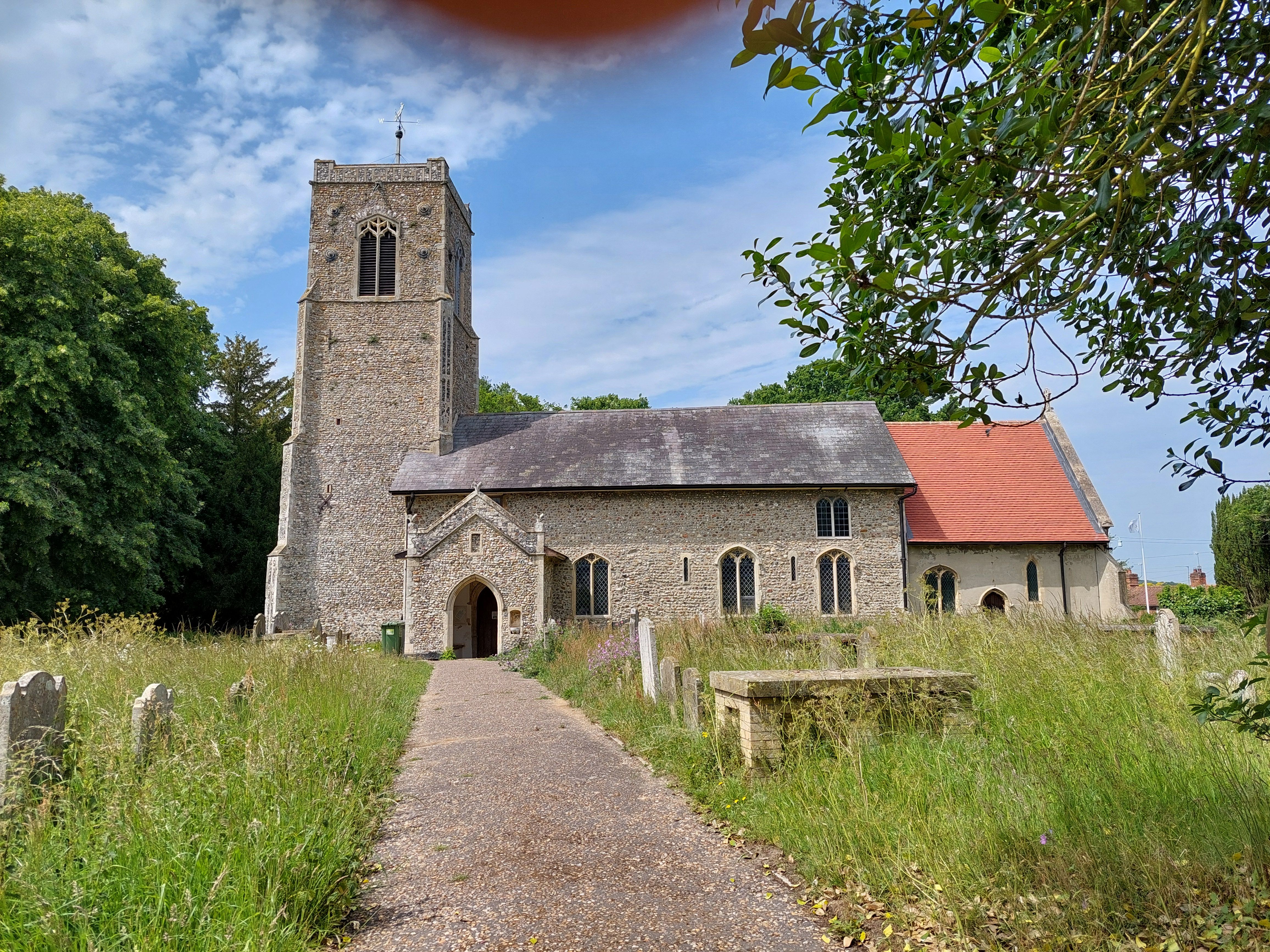
Wenhaston church

Wenhaston is about ten miles from where we live, is fairly near to Southwold on the coast, and is surrounded by farms and heathland.  Not too far away is Bulcamp, the site of a battle in the year 654 between the Anglian King Anna and the Mercian King Penda.  Anna and a couple of his sons were killed during the battle.  A workhouse was built at Bulcamp in 1764 which then became a fever hospital and has now been converted into apartments.  A little bleak and isolated for my liking. There is a nice pub in Wenhaston and I think the choir I belonged to years ago performed a concert or two in the village hall. I also had to take Alice to Wenhaston once a week for guitar lessons for a while.
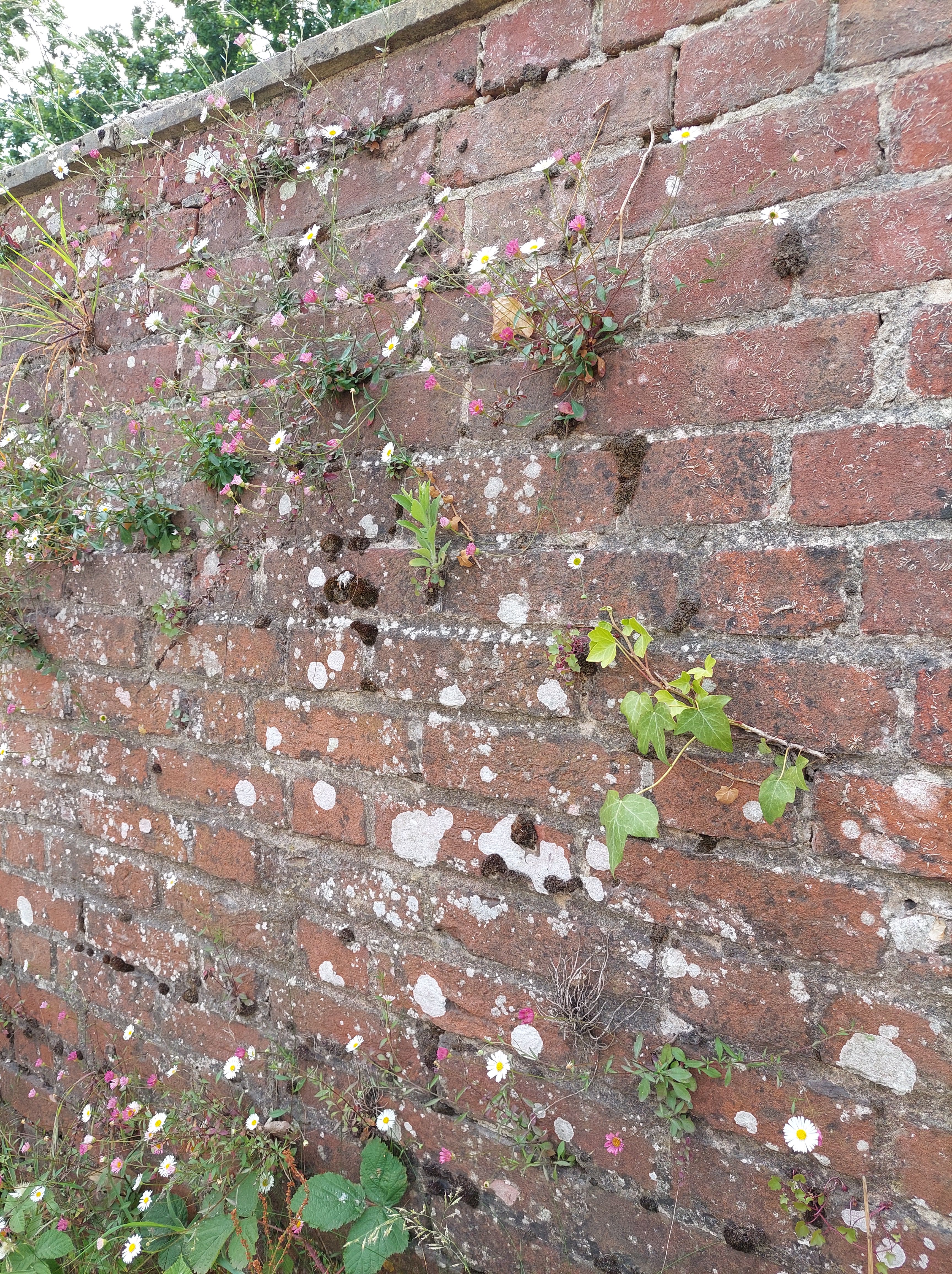
Plants on the churchyard wall
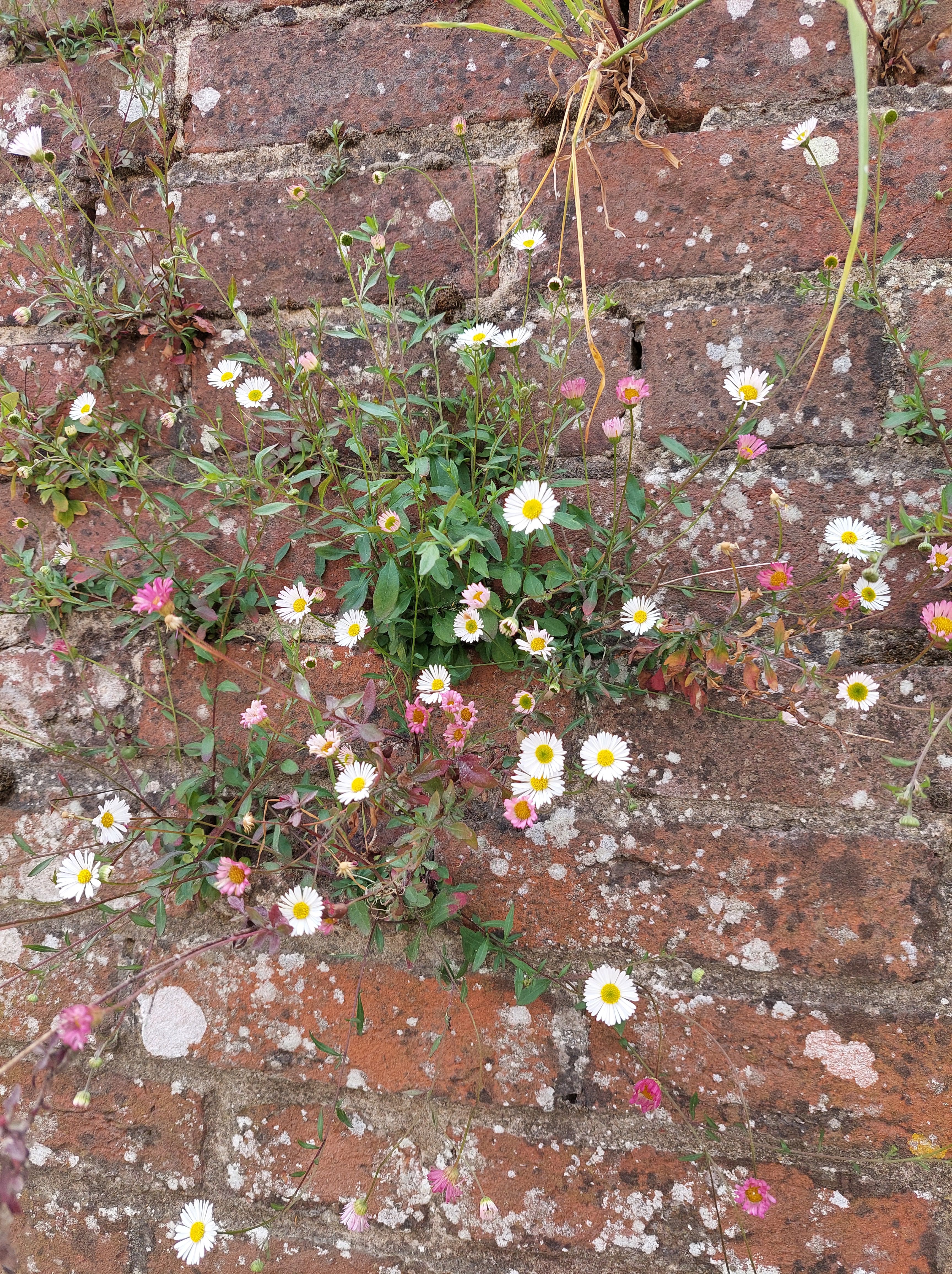
Mexican fleabane
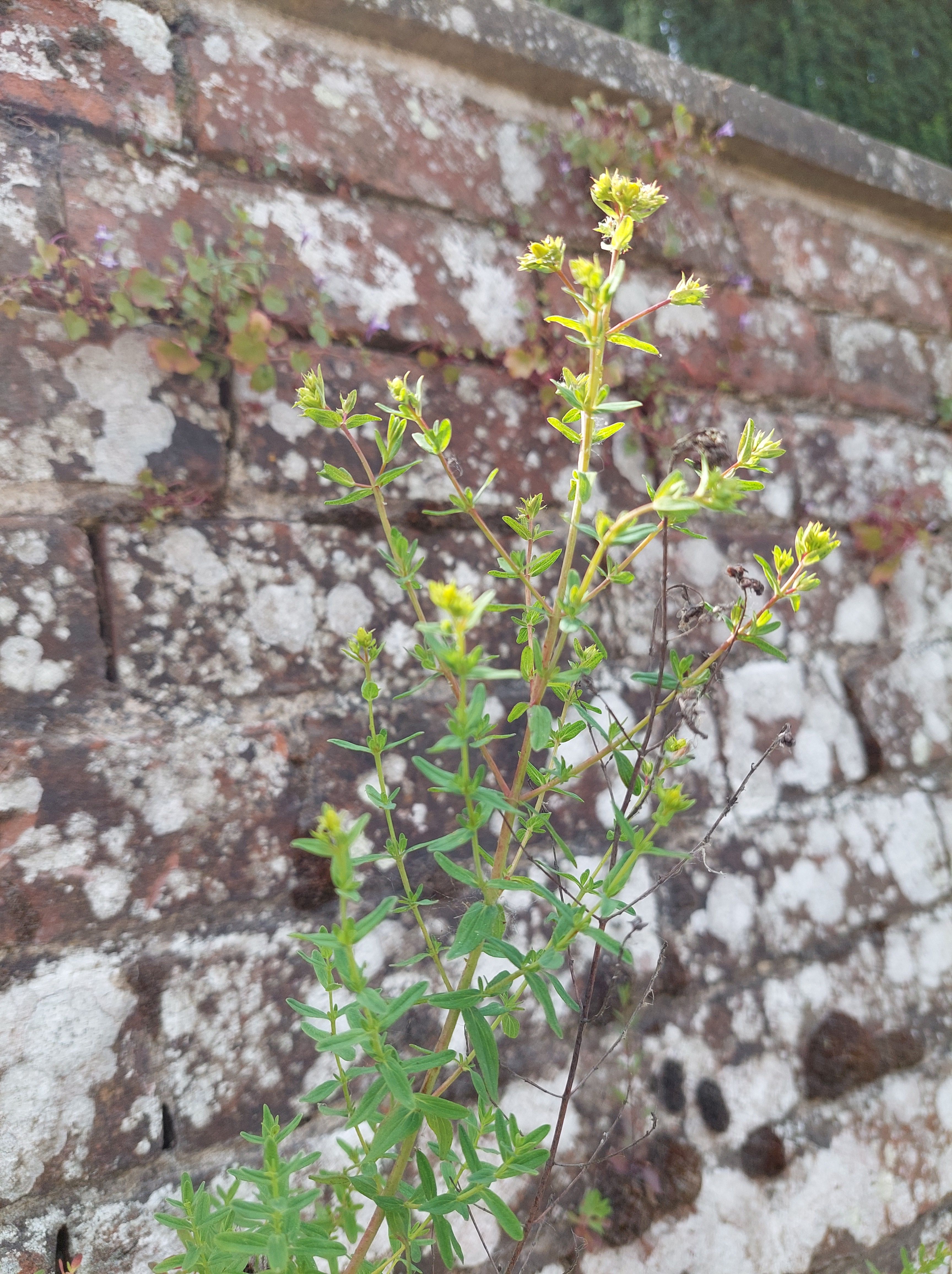
Perforate St John’s-wort
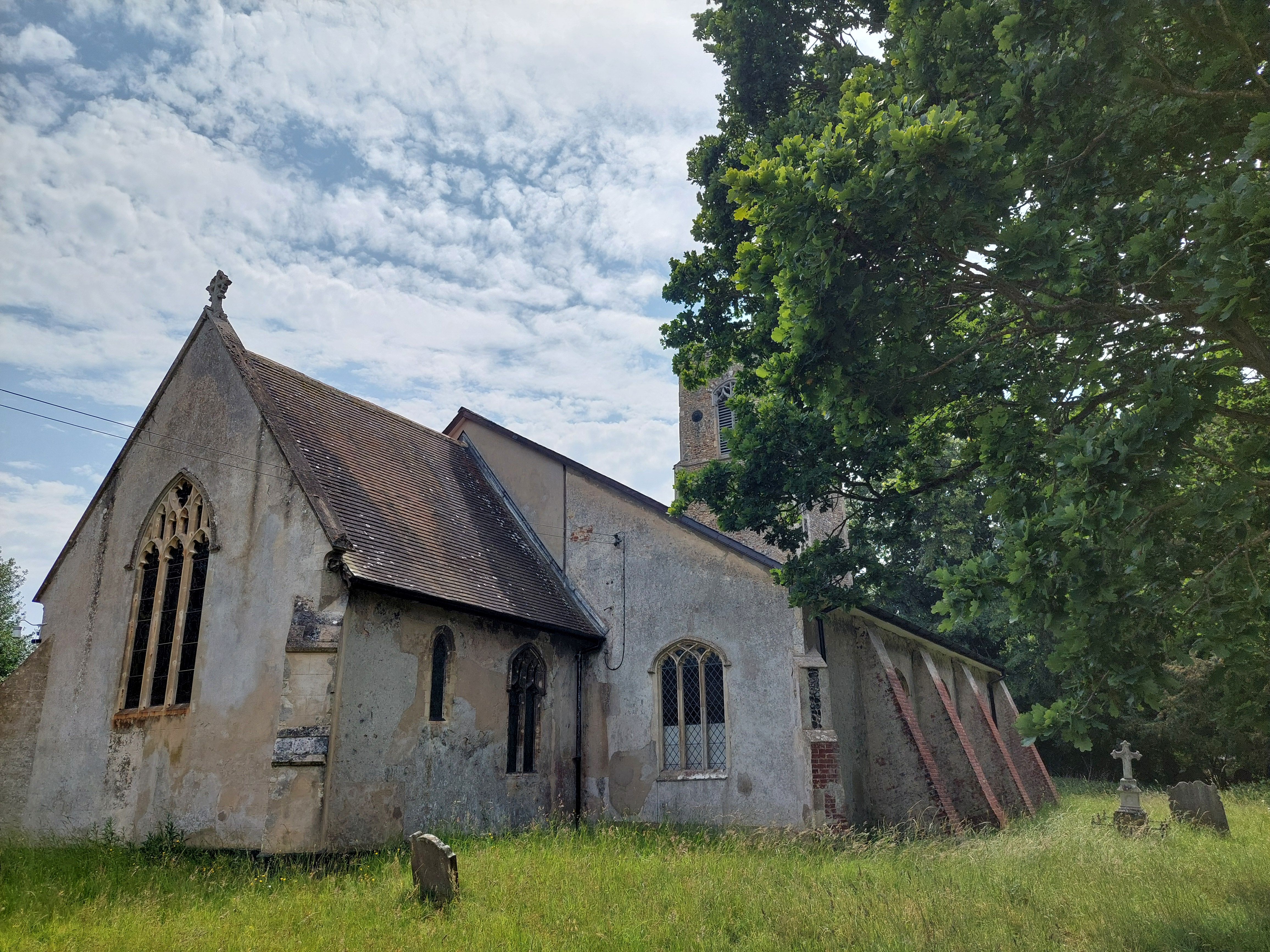
Wenhaston church
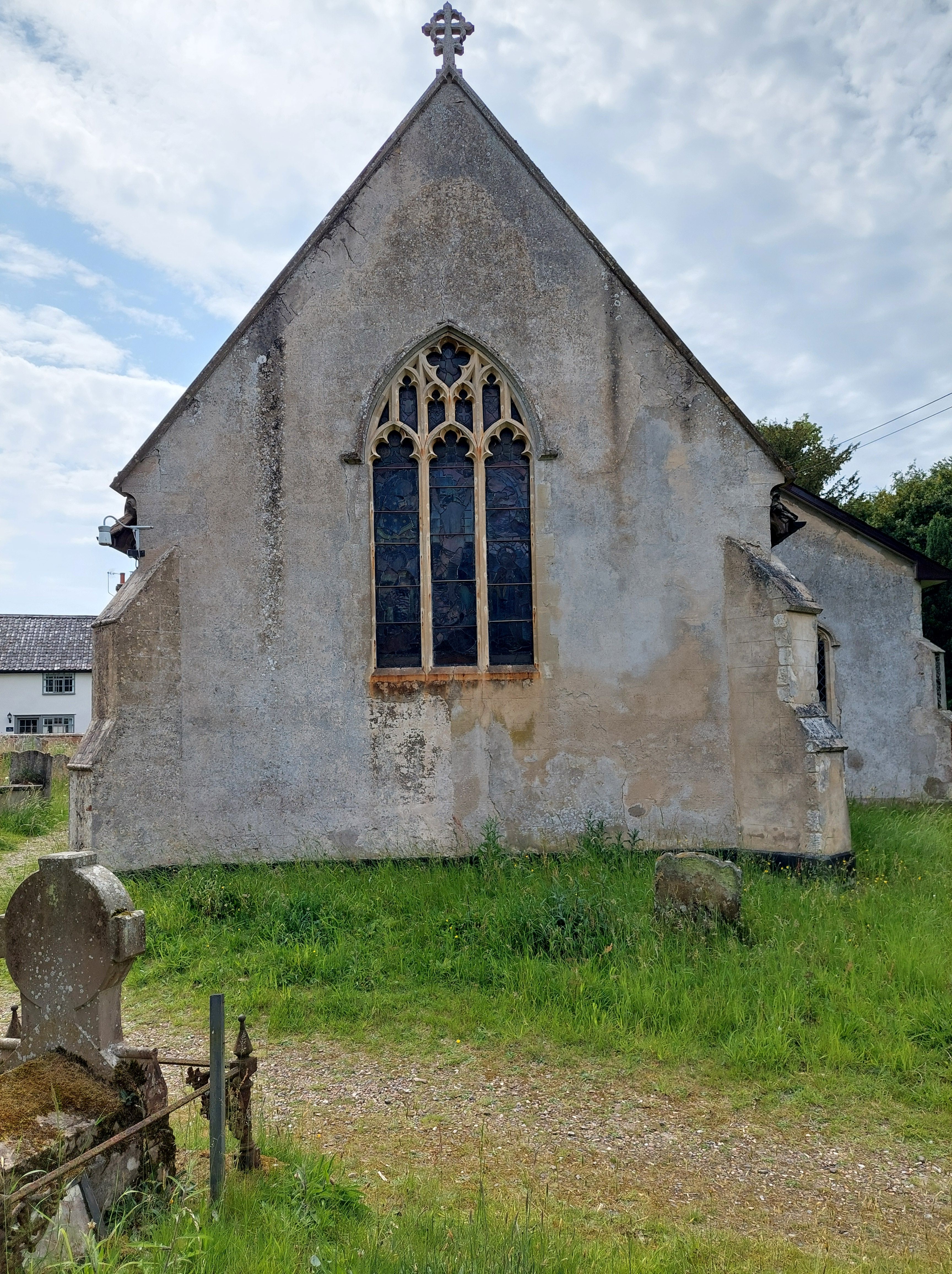
Wenhaston church

Elinor and I had come to see the church which is situated in the middle of the village.  It is referred to in the Domesday Book and part of it is of Saxon origin.  For many years it was looked after by Blythburgh Priory but like lots of churches in this country it suffered much during the reign of Edward VI and also during the Commonwealth of England under Oliver Cromwell.  William Dowsing‘s men visited in 1643 and according to the Wenhaston church guide book ‘did a lot of damage, breaking the stained glass, taking down the carved angels from the roof, removing the organ and the font cover, destroying the altar, hacking the pulpit about and much else besides’.  What they didn’t find was the Doom which the people of the parish had covered with whitewash many years earlier during Edward’s reign when he had demanded the destruction of all roods and the abolition of paintings and pictures in church.  For three centuries and more it stayed undiscovered and forgotten on the rood beam, whitewashed and painted over with passages from the Bible.
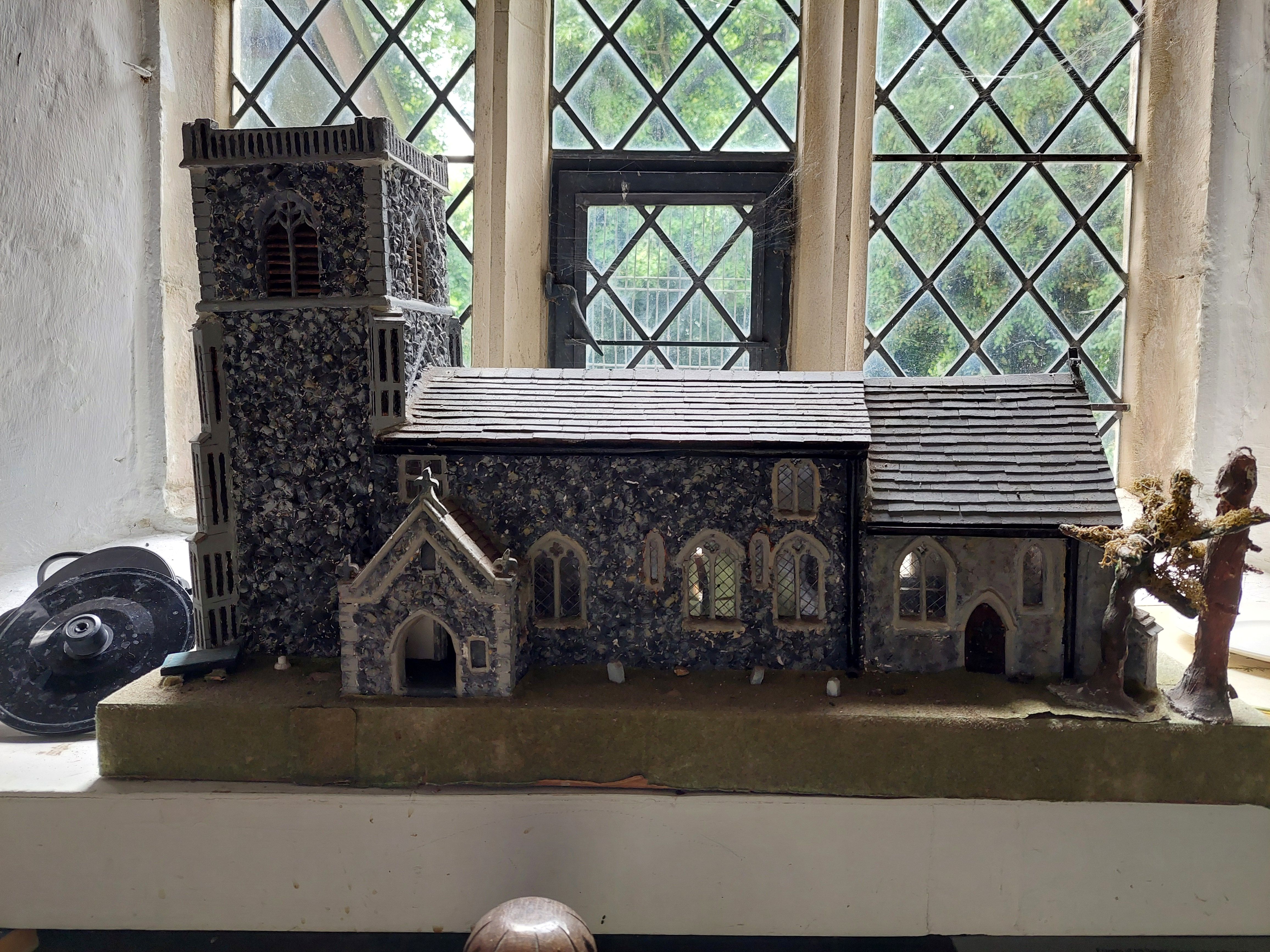
Scale model of the church on a windowsill
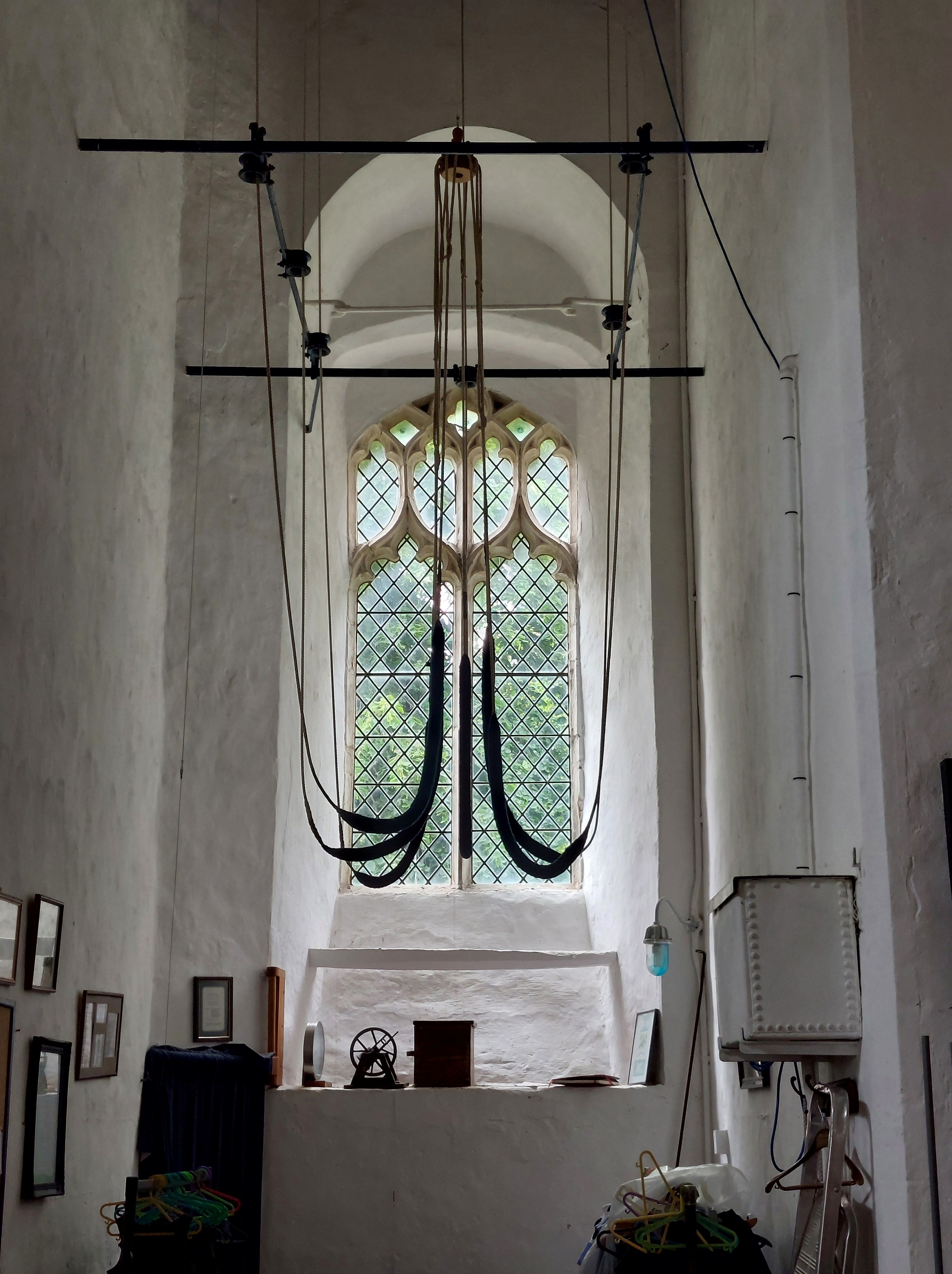
The bell-tower with the ropes lifted high, out of the reach of the hoi-polloi. There are six bells, two of which are medieval and probably came from Blythburgh Priory.
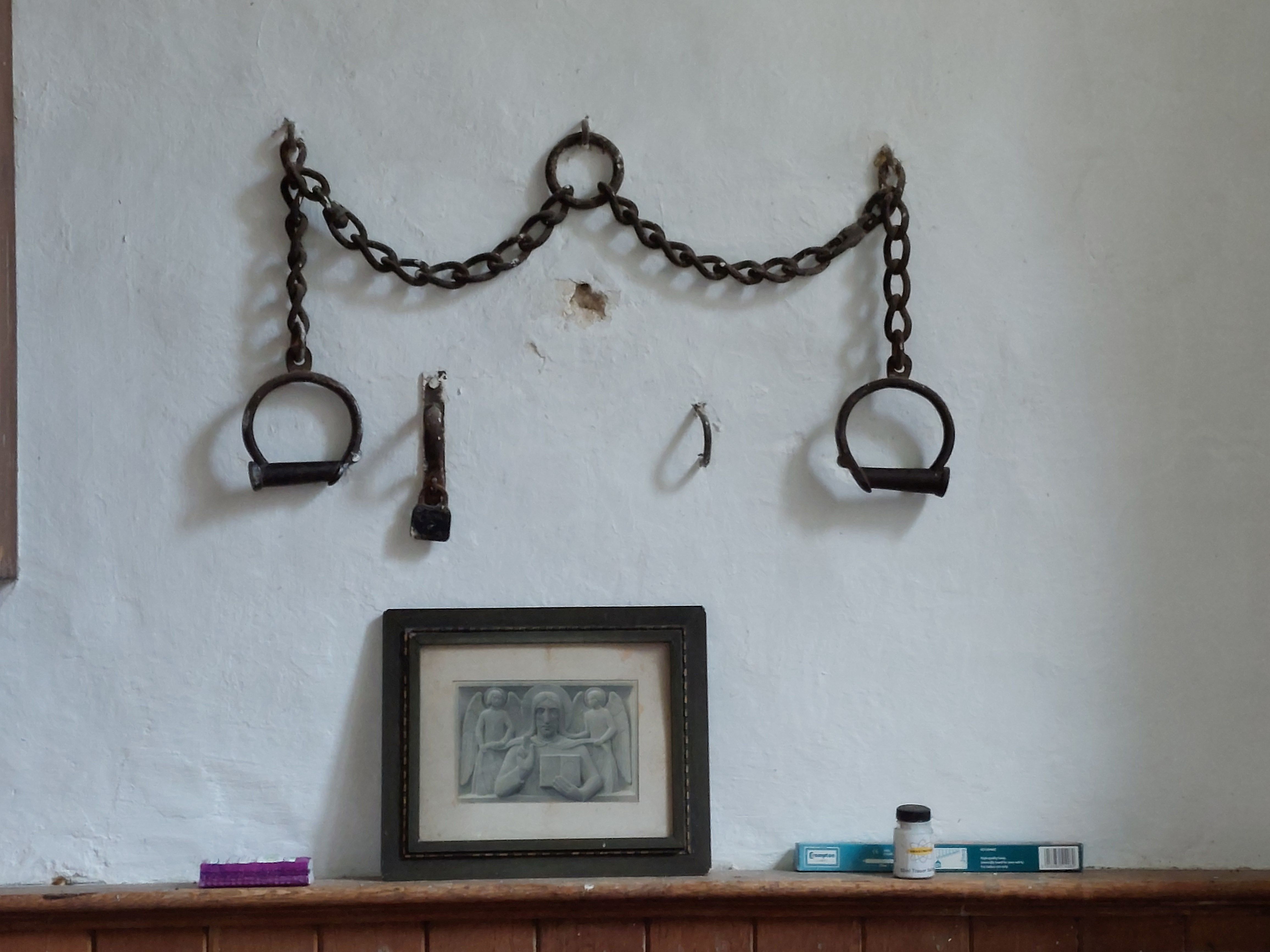
Here are the local Constable’s manacles for the stocks hanging up in the vestry. Redundant now of course, and there is no local constable any more either. I think that is a truncheon hanging there too!

In 1892 the East end of the church was rebuilt.  During the dismantling of the roof the rood beam was discovered intact and to still have its original paint and gilding.  The whitewashed Doom was removed plank by plank and thrown out into the churchyard for later destruction.  Fortunately, it rained heavily during that night and in the morning the painting underneath was beginning to emerge from under the whitewash.  The whole Doom was cleaned and experts were called in to assess its provenance.  The Doom was put on display and people paid to see it; the proceeds of which helped to pay for the rebuilding of the roof and the church was then able to get even more repairs done.  The new chancel arch was too narrow for the Doom to be replaced in its old position so for a while it was put on the West wall of the church where there was a gallery.  The gallery was removed in 1927 so that the Doom could be seen more easily and sometime later the Doom was placed where it is now on the North wall.
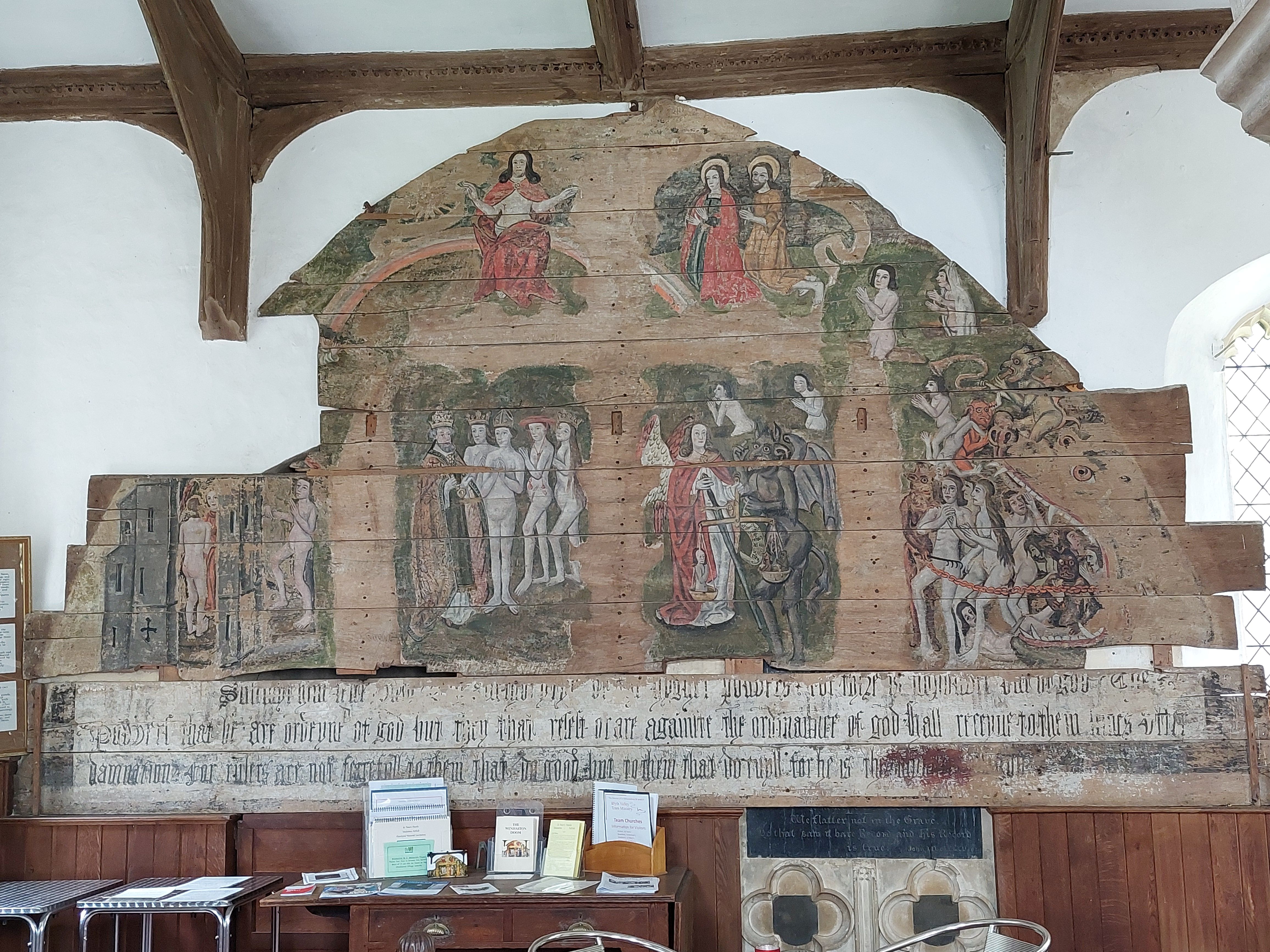
The Doom

The Doom is a representation of the Last Judgement.  It was probably painted in about 1520 or just before then, the date partly based on the style of the Virgin Mary’s bodice as depicted in the Doom. The villagers had started saving for the work to be done during the 1480’s. Dooms were usually placed on the chancel arch which separates the Nave where the common people worship – the Church Militant – and the Chancel, where the priests lead the worship – the Church Triumphant.  A rood screen was often placed at the chancel arch, which added to the seclusion of the chancel, and the sculpted or carved figures of Our Lord on the Cross with the Virgin Mary on one side and St John the Baptist on the other were placed on the top of the rood beam.  In this church the figures of the rood were attached to the Doom.  The figures have long since disappeared but their position and shape can be seen by the blank spaces on the Doom painting.

At the top of the Doom on the left is God as Christ seated on a rainbow and displaying His wounds.  At the top on the right are the Virgin Mary and St John the Baptist kneeling in prayer.  (Sadly my photograph of these two latter figures wasn’t good enough to show here).
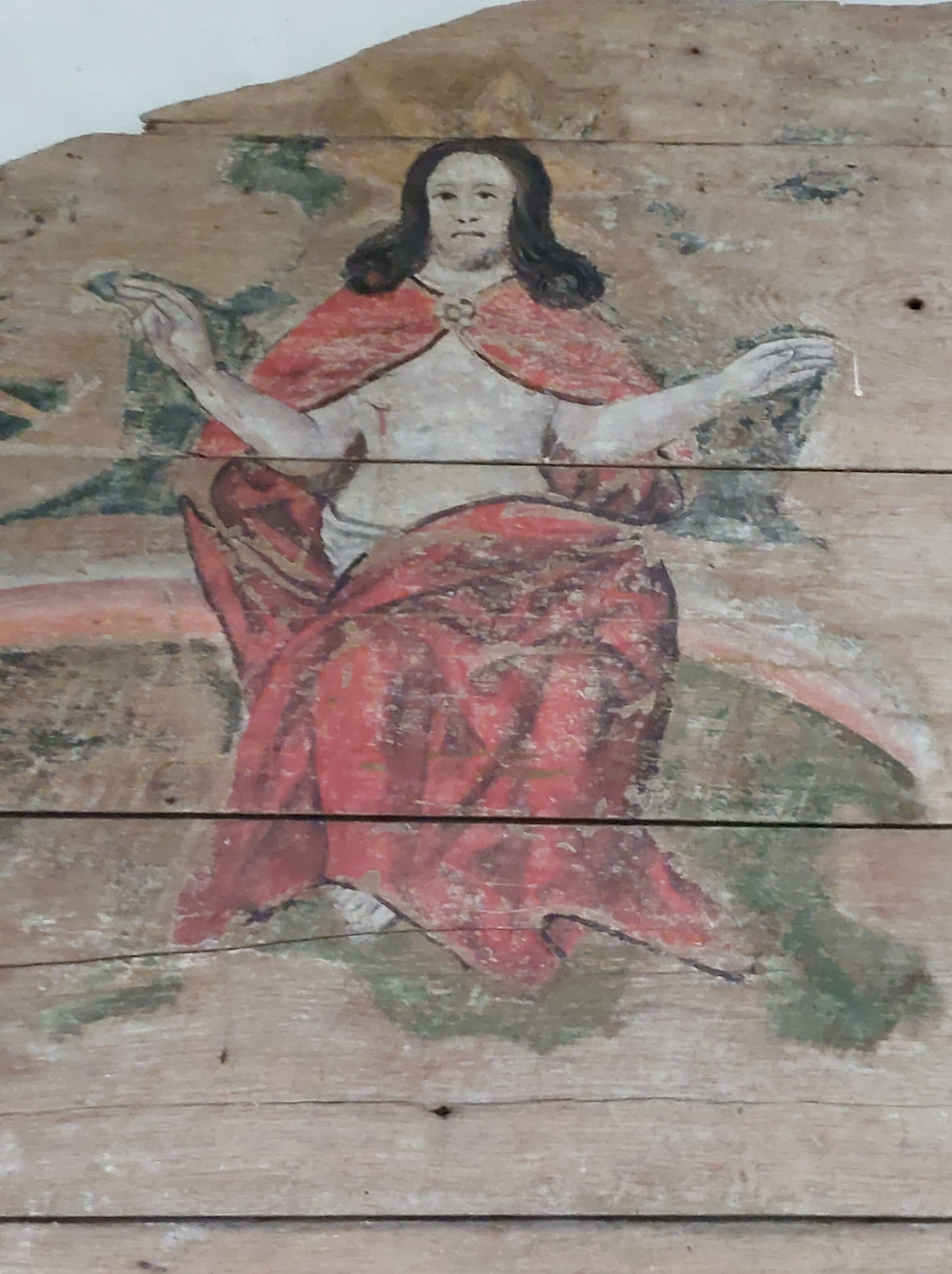
This is God appearing as Christ, the Son of Man

Beneath the figures of the Virgin and St John is the Archangel Michael with the Devil. The early Church adapted many pagan customs and ideas to Christian purposes in order to ease the transition from the pagan life to that of being a Christian.  One such custom was the idea of a messenger from Heaven and therefore the attributes of the Roman god Mercury were assumed by the Archangel Michael who became the guide of the dead.  Mercury weighed souls in classical mythology so now Michael holds the scales in his left hand.  His right hand holds his sword and he wears a circlet surmounted by a cross on his head.  The circlet at the time was very fashionable in Northern European and also English art.  You can see resurrected souls behind Michael and the Devil wending their way towards St Peter. The dead have arisen as naked as they were when they were created and all aged about 33, the age at which Christ was thought to have died.
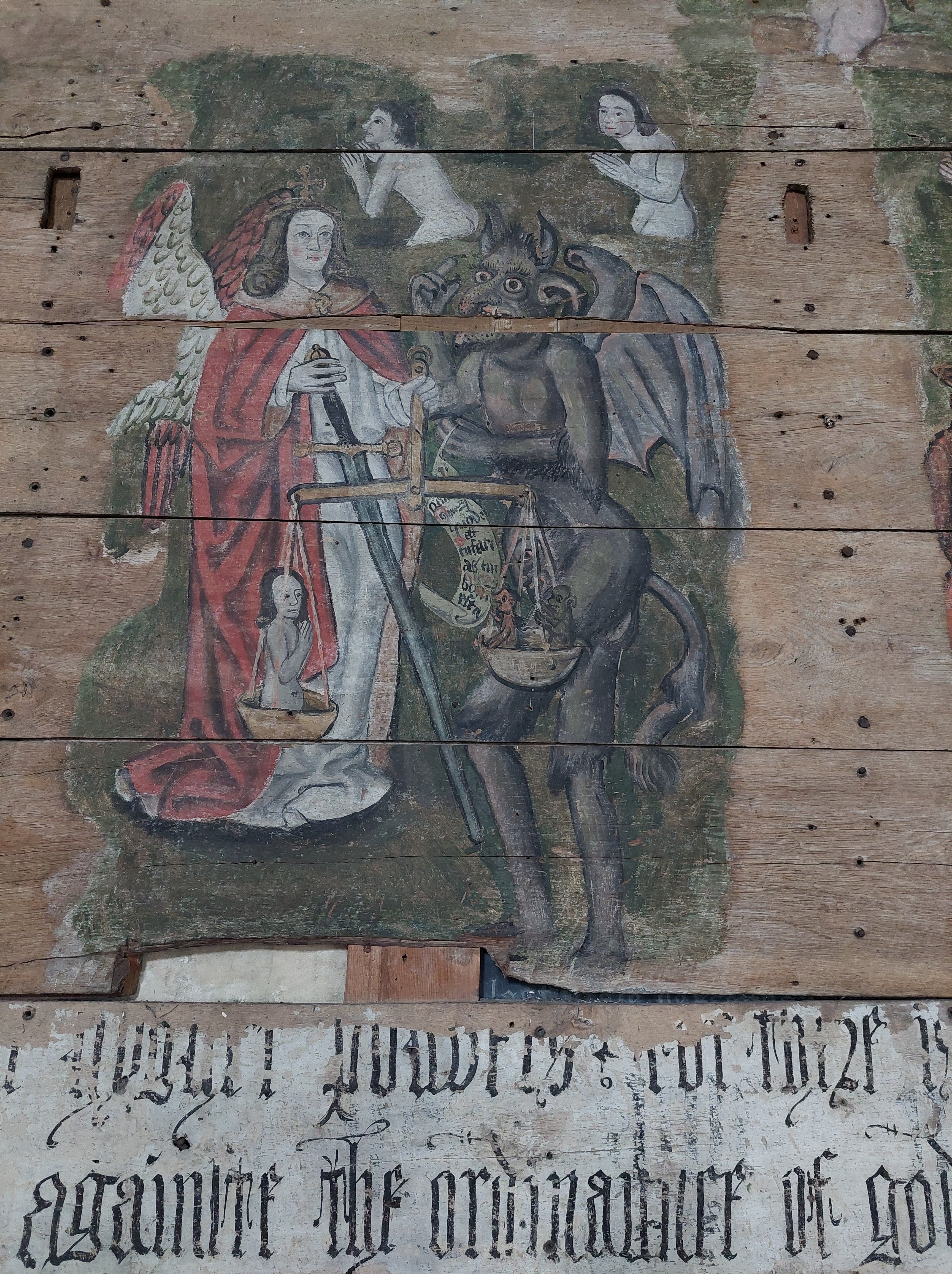
The Archangel Michael and the Devil

The Devil is wearing ragged sleeves and trousers which, according to the guide book, suggests the outfit worn by the Devil when the Wenhaston actors visited the seaside village of Walberswick in the late 15th century.  The Walberswick churchwardens described the entertainment as the ‘Wenhaston game’.  There is a second face painted on the Devil’s belly.  This is an artistic convention often seen in late medieval painting which suggests that the Devil’s soul had been put at the service of his lower appetite and he was no better than a brute.  The Latin text says ‘N(unc) quo deest tu facias tabo amnesta – now for what is lacking may you give pardon for sin’.  This is for the benefit of these two (rather cute) little souls in the upper pan of the scales as they are weighed against the single pure soul in the lower pan.
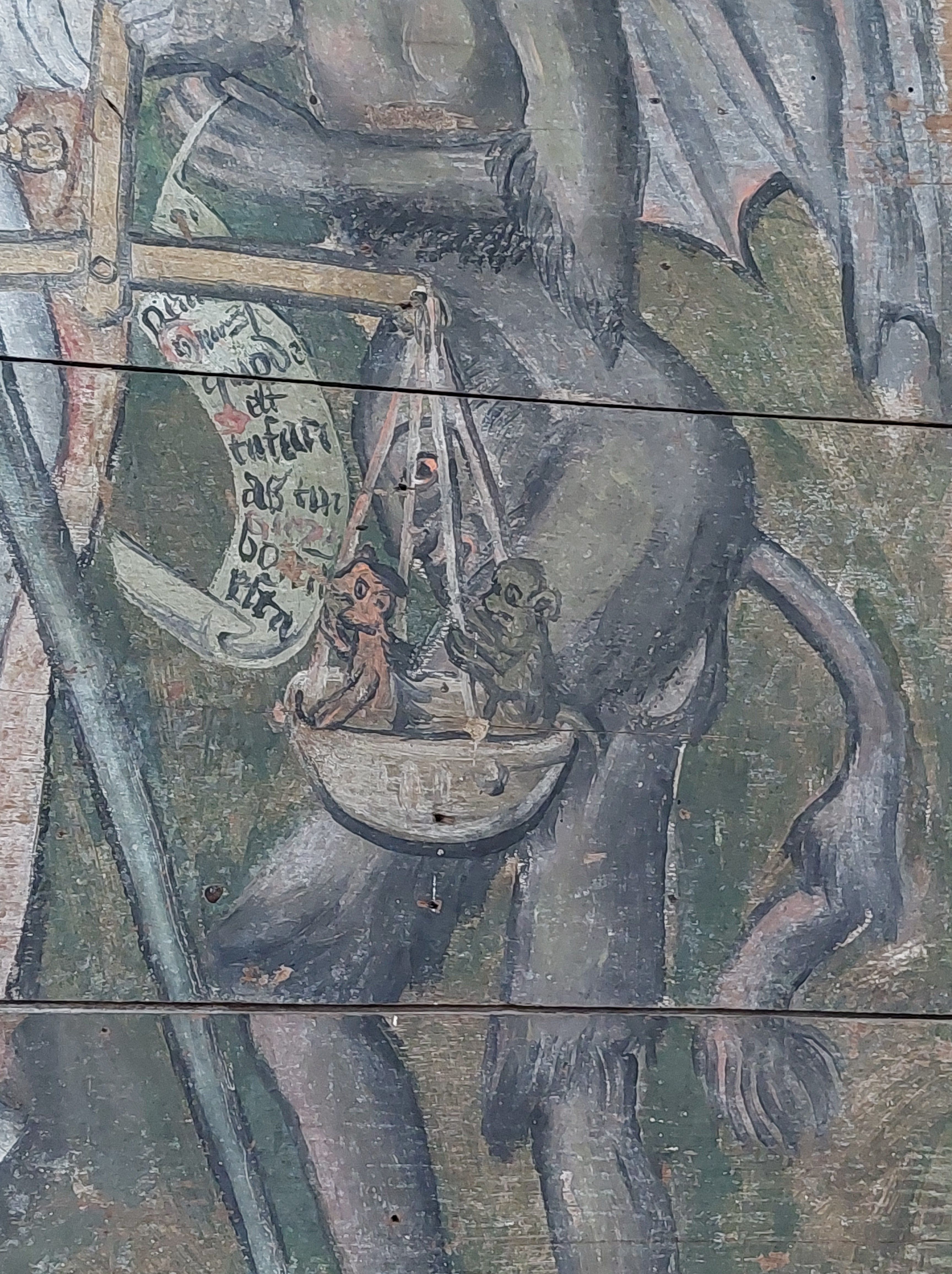
Beneath the image of Christ are the resurrected souls appearing above ground and their headgear – crowns, tiaras and mitres – have been included to show their station in life. Usually, the rich and powerful are seen mixing with ordinary mortals in Dooms to show equality on Judgement Day but in the Wenhaston Doom they are set apart for some reason.  Meeting them is St Peter in his papal tiara representing The Church which alone had the power to admit men and women to eternal life through the Sacraments.
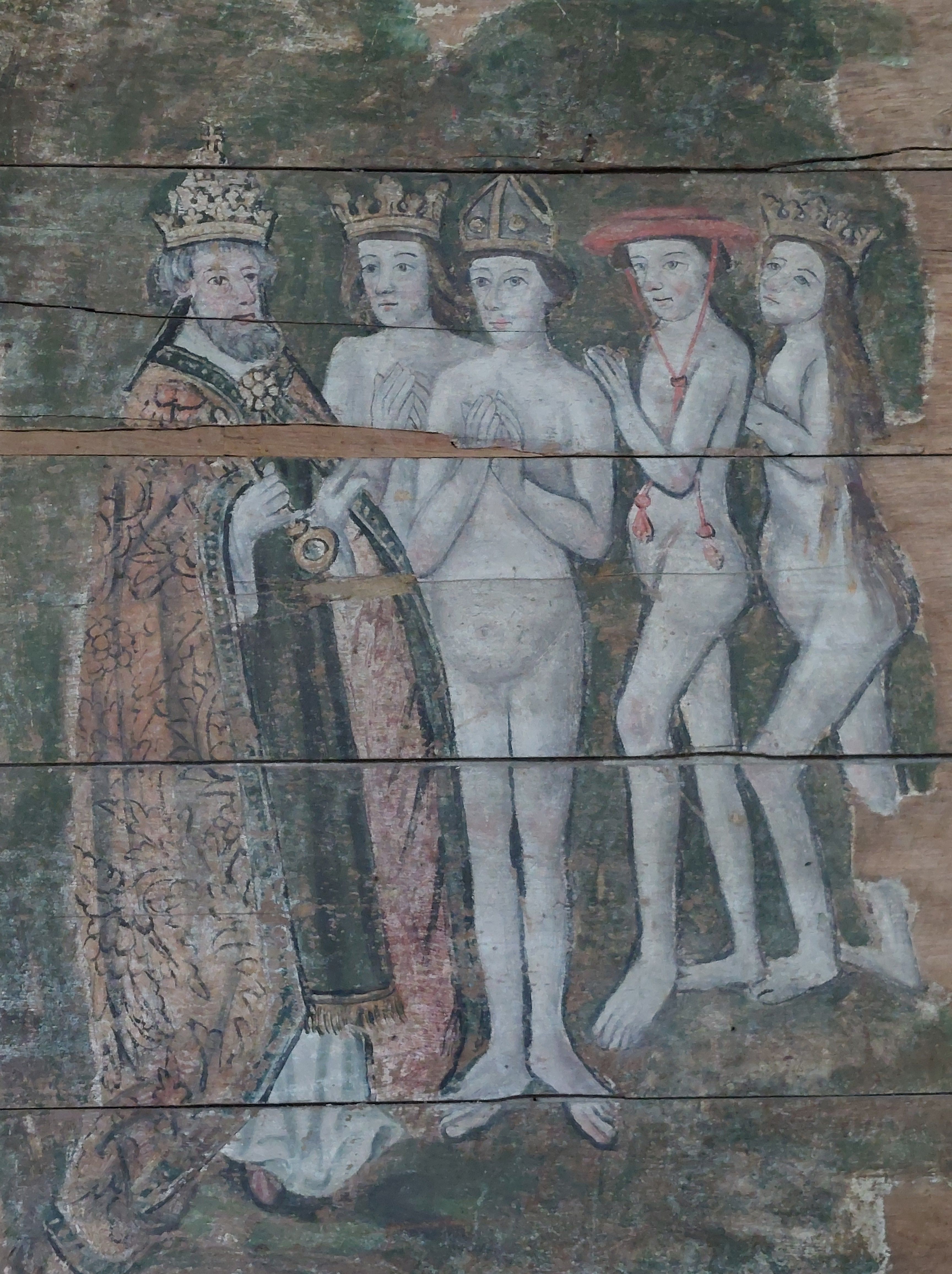
St Peter and the Resurrected.

The sheep and the goats have been separated and the sheep are admitted to the heavenly Mansions.  This is shown on the far left of the Doom.
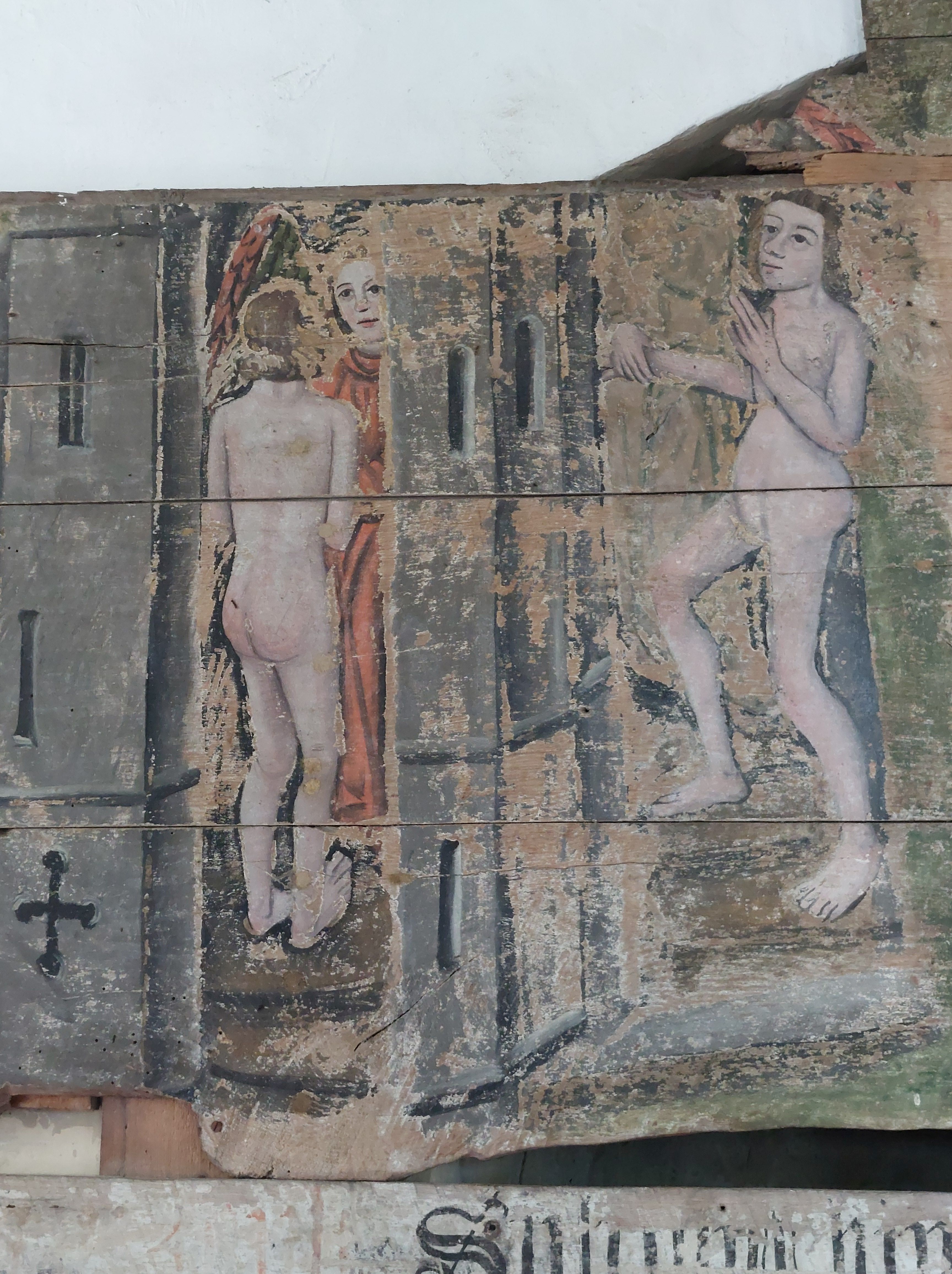
‘Do come in and make yourselves at home!’

The goats however, have only the eternal fires and gnashing of teeth to look forward to.  On the far right of the Doom little devils gather up the accursed and cast them into the jaws of Hell which are depicted here as the gaping, toothed mouth of a fish.  Leviathan, a huge aquatic creature is often mentioned in Hebrew poetry and this led to commentators and artists seeing Satan as Leviathan.  In the picture there is also a person still wearing their shroud, a swine’s snout, a devil blowing on a ram’s horn (the last trump?), the damned encircled by red-hot chains and the Seven Deadly Sins are represented, one of them carrying a female figure upside-down.
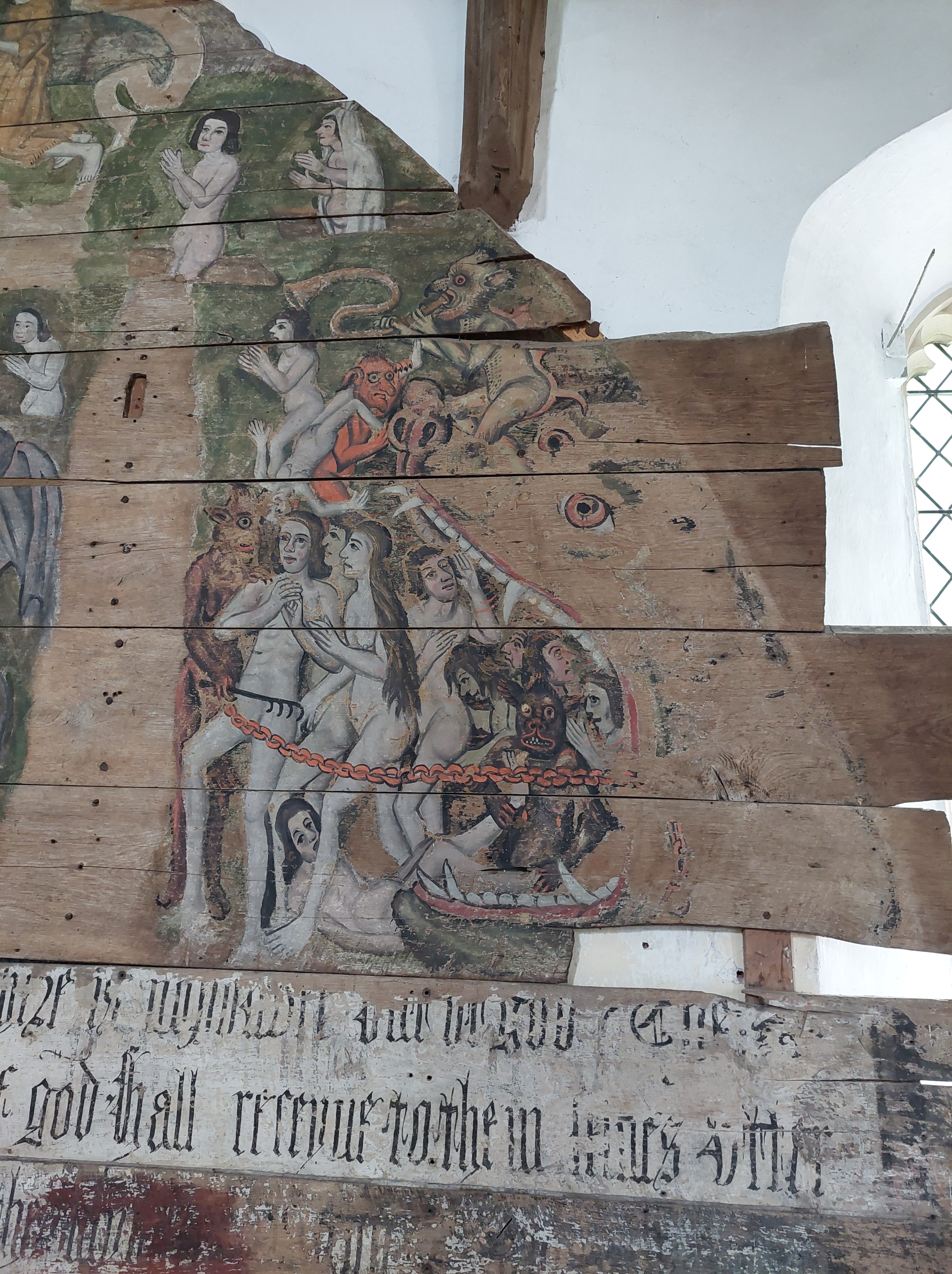
The text underneath the Doom is probably Elizabethan and is from an unknown version of the English Bible.  Romans 13 vv 1-4

“Let every soule submit him selfe unto the authorytye of the hygher powers for there is no power but of God the Powers that be are ordyend of God, but they that rest or are againste the ordinaunce of God shall recyve to them selves utter damnacion.  For rulers are not fearfull to them that do good but to them that do evyll for he is the mynister of God”.

I am greatly indebted to the excellent guide book I bought at the church for the explanation of the Doom’s symbolism.

Elinor in her red hat contemplating the Doom. The wooden panelling you can see beyond her under the windows are the repurposed box pews.
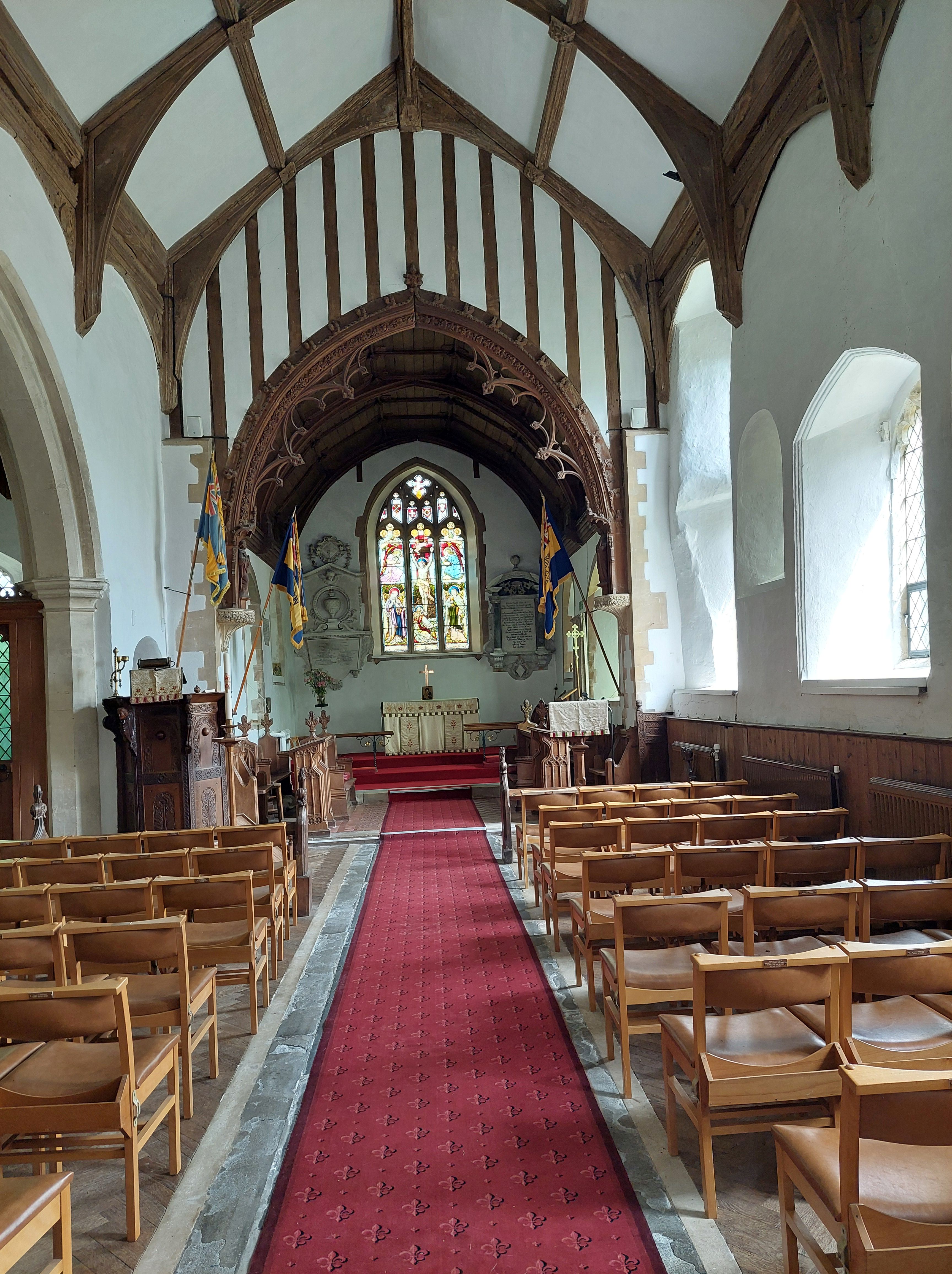
The interior of the church looking Eastward towards the altar

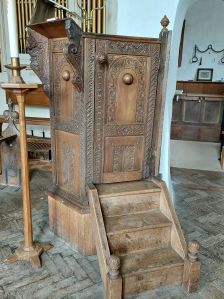
The Jacobean pulpit
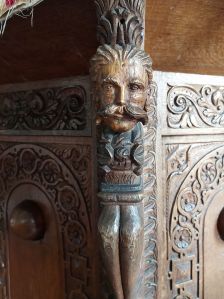
Face carved on pulpit
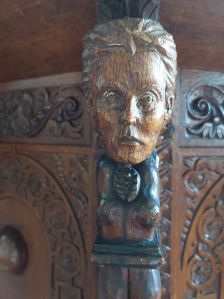
face carved on pulpit

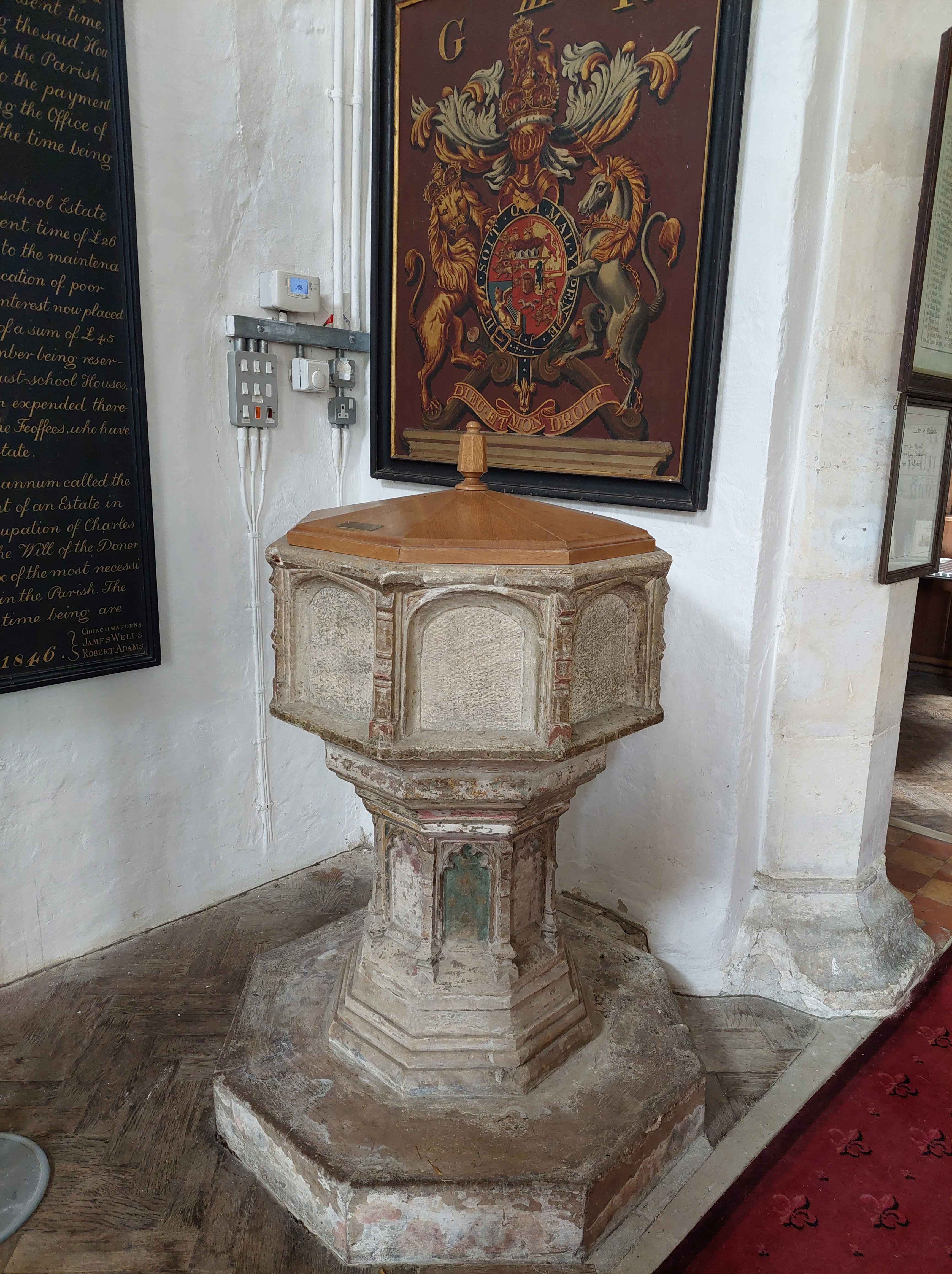
The Font – a Seven Sacrament font but unfortunately the reliefs that had been in the arched panels were erased in the 19th century. Behind the font is the George III Royal Arms
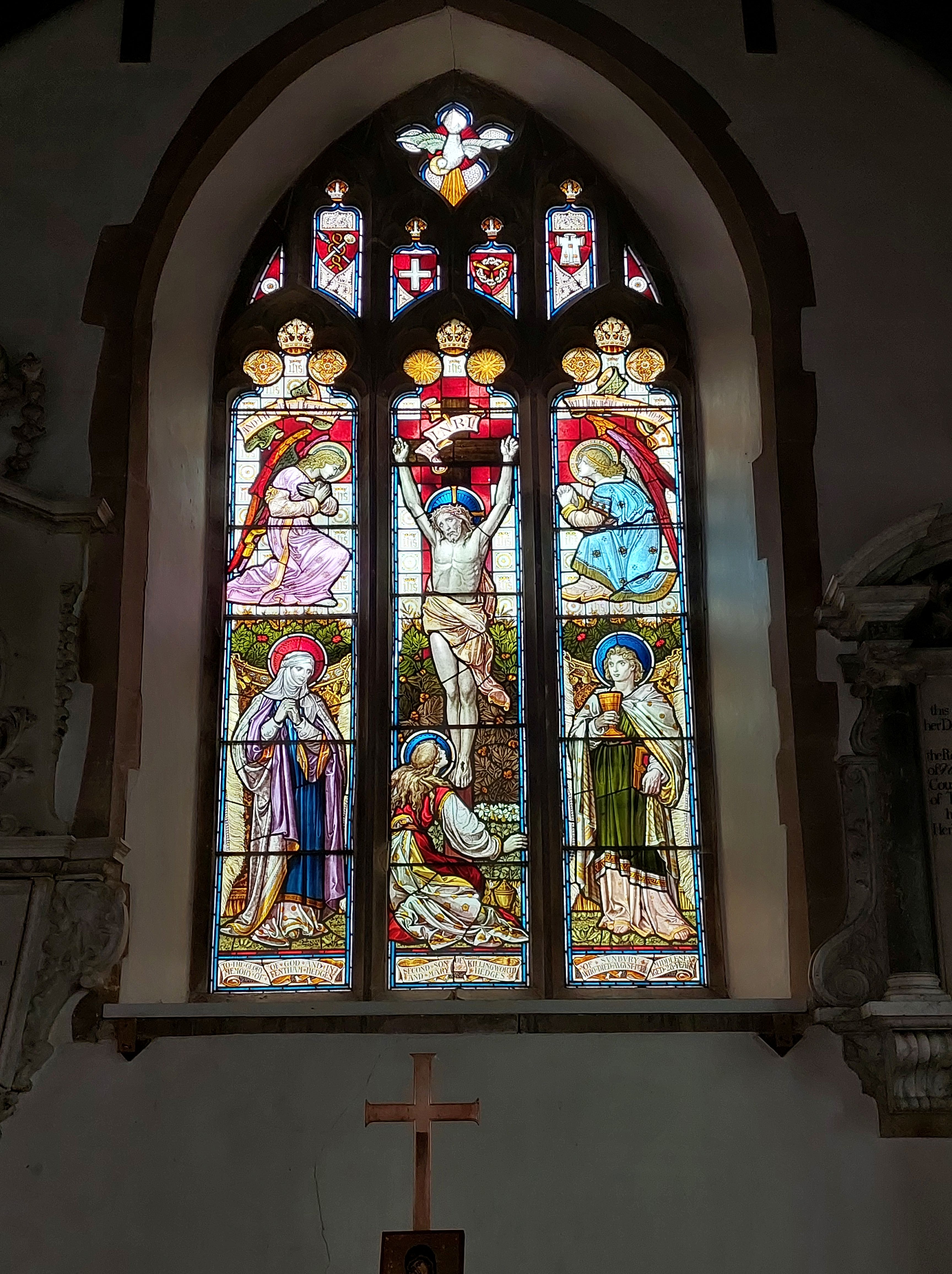
The East window
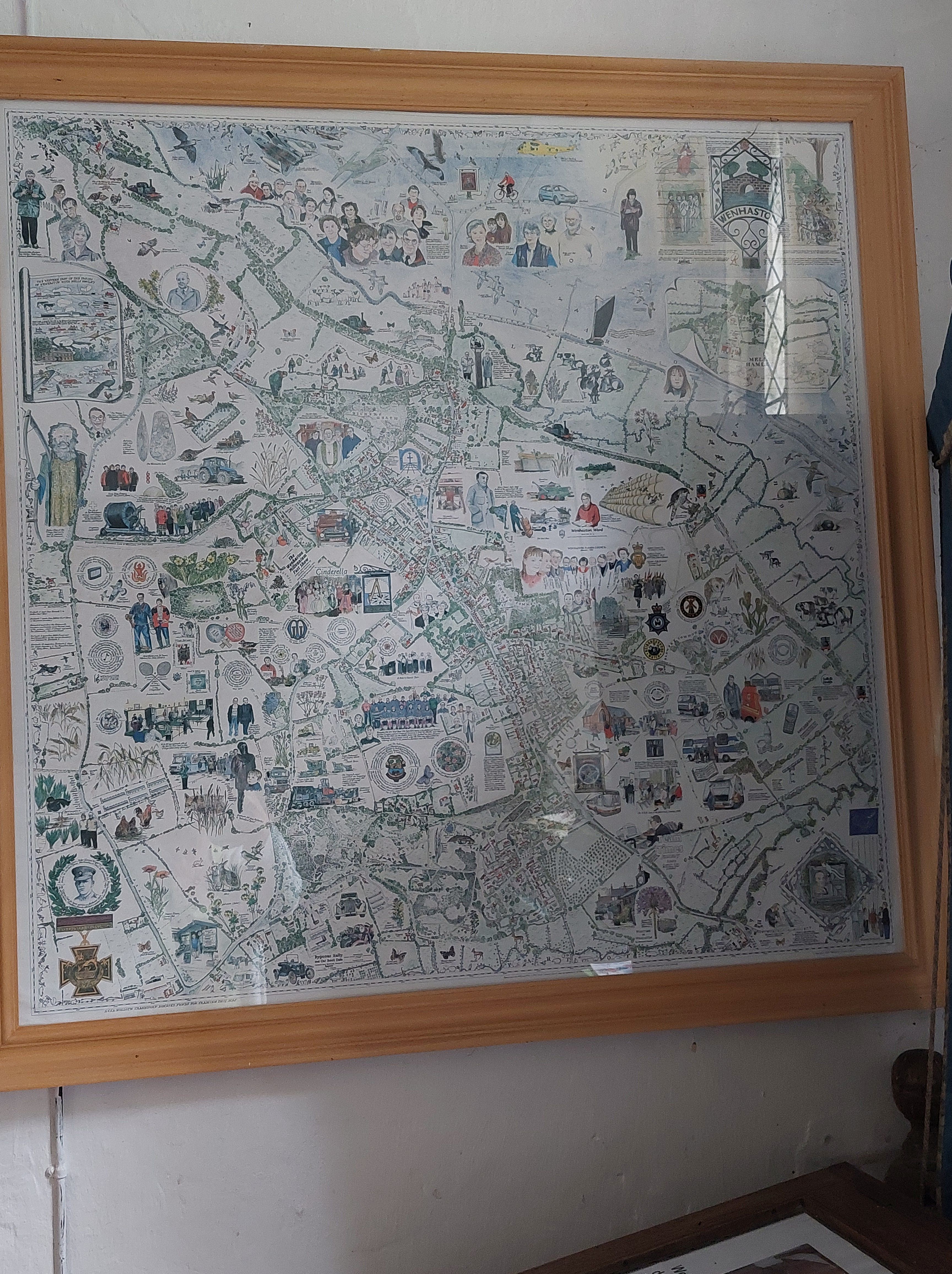
A map of the parish

This slideshow requires JavaScript.

Above is a gallery of all the windows in the church and below is the door.
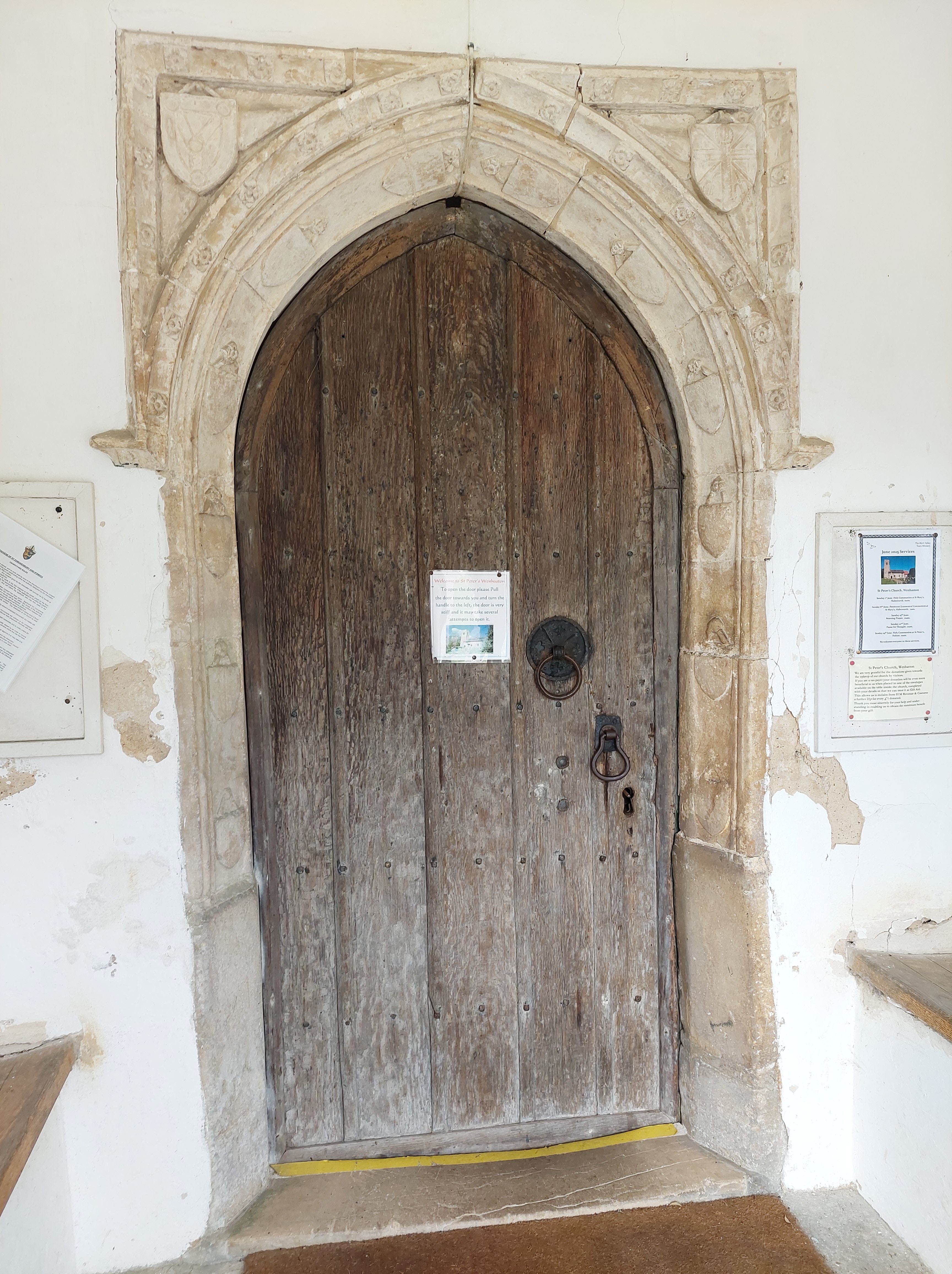
The outside of the South door, the main entrance to the church. The door retains the medieval sanctuary knocker.

A cupboard with a catch
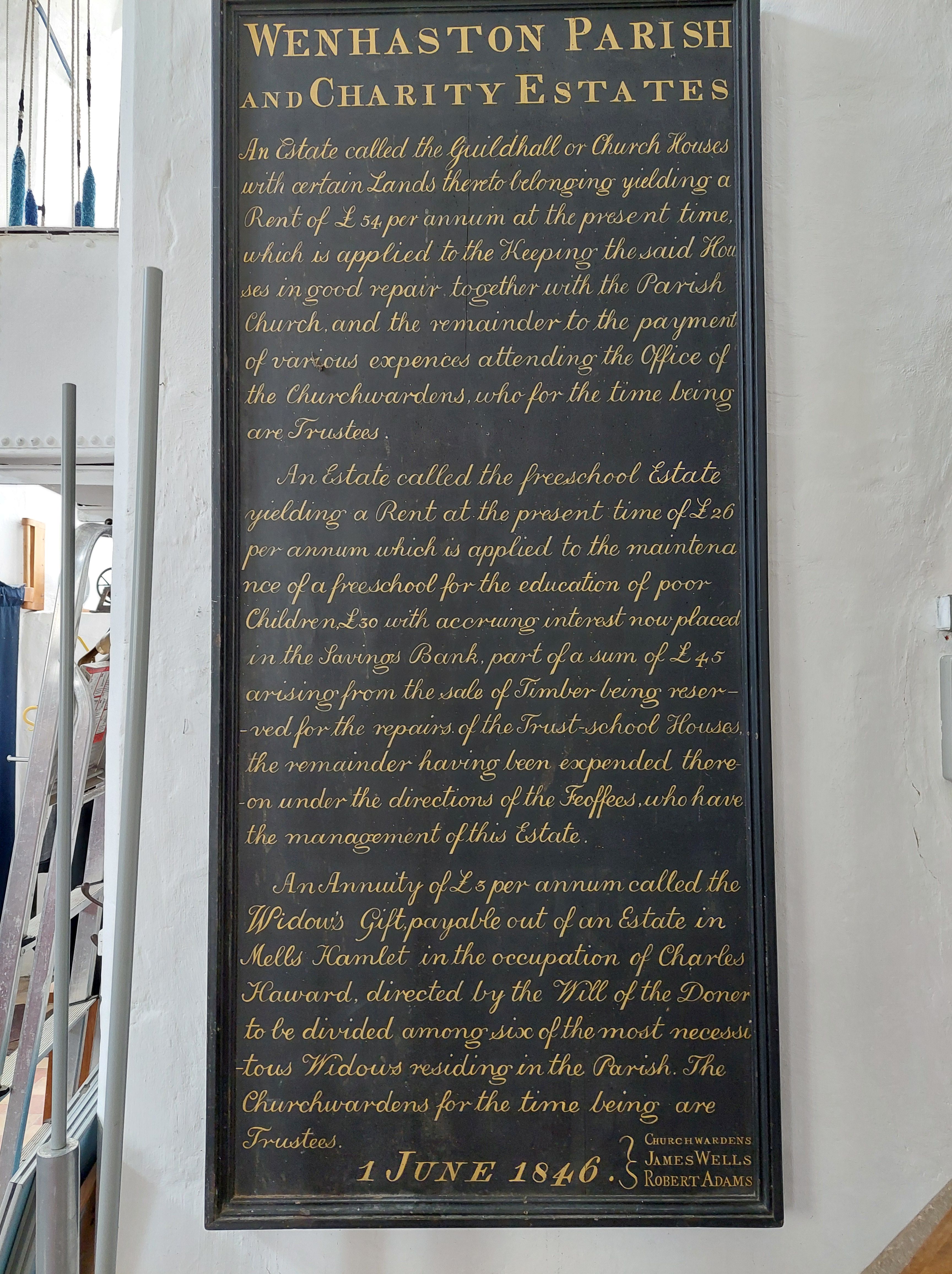
The Charity Board
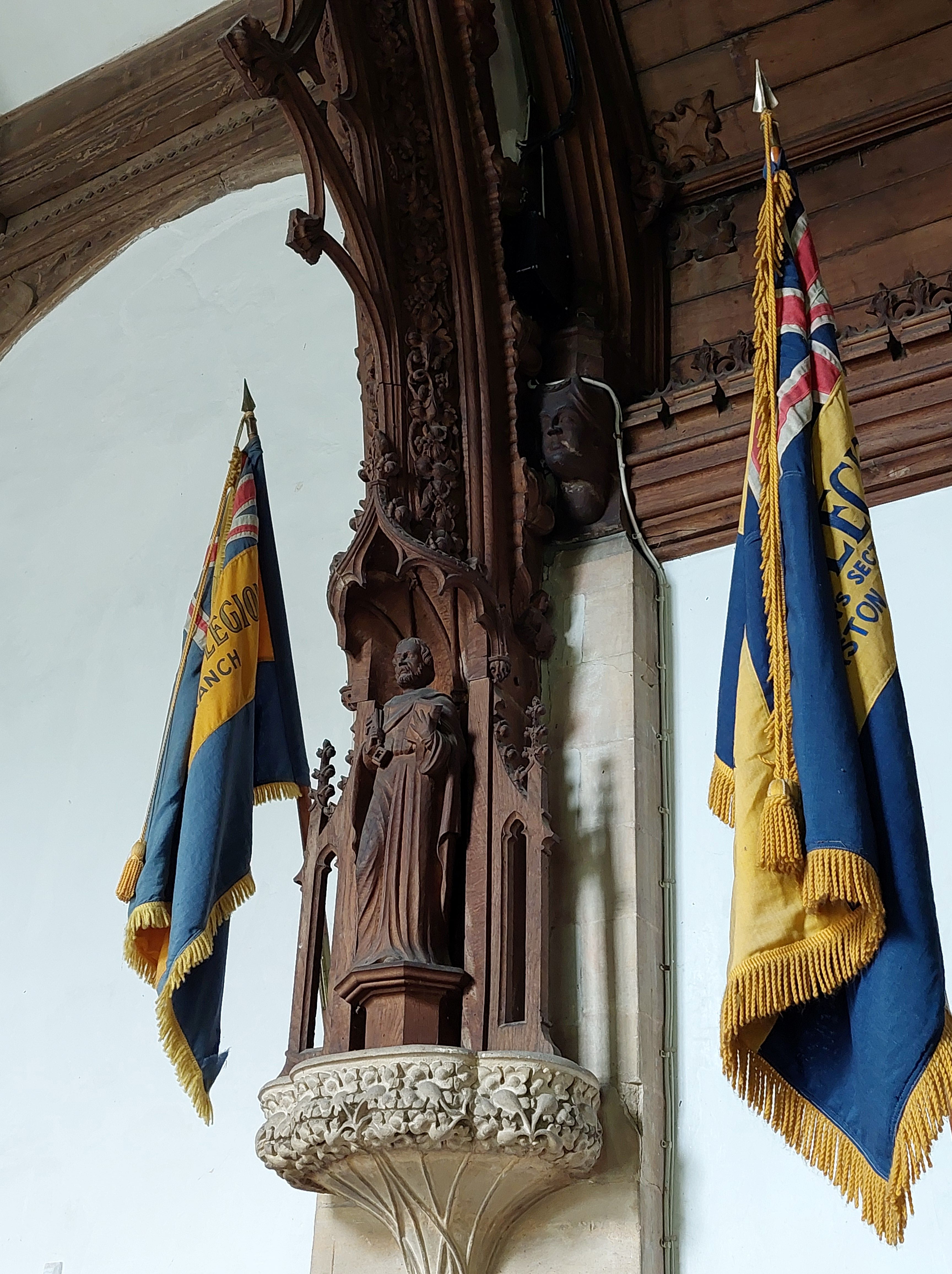
Part of the new chancel arch from 1892
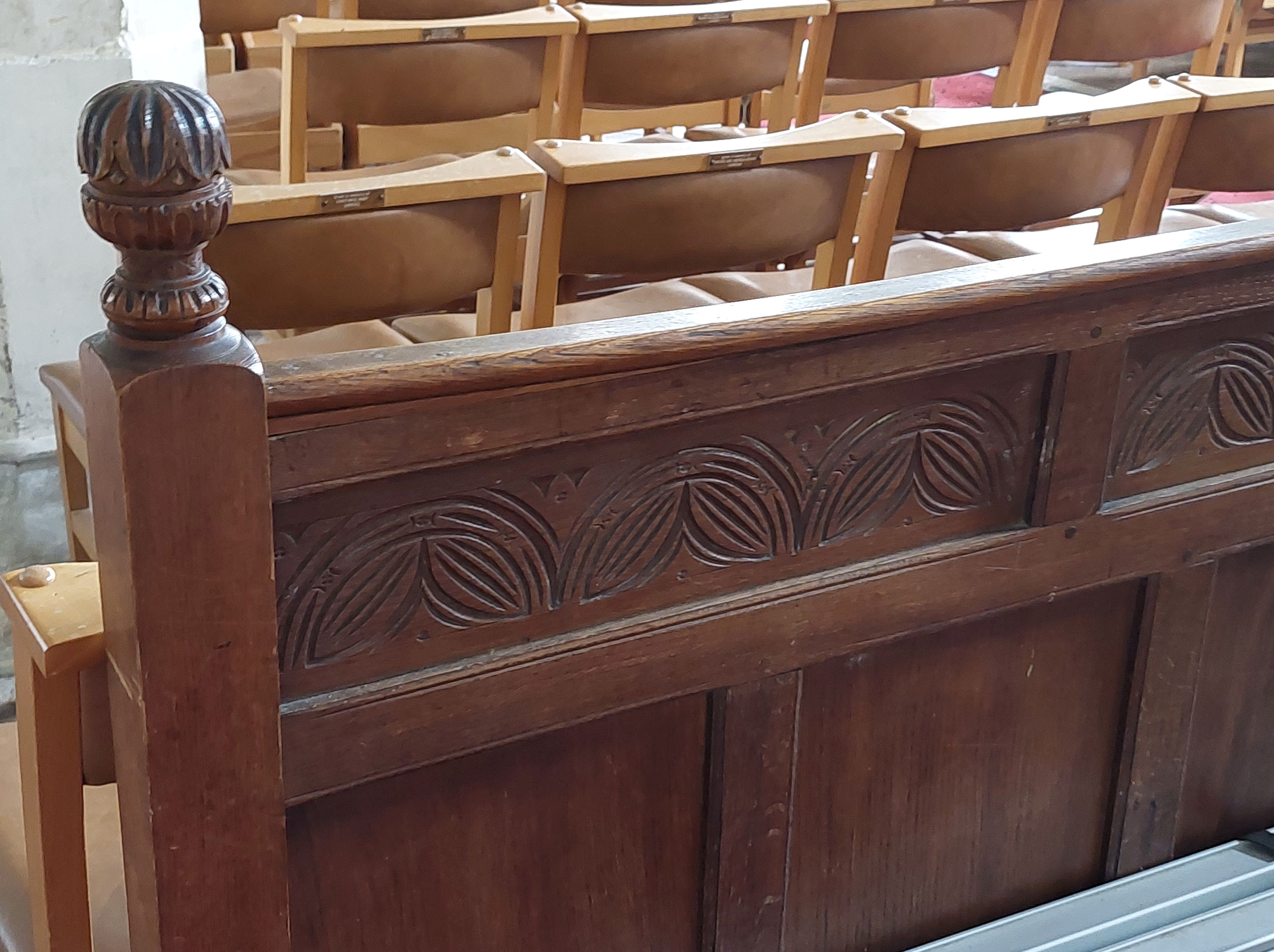
More carved panelling from the box pews.
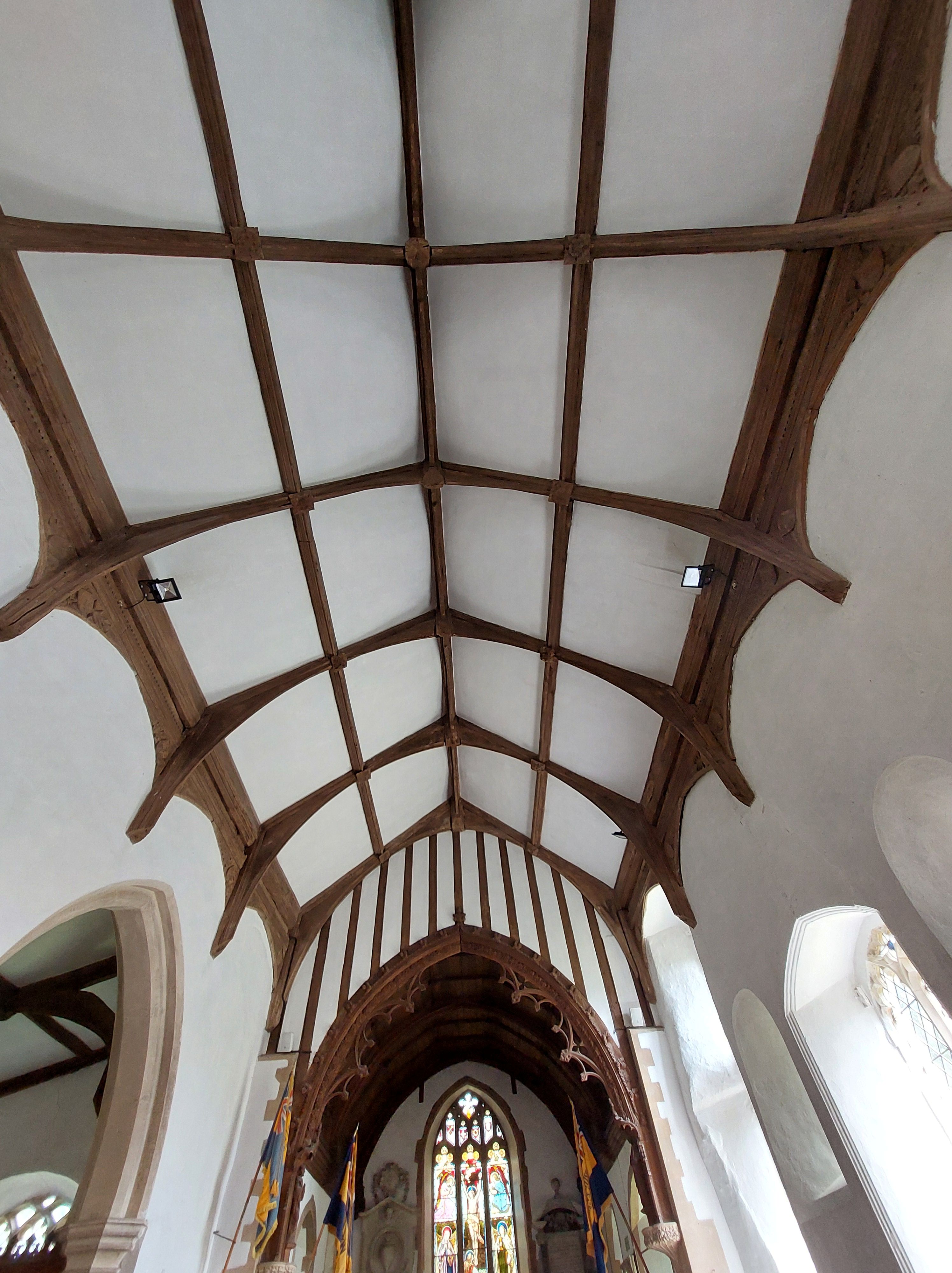
The Nave roof
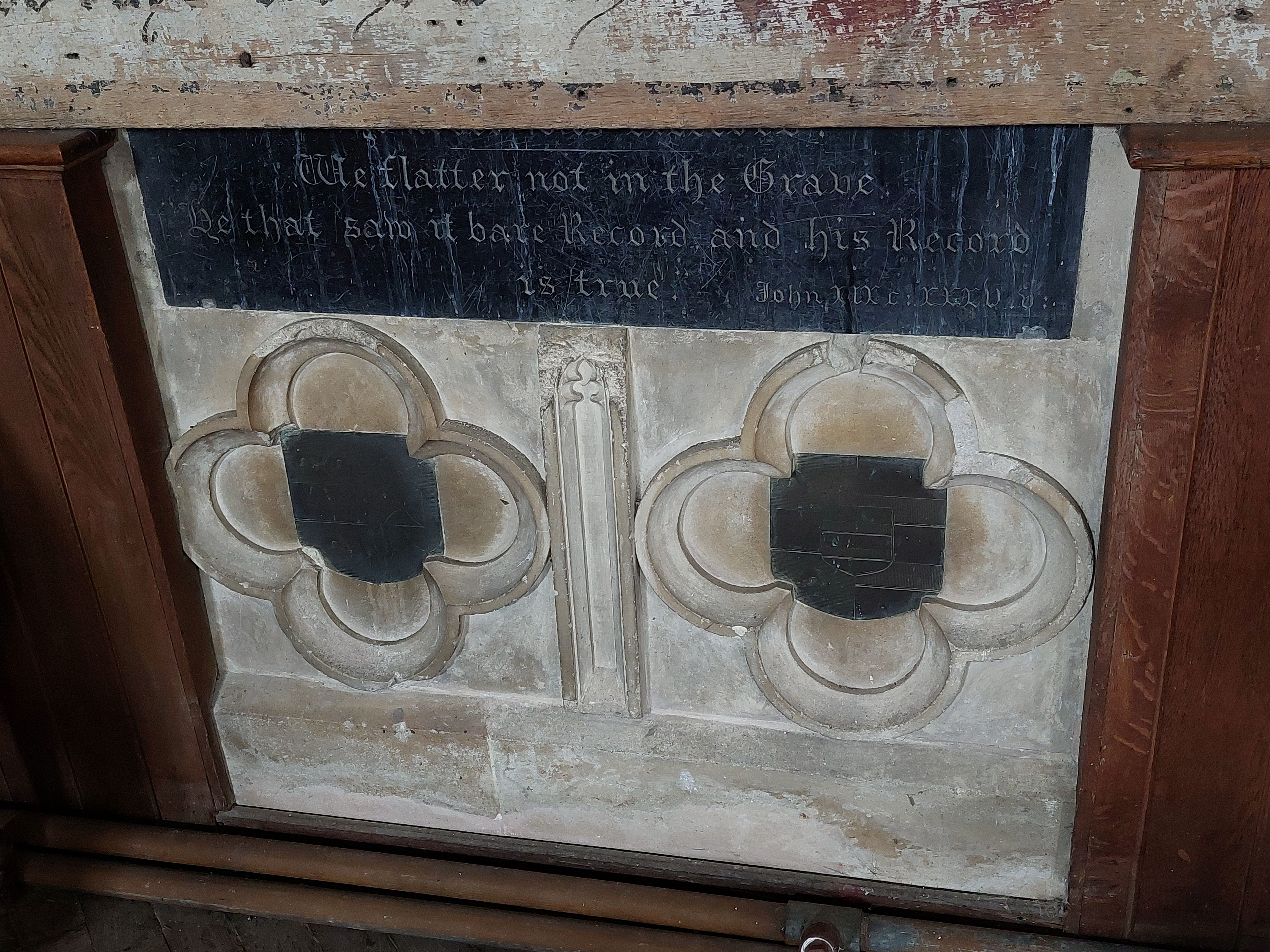
Part of a memorial to Reverend J Leman who died in Bath.
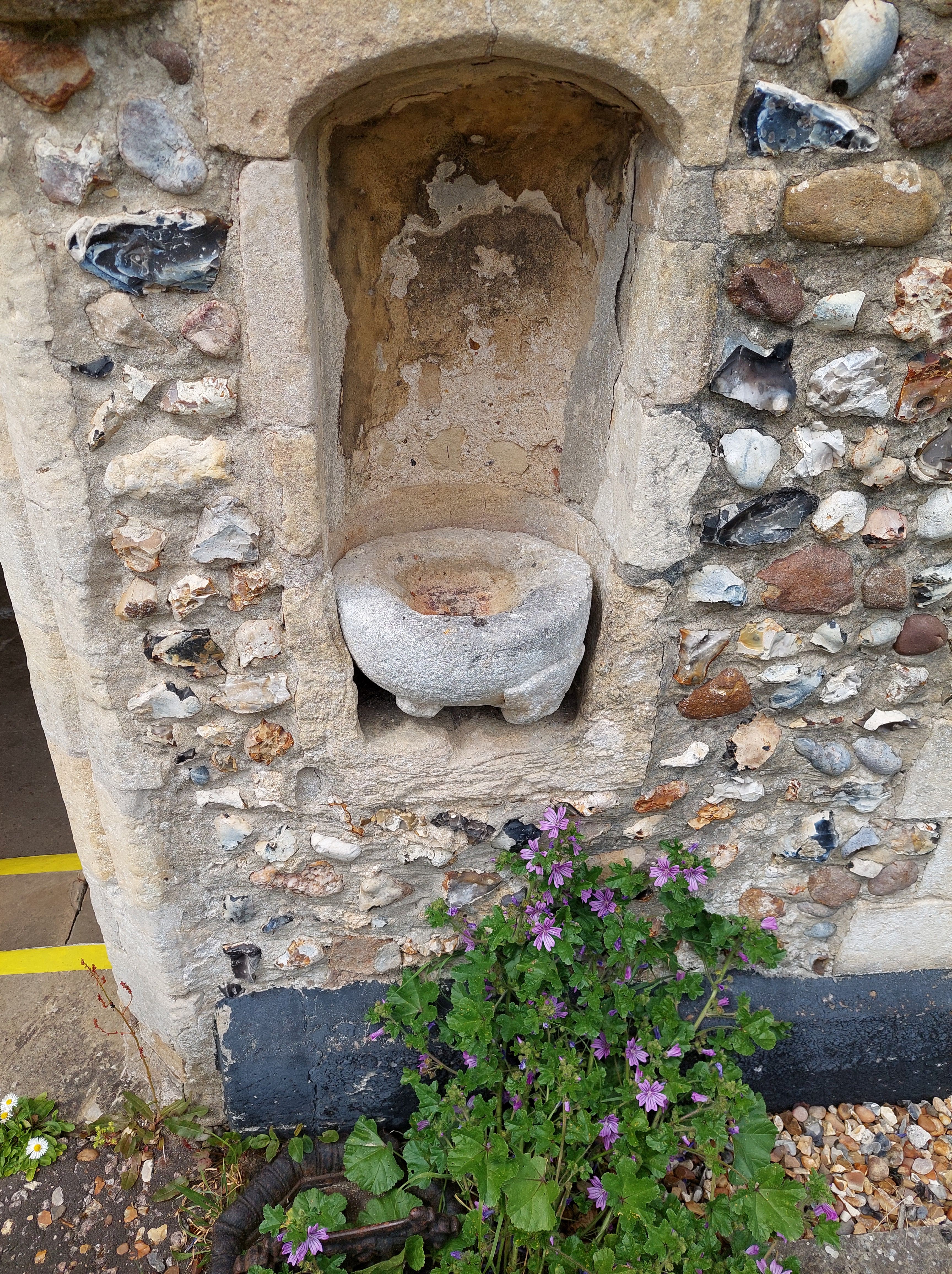
Medieval Holy water stoup on the outside of the church next to the door

Chest tombs
Chest tombs
20250612_142511Creeping cinquefoil1
Chest tomb
Chest tomb

Apologies for the length of this post.
Share this:

  • Share on X (Opens in new window) X
  • Share on Reddit (Opens in new window) Reddit
  • Share on Pinterest (Opens in new window) Pinterest
  • Share on Facebook (Opens in new window) Facebook
  • Email a link to a friend (Opens in new window) Email
  • Share on Tumblr (Opens in new window) Tumblr
  • Print (Opens in new window) Print
  • Share on Pocket (Opens in new window) Pocket
  • Share on LinkedIn (Opens in new window) LinkedIn
Like Loading...

Miscellany Part 2

15 Sun Jun 2014

Posted by Clare Pooley in churches, Landscaping, plants, Rural Diary, trees, Uncategorized, walking

≈ 6 Comments

Tags

barley, church cleaning, churchyard, coffin bier, electrical repairs, flowers, grasses, guelder rose, hedge woundwort, Klargester septic tank, landscaping, LED lights, lesser tortoiseshell butterfly, memorial stone, micro moth, ox-eye daisies, pond, Rumburgh Church, St Michael's water tower, St Peter's church, walking, wheat

I cannot believe how quickly this year is speeding by!  I always think at the beginning of spring that this year I will definitely make a better job of the gardening and I will have the time to do all the things I need to do around the house.  I always forget that as spring flows into summer the amount of jobs that need doing multiply and multiply and here I am left far behind yet again.  I forget how much time I have to spend away from the house driving about the countryside and this year I have had extra places to go.  Mum now has monthly check-ups at the hospital in Norwich to make sure her eyes are still free of macular degeneration.  My younger daughter E is hoping to go to City College Norwich in the autumn so we have had a number of visits there over the past few weeks, getting to know the place and some of the people there.

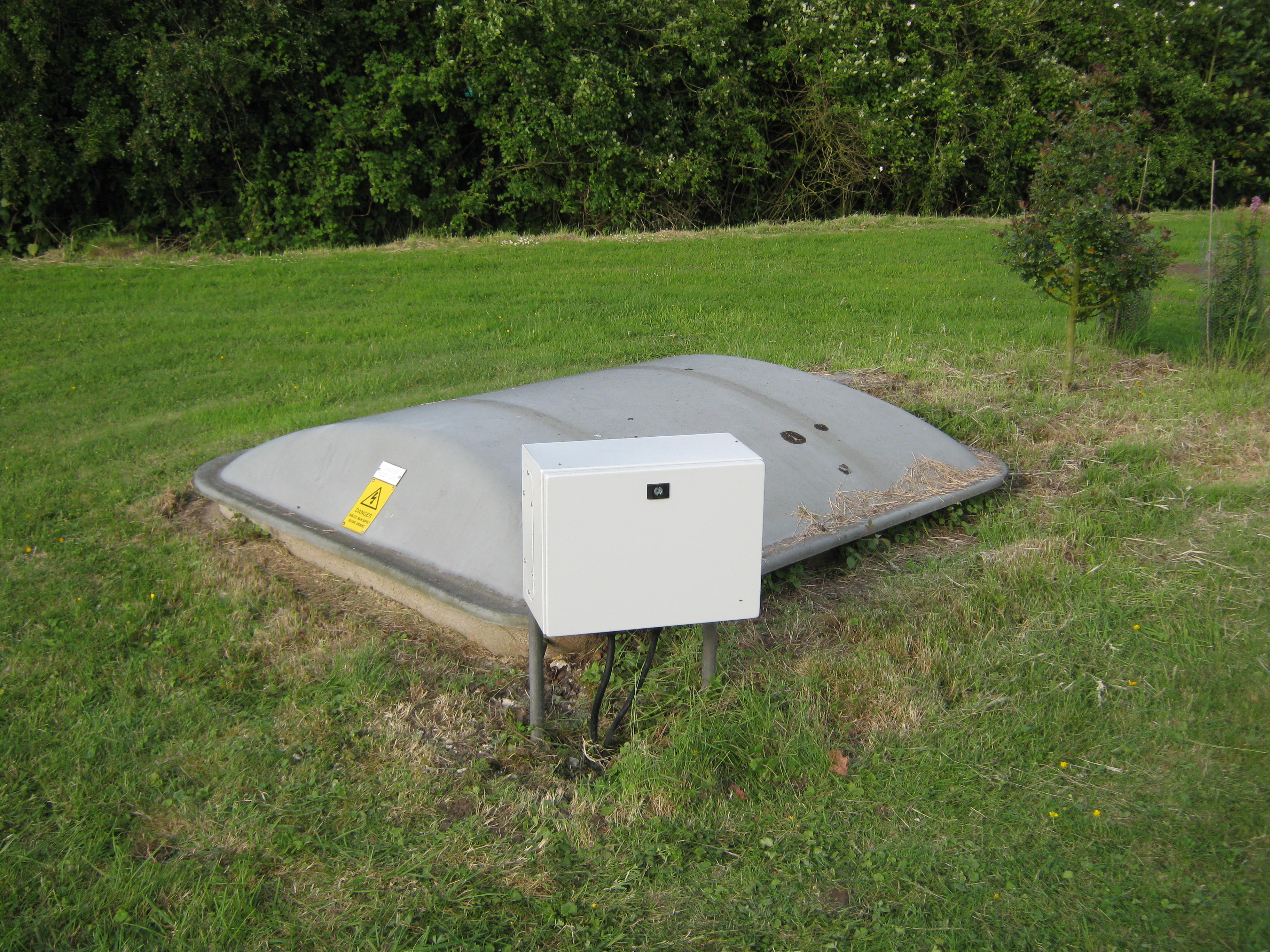
We have had a visit from the electrician who has done some work for us.  We had spoken to him a few weeks ago asking him to replace our kitchen under-cupboard lights which were very old and becoming faulty.  We also needed a new box cover for the electrics for our Klargester septic tank.  The old box cover had rusted away some years ago and we have had an upside-down plastic bin over the top since then!  We also need a lot of re-wiring done and some outside lights replacing.  The weekend before last R and I were woken in the middle of the night by a roaring noise in the house.  For some time we couldn’t think what it was and where the noise was coming from but eventually I realised it was something to do with the electric immersion heater which I switched off immediately.  (We use our immersion heater during the summer to heat our water; during the winter we use a gas boiler for water and central heating and this is fuelled by propane gas which is enormously expensive.  We are not on mains gas and as we often have power cuts it is better not to have everything powered by electricity.  We switch the immersion heater on over-night as electricity is cheaper then.)  The thermostat had gone faulty and the water was boiling.  The hot tank was emptying and the cold water tank and expansion tank were full of hot water – the house was turning into a kettle.  I wonder if steam was rising out of the roof?  If it had been left on much longer the tank would have exploded.  I phoned the electrician and asked him to add a new thermostat to his list of jobs to do.  When he visited last week he put in new kitchen lights for us….

010New kitchen lights

A thin strip of LED lights only a centimetre wide – such bright lights!

he replaced the septic tank electric box cover…..

015Septic tank with new box

The septic tank with the electric box wearing its attractive new cover.

and fitted a new thermostat to our immersion heater.  He will be coming again soon to do the rewiring and fitting new outside lights.

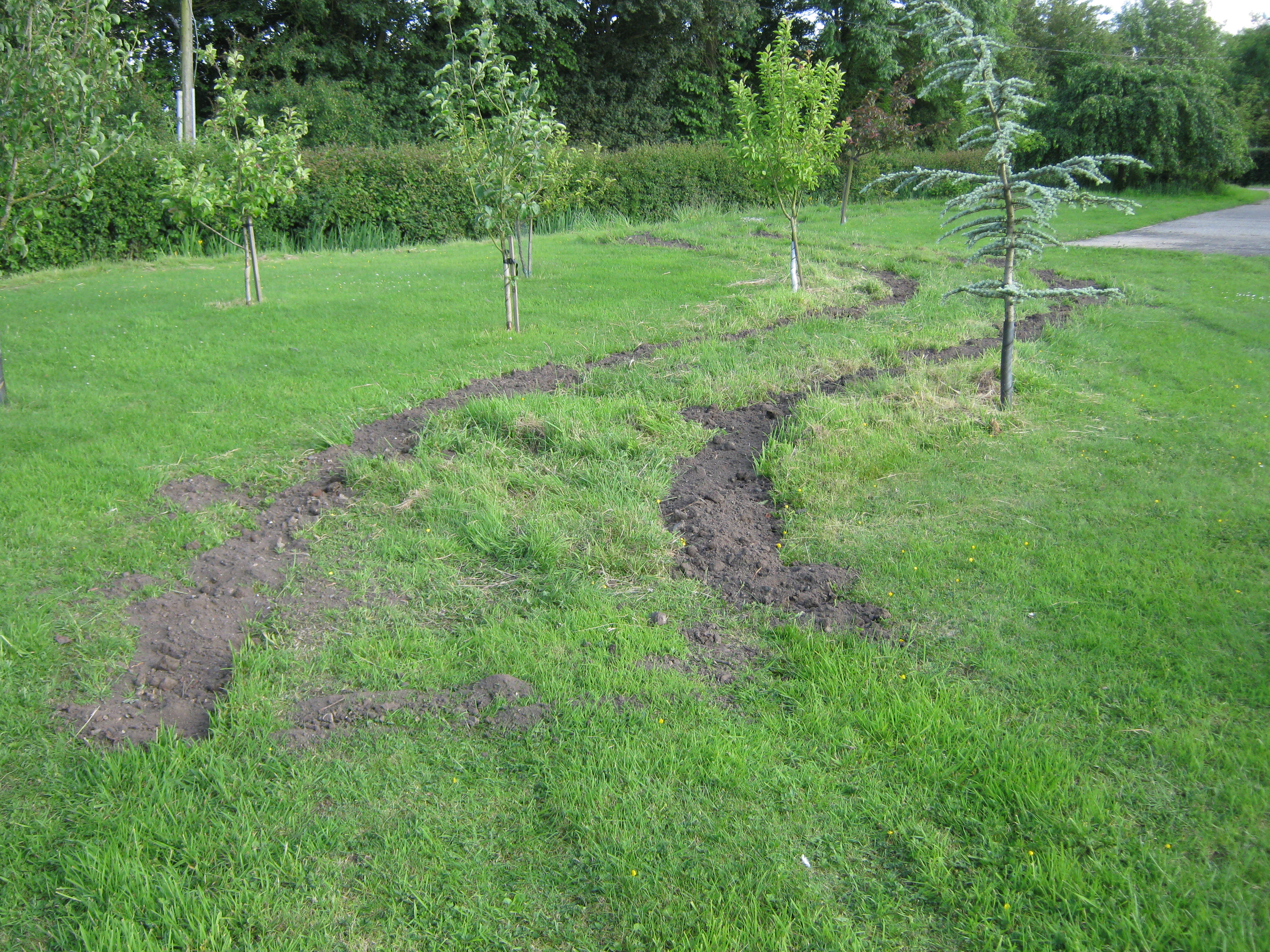
The landscaper who had worked on our big pond in February also visited our house on the same day as the electrician and filled in all the ruts the JCB had made in the lawn with top-soil.  R is very pleased that this has been done at last.  He has seeded it all and we are now waiting for the grass to regrow.
021Filled-in ruts

The ruts nicely filled-in at last.
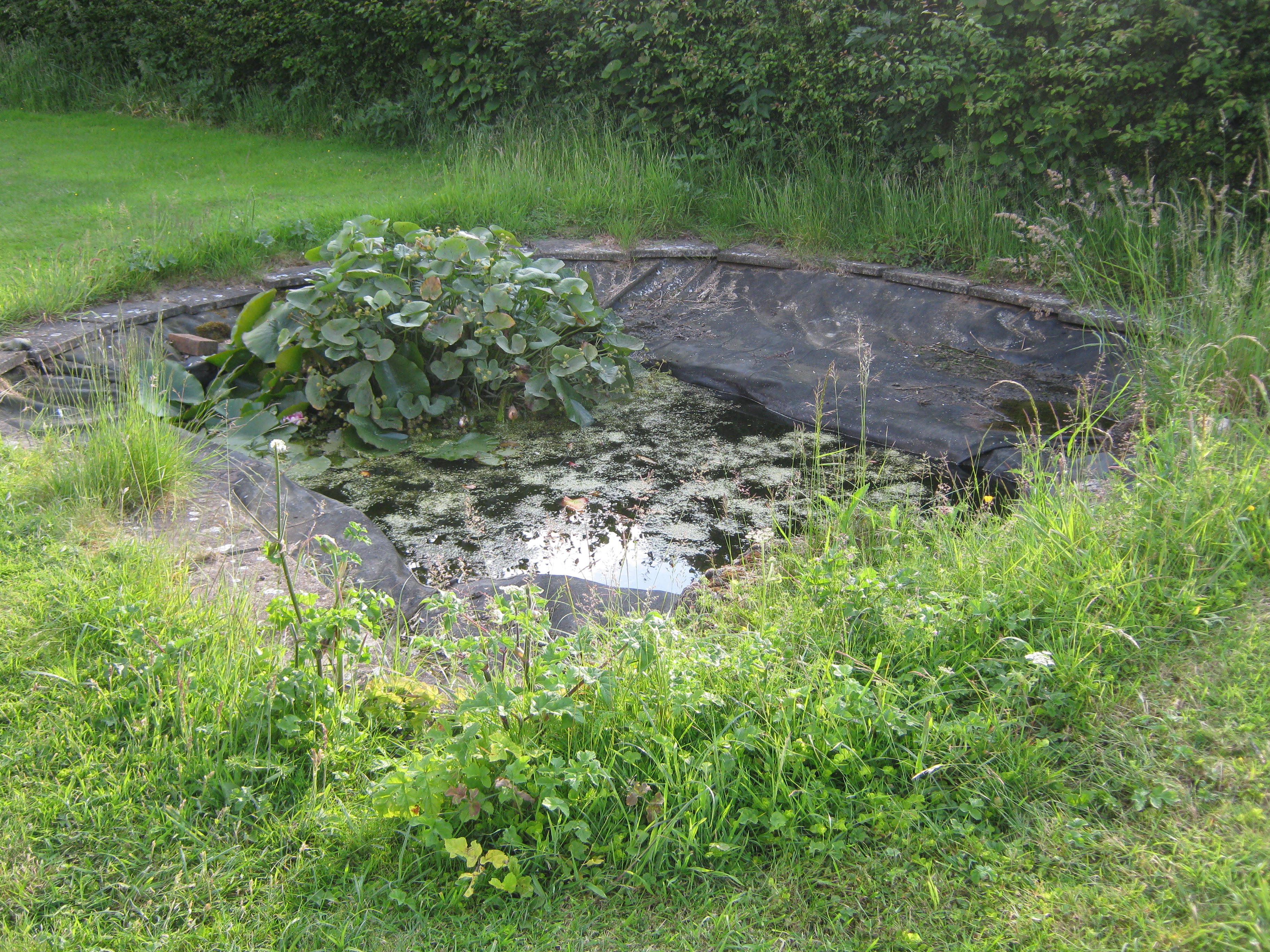
While he was at our house we asked the landscaper to look at our small pond and let us know how it can be improved.  We don’t want the pond quite so close to the hedge, the liner needs replacing and I would like a boggy area at the side of the pond where I can plant iris, lobelia  and other marsh plants.
011Small pond

The small pond in desperate need of improvement

The last couple of weeks I haven’t had to take Mum to church.  She has been taken by a young man from her church who lives in Harleston.  He works abroad, especially in Asia and the far East, for much of the year as a film director.  When he returns home from his high-powered meetings and filming in India and China he resumes his more important job of taking old ladies to church and being bossed about by them.  Well, what else has he to do except a bit of script writing!  I am really very grateful to him.  He stays in this country until September and that is probably when I’ll have to resume my duties again.

Meanwhile, I have enjoyed two weeks of going to church with my husband.  It is our month for cleaning Rumburgh church and when we went in last week we were amazed at how dirty it was.  The church had had a few visitors who had left some rubbish about and there was dirt which had been trodden in on shoes.  The main mess had been caused by our resident bats.  It took us about two-and-a -half hours to clean up the worst of the mess.  I think that during the summer when we have more visitors and when the bats are active the church should be cleaned more than once a month but some of the people on our rota will only come in once a month or only if we have a service in the church and of course we don’t have services every week in our church.  I also find that some of our cleaners will concentrate on the entrance to the church and will often ignore the Sanctuary at the East end of the church where the altar is.

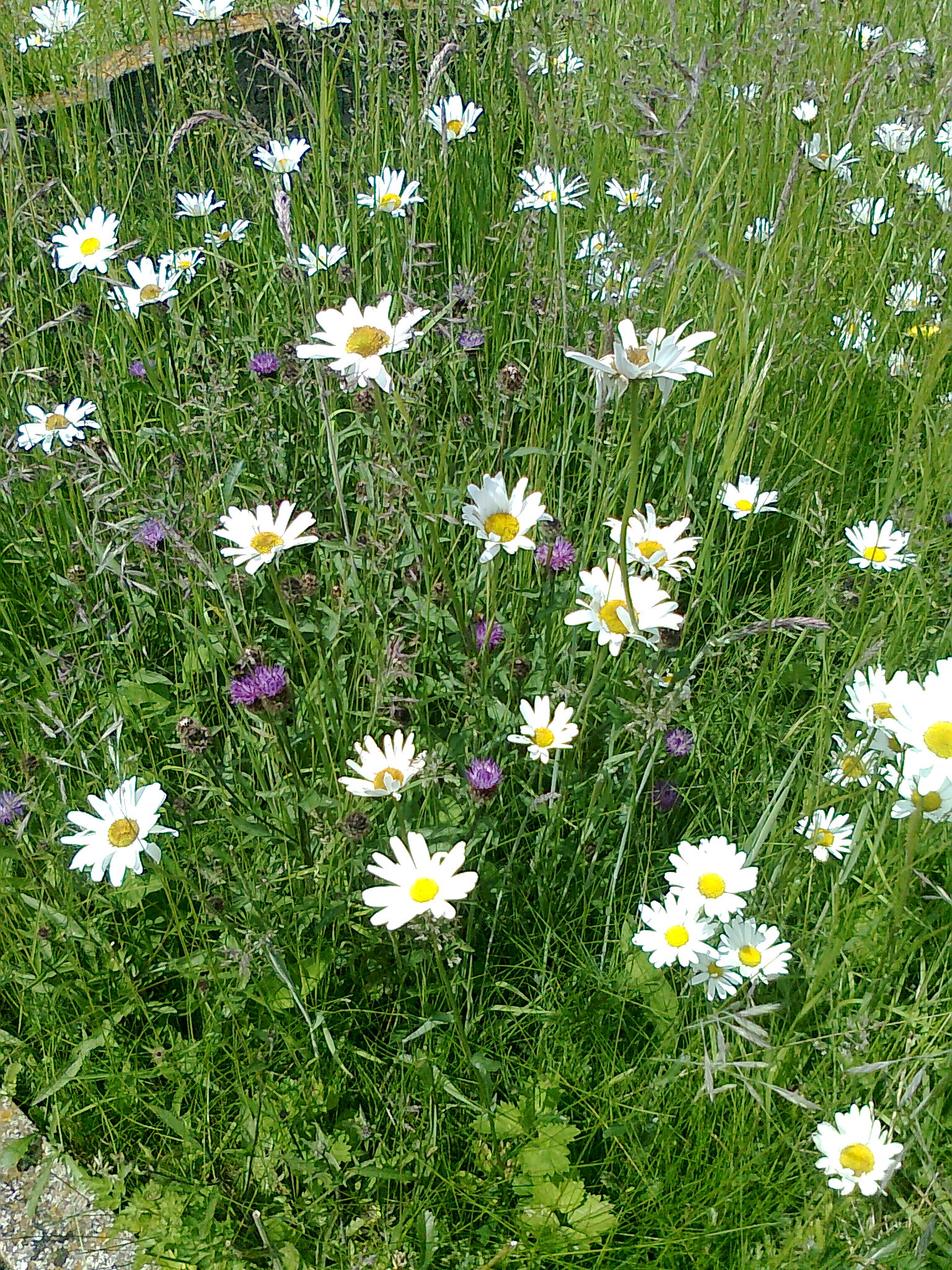
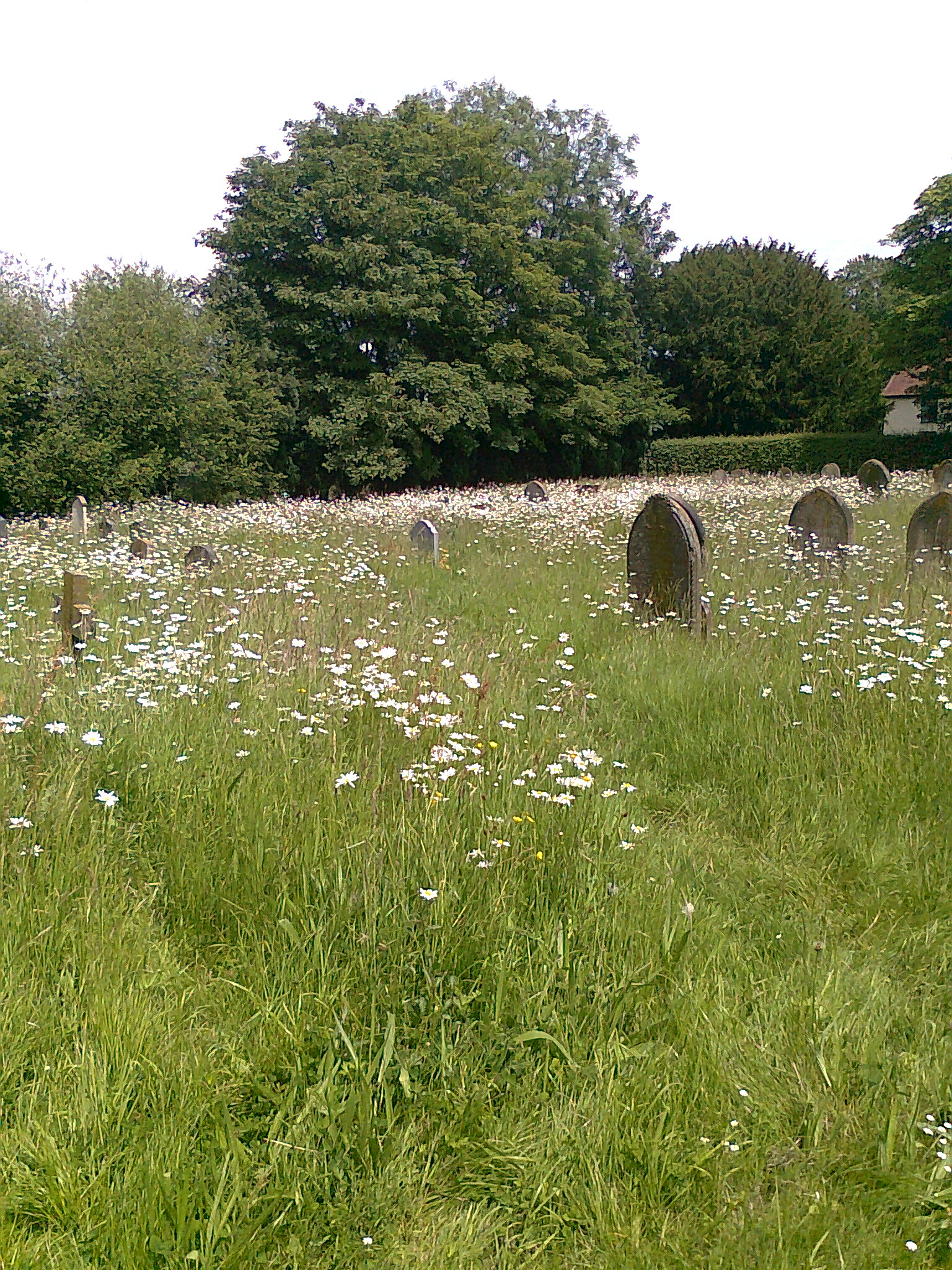
052Wild flowers in churchyard

Wild flowers in Rumburgh churchyard

054Ox-eye Daisies in churchyard

Ox-eye daisies in Rumburgh churchyard

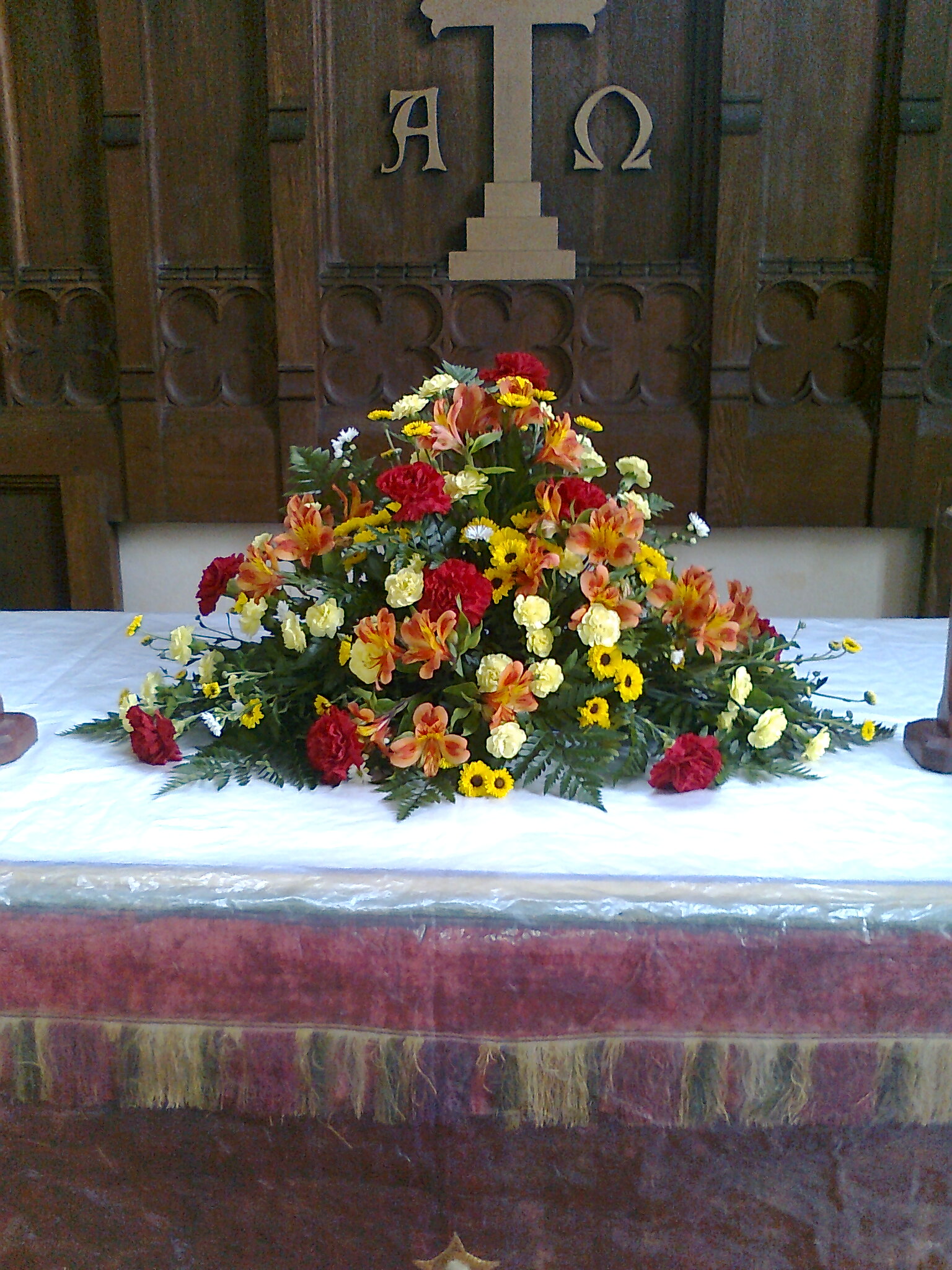
039Altar flowers

A beautiful flower arrangement on the altar

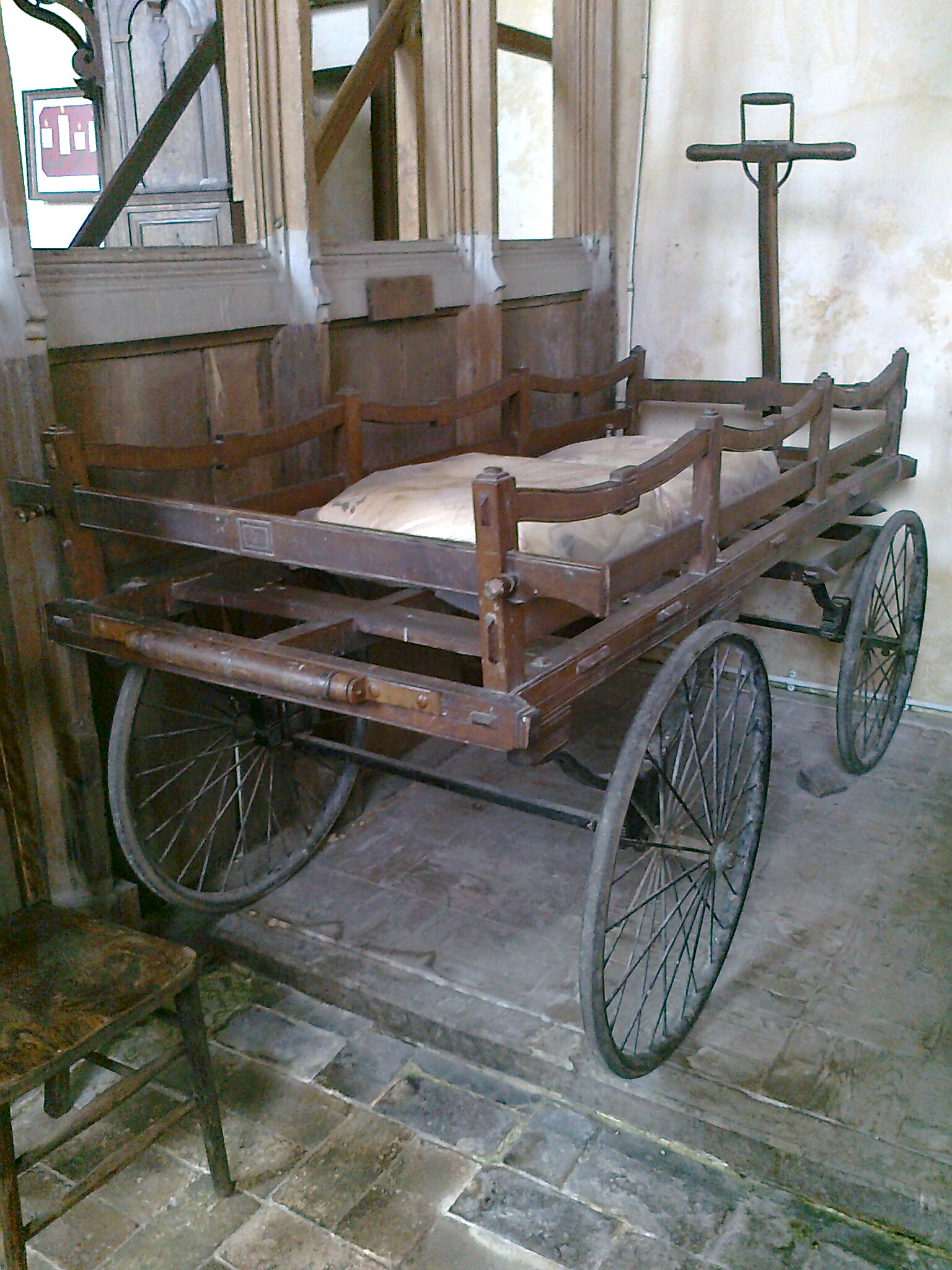
044Coffin Bier

The old coffin bier in the church

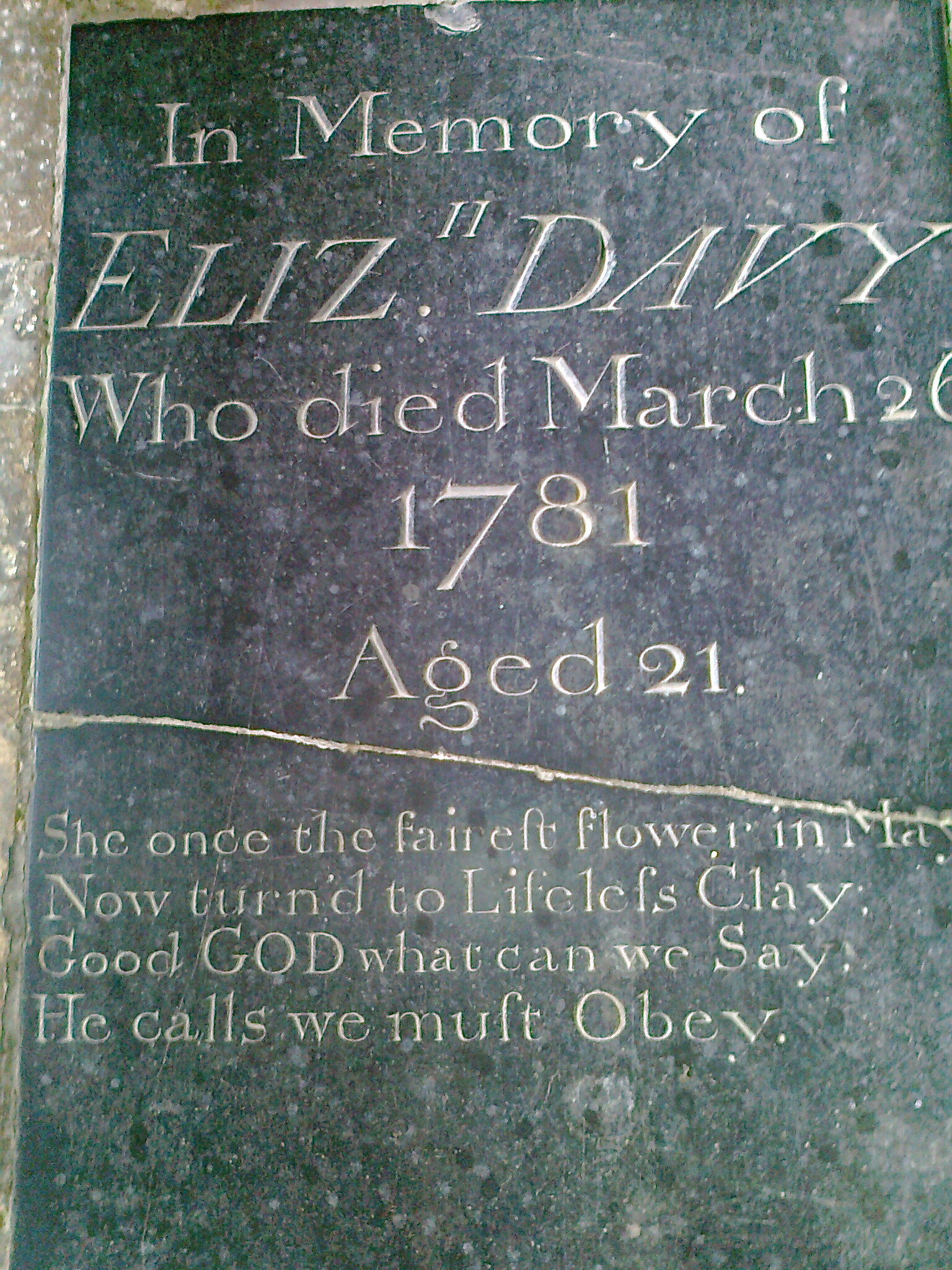
040Grave memorial Eliz Davy

Memorial stone in the aisle

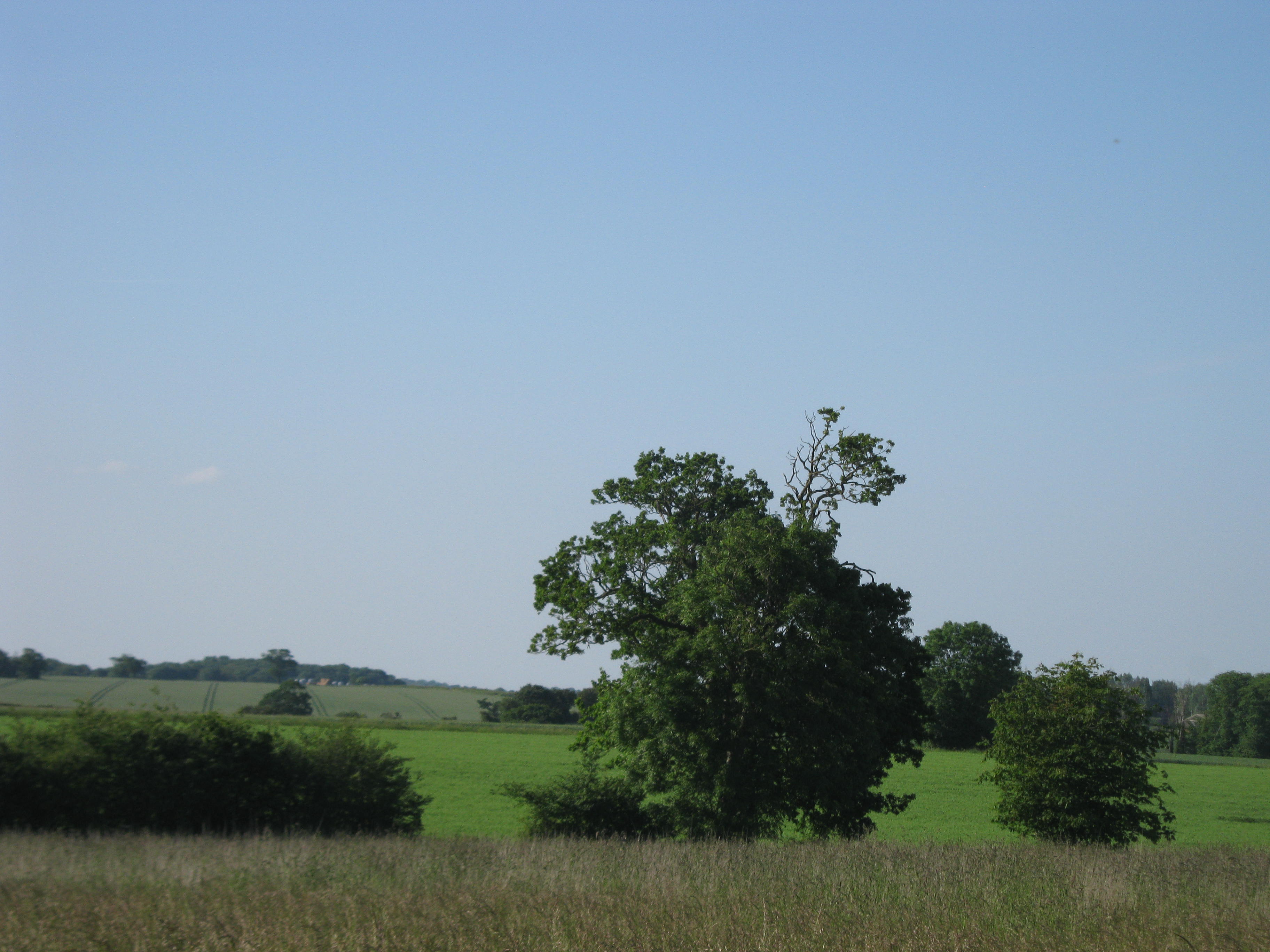
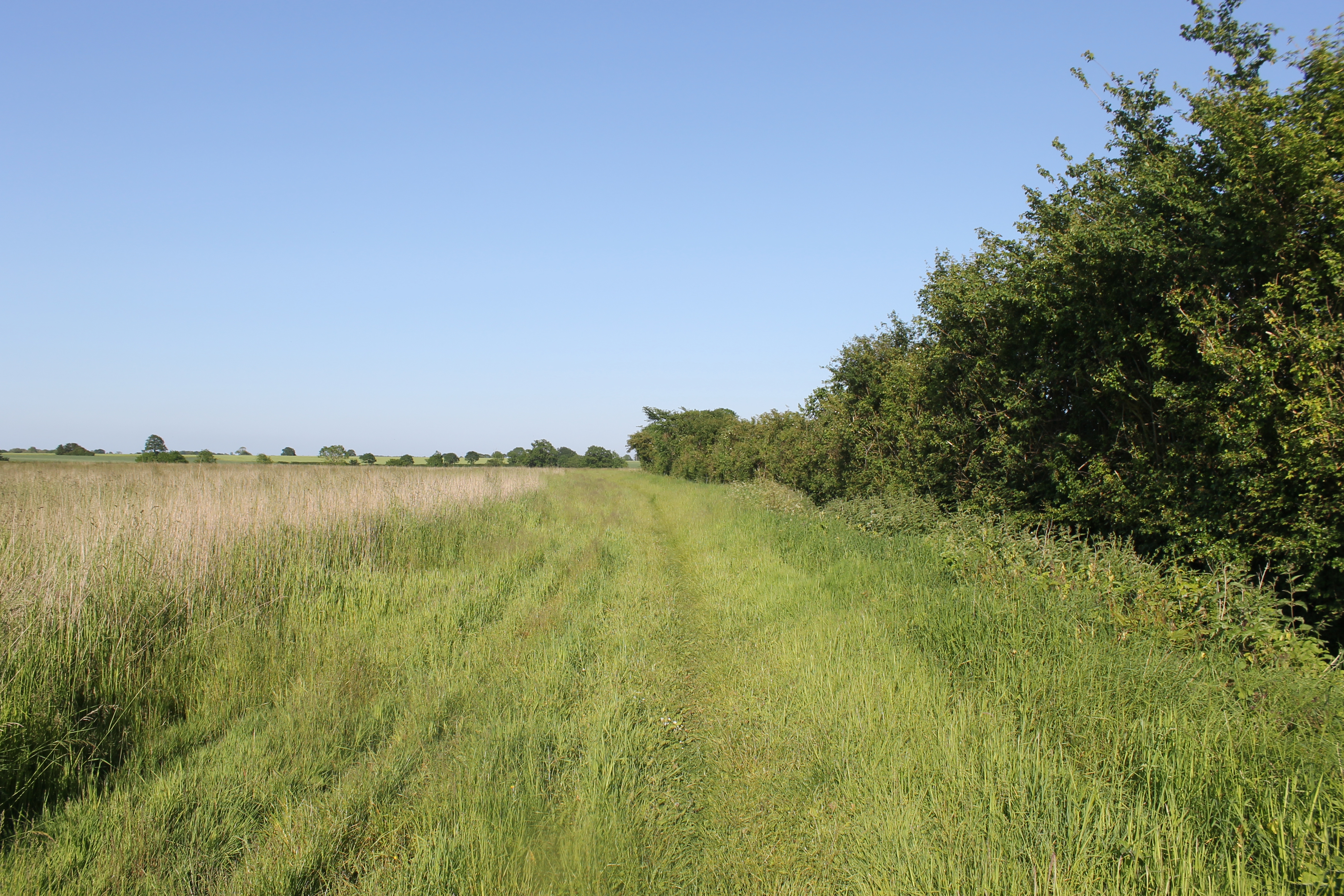
R and I went for another of our walks across the fields a week or so ago.  We didn’t intend to go far as we were both tired.

002View across fields

A view across the fields

042Path at edge of field

The path at the edge of the field

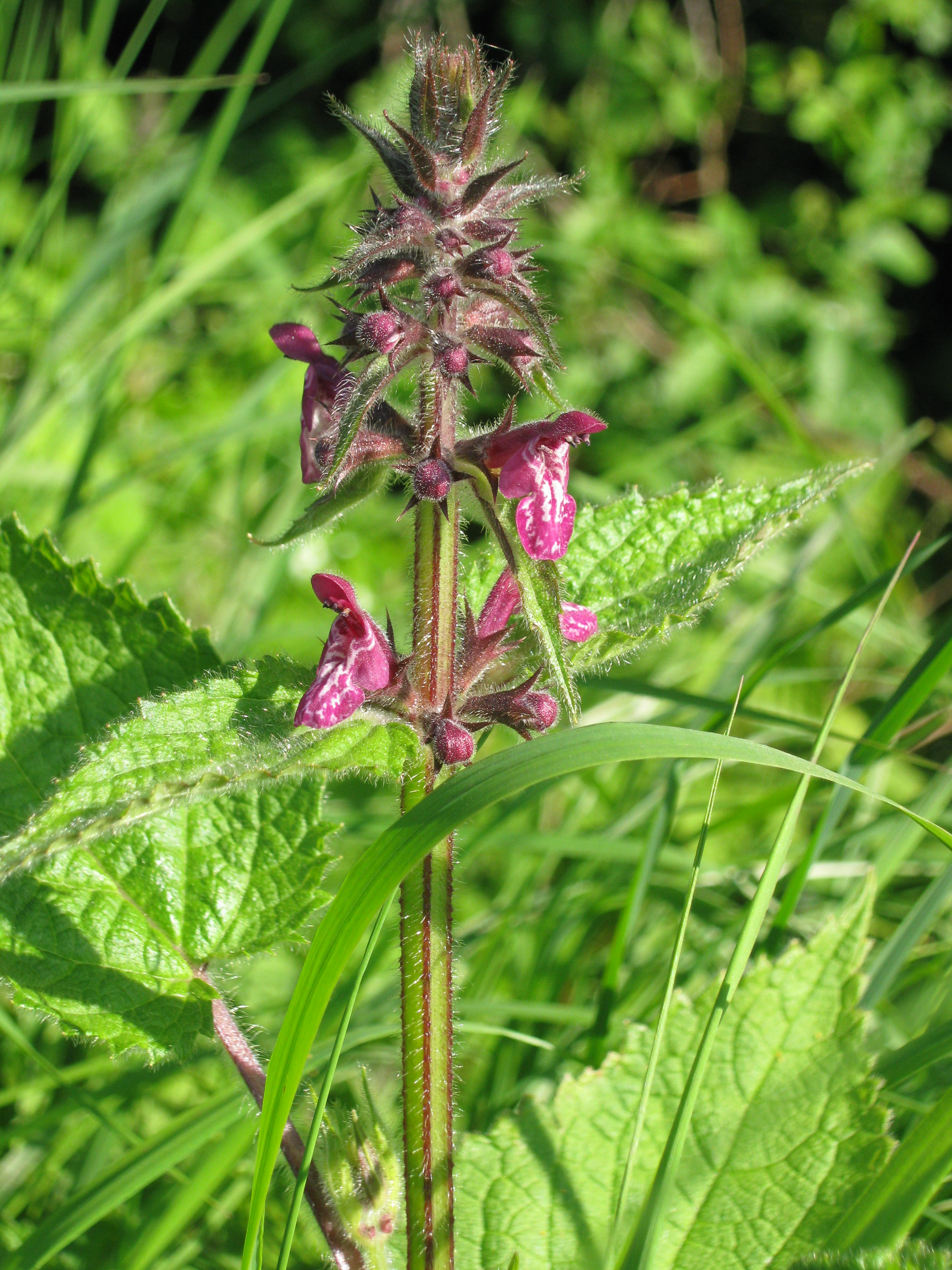
003Hedge Woundwort

Hedge Woundwort

Hedge Woundwort is in flower everywhere we look at the moment.  This plant has been used since the times of the ancient Greeks to stem bleeding and treat wounds.  Poultices, ointments and infusions were made with the leaves and the flowers made into conserves.  It has been proved that the volatile oil contained in this plant does have antiseptic qualities.

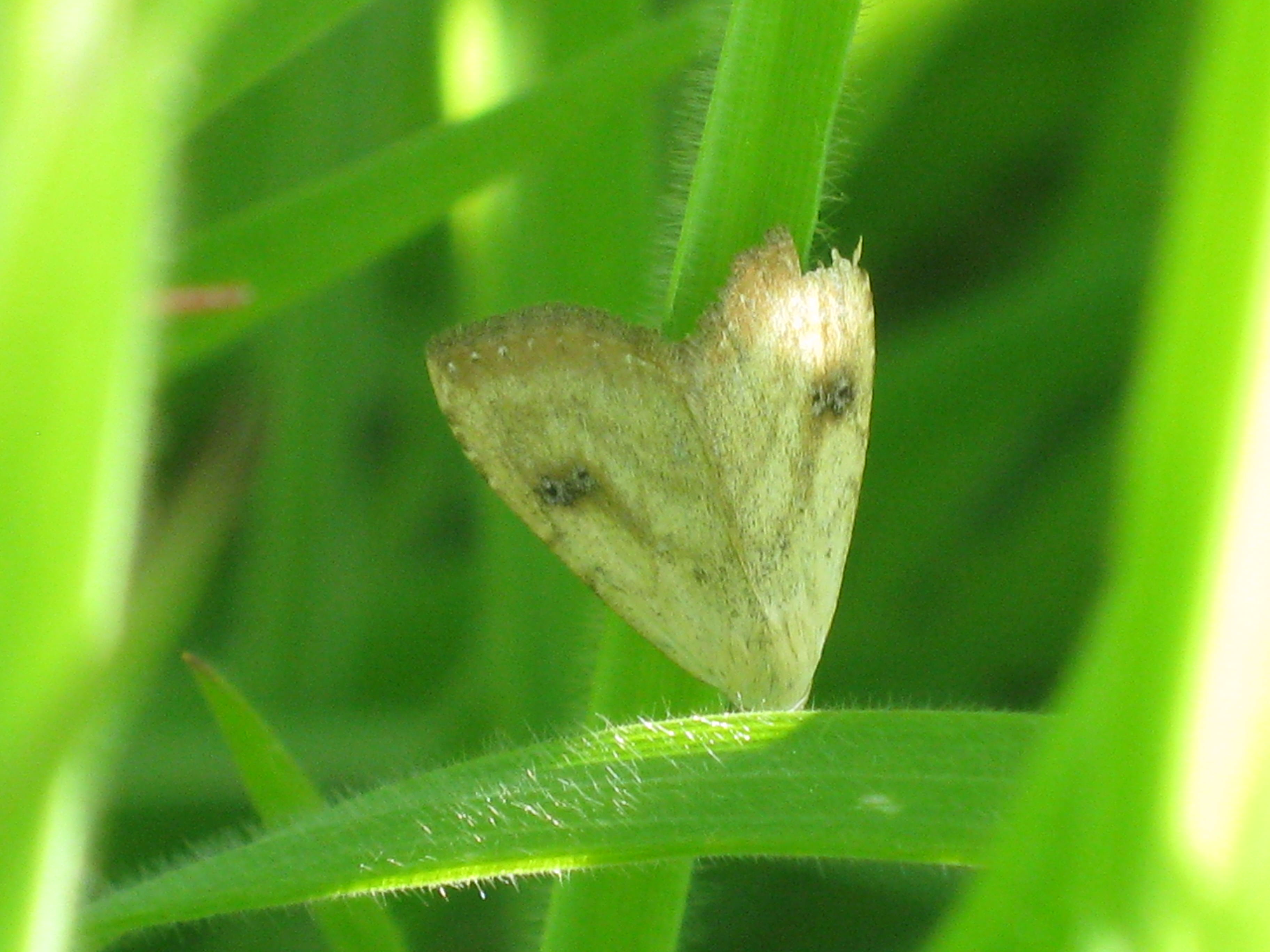
004Micro Moth

An, as yet, unidentified micro moth

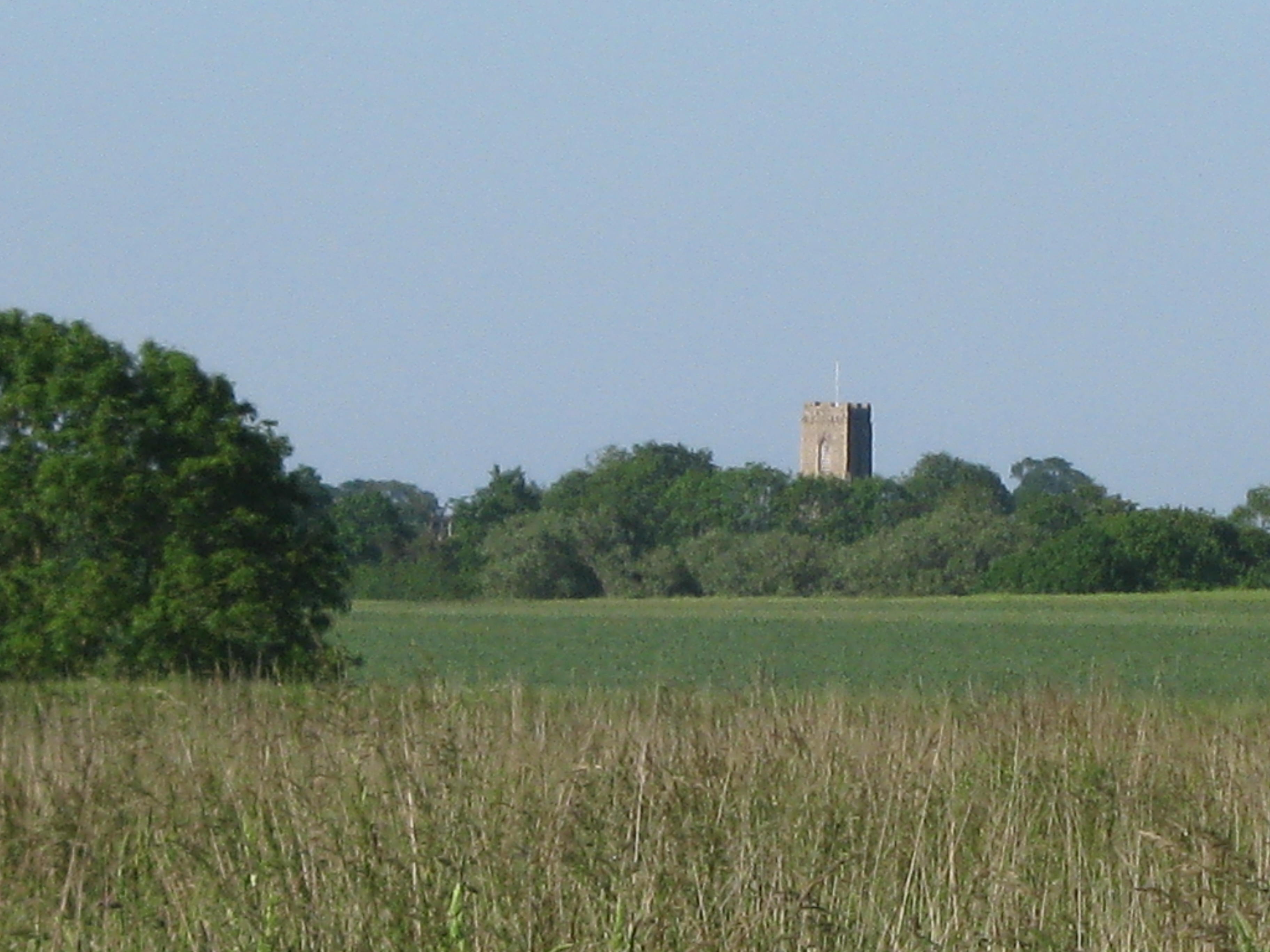
006St Peters church over fields

St Peter’s church

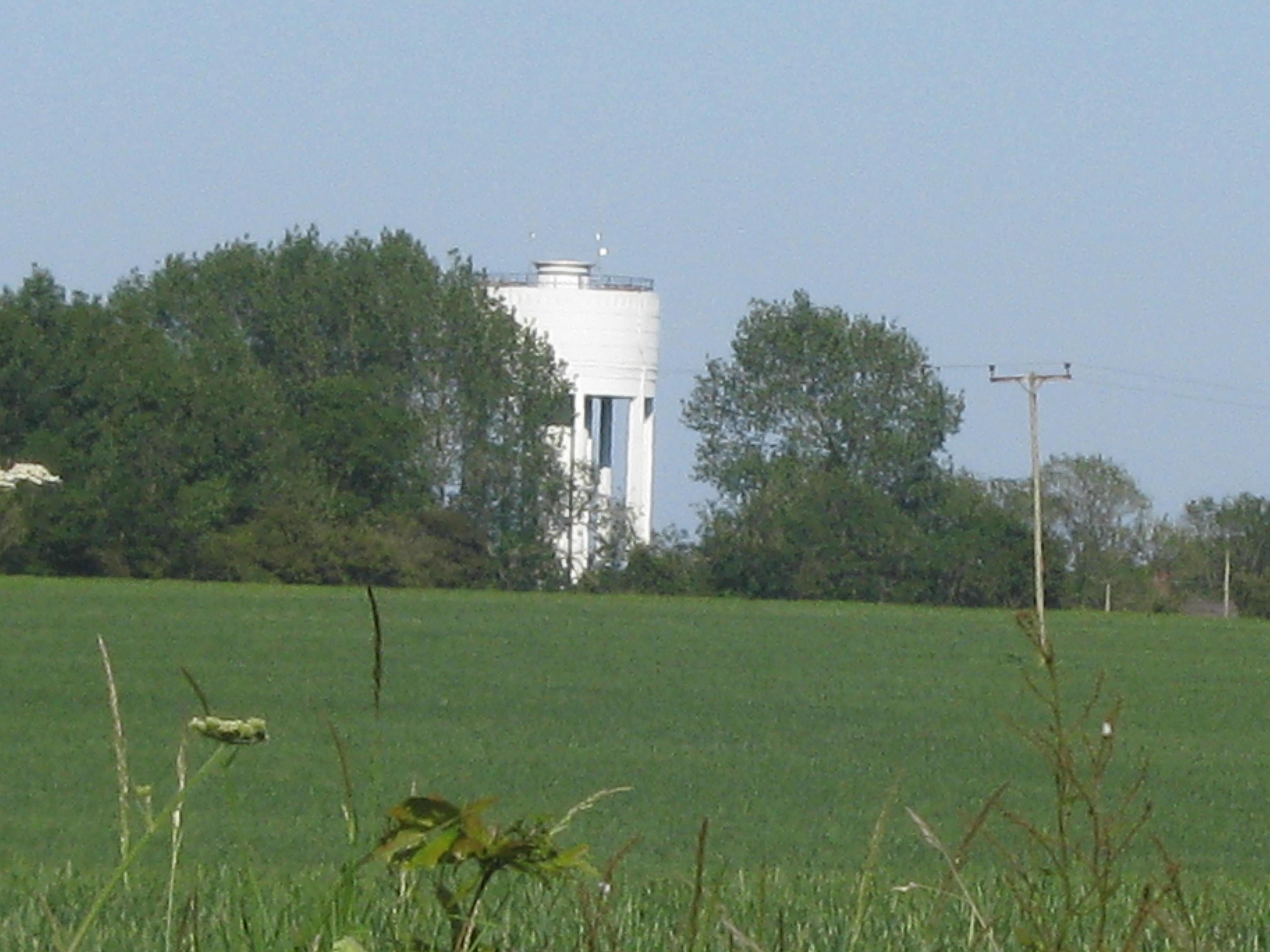
011Water Tower at St Michaels

Water tower at St Michaels

Most of the water in East Anglia comes from springs and artesian wells and is very ‘hard’ water.  We all suffer from lime-scale in our homes and all those who can afford one get a water-softener.  I love the taste of our water and when and if we get a water-softener I would have to have a tap for un-softened water.

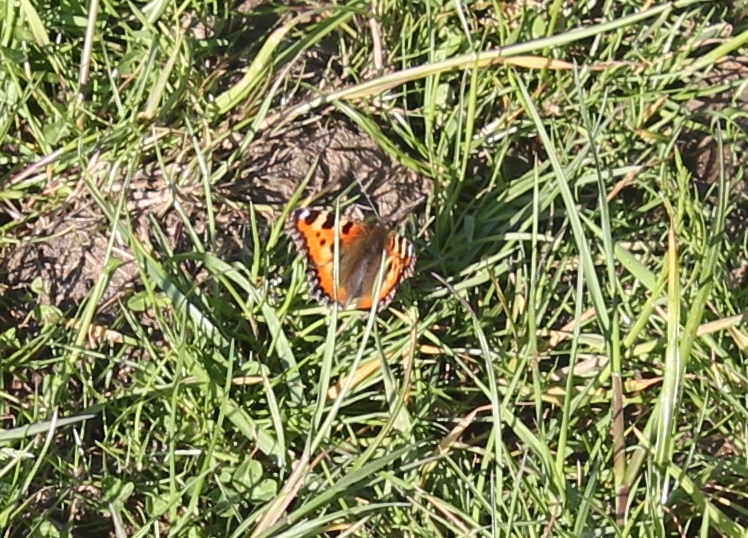
044Lesser Tortoiseshell butterfly

A Lesser Tortoiseshell butterfly

We saw this butterfly sunning itself on the path.

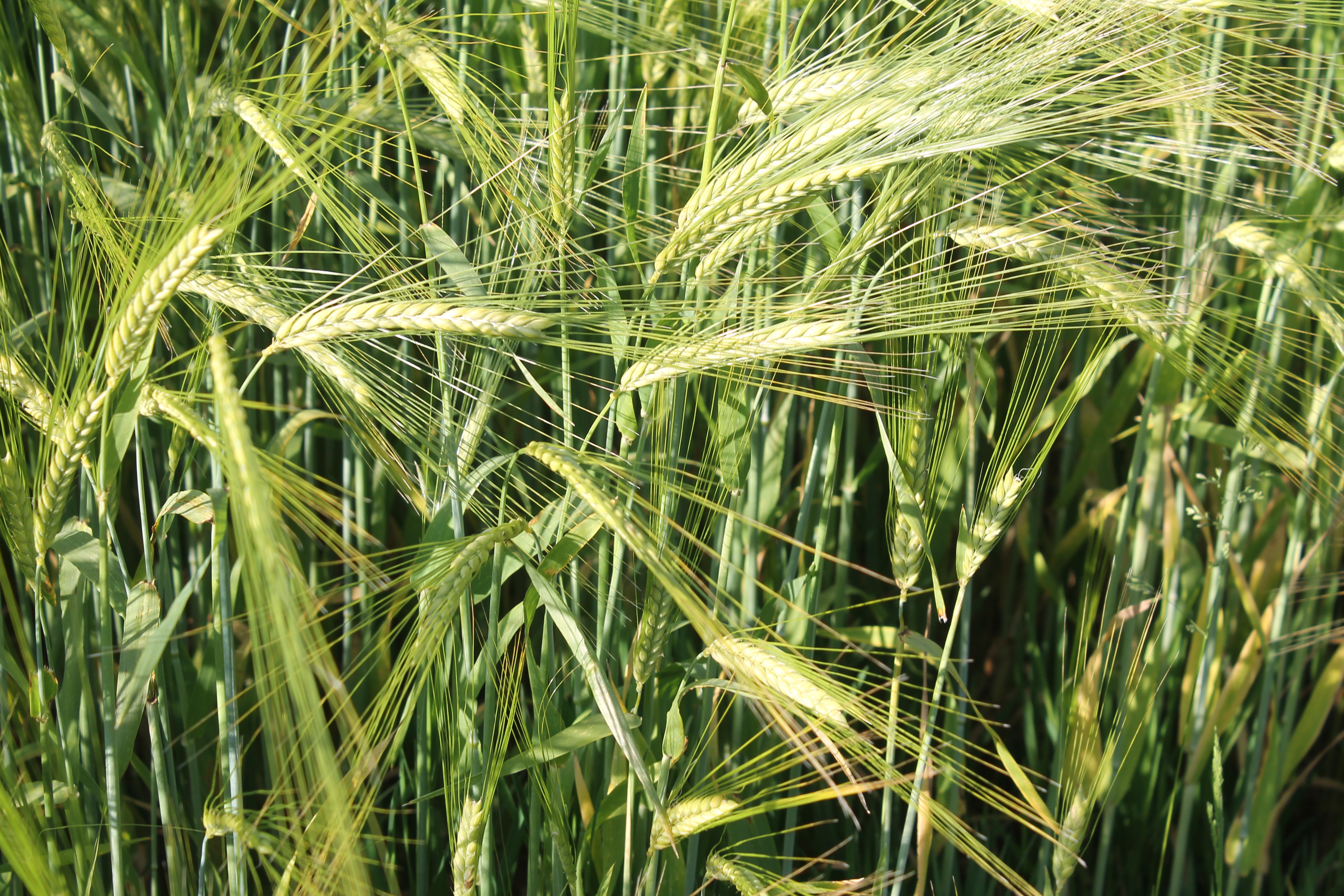
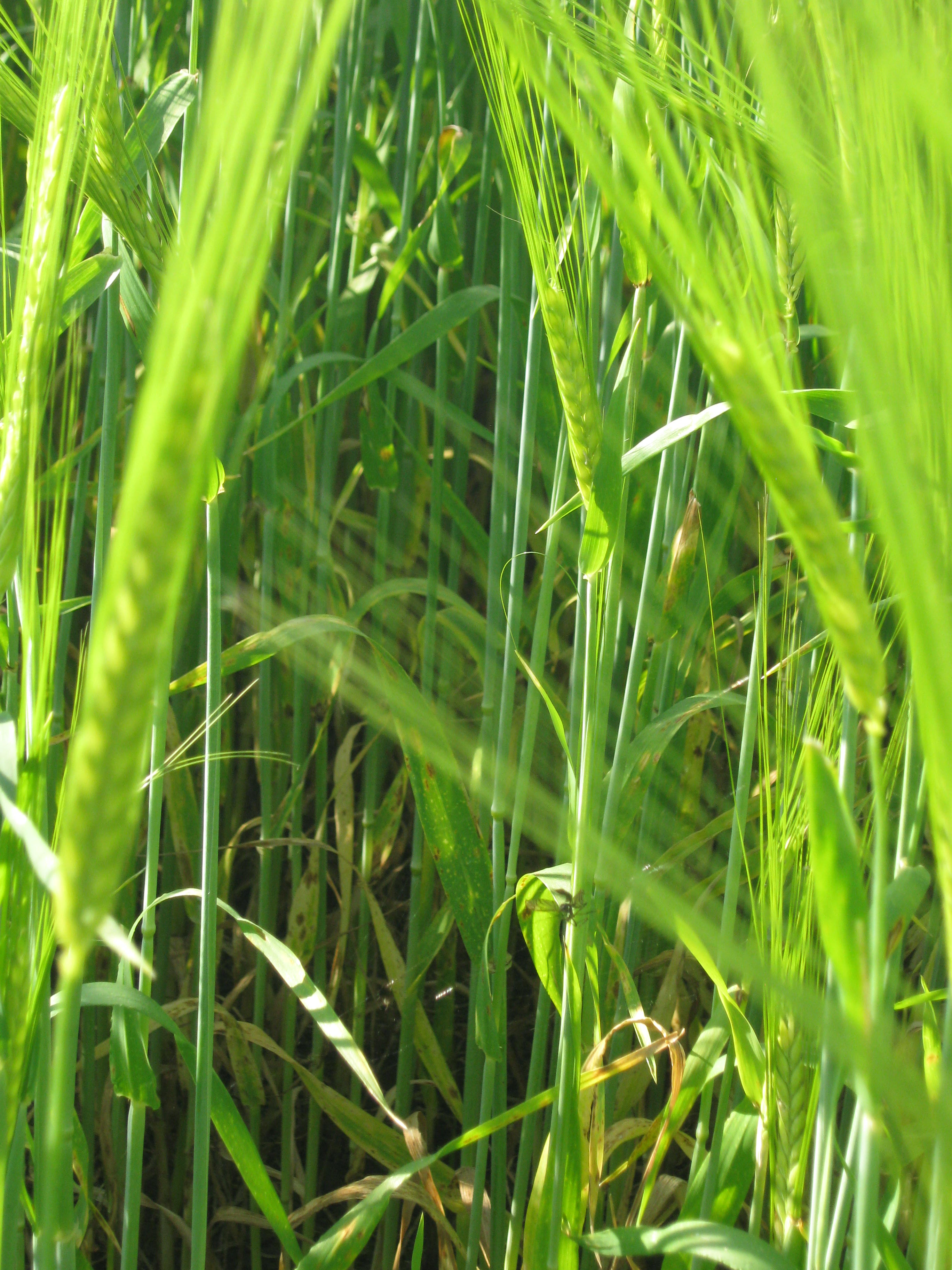
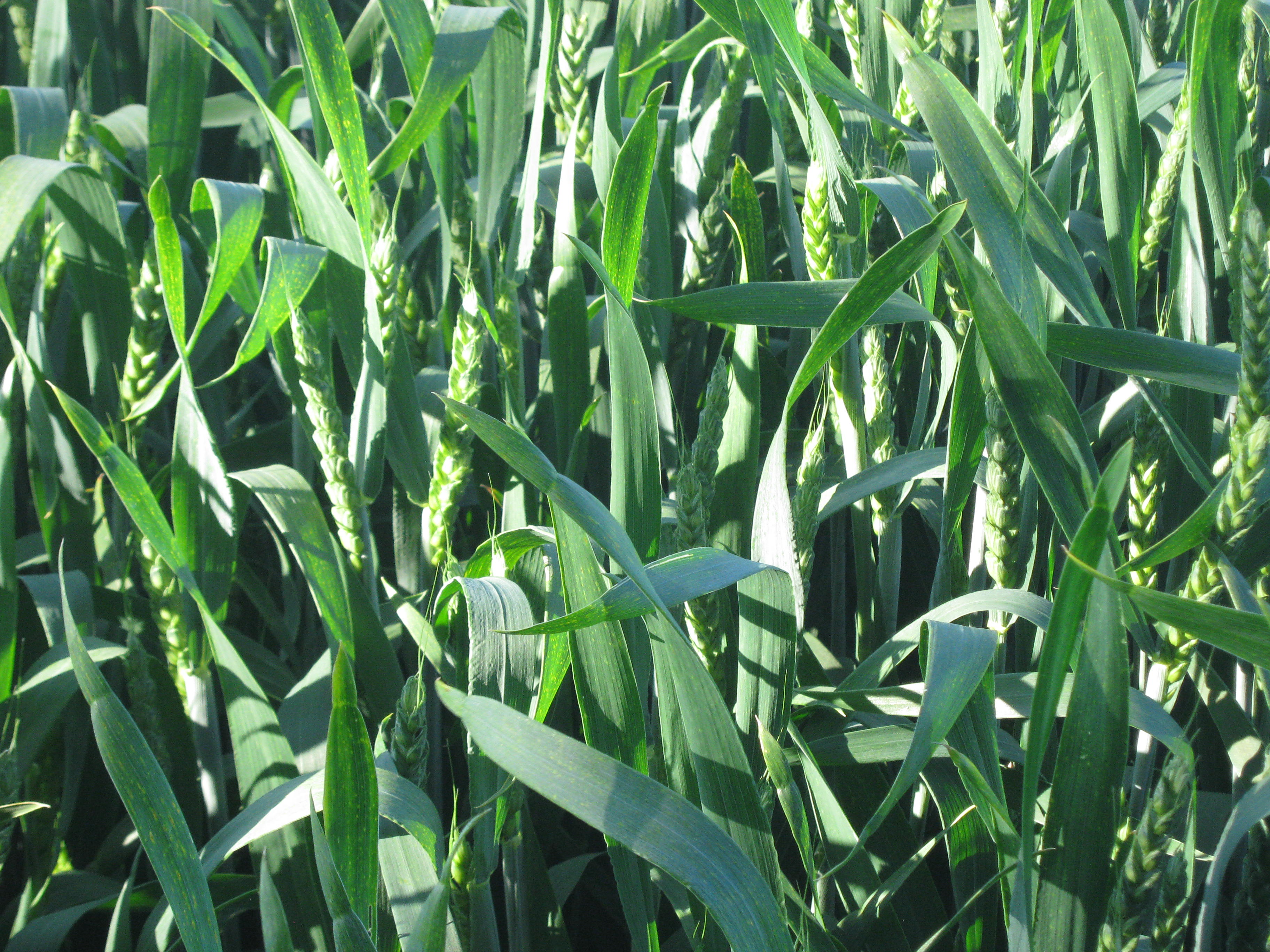
We also saw the crops ripening…..

046Barley

047Barley

010Barley

Barley.

014Ripening wheat

015Wheat

Wheat

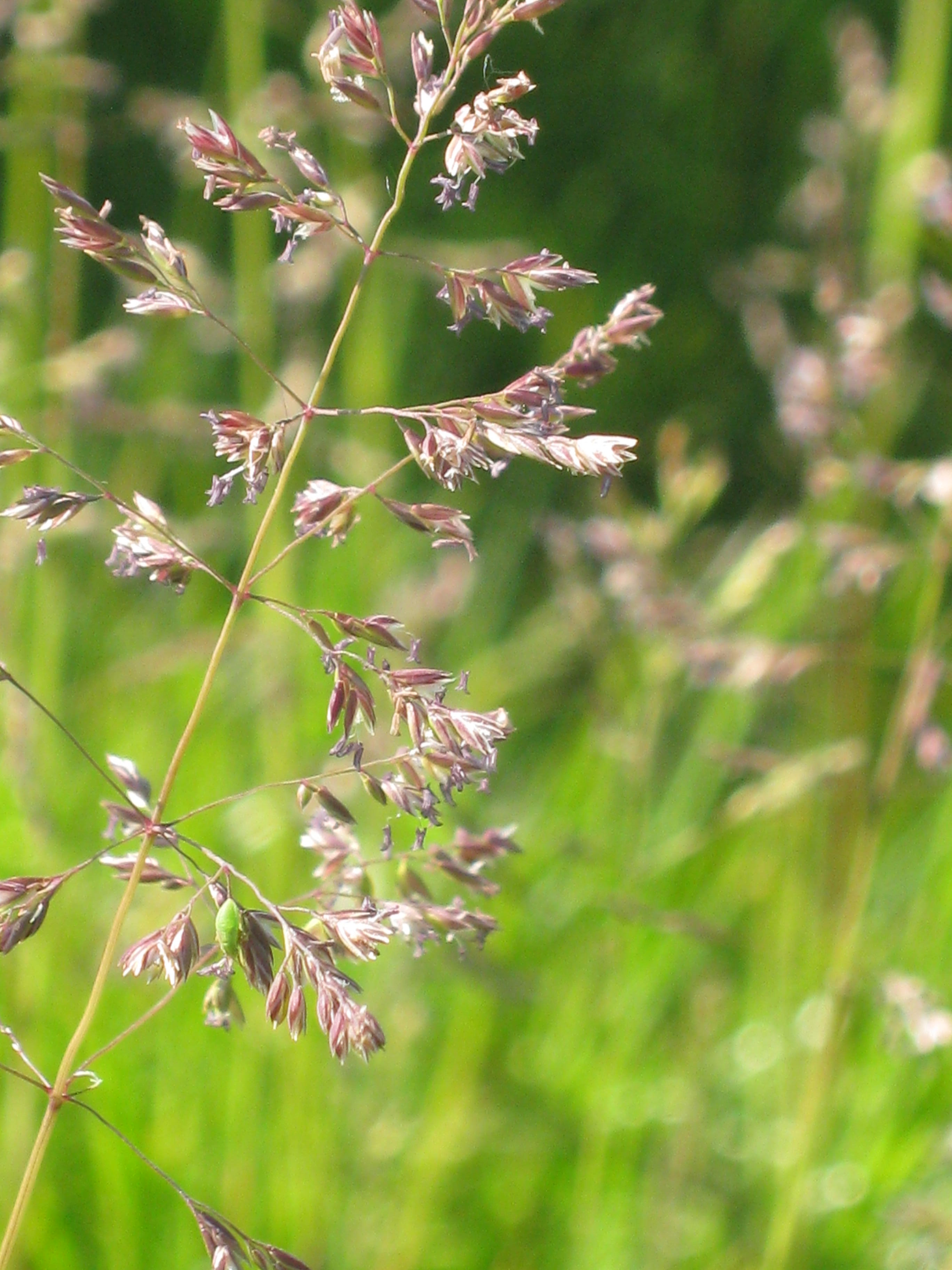
We saw other grasses too

013Grasses

012Grasses

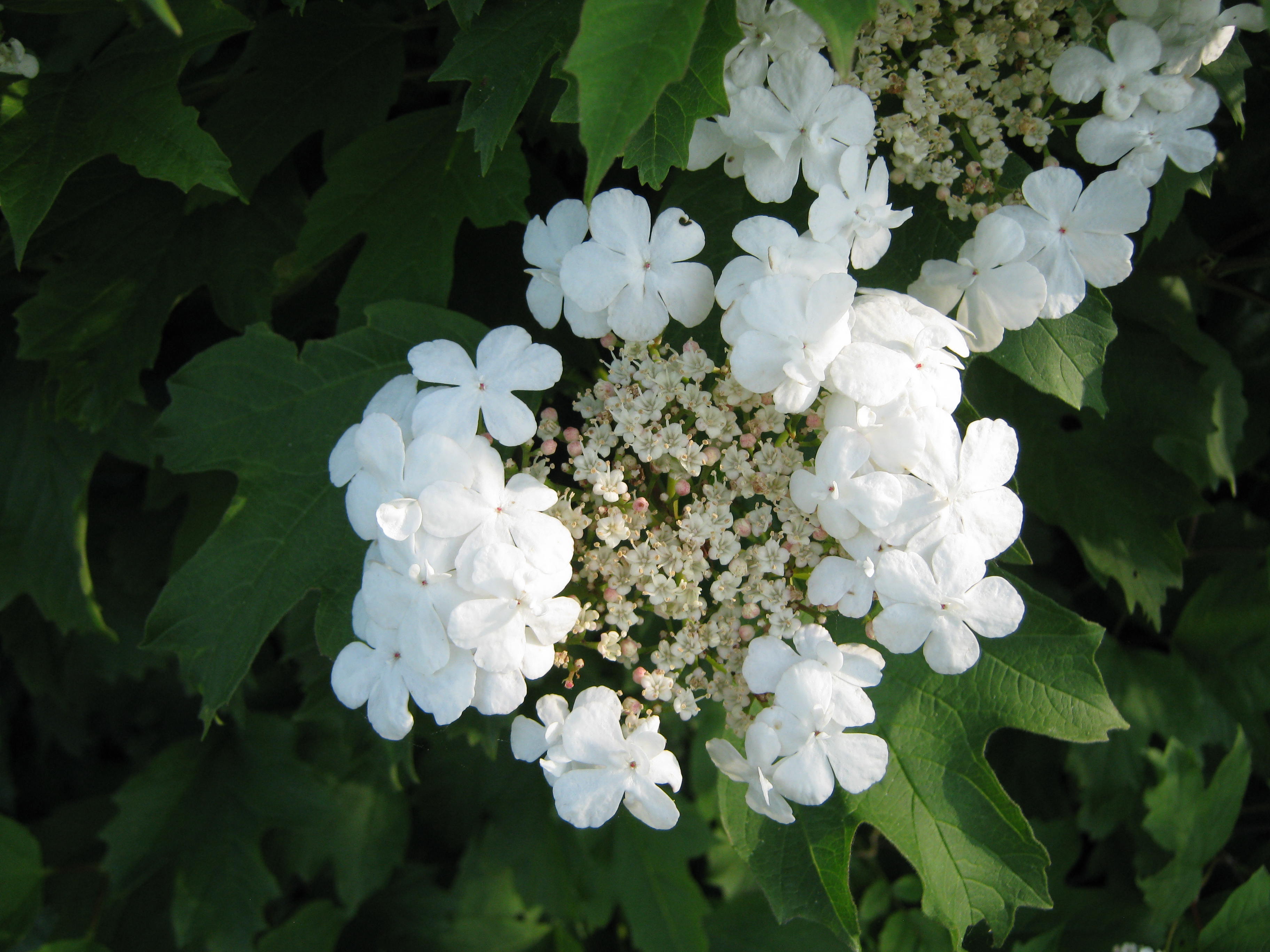
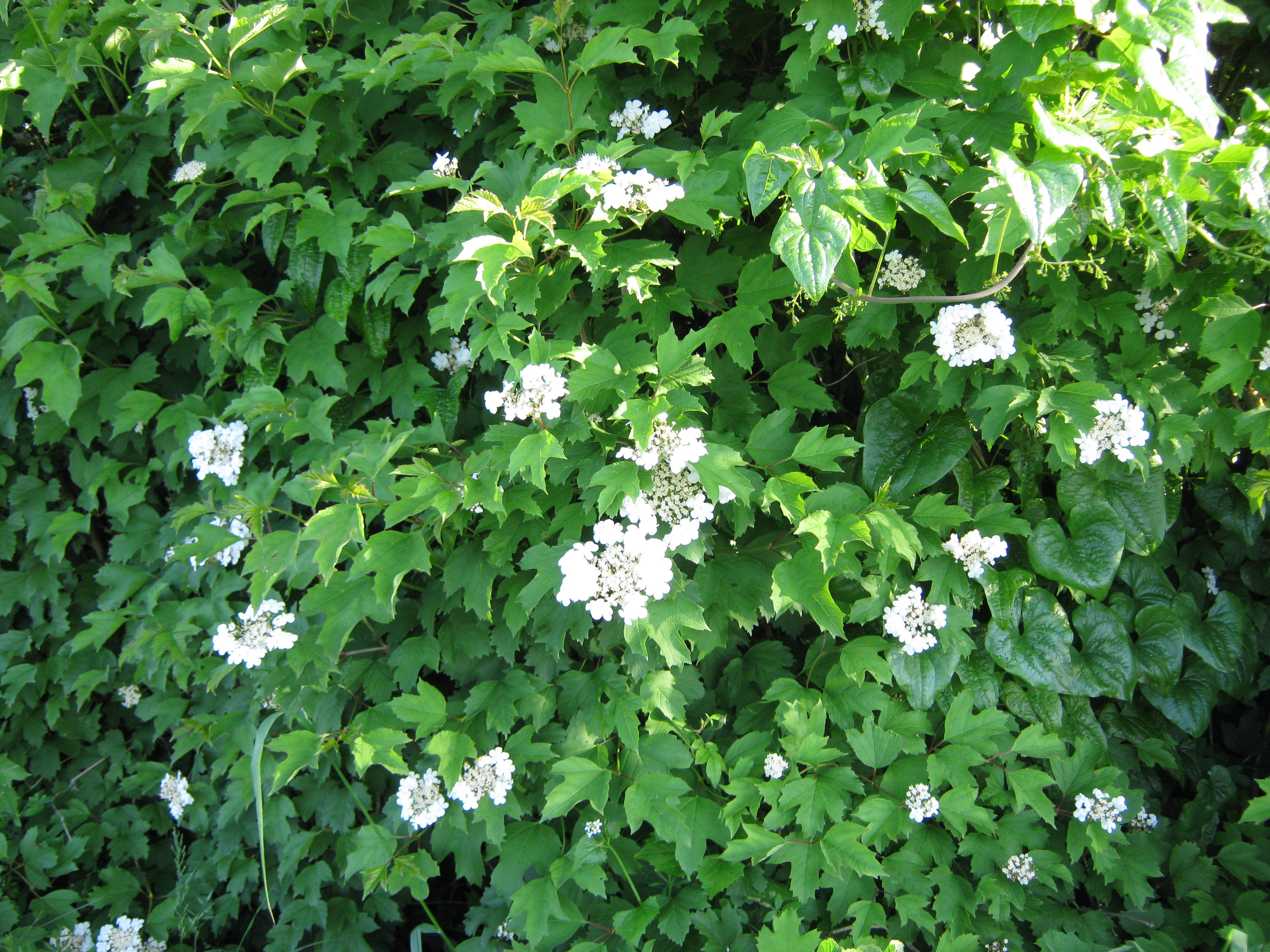
And a beautiful Guelder Rose.

019Guelder rose flower

018Guelder rose

I think I would love to have one of these in my garden!

The walk took longer than we thought it would because there was a path diversion which we took but after struggling through nettles and thistles and head-high grasses we had to turn back as the path hadn’t been cleared.

R has spent all this past week away, firstly in Gloucestershire and then he travelled to Lancashire for a couple of days.  He returned home on Friday having called in on his mother and spent the night with his brother in Manchester.  E and I had spent the day without electricity as there was a planned power cut to enable the electricity company to do repairs.  It is difficult to find things to do these days which doesn’t involve the use of electricity.  We managed however, and it is a good opportunity to have silence in the house with no humming fridges and freezers, no radios and TVs.  The only worry I had during the six-and-a-half hours was whether the food was still alright in the fridge and freezers.  It was a very warm day!  As it turned out, all was well.

Share this:

  • Share on X (Opens in new window) X
  • Share on Reddit (Opens in new window) Reddit
  • Share on Pinterest (Opens in new window) Pinterest
  • Share on Facebook (Opens in new window) Facebook
  • Email a link to a friend (Opens in new window) Email
  • Share on Tumblr (Opens in new window) Tumblr
  • Print (Opens in new window) Print
  • Share on Pocket (Opens in new window) Pocket
  • Share on LinkedIn (Opens in new window) LinkedIn
Like Loading...

A Good Day

15 Thu May 2014

Posted by Clare Pooley in churches, plants, Rural Diary, trees, walking, wild birds

≈ 6 Comments

Tags

barley, Common Whitebeam, Early Purple Spotted Orchid, English Oak, field maple, Lady's Smock, Lesser Whitethroat, Oak-apples, orange-tip butterfly, Red Clover, Red Horse Chestnut, Red May, St Michaels church, St Peter's church, stag-headed, the Beck, Turtle Doves, Willow Warbler, Wych Elm

I had a very good day yesterday.  The weather was much better than it had been for a week and I was nearly back to normal after my cold.  I hung some washing out on the line in the garden and then set off for Bungay where I had to get some shopping.  Just as I was nearing Flixton I noticed some birds at the side of the road, mainly woodpigeons but among them were a pair of Turtle Doves.  I was so pleased to see them I nearly shouted out loud!  Turtle Doves are becoming so rare, not only because of the reduction of places to nest in this country but also because of the dangers they face during migration – being shot for sport for example – and the lack of suitable places to spend the winter because of deforestation in Africa.  Even if we get no Turtle Doves in our garden this year I am happy that there are at least one pair in this area!  Their song epitomises high summer for me – a lovely drowsy, purring noise. We used to get them every year and they stayed around until the end of August.  In recent years we have had a Turtle Dove sing for a day or so and then go off elsewhere in search of a mate.  Last year they didn’t turn up at all.  Many people believed that was because of the terrible spring we had had.  Turtle Doves had arrived in this country and then we had the late snow and frost which killed some birds and others just turned round and went back to France.

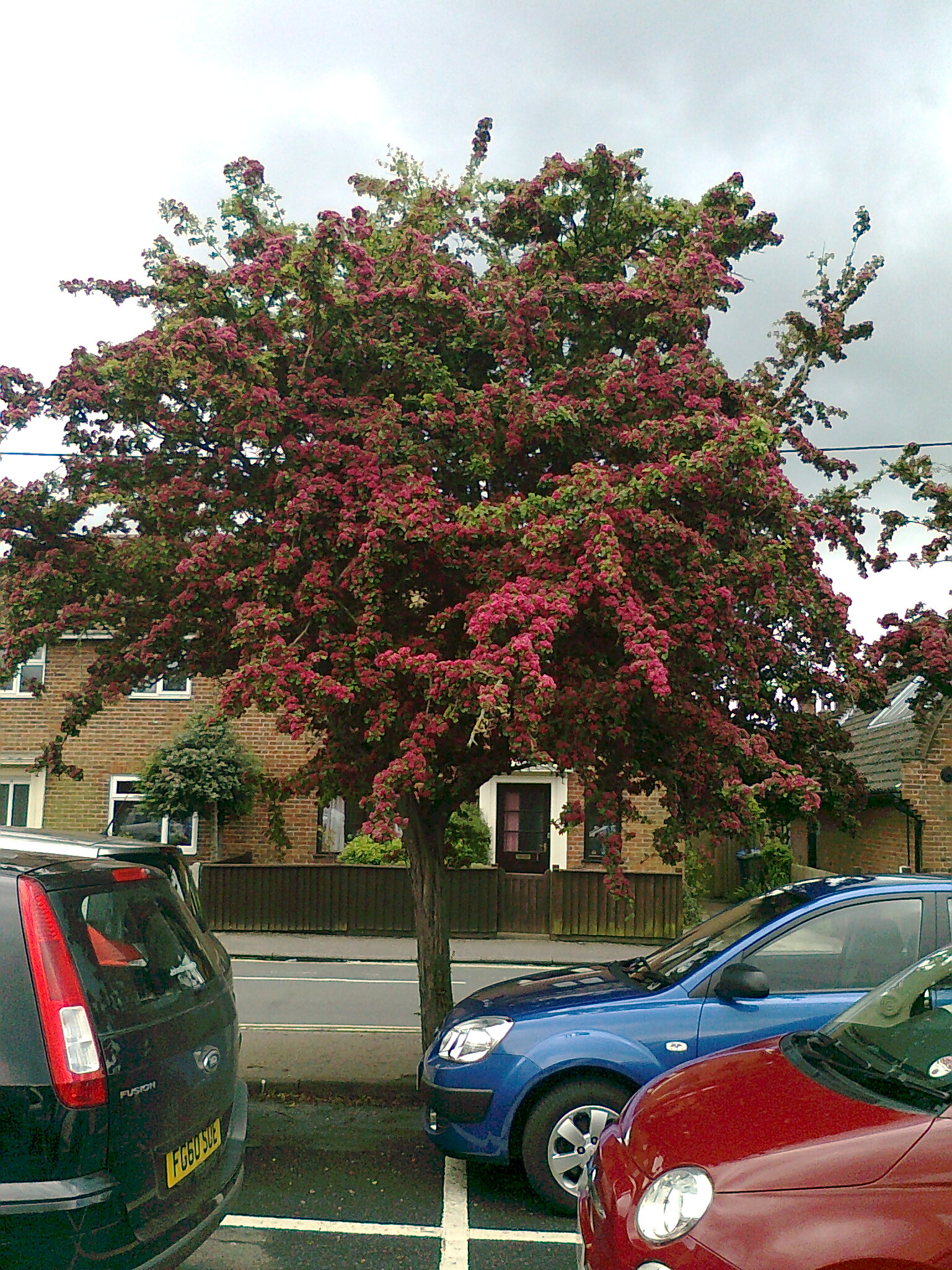
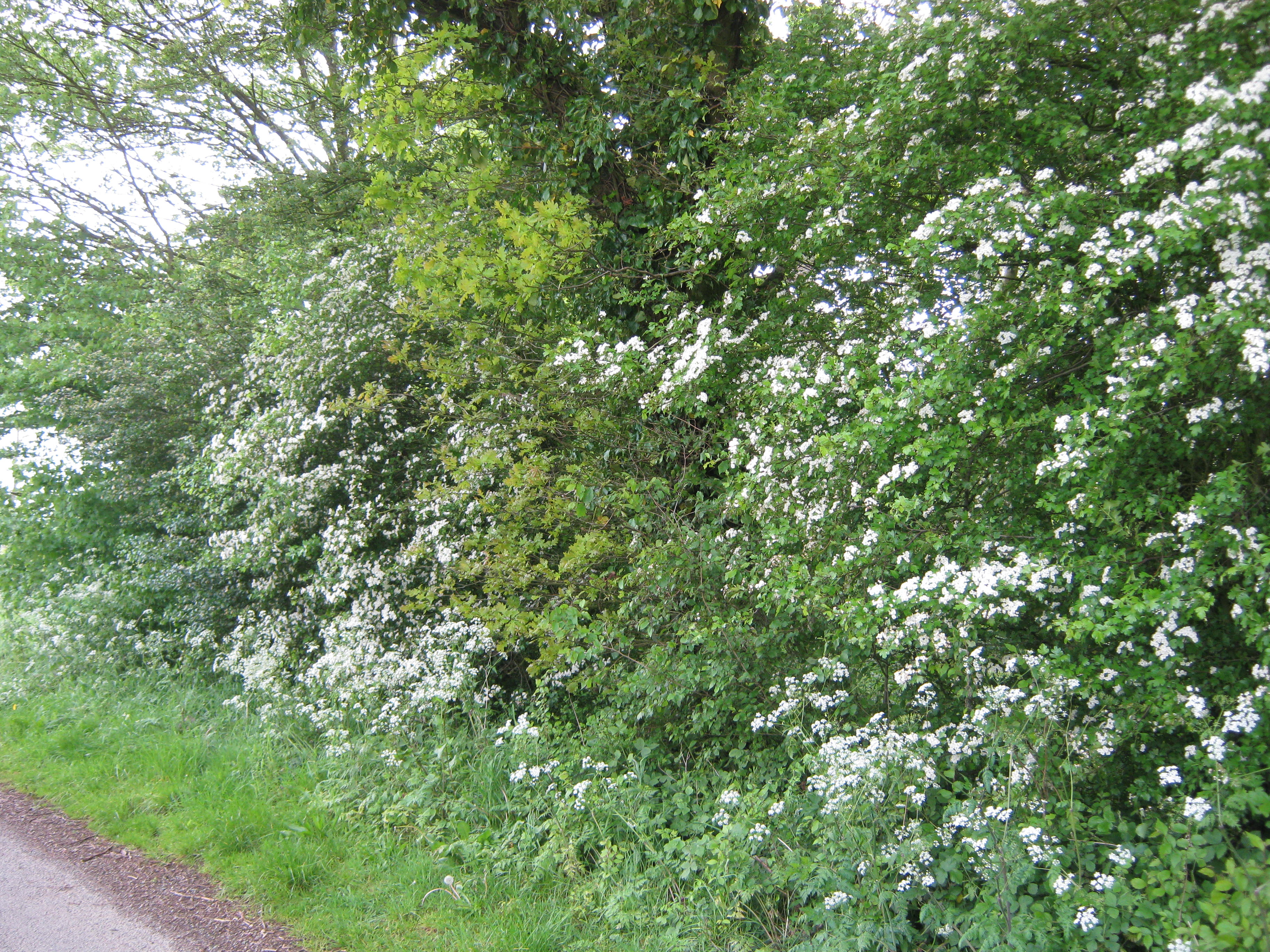
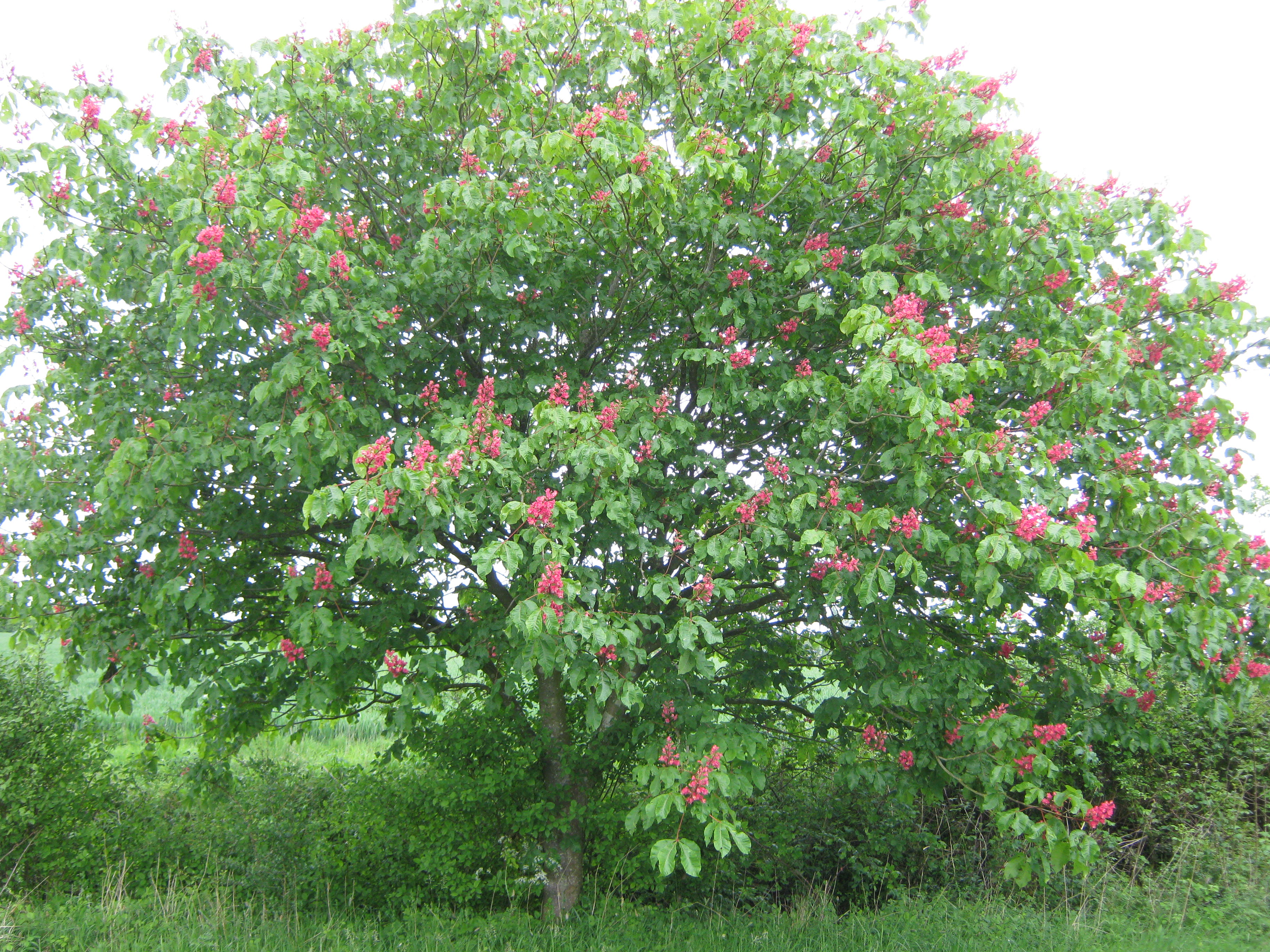
I went to my usual car park in the centre of town and noticed all the trees planted around the car park had come into flower.  They are all Red May trees – Red Hawthorns – and look so pretty with their deep pink flowers.

Image


Red Mays are not as popular here as where I grew up in Kent.  My father thought they were wonderful and planted one in one of the houses we had when I was a girl.  As I walked about the town I remembered having seen another red-blossomed tree recently and thought I would go and have a closer look at it later in the day.

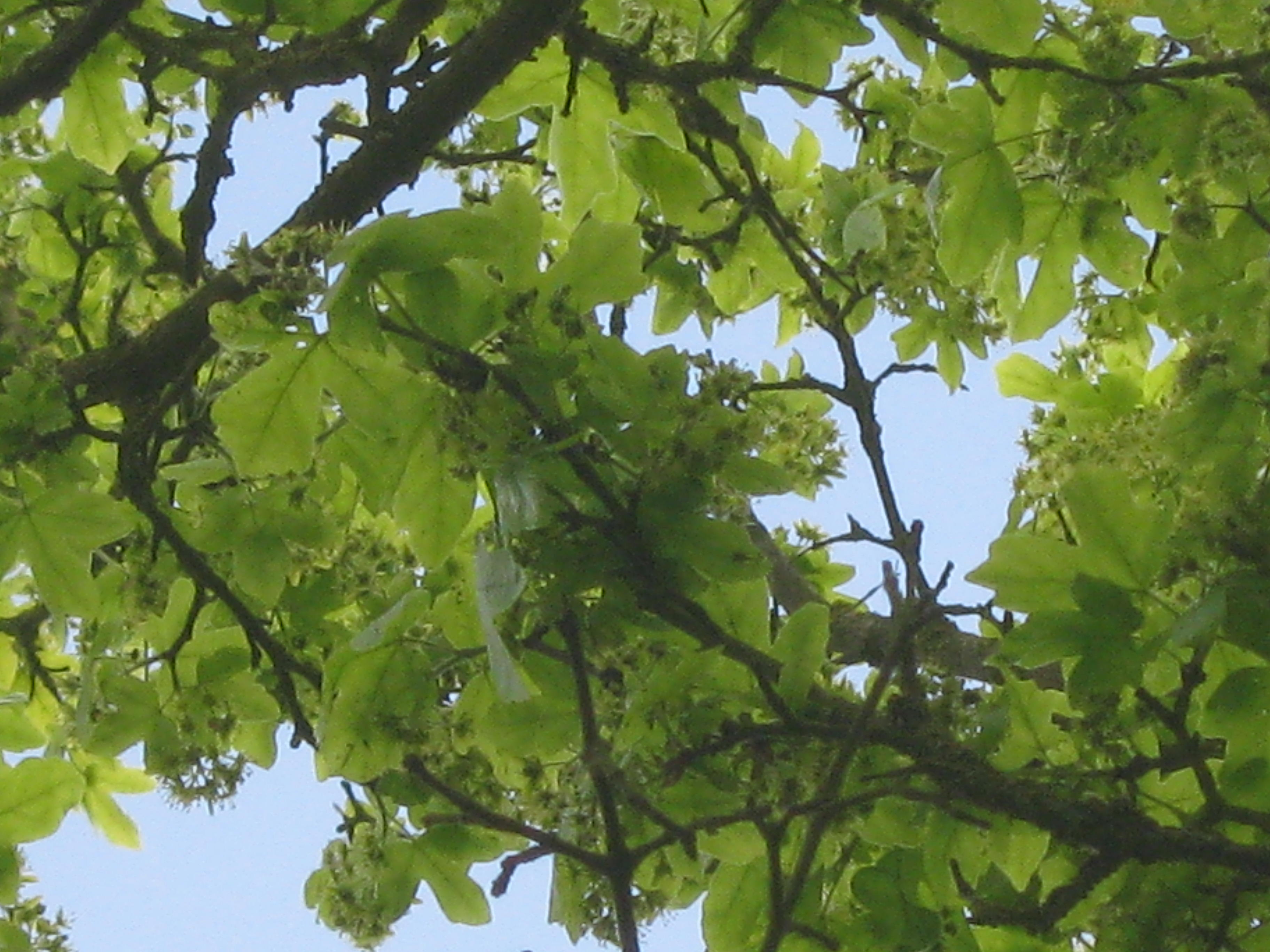
I found the opportunity to go for a quick walk in the early afternoon.  The day had warmed up considerably but there were still a few black clouds around.  As I walked down to the end of our lane and out into the next I listened to a Willow Warbler singing in the top branches of a group of trees nearby.  The Willow Warbler is another bird whose song I couldn’t do without – it has a sweet song of descending notes in a minor key.  Weep, weep, weep, weep it says and makes my heart swell and I find I am near to tears at the beauty of it.  It is another bird whose numbers are reducing drastically.  Again, we used to hear them all summer long but not any more.  I hope this one finds a mate and stays to sing for me.  I stood under the Field Maple tree it was singing in and eventually saw it in the top canopy.  It sang and then busily flitted from twig to twig in search of food and then sang again.  I tried to photograph it but wasn’t quick enough.

Image

This is the result.  Can you see it?  No, neither can I.

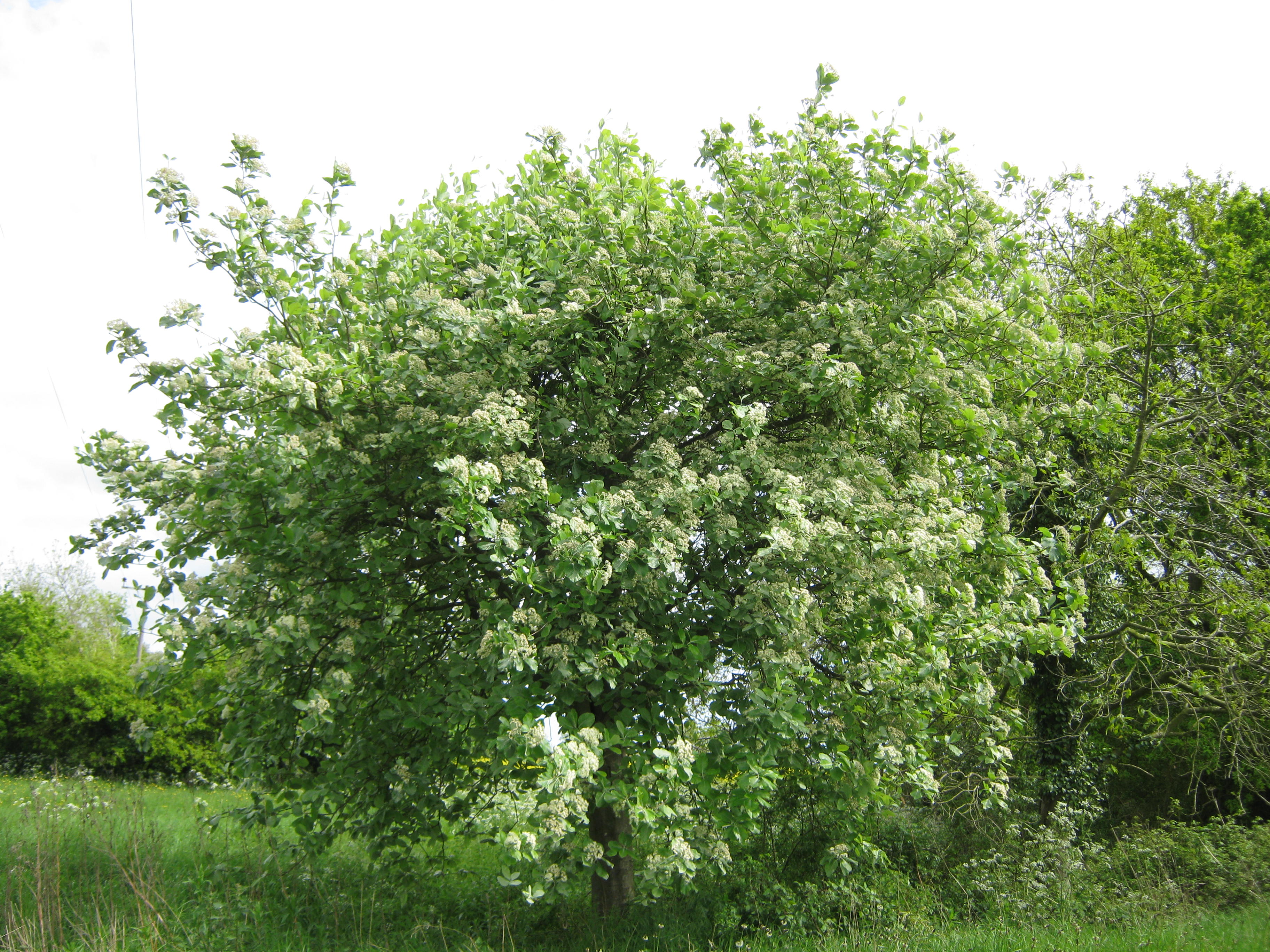
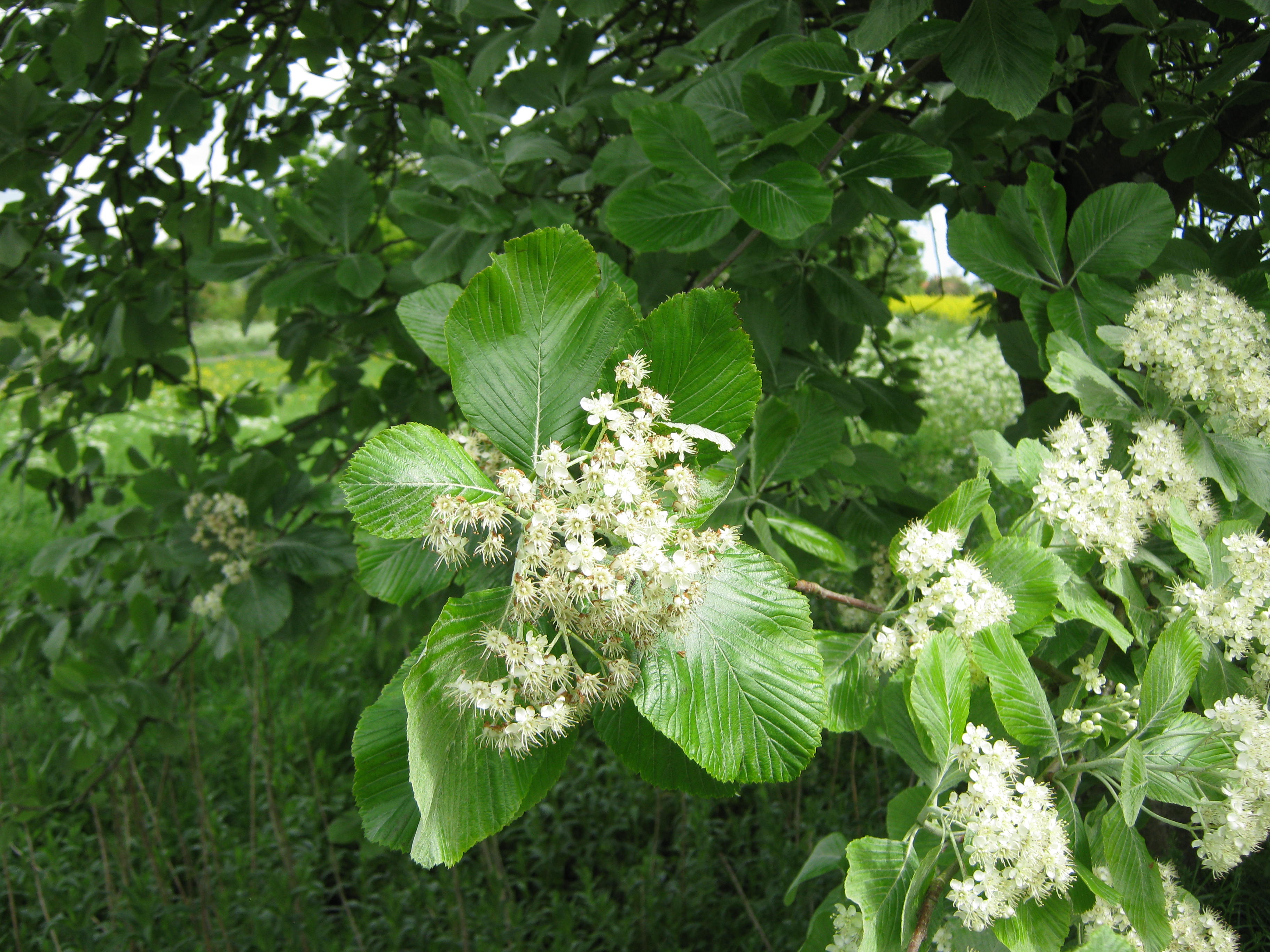
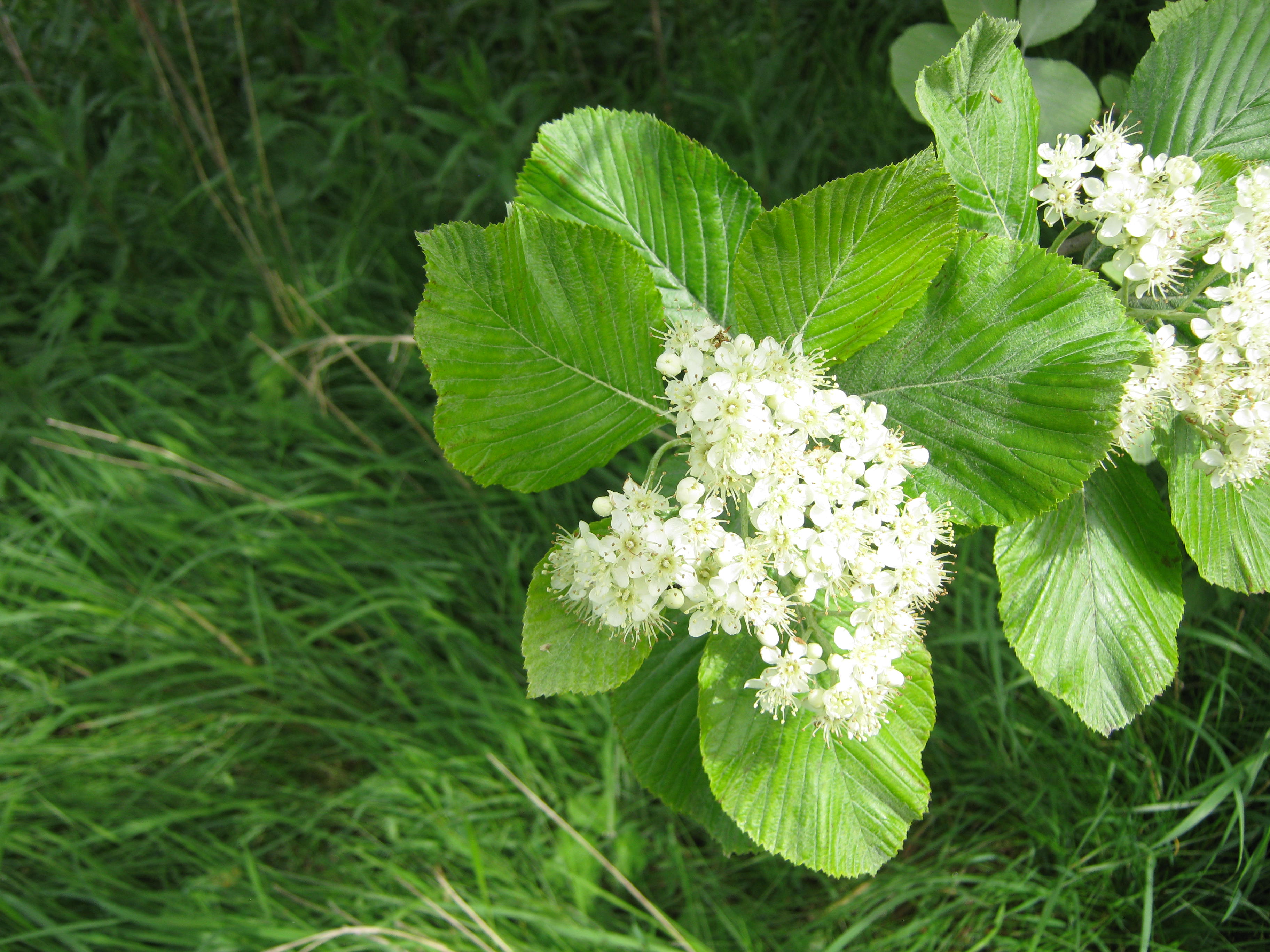
On the corner of our lane where it meets the other lane is a wide area of common land and a couple of ornamental trees have been planted there.  One is a Sweet Chestnut which is only just coming into leaf and the other is a Whitebeam, a native tree but not one that usually grows in this part of the country.

Image

Common Whitebeam tree

Image

Common Whitebeam blossom

Image

Common Whitebeam blossom

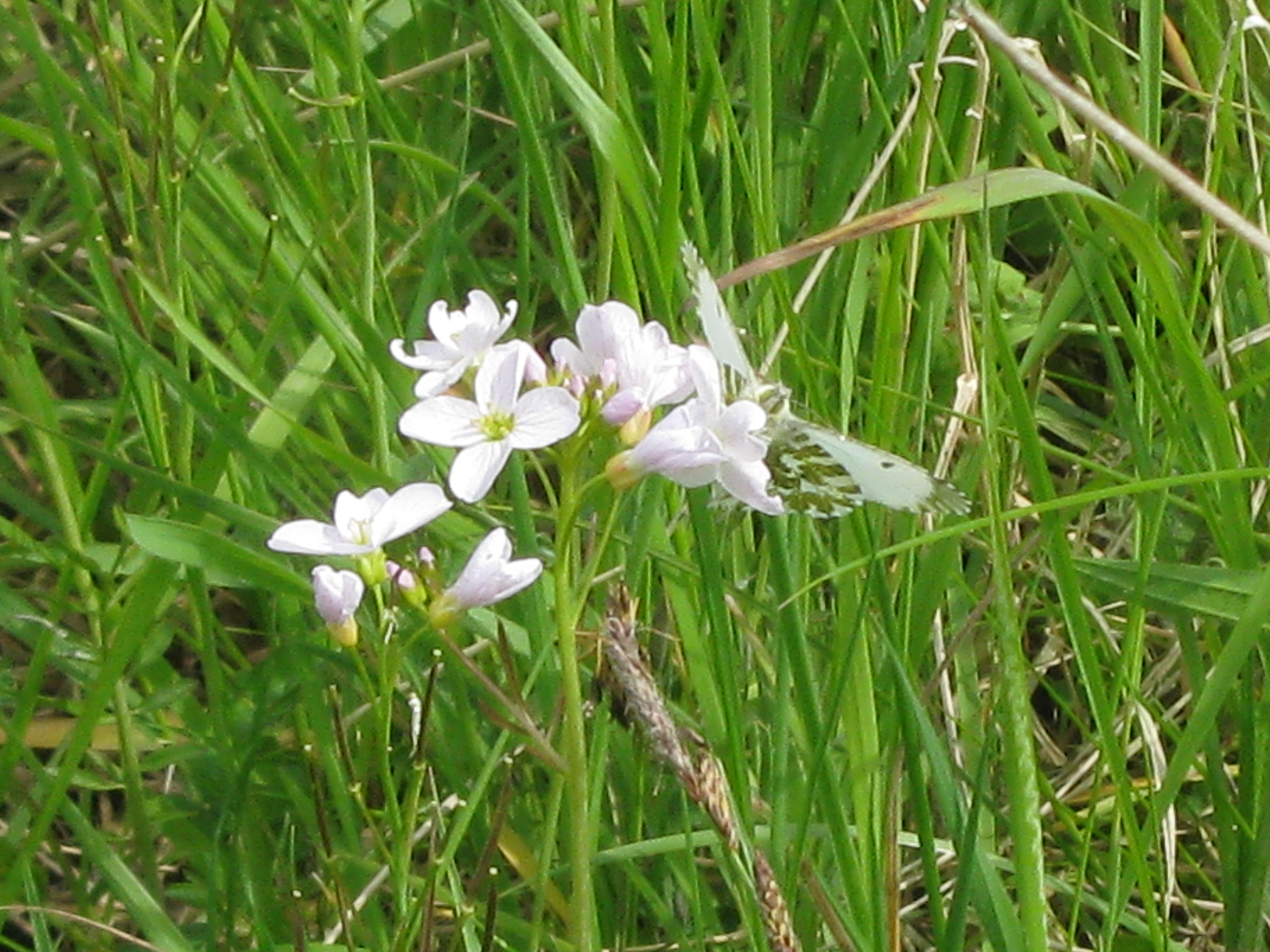
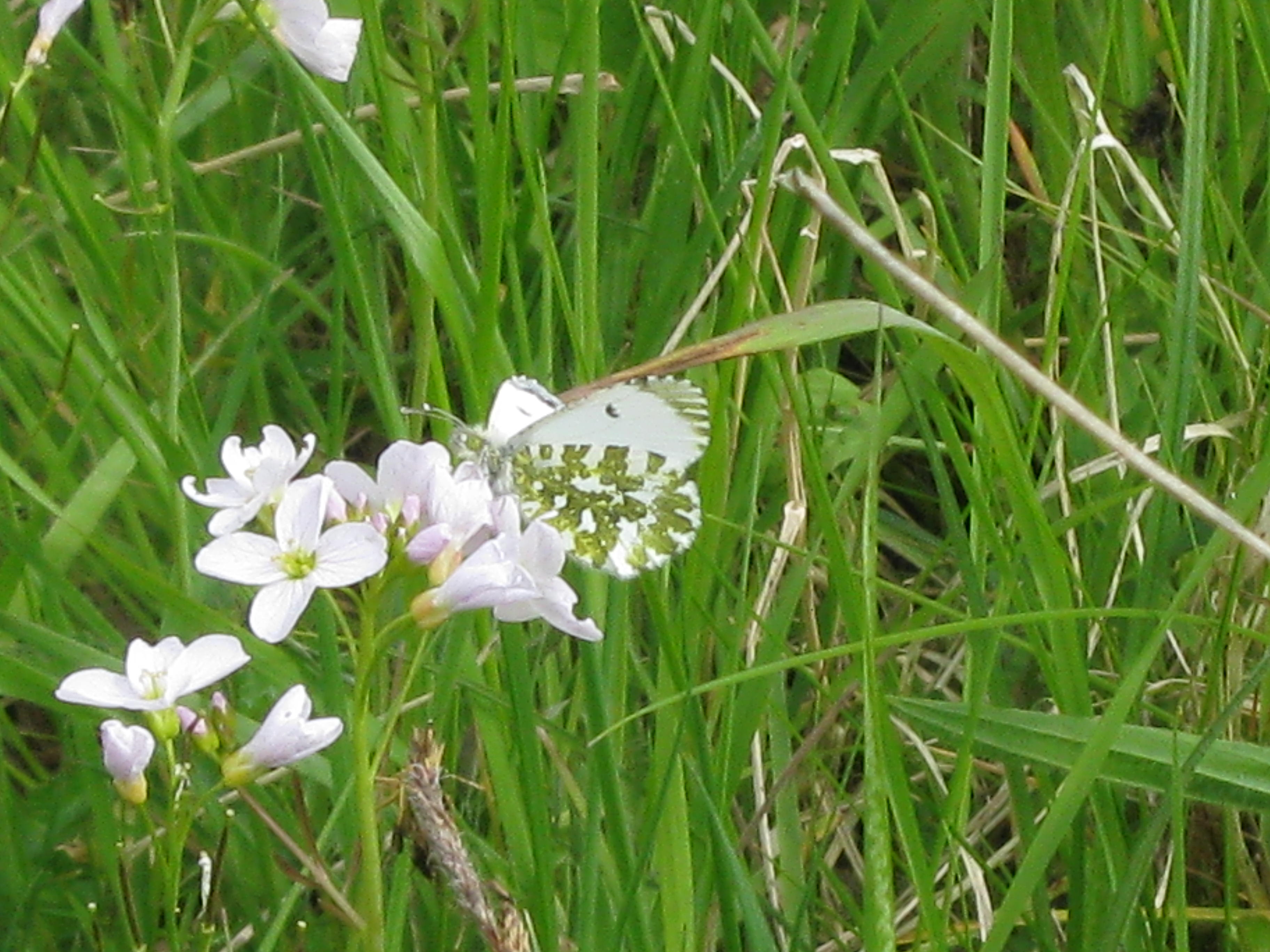
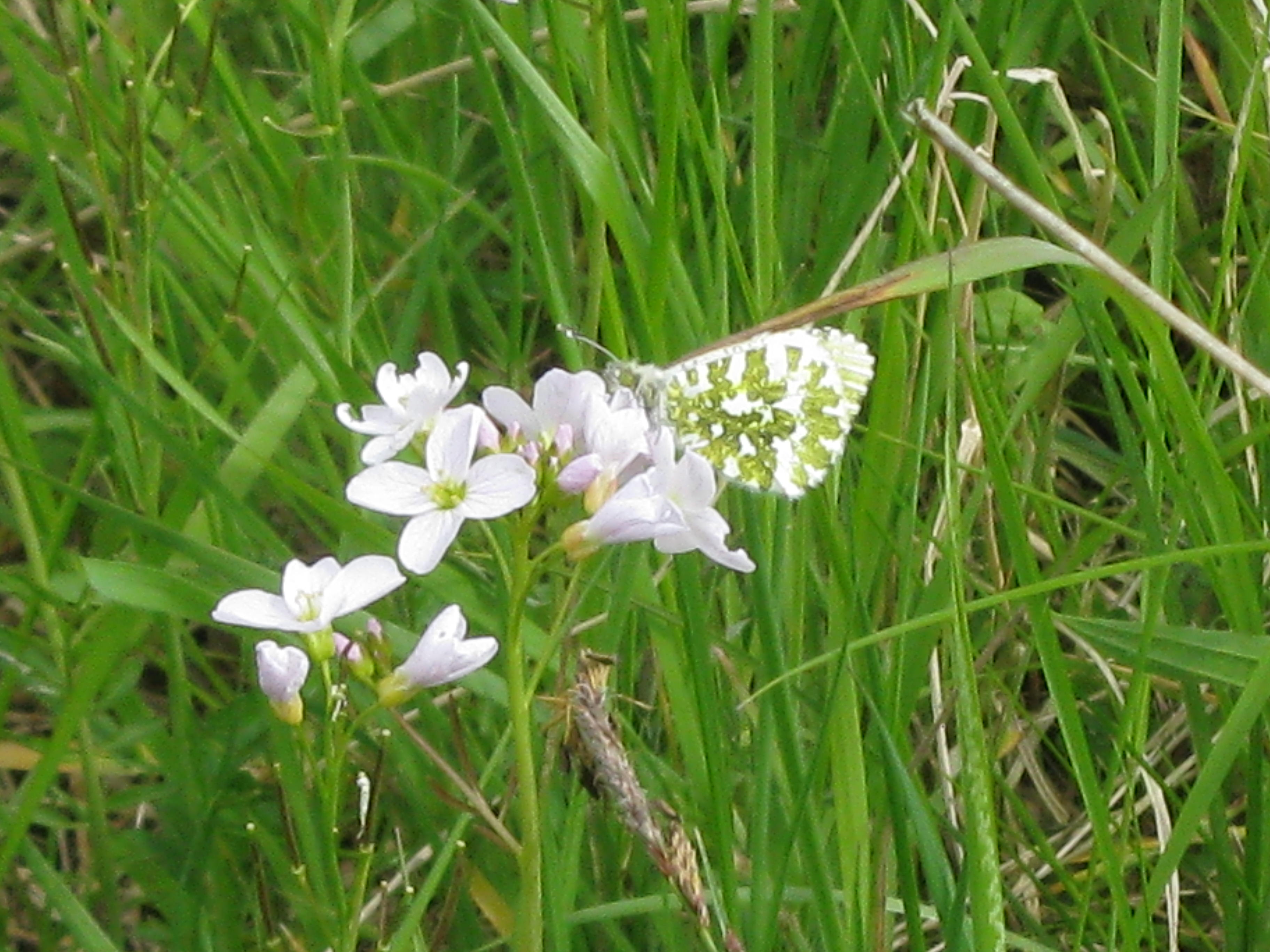
The grass of this patch of common land was covered in Lady’s Smock flowers and a female Orange Tip butterfly was feeding from them.

Image

Image

Image

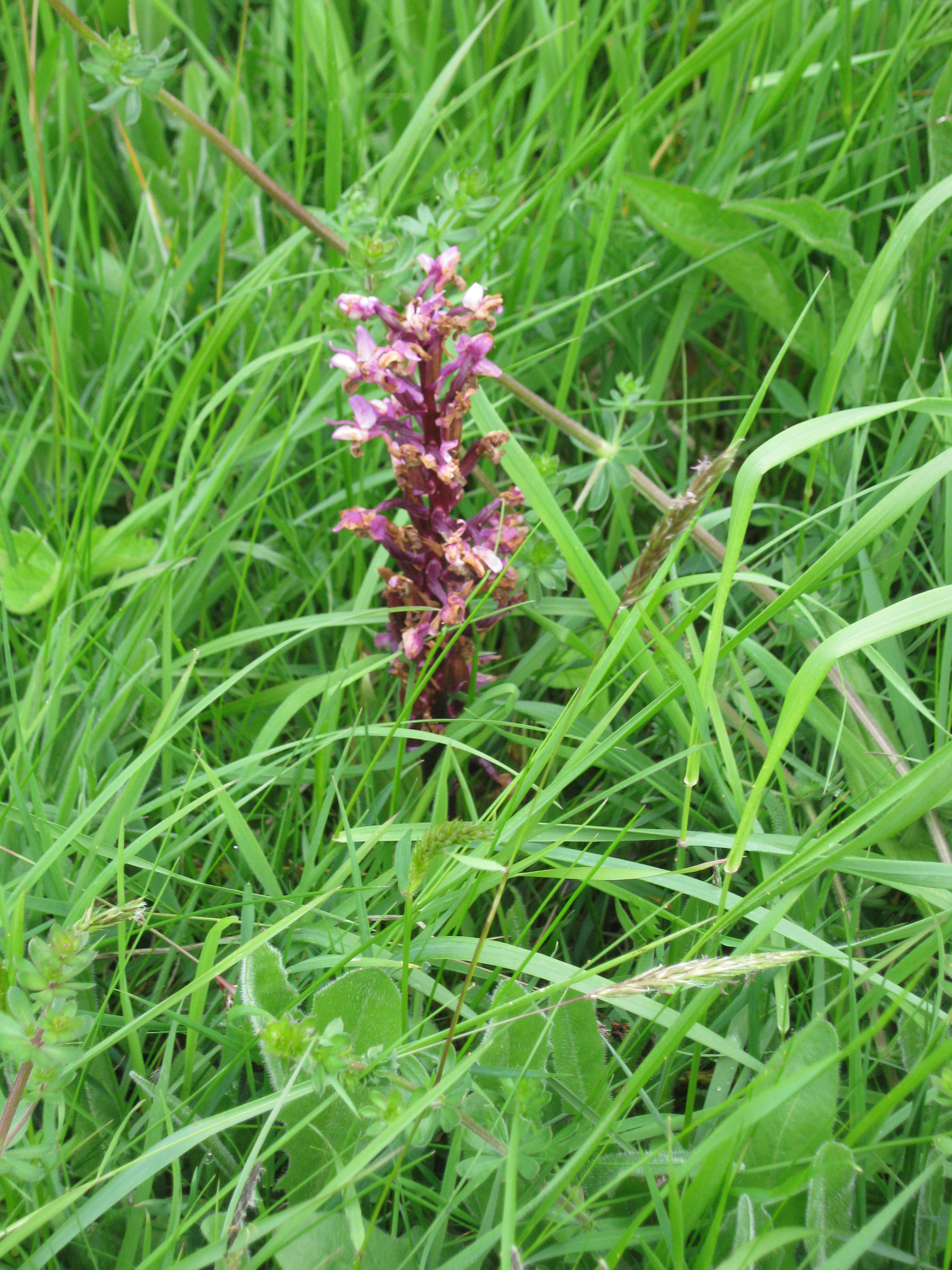
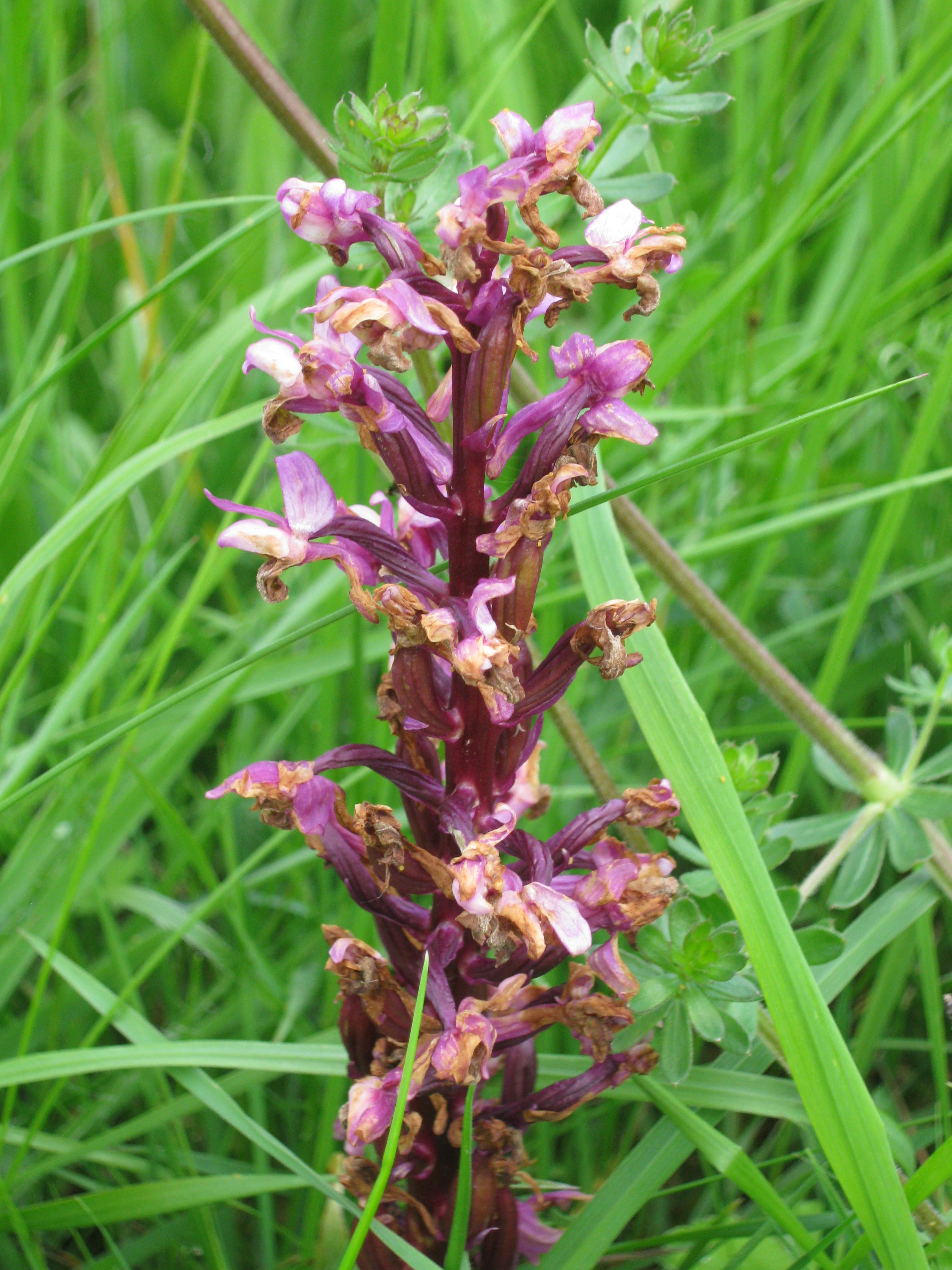
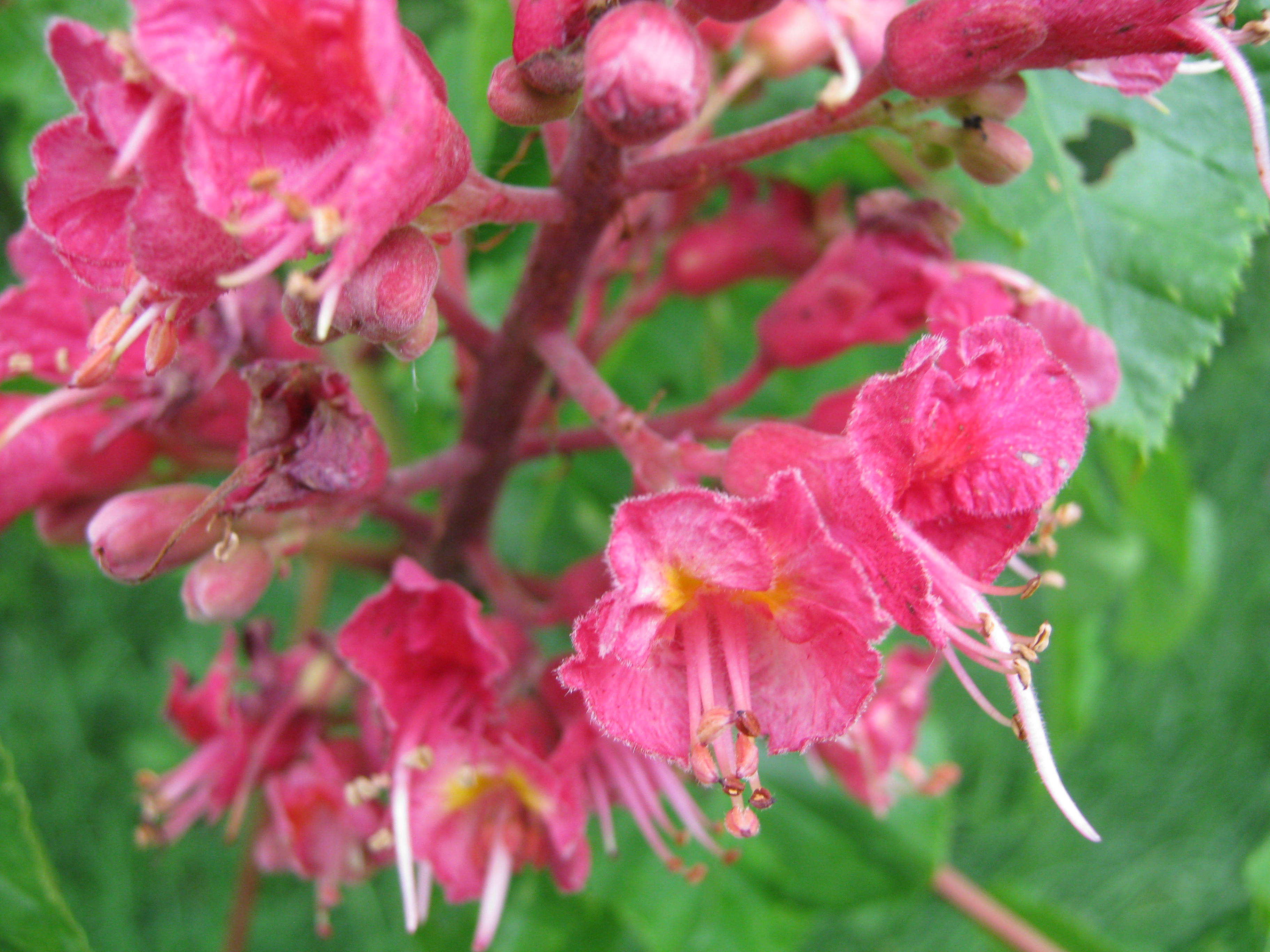
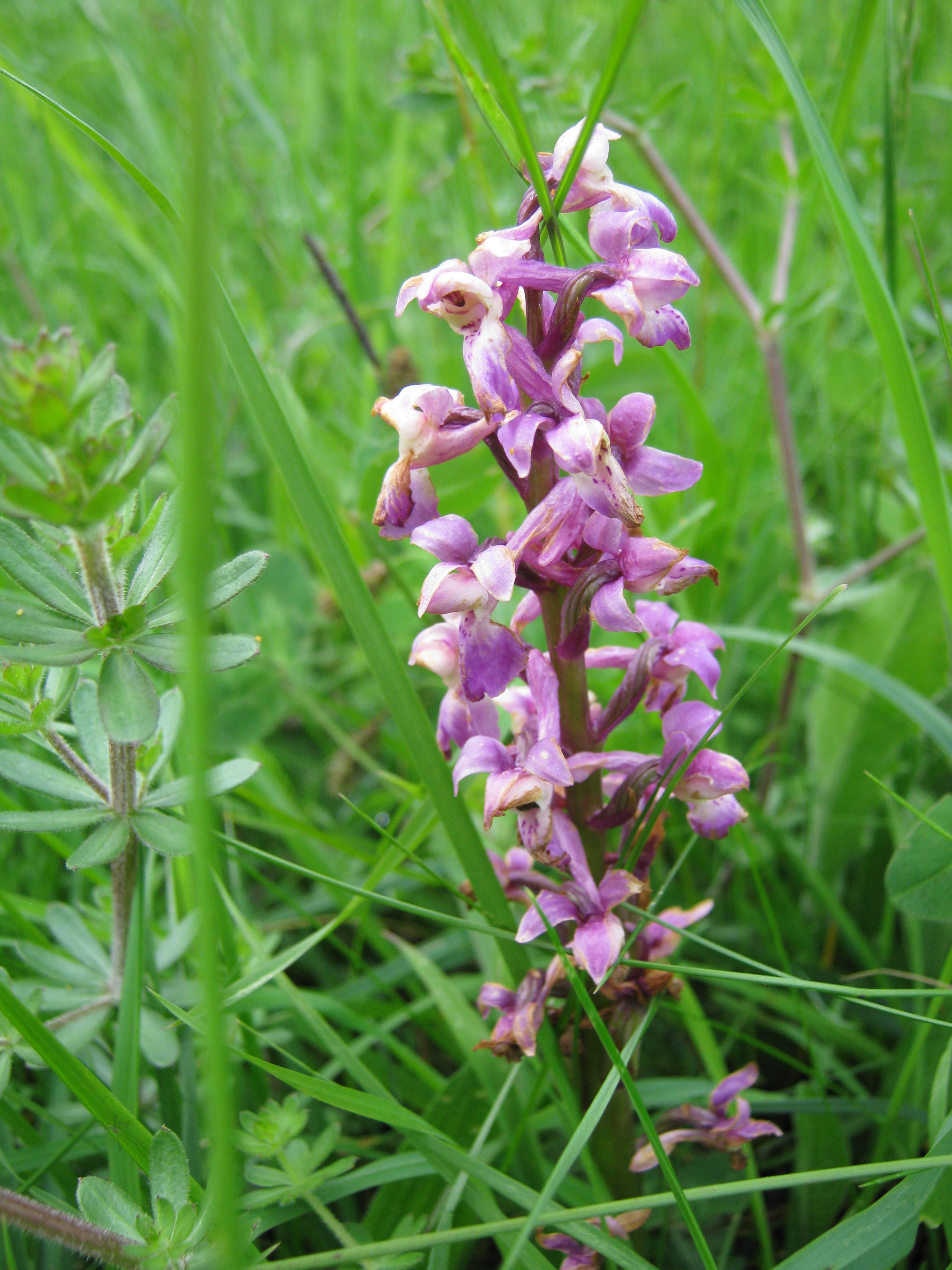
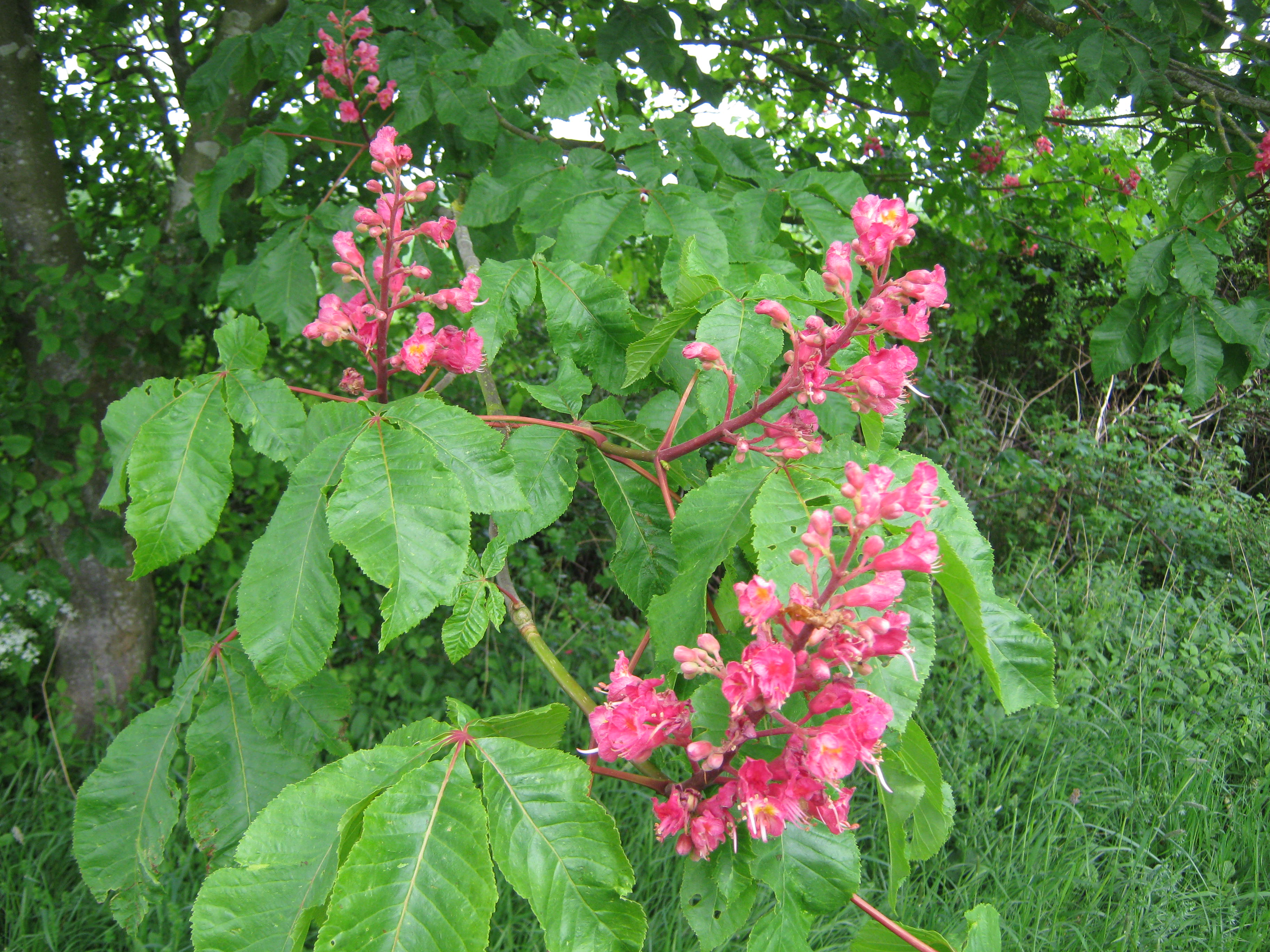
The red-blossomed tree that I had remembered seeing is a Red Horse Chestnut and it had been planted only a couple of hundred yards down this other lane.  To get to it I had to cross yet another wide area of common land and in doing so I was surprised to see an Early Purple Spotted Orchid in the grass.  This one was a little past its best but I rather liked the colour combination of the petals.

Image

Image

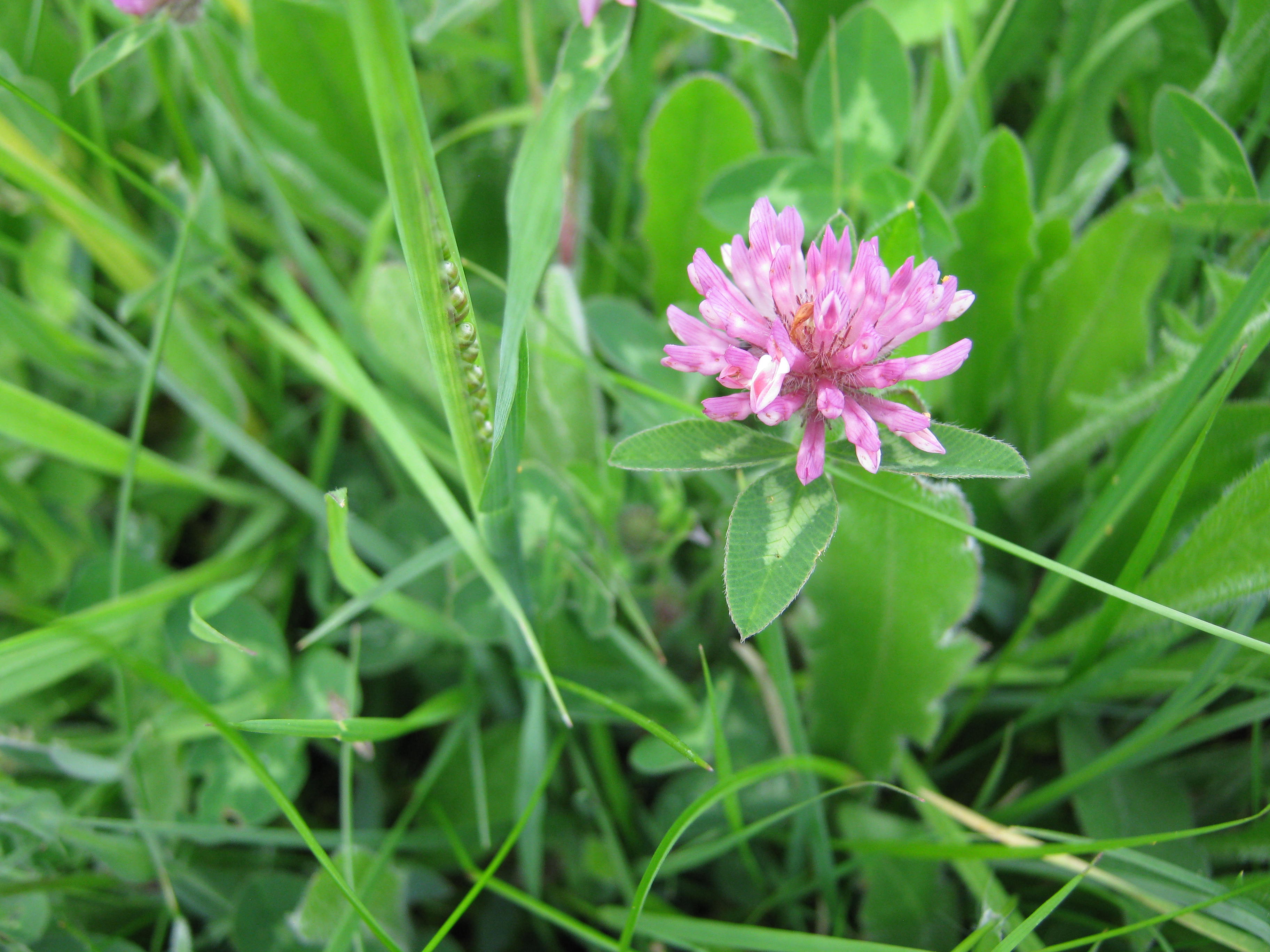
There was more Bugle or Ajuga flowers and some Red Clover.

Image

Red Clover

I love the pale markings on Red Clover leaves.  I am also fascinated by the grass in the photo which is just about to flower.  It looks like a row of tiny balls are packed into the grass stem or a lot of minuscule snails.

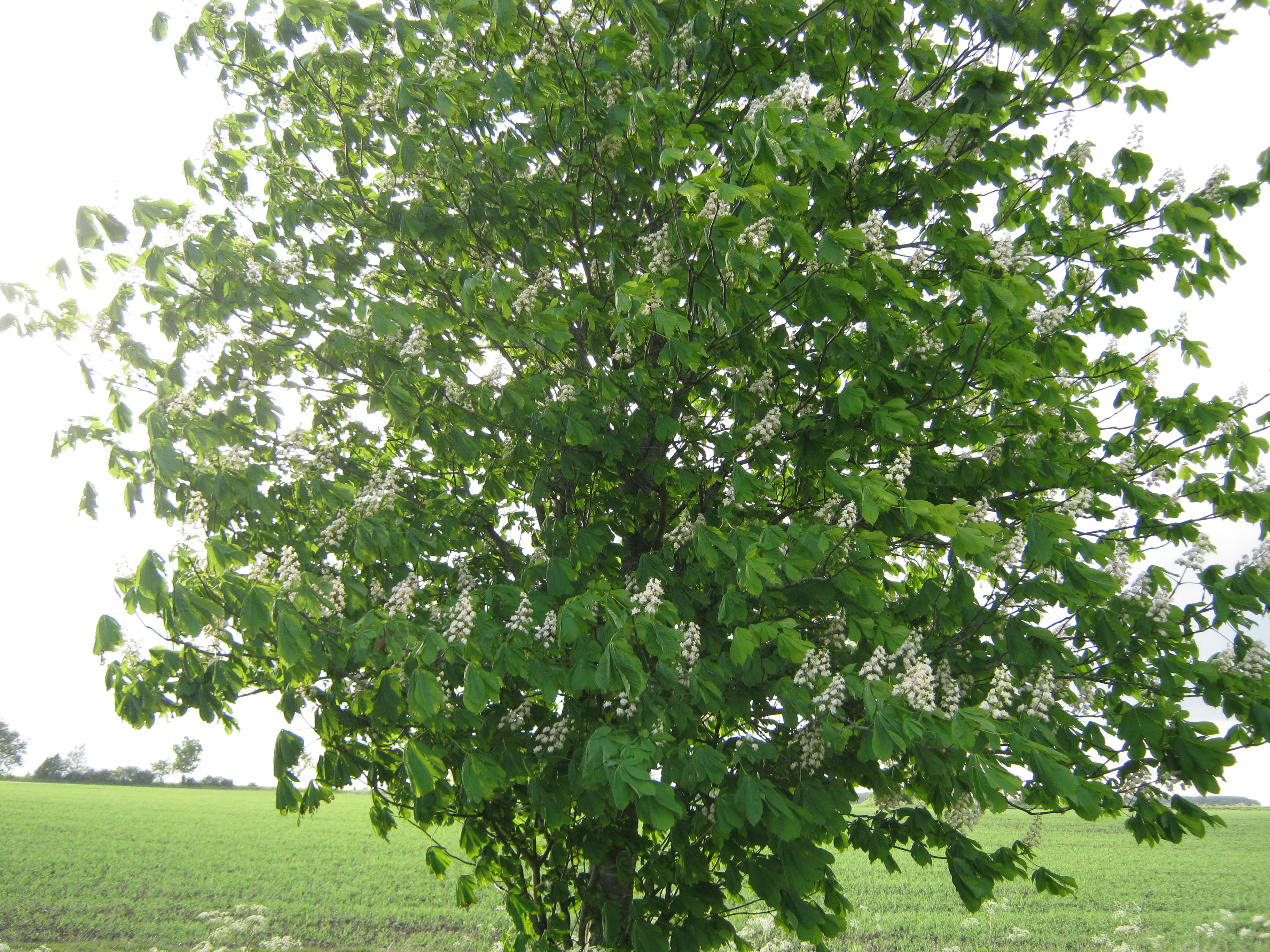
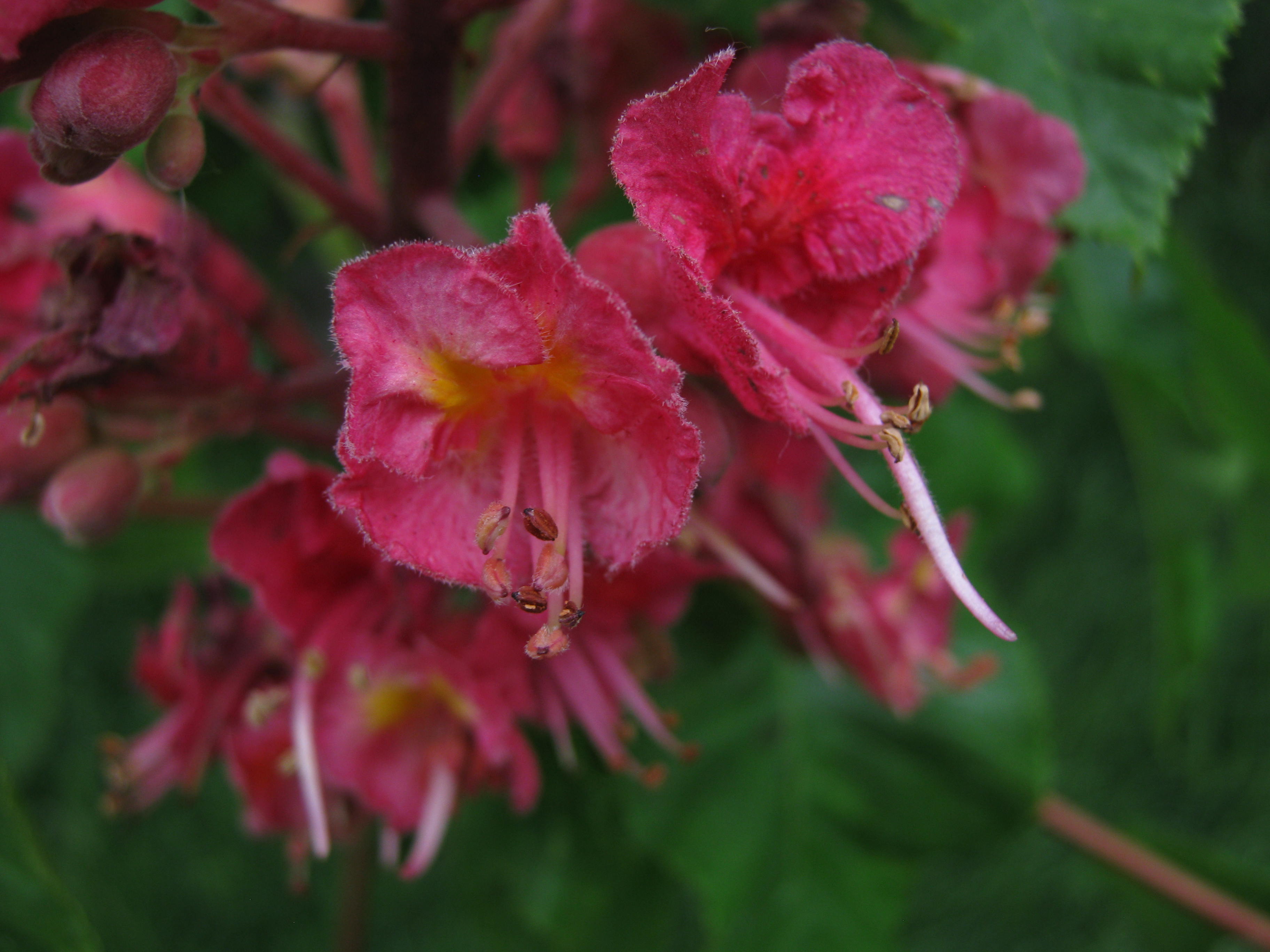
The Red Horse Chestnut is a fairly young tree so I was able to photograph the flowers easily.

Image

Image

Image

Image

A Red Horse Chestnut is a hybrid between a Horse Chestnut and a Red Buckeye.  On the way back to the road I found another Early Purple Spotted Orchid.

Image


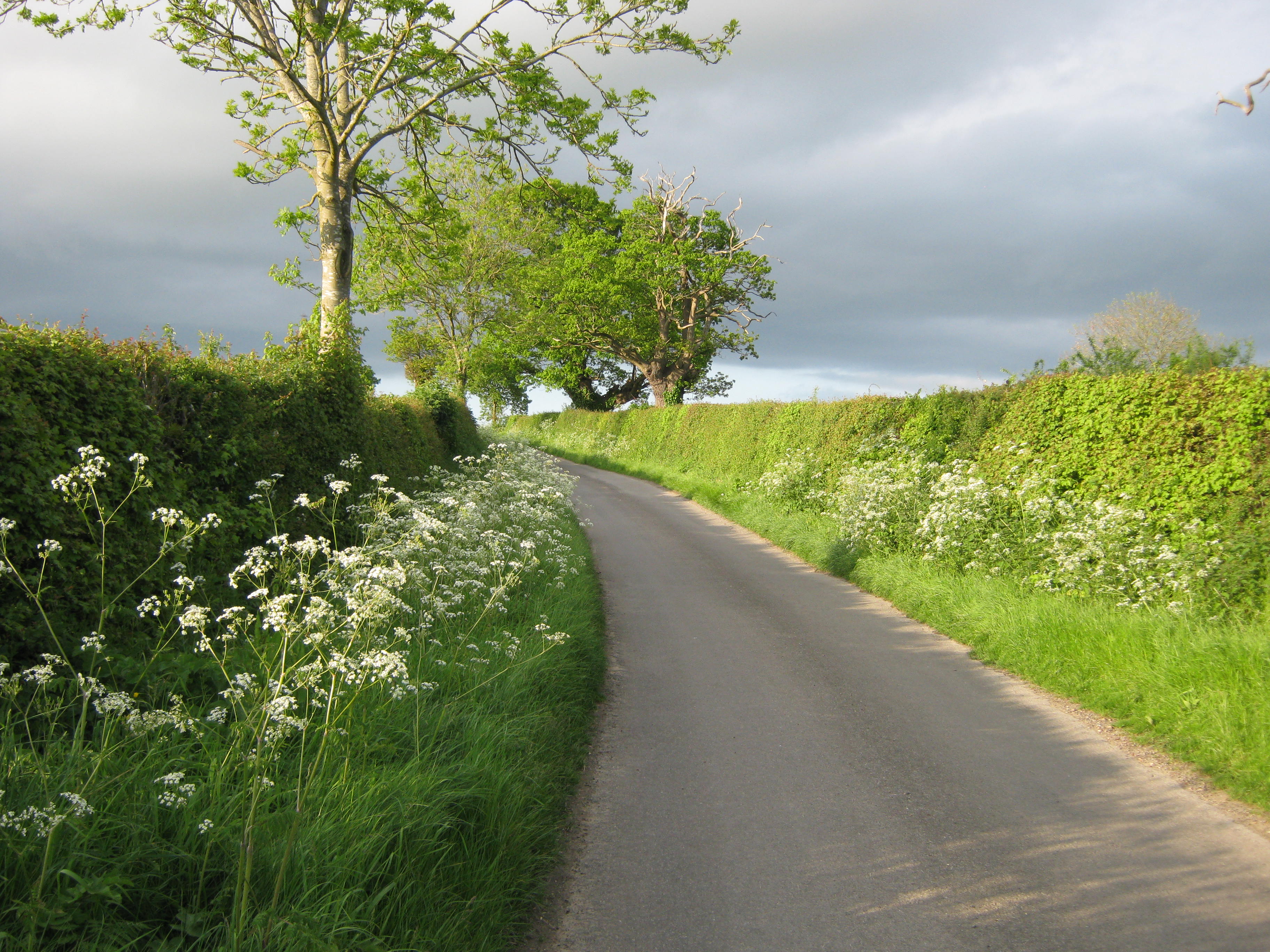
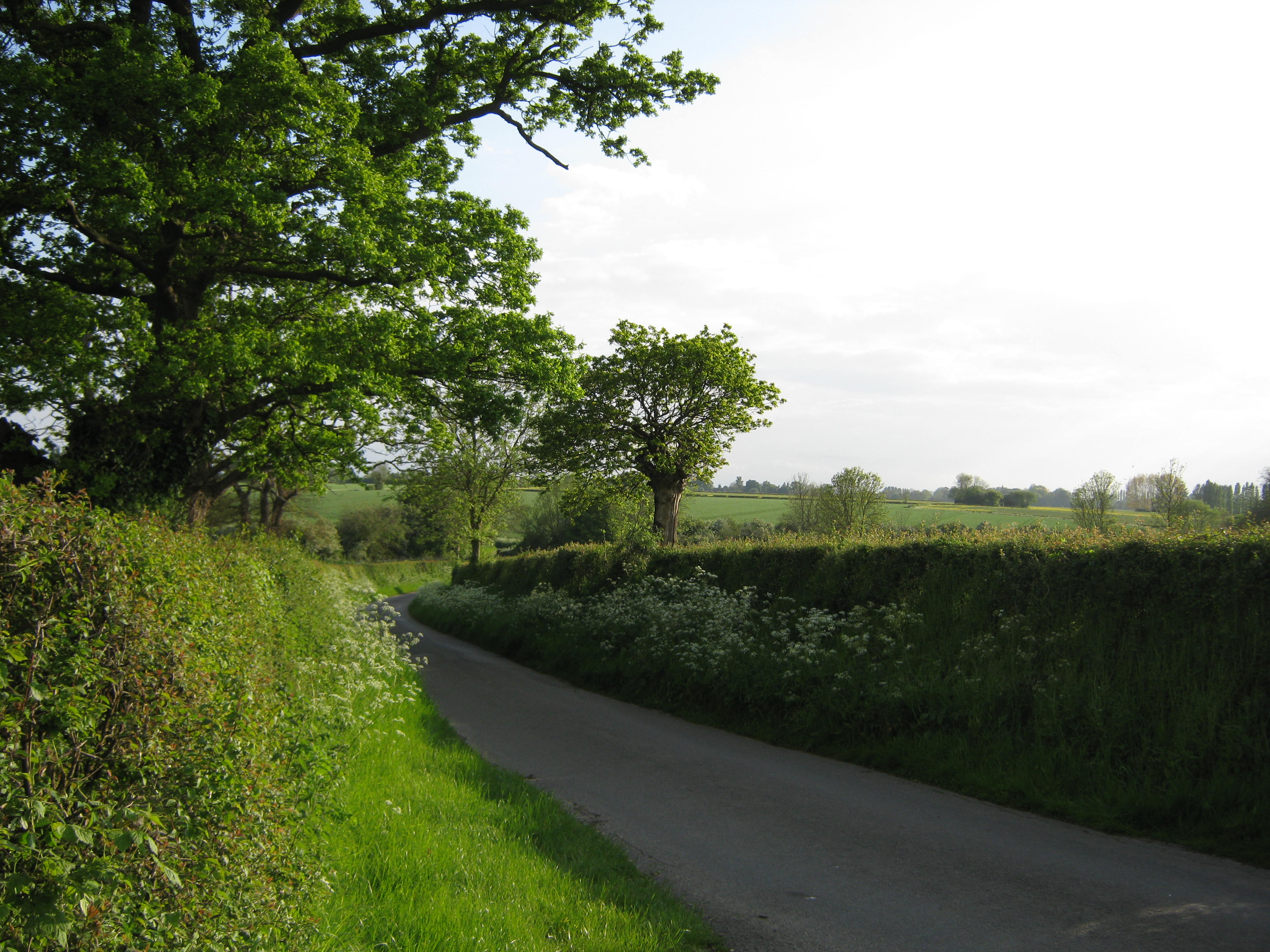
Our lane is looking very nice at the moment.

Image

On my way back home I heard another summer bird but this was one I hadn’t heard before.  It’s song was a little like a part of a Chaffinch’s or a Yellowhammer’s song but without the end flourish.  It also had a few little sweet quiet notes to start off the song and they sounded very much like a Warbler.  When I got back I listened to a few of my bird recordings and found I had been listening to a Lesser Whitethroat.

I managed to get all my washing dried outside which was really good and took some more photos of the garden while I fed the birds.  I had started on a great heap of mending by the time R came home from work.  He didn’t seem to want his evening meal straight away so I suggested a walk across the fields.

Image

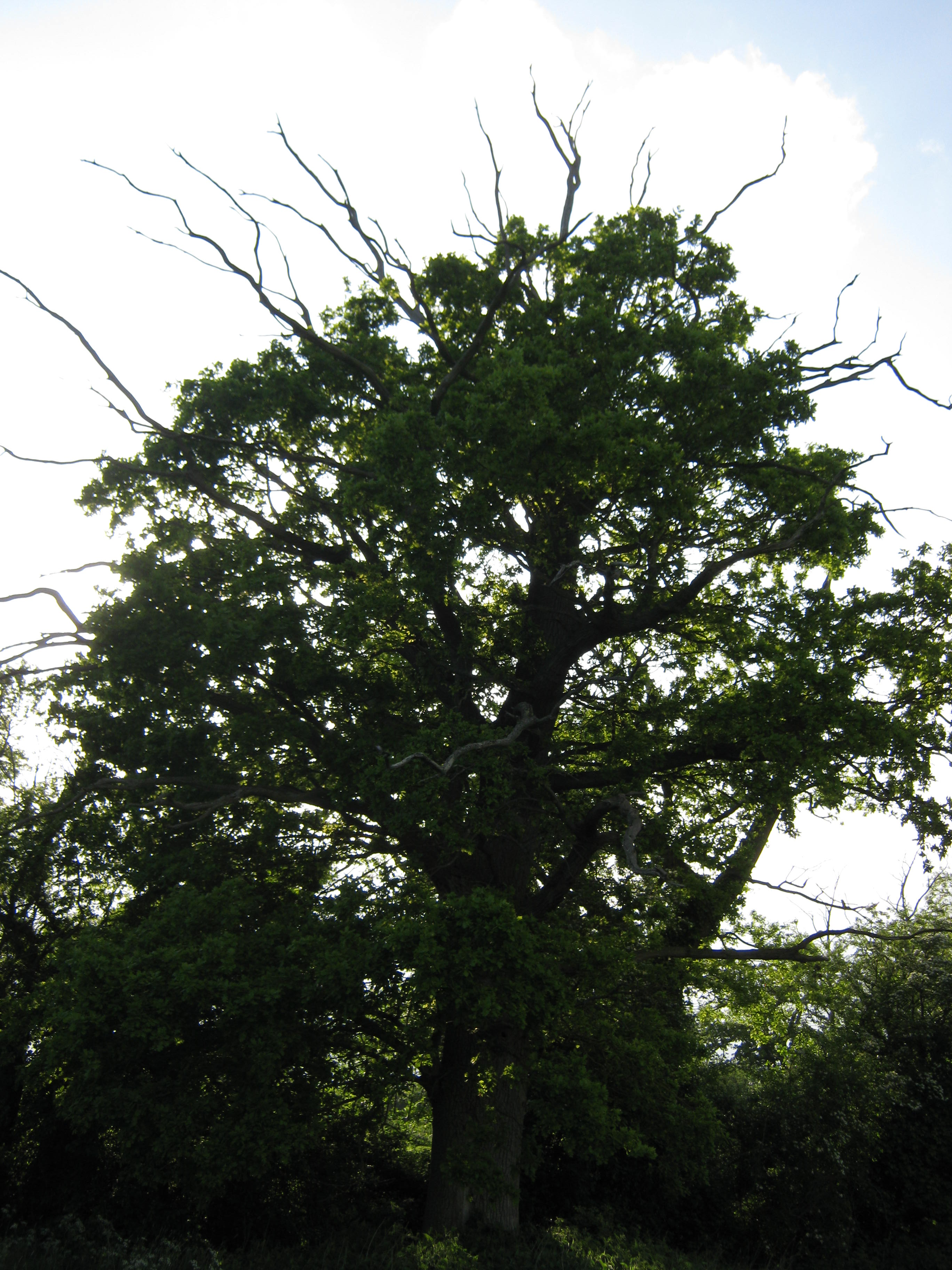
This is one of many ancient oaks we saw on our walk.  Once they get to about seven or eight hundred years old they start to die back a little.  A little like us humans:  when we get to a certain age we start to shrink a bit too.  When they get dead branches sticking out of the top of the canopy they are described as being ‘stag-headed’.

Image

A young Horse Chestnut.

Image

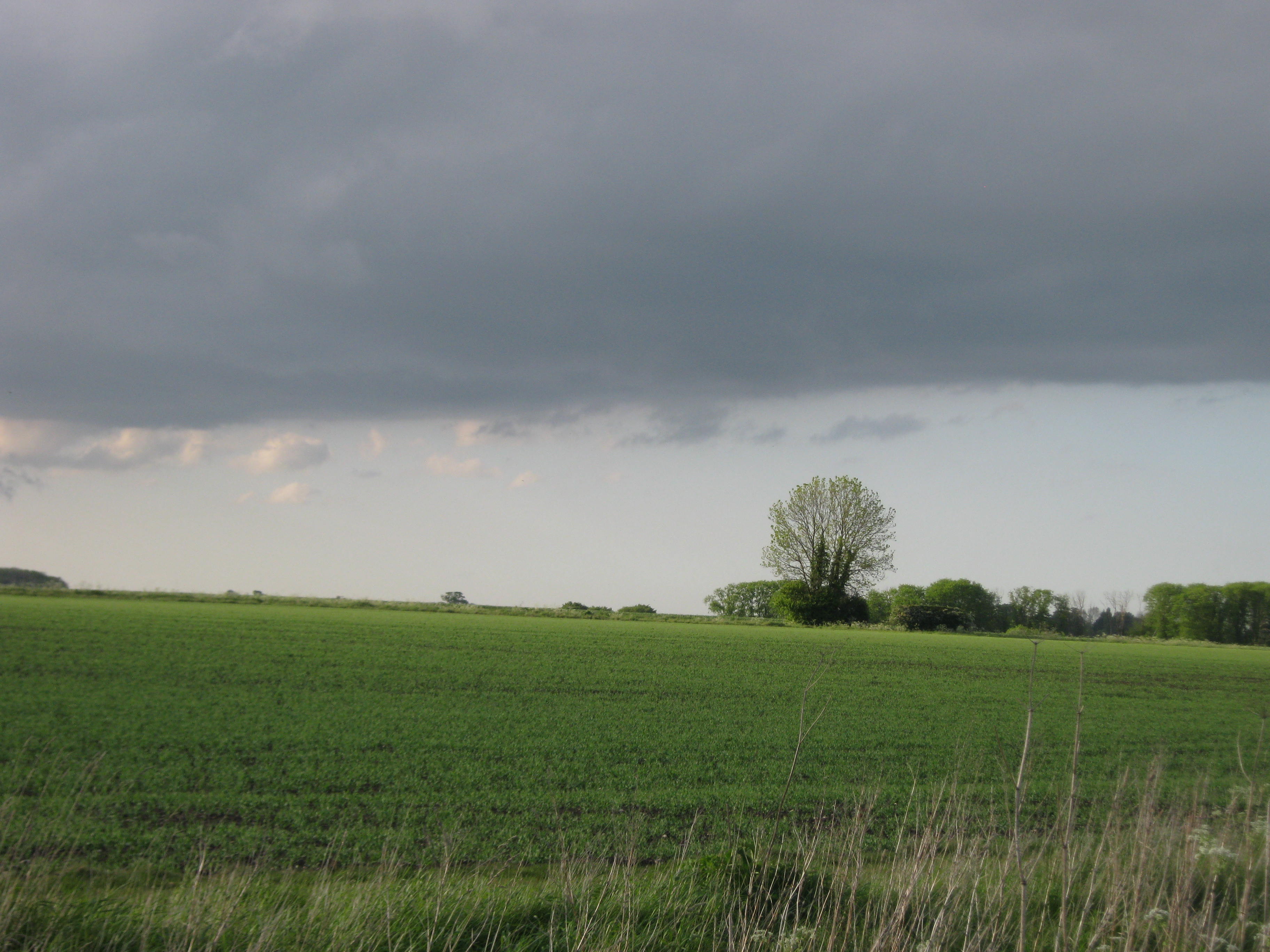
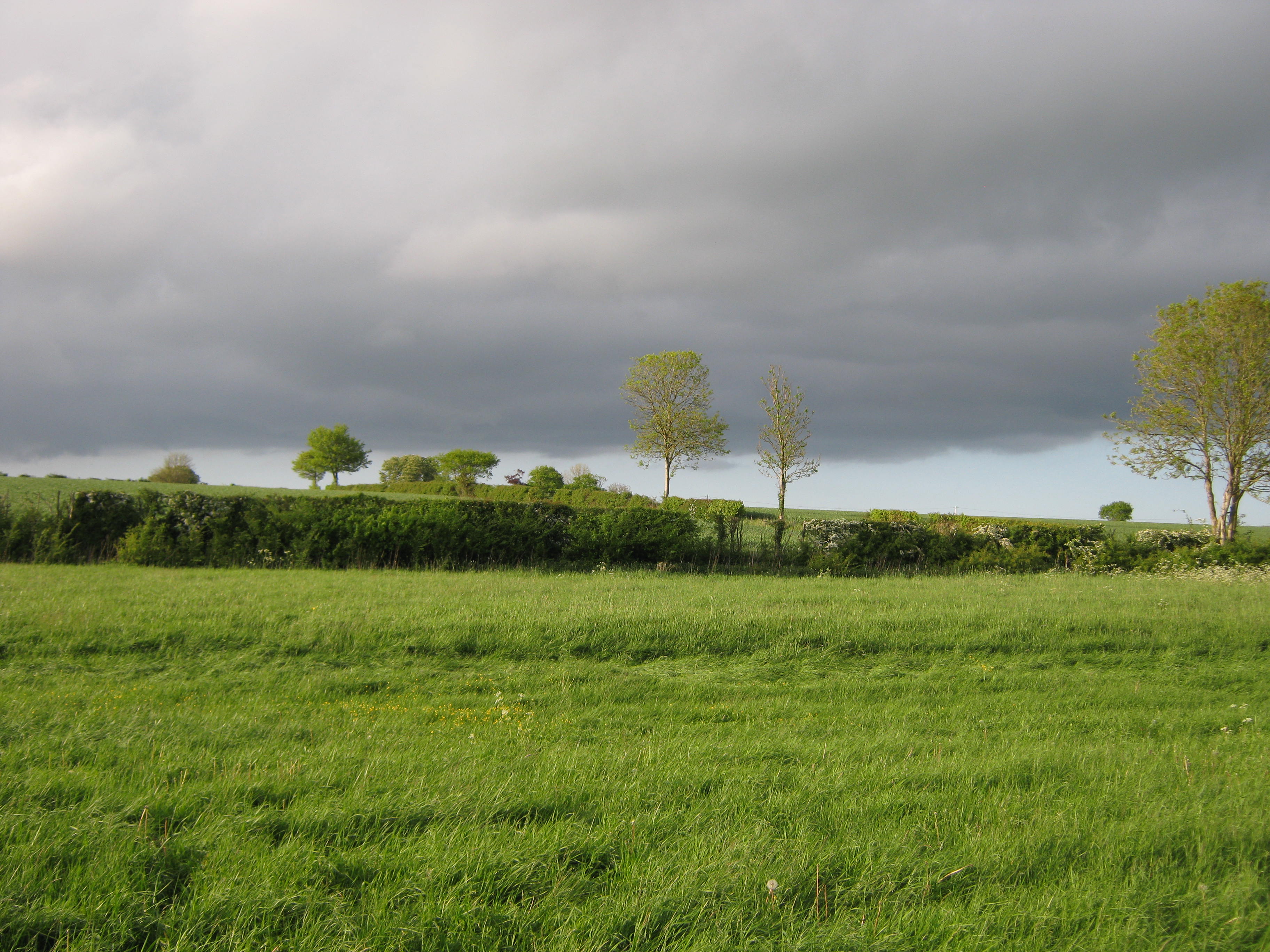
View over the fields.

Image

A field of ripening barley.

Image

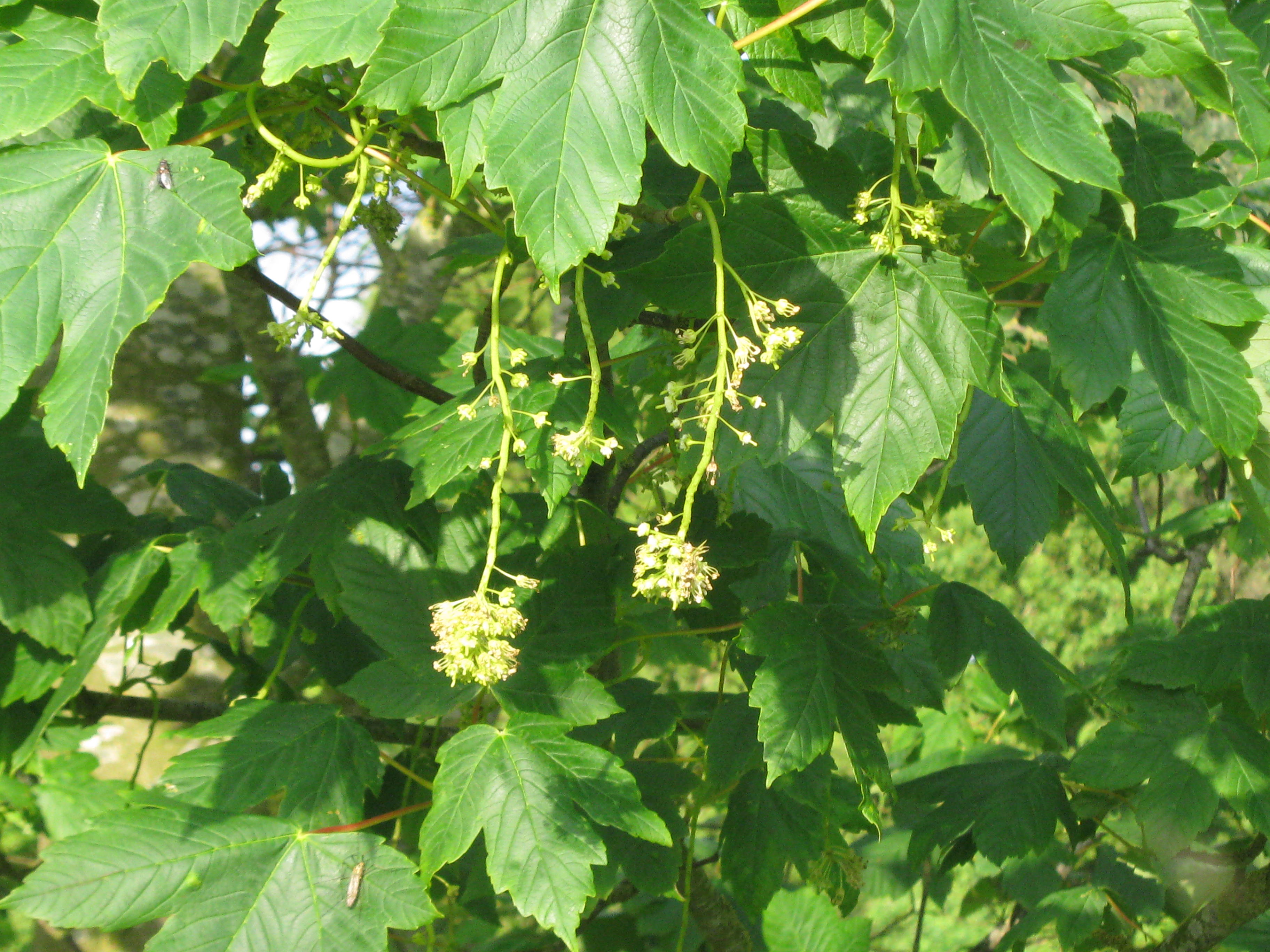
A Sycamore tree with flowers.

Image

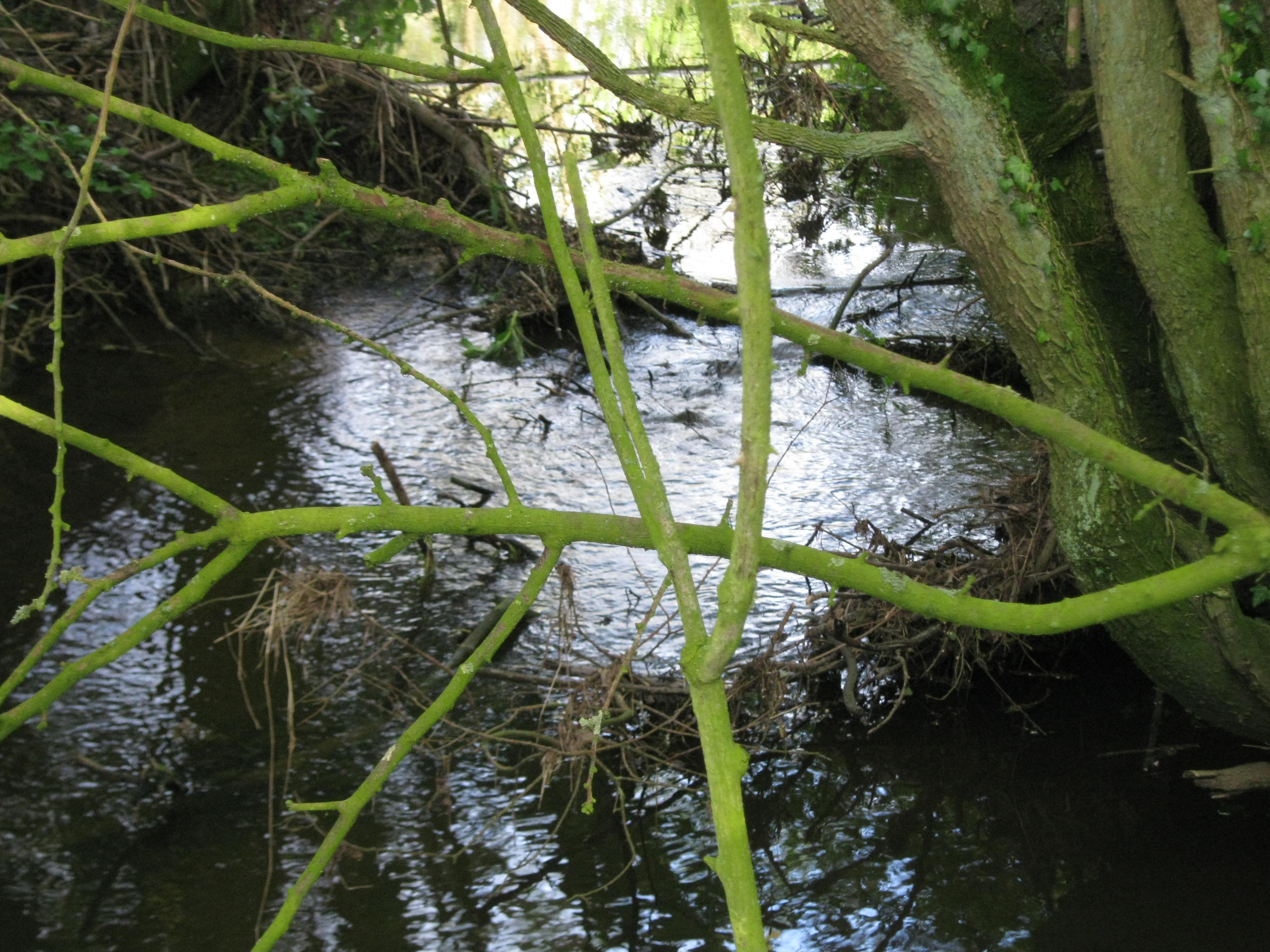
The Beck

Image

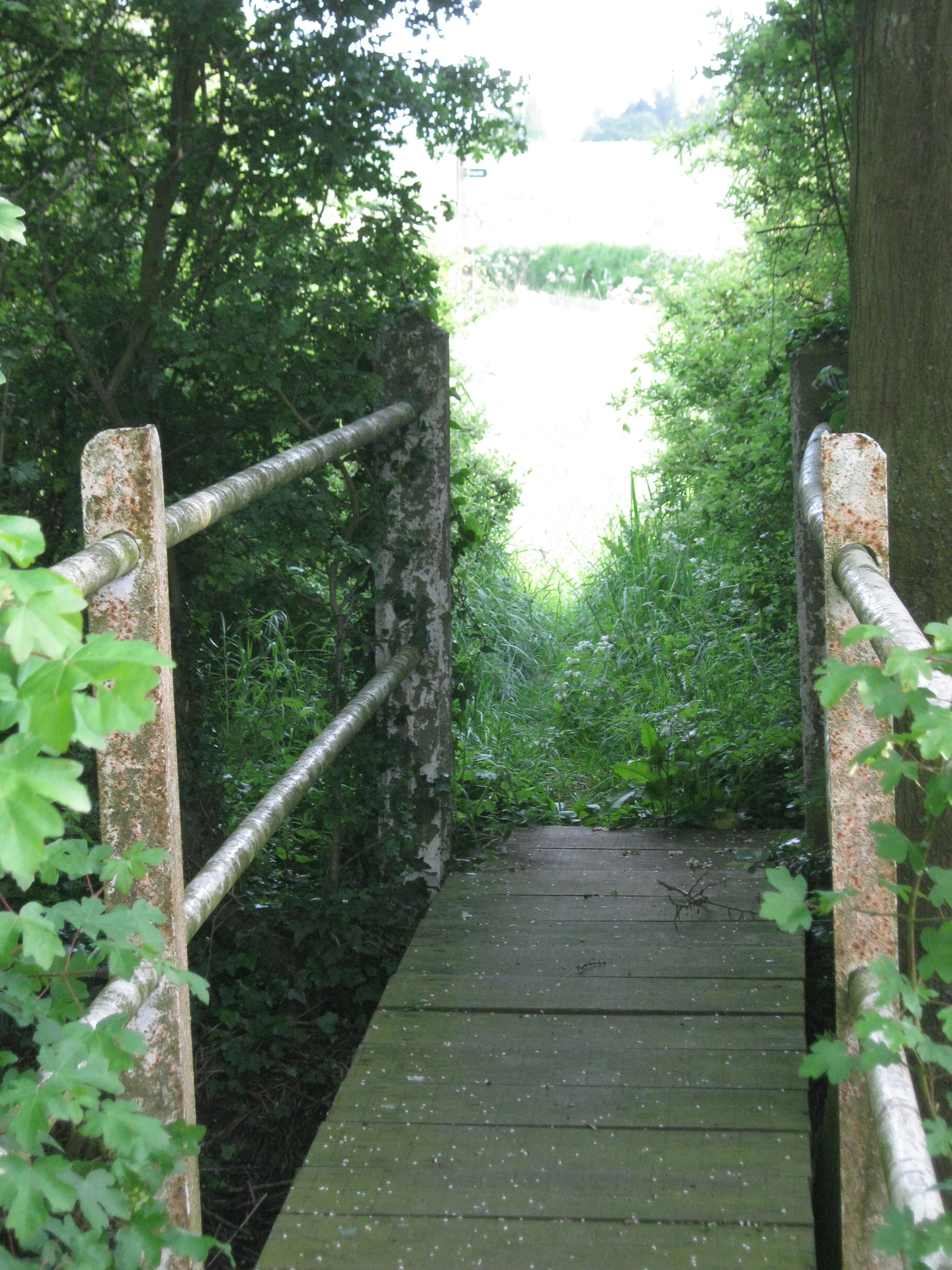
Bridge over the Beck.

Image

Image

Image

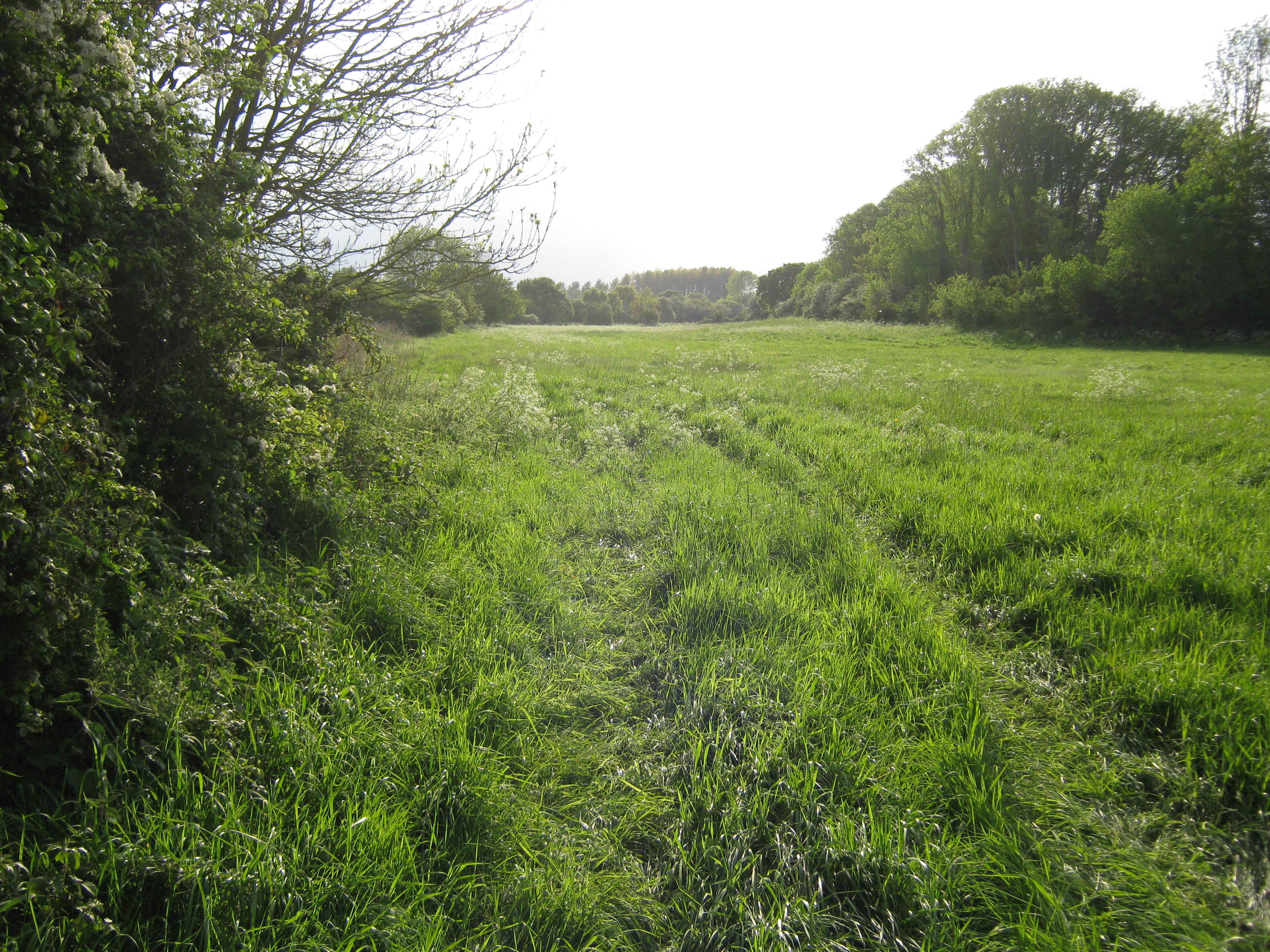
Views across the fields on the other side of the Beck.

Image

Image

The lane going up the hill from St Peter’s Washes.

Image

Another ancient oak tree.  I think this one’s trunk must be about twelve feet in circumference – it must easily be about a thousand years old.  I must try to bring a tape measure with me next time we walk this way and see if I can get through the hedge and measure it.

Image

I love standing under trees and looking up through the branches.  Trees are the most magnificent awe-inspiring things.

Image

Image

We looked down across the fields in the direction from which we’d come and then down the lane.  Many people think that East Anglia has no hills and no hedges.  This proves that we do have both though the hills aren’t very steep or high.

Image

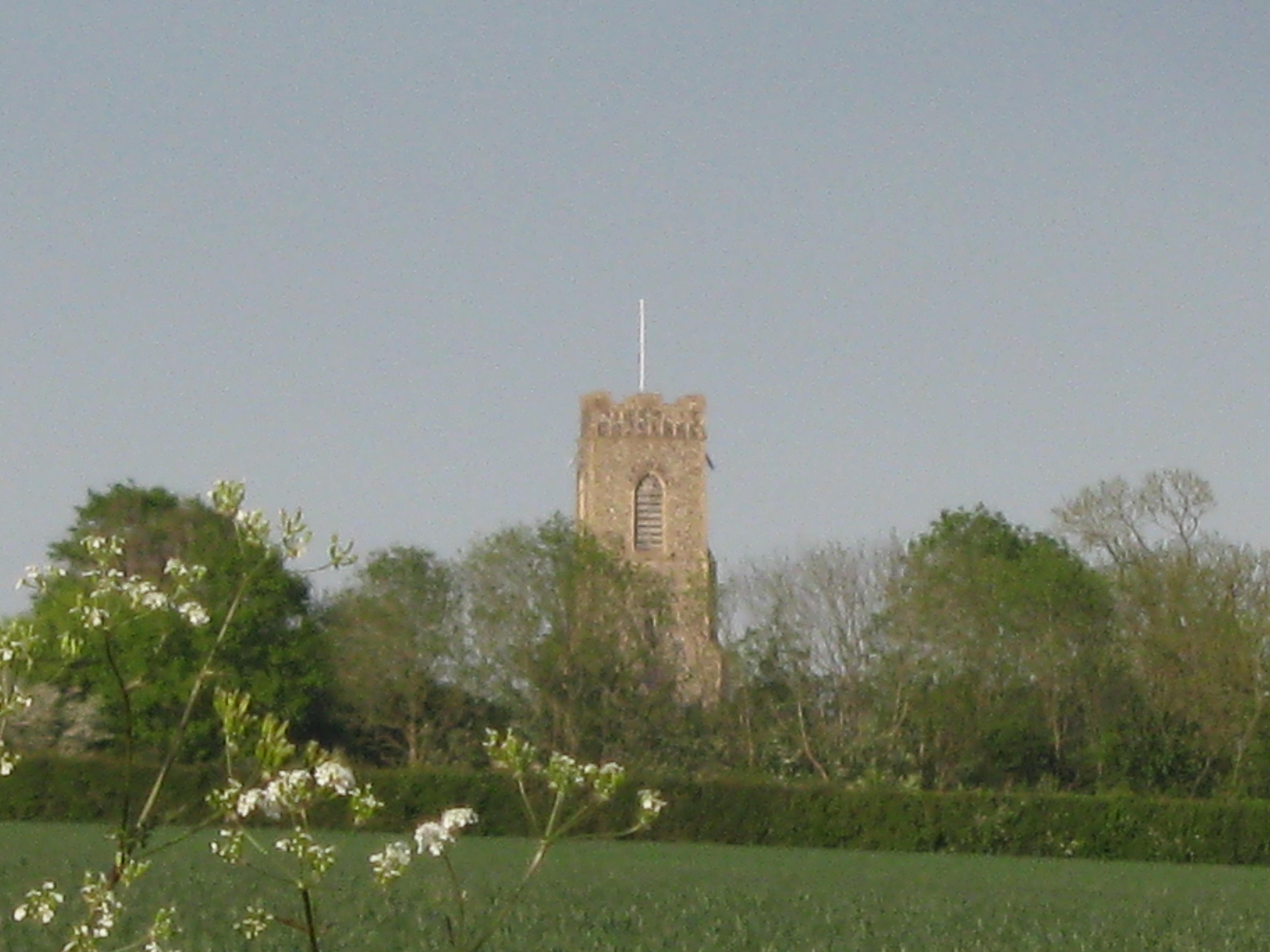
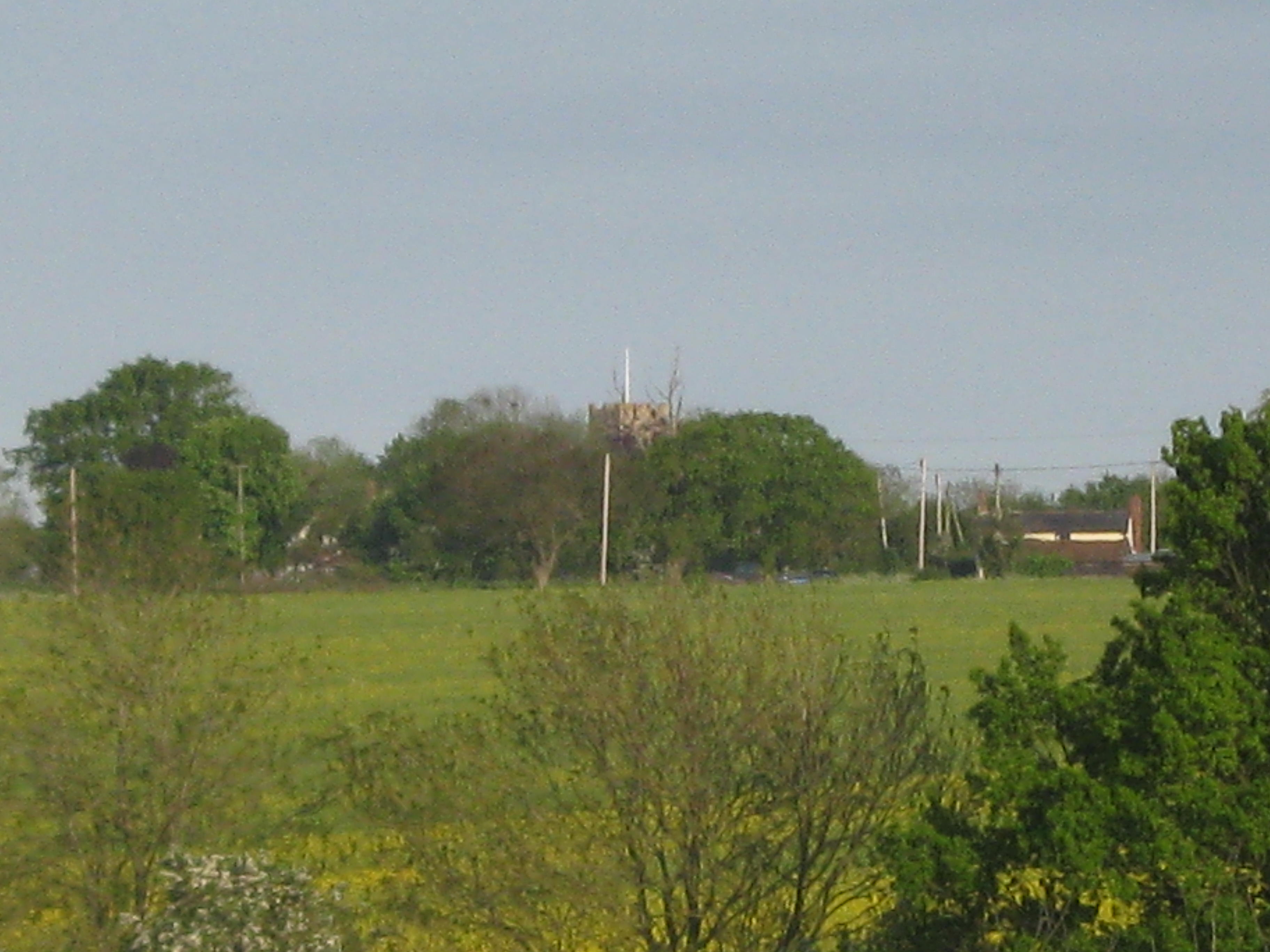
St Peter’s church over the field.

Image

Image


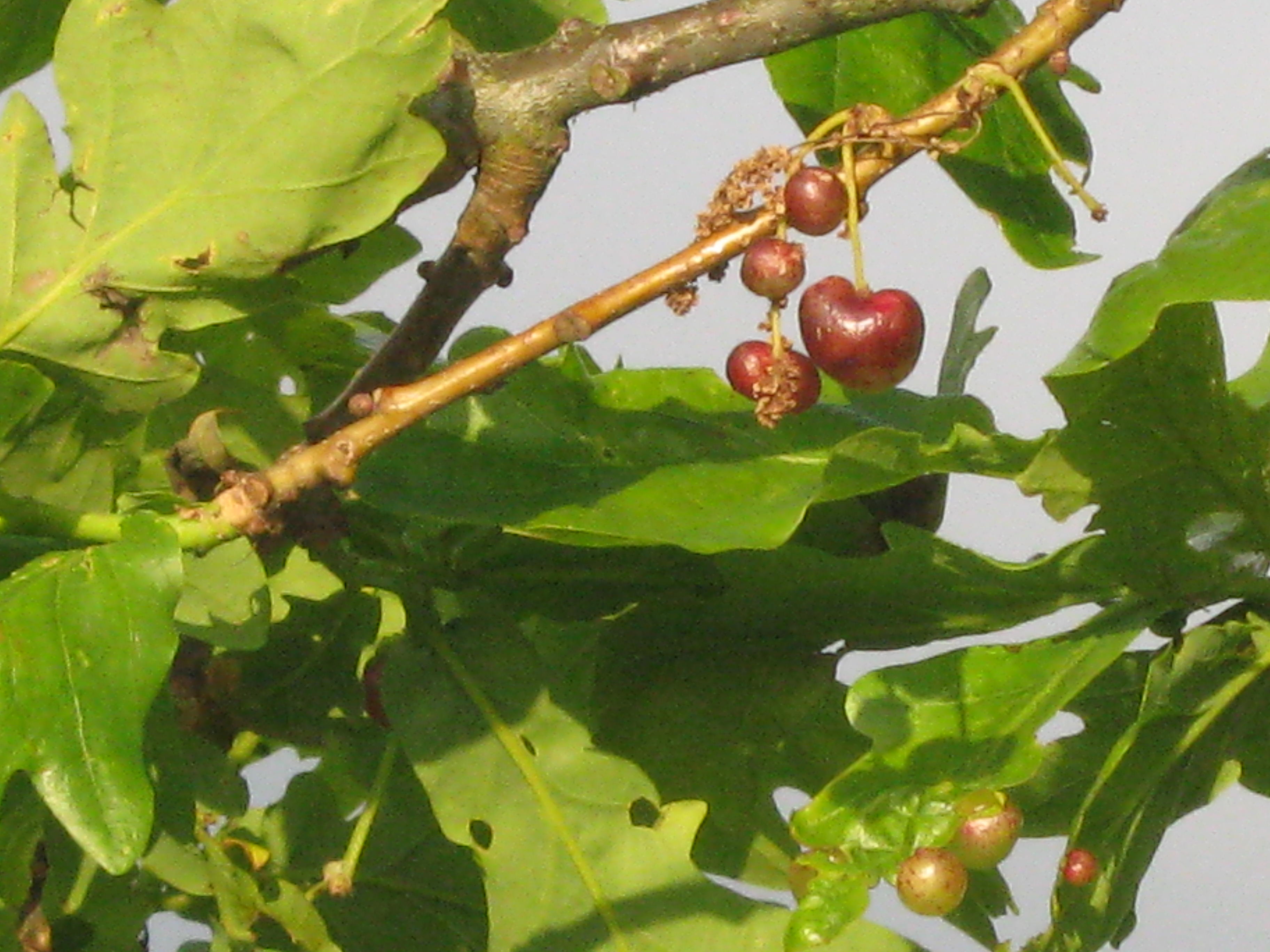
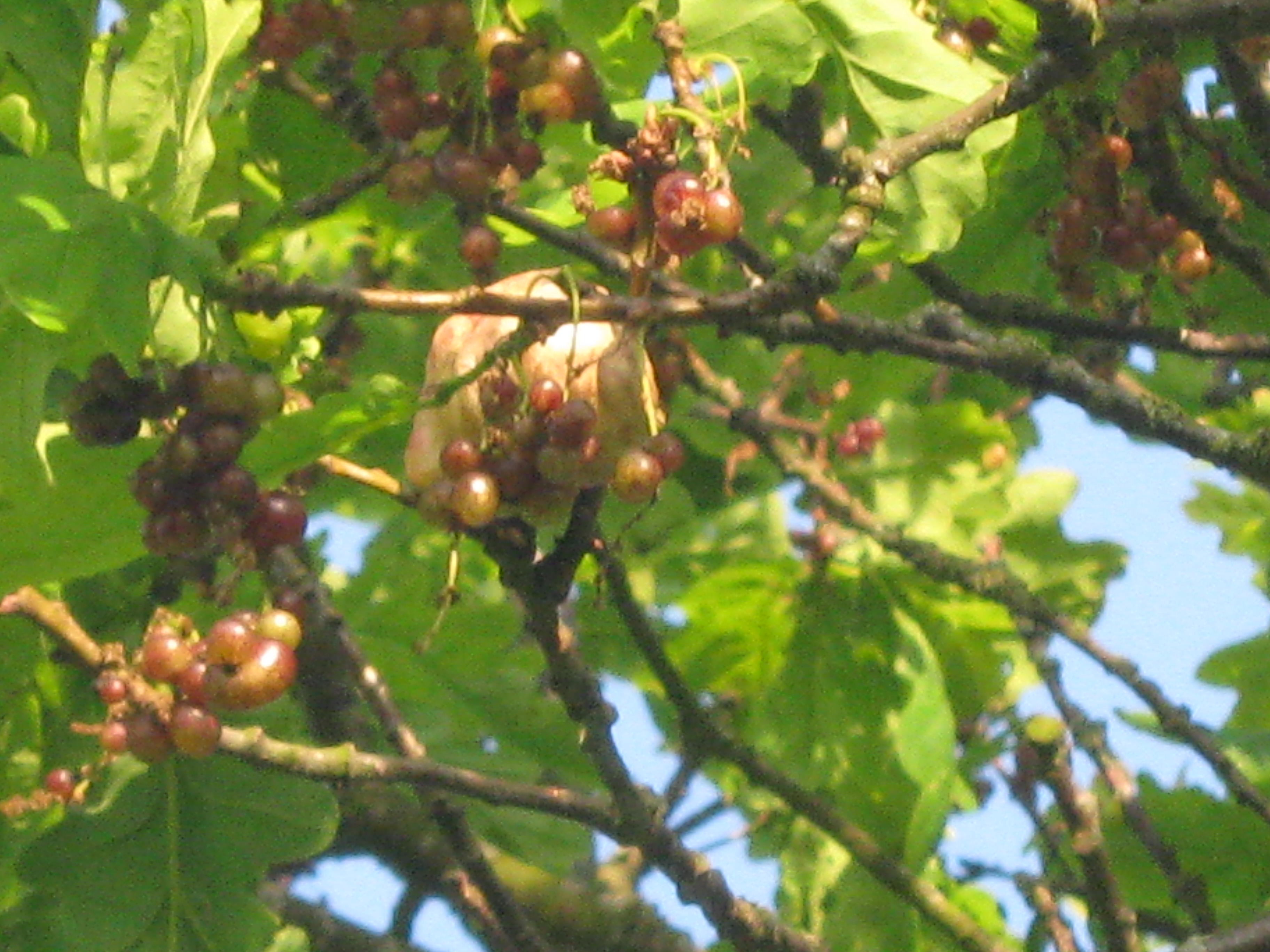
Fruits on an Oak Tree.

Image

The top of the tower of St Michael’s church can just be seen above the trees.

Image

Image

More views across the fields from the top of the lane.

Image

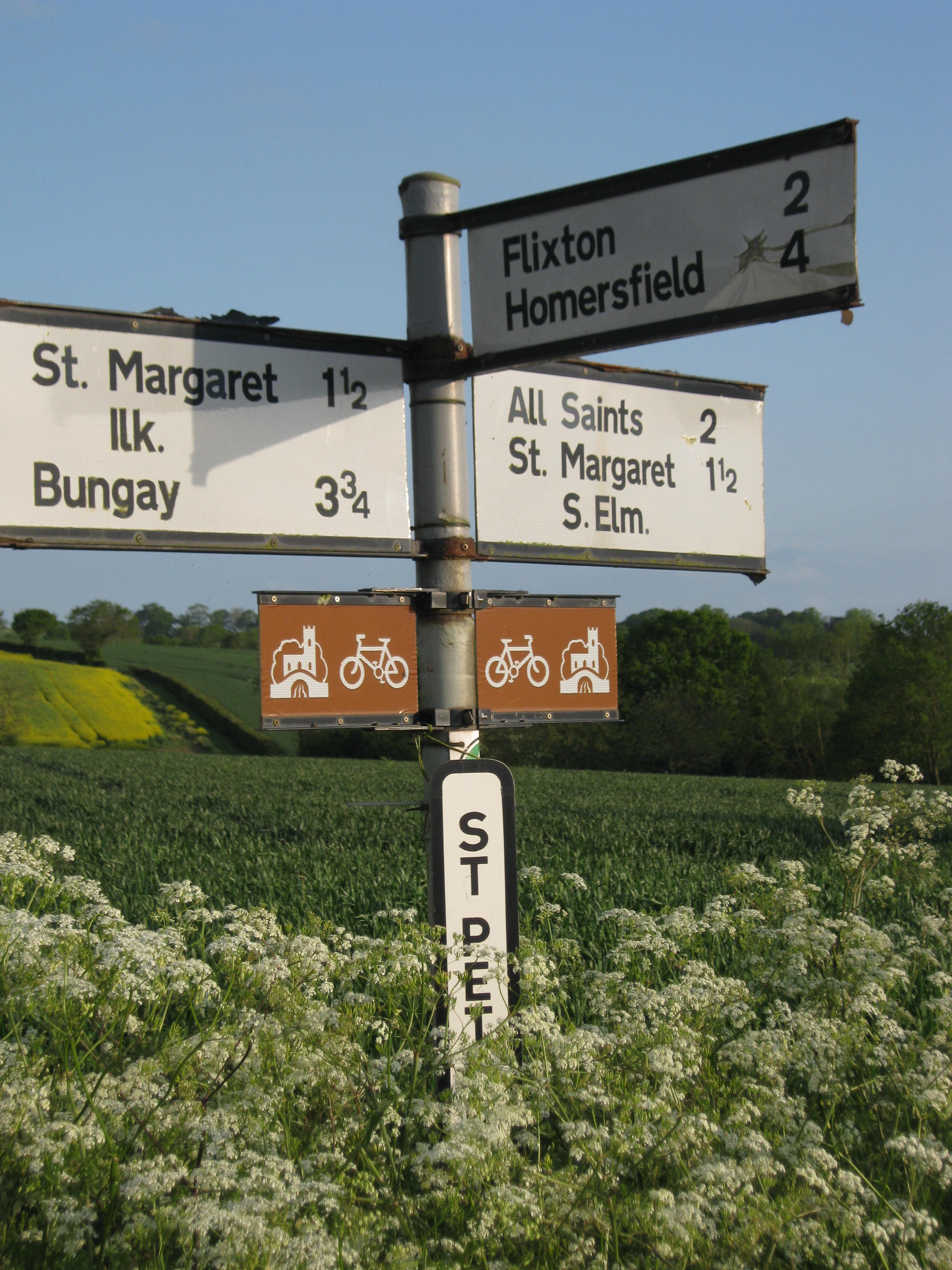
The signpost at the end of the lane.

Image

Another view from the top.

Image

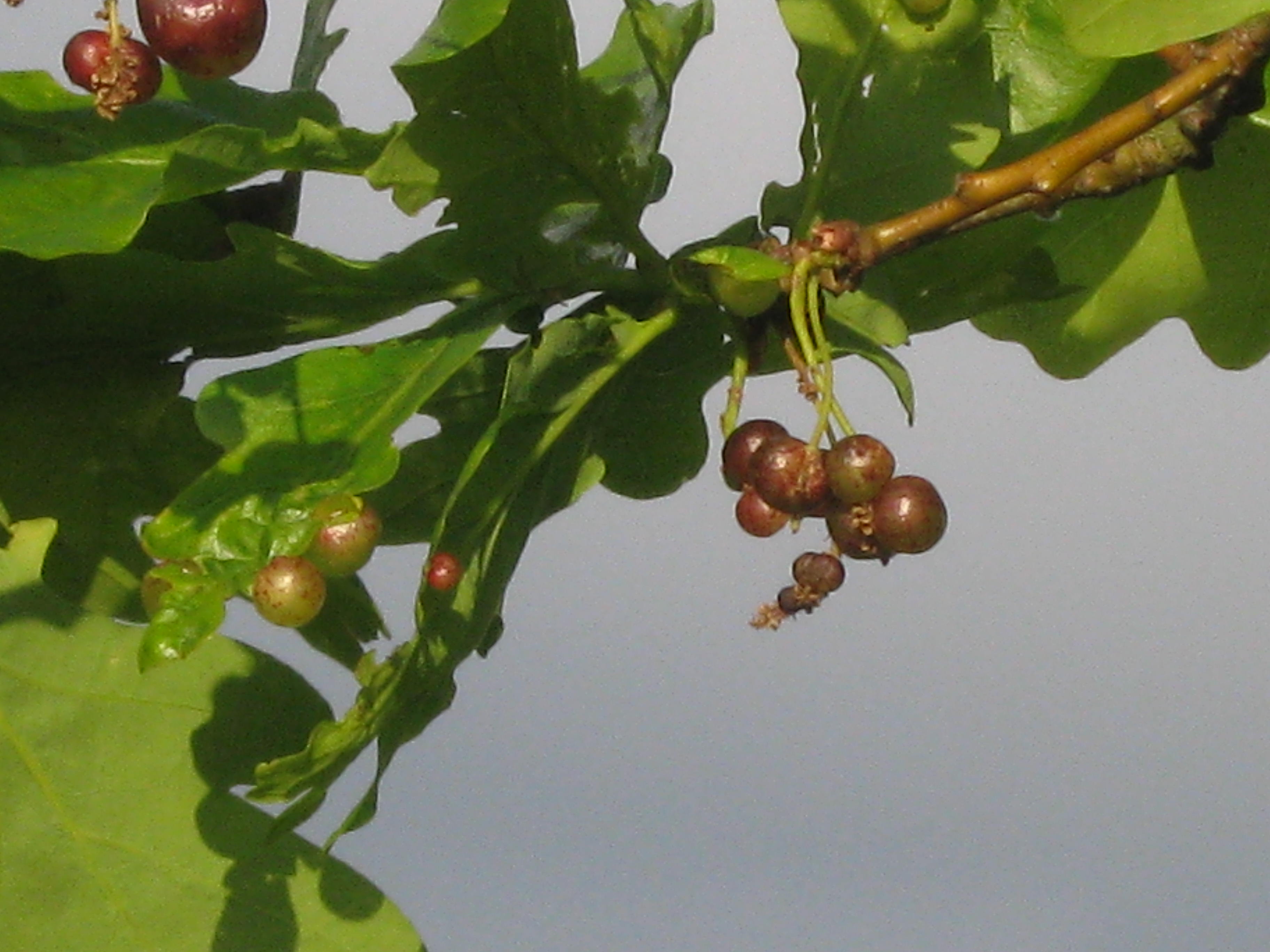
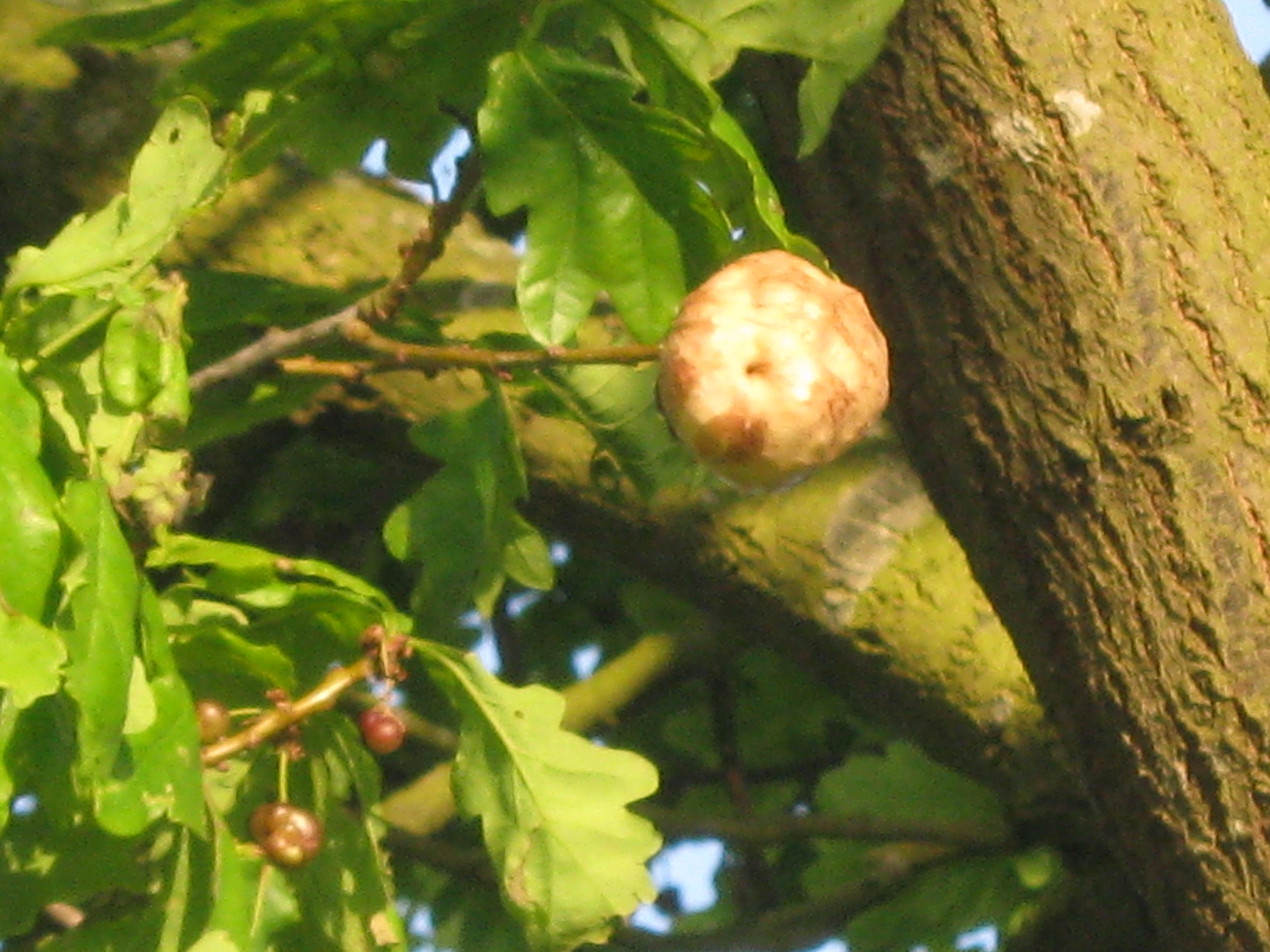
An oak-apple with fruits

Image

An oak-apple.

Image

This is a picture of a Lesser Whitethroat!  It is just below and just to the left of centre and has a curly leaf over its face.  You’ll have to take my word for it that it really was a Lesser Whitethroat.

Image

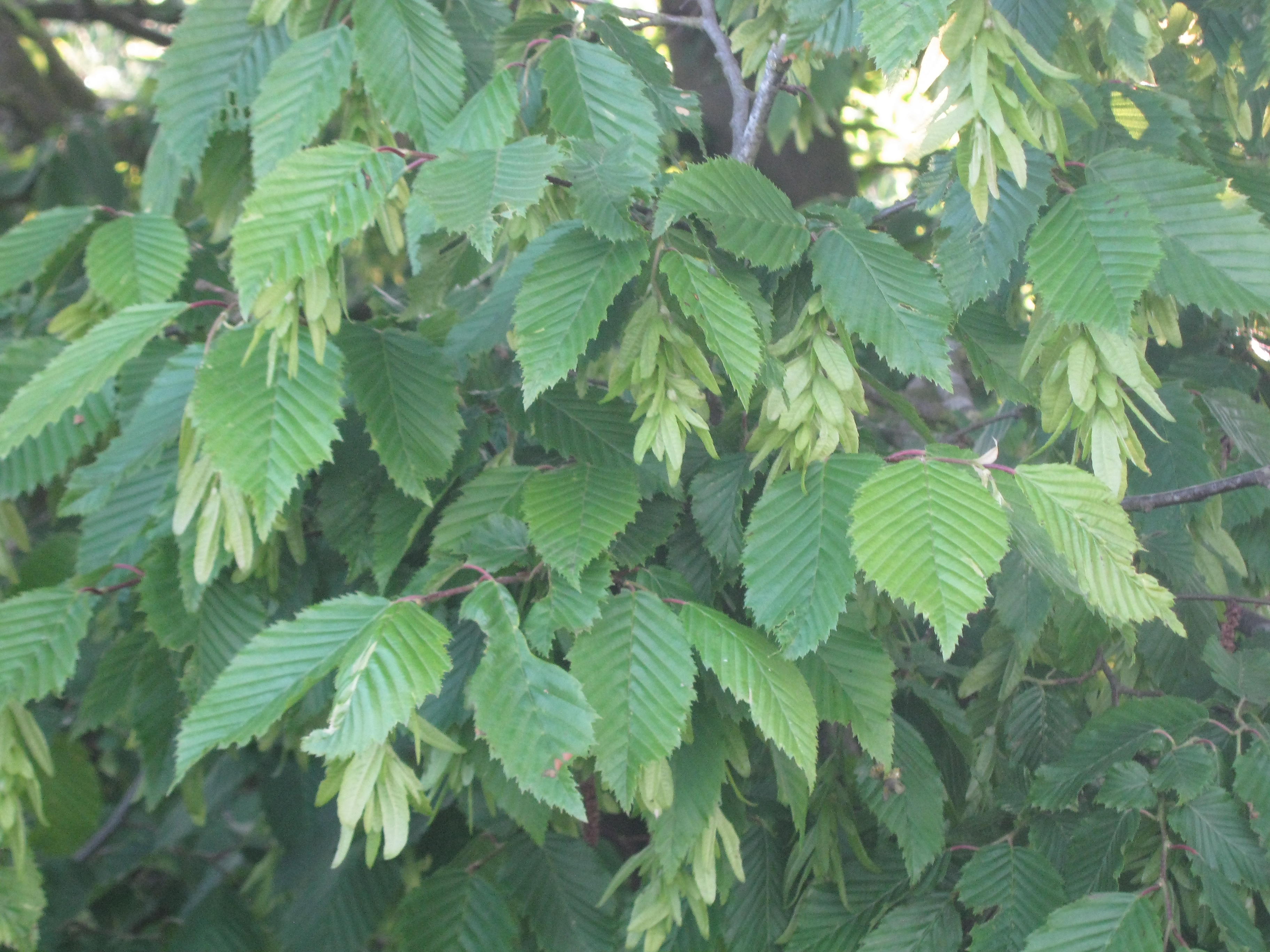
A Wych Elm and fruits.

Image

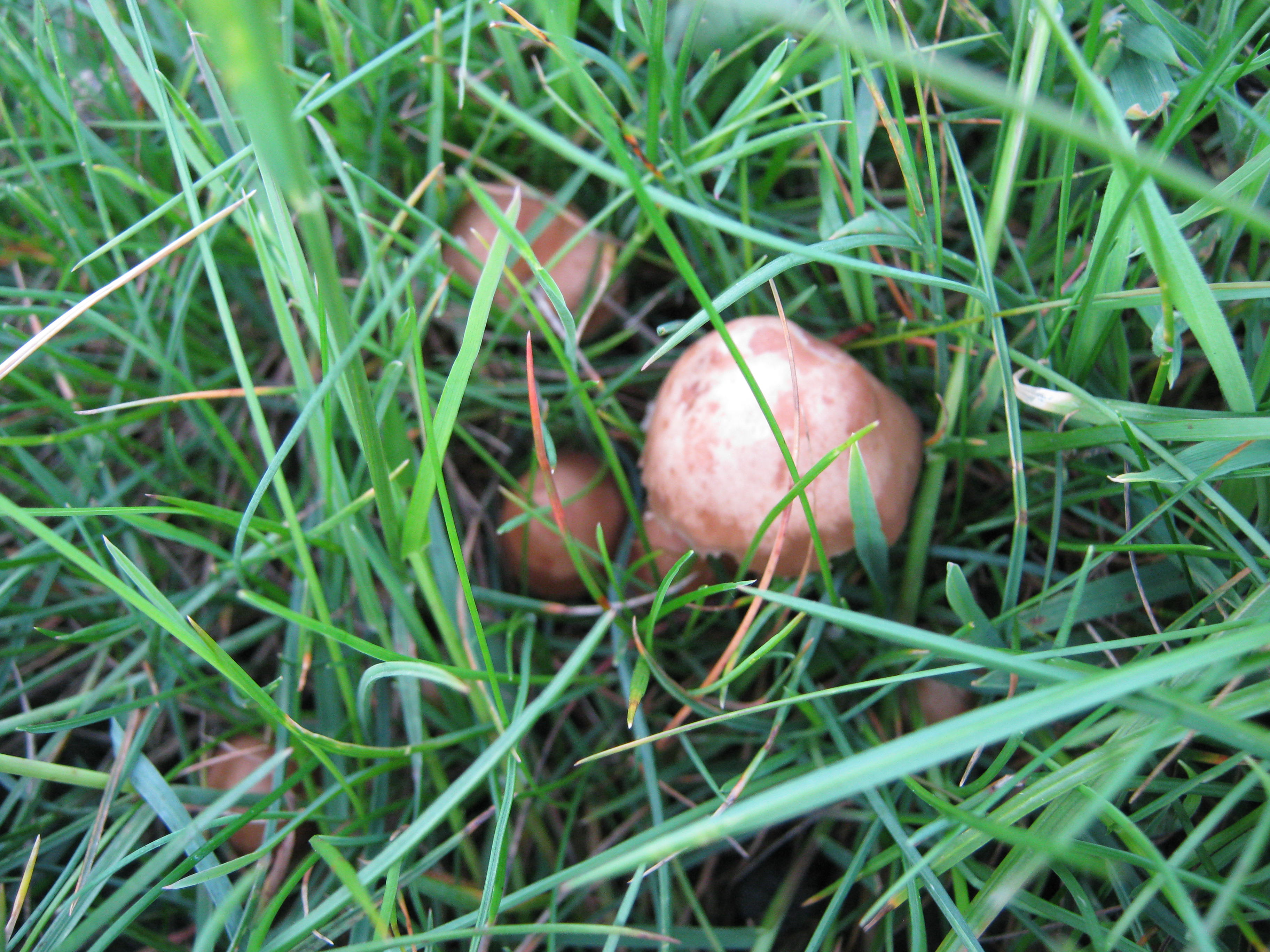
Toadstools

Image

Late sunshine.

We walked back home quite content and I cooked our evening meal.


Share this:

  • Share on X (Opens in new window) X
  • Share on Reddit (Opens in new window) Reddit
  • Share on Pinterest (Opens in new window) Pinterest
  • Share on Facebook (Opens in new window) Facebook
  • Email a link to a friend (Opens in new window) Email
  • Share on Tumblr (Opens in new window) Tumblr
  • Print (Opens in new window) Print
  • Share on Pocket (Opens in new window) Pocket
  • Share on LinkedIn (Opens in new window) LinkedIn
Like Loading...
Follow A Suffolk Lane on WordPress.com

Enter your email address to follow this blog and receive notifications of new posts by email.

Join 715 other subscribers.

Unknown's avatar

I talk about what it's like living in a quiet part of Suffolk. I am a wife, mother and daughter, a practising Christian and love the natural world that surrounds me. I enjoy my life - most of the time!

My Posts

Jan 2026
M T W T F S S
 1234
567891011
12131415161718
19202122232425
262728293031  
« Dec    

Pages

  • About my Blog
  • GDPR (General Data Protection Regulations) and This Site
  • My Life in a Suffolk Lane

Archives

Blogs I Follow

Unknown's avatar
Unknown's avatar
Unknown's avatar
Unknown's avatar
Unknown's avatar
Unknown's avatar
Unknown's avatar
Unknown's avatar
Unknown's avatar
Unknown's avatar
Unknown's avatar
Unknown's avatar
Unknown's avatar
Unknown's avatar
Unknown's avatar
Unknown's avatar
Unknown's avatar
Unknown's avatar
Unknown's avatar

Posts I Like

  • Unknown's avatar
  • Unknown's avatar
  • Unknown's avatar
  • Mélodie's avatar
  • mitchteemley's avatar
  • Unknown's avatar
  • M T McGuire's avatar
  • Unknown's avatar
  • thesimlux's avatar
  • Andrea Stephenson's avatar
  • Unknown's avatar
  • Julian Summerhayes's avatar
  • Unknown's avatar
  • Unknown's avatar
  • DoF@theinfill's avatar
  • Unknown's avatar
  • Unknown's avatar
  • Unknown's avatar
  • Unknown's avatar
  • East of Elveden's avatar
  • Unknown's avatar
  • The Introverted Bookworm's avatar
  • Unknown's avatar
  • Matthew Paul's avatar
  • Unknown's avatar
  • Unknown's avatar
  • CJ's avatar
  • Annika Perry's avatar
  • Unknown's avatar
  • Bernard Aybout (Virii8)'s avatar
  • Yeah, Another Blogger's avatar
  • Unknown's avatar
  • 60onabudget's avatar
  • Unknown's avatar
  • Talkmore's avatar
  • Unknown's avatar
  • santable's avatar
  • gederedita's avatar
  • Unknown's avatar
  • sopantooth's avatar
  • Limentinus's avatar
  • Unknown's avatar
  • Unknown's avatar
  • Unknown's avatar
  • Unknown's avatar
  • Rich's avatar
  • Unknown's avatar
  • Martha's avatar
  • Jack Ronald Cotner's avatar
  • Unknown's avatar

amphibians architecture art Arts and Crafts churches cooking Days out domestic animals family fish Folk Traditions Gardening Historic Buildings holidays Insects Landscaping literature music Norwich plants Rural Diary seashore theatre trees Uncategorized walking weather wild animals wild birds wild flowers

Tags

architecture autumn birds blackbird blackthorn Bungay butterfly church clouds common knapweed cow parsley crocus daffodils Diary dogwood family field maple flowers fungus garden gardening geese greylags ground-ivy Halesworth Hawthorn heather holiday Holly Holy Week horse chestnut Hoverfly insects ivy Lake District Lent lesser celandine lichen Lords and Ladies Mallard mallards Minsmere moorhen moss music Norwich Peak District pheasant plants pond ponds primrose primroses Rain rooks Rumburgh Rumburgh Church sheep Sheffield snow snowdrops Southwold spring Suffolk Suffolk Wildlife Trust sunset the Beck trees viburnum bodnantense walking weather wild cherry wild flowers winter-flowering honeysuckle witch-hazel

Meta

  • Create account
  • Log in
  • Entries feed
  • Comments feed
  • WordPress.com

Goodreads

Blog at WordPress.com.

Book Jotter

Reviews, news, features and all things books for passionate readers

Country Life Blog -

A blog about life in the country in the past and present

Matthew Paul: Poetry & Stuff

Poetry and what-not

Schnippelboy

Ein Tagebuch unserer Alltagsküche-Leicht zum Nachkochen

TAMARA JARE

TAMARA JARE Tamara Jare: Contemporary Figurative Painting Oil on Canvas Artist Art Studio

A Taste of Freedom

Documenting a Dream

Country Ways

Rambling Journeys in Britain, Countryside Matters and campaigning for the Right to Roam

The Strawberry Post

Here to Entertain, Educate & Inspire!

a north east ohio garden

an ongoing experiment in the dirt, 35 plus years

naturechirp

Celebrating God's creatures, birds and plants...

Sophie Neville

Writer

Going Batty in Wales

Developing a more sustainable lifestyle in SW Wales

Our Lake District Escapades

Exploring the Lake District and beyond

Short Walks Long Paths

Wandering trails around the coast of Wales

The Biking Gardener

An English persons experience of living and gardening in Ireland

Nan's Farm

A Journal Of Everyday Life

Walk the Old Ways

Rambling Journeys in Britain with John Bainbridge. Fighting for the Right to Roam. Campaigning to Protect Our Countryside.

Writer Side UP!

Waking the Writer Side...and keeping it "Up!"

Meggie's Adventures

Travel, thank you notes and other stories

amusicalifeonplanetearth

Music and the Thoughts It Can Inspire

lovefoundation.co.uk

Traveling Tortuga

Simply Living Well

Pakenham Water Mill

Historic watermill in the beautiful Suffolk countryside

Take It Easy

Retired, not expired: words from the after(work)life. And music. Lots of music!

Secret Diary Of A Country Vicar's Wife

By Olive Oyl

thanksfortheadventureorg.wordpress.com/

The Beat Goes On

#TBGO

Frank Pleszak's Blogs

Twitter: @frankpleszak @PolishIICorps

John Bainbridge Writer

Indie Writer and Publisher

roughwighting

Life in a flash - a bi-weekly storytelling blog

Walking the Old Ways

Rambling in the British Countryside

CapKane

thoughts on social realities

SkyeEnt

Jottings from Skye

jodie richelle

embracing my inner homemaker

Skizzenbuch/Blog

Just another WordPress.com weblog

Have Bag, Will Travel

The Call of the Pen

Flash Fiction, Book Reviews, Devotionals and other things.

John's Postcards

Art in Nature

You dream, I photographe it !

Smile! You’re in Barnier World......

theinfill

the things that come to hand

Dr. Mary Ann Niemczura

Author of "A Past Worth Telling"

Provincial Woman

The Pink Wheelbarrow

Luanne Castle: Poetry and Other Words (and cats!)

Poetry, Other Words, and Cats

The Family Kalamazoo

A genealogical site devoted to the history of the DeKorn and Zuidweg families of Kalamazoo and the Mulder family of Caledonia

everythingchild

The Book Owl

Canberra's Green Spaces

Paul Harley Photographer

  • Subscribe Subscribed
    • A Suffolk Lane
    • Join 715 other subscribers.
    • Already have a WordPress.com account? Log in now.
    • A Suffolk Lane
    • Subscribe Subscribed
    • Sign up
    • Log in
    • Report this content
    • View site in Reader
    • Manage subscriptions
    • Collapse this bar
 

Loading Comments...
 

    Privacy & Cookies: This site uses cookies. By continuing to use this website, you agree to their use.
    To find out more, including how to control cookies, see here: Cookie Policy
    %d