• About my Blog
  • GDPR (General Data Protection Regulations) and This Site
  • My Life in a Suffolk Lane

A Suffolk Lane

~ A diary of my life in rural north Suffolk.

A Suffolk Lane

Tag Archives: stained glass

2017 Revisited

17 Wed Jan 2018

Posted by Clare Pooley in Days out, Norwich, Rural Diary

≈ 90 Comments

Tags

crossbow, Doll's House Exhibition, Iceni artifacts, needlework, Norfolk, Norwich, Norwich Castle Museum and Art Gallery, stained glass, teapots

As I have mentioned before, we didn’t manage to do as much walking and we didn’t visit as many places as usual last year and, for the same reasons, I also didn’t write very many posts.  I have photos from the few excursions we did make and some pictures of interesting things I saw that I haven’t posted yet, so I thought I would put together some retrospective posts whenever I have spare time.

This is the first of a series of posts.

ooooOOoooo

Last spring, Elinor was asked to write about an exhibition she had visited.  Unfortunately, she hadn’t visited one for some time so we looked about us to see if there was anything on locally that appealed to her.  We were pleased to see that at the Castle Museum in Norwich there was an exhibition of doll’s houses – so that’s where we went.

The exhibits were difficult to photograph because of the lighting and the reflections from the glass cases.  Here is a slideshow of photos of some of the houses.

This slideshow requires JavaScript.

Elinor stayed in the exhibition hall to sketch a few of the houses and make some notes while I wandered round the rest of the museum.  I spent some time in the art gallery where they have a fine collection of paintings and drawings by local artists: Gainsborough, Constable, Crome, Munnings, Seago and others.  I took no photographs there nor in the natural history section where there are a number of dioramas featuring lots of stuffed birds and animals mainly collected during the 19th century.  I don’t like stuffed birds and animals.

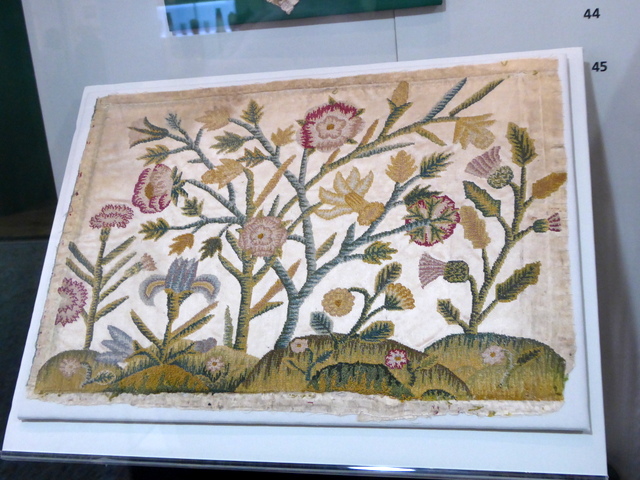
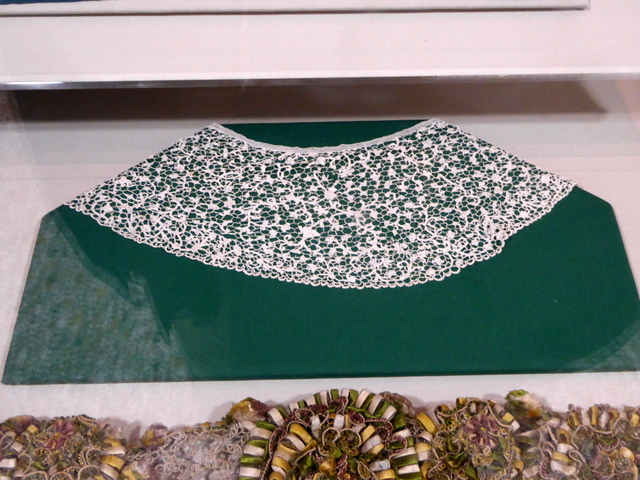
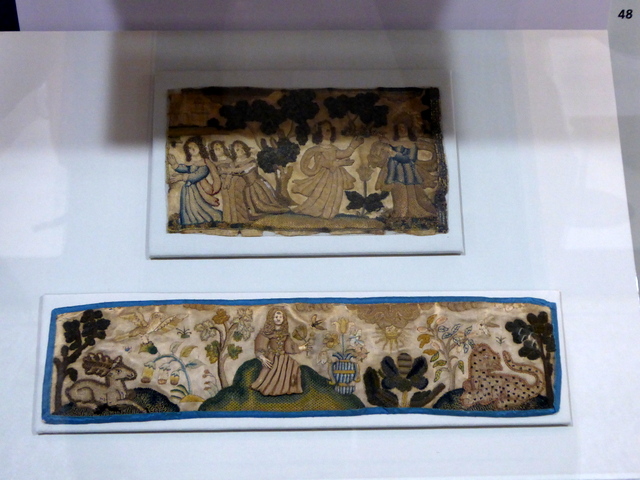
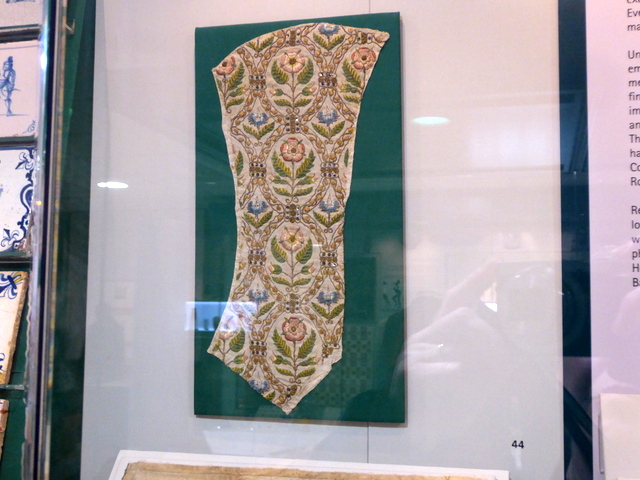
The museum has a collection of antique clothes and costumes which I enjoy seeing and also pieces of needlework and embroidery.

Here are some examples of Jacobean needlework and also a lovely lace collar.

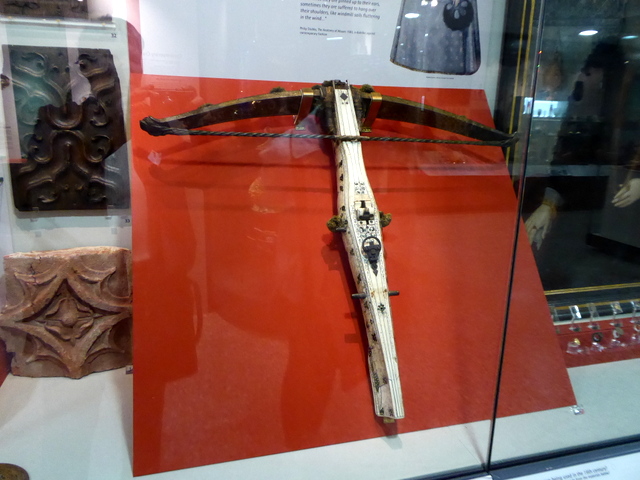
I took a photograph of a splendid crossbow.

The museum has a large collection of teapots.  Here are some of them.

This slideshow requires JavaScript.

I wandered through the Boudica and the Romans gallery and took some photos of a few of the artifacts that have been discovered.

This slideshow requires JavaScript.

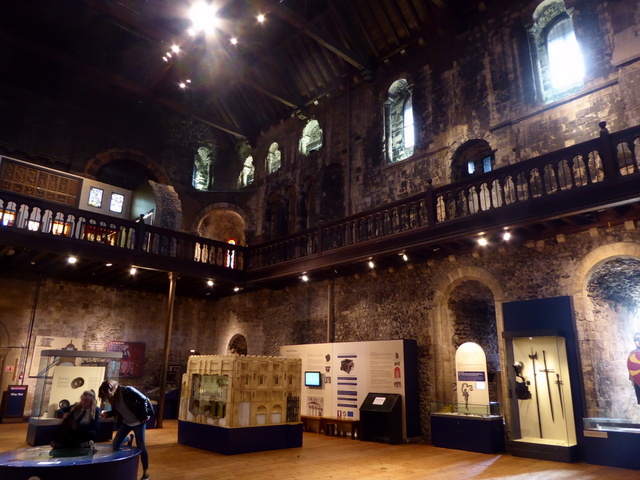
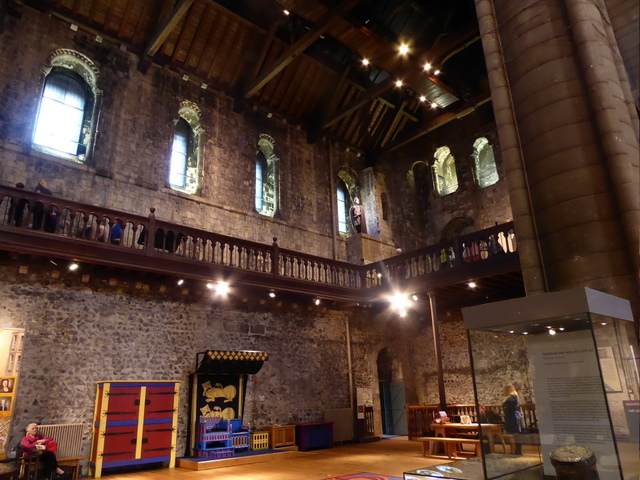
There are a few display cabinets in the large central area in the castle keep.

Castle keep

Castle keep

P1010823Museum
P1010824Museum
P1010825Museum
P1010826Museum

I like these examples of medieval stained glass.   Top left shows winter pruning, top right is a feast, bottom left shows a gardener hurrying indoors out of a spring rain or hail shower, bottom right shows a man harvesting bunches of grapes.

I had to go back to meet Elinor then before I’d finished the whole tour of the museum.  We returned a few weeks later with Richard so he could also see the exhibition and for Elinor to check on a few details.  We all enjoyed the exhibition very much.

Thanks for visiting!


Share this:

  • Share on X (Opens in new window) X
  • Share on Reddit (Opens in new window) Reddit
  • Share on Pinterest (Opens in new window) Pinterest
  • Share on Facebook (Opens in new window) Facebook
  • Email a link to a friend (Opens in new window) Email
  • Share on Tumblr (Opens in new window) Tumblr
  • Print (Opens in new window) Print
  • Share on Pocket (Opens in new window) Pocket
  • Share on LinkedIn (Opens in new window) LinkedIn
Like Loading...

St. Peter Mancroft Church, Norwich

14 Thu Jan 2016

Posted by Clare Pooley in art, churches, Days out, Norwich, Rural Diary

≈ 60 Comments

Tags

carving, churches, flushwork, medieval, Norwich, St Peter Mancroft church, stained glass

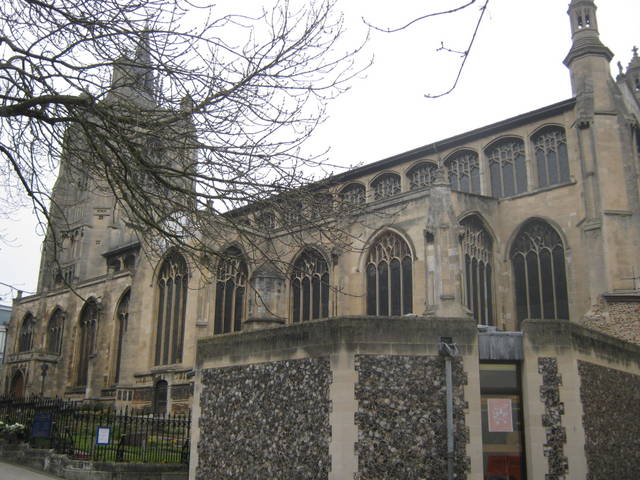
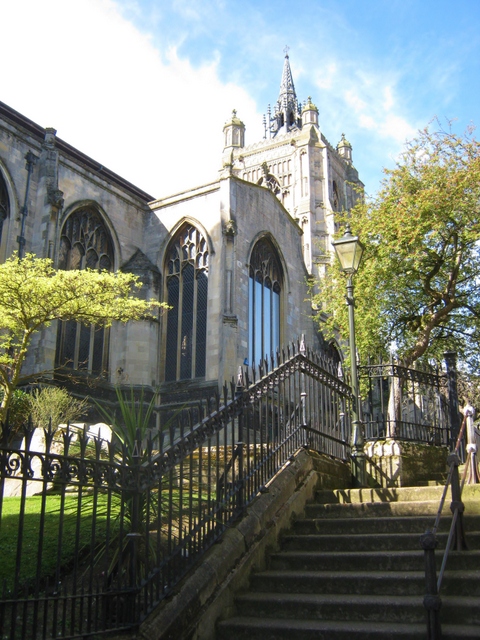
IMG_4203St Peter Mancroft Church

St Peter Mancroft Church

This large church is close to Hay Hill where my last Norwich post came from.  It is the largest of the thirty-one Church of England churches in Norwich and is often mistaken for one of the two cathedrals.

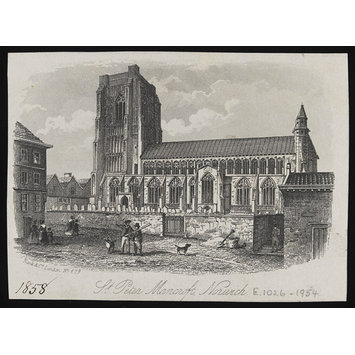
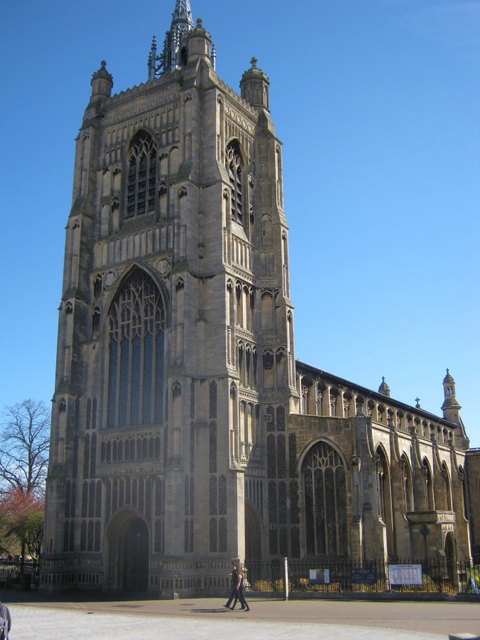
The building was begun in 1430 and was consecrated in 1455, a twenty-five year single phase of construction which gives the church its unity of style.  There have been only a few additions to the exterior of the building since then, notably the little spire on top of the tower (a fleche), the parapet round the top of the tower and the ‘pepperpots’ on the corners added by the architect A E Street in 1895.

2010EG8094_jpg_ds

St Peter Mancroft before the Victorian additions to the tower.

IMG_4206St Peter Mancroft

St Peter Mancroft Church. Beyond it on the left of the photo you can see The Guildhall featured in a recent post of mine.

This church wasn’t the first to be built on this site.  One of William the Conqueror’s barons, Ralph de Guader, Earl of Norwich, had had a church built there in 1075 but shortly afterwards he lost everything he had after rebelling against the Conqueror.  Fortunately he had already bestowed the church on one of his chaplains, Wala, who fled to Gloucester after the rebellion.  Wala passed the church on to the Abbey of St Peter in Gloucester and so for 300 years this church was known as ‘St Peter of Gloucester in Norwich’ – quite a mouthful!  After pressure from the citizens of Norwich in 1388, the church was passed to the Benedictine Community of St-Mary-in-the-Fields in Norwich whose church (long since destroyed) was where the Assembly Room and the Theatre Royal are now.  The Dean and Chapter of St Mary’s found the old church dilapidated and in very poor condition and so decided to re-build.  It took them 42 years to save enough money through gifts, legacies and donations to be able to start the construction work.

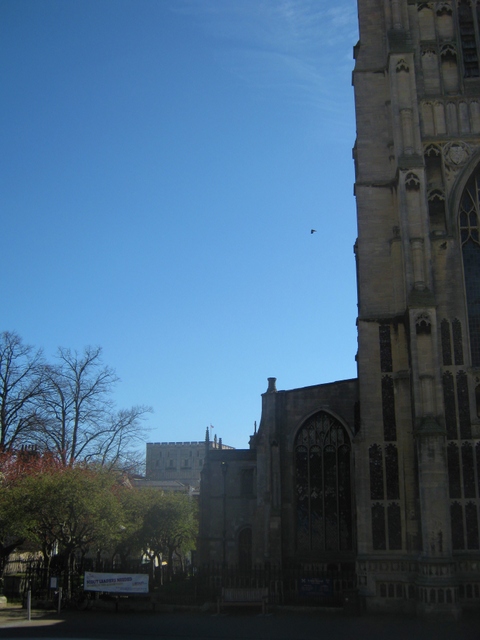
IMG_4412Castle beyond St Peter Mancroft

Norwich Castle can be seen beyond St Peter Mancroft church

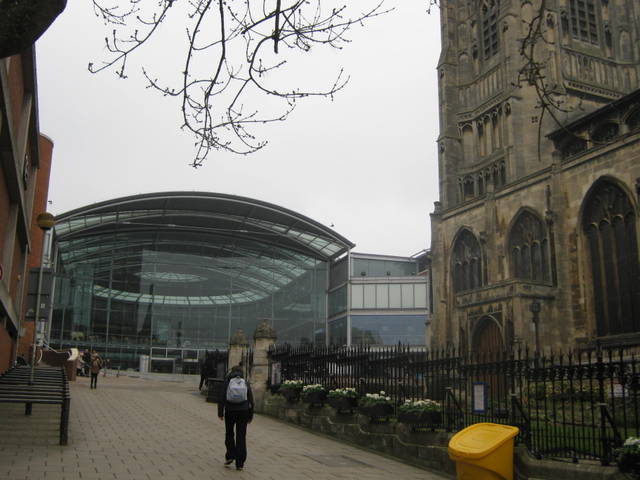
IMG_4204St Peter Mancroft and The Forum

St Peter Mancroft on the right and the Forum ahead

IMG_4410St Peter Mancroft

St Peter Mancroft

I include here a link to an aerial map of St Peter Mancroft (marked in purple).

http://www.heritage.norfolk.gov.uk/map-record?UID=MNF257&BBOX=622901,308412,622961,308442&CRS=EPSG:27700&count=1&ck_MON1=true&ck_MON=false

During the Reformation the College of St-Mary-in-the-Field was suppressed and the patronage of St Peter Mancroft was passed through several families until 1581 when it was acquired by trustees on behalf of the parishioners.  The church was originally the church of St Peter and St Paul but the name was shortened to St Peter after the two saints were given independent saints days during the Reformation.  ‘Mancroft’ probably came from the ‘Magna Crofta’ (great meadow) on which it was built.

IMG_4411St Peter Mancroft

St Peter Mancroft – the tower is 146′ high

The church is almost completely faced with limestone which was brought many miles over land and sea at great expense.  (There is no local free-stone in Norfolk).   It was a deliberate display of wealth on the part of the 15th century citizens of Norwich.  There is some knapped flint flushwork decoration most notably on the tower which is well buttressed and was probably intended to carry another lantern stage  The tower also carries a peal of 14 bells.

There are two fine porches to the church on the north and south sides.  The North Porch has a parvaise (a room over the porch).

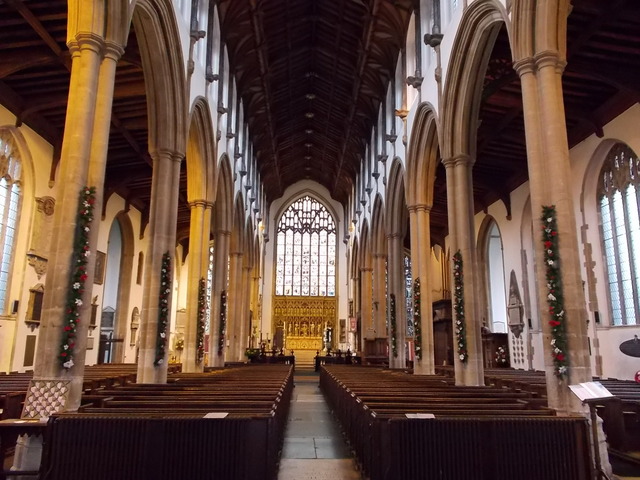
DSCN0203View down central aisle

This is a view of the interior of the church from the back looking towards the East window.

It is 60′ from floor to roof and has eight arched bays with slender columns.  The church is also very long at 180′.

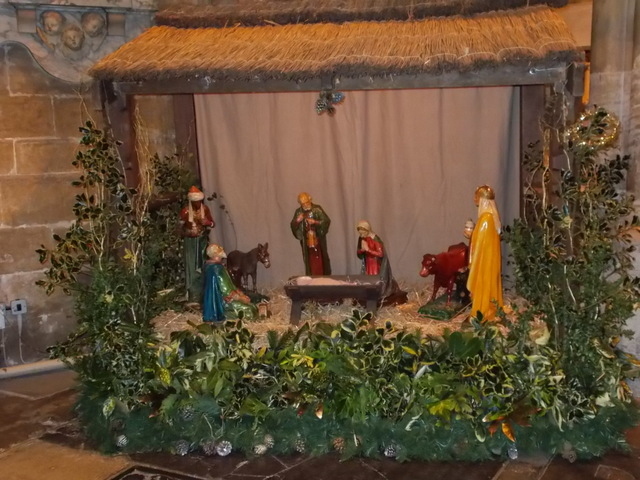
DSCN0173Crib at St Peter Mancroft

The Crib was about 5′ tall and 5′ wide. I could have got into it easily – if I had so wished!

Richard, Elinor and I visited the church on a very rainy day last week.  Amazingly, the church was warm inside!  Even the cathedral doesn’t get as cosy as St Peter Mancroft.

DSCN0174Font

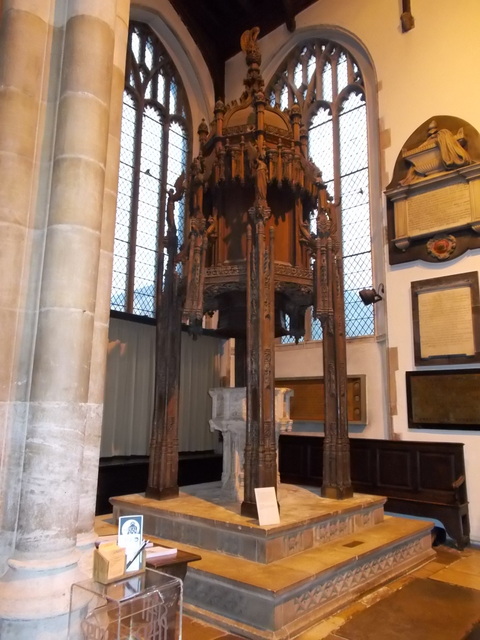
Font and Font Canopy in the Baptistery

The font was a gift to the church in 1463 by John Cawston, a grocer from Norwich.  The Seven Sacraments were carved on panels round the font basin and an eighth panel showed the ‘Sun in Splendour’, the badge of Henry IV.  Eight saints were carved on the shaft of the font.  Sadly, the Puritans hacked off all the images, plastered the font with lime and daubed it with black paint.  It was found in the crypt with other rubbish in 1926 and was cleaned and put in its present position.  The four pillars and the base of the canopy over the font were made in the 15th century but the upper part of the woodwork is 19th century Victorian work.

This slideshow requires JavaScript.

I apologise for the poor quality of the photos in the slideshow but all of the objects were in glass cases in the St Nicholas Chapel.  These objects are just a few of the many treasures owned by the church and known as the Mancroft Heritage.

DSCN0183North chapel

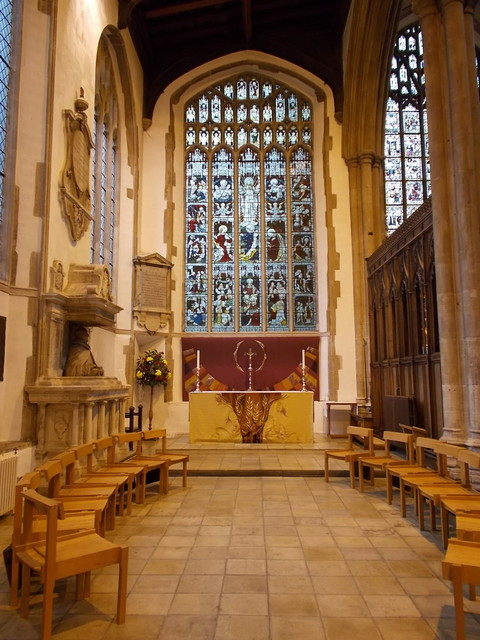
The Jesus Chapel.

This chapel is normally used for weekday services.

DSCN0184Memorial

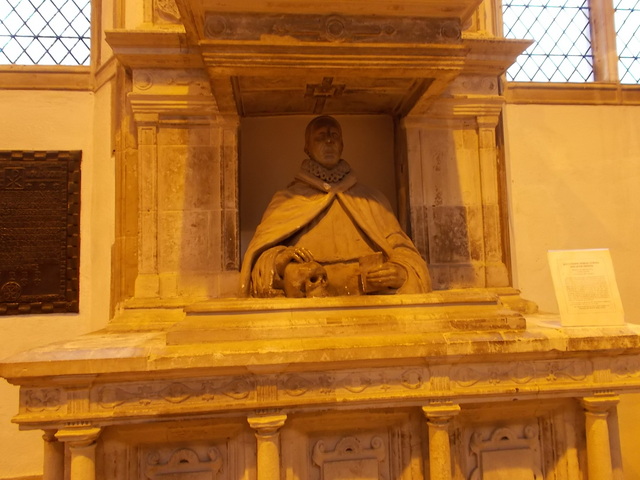
The tomb of Francis Windham, Recorder of Norwich in the reign of Elizabeth I

DSCN0186Chancel

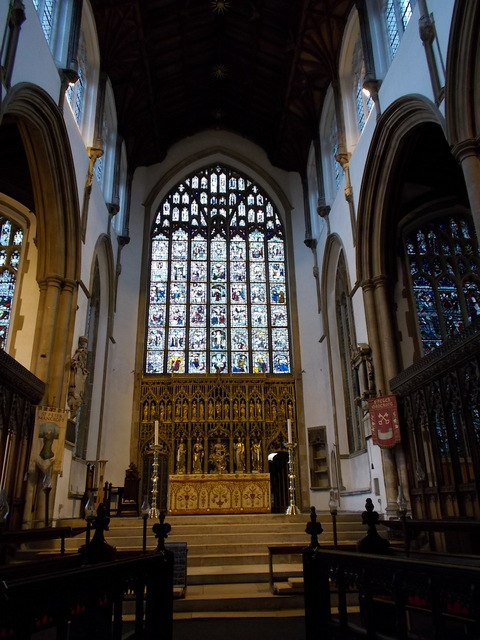
The Chancel or Choir

The Reredos (the panel behind the High Altar) has some beautiful carved figures made in 1885 and gilded in 1930 to mark the 500th anniversary of the beginning of the building of the church.  At the same time the lower line of larger figures were added by Sir Ninian Comper.

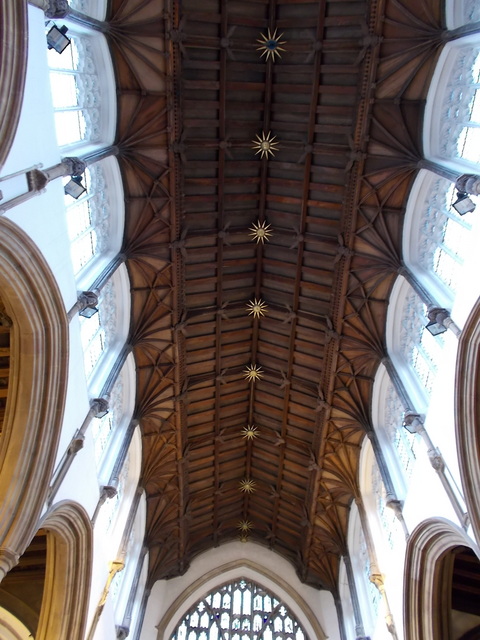
DSCN0185Chancel roof

The Chancel roof

This roof (and the roof of the Nave) is of open timbered construction supported by hammer beams.  Most hammer beam roofs are ornamented and uncovered but this one is covered by fan tracery or vaulting in wood.  Most fan traceries are made from stone so this roof is very rare.  It is also an angel roof – there is a single row of small angels on either side of the Nave roof but a double row on either side of the Chancel.  There are also gilded suns in splendour on the ridge bosses.  The roof was restored in 1962 -64.  Some amazing work was done then by the restorers who raised the roof on jacks and then pulled the walls straight which had been driven outwards by the weight of the roof over the centuries.

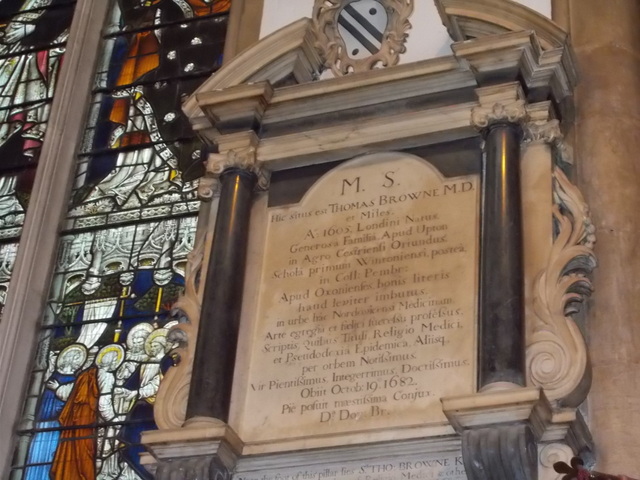
DSCN0190Memorial to Sir T Browne

Here is the memorial to Sir Thomas Browne, the subject of my previous Norwich post

I have discovered a quote of Sir Thomas Browne’s from his treatise ‘Urn-Burial’ at the beginning of Edgar Allen Poe’s ‘The Murders in the Rue Morgue’.


This slideshow requires JavaScript.

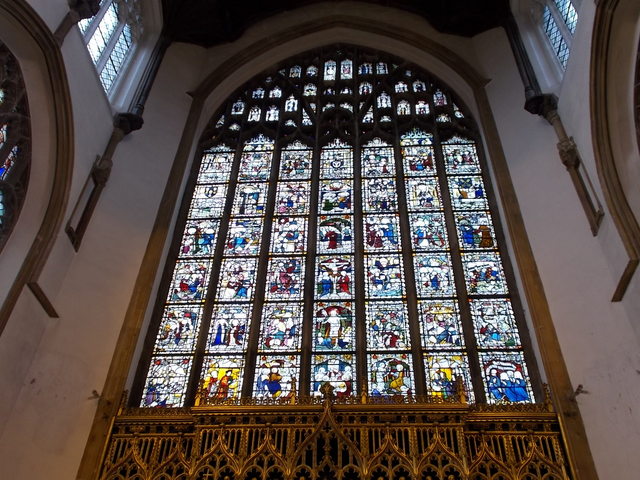
The most memorable sight in the church is that of the Great East Window.

DSCN0189East window

The East Window

It has 39 tracery lights (windows/panes of glass) and 42 main lights, all of which are 15th century except seven main lights which are Victorian.  The Victorian ones are the lower five in the centre colomn and the two bottom ones either side of the centre colomn.  This window contains some of the finest work by the 15th century School of Norwich Glass Painters.  Most of the church would have originally been full of glass like this but during rioting between Puritans and Royalists in 1648 there was a gunpowder explosion nearby in a house in Bethel Street which left many people dead and much of the glass in the church blown in.  It wasn’t until four years later that the glass was gathered together from around the church and most put into this window.

Please click on this link to see each light in detail.

I am obliged and indebted to the Church Guide I purchased in St Peter Mancroft for some of the information in this post.

Thanks for visiting!

Share this:

  • Share on X (Opens in new window) X
  • Share on Reddit (Opens in new window) Reddit
  • Share on Pinterest (Opens in new window) Pinterest
  • Share on Facebook (Opens in new window) Facebook
  • Email a link to a friend (Opens in new window) Email
  • Share on Tumblr (Opens in new window) Tumblr
  • Print (Opens in new window) Print
  • Share on Pocket (Opens in new window) Pocket
  • Share on LinkedIn (Opens in new window) LinkedIn
Like Loading...

Peak District Holiday 1st to 9th July. Day 5 Part 2 and Day 6.

09 Fri Jan 2015

Posted by Clare Pooley in churches, Rural Diary, Uncategorized

≈ 11 Comments

Tags

All Saints church, Brindley's Mill, James Brindley, Leek Staffordshire, murals, Richard Norman Shaw, stained glass

During our day in Leek (mentioned in a former post), we also re-visited two favourite places.

This post is written with some help from the information booklets I obtained from All Saint’s Church, Leek and Brindley’s Mill, Leek.

ALL SAINTS CHURCH

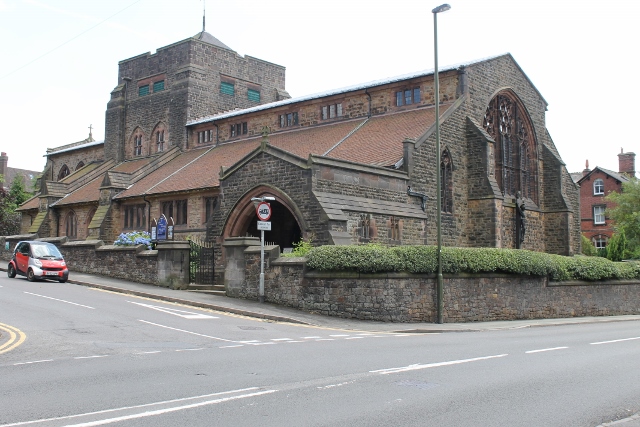
093AAll Saint's church (640x427)

All Saints Church, Leek is built of dark gritstone and some pink sandstone.

This church was designed by Richard Norman Shaw (1831-1912) and is considered the finest of all the sixteen he worked on.  He mainly designed great houses and public buildings – 200 are attributed to him – including ‘Cragside’ in Northumberland and New Scotland Yard in London, the former headquarters of the Metropolitan Police.  He followed A W N Pugin’s methods and principles which included honesty in the use of materials and the use of local building stone wherever possible.  He also worked for some years as assistant to George Edmund Street and many of Street’s principles can be seen in Shaw’s churches – very low chancel screens without superstructure and the altar visible from all parts of the building.

095Altar (640x427)

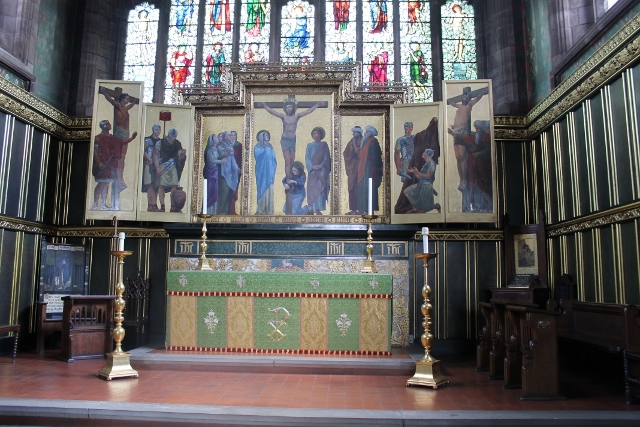
The High Altar. The beautiful painted Reredos shows Christ’s Crucifixion and the Great East Window behind, designed by the artist Edward Burne-Jones, is a ‘Jesse’ window and shows the ancestry of Christ.

This was the third time we had visited this church and each time we have been there we have been welcomed and shown wonderful hospitality by the parishioners who open their church to visitors twice a week, provide coffee, tea and biscuits and lots of information and chat.

The stained glass windows are sumptuously coloured.

Miriam, Esther and Ruth by J E Platt
Faith, Hope and Charity by E Burne-Jones
St Stephen, St Catherine and St Alban by G Horsley
St Chad of Lichfield, King Alfred of Wessex and St Werburgh of Chester by J E Platt
St Augustine of Hippo, St Jerome, St Ambrose and St Gregory by Morris and Co
King David, King Solomon, Hezekiah and Josiah by Morris and Co
Deborah, Huldar and Judith by Morris and Co
East Window - Ancestry of Christ by E Burne-Jones
East Window – Ancestry of Christ by E Burne-Jones
022West window (640x470)

The West Window has no stained glass and shows the beautiful tracery to good effect

018Pulpit (480x640)

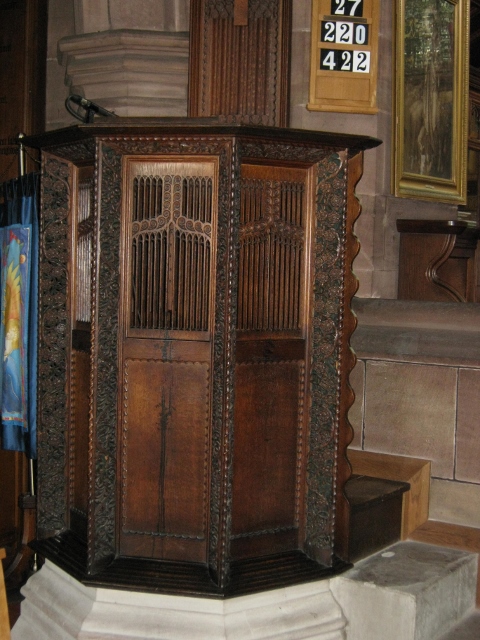
The pulpit is decorated beautifully with carving and pierced woodwork. It also has a tester or sounding board above it which helped with acoustics before the use of microphones.

020Ceiling (480x640)

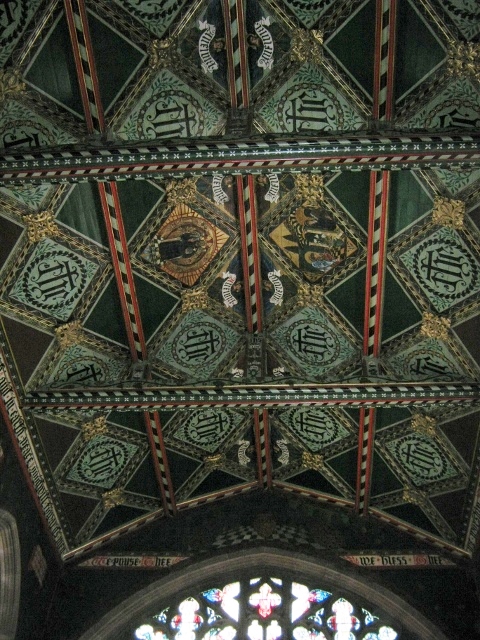
Part of the painted ceiling in the chancel.

027Lady chapel (480x640)

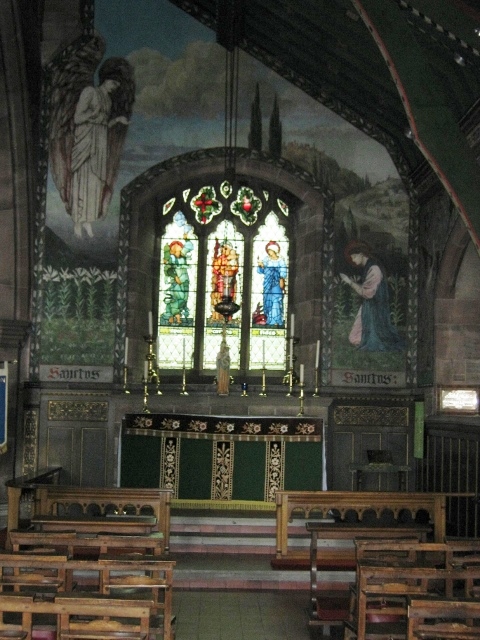
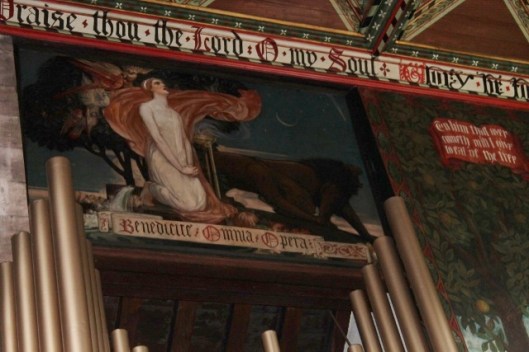
The highly decorated Lady Chapel. The wall painting shows the Annunciation, the visit of the Angel Gabriel to Mary when she is told she has been chosen to be the Mother of Christ.

Another painting in the Lady Chapel and on the south wall is of St Francis of Assisi preaching to the birds.  Unfortunately the photographs I took were not good enough as the light levels were poor.

Wall painting
Wall painting

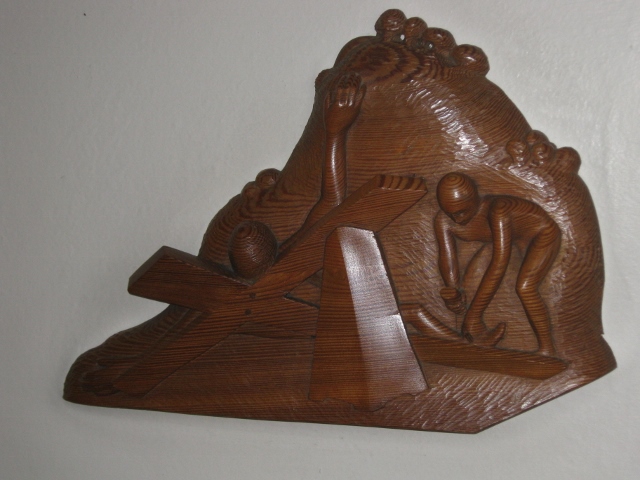
032One of stations of the cross (640x480)

One of the fourteen Stations of the Cross carved in 1991 by a local craftsman, John Owen.

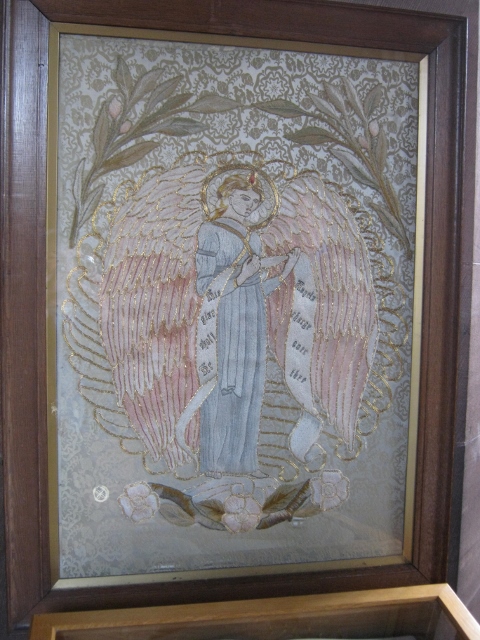
033One of the embroideries (480x640)

A framed embroidery of an angel – a late example of the work of a member of the Leek School of Embroidery.

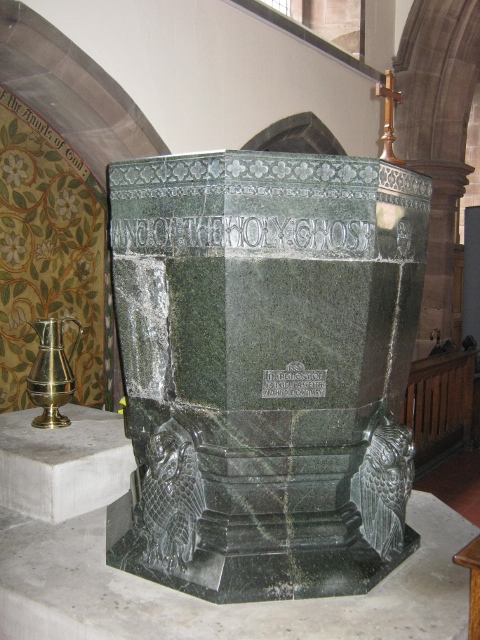
034The font (480x640)

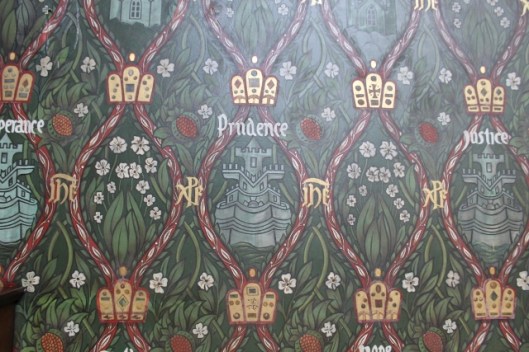
The font is made from green marble and the floral design on the west wall behind it is believed to be by William Morris.

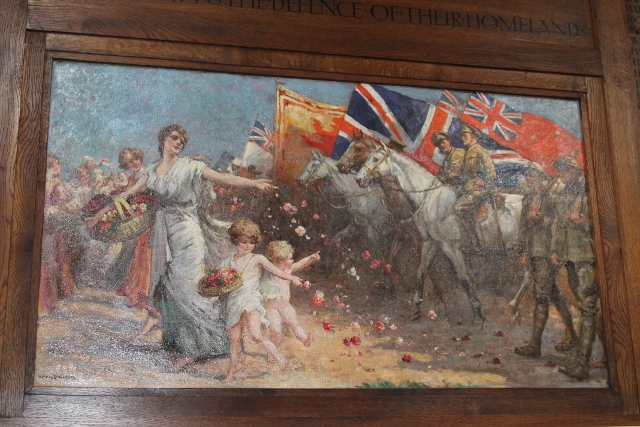
106Painting (640x427)

This painting had only just been restored and replaced in the church the day we visited.

BRINDLEY’S MILL

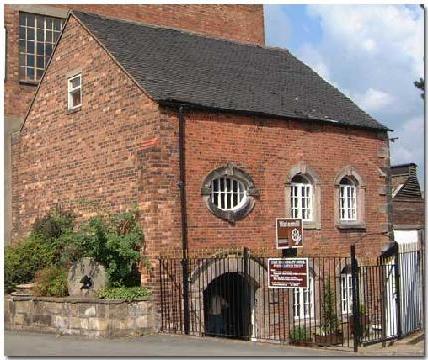
Our next port of call was to Brindley’s Mill.  As it is on a busy road I was unable to take a photograph of the outside of the mill so I have found a picture of it on-line – thanks to the Peak District On-line site.

leek-mill

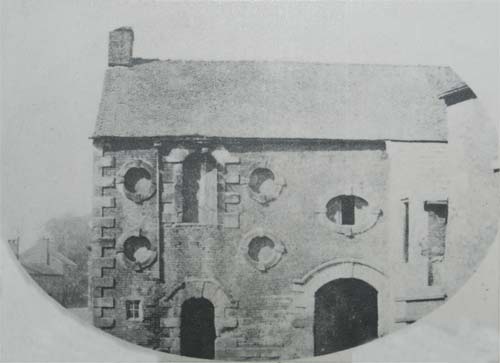
I also found a photograph of what it looked like before successive roadworks raised the road level and caused the demolition of part of the building in 1948.  This photograph comes from the Staffordshire Past Track site.

26896-0

James Brindley was born in 1716, the eldest of the seven children of a Derbyshire small farmer.  Brindley had very little schooling as he was kept very busy on the farm.  The family moved to Leek when he was ten and at the age of seventeen he was apprenticed to a millwright near Macclesfield in Cheshire.  He had a wonderful memory and stored up all sorts of useful information that he gleaned on his trips with journeymen to a variety of mills in the area.  After two years his grasp of mechanical detail was remarked on by a mill manager and when the millwright to whom he was apprenticed failed to produce machinery for a new paper mill, Brindley, on his own initiative, visited the mill fifty miles away to see what was required.  He was subsequently put in charge of the work which was completed satisfactorily.  He thereafter looked after the business until the millwright’s death.  Brindley set up his own millwright’s business in 1742 at the age of 26.  He opened up another workshop in the Potteries where, after working with master potters and colliery owners he became known as ‘The Schemer’.  His mill work continued including water mills for corn, flint and  textiles, all requiring different internal machinery.  Where no water was available he used ‘fire engines’ as early steam pumps were known.  He patented improvements to existing machines.  He replaced water by wind in Burslem for grinding flint for the Wedgewoods.

Brindley built the cornmill in Leek in 1752 on a site where a mill had stood since Domesday, on the River Churnet.

040R Churnet (640x480)

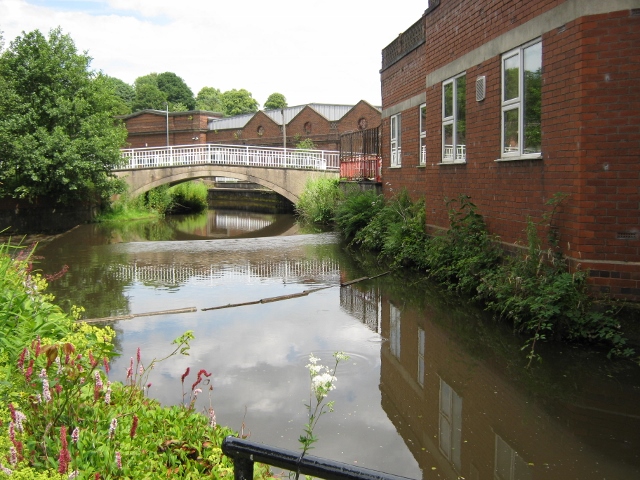
The River Churnet seen from the mill

In constructing this mill he showed a variety of skills – a millwright’s knowledge of mechanics and hydraulics was accompanied by the ability to create a stylish building using new weight-bearing techniques.  He also exhibited civil engineering skills when constructing the weir by compacting clay, as he did later when forming the beds of the canals he made.  His canals transformed the way goods were transported across England and he became very famous.  Because of his lifestyle – constant travelling, overwork and also the onset of diabetes – he died at the early age of 56.

042Wheel (480x640)

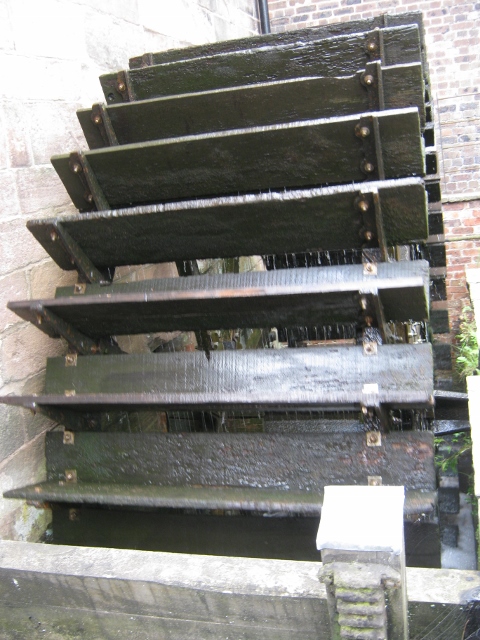
The working waterwheel


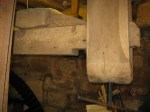
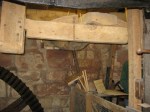
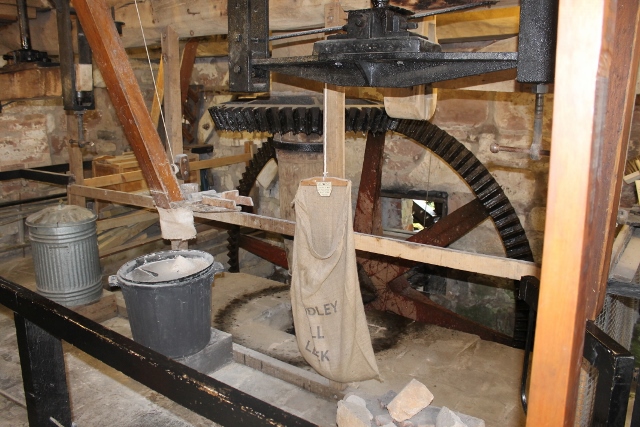
Four photos of the tentering gear (three sets of different vintages are bolted to the ceiling).  They adjust the gaps between the millstones on the floor above to control the fineness of the flour.

At the rear of the photo is the pit wheel which is connected to the waterwheel outside by the axle-tree. The main shaft is made of oak and is 18″ in diameter. It is supported by a brass footstep bearing which is bolted to the floor. Around the base of the main shaft is the wallower – a gear which is driven by the pit wheel. At the front of the photo is the wooden pipe which conveys the meal from the millstones above. The meal is then sieved.

110Mill (640x427)

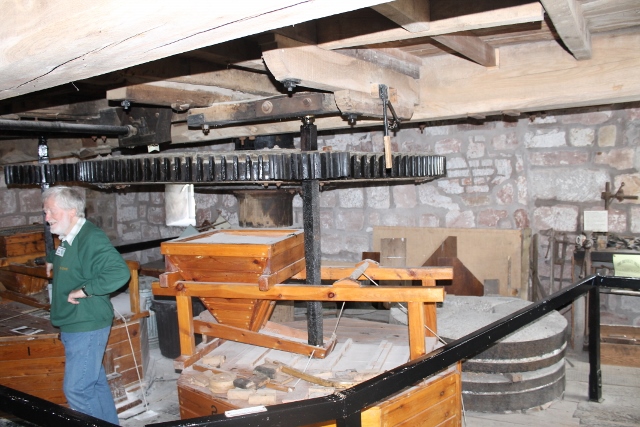
This is a photo of the next floor. Grain is poured into the wooden hopper from the floor above. The new hopper here is a quarter scale replacement to make demonstrations easier. Below the hopper is a tray (the shoe). One of the arms attached to the shoe is held against the rotating four-sided shaft by a rope attached by a springy bar of willow. As the shaft turns its four edges create a shuddering movement in the shoe which allows the grain to be jerked out at a regular pace into the eye of the top stone.

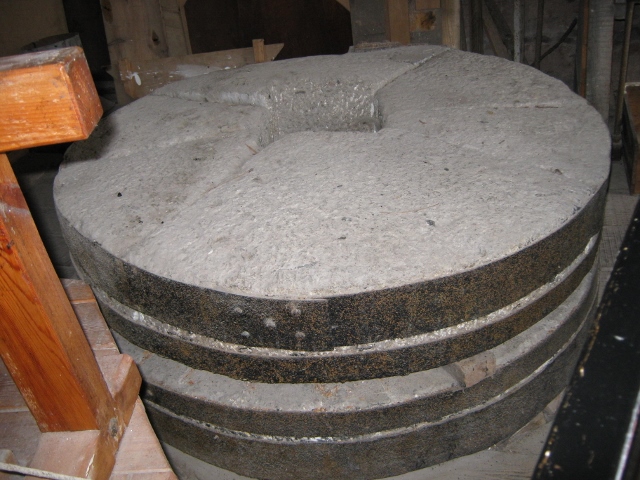
055Mill stones (640x480)

Mill stones

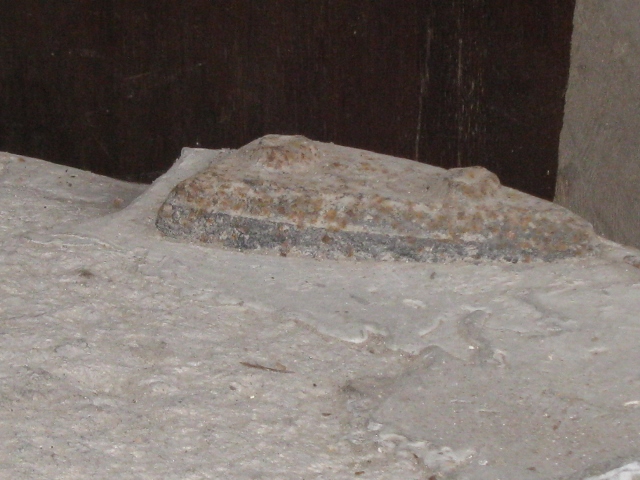
056Weighted with flat iron (640x480)

If the stone became worn or it ground unevenly it could be repaired by being weighted on one side. This one has been weighted by an old flat iron.

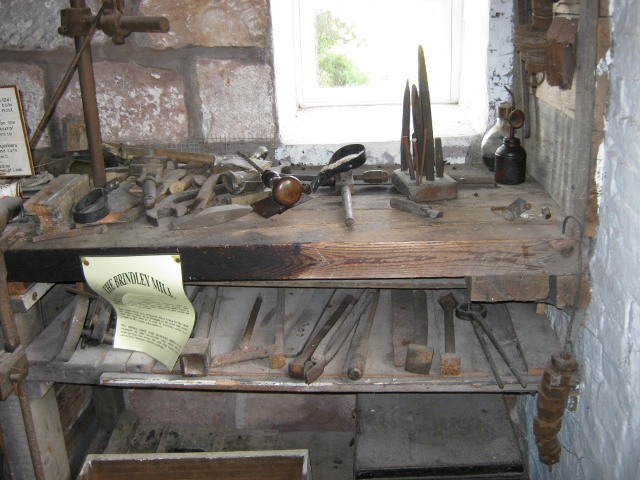
057Tools used in mill (640x480)

A work bench with tools used in the mill

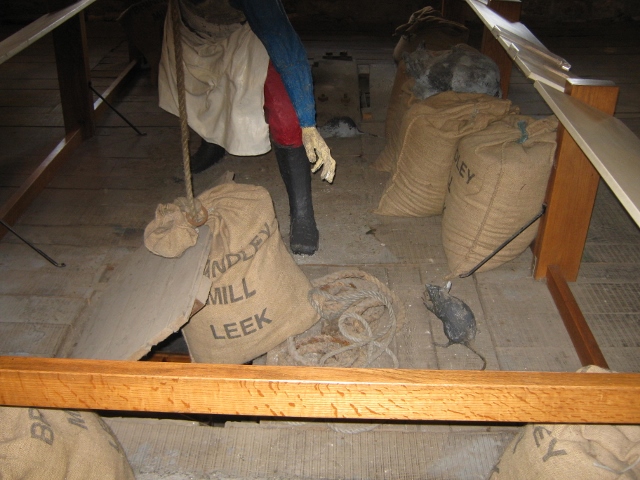
060Garner floor (640x480)

The Garner floor or top floor where the grain is stored prior to milling. The sacks are conveyed up to this floor with a sack hoist

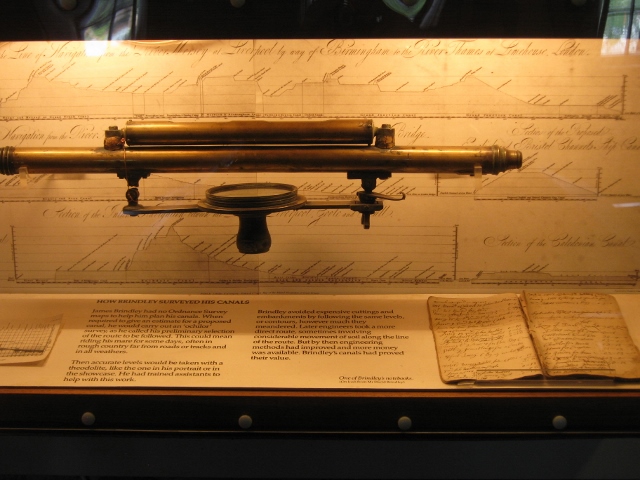
065B's level & notebook (640x480)

Brindley’s level and notebook

This is a theodolite level – a spirit level above a telescope above a compass – and was the most advanced piece of technology which he used in planning his canals.

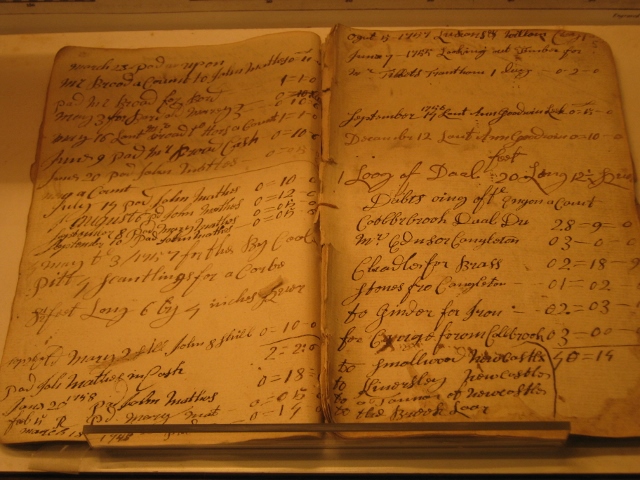
066Notebook (640x480)

This is one of four of Brindley’s notebooks in existence and are mainly aids to his memory – time taken to ride to distant places, where he found suitable timber, clothes he bought, how much he was owed etc.

The following day, which was Sunday, we attended church at All Saints and had coffee afterwards in their large church room in the undercroft.  Such friendly people!

We then travelled to Manchester and spent some time visiting my mother-in-law in her house.  Probably the last time I will see the house, though I didn’t realise it then.


Share this:

  • Share on X (Opens in new window) X
  • Share on Reddit (Opens in new window) Reddit
  • Share on Pinterest (Opens in new window) Pinterest
  • Share on Facebook (Opens in new window) Facebook
  • Email a link to a friend (Opens in new window) Email
  • Share on Tumblr (Opens in new window) Tumblr
  • Print (Opens in new window) Print
  • Share on Pocket (Opens in new window) Pocket
  • Share on LinkedIn (Opens in new window) LinkedIn
Like Loading...

Peak District Holiday 1st to 9th July. Day 5.

26 Wed Nov 2014

Posted by Clare Pooley in churches, Rural Diary

≈ 15 Comments

Tags

architecture, church of St Edward the Confessor, George Edmund Street, Greystones, Larner Sugden, Leek, Leek School of Embroidery, Nicholson Institute, Norman Shaw, oatcakes, ragged schools, River Churnet, silk mills, Staffordshire, stained glass, William Morris, William Sugden

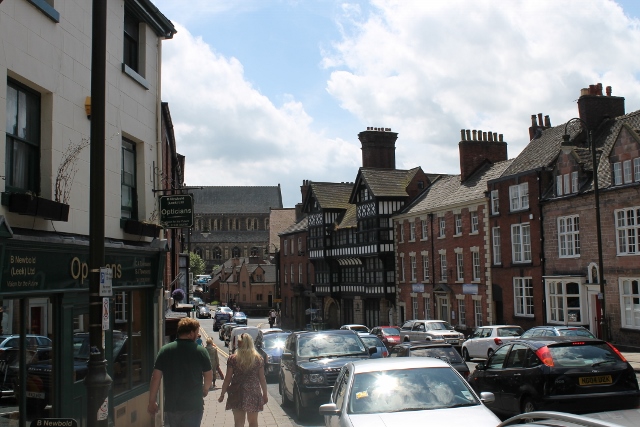
092View down street (640x427)

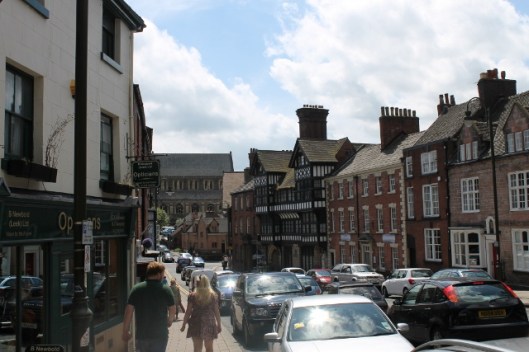
A view down one of the main streets in Leek looking towards the Roman Catholic church.

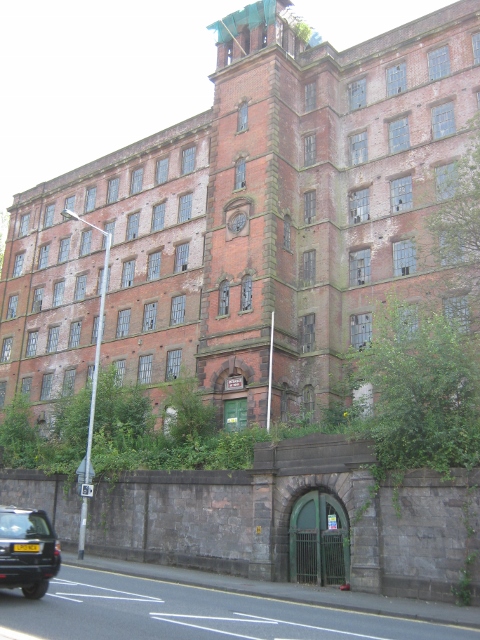
The nearest town to where we usually stay in the Staffordshire Peaks is Leek.  It is the principal town of the area and is known locally as ‘The Queen of the Moorlands’.  It is not a large town; it is built on a hill and is contained in a large bend in the River Churnet.  During the late 18th and early 19th centuries it changed from a quiet market town to a silk-weaving centre and a few large mills were built there.  This industry has completely gone now but some of the old mills remain.
069Abandoned mill (480x640)

An abandoned mill.

William Morris, the founder of the Arts and Crafts movement lived and worked in Leek from 1875 until 1878.  He studied the art of dyeing there and it was Leek which provided his firm with silk.

R and I woke on the Saturday morning to hear the rain still falling and so didn’t rush our breakfast.  Fortunately, by the time we had washed up after our meal the rain had stopped and the sun had come out.  We decided we would spend the rest of the day in Leek so after a mid-morning cup of coffee we drove into town and parked the car in a car-park next to playing fields.

The town is full of interesting architecture.
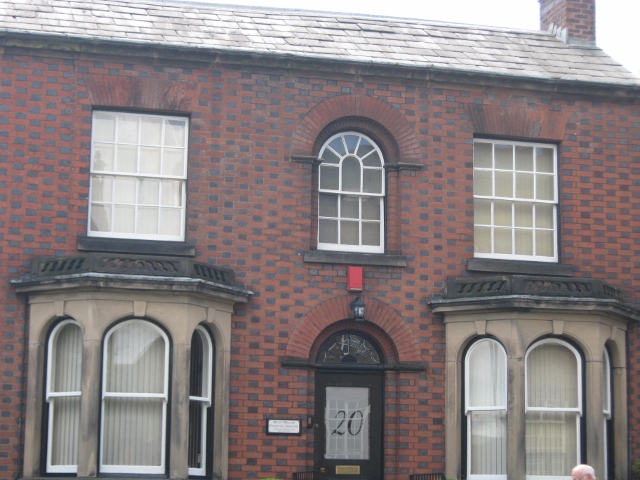
005Chequered bricks (640x480)

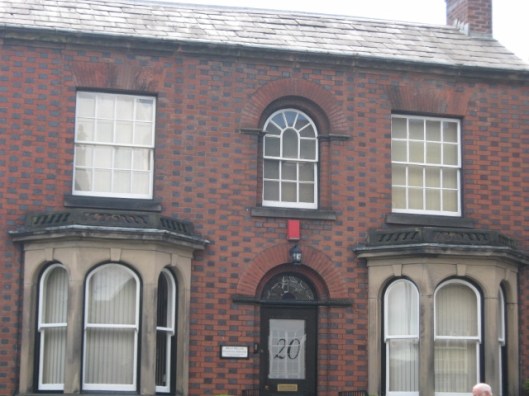
I love this house with its chequered brickwork and the arch over the door mirrored by the arch over the window above it.

004House in Leek with stained glass (2) (640x456)

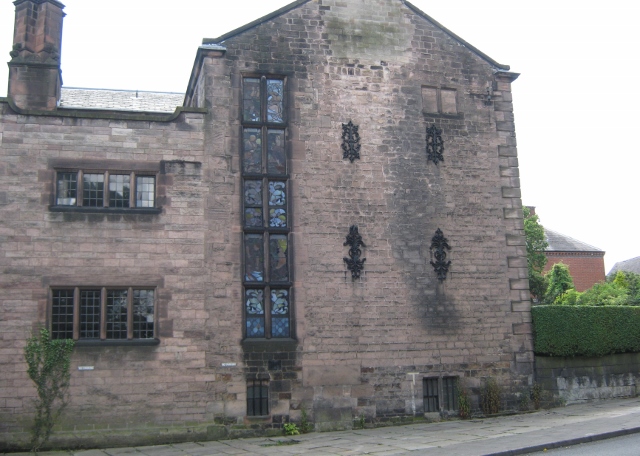
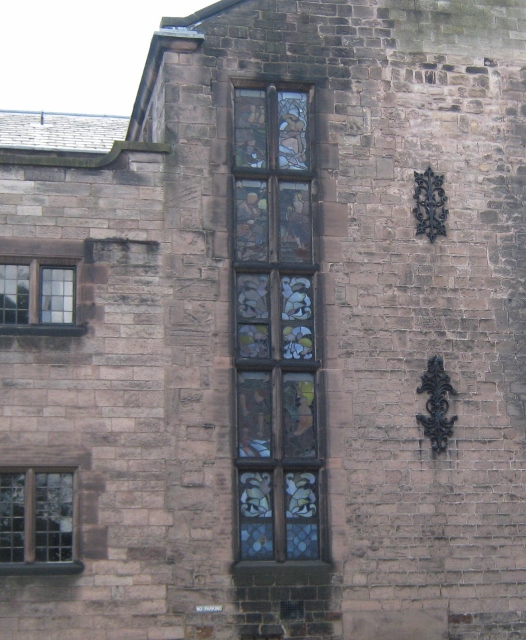
This house has a stained-glass window reaching from top to bottom.
004House in Leek with stained glass (526x640)

I wonder if this window is where the stairs are. How lovely to have jewel-coloured light shining into your home! The next time we go to Leek I must try to find out more about this house.
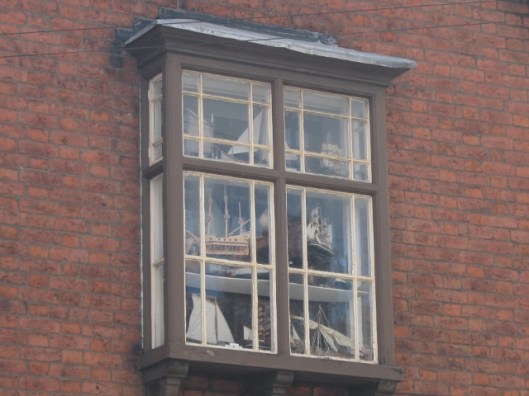
003Window with boats (640x480)

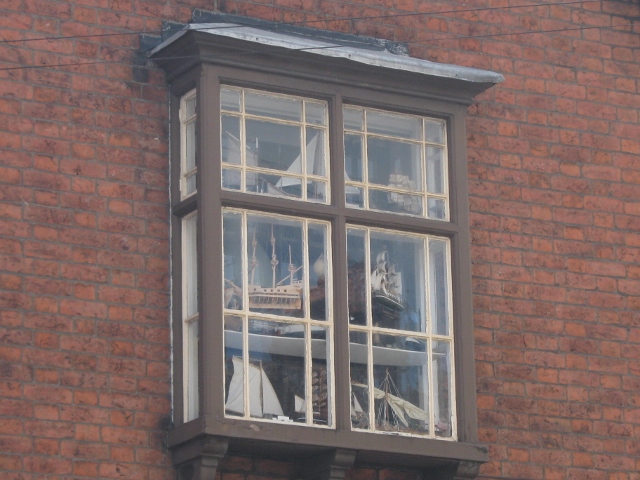
Someone has filled their bay window with model boats

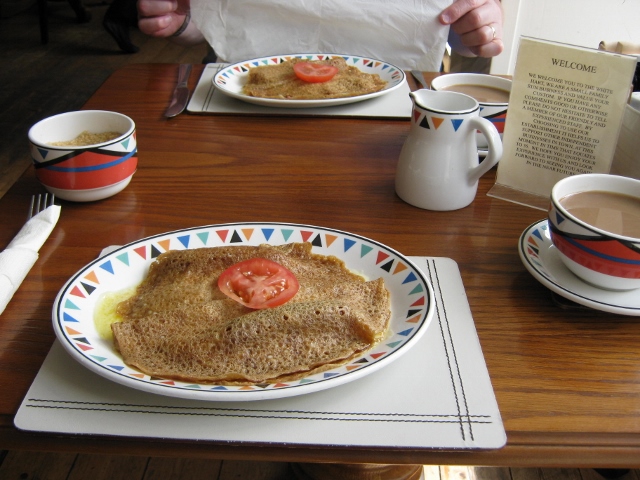
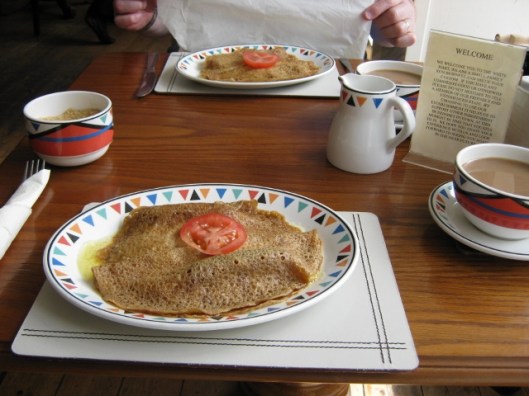
We began to feel hungry and went to the White Hart Tea Room in order that we might sample their wonderful Staffordshire oatcakes.
006Staffordshire oatcakes (640x480)

These oatcakes are made like pancakes but with oat-flour instead of wheat-flour. They are like the galettes you get in Brittany, France (which are made with buckwheat!)

Mine was filled with sausage and melted cheese and R’s had bacon and melted cheese.

Rested and refreshed, R and I continued to wander about the town.
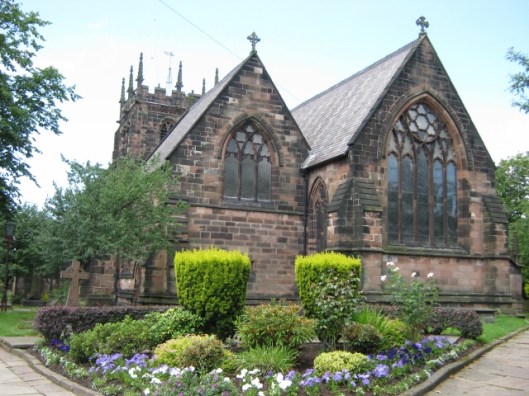
008Church of St Edward the Confessor (640x480)

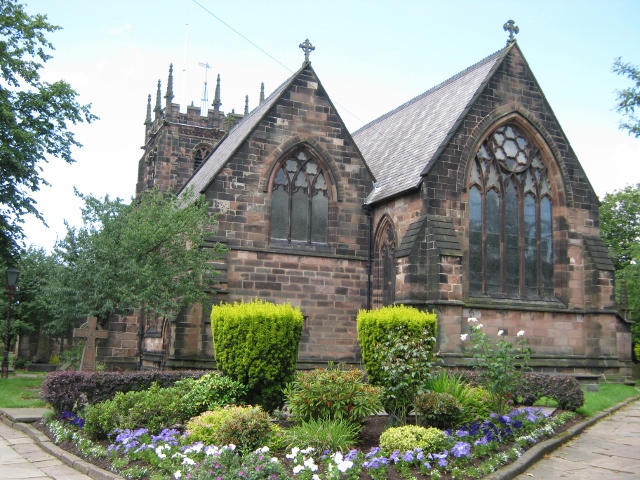
The church of St Edward the Confessor

There is an 8th Century Saxon cross in the churchyard and some of the stained glass in the church is by Morris and Co.  The church also has a wonderful collection of examples of the work of the Leek School of Embroidery that R and I were lucky enough to see a couple of years ago in an exhibition.  There were enormous altar frontals and embroidered panels as well as smaller pieces of work and all so beautifully done.  The church was extended in the 19th Century by the architect George Edmund Street.  William Morris was one of his apprentices.

Apparently, until the trees in the churchyard grew too tall, a phenomenon called a double sunset could be seen from this church at about the time of the summer solstice.  There is a hill called the Cloud and as the sun sets it can be seen above and to the side of the hill at the same time.
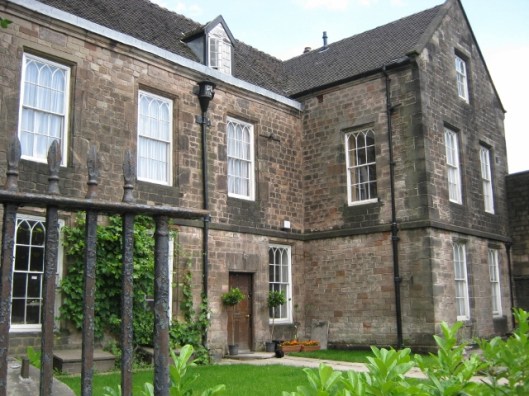
007Rectory (640x480)

The Rectory

010Spout Hall (480x640)

Spout Hall. A mock Tudor building constructed in 1873 and attributed to the architect Richard Norman Shaw. Look at the size of the chimney!  The gutters also need clearing!
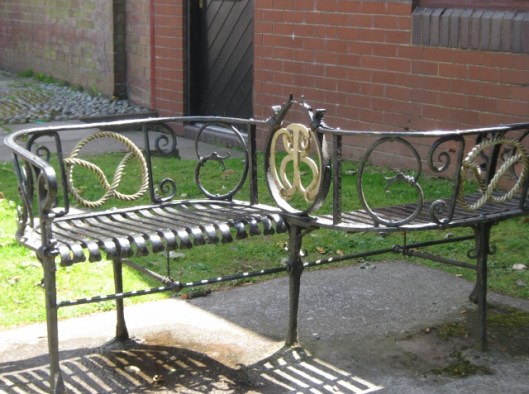
009Kissing seat (640x477)

A kissing seat decorated with the Staffordshire Knot
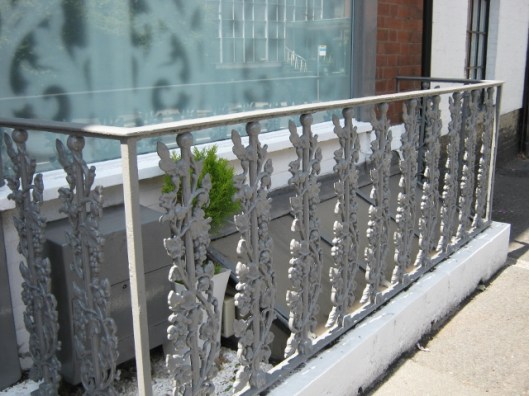
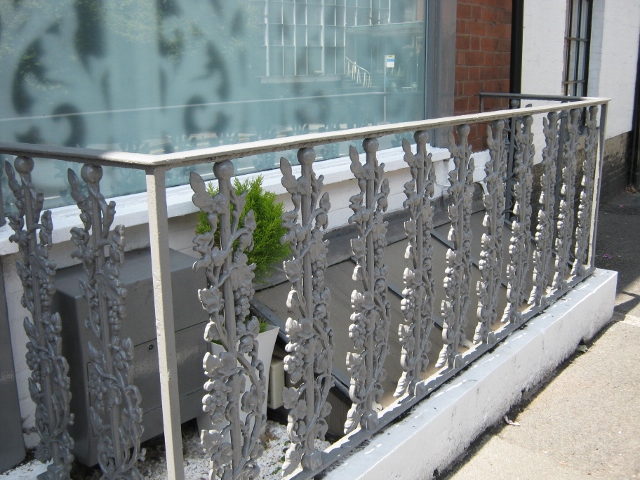
014Cast iron railing (640x480)

An attractive iron railing

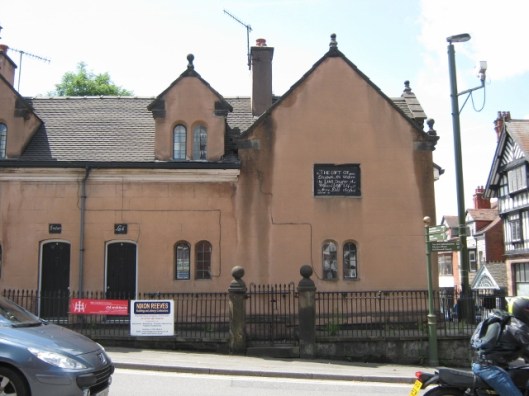
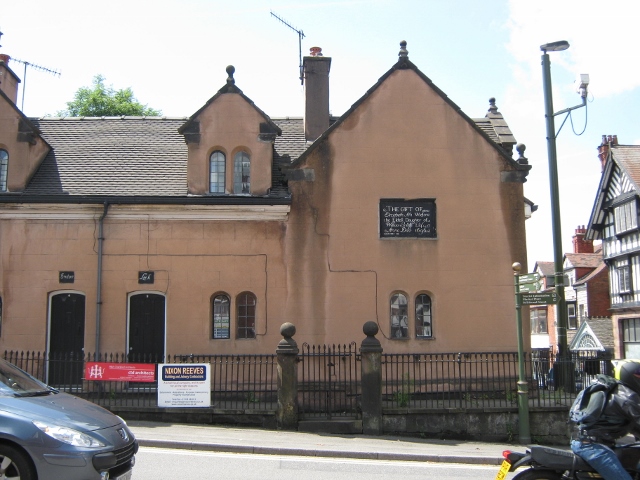
013Building as gift (640x480)

I believe these are almshouses.

The plaque on the wall states that the building was restored in 1911.  It also says ‘The gift of Elizabeth Ash widow, the eldest daughter of William Jolliffe, Esqr.  Anno Dom 1696’

I looked on the British History Online website and discovered that William Jolliffe acquired some land (part of an estate) in 1644.  When he died in 1669 the land passed to his daughter Elizabeth Ashe (the site spells her surname with an ‘e’), widow of Edward Ashe a London draper.  In 1677 she charged the land with rent to support the almshouses which she had founded at Leek.

I wonder what the tenant of the land thought about that!
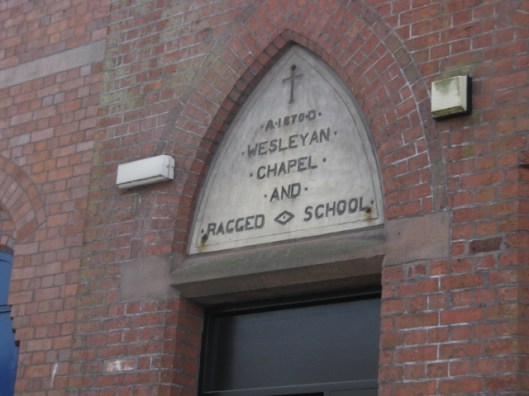
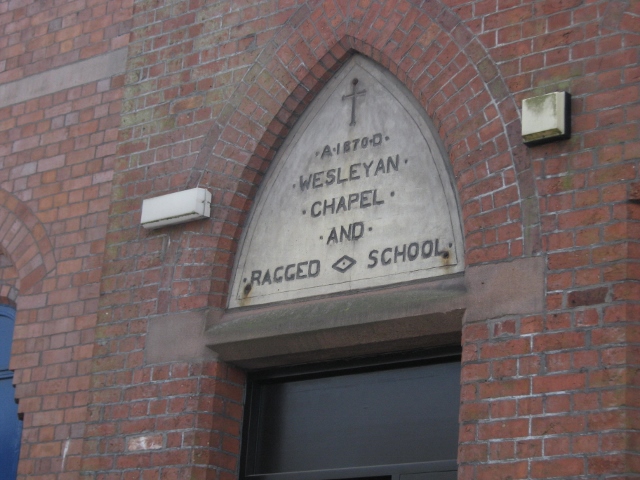
035Wesleyan Chapel and Ragged School (640x480)

As the sign over the door says, this is the Wesleyan Chapel and Ragged School.

Looking at the building it appeared to be disused and was a little worse for wear.

Ragged Schools ‘were charitable organisations dedicated to the free education of destitute children in 19th Century Britain.’  (Wikipedia)  Eventually these schools began opening at night as well to educate all comers, children and adults.  The novelist Charles Dickens began his association with Ragged Schools in 1843 when he visited one in London.  He was appalled by the conditions but wished to help them.  His experience inspired him to write ‘A Christmas Carol’.  He said, ‘They who are too ragged, wretched, filthy and forlorn to enter any other place: who could gain admission into no charity school, and who would be driven from any church door: are invited to come in here, and find some people not depraved, willing to teach them something and show them some sympathy.’

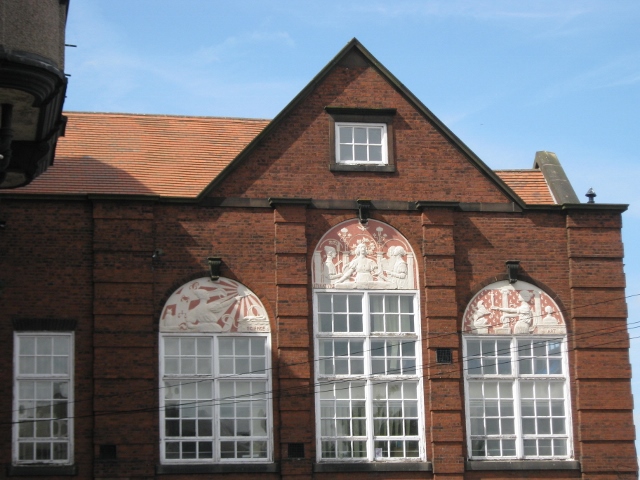
William Sugden the architect arrived in Leek in 1849 to work on the design of the Churnet Valley Railway.  His son Larner was born in 1850 and was apprenticed to his father in 1866.  Both men’s influence on the town was very great.  It was they who built the Methodist Chapel and Ragged School in 1870.  Larner’s masterpiece was the Nicholson Institute built in Queen Anne style in 1882.
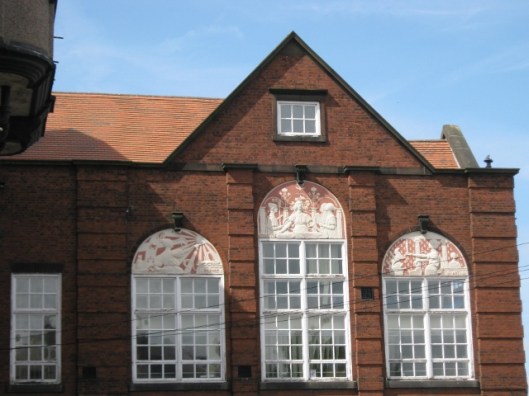
075B & L College (640x480)

This part of the building is now used by Buxton and Leek College.
078B & L College (479x640)

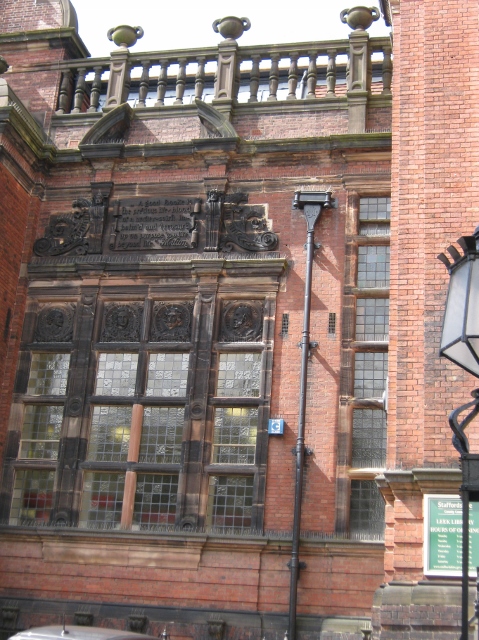
Nicholson Institute.  Now Leek Public Library and Gallery
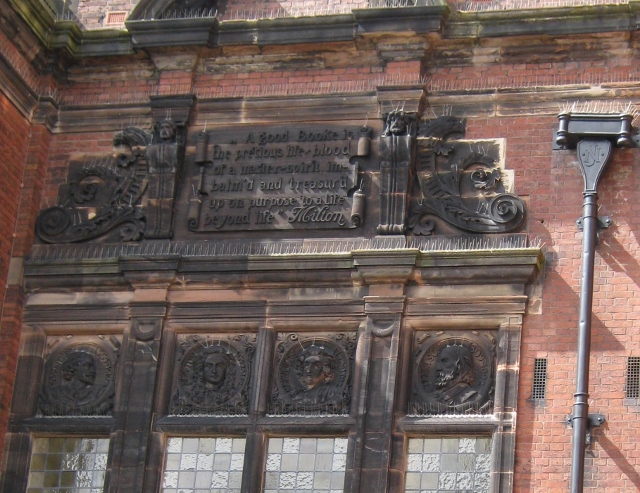
078B & L College (2) (640x493)

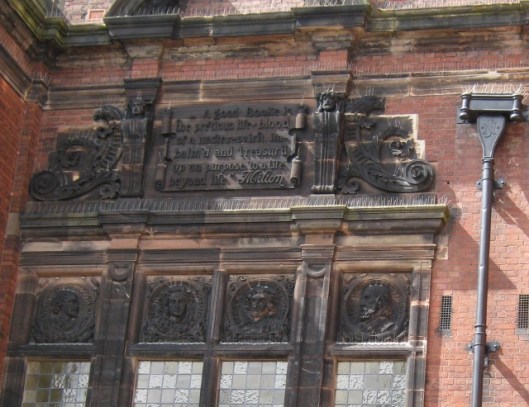
Larner incorporated busts of Shakespeare, Newton, Reynolds and Tennyson into the building, representing 400 years of artistic and scientific achievement from the 16th to 19th Centuries.

The quote from Milton says, ‘A good booke is the precious life-blood of a master-spirit imbalm’d and treasur’d up on purpose to a life beyond life.’

The Institute is tucked away behind a 17th Century building on the main road.  Any other architect of the time would have pulled the building down but apparently Larner had a real regard for old buildings and so the building was allowed to remain.
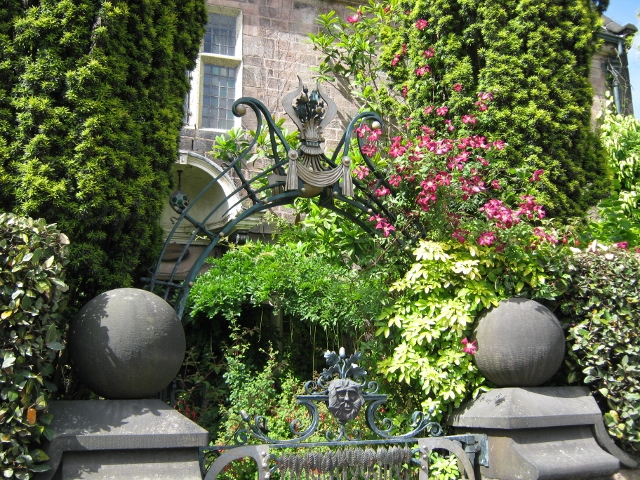
073Ornate gate (480x640)

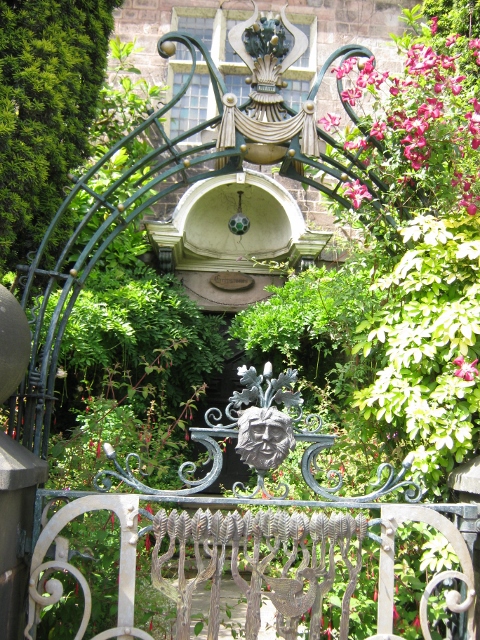
And here it is. Or at least a part of it. There were so many trees and plants in the front garden that I couldn’t see much of the house.
072Ornate gate (640x480)

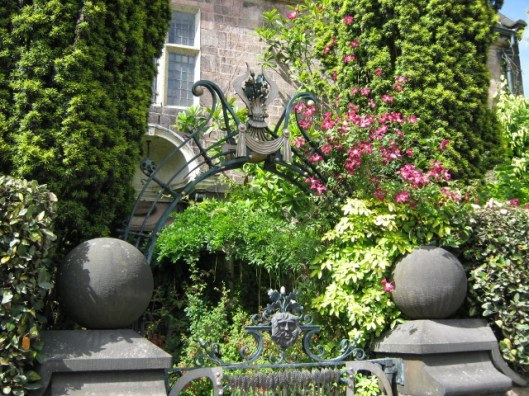
The house is called ‘Greystones’ and until recently was being used as a tea-shop.
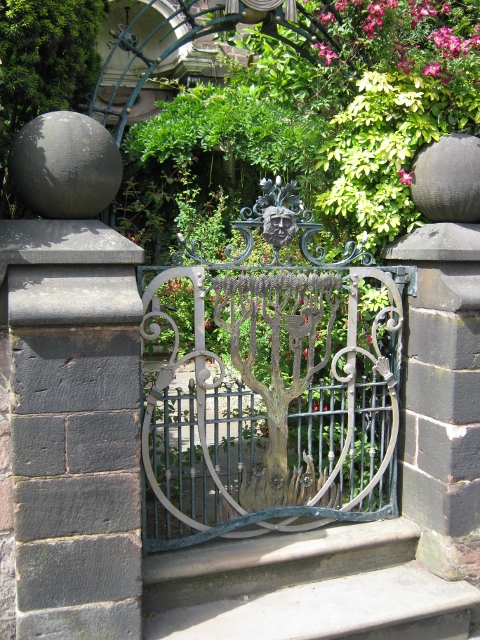
071Ornate gate 17thC house (480x640)

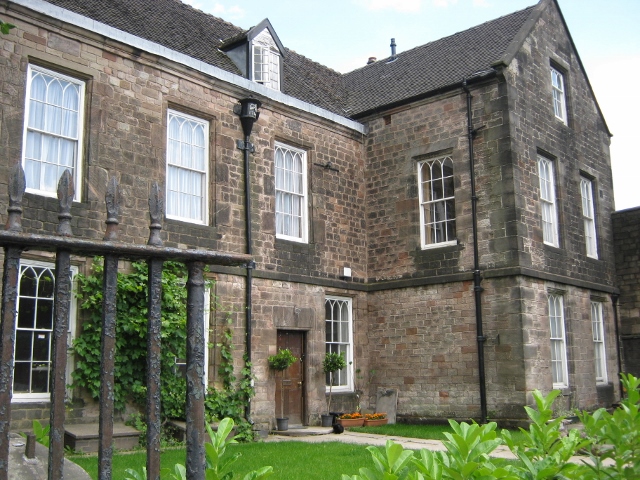
The gate is lovely!

Local rumour has it that William Morris founded the Society for the Protection of Ancient Buildings in 1877 as a result of his successful campaign to prevent the demolition of this building.  It was through the SPAB he came into contact with Larner Sugden who went on to publish some of Morris’ speeches and essays!
Share this:

  • Share on X (Opens in new window) X
  • Share on Reddit (Opens in new window) Reddit
  • Share on Pinterest (Opens in new window) Pinterest
  • Share on Facebook (Opens in new window) Facebook
  • Email a link to a friend (Opens in new window) Email
  • Share on Tumblr (Opens in new window) Tumblr
  • Print (Opens in new window) Print
  • Share on Pocket (Opens in new window) Pocket
  • Share on LinkedIn (Opens in new window) LinkedIn
Like Loading...

A Walk Across the Fields.

29 Sat Mar 2014

Posted by Clare Pooley in churches, Gardening, Rural Diary, walking

≈ 2 Comments

Tags

All Saints church, bird scarer, gargoyle, gravestones, rookery, round towers, stained glass, verges, wood carving

Last Sunday afternoon R and I decided to go for a short walk across the fields and take in All Saints Church on the way.  All Saints was a member of our benefice until the 1970s when it was deemed redundant and is now looked after by The Churches Conservation Trust which is a charity which helps to protect historic churches at risk.  The churches remain consecrated but no longer have regular worship in them.  I think we have a couple of services a year in this church, notably a Songs of Praise service in midsummer in which we sing a lot of favourite hymns or perhaps a collection of hymns with a common theme.  If people wish to hold a funeral there for example, special permission has to be sought before it can take place.  Many locals were upset when the church was closed and some would love it if it were in use again.  This would not be practicable unfortunately.  Our poor Rector has eleven churches to look after virtually on his own as it is, and bringing All Saints back into the benefice would not be a viable proposition.

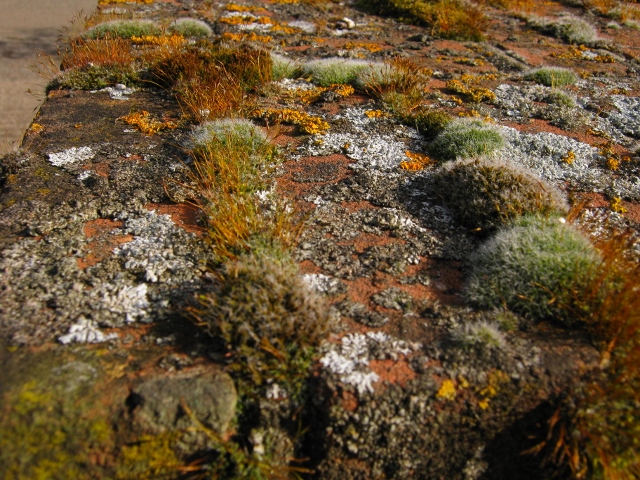
The lichen and moss on top of our gate post.

001Lichen & moss on top of gate post (640x480)


The view of our garden from the gate,

002View of garden from gate (640x480)


and the view from the gate of the verge on the other side of the hedge.  This is common land but we try to keep it as tidy as we can.  Looking at the blackthorn suckers round the telegraph pole we really ought to do something about those quite soon.

014Verge, common land (640x480)


We walked a little way down our lane and saw the church across a field of oil-seed rape.

004All Saints church (640x480)


We turned down another little lane off ours and noted someone mowing their verge.  Some people make their verges so neat and tidy they look like little lawns, with not a weed in sight.  They must get very disappointed when a tractor drives all over it.  We don’t mow our verge mainly because it is such a large area and also because the ground is so uneven and slopes down to our deep ditch.  R strims it every now and then and we try to keep the tree seedlings to a minimum.

We then walked through a yard and then through a gate into a field with a footpath at the side.

The view across the fields from the path.

005View across fields from path (640x480)


Our rookery at St, Nicholas.

006St Nicholas rookery (640x480)


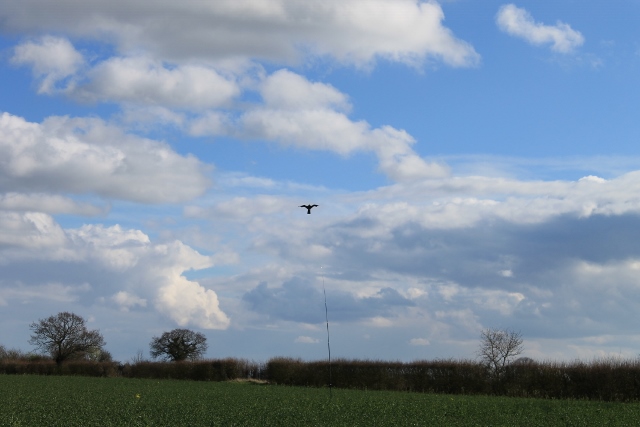
The strange looking bird to the left of the photo isn’t a bird but a bird-scarer kite.

046Birdscarer kite (640x427)


A couple of cloud photos.


009Clouds (640x480)

010Clouds (640x480)

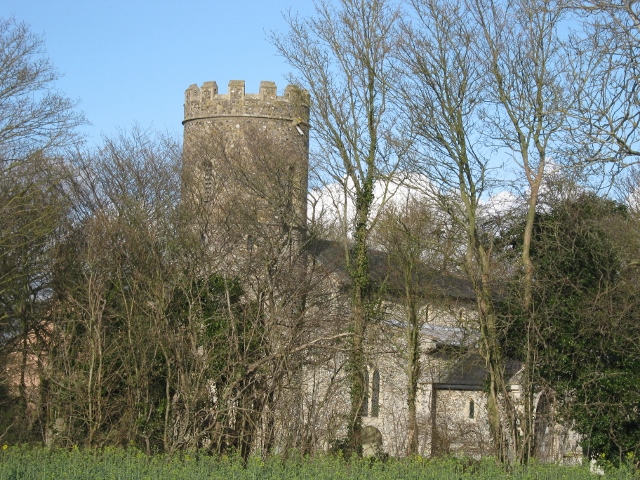
All Saints church.

012All Saints church (640x480)


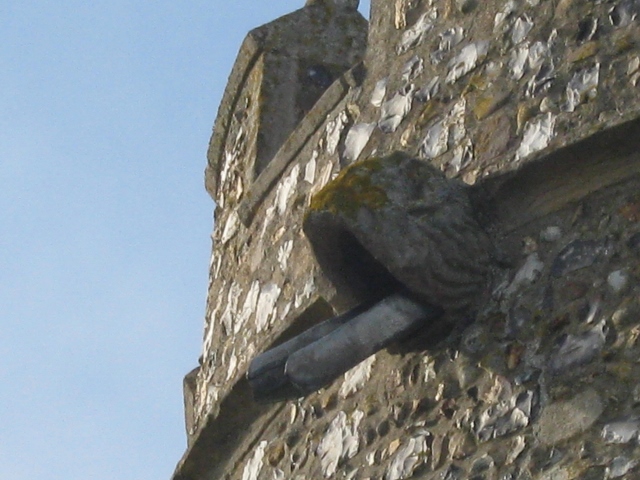
A gargoyle waterspout.  This one looks like a lion.

016Gargoyle waterspout (640x480)


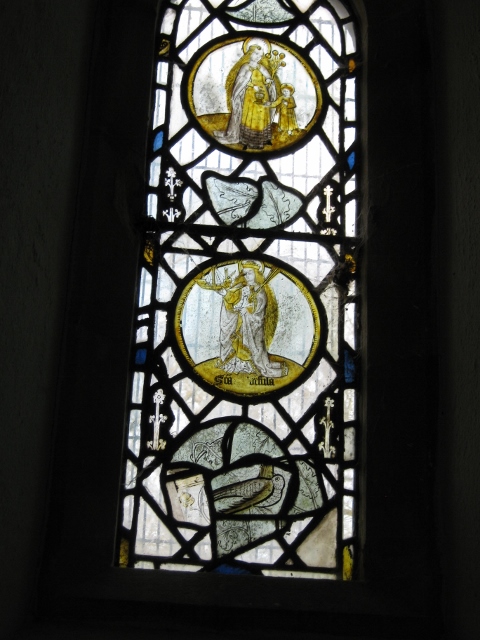
A stained glass window.  Holes in the window have been patched with fragments of other stained glass.

017Stained glass (480x640)


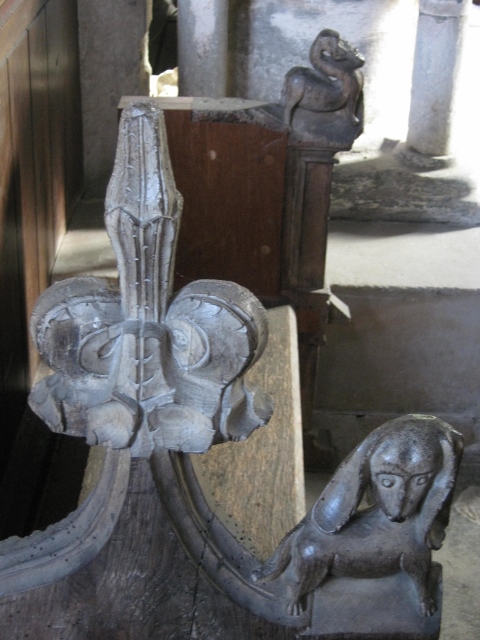
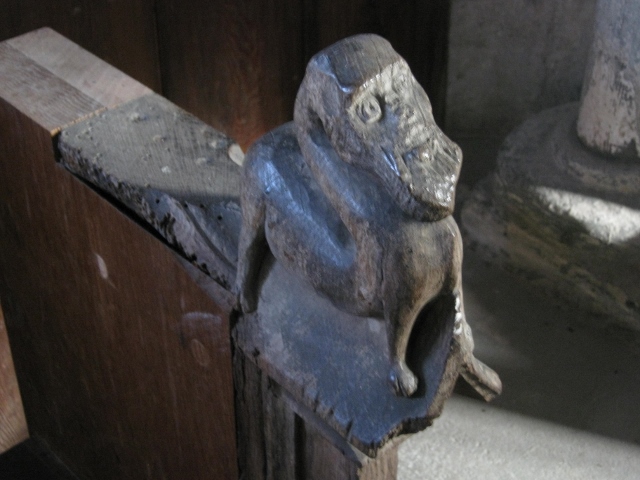
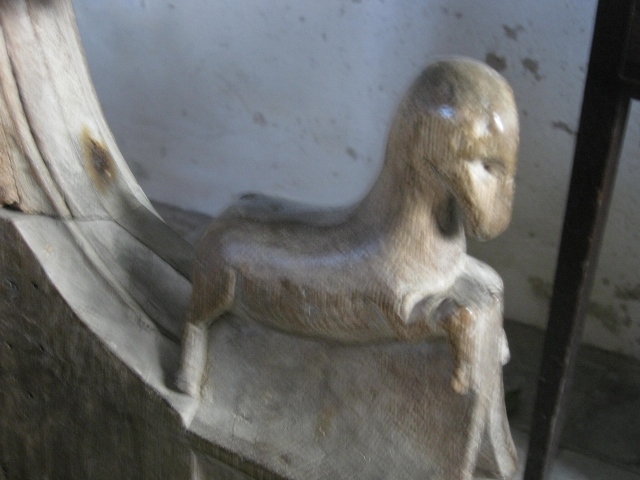
Carved bench ends.  I’m afraid the third one is very blurred but I had to include it as it is the only one I have of the horse.

018Bench ends (480x640)

019Bench end (640x480)

020Blurred bench end (640x480)

021Bench end (640x480)


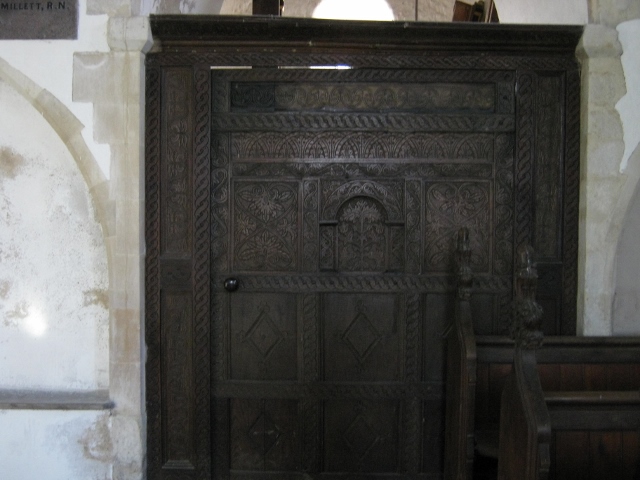
A beautifully carved door.

022Carved wooden door (640x480)


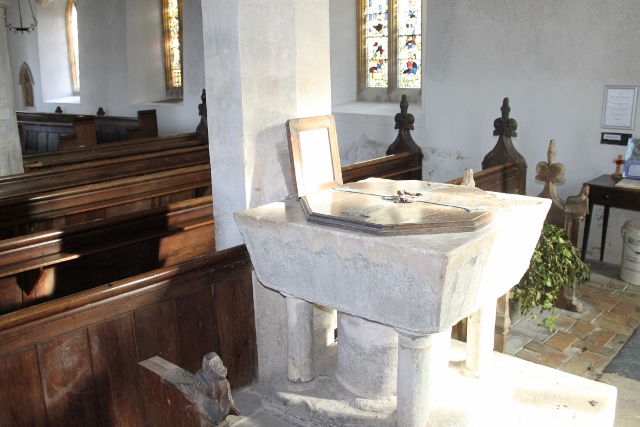
The font.

059Font (640x427)


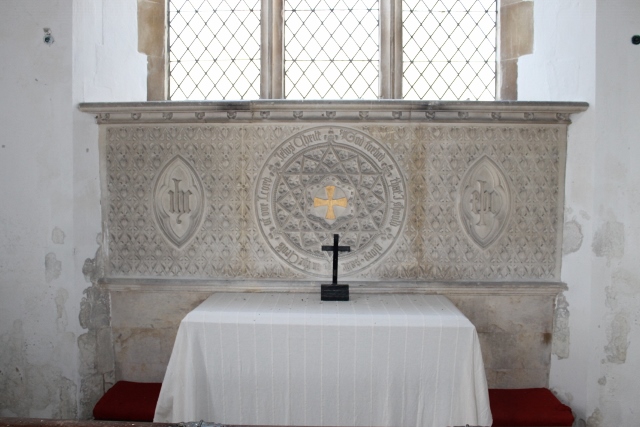
The altar.

060Altar (640x427)


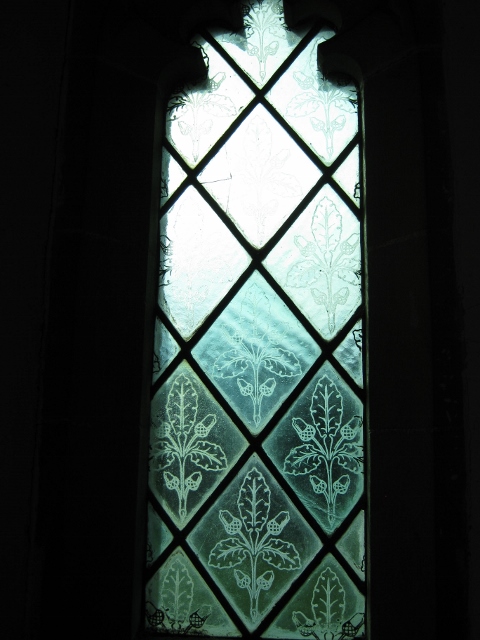
Etched glass in the porch.

023Etched glass (480x640)


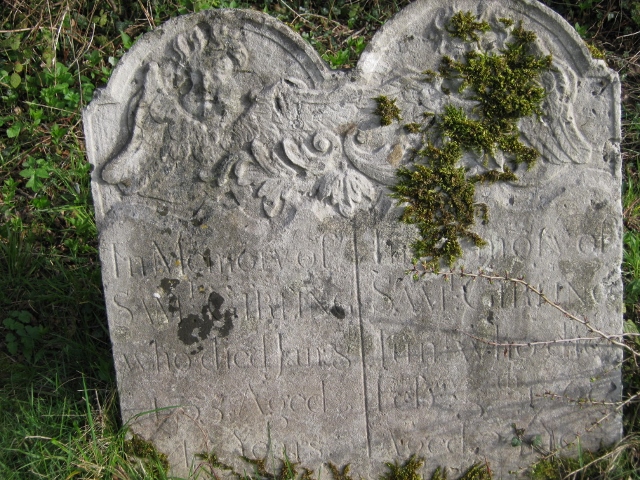
A gravestone with a very worn death’s head at the top left.

024Grave stone (640x480)


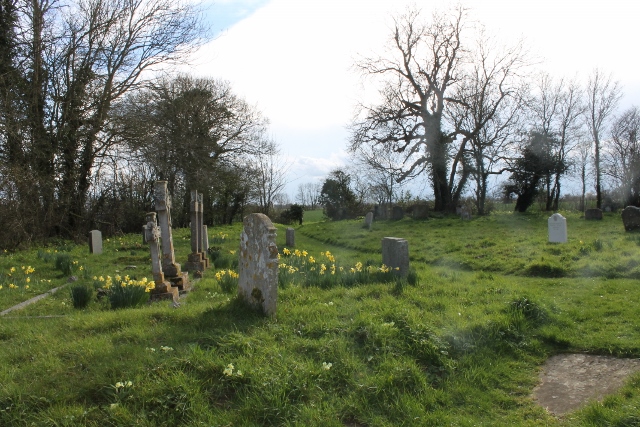
A view of the graveyard from a comfortable bench in the sun.

063Churchyard (640x427)


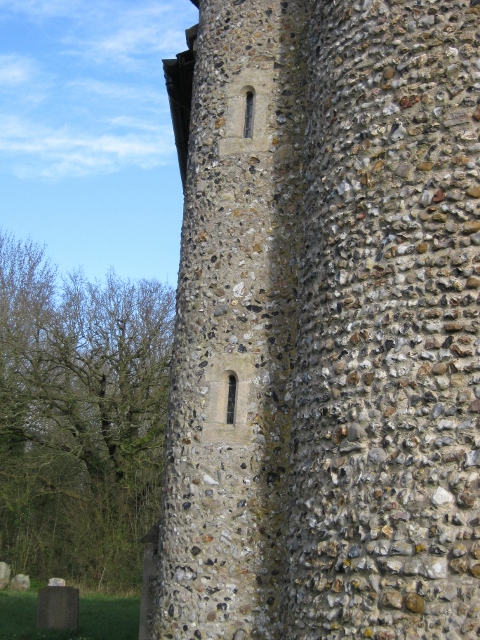
Tiny lancet windows in the tower.  Round towers are usually Saxon towers and East Anglia has more round towers than any other part of the country.

025Lancet windows (480x640)


We then had a chat with friends who live in a farm house next to the church and who keep the church tidy and clean.

We had a lovely day today (29th March) and I was able to spend a little time in the garden this afternoon.  I won’t have time tomorrow as we have church, then I will be cooking lunch for us and my mother and then spending time with her during the afternoon.

Share this:

  • Share on X (Opens in new window) X
  • Share on Reddit (Opens in new window) Reddit
  • Share on Pinterest (Opens in new window) Pinterest
  • Share on Facebook (Opens in new window) Facebook
  • Email a link to a friend (Opens in new window) Email
  • Share on Tumblr (Opens in new window) Tumblr
  • Print (Opens in new window) Print
  • Share on Pocket (Opens in new window) Pocket
  • Share on LinkedIn (Opens in new window) LinkedIn
Like Loading...
Follow A Suffolk Lane on WordPress.com

Enter your email address to follow this blog and receive notifications of new posts by email.

Join 715 other subscribers.

Unknown's avatar

I talk about what it's like living in a quiet part of Suffolk. I am a wife, mother and daughter, a practising Christian and love the natural world that surrounds me. I enjoy my life - most of the time!
My Posts

Jan 2026
M T W T F S S
 1234
567891011
12131415161718
19202122232425
262728293031  
« Dec    

Pages

  • About my Blog
  • GDPR (General Data Protection Regulations) and This Site
  • My Life in a Suffolk Lane

Archives

Blogs I Follow

Unknown's avatar
Unknown's avatar
Unknown's avatar
Unknown's avatar
Unknown's avatar
Unknown's avatar
Unknown's avatar
Unknown's avatar
Unknown's avatar
Unknown's avatar
Unknown's avatar
Unknown's avatar
Unknown's avatar
Unknown's avatar
Unknown's avatar
Unknown's avatar
Unknown's avatar
Unknown's avatar
Unknown's avatar

Posts I Like

  • Unknown's avatar
  • Unknown's avatar
  • santable's avatar
  • Unknown's avatar
  • Unknown's avatar
  • Maikhel's avatar
  • Unknown's avatar
  • M T McGuire's avatar
  • Pilgrim's Pondering Ministry's avatar
  • Unknown's avatar
  • Unknown's avatar
  • Unknown's avatar
  • Unknown's avatar
  • trulymebeingme's avatar
  • thesimlux's avatar
  • Unknown's avatar
  • The Introverted Bookworm's avatar
  • Talkmore's avatar
  • Unknown's avatar
  • Unknown's avatar
  • Unknown's avatar
  • sherijkennedyriverside's avatar
  • Unknown's avatar
  • Unknown's avatar
  • Luso Loonie — Devin Meireles's avatar
  • Ari's avatar
  • Unknown's avatar
  • Unknown's avatar
  • Unknown's avatar
  • Unknown's avatar
  • Bernard Aybout (Virii8)'s avatar
  • Unknown's avatar
  • womanseyeview's avatar
  • Unknown's avatar
  • Mélodie's avatar
  • Unknown's avatar
  • Schnippelboy's avatar
  • Wayne Wolfson's avatar
  • Unknown's avatar
  • Unknown's avatar
  • Unknown's avatar
  • John’s Postcards's avatar
  • Dad's avatar
  • Jack Ronald Cotner's avatar
  • Unknown's avatar
  • Unknown's avatar
  • Unknown's avatar
  • Unknown's avatar
  • JAM's avatar
  • gederedita's avatar

amphibians architecture art Arts and Crafts churches cooking Days out domestic animals family fish Folk Traditions Gardening Historic Buildings holidays Insects Landscaping literature music Norwich plants Rural Diary seashore theatre trees Uncategorized walking weather wild animals wild birds wild flowers

Tags

architecture autumn birds blackbird blackthorn Bungay butterfly church clouds common knapweed cow parsley crocus daffodils Diary dogwood family field maple flowers fungus garden gardening geese greylags ground-ivy Halesworth Hawthorn heather holiday Holly Holy Week horse chestnut Hoverfly insects ivy Lake District Lent lesser celandine lichen Lords and Ladies Mallard mallards Minsmere moorhen moss music Norwich Peak District pheasant plants pond ponds primrose primroses Rain rooks Rumburgh Rumburgh Church sheep Sheffield snow snowdrops Southwold spring Suffolk Suffolk Wildlife Trust sunset the Beck trees viburnum bodnantense walking weather wild cherry wild flowers winter-flowering honeysuckle witch-hazel

Meta

  • Create account
  • Log in
  • Entries feed
  • Comments feed
  • WordPress.com

Goodreads

Blog at WordPress.com.

Book Jotter

Reviews, news, features and all things books for passionate readers

Country Life Blog -

A blog about life in the country in the past and present

Matthew Paul: Poetry & Stuff

Poetry and what-not

Schnippelboy

Ein Tagebuch unserer Alltagsküche-Leicht zum Nachkochen

TAMARA JARE

TAMARA JARE Tamara Jare: Contemporary Figurative Painting Oil on Canvas Artist Art Studio

A Taste of Freedom

Documenting a Dream

Country Ways

Rambling Journeys in Britain, Countryside Matters and campaigning for the Right to Roam

The Strawberry Post

Here to Entertain, Educate & Inspire!
a north east ohio garden

an ongoing experiment in the dirt, 35 plus years

naturechirp

Celebrating God's creatures, birds and plants...

Sophie Neville

Writer

Going Batty in Wales

Developing a more sustainable lifestyle in SW Wales

Our Lake District Escapades

Exploring the Lake District and beyond

Short Walks Long Paths

Wandering trails around the coast of Wales

The Biking Gardener

An English persons experience of living and gardening in Ireland

Nan's Farm

A Journal Of Everyday Life

Walk the Old Ways

Rambling Journeys in Britain with John Bainbridge. Fighting for the Right to Roam. Campaigning to Protect Our Countryside.

Writer Side UP!

Waking the Writer Side...and keeping it "Up!"

Meggie's Adventures

Travel, thank you notes and other stories

amusicalifeonplanetearth

Music and the Thoughts It Can Inspire

lovefoundation.co.uk

Traveling Tortuga

Simply Living Well

Pakenham Water Mill

Historic watermill in the beautiful Suffolk countryside

Take It Easy

Retired, not expired: words from the after(work)life. And music. Lots of music!

Secret Diary Of A Country Vicar's Wife

By Olive Oyl

thanksfortheadventureorg.wordpress.com/

The Beat Goes On

#TBGO

Frank Pleszak's Blogs

Twitter: @frankpleszak @PolishIICorps

John Bainbridge Writer

Indie Writer and Publisher

roughwighting

Life in a flash - a bi-weekly storytelling blog

Walking the Old Ways

Rambling in the British Countryside

CapKane

thoughts on social realities

SkyeEnt

Jottings from Skye

jodie richelle

embracing my inner homemaker

Skizzenbuch/Blog

Just another WordPress.com weblog

Have Bag, Will Travel

The Call of the Pen

Flash Fiction, Book Reviews, Devotionals and other things.

John's Postcards

Art in Nature

You dream, I photographe it !

Smile! You’re in Barnier World......

theinfill

the things that come to hand

Dr. Mary Ann Niemczura

Author of "A Past Worth Telling"

Provincial Woman

The Pink Wheelbarrow

Luanne Castle: Poetry and Other Words (and cats!)

Poetry, Other Words, and Cats

The Family Kalamazoo

A genealogical site devoted to the history of the DeKorn and Zuidweg families of Kalamazoo and the Mulder family of Caledonia

everythingchild

The Book Owl

Canberra's Green Spaces

Paul Harley Photographer

  • Subscribe Subscribed
    • A Suffolk Lane
    • Join 715 other subscribers.
    • Already have a WordPress.com account? Log in now.
    • A Suffolk Lane
    • Subscribe Subscribed
    • Sign up
    • Log in
    • Report this content
    • View site in Reader
    • Manage subscriptions
    • Collapse this bar
 

Loading Comments...
 

    Privacy & Cookies: This site uses cookies. By continuing to use this website, you agree to their use.
    To find out more, including how to control cookies, see here: Cookie Policy
    %d