For our wedding in 1994 we were given a gift of place mats and coasters by one of Richard’s friends. The mats were decorated with paintings of Lake District attractions – Beatrix Potter’s cottage, The Bridge House at Ambleside and so on. One of the pictures was a really attractive painting of Ashness Bridge, and for some time we had no idea where it could be found. Before we left home we decided that as we were staying near Derwentwater, we ought to include it on one of our trips.
The day was bright and sunny and as it was St Swithin’s Day we hoped it would stay dry. We thought we would take the ferry round Derwentwater from Keswick to Ashness Gate, the stop nearest to Ashness Bridge and then walk up to the bridge.
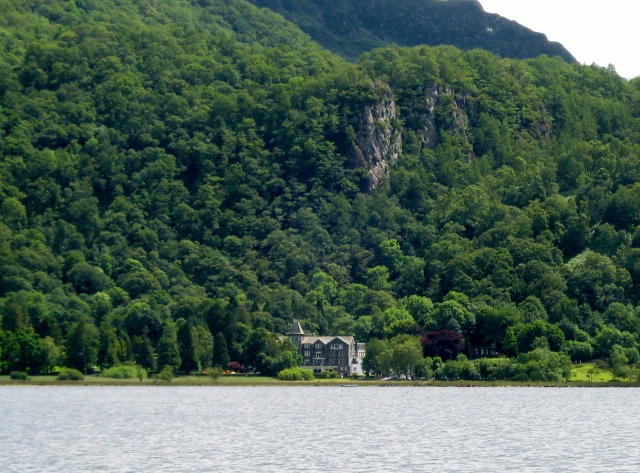
The views of the surrounding hills look wonderful from the boat
The woodlands here are mainly of oak. These ‘Atlantic Oakwoods’ are an example of temperate rainforest.
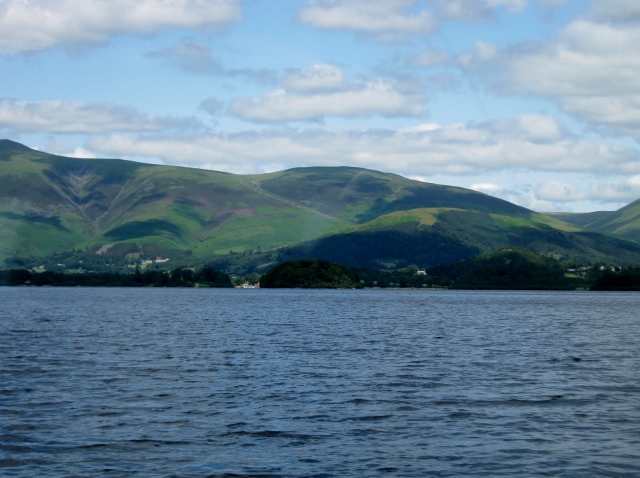
I love looking at cloud shadows sliding over the hills
The ferry was crowded with walkers and other tourists like us, so it wasn’t too easy to take photos.
We got off the boat and began the steep walk up the lane to the bridge. I saw a shrew running about at the side of the road and tried to take its picture but it wouldn’t show its face with the long snout.
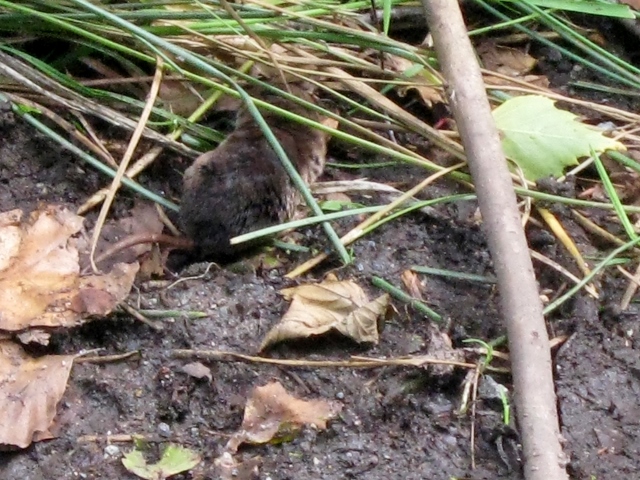
Shy shrew
I saw a few wildflowers by the roadside.
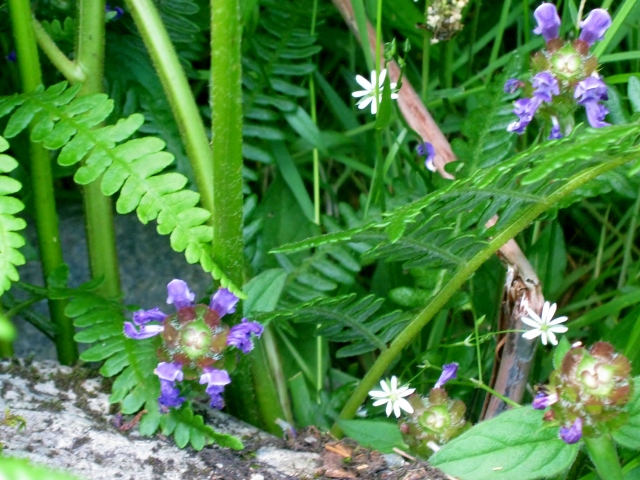
Self-heal (purple) (Prunella vulgaris) and Lesser Stitchwort (white) (Stellaria graminea) with Bracken (Pteridium aquilinum) also known as Brake Fern
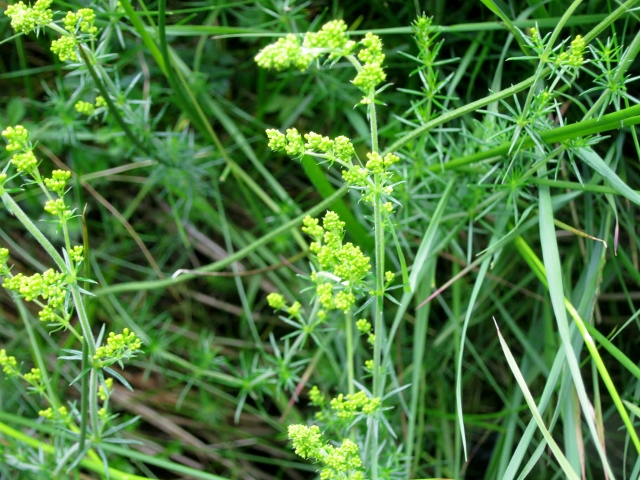
Lady’s Bedstraw (Galium verum)
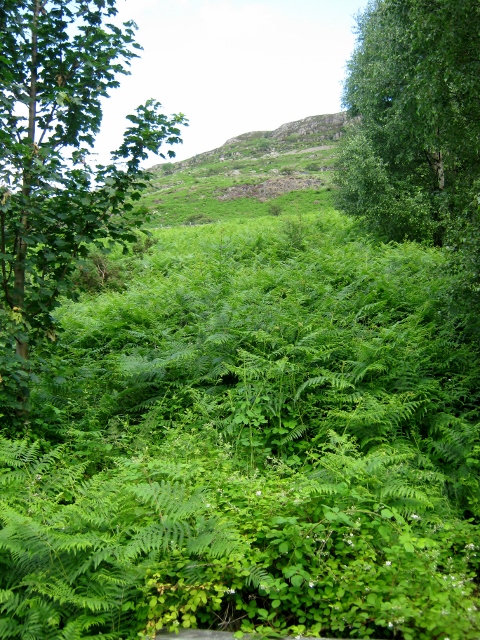
Looking up the hill from the path
After quite a long steep climb we left the road and carried on up a pathway and eventually got to the bridge. It is a very popular attraction and again, trying to get a picture of the bridge without lots of people in the way was hard.
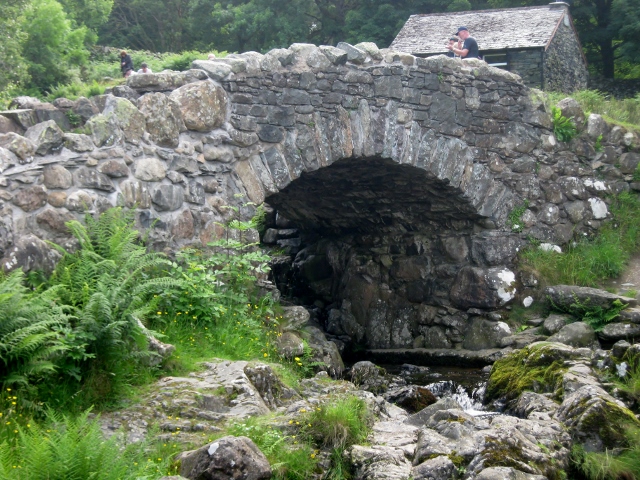
Ashness Bridge
This is an old pack-horse bridge which enables the road to cross Barrow Beck, the stream that joins Derwentwater at the foot of the hill.
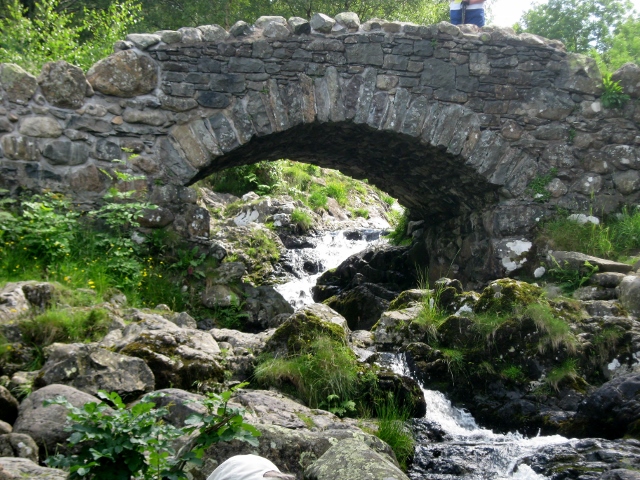
These old bridges are beautiful as well as being very useful. The skill of the bridge builder is apparent from this photo – each stone being placed so carefully, one next to the other.
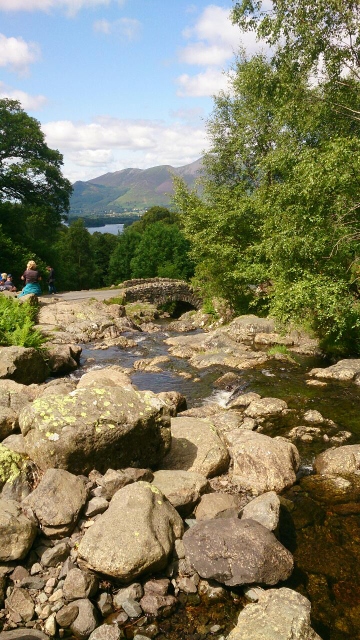
Richard took this photo from further upstream. Derwentwater can be seen in the distance
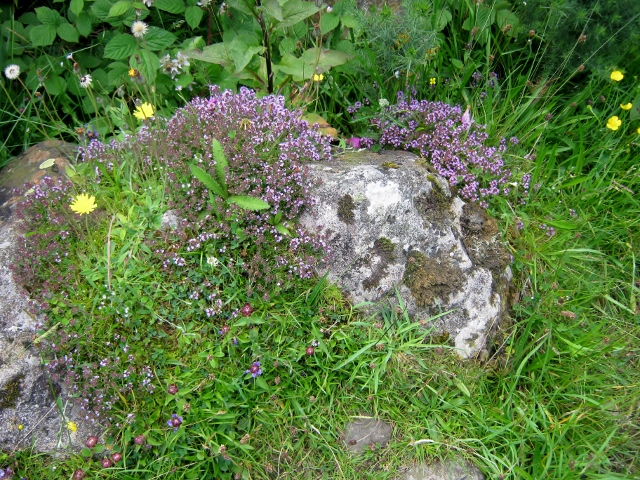
I found some Wild Thyme (Thymus serpyllum) growing by the stream
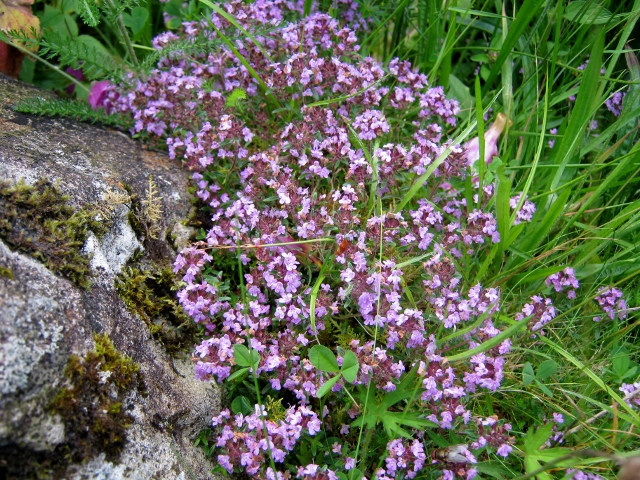
It’s scent was wonderful!
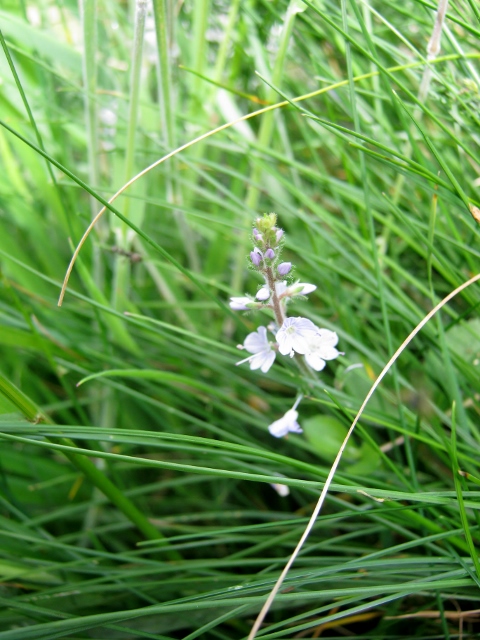
I also found some Blue Water-speedwell (Veronica anagallis-aquatica)
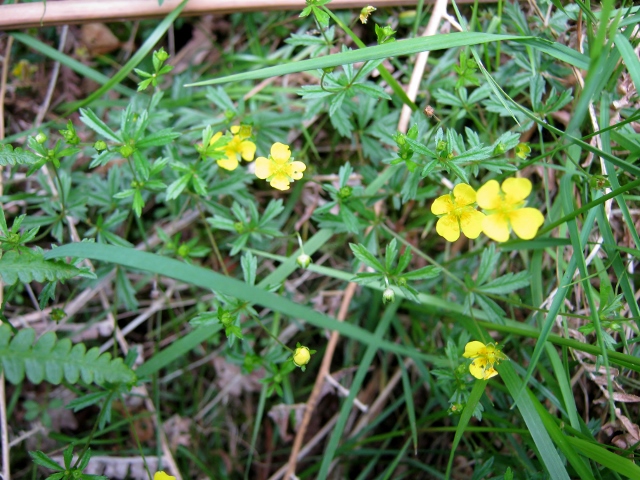
Tormentil (Potentilla erecta)
We walked back down the hill and caught the ferry back to Keswick.
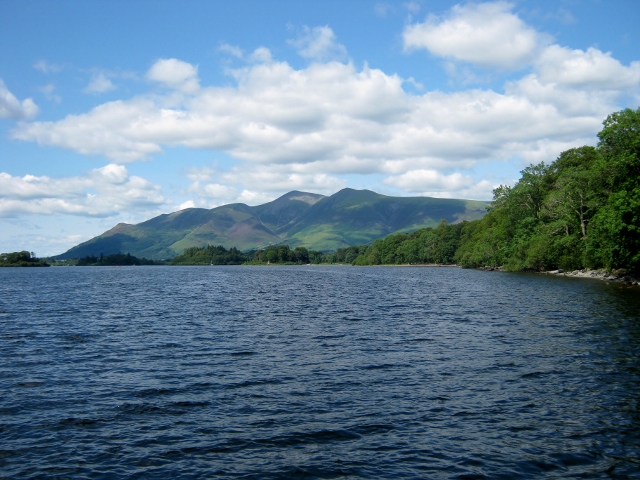
Derwentwater with Skiddaw in the background.
Thanks for visiting!
 A Suffolk Lane
Wow! These photographs are amazing, Clare! The Ashness Bridge is spectacular!
LikeLiked by 1 person
Thank-you Jill! I am so pleased you liked it.
LikeLiked by 1 person
Some lovely photos! What a wonderful part of England and looks like you really enoyed your walk – thanks for sharing.
LikeLiked by 1 person
Thank-you! It is a lovely area even in the frequent bad weather!
LikeLiked by 1 person
I really have to admire the skills of the stone masons that built that bridge, they took pride in their work and built things to last. The views of the surrounding countryside were spectacular! I had no idea that there were areas that rugged in England. I also loved the wildflowers, they added a nice touch to this post.
LikeLiked by 1 person
Thank-you so much! The bridges have lasted a very long time and most are still used regularly though some have had to be strengthened quite a bit. England does have quite a bit of rugged country but it isn’t as well known as the more gentle scenery.
LikeLike
That bridge was worth the trip. What a masonry work it is, and what a beautiful place.
LikeLiked by 1 person
Thank-you Aggie, I’m glad you liked it.
LikeLiked by 1 person
The bridge is a work of art and I really enjoyed the wild flowers, especially the self heal. Thanks
LikeLiked by 1 person
My pleasure! Stone bridges like the one at Ashness can still be found all over Britain and I am always pleased when I find one.
LikeLike
I think this is the first time I have seen large areas of thick forest in a UK blog. Oak forests…sounds beautiful. I am a big fan of your lovely stone bridges. I’m commented on Tom’s blog before that I’ve never seen anything like them here. I also enjoy watching the shadows of clouds move across the hills. They really change the way a picture can look. We don’t have shrews here but we do have similar kinds of small mammals and marsupials. Most of the time they are too quick for me or I can only capture their bottom ends. They are not very kind to photographers. 🙂
I also admire the lovely wildflowers you have there. I don’t see such clusters here very often although the outback can be carpeted in them after good rains. Lovely pictures and interesting information, Clare. I do enjoy your posts! 🙂
LikeLiked by 1 person
Thank-you very much, Jane! Sadly, there aren’t many large areas of forest left in Britain and what forest is left is in danger of disappearing altogether unless we aren’t very careful. The stone bridges are in less danger and we still have plenty of them all over the country I’m glad to say. I think rain is the key to the amount of flowers we see and the Lake District has lots of it!
LikeLiked by 1 person
It’s always nice to follow along with you on your outings 🙂 thank you for sharing!
LikeLiked by 1 person
Thank-you too!
LikeLiked by 1 person
That house really shows the immense scale of the hills! I wonder what it’s like living under those shear rock faces.
The bridge is beautiful. I don’t blame you for wanting to see it. I’ve done a lot of stonework but I can’t imagine building something like that. They were skillful, talented people.
I’ve never heard of the water speedwell. I’ll have to keep an eye out for it.
LikeLiked by 1 person
Thank-you Allen. It was the first time I had seen the speedwell too. It was obviously a speedwell so I knew where to start looking.
I’m not sure that I would like to live in that house, though it has been there for many years with no harm done so far. I have seen houses built in similar positions in the Alps with a lot more mountain up above.
There are many pack-horse bridges remaining all over Britain which proves how well made they were originally. Most of them were built in the Middle Ages when the only way goods could be transported across country was by pack-horse. Many of them have been strengthened to allow cars to drive over them.
LikeLiked by 1 person
Well worth the uphill work to visit such an elegant bridge. I liked your last picture of Derwentwater as well.
LikeLiked by 1 person
Thank-you. We were pleased we made the effort.
LikeLiked by 1 person
Such a different landscape from our own dear Suffolk!
LikeLiked by 1 person
It certainly is!
LikeLike
Amazing photos of a beautiful place!! The world can be so wonderful!! xo Johanna
LikeLiked by 1 person
Yes it can! Thank-you Johanna!
LikeLike
Had not heard of St. Swithin’s Day. Always something new for me to learn here! Beautiful photos and countryside. Love the little shy shrew!
LikeLiked by 1 person
Thank-you Lavinia. I find photographing little rodents really difficult. I thought I’d have more luck with a shrew as they are usually quite brave little creatures, but no!
LikeLike
I love that bridge. A thing of beauty, and for you and Richard, it sounds like a special adventure. Have you ever built a stone wall, Clare? It’s almost a mystical experience: finding the rocks, then placing them just so. I never realized how beautiful and interesting rocks can be till I collected nearly 700 for the stone wall in front of our house in the country.
LikeLiked by 1 person
My goodness Cynthia; you always amaze me with the things you’ve done. I haven’t built a wall before – I’m not at all sure I’d be any good at it!
LikeLiked by 1 person
I had never built one before either, but since it was to be a dry-stack wall, I knew I had to choose great rocks and place them very wisely. It was a beautiful wall.
LikeLiked by 1 person
I can imagine you found great peace while building it.
LikeLiked by 1 person
Fabulous pictures, great to see a photo of a shrew. You must have lightning reactions to have taken an action shot of him running along the ground! 🙂 x
LikeLiked by 1 person
Thanks Becky! I don’t know about lightning reactions! The shrew was very busy but not really bothered about us looking at him so I had plenty of time to take photographs. He just wouldn’t look at me – and no profile either! 😀
LikeLiked by 1 person
I’m sure you’ll get a portrait next time! 😉 x
LikeLiked by 1 person
😀 xx
LikeLike