Tags
churches in Norwich, Norwich, St John Maddermarket, St John the Baptist, The Churches Conservation Trust
This is one of my occasional posts about Norwich.
Last summer, as I wandered about in Norwich while Elinor was at college, I saw that the church of St John Maddermarket was open and so took the opportunity to look inside.
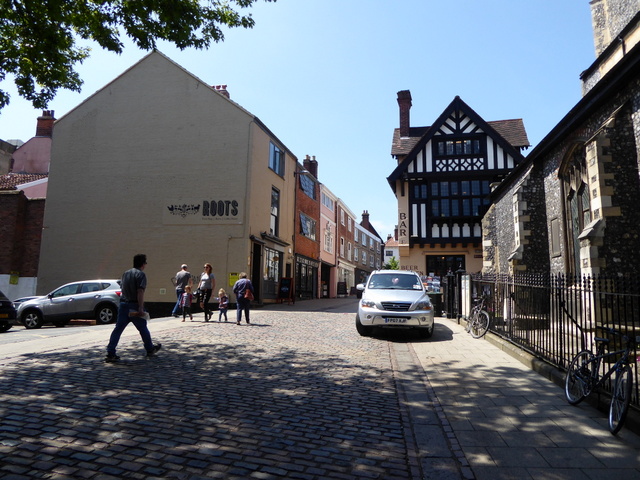
This lane is Pottergate and the church of St John Maddermarket is on the right of the photo. The black and white building next to the church is The Belgian Monk pub
St John Maddermarket, dedicated to St John the Baptist, closed for Anglican worship on 31st December 1981 and for the following eight years was used by the Greek Orthodox Church. It is now cared for by The Churches’ Conservation Trust. Madder flowers were used to make red dye for the flourishing cloth industry in medieval Norwich but there is no evidence to prove that there ever was a maddermarket in the city.
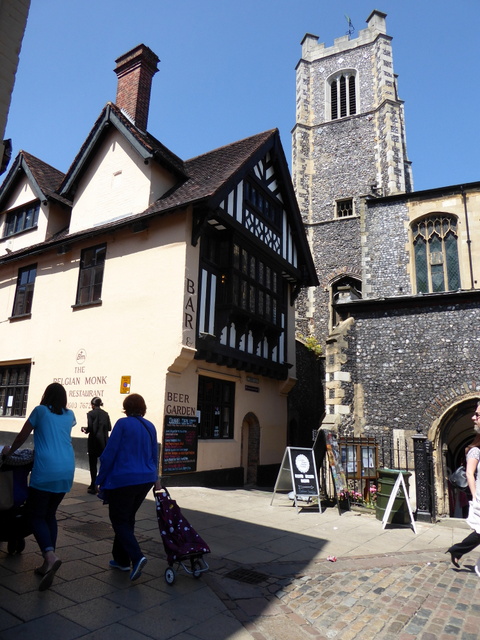
St John’s church, the Belgian Monk pub and St John’s Alley in-between them.
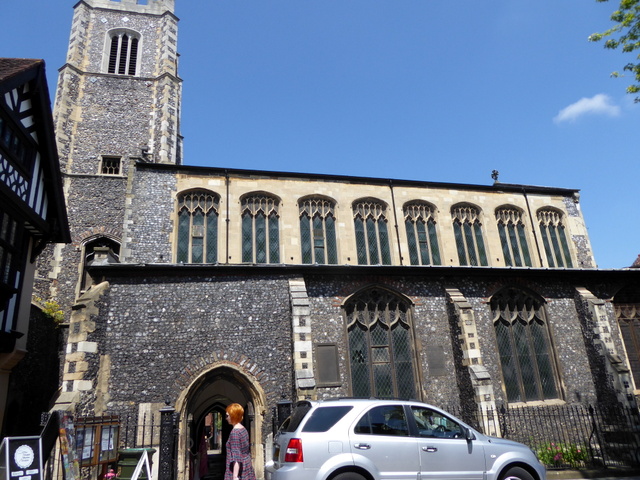
St John Maddermarket

The processional way (St John’s Alley) goes through the base of the tower. The pub is on the left of the photo and the Maddermarket theatre can be seen at the far end of the passageway.
In writing this post I realised that I needed a few more photos to illustrate some of the things I wanted to say about this church. I called in at the church again on Tuesday 17th January and took most of the pictures I wanted.
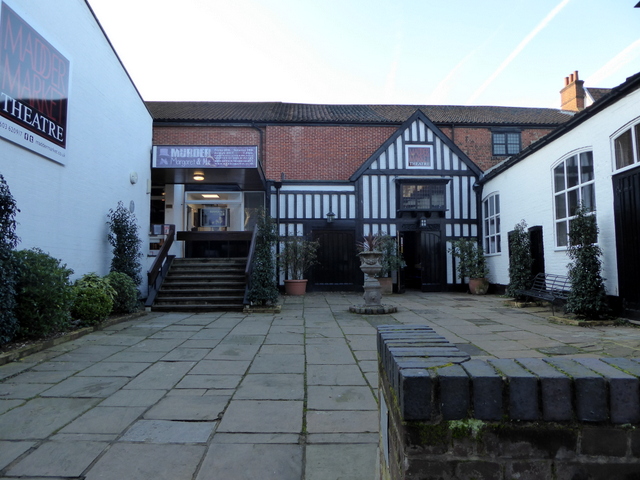
The Maddermarket Theatre was founded in 1921 by Walter Nugent Monck who, during that decade was one of the first people to re-create a Shakespearean stage.
There is a memorial in St John’s church to Walter Monck 1878-1958 (one photo I forgot to take!)
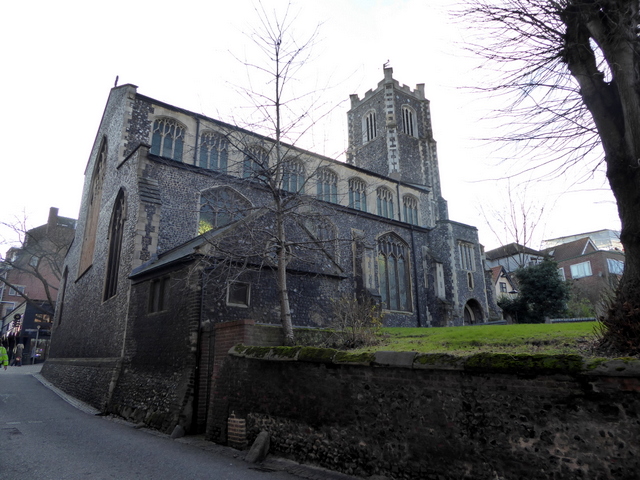
St John Maddermarket
Note the raised burial ground. In the 16th and 17th centuries there were many complaints about graveyards like this one. Because of the confined space allowed for burial there were often too many bodies with too little earth to cover them! This graveyard contains the Crabtree headstone which has a pre-Christian symbol of the Ouroboros carved on it. An Ouroboros is a serpent eating its own tail.
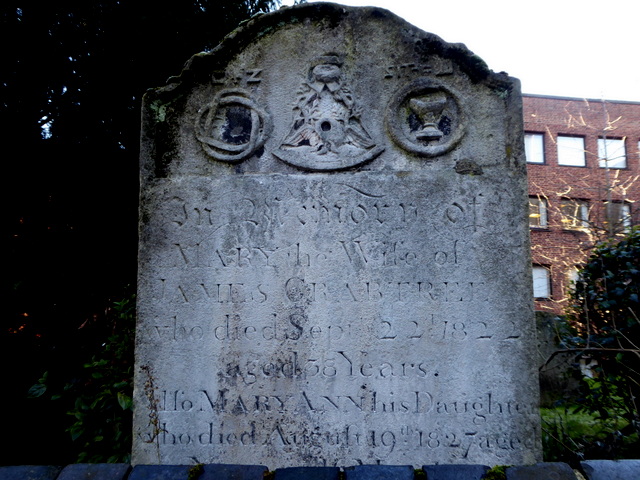
The Crabtree headstone with the Ouroboros at the top on the left. There are other strange markings on this headstone which I think are Masonic. Why the headstone for Mary and Mary Ann Crabtree should have these markings on it, I have no idea! I couldn’t see all of it as the churchyard is permanently locked and this is the view I got over the wall.
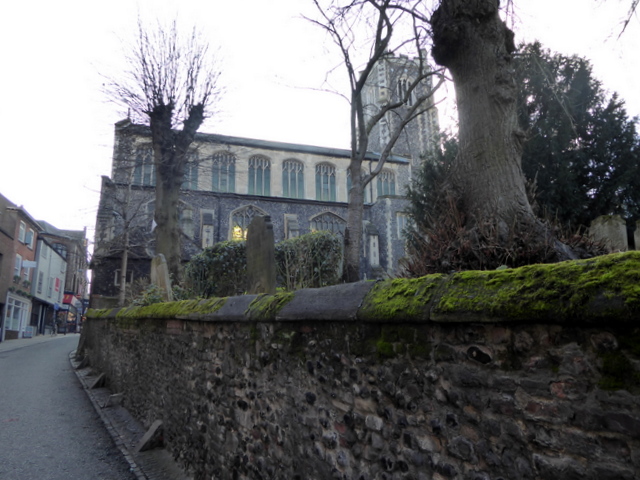
Wall of St John’s churchyard
William Shakespeare’s friend William Kempe, the comic actor, had an argument with Shakespeare and in trying to upstage him wagered that he could morris-dance all the way from London to Norwich (about 100 miles) in nine days. He managed to do it (though with a few days rest in-between the days of dancing) and on his arrival he jumped the wall of St John’s churchyard. He wrote about it in his book ‘A Nine Daies Wonder’.
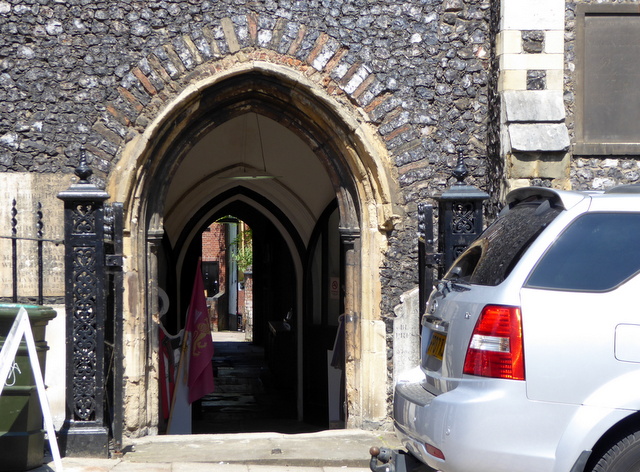
Entrance to the church through the south porch. The door to the north porch was open so a view of the lane beyond the church can be seen
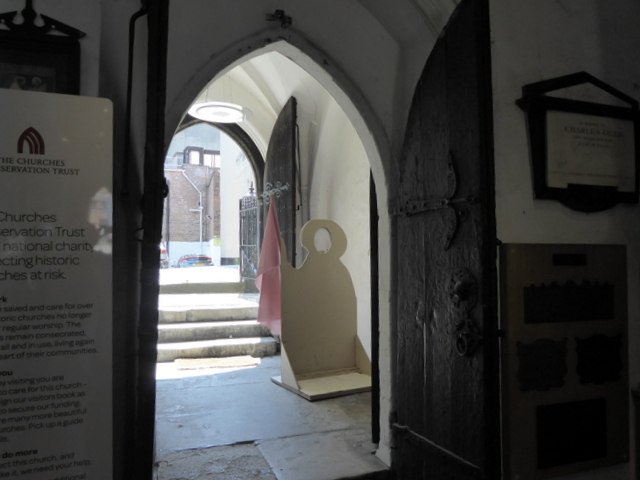
Inside the church, looking out through the south porch door
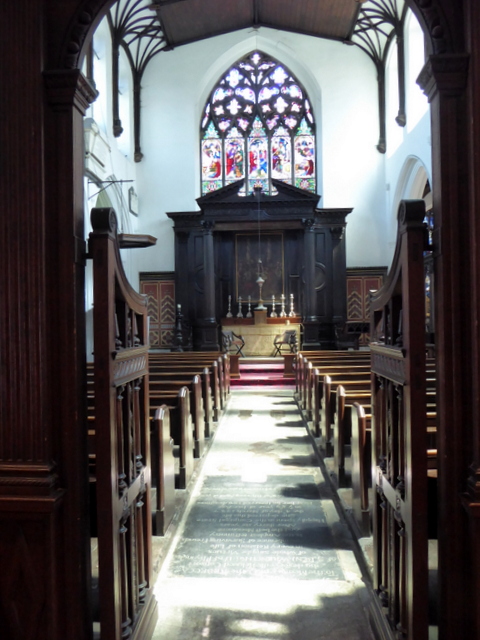
Looking towards the altar from the back of the church
The eye is drawn to the imposing Georgian baldachin (canopy) over the high altar which is supported on columns. I’m not at all sure I like it there very much; it seems too big and heavy for the church it is in. William Busby who was Rector of this church from 1898-1923, assembled a large collection of church furnishings and this canopy was part of the collection. It was made for another Norwich church (St Miles, Coslany) and brought to St John’s in 1917. It obscures the Gothic revival reredos (decoration behind the altar) which had been installed in 1863, and part of the east window. The east window itself (i.e. not the glass) dates from about 1325 and is older than the rest of the church. It was possibly taken from a former chancel.
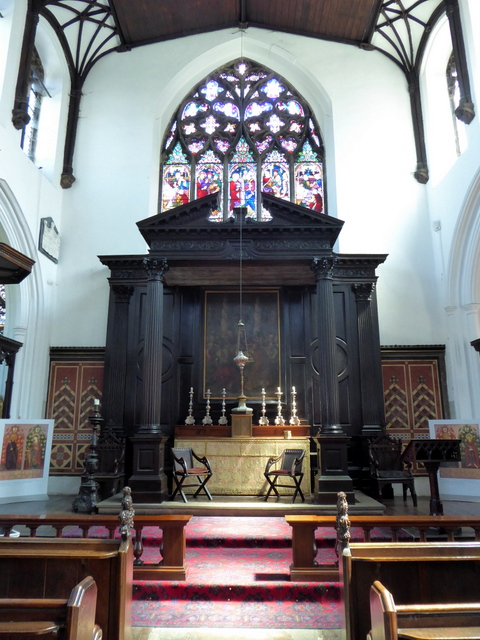
A closer view of the baldachin and high altar
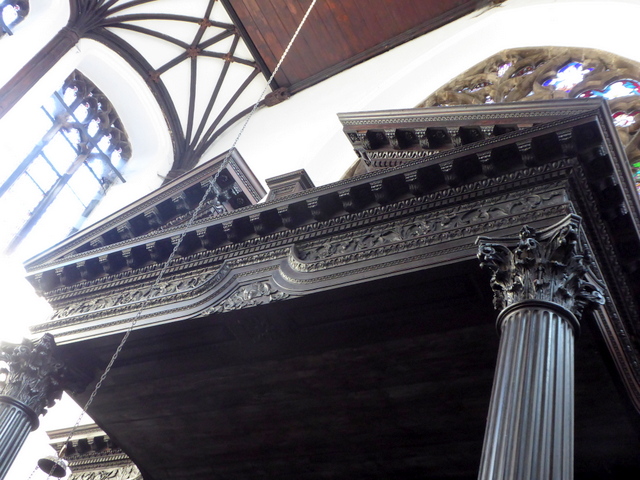
Here you can see how ornate the carving on the baldachin is.
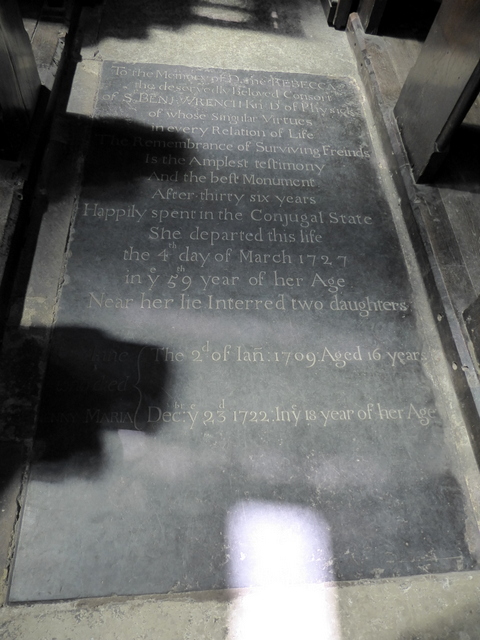
This is the ledger stone in memory of ‘Dame Rebecca the deservedly beloved consort of S. Benj. Wrench Knt. Dr. of Physick, of whose singular virtues in every relation of life, the remembrance of surviving freinds (sic) is the amplest testimony and the best monument. After thirty-six years happily spent in the conjugal state she departed this life the 4th day of March 1727 in the 59th year of her age’.
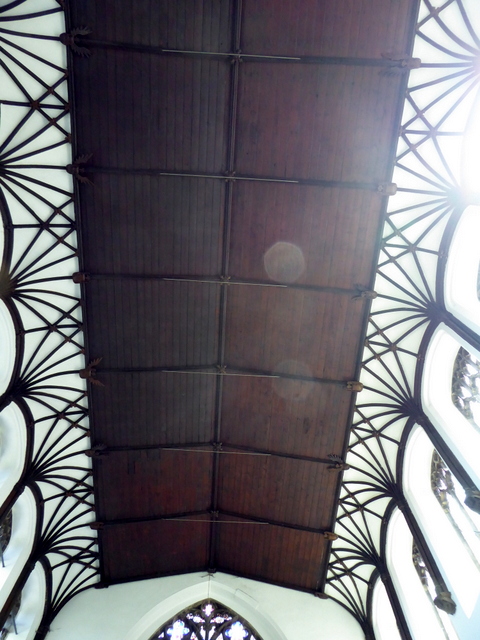
The nave roof is basically medieval but was heavily restored in 1876 after it was damaged in a gas explosion. It probably has a hammer-beam roof but ribbed plaster coving hides the hammer-beams. There are angels at the edge of the coving.
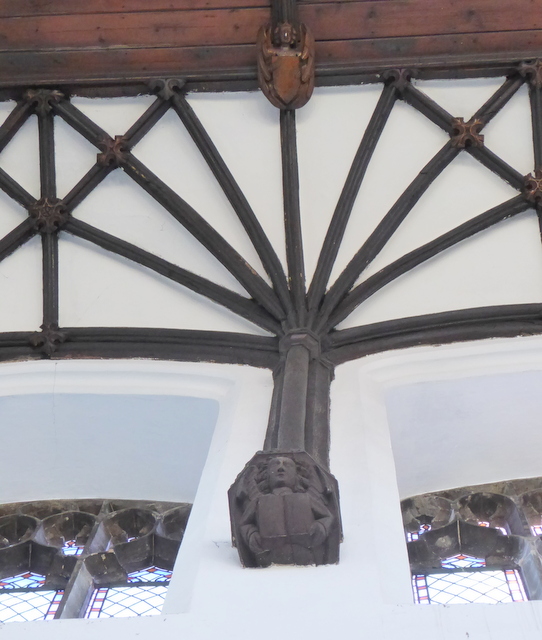
The ribbed coving and an angel holding a shield. The stop at the bottom of the photo also has an angel.
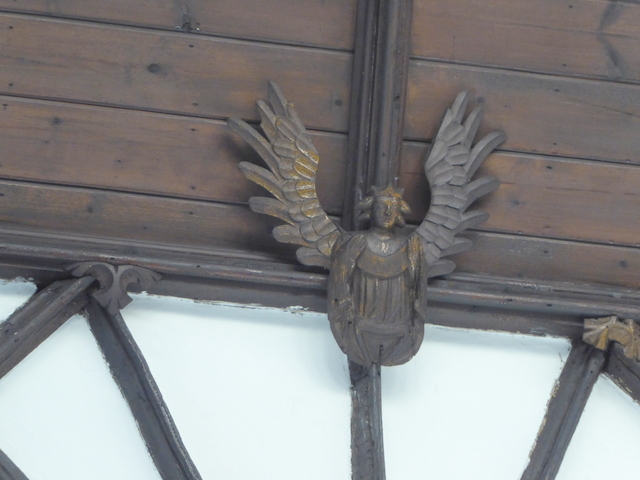
This angel has traces of gold paint still upon it. Just imagine how bright the church must have been when new!
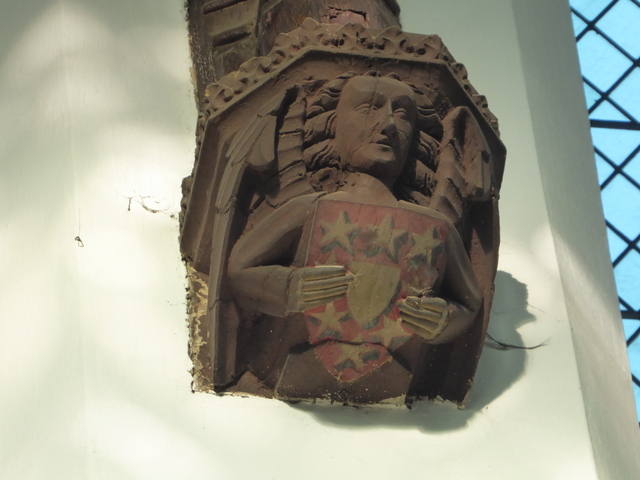
Another angel with traces of paint on it.


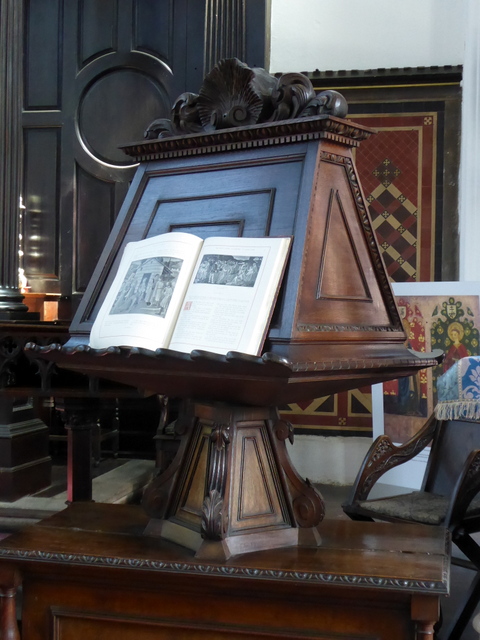
The lectern was made in the 18th century. It revolves.
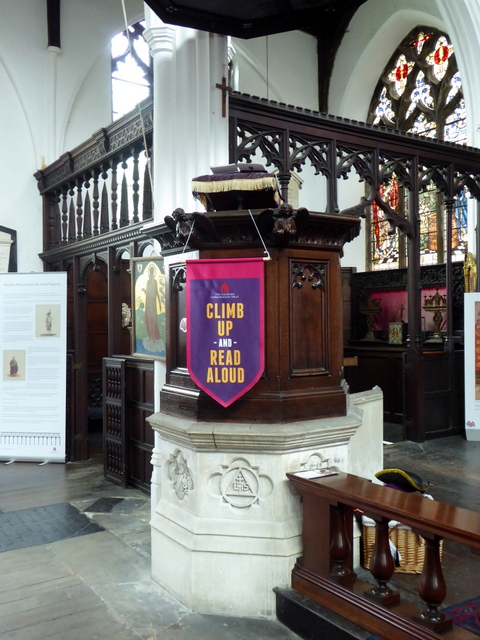
Here is the pulpit, made in 1863. The banner inviting us to climb up and read aloud is for the benefit of the many school visits they have.
The pulpit has a sounding board above it which may be 17th century.
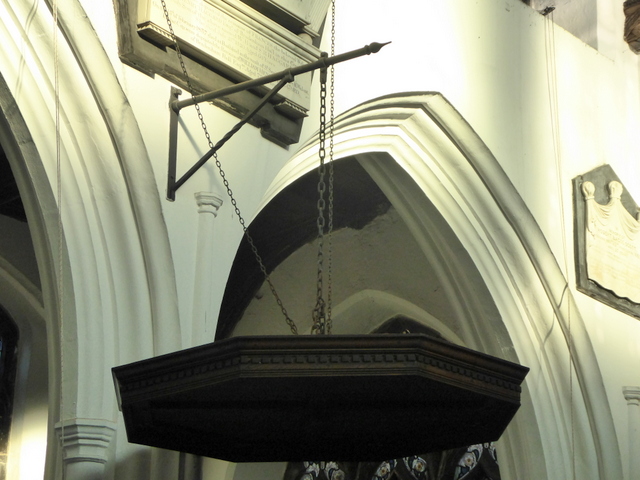
The sounding board hanging above the pulpit. It helped the preacher’s voice carry round the church.
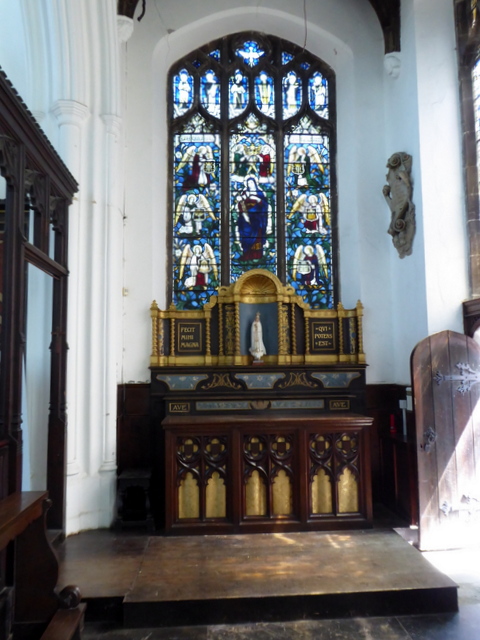
The Lady Chapel
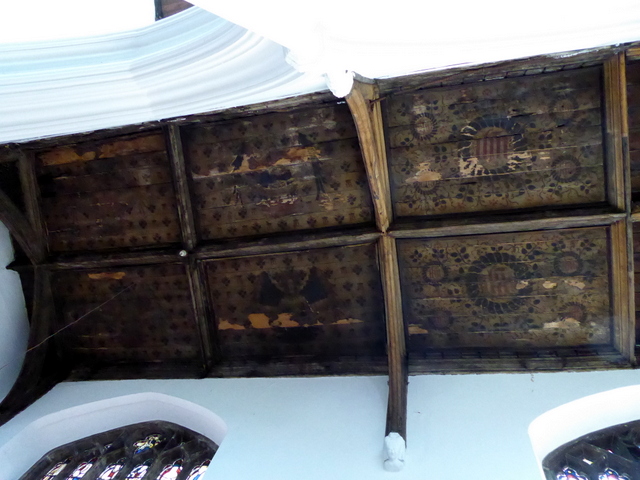
The roof of the Lady Chapel in the south aisle is painted
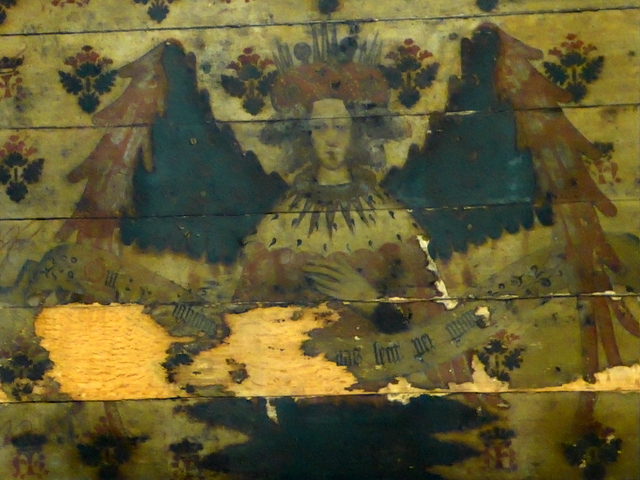
A detail from the painted ceiling.
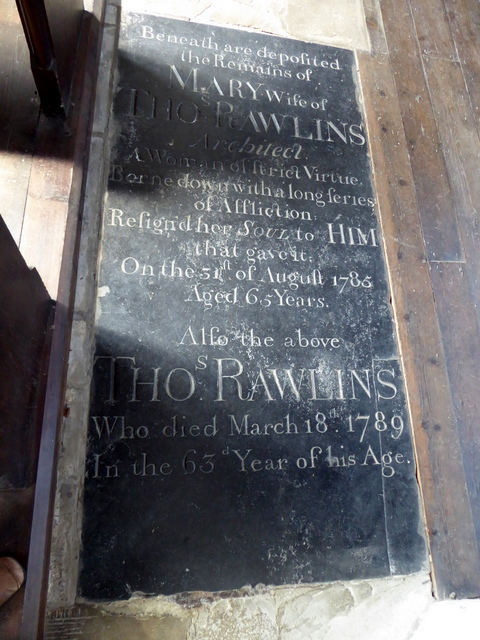
Another ledger stone. “Beneath are deposited the remains of Mary, wife of Thos. Rawlins architect. A woman of strict virtue. Borne down with a long series of affliction. Resign’d her soul to Him that gave it. On the 31st of August 1785 aged 65 years. Also the above Thos. Rawlins who died March 18th 1789 in the 63rd year of his age”.
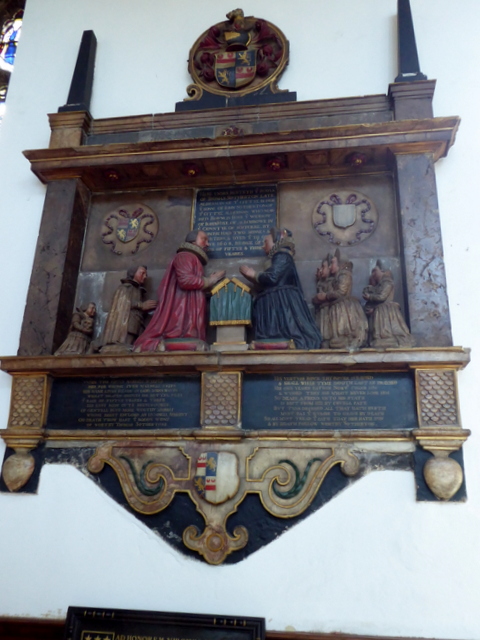
A wall monument to Alderman Thomas Sotherton and his wife Frances with their children kneeling behind them.
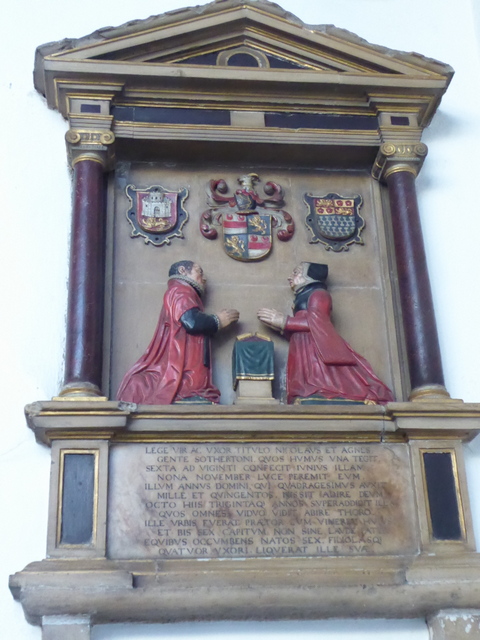
Another Sotherton family monument, this time for Nicolas and Agnes Sotherton. They had six sons and five daughters. Nicolas was a grocer who amassed a great fortune and owned much property in the city. He died in 1540.
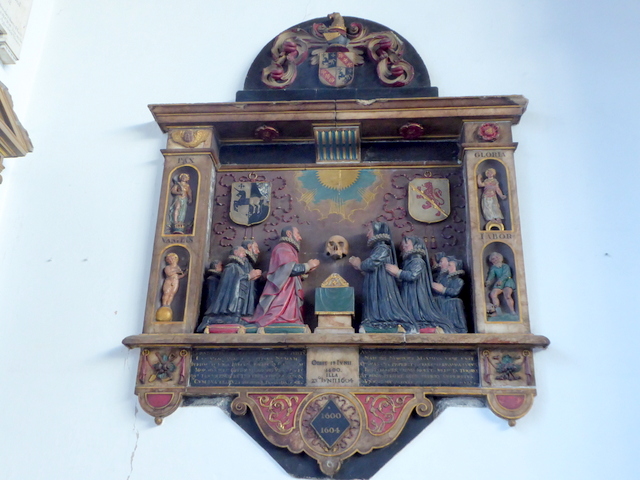
Monument to Christopher Layer (died 1600) and his wife Barbara (died 1604). There are personifications of Pax, Vanitas, Gloria and Labor on the uprights at the side of the monument. See here for a full description
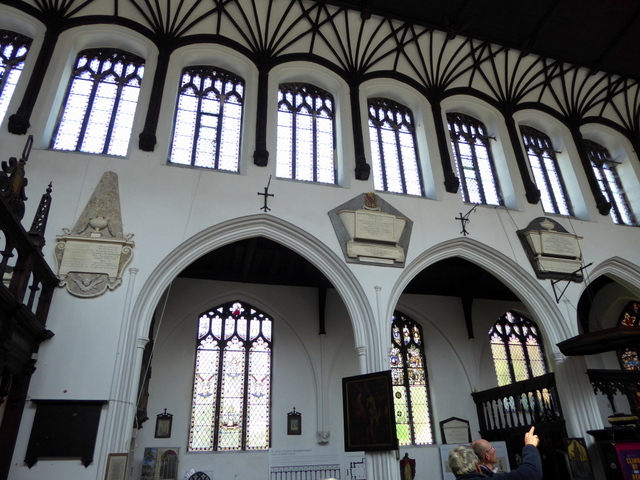
Three wall monuments and the beautiful clerestory windows above
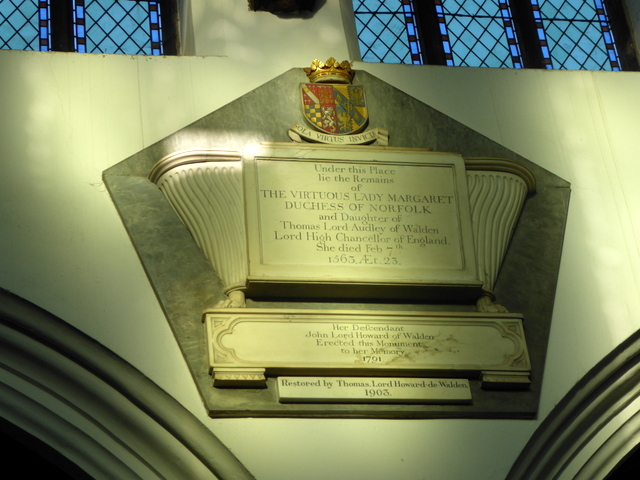
This is the centre monument from the photo above. It is to The Virtuous Lady Margaret Duchess of Norfolk
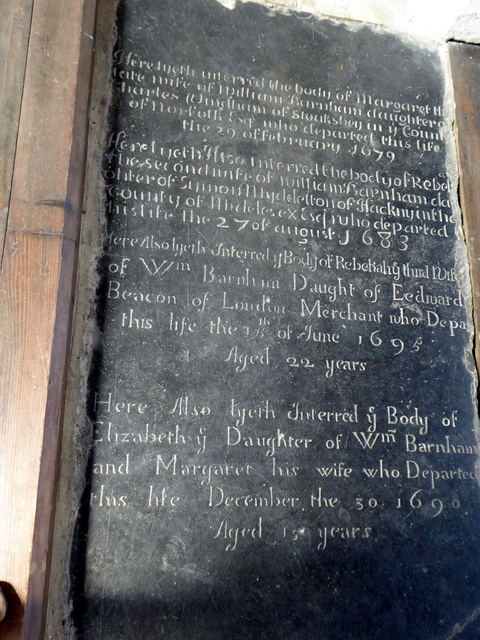
There’s quite a crowd of wives in this grave! Margaret, Rebekah 1 and Rebekah 2; the first, second and third wives of William Barnham, as well as his daughter Elizabeth!
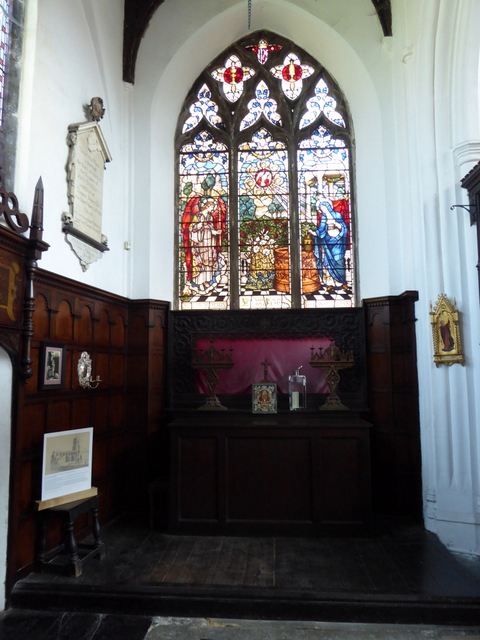
The North Chapel dedicated to the Blessed Sacrament with its wood panelling


Because of the gas explosion in the 19th century most of the stained glass in the church is from the 19th and 20th centuries. The window pictured above on the right has many fragments of the medieval glass that were rescued after the accident. Fortunately, no-one was killed or even badly injured in the explosion despite it happening during choir practice.
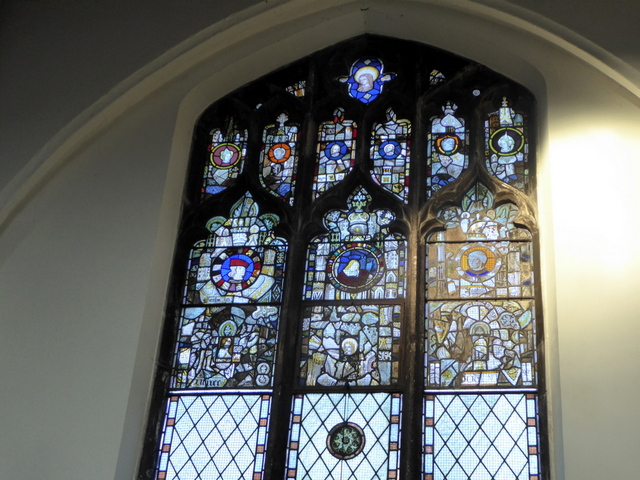
A closer view of the pieces of old glass.
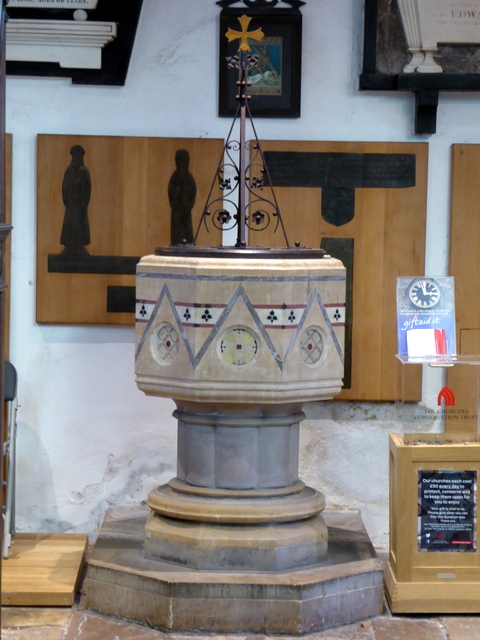
The font at the back of the church dates from the 1860’s.

This beautifully made gallery was erected in 1912 and has made the west bay at the rear of the church into a narthax (antechamber)
The north and south porches, which are inside the body of the church, are at either end of this narthax. The craftsman responsible for the gallery lived just a few yards from the church and made it in the Jacobean style. (The Jacobean era was named after King James I and covered the first quarter of the 17th century – 1600-1625). The choir sang from the gallery.
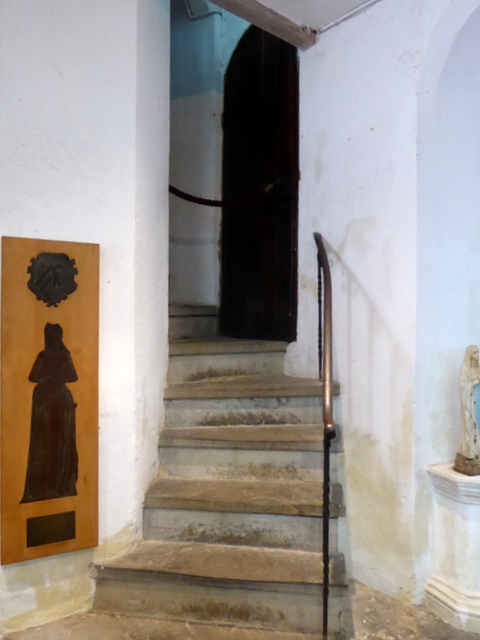
Stairs up to the gallery. On the left is one of the brasses from the church which were removed from the floor during one of the many re-organisations of the church.
Apparently, there is also a room above one of the porches (I think) which has information on all the servicemen in the parish who lost their lives in the First World War.


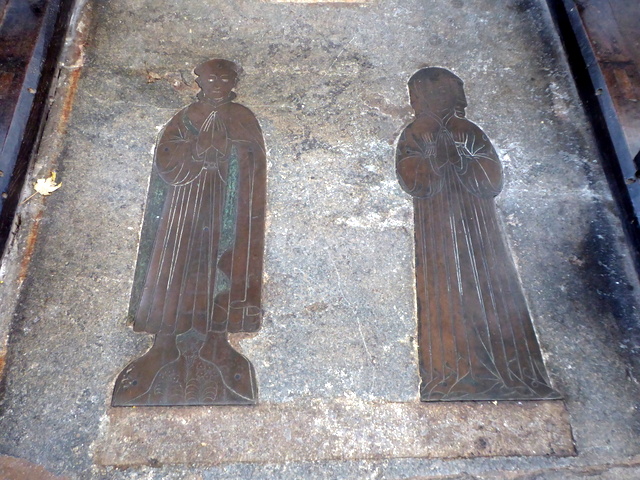
A monumental brass that is still in situ in the centre aisle. I believe this is to Ralph Segrym (d. 1472) MP 1449, Mayor 1451 and his wife.
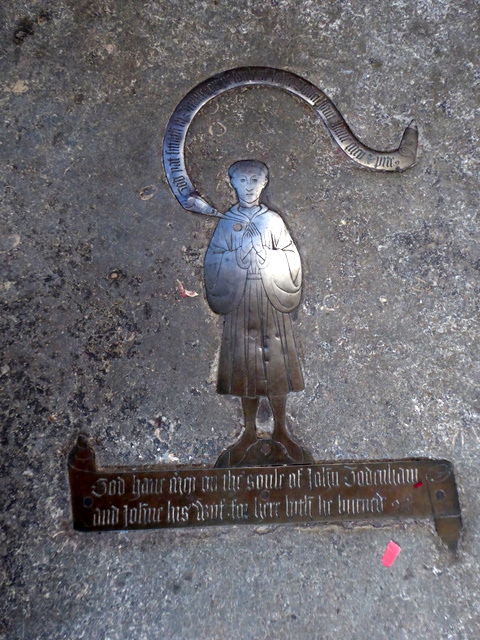
A monumental brass in the north chapel to John Todenham (c.1450) in civilian dress with inscription and scroll

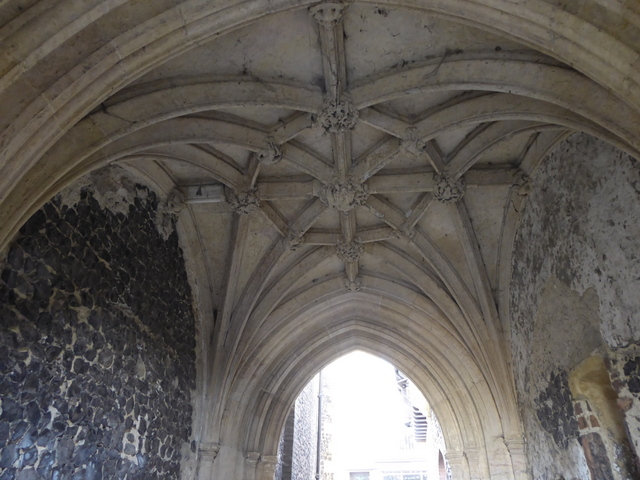
The wonderful rib-vault in the north porch
The north porch has much thicker walls than the rest of the church and many people think this is because it might be all that remains of the Anglo Saxon church which stood on the site before the current church was built. The doorway is much more ornate than the south porch door. (Another missed photo!)
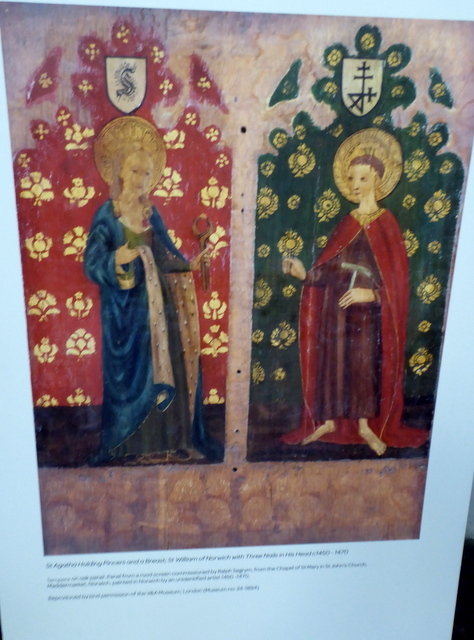
Photograph of a panel depicting St Agatha and St William of Norwich
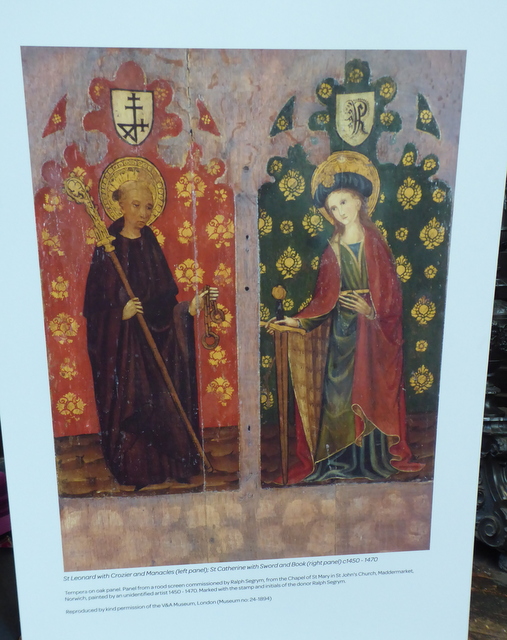
Photograph of a panel depicting St Leonard and St Catherine
Both these panels came from St John Maddermarket and are now housed in the Victoria and Albert Museum
http://collections.vam.ac.uk/item/O77491/st-agatha-holding-pincers-and-panel-unknown/
http://collections.vam.ac.uk/item/O131973/st-leonard-with-crozier-and-panel-unknown/
These panels were commissioned by Ralph Segrym whose memorial brass I have commented on above. If you are interested in clicking on the links to the panels, I recommend you subsequently click on the ‘Further Information’ button.
All photographs are mine.
Information gleaned from a conversation with a Churches Conservation Trust officer at the church and also from the following books:
The Medieval Churches of the City of Norwich – Nicholas Groves
The Little Book of Norwich – Neil R Storey
Norwich – Stephen Browning
Churches Conservation Trust Church Tour leaflet
Thanks for visiting!
Discover more from A Suffolk Lane
Subscribe to get the latest posts sent to your email.


Oh my, Clare. What a treat this post was. I enjoyed all of your fabulous photos and the history behind them. You would make an excellent walking tour guide…your attention to detail is excellent. Thank you for taking us along. Enjoy the upcoming week. ❤
LikeLiked by 1 person
Thank-you very much Jill! I’m sure I would get quite tongue-tied and forget everything! I hope you enjoy the week ahead too ❤
LikeLiked by 1 person
LOL! We’ll maybe if I ever make it over there, you can give me a private tour. 🙂 ❤
LikeLiked by 1 person
😀 That would be my great pleasure Jill! xx
LikeLike
A wonderful tour of this church, Clare! The history of the stained glass was interesting – replaced due to an explosion during choir practice! Glad no one was hurt.
LikeLiked by 1 person
Yes! Apparently someone went looking for the gas leak while holding a candle! The explosion went straight up and apart from a few minor burns and shock no-one was seriously hurt. Quite a miracle! Thank-you Lavinia.
LikeLike
Wow such a lovely place to visit and so many interesting things to see. I’m always attracted to old churches, there’s always something unique to see in each one. I had no idea what a sounding board was! How do you find out so much information? :). Thank you and as usual you take some beautiful photographs ❤
LikeLiked by 1 person
Thank-you Cat! I love old churches and old buildings and I have quite a collection of books about them! I have learnt a lot over the years but there is always something more to find out. The guide books and leaflets available at most churches are very useful as are any of the people who look after the building. In talking to the conservation officer I learnt a lot about the church and then heard about his wife’s family history, where he was born and grew up, the best places to find real ale and all about the open days they will be having later this year! It was great!
LikeLiked by 1 person
Very beautiful as much as interesting to see the well preserved art and architectural buildings. You take very good pictures Clare! 🙂
LikeLiked by 1 person
Thank-you very much HJ! You are very kind 🙂
LikeLiked by 1 person
Definitely my kind of place, Clare, as you know. What is it about churches? – so much history, so many stories and beautiful things. Great post – as usual. I think I’d like to dig some more into the origins of Maddermarket.
LikeLiked by 1 person
Thank-you Mike. I was intrigued by the name Maddermarket and assumed that there had been one there at some time in the past. I have read a number of conflicting articles about the madder market; some say there was a wool and madder market on the site where the theatre is now and that the area has been called Maddermarket since the 13th century. Others say that despite madder being sold in Norwich and the area named after it there is no proof! I gave up!
LikeLike
Wow, what a fascinating and beautiful place to visit. Your excellent pictures make me keen to go there myself.
LikeLiked by 1 person
Thank-you very much Susan. It is well worth a visit.
LikeLike
Delightful! My only knowledge of Norwich is that it was the filming base for ‘The Sale of the Century’ all those years ago – isn’t it strange what sticks in your mind. And so nice to see such a different and interesting side to the city!! 🙂
LikeLiked by 1 person
My goodness! I had forgotten ‘The Sale of the Century’ – with Nicholas Parsons wasn’t it? Yes, certain things stick in your mind and there are other things that just won’t stick no matter how hard you try! My husband and I were talking about composers today and the piece of music that people remember them by. Saint-Saens hated being remembered as the composer of the Carnival of the Animals because he considered it as trivial – poor man! 🙂
LikeLiked by 1 person
Oh dear, poor man indeed. I offer up a consolation to him, that my favourite is his magnificent organ symphony! We first heard it live at the Royal Albert Hall just after the organ had been restored – an unforgettable experience. And dear old NP – he still, at 90+, performs each year at the Fringe – we have seen him a couple of times – amazing stamina! 🙂
LikeLiked by 1 person
We said that we love his organ symphony best too though I’ve never heard it in concert – only recordings. NP – such a sweet man, funny and naughty too!
LikeLiked by 1 person
Grab it if you ever get the chance – there’s nothing quite like feeling the amazing bass vibrations which come racing through the orchestra to one’s solar plexus, not to mention being able to wallow in all those beautiful harmonies. 🙂
LikeLiked by 1 person
That has convinced me! 😀
LikeLiked by 1 person
Lovely post Clare. St John Maddermarket, with its reassembled assortment of local treasures is one of our favourites.
LikeLiked by 1 person
Thank-you very much Reggie.
LikeLike
So much history and beauty in one place! It’s really fascinating–you’re a great tour guide!
LikeLiked by 1 person
Thank-you Kerry! You’re very kind!
LikeLike
Wonderful to walk long with you!! Such delicious medieval images. xo Johanna
LikeLiked by 1 person
Thank-you so much Johanna! xo
LikeLike
I found it interesting that many of the things in this church had been recycled from other churches. It must take you a great deal of time and effort to so thoroughly research everything for this post and the others like it that you do, thank you for your hard work. You do make an excellent tour guide!
LikeLiked by 1 person
You’re very kind Jerry, thank-you! Re-cycling still goes on in our churches. Many churches have second-hand or third-hand sets of hymn books and prayer books either from churches that have had to close or, more rarely, from churches that have been able to afford a new set or have been gifted with new books. It’s the same with furniture, linen and larger items like organs. My mother’s church was left some money in someone’s will and they decided to replace the old organ they had with a newer one. A church in the Midlands was replacing their organ with something better and so my mother’s church bought their old one (for many thousands of pounds!). My mother’s church is wealthier than mine. 🙂
LikeLiked by 1 person
East Anglia has so many fascinating churches, and here’s another for my list. The name alone is so evocative. I’ll be joining the queue that I see has already formed to ask for your services as a tour guide!
LikeLiked by 1 person
Thank-you Margaret! There are churches everywhere and I’m never going to have time to see a fraction of them!
LikeLiked by 1 person
I really like the oldest parts – those carved angels and the angel painted on the ceiling. The revolving lectern is certainly interesting!
And now I have an idea of where the term “sounding board” comes from (not that I ever wondered at it)! We often accept sayings without questioning the origins. Thanks for the tour, Clare!
LikeLiked by 1 person
Thank-you very much Lisa! You’re right about accepting words and phrases without question. The moment you suddenly find out where they come from and what they mean is wonderful!
I love the really old things in these churches too! The fact that they have survived so long is amazing in itself.
LikeLike
Elegant church and I love how you describe it. I would miss so much just standing there.
An Ouroboros is a new one for me. Madder is quite new, but I’m reading a beautiful book on paint – Colour by Victoria Finlay – so I’ve been learning.
LikeLiked by 1 person
It is so good to hear from you again Catherine. I had never heard of Ouroboros either until I visited the church and was told about it. I have yet to find a madder plant – I hope I do one day. The colour “rose madder” always appealed to me when I was little and I was delighted when my parents got me a paint box with some in it!
I have been enjoying reading your blog very much; you write so well and with great honesty.
LikeLike
A beautiful church, very dramatic and some really interesting facts and history. I’m glad you told us where ‘maddermarket’ comes from as I found it intriguing – and like Lisa above, I’ve realised where ‘sounding board’ comes from!
LikeLiked by 1 person
Thank-you very much Andrea. I love the history of words and that moment of realisation when I discover the origin of a phrase or word I’ve been using without thought is wonderful! Like a door being opened on a new world!
LikeLiked by 1 person
Maddermarket is such an unusual word, it’s hard to imagine them using it unless there really was a market there, but I don’t suppose anyone will ever know for sure.
I love the nave ceiling. It looks so delicate though I doubt that it is.
I always wonder when I see these beautiful old churches, how anyone could stop ogling the church long enough to listen to the sermon. I doubt that I’d have remembered a word of it. I would have been too busy admiring the surroundings.
LikeLiked by 1 person
Thank-you Allen. I think most of us who worship in beautiful or interesting buildings would recognise that dilemma! When we go to the Cathedral I find it difficult to take my eyes from the glorious splendour around me!
As for the Maddermarket – I am sure that madder was sold there at some time but many historians want actual proof and that is so hard to get when dealing with something that happened 800 years ago! They may get it one day – who knows! The nave ceiling is beautiful. It is a pity so much of it was damaged in the explosion, though the restoration work has been done very well.
LikeLike
It certainly has, and it really is beautiful. Thanks for the tour!
LikeLiked by 1 person
My pleasure, Allen.
LikeLiked by 1 person
I would like to have seen some of the old churches in their fully painted glory
LikeLiked by 1 person
Yes! How marvellous that would have been!
LikeLike
Hello Clare! Many apologies for my absence – I needed to take a little break but certainly did not expect time to have gone by so fast. A very happy 2017 to you and it is lovely to be reading your blog again. What a beautiful and very interesting church this is. I have to admit that I have always had a fascination for reading inscriptions of gravestones and some of these are so interesting. The traces of the medieval paint show just how vibrant in color these ancient buildings must have been. So thoughtfully researched – well done!
– Kate xx
LikeLiked by 1 person
Thank-you Kate, and a very happy 2017 to you too. Time does seem to rush by – I am surprised that we are already nearly at the end of January!
LikeLiked by 1 person
Very interesting tour – isn’t it annoying when you start writing and realise you didn’t take the photo you need? Glad it’s not just me. 🙂
LikeLiked by 1 person
I have just been going through some photos I took a month after my first visit to the church and I’ve discovered that I went back and took a couple of really good shots of the north porch and I’d completely forgotten about doing it! Now that’s really annoying!
LikeLiked by 1 person
Yes, I can understand that. 🙂
LikeLiked by 1 person
Beautiful pictures and great commentary. I love the idea of distance Morris dancing – now that is an Olympic discipline I would watch!
LikeLiked by 1 person
Thank-you! I’d watch that one too! 😀
LikeLiked by 1 person
Lovely treatment of the vaults and ceiling.
Thanks for showing them
LikeLiked by 1 person
Thank-you very much Mark.
LikeLike
I love those ceilings and the Morris dancing story was great too, imagine trying to do that down some A road now, the thought of it makes me cringe. You should be a tour guide!
LikeLiked by 1 person
Thanks Ste! He wouldn’t last long, would he? Knocked down or locked up for his own good! If he managed to get permission to do it he’d have to have a rolling police escort and media coverage too.
LikeLiked by 1 person
And sponsorship to the eyeballs.
LikeLiked by 1 person
😀
LikeLike
What a feast for the eyes your photos of this church provide! I was really fascinated by the way it has become a collection of treasurers down through the ages…somehow creating a continuing story linking those who attend. Also enjoyed the link to Shakespeare’s friend, Will Kempe – quite a character he sounds 🙂
LikeLiked by 1 person
Thank-you! Will Kempe was very popular with the people and had a great following. He was a clown and all plays up til then had a spot for the clown to perform his act. He had been in many of Shakespeare’s plays, playing Falstaff for example, but Shakespeare began to object to Kempe’s ad-libs and wanted him to stick to the script. He felt that clowns were old-fashioned and had no part in his modern plays. So Kempe wished to prove his popularity to Shakespeare and danced all the way to Norwich. It was a great success but very short-lived because within a couple of years he had disappeared from view and died penniless and in obscurity. Sad; this continues to happen to celebrities doesn’t it?
LikeLike
It does seem to especially when they take themselves too seriously…maybe that will apply to politicians too;-)
LikeLiked by 1 person
Here’s hoping! 😉
LikeLiked by 1 person
Thank you for the beautiful tour. So much interesting history, I wish I could see it all!
LikeLiked by 1 person
Thank-you Karen!
LikeLiked by 1 person
What a fantastic photo essay – I hugely enjoyed this tour. You put so much detail and research into this post. So interesting!
LikeLiked by 1 person
You are very kind, Sheryl; thank-you.
LikeLike