Elinor and I went to Framlingham three weeks ago. Richard had intended coming with us but he had a bad cough and cold and stayed at home instead.
The distance to Framlingham from home is about 17 miles and in ideal conditions would normally take about 40 minutes. However, with local road closures for repairs and other works, the long diversion we had to take meant it took us nearly an hour to get there. I checked the route after we got home on Googlemaps and it now provides information on how to travel to the required destination by public transport. I was amused to discover that it would have taken us 4 hours and 5 minutes to get to Framlingham by using three different buses, walking some distance and only if we had travelled on a Wednesday!
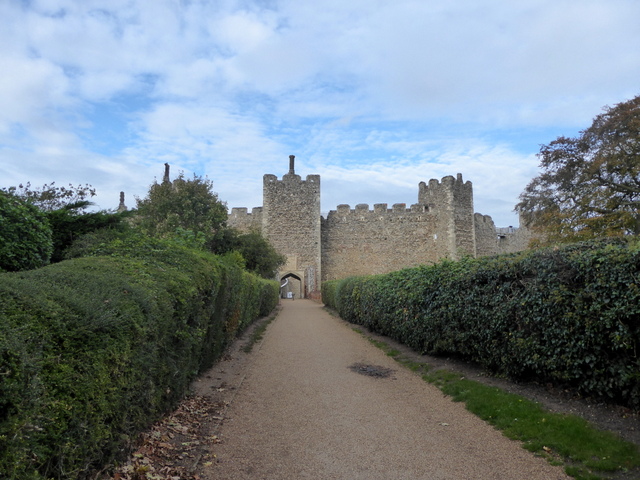
The approach to Framlingham castle
We eventually found somewhere to park in the town centre, though there is a car park at the castle, and walked to the castle. We hadn’t visited it for many years, not since Elinor was very small and she had no recollection of the place at all. The castle is looked after by English Heritage and they have recently been working on expensive improvements to the wall walk, the exhibitions and the museum and in providing a large café. Disabled access has been improved too. While all the repairs were underway a chute was installed from the top of the wall walk down to the inner court to entertain visitors. The chute is still in place but we didn’t avail ourselves of it!
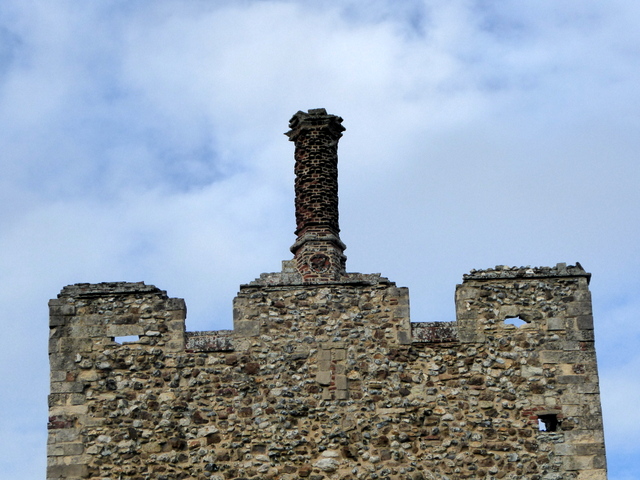
A Tudor brick chimney on the top of the gatehouse. Most of the chimneys at Framlingham are purely ornamental and were added as a sign of wealth.
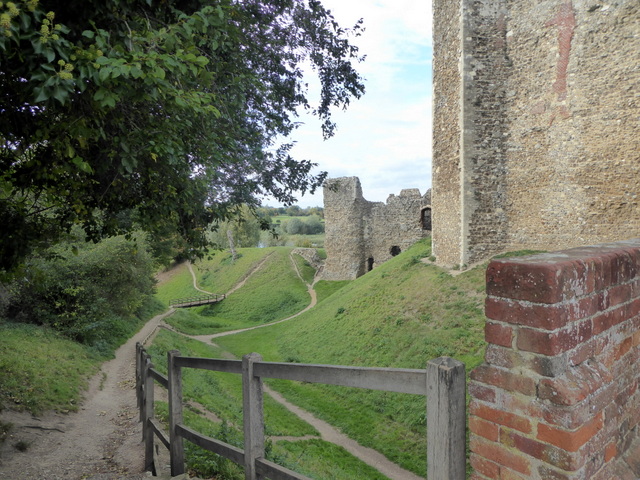
The castle has a deep, steep-sided ditch around it which was always a dry ditch. This was designed to prevent tunnelling under the walls and made breaching the walls almost impossible.
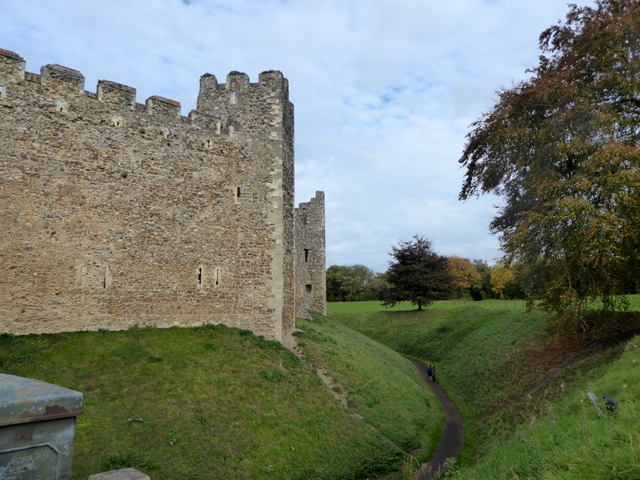
The inner ditch and curtain wall. Do you see the people walking at the bottom of the ditch? This castle is enormous!
Skip this next bit unless you have the time to read some historical background!
Roger Bigod I was formally granted the manor of Framlingham in 1101 by King Henry I even though he had been living there since shortly after the Norman Conquest. The Bigods, who were very powerful and rich barons were also made Earls of Norfolk. Roger Bigod II built the castle that we see today and he and his son were the first two of the list of barons who forced King John to accept the Magna Carta in 1215. The Bigods were constantly at odds with their king and were a law unto themselves. Eventually, the expense of numerous building projects and constant quarrels with Edward I produced such enormous debts that Roger Bigod IV was forced to make the king his heir and at his death all his lands were given to the king.
Edward II gave Framlingham to his half-brother, Thomas Brotherton who left the estate to his two daughters. His elder daughter, Margaret was created Duchess of Norfolk in 1397 – the first Englishwoman to be a duchess in her own right. Her grandson and heir, Thomas Mowbray was created First Duke of Norfolk, also in 1397 and Framlingham remained with the Mowbrays until the death of John Mowbray VII in 1476.
The castle then passed to the Howard family who were descendants of the Mowbrays. The Howards were skillful politicians and also brave soldiers and included John, First Howard Duke of Norfolk who died at the battle of Bosworth aged 60 while commanding Richard III’s troops. His son, Thomas was imprisoned in the Tower of London but was released and gradually recovered the Howard estates. At the age of 70 he led the English forces to victory against King James IV of Scotland at Flodden Field. In gratitude for this victory Henry VIII gave him back the title of Duke of Norfolk. His son, also Thomas, the 3rd Duke of Norfolk was the uncle of two of Henry VIII’s wives – Anne Boleyn and Catherine Howard. He not only schemed to get them to court and to marry the king but also betrayed them both for his own ends. Eventually his scheming and the arrogance of his son Henry, a soldier and gifted poet, proved his downfall. They were both sentenced to death, Henry Howard was executed in January 1547 but his father survived through the good fortune of King Henry’s own death taking place a day before the execution date. The Norfolk title and lands were surrendered to the Crown.
In her father’s will, Mary Tudor was granted most of the Howard lands in East Anglia and received Framlingham in 1552. On his death bed in 1553, Mary’s brother, King Edward VI was persuaded to disinherit both his half-sisters on the plea that they were illegitimate. He and his mentor, the Duke of Northumberland were both staunch Protestants and were fearful that the country would revert back to being Roman Catholic when he died. He named his successor to the throne as Lady Jane Grey, Northumberland’s 17-year-old daughter-in-law. Mary heard that the Duke of Northumberland planned to capture her so she fled to Framlingham and rallied her troops about her. Not only the local landed gentry came to her support but also crowds of the poor country people. Support for Northumberland and Lady Jane Grey dwindled and eventually Northumberland surrendered and Mary was crowned queen. Queen Mary released the elderly Thomas Howard and gave him back his lands and title.
The castle was passed to Queen Elizabeth after the 4th Duke of Norfolk was executed and she used it as a prison, housing mainly Catholics. James I returned the castle to the Howard family in 1603 but by then it was in a sorry state of repair. It was sold to Sir Robert Hitcham, a rich lawyer and politician in 1635 who died the following year leaving it to his old college at Cambridge. He asked that all the castle not built of stone be pulled down and a poorhouse built. The first poorhouse built in the castle grounds was the Red House. It was soon found inadequate but a bigger and better one wasn’t built until 1729.
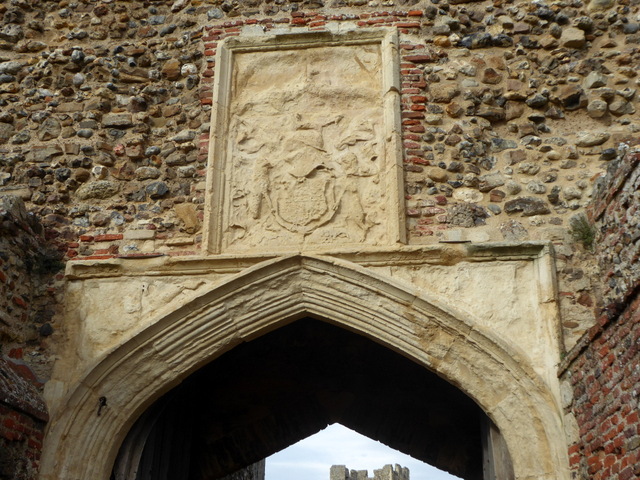
The gatehouse was rebuilt at the beginning of the C16th. This is the coat of arms of the Howard family, much weathered.
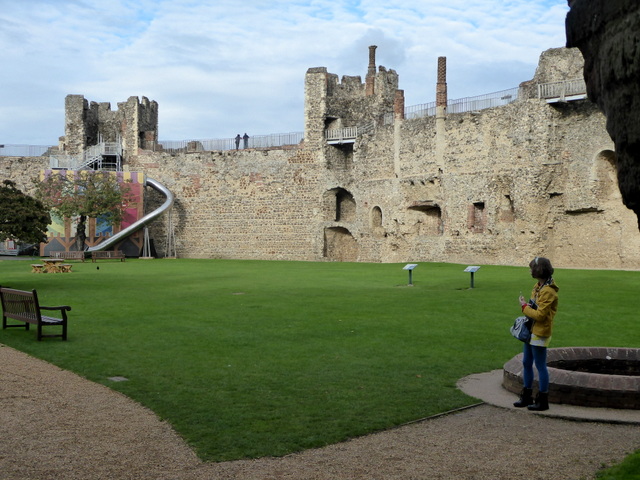
This was our first view of the inside of the curtain wall. You can see the chute on the left of the photo. Elinor stands next to the well.
The buildings in the inner court were originally built out from the curtain wall and you can see window recesses and fireplaces in the curtain wall in the photo above.
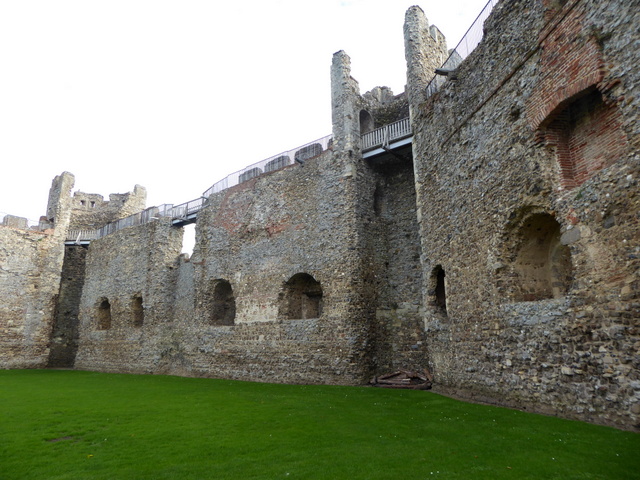
Part of the inside of the curtain wall
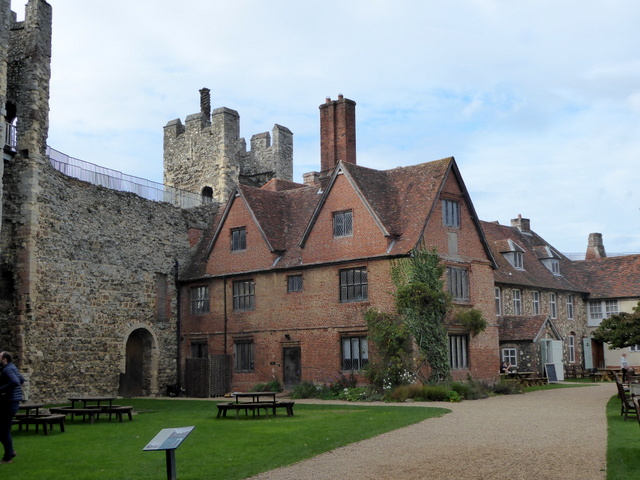
The Red House, built in 1660 and now containing private accommodation and beyond it, the Poorhouse built in 1729 on the site of the Great Hall.
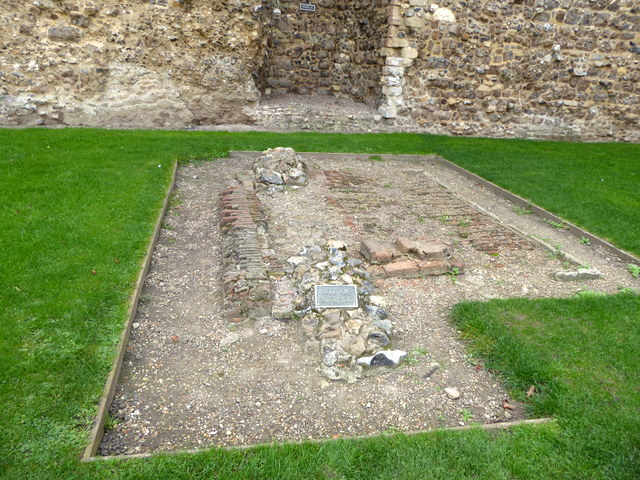
The site of the kitchen, which was always kept well away from other buildings as it was a fire risk.
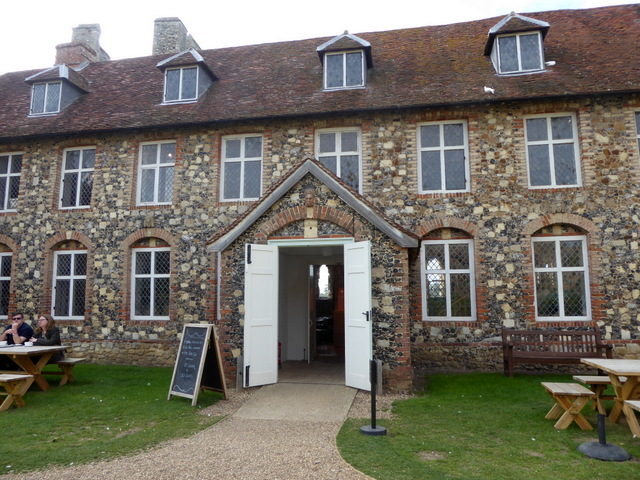
The old Poorhouse, now the café, museum and exhibition room.
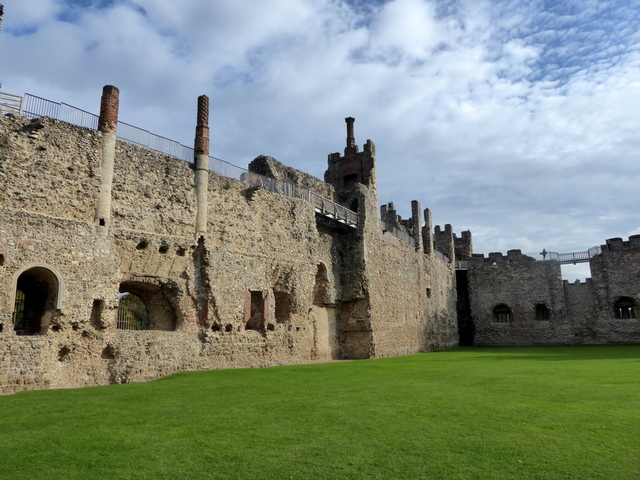
Another view of the inside of the curtain wall showing the traces of the chamber block.
From left to right – the first arch is a 12th century stone window that was later opened up as a doorway. The next wider opening is a Tudor window and above it the three small holes in a row are impressions left by the rafters of the mid-12th century building which was encased in the curtain wall. The floor joists can be seen above them. The stone chimneys are 12th century and were extended in Tudor brick. These two chimneys are the earliest known surviving cylindrical chimneys in England. Two more smaller openings in the wall are followed by the remains of a tower under which was the chapel, the east window of which can be seen below the walkway.


Four of the five stone heads that survive from the medieval buildings. They have been re-set into the facade of the Poorhouse.
Elinor and I went into the Poor House building from where we were able to climb up to the wall walk.
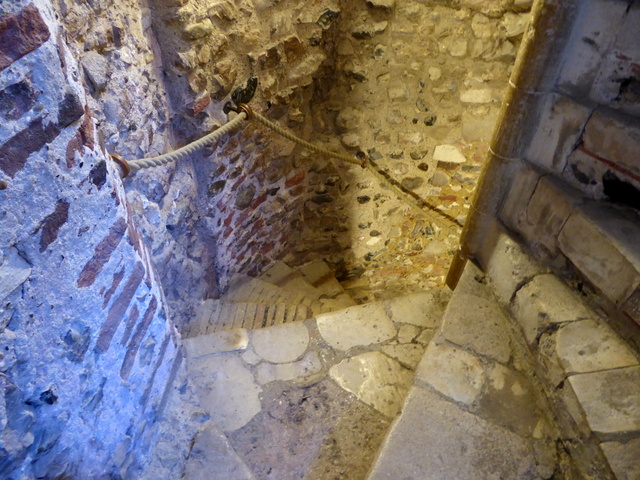
The stairs to the wall walk are in a tower which is part of the curtain wall. This is a photo looking down the stairs.
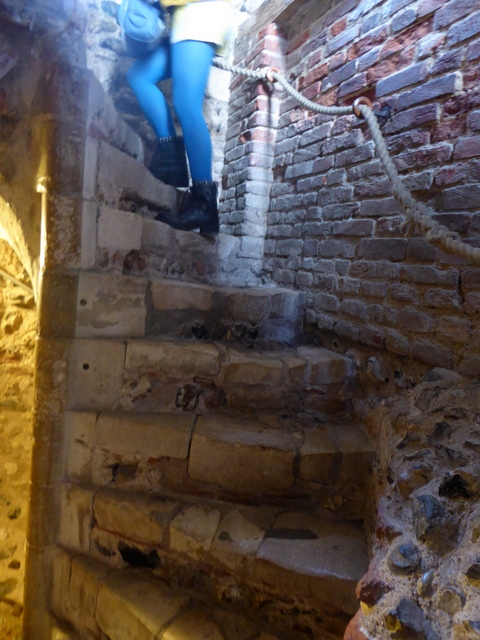
Looking up the stairs as Elinor climbs up ahead of me.
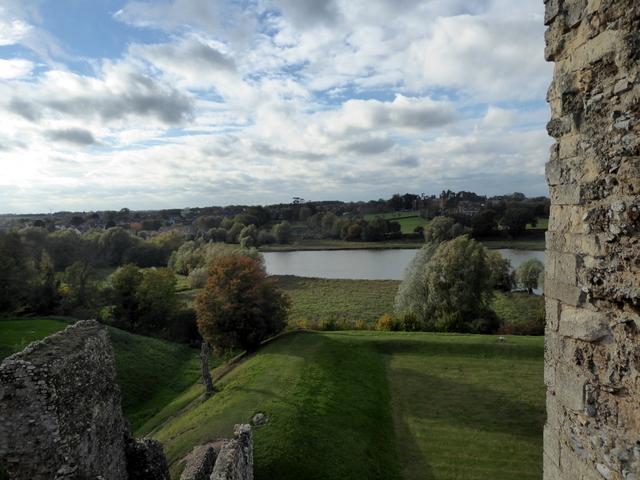
Looking towards Framlingham Mere from the wall walk
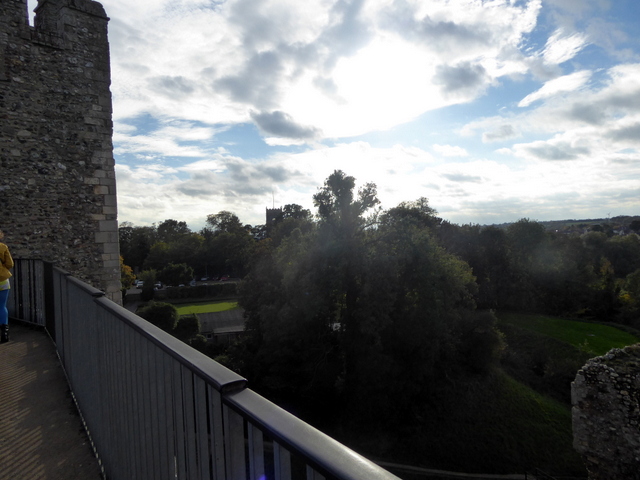
Looking towards the town. The church tower is in the centre of the photo.

Looking down into the inner ditch.
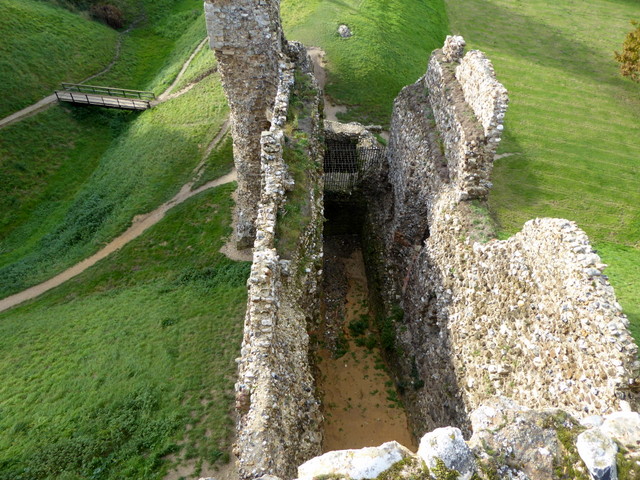
The remains of the western tower which protected the castle from attack from the west. Also known as the Prison Tower.
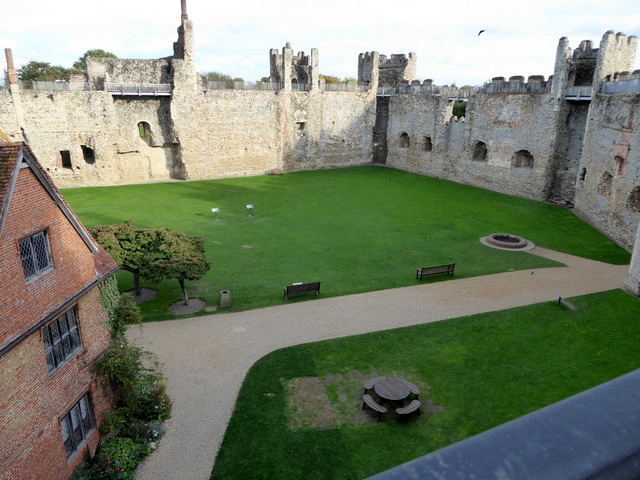
Looking down into the Inner Court.
Here is a slideshow of a few views from the wall walk.
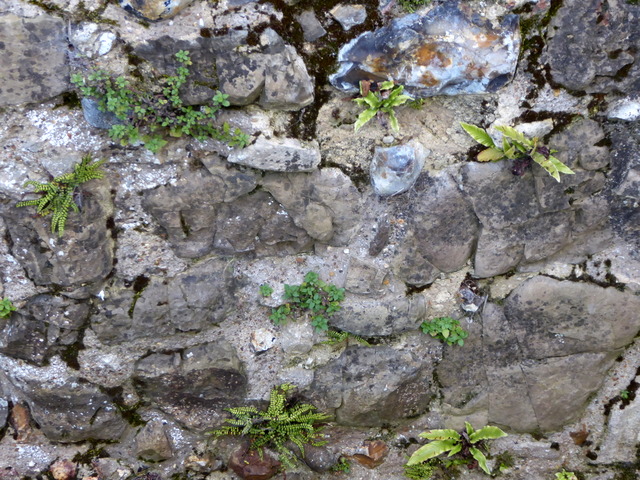
Hart’s-tongue Fern (Phyllitis scolopendrium ), Maidenhair Spleenwort (Asplenium trichomanes ) and other plants growing in the castle wall.
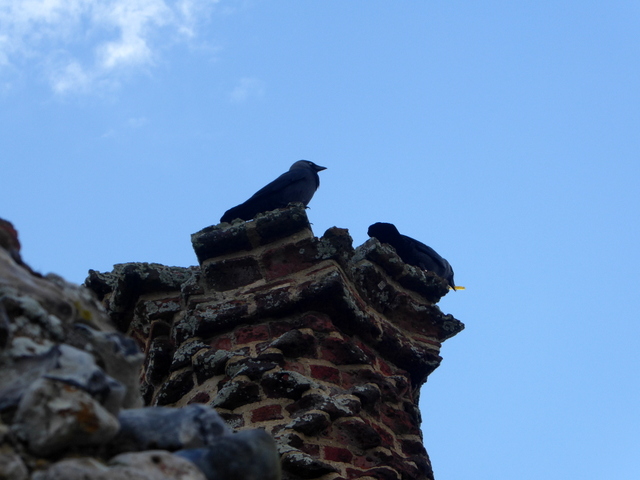
Jackdaws (Corvus monedula ) were still nesting in the chimneys of the castle.
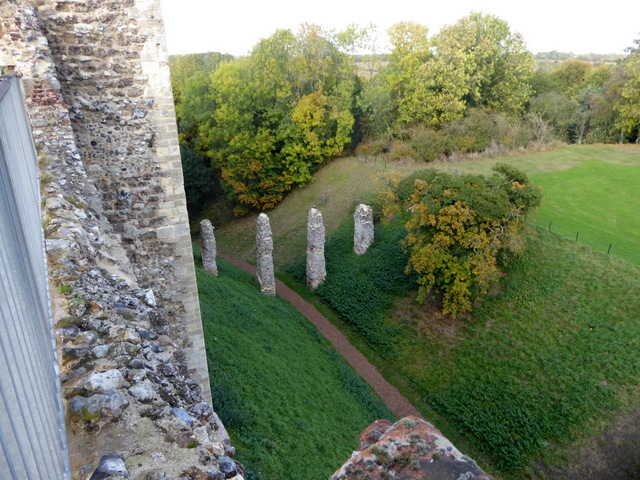
The white pillars are the remains of a Tudor bridge.
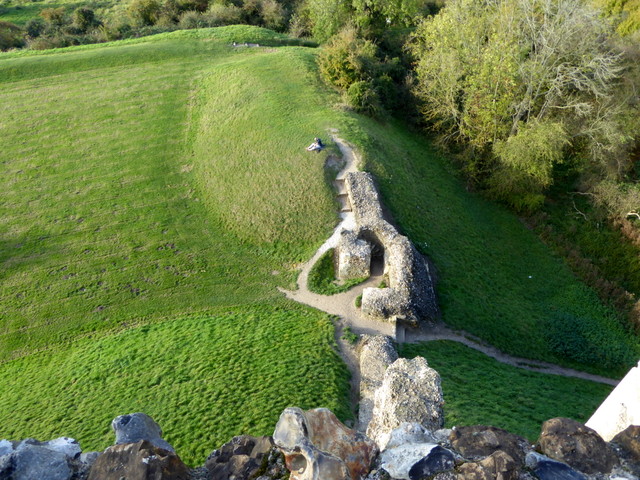
Just outside the curtain wall and built at the same time, is the Lower Court. It was walled on all sides and was defended by two towers. It may have originally housed granaries, barns or stables.
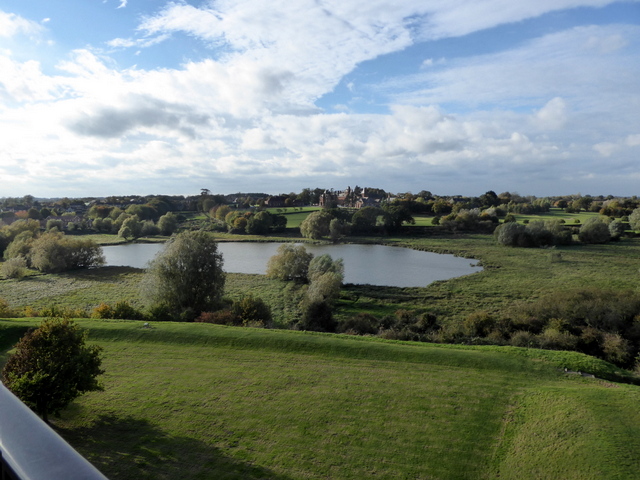
Framlingham Mere and beyond it, behind the trees is Framlingham College.
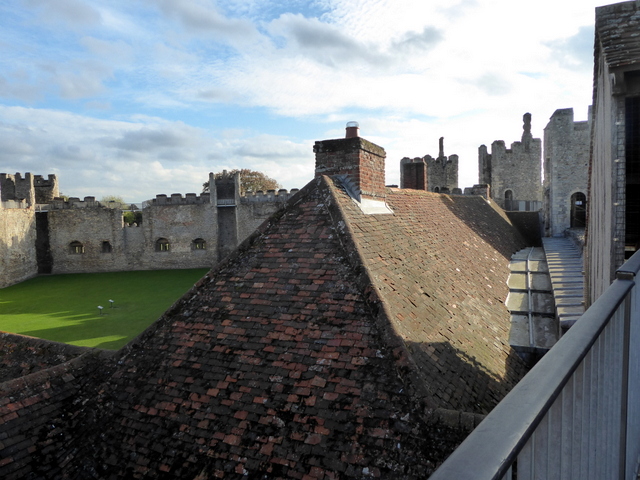
The roof of the Poor House
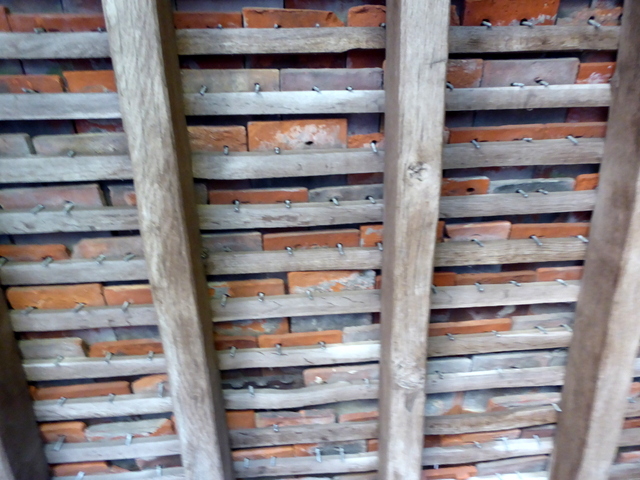
The underside of the roof . You see how the slates are attached to the rafters.
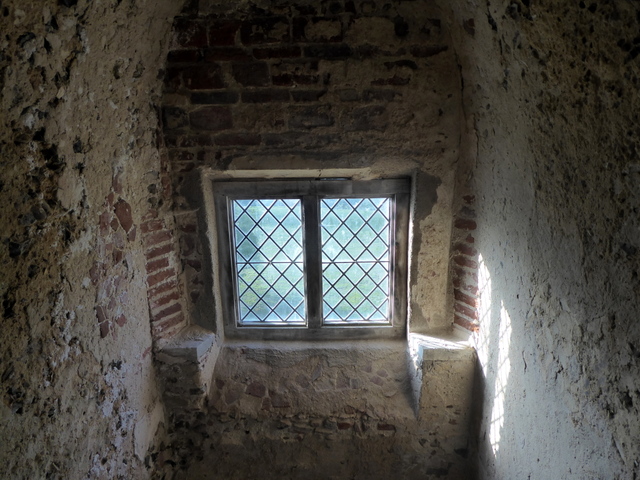
One of the windows in the Poor House
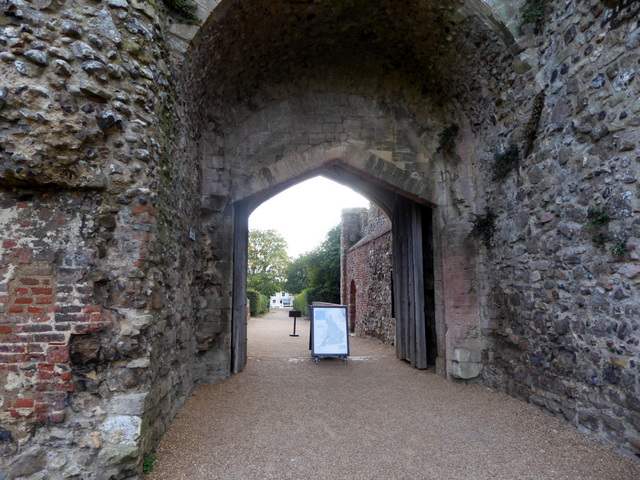
The Gatehouse as we left the castle
We enjoyed our short visit to the castle and went next to the church which I will talk about in another post.
The singer Ed Sheeran, who grew up here, has brought many more visitors to the town than it had before. Here is his recent song, ‘Castle on the Hill’ which talks about the time he lived in the town. The young people acting in the video are members of Framlingham College.
Thanks for visiting!
 A Suffolk Lane
Another place to add to my ‘must visit’ list. Maybe not by public transport though …..
LikeLiked by 2 people
I wouldn’t recommend going by bus! I’m sure you have similar problems where you live…
LikeLike
A fascinating account Clare. Framlingham is a lovely little town. The church has many treasures but I have not yet been inside the castle – I plan to soon.
LikeLiked by 1 person
Thanks very much, Reggie. The church certainly is worth a visit. The castle is shut for the winter now and not re-opening until Easter.
LikeLike
A most interesting tour of the castle, I loved the stone heads that they have repositioned. Thanks for all the photographs giving us such a good idea of what there is to see.
LikeLiked by 1 person
Thank you very much, Susan. Those heads are wonderful, aren’t they?
LikeLike
Ah, Clare, I have been sitting (not literally) on my photos of Framlingham – one of our great castles and churches – not got round to featuring either yet. Your post is so comprehensive – loved it, as usual, accompanied by your wonderful photos. I completely missed those stone heads – aren’t they wonderful? I’d heard about the slide/chute – not sure how I feel about our castles being turned into fun fairs, but I guess it at least helps ensure they’re used!
LikeLiked by 1 person
Thanks very much, Mike. I look forward to your impressions of the castle and church. I loved the stone heads and am pleased they have been incorporated in the building and not on display in a museum. I believe the chute is no more. It was only there for the duration of the building works to give people ‘something to do’.
LikeLiked by 1 person
What a wonderful place to visit, I’ve only heard the name in passing but really enjoyed your history and pictures :). The chute seems like a strange thing to add to the castle, is that like a slide for people? Did anyone use it? It’s not the sort of addition I’d expect in a castle! Lol 🙂
LikeLiked by 1 person
Thanks very much, Cat. The chute (yes, it’s a slide!) was only at the castle while the repairs were being made. It was very popular during the summer. It gave people something to do as the wall walk was out of action. The poor house was being done up and so there were no displays to look at either. 🙂
LikeLiked by 1 person
A fascinating and comprehensive tour of the castle, Clare. Of particular interest were the ornamental chimneys, an item which is popular in Christchurch post earthquakes. As for Ed Sheeran, I hadn’t realized there was a real castle behind the song. And your bus schedules seem to be on a par with ours!
LikeLiked by 1 person
Thanks very much, Anne! How interesting and surprising that you have ornamental chimneys in Christchurch now! Not something I would have expected at all! It’s a sad state of affairs when we are supposed to be reducing our use of cars and using public transport only to find that there is no public transport to use – at least not in rural areas!
LikeLiked by 1 person
Oh I do agree about the public transport. I live near a railway line which is only used for freight trains now. If only I could walk to the railway line and get a train into town; it would be so easy. But, no, apparently it’s too expensive to run a passenger service! Sigh.
LikeLiked by 1 person
Big sigh! What a disappointment!
LikeLiked by 1 person
An excellent, comprehensive, tour. Fascinating history. Great song. You are a very good advocate for mobile phone photography.
LikeLiked by 1 person
Thank-you very much, Derrick. Actually, I didn’t use my mobile phone for this post. I have a point-and-shoot Lumix which is not too bad a camera for someone like me with very little skill in photography!
LikeLiked by 1 person
My sister-in-law has a Lumix. Very impressive.
LikeLiked by 1 person
What a remarkable history! I’ve read about this place, but never visited, so I thank you for the tour. I’d forgotten that two of Henry’s wives shared an uncle who schemed to get them married to Henry, then betrayed them. And how interesting that a poorhouse was built on that land, after all that high drama.
LikeLiked by 1 person
Thank-you, Cynthia. I think Sir Robert Hitcham was a very astute gentleman and knew exactly what he was doing when he asked that a poorhouse should be built in the castle grounds. The Bigods and the Howards had great wealth and power and continuously strove to accrue more; it was fitting that the weakest and poorest in the town should find food and shelter in their castle. It was a pity that arguing and wrangling meant that the building of the poorhouse was delayed for more than seventy years. The poorhouse was only in use for about a hundred years and was superseded by the dreadful workhouses of the 19th and early 20th centuries. The Dukes of Norfolk don’t cause trouble these days! They have always been of the Roman Catholic faith and the 15th Duke provided the funds for the construction of the Roman Catholic Cathedral in Norwich during the 19th century.
LikeLiked by 1 person
Very interesting, Clare. Thanks for telling me this.
LikeLiked by 1 person
After a difficult journey you seem to have made full use of your visit to this amazing castle. Thank you for such a detailed and well illustrated account. All credit to English Heritage for looking after this historic place so well.
LikeLiked by 1 person
Thank-you very much, Richard!
LikeLike
You’re an amazing tour guide, Clare. Thank you so much for taking us along on your excursion. Great song too! I hope Richard is feeling better. xo
LikeLiked by 1 person
You are very kind, Jill – thank-you! Richard is completely better. He passed the cold on to Elinor and me and the day after our trip to Framlingham found us all croaking and sneezing! 😀 (We are all fine now xo )
LikeLiked by 1 person
I’m glad to hear you are all well. 🙂
LikeLiked by 1 person
What a lot of luminaries and scoundrels have been connected to the castle over the years! This was fascinating and your photos are great! I’d love to visit this one day.
LikeLiked by 1 person
Thank-you, Kerry. Yes, the castle has had it’s fair share of ‘interesting’ people associated with it. Many of them were absolute stinkers! It’s a peaceful spot now and the views from the top of the wall walk are spectacular. I couldn’t do them justice.
LikeLike
Hello lovely Clare, I hope Richard is feeling much better now? Thank you for this visit, it lifted my lunch break. Hugs and much ❤ xXx ❤
LikeLiked by 1 person
Thank-you so much, my dear Jane ❤ Richard is perfectly fine now I'm pleased to say. Hugs and ❤ are winging their way to you xxXXxx
LikeLiked by 1 person
❤ xXx ❤ always
LikeLiked by 1 person
Wow, what a place! If I ever come to England…Hope Richard is feeling better.
LikeLiked by 1 person
Thanks very much, Laurie. Richard is fully recovered I’m glad to say.
LikeLiked by 1 person
Thank you for the wonderful tour and history lesson, Clare! If castle walls could talk, what a story they would tell! And thank you for the introduction to Ed Sheeran, too. Lovely song! 🙂
I hope Richard is feeling better. Stay well.
LikeLiked by 1 person
Thank-you so much, Lavinia. Framlingham was certainly a very important place for some centuries. It is very quiet and peaceful now and a lovely place to visit. I am pleased you liked the song. Richard is fully recovered now, thank-you.
LikeLiked by 1 person
A gascinat
LikeLike
A fascinating read. I do love history…. I wish the castle hadn’t been neglected and then partially pulled down, as it would have been brilliant to see it whole. Still, as commenters have said, your photos show us a great deal.
You’ve really got to be dedicated to use public transport sometimes, haven’t you. I looked up something similar recently and discovered the hour and a half car journey would have become a five hour train, bus and foot trek.
LikeLiked by 1 person
Thank-you, Helen. I have always been disappointed that the buildings inside the castle walls were destroyed but from what I read they were in a terrible state and people in the 17th century weren’t as sentimental about old buildings as we are now.
My goodness! Your public transport journey would have been worse than mine! I would like to use public transport more but it is virtually impossible at present. Most of the buses near here only run once a week!
LikeLike
Once a week!! That’s no service at all.
LikeLiked by 1 person
I know!
LikeLiked by 1 person
What an excellent castle. Your trip was worth the delays in driving in my view.
LikeLiked by 1 person
Thank-you very much, Tom.
LikeLike
That’s quite a place!
I couldn’t help wondering if some of my ancestors were imprisoned there when it was used as a prison. They were jailed for being Catholic sometime between 1605-1608 if I remember correctly. Being jailed and harassed due to their religion is what eventually drove them here in 1638. (I don’t expect you to be able to answer that. I’m just thinking out loud.)
The thickness of the walls is amazing. I don’t imagine that much light came in through the windows but I’d guess that is why it still stands.
I’d love to see it in person some day.
LikeLiked by 1 person
Thank-you very much, Allen. Religious intolerance – any kind of intolerance – is a most unkind and damaging thing. It would be interesting to see if there was any kind of record to say where your ancestors were incarcerated. I don’t think Framlingham was the only place in the country that was a prison for Roman Catholics at that time.
I don’t think much light came in through those windows, especially during the winter but then I think they were more concerned about being attacked by enemies! Perhaps the side of the building facing into the courtyard had larger windows? We will never really know as the buildings were destroyed so long ago.
LikeLiked by 1 person
So sorry to hear about Richard – hope he starts to feel much better soon. And what a fantastic place Framlingham looks to be – worth a 4+ hr bus trip lol! 🙂
LikeLiked by 1 person
Thank-you Liz. I am grateful I have a car and don’t have to rely on our bus service! 😀 Richard is completely recovered now, thank-you. He passed his cold on to Elinor and me so we have all had it now!
LikeLiked by 1 person
Nothing like sharing all things ‘en famille’ is there! 🙂
LikeLiked by 1 person
😀
LikeLike
The castle itself is very interesting, much like what I imagine when I think of an English castle. That’s probably due to the look of castles that I’ve seen in the movies though, as I’ve never visited a real castle.
Even more interesting was the history of the ownership of the castle, and the way that it changed hands over the centuries based on the power struggles between royalty and family factions. As some one who grew up in the US and knows no other form of government, it all seems a little strange to me in many ways. I do thank you for the wonderful tour and the history lesson included.
LikeLiked by 1 person
My pleasure, Jerry and thank-you so much for your thoughtful comment. I would find it very unnerving living in those past times too. I am grateful for our democratic parliament and government and I am also a royalist and am pleased we have a Queen as head of state. Things might be a little uncomfortable at present but at least we are a fairly peaceful and ordered nation these days!
LikeLiked by 1 person
I can only imagine all the events that have taken place in that castle over its long life. Thank you for sharing.
LikeLiked by 1 person
My pleasure and thank-you.
LikeLiked by 1 person
Nice song by Ed Sheeran. I can’t imagine growing up near some of the monuments and ruins you English live near to! Such views!
I was sorry to hear about Norfolk, since he always seems portrayed favorably in films and novels about St. Thomas More. 🙂 Now, I have a dilemma: should I like him, or not?
LikeLiked by 1 person
I think, as with all historical characters, it depends from what stand-point you are looking at them. Norfolk was a good and loyal Roman Catholic, he was a brilliant politician, intelligent and he tried to do his best to be loyal to his monarch – an extremely difficult thing to do at times. He also was a schemer, and power-hungry and betrayed others to save his own skin. He was a man of his times, and his times were brutal. I think you should carry on liking him. Queen Mary I approved of him!
LikeLike
I do love a castle and we’re lucky to have so many. This one looks particularly interesting and has some fascinating history – thank you for taking me on a tour Clare.
LikeLiked by 1 person
My pleasure, Andrea and thank-you.
LikeLiked by 1 person
So fascinating! Your research is so in-depth, as always, and your photos are fantastic! I really enjoyed this.
LikeLiked by 1 person
Thank-you so very much for your kind comment, Sheryl!
LikeLike
Hi Clare, great views! One photo in particular made me feel a little queesy – looking down into the ditch.
We are so lucky to have frequent buses in london and the tube. Out in the country public transport has just got worse and worse. I wonder if you’d have been able to get back home again?
LikeLiked by 1 person
Thank-you very much, Rachel. It is definitely a long way down from the top of the wall-walk to the bottom of the ditch!
I also wondered if I’d been able to get home!
LikeLiked by 1 person
Yes, you can get home on the same day next week. 🙂
One of my brothers-in-law has the same problem with going to Ipswich – there’s one day when he can travel in but there is no return service.
LikeLiked by 1 person
Haha! Yes! You just sit on the bus and go straight home again if you’re lucky!
LikeLiked by 1 person
I lived in a number of places that had three buses a day – fortunately I never had to use them. 🙂
LikeLiked by 1 person
🙂
LikeLiked by 1 person
🙂
LikeLiked by 1 person
What lovely photos I love going to places like this, the lady that looked after us in some of the school holidays had a National Trust pass so we used to go exploring a lot and my little brother is a history boff so my parents always had to take us to places Tom had read about.
LikeLiked by 1 person
Thank-you very much, Charlotte. I never had the chance to visit castles when I was young so I’m trying to see as many as I can now!
LikeLike
Clare, a wonderful post bringing a wonderful sense of history to the photos and your visit! Framlingham has a special aura and the views from the walls are beautiful. Reading this brought back memories of my trip there in March…it is a bit tricky to get to and impossible on public transport! We were tempted to use the chute down but our teenage son glared in disapproval – not cool! I hadn’t realised that the people in Ed Sheeran’s video of ‘Castle on the Hill’ were from the local college…great idea and I love how he feels about this place. I look forward to coming back here in the Spring.
Wishing you a lovely week. ❤️😃
If you’re interested my post about Framlingham is here… https://annikaperry.com/2017/03/12/perfume-of-the-mountain-grass/
LikeLiked by 1 person
Thank-you very much for your lovely response, Annika! You made me laugh when you mentioned the chute and your son’s disapproval! Our younger daughter is now 20 and she still objects to our ‘bad’ behaviour! I am so pleased you provided a link to your Framlingham post; we didn’t have time to walk round the outside of the castle or get nearer to the mere.
I wish you a lovely week too ❤ xx
LikeLiked by 1 person
Wonderful tour of the castle. Loved the stone heads, particularly the headdresses. I’ve been meaning to visit for 40 years and never quite made it! 🙂
LikeLiked by 1 person
Thank-you, Simon. Those heads are fantastic and wonderfully un-weathered. There is another one but the photo I took was completely out of focus!
LikeLiked by 1 person
Yes, the best ones always seem to be out of focus when you get home. 🙂
LikeLiked by 1 person
🙂
LikeLiked by 1 person
Wow, you really outdid yourself with this post! I truly enjoyed every bit of it, including the history part. I adore a great history lesson!
Your word and pics put together a wonderful visit, and the video by Ed Sheeran – Castle On The Hill was fabulous…. a perfect ending to this post! Thank you, Clare!
LikeLiked by 1 person
Thank-you so much for this lovely comment, Resa!
LikeLiked by 1 person
Wow that is awesome. What a stunning place. Those steps look deadly though!
LikeLiked by 1 person
Thank-you very much, Ari. The steps are a bit scary!
LikeLiked by 1 person
I love castles and places like this that have somehow survived for centuries. Those stairs do look scary, but the beautiful views look like they’re worth it. I love the dry ditches too. It’s so easy to imagine knights and horses trotting around there.
LikeLiked by 1 person
Thank-you, Sheila. Yes, the views are worth the climb up the stairs and the countryside has changed very little in the last 600 years. It is really easy to imagine what it was like living there during the Middle Ages.
LikeLiked by 1 person
What a WONDERFUL post to stumble upon! It has been a joy to read and I have learned much from it – thank you.
LikeLiked by 1 person
My goodness! What a lovely comment, Anne – thank-you!
LikeLike
My mother lives in Framlingham and so I visit frequently. I hadn’t noticed the medieval heads in the poorhouse wall before so thank you for pointing these out to me.
LikeLiked by 1 person
Thank-you very much. I can’t say I noticed the heads on the poorhouse wall before either. I may not have been looking (and it was some time ago we visited the castle) or perhaps they were recently put there during the improvement work . I cannot find any information on this.
LikeLike
I am a passionate lover of castles and this one seems remarkable, Clare. I am definitely adding the Framlingham Castle to my bucket list. The scenery there is so breathtaking. Is it a good place for hiking?
LikeLiked by 1 person
Thank-you very much, Agness! Framlingham Castle is well worth a visit because of the almost complete curtain wall and the views to be had from the top of it. It’s not a bad place for hiking. The scenery is not dramatic – gently rolling countryside which is mainly agricultural. Lots of attractive villages with (usually) a pub or café. There is another castle at Orford on the coast about 14 miles from Framlingham. Orford is just the castle keep, but is completely intact with lots of rooms and passageways.
LikeLike
Will certainly put this castle on the list as we are due to be in the Norfolk/ Suffolk borders for a family celebration in June.
LikeLiked by 1 person
It’s well worth a visit and children and adults alike enjoy it.
LikeLiked by 1 person