• About my Blog
  • GDPR (General Data Protection Regulations) and This Site
  • My Life in a Suffolk Lane

A Suffolk Lane

~ A diary of my life in rural north Suffolk.

A Suffolk Lane

Category Archives: churches

Spring Odds and Ends – March

26 Sun May 2019

Posted by Clare Pooley in churches, Gardening, plants, Rural Diary, trees, wild animals, wild flowers

≈ 83 Comments

Tags

blackthorn, blossom, Brown Hare, Bugle, cherry-plum tree, daffodils, daisy, Dog's Mercury, early dog-violet, flowers, garden, grape hyacinth, lesser celandine, leveret, March, Narcissus Rip van Winkle, Periwinkle, plants, pond, primroses, silver-laced primula, Spindle, St Mary's church Homersfield, Suffolk, Suffolk Lane, trees

Not having posted anything for over two months I have a number of photographs of things I’ve seen on my travels or in the garden.  This post will be a selection of these photos.
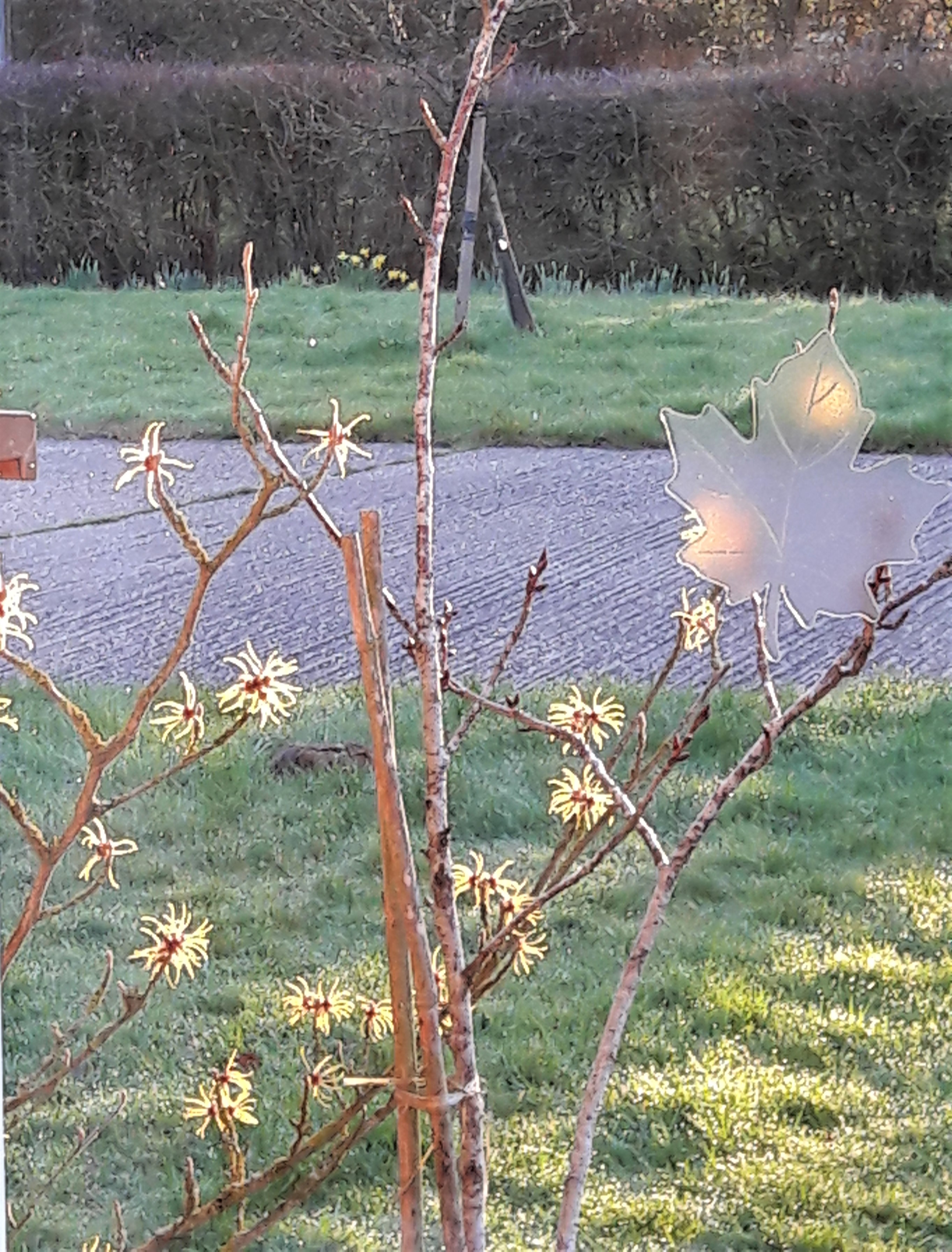
View from my kitchen window

This photo was taken with my phone early one March morning.  You can see the maple leaf sticker on the glass which works well at preventing birds from crashing into the window and injuring themselves.  Just outside the window is my witch-hazel which is planted in a large pot and also a Japanese flowering-cherry tree tied to canes, in a different pot.  We keep both trees up close to the front of the house to protect them from wind damage.  On the other side of our drive you can see the first of the daffodils in flower along the edge of the ditch.  What really excited me was the sight of a leveret, a young hare ( lepus europaeus), crouched in the grass.  Richard had had a sight of this young animal in the garden a couple of days before this and I was so pleased to see it for myself.
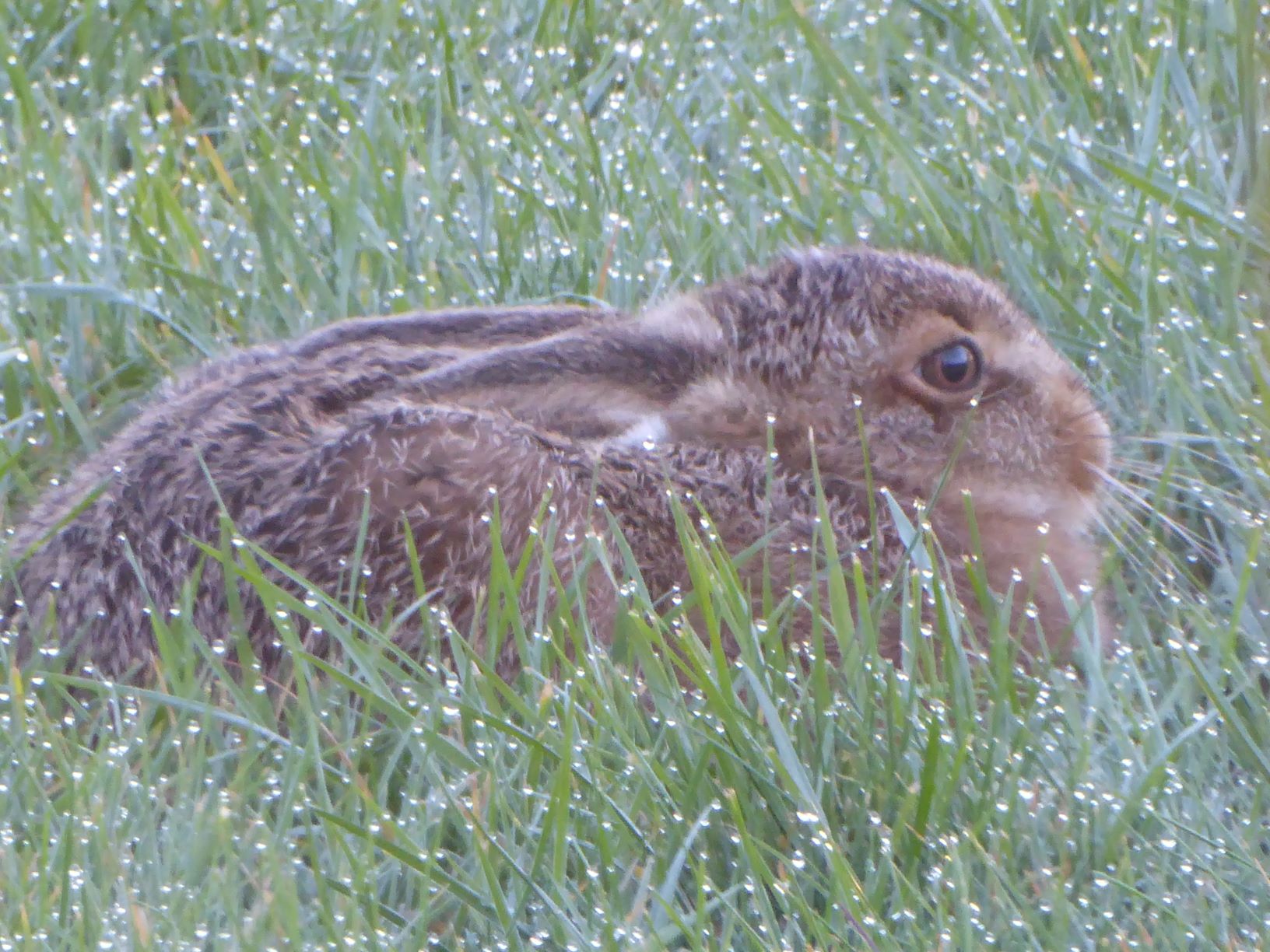
Leveret

I took this picture with my smaller camera from the utility room window and you can see how damp with dew everything was, including the leveret.  It stayed with us for a few days, hardly ever moving from its ‘form’, the nest in the grass it had made for itself.
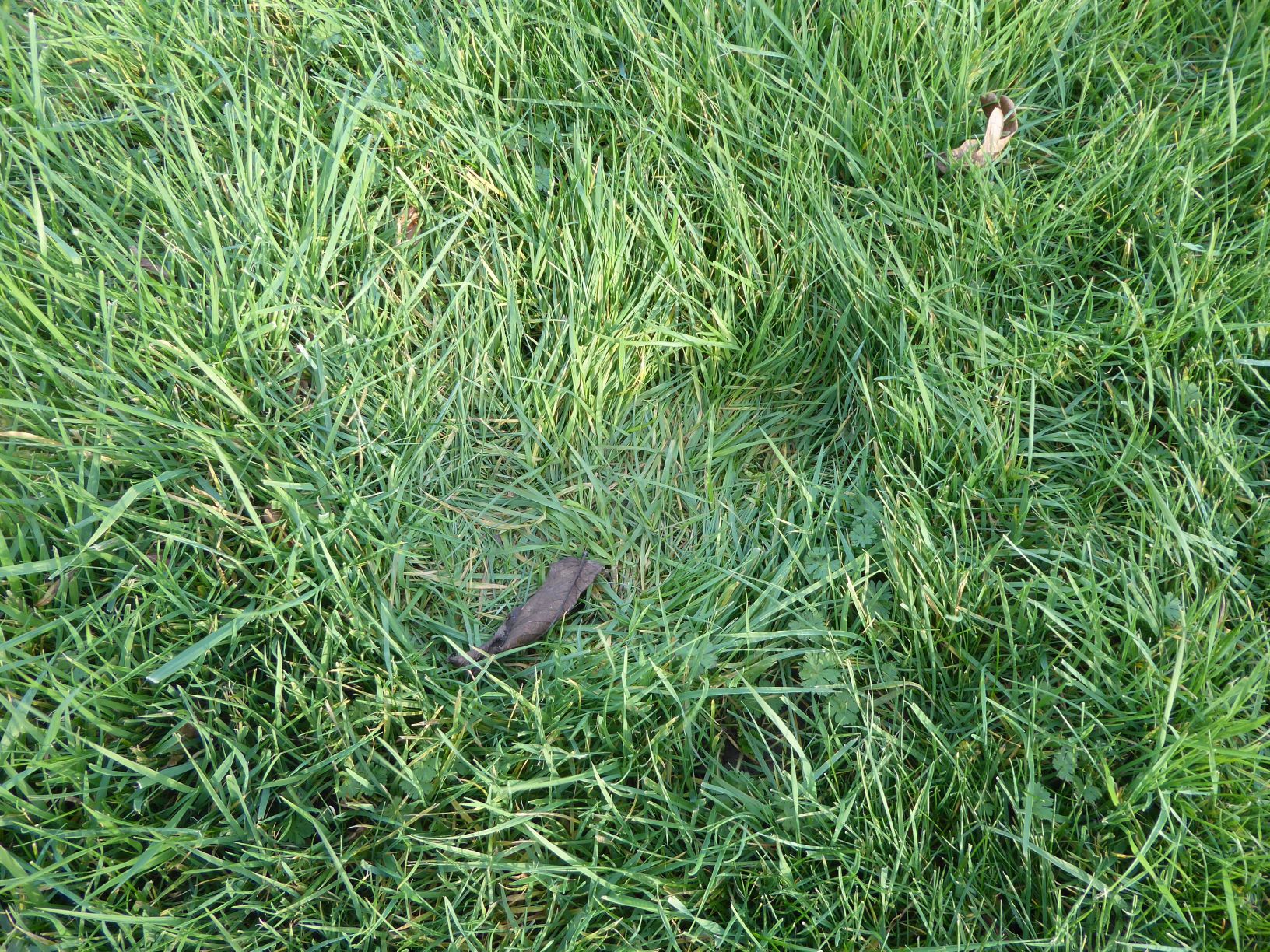
The leveret’s form
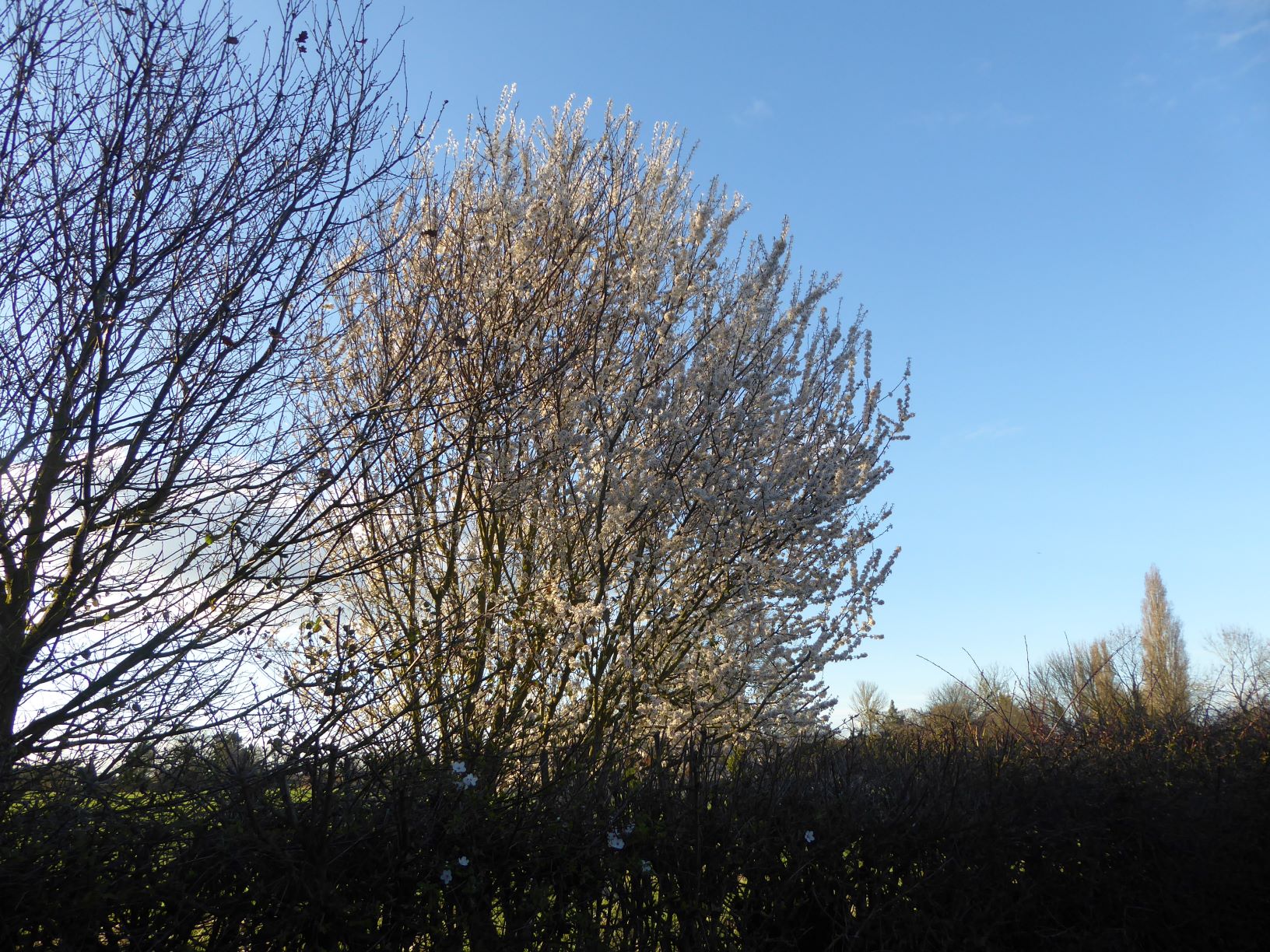
Cherry-plum tree (Prunus cerasifera )covered in blossom

When this tree first grew I assumed it was an early-flowering blackthorn tree as they can look very similar.  However, a few years ago I happened to see some of its fruit before the birds ate it all and realised my mistake.

cherry-plum blossom
cherry-plum blossom
cherry-plum blossom
cherry-plum blossom
cherry-plum blossom
cherry-plum blossom

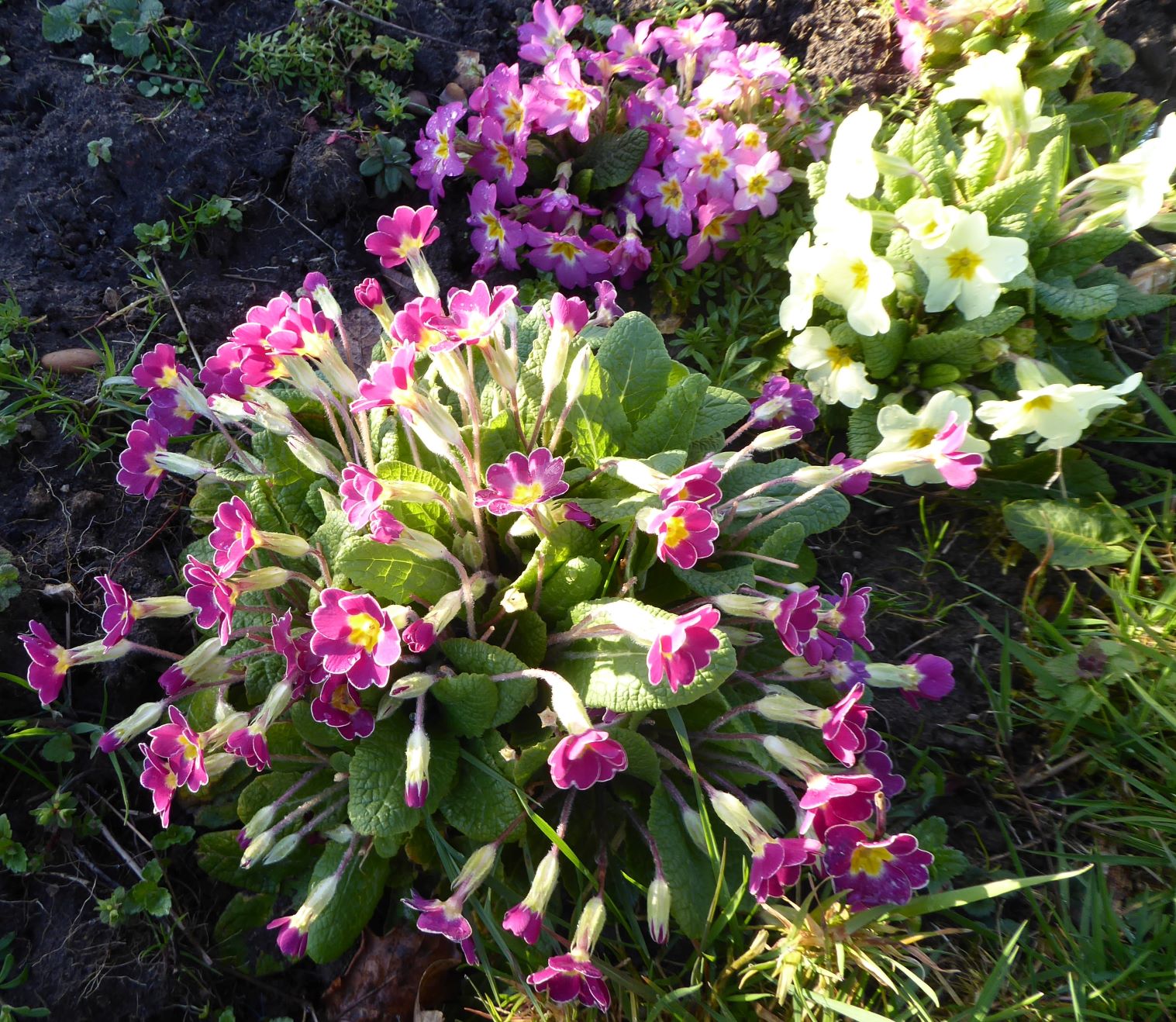
Silver-laced Primula

A year and a half ago I was trying to get rid of Common Nettle and Black Bryony in a flowerbed full of primulas and hellebores.  The only way to deal with them was to remove the plants I wanted before tackling the ones I didn’t.  I planted some of the primulas at the edge of a bed Richard grows dahlias in.  This March I was pleased to see that my treasured silver-laced primula had survived the move and two winters.  I still haven’t finished working on that weedy bed!  The Primula has a pretty silver edge to its petals.
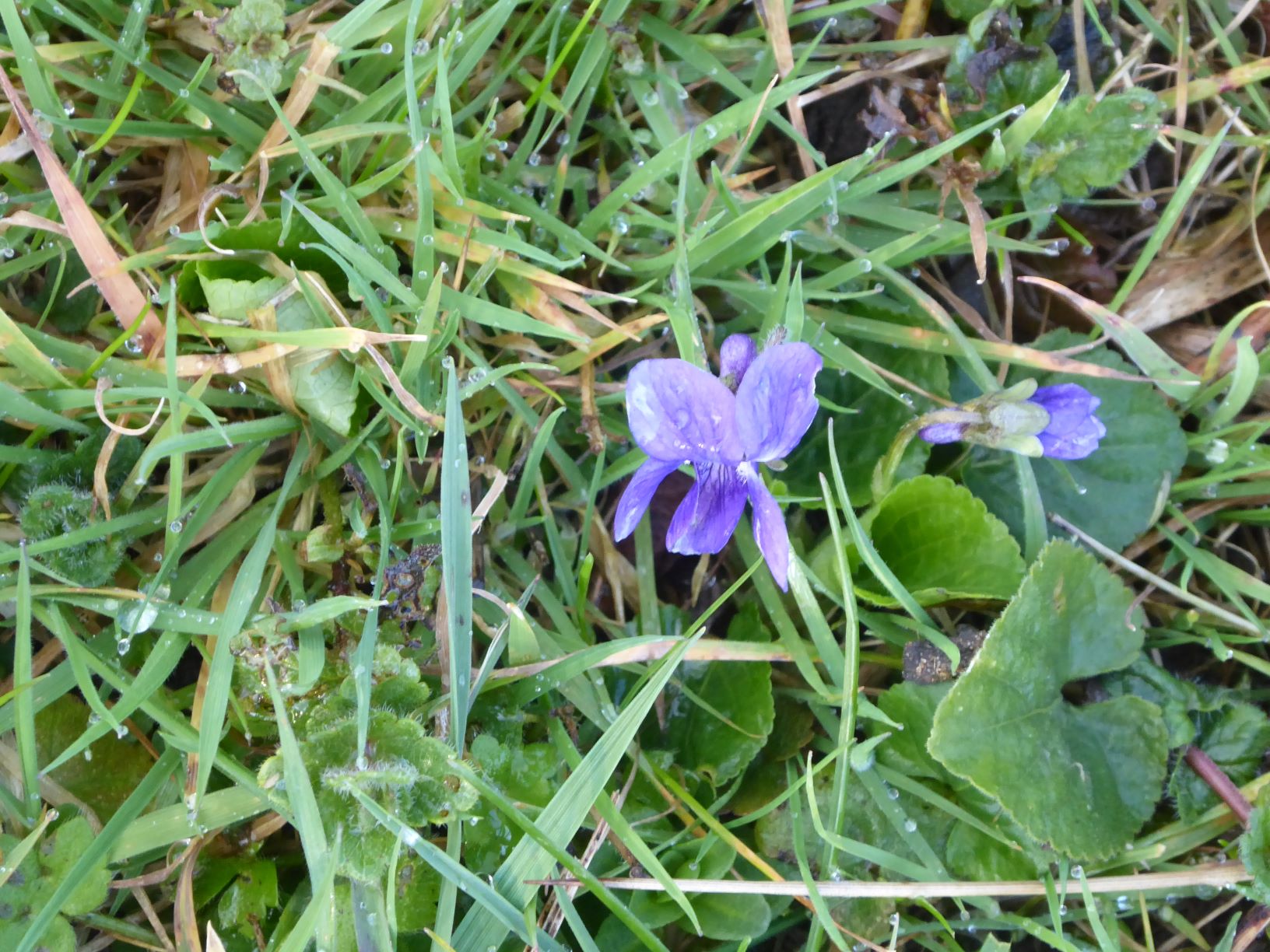
Early Dog-violet ( Viola reichenbachiana )

We have these early violets growing in the grass round our pond.

Large pond
Large pond
Large pond
Large pond

Our large pond in March.  The water-level is very low due to insufficient rainfall for a year.
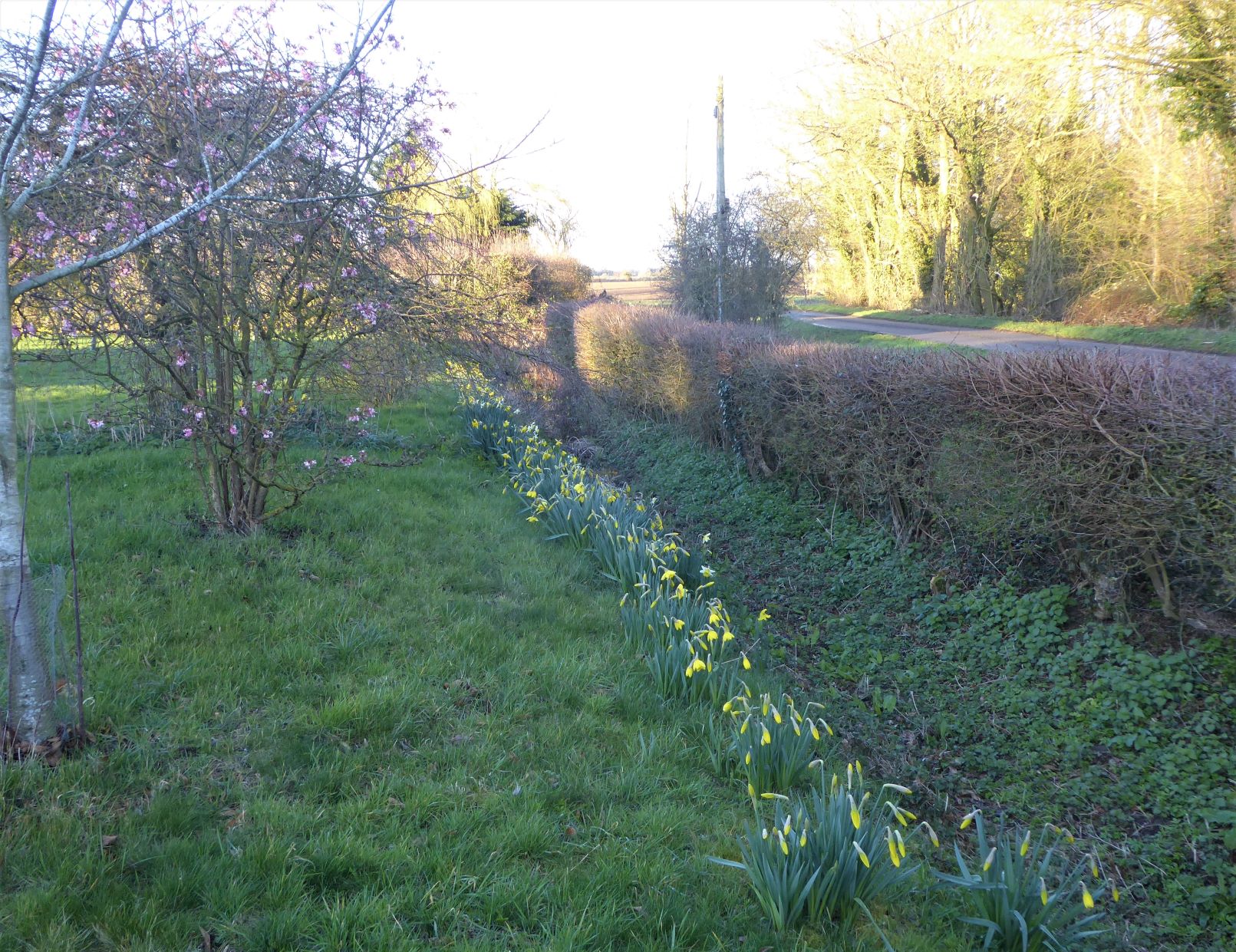
The front hedge and ditch

A week or two on from when the photo of the leveret was taken and the daffodils are all coming out.
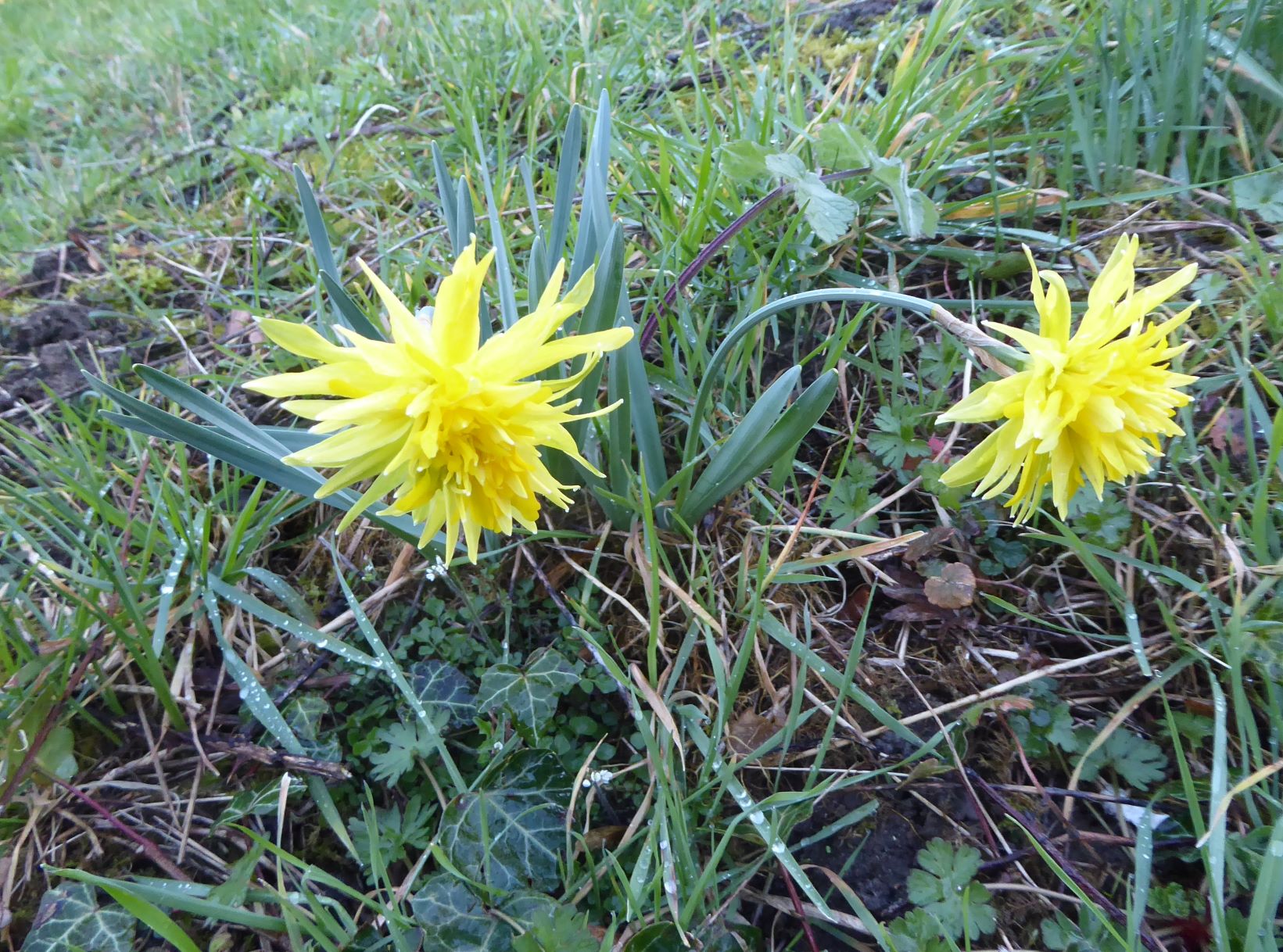
I love these little Narcissus ‘Rip van Winkle’!

Grape Hyacinth (Muscari ), Bugle (Ajuga reptans ), Variegated Lesser Periwinkle(Vinca minor ) and Spindle (Euonymous ) ‘Emerald n Gold’.

This is a very narrow bed alongside the rear of the garage next to the back door.  All the flowers are blue and two of the plants have variegated yellow and green leaves.  However, just to prove that nothing goes exactly to plan, the bed also contains a red-berried Firethorn ( Pyracantha) which has creamy white flowers; this plant was here when we moved here and the birds and bees love it.
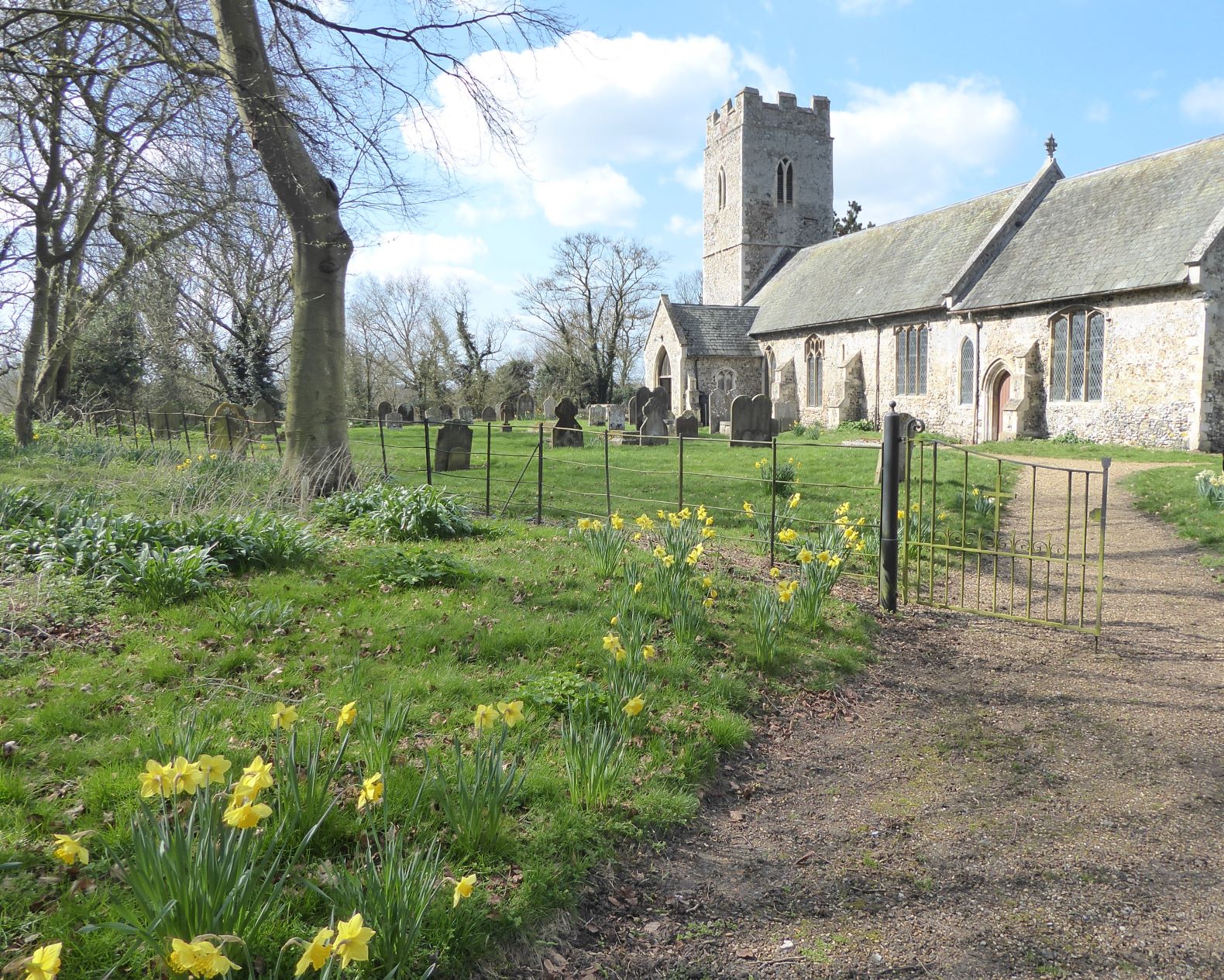
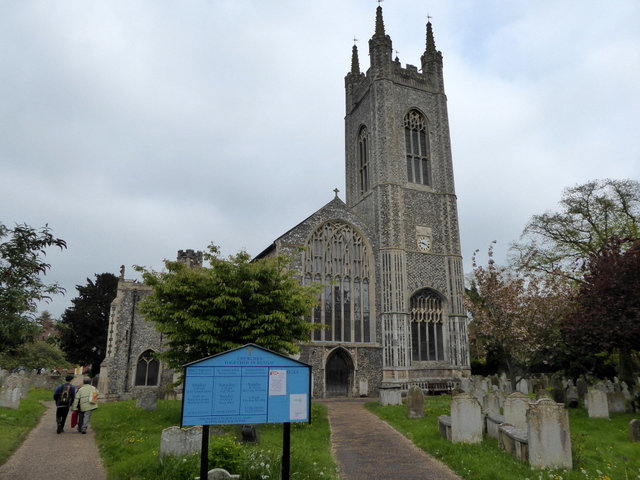
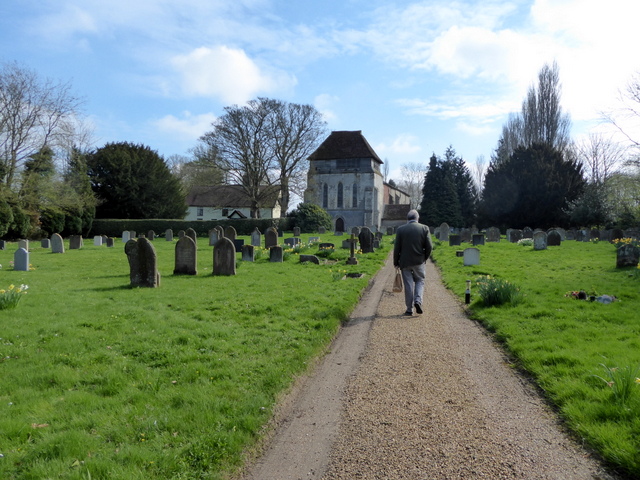
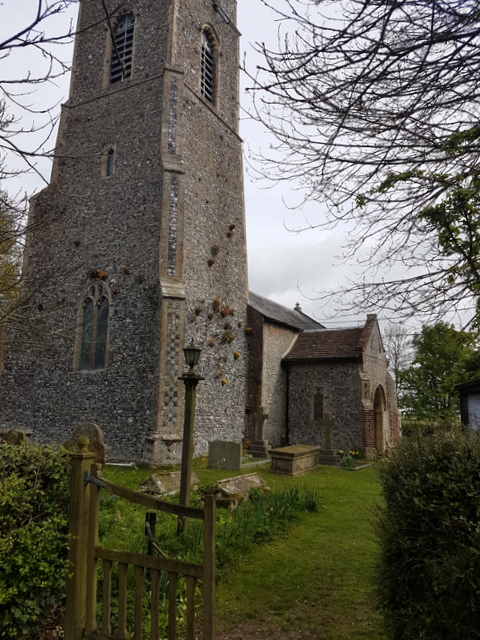
St. Mary’s church at Homersfield

We attended church here in March and I thought it looked lovely in the sunshine.
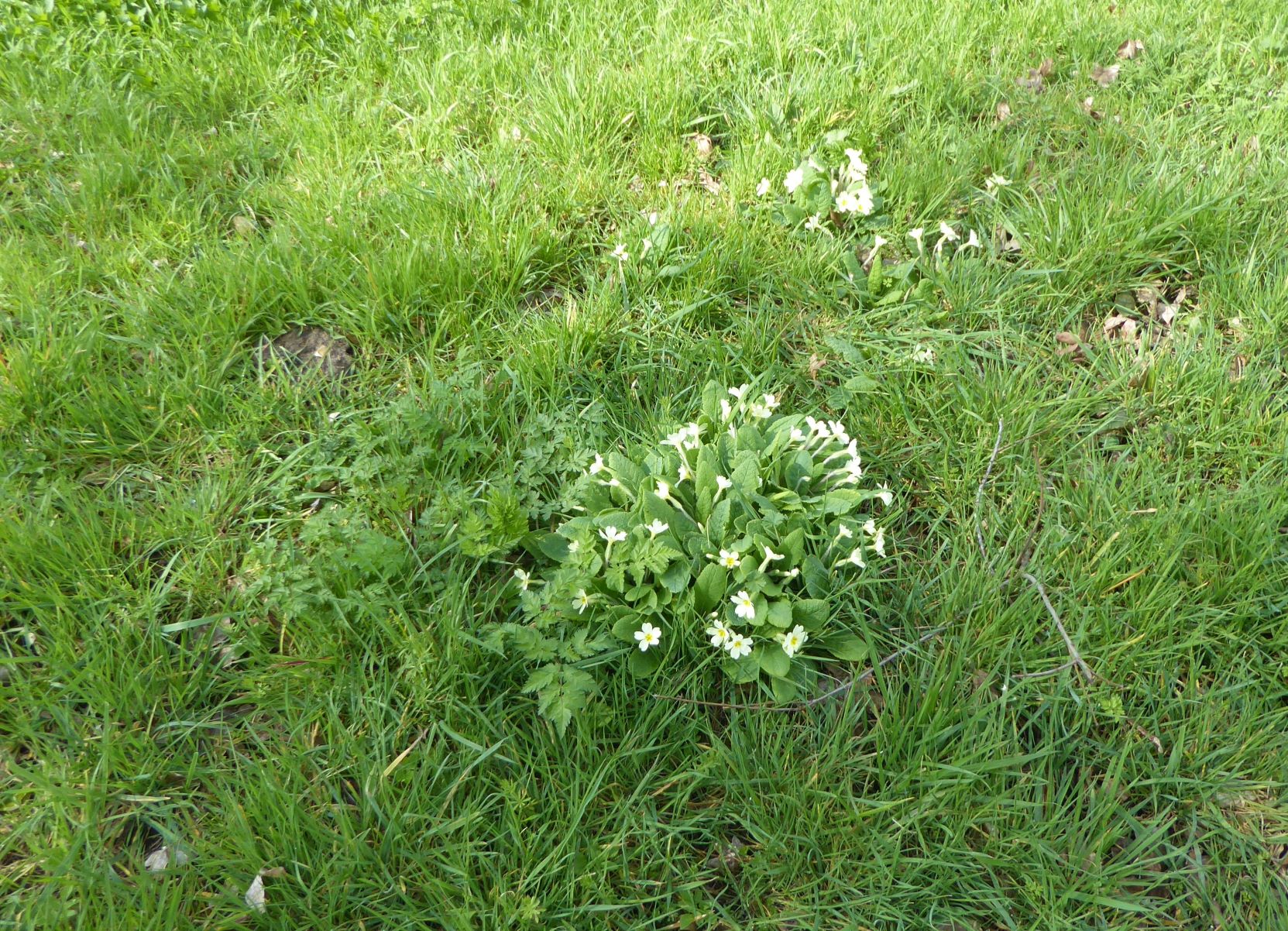
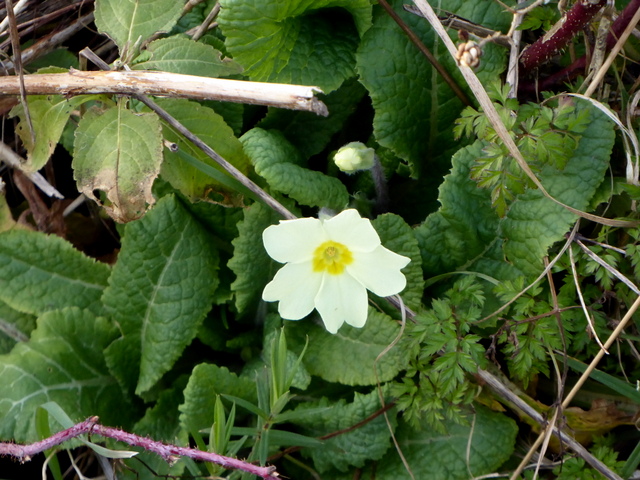
Primroses (Primula vulgaris )

That same day I walked round the garden and then out onto the verge next to the lane  beyond our hedge and found these primroses in flower.  Garden primulas are able to flower at any time of the year as long as it isn’t too hot or too cold.  Wild primroses, however, have their season and late March is the best time to see them round here.
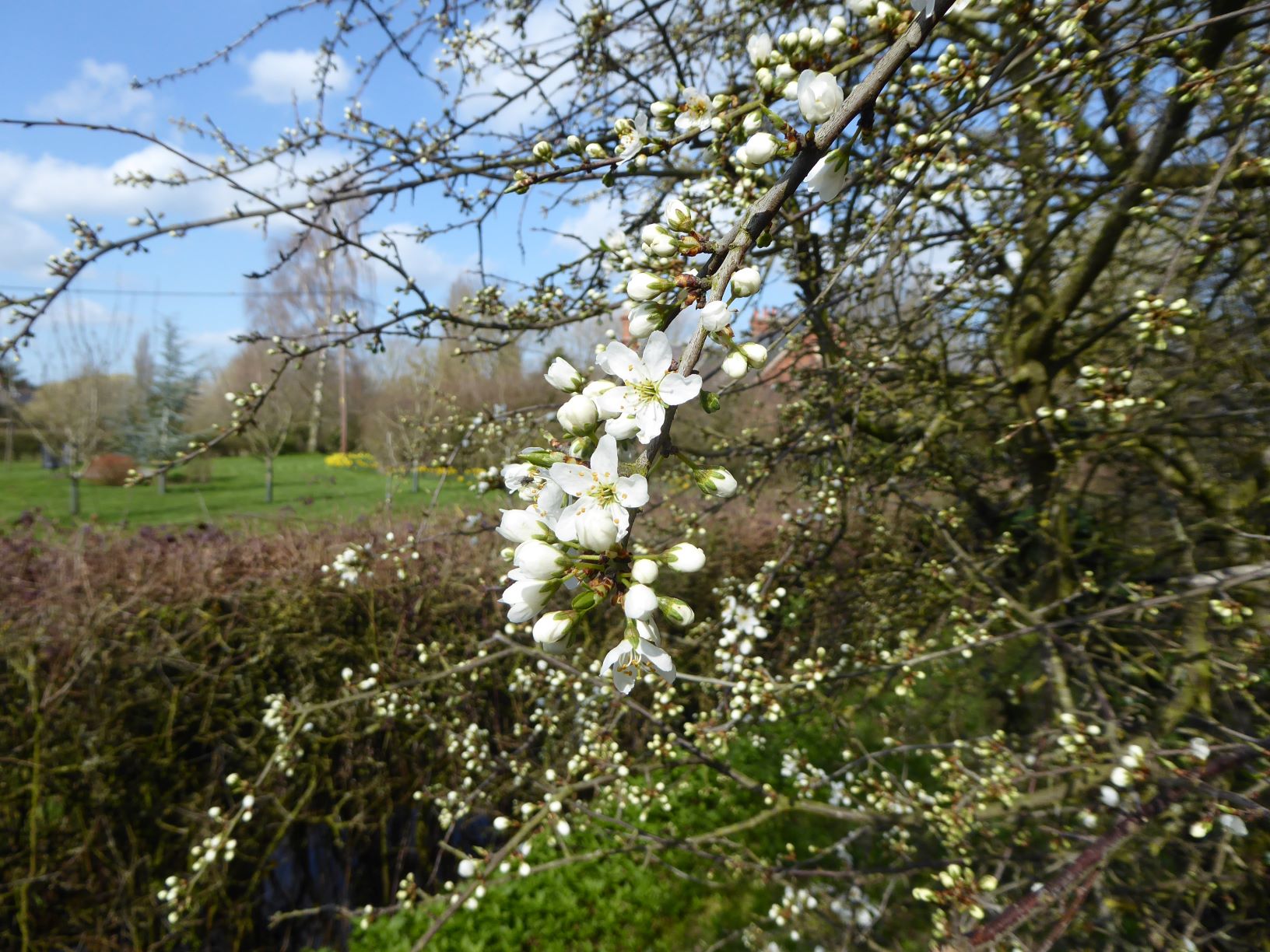
Blackthorn (Prunus spinosa )

There is a tangle of Blackthorn on the verge and it was just coming into flower.  You can see our garden over the other side of the hedge.
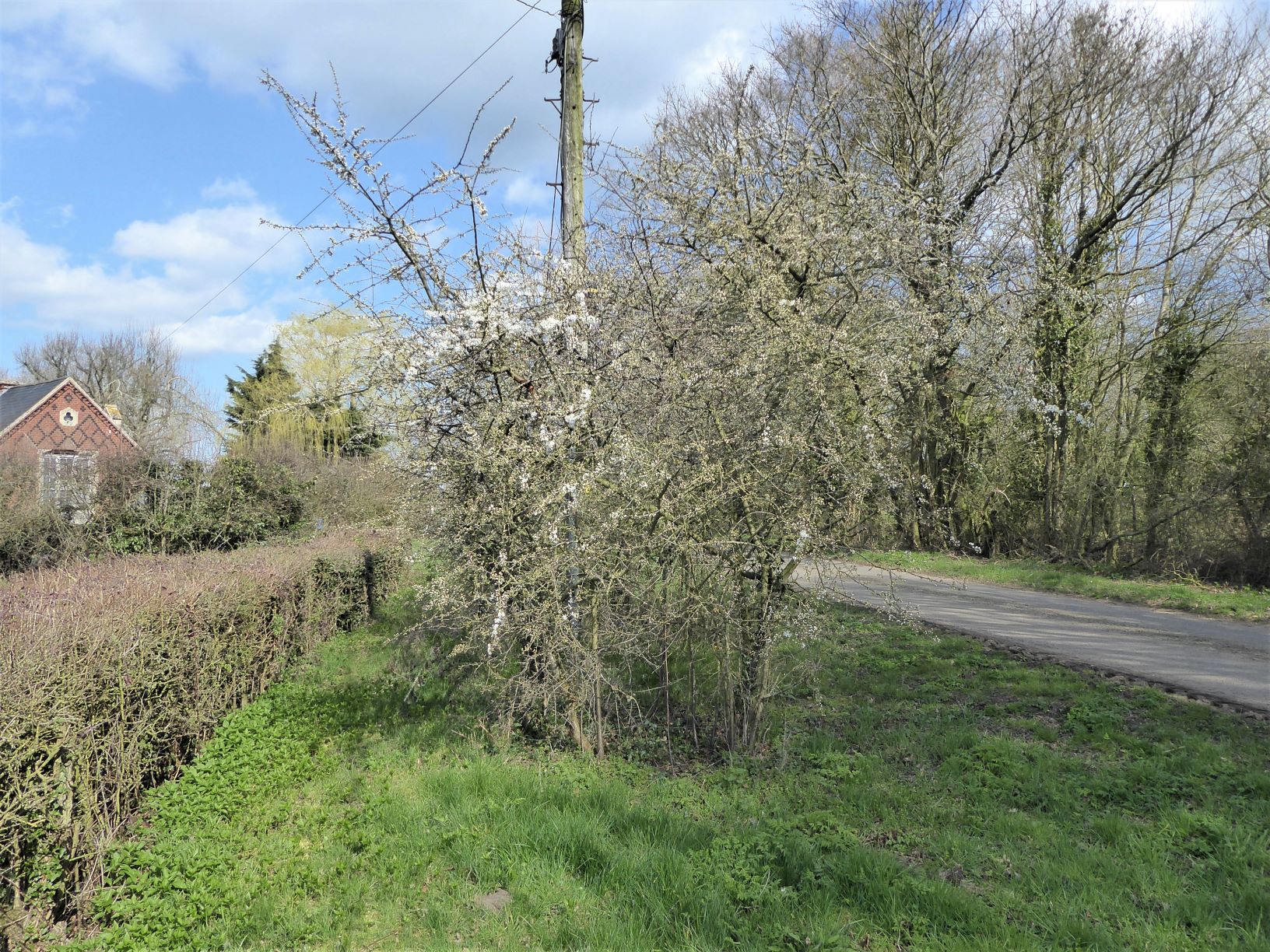
Here is the Blackthorn on the verge.

It is a very untidy tree with suckers but it has blossom like snow and the fruit (sloes) in the autumn are used for flavouring gin, among other things.

Dog’s Mercury (Mercurialis perennis )

We have this rather insignificant plant growing under all our hedges and in amongst the trees near the large pond.  It is often a sign of old woodland and won’t tolerate being disturbed; it fades away.  The male and female flowers are on separate plants.
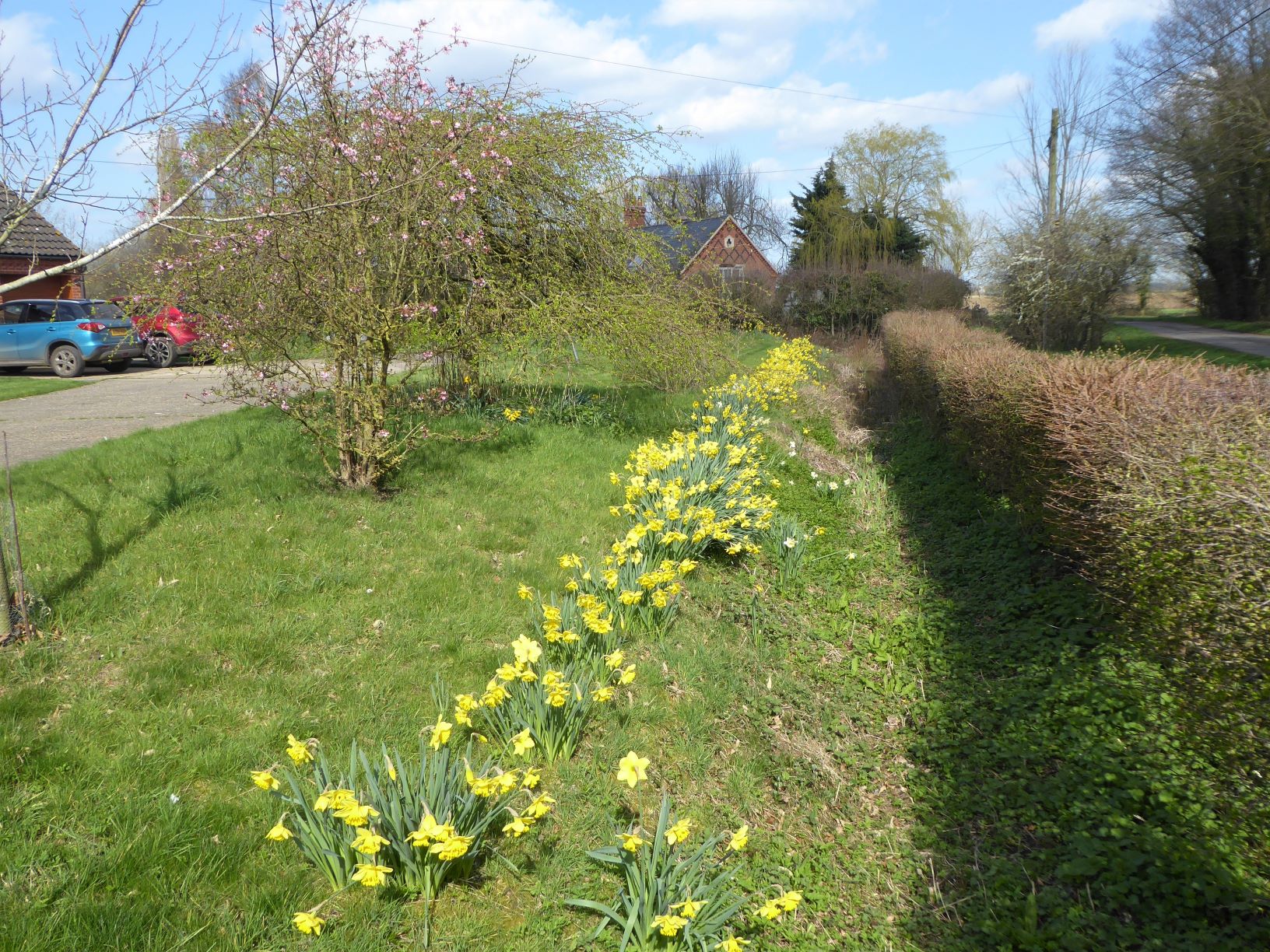
The daffodils at the end of March
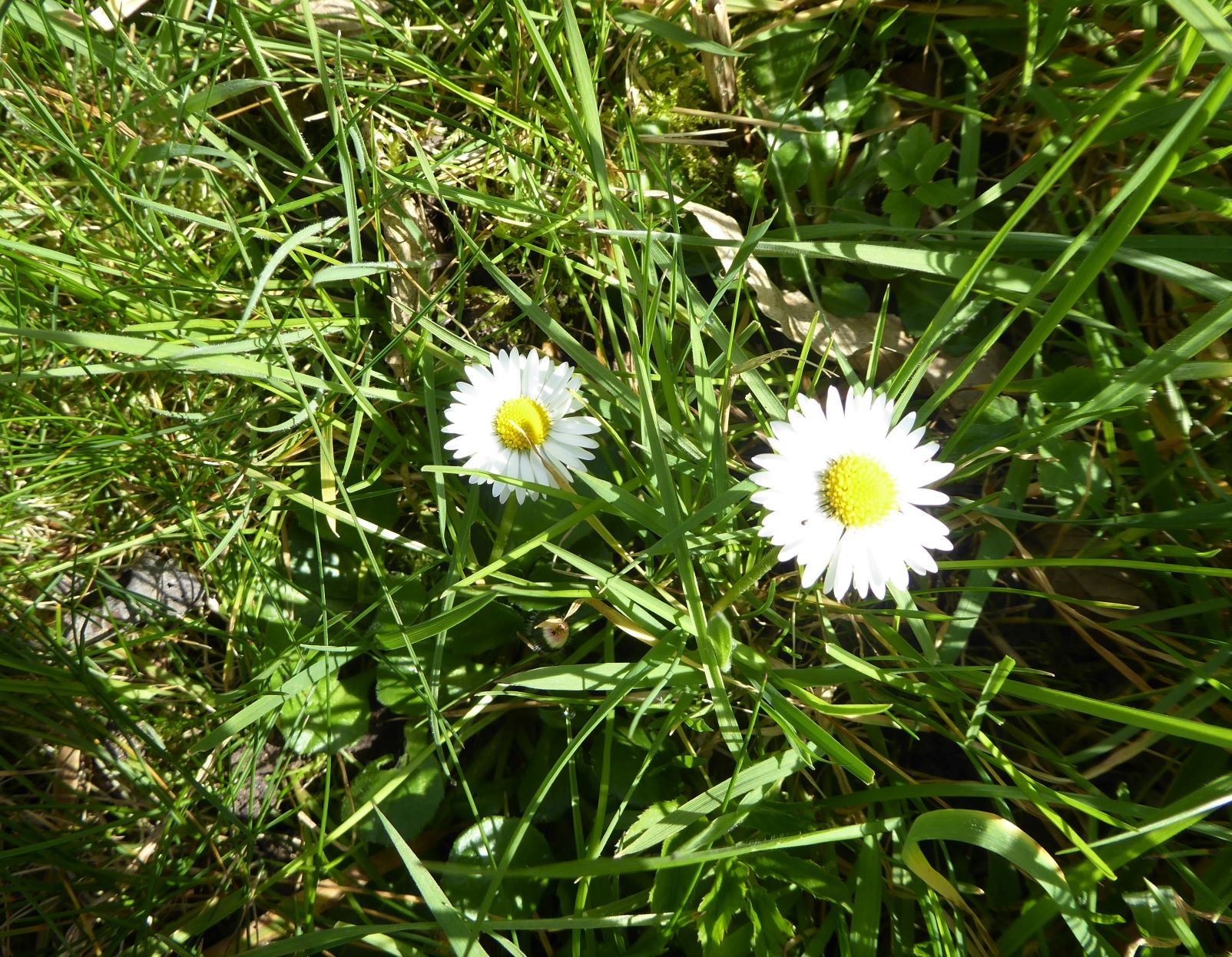
Daisy (Bellis perennis )
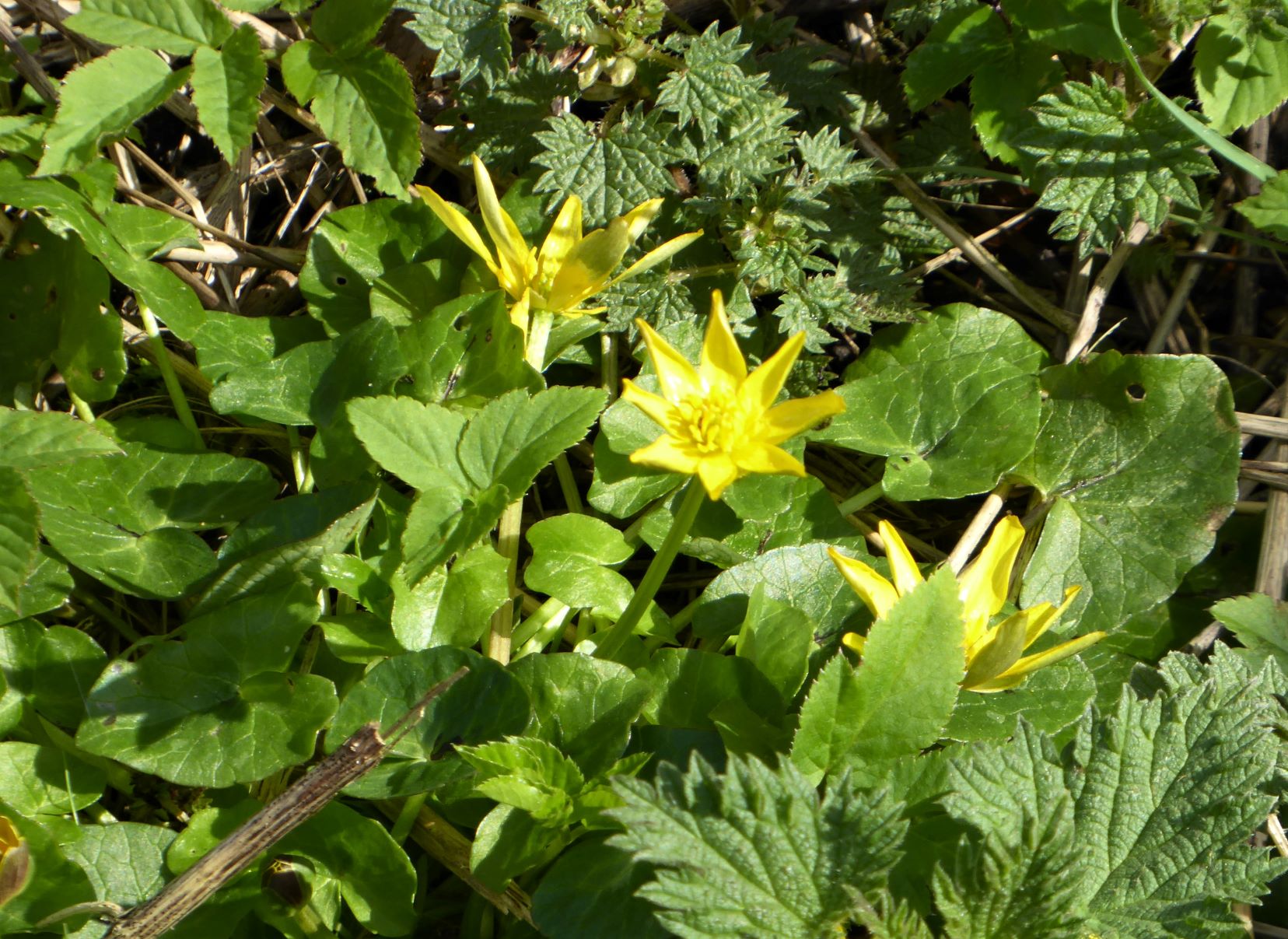
Lesser Celandine (Ficaria verna )

Here is this sunshiny little flower peeping out from inbetween Common Nettles and Ground Elder in the ditch.

These were the highlights of March this year.  I hope to begin an April post as soon as I have published this one.  Whether I’ll be able to finish it and publish it in the next day or so only time will tell!
Share this:

  • Share on X (Opens in new window) X
  • Share on Reddit (Opens in new window) Reddit
  • Share on Pinterest (Opens in new window) Pinterest
  • Share on Facebook (Opens in new window) Facebook
  • Email a link to a friend (Opens in new window) Email
  • Share on Tumblr (Opens in new window) Tumblr
  • Print (Opens in new window) Print
  • Share on LinkedIn (Opens in new window) LinkedIn
Like Loading...

A Walk at Iken

11 Mon Mar 2019

Posted by Clare Pooley in churches, Rural Diary, walking

≈ 61 Comments

Tags

estuary, Iken, River Alde, Roy Tricker, Saxon cross, St. Botolph's church, Suffolk, wading birds, walking

Three days after the walk we took round the lanes on New Year’s Day, mentioned in a previous post, Richard and I took ourselves off for another walk.  Elinor joined us.  We set off quite early as we needed to complete the walk before lunchtime; Richard had an optician’s appointment in the early afternoon in Halesworth and we had decided we would have lunch in a pub together before the appointment.

Iken is about twenty-four miles to the south of us and is a tiny village near the estuary of the River Alde and near the coast.  We have walked here a few times before but not for some time and never in the depths of winter.  The day was cloudy and raw, the temperature didn’t rise above 1 degree Centigrade all day ; a day when it would have been pleasant to have stayed at home and read a book.

The view of the Alde estuary through the trees at the edge of the car park.

There is a narrow pathway from the car park down to the estuary.

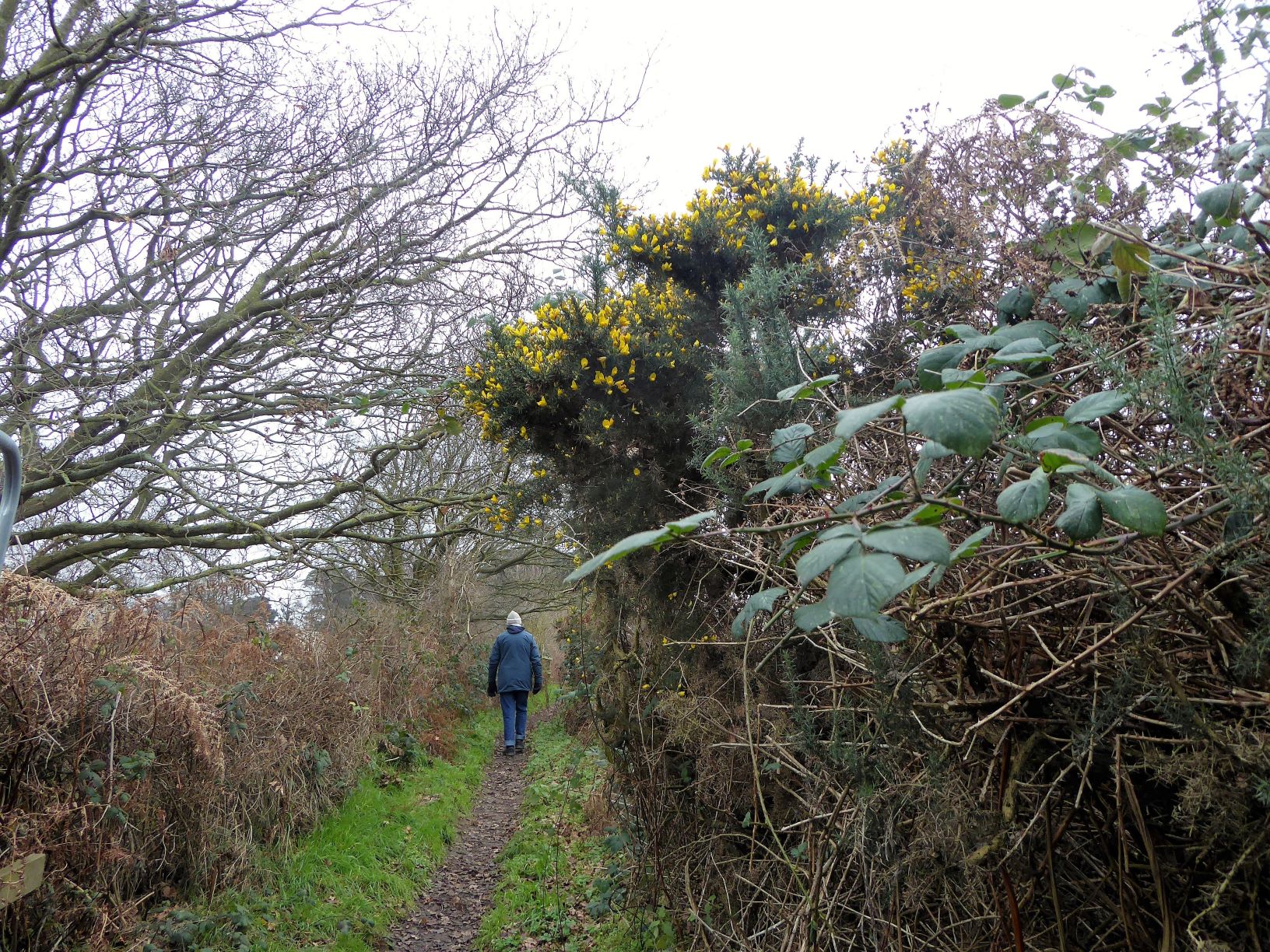
Despite the cold weather the Gorse (Ulex europaeus) was still in bloom. ‘Gorse is out of bloom, kissing’s out of fashion’.

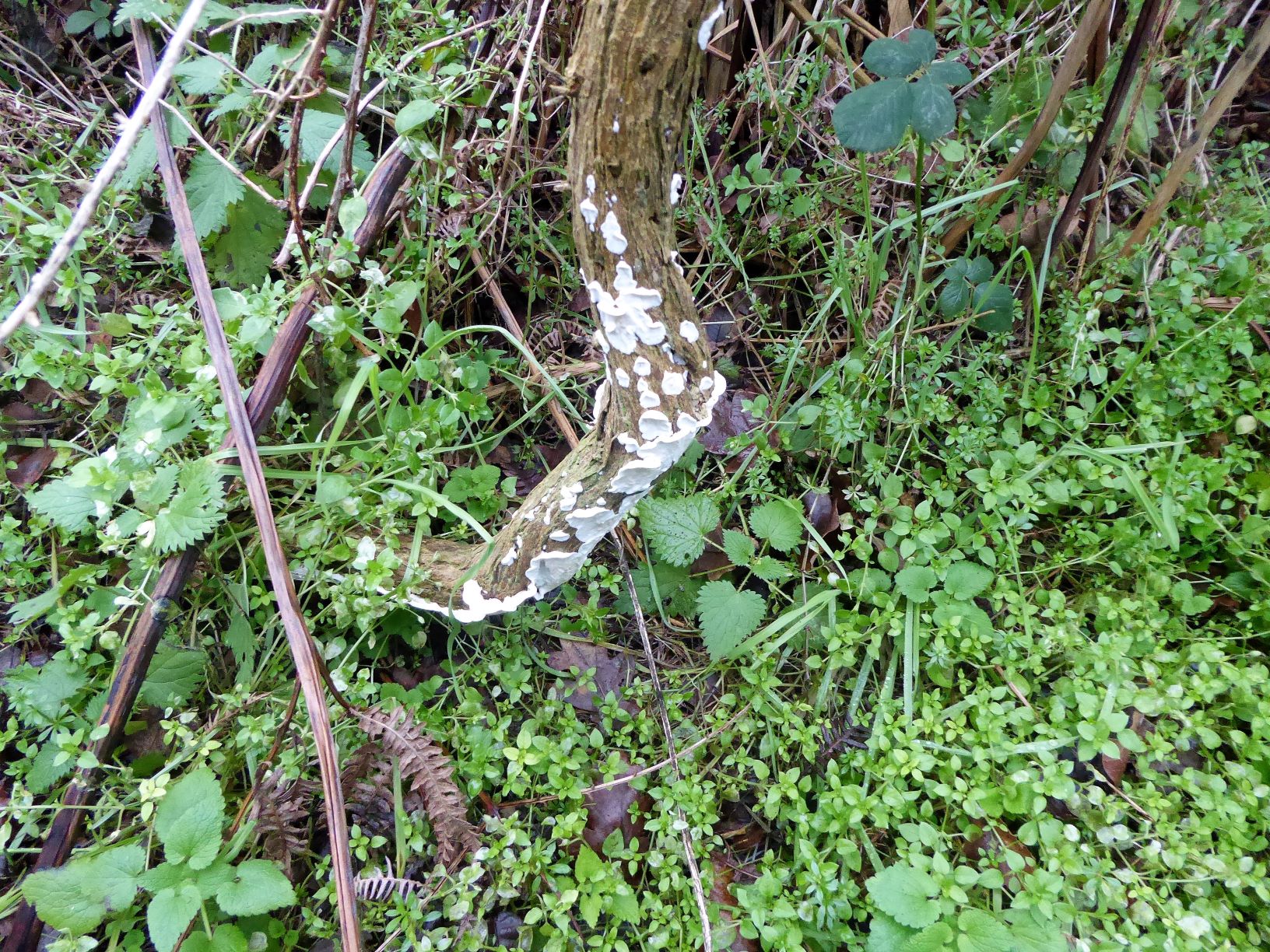
I noticed this branch covered in fungus.  It was almost luminous.

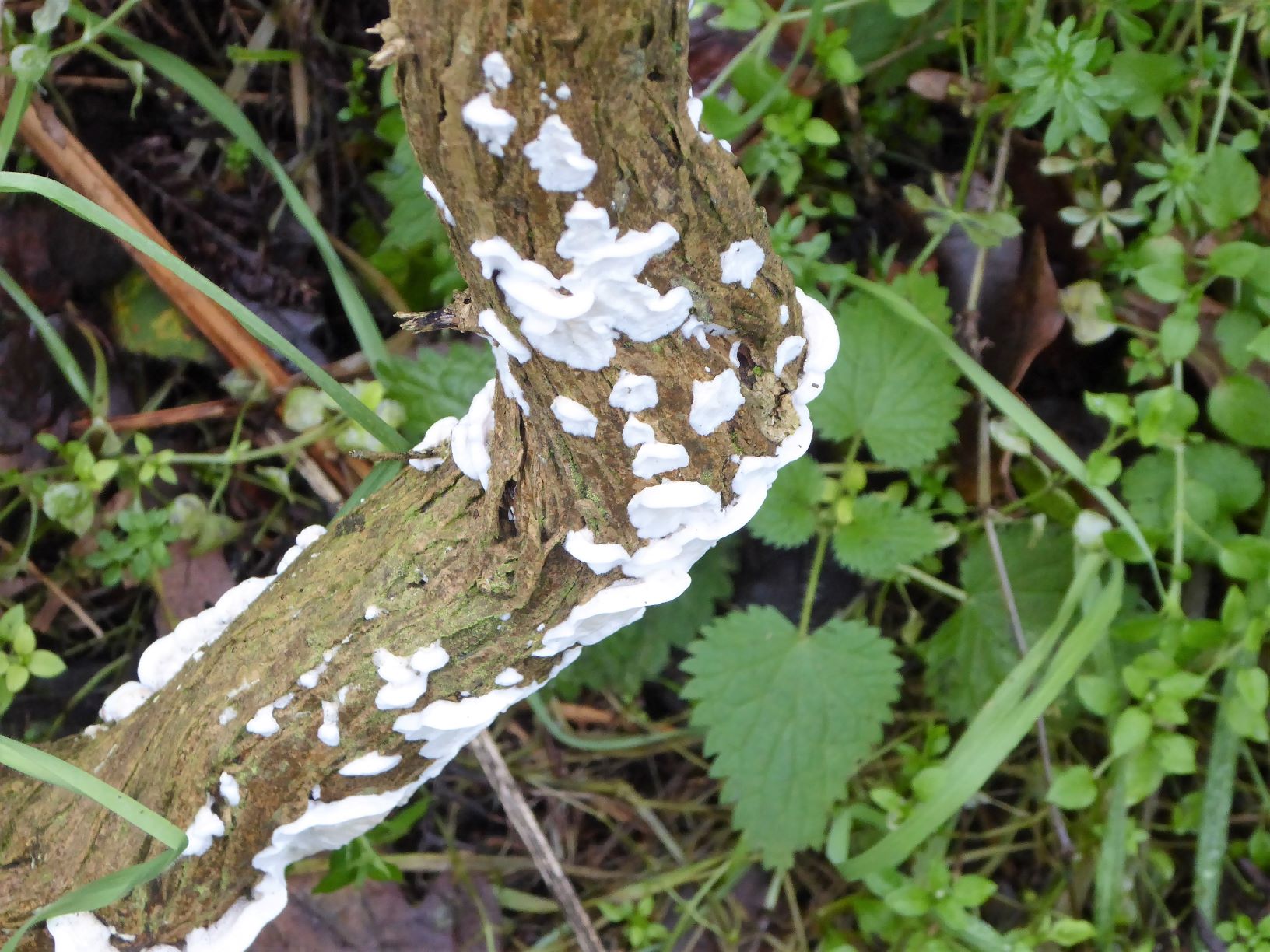
I looked closer……

I don’t know what this fungus is.  It was much too cold to stand still for more than a couple of minutes so I had to leave it.

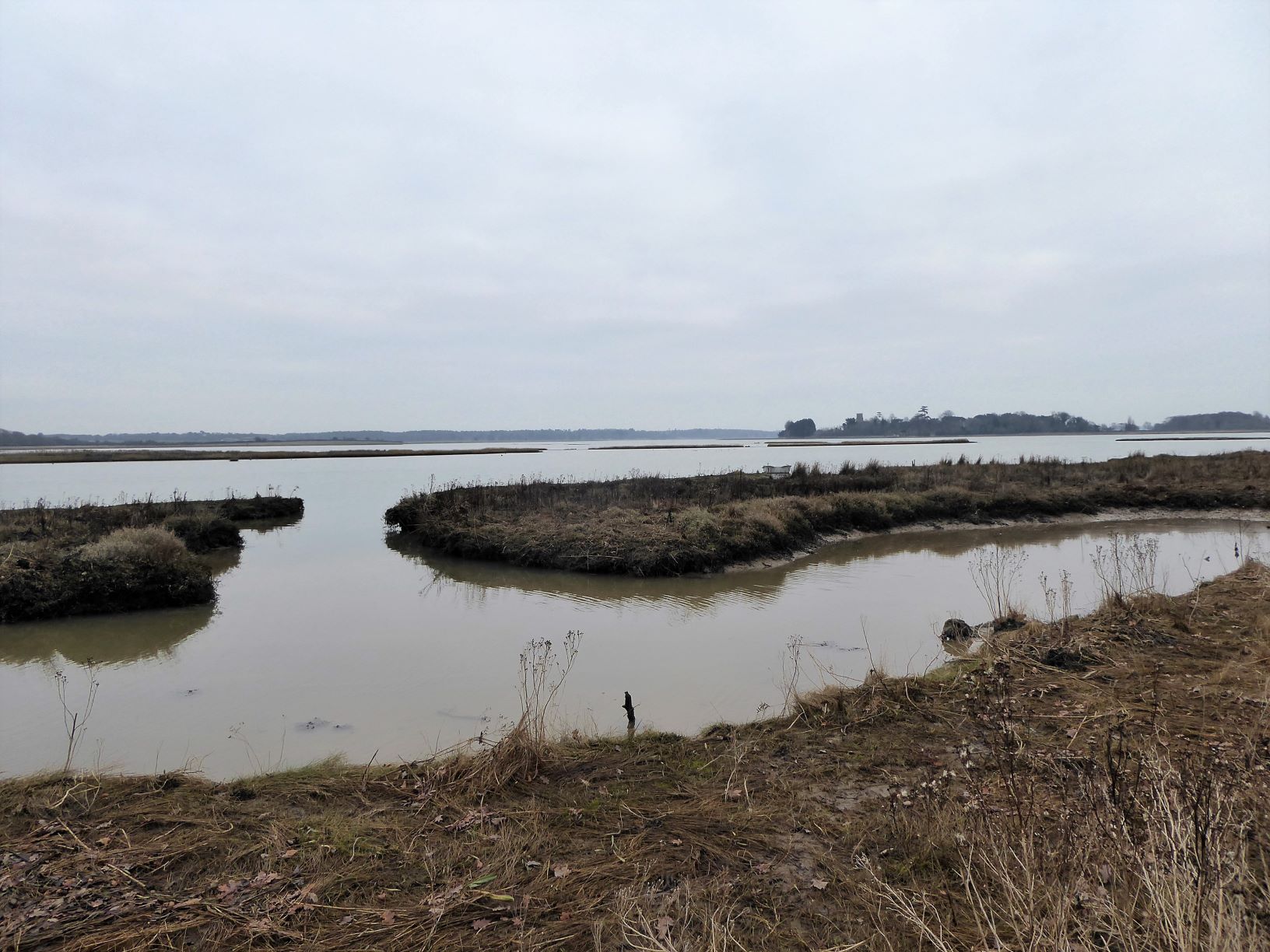
The Alde estuary.  You can just see the tower of Iken church sticking out above the dark trees on the horizon on the right.

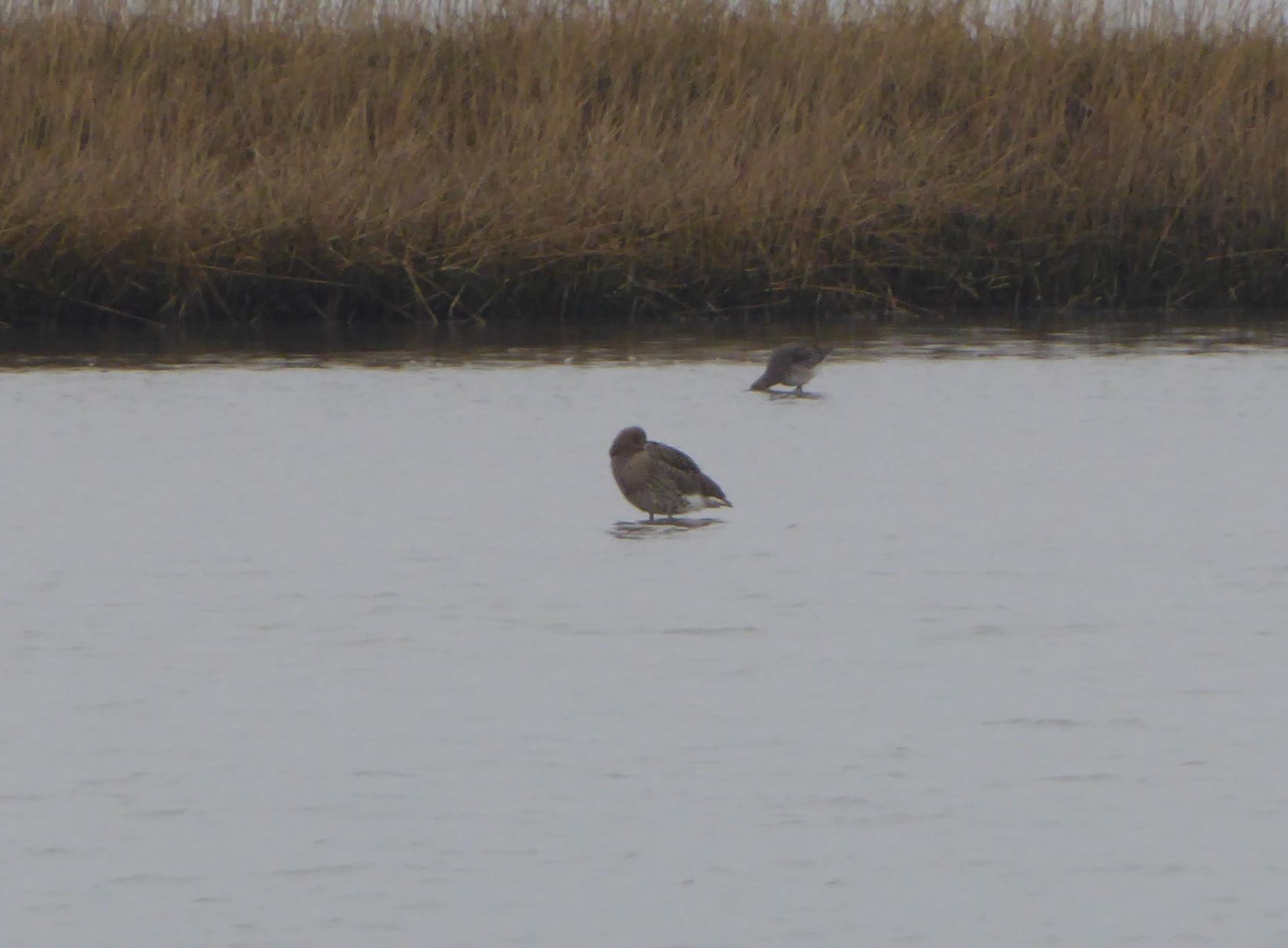
There are many geese, ducks and wading birds on the estuary.  I don’t know what type of geese these are.

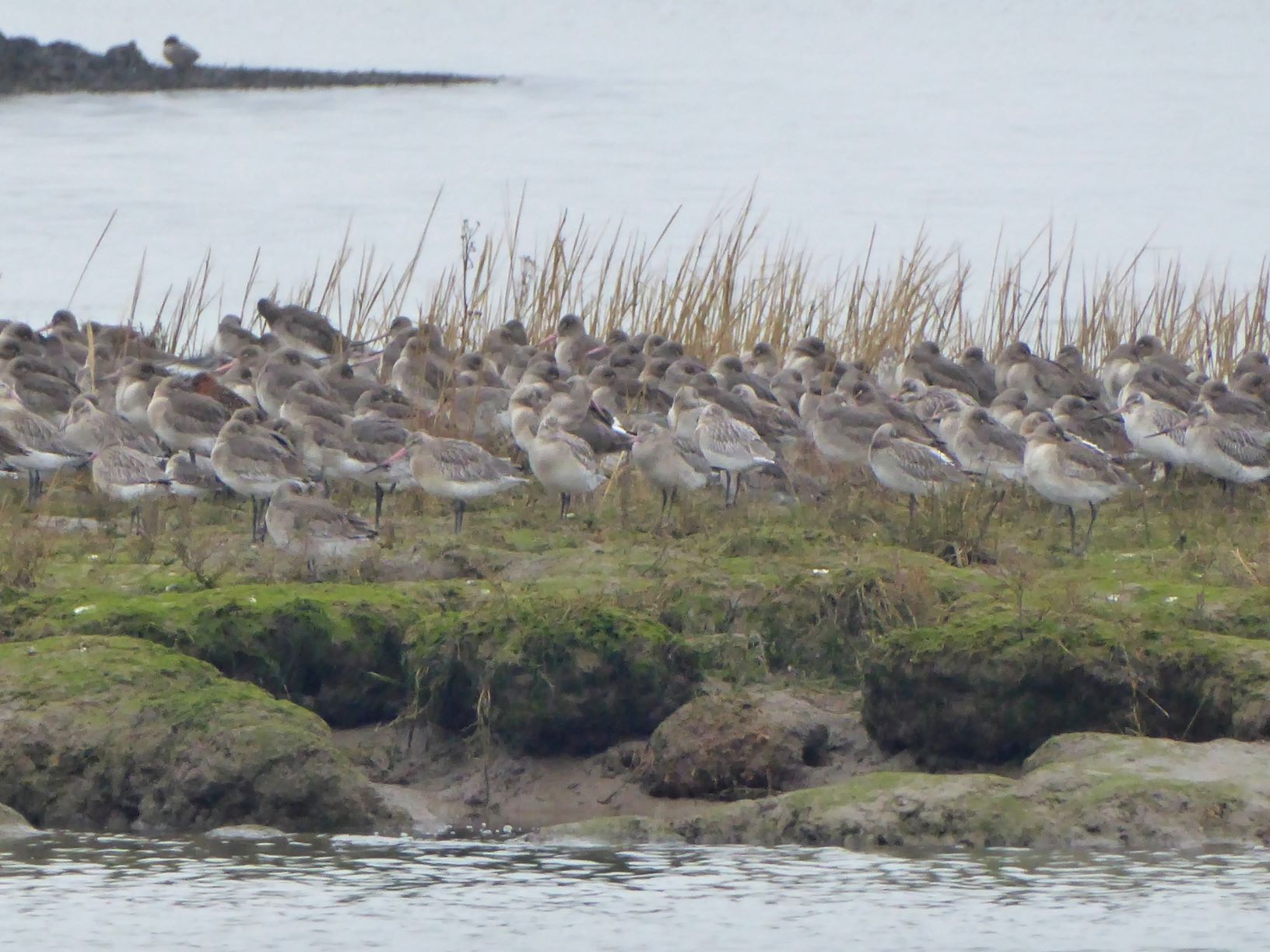
Some, if not all of these waders are probably Bar-tailed Godwits (Limosa lapponica). They appear to have slightly up-turned bills with pink-orange bases.

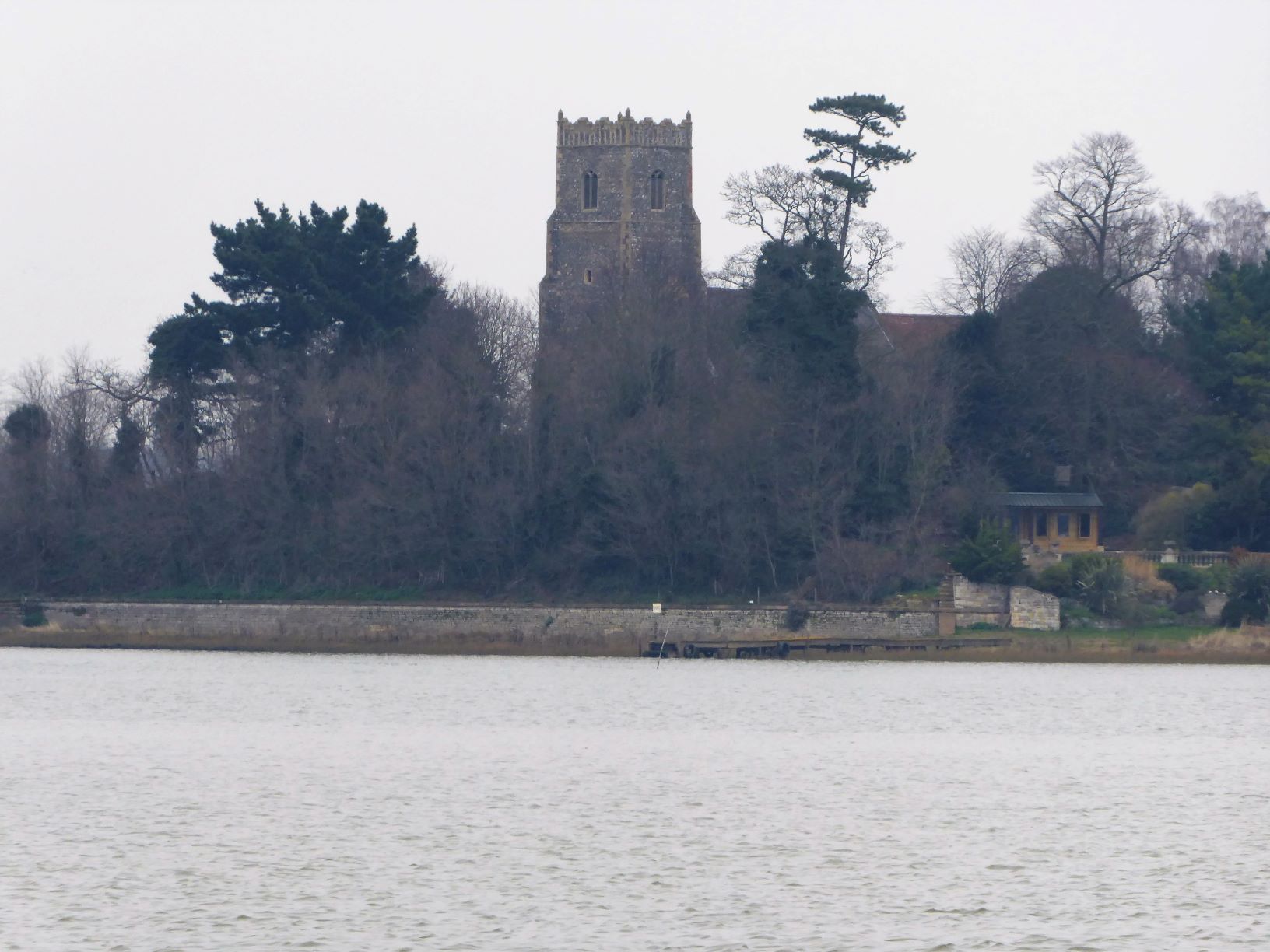
Here is Iken church near the edge of the estuary.

The shore was very muddy and difficult to walk on.

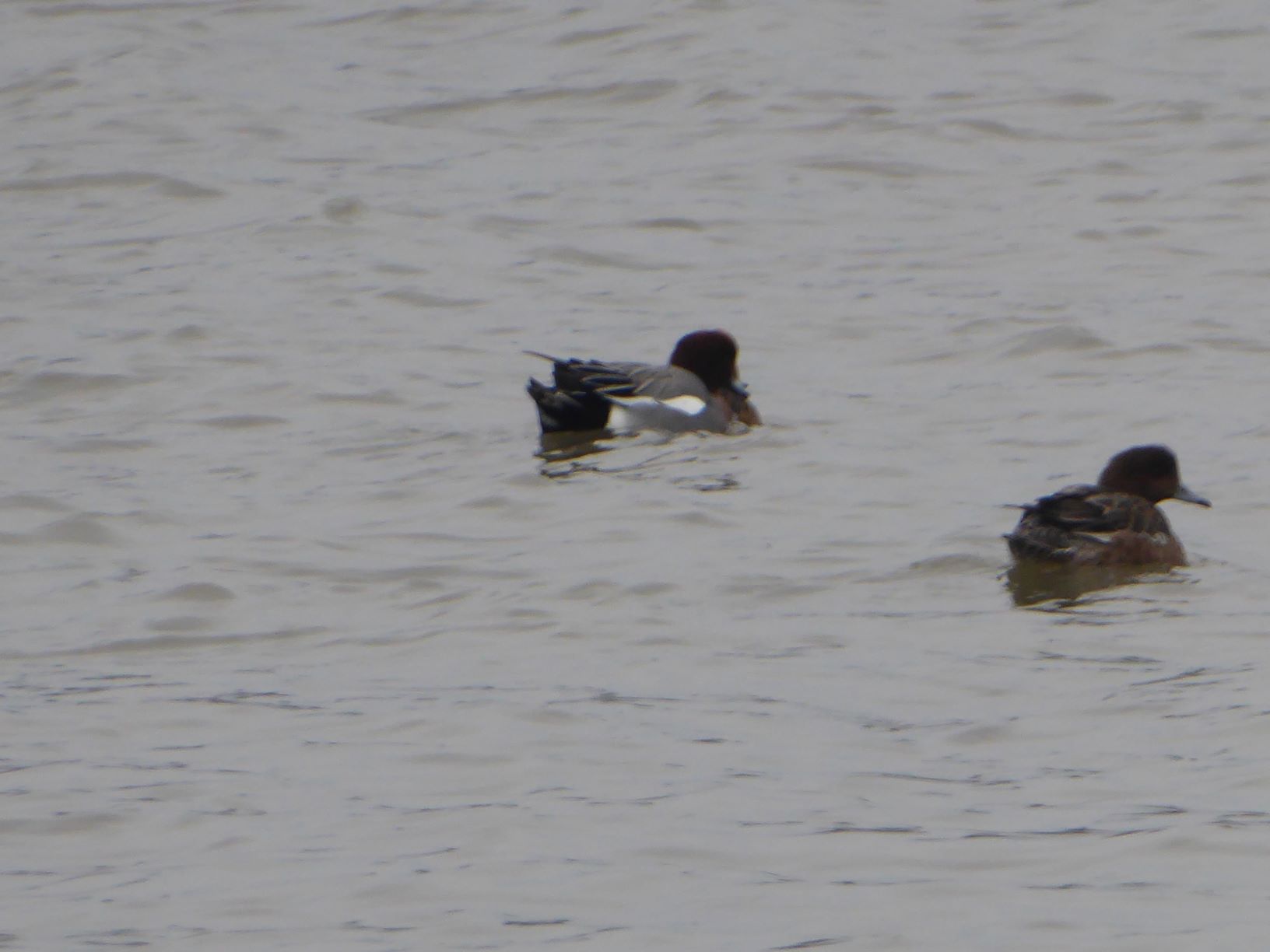
Ducks…..

I couldn’t definitely identify these ducks either!
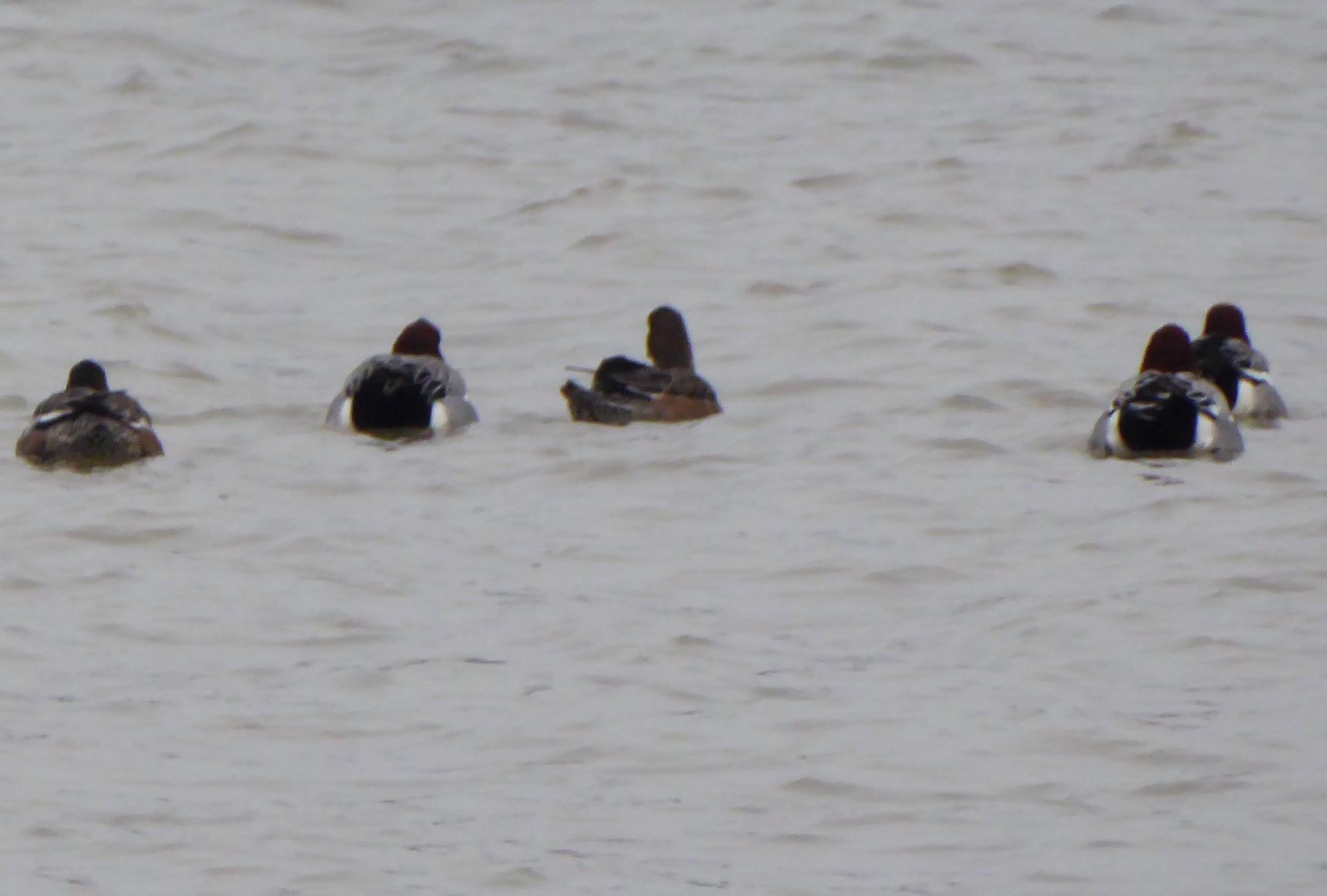
……. and yet more ducks. All floating about far out on the water in the gloom.

We left the estuary and walked along another narrow pathway adjacent to a few gardens until we got to the road in the village.  At a junction on the edge of the village we turned left towards the church which is situated right at the end of a promontory jutting out into the estuary.

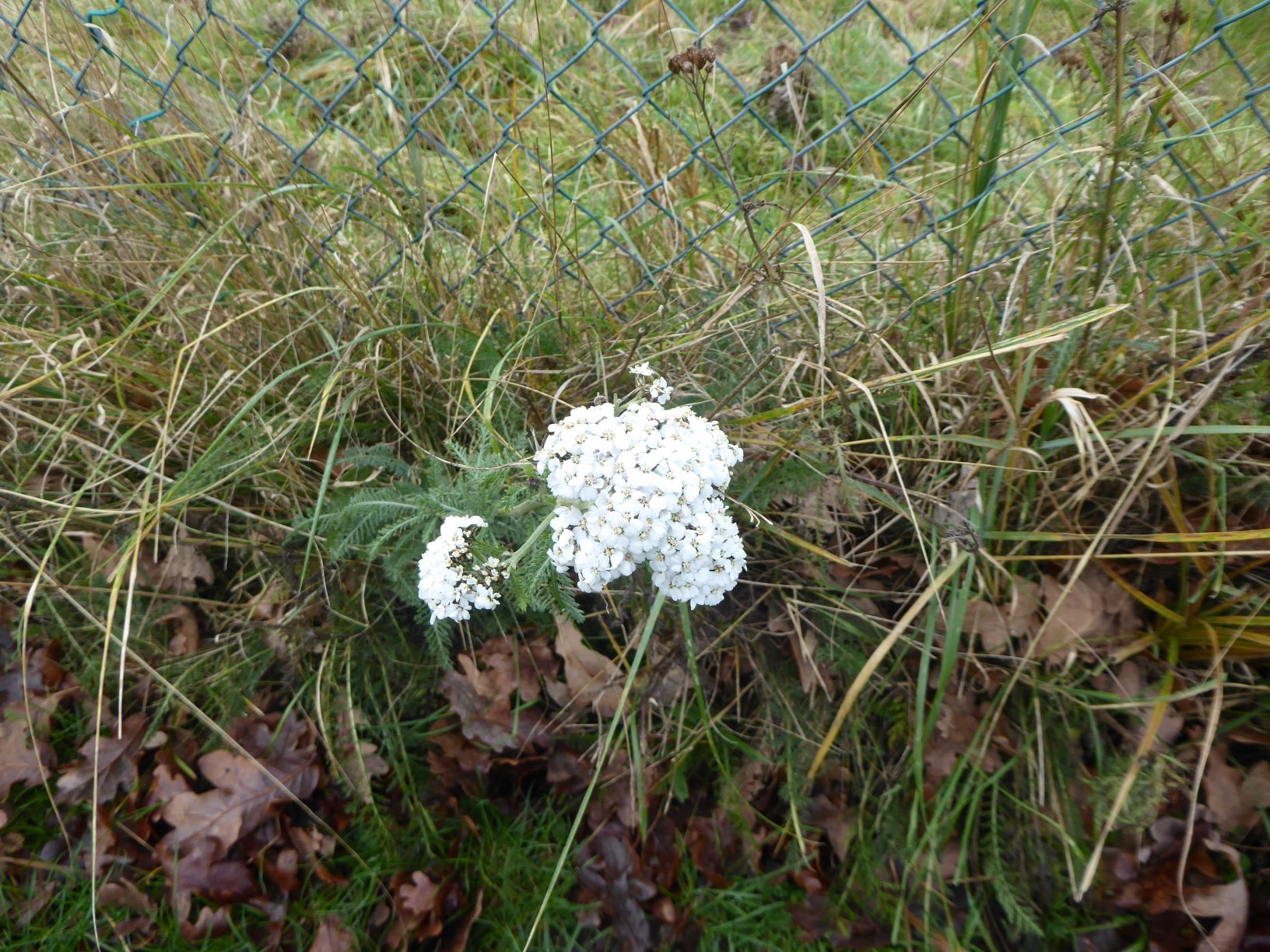
I saw this Yarrow (Achillea millefolium) in flower by the side of the lane, What a hardy plant!
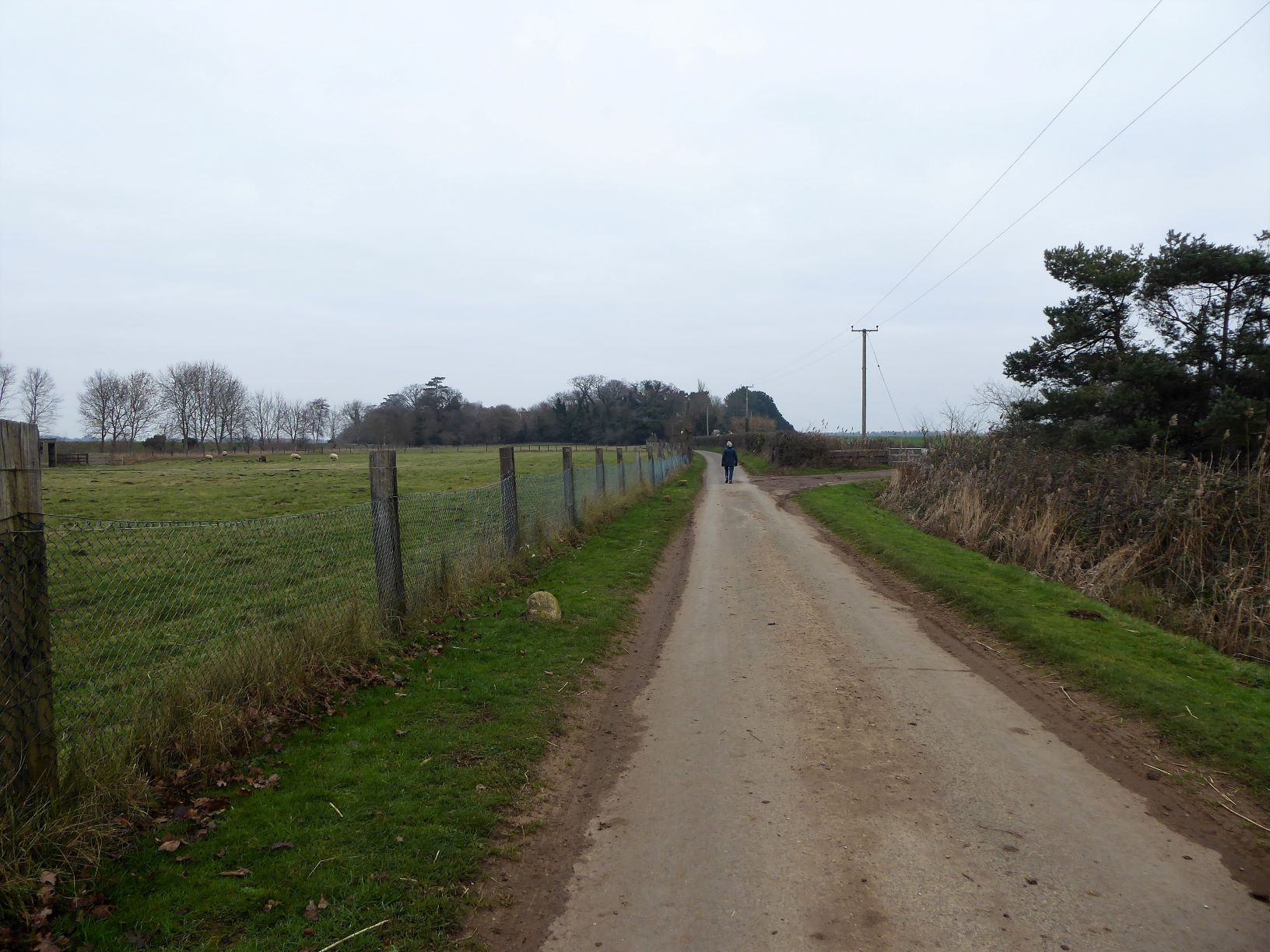
Richard disappearing into the distance along the lane towards the church.

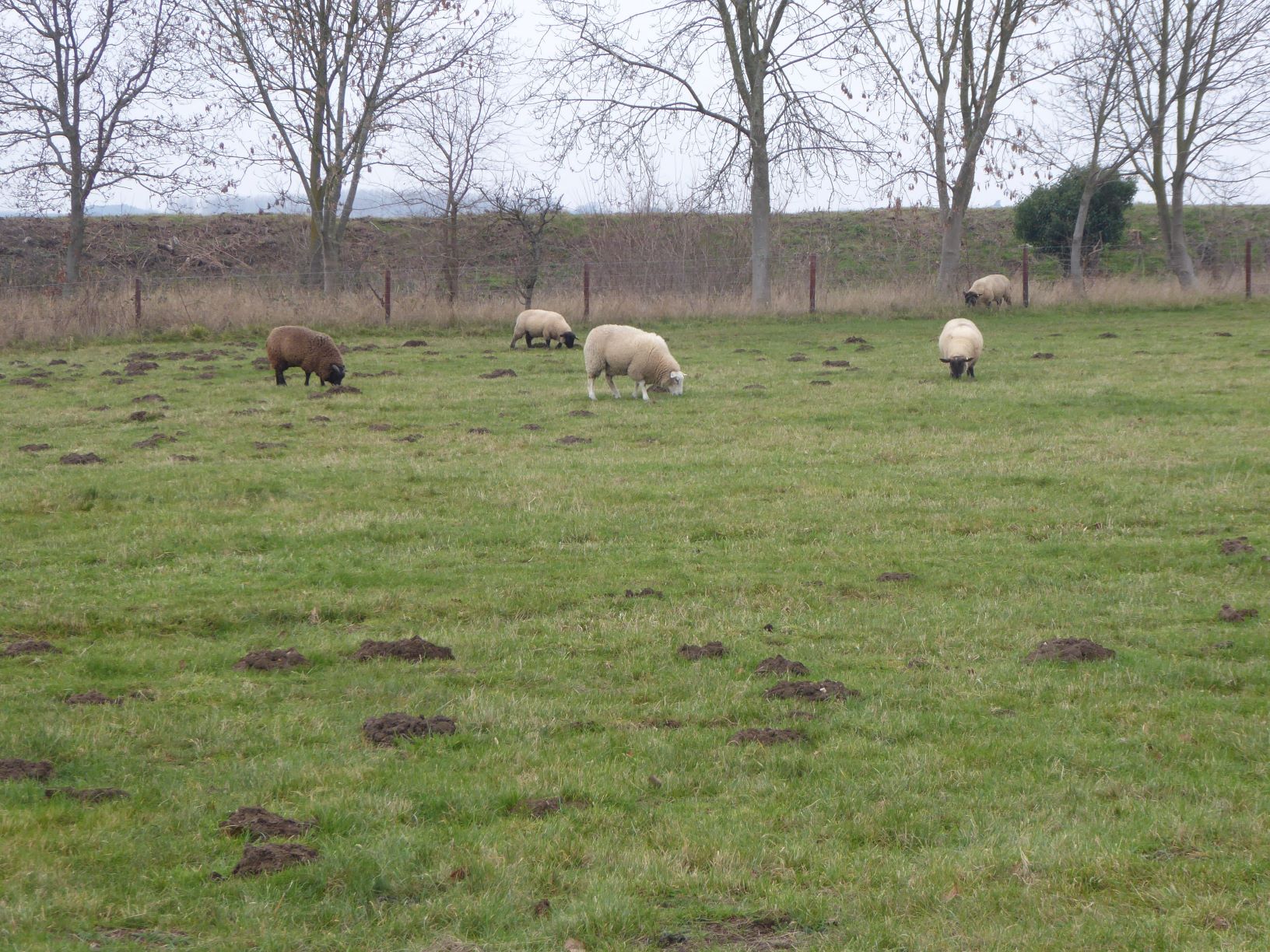
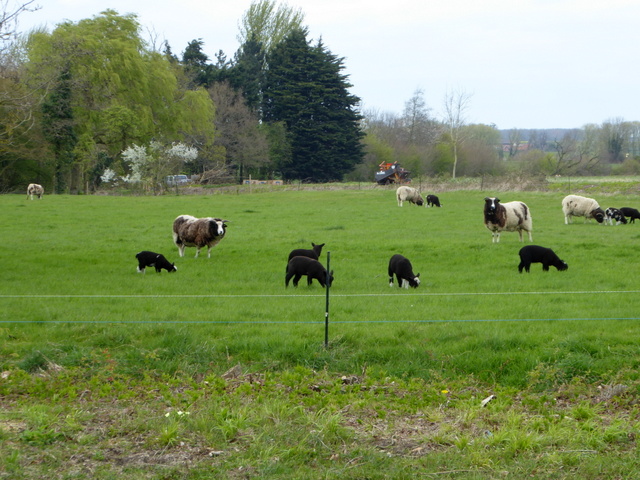
Sheep in a field by the side of the lane. So many molehills in this field!

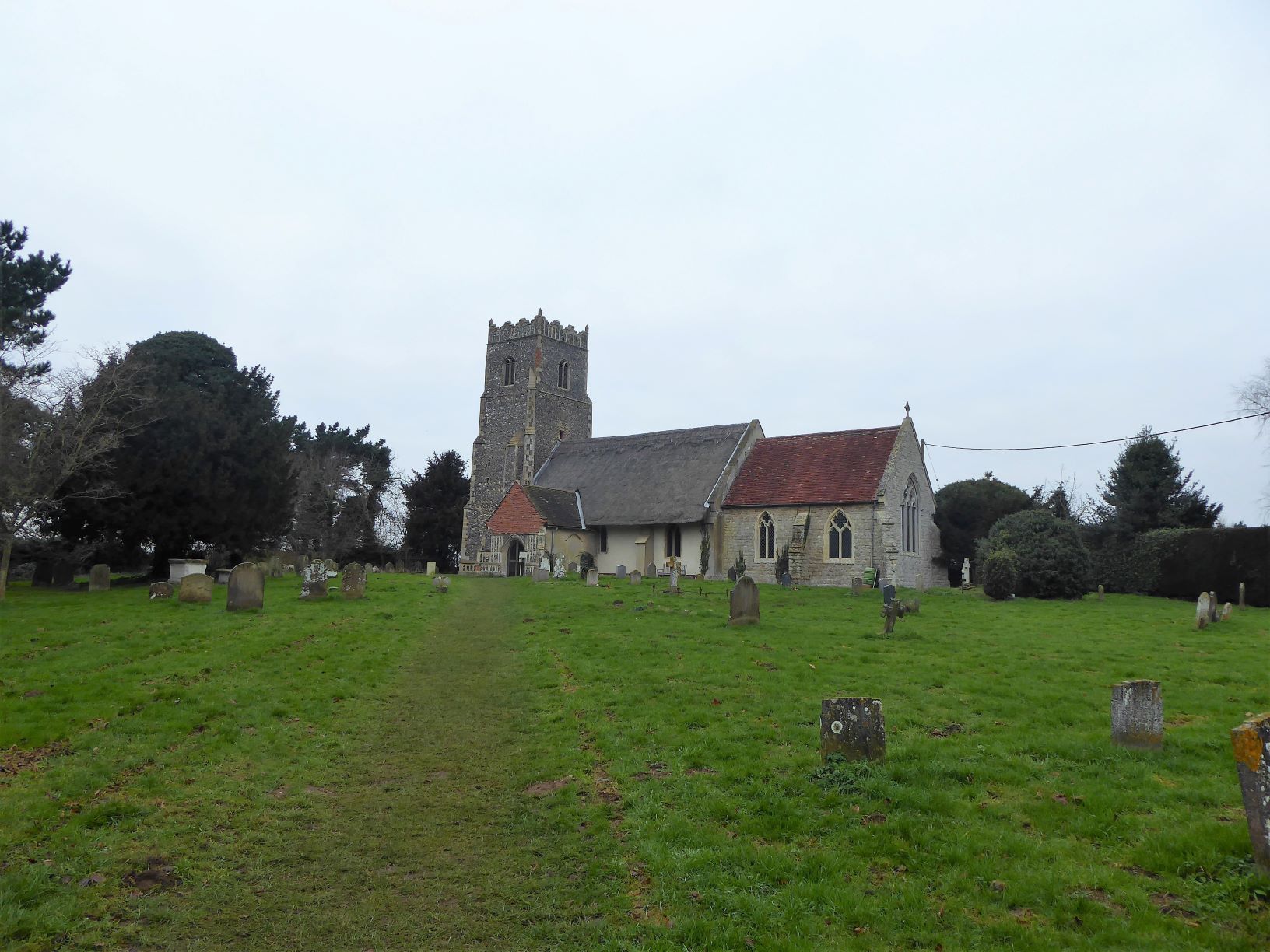
Iken church, dedicated to Saint Botolph.

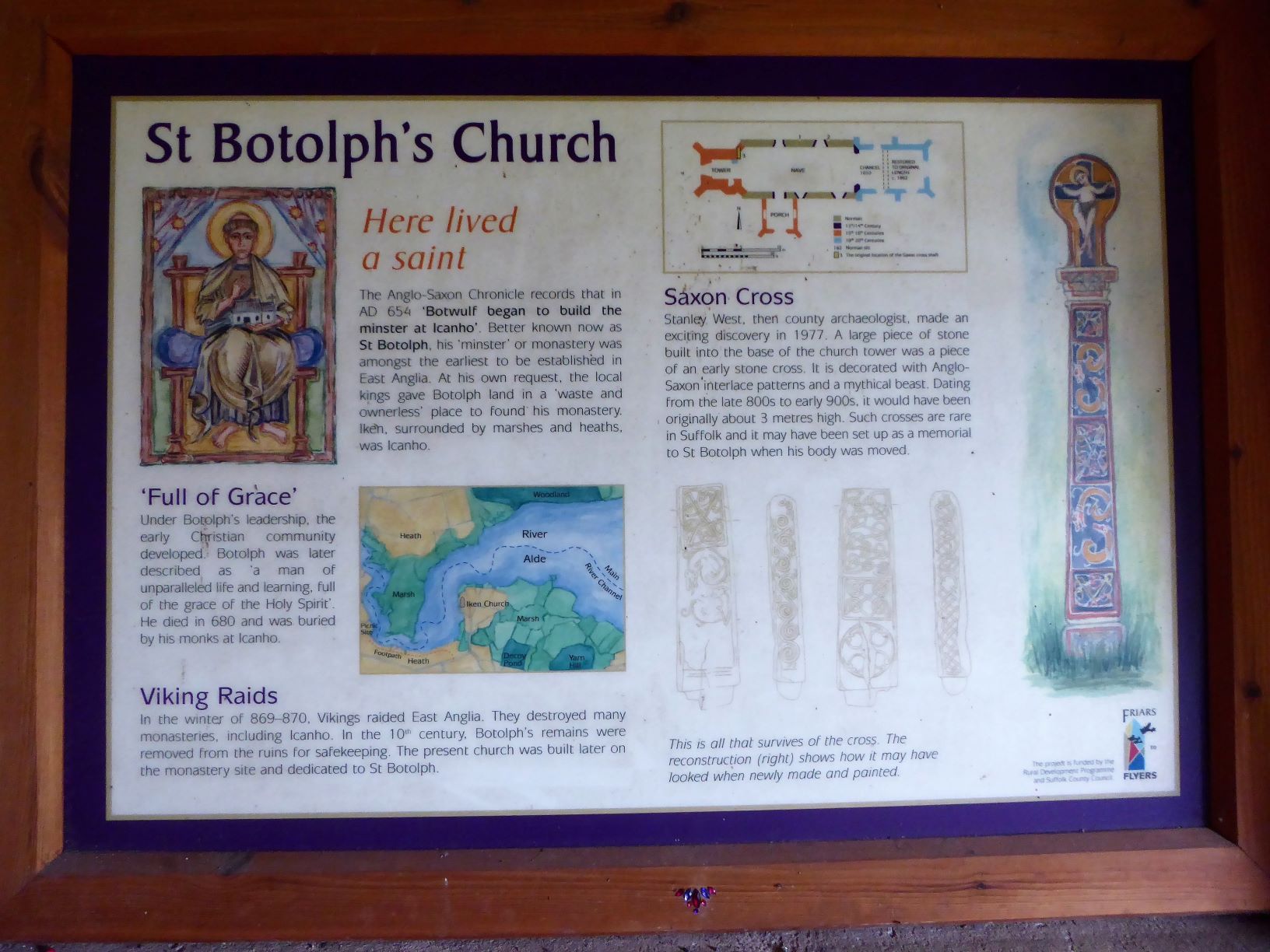
This church is mentioned in the Anglo Saxon Chronicle.  “Here in 654……Botwulf (Botulph) began to build the minster at Icanho”.  There are a couple of other places that have been considered as the possible site of Botulph’s first church (Boston in Lincolnshire and Hadstock in Essex) but this promontory, or hoo is now considered to be the most likely site.Here is a short passage quoted from the church guide written by Roy Tricker.

‘A Saxon minster was a nucleus of Christian worship, witness and learning for a wide area.  It was staffed either by a community of monks or a group of priests and from it missionaries travelled to spread the Faith and to establish satellite churches.  Botolph remained at Icanho as its abbot until his death in c.680.  It is recorded that he was buried by his disciples on June 17th and this has remained his annual feast day.  Abbot Coelfrith of Wearmouth and Jarrow, who nurtured the young (though later to become the Venerable) Bede, paid a visit to Icanho in 670 to observe the type of monastic life in operation here, and it is recorded that he was greatly impressed.

From Icanho the monks made missionary journeys into East Anglia and beyond and it may be that the 75 or so English churches which bear (or have once borne) St. Botolph’s name may give some clue to the extent of their work.  They include 16 in Norfolk, 4 in Essex and 6 in Suffolk, of which the church at Burgh (near Woodbridge) appears to have enshrined the Saint’s remains for a time.  King Cnut authorised the removal of some of Botolph’s bones to the abbey at Bury St. Edmunds, which he had founded in 1020.  These precious relics had clearly at some time been transferred from Icanho to the relative safety of Burgh, which was also a fort and a defensive site”.

The invading Danes destroyed the monastery in 870 and some time later the site was marked with a stone memorial cross.  The church was rebuilt, again in timber in 900 and re-dedicated to Saint Botolph.  The Normans rebuilt the church in flint-rubble between 1070 and 1110 and from then on parts were rebuilt or improved upon over the centuries.  By the early 19th century only the western end of the church was in use, the rest being in ruins.  The church was repaired and a new chancel built in the mid 19th century.  The village was evacuated in 1942 and the church closed so that the area could be used as a centre for battle training.  The church, which had been slightly damaged  by a fallen tree in a gale and then by the blast from a land mine, reopened in 1947 and the parishioners spent the next ten years or so improving and decorating the church.  During tree-felling in the churchyard in 1968 some sparks from a pile of burning logs set fire to the thatched roof of the nave and destroyed it.  Fortunately, the chancel was undamaged and was blocked off and made fairly watertight. The Parochial Church Council and the tiny congregation have worked hard for many years to raise money for the church’s restoration.  The tower was restored first from 1984 onwards then the nave walls and buttresses conserved and the nave got its new roof in 1987-9.  Between 1990-94 the nave floor was laid and repairs done to the porch and chancel roofs, benches and altar rails, the stonework and glass of the windows and the font.  The work continues still.

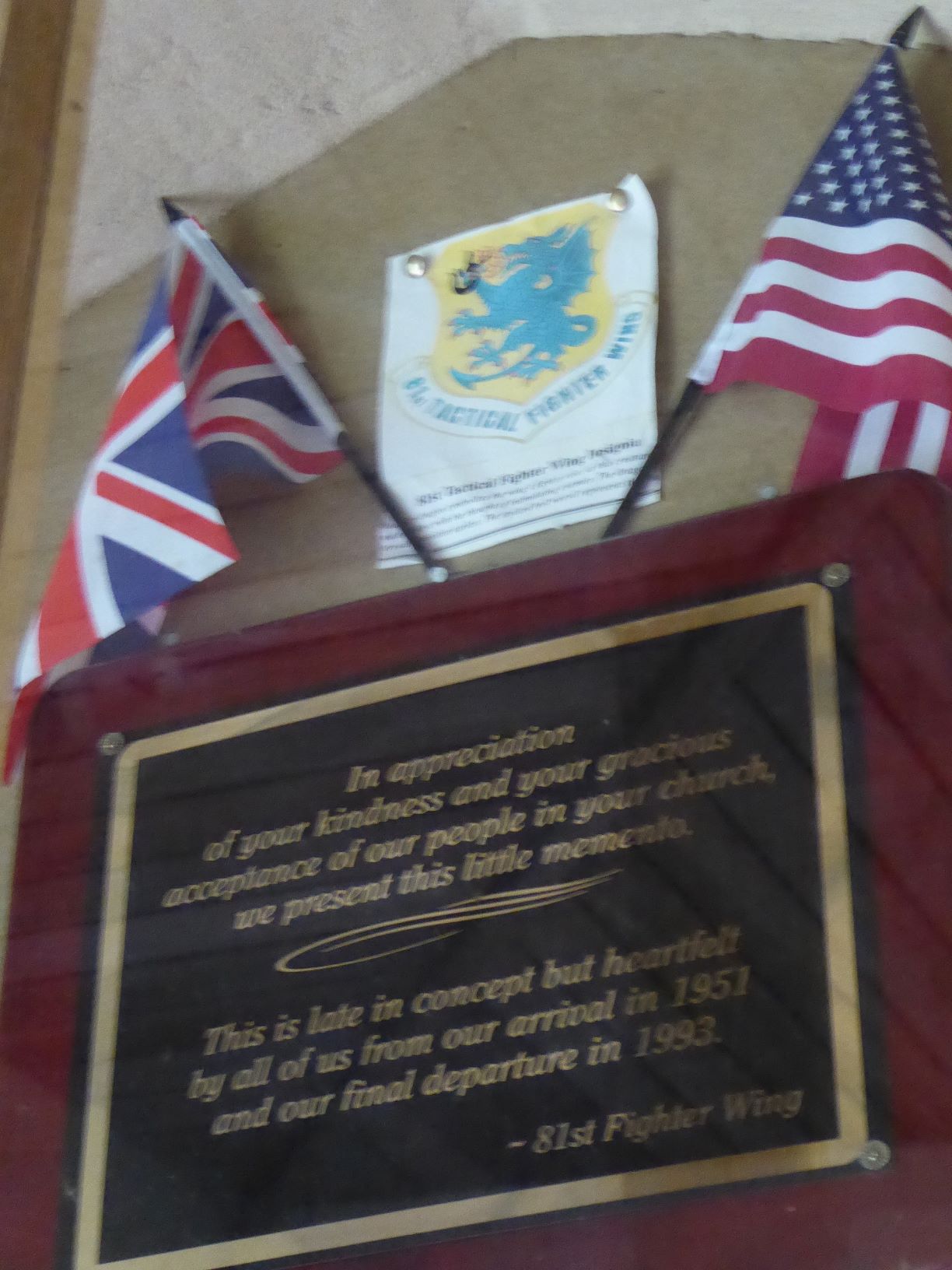
A plaque donated by the 81st Fighter Wing USAF who were stationed near Iken from 1951 – 1993.

Information plaque.

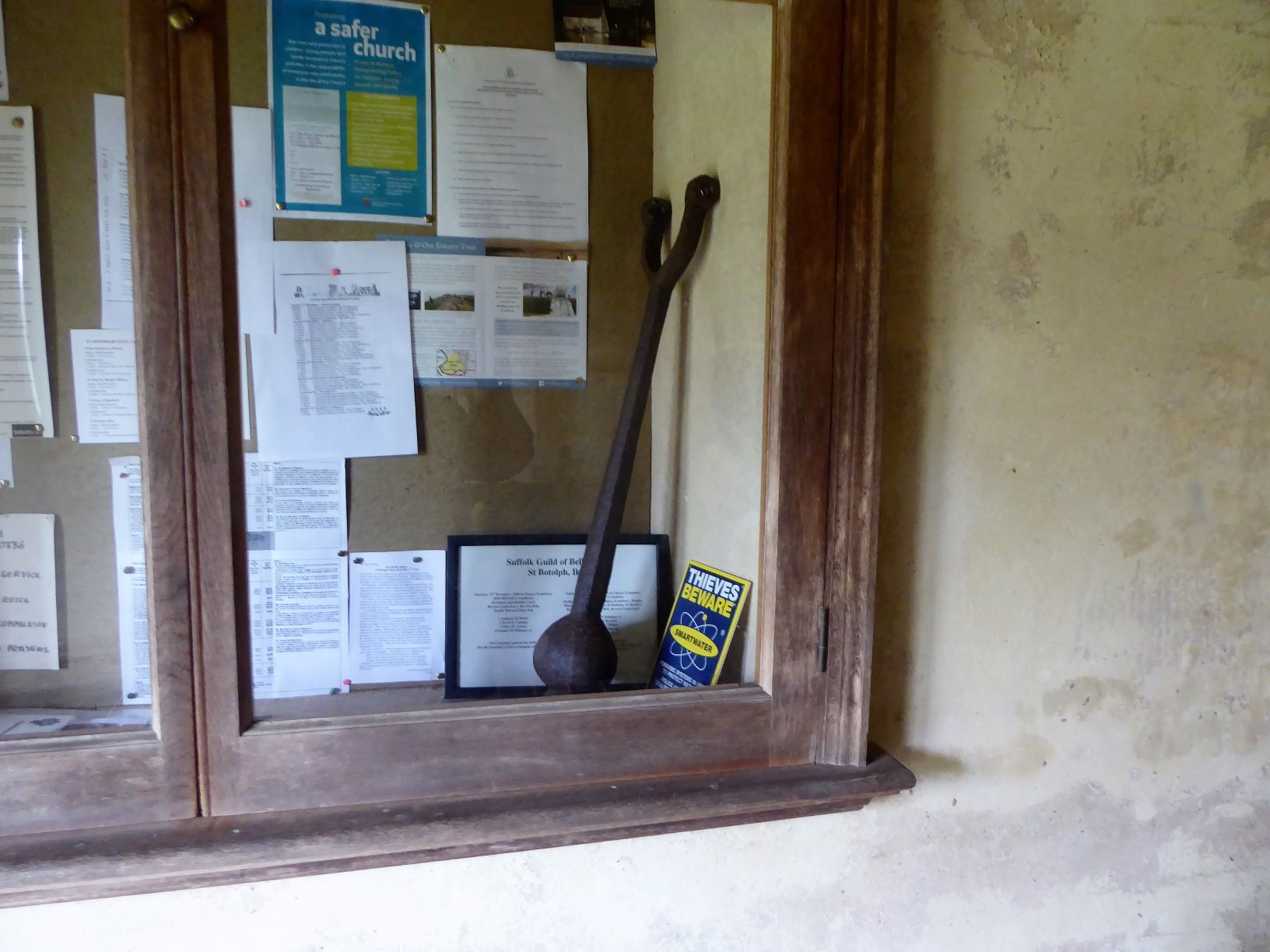
Noticeboard with what I believe to be a bell-clapper.

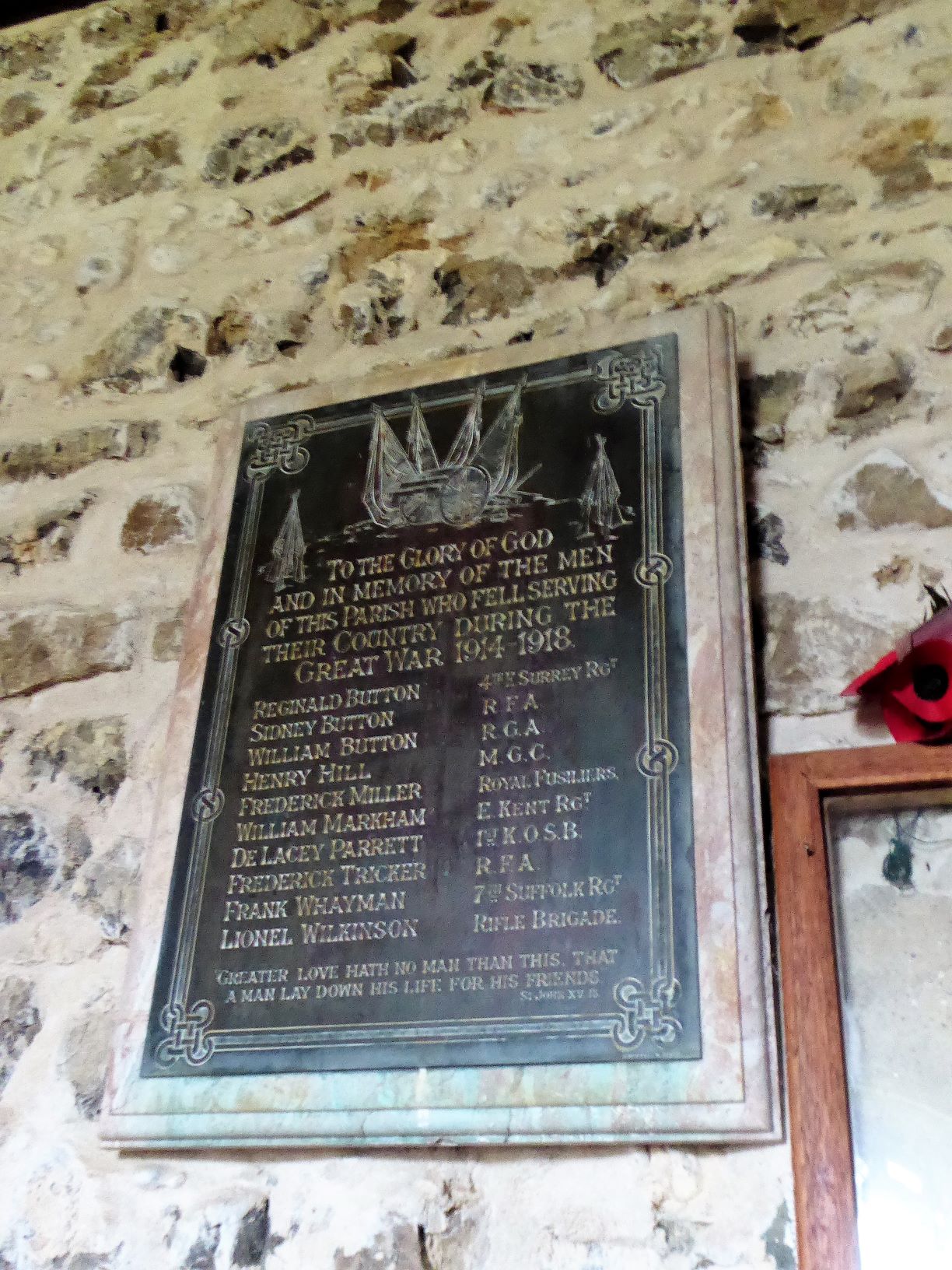
The War Memorial to ten local men who lost their lives in the Great War 1914-18.

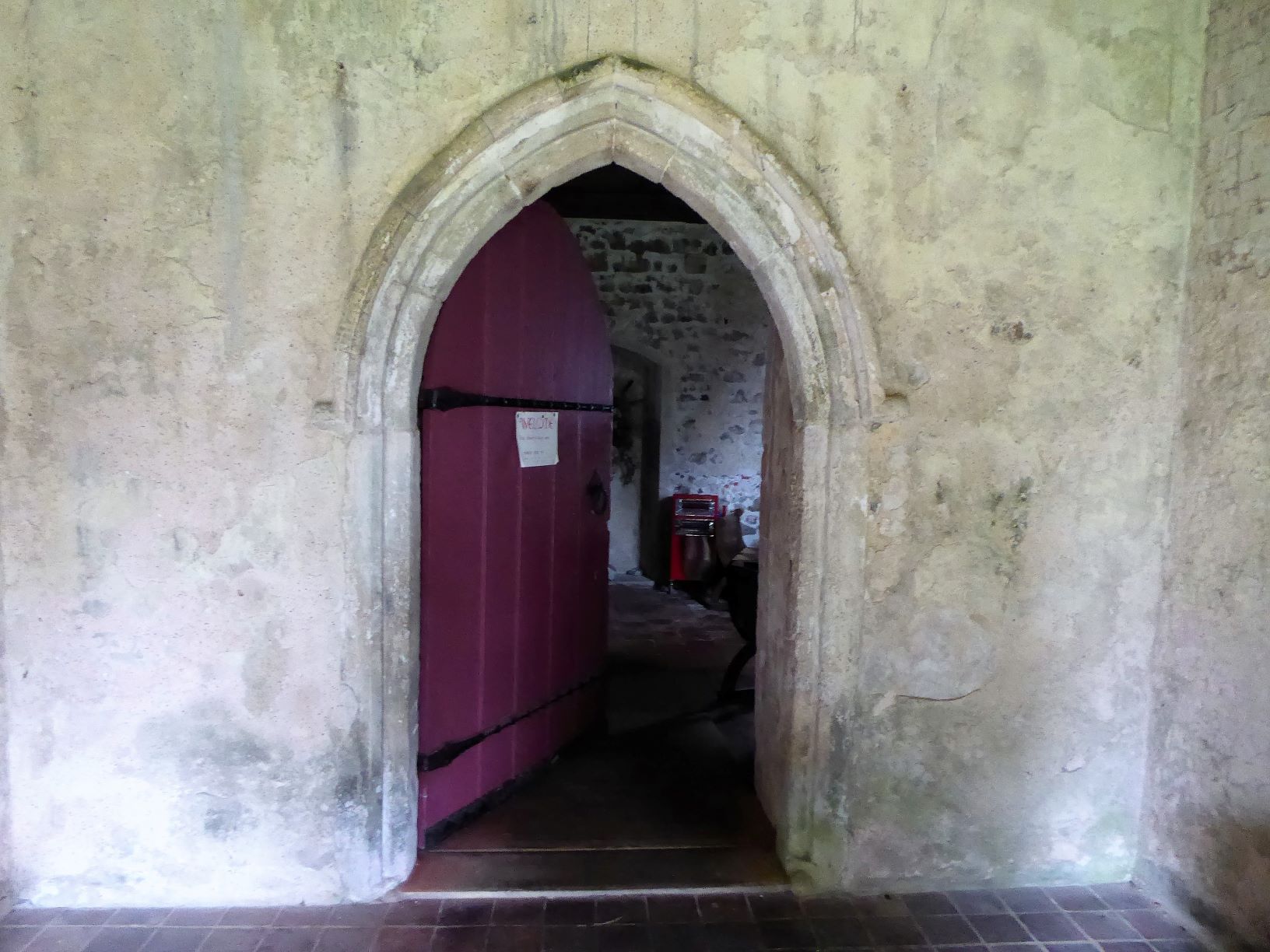
The door from the porch into the church.

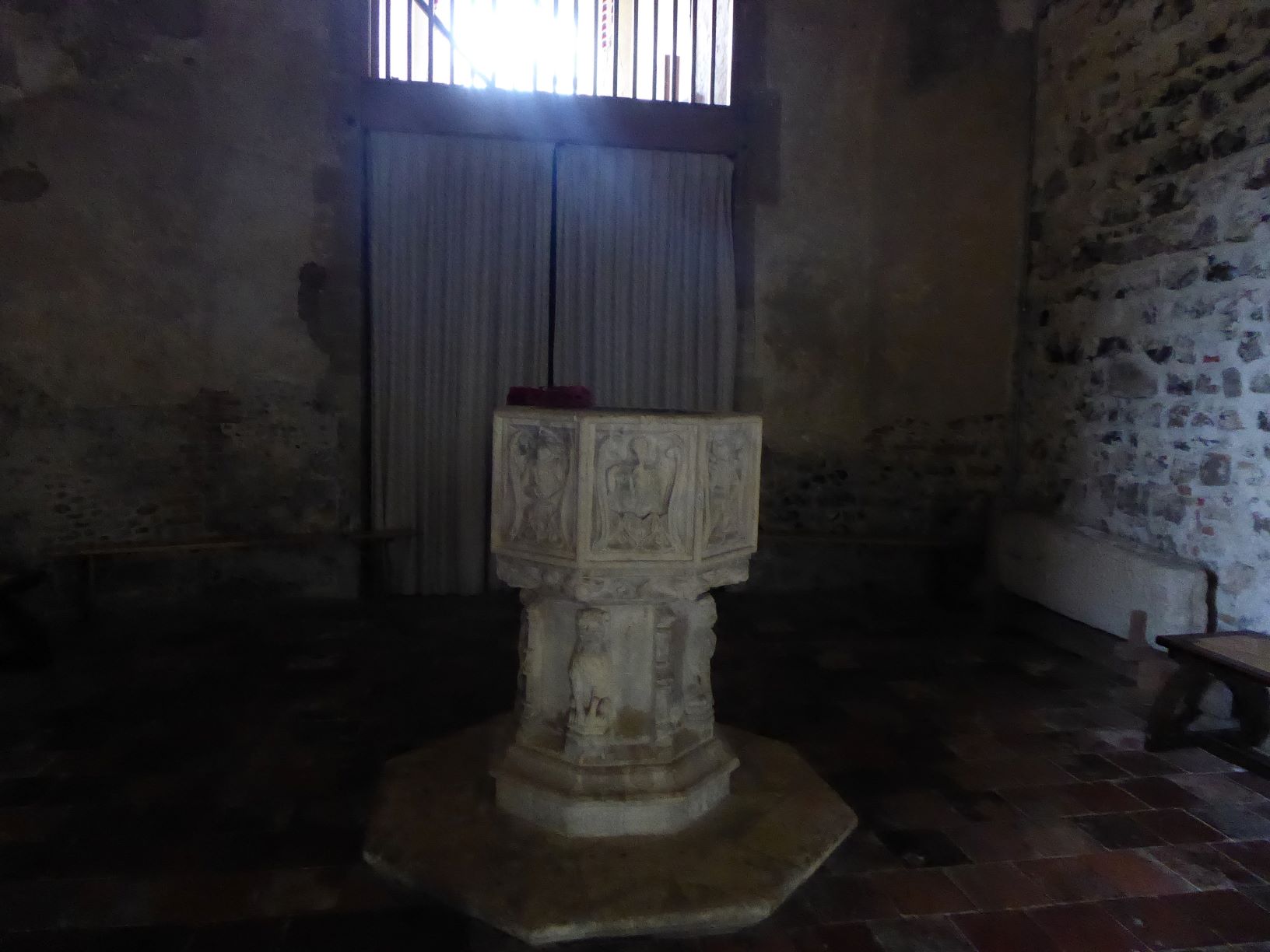
The beautiful 15th Century font with it’s typically East Anglian decoration of four lions round the stem and angels with outstretched wings under the bowl. The bowl is decorated with the emblems of the four Evangelists and four angels.

I apologise for the murky picture.  It was a very gloomy day and the church had no lights available to us.

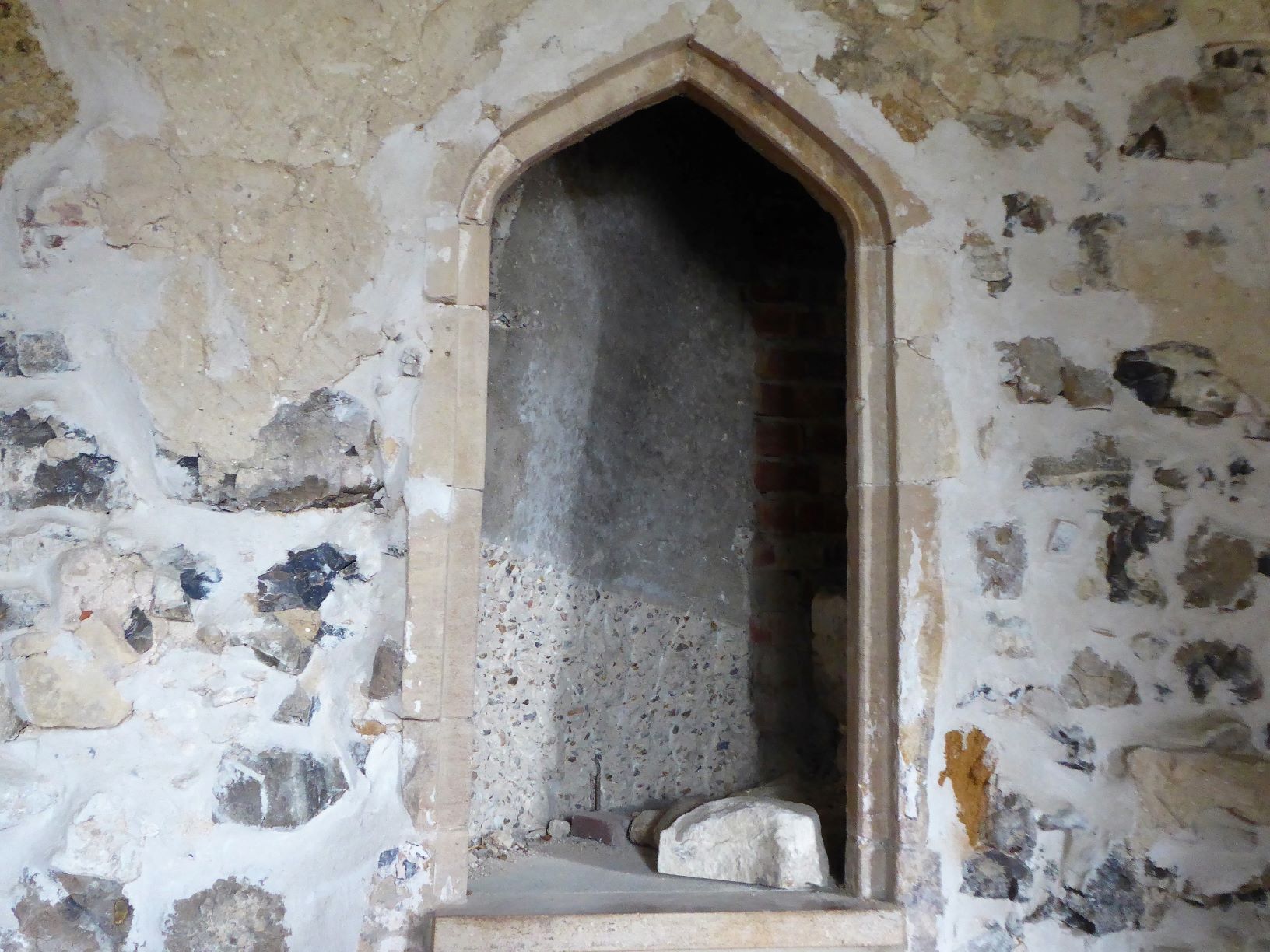
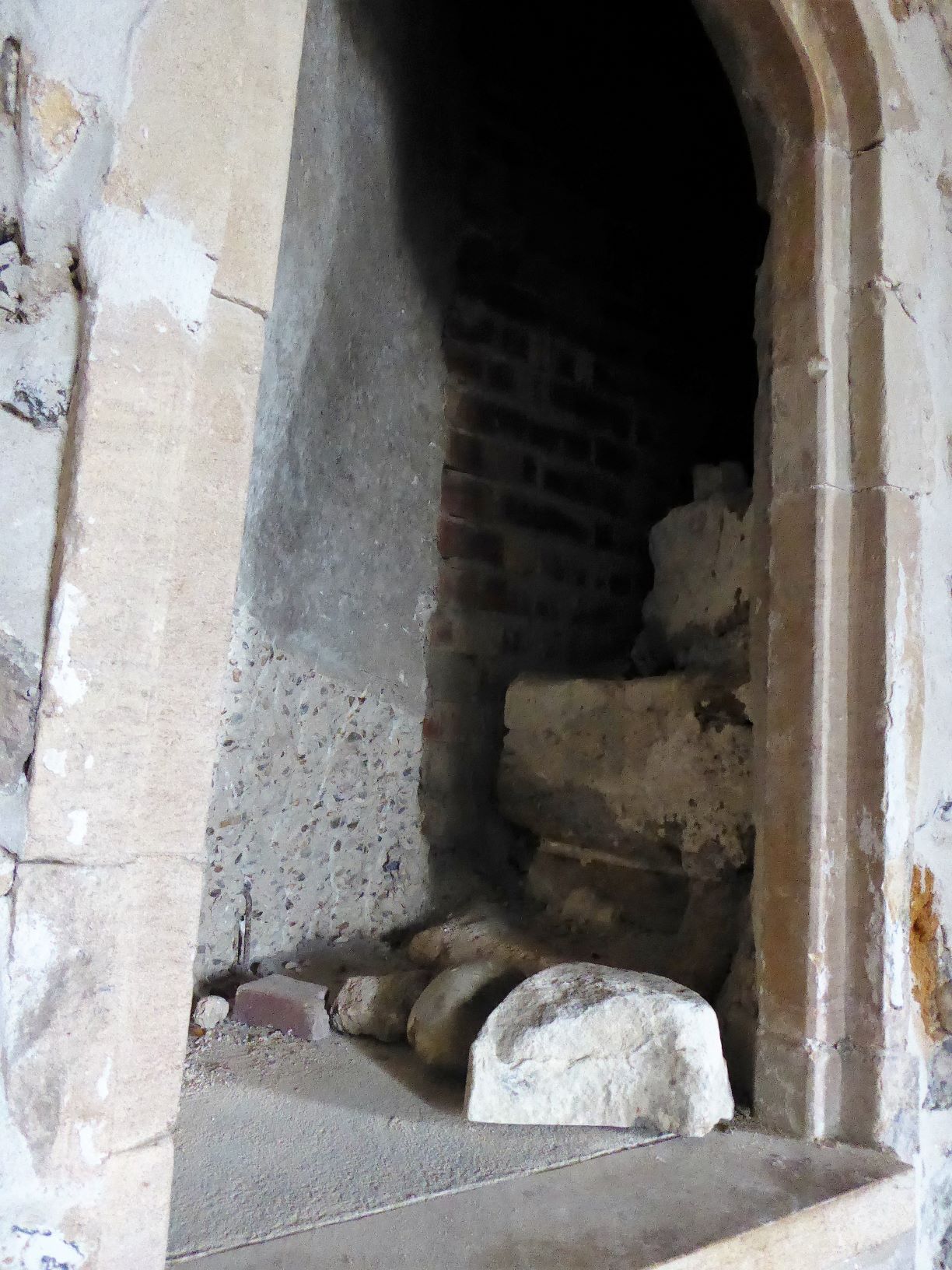
The opening to the rood loft staircase.

You can just see the stairs going up to the rood loft. The rood loft has long gone so the stairs go nowhere.

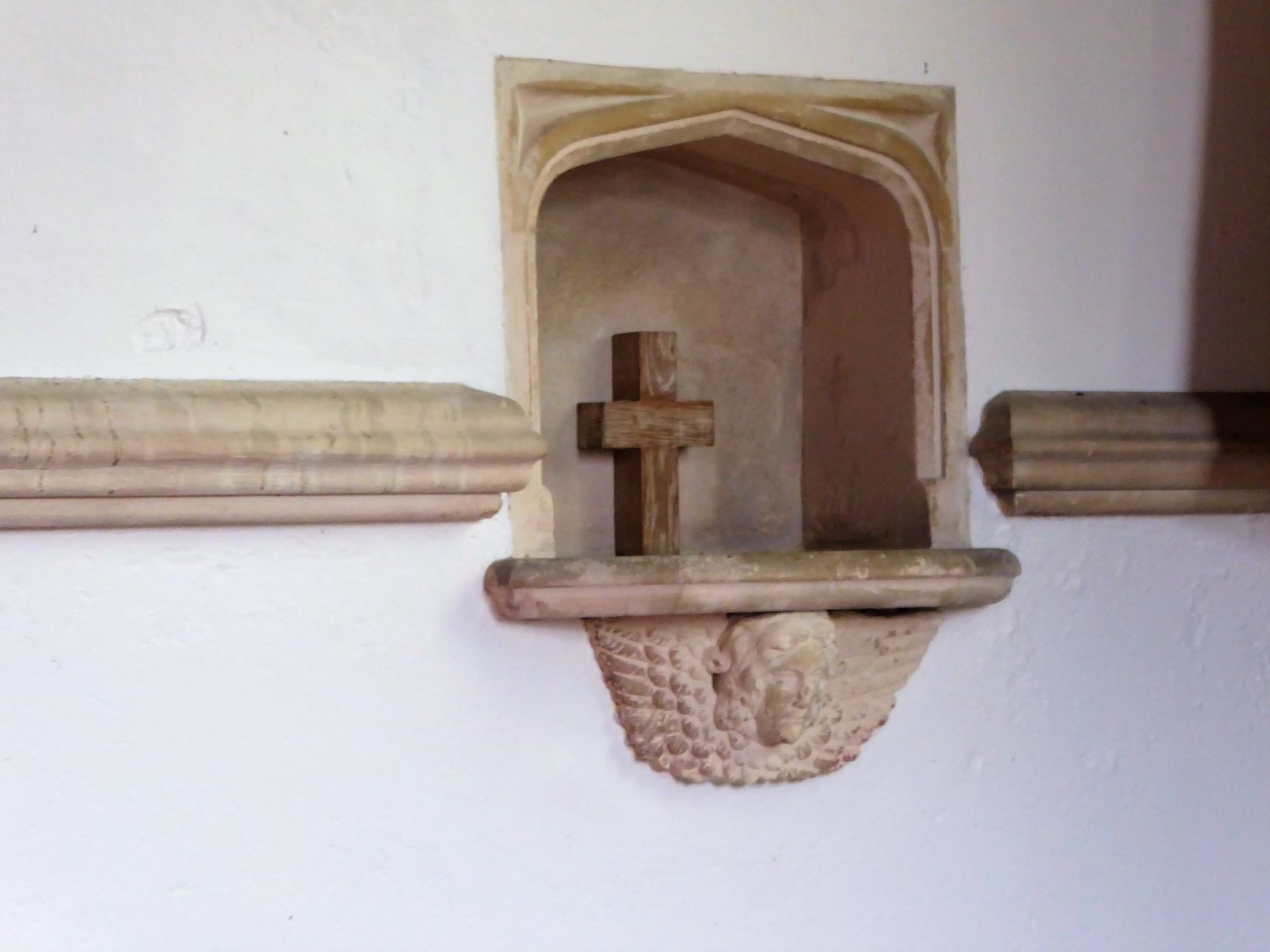
A recess. See the angel with spread wings underneath!

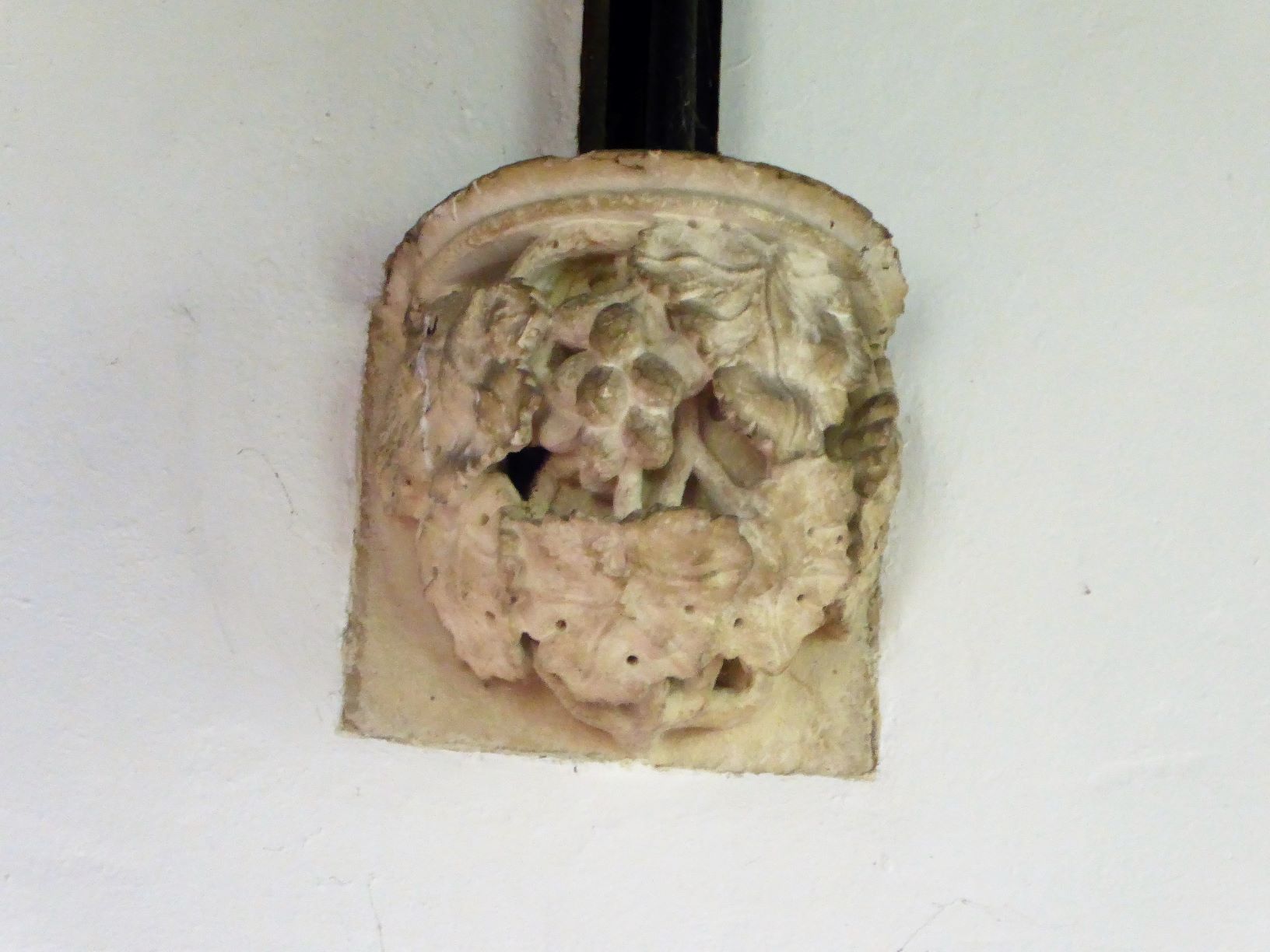
A prettily carved corbel in the roof.

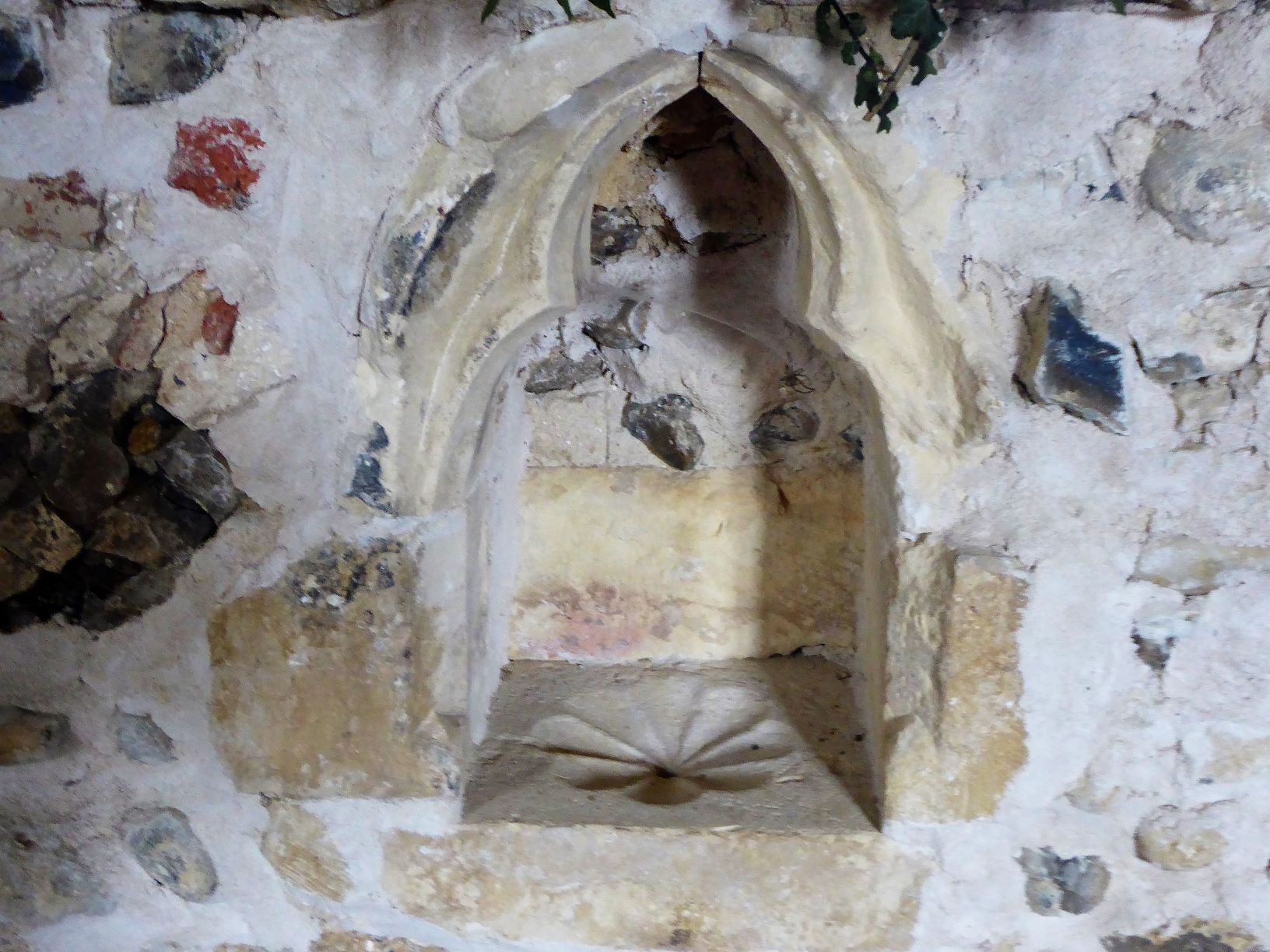
A piscina, so that water used by the priest to wash his hands could be disposed of.

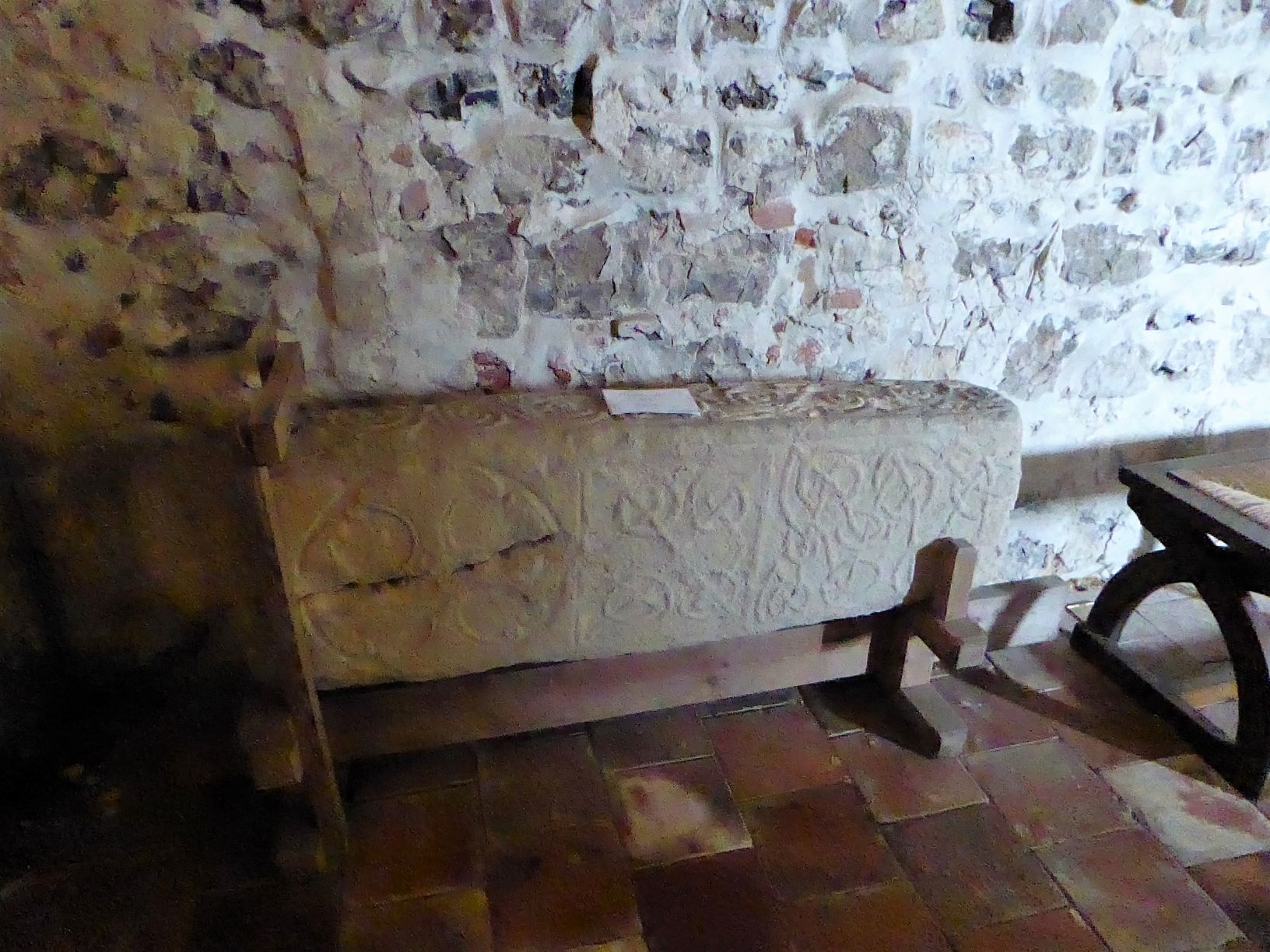
The lower half of the 9th Century Saxon cross probably dedicated to St Botolph found embedded in the tower wall during restoration work in the 1970’s.

The cross is very weather-beaten as one might suppose, but typical inter-lacing Saxon patterns decorate it and there is also what could be a dragon carved on it, but I was unable to photograph it due to the gloom.We left the church and retraced our steps back to the car-park.

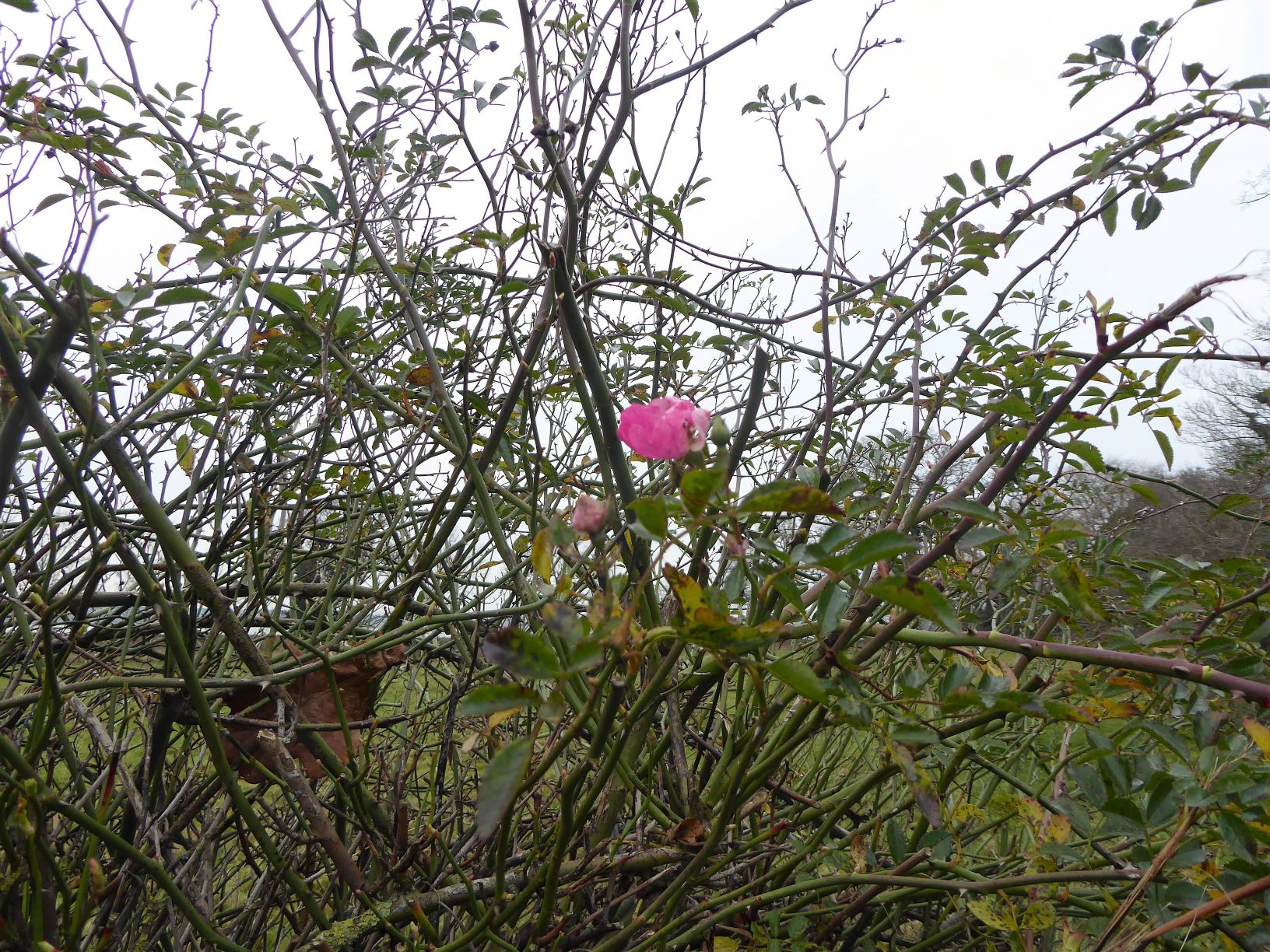
I saw this tiny rose in flower!

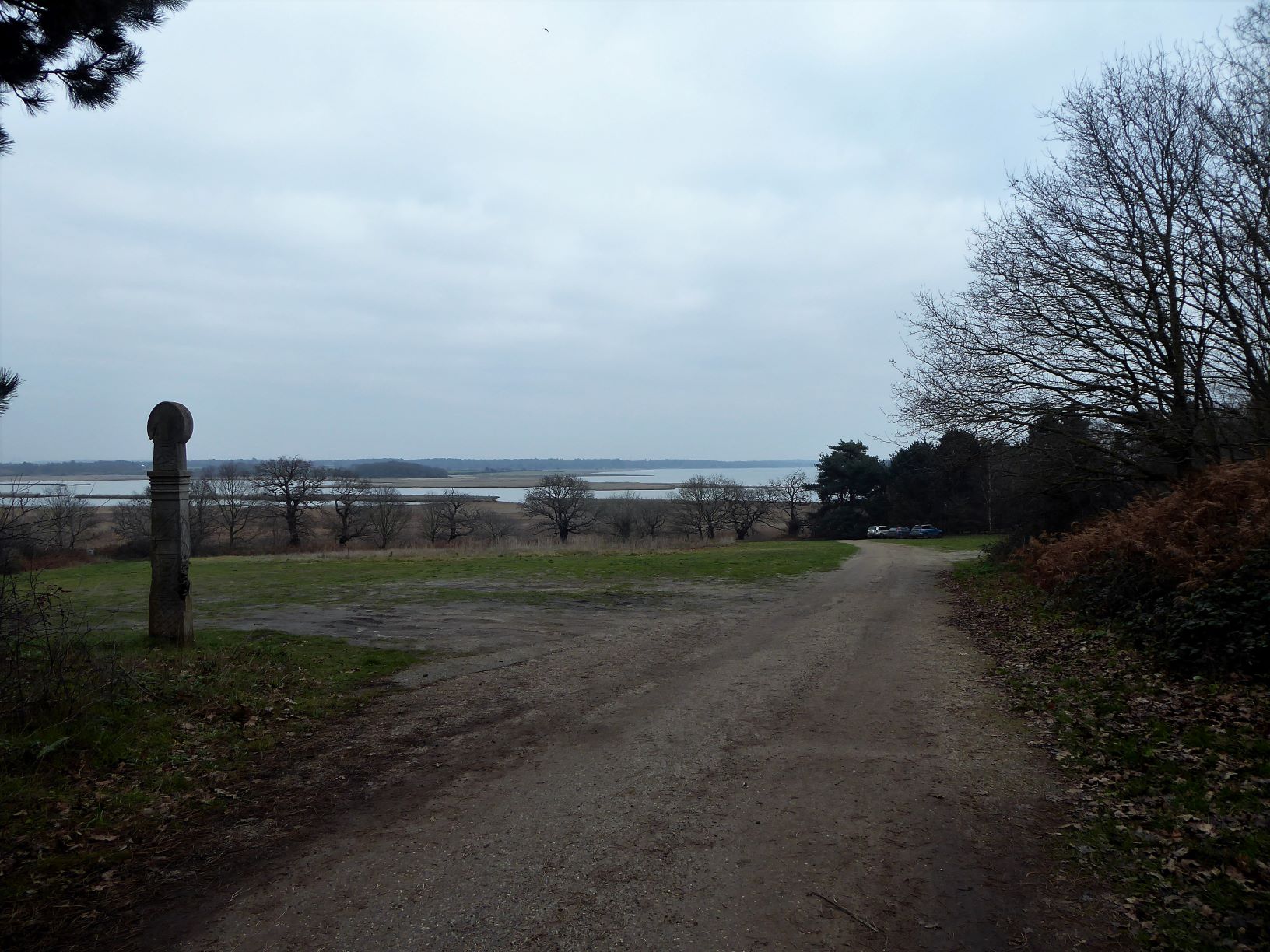
The entrance to the car-park.

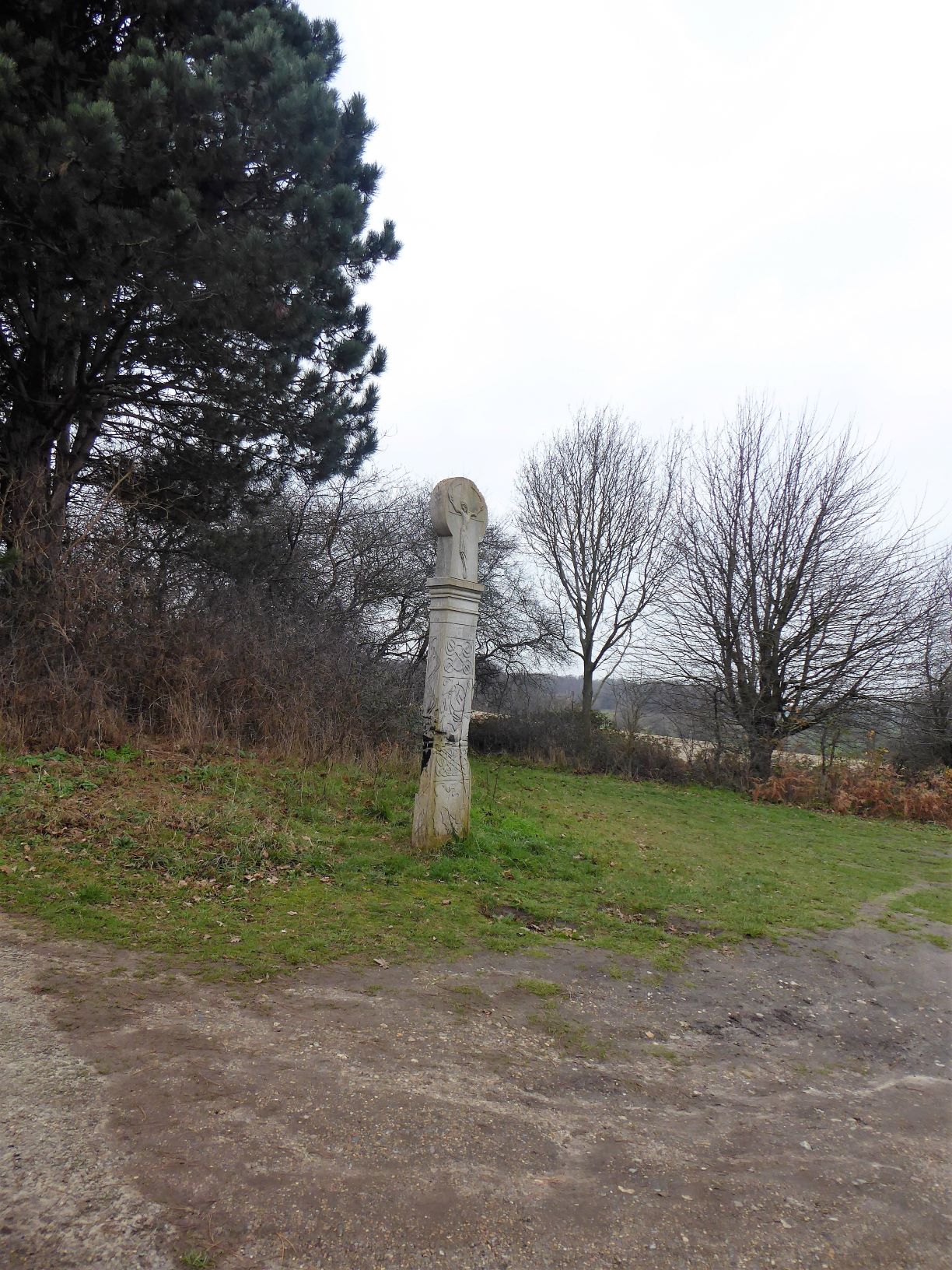
A replica Saxon cross stands in the car-park.

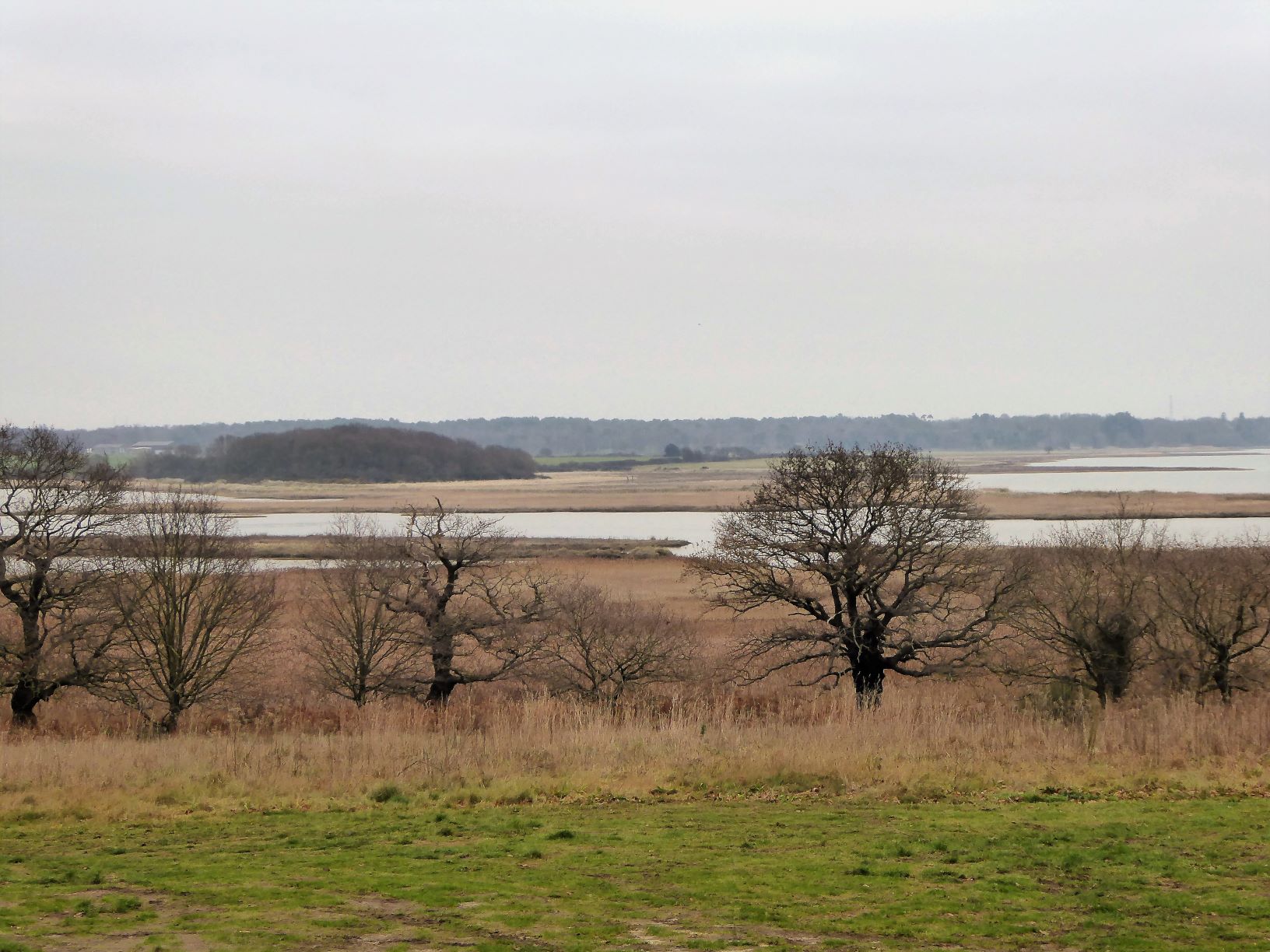
The view across the estuary.

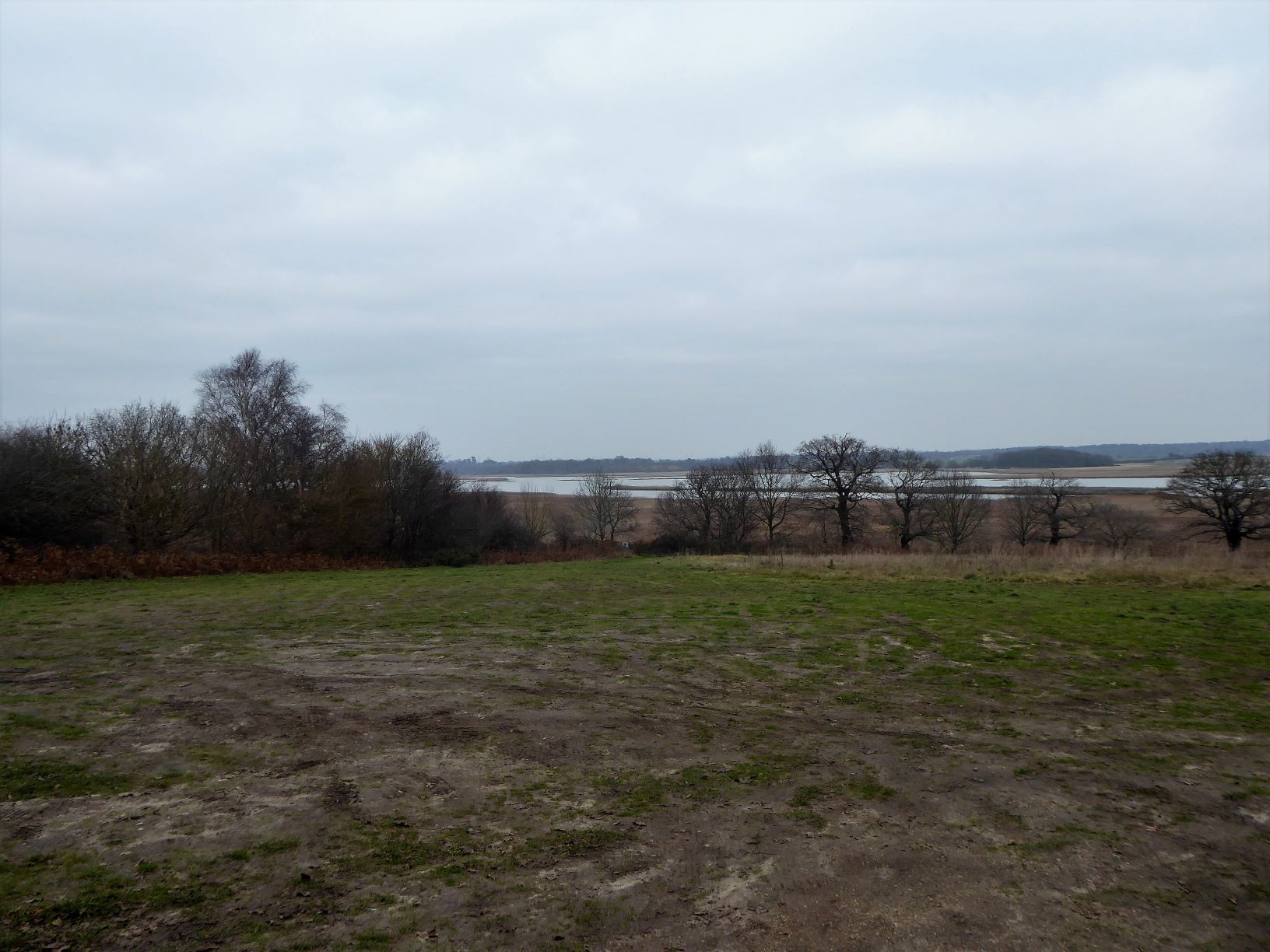
Another bleak view!

We were glad to return to the car and I drove us to Halesworth where we enjoyed a tasty lunch and a drink.

Share this:

  • Share on X (Opens in new window) X
  • Share on Reddit (Opens in new window) Reddit
  • Share on Pinterest (Opens in new window) Pinterest
  • Share on Facebook (Opens in new window) Facebook
  • Email a link to a friend (Opens in new window) Email
  • Share on Tumblr (Opens in new window) Tumblr
  • Print (Opens in new window) Print
  • Share on LinkedIn (Opens in new window) LinkedIn
Like Loading...

2017 Revisited

12 Thu Apr 2018

Posted by Clare Pooley in Arts and Crafts, churches, Rural Diary

≈ 90 Comments

Tags

Bungay, Churches Conservation Trust, gargoyles, grotesques, H Rider Haggard, John Barber Scott, Priory Church of Saint Mary, Suffolk

As I mentioned in a previous post, I am writing a series of posts about a few places I visited last year but hadn’t the time then, to feature in my blog.

ooooOOoooo

The Priory Church of Saint Mary, Bungay, Suffolk

Last spring I went to see an exhibition of ancient and modern needlework and textiles at St. Mary’s Priory Church in Bungay.  The exhibition was called ‘A Stitch in Time’ and the leaflet I was given as I entered the church stated that it “… offer(ed) the visitor the opportunity to explore Bungay through the textiles that have been left as legacies of its past and … (admire) textiles that, it is hoped, will become heirlooms for future generations”.

Star of Bethlehem
Star of Bethlehem
Star of Bethlehem
Star of Bethlehem

Star of Bethlehem (Ornithogalum umbellatum) were in flower in the churchyard.

I enjoyed the exhibition exceedingly but photography was not allowed because many of the exhibits were extremely old and precious and all were unique and beautiful.  I spent some time admiring the needlework and also watching as some of the members of the ‘Sew on Sunday’ group worked on their current projects.

St. Mary’s Church tower

St. Mary’s Church began its life as part of a Benedictine Priory, its Parochial Nave, which was founded in the 12th century (about 1160) byGundreda wife of Roger de Glanville.  The nuns who resided in the priory were skilled needlewomen and made beautifully embroidered wall-hangings, altar cloths and other textiles used in church and chapel.  They probably also made embroidered vestments for the clergy.   The leaflet told me that after the Reformation in 1536 the Priory was closed and according to the parish accounts and local wills, “some of the church embroideries and vestments were cut up and made into elaborate theatrical costumes for the plays forming part of the annual Ale-Games in the churchyards during the Whitsun period!”  Don’t ask me about Ale-Games, because I can’t tell you a thing about them!  On display were some exquisite vestments and other church textiles.  Local churches, the Community of All Hallows and the Museum in Bungay had contributed some items for display, as had a number of local people.

St. Mary’s Church, built in the 15th century

Also on display were some needlework samplers dating from  the late 17th century.  These were made by the female ancestors of John Barber Scott (1792 – 1862) who was a wealthy local gentleman, diarist, philanthropist and Town Reeve.

I particularly enjoyed the display of work by the All Hallows Embroidery School which used to be part of the Community of All Hallows in Ditchingham.

The Barber Scott memorials and grave stones in the churchyard

I returned to the church a week later once the exhibition had finished, and took some more photographs of the church, inside and out.  This church is now redundant and is cared for by the Churches Conservation Trust.

Carving over north door.  A knight and a lion.

Carving over north door.  A lion and a mouse.  There is also a man’s head to the right of the lion.

An arch-stop with oak leaves and acorns

The north wall of the church.

I enjoy looking out for grotesques and gargoyles on churches.

Dog grotesque on north side of the church
What looks like a pig with a crown and long hair on north side of the church
Man with a toothache on north side of the church
Grotesque on north side of the church

These are the ruins of the 13th and 14th century priory buildings at the east end of the church

Priory ruins

Priory ruins

Churchyard with the Barber Scott graves in the middle distance

Look at the beautiful open-work cresting on the top of the north aisle! What skilled masons they were to have carved this!

I love this tiny figure of a knock-kneed kneeling knight in armour!

These niches on the buttresses would have contained figures of saints which were probably destroyed when the priory was dissolved.

More grotesque faces!

A chained begging monkey

A hound with folded paws

I’m not sure what this creature is!

I like the pinnacles on top of the tower. More fine carving here too.

Carving and flushwork on the West Front

Note the crowned ‘M’s above the West window.  The emblem incorporates all the letters of the name ‘Maria’.

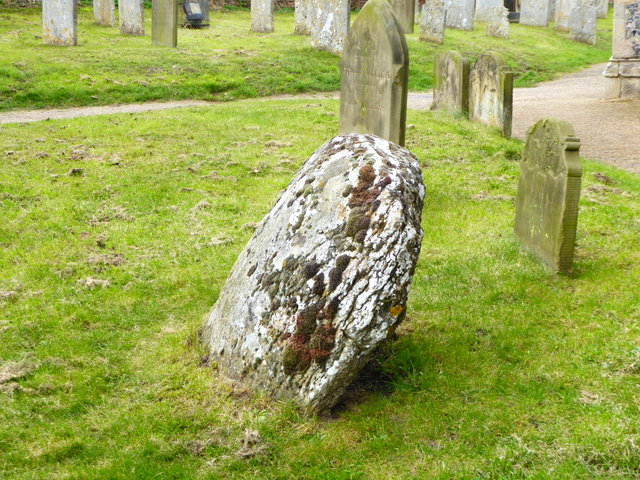
Opposite the West Door is this stone known as ‘The Druid’s Stone’ which has probably been there since the Ice Age.

The inside of the church is less interesting than the outside.  Damage was done to the church in the Bungay Great Fire of 1688 when most of the roof timbers were destroyed and again during the Second World War when most of the glass was lost.

This slideshow requires JavaScript.

The slideshow above is of the windows and the stained glass in the church, most of which had to be replaced after the Second World War.

The High Altar

Some of the modern needlework that adorns the church

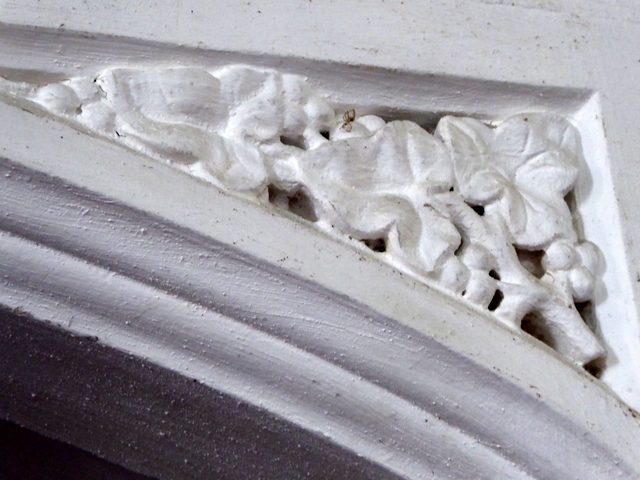
Carved ivy

One of the bosses in the roof. I apologise for it being out of focus.

Some of the original 15th century woodwork was saved.  I have no idea if this might be one of the older carvings.  Most of the roof dates from the restoration after the fire which was completed in 1699.

Another blurred boss

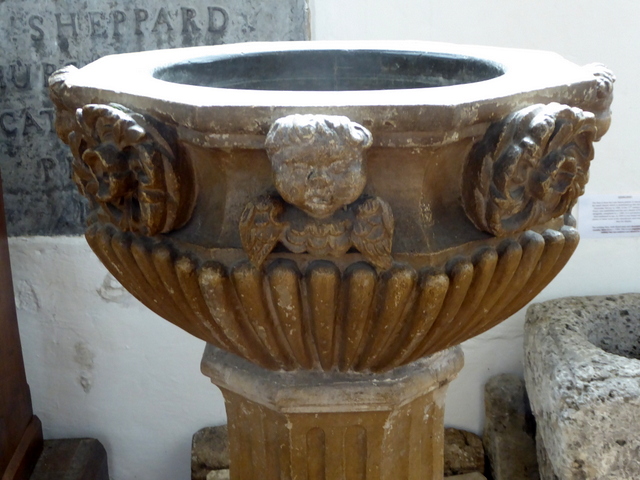
The font is 18th century and decorated with cherubs and roses.

Behind and to the right of the font is a stone bowl thought to be part of a Saxon or Norman font which was found near the Staithe in the town.

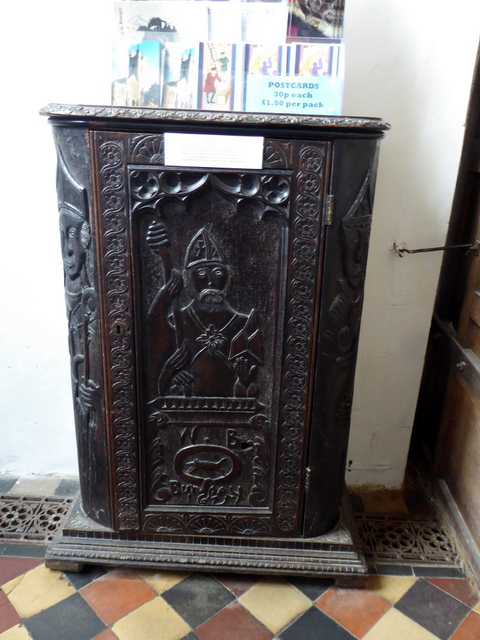
This is a dole cupboard where bread and other scraps of food were placed for the poor to collect.

The cupboard was restored in the 19th century but it is dated 1675.  Or, it may be a fake and made in the 19th century.  Who knows!  There is a rebus on the lower front of the cupboard; a large Q with a rat inside it (Curate) and his initials.  There are also mitred bishops being pulled downwards by hands.  Hmmm!  Bishops can’t have been rated very highly here!

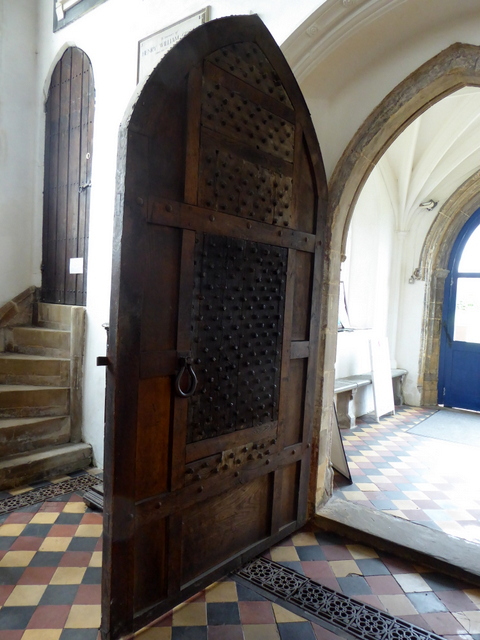
I like the studded door.

The studded panels came from a 16th century house in the town.

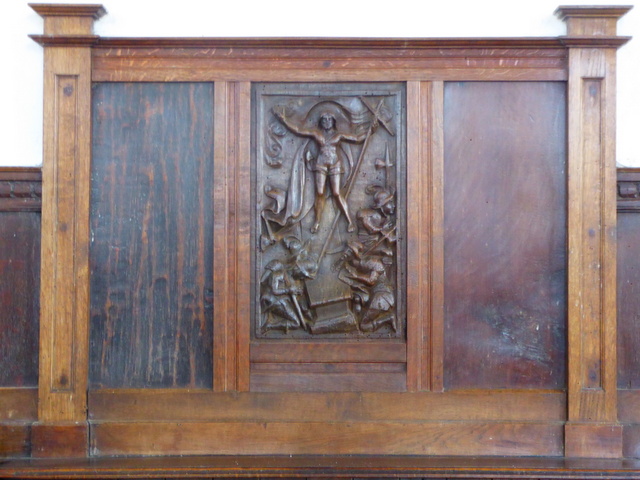
The War Memorial Chapel in the church has this 17th century Flemish carving of the Resurrection as the central panel of the reredos.  

This beautiful carving was the gift of Sir H Rider Haggard  of ‘King Solomon’s Mines’ and ‘She’ fame, who lived in Ditchingham House nearby.

Thank you very much for taking the time to read this long post!

Share this:

  • Share on X (Opens in new window) X
  • Share on Reddit (Opens in new window) Reddit
  • Share on Pinterest (Opens in new window) Pinterest
  • Share on Facebook (Opens in new window) Facebook
  • Email a link to a friend (Opens in new window) Email
  • Share on Tumblr (Opens in new window) Tumblr
  • Print (Opens in new window) Print
  • Share on LinkedIn (Opens in new window) LinkedIn
Like Loading...

Interregnum

05 Sat Aug 2017

Posted by Clare Pooley in churches, Rural Diary

≈ 61 Comments

Tags

benefice, church, retirement of our priest, Suffolk, the Suffolk Saints

On Thursday Richard, our Rector retired.

Richard was with us for sixteen and a half years and looked after us well.  We are a large (in area) benefice consisting of eleven parishes with eleven ancient churches; and I really mean ancient!  Richard not only worked very hard to keep all these unique churches going despite many set-backs but also at the same time, managed to get us to think of ourselves as a team; a ‘federation’ of parishes.  We help each other out whenever possible.  He gave us thought-provoking sermons each week.  His constant message was that all people are equal in the sight of God and all should have equal rights and opportunities.  He is a fairly shy and self-effacing man but who also would not put up with thoughtless, careless and bad behaviour from anyone.  He has an encyclopaedic knowledge of films and often quoted from them in his sermons.  He is a talented artist and has also written a book about a pilgrimage he made in France.  He can also tell the most awful and funny jokes!   He supported all our individual fund-raising efforts and provided us and our churches with all sorts of different things that have been of invaluable service.  He cleaned, polished, mended, tidied and adorned our church buildings.  He designed our website and kept it up-to-date.  He edited our benefice magazine and often wrote most of the copy, got people to advertise in it and sent it off to be printed.  He ran a coffee morning once a month in his home and made marmalade, cakes and breads for us.  He fought on our behalf with anyone who tried to make our lives more difficult.  He researched the history of all our churches and was extremely knowledgeable about their architecture.  At the centenary of the start of World War I he presented each of our churches with a Remembrance folder containing information on all the men (and women) from each parish who are mentioned on the war memorials.

This is only a fraction of all he has done for us.  Like children, we accepted it all and often took him for granted.  We now have to fend for ourselves for goodness knows how long.

Richard’s last service was the mid-week said Eucharist at 9.00 am on Thursday at Ilketshall St Margaret’s church.  Usually, there are less than ten people who attend this service.  This Thursday the church was nearly full with representatives from most of the churches in the benefice.  Richard asked us where we’d all been for the past 16 years!  A good question!  After the service we presented him with a gift and sang happy birthday to him.  We had sherry to drink and Pam had made a delicious fruit cake.  We chatted and laughed and then it was over.

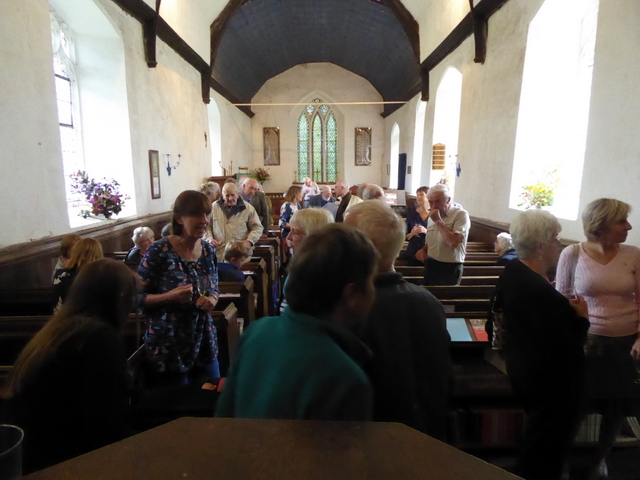
Looking towards the East end of the church. Some of the people at Richard’s last service.

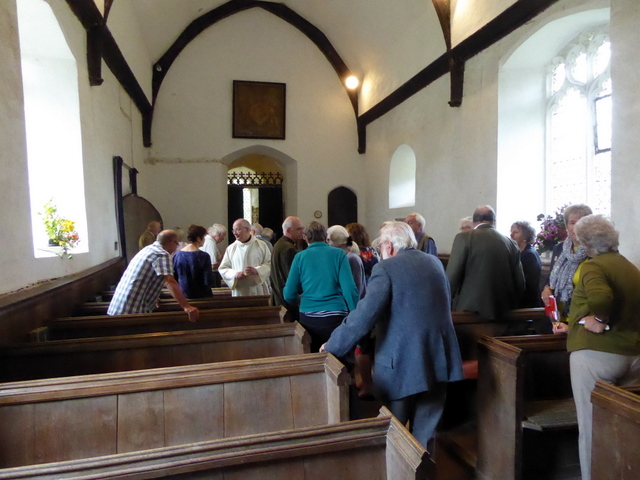
Looking towards the back of the church. You can see Richard in the centre of this photo.

Goodbye and good luck, Richard.  We will miss you very much.

Share this:

  • Share on X (Opens in new window) X
  • Share on Reddit (Opens in new window) Reddit
  • Share on Pinterest (Opens in new window) Pinterest
  • Share on Facebook (Opens in new window) Facebook
  • Email a link to a friend (Opens in new window) Email
  • Share on Tumblr (Opens in new window) Tumblr
  • Print (Opens in new window) Print
  • Share on LinkedIn (Opens in new window) LinkedIn
Like Loading...

A Quiet Spring – March and April Part 1

06 Tue Jun 2017

Posted by Clare Pooley in churches, Gardening, Insects, plants, Rural Diary, wild birds, wild flowers

≈ 56 Comments

Tags

birds, churches, flowers, garden, insects, spring, Suffolk, sunset

We weren’t very adventurous this spring, staying close to home and taking things easy, so there wasn’t too much to blog about.

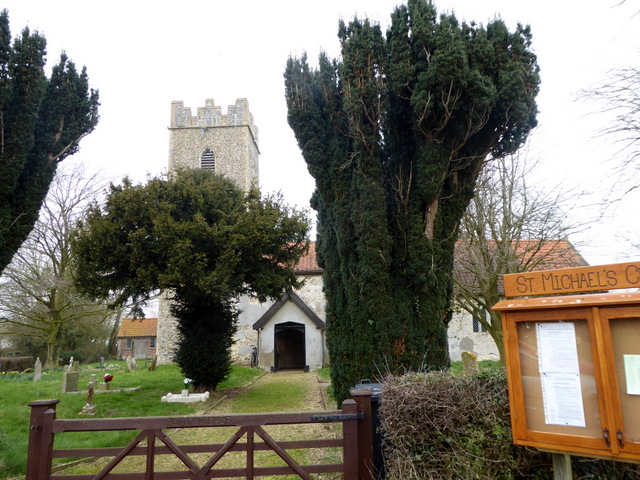
A visit to St Michael’s church on the first mild spring day in March

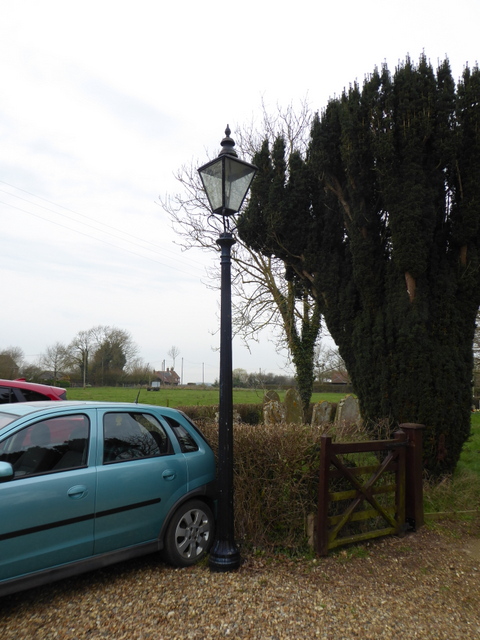
We admired the ‘Narnia’ lamp post by the gate.

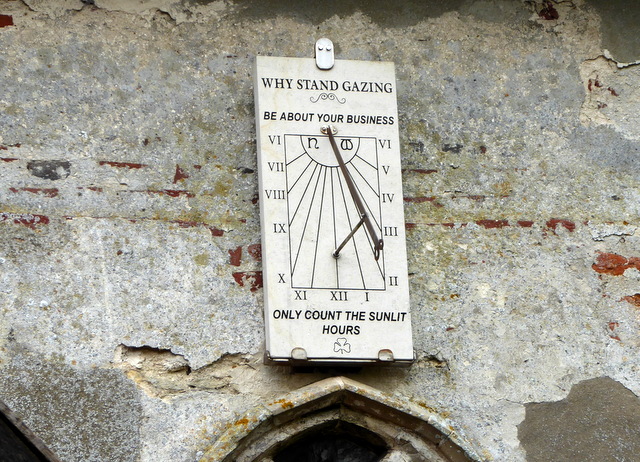
We were unable to tell the time as the sun failed to shine.

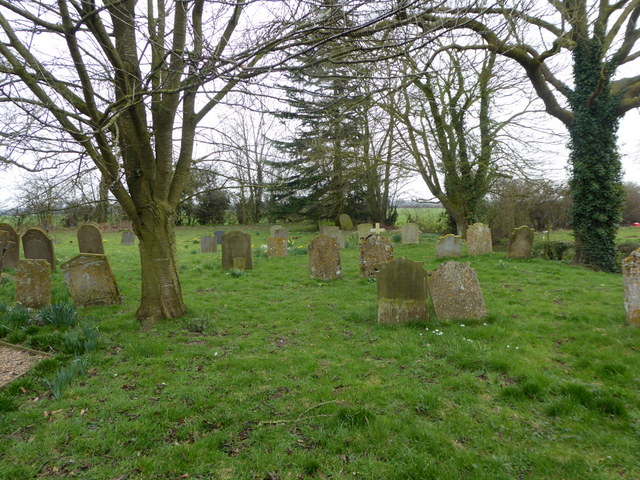
The peaceful churchyard.

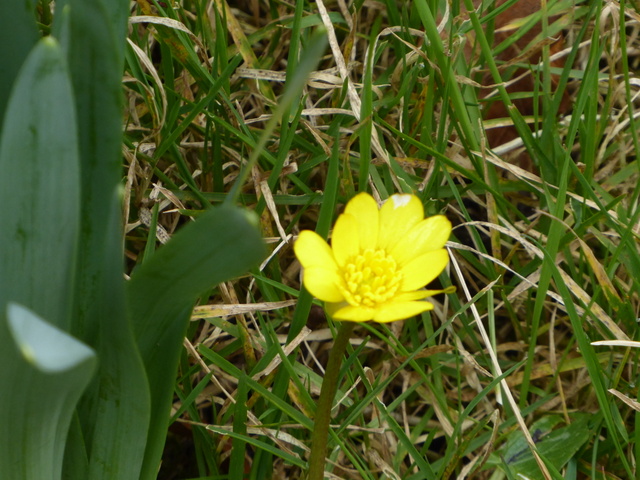
Marsh Marigold (Caltha palustris ) The flowers are in the centre of the bloom and have no petals. The 5 – 8 petal-like sepals are bright shiny yellow.

Peacock butterfly (Inachis io)  It was very sluggish and was still in the grass outside the church when we came out again.

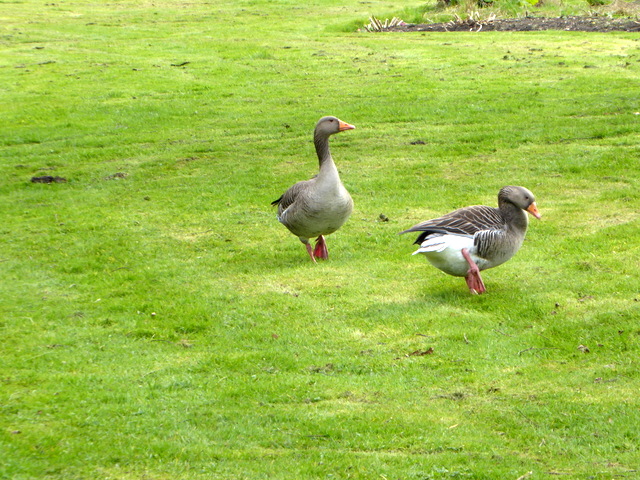
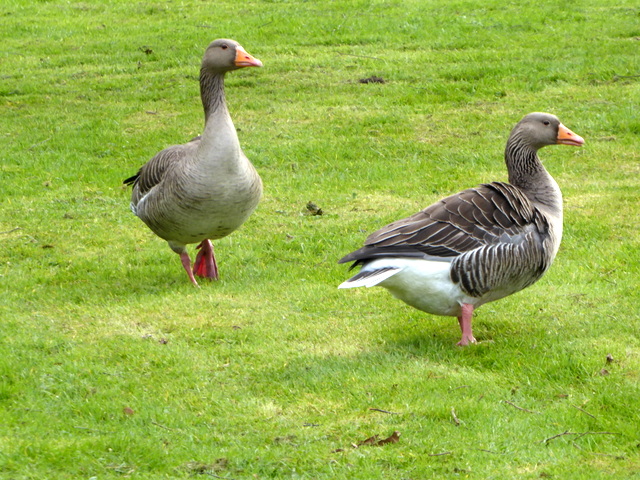
A pair of Greylags (Anser anser) took up residence in our garden as they usually do each spring

We enjoy their company.

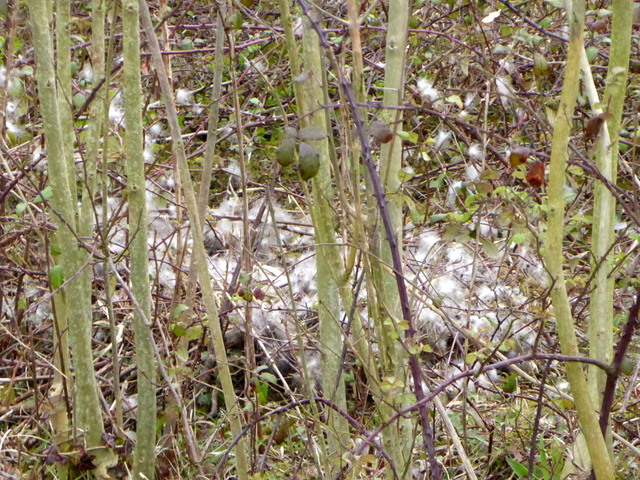
They constructed a nest on the island in the middle of the big pond but after ten days it was abandoned.  Feathers were spread everywhere. We don’t know what happened but we suspect an otter or an American mink was to blame.

The abandoned nest.

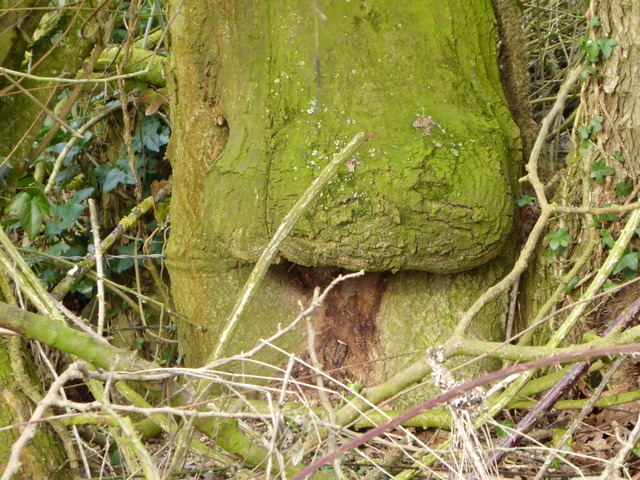
After we lost our summerhouse in the storm earlier this year we spent some time clearing the area behind it and discovered this tree with the deformed trunk. What could have caused this?

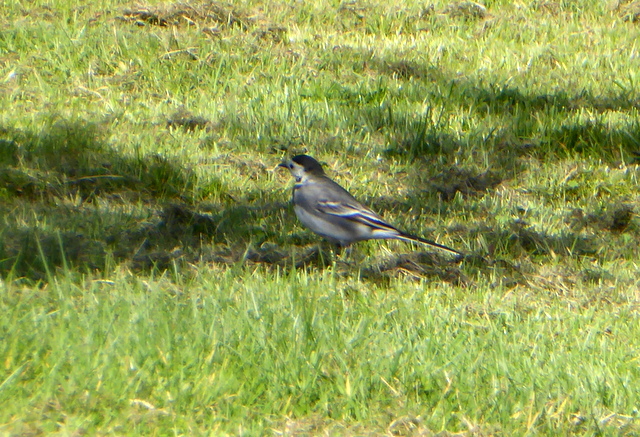
We enjoy seeing all the birds that visit our garden including the Pied Wagtails (Motacilla alba). Not a good shot as the bird hurried into the dappled shade just as I took its picture.

A sunset seen from the back of the house.

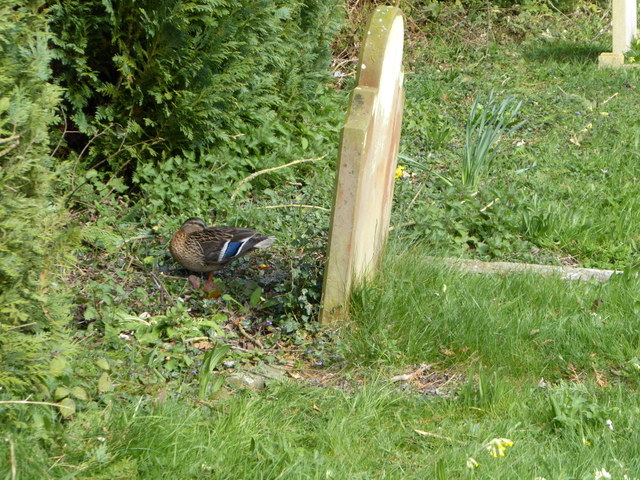
On a visit to our church at Rumburgh we saw this Mallard duck (Anas platyrhynchos) resting in the shade of a gravestone.

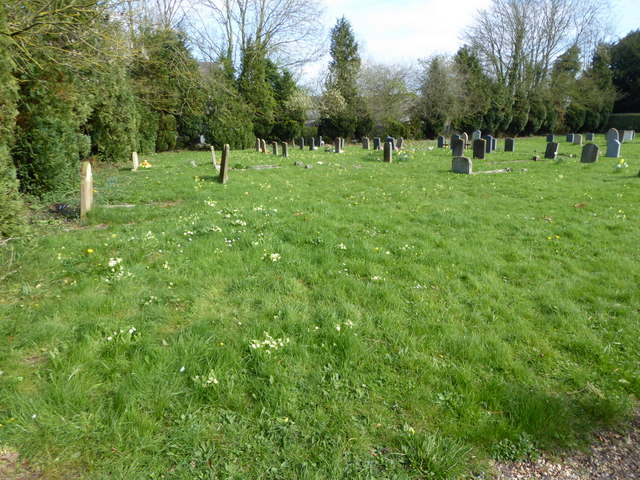
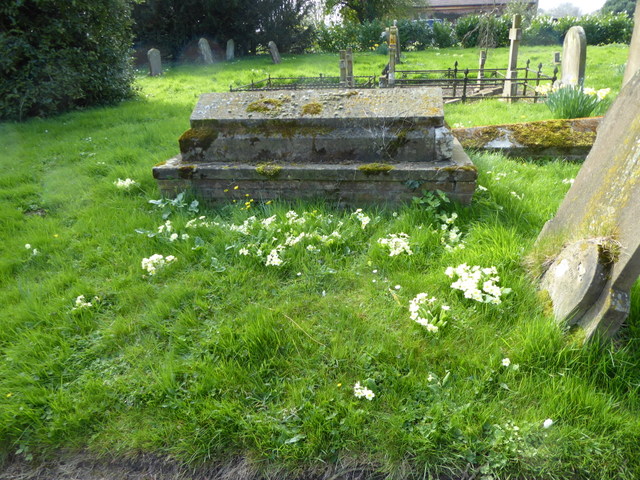
Primroses (Primula vulgaris) in the churchyard

I love the informality of our country churchyards and I like to see the wild flowers there. The wild flowers are just as much God’s work as any garden flower or exotic bloom.  They have a haven in our churchyards and should be safe from herbicides.

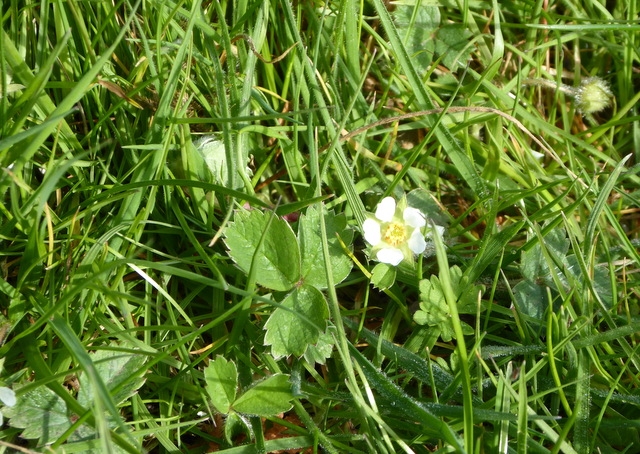
Barren Strawberry (Potentilla sterilis)

Richard on his way to church

This slideshow requires JavaScript.

Meanwhile, back in my garden…..

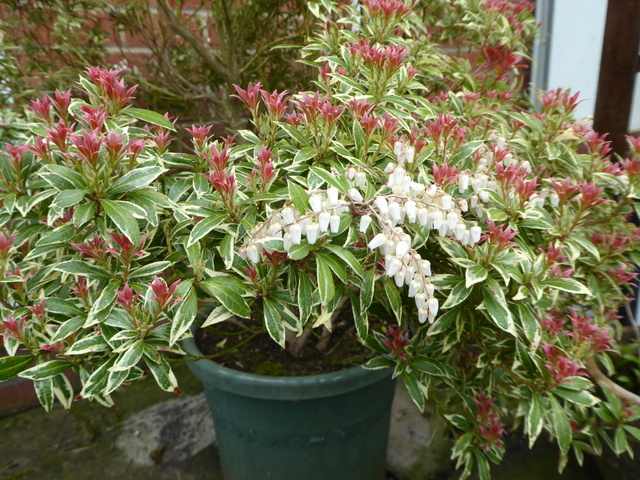
My Pieris with its new leaves of red and its little white bell flowers

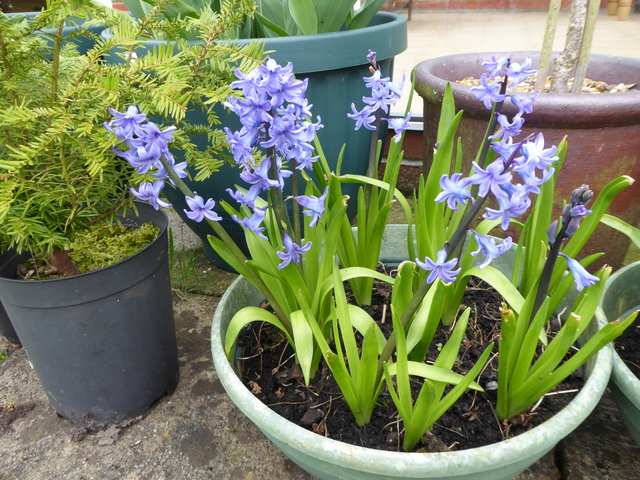
I have been growing these hyacinth bulblets on in shallow tubs and they are now ready for planting out in the garden to flower next spring.


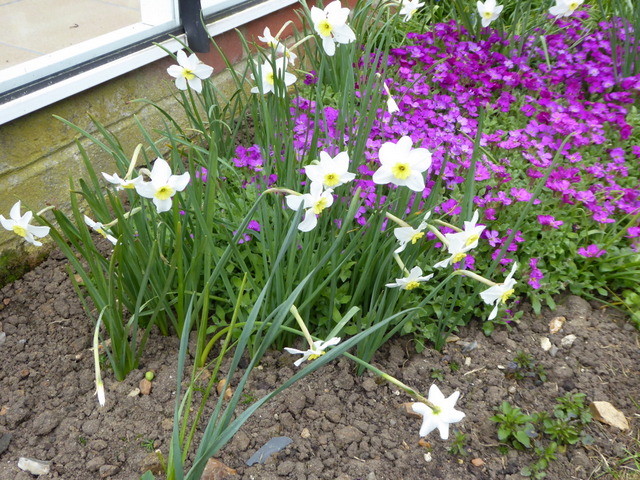
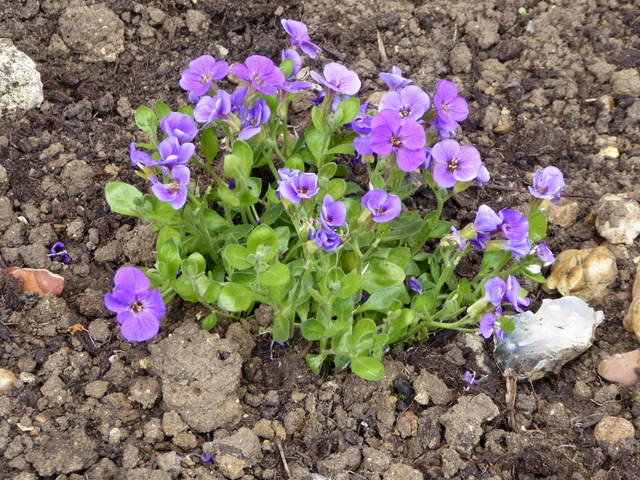
Scented narcissi and pink aubretia

Elinor gave me some more aubretia, a mauve variety, as a gift on Mothering Sunday

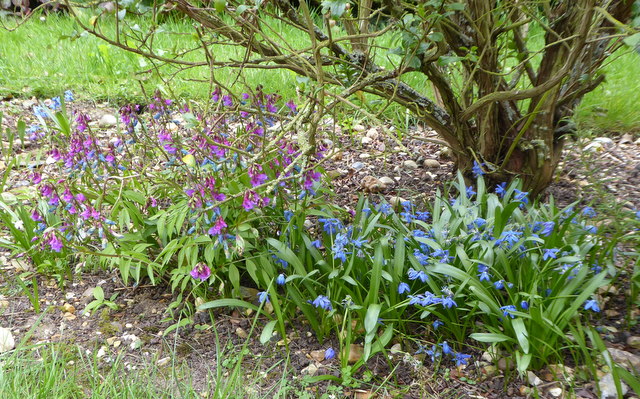
Lathyrus and scilla

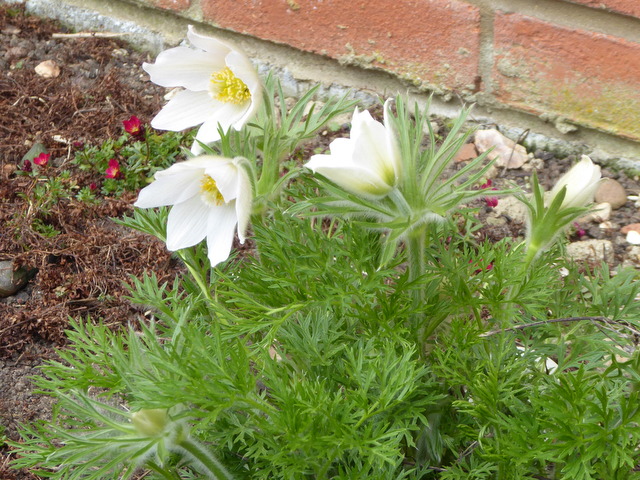
Pasque flowers. These began flowering just a couple of days after Easter Sunday.

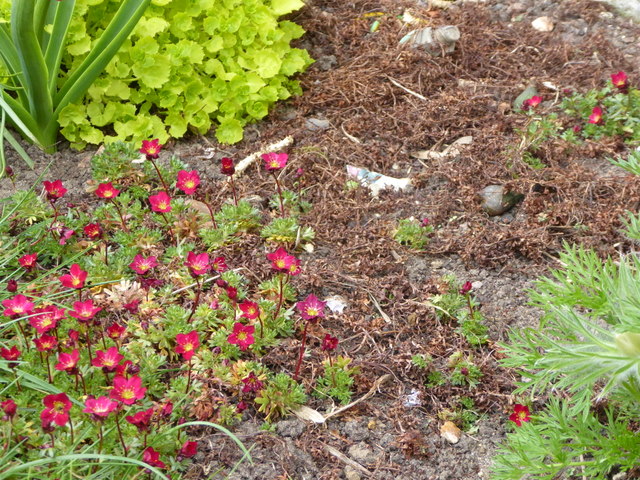
I had a large patch of these red saxifrage but the deer scraped most of them up. I’m hoping they will spread again.

My music choice is ‘Glorious’ sung by The Pierces

Thanks for visiting!

Share this:

  • Share on X (Opens in new window) X
  • Share on Reddit (Opens in new window) Reddit
  • Share on Pinterest (Opens in new window) Pinterest
  • Share on Facebook (Opens in new window) Facebook
  • Email a link to a friend (Opens in new window) Email
  • Share on Tumblr (Opens in new window) Tumblr
  • Print (Opens in new window) Print
  • Share on LinkedIn (Opens in new window) LinkedIn
Like Loading...

Easter Day

17 Mon Apr 2017

Posted by Clare Pooley in churches, family, Rural Diary

≈ 39 Comments

Tags

Diary, Easter, eating out, Hot Cross Buns, St. Peter and St. Paul Eye, St. Peter's church St. Peter South Elmham

Happy Easter everyone!

St. Peter’s church, St. Peter South Elmham

Richard attended Holy Communion this morning at the church of St. Peter in the village of St. Peter South Elmham.  He kindly took this photograph for me on his phone.

I attended Solemn Mass this morning at the church of St. Peter and St. Paul in the town of Eye.  I was unable to take any photos as I was busy helping my mother so this link may give you an idea of where I was.  One day I intend to write a post about the church at Eye.

During Holy Week we did manage to do a few things on top of all the church-going.  We visited Norwich on Tuesday so that Elinor could revisit the exhibition of dolls’ houses currently on display at the Castle Museum.  She decided that this was the exhibition she wanted to review for her college interview this coming Wednesday and she needed to check up on a few details and take some more photos.  While we were in the city we did some Easter shopping and had an extremely pleasant lunch at the Iron House.

On the way home I stopped off in Bungay to get some more shopping and to order some flowers for the church to be collected on Holy Saturday.

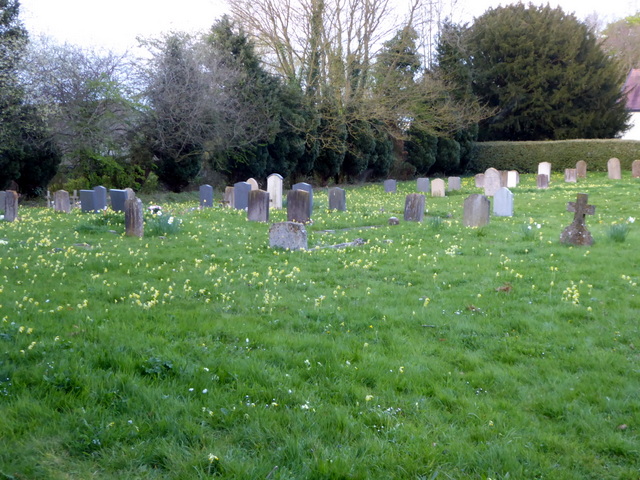
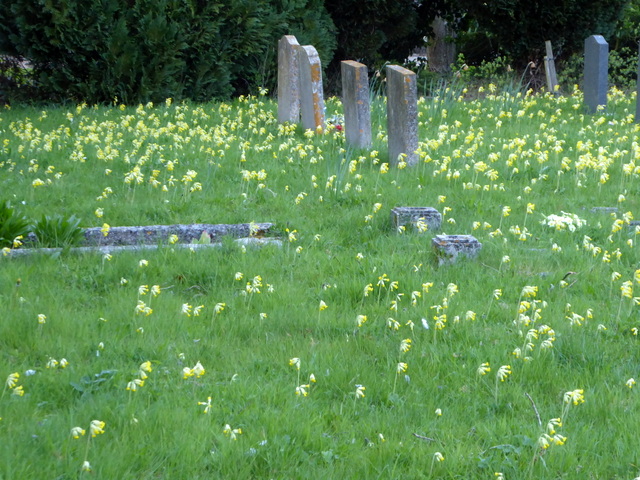
On Wednesday I took my mother out shopping in Diss and she gave me a dozen Hot Cross Buns she had made which I put in the freezer when I got home.  Richard and I went to Rumburgh church to tidy it a little before the service that evening.  The building works have nearly finished but the dust is still settling on everything.  The churchyard is full of cowslips!

Rumburgh churchyard

Rumburgh churchyard

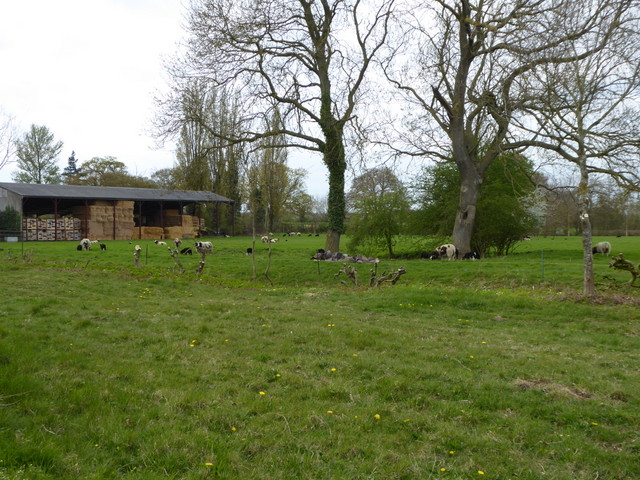
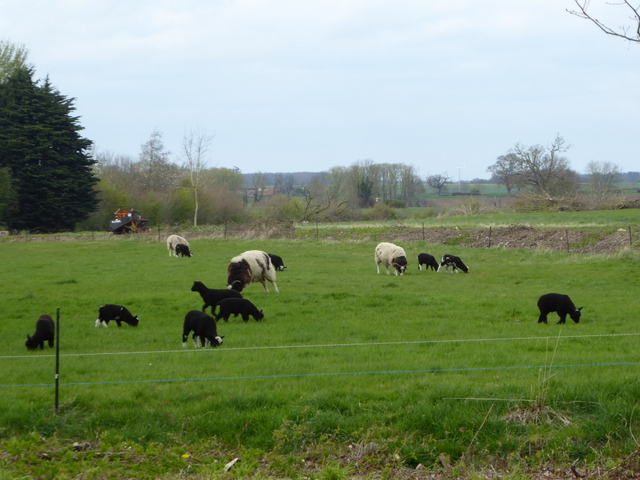
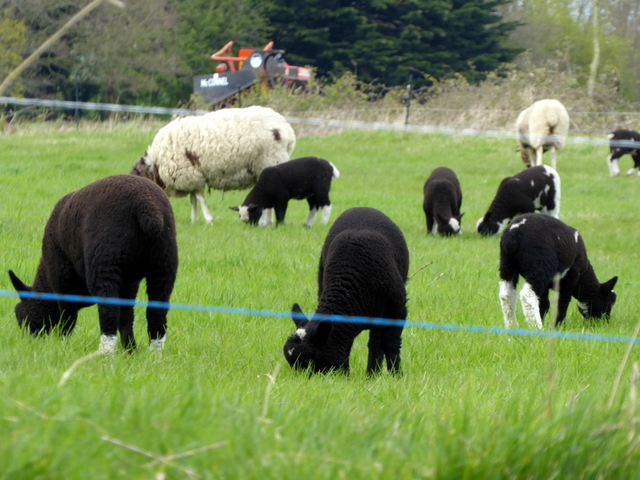
We drove back home and then walked to the corner of the lane to admire all the Jacob sheep and their lambs.

Jacob sheep and lambs

Jacob sheep and lambs

Jacob sheep and lambs

Jacob sheep and lambs

Thursday was quite busy.  After the early church service I went into Halesworth to pick up some things I needed and spent some time in town.  We  had organised a team cleaning session at Rumburgh church for 2 pm but only five people managed to attend – Richard the Rector, Pam and Ian (the other Churchwarden and his wife), Richard and I.  We all worked hard for two and a half hours and the church is clean and tidy again with everything back where it should be.  We got rid of a lot of rubbish and moved some furniture about too.

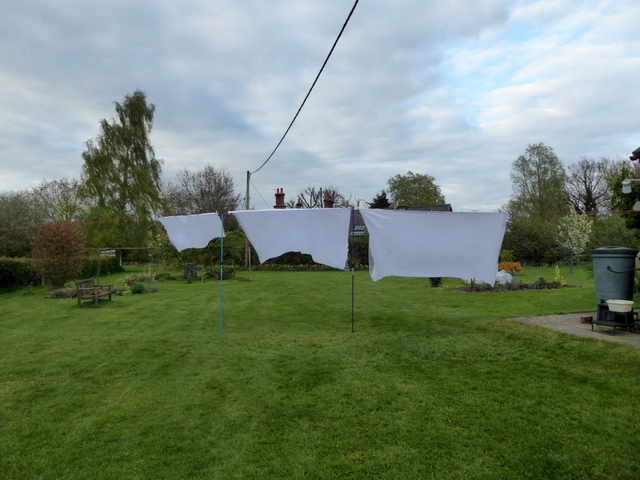
Before going out again that evening I managed to wash two altar cloths and a table cloth from the church.  They dried quickly in the strong, cold breeze that has been blowing all the week.

Church washing

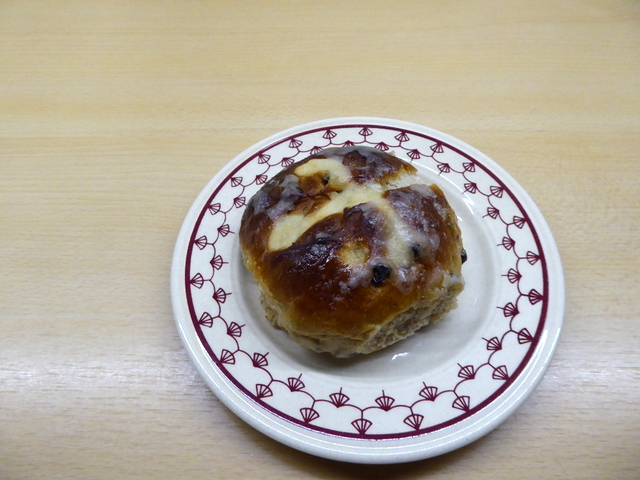
Friday was Hot Cross Bun Day!

One of my mother’s excellent Hot Cross Buns. They are split, toasted and then buttered.

Not only did we have buns at home but the Rector held a tea at his house after the last service of the day.  It was very well attended, much food and drink was consumed and a lot of talking and gossiping was done!

We got a little much needed rain later but unfortunately, just as it started at 5.15 pm we got yet another power-cut which lasted until after 9.30 pm.  A power cable was hit by a branch again!  I had nothing suitable to cook on the gas hob for our evening meal so we went out to Bungay and had a pizza at the Stonehouse.

I went back to Bungay on Saturday morning to collect the flowers I had ordered and to  buy some wrapping paper for presents for my mother whose 87th birthday is tomorrow.  I also had to take a large parcel to the post office.

Today we went to the Fox and Goose in Fressingfield for lunch to celebrate both Easter and Mum’s birthday.  It was a lovely meal, enjoyed by all of us and then Mum came home with us for the afternoon.  The rain that was forecast for today held off until the afternoon so we didn’t get wet.

We have eaten out much more than usual this week, and very nice it has been too!

Thanks very much to you all for visiting my blog!

Share this:

  • Share on X (Opens in new window) X
  • Share on Reddit (Opens in new window) Reddit
  • Share on Pinterest (Opens in new window) Pinterest
  • Share on Facebook (Opens in new window) Facebook
  • Email a link to a friend (Opens in new window) Email
  • Share on Tumblr (Opens in new window) Tumblr
  • Print (Opens in new window) Print
  • Share on LinkedIn (Opens in new window) LinkedIn
Like Loading...

Doris Remembered

08 Sat Apr 2017

Posted by Clare Pooley in churches, family, Gardening, plants, Rural Diary, weather

≈ 47 Comments

Tags

church renovations, damage, Diary, garden flowers, home improvements, lay-led worship training, Mothering Sunday, power cuts, quizzes, Storm 'Doris', Suffolk

I arranged to visit Alice in Sheffield on Thursday 23rd February, spend the night in a hotel and return home again the following day.  What I hadn’t expected when I bought the train tickets and booked the hotel room was a visit from ‘Doris’ that day too.  For those who don’t know who ‘Doris’ is (or who might have forgotten), ‘Doris’ was a storm that caused some disruption here.  Fortunately, my journey went ahead with no problems other than a speed restriction.  Alice met me at the station and we decided to have lunch together before I went to my hotel.  We nearly got blown off our feet on the way to the café, the door of which kept blowing open while we ate, but we weren’t inconvenienced too much by this.  I spent a lovely afternoon with Alice either chatting in my hotel room, drinking tea in another coffee shop or buying books.

While I was enjoying myself, Richard and Elinor were having quite an unpleasant time at home.  The power went off at about 2 pm and in the garden a few of our belongings started flying through the air despite Richard having tried to make them safe before the storm began.

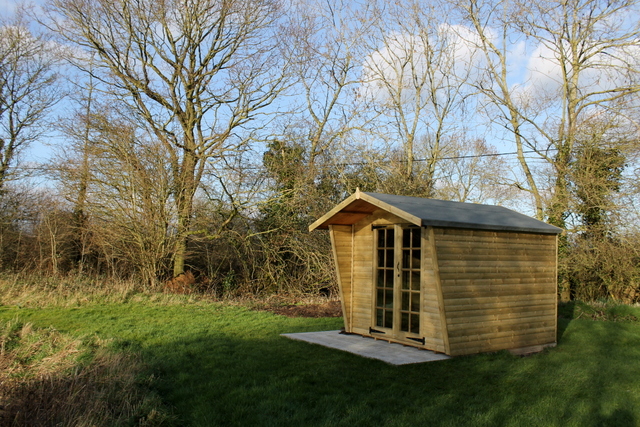
I wonder if any of you remember how pleased we were when we got our new summerhouse last year?  Here is a photo of it.

Our summerhouse when it was new last February.

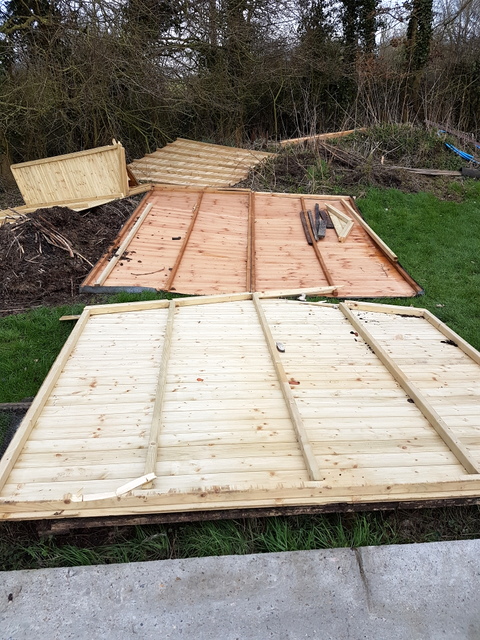
The summerhouse after the storm this February.

The wind ripped the roof off and the rest of the building just broke apart.  A number of trees in the area were blown over and roads were blocked.  When I got back to Norwich the following afternoon Richard was a little delayed when collecting me from the station by having to make detours to avoid blocked roads.  The power was still off when I got home and the house was cold.  Richard and Elinor had coped very well using the gas hob to cook meals and heat water for hot drinks and washing up.  They had sat together the evening before in front of the gas fire listening to the battery-powered radio by candlelight.  We often get power-cuts living where we do, though not as many as we used to do before the power company changed the cables and started regular cutting-back of tree branches that are too close to the cables.  Having said that, we have had six power-cuts of at least an hour this year already.  We keep a supply of candles and lamps ready and have torches in all the bedrooms and in the kitchen, utility room and garage.  We have a portable gas heater as well as the gas fire and gas hob.  We can also use the caravan which has a large battery and a gas supply.

Fortunately, the power came back on later that day.  I was very grateful for it as we were expecting my cousin Beverley and her partner Jeremy to visit the following day for an evening meal.  I didn’t have the time to prepare all the things I had hoped to, but at least the house was warm and the evening was great fun!

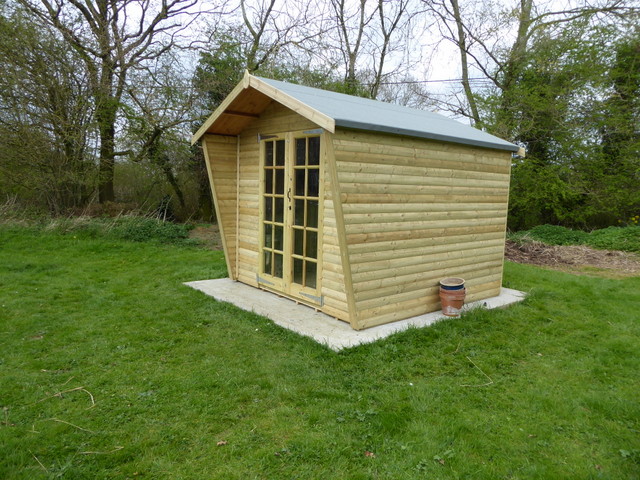
We have been able to claim for a new summerhouse on our insurance and our replacement arrived on Monday of this week.  We got an identical summerhouse which had to be put where the old one was which is a little worrying, knowing how quickly it succumbed to the storm-force winds.  Richard will bolt it to the concrete base and try to make it somewhat sturdier.  We will see what we can do.  We lost our old incinerator during the storm and wondered how far it had travelled, but once Richard had taken photos of the wreck and started to clear up the glass and the panels he found it squashed as flat as a pancake underneath one of the sections.  I am grateful neither Richard nor Elinor got squashed under it!

Here is our new summerhouse. Spot the difference!

Our new internal doors were due to be fitted that week in February but the storm put paid to that, and, because of storm damage the carpenter had to deal with, we didn’t get the doors until nearly a fortnight later.  We are very pleased with them.  They look good, they are more sound-proof than the old ones and the doors downstairs are now glazed and let much needed light into the hall.  The sliding door to the en-suite WC has been replaced with a better one and the sliding door to the downstairs shower-room has been replaced with an ordinary door which is so much nicer.  We will now employ a painter and decorator to decorate the hall, stairs and landing and to paint all twelve doors (we replaced the airing cupboard door too).

ooOOoo

Richard and I have attended a Lay-led Worship Training Course at a church in Beccles.  To enable us to keep our churches open, the way forward is for us, the members of the church to take the services ourselves if there is no priest to lead us.   This will be very useful to us when our Rector retires in the summer.  The four-part course was interesting and well-attended and it gave us the opportunity to meet people from other churches in the Deanery.  Our Deanery is made up of a number of benefices from Halesworth, Bungay, Beccles, Southwold and the villages in-between.

ooOOoo

We have carried on with the usual round of duties and chores; hospital visits, blood tests, appointments with opticians, hairdressers, acupuncturists and chiropractors; housework, gardening, shopping.  We have all had bad colds.  I continue to take my mother to church once a fortnight and join Richard at church in our benefice when I can.

Richard went to visit his brother Chris in Manchester for a few days recently and had a very pleasant time.  On his return we took part in two quizzes.  Last year we had been in a team that had won the quiz held in the village of Walpole.  Part of the ‘prize’ was the honour of composing and presenting the following year’s quiz and Richard offered to take it on.  The time for the quiz duly arrived and he did a fantastic job as Quizmaster (I was his assistant) and he was presented with a bottle of wine as a thank-you gift.  The following night we were at the village of St James taking part in the quiz to raise funds for the Harleston Choral Society.  A meal was included in the fees – very good it was, too – and the questions appealed to me more than usual as there were more music ones and fewer sport! Our team managed to win again.

ooOOoo

We celebrated Mothering Sunday on the 26th of March and it was our church at Rumburgh’s turn to hold the service.  I helped make a few posies to present to the mothers or for people to give to their mothers or take to graves.  Though we have no flowers in church during Lent I was asked to provide some flowers to put in the porch.

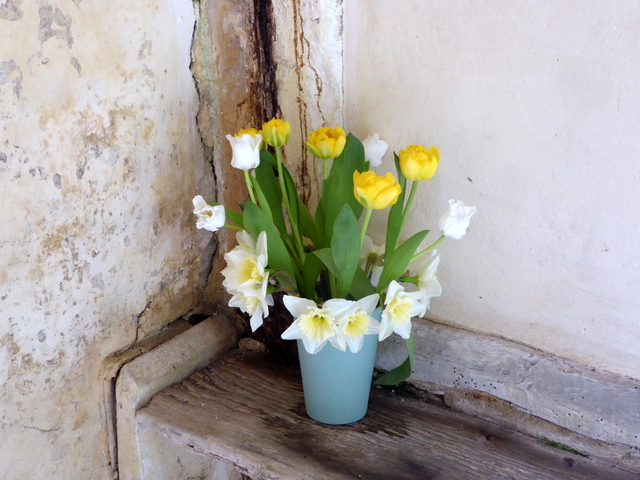
The flowers in the porch.  Looking at this little work of art, you may be surprised to know I am not a flower-arranger 😉  The flowers are lovely in spite of my ministrations. As you can see, the porch is in urgent need of work. If nothing is done soon, the porch will collapse and we won’t be able to use the church.

The church was a little disorganised because we are having a tower screen fitted at the moment and there was dust everywhere.  We have been saving for years for this improvement!  We put everyone as near the front of the church as possible (well away from the building works) sitting in the choir stalls, which was very pleasant.  Richard our Rector chose lots of good hymns and his sermon was amusing and instructive.  I brought my mother to our church for a change and took her back home afterwards.  I couldn’t ask her to lunch because I had no time to prepare a midday meal but she came for an evening meal instead.

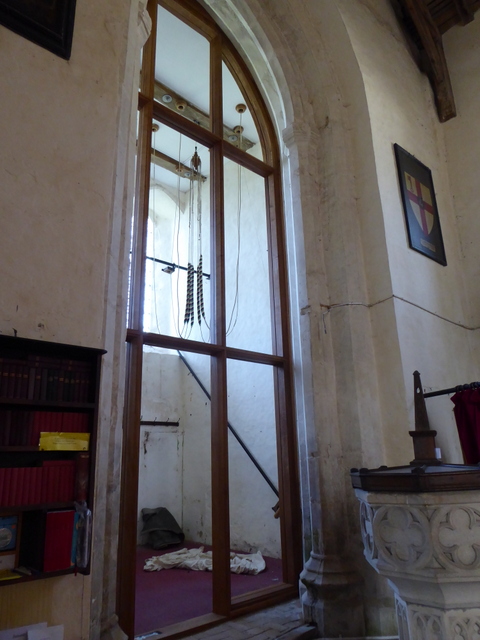
This is the new tower screen. You can see the framework for the glass which has yet to be put in. There will be a glazed door at the bottom of the screen.

We will now be able to see and watch the bell-ringers as they ring before our services.

ooOOoo

I will end this rather wordy post with some photos of the flowers in our garden starting with my favourite iris reticulata that bloomed for too short a time in February.

Miniature iris
Miniature iris
Miniature iris
Miniature iris
Miniature iris
Miniature iris
Miniature irises
Miniature irises
Crocus
Crocus
Crocus
Crocus
Crocus
Crocus
Mahonia
Mahonia
Mahonia with a bumblebee
Winter-flowering honeysuckle
Miniature daffodils
Miniature daffodils

My music selection is ‘Handle With Care’ by the Traveling Wilburys.

Thanks for visiting!

Share this:

  • Share on X (Opens in new window) X
  • Share on Reddit (Opens in new window) Reddit
  • Share on Pinterest (Opens in new window) Pinterest
  • Share on Facebook (Opens in new window) Facebook
  • Email a link to a friend (Opens in new window) Email
  • Share on Tumblr (Opens in new window) Tumblr
  • Print (Opens in new window) Print
  • Share on LinkedIn (Opens in new window) LinkedIn
Like Loading...

Slightly Newer News!

20 Mon Mar 2017

Posted by Clare Pooley in churches, Gardening, plants, Rural Diary, trees, walking, weather, wild flowers

≈ 56 Comments

Tags

bird-scare cannons, Christmas box, crocus, Cymbidium orchids, dandelion, Diary, Germander Speedwell, Homersfield church, mallards, miniature iris, Periwinkle, primroses, snow, snowdrops, St Mary's church Homersfield, Suffolk, sweet violets, walking, winter-flowering honeysuckle

p1010687sunday-morning-snow

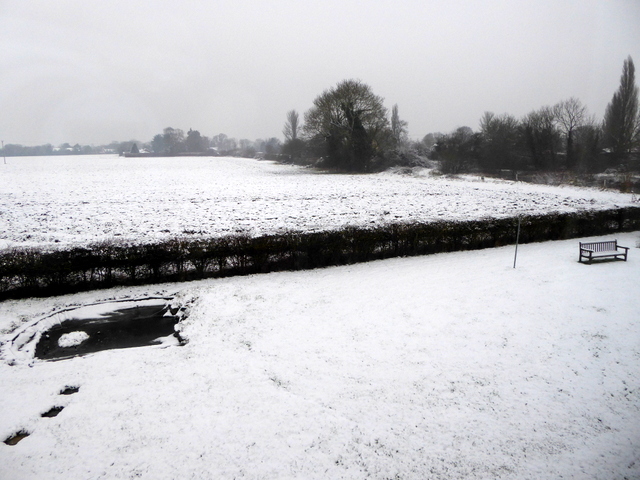
We had a dusting of snow five weeks ago

This is the view from our spare bedroom window.  We had had a few days of snow showers but nothing had settled until we woke on the Sunday morning to this.  Up until a few years ago we got snow every winter, sometimes a lot of snow; but not now.

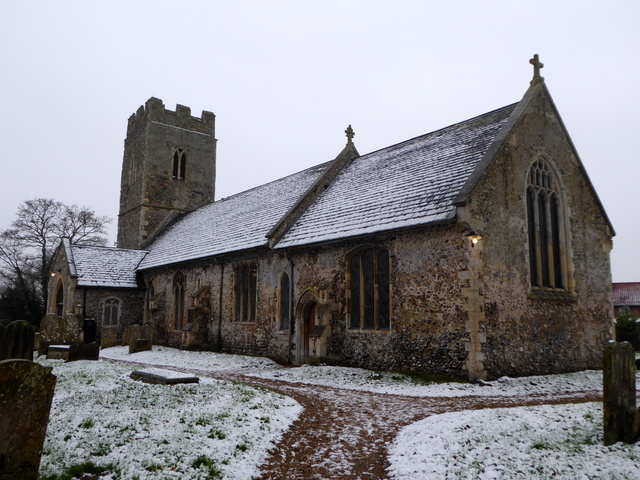
p1010691homersfield-church

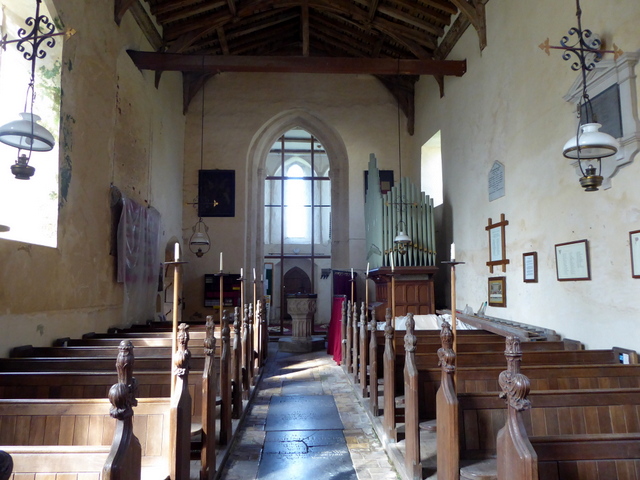
Homersfield church is dedicated to St Mary

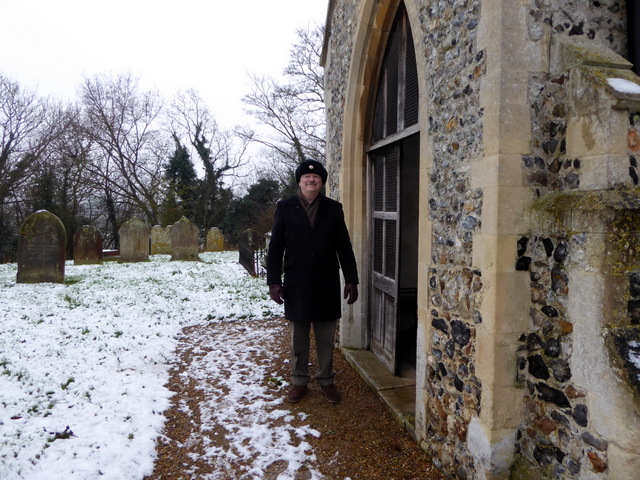
Richard and I went to church together that Sunday.

p1010688russian-richard

Here he is, looking very Russian!

Homersfield church is beautifully situated on a bluff above the River Waveney with its water meadows and marshes.  My favourite approach to it is up a track through woodland.

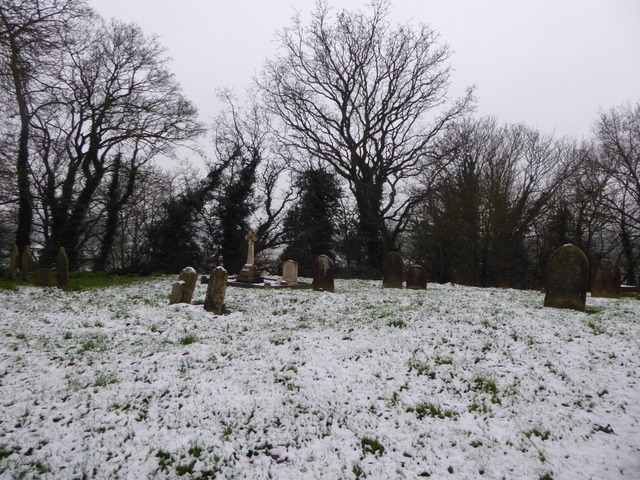
p1010689homersfield-churchyard

The churchyard. Beyond the trees the land drops away steeply.

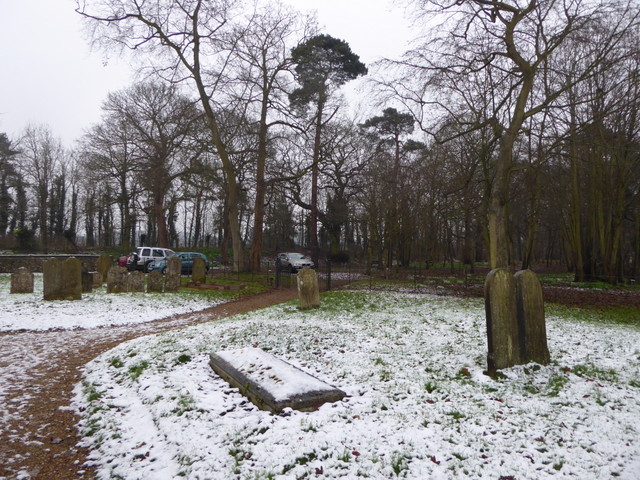
p1010690homersfield-churchyard

Homersfield churchyard looking towards the woodland where we park our car.

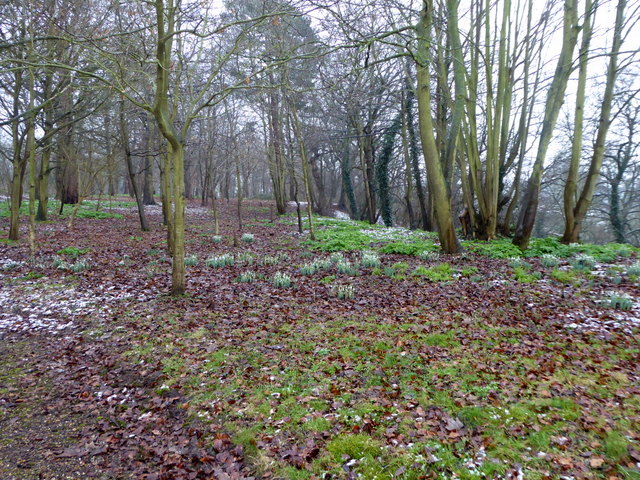
p1010692woodland-beyond-the-churchyard-homersfield

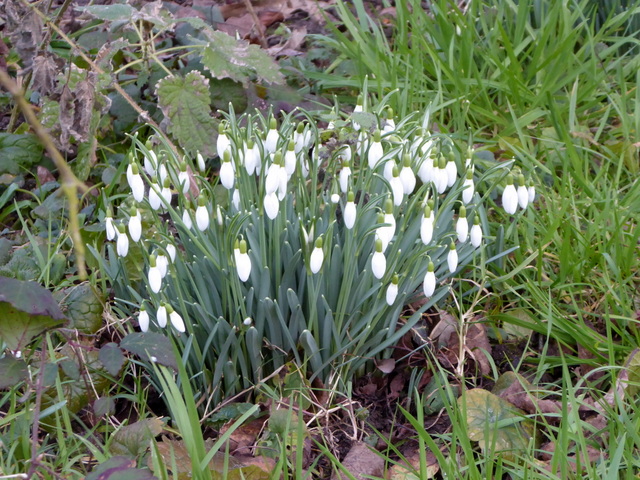
The woodland with snowdrops (Galanthus nivalis)

p1010693snowdrops

Snowdrops

The snow had all gone by the end of the day and the beginning of the following week was mild and sunny.

Richard and I went out for a short walk down the lane.  He can’t walk too far as yet so we weren’t able to do our usual circuit route but it was good to be out together.

p1010698bird-scarer

We have been listening to bird-scaring cannons going off at intervals every day, from dawn til dusk since the middle of autumn. Wood pigeons do considerable damage to leafy crops such as oil-seed rape.

p1010701view

Bare trees and a see-through hedge

Further up the lane was the sheltered bank of a ditch on which I found a number of tiny plants.  They had begun flowering in the milder weather we had had that week.

p1010702primrose

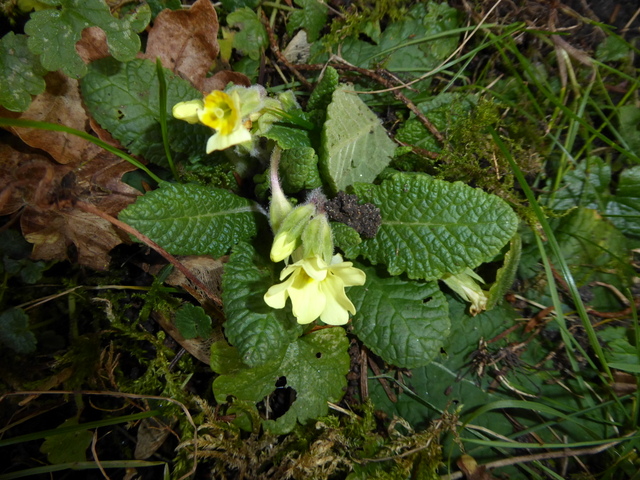
Primrose (Primula vulgaris) plants

p1010703primrose

Primrose.  This is a ‘thrum-eyed’ primrose flower.  If you look at the centre of the flower you see its long stamens, the short stigma is hidden below.  A ‘pin-eyed’ primrose has a long stigma visible and its short stamens are concealed.  I will see if I can find a ‘pin-eye’ flower so you can compare the two.

p1010704speedwell

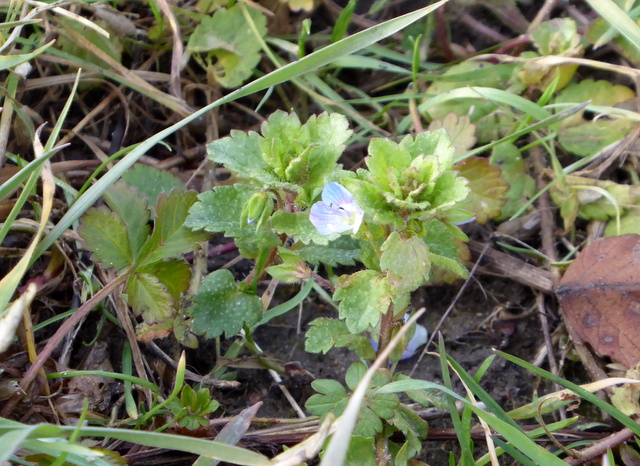
Germander Speedwell (Veronica chamaedrys)

p1010705dandelion

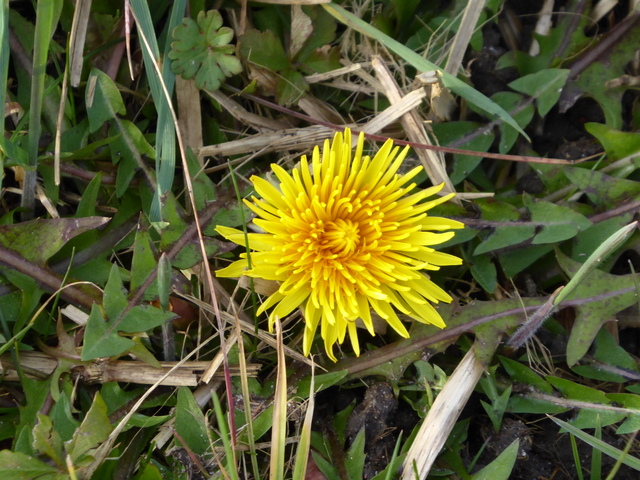
Dandelion (Taraxacum agg.)

p1010706red-deadnettle

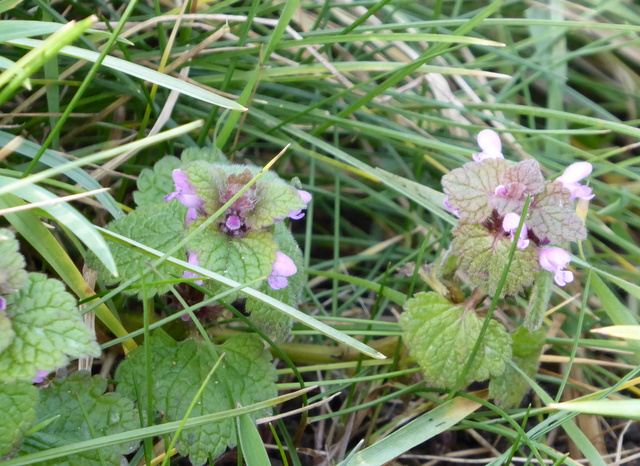
Red Dead-nettle (Lamium purpureum)

p1010707tree

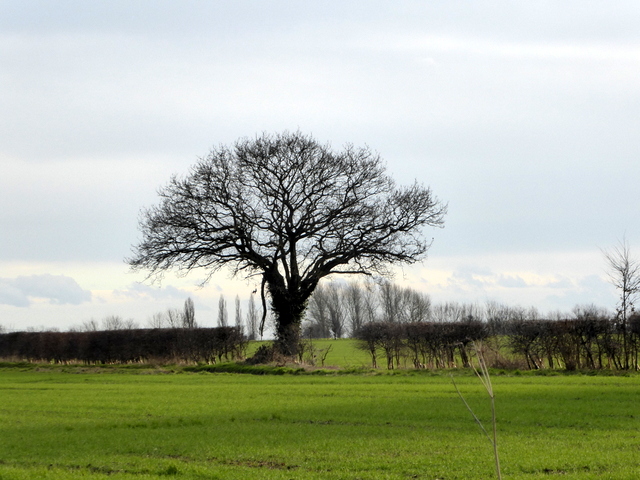
An oak tree in a hedgerow. A dead branch has broken and is dangling from the tree.  You cannot see it in this photo but a single track road runs this side of the hedge.

p1010708signpost

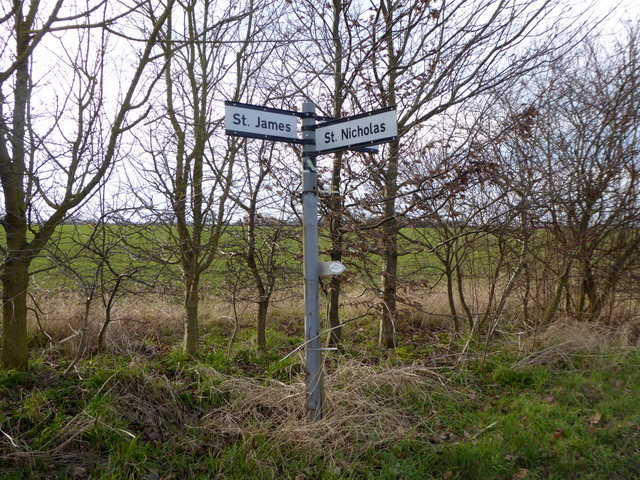
The signpost at the end of the lane

Field view
Field view
Field view
Field view

We stood for a while and looked across the fields; we tried to walk a little further towards the village of St James but Richard soon knew he would be too tired if he went any further.  We turned for home.

Our muddy lane
Our muddy lane
Our muddy lane
Our muddy lane
Our muddy lane
Our muddy lane

For many months of the year our lane is covered with a thick layer of mud.  Our cars are perpetually filthy and walking is a messy business!

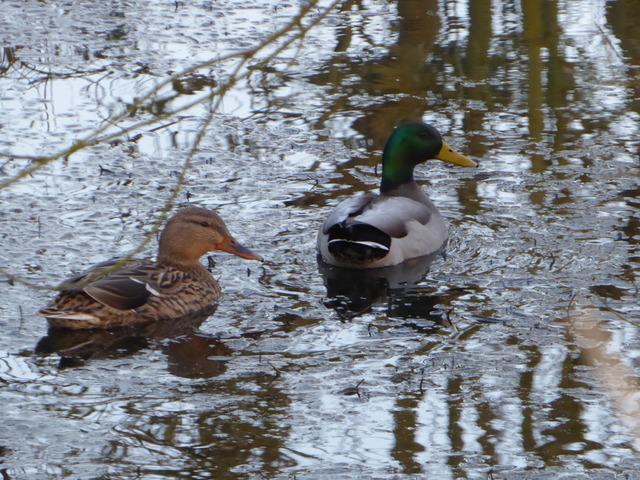
Mallards (Anas platyrhynchos) on our pond.

I know it is spring once I start to see pairs of Mallards on our pond! We have also been visited by our Graylag geese friends and yet again we realise we have failed to clear the the willow and bramble scrub off the island they like to nest on.

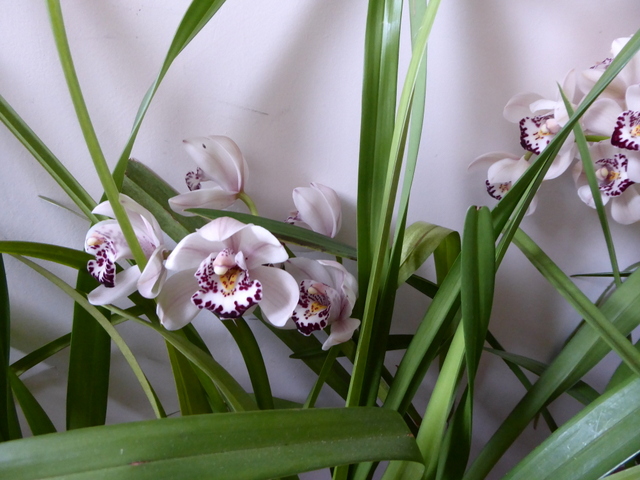
I was pleased that my Cymbidium orchids flowered from Christmas until just a week ago.

They had produced seven spikes of flowers altogether, which is the best ever!

Here is a slideshow of the flowers in bloom in my garden during February.

This slideshow requires JavaScript.

My music choice is ‘Laudate Dominum’ by Mozart and sung by Emma Kirkby.  I have been fortunate to have heard Emma Kirkby sing on two occasions, in recitals held at the church in my mother’s village.

Thanks for visiting!

Share this:

  • Share on X (Opens in new window) X
  • Share on Reddit (Opens in new window) Reddit
  • Share on Pinterest (Opens in new window) Pinterest
  • Share on Facebook (Opens in new window) Facebook
  • Email a link to a friend (Opens in new window) Email
  • Share on Tumblr (Opens in new window) Tumblr
  • Print (Opens in new window) Print
  • Share on LinkedIn (Opens in new window) LinkedIn
Like Loading...

Old News

03 Fri Mar 2017

Posted by Clare Pooley in art, churches, Days out, Norwich, plants, Rural Diary

≈ 69 Comments

Tags

Black Spleenwort, family, hazel catkins, primrose, Rumburgh Church, Sainsbury Centre, snowdrops, spring, St Michael and St Felix Church Rumburgh, Suffolk, University of East Anglia, witch-hazel

It is over a month since I last wrote a diary post.  We haven’t done very much in that time but the days are getting longer and there are signs of spring in the garden and hedgerows.

Witch hazel
Witch hazel
Witch hazel
Witch hazel
Witch hazel
Witch hazel

ooOOoo

The central elements on our old toaster had stopped working so we have bought ourselves a new toaster and this new one manages to toast both sides of a slice of bread at the same time!  It has a ‘bagel button’ (though as I have never eaten a bagel I think I would prefer to call it a ‘teacake button’) which toasts one side and warms the other.  We can now re-live the old toaster experience, except in reverse.

p1010719snowdrops

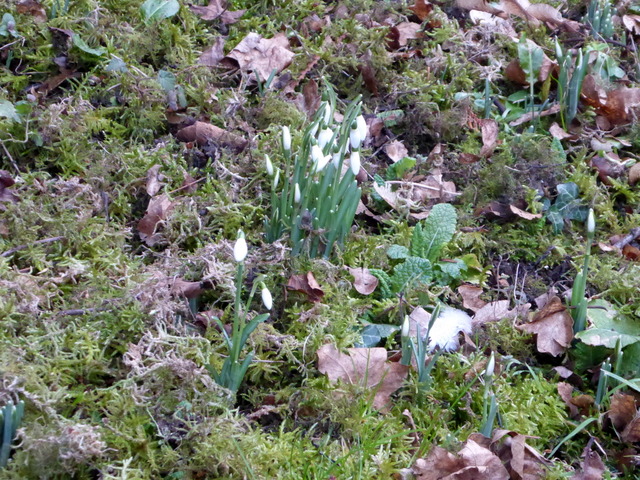
Snowdrops in bud

ooOOoo

Another excitement has been the emptying and repair of the septic tank.  Only those of you who do not have mains sewage can truly relate to this.  The tank was well overdue for emptying and we knew it needed repairing a year ago but we have been let down by our usual contractor and have had to find someone new.  The new contractor arrived and did what he had to do and was efficient and professional.  An added bonus, as far as we were concerned, was the wind direction on the day.

p1010720catkins

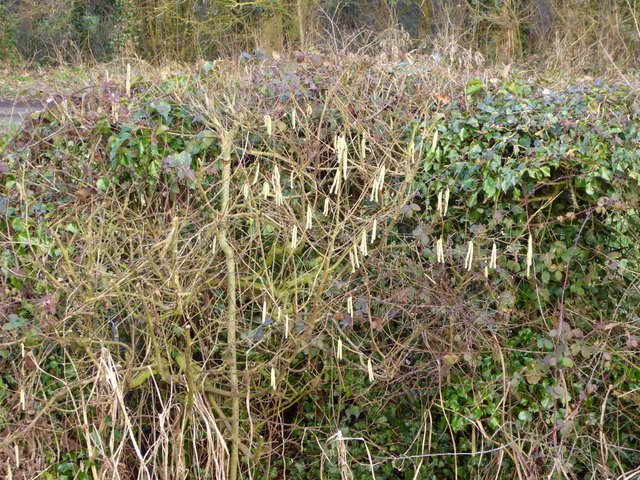
Hazel catkins in the hedge

ooOOoo

We have decided to have all our internal doors replaced and a carpenter has visited and priced up the job for us.  He will be doing the work over three days next week.  Richard will then have to spend quite a lot of time painting the doors, as well as all the skirting boards and the banisters.  We hope to redecorate the hall, stairs and landing and get a new carpet some time in the next few months.

p1010723catkins

I’m not sure how many hazel nuts we will have on this tree this year. The female flowers have appeared before the male catkins have matured.

ooOOoo

At the very end of January we had a morning prayer service at our church of St Michael and St Felix at Rumburgh.  The day before the service Richard and I called in at the church to make sure everything was tidy and to set the heating to come on well before the service.  It was a cold day but inside the church was even colder than out in the open!

p1010657primroses

I found the first rather bedraggled primroses of the year in a sheltered spot in the churchyard.

p1010659snowdrops

I also found my first snowdrops of the year

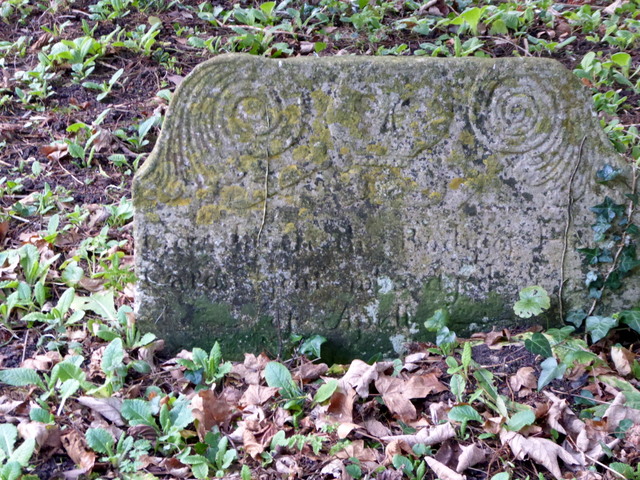
p1010658headstone

Rumburgh gravestone

This gravestone has a skull engraved on it.  Richard was asked to see if it was still in the graveyard recently as there had been a report that it might have gone missing.

p1010662rumburgh-church

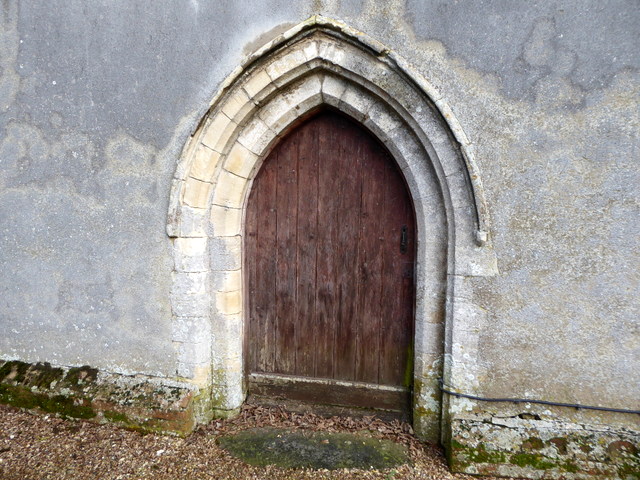
The west door, which isn’t used anymore.

p1010663rumburgh-church

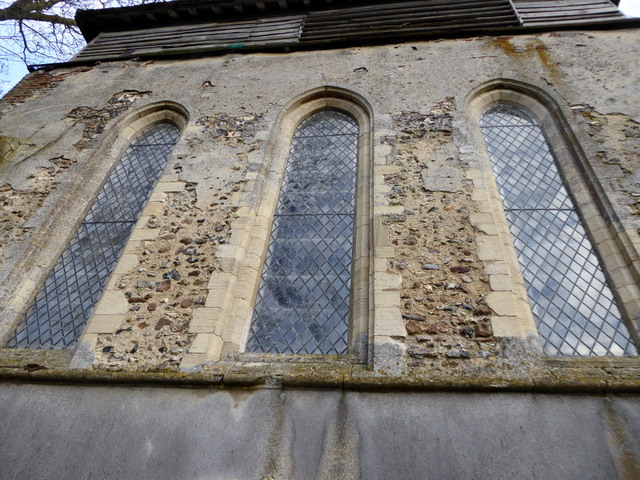
The west window

Work will start on March the 20th on the new tower screen in the church.  We have been saving for years and years to get the work done and at last it is about to happen.  Once the screen is in place the tower will be shut off from the body of the church and we hope it might be less draughty and warmer.

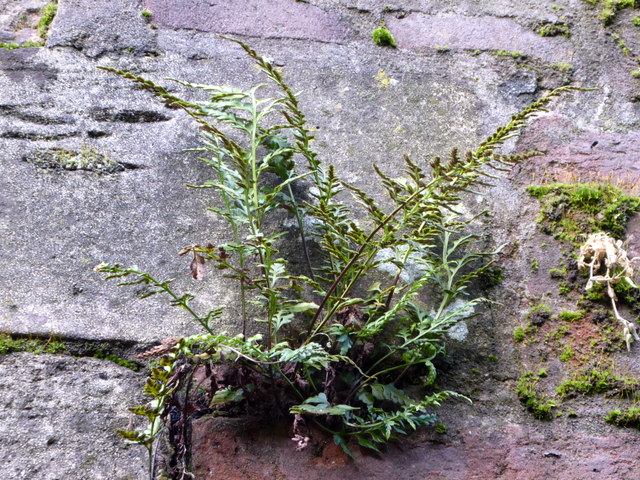
p1010660black-spleenwort

Black Spleenwort (Asplenium adiantum-nigrum) growing in the mortar on the wall of the church

ooOOoo

Elinor has now left the City College but we hope this is only a temporary thing.  As I mentioned in my last diary post she wants to enrol on a one year Art and Design course for older students and has therefore filled out the application form.  We have been notified that the college has received the form and I hope we will hear that Elinor has an interview soon.  At the interview she will be expected to hand in a review of an exhibition she has been to see recently and with that in mind, we went to the Sainsbury Centre in Norwich and viewed an exhibition of 20th century Japanese photography.  Photography was not allowed in the exhibition hall but there is a large collection of world art on display in the main gallery, most of the exhibits donated by Lord and Lady Sainsbury.

Below are my favourites from the main gallery.

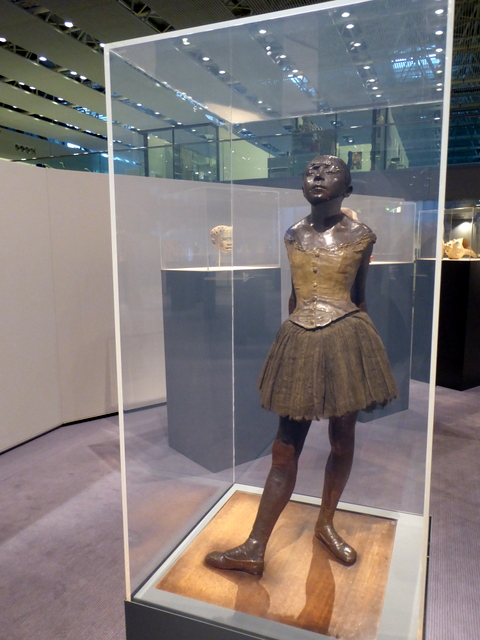
p1010669dancer-degas

Edgar Degas – Little Dancer Aged Fourteen

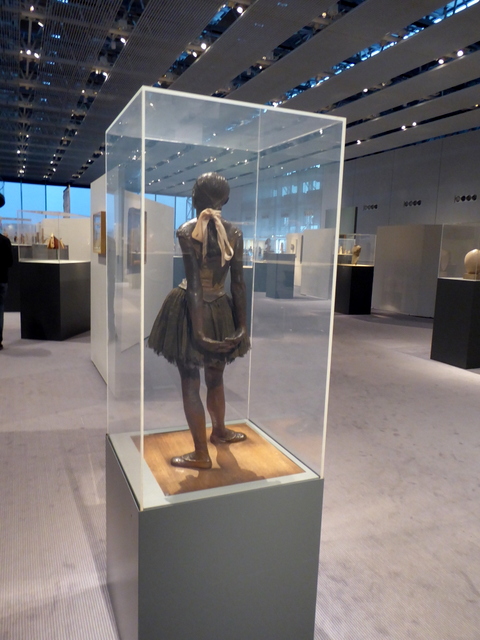
dancer-degas

Edgar Degas – Little Dancer Aged Fourteen

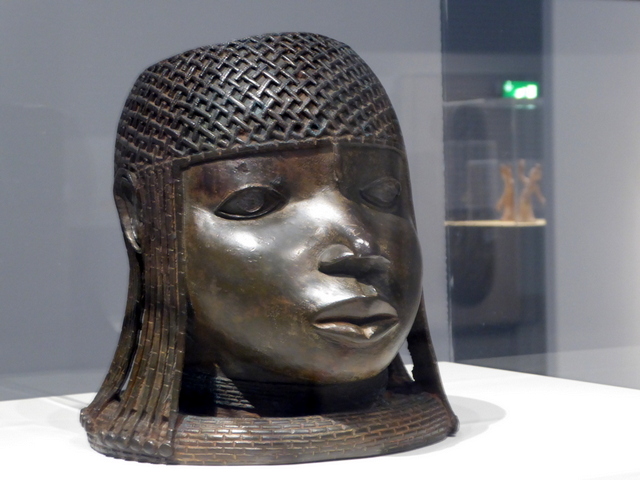
p1010664benin-bronze

A beautiful Benin bronze – the Head of an Oba; early 16th century

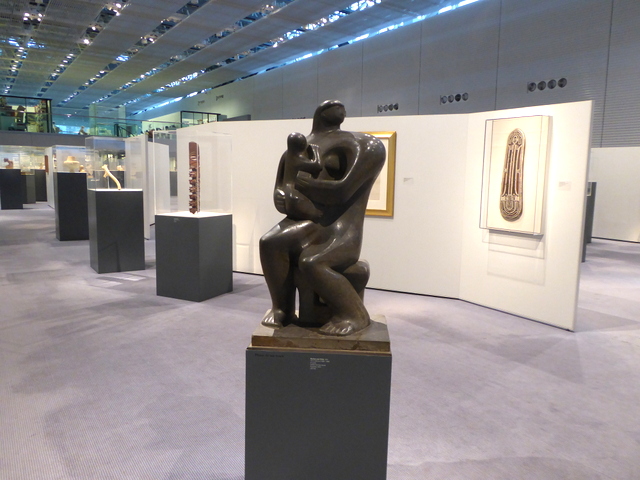
p1010665henry-moore-mother-and-child

Henry Moore – Mother and Child

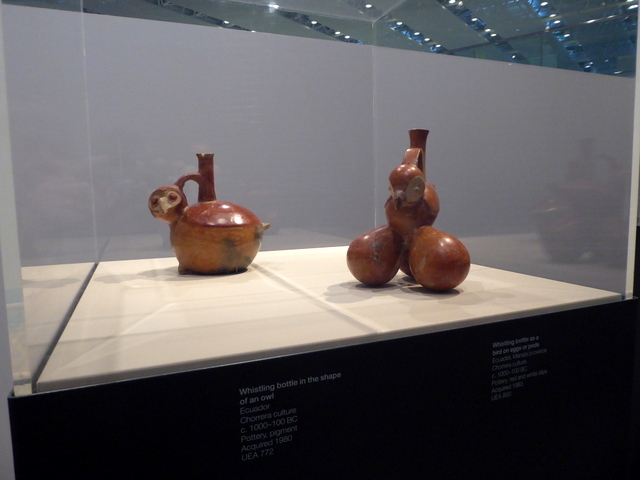
p1010666whistling-bottles-from-equador

Whistling bottles from Equador – one in the shape of an owl and the other is a bird sitting on eggs or pods.  Both 1000 – 100 BC

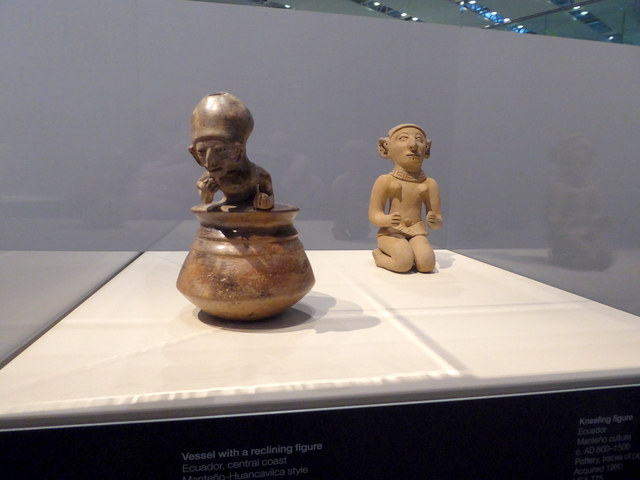
p1010667exhibits-from-equador

Another couple of exhibits from Equador

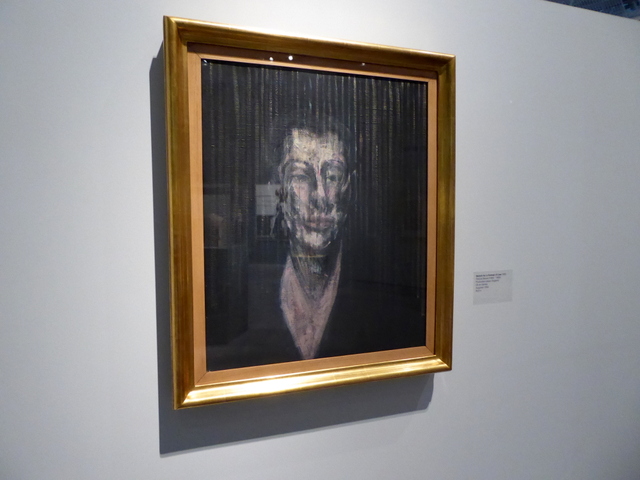
p1010671francis-bacon

Sketch for a Portrait of Lisa by Francis Bacon

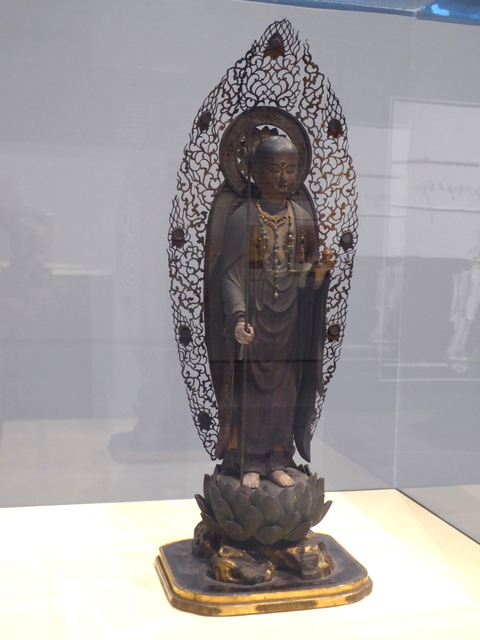
p1010672japanese-exhibit

Standing Jizo Bosatsu – Japan (1185-1333)

p1010674japanese-exhibits

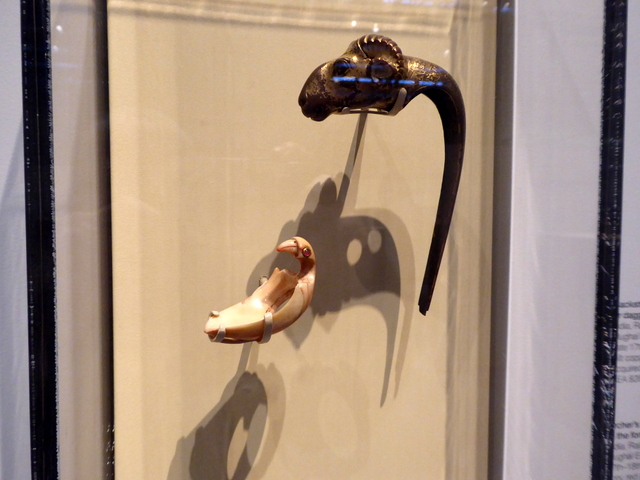
The top exhibit with the ram’s head is a backstrap from a sword or dagger hilt – India late 17th century The lower exhibit is an archer’s thumb-ring in the form of a bird – India 17th – 18th century

p1010676indian-exhibits

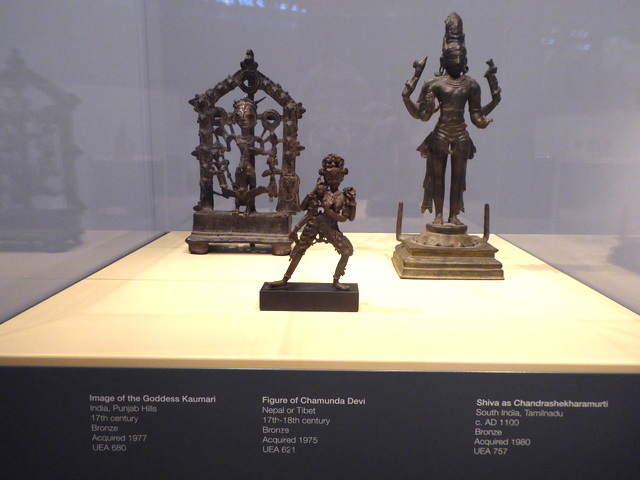
Left rear – Image of the Goddess Kaumari, India 17th century.   Right rear – Shiva as Chandrashekharamurti, South India c. AD 1100.   Front centre – Figure of Chamunda Devi, Nepal/Tibet 17th/18th century

p1010677egyptian-hippo

Walking Hippopotamus – Egypt c. 1880 BC

p1010679sainsbury-centre-norman-foster

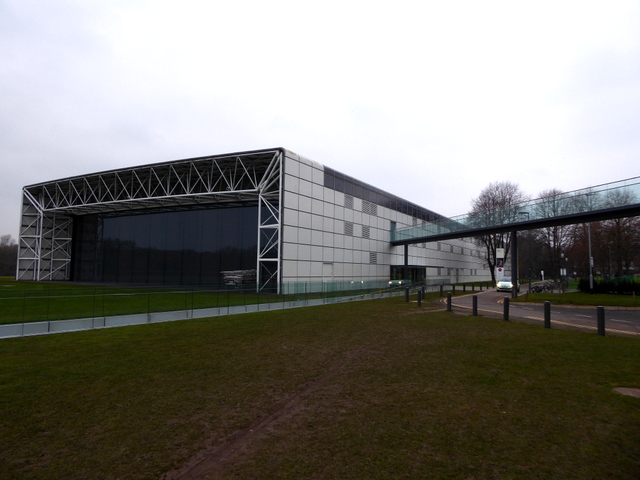
The Sainsbury Centre.  One of the first major buildings designed by Sir Norman Foster, it was completed in 1978.

p1010682sainsbury-centre

It is a steel clad building with one face almost entirely glazed.

p1010685sainsbury-centre

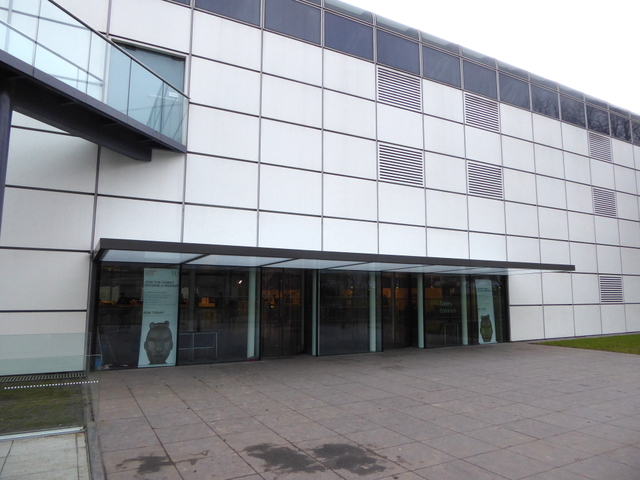
By the late 80’s the collection had grown so much that Foster was asked to design an extension. He decided to build underground and this is one of the entrances to it.

The new basement has a curved glass frontage that emerges from the slope underneath the original building overlooking the man-made lake.  This new wing can only be seen from the lake but as it was very muddy there and beginning to go dark on a very gloomy day, I was unable to photograph it.

p1010683uea-grounds

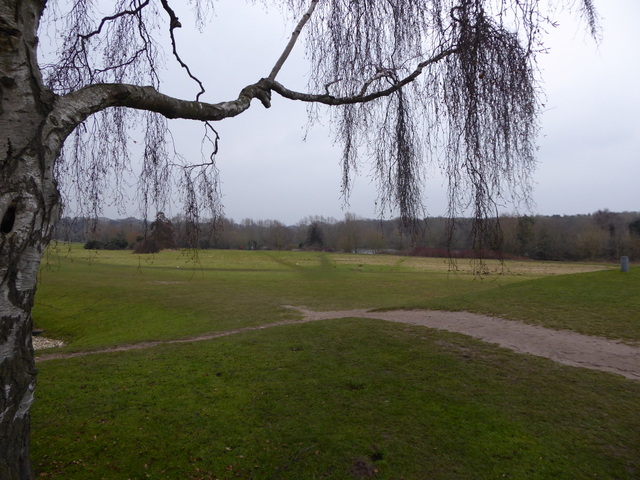
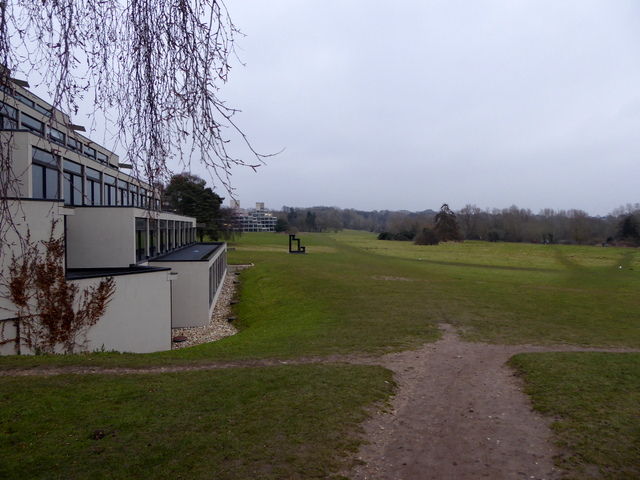
The University of East Anglia’s grounds looking towards the lake

p1010684uea

Part of the university. There are many items of sculpture to be seen here.

p1010680henry-moore-sculpture

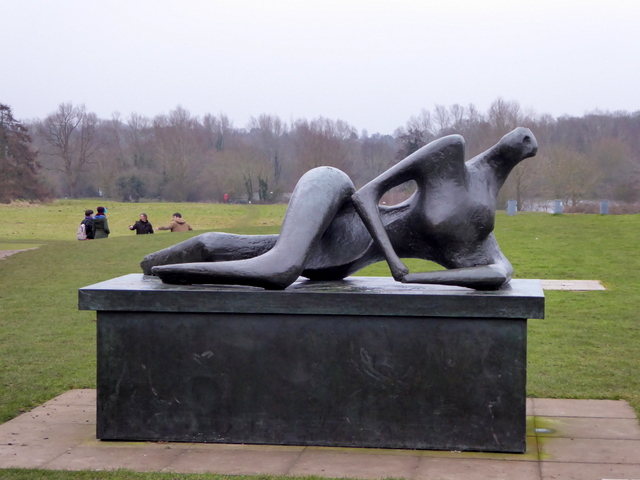
Another Henry Moore sculpture

The University has an excellent creative writing department and many well known writers have studied here. Tracy Chevalier; Kazuo Ishiguro; Ian McEwan; Rose Tremain – to name but a few.

My music choice today is a song from Katie Melua.

Thanks for visiting!

Share this:

  • Share on X (Opens in new window) X
  • Share on Reddit (Opens in new window) Reddit
  • Share on Pinterest (Opens in new window) Pinterest
  • Share on Facebook (Opens in new window) Facebook
  • Email a link to a friend (Opens in new window) Email
  • Share on Tumblr (Opens in new window) Tumblr
  • Print (Opens in new window) Print
  • Share on LinkedIn (Opens in new window) LinkedIn
Like Loading...

St John Maddermarket

22 Sun Jan 2017

Posted by Clare Pooley in churches, Norwich

≈ 63 Comments

Tags

churches in Norwich, Norwich, St John Maddermarket, St John the Baptist, The Churches Conservation Trust

This is one of my occasional posts about Norwich.

Last summer, as I wandered about in Norwich while Elinor was at college, I saw that the church of St John Maddermarket was open and so took the opportunity to look inside.

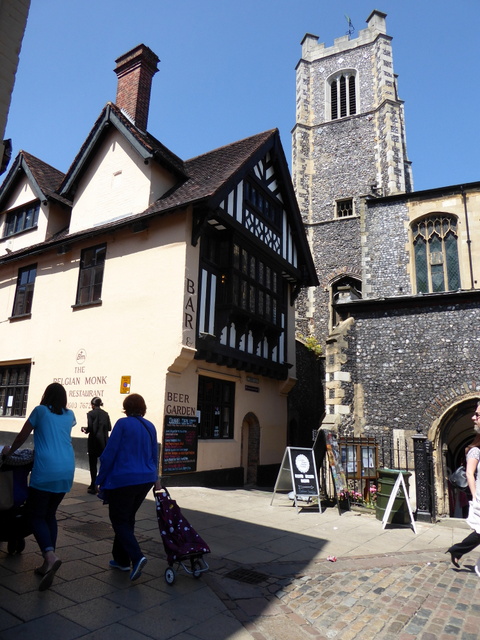
p1000415pottergate

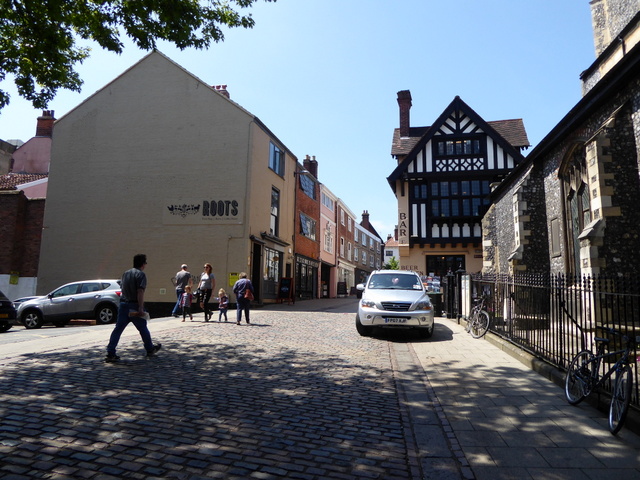
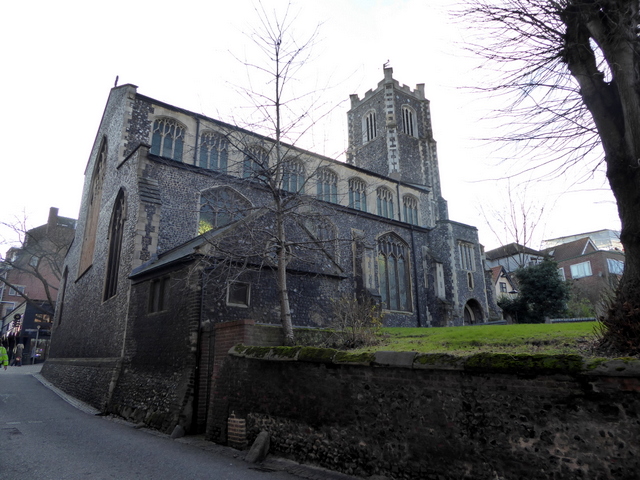
This lane is Pottergate and the church of St John Maddermarket is on the right of the photo. The black and white building next to the church is The Belgian Monk pub

St John Maddermarket, dedicated to St John the Baptist, closed for Anglican worship on 31st December 1981 and for the following eight years was used by the Greek Orthodox Church.  It is now cared for by The Churches’ Conservation Trust.  Madder flowers were used to make red dye for the flourishing cloth industry in medieval Norwich but there is no evidence to prove that there ever was a maddermarket  in the city.

p1000416st-john-maddermarket

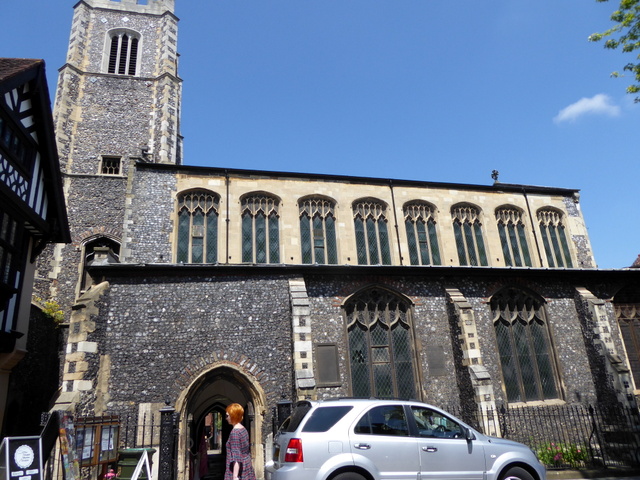
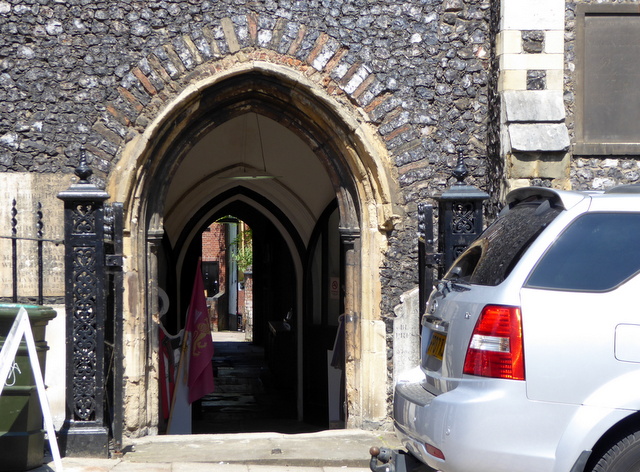
St John’s church, the Belgian Monk pub and St John’s Alley in-between them.

p1000418st-john-maddermarket

St John Maddermarket

p1000420st-john-maddermarket

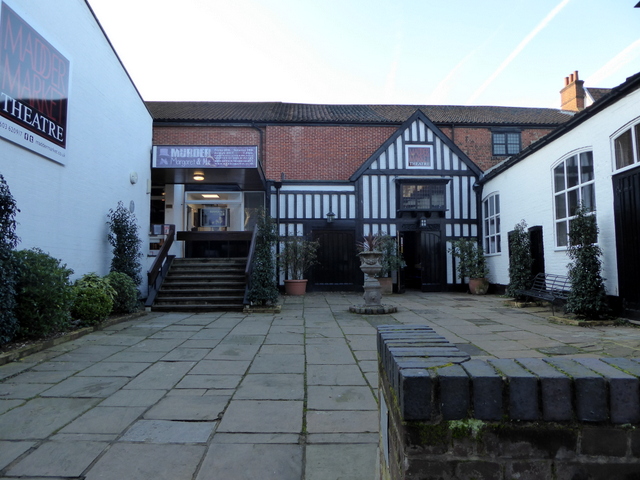
The processional way (St John’s Alley) goes through the base of the tower. The pub is on the left of the photo and the Maddermarket theatre can be seen at the far end of the passageway.

In writing this post I realised that I needed a few more photos to illustrate some of the things I wanted to say about this church.  I called in at the church again on Tuesday 17th January and took most of the pictures I wanted.

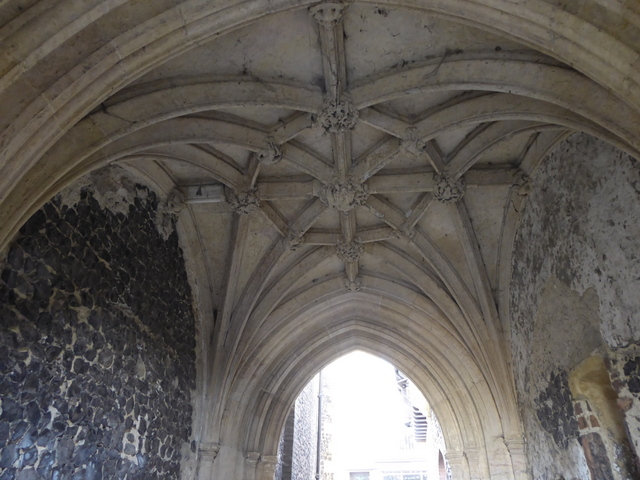
p1010616st-john-maddermarket

The processional arch under the tower has a rib vault with carved bosses 

p1010643maddermarket-theatre

The Maddermarket Theatre was founded in 1921 by Walter Nugent Monck who, during that decade was one of the first people to re-create a Shakespearean stage.

There is a memorial in St John’s church to Walter Monck 1878-1958 (one photo I forgot to take!)

p1010614

St John Maddermarket

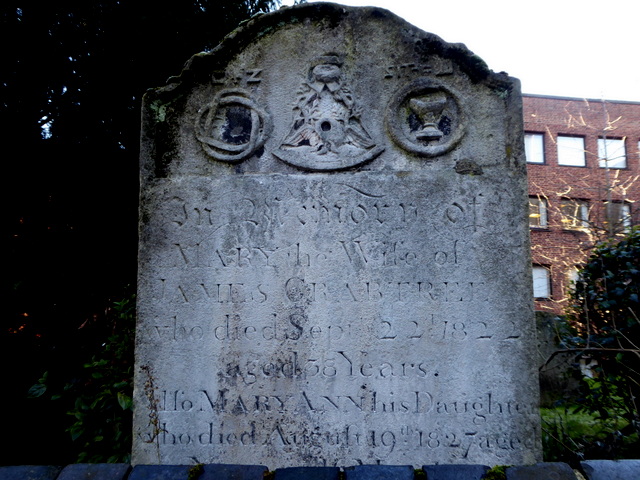
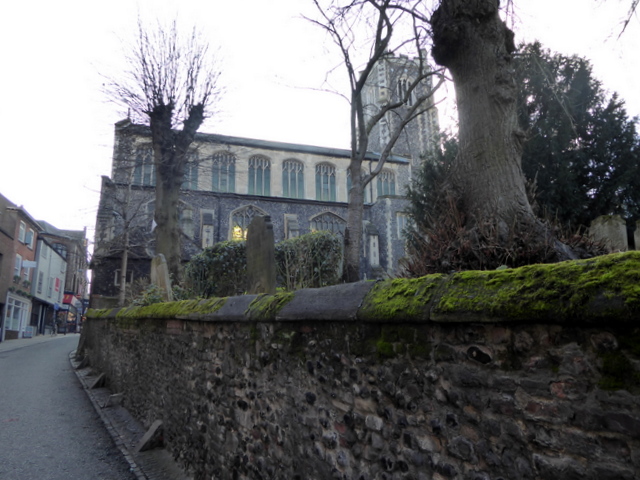
Note the raised burial ground.  In the 16th and 17th centuries there were many complaints about graveyards like this one.  Because of the confined space allowed for burial there were often too many bodies with too little earth to cover them!  This graveyard contains the Crabtree headstone which has a pre-Christian symbol of the Ouroboros carved on it.  An Ouroboros is a serpent eating its own tail.

p1010644crabtree-gravestone

The Crabtree headstone with the Ouroboros at the top on the left. There are other strange markings on this headstone which I think are Masonic.  Why the headstone for Mary and Mary Ann Crabtree should have these markings on it, I have no idea!  I couldn’t see all of it as the churchyard is permanently locked and this is the view I got over the wall.

p1010615st-john-maddermarket

Wall of St John’s churchyard

William Shakespeare’s friend William Kempe, the comic actor, had an argument with Shakespeare and in trying to upstage him wagered that he could morris-dance all the way from London to Norwich (about 100 miles) in nine days.  He managed to do it (though with a few days rest in-between the days of dancing) and on his arrival he jumped the wall of St John’s churchyard.   He wrote about it in his book ‘A Nine Daies Wonder’.

p1000419st-john-maddermarket

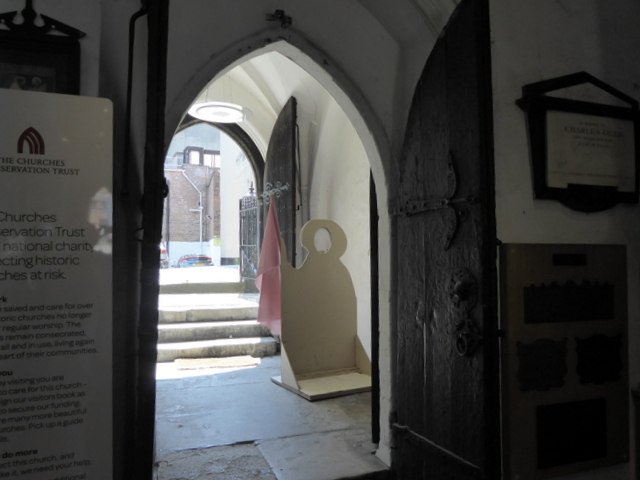
Entrance to the church through the south porch. The door to the north porch was open so a view of the lane beyond the church can be seen

p1000438st-john

Inside the church, looking out through the south porch door

p1000421st-john-maddermarket

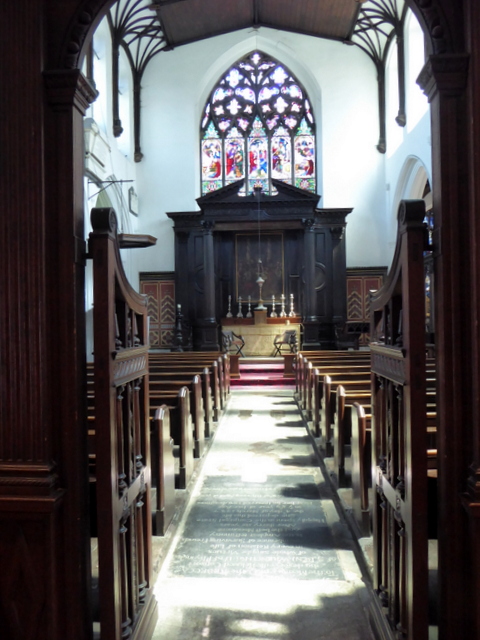
Looking towards the altar from the back of the church

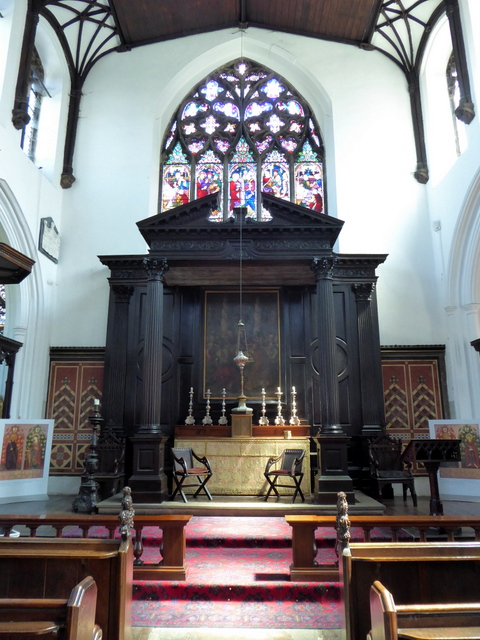
The eye is drawn to the imposing Georgian baldachin (canopy) over the high altar which is supported on columns.  I’m not at all sure I like it there very much; it seems too big and heavy for the church it is in.  William Busby who was Rector of this church from 1898-1923, assembled a large collection of church furnishings and this canopy was part of the collection.  It was made for another Norwich church (St Miles, Coslany) and brought to St John’s in 1917.  It obscures the Gothic revival reredos (decoration behind the altar) which had been installed in 1863, and part of the east window.  The east window itself (i.e. not the glass) dates from about 1325 and is older than the rest of the church.  It was possibly taken from a former chancel.

p1000423st-john-maddermarket

A closer view of the baldachin and high altar

p1010620st-john-maddermarket

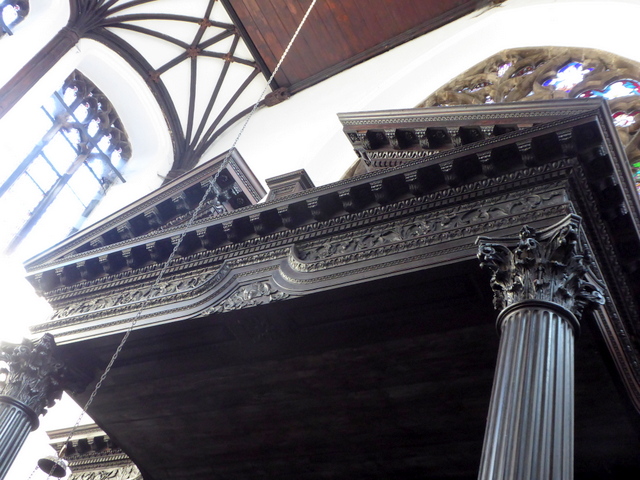
Here you can see how ornate the carving on the baldachin is.

p1000422st-john-maddermarket

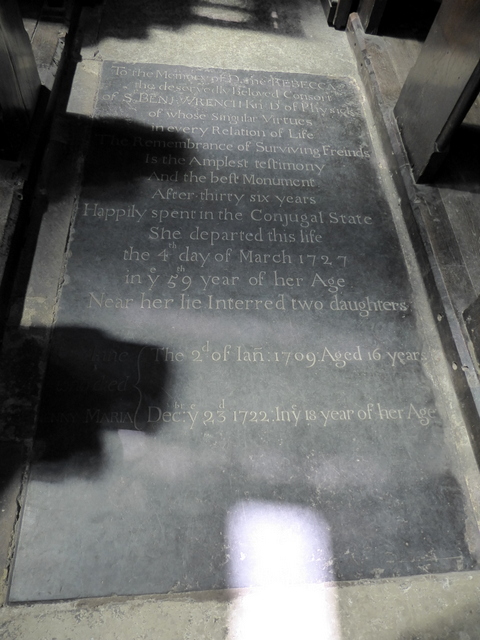
This is the ledger stone in memory of ‘Dame Rebecca the deservedly beloved consort of S. Benj. Wrench Knt. Dr. of Physick, of whose singular virtues in every relation of life, the remembrance of surviving freinds (sic) is the amplest testimony and the best monument.  After thirty-six years happily spent in the conjugal state she departed this life the 4th day of March 1727 in the 59th year of her age’.

p1000424st-john-maddermarket

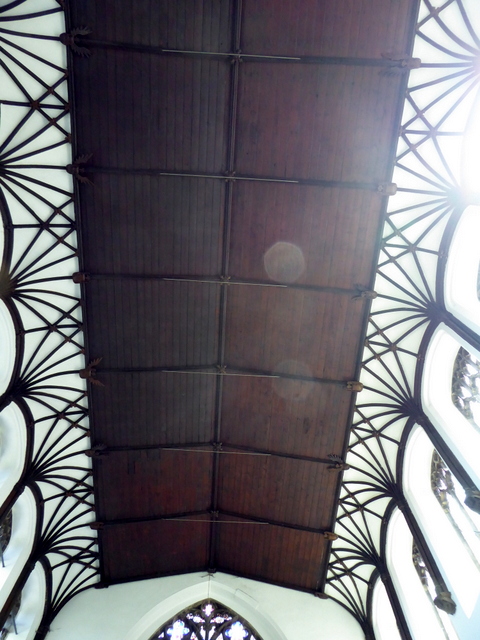
The nave roof is basically medieval but was heavily restored in 1876 after it was damaged in a gas explosion. It probably has a hammer-beam roof but ribbed plaster coving hides the hammer-beams.  There are angels at the edge of the coving.

p1010619st-john-maddermarket

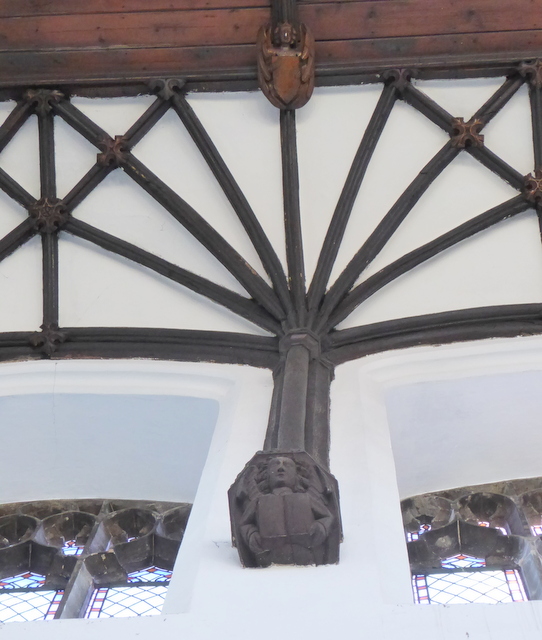
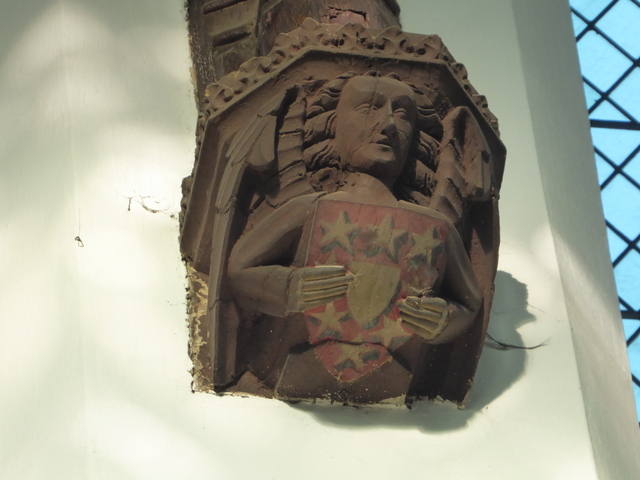
The ribbed coving and an angel holding a shield. The stop at the bottom of the photo also has an angel.

p1010618st-joh-maddermarket

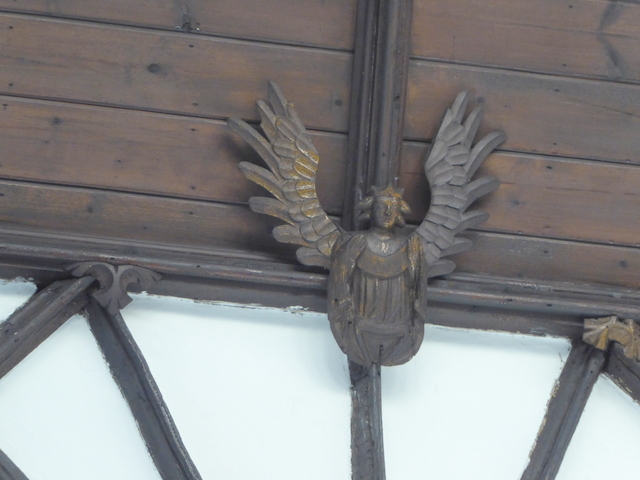
This angel has traces of gold paint still upon it. Just imagine how bright the church must have been when new!

p1010629

Another angel with traces of paint on it.

Carved head on an arch stop
Roof boss
Roof boss
p1000425st-john-maddermarket

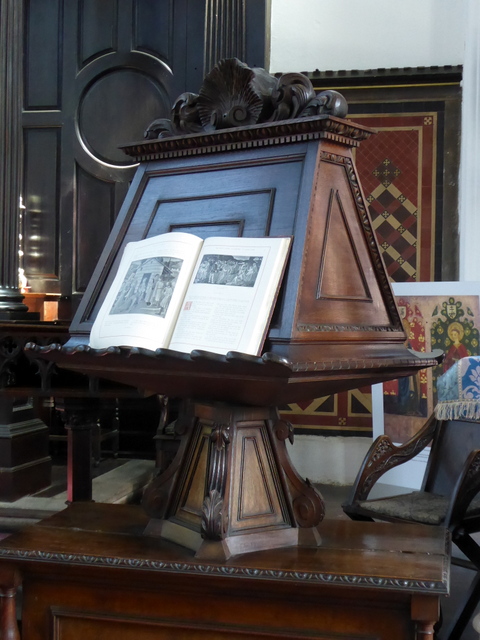
The lectern was made in the 18th century. It revolves.

p1000629st-john-maddermarket

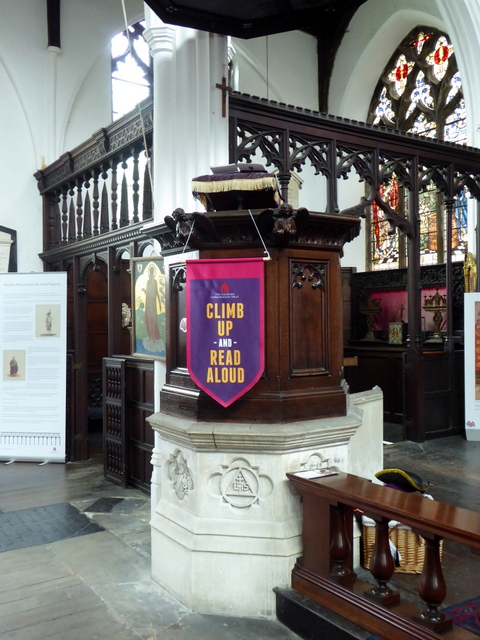
Here is the pulpit, made in 1863. The banner inviting us to climb up and read aloud is for the benefit of the many school visits they have.

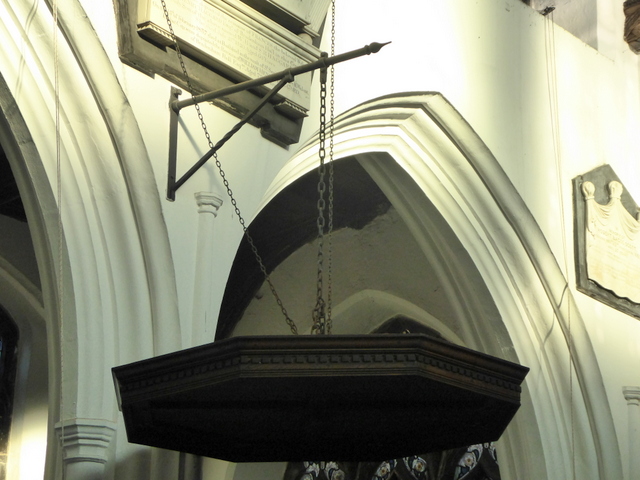
The pulpit has a sounding board above it which may be 17th century.

p1010627st-john-maddermarket

The sounding board hanging above the pulpit. It helped the preacher’s voice carry round the church.

p1000426st-john-maddermarket

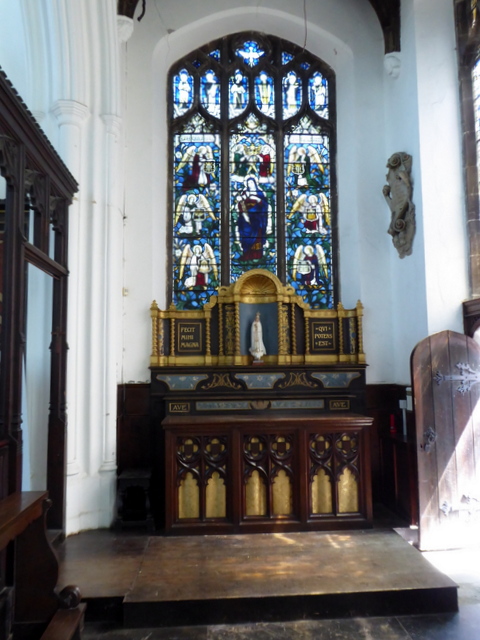
The Lady Chapel

p1000430st-john-maddermarket

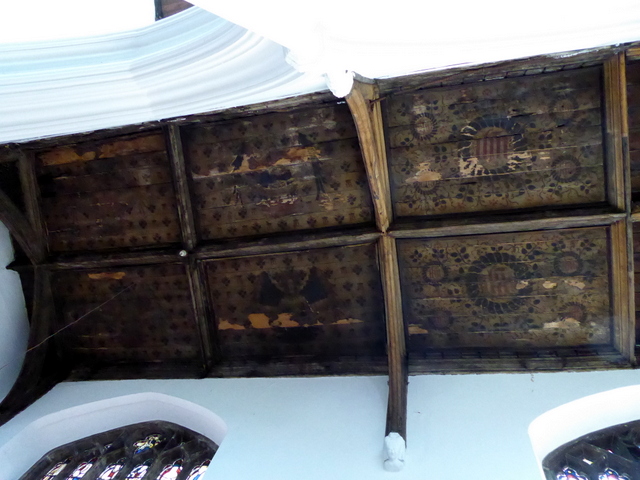
The roof of the Lady Chapel in the south aisle is painted

p1010642

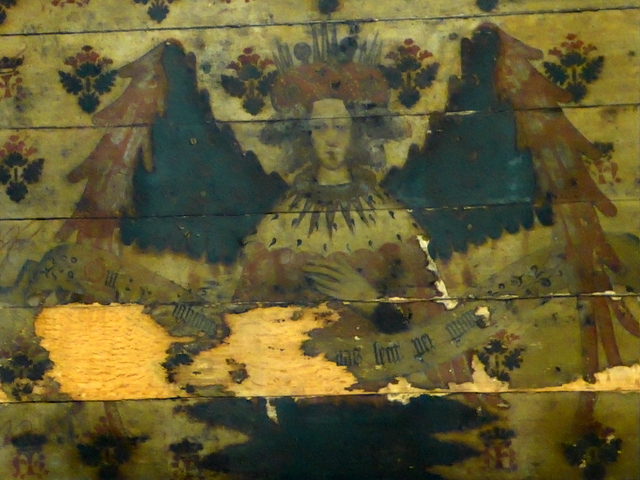
A detail from the painted ceiling.

p1000432st-john-maddermarket

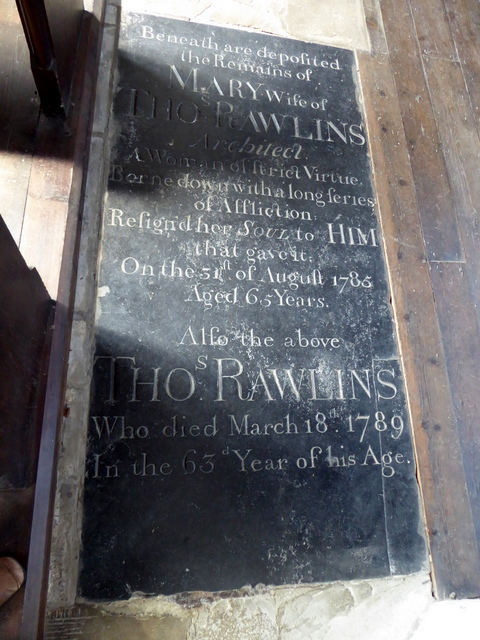
Another ledger stone. “Beneath are deposited the remains of Mary, wife of Thos. Rawlins architect. A woman of strict virtue. Borne down with a long series of affliction. Resign’d her soul to Him that gave it. On the 31st of August 1785 aged 65 years. Also the above Thos. Rawlins who died March 18th 1789 in the 63rd year of his age”.

p1000429st-john-maddermarket

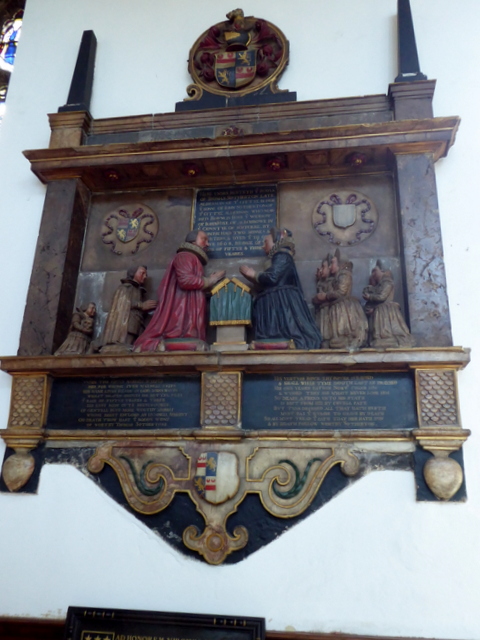
A wall monument to Alderman Thomas Sotherton and his wife Frances with their children kneeling behind them.

p1010623st-john-maddermarket

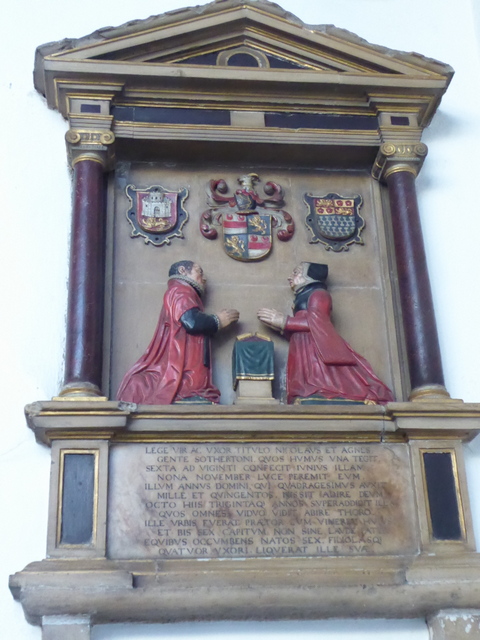
Another Sotherton family monument, this time for Nicolas and Agnes Sotherton.  They had six sons and five daughters.  Nicolas was a grocer who amassed a great fortune and owned much property in the city.  He died in 1540.

p1010625st-john-maddermarket

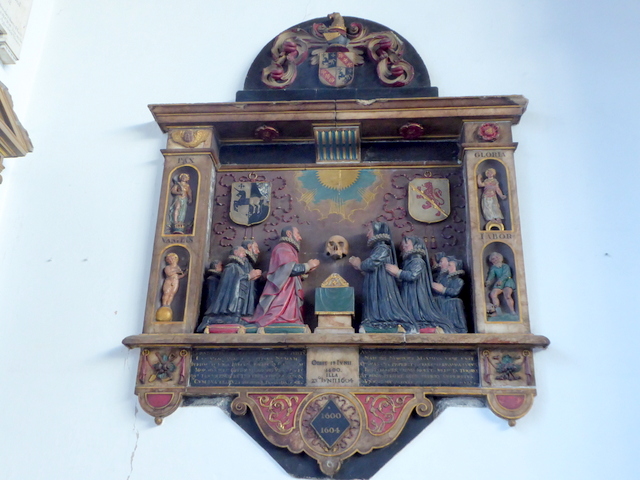
Monument to Christopher Layer (died 1600) and his wife Barbara (died 1604). There are personifications of Pax, Vanitas, Gloria and Labor on the uprights at the side of the monument.  See here for a full description

p1000437st-john

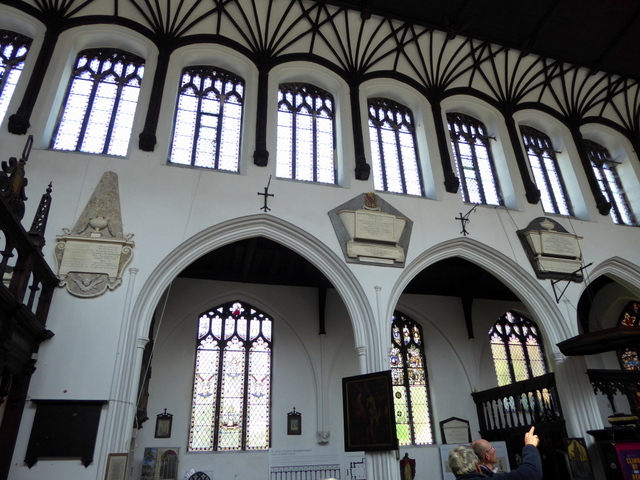
Three wall monuments and the beautiful clerestory windows above

p1010626st-john-maddermarket

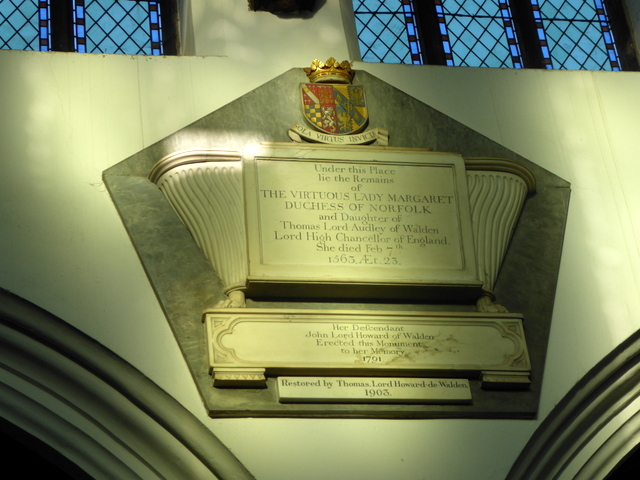
This is the centre monument from the photo above. It is to The Virtuous Lady Margaret Duchess of Norfolk 

p1000433st-john

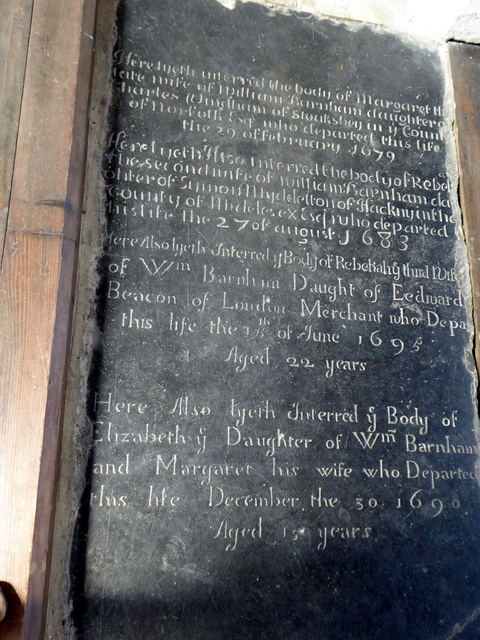
There’s quite a crowd of wives in this grave!  Margaret, Rebekah 1 and Rebekah 2; the first, second and third wives of William Barnham, as well as his daughter Elizabeth!

p1000447st-john

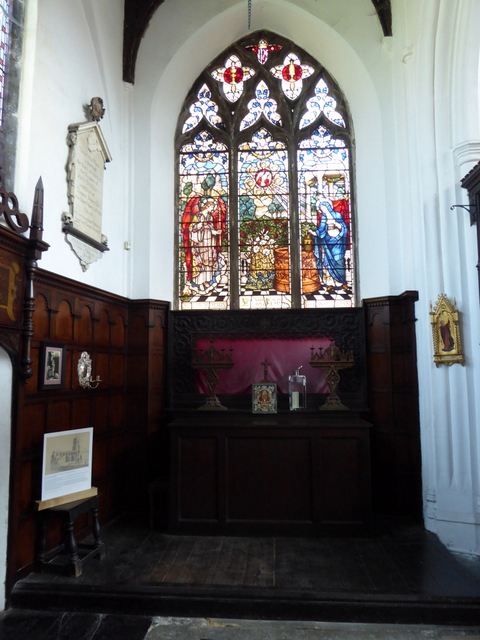
The North Chapel dedicated to the Blessed Sacrament with its wood panelling

Stained glass
Stained glass
Stained glass
Stained glass

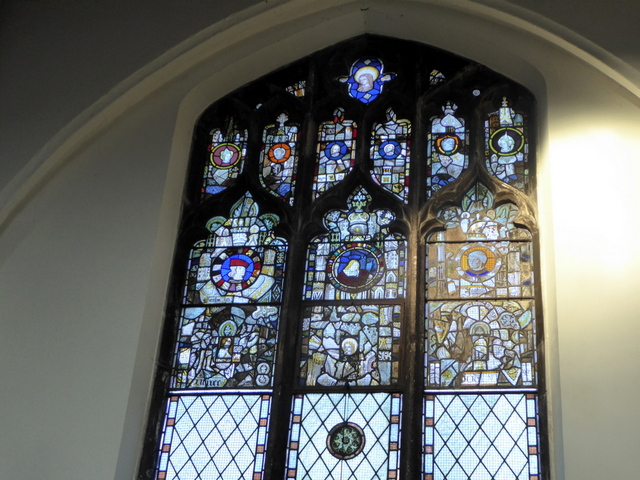
Because of the gas explosion in the 19th century most of the stained glass in the church is from the 19th and 20th centuries.  The window pictured above on the right has many fragments of the medieval glass that were rescued after the accident.  Fortunately, no-one was killed or even badly injured in the explosion despite it happening during choir practice.

p1010631st-john-maddermarket

A closer view of the pieces of old glass.

p1010628st-john-maddermarket

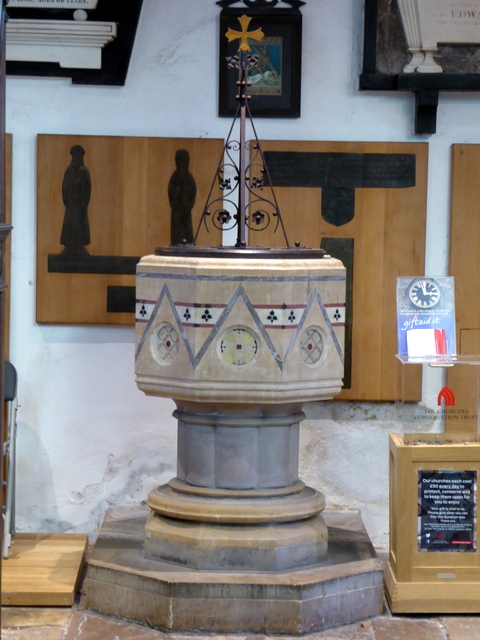
The font at the back of the church dates from the 1860’s.

p1000436st-john

This beautifully made gallery was erected in 1912 and has made the west bay at the rear of the church into a narthax (antechamber)

The north and south porches, which are inside the body of the church, are at either end of this narthax.  The craftsman responsible for the gallery lived just a few yards from the church and made it in the Jacobean style.  (The Jacobean era was named after King James I and covered the first quarter of the 17th century – 1600-1625).  The choir sang from the gallery.

p1000439st-john

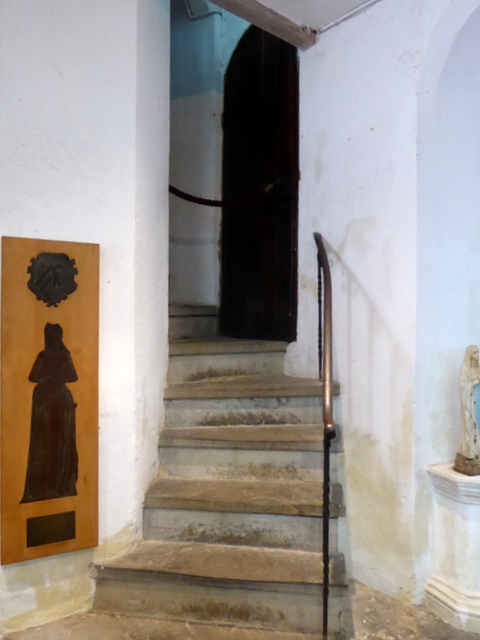
Stairs up to the gallery.  On the left is one of the brasses from the church which were removed from the floor during one of the many re-organisations of the church.

Apparently, there is also a room above one of the porches (I think) which has information on all the servicemen in the parish who lost their lives in the First World War.

Brasses from the church damaged in the explosion
p1010635st-john-maddermarket

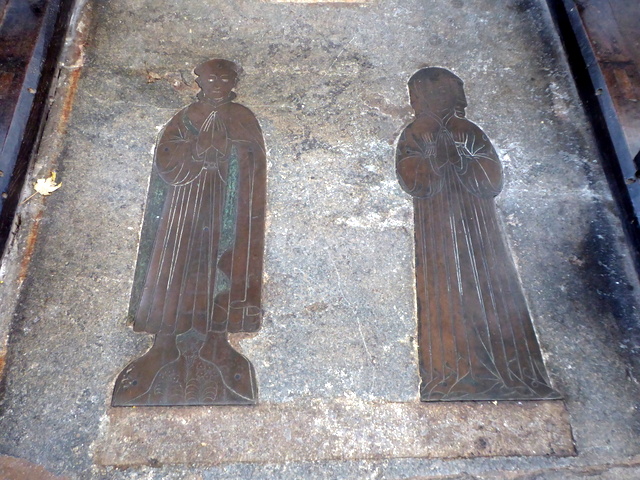
A monumental brass that is still in situ in the centre aisle.  I believe this is to Ralph Segrym (d. 1472) MP 1449, Mayor 1451 and his wife. 

p1010637st-john-maddermarket

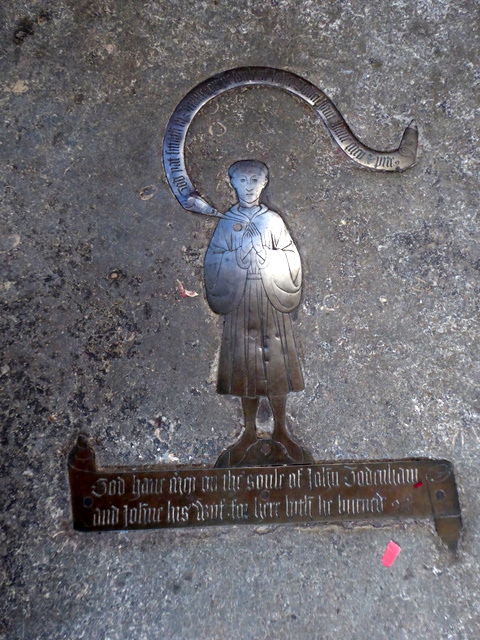
A monumental brass in the north chapel to John Todenham (c.1450) in civilian dress with inscription and scroll  

p1000441st-john

The wonderful rib-vault in the north porch

The north porch has much thicker walls than the rest of the church and many people think this is because it might be all that remains of the Anglo Saxon church which stood on the site before the current church was built.  The doorway is much more ornate than the south porch door.  (Another missed photo!)

p1010617st-john-maddermarket

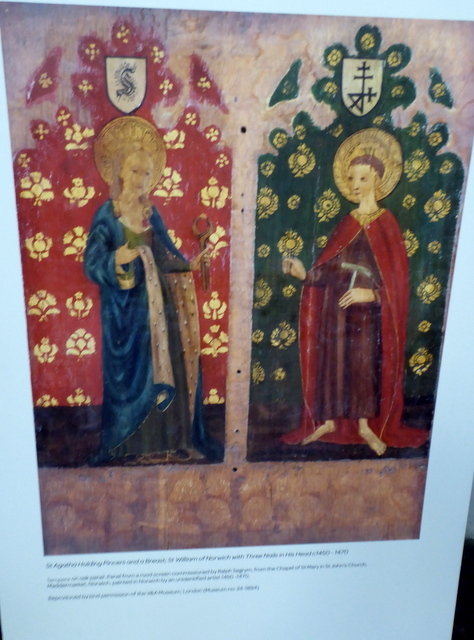
Photograph of a panel depicting St Agatha and St William of Norwich

p1010630st-john-maddermarket

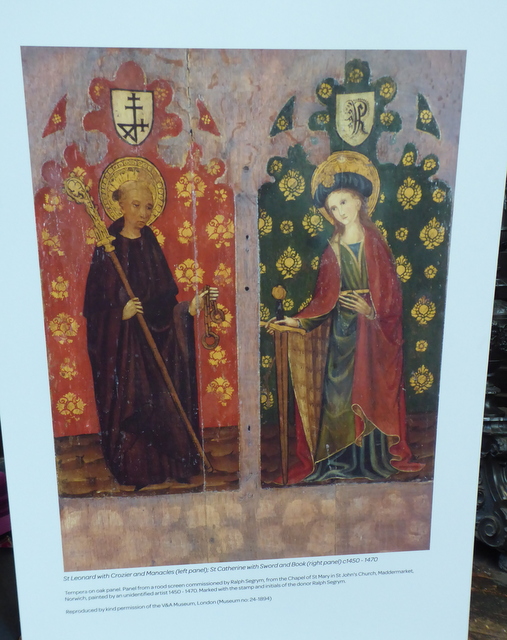
Photograph of a panel depicting St Leonard and St Catherine

Both these panels came from St John Maddermarket and are now housed in the Victoria and Albert Museum

http://collections.vam.ac.uk/item/O77491/st-agatha-holding-pincers-and-panel-unknown/

http://collections.vam.ac.uk/item/O131973/st-leonard-with-crozier-and-panel-unknown/

These panels were commissioned by Ralph Segrym whose memorial brass I have commented on above.  If you are interested in clicking on the links to the panels, I recommend you subsequently click on the ‘Further Information’ button.

All photographs are mine.

Information gleaned from a conversation with a Churches Conservation Trust officer at the church and also from the following books:

The Medieval Churches of the City of Norwich – Nicholas Groves

The Little Book of Norwich – Neil R Storey

Norwich – Stephen Browning

Churches Conservation Trust Church Tour leaflet


Thanks for visiting!

Share this:

  • Share on X (Opens in new window) X
  • Share on Reddit (Opens in new window) Reddit
  • Share on Pinterest (Opens in new window) Pinterest
  • Share on Facebook (Opens in new window) Facebook
  • Email a link to a friend (Opens in new window) Email
  • Share on Tumblr (Opens in new window) Tumblr
  • Print (Opens in new window) Print
  • Share on LinkedIn (Opens in new window) LinkedIn
Like Loading...
← Older posts
Newer posts →
Follow A Suffolk Lane on WordPress.com

Enter your email address to follow this blog and receive notifications of new posts by email.

Join 697 other subscribers.

Unknown's avatar

I talk about what it's like living in a quiet part of Suffolk. I am a wife, mother and daughter, a practising Christian and love the natural world that surrounds me. I enjoy my life - most of the time!

My Posts

Jul 2026
M T W T F S S
 12345
6789101112
13141516171819
20212223242526
2728293031  
« May    

Pages

  • About my Blog
  • GDPR (General Data Protection Regulations) and This Site
  • My Life in a Suffolk Lane

Archives

Blogs I Follow

Unknown's avatar
Unknown's avatar
Unknown's avatar
Unknown's avatar
Unknown's avatar
Unknown's avatar
Unknown's avatar
Unknown's avatar
Unknown's avatar
Unknown's avatar
Unknown's avatar
Unknown's avatar
Unknown's avatar
Unknown's avatar
Unknown's avatar
Unknown's avatar
Unknown's avatar
Unknown's avatar
Unknown's avatar
  • Unknown's avatar
  • Unknown's avatar
  • Unknown's avatar
  • Noémi's avatar
  • John Bainbridge's avatar
  • Unknown's avatar
  • Unknown's avatar
  • Unknown's avatar
  • Unknown's avatar
  • georgi.kisyov's avatar
  • Unknown's avatar
  • Unknown's avatar
  • Unknown's avatar
  • sietchjameseguin's avatar
  • Unknown's avatar
  • Unknown's avatar
  • Unknown's avatar
  • Amin Academy's avatar
  • Unknown's avatar
  • Unknown's avatar
  • Talkmore's avatar
  • Unknown's avatar
  • Unknown's avatar
  • Unknown's avatar
  • Unknown's avatar
  • Unknown's avatar
  • Stanley Maruda's avatar
  • Resa's avatar
  • sylvanoak's avatar
  • Unknown's avatar
  • Unknown's avatar
  • Unknown's avatar
  • Unknown's avatar
  • bowlandclimber's avatar
  • Unknown's avatar
  • SueW's avatar
  • Unknown's avatar
  • Unknown's avatar
  • glorious78aec7b204's avatar
  • womanseyeview's avatar
  • Unknown's avatar
  • Unknown's avatar
  • willedare's avatar
  • John’s Postcards's avatar
  • Charlie's avatar
  • Unknown's avatar
  • Unknown's avatar
  • burndettandres's avatar
  • Unknown's avatar
  • Unknown's avatar

amphibians architecture art Arts and Crafts churches cooking Days out domestic animals family fish Folk Traditions France Gardening Historic Buildings holidays Insects Landscaping music Norwich plants Rural Diary seashore theatre trees Uncategorized walking weather wild animals wild birds wild flowers

Tags

architecture autumn birds blackbird blackthorn Bungay butterfly church clouds common knapweed cow parsley crocus daffodils Diary dogwood family field maple flowers fungus garden gardening geese greylags ground-ivy Halesworth Hawthorn heather holiday Holly Holy Week horse chestnut Hoverfly insects ivy Lake District Lent lesser celandine lichen Lords and Ladies Mallard mallards Minsmere moorhen moss music Norwich Peak District pheasant plants pond ponds primrose primroses Rain rooks Rumburgh Rumburgh Church sheep Sheffield snow snowdrops Southwold spring Suffolk Suffolk Wildlife Trust sunset the Beck trees viburnum bodnantense walking weather wild cherry wild flowers winter-flowering honeysuckle witch-hazel

Meta

  • Create account
  • Log in
  • Entries feed
  • Comments feed
  • WordPress.com

Goodreads

Blog at WordPress.com.

Book Jotter

Reviews, news, features and all things books for passionate readers

Country Life Blog -

A blog about life in the country in the past and present

Matthew Paul: Poetry & Stuff

Poetry and what-not

Schnippelboy

Ein Tagebuch unserer Alltagsküche-Leicht zum Nachkochen

TAMARA JARE

Tamara Jare Contemporary Figurative Art – Bold Colors, Resilient Souls

A Taste of Freedom

Documenting a Dream

Country Ways

Rambling Journeys in Britain, Countryside Matters and campaigning for the Right to Roam

The Strawberry Post

Here to Entertain, Educate & Inspire!

a north east ohio garden

an ongoing experiment in the dirt, 35 plus years

naturechirp

Celebrating God's creatures, birds and plants...

Sophie Neville

Writer

Going Batty in Wales

Developing a more sustainable lifestyle in SW Wales

Our Lake District Escapades

Exploring the Lake District and beyond

Short Walks Long Paths

Wandering trails around the coast of Wales

The Biking Gardener

An English persons experience of living and gardening in Ireland

Nan's Farm

A Journal Of Everyday Life

Walk the Old Ways

Rambling Journeys in Britain with John Bainbridge. Fighting for the Right to Roam. Campaigning to Protect Our Countryside.

Writer Side UP!

Waking the Writer Side...and keeping it "Up!"

Meggie's Adventures

Travel, thank you notes and other stories

amusicalifeonplanetearth

Music and the Thoughts It Can Inspire

lovefoundation.co.uk

Traveling Tortuga

Simply Living Well

Pakenham Water Mill

Historic watermill in the beautiful Suffolk countryside

Take It Easy

Retired, not expired: words from the after(work)life. And music. Lots of music!

Secret Diary Of A Church Of England Vicar's Wife

thanksfortheadventureorg.wordpress.com/

The Beat Goes On

#TBGO

Frank Pleszak's Blogs

Twitter: @frankpleszak @PolishIICorps

John Bainbridge Writer

Indie Writer and Publisher

roughwighting

Life in a flash - a bi-weekly storytelling blog

Walking the Old Ways

Rambling in the British Countryside

CapKane

thoughts on social realities

SkyeEnt

Jottings from Skye

jodie richelle

embracing my inner homemaker

Skizzenbuch/Blog

Just another WordPress.com weblog

Have Bag, Will Travel

The Call of the Pen

Flash Fiction, Book Reviews, Devotionals and other things.

John's Postcards

Art in Nature

You dream, I photographe it !

Smile! You’re in Barnier World......

theinfill

the things that come to hand

Dr. Mary Ann Niemczura

Author of "A Past Worth Telling"

Provincial Woman

The Pink Wheelbarrow

Luanne Castle: Poetry and Other Words (and cats!)

Poetry, Other Words, and Cats

The Family Kalamazoo

A genealogical site devoted to the history of the DeKorn and Zuidweg families of Kalamazoo and the Mulder family of Caledonia

everythingchild

The Book Owl

Canberra's Green Spaces

Paul Harley Photographer

  • Subscribe Subscribed
    • A Suffolk Lane
    • Join 697 other subscribers.
    • Already have a WordPress.com account? Log in now.
    • A Suffolk Lane
    • Subscribe Subscribed
    • Sign up
    • Log in
    • Report this content
    • View site in Reader
    • Manage subscriptions
    • Collapse this bar
Loading Comments...
    Privacy & Cookies: This site uses cookies. By continuing to use this website, you agree to their use.
    To find out more, including how to control cookies, see here: Cookie Policy
    %d