Weekend

Tags

, , , , , , , , , , , , , , ,

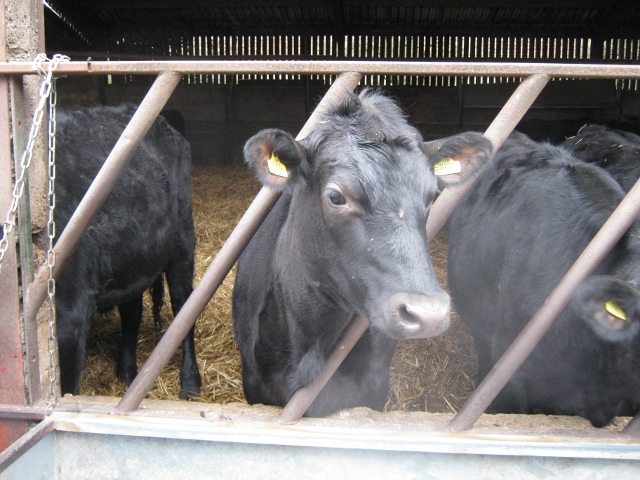
IMG_3980Bullocks (640x480)

Calves in the cow shed at our friends’ farm.  The blurring is caused by the calves’ steamy breath.

On Saturday, Richard and I went to the church coffee morning held this month at our friends’ farm instead of at the Rector’s house.  Our Rector had his heart surgery last week, and will be off work for some time while he recovers.  We wish him a speedy return to full health.  As usual we listened to all the gossip and news.  I bought some delicious home-made Bakewell bars which we ate later that day and Richard won a tin of sweets in the raffle.

Saturday was cloudy and chilly but there was no frost and the birds were singing lustily.  I heard the chaffinch’s spring song for the first time this year.

Sunday was a much brighter day.  The church service was held at our church in Rumburgh so Richard and I got there early to get things ready.  The church didn’t need much tidying as I had helped another lady to clean it thoroughly on Friday and there had been a wedding on Saturday afternoon after which Richard had tidied up again.

After lunch we went out for a walk.  We decided against driving somewhere and also thought it better not to walk across the fields as everywhere is waterlogged.  We took our usual circuit of a couple of miles, walking along the lanes.  I have photographed this walk so many times now, so I will just show you a few of the new and/or interesting things I saw.
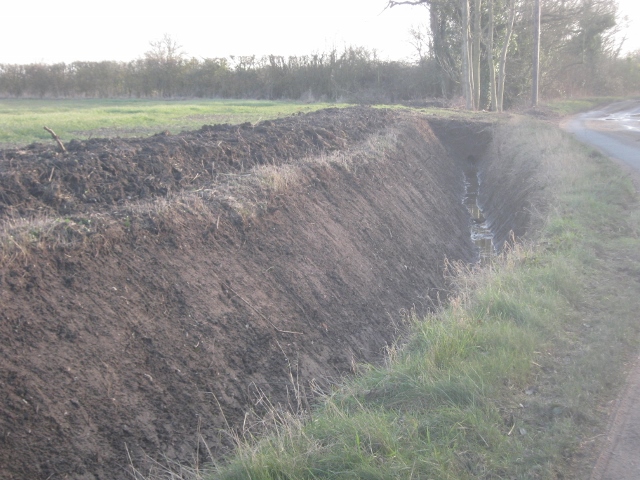
IMG_3982Ditch newly chased out (640x480)

A part of the ditch in our lane has recently been chased out. Regular ditch maintenance is necessary to ensure proper field drainage and to stop flooding on the roads.
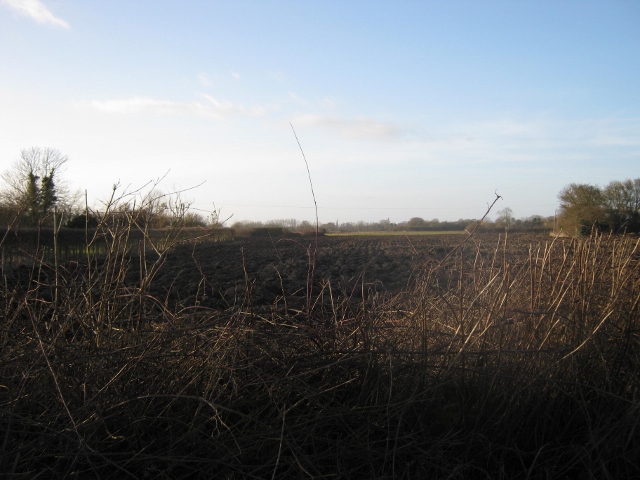
IMG_3983Newly ploughed field (640x480)

This field has been newly ploughed. For years probably, it has been rough grass with heaps of old rusty farm implements alongside the hedge.
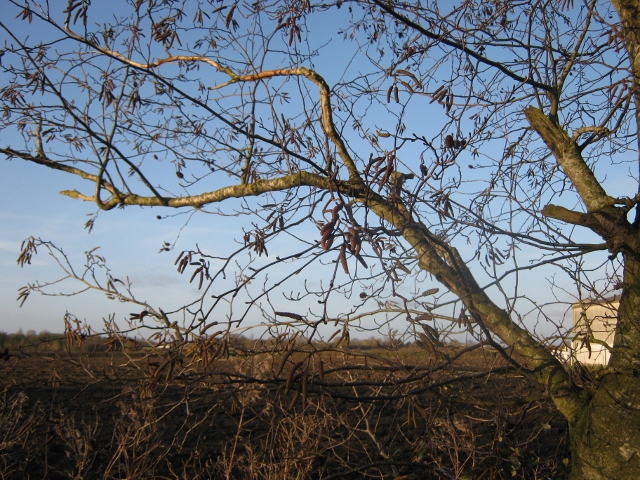
IMG_3985Italian alder tree (640x480)

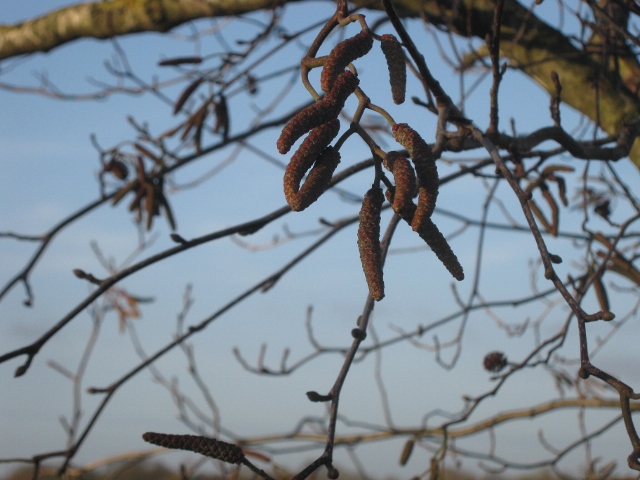
Italian Alder tree (Alnus cordata)  There is a row of these trees along the roadside.
IMG_3986Italian Alder catkins (640x480)

Italian Alder catkins

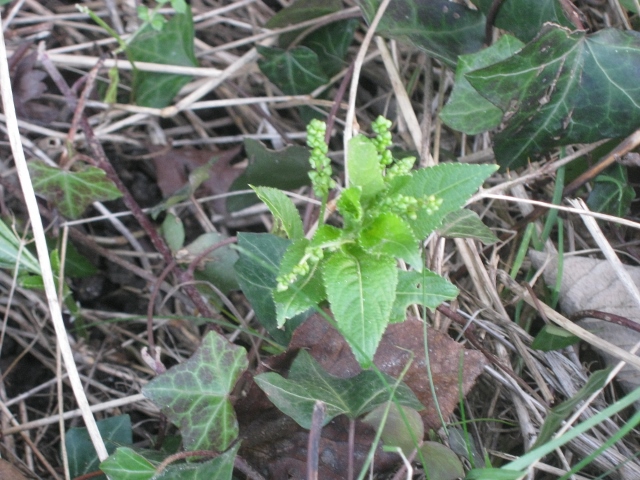
IMG_3988Dog's Mercury (640x480)

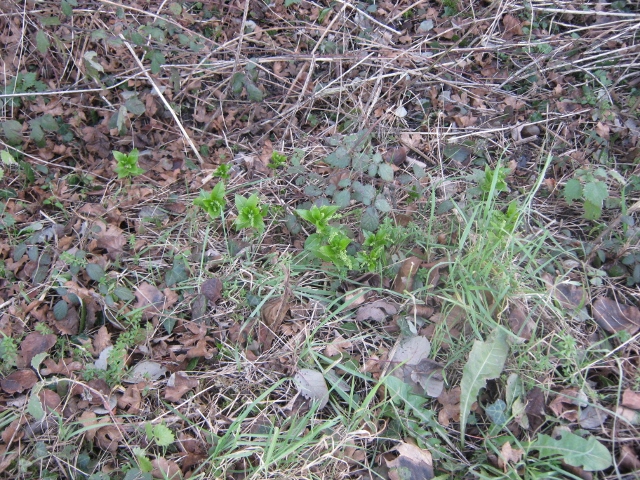
I found that Dog’s Mercury (Mercurialis perennis) was already starting to flower.

This plant is found in woodland often forming carpets, also under hedges and in other shady places.  It has a fetid smell and is poisonous, being a member of the spurge family (Euphorbiaceae).  Male and female flowers are found on separate plants and are small and yellow in spikes.  It is pollinated by midges.
IMG_3989Dog's Mercury (640x480)

Bright green Dog’s Mercury.

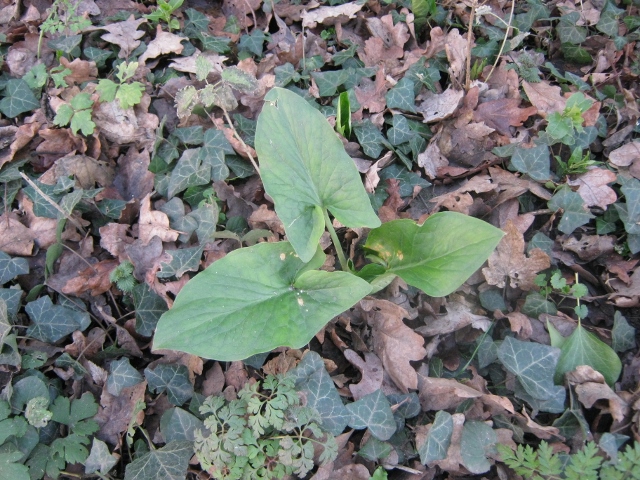
IMG_3992Lords and Ladies (640x480)

Lords-and-ladies (Arum maculatum)

Another woodland and hedgerow plant.  I was surprised that these leaves were matte green – they are usually glossy.  Another plant that smells of decay when in flower, the berries are poisonous and the roots have a high starch content.  In Elizabethan times the roots were gathered to make starch for stiffening the high pleated linen ruffs that were then in fashion.
IMG_3995Flies in the sunshine (640x480)

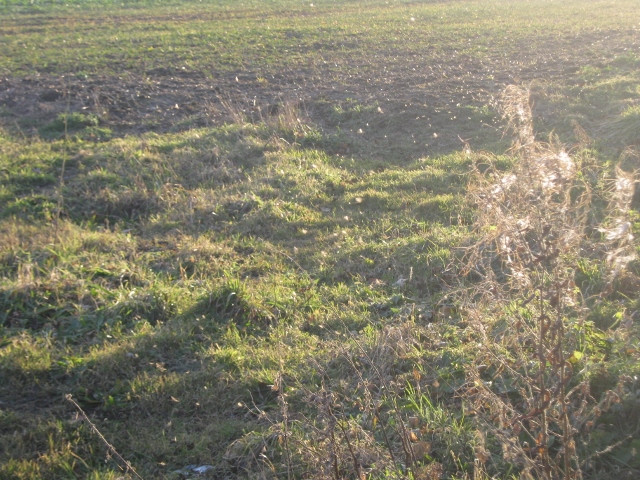
The white spots in the photo are midges or Winter Gnats flying in the sunshine.
IMG_3996Lichen-covered dead tree (640x480)

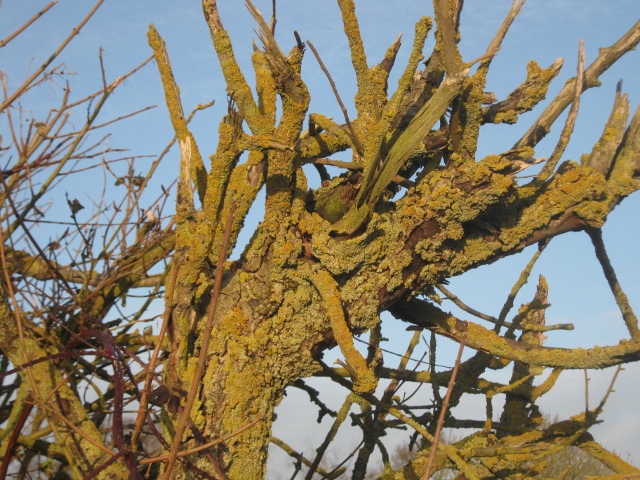
This dead tree at the end of a hedge and at the entrance to a field is covered in lichen. The bark of the tree has started to fall off taking the lichen with it.


IMG_3997Clouds and shadows (640x480)

Our long shadows and that of the hedge behind us can be seen on the field as I took a photo of the beautiful cloud patterns

IMG_3998Clouds (640x480)

The clouds.

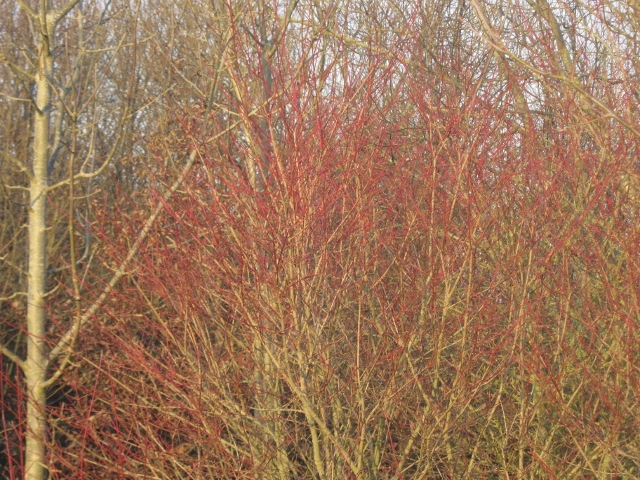
IMG_3999Dogwood (640x480)

The Dogwood (Cornus sanguinea) twigs were blazing in the low sunlight.
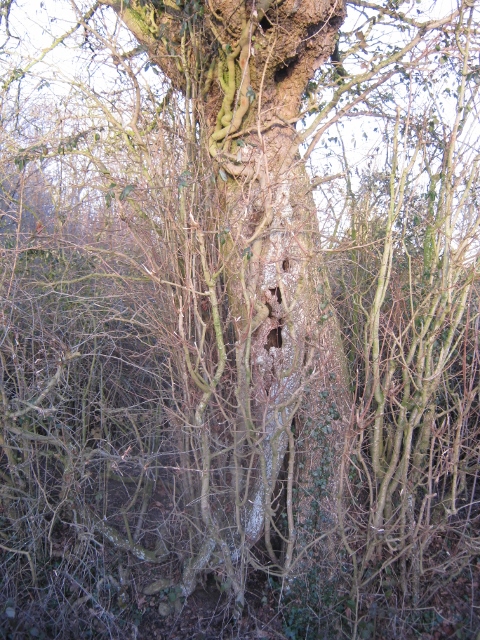
IMG_4001Hollow tree (480x640)

A hollow tree. In spite of its hollow trunk and all the ivy growing up it the tree, an oak I think, is still alive.
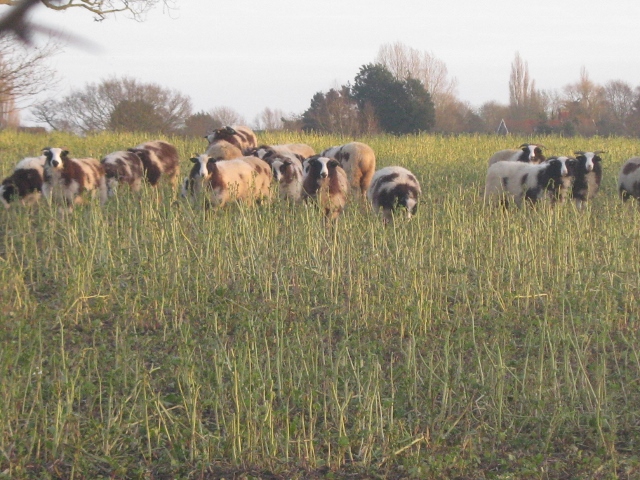
IMG_4002Jacob Sheep (640x480)

Jacob sheep. They will be having their lambs soon.
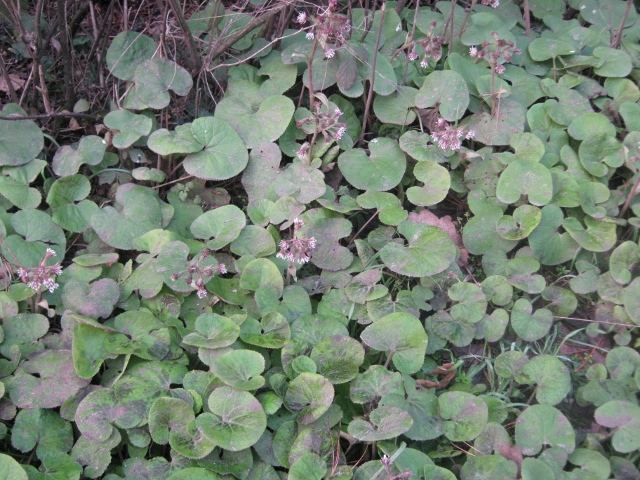


IMG_4003Winter Heliotrope (640x480)

Winter Heliotrope (Petasites fragrans) growing along the roadside verge near someones house. The flowers are vanilla-scented and the plant spreads quite quickly preferring damp and shady places. It is a naturalised garden plant.
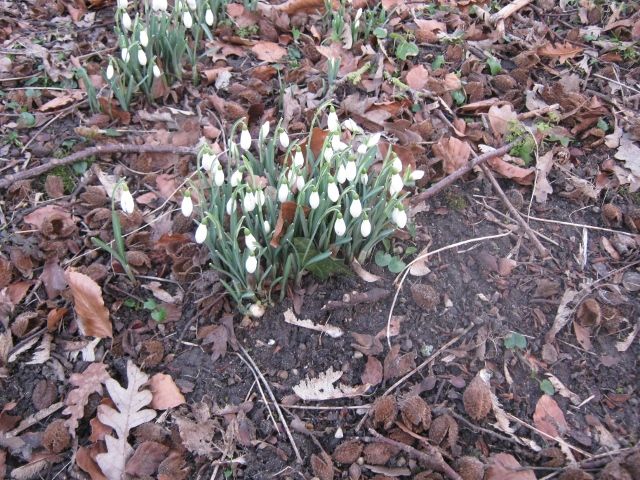
IMG_4005Snowdrops (640x480)

Snowdrops (Galanthus nivalis) in the churchyard
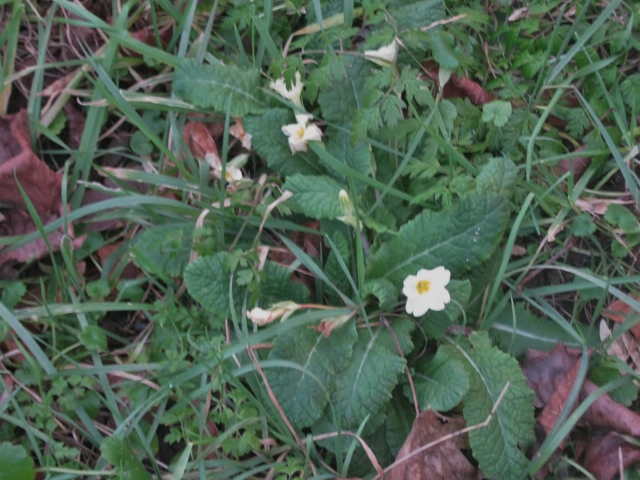
IMG_4006Primroses (640x480)

Primroses too! (Primula vulgaris)

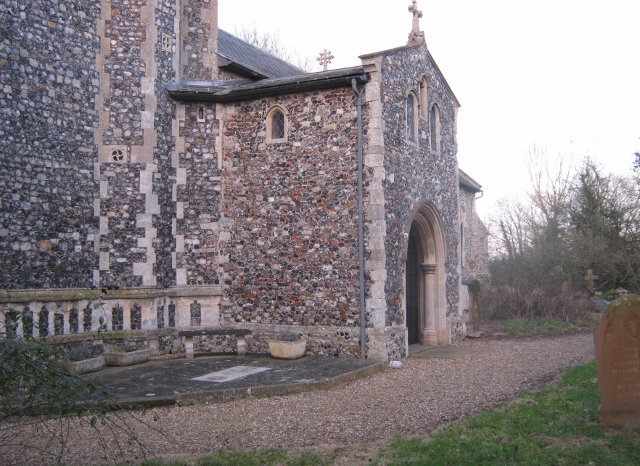
IMG_4007St Margaret's church porch (640x466)

St Margaret’s church porch has an upstairs room.


IMG_4010Lichen on gravestone (640x480)

White lichen on a gravestone

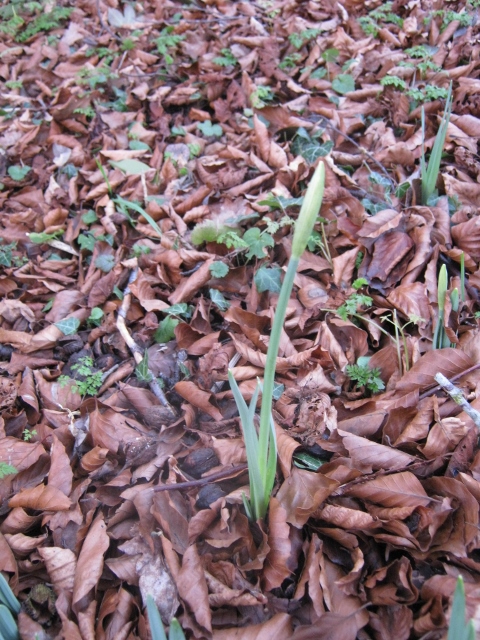
IMG_4011Daffodil bud (480x640)

A daffodil bud in the sheltered churchyard.
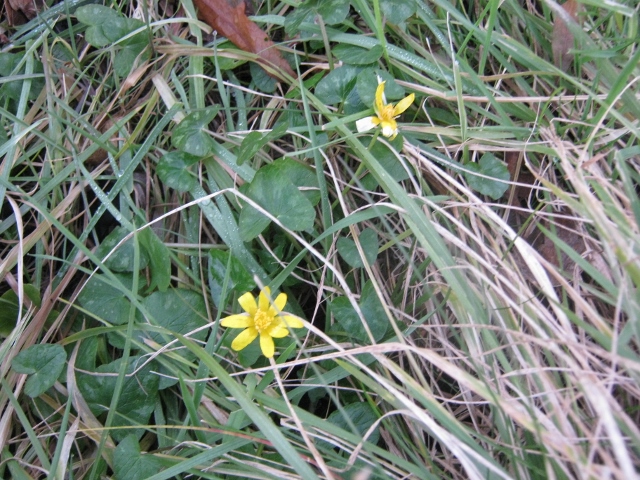
 

IMG_4016Celandines (640x480)

Celandines (Ranunculus ficaria) flowering on the roadside verge.  I was so surprised to see these as they don’t usually appear until March.  They were everywhere I looked, though as the sun was setting they were closing up for the night.  I should have got there an hour earlier.

IMG_4017Sunset (640x440)

Sunset.


We got home as the sun sank below the horizon.

This week Elinor is taking her mock GCSE exams.  She has already taken Psychology and English.  Maths is on Wednesday and Thursday and Art is all day on Friday.  She is coping very well indeed though she is exhausted already with the strain of it all.

Richard stays away from home only one night this week; Wednesday night is spent in Gloucestershire.  On Friday he goes back to the specialist to find out more about the lesion/tumour on his pituitary gland and what is to be done about it.

I am disappointed at not being able to go to Sheffield  to see Alice perform in ‘Emma’ especially as she is taking the leading role.  I would really have loved to see her and support her but the performances are at the same time as Elinor’s exams and Richard’s hospital visit.  I also don’t have much money to spare for train travel and hotel rooms after Christmas and Elinor’s birthday in January.

My mother is fine.  She went to the eye specialist on the 30th December and had to return the next day for an injection to stop a bleed in her eye.  We went back last week for a check-up and fortunately all is well again.  The next appointment is in mid March.  My brother has filed for divorce and is in the process of selling his house.  He is moving to Suffolk to be near us and Mum and especially his daughter and has got a transfer to work in the open prison in Suffolk and continue his teaching.  My sister is working hard as always as a paramedic practitioner. She got her degree and will be getting her certificate at a ceremony in May.  My mother-in-law is out of hospital and in a nursing home.  This is a temporary arrangement as she hasn’t yet been assessed but we all know that she won’t be able to go back home.  She has a weak heart, breast cancer, problems with her thyroid and has lost all her mobility.  All so sad.  She understands the situation and is making the best of it; such a sensible woman.
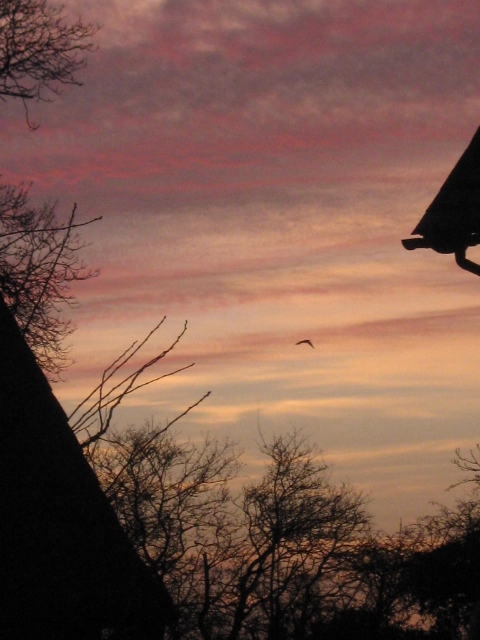
IMG_4018Sunset (480x640)


Peak District Holiday 1st to 9th July. Days 7 to 9.

Tags

, , ,

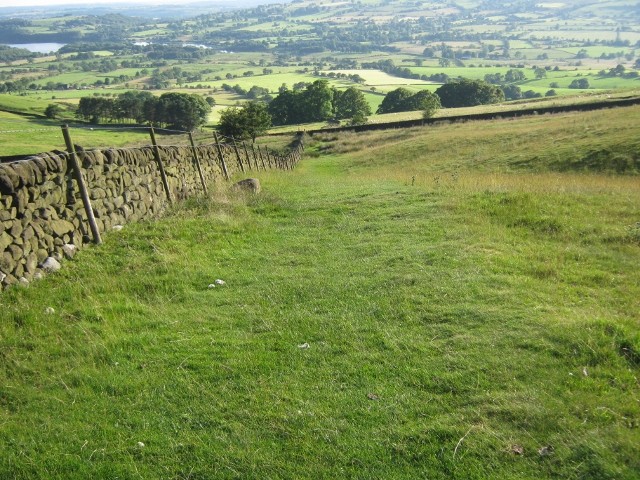
As we were nearing the end of our holiday and the weather looked as though it would stay fine, Richard and I decided it would be a good idea to do another walk while we had the chance.  We had made a list of the walks we wanted to do before we came on holiday and we had already walked in Back Forest and up Hen Cloud.  Our third choice was a walk we had never tried before – along the top of the Roaches.  Our book of local walks suggested a circular walk starting at Tittesworth Water, walking across farmland up to where we usually park our car for our Hen Cloud walk and then up from there to the Roaches.   After descending from the rocks at the far end we would be able to follow paths and lanes back to where we left our car at the reservoir.  Richard made us some sandwiches, I washed up and packed our rucksacks and we set out about 11 o’clock.

001Tittesworth reservoir (640x480)

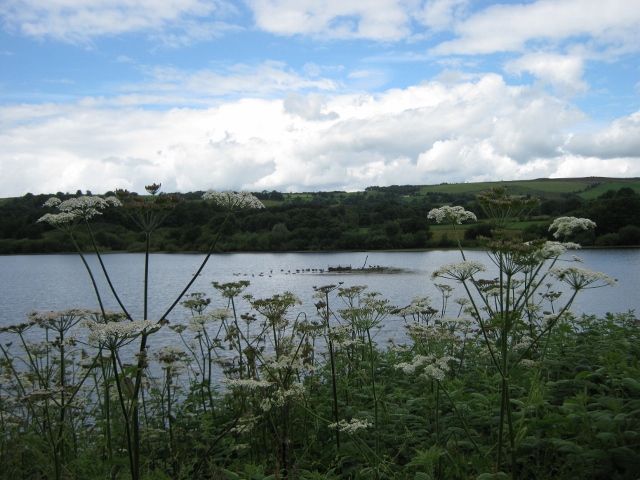
Tittesworth Reservoir

Tittesworth reservoir is a very short drive from our camp.  We had been there before but only for a short visit about seven years ago.  It has a visitor centre and people are welcome to walk all round the water and watch the many different types of wildfowl that live there.  Boating is also a popular activity on the water.

We walked from the car-park to Meerbrook, a village next to the water.

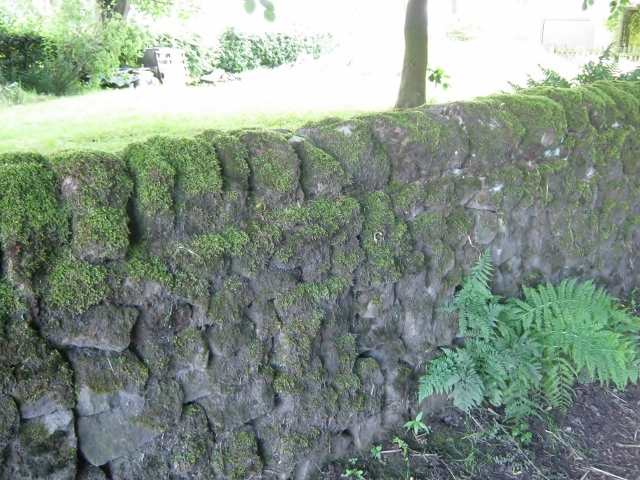
009Mossy wall (640x480)

I liked this mossy wall which surrounded someone’s garden.

I didn’t take many photos during the first half of the walk as it became quite hard-going shortly after we left the village.  The paths were very overgrown or we sunk into deep mud.  The local farmer hadn’t kept the ways clear and so it was difficult to follow the directions set out in our guide.

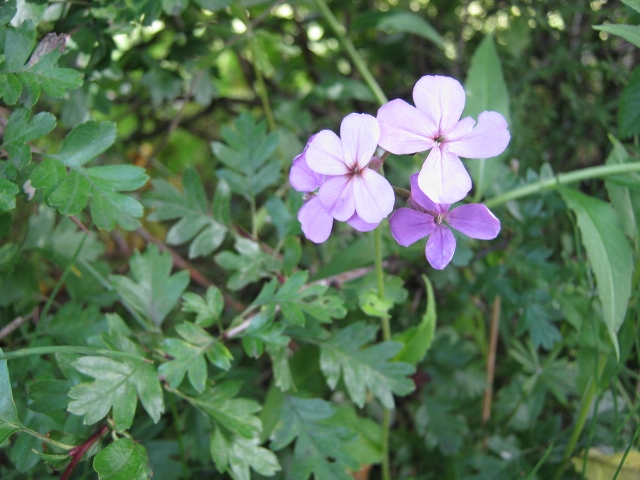
010Honesty (640x480)

Honesty (Lunaria annua)  A garden escapee that has naturalised all over the country.

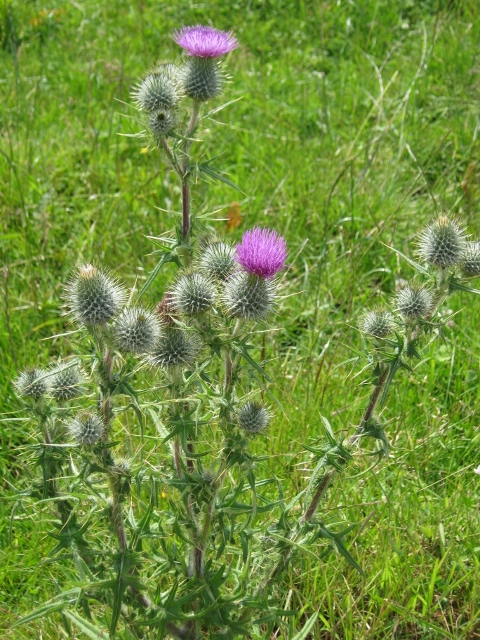
012Thistle (480x640)

Spear Thistle (Cirsium vulgare)

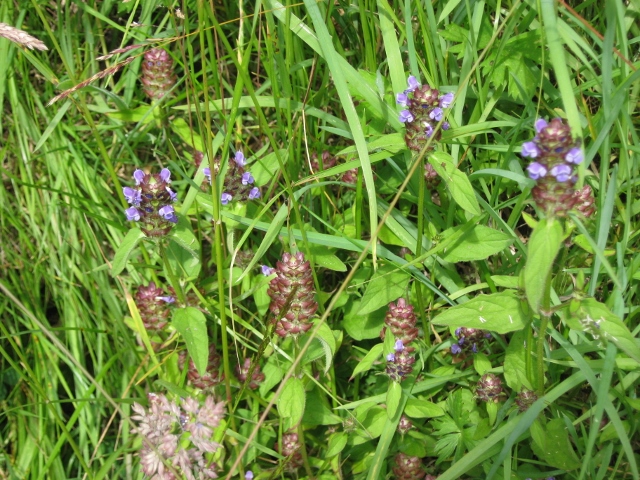
013Self Heal (640x480)

Selfheal (Prunella vulgaris)

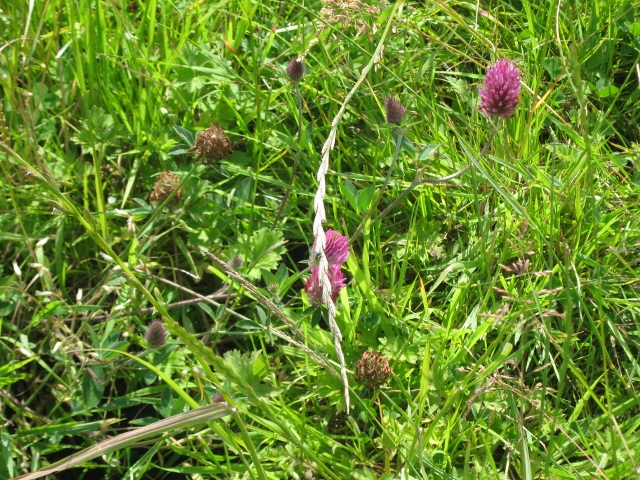
014Red Clover (640x480)

Red Clover (Trifolium pratense)

We found a man tying up a gate with binder twine and asked if we could use the gate to get to the path we needed.  He said we could use the gate and then commented on the humidity of the day – nothing else.  We walked on and found the way blocked by an electric fence which we had to crawl under – not easy for those like us who are past the first flush of youth.  Getting up again is much more difficult than getting down on the ground.  Why hadn’t the farmer/farm worker said anything about this to us?  It amused him, no doubt.  We had to pass through a farm yard next.

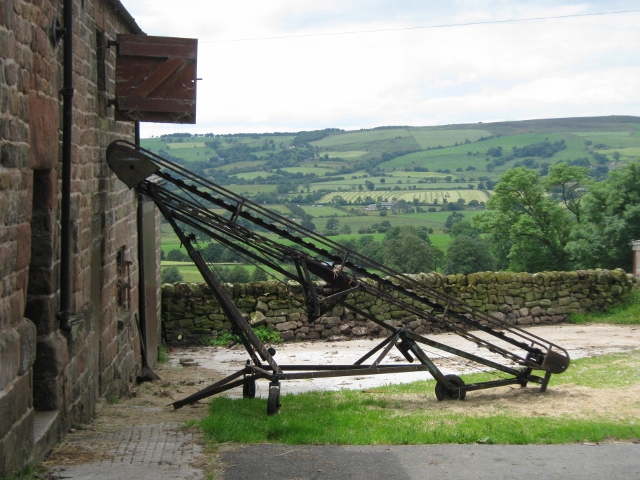
015Conveyor (640x480)

This old conveyor-belt caught my eye…..

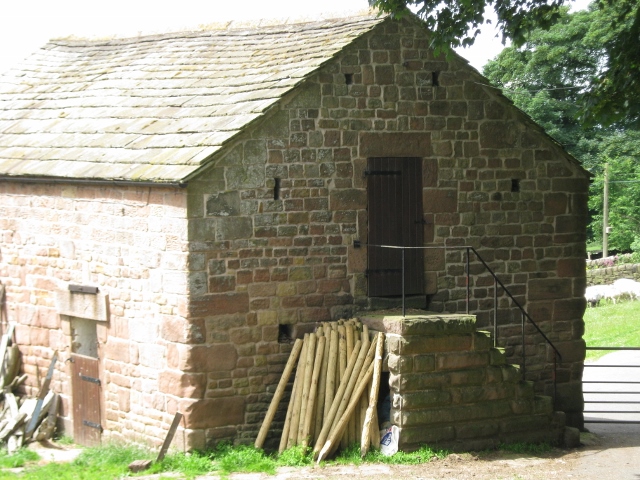
016Barn (640x480)

and I liked the barn.

We then lost the path at the corner of a field and had to scrabble about for a while til we found what we hoped was the right way.  We were discussing what our options were when, to our great surprise a man’s head popped over the wall above us and asked if he could help.  It is a very strange thing to think that you are in the middle of nowhere and then find that a man is hanging out his washing in his garden right next to you!  He was very helpful and we were on our way again.  By this time we were very hot and tired as the way had been difficult and uphill all the way.  Richard was getting annoyed and I had a great urge to laugh!

We had just entered the bottom of a steep field when we saw a muck spreader arrive and start its smelly work on the opposite side of the same field.  It was a race against time for us to get to the top of the field before the tractor had worked its way over to our side.  We knew that the driver would not have stopped his work just for us.  Fortunately we just managed it in time but we were so tired!  The main reason for this walk was to climb the Roaches and we hadn’t reached them yet.  We had thought the walk across the fields would have been a pleasant preliminary but we had sadly been mistaken!

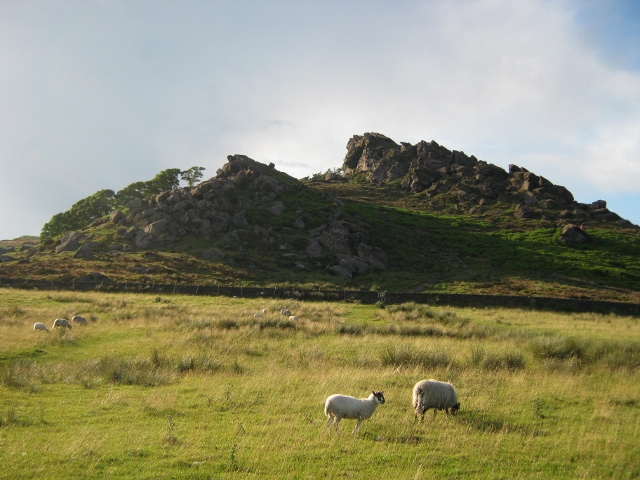
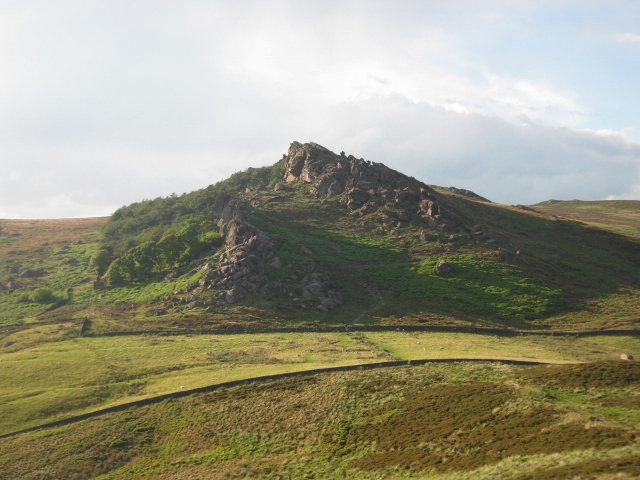
We were now at the base of Hen Cloud and decided that we would stop for a short while and have our lunch after which we turned and walked towards the Roaches.  They, with Hen Cloud and Ramshaw Rocks, form a gritstone escarpment which marks the south-western edge of the Peaks.  The Roaches consist of two edges – a Lower and an Upper Tier.

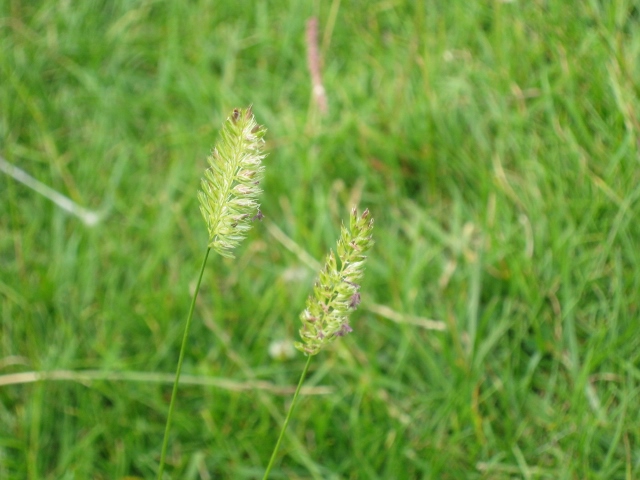
018Crested Dog's-tail (640x480)

Crested Dog’s-tail (Cynosurus cristatus)

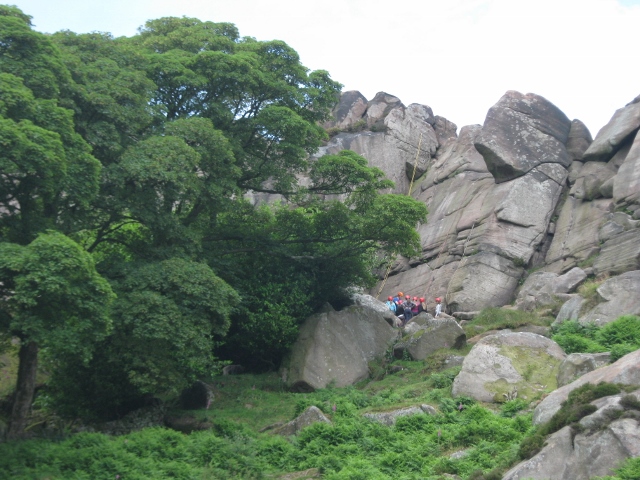
020Climbers (640x480)

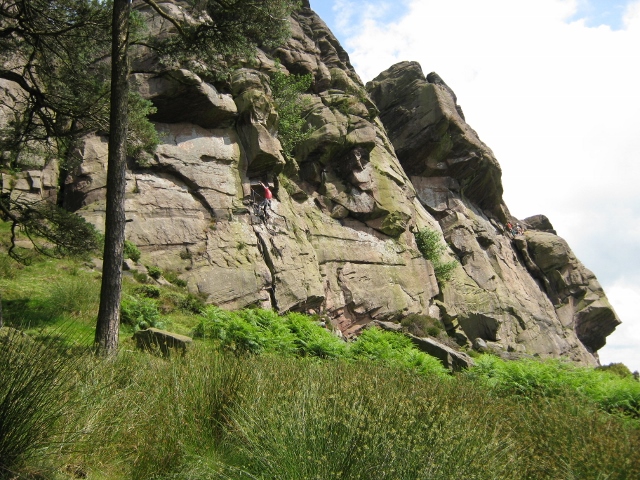
The Roaches are very popular with climbers.

021Lodge in hillside (640x480)

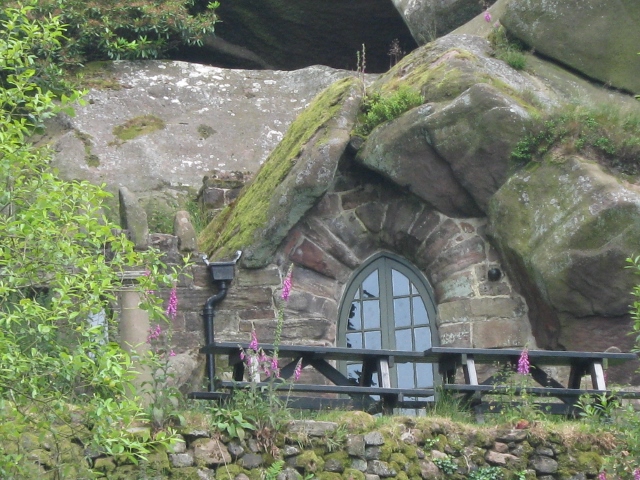
This is Rock Cottage which is built into the rocks of the Lower Tier. It was formerly a gamekeeper’s cottage but is now a climbing hut.

022R at top of steps (480x640)

A set of rock steps connect the Lower and Upper Tier. Richard is at the top.

The views through the trees from the top of the steps looking down and then upwards were very fine.

026Climber (640x480)

There were climbers everywhere.

These edges provide some of the best gritstone climbing in the country with famous classic routes such as ‘Valkyrie’, ‘The Sloth’ and ‘The Swan’.

027Strange rocks (480x640)

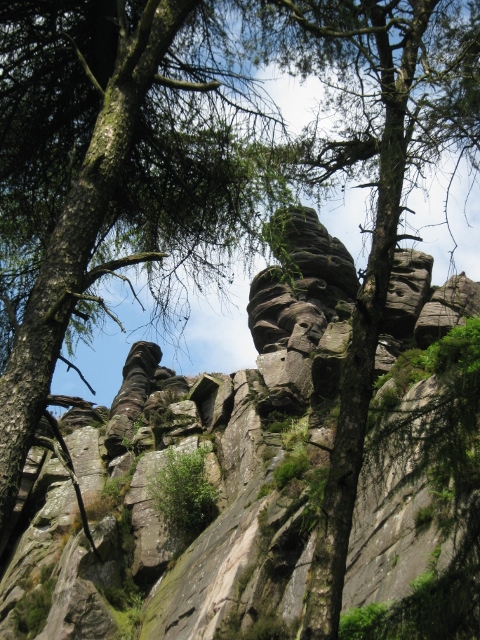
These strange rocks have been weathered by the elements.

029Pine tree (640x480)

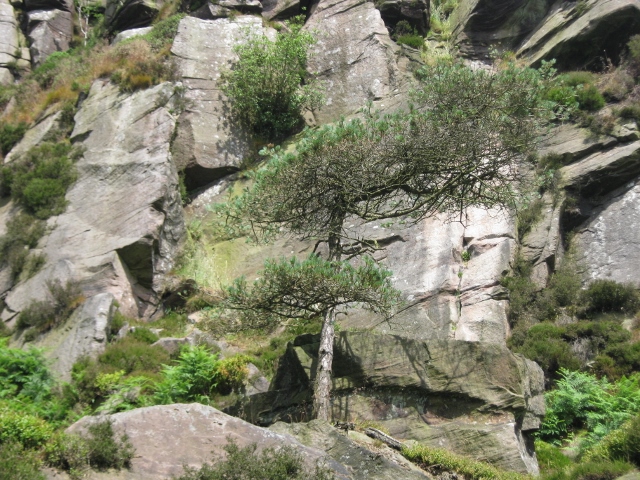
The pine tree is growing out from a crack in the rocks.

There was something of interest to look at whichever way we turned.  Please click on the images to enlarge them.

035Sheep (640x480)

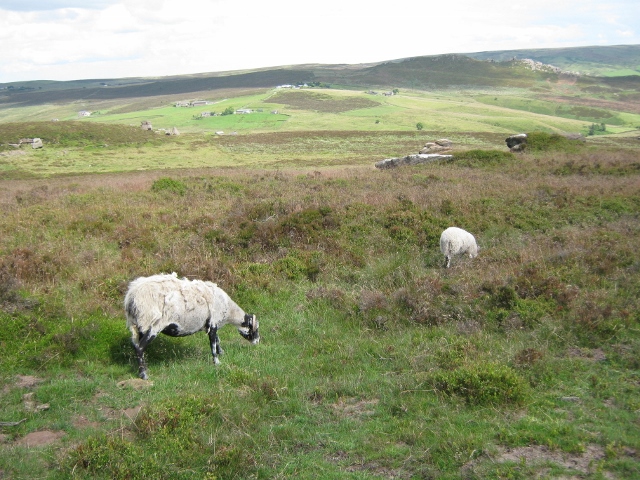
Sheep are never far away in the Peaks.

036Cotton grass (480x640)

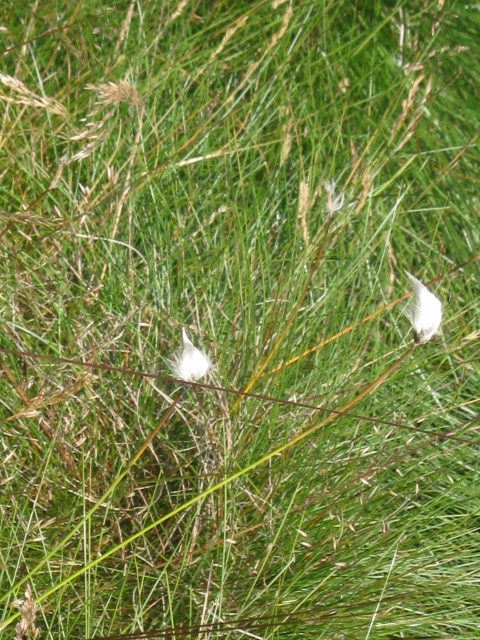
I was surprised to see what I believe is Common Cottongrass (Eriophorum angustifolium) flowering this late in the season.  It could be Hare’s-tail Cottongrass (Eriophorum vaginatum).  Either way, their flowering time is usually April to May.


Doxey Pool is on the top of the Roaches.  According to legend it is inhabited by a water spirit or mermaid known by some as Jenny Greenteeth.  The pool is said to be bottomless and connected by an underground passage to another Mere or lake which also contains a water spirit.  Doxey Pool is situated many hundreds of feet above any known spring.  We didn’t see anything ‘unexplained’ while we were there!

A selection of rocks.

056Heather (640x480)

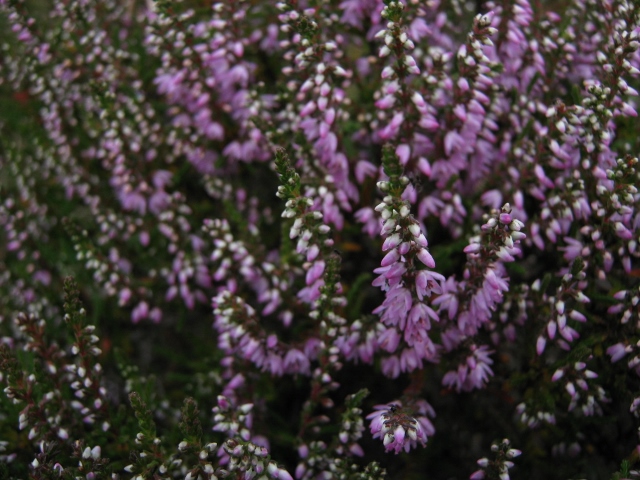
Heather (Calluna vulgaris)

057R at trig point (480x640)

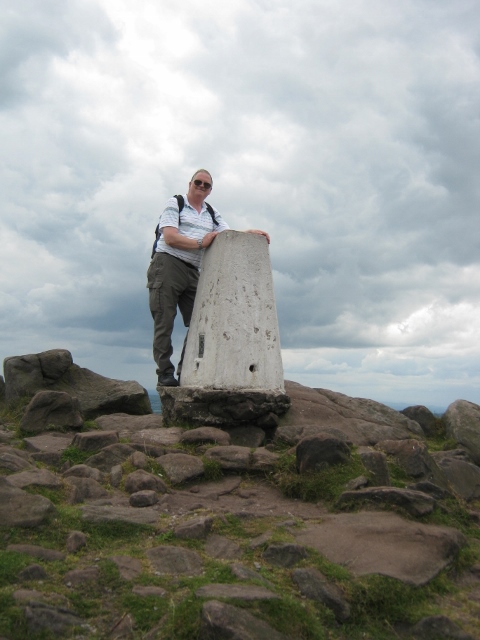
Richard standing at the trig point

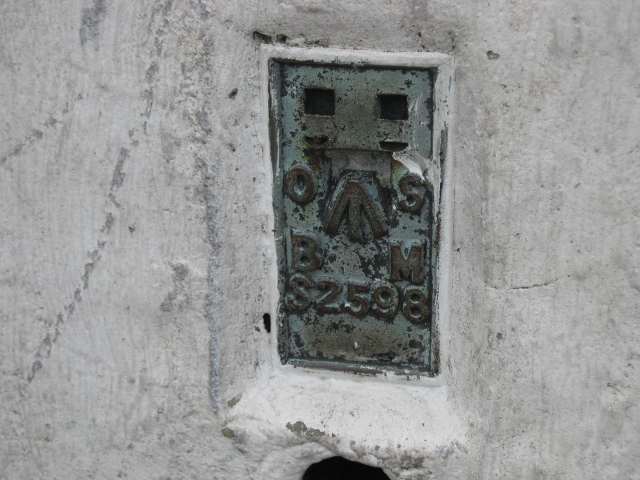
058Trig number (640x480)

The bench mark. Triangulation stations have now largely been superseded by digital mapping and aerial photography but many are kept because of their usefulness to hill walkers and because many people are so fond of them.

Yet more rocks!

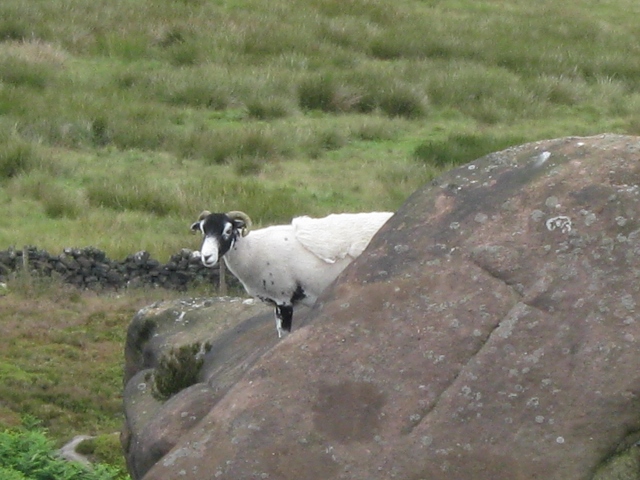
064Sheep (640x480)

Hello! says the sheep.

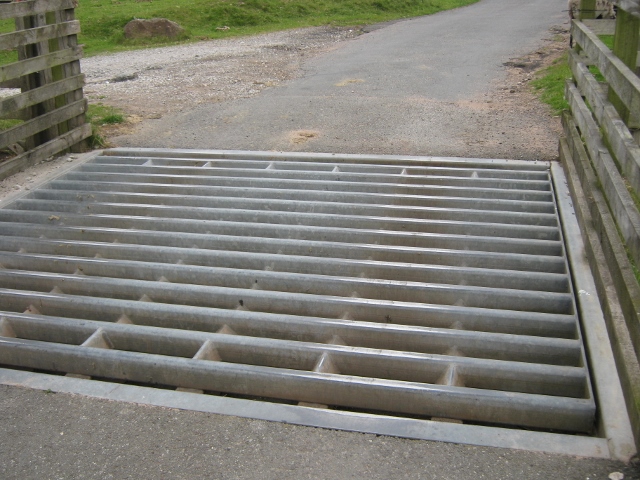
065Cattle grid (640x480)

This is a cattle-grid (for those of you who don’t know). They enable traffic to use roads through farmland but stop the cattle from escaping from their pasture.

We left the Roaches and started to descend down through moorland and meadows.

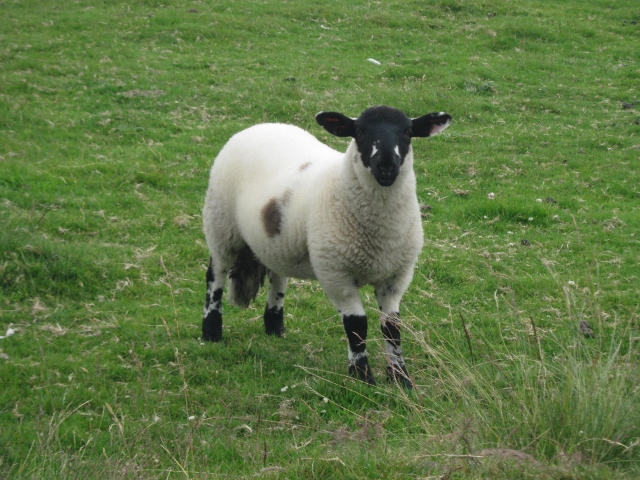
067Lamb (640x480)

We met a very friendly lamb.

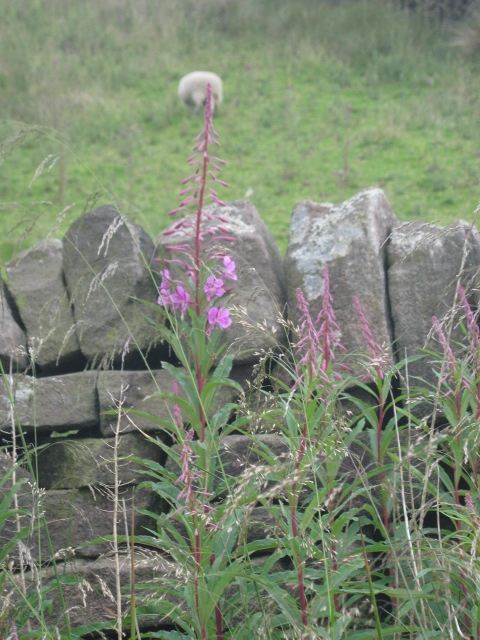
068Rosebay Willowherb (480x640)

Rosebay Willowherb (Chamerion angustifolium)

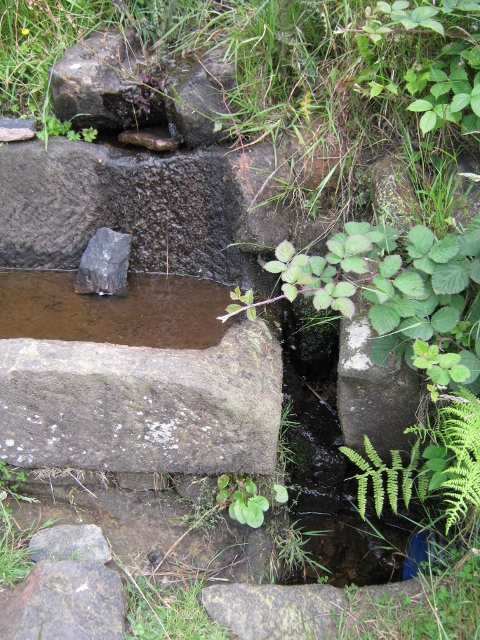
069Water trough (480x640)

These drinking troughs that use spring water or little rivulets remind me of the picture of the spring bubbling out of the hillside in ‘Mrs Tiggywinkle’ by Beatrix Potter


I am not sure what this grass is and any suggestions would be much appreciated.  It may be False Oat-grass (Arrhenatherum elatius)  I apologise for the poor photos.

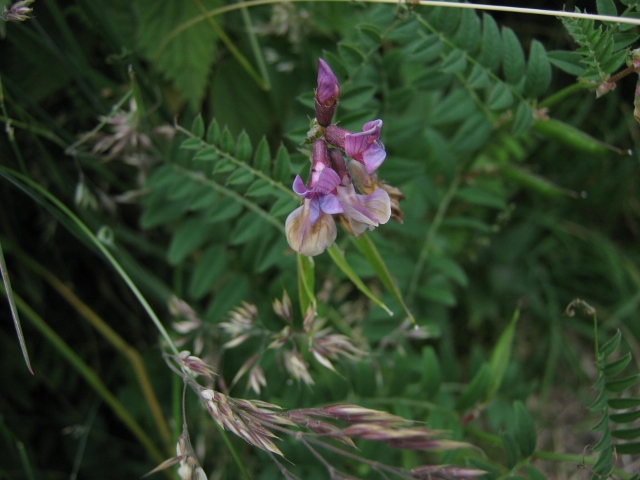
073Vetch (640x480)

Some pretty vetch flowers. Probably Bush Vetch (Vicia sepium) 

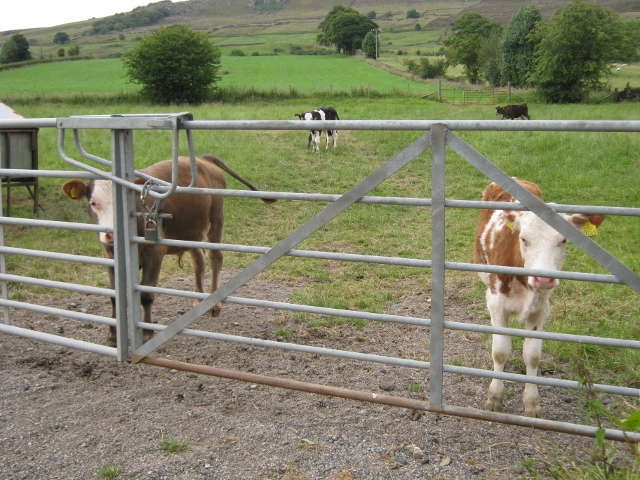
074Calves (640x480)

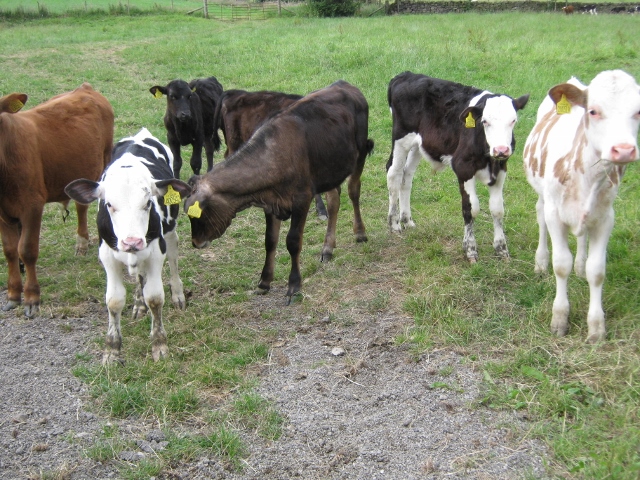
We walked past a field full of bullock calves. I can’t resist them!

075Calves (640x480)

They are so curious and playful ….

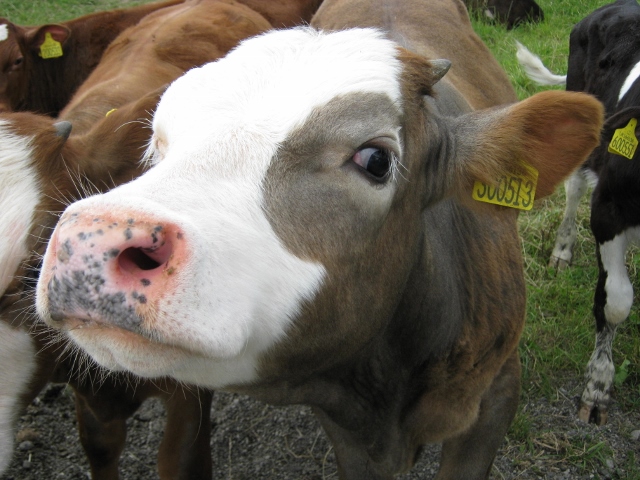
076Calf (640x480)

and have such lovely faces!


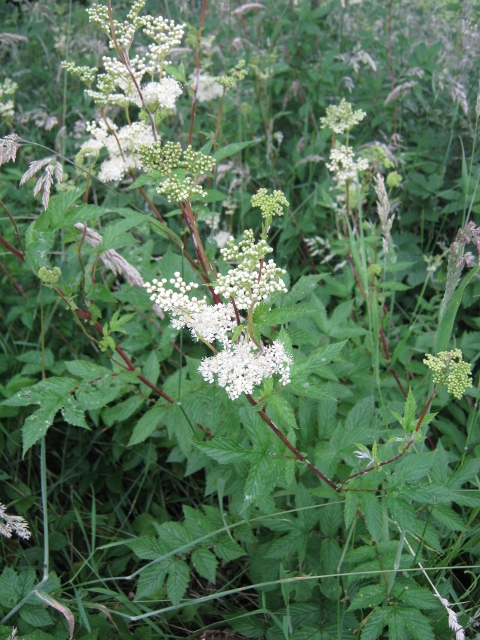
I don’t know what this plant is either.  I tried to take photos of its flowers – pink-tinged white umbellifers – but none of them came out.  The stems are purple and hairy and the leaves are quite distinctive.  I thought at first it might be Cow Bane but that and Hemlock are hairless.

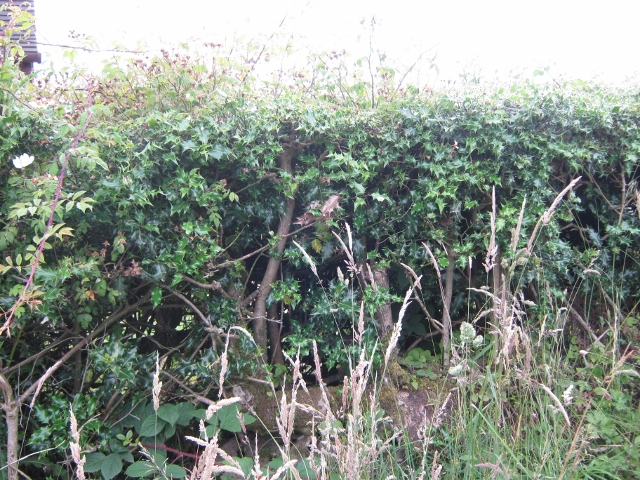
080Holly hedge (640x480)

A Holly hedge (Ilex aquifolium)

082Meadowsweet (480x640)

Meadowsweet (Filipendula ulmaria)

We soon found our way back to the reservoir and then returned to our caravan.  The following day was our last day and we had hoped to spend it sitting, reading and relaxing.  Fate and farmers decided otherwise.  The muck-spreading fever had taken hold and the field next to us was being fertilized.  We couldn’t stay where we were so we returned to Tittesworth Water and walked around there and had some lunch.  We amused ourselves for a while by watching some boys being taught how to row.  There were about six boys to a boat and the group that we enjoyed watching most consisted of a couple of lads who did all the work and the rest just made a lot of noise.  The two who actually did the rowing were on the same side of the boat so they went round in circles.  In the end they had to be towed ashore.

The next day we got ready to leave but before returning home we drove to the station to collect Elinor who had been staying with Alice.  They both seemed to have had a good time together but both were very tired and needed sleep.  Our journey home was fortunately uneventful.


Garden Visitors

Tags

, , , , , , , , , , , , , , , ,

I will continue to post last year’s photos while this winter weather continues.  I am away from home for a good part of the day; certainly the part of the day with the best light for taking pictures.  We haven’t been out anywhere recently either, so nothing much to show or tell you.

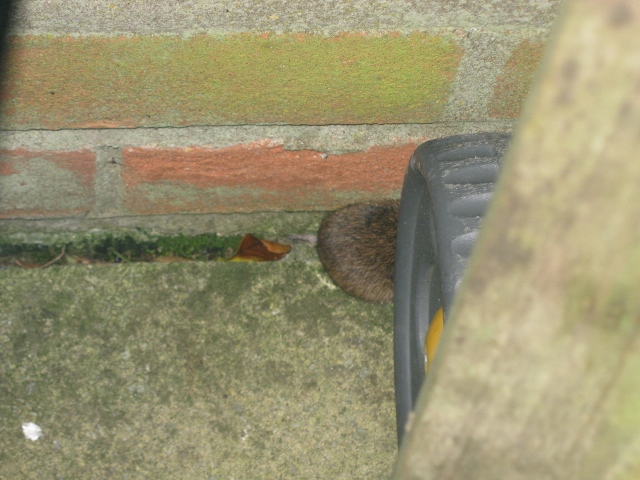
IMG_3881Vole (640x480)

Rear end of a vole. I think this may be a Field Vole (Microtus agrestis) rather than a Bank Vole (Clethrionomys glareolus).

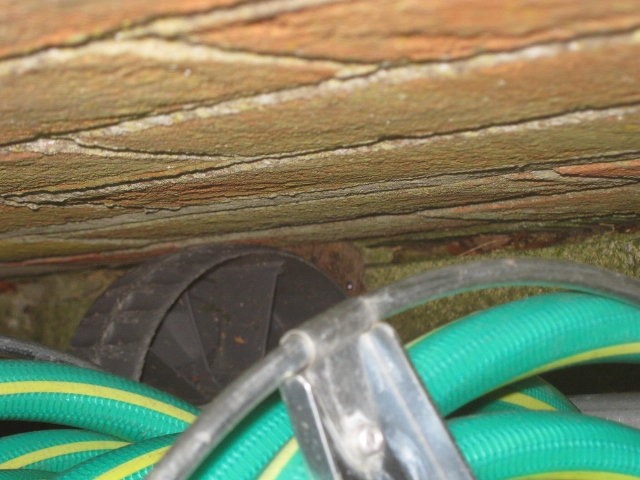
IMG_3882Vole (640x480)

Front end of a vole.

This vole was hiding behind the wheel of the hose-pipe cart.  In fact, the shots were taken just a couple of weeks ago but I was unable to add them to the other posts I’ve published this year.  Field Voles are aggressive and noisy rodents and like to live in damp and tussocky grass.  Exactly!  Our garden is full of that at the moment.

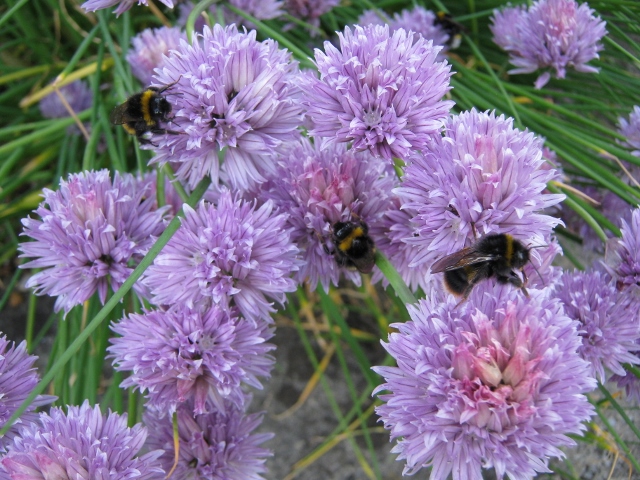
008Bees on chive flowers (640x480)

Bees on Chive flowers

I let most of my herbs flower as I prefer to see the insects and flowers to having perfect tasting herbs.

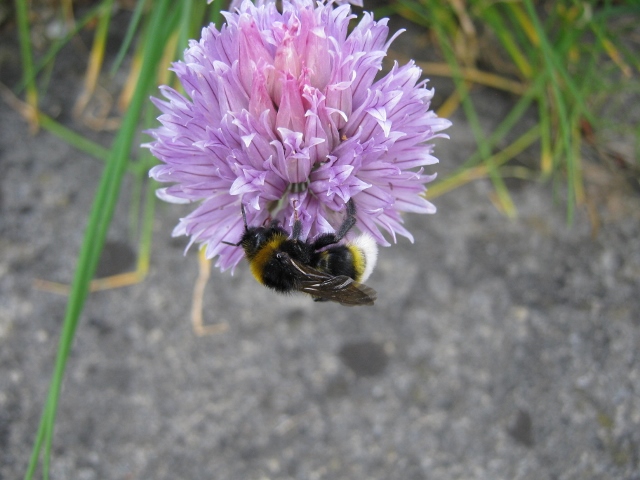
009Cuckoo bee Psithyrus vestalis on chive flower (640x480)

I believe this is a Cuckoo Bee (Psithyrus vestalis) on Chives.

005Micro Moth (640x480)

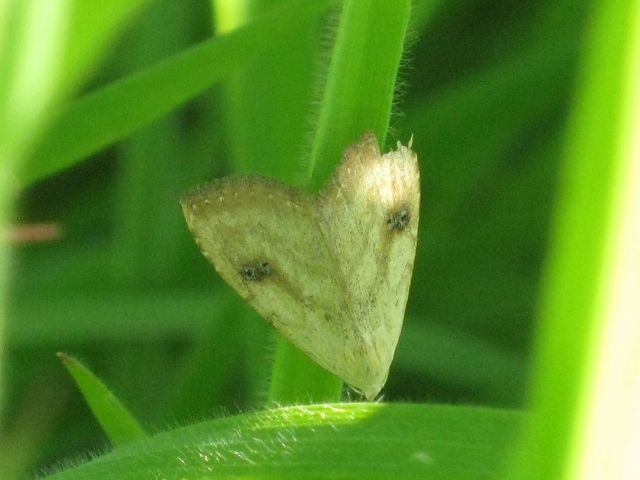
A micro moth I found in grass. I haven’t yet discovered what it is called.

001Micro moth (640x497)

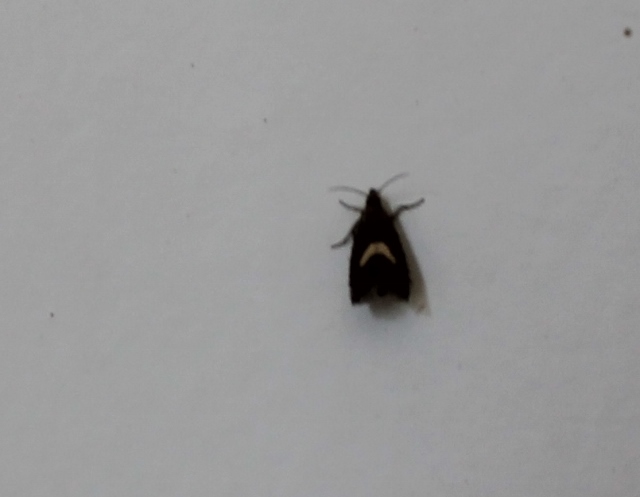
Another micro moth seen on a wall. I apologise for the shot being out of focus.

042Brown Hawker (640x488)

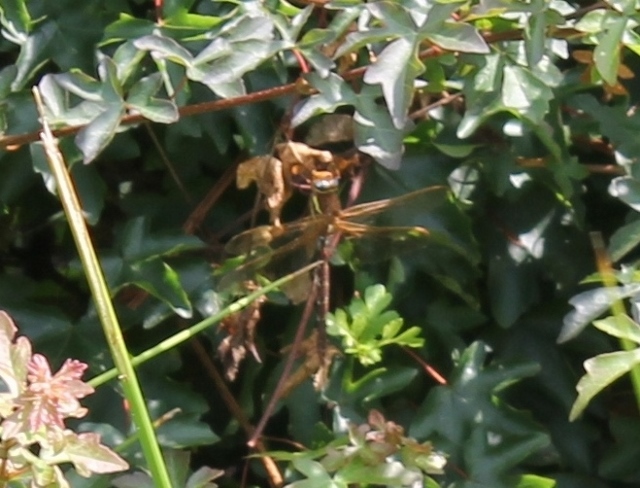
A Brown Hawker dragonfly. This is the only photo I managed to get of it and it blends in so well with the dead leaf it was perching on. This is our only Hawker with amber wings and has prominent yellow stripes on its thorax. These can just be seen above the wings. I believe this is a female.

047Tachina fera on marjoram (640x427)

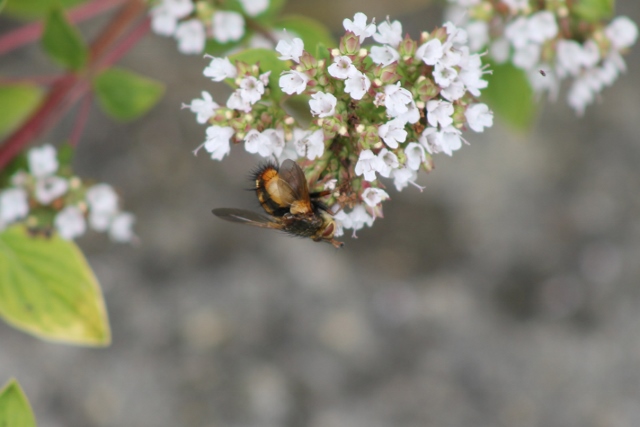
Tachina fera on Marjoram.  The larvae of these flies are parasites of saw flies and other caterpillars.

048Small tortoiseshell on marjoram (640x427)

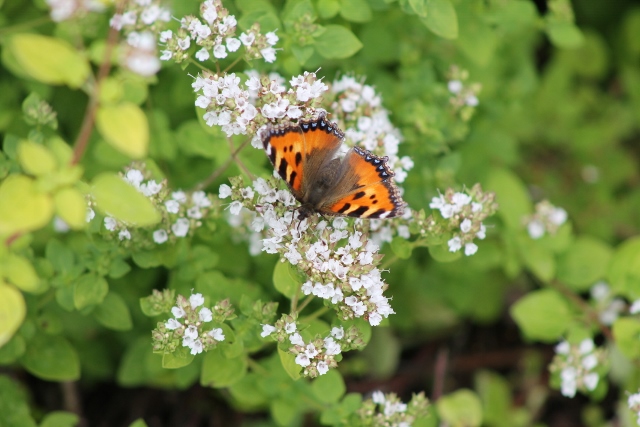
Small Tortoiseshell butterfly (Aglais urticae) on Marjoram

049Small tortoiseshell on marjoram (640x427)

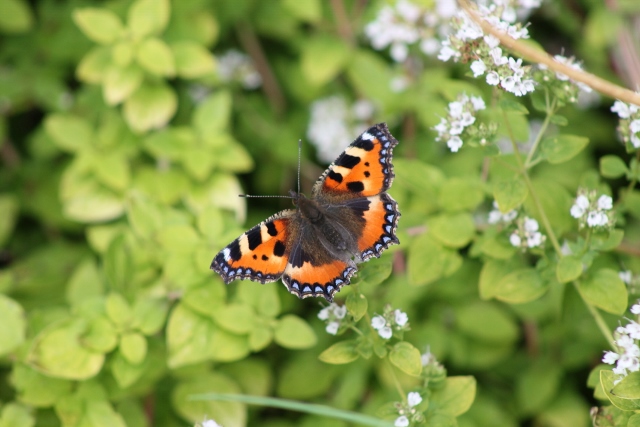
Small Tortoiseshell butterfly on Marjoram.

050Small tortoiseshell on marjoram (640x427)

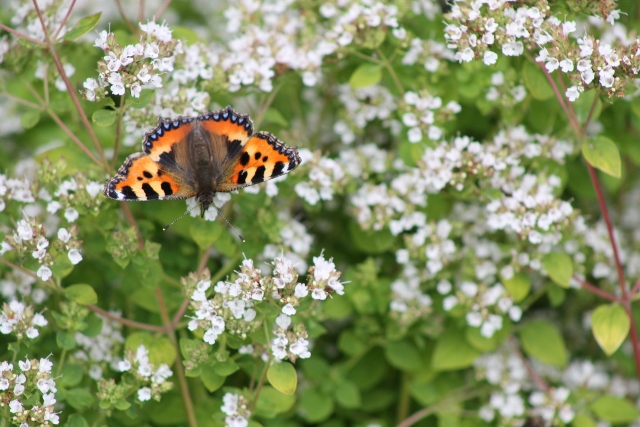
Small Tortoiseshell butterfly on Marjoram.


051Poss ichneumon wasp Amblyteles armatorius (640x485)

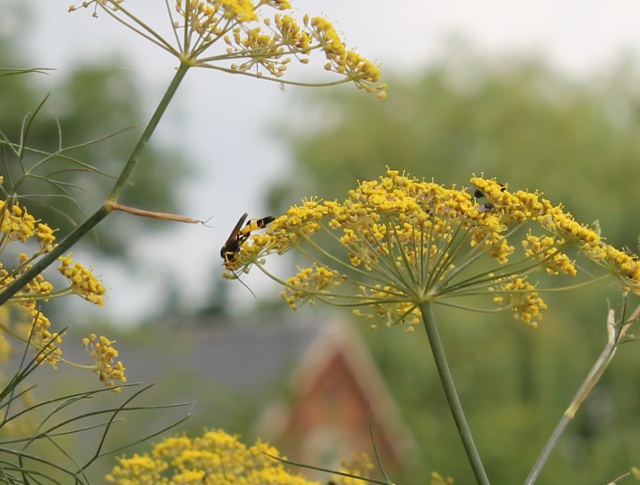
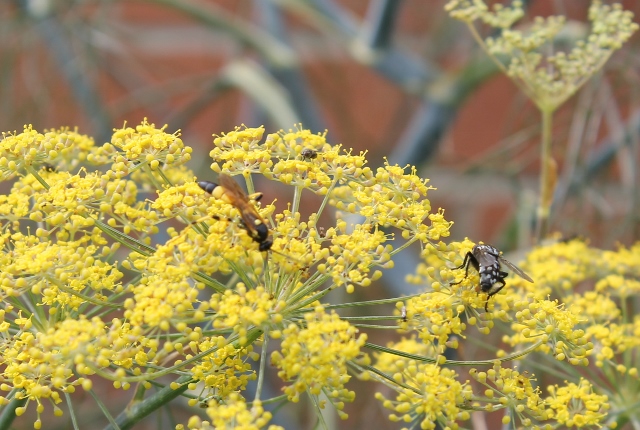
This is an Ichneumon wasp (possibly Amblyteles armatorius but I have my doubts about this ID). It is on Bronze Fennel.

053Flesh fly and ichneumon wasp (640x430)

Ichneumon Wasp and Flesh-fly (Sarcophaga carnaria) on Bronze Fennel.

011Moth (640x480)

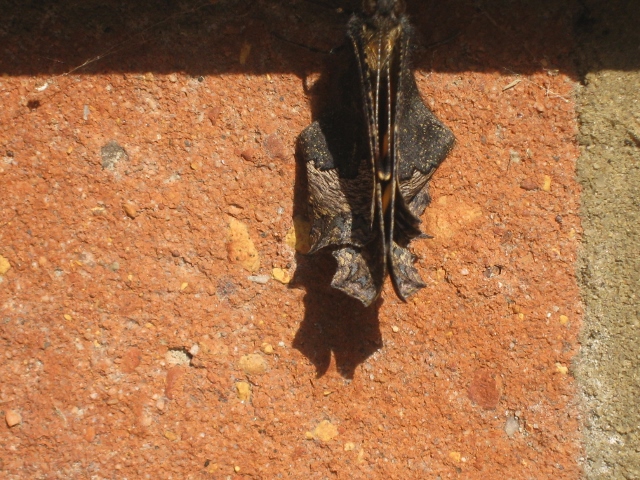
Unknown moth.  Angle Shades moths (Phlogophora meticulosa) fold their wings like this but I am not sure that they are this dark in colour.

004Small white (640x427)

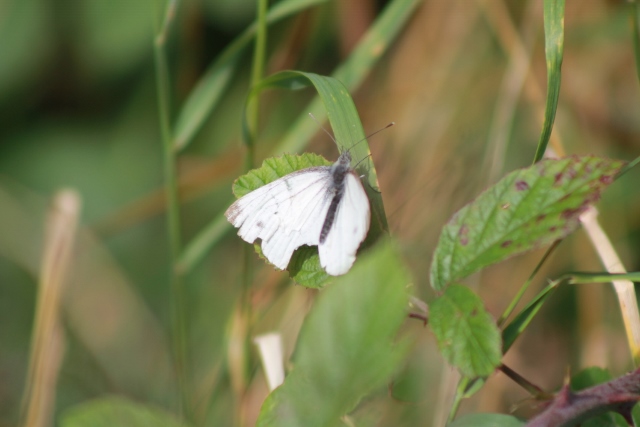
A rather chewed Small White butterfly (Pieris rapae).

012Large Yellow Underwing (640x480)

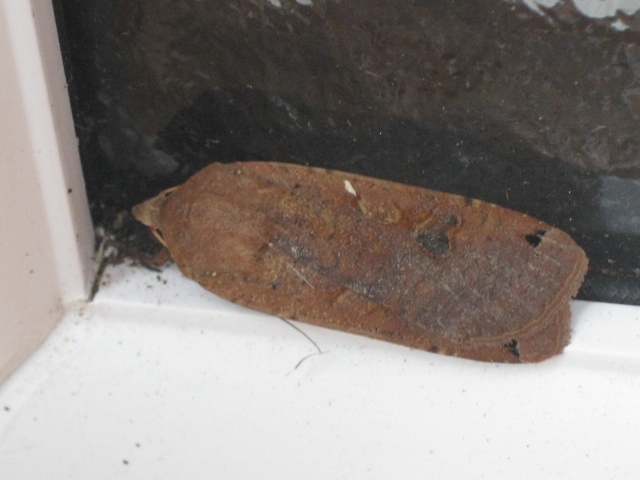
Large Yellow Underwing moth (Noctua pronuba)

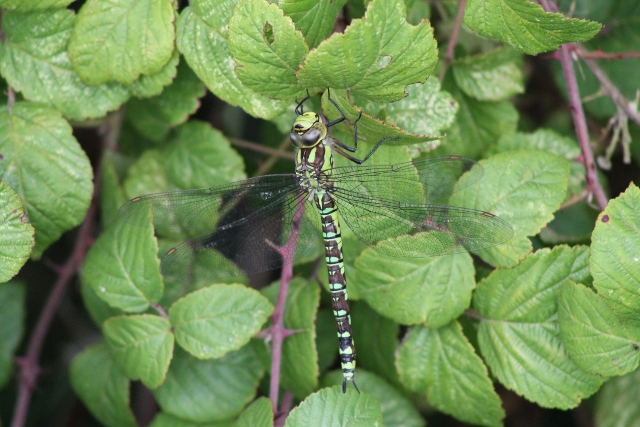
011Female southern hawker (640x427)

Southern Hawker dragonfly (Aeshna cyanea) – female.

Best wishes to you all!


More Visitors to my Garden

Tags

, , , , , , , ,

This is a post title I have used before and a very useful one it is too!

I have been going through the photographs I took last year in my garden and have found a few that I didn’t post for one reason or another.  Some of them are ok and some of them are definitely not but I will include a few of the latter as a record to myself of what I saw.  I won’t bore you with all the shots at once but will split them up into digestible portions.

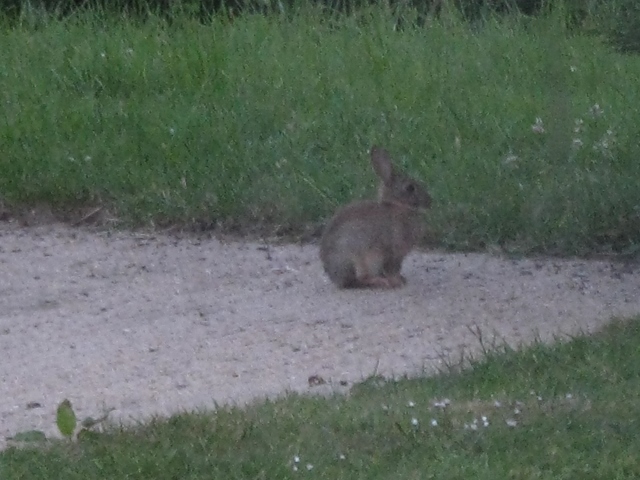
016Young rabbit (640x480)

A young Rabbit (Oryctolagus cuniculus) photographed one evening in June

I veer about in my attitude towards rabbits.  When I see rabbit kittens and young rabbits like this one I am full of love towards them.  How sweet they are!  I once looked out of an upstairs window early one morning and saw a couple of adult rabbits with a tiny rabbit kitten.  The adults were watching the baby and eating grass now and then while the kitten was exploring and skittering about, having fun.  It then ran up to the adults and rolled on its back just in front of them.  One of the adults nuzzled its head against the baby.  It all looked so peaceful.

I don’t feel quite the same about rabbits when I find large holes dug in the flower bed or bark chewed off my favourite trees and shrubs.  I am grateful for the control exerted on our rabbit population by stoats.

While hanging washing out on the line one summer a young rabbit ran past me.  I could tell from the way it ran that it was distressed and wasn’t sure where to go.  It headed for one of our vegetable plots.  I then saw the cause of the rabbit’s fear;  a stoat appeared round the corner of the house and well, skipped past me and made straight for the vegetable patch.  I couldn’t bear to watch any more so I went back indoors.  We haven’t seen any stoats in the garden for a couple of years – but we haven’t had too many rabbits either!

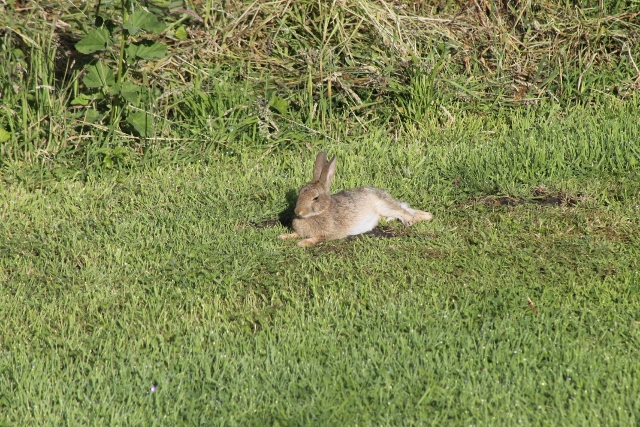
098Sleeping rabbit (640x427)

A sun-bathing, dozing rabbit seen one morning in late June

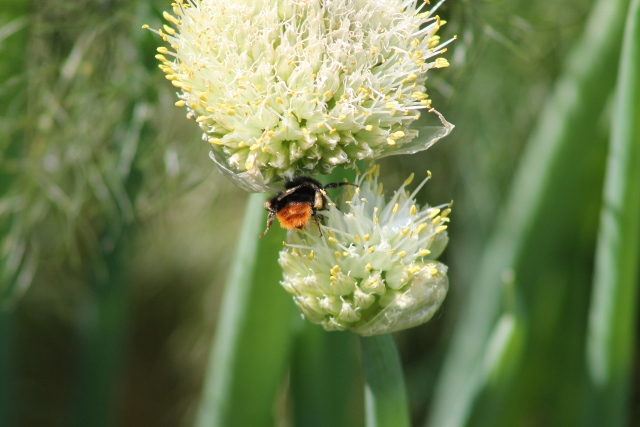
026Tawny Mining Bee on Welsh Onion (640x427)

This is (I think) a Red-tailed Bumble Bee (Bombus lapidarius) on a Welsh Onion flower.

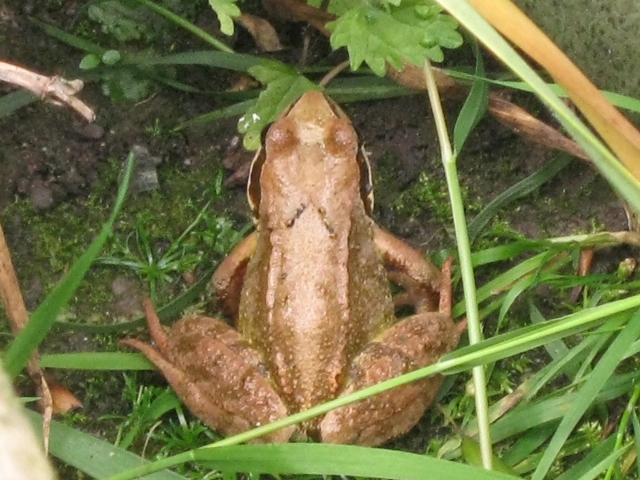
003Common frog (640x480)

A Common Frog (Rana temporaria)

This frog would not turn round so I could only photograph its back.  Common Frogs can be found in shades of yellow, orange, red, green, brown and even blue and usually have dark spots and markings on them.  They also have a dark patch behind the eye.

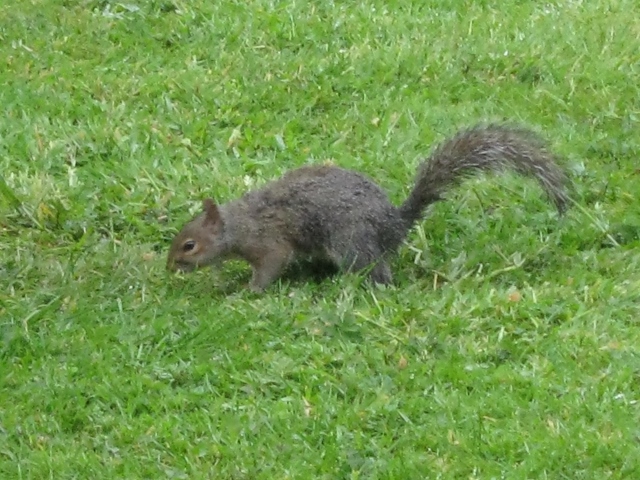
001Grey squirrel (640x480)

A Grey Squirrel (Sciurus carolinensis)  This one is very thin!

Grey Squirrels were introduced into this country in the mid-19th century but didn’t become established here until the beginning of the 20th century after many releases.


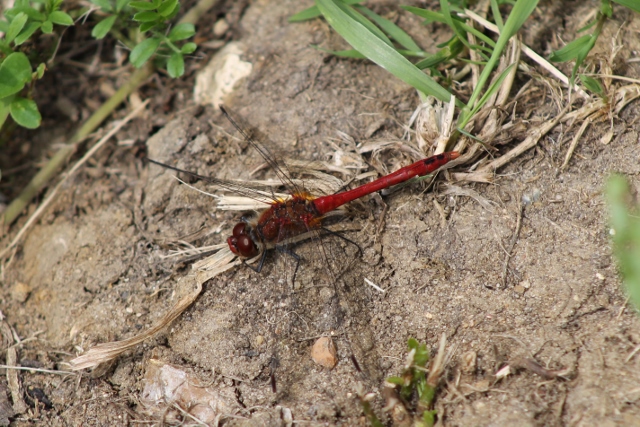
005Ruddy darter (640x427) (2)

Ruddy Darter dragonfly; male ( Sympetrum sanguineum )

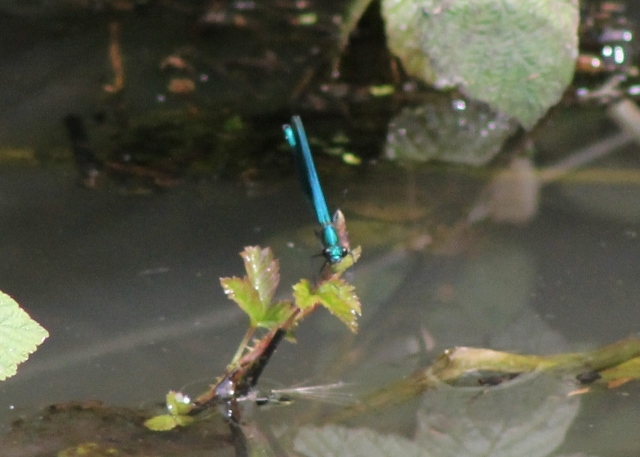
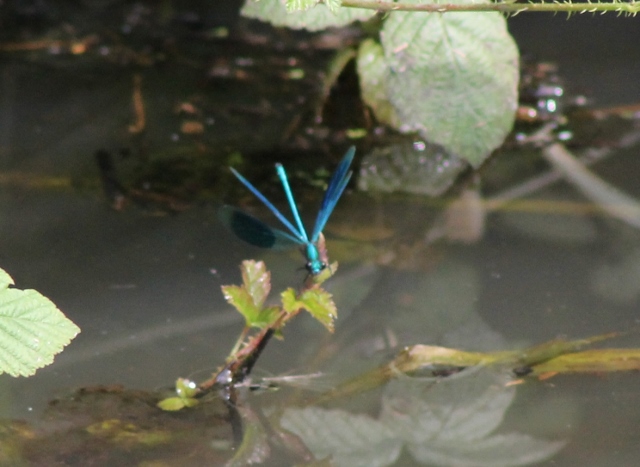
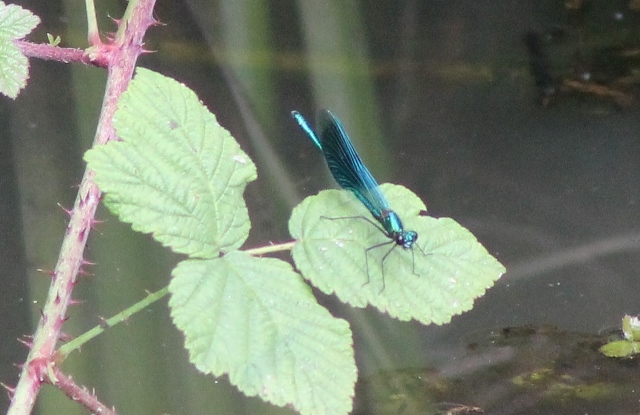
036Banded demoiselle (640x457)

Banded Demoiselle damselfly; male


037Banded demoiselle (640x467)

This is a little out of focus but you can still see the dark iridescent band on this male’s wing

044Banded demoiselle (640x415)

These beautiful damselflies are quite large and flutter their wings more as a butterfly does


039Pond skater (640x477)

Pond Skater ( Gerris lacustris )

They use their short front legs to capture prey that has fallen onto the surface of the water.

That’s it for now.


January’s End

Tags

, , , , , , , ,

The last day of the first month of the year.  There are plenty of signs of spring about.

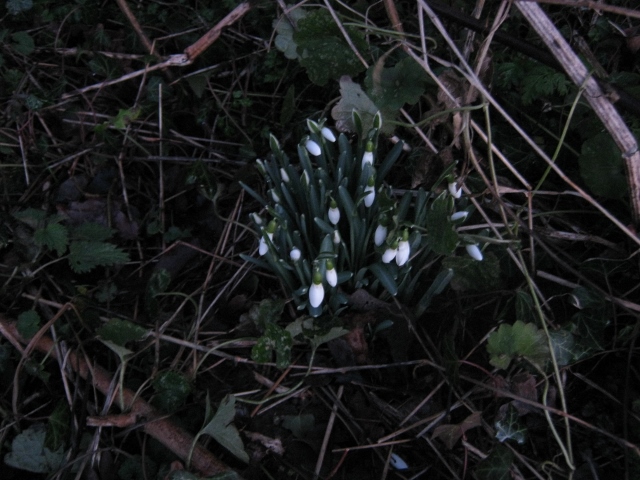
IMG_3925Snowdrops (640x480)

Snowdrops in the garden

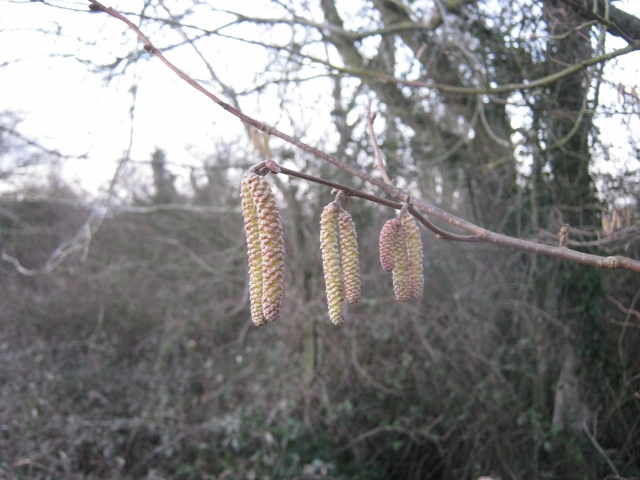
IMG_3922Hazel catkins (640x480)

Hazel catkins


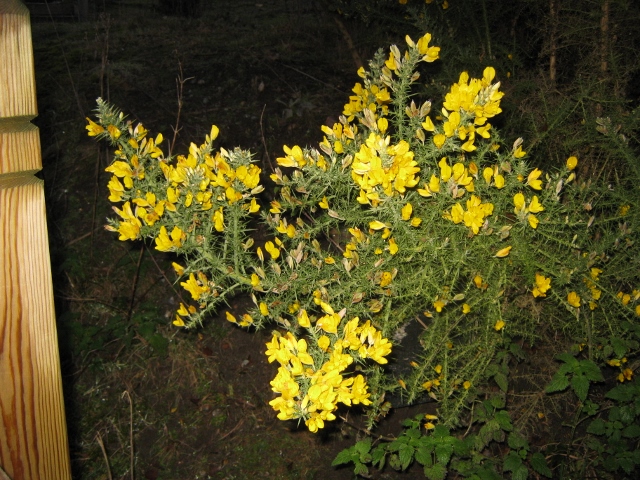
IMG_3868Gorse at Minsmere (640x480)

Gorse at Minsmere. Though gorse is in flower through most of the year!


But there were signs of spring about in the autumn too.

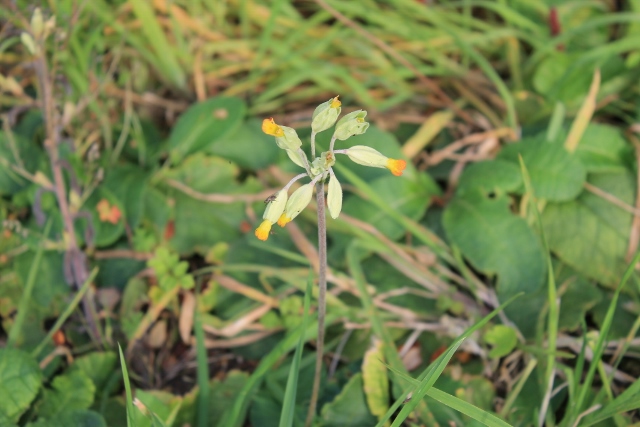
010Cowslip (640x427)

Cowslip in the garden at the end of August.  We had a strange summer!


We have had rain and hail and sleet and even snow this month.  High winds, fog, thunder and lightening and even some sunshine!

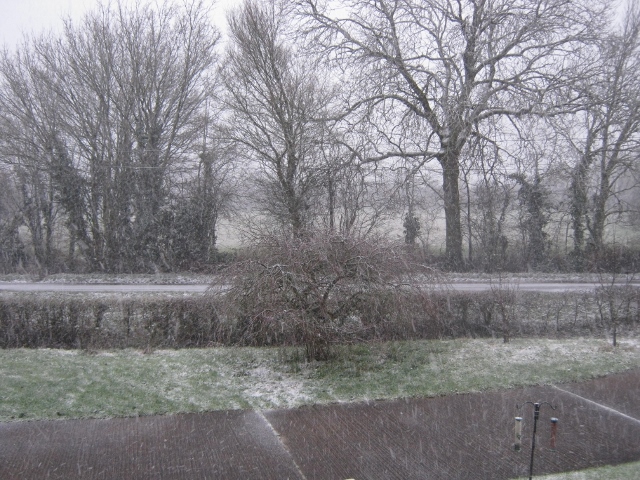
IMG_3917Snowfall (640x480)

Snowfall on Thursday afternoon.

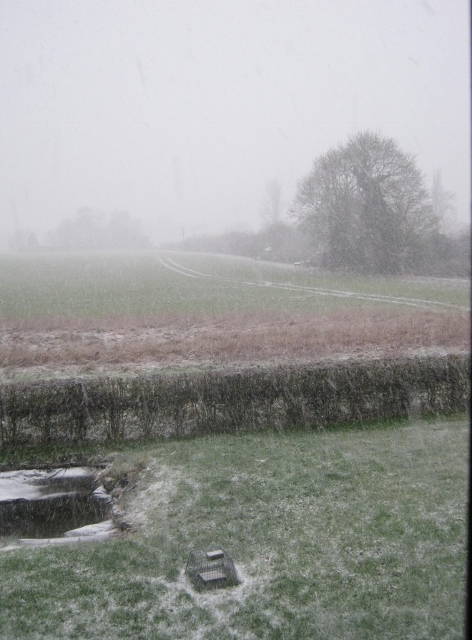
IMG_3919Snowfall (472x640)

It was quite heavy while it lasted!


The snow hasn’t lingered.  By lunchtime on Friday it had all gone again.  Despite the frosts, the ground is still fairly warm; especially the roads and paths.  We had a wet year last year and a very mild autumn and early winter.  The grass continues to grow and grow and we have no opportunity for cutting it.  The garden is very, very untidy.  The best days for gardening are the days we cannot get out there.  Such is life!

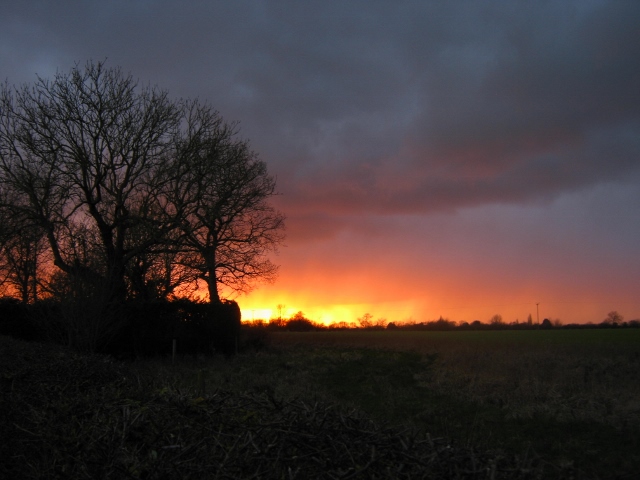
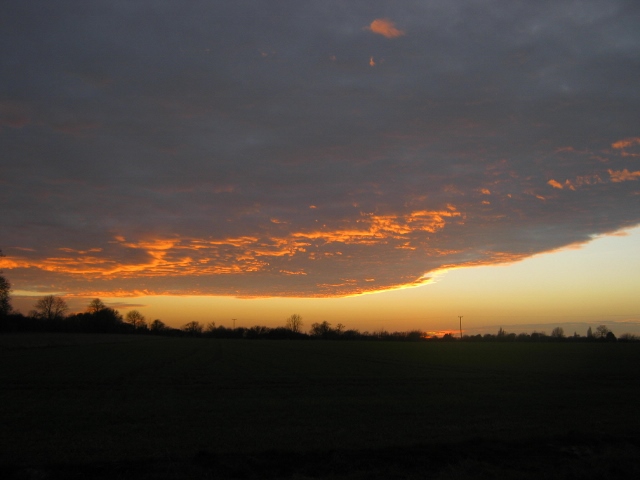
We have had some glorious sunsets.

IMG_3883Sunset (640x480)

A fiery furnace!

IMG_3906Sunset (640x480)

Reflected glory!

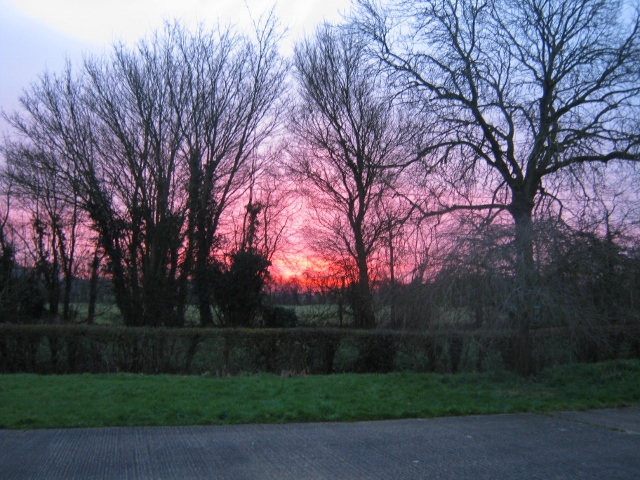
We have had some exceptional sunrises too.

IMG_3914Sunrise (640x480)

I admired the colour scheme here.

When I have been able to get outside there has been plenty to see, though the light has not often been good enough for photography.

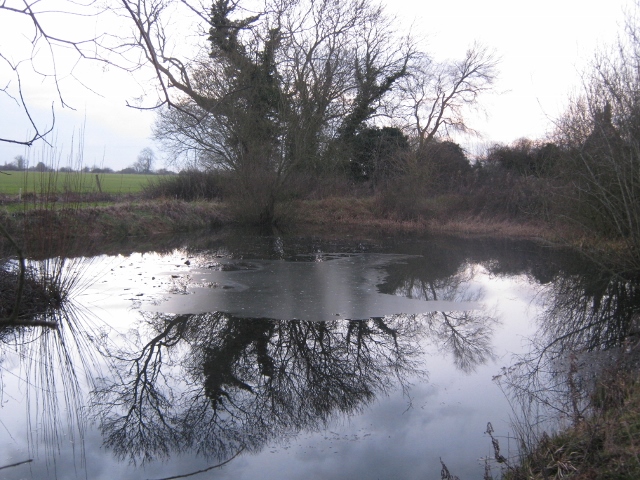
IMG_3921Ice on pond (640x480)

Reflections (and the remnants of the ice) on the big pond

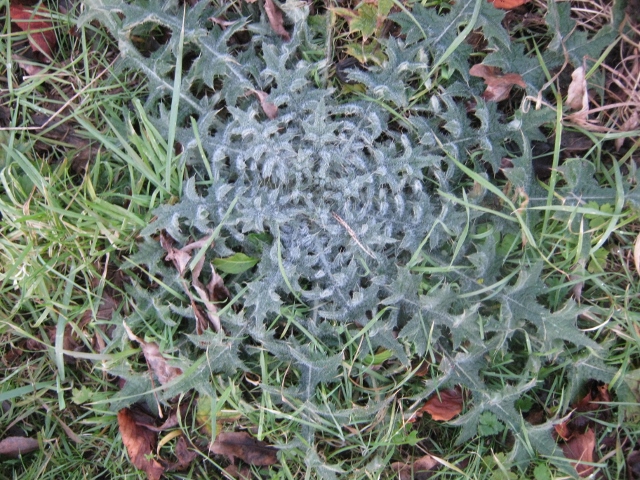
IMG_3923Thistle (640x480)

The whorl of a new thistle.

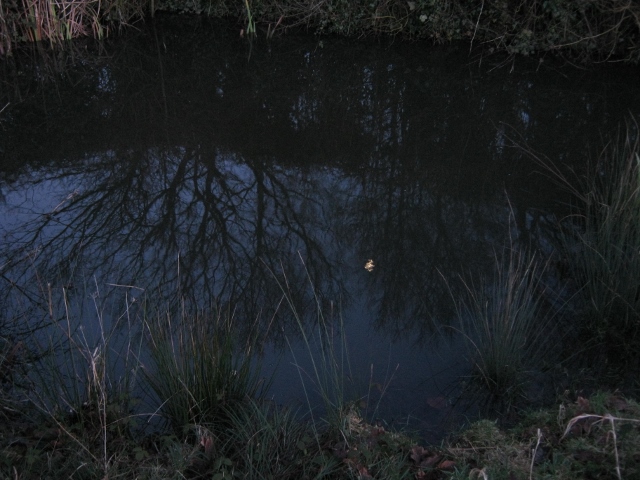
IMG_3929Reflection in pond (640x480)

Reflection of the moon and trees in the corner pond.

I woke to snow fall this morning and we got a dusting that settled everywhere as the frost had been hard last night.  The ponds were all covered in ice and snow.  By the time Elinor came downstairs (at midday!) it had all (except the pond ice) gone.  It is snowing again now as I type this.

Elinor has not had a very good week as she has been very anxious again.  She was unable to go into college on Tuesday and Friday.  She has produced some good art work though.

Richard is in Manchester this weekend visiting his mother in her nursing home and staying with his brother.  He took his brother a gift of a barrel of local Adnam’s beer which last night, so I heard, was being left to settle in my brother-in-law’s cellar.  I doubt whether it will be left to settle long!

I must now go outside quickly to top up the bird-feeders before it gets dark.  The snow has changed to sleet unfortunately.  I dislike sleet very much.


Eighteen

Tags

, , , , , ,

029Me and E in kitchen (557x640)

Elinor had her eighteenth birthday on Wednesday.  She celebrated by going to college, attending her Psychology class and then going into the city with her friends.  They went to McDonald’s and had something to eat.  Elinor would have preferred to have gone somewhere else as she doesn’t like McDonald’s’ food but her friends all do, so she went where they wished to go.  She bought some fries and offered to get her friends’ food for them but they declined her offer and bought her an enormous badge with ’18’ on it and insisted that she wear it.  They gave her their gifts and then they all went to their favourite bookshop and browsed.  They also visited a department store and the boys found the toy department and fooled around with the toy swords and guns.  I collected her from college at 2.00 pm and we went home.  She opened her presents from us and had a few cards from relatives in the post.  My mother had baked her a chocolate cake.  My brother came to stay for the night as he had a meeting to go to in the area early next morning.  We all ate cottage pie for our evening meal as it is Elinor’s favourite.  She was so tired she fell asleep during the evening.

112Elinor on path (640x427)

This may sound a rather tame way to celebrate an eighteenth birthday but for the past few years her birthday has been spent at home with just her parents and her sister for company.  Until she started at college last September, she had had no contact with people of her own age for a long time because of her chronic anxiety.  She was a very lonely and depressed young woman.

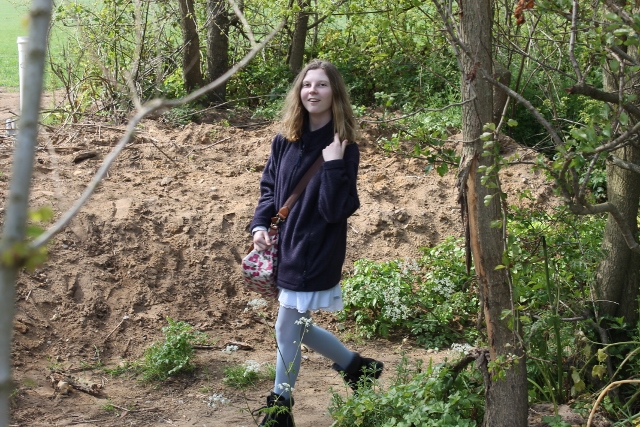
038R and E in bluebell wood (640x480)

Her first term at college was a very difficult one; as you know if you have been reading this blog.  However, by Christmas she had fought very hard to over-come her fears and had attended every day for six weeks and had caught up with most of her work.  This term has been very successful so far.  Apart from a couple of days absence because of a bad cold she has been into college every day and has started to attend her Maths classes again.  She has taken a test in Psychology and got 85% and completed a paper in Maths and got 79%.  Her English is good and continues to improve and she is working very hard at her Art.  Her Art teacher is very impressed indeed and believes she has a good chance of doing very well in her exams.  She hopes to go on to do a Graphic Art course at the college.  She is beginning to get some self-confidence and is enjoying quite a lot of her college work.  She likes the feeling she gets when she does well in class.  She is also learning how to control her anxiety and is starting to ask for help at college when she feels anxious.

054E at Billingford windmill (640x457)

Richard and I are feeling more relaxed about her than we have in years.

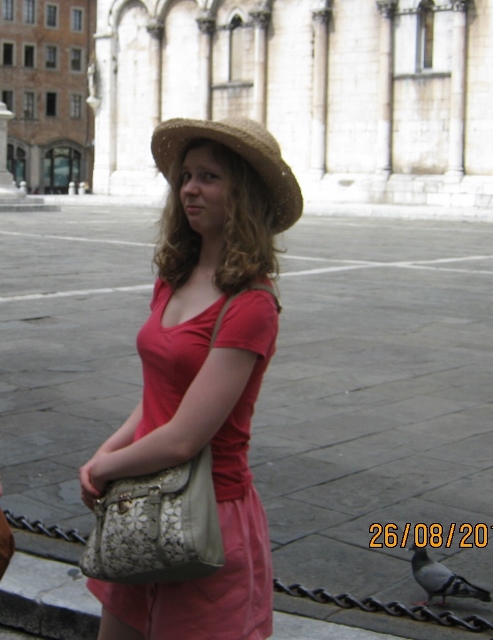
042C & E at Lucca (493x640)

It is hard for parents to realise that their own (probably selfish) hopes for their children may not be realistic hopes.  We know that Elinor is very intelligent and capable and we dreamt of her taking many exams, doing well and going off to university like her sister, her cousins, her old school friends.  If she hadn’t become so anxious she could have done these things.  We have had to put up with comments from other parents who accuse us of spoiling our daughter – giving in to her and letting her stay at home.  These other parents implied that had Elinor been theirs she wouldn’t have got away with it.  She would have been forced to go to school.  I have no idea whether their method would have worked.  We did try at first to ‘make her’ go to school but when your child is so terrified she vomits at the thought of school, and panics and then starts to shut themselves away from all contact with others, it becomes impossible to continue.  We have seen so many therapists and they have all said that the worst we could do is to try to force her to do anything.  We were left feeling helpless, impotent and guilty.  We were avoided by almost all the people we used to know through the school.  We fought and fought to get her the best help and to find some way for her to continue with her education.  Once she left school eighteen months ago everything became easier.  Elinor started to relax for one thing and then she completed a course of Cognitive Behavioural Therapy.   A year ago we were contacted by the Education Department who asked if we would like some help.  YES!
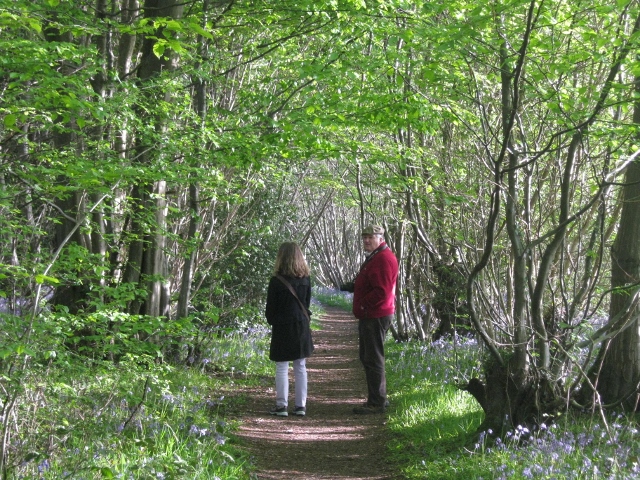
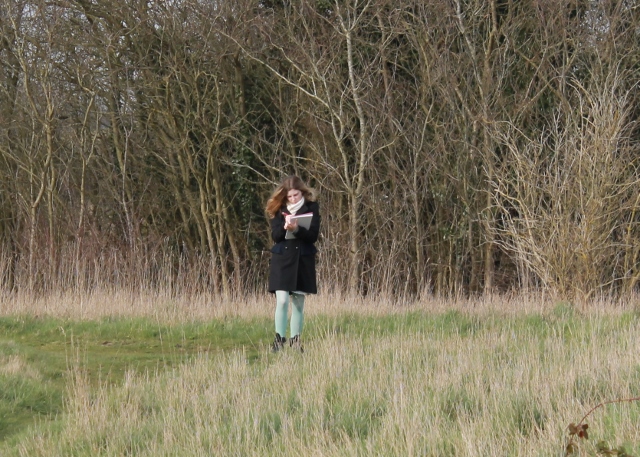
018Elinor (640x427)


The key to being a happy parent is to rejoice in the wonder of being a parent.  This child that you have created is a unique and wonderful creature, loved by God.  It doesn’t matter whether they pass exams or not, are intelligent or not, are healthy or not – except you would rather they were healthy for their sakes.  You love them.  A parent has a duty to make sure that their child grows up knowing they are loved for who and what they are and not for what they can do.  There are always opportunities these days to take exams, get qualifications, go to college at any time and at any age.  We do not have to fit in with everyone else.  Of course, a parent must teach their children the difference between right and wrong, respect for others and that life isn’t easy most of the time.  But – the important thing is to help your child to grow and blossom and become the person they were intended to be and what they want to be.  This isn’t spoiling them, this is the opposite of spoiling.

Plough Sunday

Tags

, , ,

009The crib (640x480)

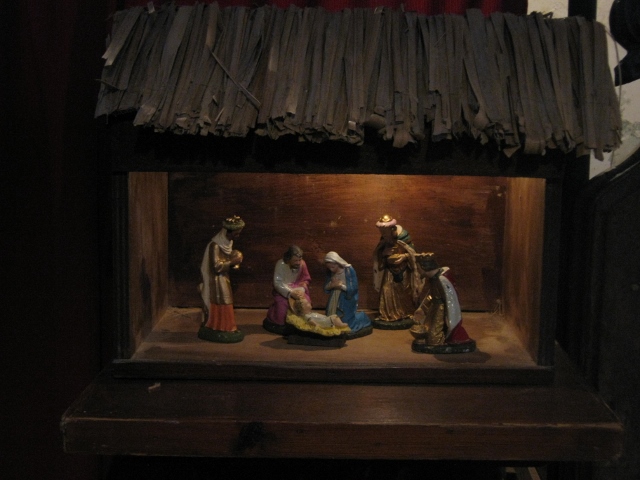
The Crib in Rumburgh Church.  As we are still celebrating Epiphany the Crib shows the Three Kings or Wise Men visiting the Holy Family.


I seem to have spent most of the day in church today.  I woke this morning to clear skies and when the sun rose everything looked beautiful and sparkling.  There was still a strong wind blowing which made it feel much colder outside than it really was.

I had promised my mother that I’d take her to her church this morning, as the services at our church were both in the afternoon.  I left home at just after 9.45 am, picked Mum up at 10.10 and got to Eye just after 10.30.  There were a couple of places near the church where I could park which is the advantage of arriving a little early.  The service went well but is always much longer than our one and by the time we left the skies were beginning to cloud over.  I dropped Mum back at her house at about 12.30 and then went home for something to eat.

Richard and I went to the Plough Service at our church this afternoon.  We set out in plenty of time for the 3.00 pm start but we discovered the road was blocked by a fallen tree.  It wasn’t a large tree and most of it was dead but it was very heavy and Richard and I really struggled to get it to the side of the road.  By the time we had got it half way to the side a few other cars had arrived and first a woman in the car behind us and then a man from a car two behind her and then a young man who had driven up from the opposite direction all got out to help clear the road.  Richard, the woman and I had managed to get it almost to the side of the road by dragging it one way but the young man said he would be able to get it further off the road by taking it a different way.  He was very strong and put the tree over his shoulder and with the other men’s help he got it right off the road.

001Plough Sunday service sheet

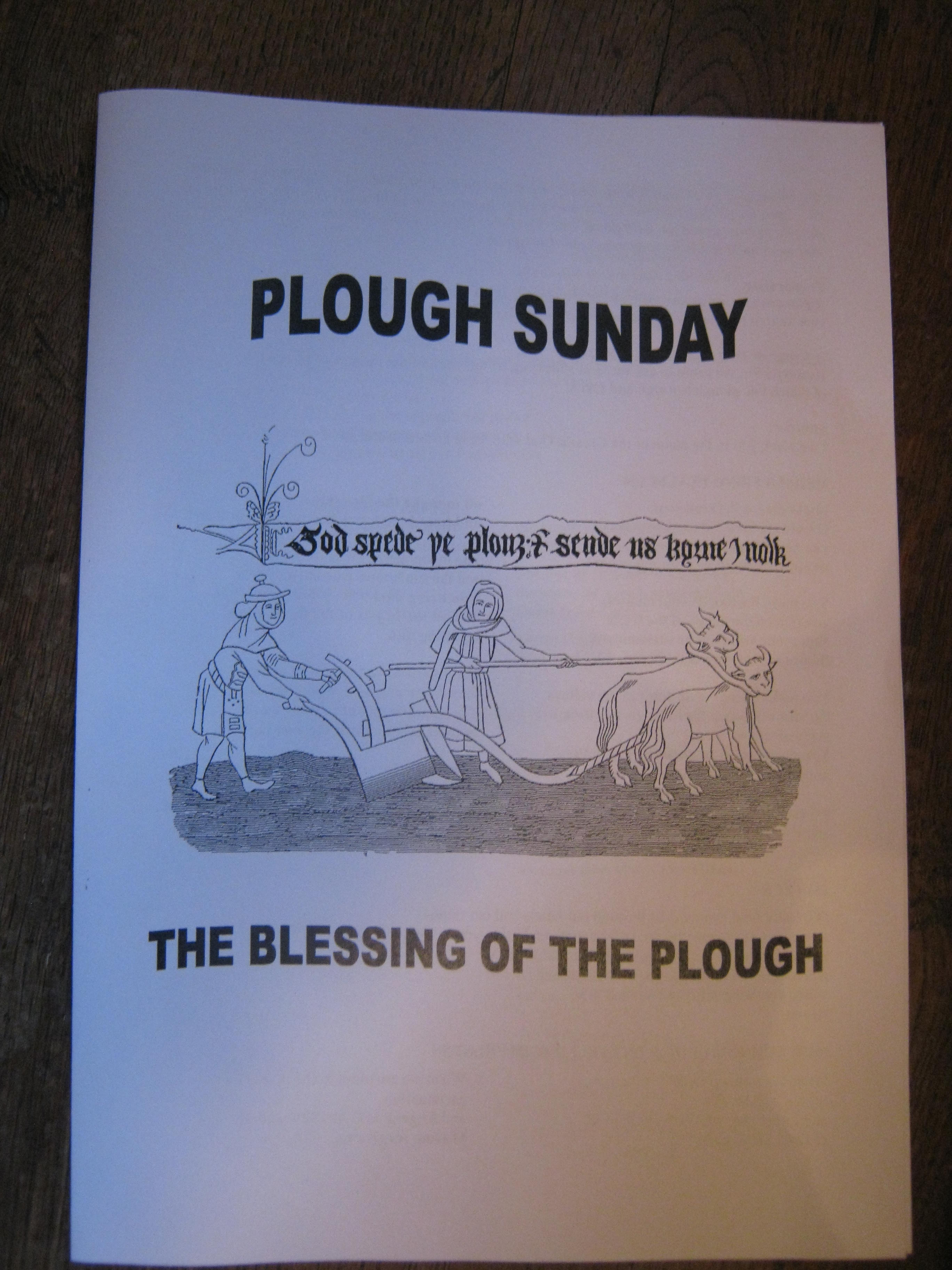
The cover of the Plough Sunday service sheet

To quote from the service sheet –

‘The Blessing of the Plough is traditionally celebrated on the first Sunday after Epiphany, January 6th.  Often the plough was feted and drawn through the streets to be blessed in church.  This was thought to ensure food for the coming year.  The following day, Plough Monday, was the first day that work in the fields recommenced after Christmas’.

008The plough (640x480)

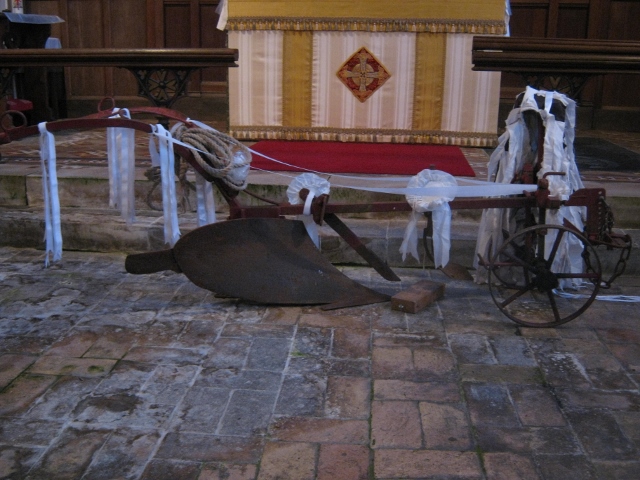
The decorated plough in our church

A local family bring their plough into the church and decorate it with ribbons and rosettes.

A farmer or his representative says:

‘Reverend Sir, we come to ask for God’s blessing on the work of the farmers of our country, of which this plough is a sign and token’.

To which the Minister replies:

‘I welcome you in the name of the Creator God who made this earth and all life upon it’.

042View across fields (640x480)

The short service that follows includes verses from Psalm 104 which is a lovely song of praise for all creation and is worth a read for the wonderful phrases like ‘…..You cause grass to grow for the cattle,/ and plants for man to cultivate,/ to bring forth food from the earth,/ and wine to gladden the human heart.’

‘…..You bring darkness, it becomes night,/ and all the beasts of the forest come creeping out.’

031View across fields (640x480)

In the service we acknowledge our forgetfulness and our gratitude for God’s Gifts.  The blessing of the plough follows and then ‘God Speed the Plough’ – some verses about ploughing.

‘God Speed the Plough,/ the plough and the ploughman,/ the farm and the farmer,/ God Speed the Plough.

God Speed the Plough,/ the beam and the mouldboard,/ the slade and the sidecap,/ the share and the coulters,/ God Speed the Plough.

God Speed the Plough,/ on hillside and in valley,/ on land which is rich and on land that is poor,/ in countries beyond the seas,/ and in our homeland,/ God Speed the Plough.

God Speed the Plough,/ in fair weather and foul,/ in rain and wind, in frost and sunshine,/God Speed the Plough.


We are then blessed and we sing the harvest hymn ‘ We Plough the Fields and Scatter the Good Seed on the Land’.  Even though there were only eight of us in the church we all sang heartily and made a joyful noise.  And the service was over.

049View across fields (640x480)

The Rector, Richard and I tidied up and blew out the candles and then had a pleasant chat together for a while until it was time for the Rector to leave for home.  He is still suffering from a bad cold and has to visit hospital very soon to be assessed for heart surgery.  He will have some fairly unpleasant procedures to go through and we wish him very well.

Richard and I had put the heater on in the Ringing Chamber (where the bell-ringers ring) and after Richard had done some maintenance in the church and tidied up the candles we sat and read and talked and Richard drank some coffee he had brought with him in a flask and waited for the next service to start at 4.30 pm.

Maurice our Elder arrived to take Evening Prayers and three other people joined us for the service.  Maurice always prepares his services so well; it is a pity more people don’t come to hear him. 

An Appointment with the Dentist

Tags

, , , , ,

Before I begin this post I must apologise for the confusion about my last two posts, both of which I published on Friday.  I have started looking back over my photos from last year and because I am not taking many pictures at present I thought I would write posts about last summer and autumn and use old photographs.  In looking back over past posts I realised that I had started writing up my summer holiday but hadn’t finished, so I wrote two catch-up posts on Friday.  I continued to use the series title I had started using last summer, but this meant the titles were virtually the same so some of you have read one post and some of you have read the other and very few of you have read both, probably thinking that I had posted the same one twice.  I am also having trouble posting onto Facebook.  Some of my posts get there and some don’t – heaven knows why.

DSC_0408

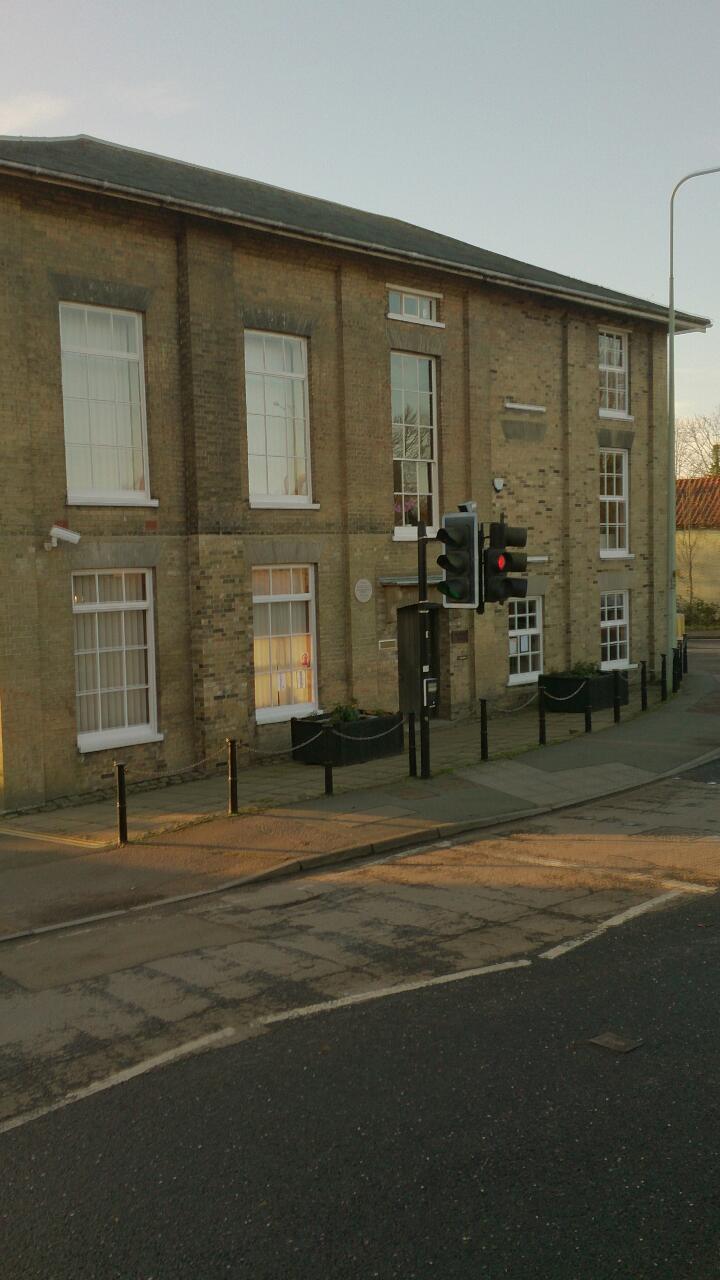
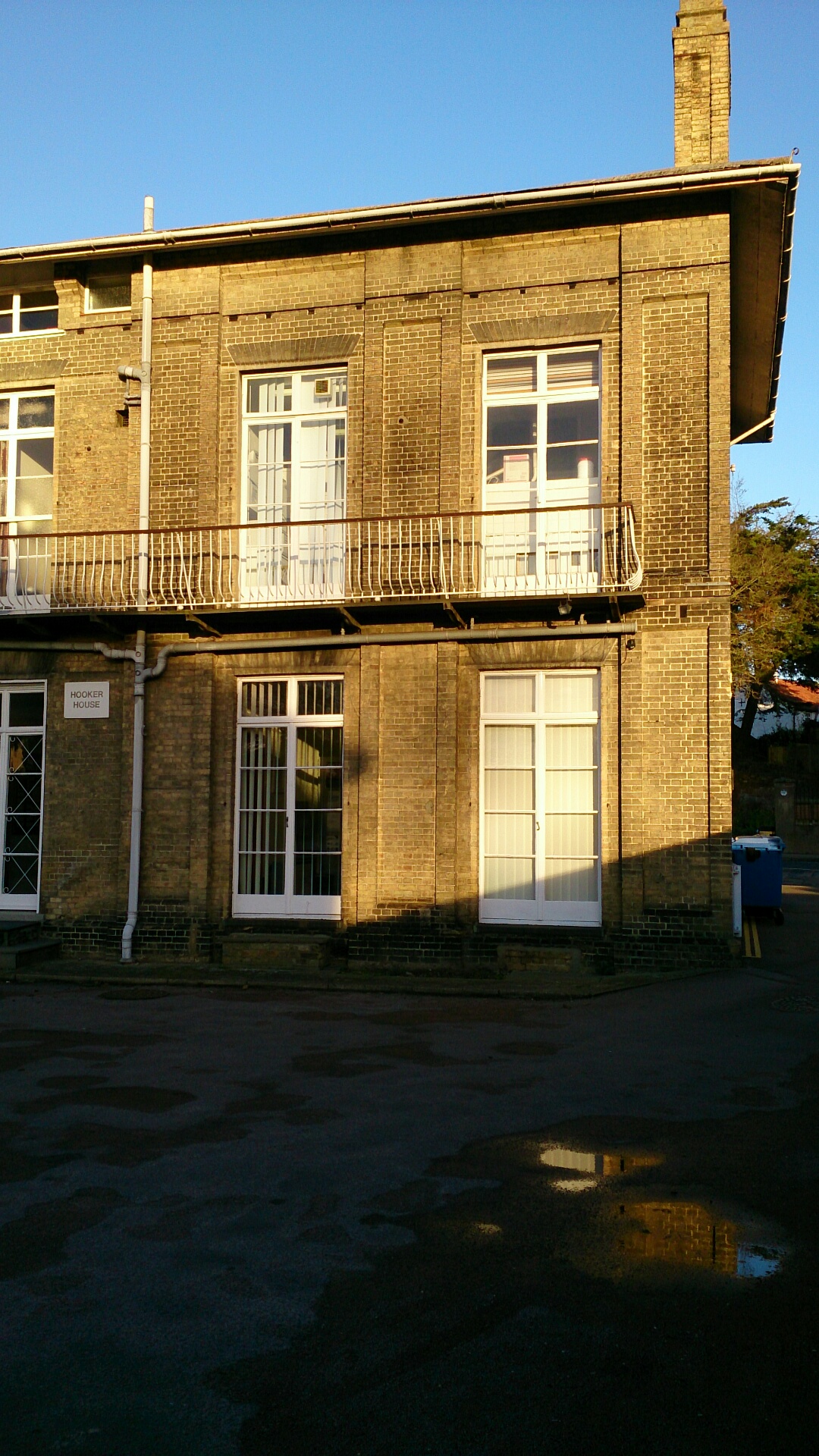
Hooker House – situated right next to a busy roundabout in the middle of Halesworth.

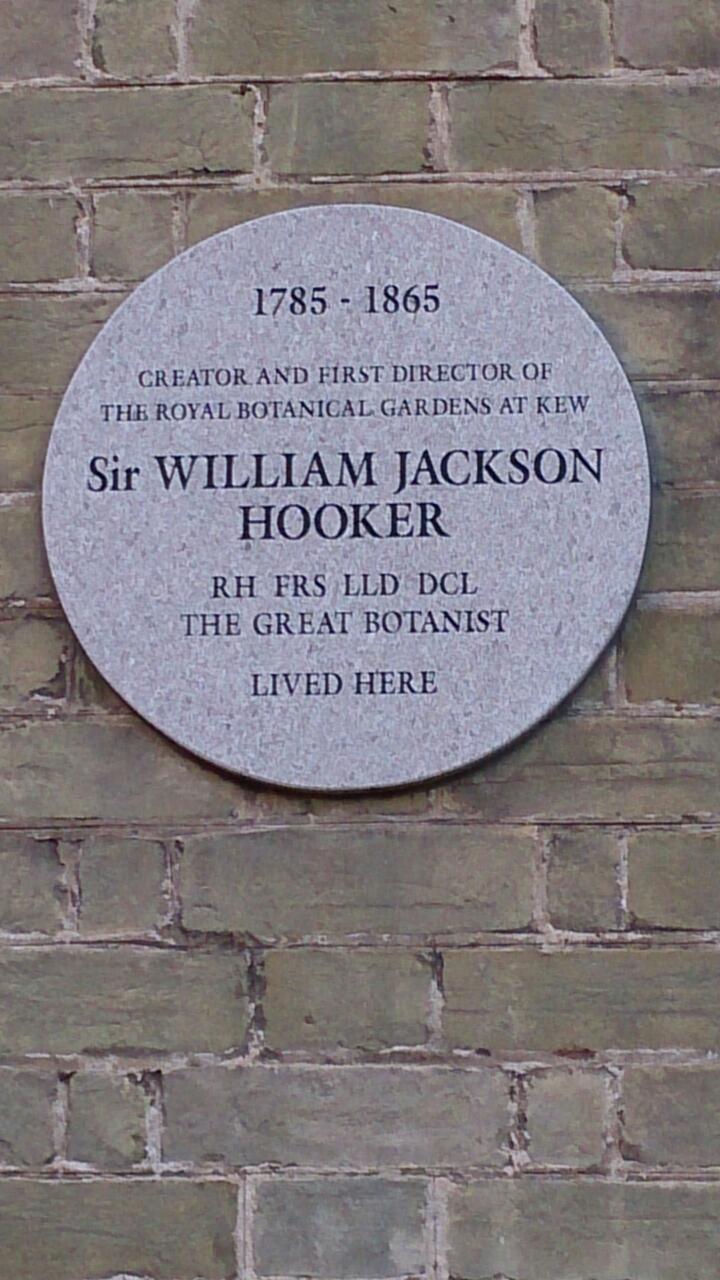
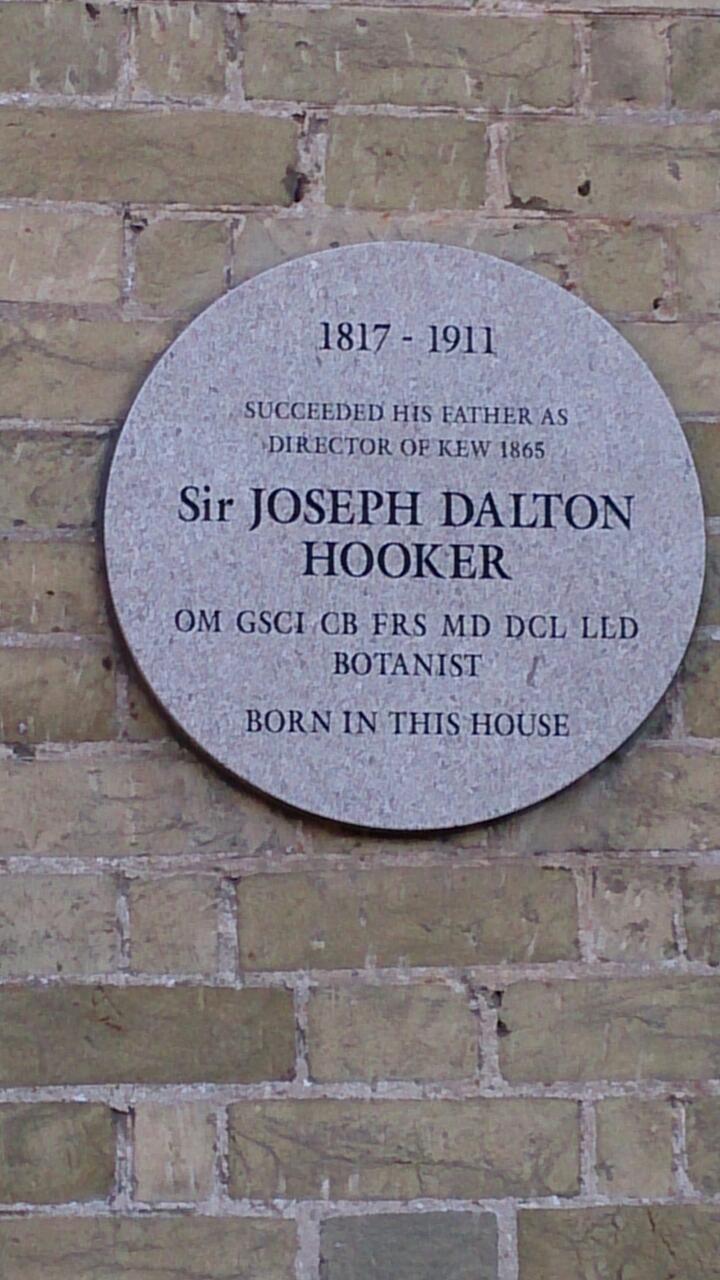
Richard had a dental appointment on 2nd January.  His dentist’s surgery is in Halesworth in Hooker House.   Many people will think this a strange name for a house until you find out that it was named after two famous men who lived there.   Sir William Jackson Hooker moved into the house in about 1809/1810 after his marriage and lived there for eleven years.  His second son, Sir Joseph Dalton Hooker was born there but moved with his family to Glasgow when he was four years old.

DSC_0415

The rear of Hooker House


William Jackson Hooker was born in Norwich on 6th July 1785 and went to Norwich School.  He was encouraged in his interest in botany by James Smith, a Norwich doctor who also founded the Linnaean Society.  He inherited in trust the Jackson estate in Kent when he was eleven years old.  William studied estate management and then became a partner in Halesworth Brewery.  He took a quarter share for £8000 and moved into Brewery House (as Hooker House was then called) so that he could be near to his work.  The house had a large garden and a heated greenhouse in which William grew exotic orchids.  He also devoted himself to the formation of his herbarium – his collection of dried plants.

DSC_0411

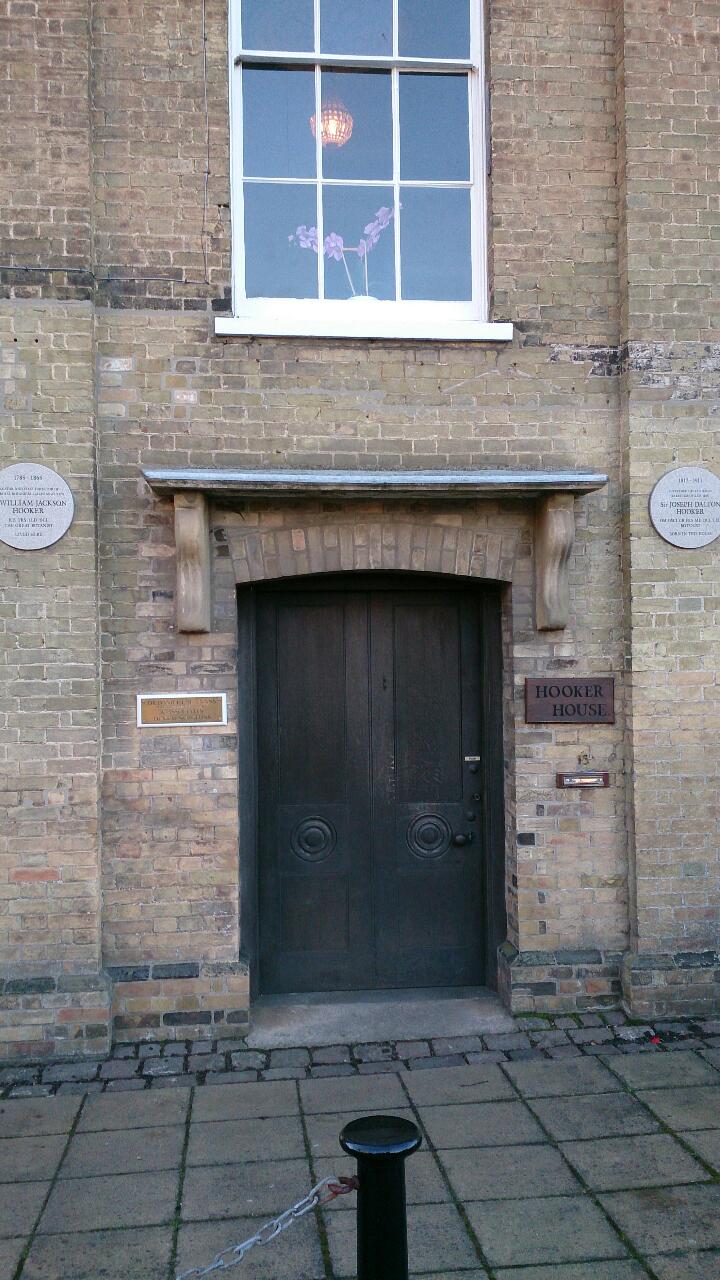
The front door


In fact the house then was about twice the size it is now and the gardens stretched down to the river.  Probably the town park is all that remains of the magnificent garden.   He was appointed Professor of Botany at the University of Glasgow in 1820 where his career really developed.  He retained his partnership in Halesworth Brewery but sold the house to Patrick Stead, a maltster from Halesworth whose maltings were the largest in the country.

DSC_0413

Sign on the wall of Hooker House. I’m sure you’ll understand why I didn’t call it a ‘plaque’

William was dubbed a Knight of Hanover in 1836 and then in 1841 he was made the first Director of Kew Gardens.  He held this post until his death in 1865, enlarging and transforming the grounds into one of the world’s leading botanical gardens.  He built the Temperate and Palm Houses.

DSC_0412

Sign commemorating Sir Joseph Hooker

Sir Joseph’s education was more specialised than his father’s.  Joseph travelled and worked as a surgeon and botanist on a voyage from Antarctica to the Himalayas.  He sent home the first Rhododendron and Sarcococca Hookeriana (Sweet Christmas Box) was named after him.  He was a great friend of Charles Darwin and encouraged and supported Darwin when he wrote ‘The Origin of Species’.  Joseph’s work on the distribution of plants seems to be in support of Darwin’s theories.  By the time his father died Sir Joseph Hooker was already Deputy Director of Kew Gardens and so succeeded him as Director.

DSC_0403

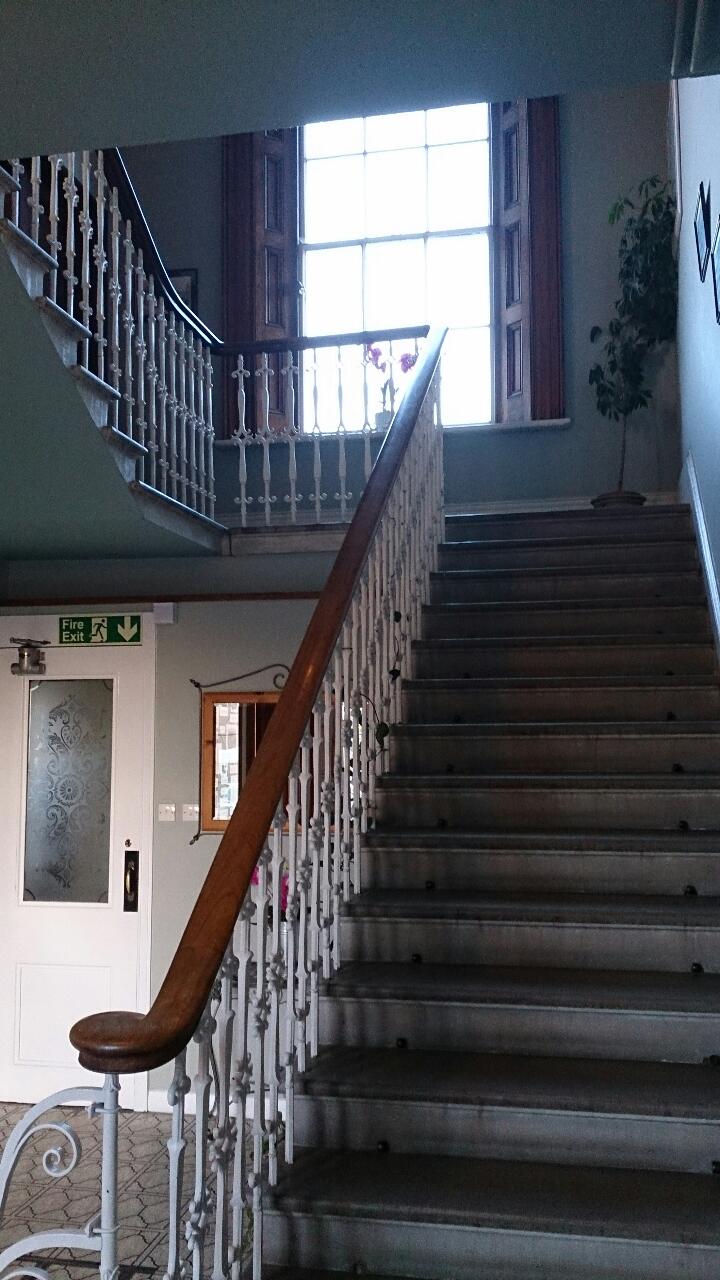
Staircase inside the house.

When I first moved to Halesworth in 1988 when Alice was three years old and I was newly divorced form my first husband I used this dentist.  I was very pleased to find that such eminent men had lived there and the unpleasant duty of going to the dentist was made more palatable by being able to look round the house.  There are information displays on the walls in the hall.

Richard and I met and we found we attended the same dentist.  As Alice got older she became unhappy with the dentist at Hooker House as he wasn’t very good at putting children at ease.  I took her to a different dentist in the town but continued going to Hooker House myself and started taking Elinor as soon as her teeth came through.  We both eventually left the dentist after an ‘incident’.  When Elinor was about two years old she started to become very nervous about going to see doctors and dentists.  During an examination Elinor became quite distressed and kicked the dentist!  He was very good about it considering the discomfort he was in but I just couldn’t go back again!

Richard took these photographs on his phone.


Peak District Holiday 1st to 9th July. Day 6.

Tags

, , , ,

048View (640x427)

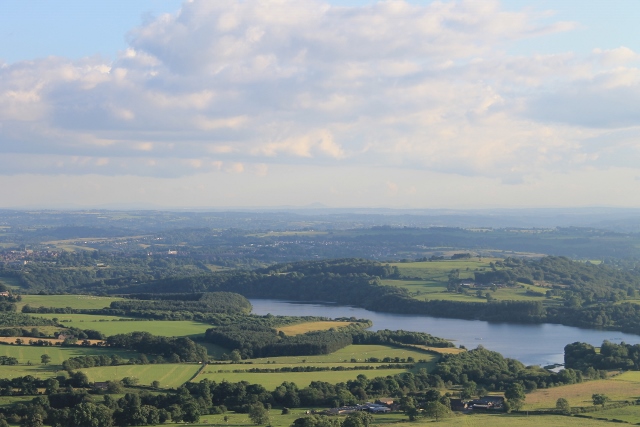
Tittesworth Reservoir  

After a very pleasant afternoon spent in Manchester with my mother-in-law, Richard and I returned to our caravan near Leek via the ‘Cat and Fiddle’ pass.  This is a road that crosses the Peaks from Macclesfield to Buxton with the Cat and Fiddle pub at the summit at an altitude of 1690 feet.  This has often been voted Britain’s most dangerous road as it has drystone walls along it and has many sharp and sometimes blind bends.  It is a favourite road with motorcyclists.  Richard drove carefully and we enjoyed glorious views across the Cheshire plains and over the moors.  No photographs I’m afraid.

We had a quick meal and after a short rain shower passed over us we decided to go out for an evening walk.  Our favourite short walk is up Hen Cloud and this is what we decided to do that evening.

002View from road HC (640x480)

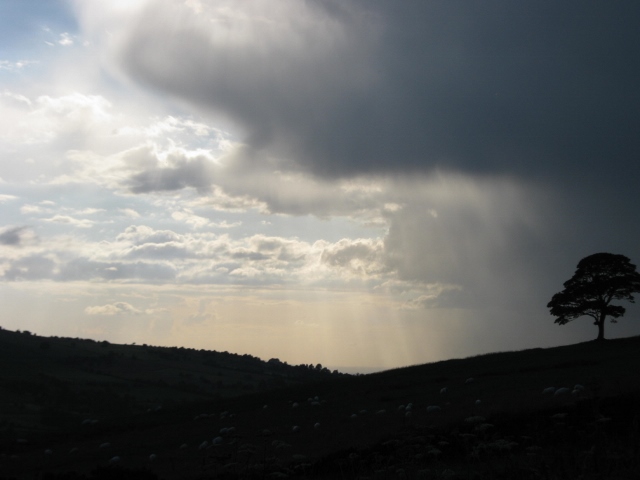
The shower disappearing over the hill

The hill is a short drive from our camp-site – we can get there in less than ten minutes.

004HenCloud (640x480)

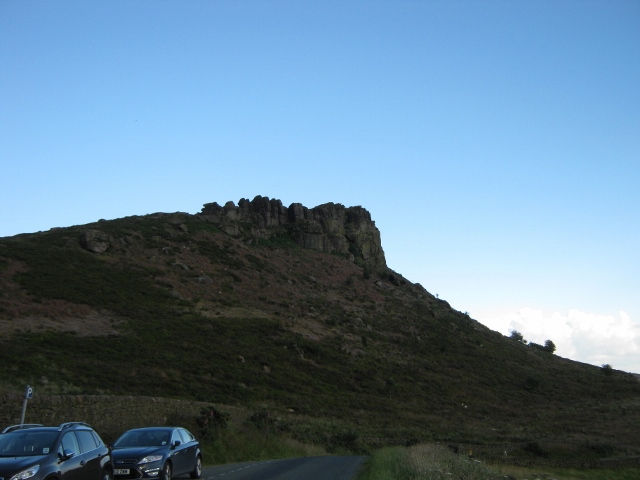
This is Hen Cloud seen from where we parked our car.

006Ascent (640x480)

The most strenuous part of the walk is the steep ascent up the side of a field from the road which always leaves us a little breathless.

007The Roaches (640x480)

At the top of the field is a gate on the right leading to the path up Hen Cloud.  If we look left we see The Roaches.  The word ‘Roaches’ derives from the French word roches – rocks.

013View (640x480)

This is what The Roaches look like when we have ascended Hen Cloud a little.

014Tittesworth Res (480x640)

A view of Tittesworth Reservoir (or Tittesworth Water as it is now called) from near the top of Hen Cloud

016Path (640x480)

As you can see the path is fairly easy and goes through heather and cotton grass.

020Tittesworth Res (640x480)

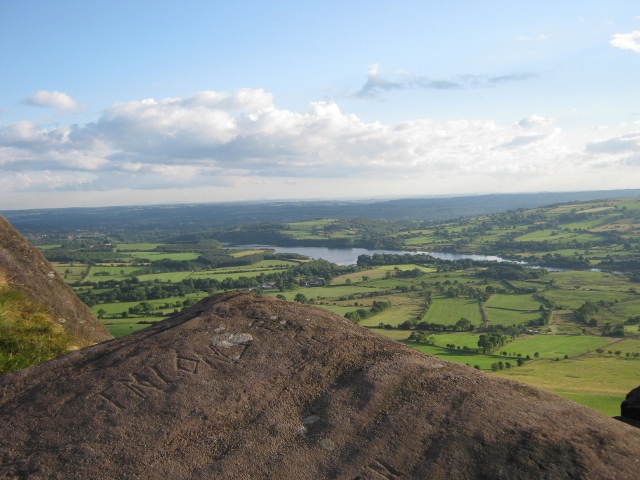
Tittesworth Water from the top of Hen Cloud. Why do some people feel it necessary to cut their names and messages into rocks and trees?

021Drop to road (640x480)

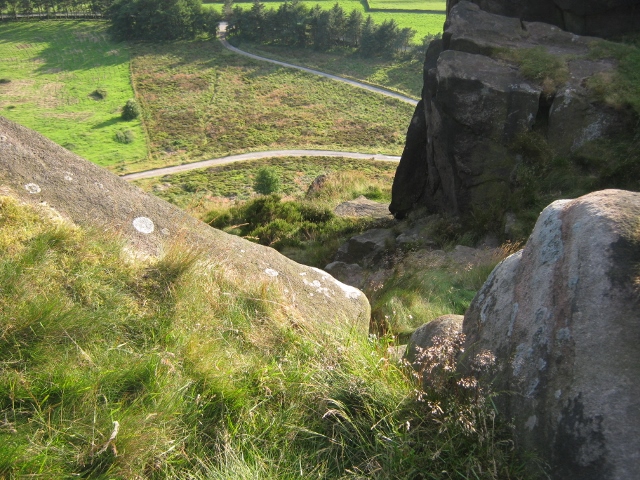
Looking through a gap in the rock we see the steep drop to the road below.

033Roaches (640x427)

Another view of the Roaches. It has only taken us half an hour to get up here and we are old and infirm – well – nearly!

035View (640x427)

A different view from the top of Hen Cloud

037View (640x427)

And another!

045View (640x427)

Tittesworth Water again

046View (640x427)

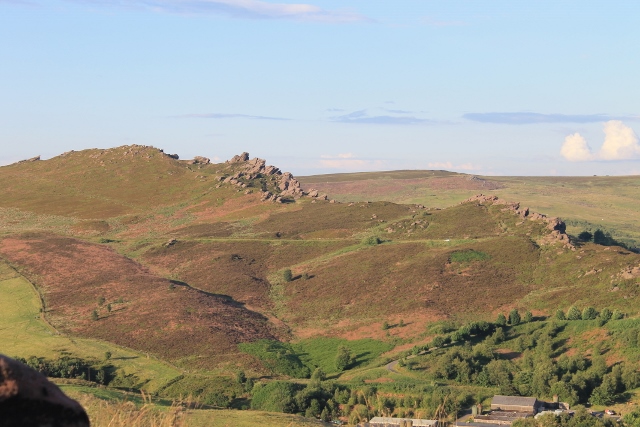
These rocks are on the edge of the escarpment

047View camp (640x427)

On the other side of the line of trees below us was a camp full of teenage girls. You wouldn’t believe the noise of incessant chatter that floated up to us on the still evening air! Or perhaps you would, if you have anything to do with teenage girls!

052Rocks (640x427)

A close-up of one of the rocks. This, I believe, is Gritstone which erodes easily. It is a coarse type of Sandstone.

055Plants (640x427)

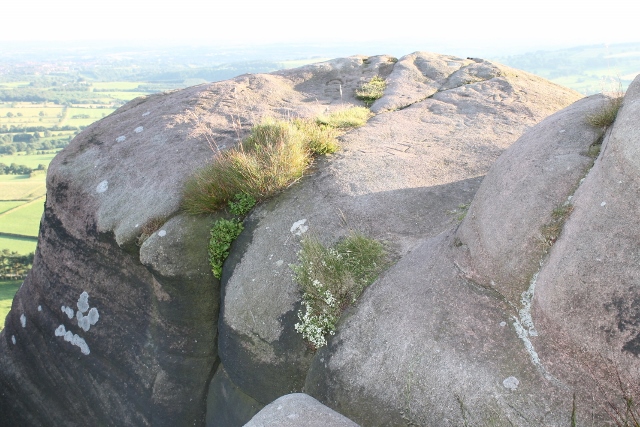
Grasses and flowers living in the cracks in the rocks.  A few lichens there too.

056Rocks (640x427)

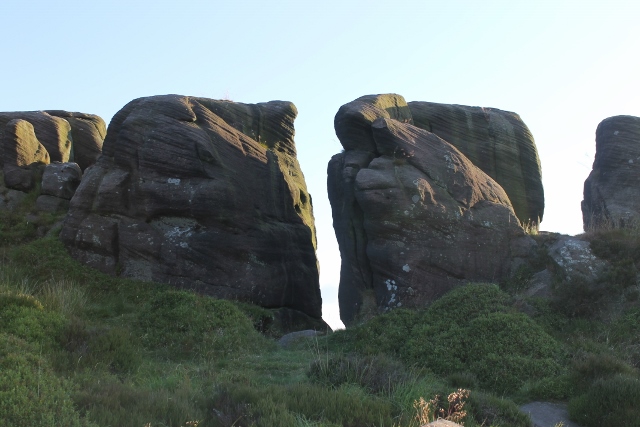
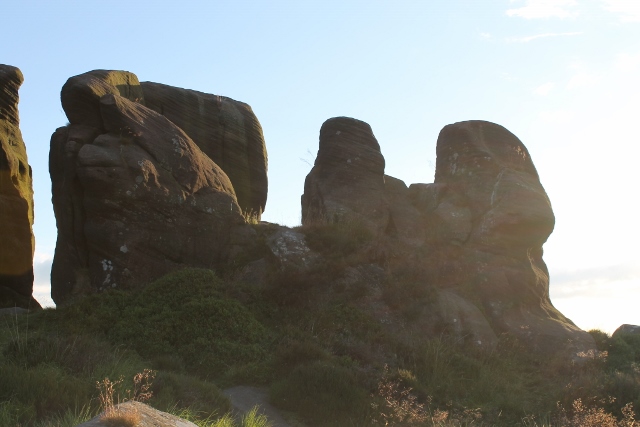
Strange rock shapes

057Rocks (640x427)

And more strange rocks.

We are always a little sad to leave the top of Hen Cloud.


Peak District Holiday 1st to 9th July. Day 5 Part 2 and Day 6.

Tags

, , , , , ,

During our day in Leek (mentioned in a former post), we also re-visited two favourite places.

This post is written with some help from the information booklets I obtained from All Saint’s Church, Leek and Brindley’s Mill, Leek.

ALL SAINTS CHURCH

093AAll Saint's church (640x427)

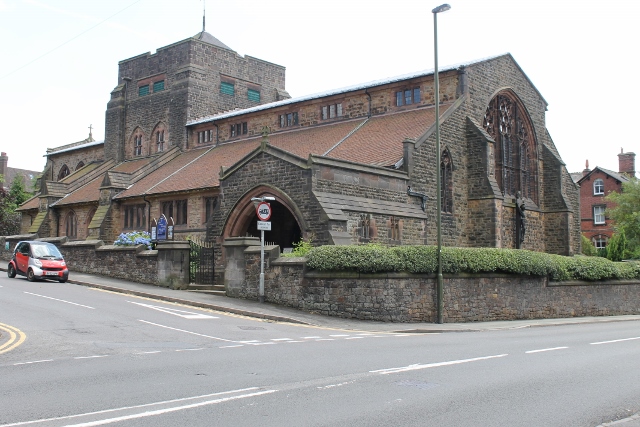
All Saints Church, Leek is built of dark gritstone and some pink sandstone.

This church was designed by Richard Norman Shaw (1831-1912) and is considered the finest of all the sixteen he worked on.  He mainly designed great houses and public buildings – 200 are attributed to him – including ‘Cragside’ in Northumberland and New Scotland Yard in London, the former headquarters of the Metropolitan Police.  He followed A W N Pugin’s methods and principles which included honesty in the use of materials and the use of local building stone wherever possible.  He also worked for some years as assistant to George Edmund Street and many of Street’s principles can be seen in Shaw’s churches – very low chancel screens without superstructure and the altar visible from all parts of the building.

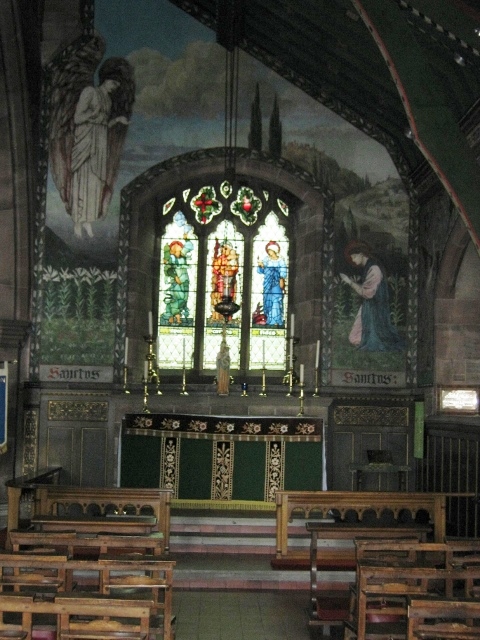
095Altar (640x427)

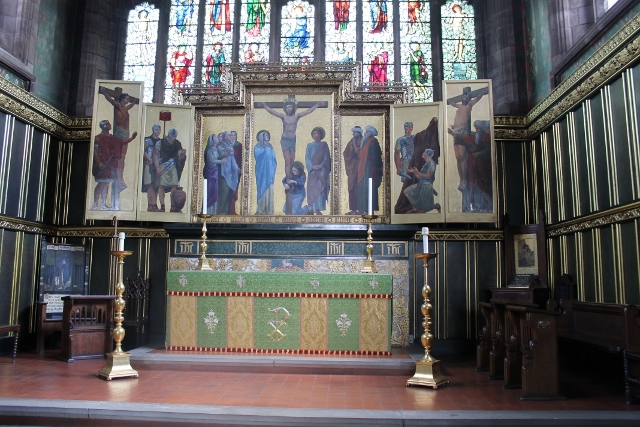
The High Altar. The beautiful painted Reredos shows Christ’s Crucifixion and the Great East Window behind, designed by the artist Edward Burne-Jones, is a ‘Jesse’ window and shows the ancestry of Christ.

This was the third time we had visited this church and each time we have been there we have been welcomed and shown wonderful hospitality by the parishioners who open their church to visitors twice a week, provide coffee, tea and biscuits and lots of information and chat.

The stained glass windows are sumptuously coloured.

022West window (640x470)

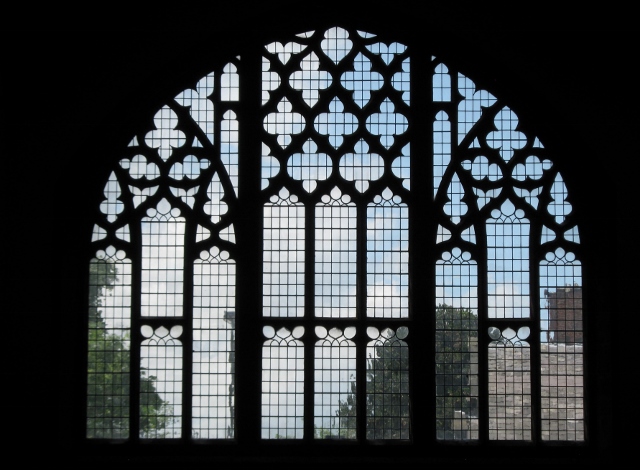
The West Window has no stained glass and shows the beautiful tracery to good effect

018Pulpit (480x640)

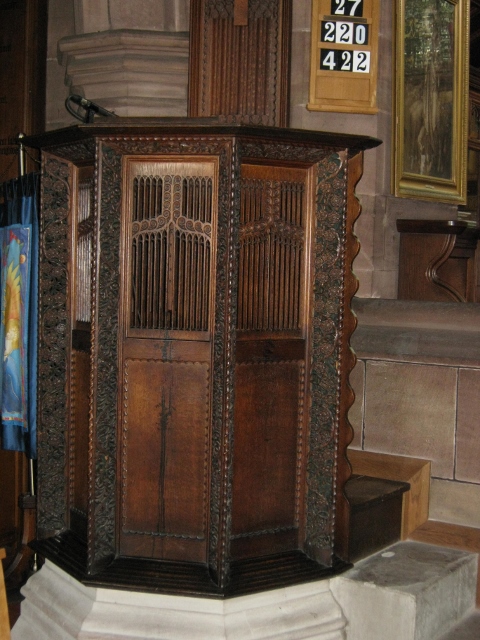
The pulpit is decorated beautifully with carving and pierced woodwork. It also has a tester or sounding board above it which helped with acoustics before the use of microphones.

020Ceiling (480x640)

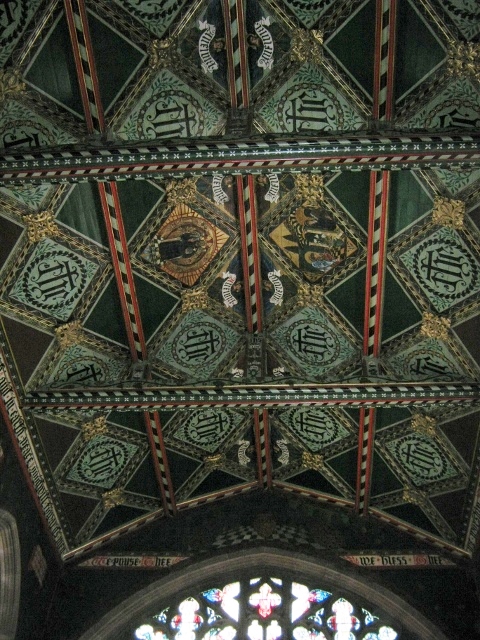
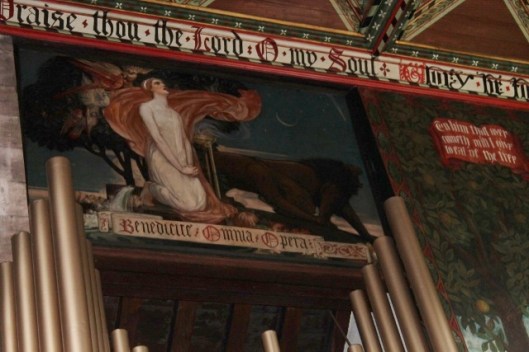
Part of the painted ceiling in the chancel.

027Lady chapel (480x640)

The highly decorated Lady Chapel. The wall painting shows the Annunciation, the visit of the Angel Gabriel to Mary when she is told she has been chosen to be the Mother of Christ.

Another painting in the Lady Chapel and on the south wall is of St Francis of Assisi preaching to the birds.  Unfortunately the photographs I took were not good enough as the light levels were poor.

032One of stations of the cross (640x480)

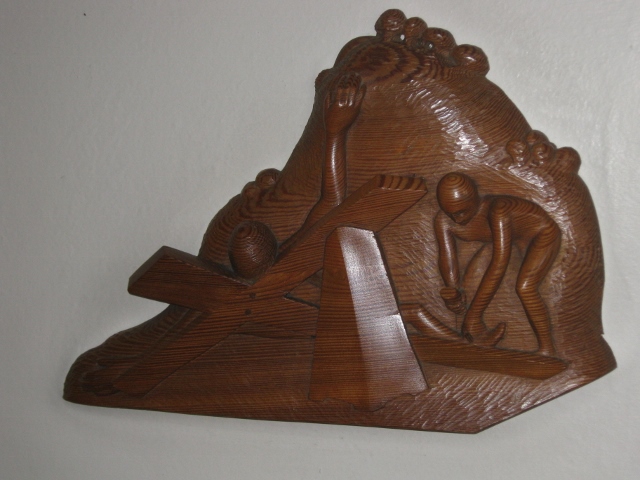
One of the fourteen Stations of the Cross carved in 1991 by a local craftsman, John Owen.

033One of the embroideries (480x640)

A framed embroidery of an angel – a late example of the work of a member of the Leek School of Embroidery.

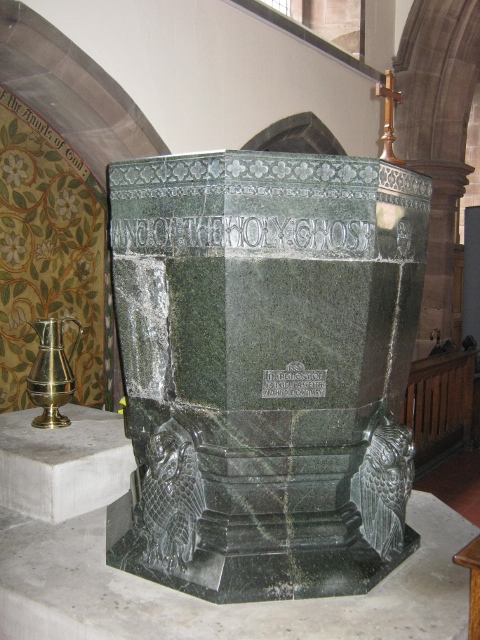
034The font (480x640)

The font is made from green marble and the floral design on the west wall behind it is believed to be by William Morris.

106Painting (640x427)

This painting had only just been restored and replaced in the church the day we visited.

BRINDLEY’S MILL

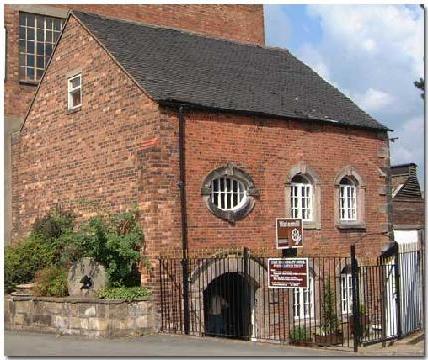
Our next port of call was to Brindley’s Mill.  As it is on a busy road I was unable to take a photograph of the outside of the mill so I have found a picture of it on-line – thanks to the Peak District On-line site.

leek-mill

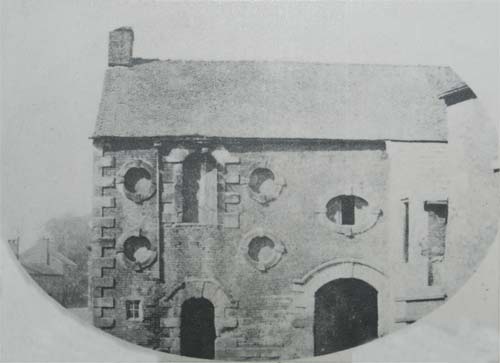
I also found a photograph of what it looked like before successive roadworks raised the road level and caused the demolition of part of the building in 1948.  This photograph comes from the Staffordshire Past Track site.

26896-0

James Brindley was born in 1716, the eldest of the seven children of a Derbyshire small farmer.  Brindley had very little schooling as he was kept very busy on the farm.  The family moved to Leek when he was ten and at the age of seventeen he was apprenticed to a millwright near Macclesfield in Cheshire.  He had a wonderful memory and stored up all sorts of useful information that he gleaned on his trips with journeymen to a variety of mills in the area.  After two years his grasp of mechanical detail was remarked on by a mill manager and when the millwright to whom he was apprenticed failed to produce machinery for a new paper mill, Brindley, on his own initiative, visited the mill fifty miles away to see what was required.  He was subsequently put in charge of the work which was completed satisfactorily.  He thereafter looked after the business until the millwright’s death.  Brindley set up his own millwright’s business in 1742 at the age of 26.  He opened up another workshop in the Potteries where, after working with master potters and colliery owners he became known as ‘The Schemer’.  His mill work continued including water mills for corn, flint and  textiles, all requiring different internal machinery.  Where no water was available he used ‘fire engines’ as early steam pumps were known.  He patented improvements to existing machines.  He replaced water by wind in Burslem for grinding flint for the Wedgewoods.

Brindley built the cornmill in Leek in 1752 on a site where a mill had stood since Domesday, on the River Churnet.

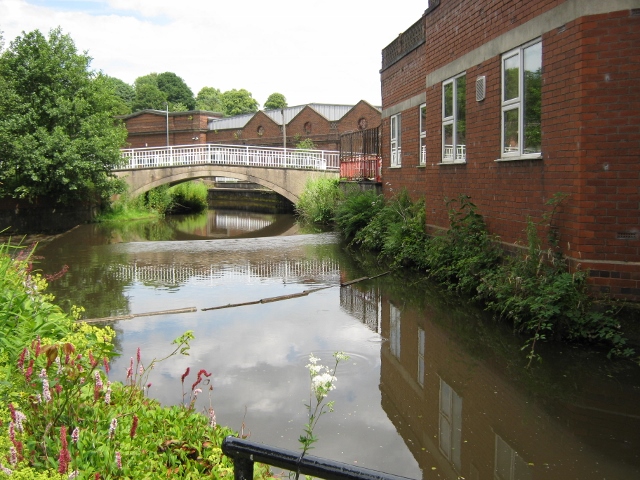
040R Churnet (640x480)

The River Churnet seen from the mill

In constructing this mill he showed a variety of skills – a millwright’s knowledge of mechanics and hydraulics was accompanied by the ability to create a stylish building using new weight-bearing techniques.  He also exhibited civil engineering skills when constructing the weir by compacting clay, as he did later when forming the beds of the canals he made.  His canals transformed the way goods were transported across England and he became very famous.  Because of his lifestyle – constant travelling, overwork and also the onset of diabetes – he died at the early age of 56.

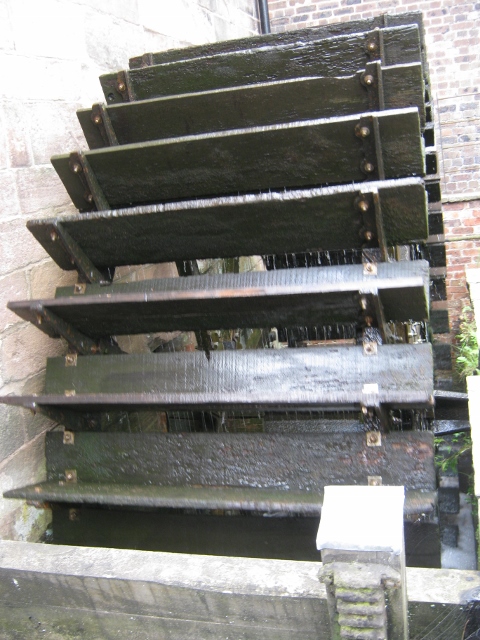
042Wheel (480x640)

The working waterwheel

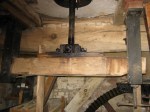
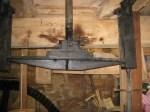
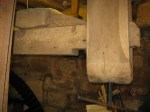
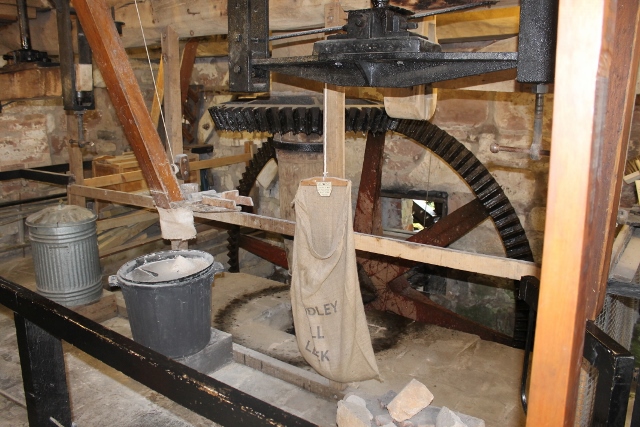
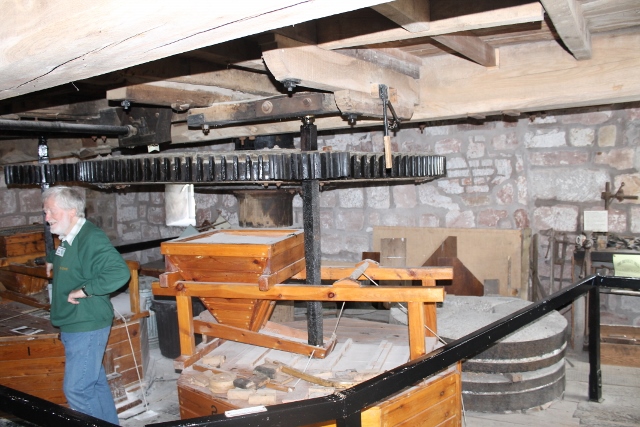
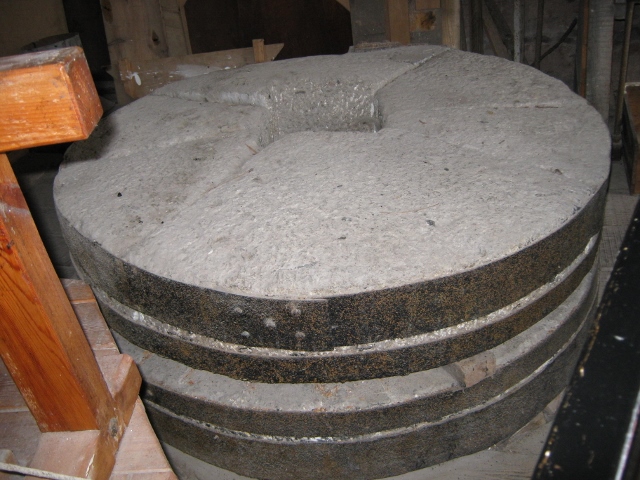
Four photos of the tentering gear (three sets of different vintages are bolted to the ceiling).  They adjust the gaps between the millstones on the floor above to control the fineness of the flour.

At the rear of the photo is the pit wheel which is connected to the waterwheel outside by the axle-tree. The main shaft is made of oak and is 18″ in diameter. It is supported by a brass footstep bearing which is bolted to the floor. Around the base of the main shaft is the wallower – a gear which is driven by the pit wheel. At the front of the photo is the wooden pipe which conveys the meal from the millstones above. The meal is then sieved.

110Mill (640x427)

This is a photo of the next floor. Grain is poured into the wooden hopper from the floor above. The new hopper here is a quarter scale replacement to make demonstrations easier. Below the hopper is a tray (the shoe). One of the arms attached to the shoe is held against the rotating four-sided shaft by a rope attached by a springy bar of willow. As the shaft turns its four edges create a shuddering movement in the shoe which allows the grain to be jerked out at a regular pace into the eye of the top stone.

055Mill stones (640x480)

Mill stones

056Weighted with flat iron (640x480)

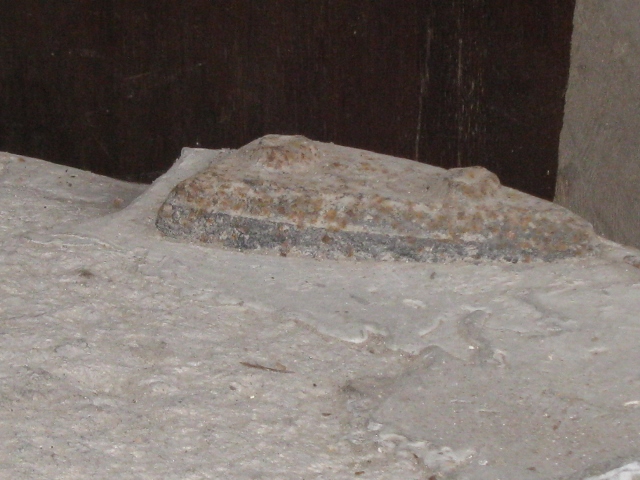
If the stone became worn or it ground unevenly it could be repaired by being weighted on one side. This one has been weighted by an old flat iron.

057Tools used in mill (640x480)

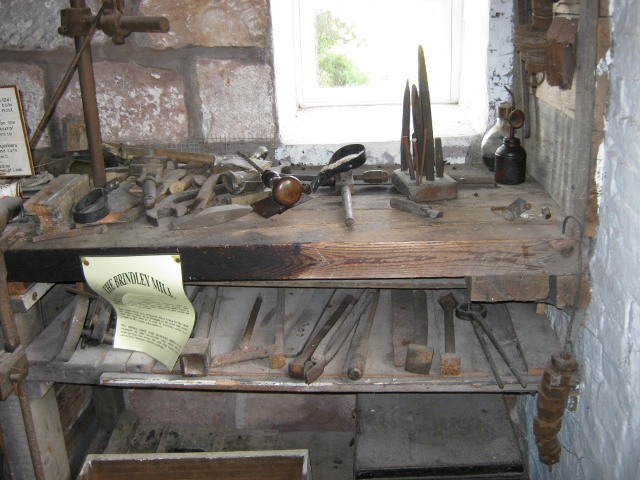
A work bench with tools used in the mill

060Garner floor (640x480)

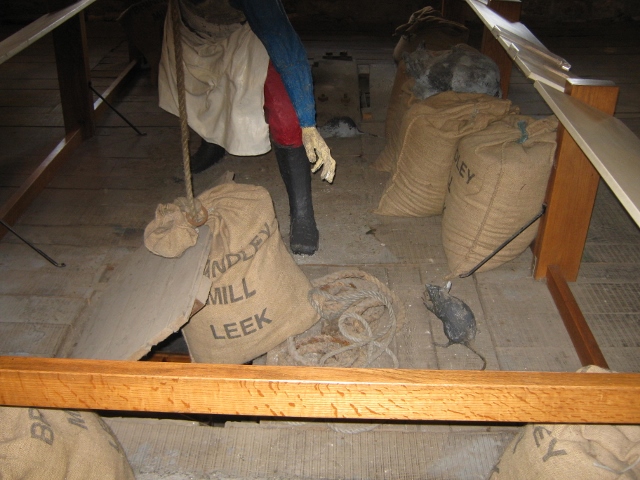
The Garner floor or top floor where the grain is stored prior to milling. The sacks are conveyed up to this floor with a sack hoist

065B's level & notebook (640x480)

Brindley’s level and notebook

This is a theodolite level – a spirit level above a telescope above a compass – and was the most advanced piece of technology which he used in planning his canals.

066Notebook (640x480)

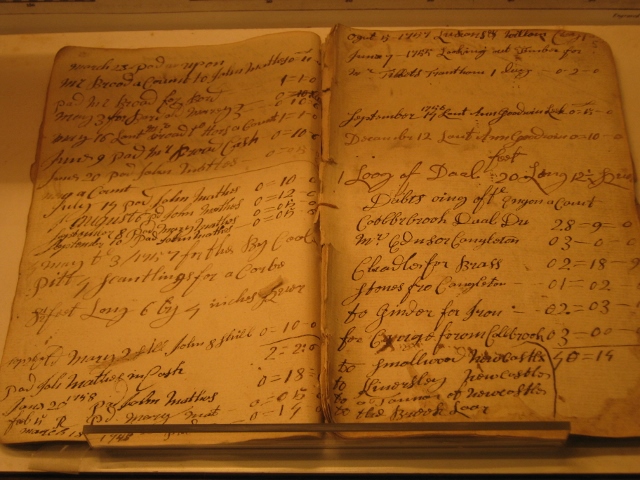
This is one of four of Brindley’s notebooks in existence and are mainly aids to his memory – time taken to ride to distant places, where he found suitable timber, clothes he bought, how much he was owed etc.

The following day, which was Sunday, we attended church at All Saints and had coffee afterwards in their large church room in the undercroft.  Such friendly people!

We then travelled to Manchester and spent some time visiting my mother-in-law in her house.  Probably the last time I will see the house, though I didn’t realise it then.