I have a few photographs of things I’ve seen this autumn dating from the beginning of September until mid October. I thought I’d make a post of them all.
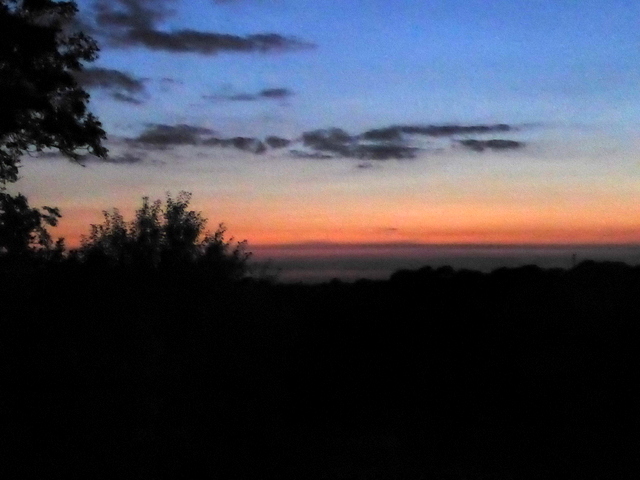
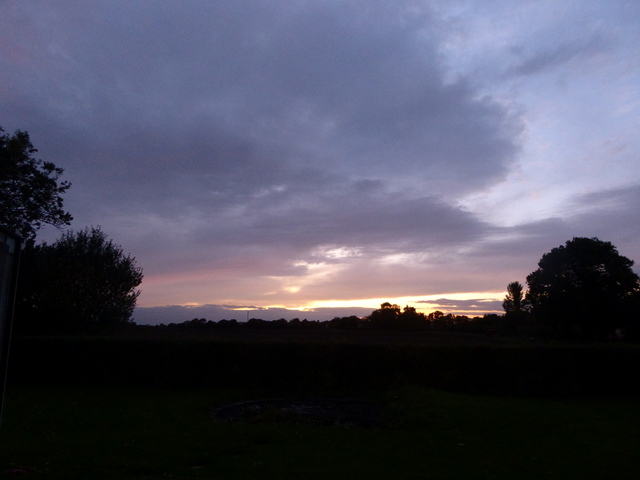
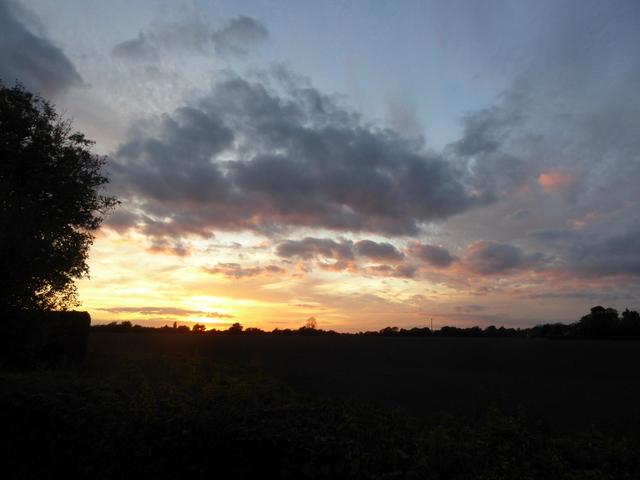
A sunset seen from our back garden – again in September.
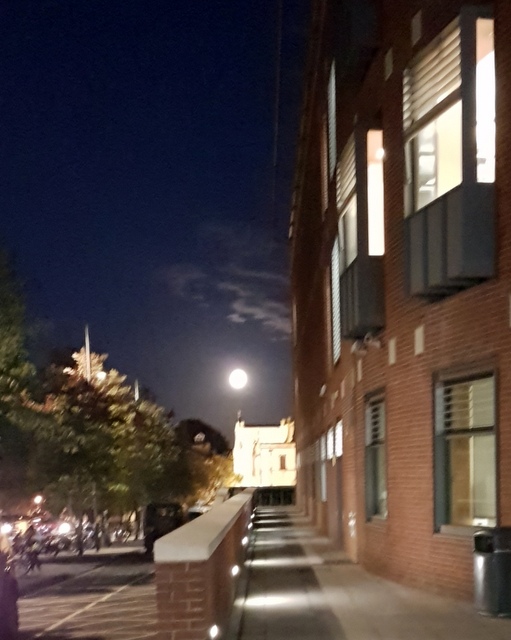
This photograph of the harvest moon at the beginning of October was taken in Norwich by Richard.
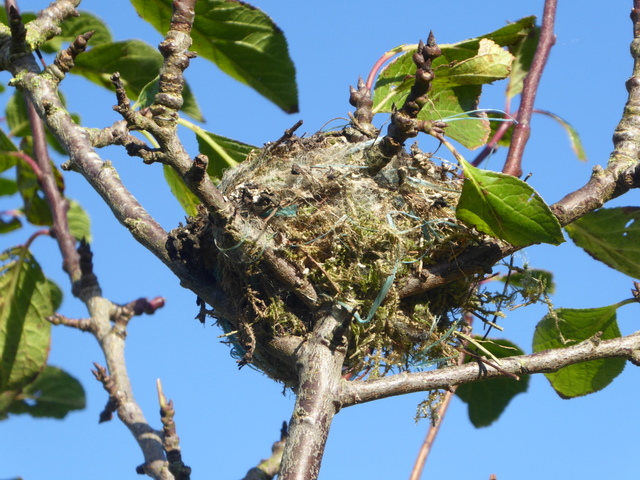
A Goldfinch (Carduelis carduelis) nest in our Greengage tree.
Once some of the leaves had fallen from the tree it was easier to see the nest which, when it was occupied, prevented us from harvesting our greengages until it was almost too late. Moss, grasses, feathers and cobwebs have been used as well as green plastic garden twine. The nest has been anchored to the branches of the tree by stouter grasses.
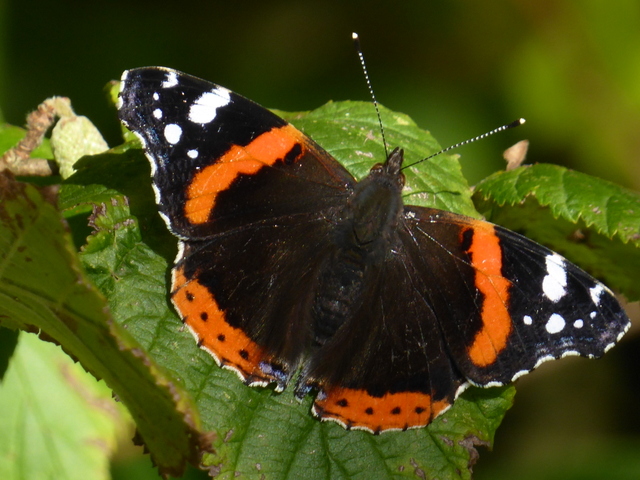
A Red Admiral butterfly (Vanessa atalanta) sunning itself.
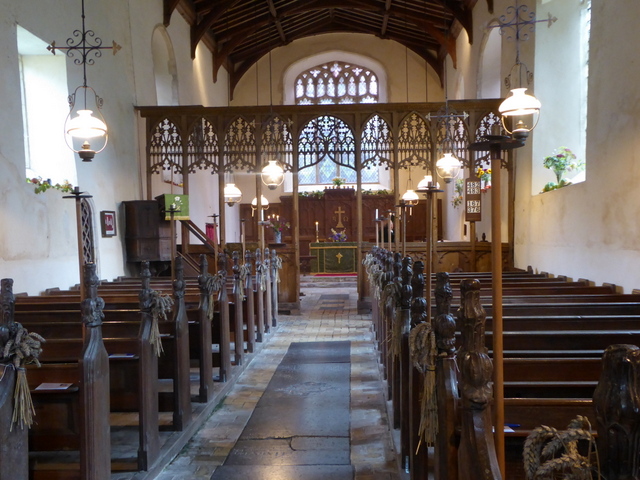
Our church at Rumburgh, decorated for Harvest Festival
Richard and I collected all the fruit and vegetables the next day and delivered them to a local nursing home where they were very gratefully received.
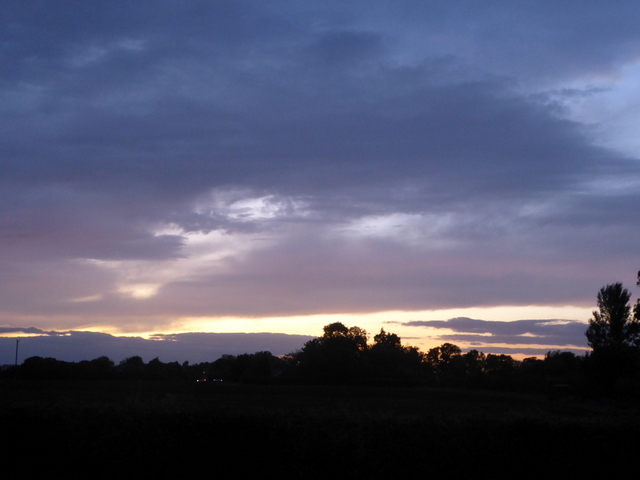
Another sunset
I love the dark purples and greys with the slash of bright yellow cutting through
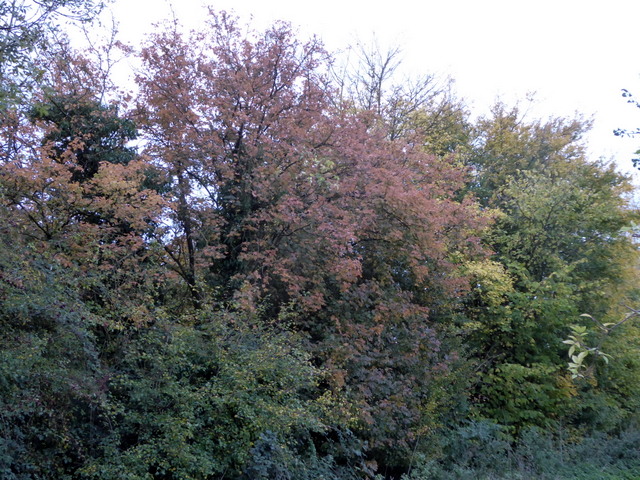
Autumn colour in October
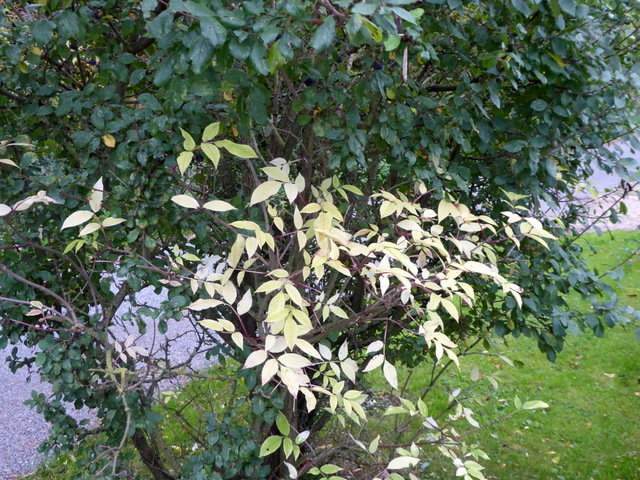
These Elder ( Sambucus nigra) leaves have lost nearly all their colour and have become almost luminous
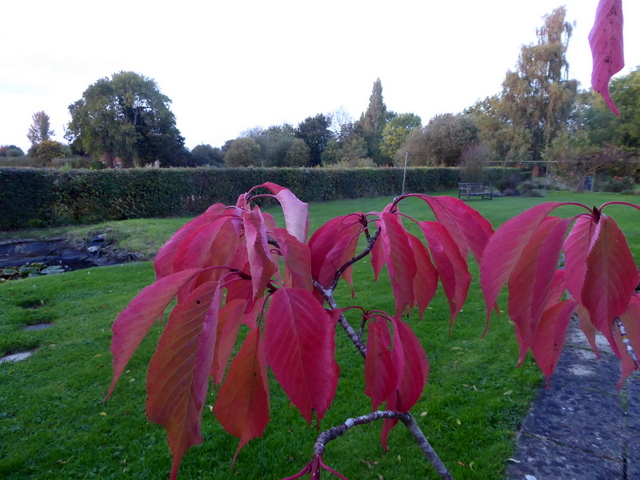
Cherry tree leaves in our garden
Yet another sunset!
A late and rather battered oriental poppy
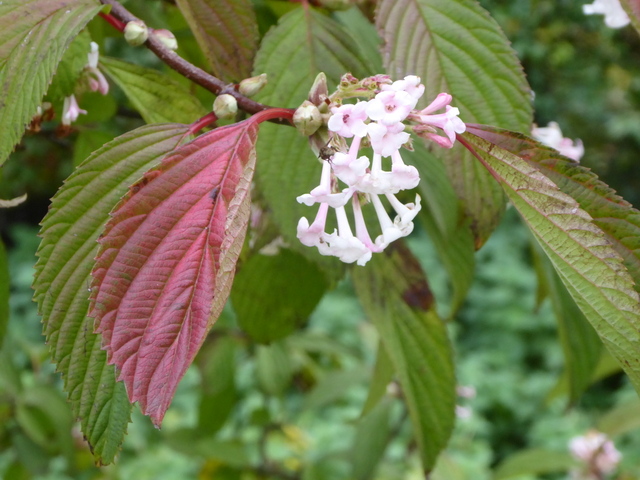
The almond-scented flowers of Viburnum bodnantense
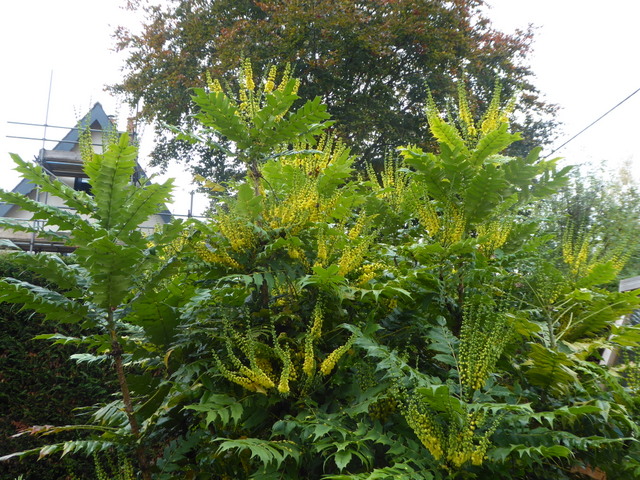
Mahonia flowers smell like lily-of-the-valley.
I like to have late autumn, winter and early spring flowering plants. On milder days when the wind isn’t too strong, their scent can be so welcome. The insects, especially the bumble-bees, enjoy the flowers too!
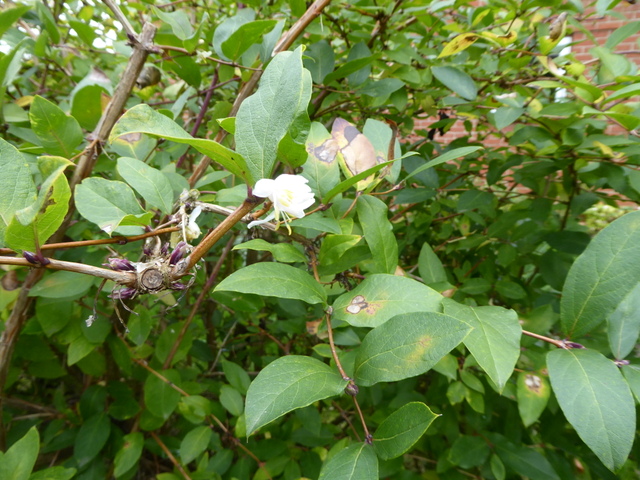
Winter-flowering Honeysuckle
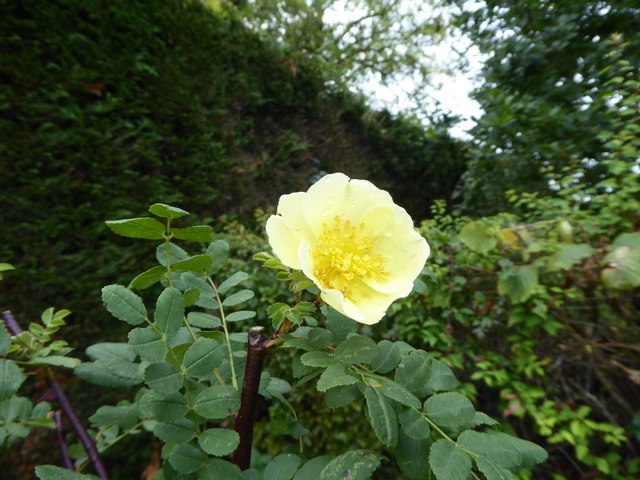
This ‘Canary Bird’ rose is one of the first to flower in early summer. It decided to flower again in October.
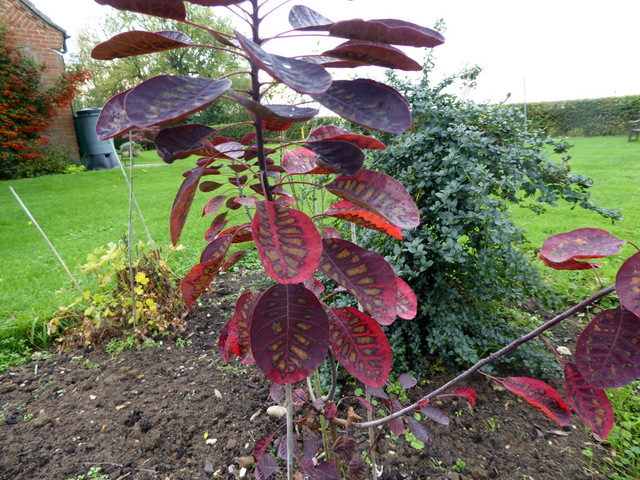
The Cotinus leaves were very attractive
I’m sorry but here is one more sunset! This was the colourful one caused by storm Ophelia and the smoke pollution from the forest fires in Portugal.
This slideshow requires JavaScript.
My music choice today is Dietrich Fischer-Dieskau singing ‘Herbst’ (Autumn) by Franz Schubert. Here is a link to a translation into English of the lyrics.
Richard asked me if I’d like to accompany him to the post-box down the lane. He had a birthday card to post to his brother and also a notice to put on the village notice-board. The weather was fine, though cloudy and we hadn’t walked anywhere together for a few weeks. I quickly put on my coat and walking shoes and we set off.
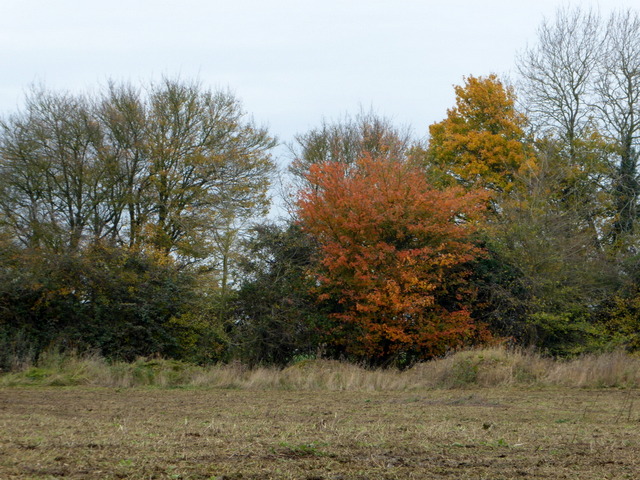
The hedge on the opposite side of the lane was pale green and orange.
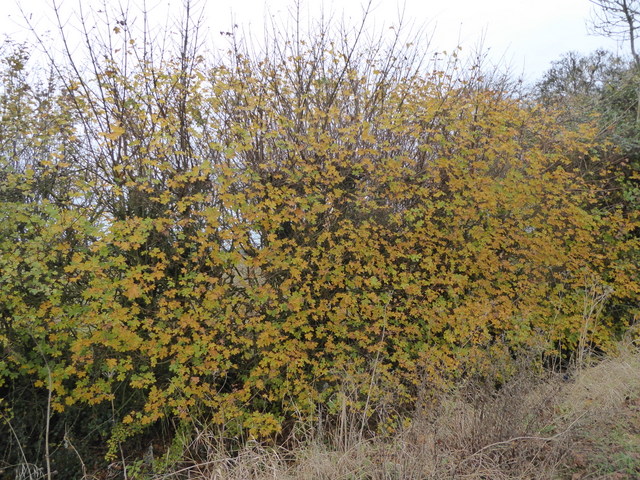
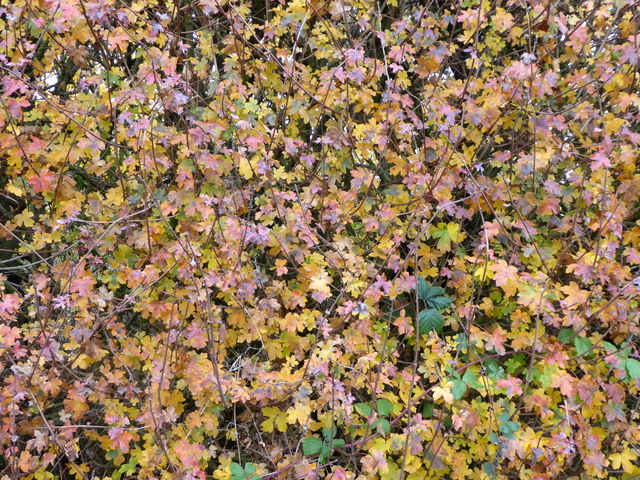
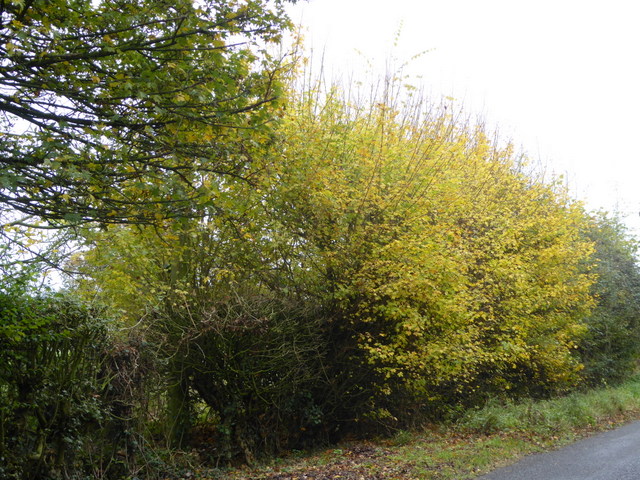
The hedges still had a few leaves left on them. This is a Field Maple (Acer campestre) hedge. Not in focus, but I liked the colours.
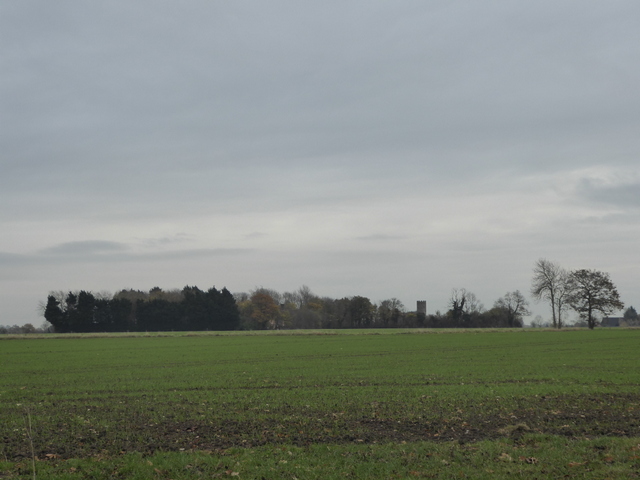
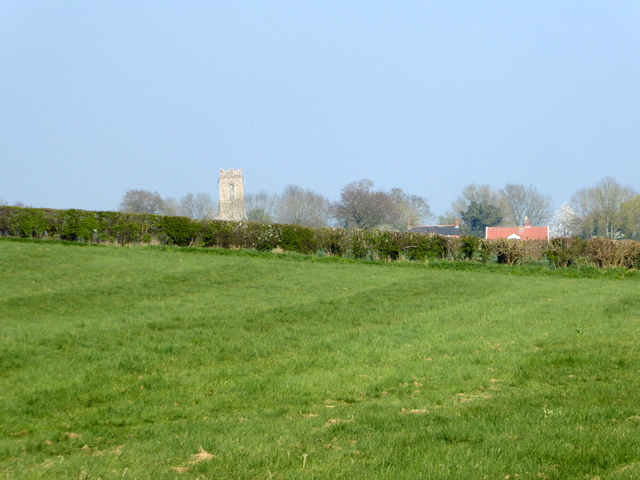
A gap in the hedge further along the lane gave us a sight of the tower belonging to All Saints church. It is surrounded by trees, most of which have lost their leaves now. The field has been sown with barley or wheat which has germinated and will continue to grow on milder days all through the winter.
All Saints church in the distance
Some of the more sheltered Field Maple trees still had leaves.
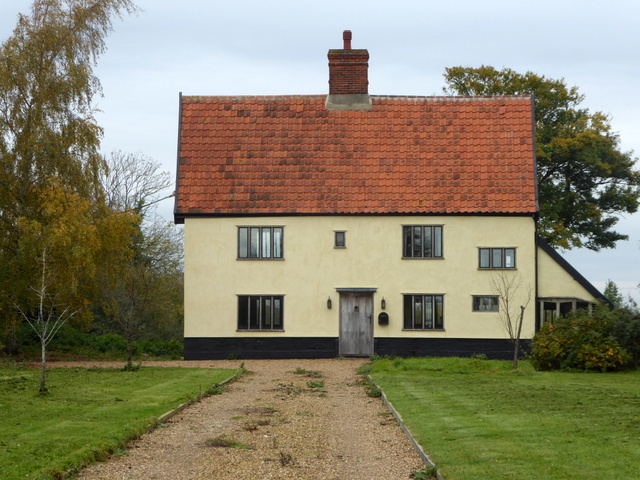
This fine-looking old house near us has been empty for some time.
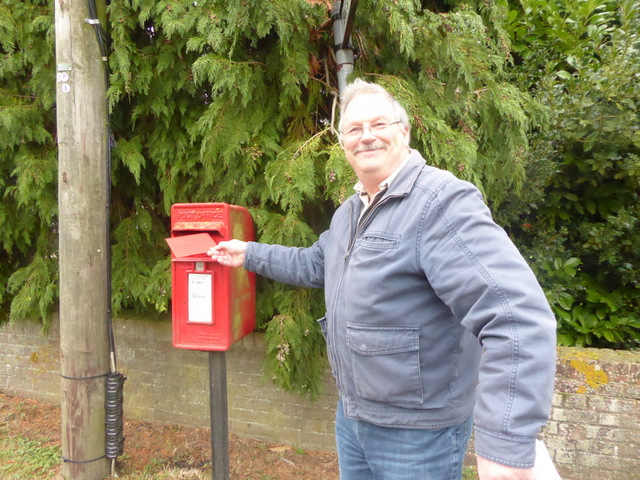
Richard proudly demonstrates his posting technique!
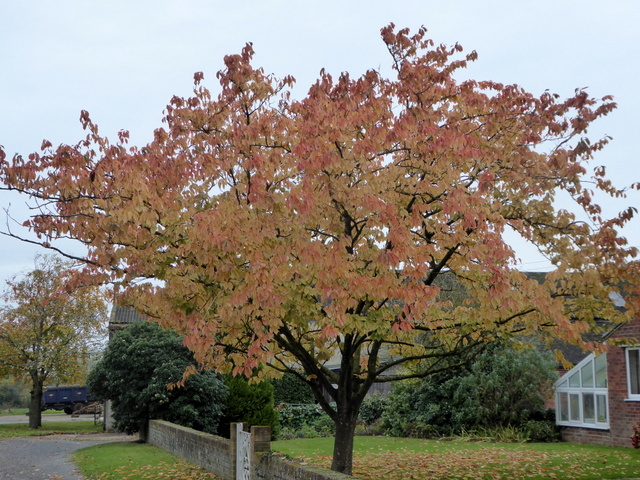
We met a neighbour and chatted with her for some time. I admired the fine cherry tree in her front garden.
Our neighbour’s beautiful cherry tree.
We walked on to the notice-board and then decided to continue down the lane.
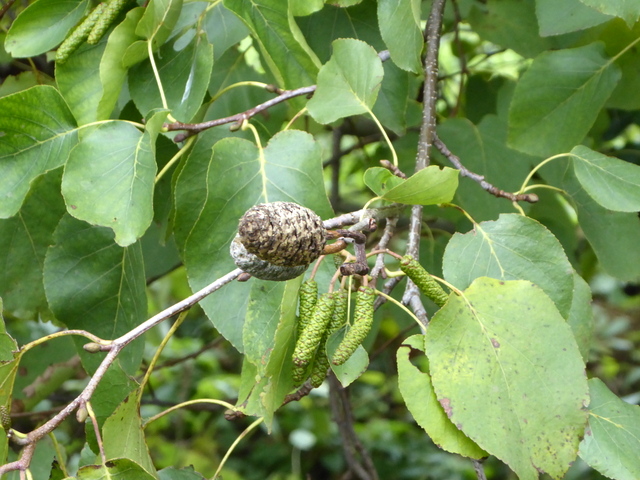
A row of Italian Alders (Alnus cordata) were planted some years ago as a wind-break along the edge of a field. The cones are much larger than our native Alder cones.
Italian Alder cones
Our local stream, The Beck, has been dry for months. We have not had enough rainfall this year.
The Beck
Another pretty hedge
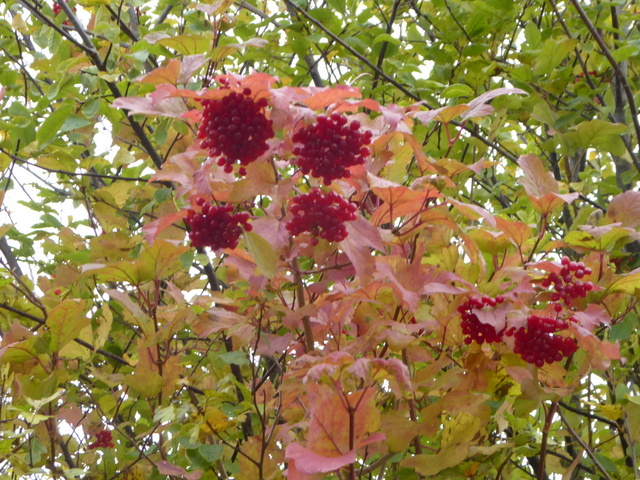
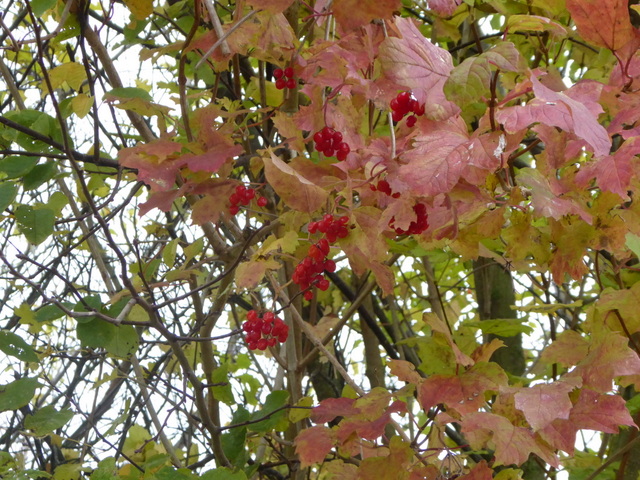
The Guelder-rose trees (Viburnum opulus) have been beautiful this autumn! I have never seen so much viburnum fruit before!
Here is another Guelder-rose.
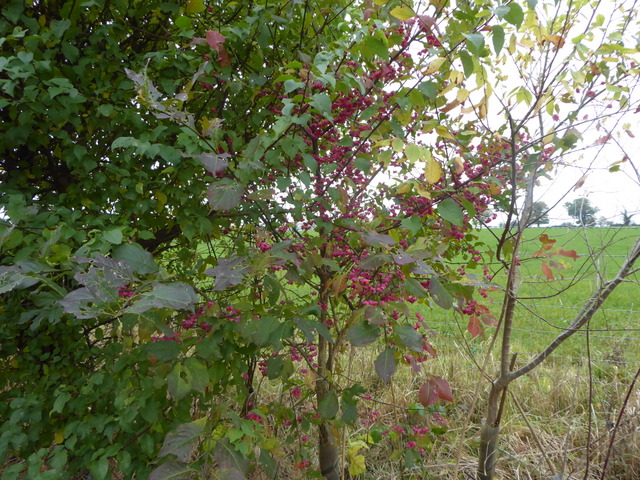
This is a Spindle tree (Euonymus europaeus) in the hedgerow
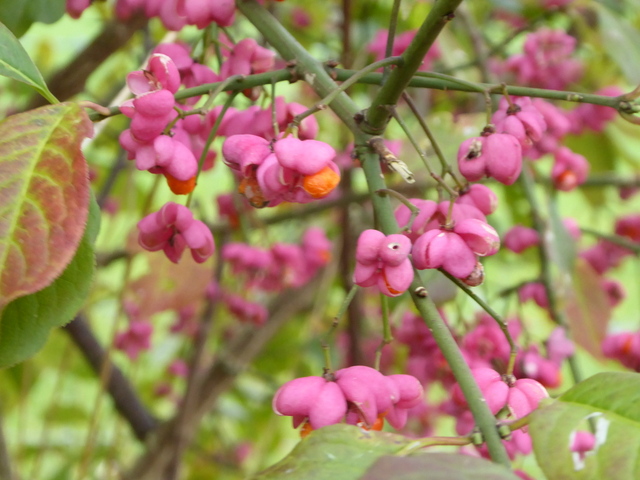
Here is the pretty pink and orange spindle fruit
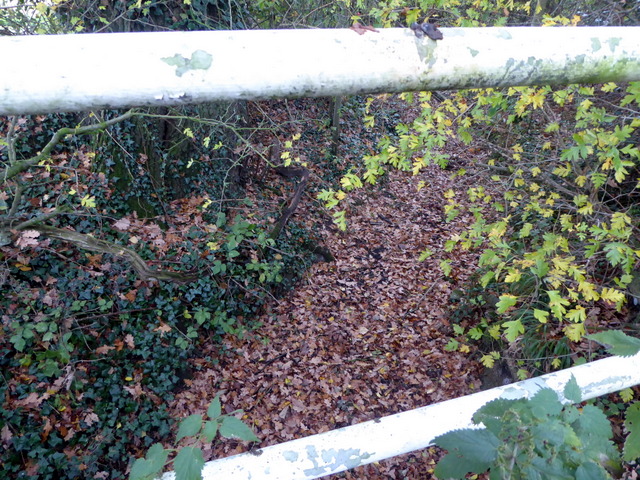
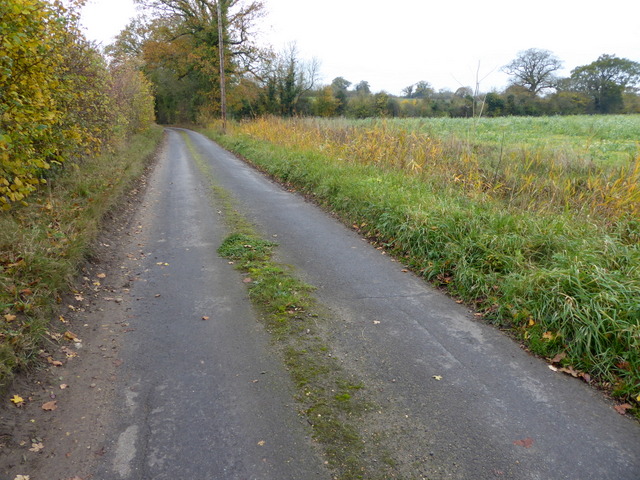
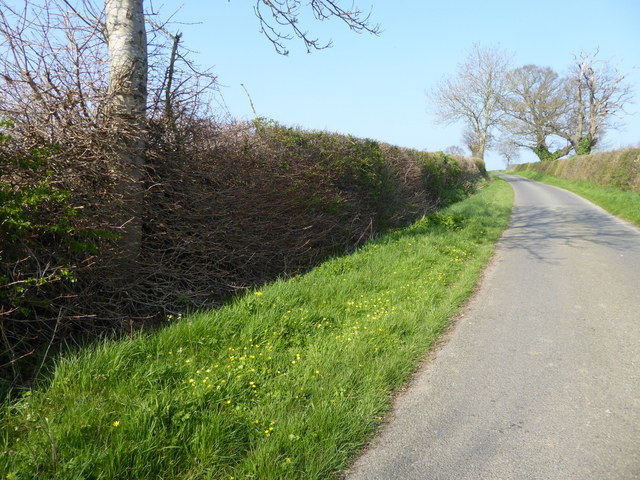
This is a picture of the lane along which we walked
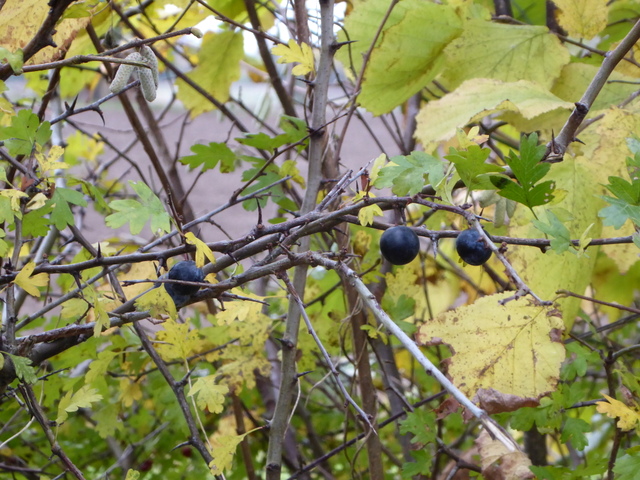
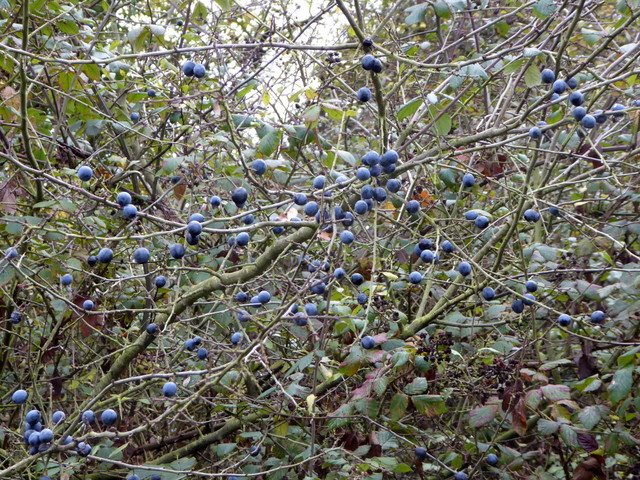
There were a few sloes left on the Blackthorns (Prunus spinosa)
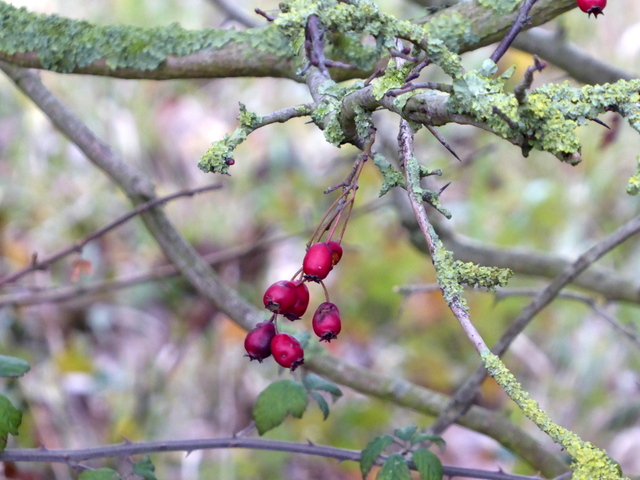
A few Common Hawthorn berries (haws) too (Crataegus monogyna)
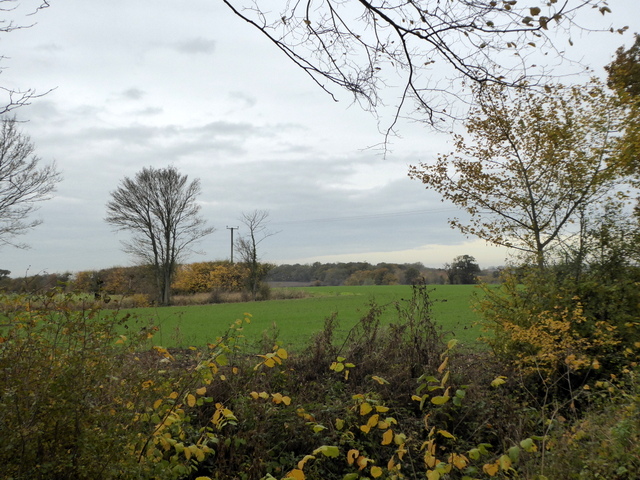
A view over the hedge to the fields beyond. The skies were clearing.
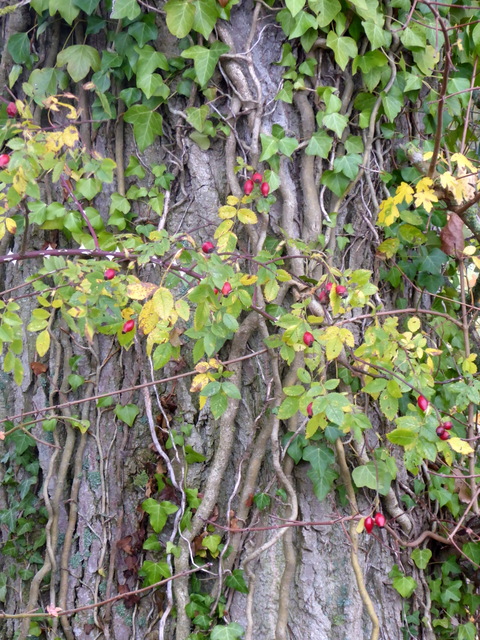
This tree-trunk was covered with Ivy stems (Hedera helix). It attaches itself to trees, fences and walls by short roots and can completely cover tall trees. A Dog Rose (Rosa canina) stem hung in front of the tree.
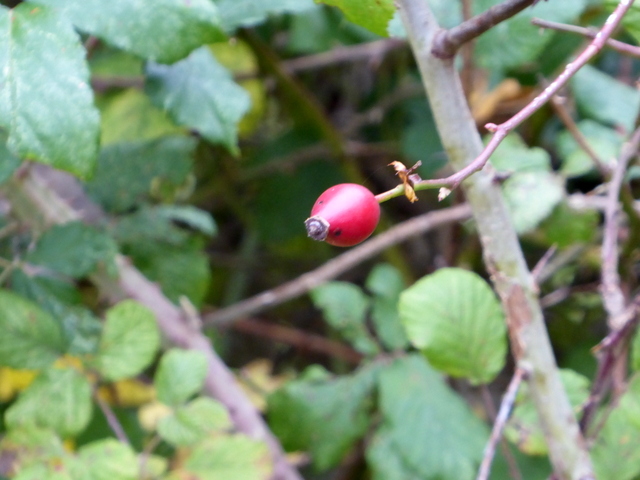
Rosehip
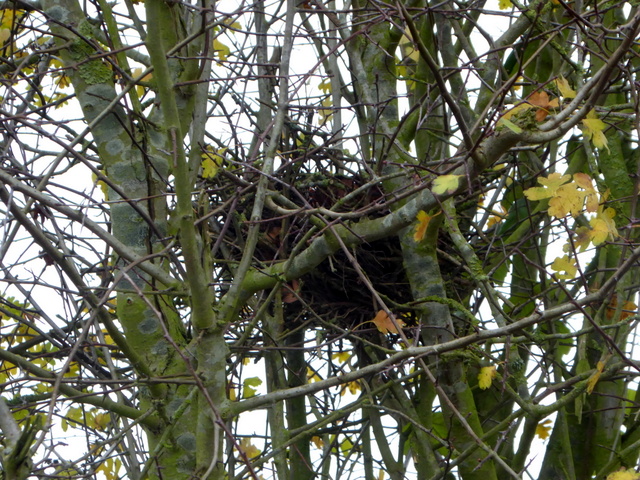
Bird’s nests are easier to see now that the leaves are falling from the trees
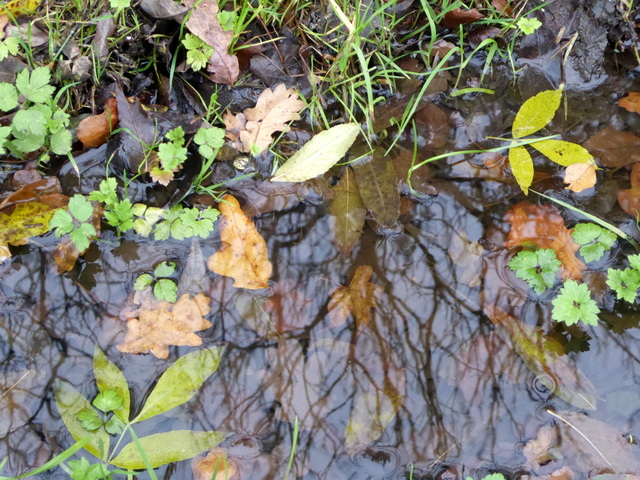
Puddles were full of leaves and reflections
We walked through St Margaret South Elmham churchyard and Richard sat for a while to rest his back.
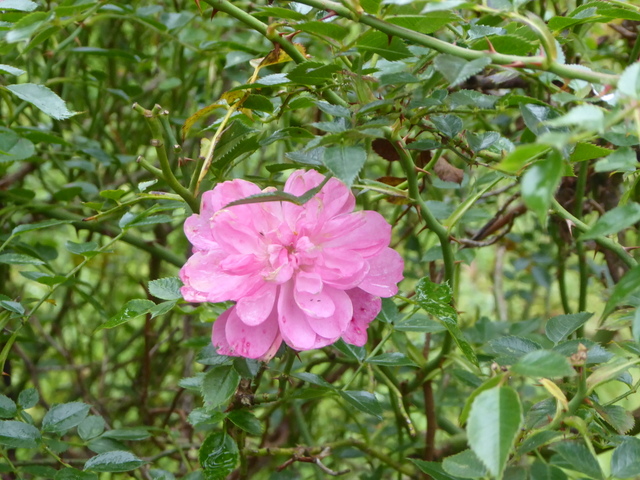
A late rose was blooming
The Holly (Ilex aquifolium) had a few berries on it
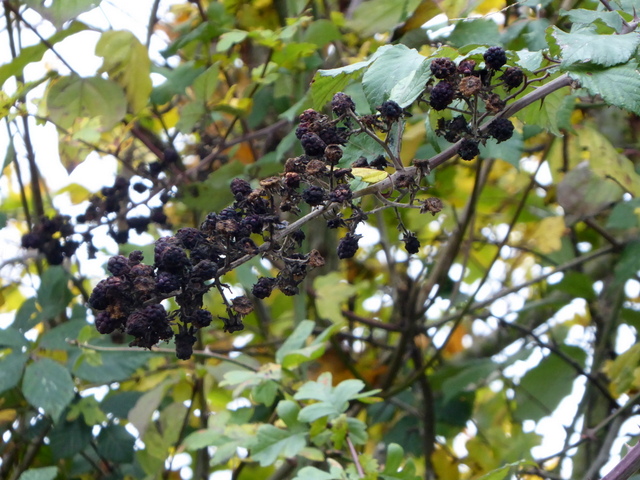
Our Blackberries (Bramble) (Rubus fruticosus agg.) were very poor this year because of the low rainfall. Even the mice and birds didn’t chose to eat these ones which have been left to shrivel on the vine.
I am not sure whether these fruits are Blackthorn or Bullace (a type of wild plum).
Autumn leaves
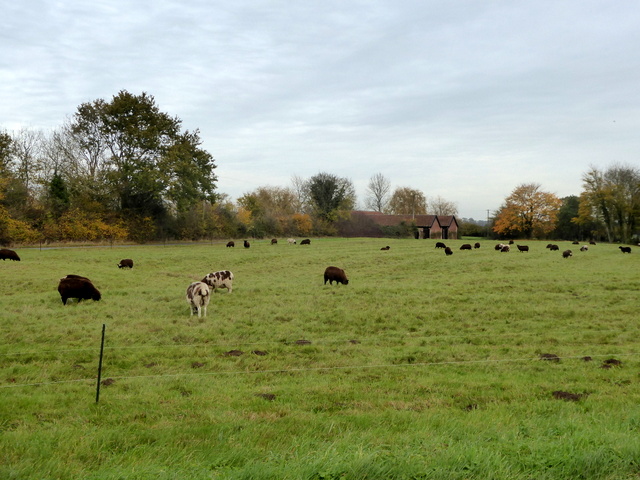
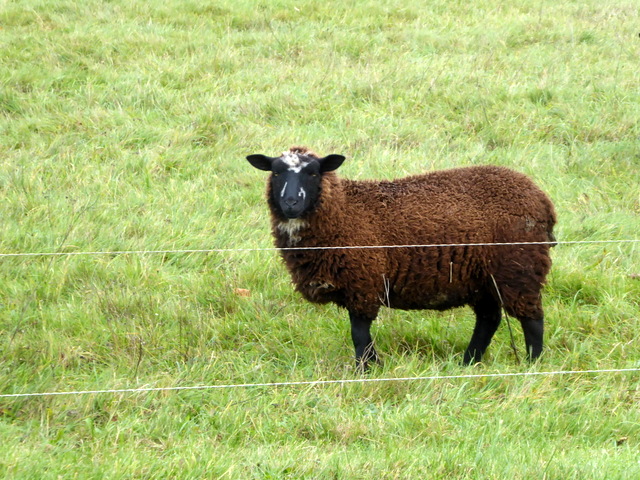
Sheep were being grazed on the common at the end of our lane
This sheep was happy to stop and stare
We soon arrived back home, having been away a lot longer than we had originally intended.
This was a walk we took a fortnight ago and after a couple of frosts and some strong wind last night most of the remaining leaves have fallen from the trees. The countryside looks ready for winter now.
My music choice today is ‘Somewhere in my Heart’ by Aztec Camera. There is no special reason for my choice except I like it and am amazed it is thirty years old!
Elinor and I went to Framlingham three weeks ago. Richard had intended coming with us but he had a bad cough and cold and stayed at home instead.
The distance to Framlingham from home is about 17 miles and in ideal conditions would normally take about 40 minutes. However, with local road closures for repairs and other works, the long diversion we had to take meant it took us nearly an hour to get there. I checked the route after we got home on Googlemaps and it now provides information on how to travel to the required destination by public transport. I was amused to discover that it would have taken us 4 hours and 5 minutes to get to Framlingham by using three different buses, walking some distance and only if we had travelled on a Wednesday!
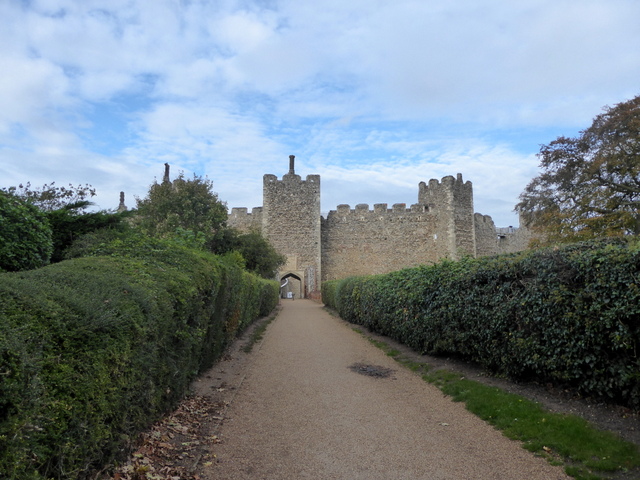
The approach to Framlingham castle
We eventually found somewhere to park in the town centre, though there is a car park at the castle, and walked to the castle. We hadn’t visited it for many years, not since Elinor was very small and she had no recollection of the place at all. The castle is looked after by English Heritage and they have recently been working on expensive improvements to the wall walk, the exhibitions and the museum and in providing a large café. Disabled access has been improved too. While all the repairs were underway a chute was installed from the top of the wall walk down to the inner court to entertain visitors. The chute is still in place but we didn’t avail ourselves of it!
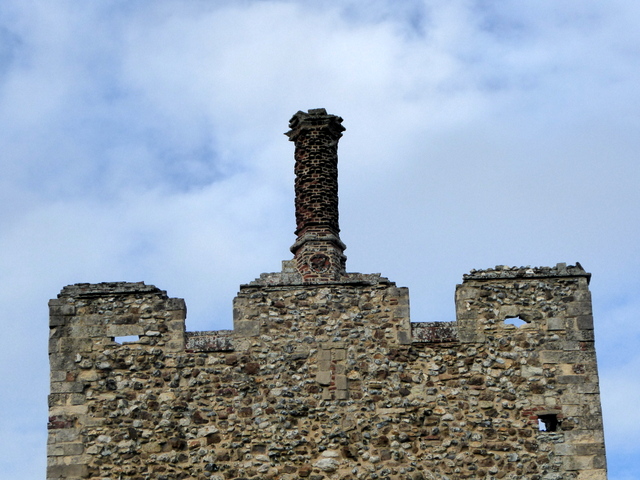
A Tudor brick chimney on the top of the gatehouse. Most of the chimneys at Framlingham are purely ornamental and were added as a sign of wealth.
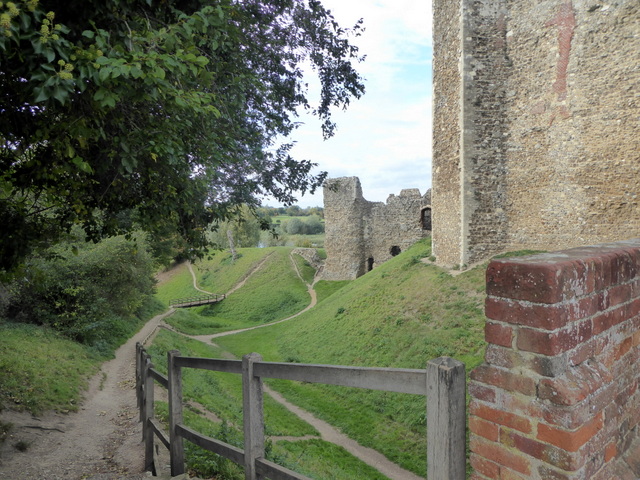
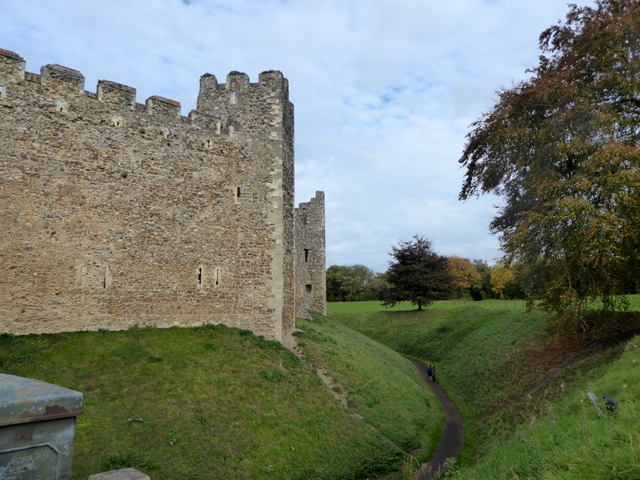
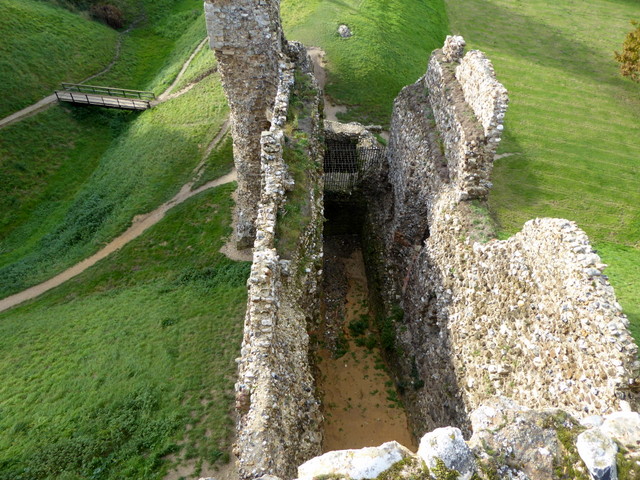
The castle has a deep, steep-sided ditch around it which was always a dry ditch. This was designed to prevent tunnelling under the walls and made breaching the walls almost impossible.
The inner ditch and curtain wall. Do you see the people walking at the bottom of the ditch? This castle is enormous!
Skip this next bit unless you have the time to read some historical background!
Roger Bigod I was formally granted the manor of Framlingham in 1101 by King Henry I even though he had been living there since shortly after the Norman Conquest. The Bigods, who were very powerful and rich barons were also made Earls of Norfolk. Roger Bigod II built the castle that we see today and he and his son were the first two of the list of barons who forced King John to accept the Magna Carta in 1215. The Bigods were constantly at odds with their king and were a law unto themselves. Eventually, the expense of numerous building projects and constant quarrels with Edward I produced such enormous debts that Roger Bigod IV was forced to make the king his heir and at his death all his lands were given to the king.
Edward II gave Framlingham to his half-brother, Thomas Brotherton who left the estate to his two daughters. His elder daughter, Margaret was created Duchess of Norfolk in 1397 – the first Englishwoman to be a duchess in her own right. Her grandson and heir, Thomas Mowbray was created First Duke of Norfolk, also in 1397 and Framlingham remained with the Mowbrays until the death of John Mowbray VII in 1476.
The castle then passed to the Howard family who were descendants of the Mowbrays. The Howards were skillful politicians and also brave soldiers and included John, First Howard Duke of Norfolk who died at the battle of Bosworth aged 60 while commanding Richard III’s troops. His son, Thomas was imprisoned in the Tower of London but was released and gradually recovered the Howard estates. At the age of 70 he led the English forces to victory against King James IV of Scotland at Flodden Field. In gratitude for this victory Henry VIII gave him back the title of Duke of Norfolk. His son, also Thomas, the 3rd Duke of Norfolk was the uncle of two of Henry VIII’s wives – Anne Boleyn and Catherine Howard. He not only schemed to get them to court and to marry the king but also betrayed them both for his own ends. Eventually his scheming and the arrogance of his son Henry, a soldier and gifted poet, proved his downfall. They were both sentenced to death, Henry Howard was executed in January 1547 but his father survived through the good fortune of King Henry’s own death taking place a day before the execution date. The Norfolk title and lands were surrendered to the Crown.
In her father’s will, Mary Tudor was granted most of the Howard lands in East Anglia and received Framlingham in 1552. On his death bed in 1553, Mary’s brother, King Edward VI was persuaded to disinherit both his half-sisters on the plea that they were illegitimate. He and his mentor, the Duke of Northumberland were both staunch Protestants and were fearful that the country would revert back to being Roman Catholic when he died. He named his successor to the throne as Lady Jane Grey, Northumberland’s 17-year-old daughter-in-law. Mary heard that the Duke of Northumberland planned to capture her so she fled to Framlingham and rallied her troops about her. Not only the local landed gentry came to her support but also crowds of the poor country people. Support for Northumberland and Lady Jane Grey dwindled and eventually Northumberland surrendered and Mary was crowned queen. Queen Mary released the elderly Thomas Howard and gave him back his lands and title.
The castle was passed to Queen Elizabeth after the 4th Duke of Norfolk was executed and she used it as a prison, housing mainly Catholics. James I returned the castle to the Howard family in 1603 but by then it was in a sorry state of repair. It was sold to Sir Robert Hitcham, a rich lawyer and politician in 1635 who died the following year leaving it to his old college at Cambridge. He asked that all the castle not built of stone be pulled down and a poorhouse built. The first poorhouse built in the castle grounds was the Red House. It was soon found inadequate but a bigger and better one wasn’t built until 1729.
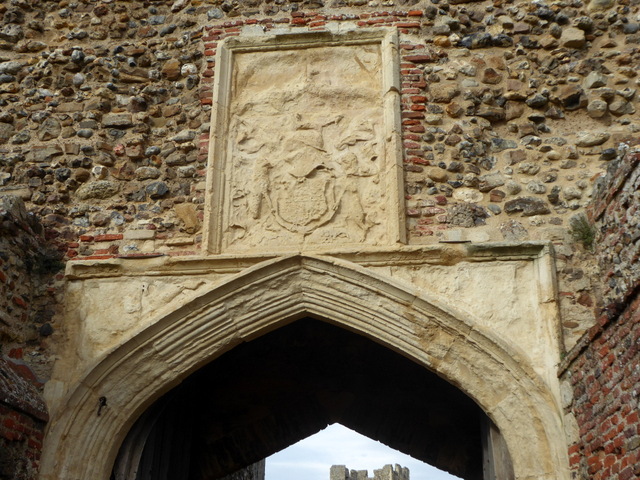
The gatehouse was rebuilt at the beginning of the C16th. This is the coat of arms of the Howard family, much weathered.
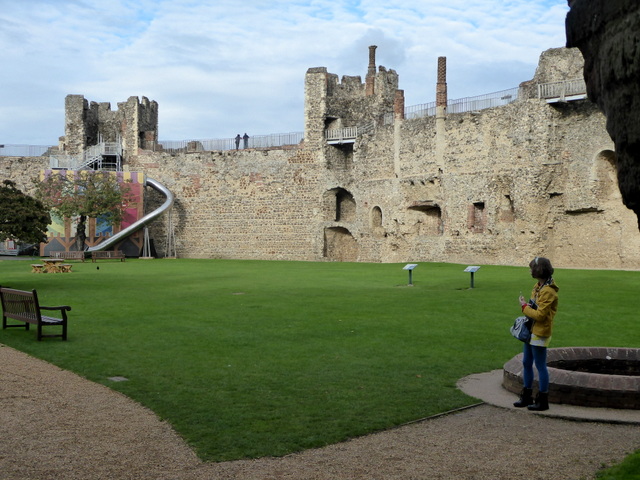
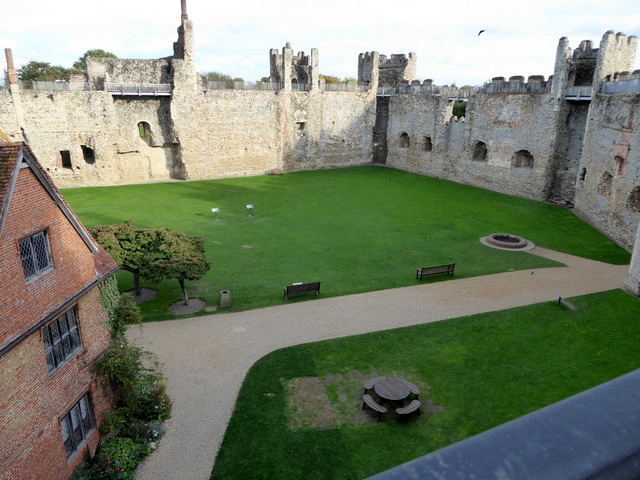
This was our first view of the inside of the curtain wall. You can see the chute on the left of the photo. Elinor stands next to the well.
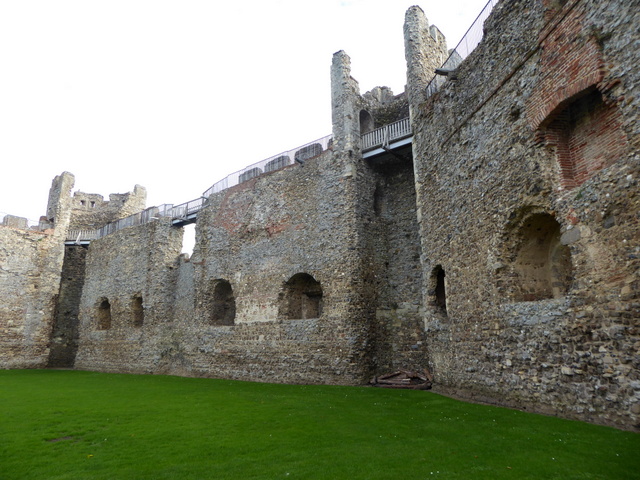
The buildings in the inner court were originally built out from the curtain wall and you can see window recesses and fireplaces in the curtain wall in the photo above.
Part of the inside of the curtain wall
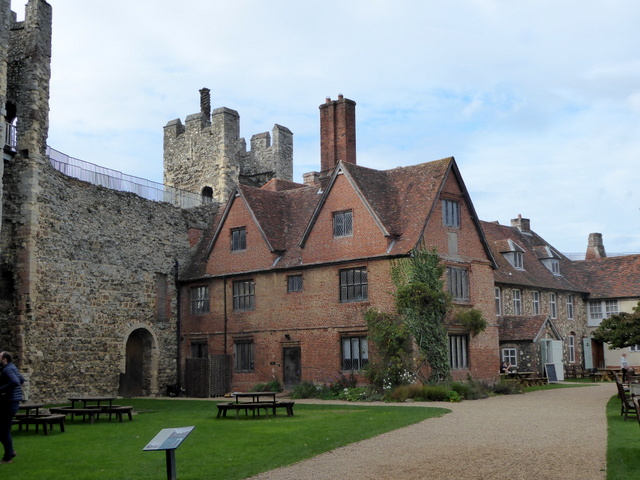
The Red House, built in 1660 and now containing private accommodation and beyond it, the Poorhouse built in 1729 on the site of the Great Hall.
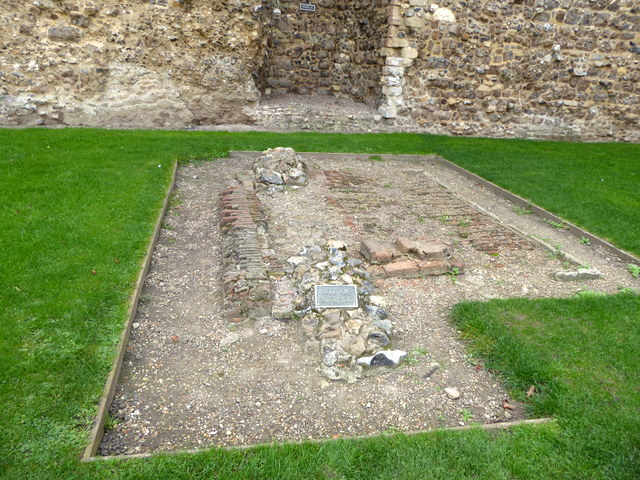
The site of the kitchen, which was always kept well away from other buildings as it was a fire risk.
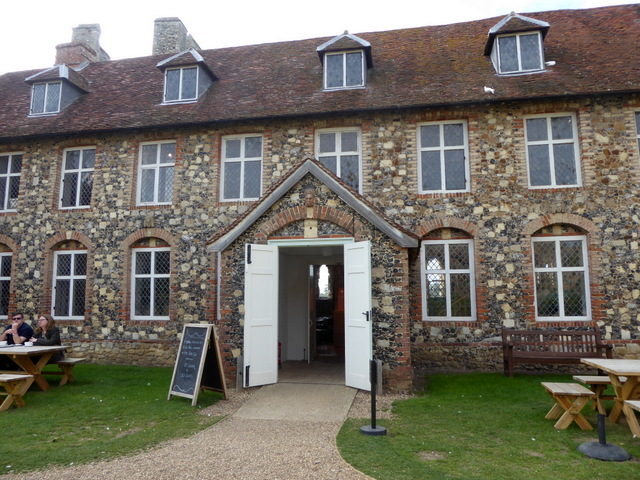
The old Poorhouse, now the café, museum and exhibition room.
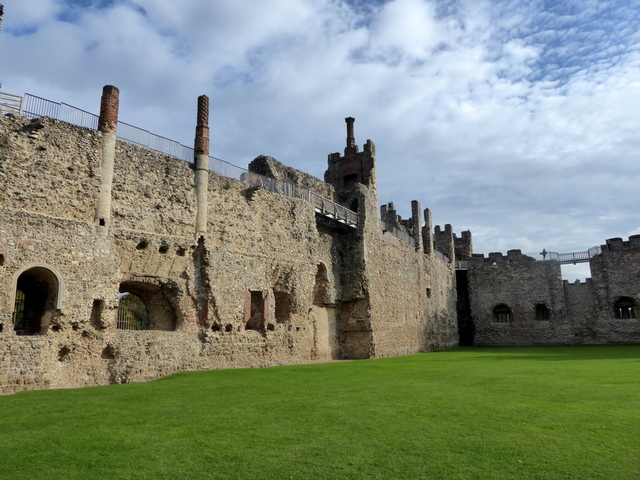
Another view of the inside of the curtain wall showing the traces of the chamber block.
From left to right – the first arch is a 12th century stone window that was later opened up as a doorway. The next wider opening is a Tudor window and above it the three small holes in a row are impressions left by the rafters of the mid-12th century building which was encased in the curtain wall. The floor joists can be seen above them. The stone chimneys are 12th century and were extended in Tudor brick. These two chimneys are the earliest known surviving cylindrical chimneys in England. Two more smaller openings in the wall are followed by the remains of a tower under which was the chapel, the east window of which can be seen below the walkway.
Four of the five stone heads that survive from the medieval buildings. They have been re-set into the facade of the Poorhouse.
Elinor and I went into the Poor House building from where we were able to climb up to the wall walk.
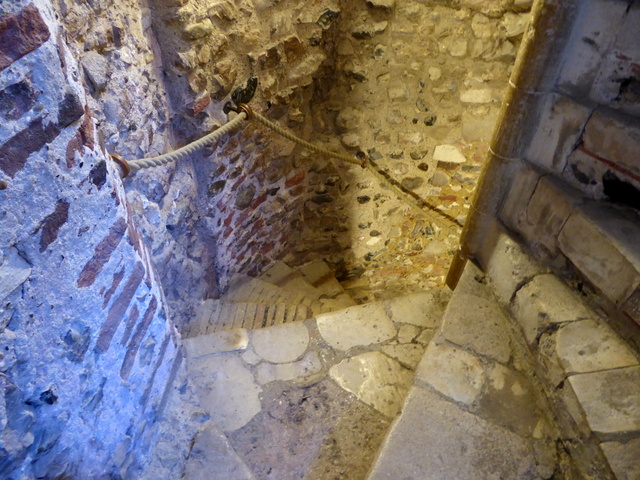
The stairs to the wall walk are in a tower which is part of the curtain wall. This is a photo looking down the stairs.
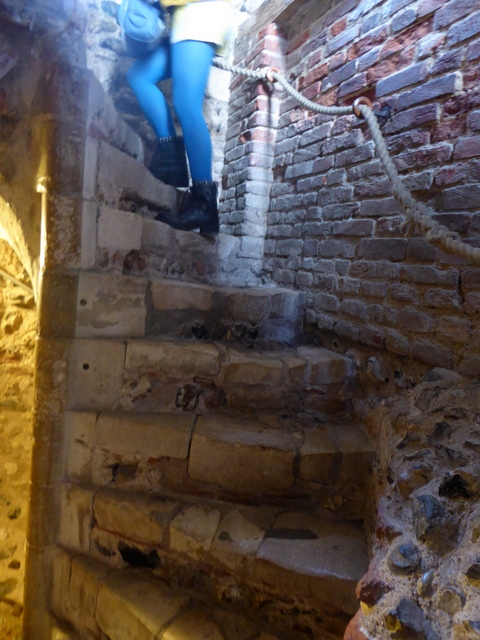
Looking up the stairs as Elinor climbs up ahead of me.
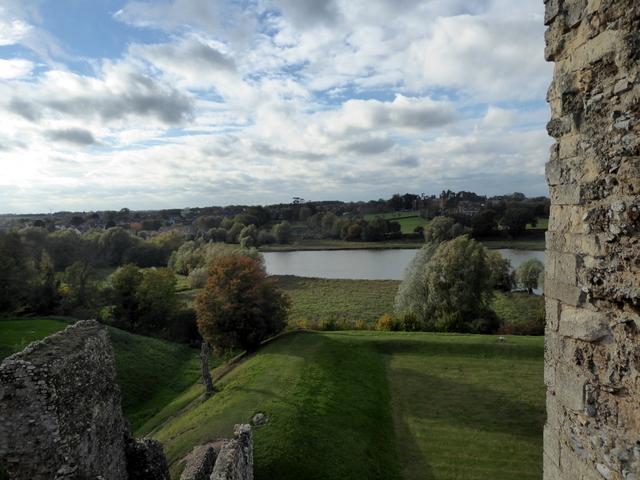
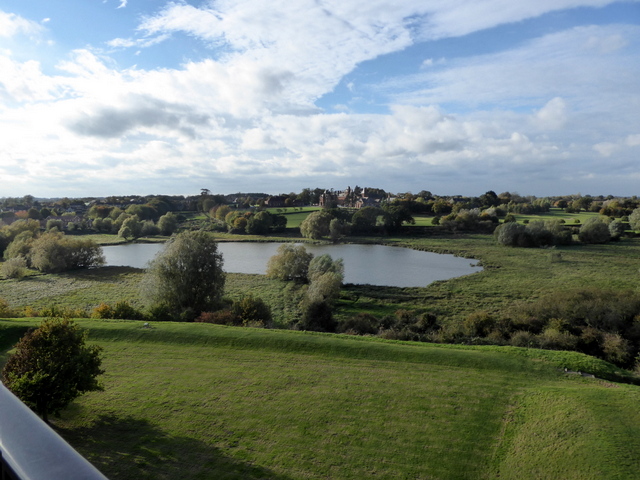
Looking towards Framlingham Mere from the wall walk
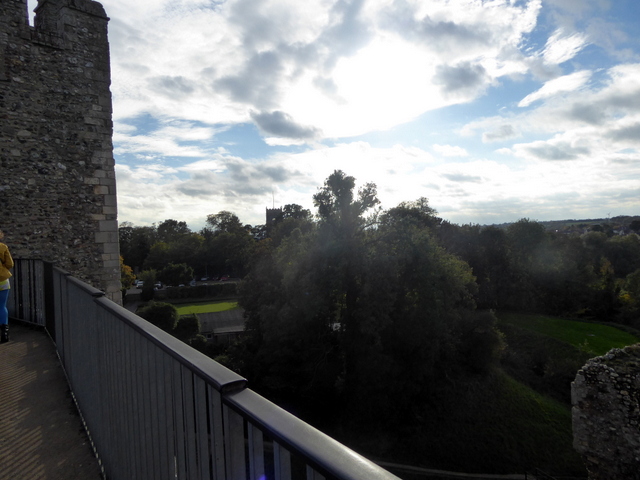
Looking towards the town. The church tower is in the centre of the photo.
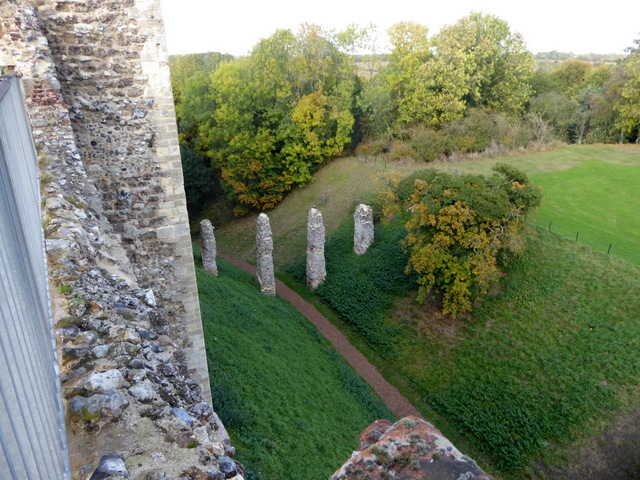
Looking down into the inner ditch.
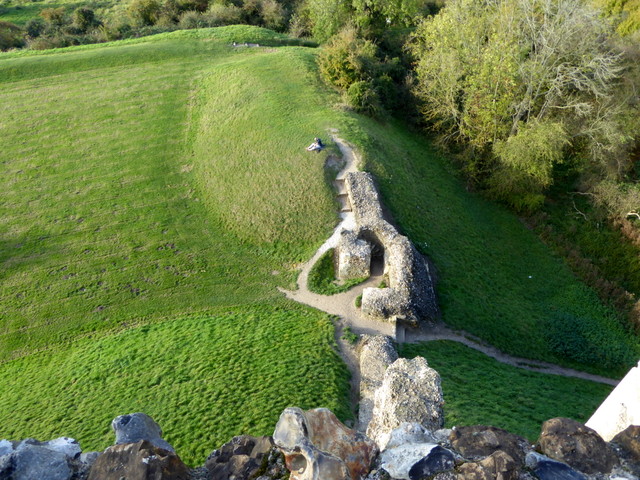
The remains of the western tower which protected the castle from attack from the west. Also known as the Prison Tower.
Looking down into the Inner Court.
Here is a slideshow of a few views from the wall walk.
This slideshow requires JavaScript.
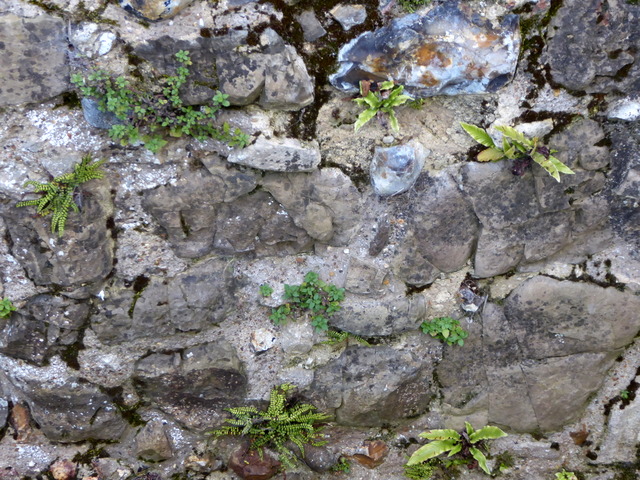
Hart’s-tongue Fern (Phyllitis scolopendrium ), Maidenhair Spleenwort (Asplenium trichomanes ) and other plants growing in the castle wall.
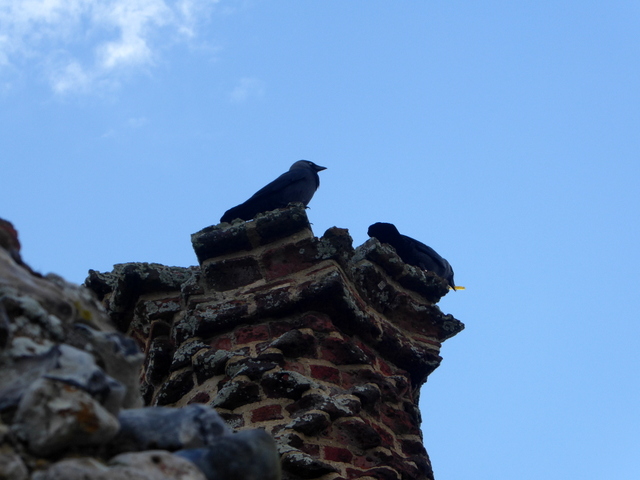
Jackdaws (Corvus monedula ) were still nesting in the chimneys of the castle.
The white pillars are the remains of a Tudor bridge.
Just outside the curtain wall and built at the same time, is the Lower Court. It was walled on all sides and was defended by two towers. It may have originally housed granaries, barns or stables.
Framlingham Mere and beyond it, behind the trees is Framlingham College.
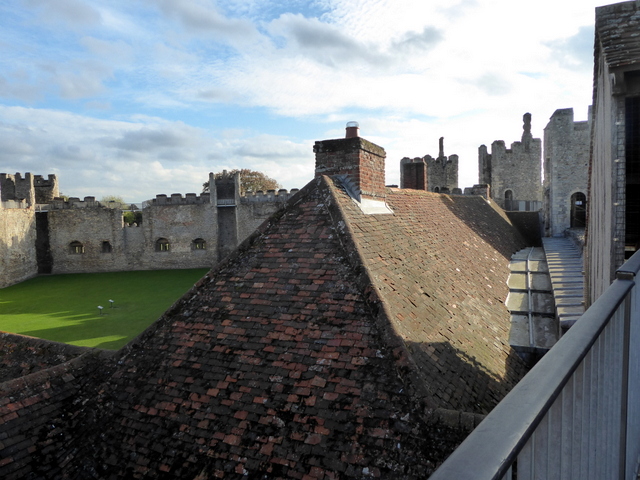
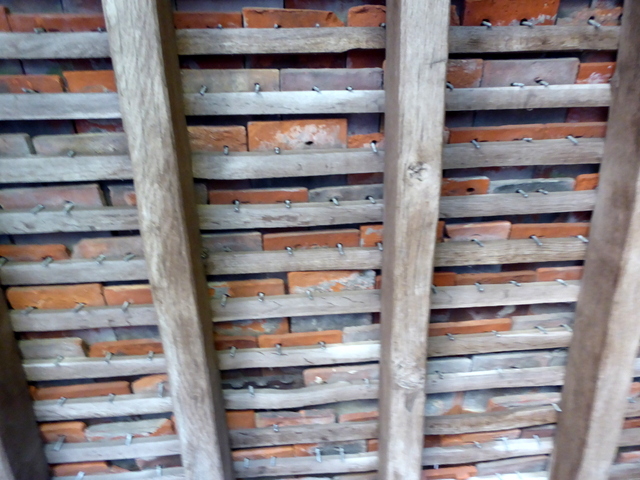
The roof of the Poor House
The underside of the roof . You see how the slates are attached to the rafters.
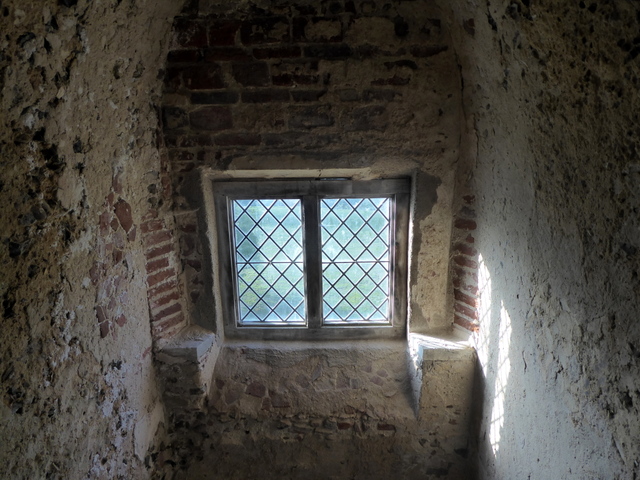
One of the windows in the Poor House
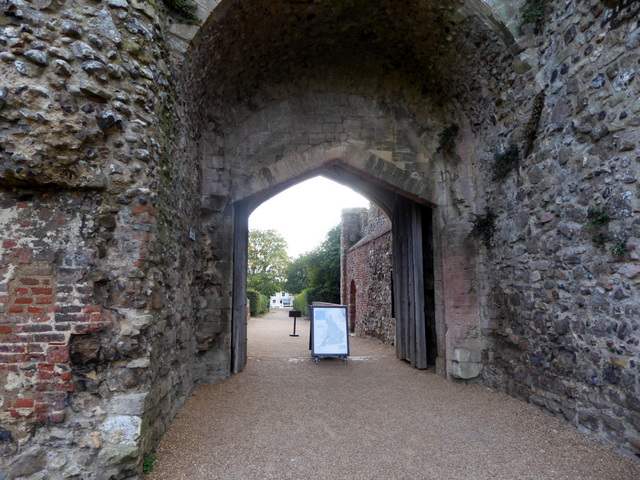
The Gatehouse as we left the castle
We enjoyed our short visit to the castle and went next to the church which I will talk about in another post.
The singer Ed Sheeran, who grew up here, has brought many more visitors to the town than it had before. Here is his recent song, ‘Castle on the Hill’ which talks about the time he lived in the town. The young people acting in the video are members of Framlingham College.
Richard was with us for sixteen and a half years and looked after us well. We are a large (in area) benefice consisting of eleven parishes with eleven ancient churches; and I really mean ancient! Richard not only worked very hard to keep all these unique churches going despite many set-backs but also at the same time, managed to get us to think of ourselves as a team; a ‘federation’ of parishes. We help each other out whenever possible. He gave us thought-provoking sermons each week. His constant message was that all people are equal in the sight of God and all should have equal rights and opportunities. He is a fairly shy and self-effacing man but who also would not put up with thoughtless, careless and bad behaviour from anyone. He has an encyclopaedic knowledge of films and often quoted from them in his sermons. He is a talented artist and has also written a book about a pilgrimage he made in France. He can also tell the most awful and funny jokes! He supported all our individual fund-raising efforts and provided us and our churches with all sorts of different things that have been of invaluable service. He cleaned, polished, mended, tidied and adorned our church buildings. He designed our website and kept it up-to-date. He edited our benefice magazine and often wrote most of the copy, got people to advertise in it and sent it off to be printed. He ran a coffee morning once a month in his home and made marmalade, cakes and breads for us. He fought on our behalf with anyone who tried to make our lives more difficult. He researched the history of all our churches and was extremely knowledgeable about their architecture. At the centenary of the start of World War I he presented each of our churches with a Remembrance folder containing information on all the men (and women) from each parish who are mentioned on the war memorials.
This is only a fraction of all he has done for us. Like children, we accepted it all and often took him for granted. We now have to fend for ourselves for goodness knows how long.
Richard’s last service was the mid-week said Eucharist at 9.00 am on Thursday at Ilketshall St Margaret’s church. Usually, there are less than ten people who attend this service. This Thursday the church was nearly full with representatives from most of the churches in the benefice. Richard asked us where we’d all been for the past 16 years! A good question! After the service we presented him with a gift and sang happy birthday to him. We had sherry to drink and Pam had made a delicious fruit cake. We chatted and laughed and then it was over.
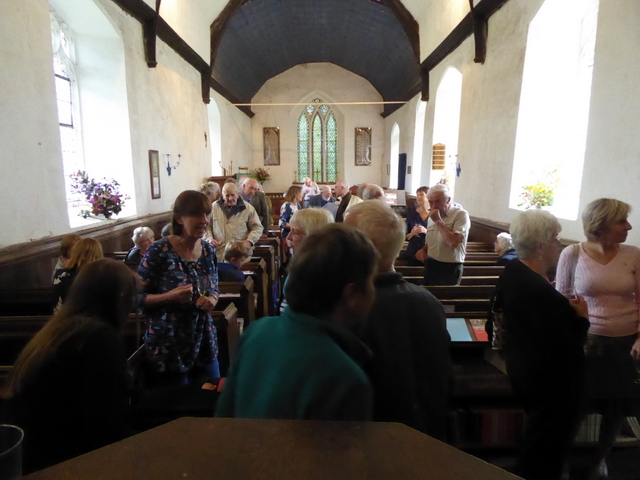
Looking towards the East end of the church. Some of the people at Richard’s last service.
Looking towards the back of the church. You can see Richard in the centre of this photo.
Goodbye and good luck, Richard. We will miss you very much.
As you know, we have been busy with home improvements this year so haven’t had the time to go on our usual walks very often and I haven’t taken as many photos as usual. Richard and I did manage a walk or two in April along the lanes and over the fields.
Our local farmer has taken to sheep farming in recent years and this year he coppiced many of his overgrown hedges and then waited to see what came up again. He has selected the plants he wishes to retain in the hedges and has cut out the rest. He has put up stock fencing next to the new slim-line hedge and all is looking very different now.
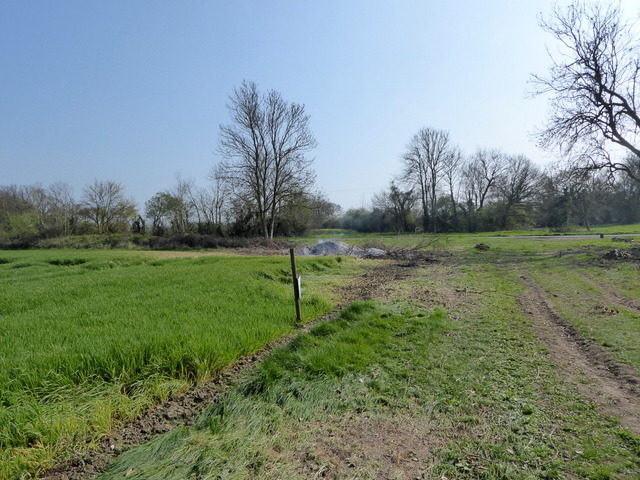
We took our usual walk across the fields just after the coppicing had been done. All the heaps of wood were burnt and you can see a smouldering heap of wood-ash in the centre of this picture.
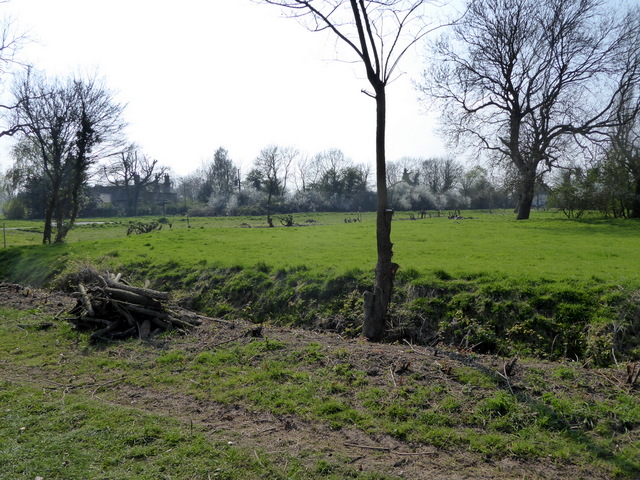
The last time we had walked this route there had been a thick hedge just in front of the ditch in the foreground.
I was quite concerned about the loss of the hedges because they are usually full of nesting, singing birds in the spring. However, the farmer does care about the local wildlife and had left reassuring notices next to the ex-hedges stating what he was intending to do.
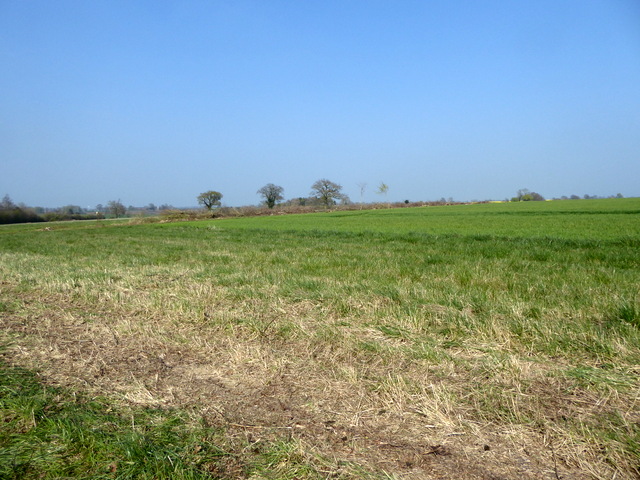
A view across the open fields. This walk was taken at the beginning of April while the weather was still bright and warm.
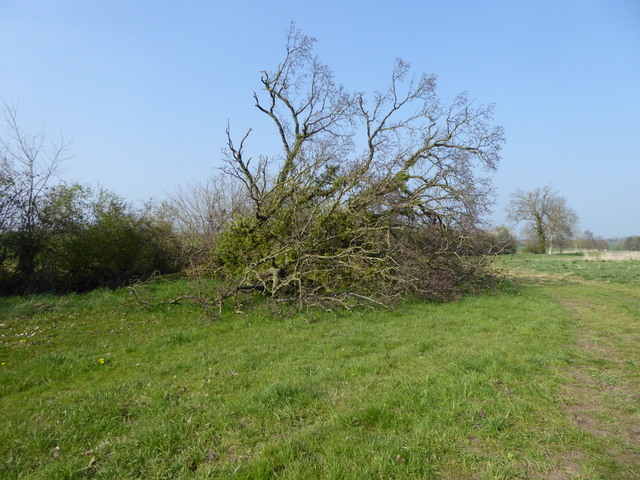
This oak tree had been blown down in storm ‘Doris’. The green you can see is the ivy that had been growing up the tree trunk. Most healthy trees can cope with ivy growing on them and this one had seemed to be healthy.
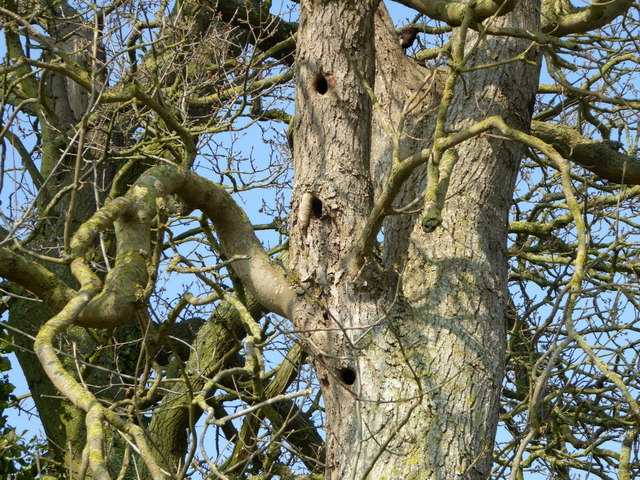
An upright tree this time, with holes it in, probably made by woodpeckers.
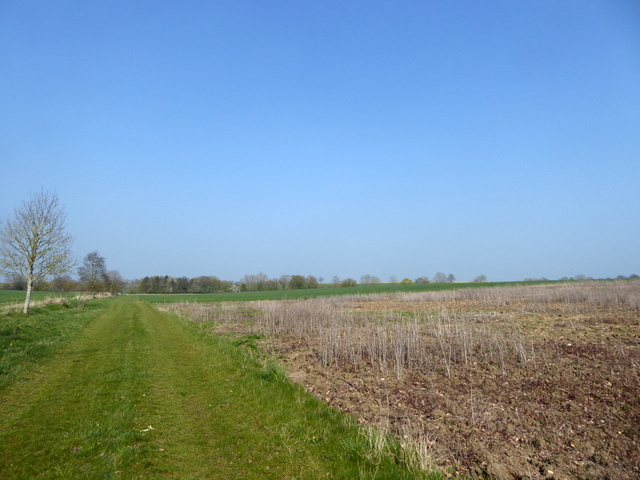
Another view of the fields and that blue sky!
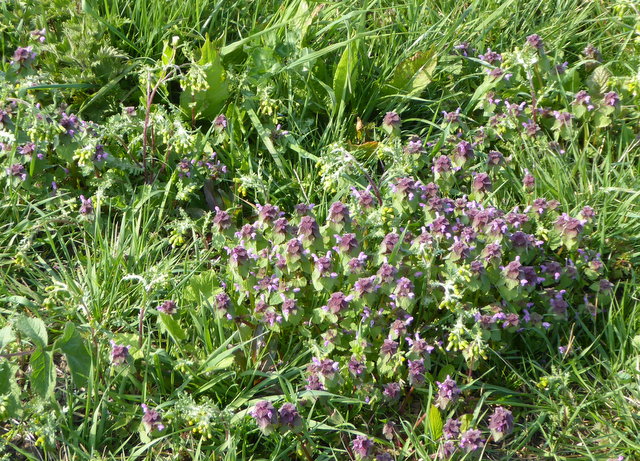
Red Dead-nettle (Lamium purpureum) and Groundsel (Senecio vulgaris)
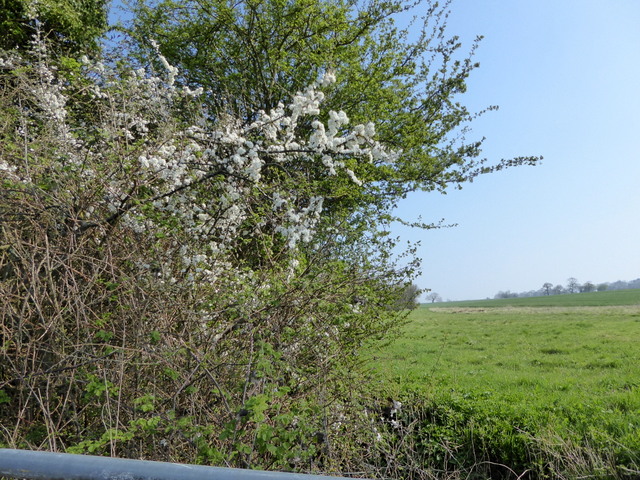
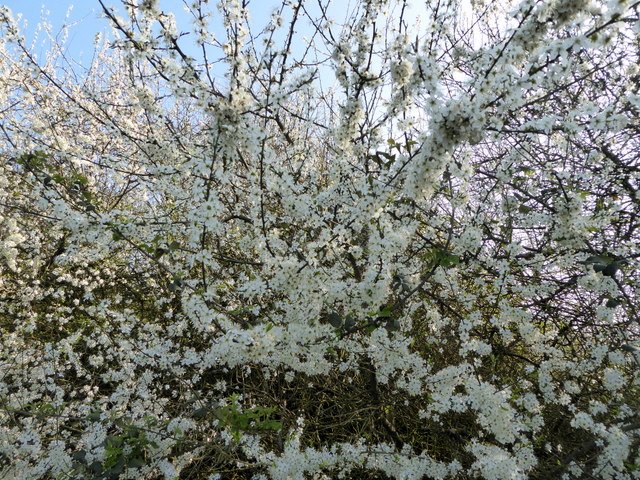
The Blackthorn blossom (Prunus spinosa) was very good this spring.
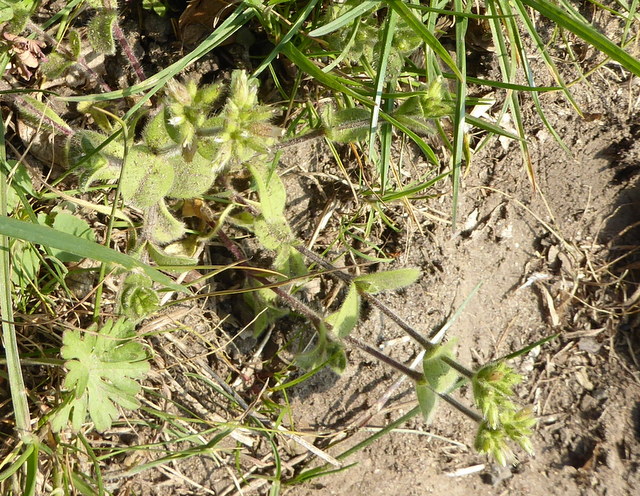
This rather dull and unassuming little plant (not a clear photo, I’m afraid) has the interesting name of Sticky Mouse-ear (Cerastium glomeratum)! The leaves are the shape of a mouse’s ear and they are also sticky as you can see in the photo; the leaves are covered with grains of sand.
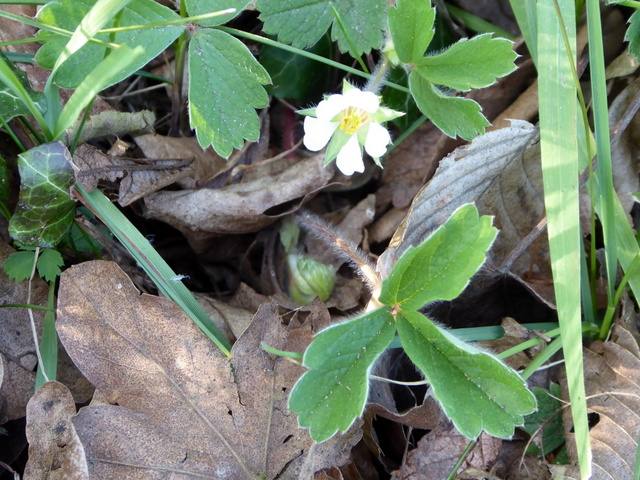
I found yet another Barren Strawberry plant. (Potentilla sterilis)
It is easy to tell the difference between a Wild Strawberry and a Barren Strawberry even if there are no flowers to be seen. The leaves of the Barren Strawberry are a mid-green colour and are matt whereas the Wild Strawberry leaves are shiny and yellow-green. The leaves of both plants are toothed but the Barren Strawberry’s terminal tooth (the one at the tip of each leaflet) is smaller and shorter than the ones next to it. You can see this quite clearly on the photo above. The Wild Strawberry’s terminal tooth is as long as or longer than the ones next to it. The flowers are different too. The Barren Strawberry flowers have large gaps between the petals and the sepals are clearly seen in the gap. The Wild Strawberry’s petals are close together and the sepals are hidden behind them.
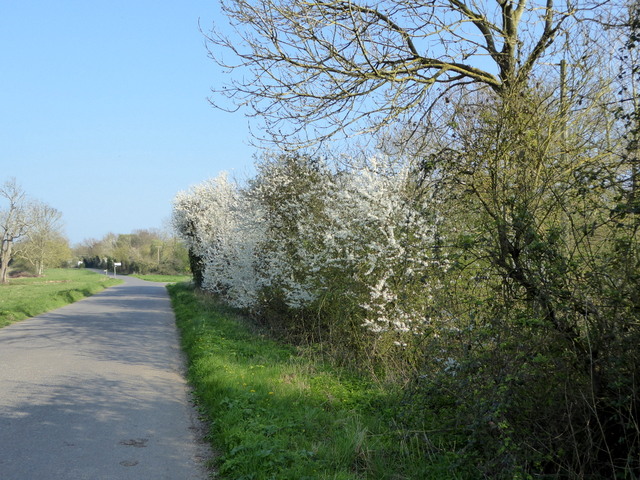
A Blackthorn hedge in flower
A view of St. Peter’s church tower in the distance
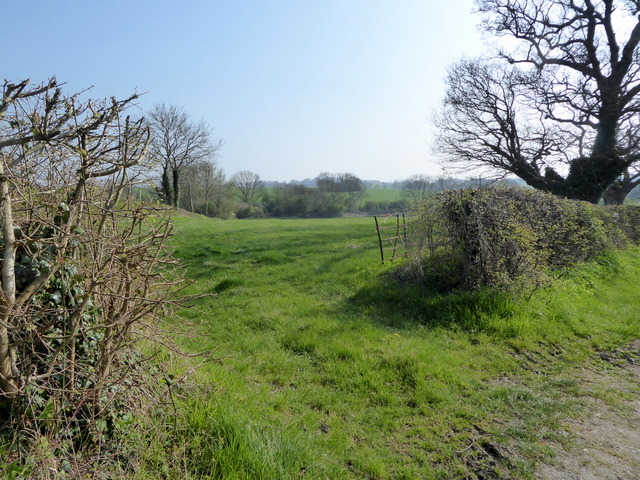
One of my favourite views through a gap in the hedge
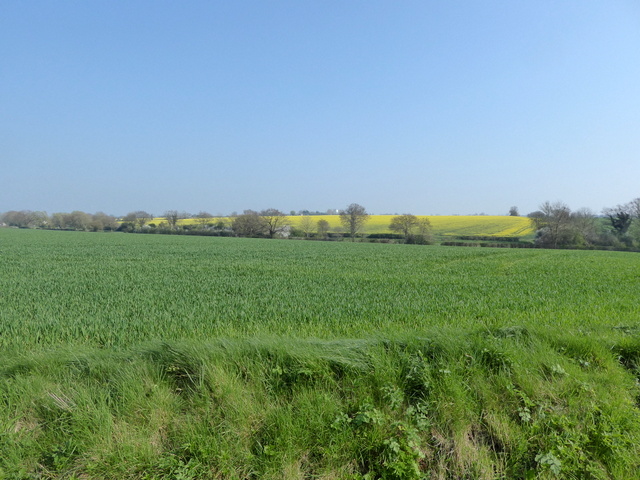
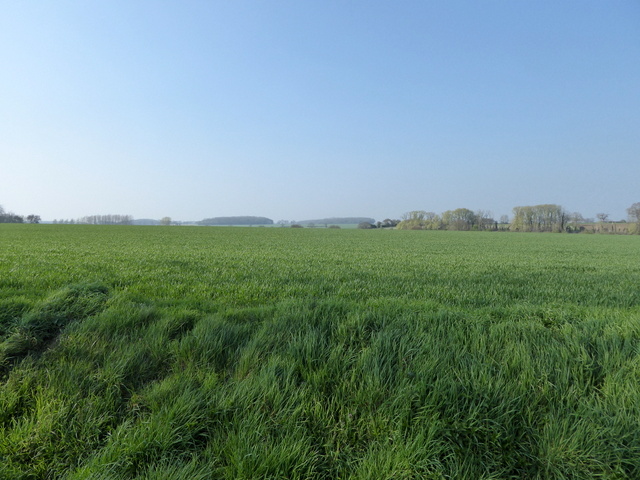
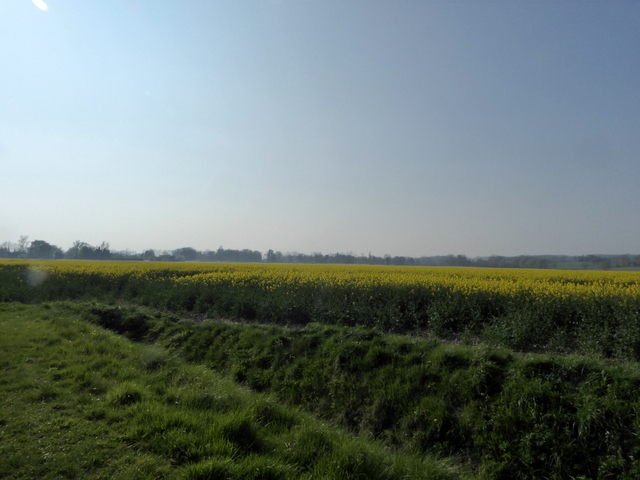
Another view from our walk. The field close-by has barley or wheat growing in it; the yellow field in the distance is of oil-seed rape.
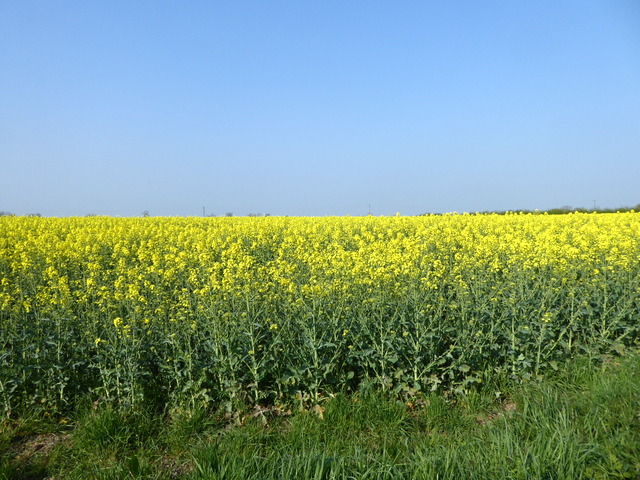
A field of Oil-seed Rape
This photo is of the bank of a ditch and shows the lumps of chalk that can be found in the clay soil here
The verge at the side of the lane was covered with Lesser Celandines (Ficaria verna)
Another view across the fields…
…and another!
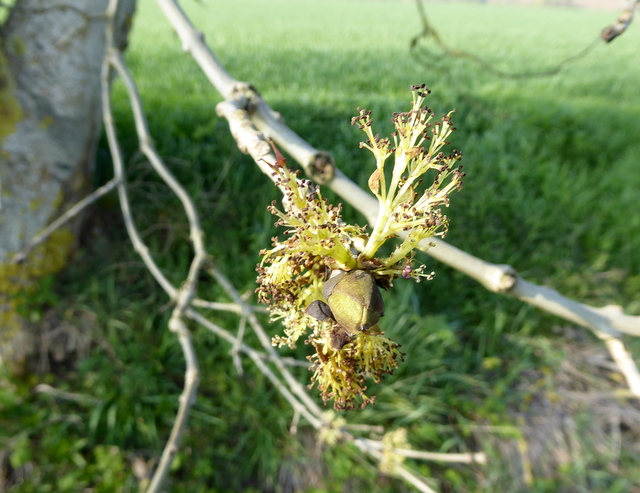
Ash tree flowers ( Fraxinus excelsior)
Most of our fields are surrounded by deep ditches.
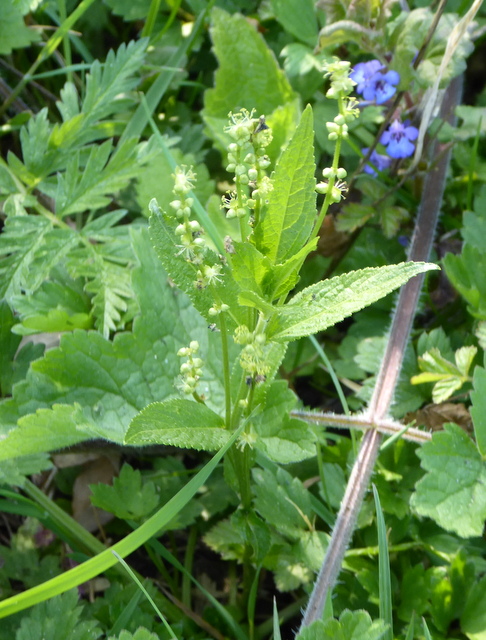
Annual Mercury (Mercurialis annua)
Most of the Mercury that grows here is the perennial Dog’s Mercury which is found in (sometimes) large swathes under hedges and in the woodland. The Mercury in the photo above is the Annual Mercury which doesn’t grow in swathes and is branched (unlike the Dog’s Mercury). It is not a native plant but has been here for at least 1000 years, introduced from mainland Europe.
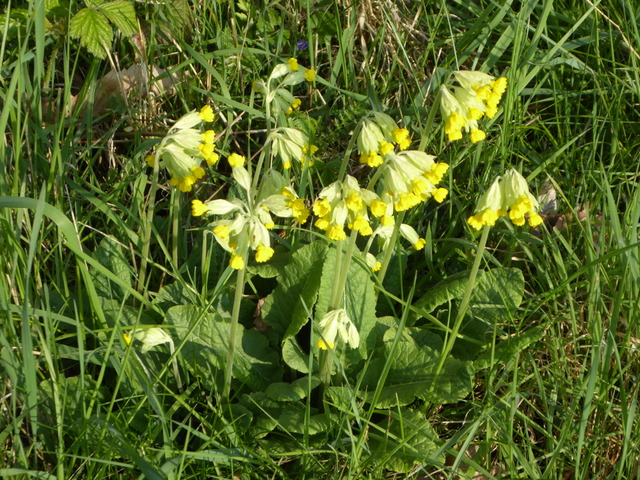
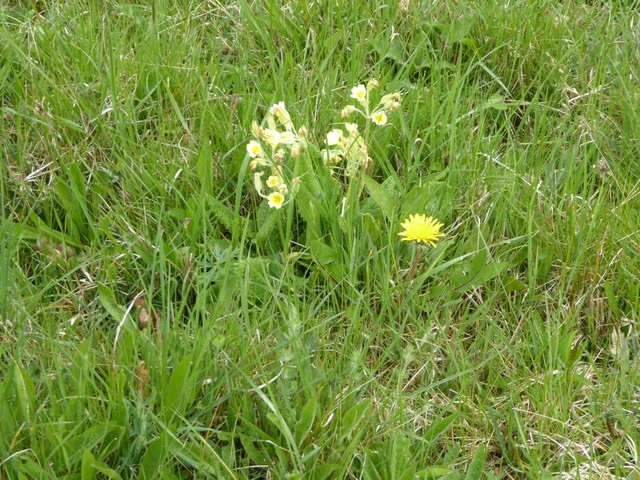
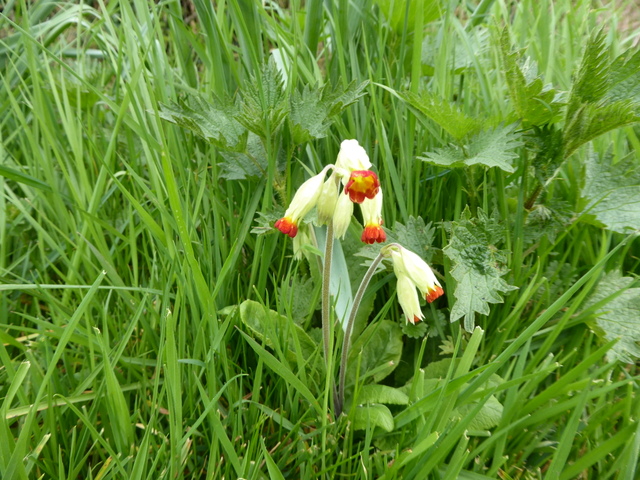
Cowslips (Primula veris)
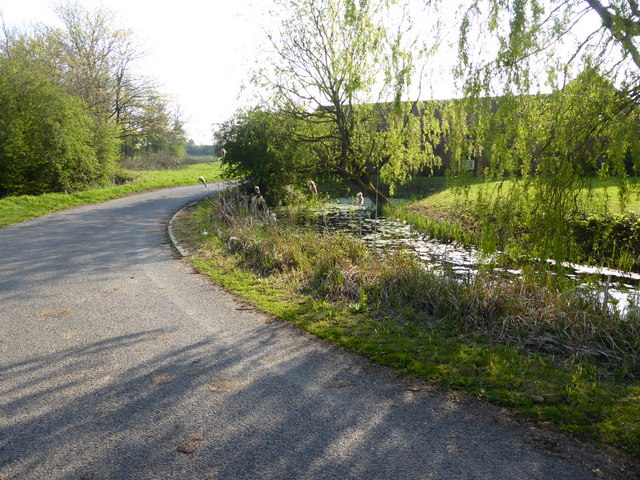
A pond at the side of the lane
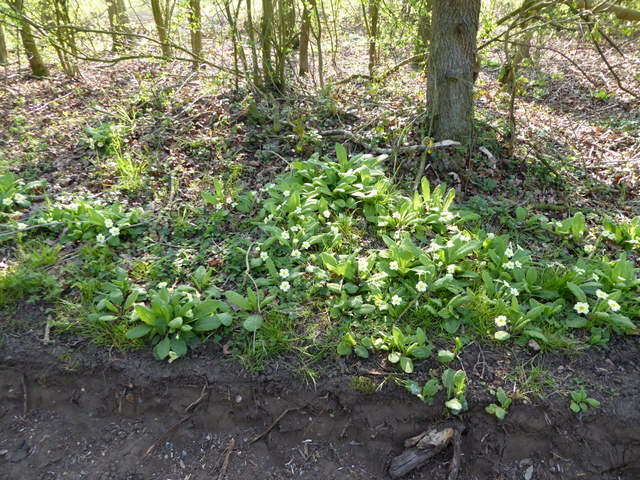
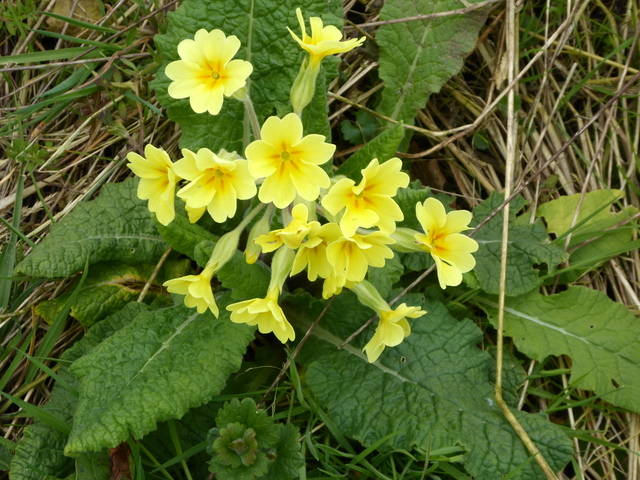
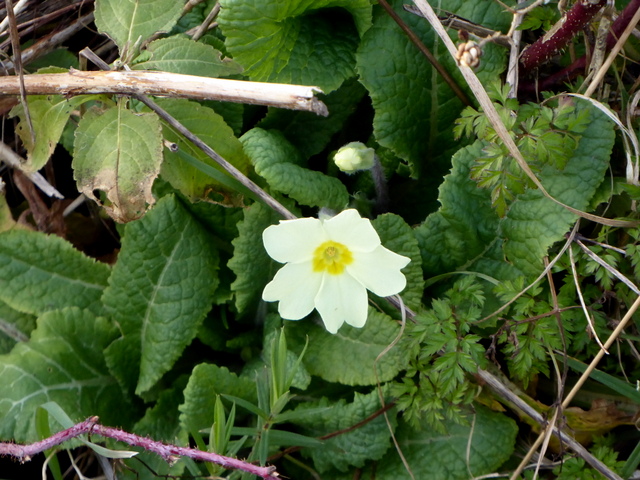
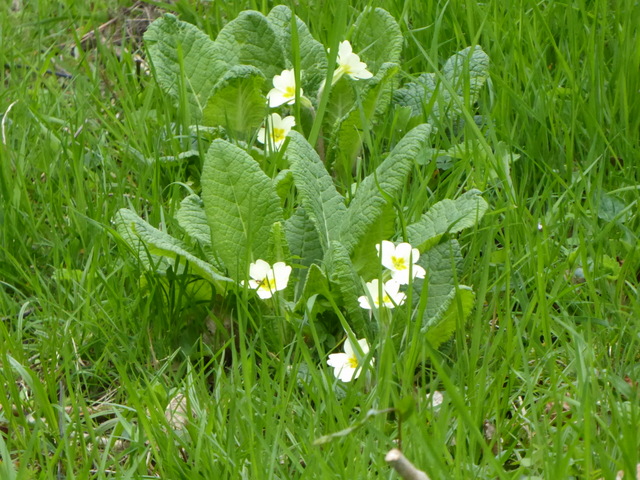
The last of the Primroses (Primula vulgaris)
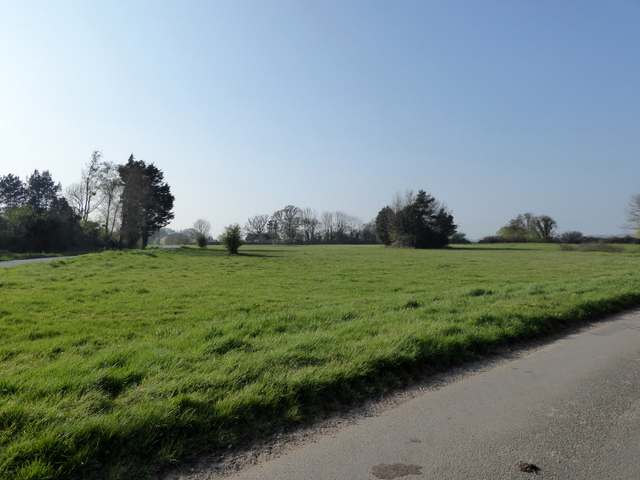
Part of St. Margaret South Elmham common
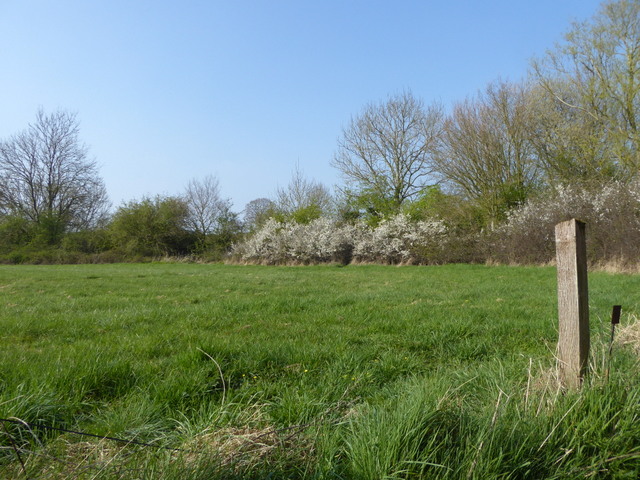
Another Blackthorn hedge
Blackthorn blossom
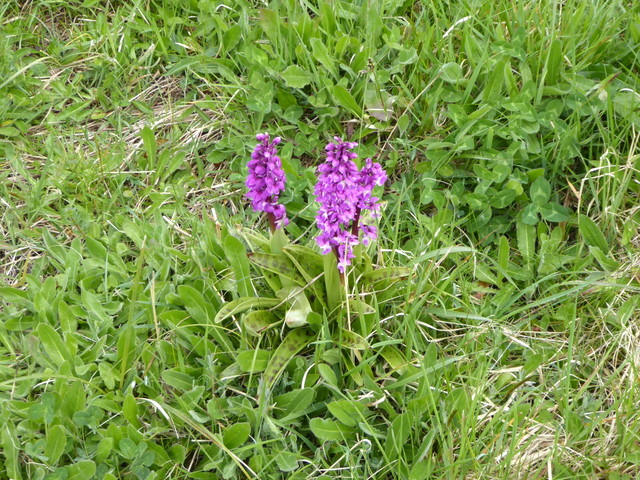
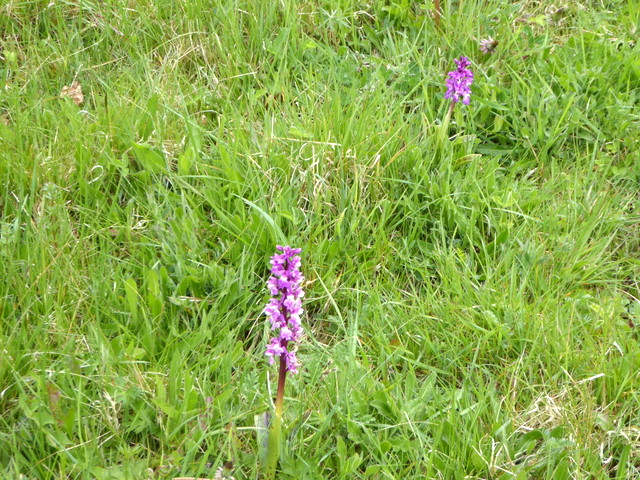
Another short walk we took was to view the orchids flowering along the verge near to us.
Early Purple Orchids (Orchis mascula)
Early Purple Orchids
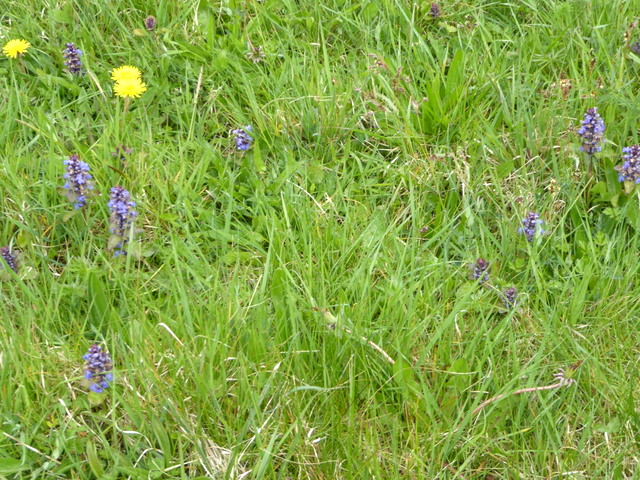
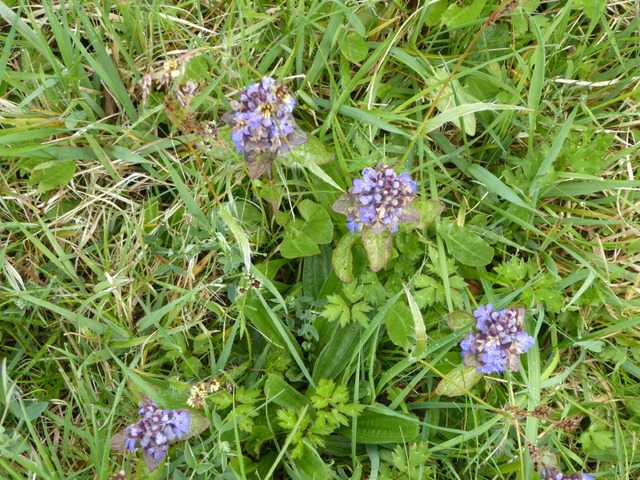
We also saw purple Bugle (Ajuga reptans) and Dandelions (Taraxacum agg.)
Bugle
This seems to be a Cowslip/Primrose cross
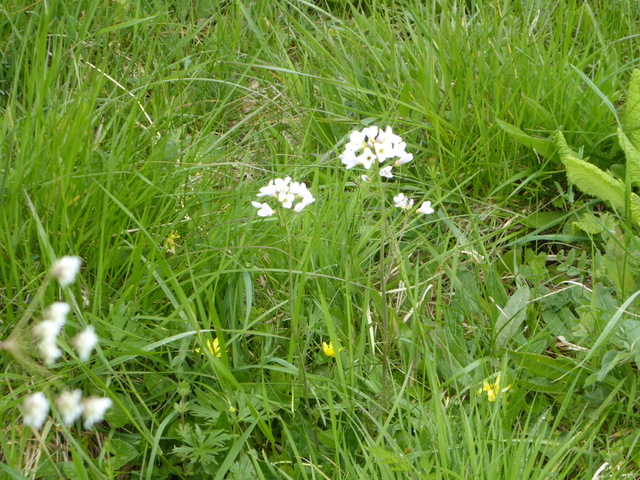
An over-exposed and out-of-focus photo of Lady’s-smock/ Cuckooflower (Cardamine pratensis)
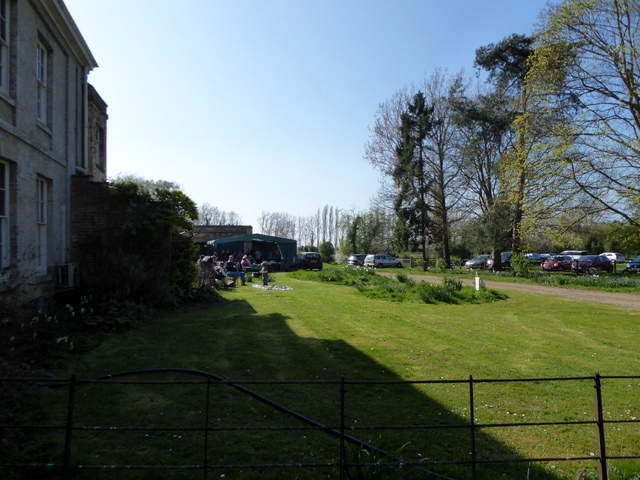
Richard and I also called in at our neighbour Cordelia’s Daffodil Sunday when every year she opens her beautiful garden to the public in aid of St. Margaret’s church.
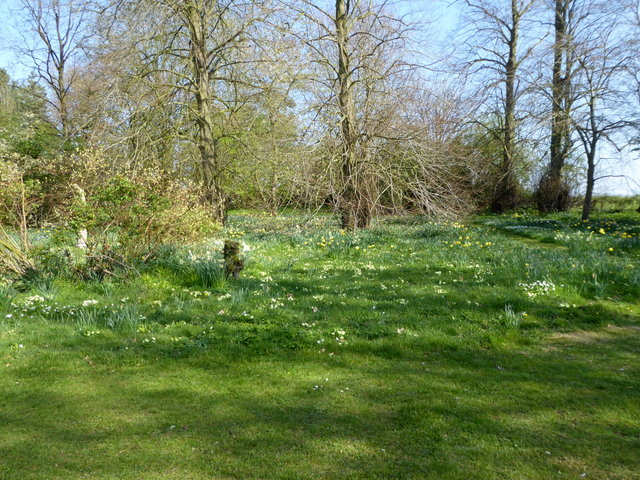
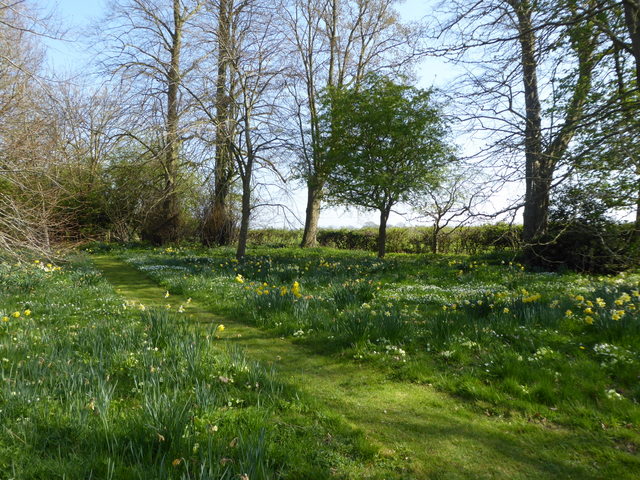
Her garden is full of spring flowers
The weather was perfect for the open garden this year
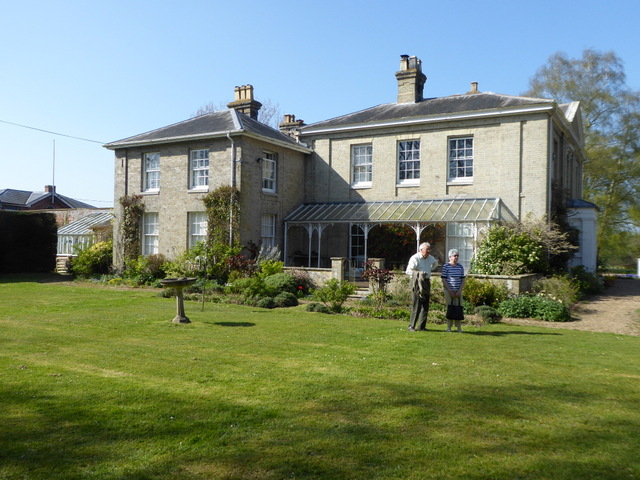
The Old Rectory
Looking towards the church from the Old Rectory
More flowers
Daffodil Sunday
Daffodil Sunday
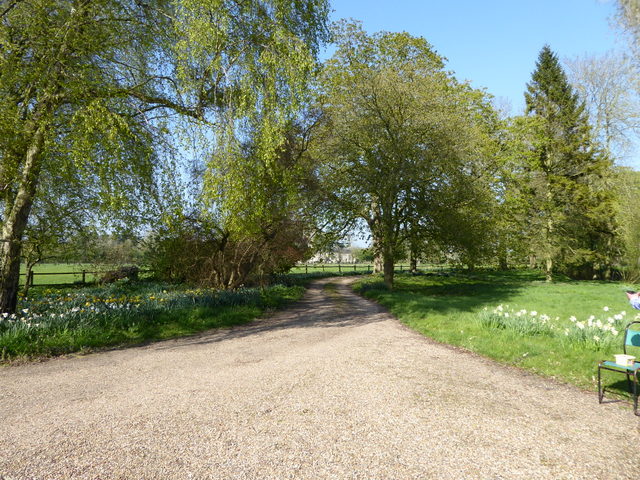
The drive up to the house
I apologise for the length of this post!
My music choice this time is ‘The Banks of Green Willow’ by George Butterworth
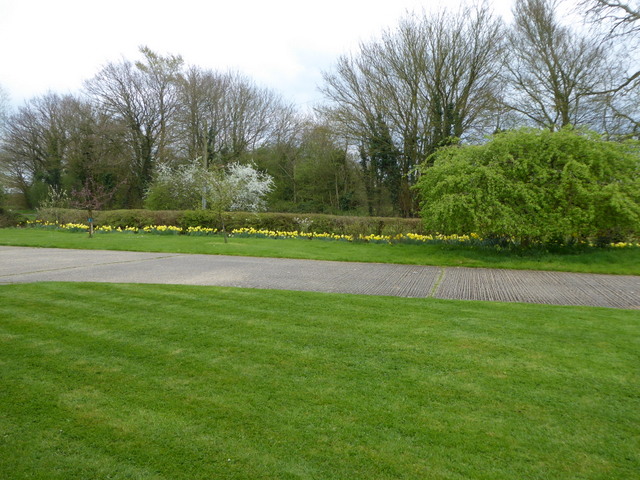
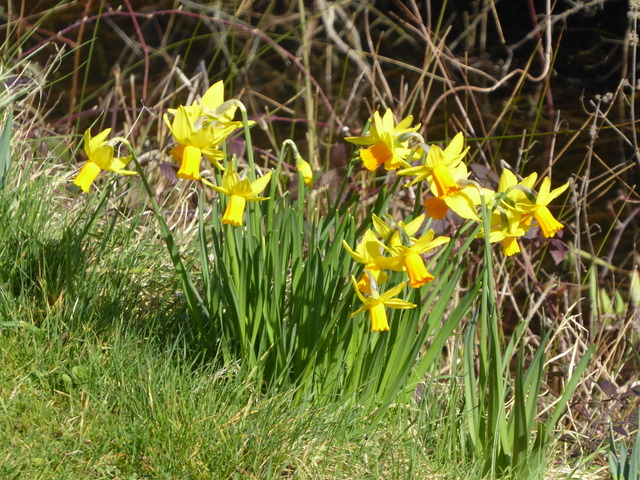
The daffodils this spring were marvellous! We had a few warm days at the beginning of April that brought the flowers forward and then from Easter onwards the weather was decidedly chilly. Very dry but chilly and with very little sunshine.
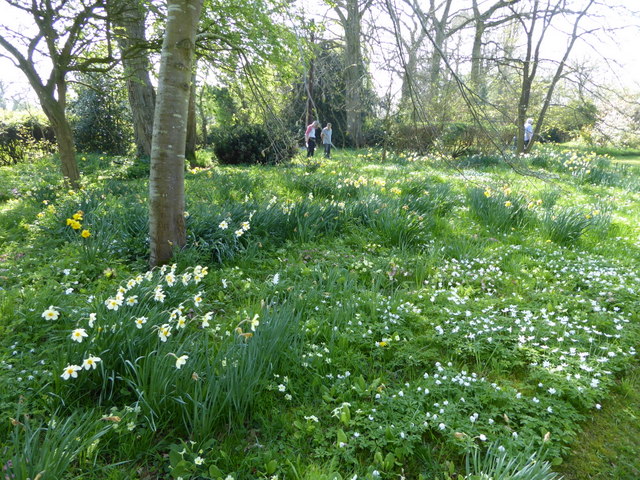
The white daffodils look just like butterflies when a breeze catches them! Most of these flowers are scented as well.
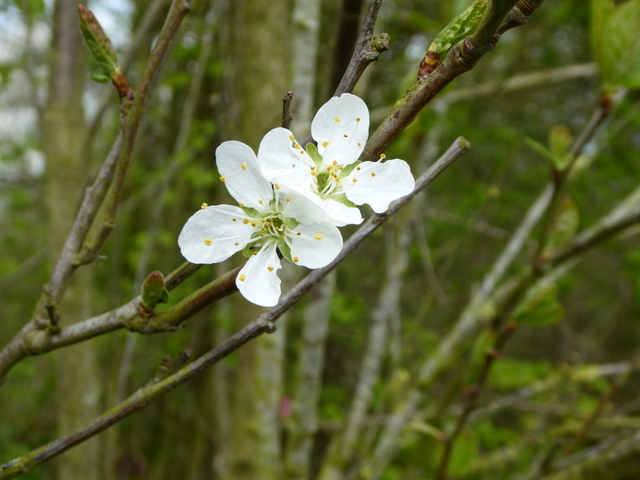
The blossom on the fruit trees was good this spring.
Wild Cherry
Wild Cherry blossom
Weeping Crabtree
Weeping Crabtree blossom
Crabtree ‘Evereste’
‘Evereste’ blossom
Crabtree ‘Harry Baker’
‘Harry Baker’ blossom
Greengage
Greengage blossom
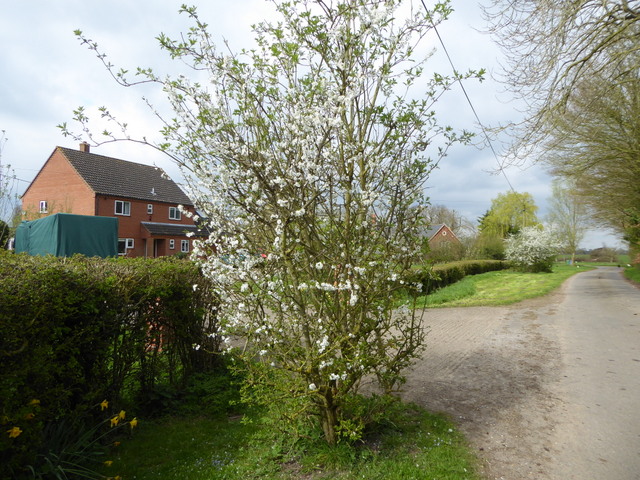
Damson blossom
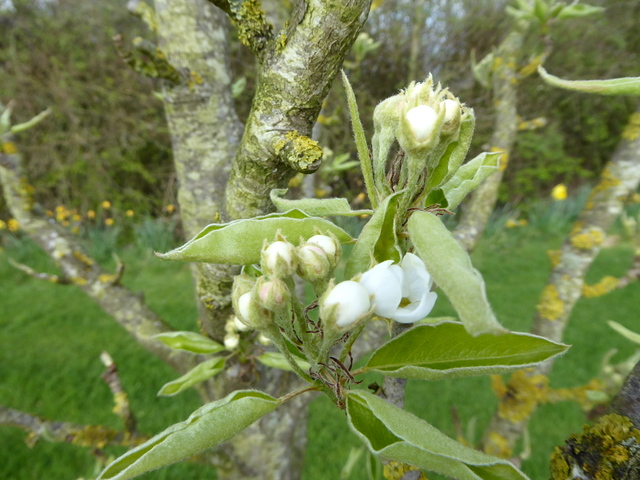
Pear ‘Concorde’ blossom
Other trees with blossom looked wonderful this spring too.
Amelanchier
Amelanchier blossom
The Blackthorn at the end of our drive
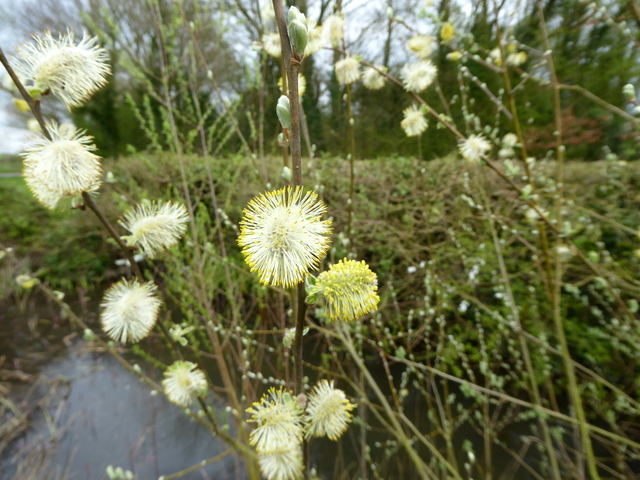
The Pussy Willow was covered in fuzzy flowers
I took photos of some of the plants in the garden.
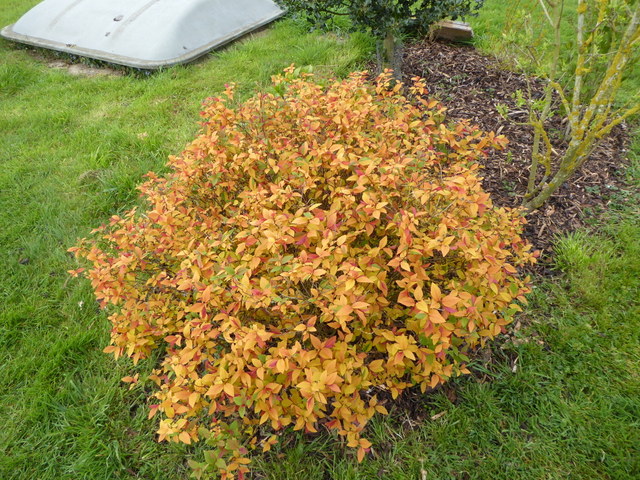
The Spirea in Richard’s new shrub border was very bright and beautiful.
A pretty primula had planted itself in one of the ditches that surround our garden
We have a number of orange and red cowslips that grow here and there about the garden. I have started to gather them into one place so they don’t get mowed before they set seed.
The King-cups on the bank of the pond looked cheerful.
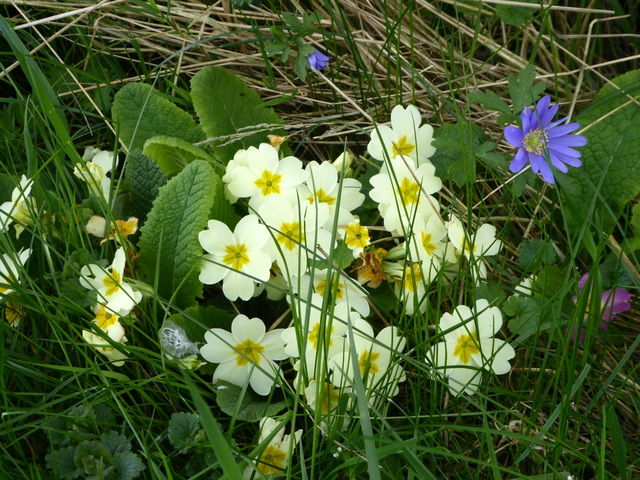
Primroses and Anemone blanda
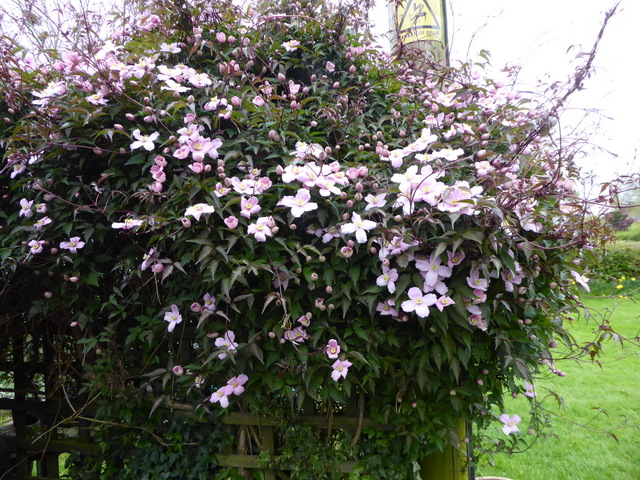
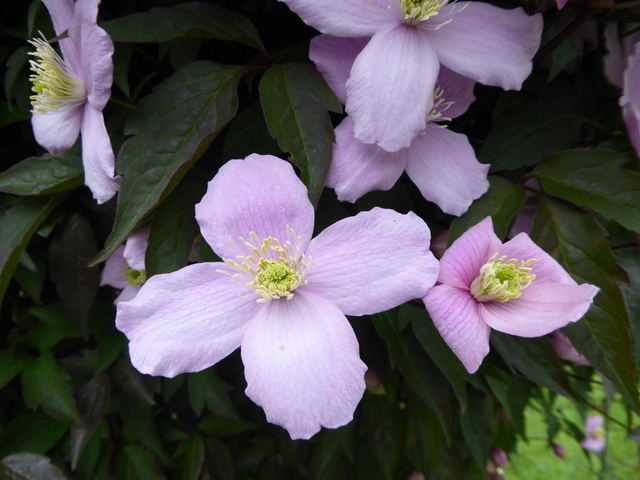
The clematis flowered at the end of the month and filled the garden with scent.
Clematis flowers
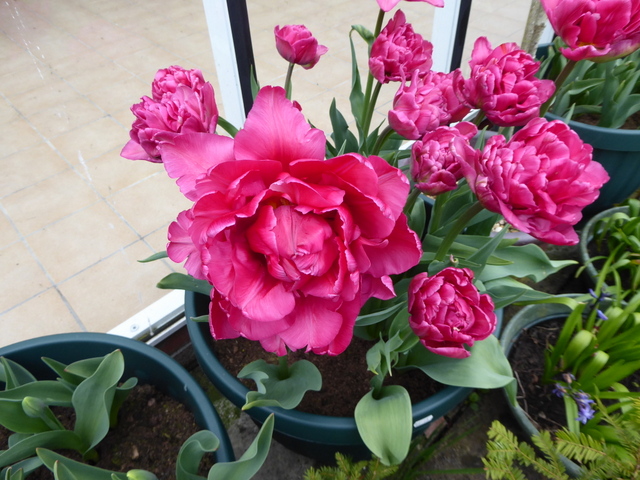
Last autumn I ordered some tulips and planted them in large tubs. I was glad I did when I saw the damage the deer had wreaked on those planted in the borders! I covered the tubs in wire mesh and left them at the back of the house to over-winter. I had no mouse, vole or deer damage at all!
These lovely tulips look more like peonies! Because of the cool spring they were in flower for nearly a month.
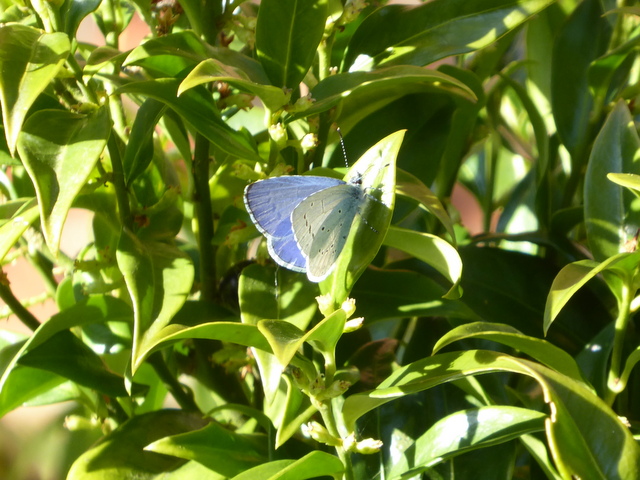
This is a male Holly Blue butterfly (Celastrina argiolus). There were a number of these flying in the garden at the end of April.
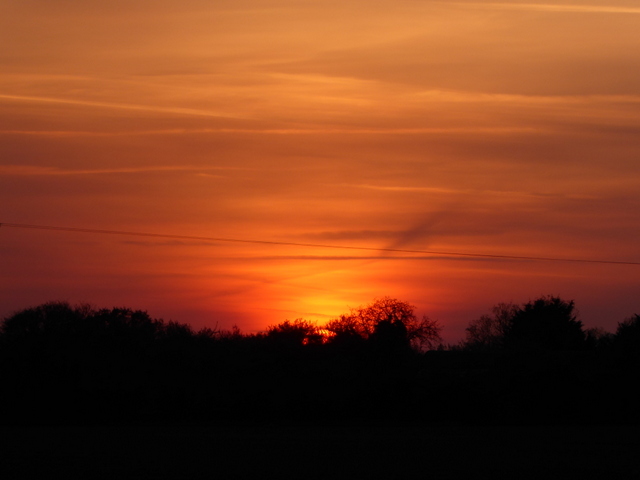
A sunset seen from the back of the house
This post has taken me weeks to write because I have been so busy and tired! I thought about abandoning it a couple of times because of its lateness but decided to post it after all and I hope you will forebear with me.
My choice of music is ‘Schmetterling’ (Butterfly) by Grieg, one of his Lyric Pieces.
We weren’t very adventurous this spring, staying close to home and taking things easy, so there wasn’t too much to blog about.
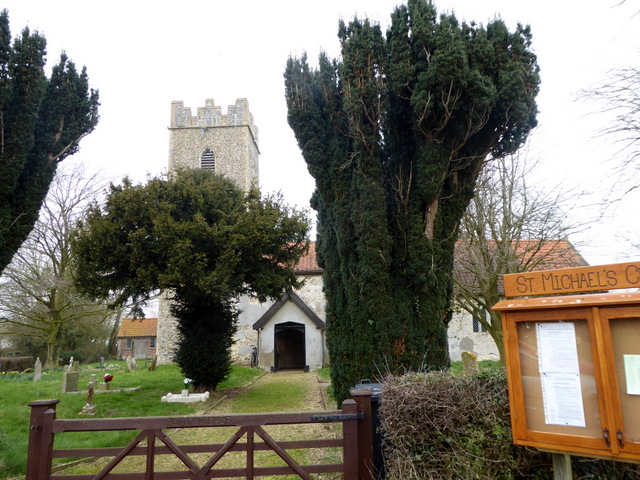
A visit to St Michael’s church on the first mild spring day in March
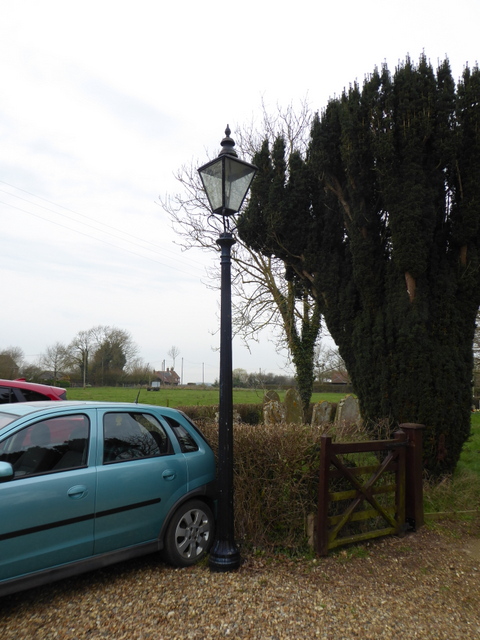
We admired the ‘Narnia’ lamp post by the gate.
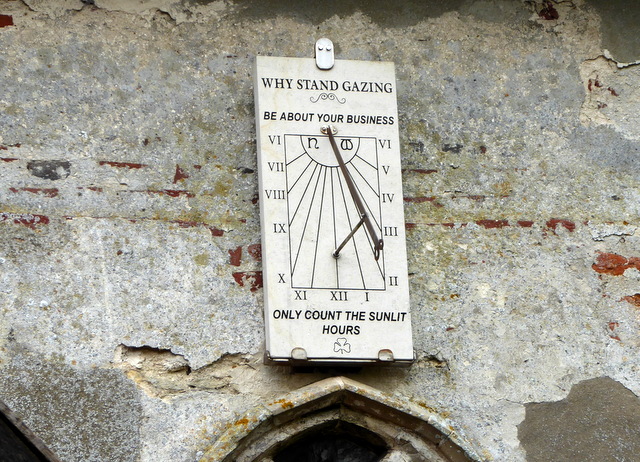
We were unable to tell the time as the sun failed to shine.
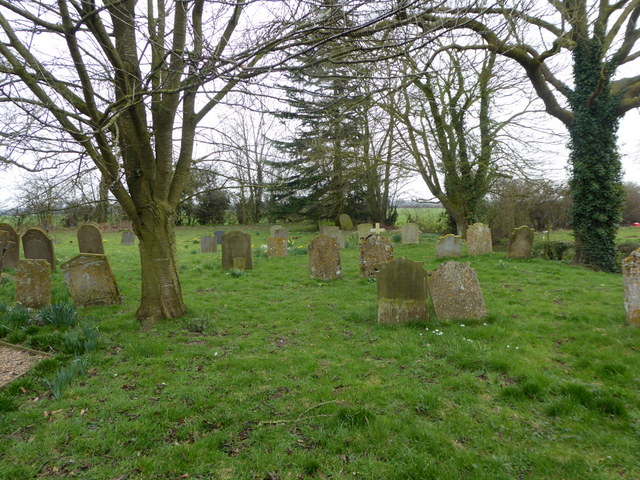
The peaceful churchyard.
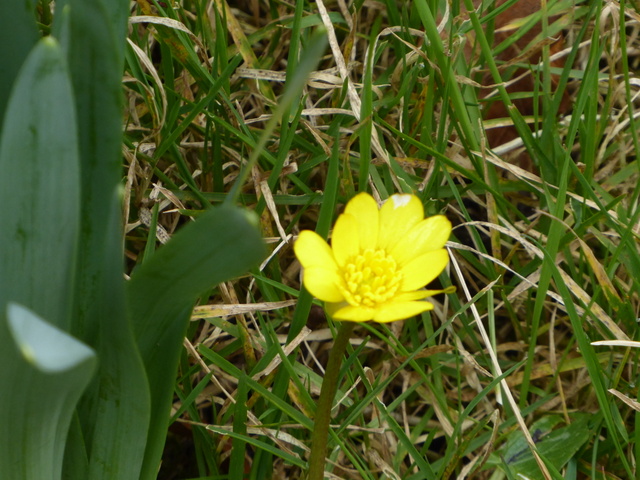
Marsh Marigold (Caltha palustris ) The flowers are in the centre of the bloom and have no petals. The 5 – 8 petal-like sepals are bright shiny yellow.
Peacock butterfly (Inachis io) It was very sluggish and was still in the grass outside the church when we came out again.
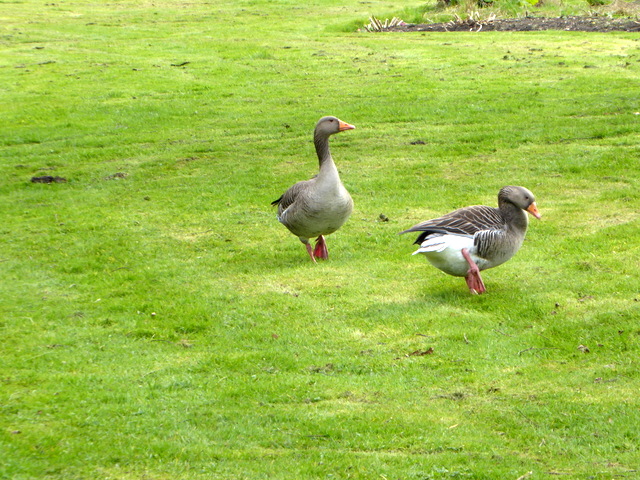
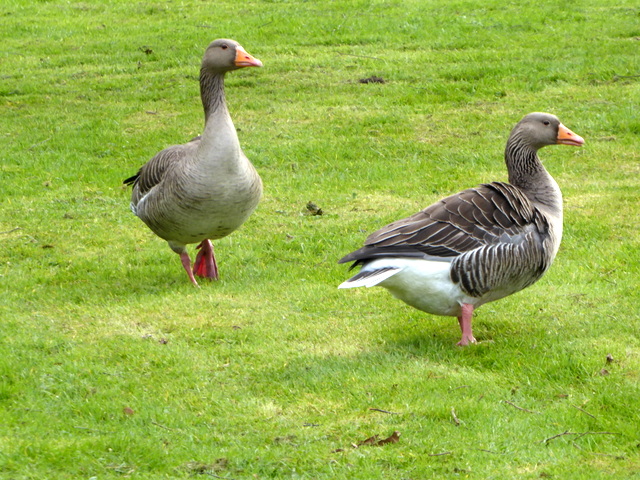
A pair of Greylags (Anser anser) took up residence in our garden as they usually do each spring
We enjoy their company.
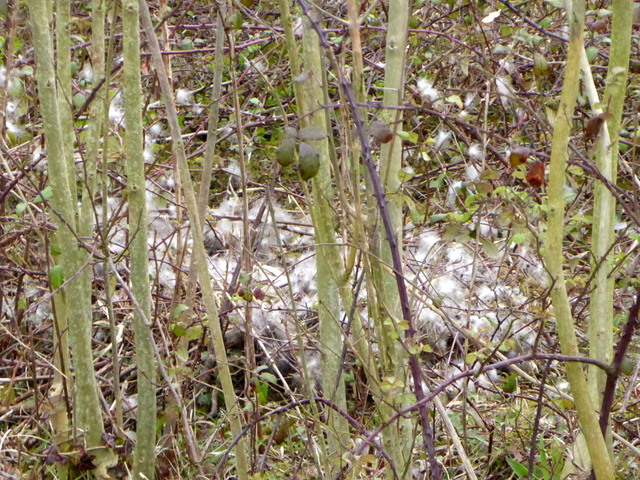
They constructed a nest on the island in the middle of the big pond but after ten days it was abandoned. Feathers were spread everywhere. We don’t know what happened but we suspect an otter or an American mink was to blame.
The abandoned nest.
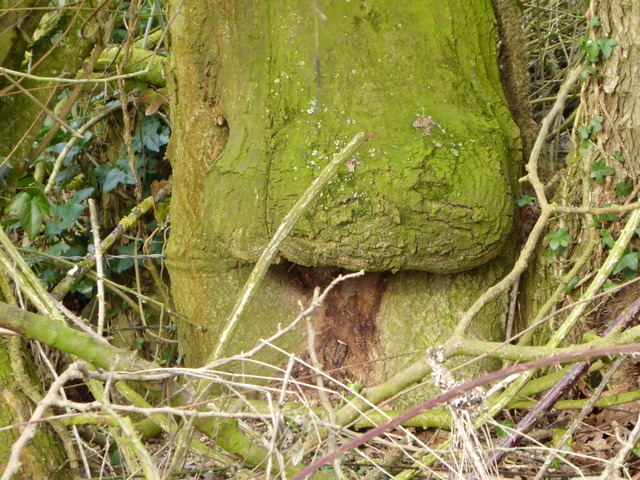
After we lost our summerhouse in the storm earlier this year we spent some time clearing the area behind it and discovered this tree with the deformed trunk. What could have caused this?
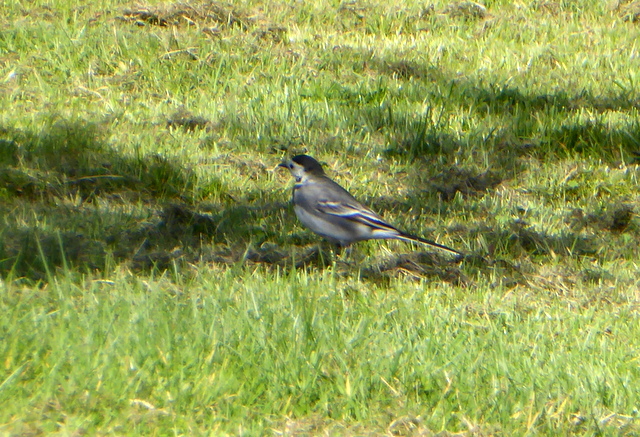
We enjoy seeing all the birds that visit our garden including the Pied Wagtails (Motacilla alba). Not a good shot as the bird hurried into the dappled shade just as I took its picture.
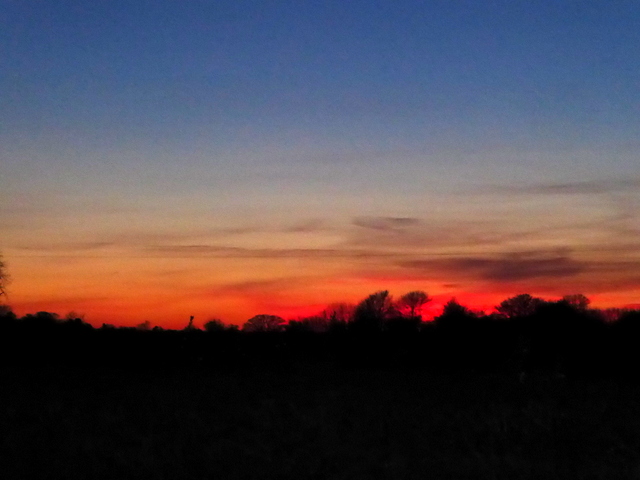
A sunset seen from the back of the house.
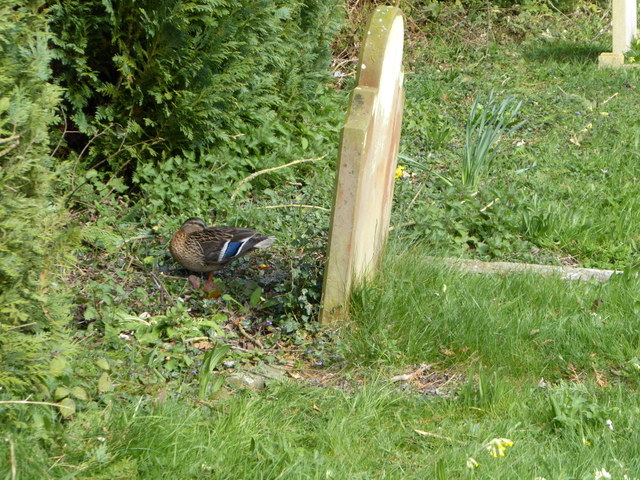
On a visit to our church at Rumburgh we saw this Mallard duck (Anas platyrhynchos) resting in the shade of a gravestone.
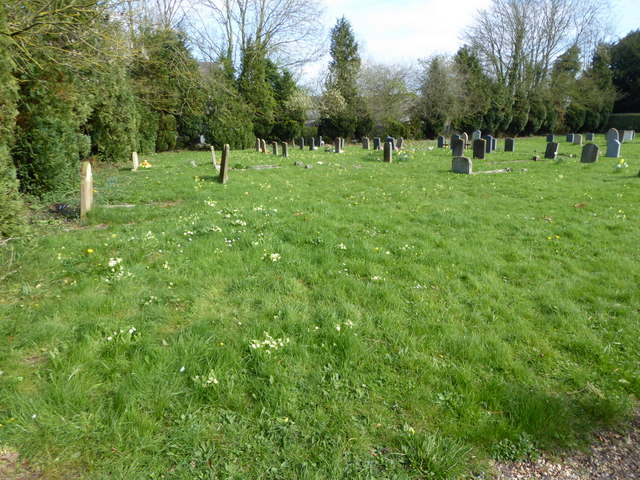
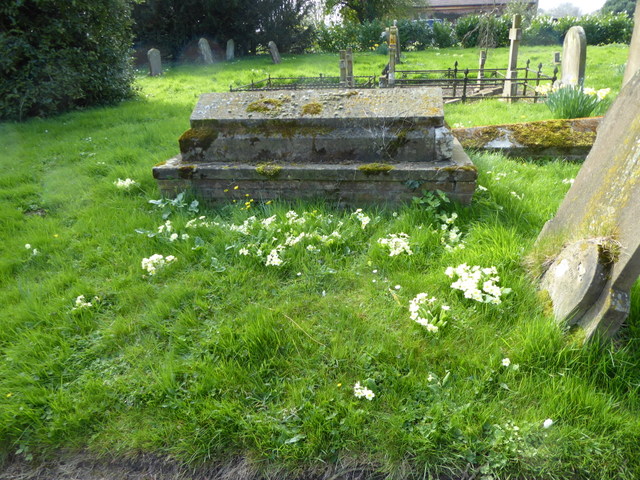
Primroses (Primula vulgaris) in the churchyard
I love the informality of our country churchyards and I like to see the wild flowers there. The wild flowers are just as much God’s work as any garden flower or exotic bloom. They have a haven in our churchyards and should be safe from herbicides.
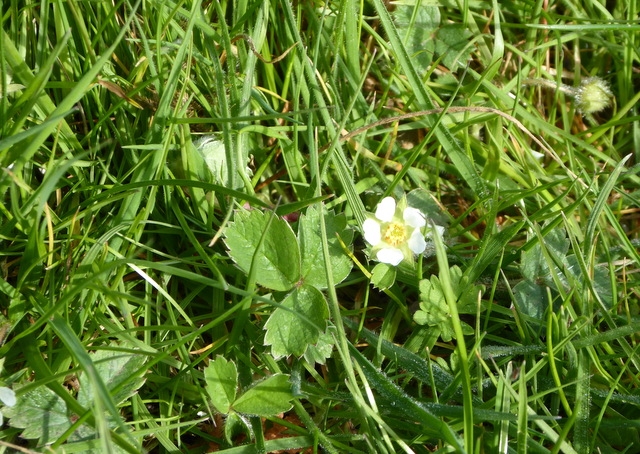
Barren Strawberry (Potentilla sterilis)
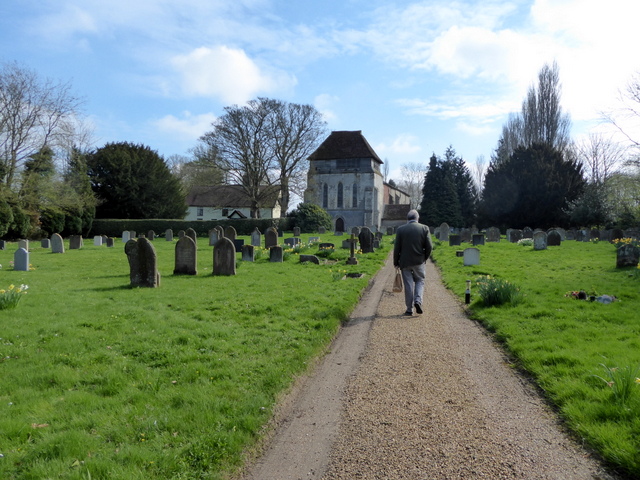
Richard on his way to church
This slideshow requires JavaScript.
Meanwhile, back in my garden…..
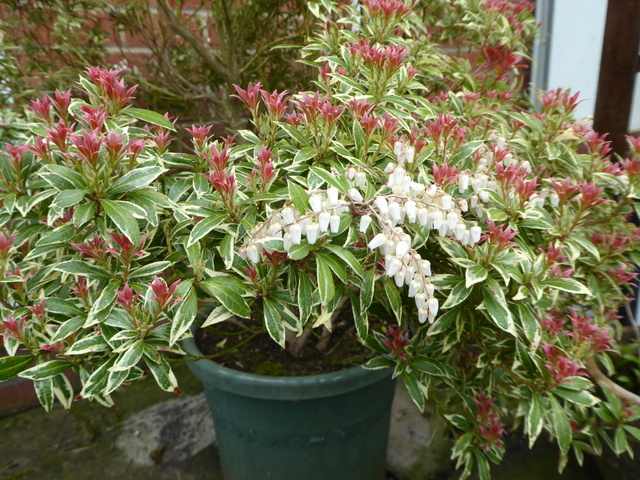
My Pieris with its new leaves of red and its little white bell flowers
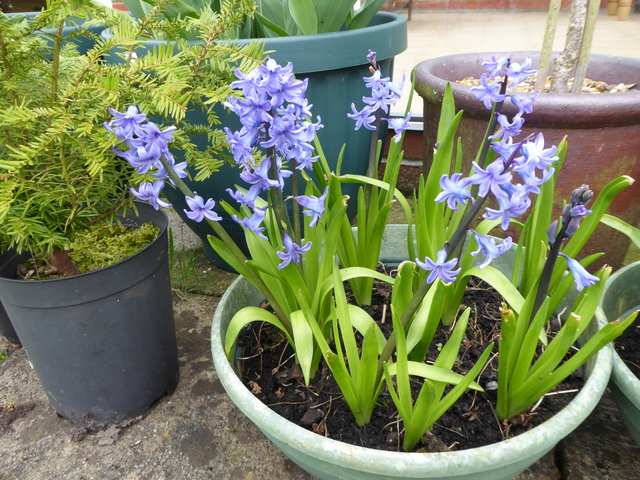
I have been growing these hyacinth bulblets on in shallow tubs and they are now ready for planting out in the garden to flower next spring.
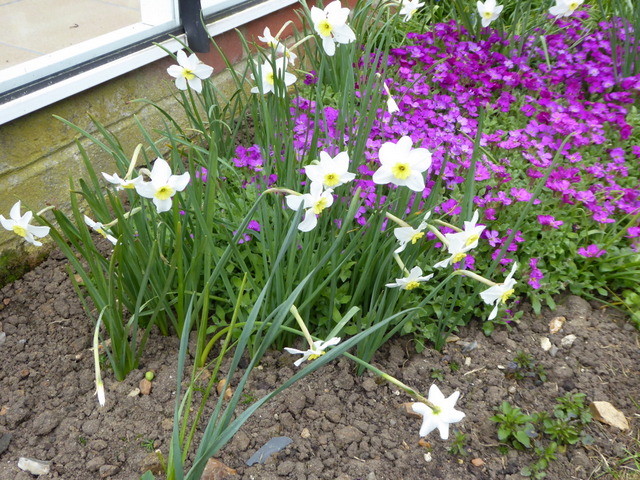
Scented narcissi and pink aubretia
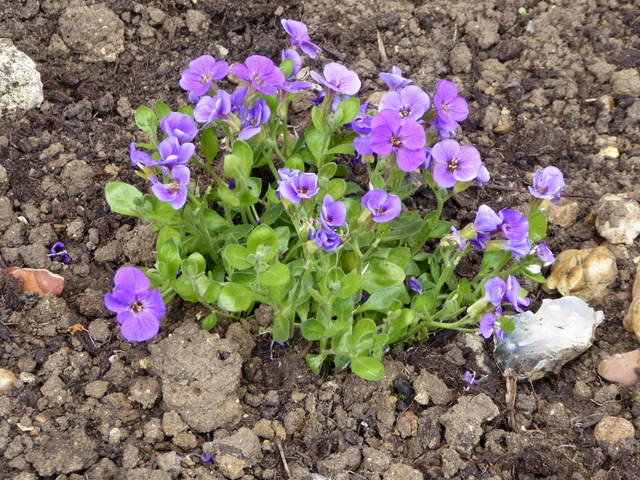
Elinor gave me some more aubretia, a mauve variety, as a gift on Mothering Sunday
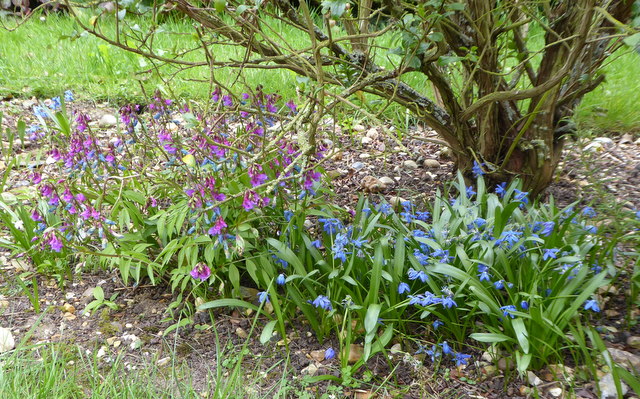
Lathyrus and scilla
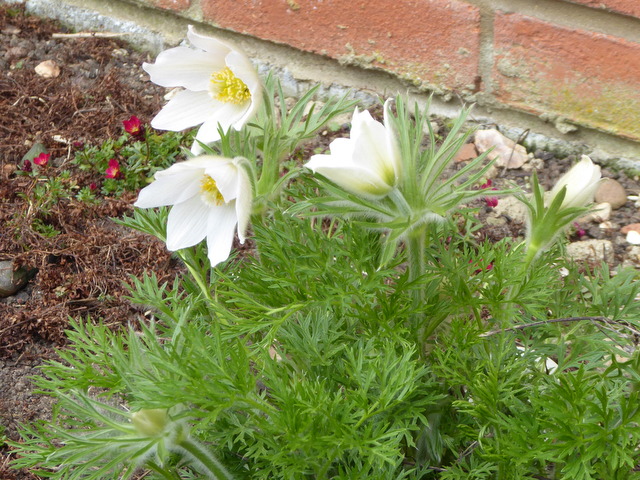
Pasque flowers. These began flowering just a couple of days after Easter Sunday.
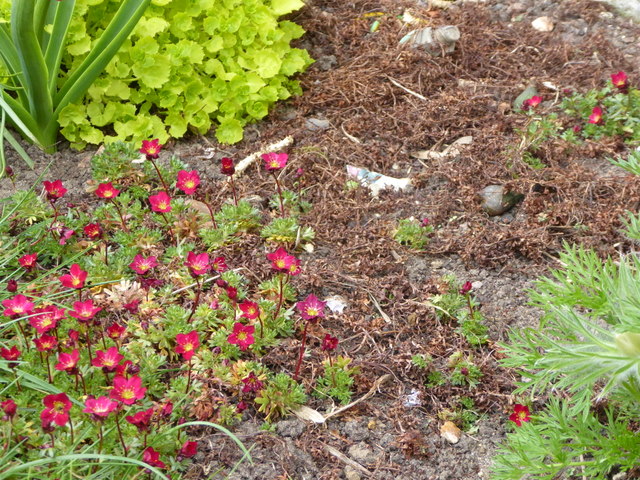
I had a large patch of these red saxifrage but the deer scraped most of them up. I’m hoping they will spread again.
I managed to find a number of flowers to photograph in my garden this March.
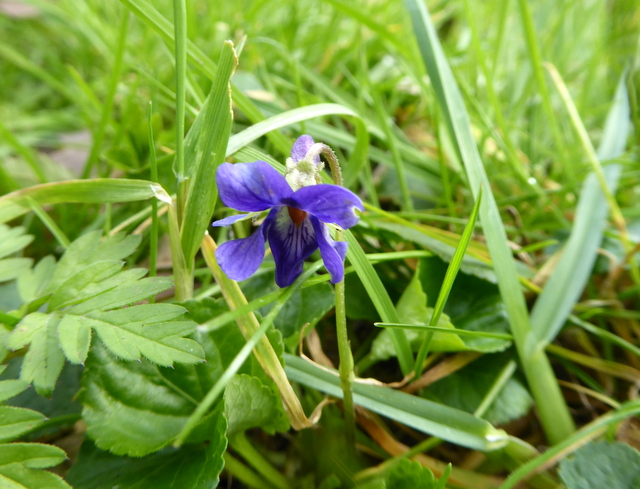
We have areas in our garden that are left wild. This is one of the many violets that bloomed in March. I think this is an Early Dog Violet (Viola reichenbachiana )
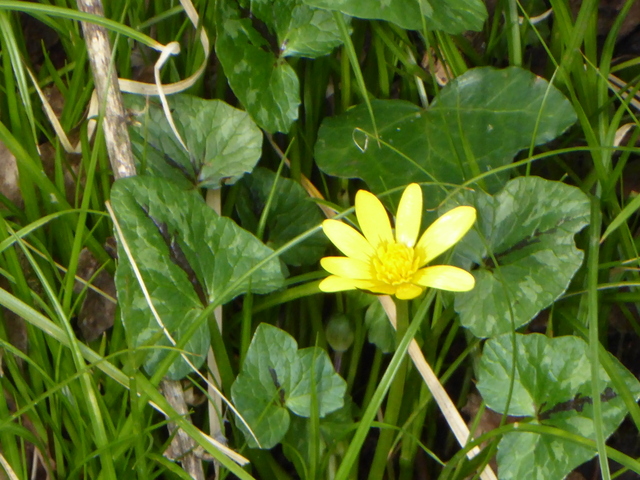
Lesser Celandine (Ficaria verna ). Not only are the flowers so shiny and buttercup-yellow but the leaves are interesting too. They are patterned and blotchy with different shades of green and then there is the strange black line down the centre of the leaf looking like it was drawn carelessly with a felt pen.
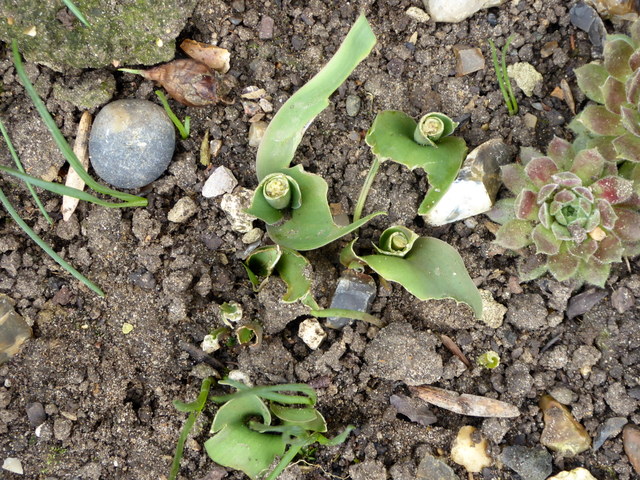
This is all that was left of some of my favourite tulips after a Muntjac deer came visiting. I wasn’t too happy about this. I can see a grape hyacinth bulb that was dug up as well.
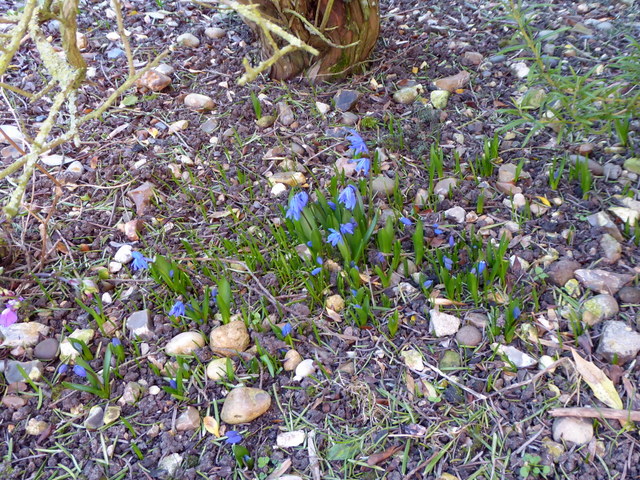
I am very fond of Scillas and this was a patch of them as they were beginning to flower.
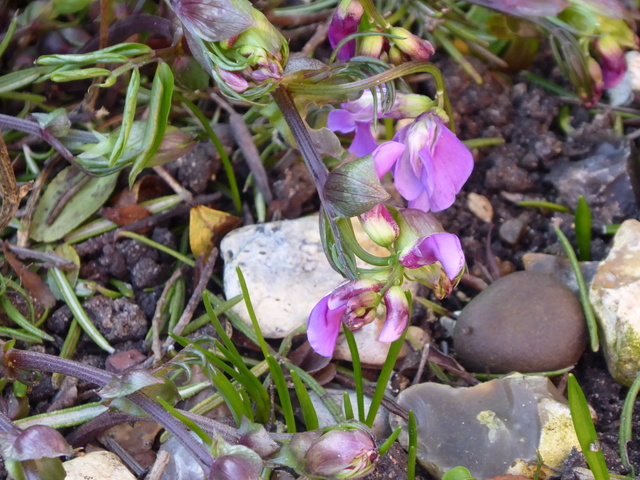
This is a pea – Lathyrus ‘Spring Beauty’ just as it too, began to flower.
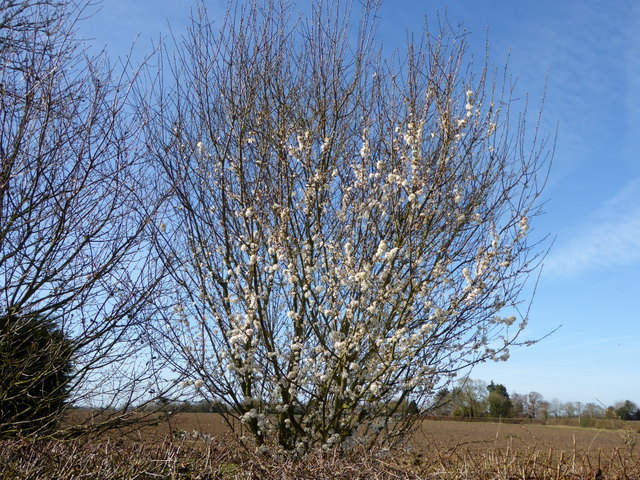
Our Cherry Plum (Prunus cerasifera ) always looks good against a blue sky. Cherry Plum are the first of the flowering trees to have blossom in the spring.
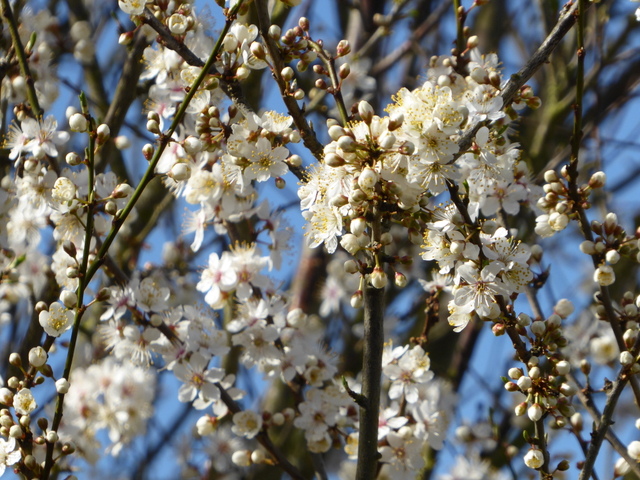
Cherry Plum blossom
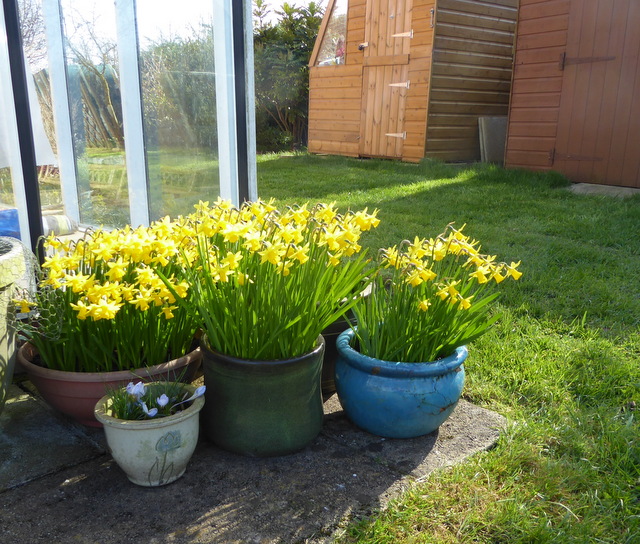
Pots of ‘Tete a Tete’ miniature daffodils and just a few pale blue crocus.
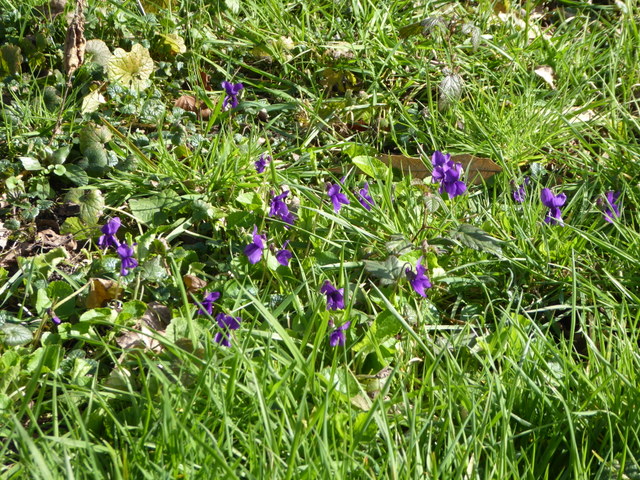
Sweet Violets (Viola odorata ) growing under the Crabapple tree.
The first of the garden daffodils to flower. It isn’t easy to see in this photo but the trumpets are a darker orange colour. I think they might be ‘Jetfire’ daffodils.
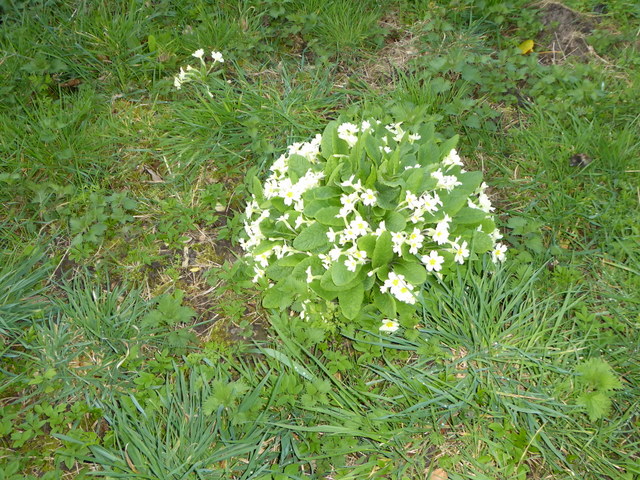
A large clump of Primroses ( Primula vulgaris) growing in the verge at the front of the house.
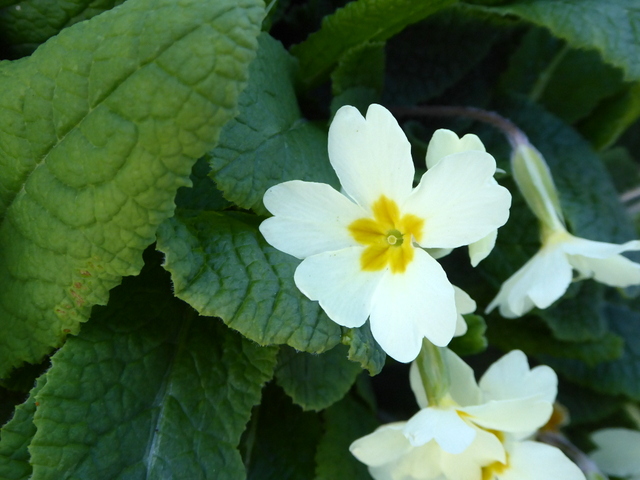
Primrose flower. This is a pin-eye flower, with the pinhead-like stigma in the centre of the flower and the stamens hidden below.
We drove to Reydon Wood on Friday, in search of bluebells.
Wood Lane
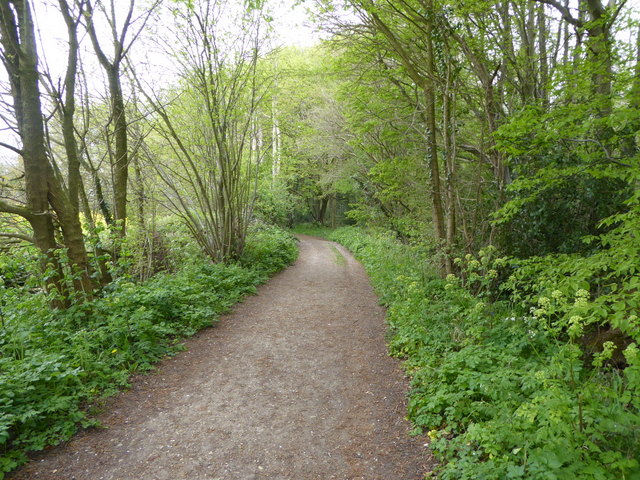
We parked at the end of Wood Lane. The walk down the lane is pleasant and we get glimpses of the wood on the other side of the deep ditch on our right.
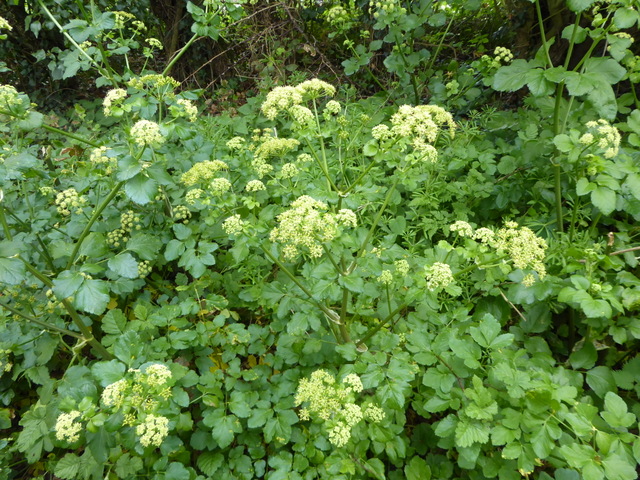
Alexanders (Smyrnium olusatrum) is in flower everywhere.
The Romans introduced Alexanders into Britain and it is mainly found near the coast especially in the east of the country. It was used as a medicinal herb and also as a pot herb. The flowerheads can be steamed like broccoli.
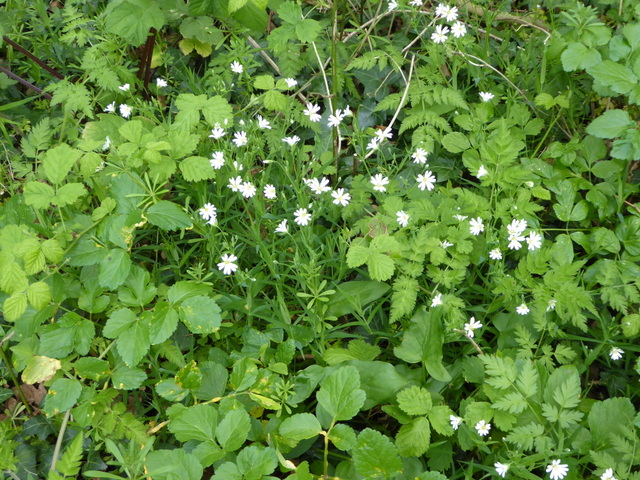
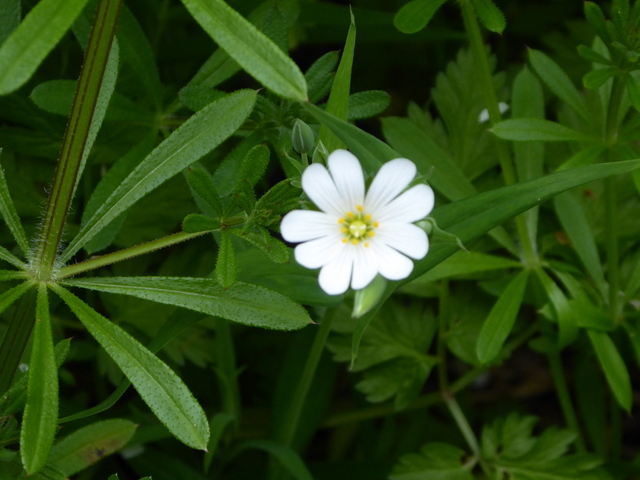
Greater Stitchwort (Stellaria holostea) is another flower that is blooming wherever I go at present.
The Anglo Saxons and Celts believed that a stitch in the side was probably caused by elf-shot and this plant cured it!
Greater Stitchwort
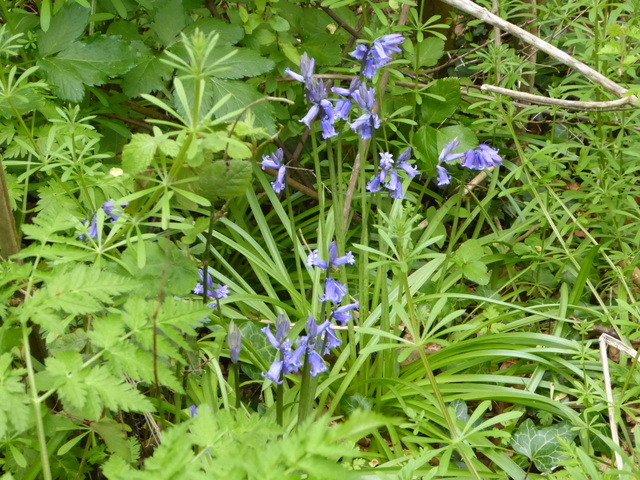
Our first sighting of Bluebells (Hyacinthoides non-scripta)
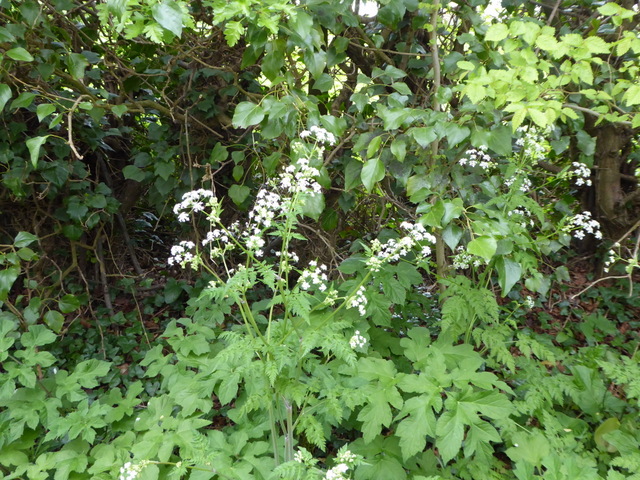
Cow-parsley (Anthriscus sylvestris) is coming into flower very early this year
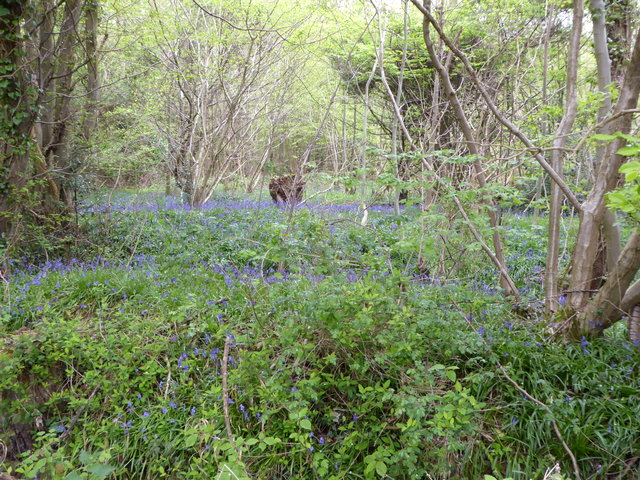
There they are, on the far side of the ditch!
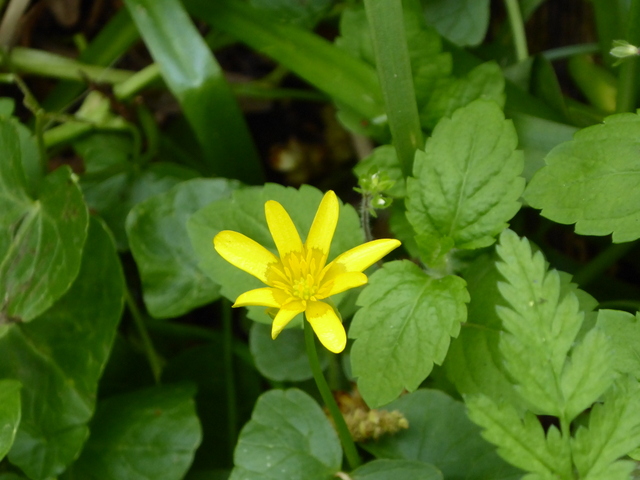
A beautiful Lesser Celandine (Ficaria verna )
Bluebells and Greater Stitchwort
To the left of us as we walked up Wood Lane we could see a field full of bright yellow Oil-seed Rape (Brassica napus) through the hedge.
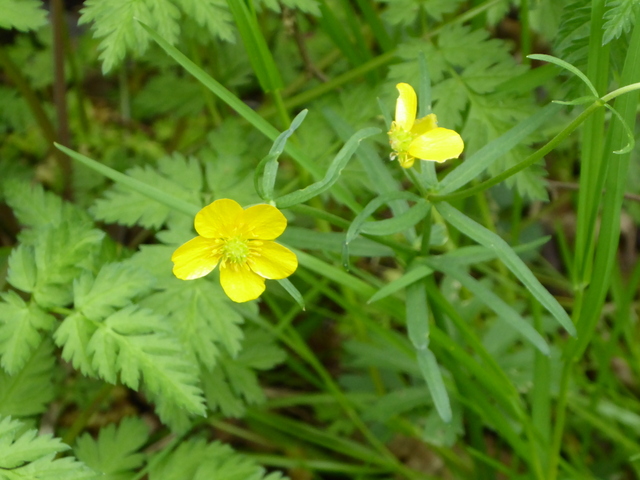
I believe this is Goldilocks Buttercup ( Ranunculus auricomus)
This is the first time I have taken notice of this buttercup. I have probably seen it before because I find they are fairly common in woodland, but I’ve never looked at one properly, just assuming it was a Meadow or Creeping Buttercup. The stem leaves are quite different from the other buttercups I know and I read that the flowers are usually deformed or have some or all of their petals missing.
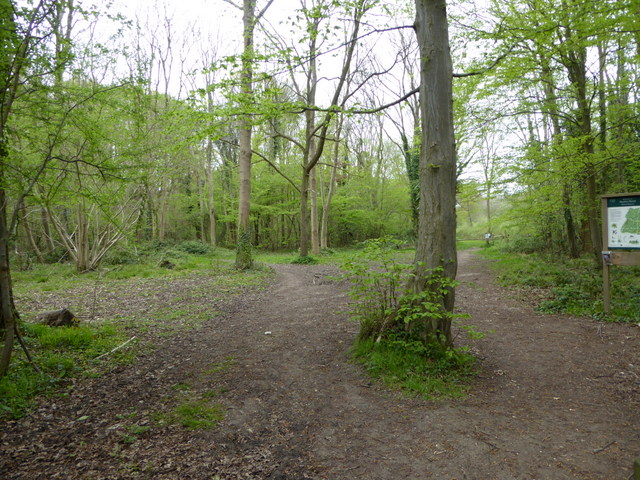
We arrived at the entrance to the wood
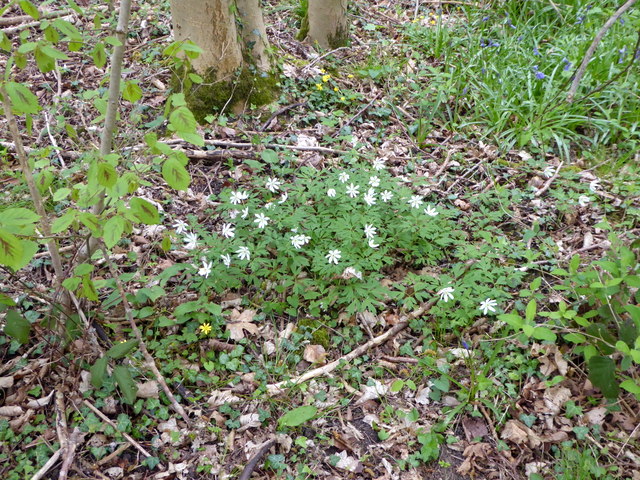
This is the first time I have seen Wood Anemones ( Anemone nemorosa) here.
There were a few primroses (Primula vulgaris ) still flowering.
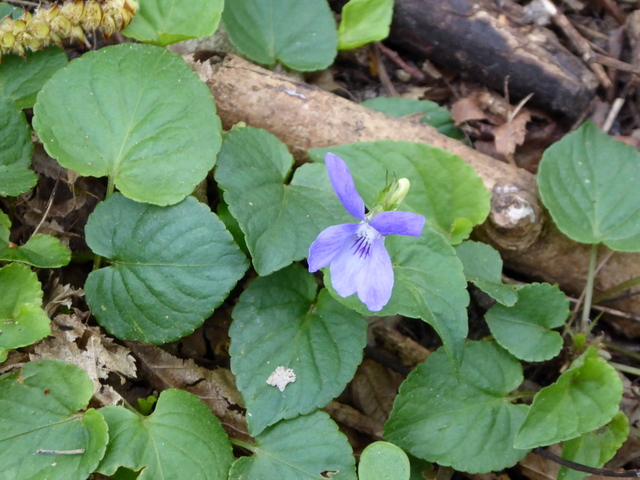
Common Dog Violet (Viola riviniana )
This is the most common violet we have in this country and it can be found anywhere except on very acidic soils. The leaves are heart-shaped and the spur (at the back of the flower) is much paler than the petals. This violet is unscented.
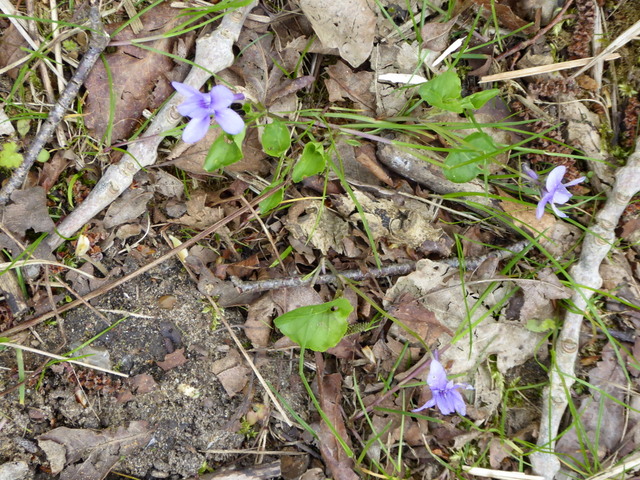
Early Dog Violet (Viola reichenbachiana )
Another unscented violet; the flowers of this plant are paler and smaller than the Common Dog Violet and the spur is usually as dark or even darker than the petals. The leaves are narrower than those of the Common Dog Violet. This isn’t a good photo but it is the best out of the three I took!
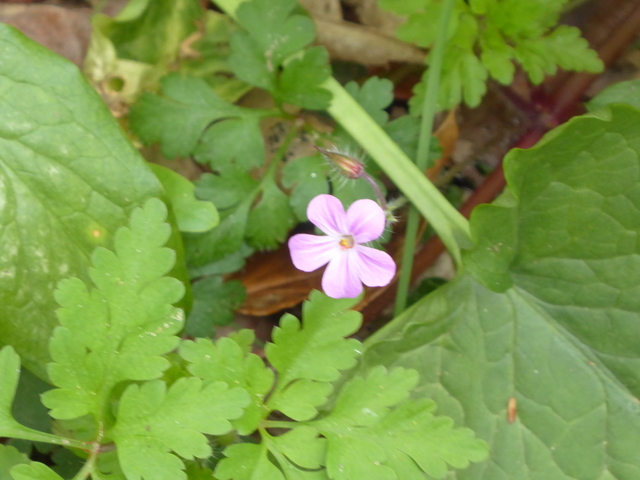
Herb Robert (Geranium robertianum)
This plant could be named after St Robert of Molesme who founded Citeaux Abbey in France and who is said to have staunched wounds and healed ulcers with Herb Robert. It could also be named after Robert, Duke of Normandy, the son of William the Conqueror and a patron of medical botany. He used Herb Robert to cure the plague.
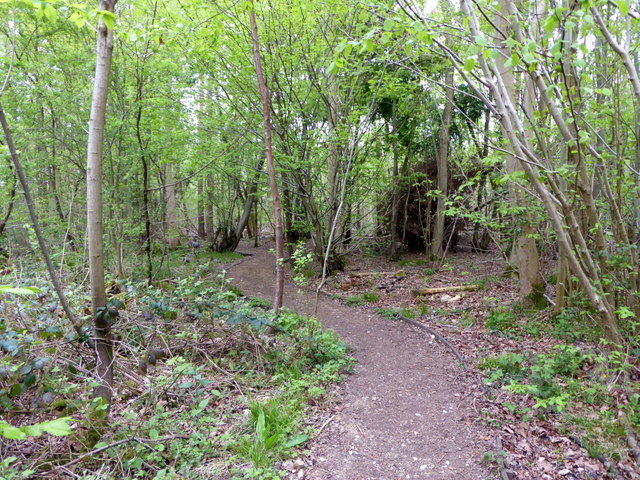
The path through the wood.
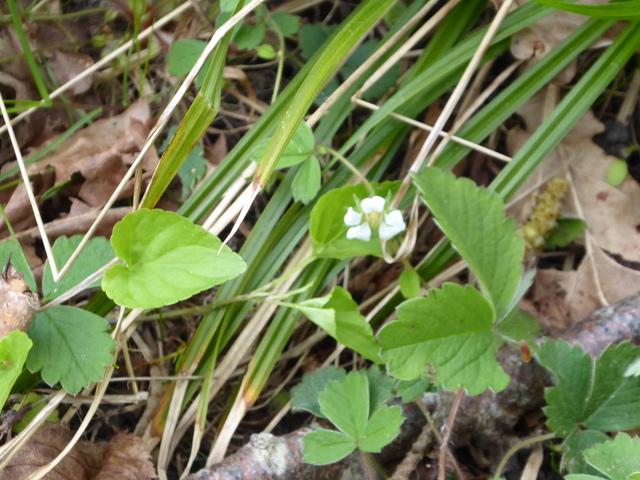
Barren Strawberry (Potentilla sterilis )
The flower here is past its best so it is not easy to see that the petals have a gap between them and that the sepals are clearly seen. The leaves (on the right of the photo) are a dull, matt green and divided into three toothed leaflets with the terminal tooth on each leaflet being smaller and shorter than the adjacent teeth.
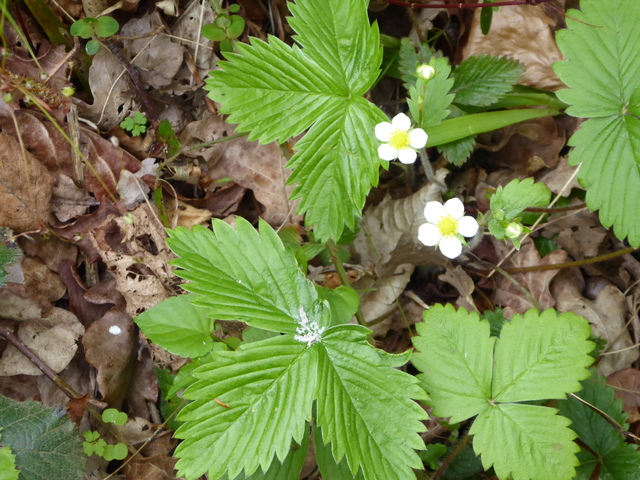
Wild Strawberry (Fragaria vesca )
Here is a Wild Strawberry, which I found just a few feet away from the Barren Strawberry and you can see the difference between them. The petals are close together and mainly hide the sepals. The leaves are a bright, shiny yellow-green and the terminal tooth is as long as (sometimes longer than) the adjacent teeth.
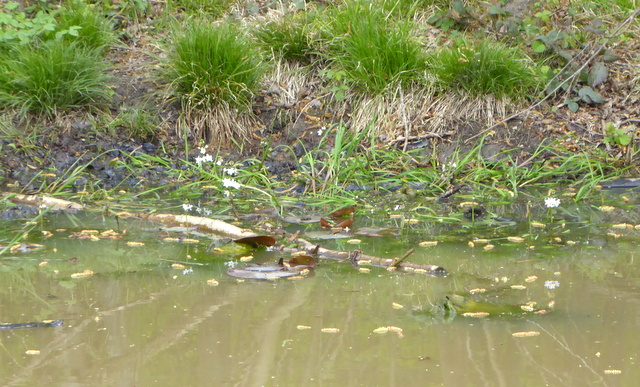
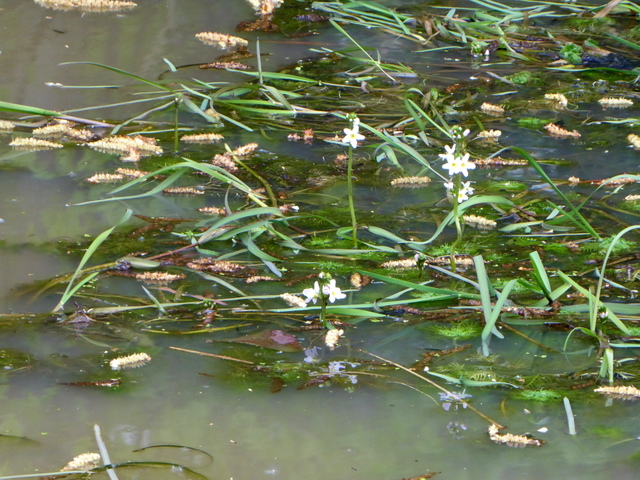
Here is the pond in the middle of the wood. On the far side are Water Violets (Hottonia palustris )
More Water Violets – I couldn’t get a better photo of them.
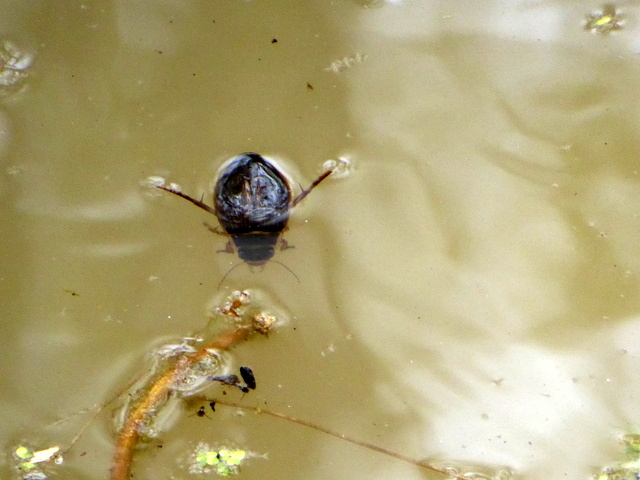
Great Diving Beetle (Dytiscus marginalis )
We watched this beetle for a while as it came to the surface to gather air which it stores under its elytra or wing cases. The beetle’s spiracles (breathing pores) are under the wing cases and allow the air stored there to enter the body. When the air is used up the beetle returns to the surface for more. There were many newts in the pond too.
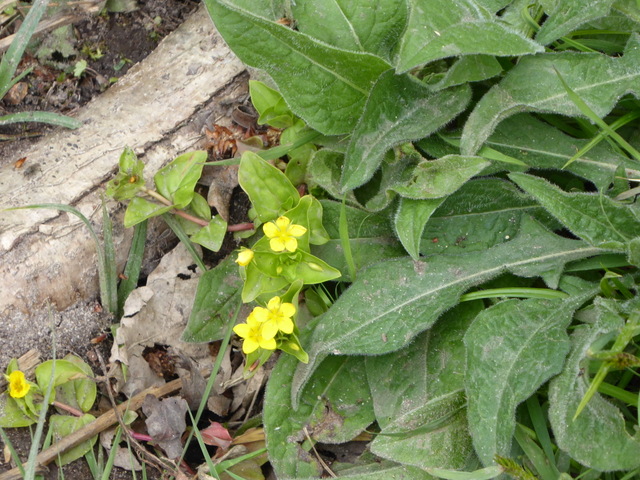
Yellow Pimpernel (Lysimachia nemorum )
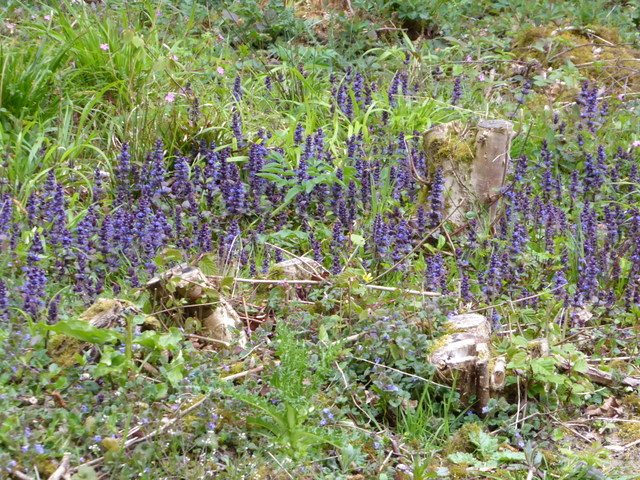
A large patch of Bugle (Ajuga reptans )
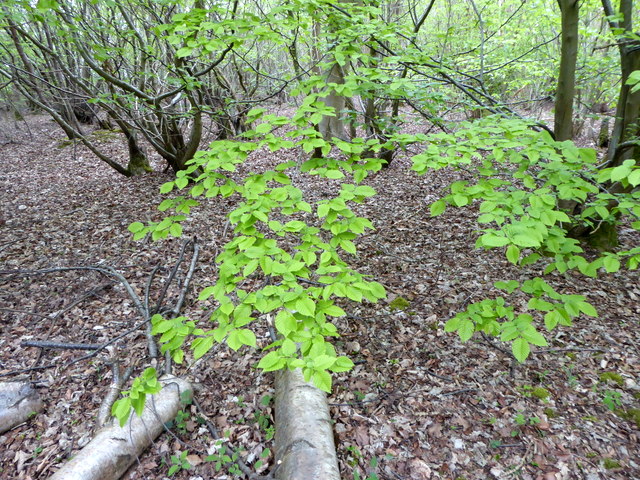
Beautiful new green leaves of Hornbeam (Carpinus betulus )
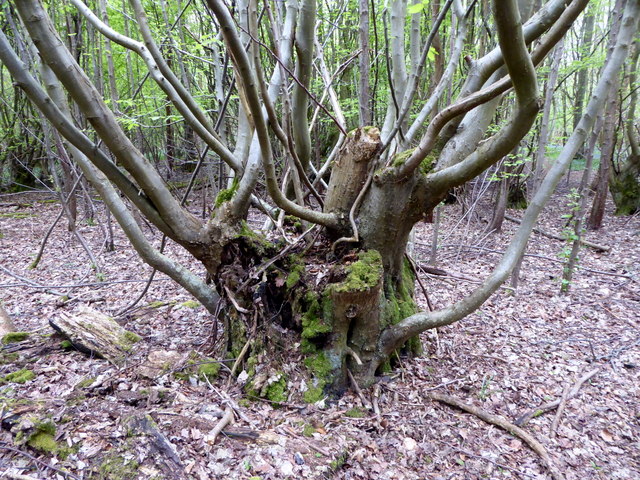
Hornbeams look a little like Beech trees but the trunks have fluted bark and the leaves are toothed. Hornbeams are regularly coppiced and Reydon Wood is a coppice wood.
A coppice tree which will probably be harvested in the next few years. The tree is probably many hundred years old.
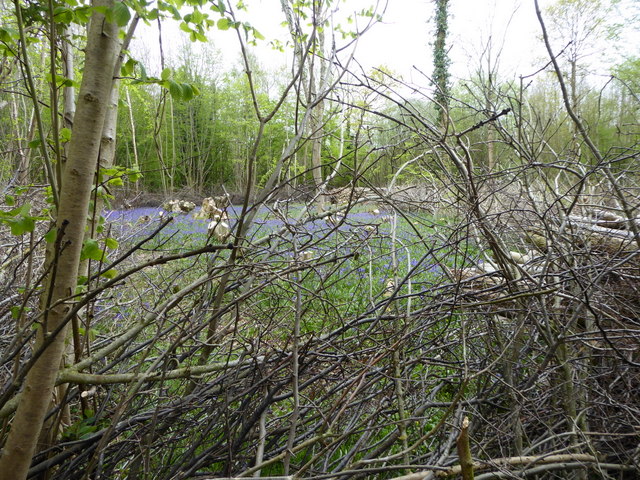
The area just beyond this barrier has recently been coppiced and the stools (tree stumps) will be sprouting soon. The barrier has been built up using twigs and branches to stop deer from eating the new growth on the coppice stools.
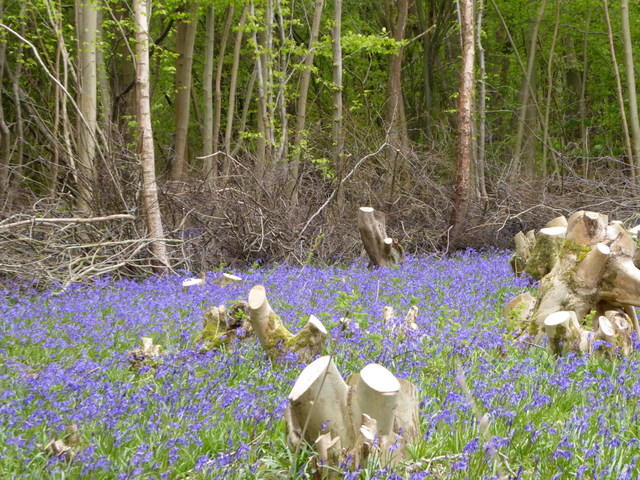
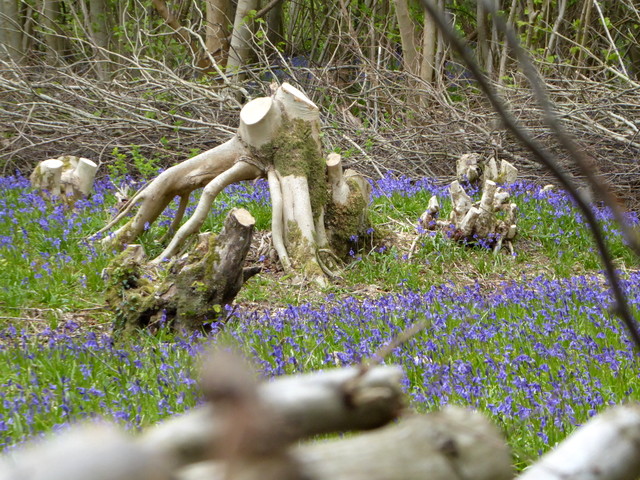
Coppice stools surrounded by Bluebells and with the deer barrier in the background
A strange-looking stool which looks as though it might run off as soon as our backs are turned!
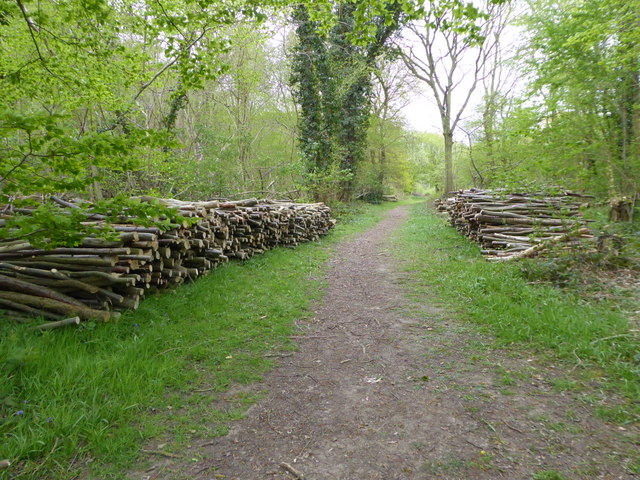
Harvested coppice logs
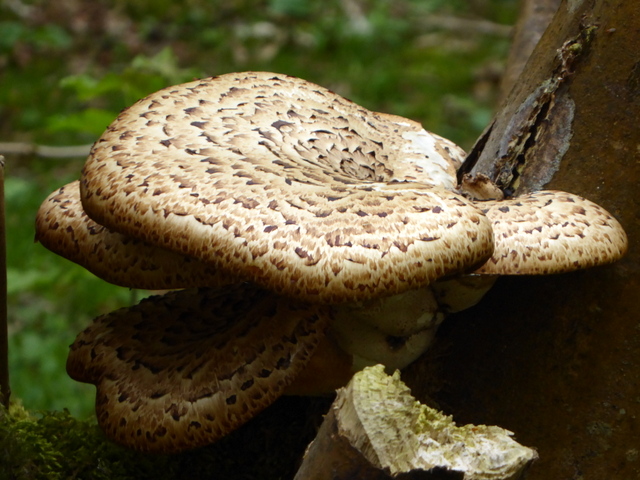
I believe this fungus is Dryad’s Saddle (Polyporus squamosus )
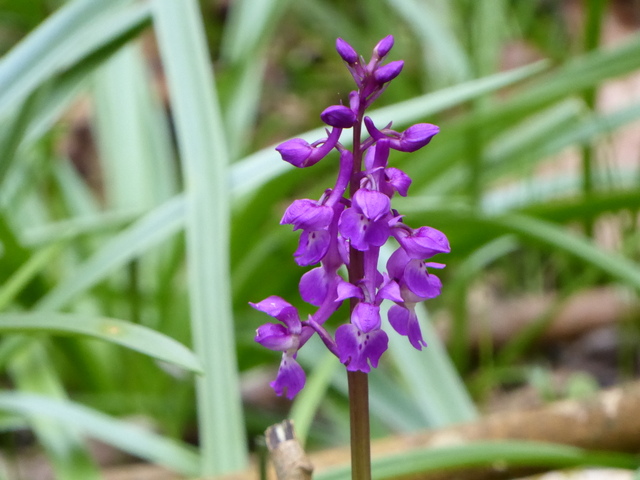
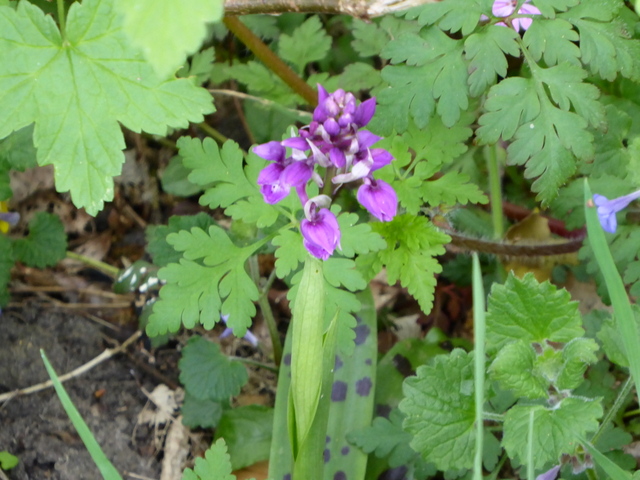
Early Purple Orchid ( Orchis mascula)
Early Purple Orchid showing its spotted leaves
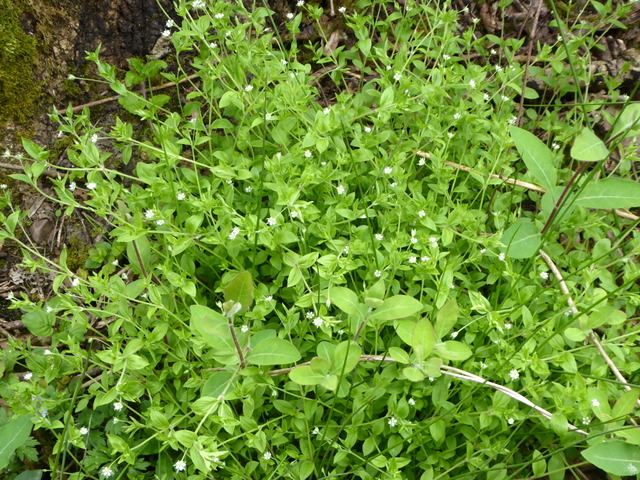
Three-nerved Sandwort (Moehringia trinervia )
At first I thought this was Common Chickweed but then I noticed the petals are not split and that the sepals are longer than the petals. The leaves have three to five parallel veins on them. I didn’t manage to get a close-up shot of the plant.
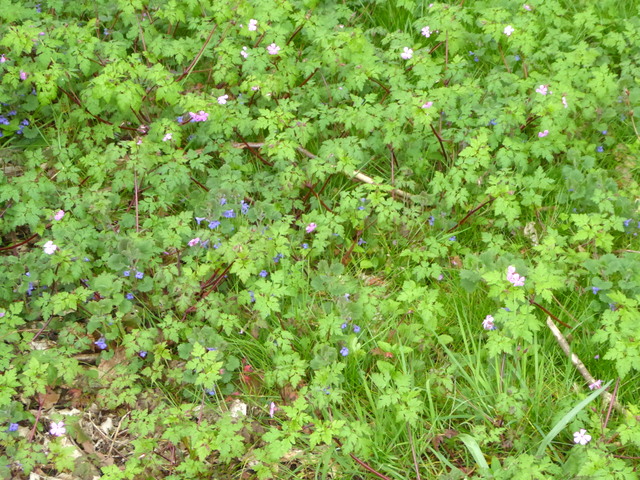
Herb Robert (pink flowers) and Ground Ivy (Glechoma hederacea ) (Blue flowers)
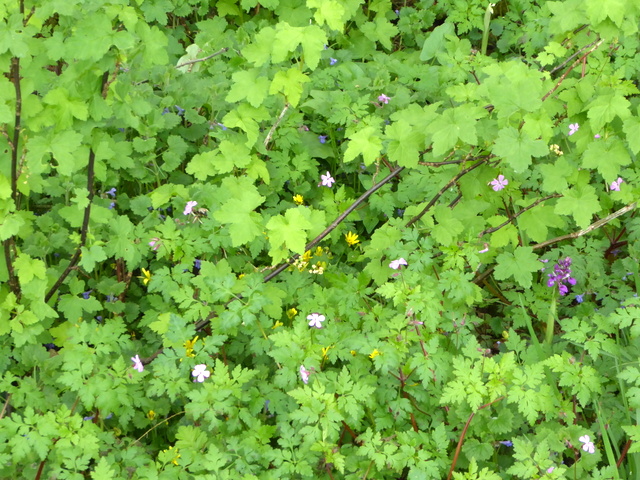
Lesser Celandine, Herb Robert, Ground Ivy and Early Purple Orchid
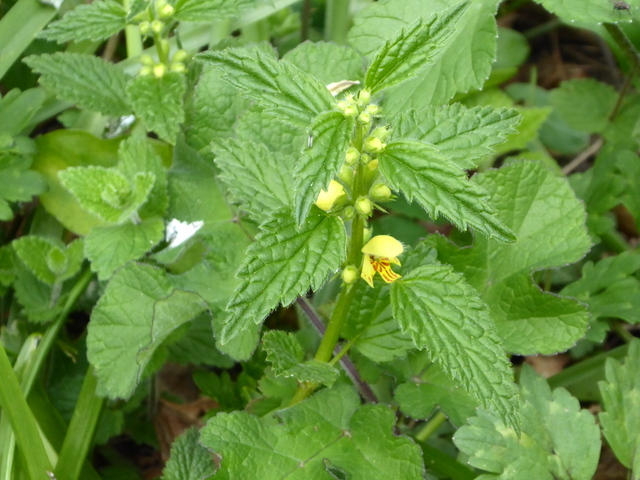
Yellow Archangel ( Lamiastrum galeobdolon)
There is a cultivated form of this plant (subspecies ‘argentatum’) with silvery patches on the leaves which has escaped into the wild and is quite invasive.
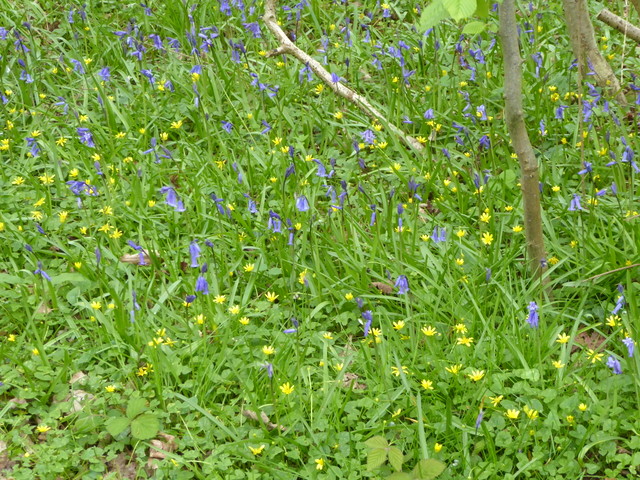
Lesser Celandines and Bluebells
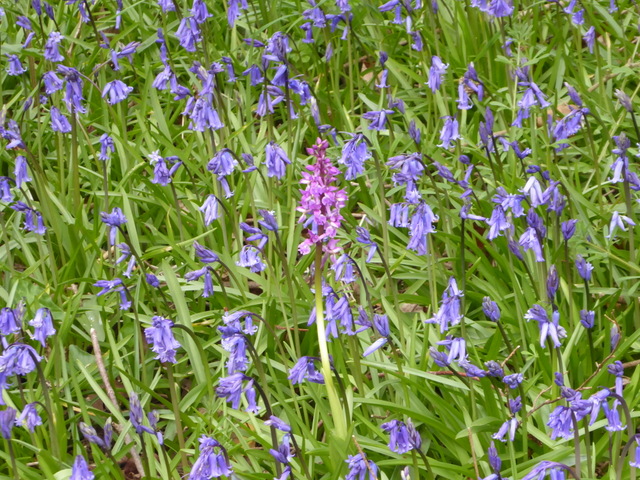
Early Purple Orchid and Bluebells
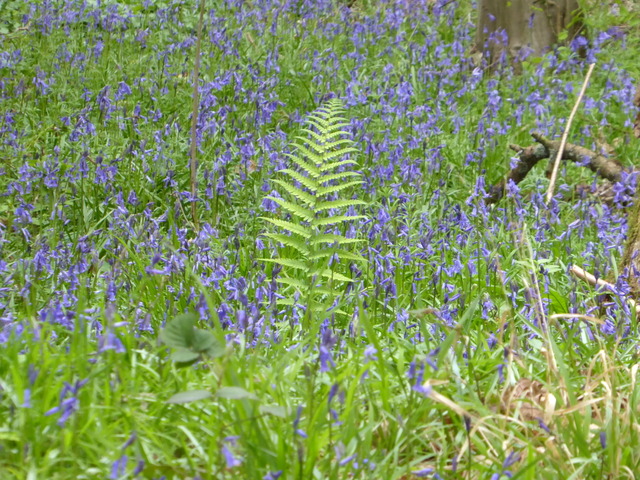
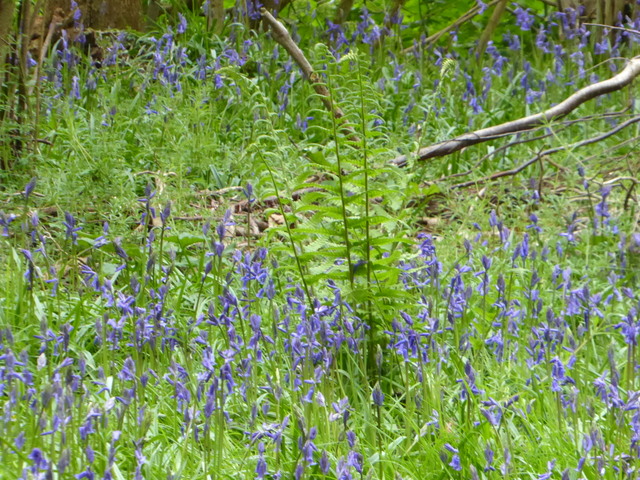
Fern and Bluebells
Bluebells and ferns
Here is a slideshow of the Bluebells we saw.
This slideshow requires JavaScript.
The Bluebells were not quite at their peak and as the day was overcast and chilly we didn’t smell their wonderful scent. We decided it would be a good idea for us to return in a week’s time to see how they had developed. Unfortunately, we have had very cold weather this week with frosts and wintery showers of hail and sleet. I hope the Bluebells are not too damaged. I apologise for the length of this post.
I arranged to visit Alice in Sheffield on Thursday 23rd February, spend the night in a hotel and return home again the following day. What I hadn’t expected when I bought the train tickets and booked the hotel room was a visit from ‘Doris’ that day too. For those who don’t know who ‘Doris’ is (or who might have forgotten), ‘Doris’ was a storm that caused some disruption here. Fortunately, my journey went ahead with no problems other than a speed restriction. Alice met me at the station and we decided to have lunch together before I went to my hotel. We nearly got blown off our feet on the way to the café, the door of which kept blowing open while we ate, but we weren’t inconvenienced too much by this. I spent a lovely afternoon with Alice either chatting in my hotel room, drinking tea in another coffee shop or buying books.
While I was enjoying myself, Richard and Elinor were having quite an unpleasant time at home. The power went off at about 2 pm and in the garden a few of our belongings started flying through the air despite Richard having tried to make them safe before the storm began.
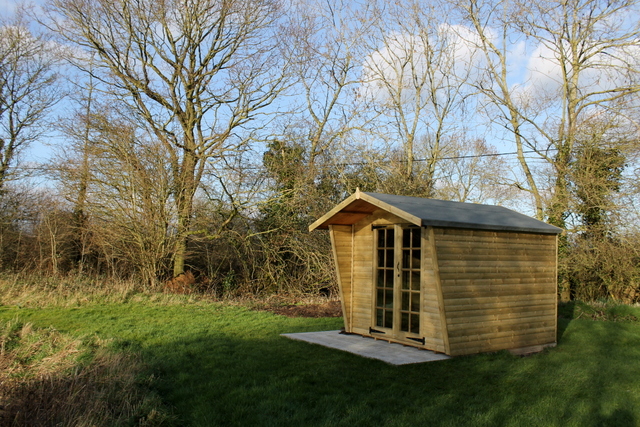
I wonder if any of you remember how pleased we were when we got our new summerhouse last year? Here is a photo of it.
Our summerhouse when it was new last February.
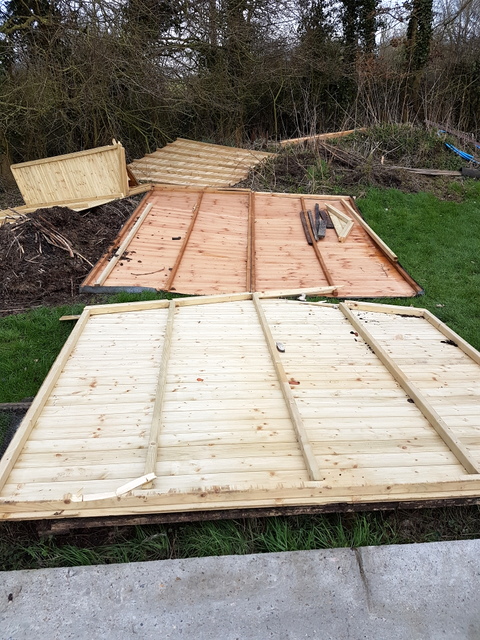
The summerhouse after the storm this February.
The wind ripped the roof off and the rest of the building just broke apart. A number of trees in the area were blown over and roads were blocked. When I got back to Norwich the following afternoon Richard was a little delayed when collecting me from the station by having to make detours to avoid blocked roads. The power was still off when I got home and the house was cold. Richard and Elinor had coped very well using the gas hob to cook meals and heat water for hot drinks and washing up. They had sat together the evening before in front of the gas fire listening to the battery-powered radio by candlelight. We often get power-cuts living where we do, though not as many as we used to do before the power company changed the cables and started regular cutting-back of tree branches that are too close to the cables. Having said that, we have had six power-cuts of at least an hour this year already. We keep a supply of candles and lamps ready and have torches in all the bedrooms and in the kitchen, utility room and garage. We have a portable gas heater as well as the gas fire and gas hob. We can also use the caravan which has a large battery and a gas supply.
Fortunately, the power came back on later that day. I was very grateful for it as we were expecting my cousin Beverley and her partner Jeremy to visit the following day for an evening meal. I didn’t have the time to prepare all the things I had hoped to, but at least the house was warm and the evening was great fun!
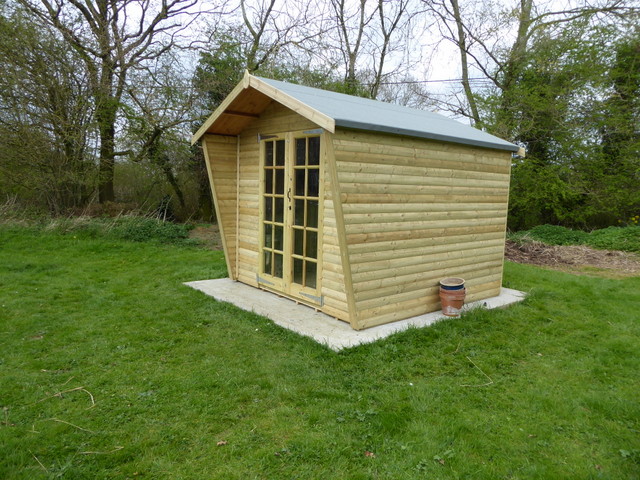
We have been able to claim for a new summerhouse on our insurance and our replacement arrived on Monday of this week. We got an identical summerhouse which had to be put where the old one was which is a little worrying, knowing how quickly it succumbed to the storm-force winds. Richard will bolt it to the concrete base and try to make it somewhat sturdier. We will see what we can do. We lost our old incinerator during the storm and wondered how far it had travelled, but once Richard had taken photos of the wreck and started to clear up the glass and the panels he found it squashed as flat as a pancake underneath one of the sections. I am grateful neither Richard nor Elinor got squashed under it!
Here is our new summerhouse. Spot the difference!
Our new internal doors were due to be fitted that week in February but the storm put paid to that, and, because of storm damage the carpenter had to deal with, we didn’t get the doors until nearly a fortnight later. We are very pleased with them. They look good, they are more sound-proof than the old ones and the doors downstairs are now glazed and let much needed light into the hall. The sliding door to the en-suite WC has been replaced with a better one and the sliding door to the downstairs shower-room has been replaced with an ordinary door which is so much nicer. We will now employ a painter and decorator to decorate the hall, stairs and landing and to paint all twelve doors (we replaced the airing cupboard door too).
ooOOoo
Richard and I have attended a Lay-led Worship Training Course at a church in Beccles. To enable us to keep our churches open, the way forward is for us, the members of the church to take the services ourselves if there is no priest to lead us. This will be very useful to us when our Rector retires in the summer. The four-part course was interesting and well-attended and it gave us the opportunity to meet people from other churches in the Deanery. Our Deanery is made up of a number of benefices from Halesworth, Bungay, Beccles, Southwold and the villages in-between.
ooOOoo
We have carried on with the usual round of duties and chores; hospital visits, blood tests, appointments with opticians, hairdressers, acupuncturists and chiropractors; housework, gardening, shopping. We have all had bad colds. I continue to take my mother to church once a fortnight and join Richard at church in our benefice when I can.
Richard went to visit his brother Chris in Manchester for a few days recently and had a very pleasant time. On his return we took part in two quizzes. Last year we had been in a team that had won the quiz held in the village of Walpole. Part of the ‘prize’ was the honour of composing and presenting the following year’s quiz and Richard offered to take it on. The time for the quiz duly arrived and he did a fantastic job as Quizmaster (I was his assistant) and he was presented with a bottle of wine as a thank-you gift. The following night we were at the village of St James taking part in the quiz to raise funds for the Harleston Choral Society. A meal was included in the fees – very good it was, too – and the questions appealed to me more than usual as there were more music ones and fewer sport! Our team managed to win again.
ooOOoo
We celebrated Mothering Sunday on the 26th of March and it was our church at Rumburgh’s turn to hold the service. I helped make a few posies to present to the mothers or for people to give to their mothers or take to graves. Though we have no flowers in church during Lent I was asked to provide some flowers to put in the porch.
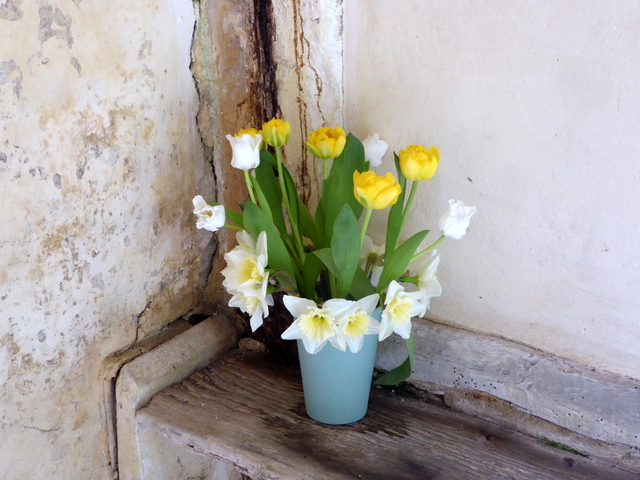
The flowers in the porch. Looking at this little work of art, you may be surprised to know I am not a flower-arranger 😉 The flowers are lovely in spite of my ministrations. As you can see, the porch is in urgent need of work. If nothing is done soon, the porch will collapse and we won’t be able to use the church.
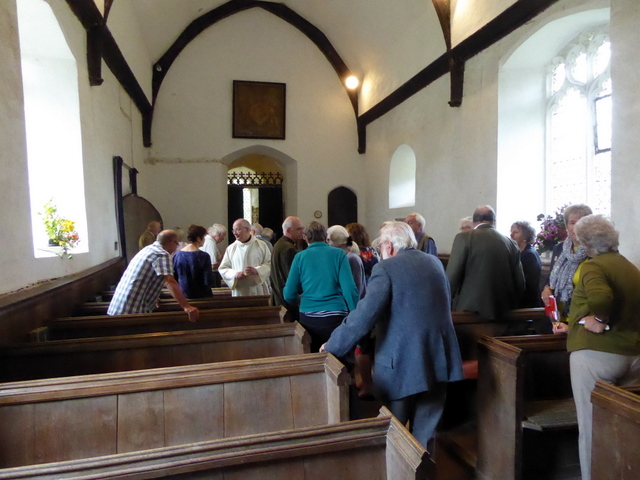
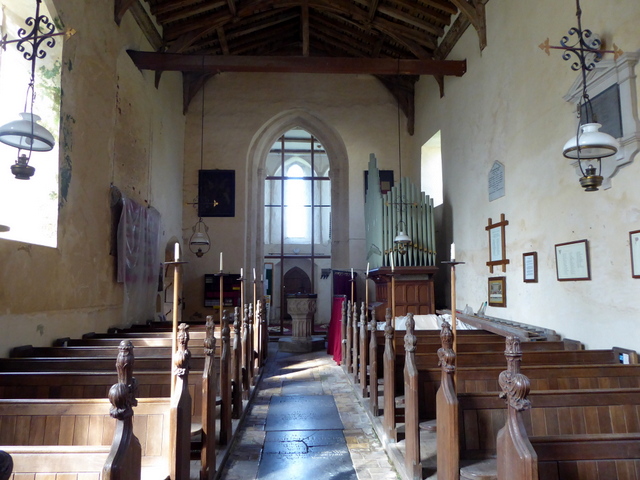
The church was a little disorganised because we are having a tower screen fitted at the moment and there was dust everywhere. We have been saving for years for this improvement! We put everyone as near the front of the church as possible (well away from the building works) sitting in the choir stalls, which was very pleasant. Richard our Rector chose lots of good hymns and his sermon was amusing and instructive. I brought my mother to our church for a change and took her back home afterwards. I couldn’t ask her to lunch because I had no time to prepare a midday meal but she came for an evening meal instead.
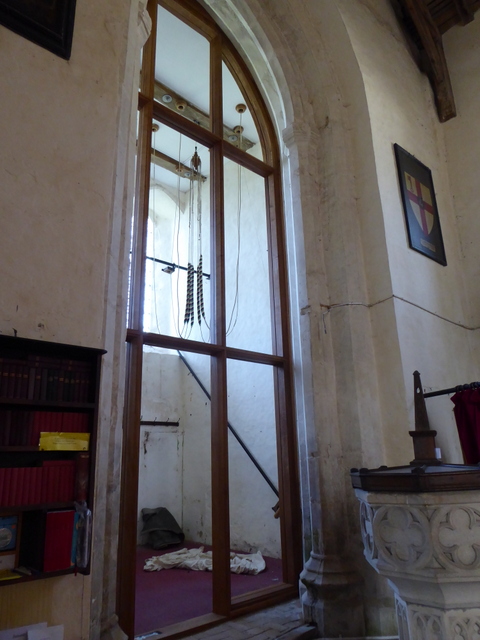
This is the new tower screen. You can see the framework for the glass which has yet to be put in. There will be a glazed door at the bottom of the screen.
We will now be able to see and watch the bell-ringers as they ring before our services.
ooOOoo
I will end this rather wordy post with some photos of the flowers in our garden starting with my favourite iris reticulata that bloomed for too short a time in February.
Miniature iris
Miniature iris
Miniature iris
Miniature irises
Crocus
Crocus
Crocus
Mahonia
Mahonia with a bumblebee
Winter-flowering honeysuckle
Miniature daffodils
My music selection is ‘Handle With Care’ by the Traveling Wilburys.