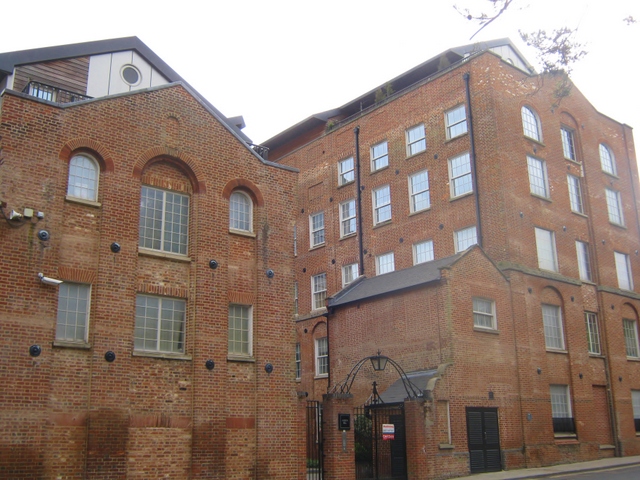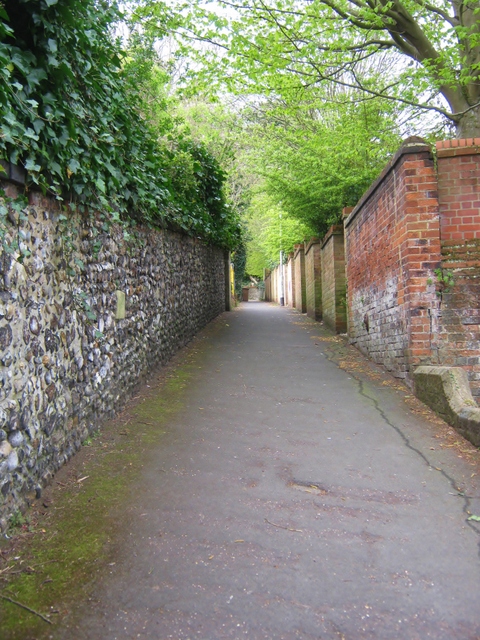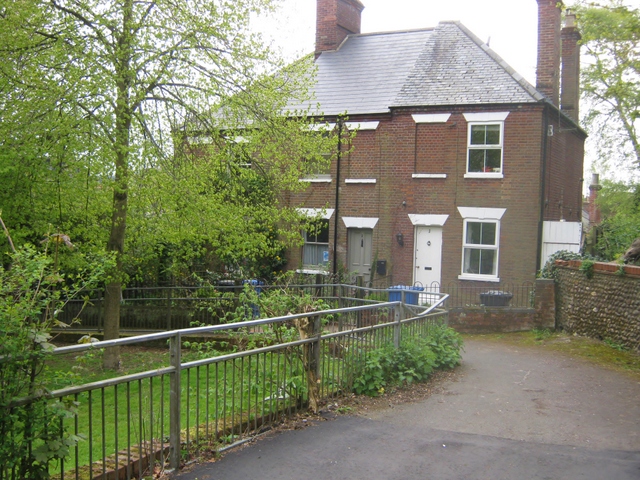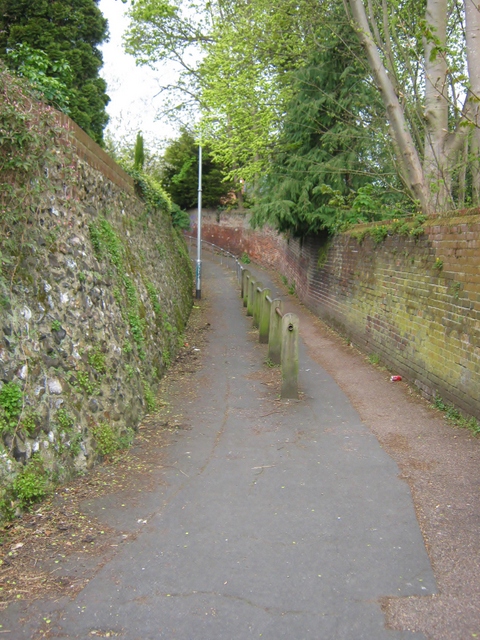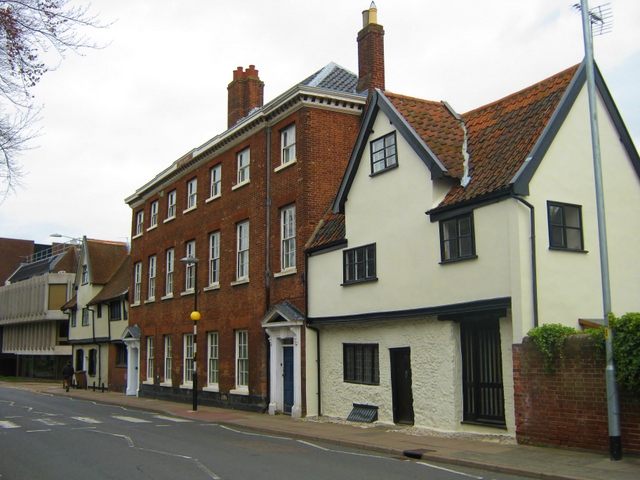
King Street, Norwich

Tags

, , , , , , , , , , , , , , , , , , , , , , , ,

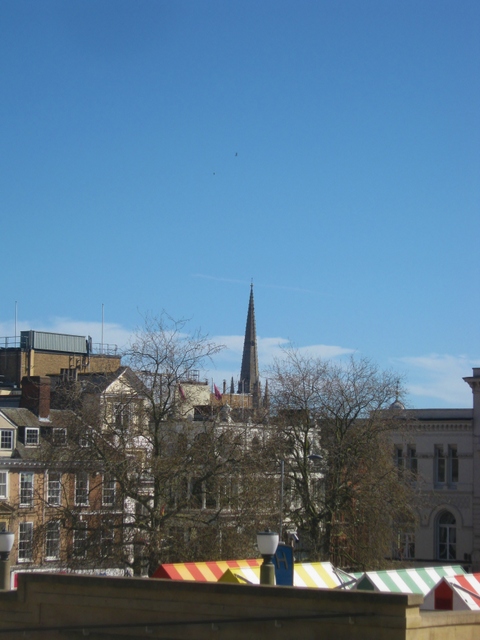
IMG_4414Cathedral beyond market

A view of Norwich Cathedral’s spire beyond the market

One bright morning last spring I decided to take another walk through the city.  I started at the Market and made my way towards the Castle.

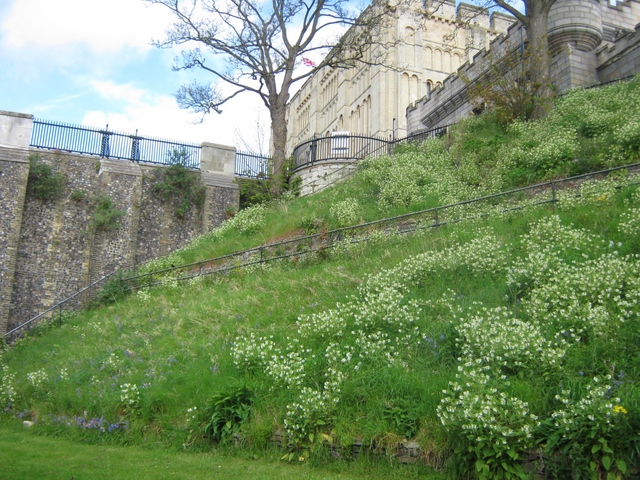
IMG_4487Norwich Castle

Norwich Castle seen from Castle Gardens

On the wall outside the castle I found these plaques which tell a story.  I will have to go into the castle one day and find out who wrote the lines and who designed the plaques.  I am put off by the entrance fee of £8.80 though!

If you read the comments you will now see that Simon Nott from Quercuscommunity has supplied all the information I needed with this link

http://www.racns.co.uk/sculptures.asp?action=getsurvey&id=838

Thank-you, Simon!

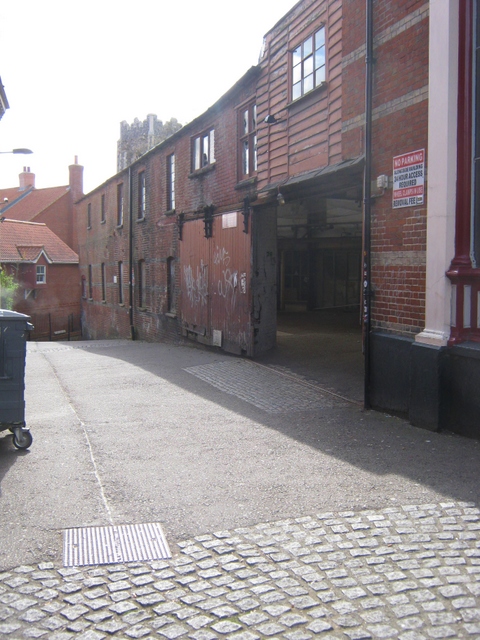
Just opposite the Castle in Cattle Market Street I found this interesting yard.

IMG_4490Furniture warehouse

A warehouse yard with workshops.

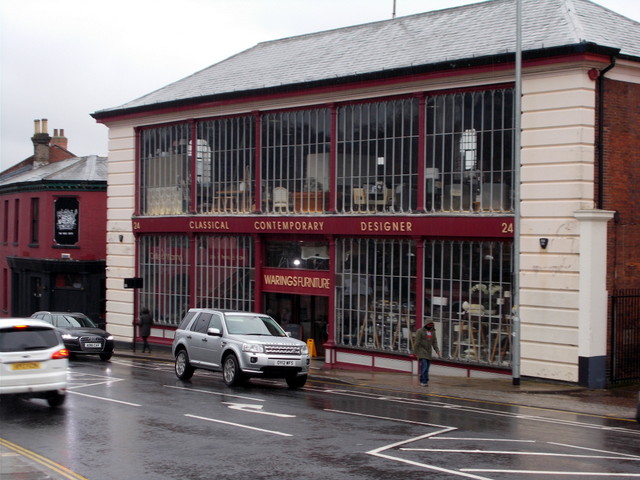
The warehouse is part of a Grade II Listed building which was originally constructed as a showroom for Holmes and Sons who manufactured and sold agricultural machinery.  The front of the building is mainly glass in an iron framework made in a lily pattern design and was inspired by the Crystal Palace (built by Paxton) to house the Great Exhibition of 1851.  This building is known as the Crystal House.  I believe there have been plans to convert the building into apartments.

DSCN0356Waring's shop

Photo of Waring’s Furniture shop (the Crystal House) taken this April

I walked from the Crystal House in Cattle Market Street, down Rouen Road and into St Julian’s Alley where I took this photo of St Julian’s church.  I wrote something about this church and shrine a while ago as well as writing about the castle.

IMG_4491St Julian's church

St Julian’s church

There is a narrow path between buildings that runs from St Julian’s Alley to King Street and in King Street is…..

IMG_4492Dragon Hall

Dragon Hall.

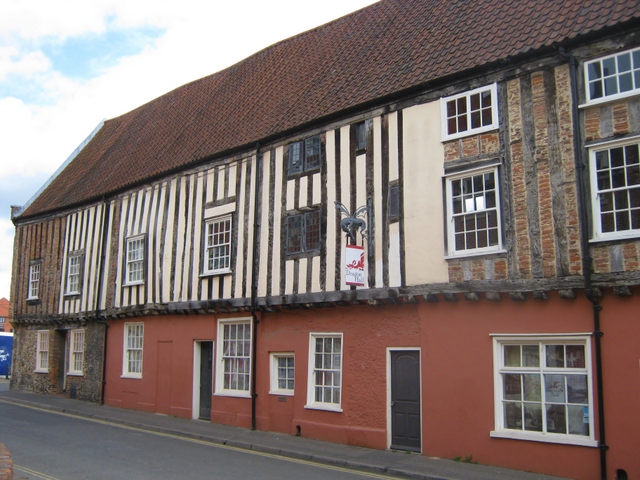
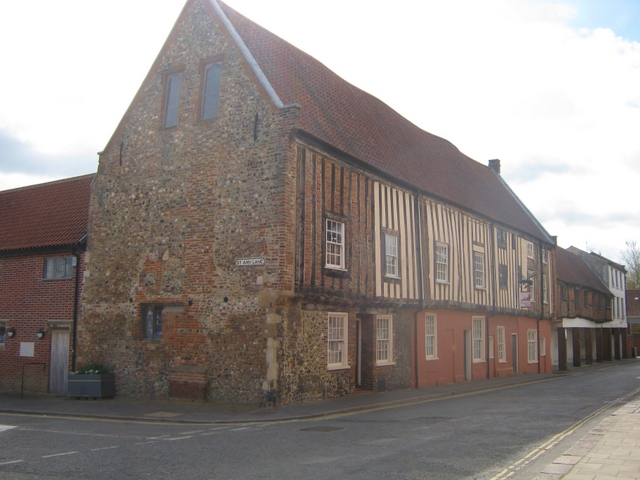
Until last year the Dragon Hall could be visited quite easily.  Now, since it has become the home of “The Writers’ Centre Norwich” it is only open for a tour once a month and I cannot find any details of when this one day a month is.  Dragon Hall is Grade I listed and dates from 1420 and is the only surviving medieval trading hall in Western Europe built by an individual.  That individual was a Robert Toppes who was elected four times Mayor of the City of Norwich.

IMG_4493Dragon Hall

Dragon Hall

It is made with close studded timber framing where planks of wood (studs) are placed vertically and close together to great effect.  It contained a grand hall; the ground floor rooms and the undercroft were used as storage for goods.  One of the spandrels (triangles of space between beams and braces in the roof) was intricately carved with a figure of a dragon, which is where the building’s name has come from.  I have seen a photograph and would love to see it for myself one day.

IMG_4494Dragon Hall

Dragon Hall

IMG_4495R Wensum behind Dragon Hall

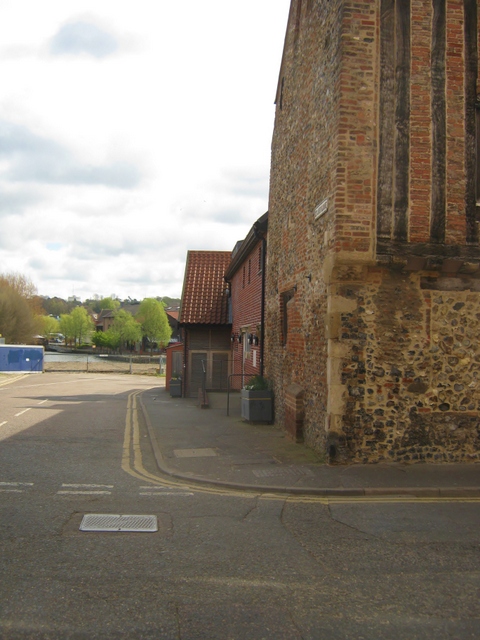
View of the River Wensum behind the Dragon Hall. Goods could easily be brought into the Hall from boats on the river.

IMG_4496Side door of Dragon Hall

The Dragon Hall’s main door

The King Street area was one of the first areas in Norwich to be inhabited and as it was close to the river many of the inhabitants were rich merchants.  The Dukes of Norfolk and the Howard family (Catherine Howard was Henry VIII’s fifth wife) all had houses here. John Caius, physician to Edward VI and founder of Caius College Cambridge was born here.

IMG_4497Music House

Music House

Just a short step up King Street is the Music House.  This was reputed to be the oldest occupied house in Norwich until recently when it was taken over by Wensum Lodge.  The first occupants were the Jurnets who were an extremely wealthy Jewish family and who lived there in the 12th century.  It became known as the Music House because during the reign of Elizabeth I it was the headquarters for the Norwich waits and minstrels.

Almost next door is…..

IMG_4498Wensum Lodge

Wensum Lodge. The centre for Adult Education in Norwich.

IMG_4499Houses in King Street

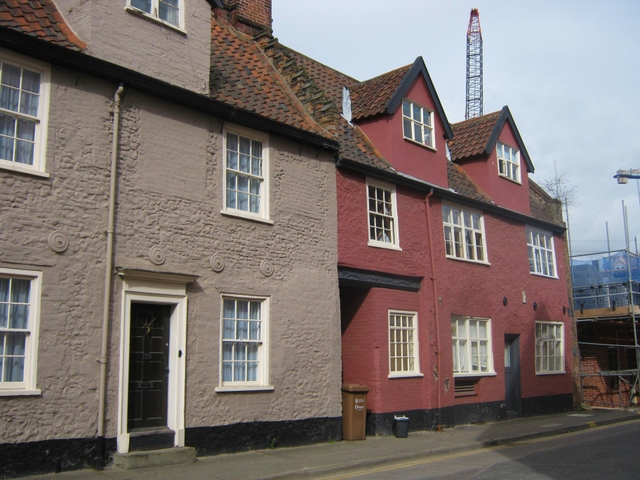
Interesting old houses in King Street. These buildings are probably 400 years old with lots of adaptations made to them over the years.

New buildings were being put up next door to these old houses.  From what I could see, great care was being taken that the new construction didn’t look out of place amongst the old buildings.

IMG_4500St Etheldreda Artist Studios

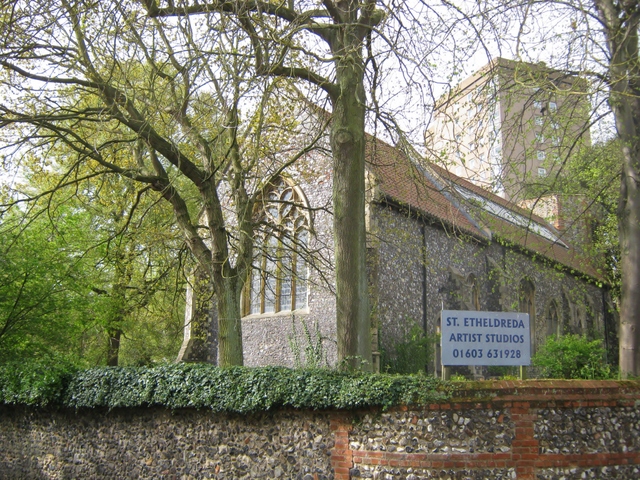
St Etheldreda Artist Studios

St Etheldreda was one of the four daughters of King Anna of East Anglia.  She founded a monastery on the Isle of Ely (an example of tautology as Ely means Isle) and she died there in 679.

This is a Norman church which became dilapidated in the 19th century and was then ‘restored’ by an enthusiastic clergyman who got rid of a lot of the original features in order that an idealised ‘medieval’ church could be created.  A wall painting of St Christopher was uncovered and was copied but the original painting did not survive.  Because of extensive bomb damage during the Second World War the amount of people living in the area dropped considerably and by the 1970’s the church had become derelict. Restoration was begun in 1975 and it has now been fitted out as artists’ studios.

IMG_4501Converted mill

Albion Mill

This former mill has been converted into apartments.  You might be interested to see one of the apartments which is available for sale at the moment; a three-bedroom penthouse apartment valued at just under £1,000,000.

The building started out as a yam mill in the 1830’s but by the end of the 19th century it had become derelict.  It was bought by  Robert John Read (junior) of R J Read Ltd. in 1932 for £5,750 as he needed to expand his already thriving milling business.  He milled flour, not only local wheat but imported grain, oyster shell (for the chicken/hen trade) and maize (imported form Argentina).  He developed a flaking machine for the maize, as flaked maize was used in the stock and animal feed industry.  When Britain joined the Common Market the price of local and European wheat dropped and Read no longer imported grain.  By the late 1980’s maize was no longer imported either so the firm concentrated on wheat milling and in 1988 they were producing 5 tons of wheat an hour.  The business closed in 1993 and the site remained vacant until 2004 when it was bought along with other buildings nearby to be converted into flats and apartments.

IMG_4502Southgate Lane

Southgate Lane

I turned up Southgate Lane which is quite a steep climb though this isn’t easy to see in the photo.

IMG_4503Cottages

Halfway up the hill were a couple of semi-detached cottages.

IMG_4504Southgate Lane

The second half of the lane had a handy handrail.

IMG_4505Victorian House

Towards the top of the hill the lane widened and one of the beautiful Victorian villas in Bracondale came into view.

IMG_4506City Wall

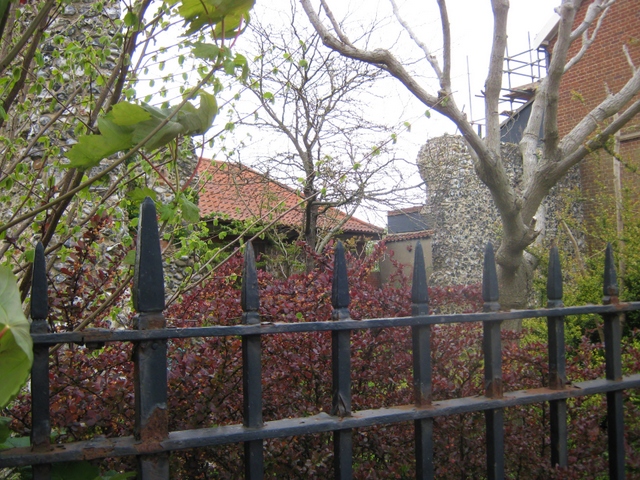
This old flint wall is part of the City Wall

IMG_4507City wall

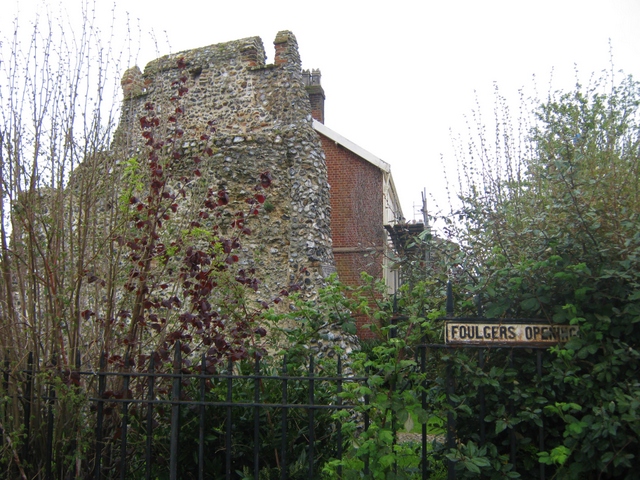
Here is another bit of the Wall next to the interestingly named road, Foulgers Opening.

IMG_4508Berstrete Gates pub

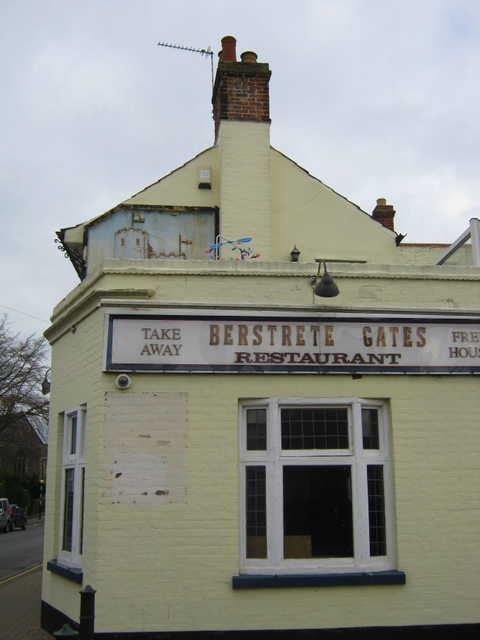
I was now in Ber Street and this is the Berstrete Gates pub. The old Ber Street Gate in the city Wall was taken down in 1807.

IMG_4509St John-de-Sepulchre's church

St John-de-Sepulchre’s church

This church on the corner of Ber Street and Finkelgate was made redundant in 1984 and between 1986 and 2009 was used by an Eastern Orthodox congregation.

IMG_4510St John-de-Sepulchre's church

St John-de-Sepulchre’s church

IMG_4511Buildings in Ber St

Buildings in Ber Street. The nearest is a medieval house; the one next to it is rather an elegant red-brick Georgian building. Next to that is another ancient medieval house with a modern office building beyond that.

I turned back the way I had come, walked back down Ber Street and into Bracondale and then past Southgate Lane.  The next road is Carrow Hill.

IMG_4512City Wall Carrow Hill

The City Wall in Carrow Hill

IMG_4513City Wall

The City Walls are very well preserved here

IMG_4514Black Tower

The Black Tower

This tower was part of the defence of the city and was traditionally the residence of the Constable.  In the 16th century it was used for plague victims and in the 18th century a snuff mill was built on top of it.  The mill was removed in the 19th century but the tower is still sometimes referred to as the Snuff Tower.  Another name is the Duke of Buckingham’s Tower though I haven’t yet found a reason for this.

IMG_4515Black Tower

The Black Tower

IMG_4516Black Tower

The Black Tower and part of the City Wall

IMG_4517Tower

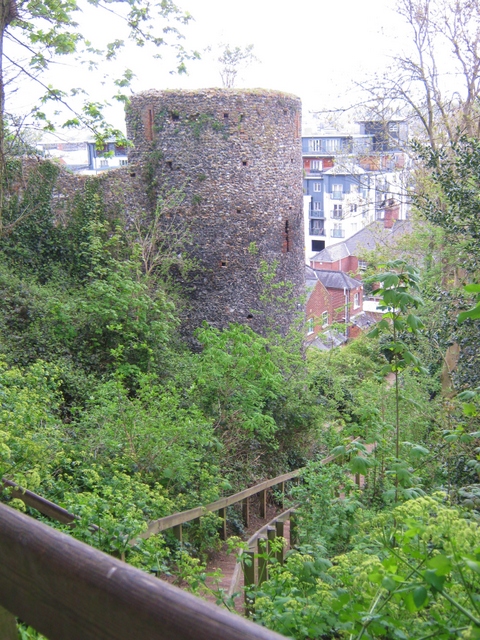
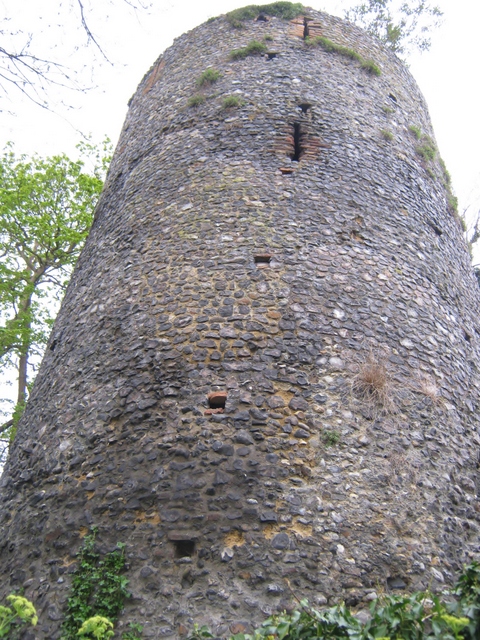
The Wilderness Tower

This second tower is further down the steep hill.  There was never any wall built between these two towers but there are plenty of arrow slits built into the sides of the towers to enable the defenders to cover the steep hill inbetween.

The Wilderness is nicely planted with trees and shrubs and there is a wooden path and stairs that take one from the top of the hill in Carrow Hill to the bottom in Alan Road.

IMG_4518Tower

The Wilderness Tower

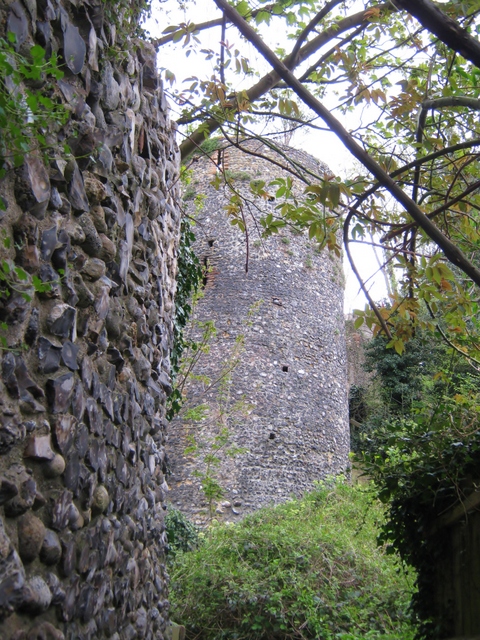
IMG_4519City wall & tower

City Wall and the Wilderness Tower

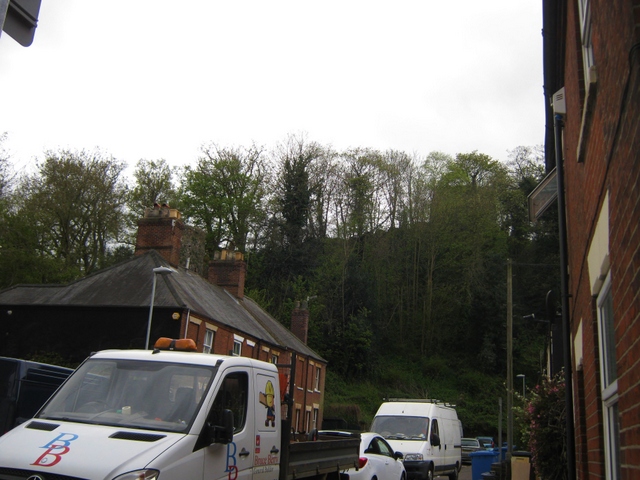
IMG_4522Alan Road

Alan Road with the Wilderness Tower nearly hidden behind the trees

From Alan Road I walked along King Street to Rouen Road and from there back to the city centre.

IMG_4524St John the Baptist Timberhill

St John the Baptist, Timberhill.

The church was originally sited just outside the Castle’s bailey.  Timberhill is to the south of the church, once an open space and the site of the timber market.

IMG_4526Timberhill

Attractive shops in Timberhill

I apologise for the length of the post.

Thanks for visiting!

Morris Dancing in Halesworth

Tags

, , , ,

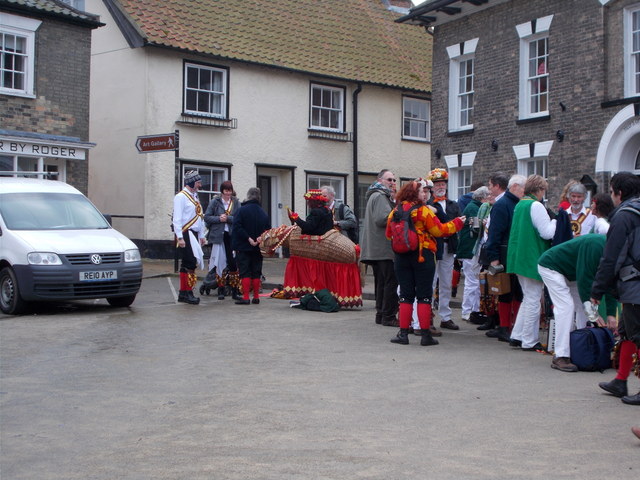
Richard and I both enjoy folk music.  We grew up singing folk songs at school and then we met when we were members of a choir that often included folk songs in it’s programmes.  We also love watching folk dance, especially Morris dancing.  I published a post last year about Halesworth’s Day of Dance which you can see here.  This year we turned up to watch but were unable to get a programme so I can’t tell you the names of most of the groups we saw.  Richard made a few short videos of most of the groups and I have included some of these in this post.  The weather was better than last year – it was bright and mild and everyone appeared to be enjoying themselves.

DSCN0259Morris dancers

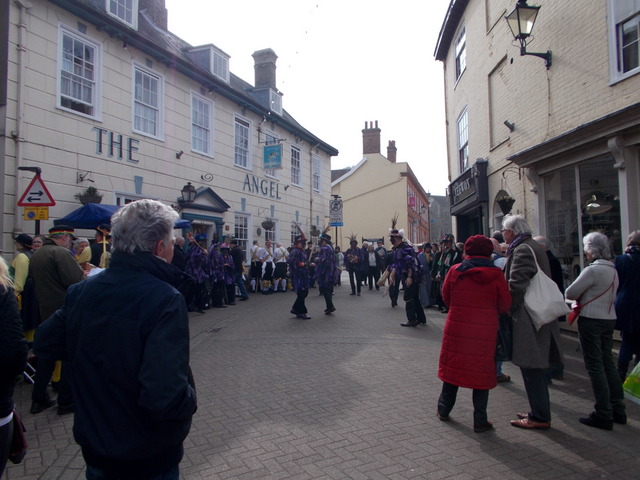
Pedant’s Revolt dancing outside The Angel

DSCN0268Hobby horse

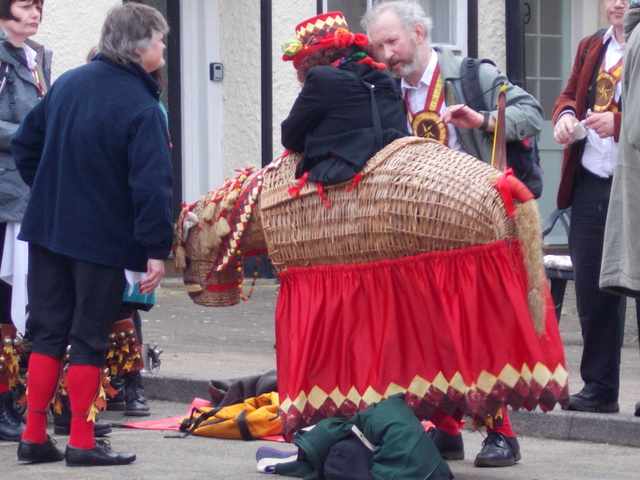
The Hobby Horse from Golden Star Morris

DSCN0269Morris dancers

Golden Star Morris chatting with the musicians from Chelmsford Ladies Morris in the Market Place

DSCN0267Belly dancers

Some of the ladies from the belly dance group who were also taking part in the day of dance.

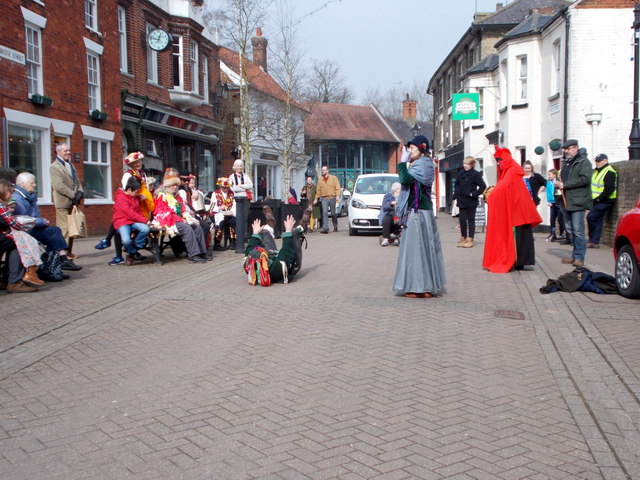
There was a trio of Mummers – Mad Moll and her husband Old Tom who had a visitation from the Devil.

DSCN0262Mummers

Poor Old Tom is taken down to hell by the Devil but Mad Moll rescues him by using cunning and guile.

DSCN0271Ukelele band

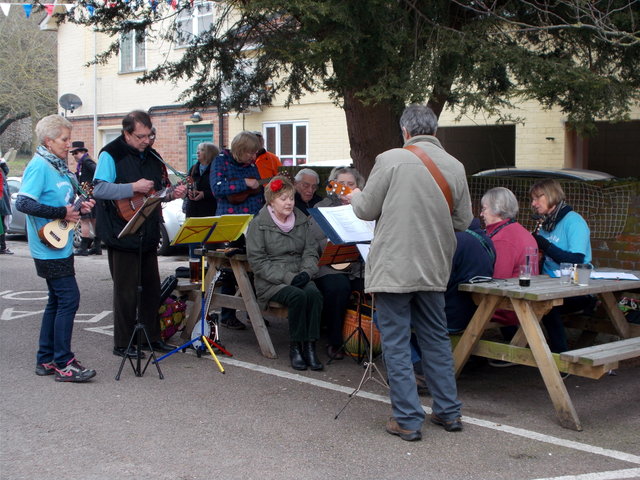
The Ukulele Band from the University of the Third Age who played while everyone was having a break for lunch.

DSCN0260Morris dancers

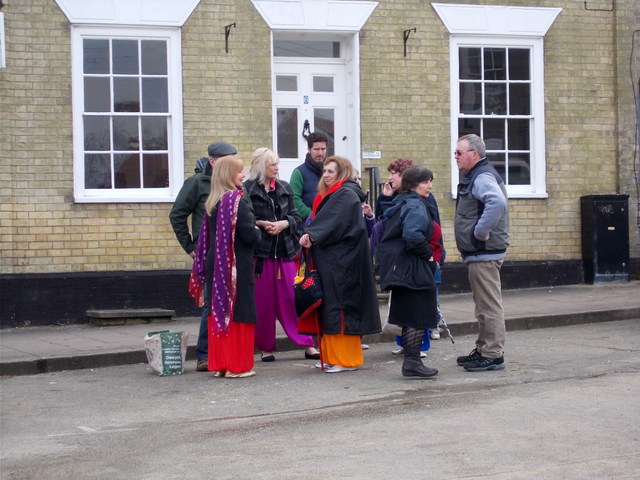
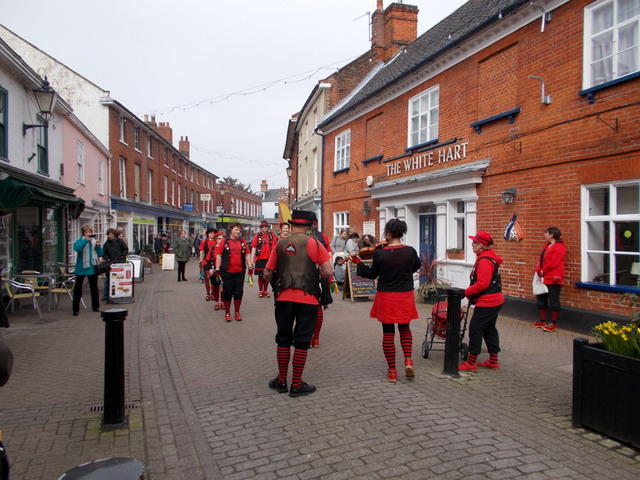
We never discovered the name of this group of women dancers outside The White Hart.

DSCN0273Morris dancers

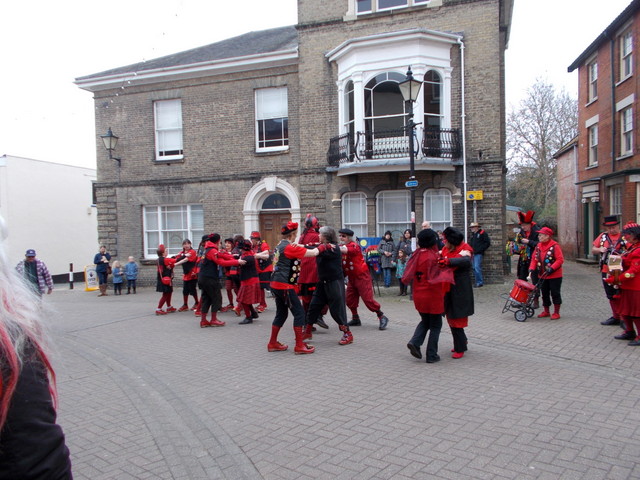
Oxblood Molly teaching the women’s team a new dance

DSCN0264Morris dancers

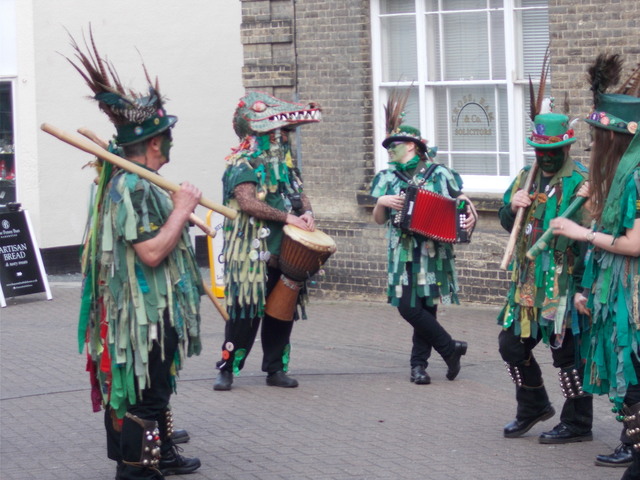
The drummer in this group has a crocodile head.

The last group I have included is another one of the few I know the name of.

DSCN0266Morris dancers

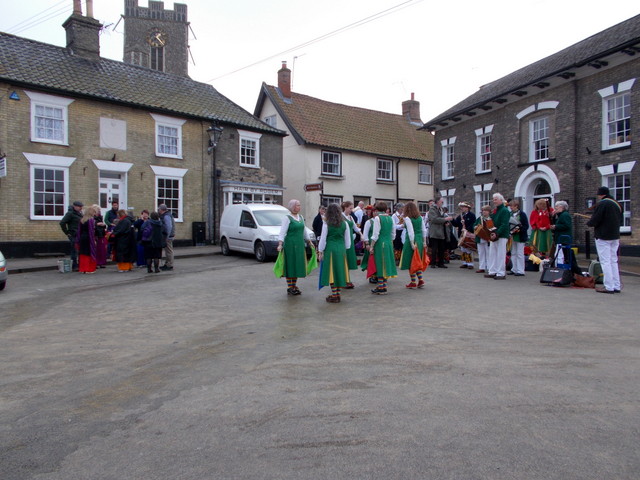
Chelmsford Morris Ladies side dancing in the Market Place

I hope you have enjoyed our Day of Dance.

Thanks for visiting!

A Walk

Tags

, , , , , , , , , , , , ,

On Sunday 13th March Richard and I were able to go for a walk along the lanes together for the first time in months.  The fields were still much too wet for us to walk across them easily so we stuck to the roads and got along very well.  The weather was bright and sunny but the wind was strong and from the north-east so we didn’t linger.

DSCN0276Primroses-001

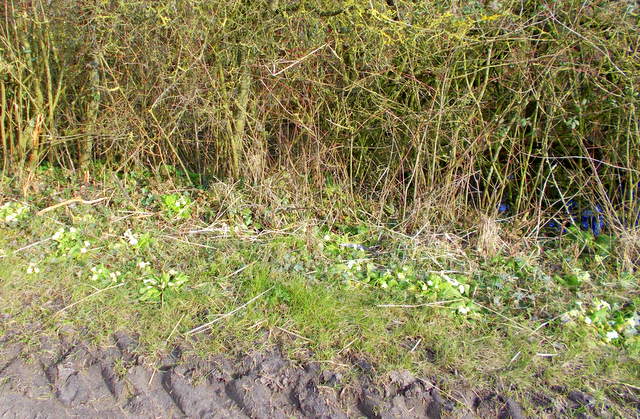
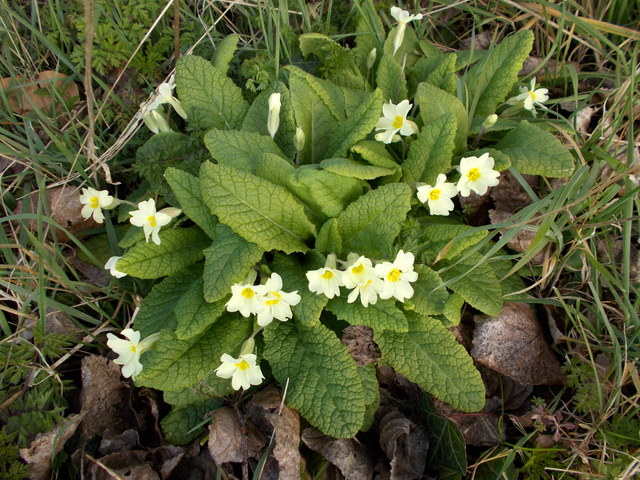
Primroses (Primula vulgaris) had begun to adorn the edges of the roadside.

DSCN0277Roe deer-001

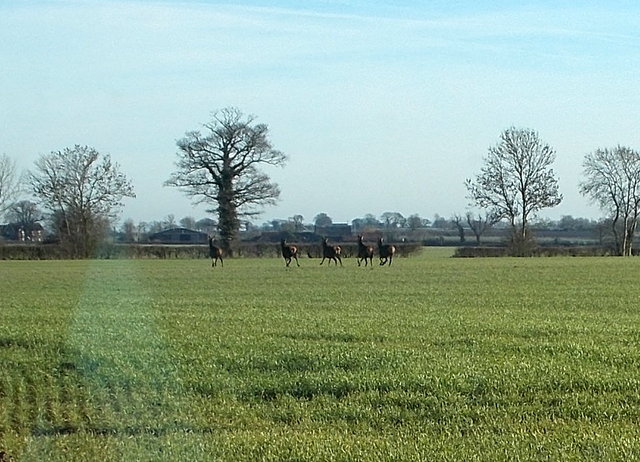
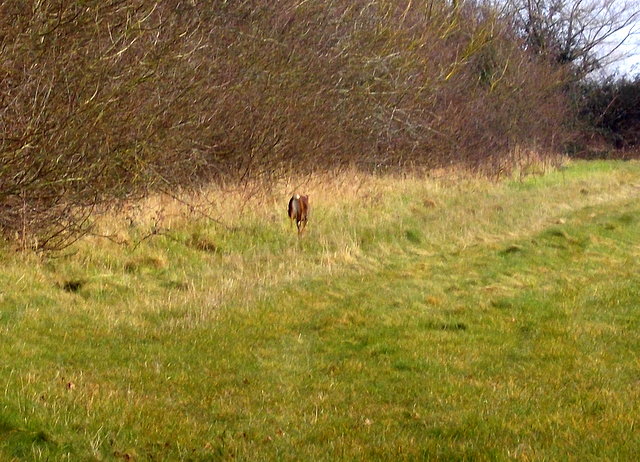
We surprised a Roe Deer (Capreolus capreolus) who didn’t stay around for a photograph.

DSCN0279New pond-001

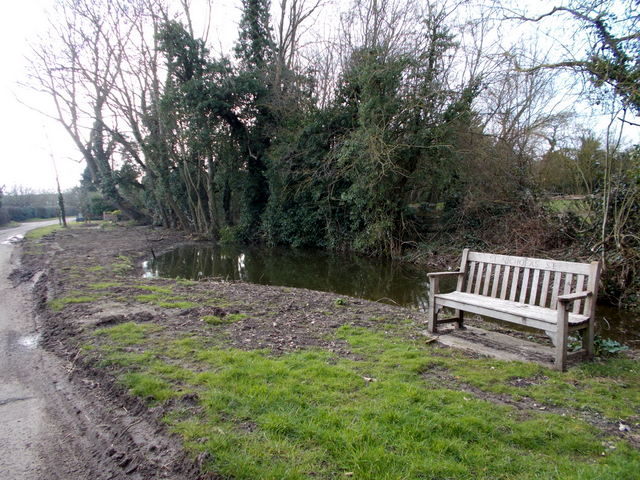
This pond was dug a few weeks ago and it is now full of water. It is about five or six feet deep. There is a cottage on the opposite side of the lane which is being renovated and we think this pond was dug to improve the drainage round the building.

DSCN0280Italian Alder catkins-001

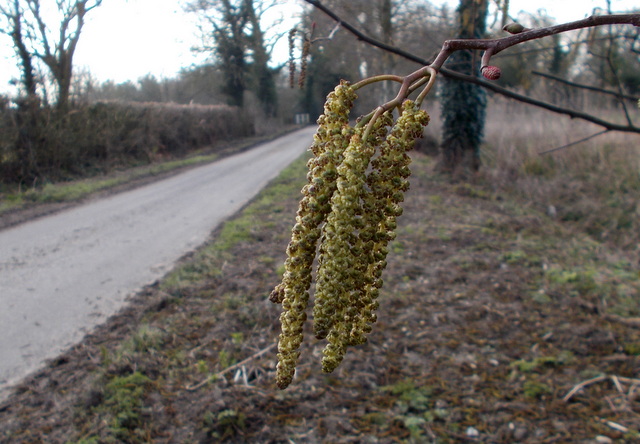
Italian Alder catkins

Halfway down our lane a row of Italian Alders (Alnus cordata) grow between the lane and a wide arable field.  The trees are large and I assume were planted as a windbreak.

DSCN0281The Beck

The Beck wasn’t as deep as it had been a couple of weeks earlier but was still flowing quite quickly.

DSCN0282Our lane

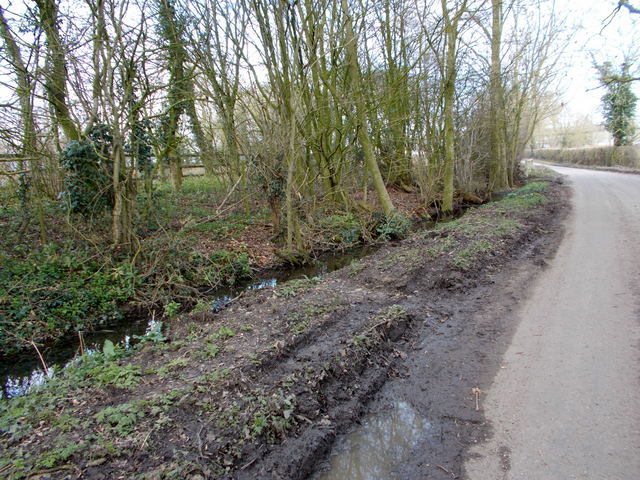
Looking back the way we had come you can see the ditch at the side of the road is still very full. This ditch, along with most of the others near our house, has been cleared and dug out this winter.

The sides of the ditches are scraped to clear away the thick vegetation which if left, can stop the water from flowing away and will cause the roads and fields to flood.  The mud is then heaped up on the top of the bank and tamped down.  This is necessary work but means that we won’t see many wild flowers here for a while.

DSCN0283Recent hedging and ditching work

This photo shows more of the hedging and ditching work going on.

The ditch in the middle distance has been dug out and the hedge on the far side of it which had been left for too long without maintenance and had grown into a row of spindly trees, was being cut right back.

DSCN0284View

A view across the field looking in the direction of our house.

DSCN0287English Oak-001

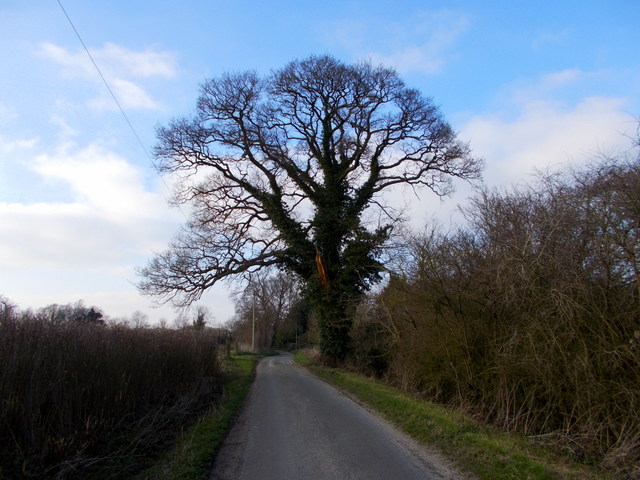
A grand Pedunculate or English Oak (Quercus robur) at the side of the lane. It has lost a large branch recently in a storm. You can just see the orange scar where the branch was ripped away.

DSCN0289View

Another view from the lane.

DSCN0288Lane-001

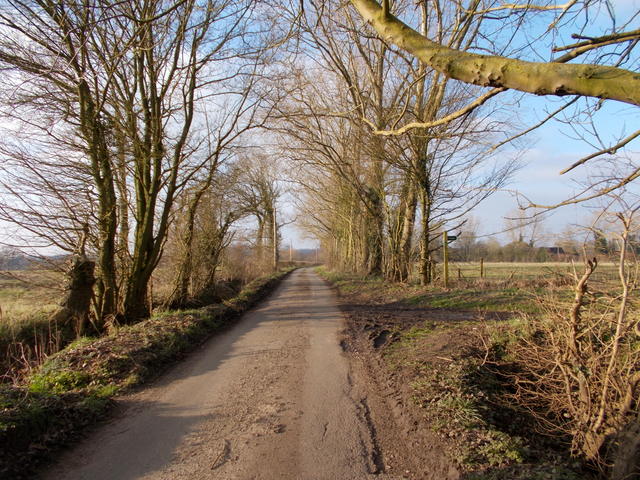
Another of the muddy lanes we walked along. The sunshine and the strong wind were doing a good job of drying the road.

DSCN0290Dandelion

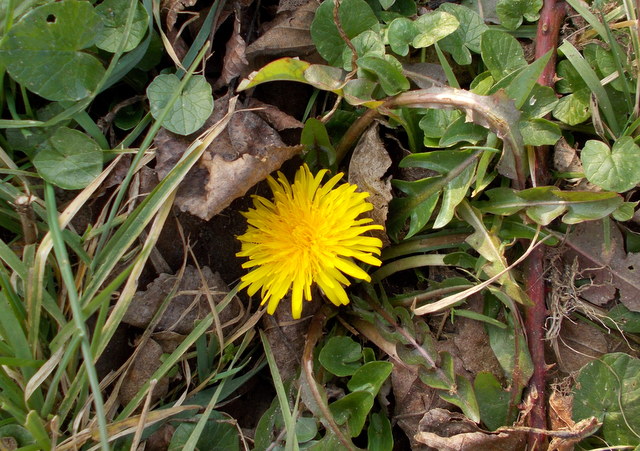
The Dandelions (Taraxacum officinale agg.) are beginning to flower…..

DSCN0292Celandines

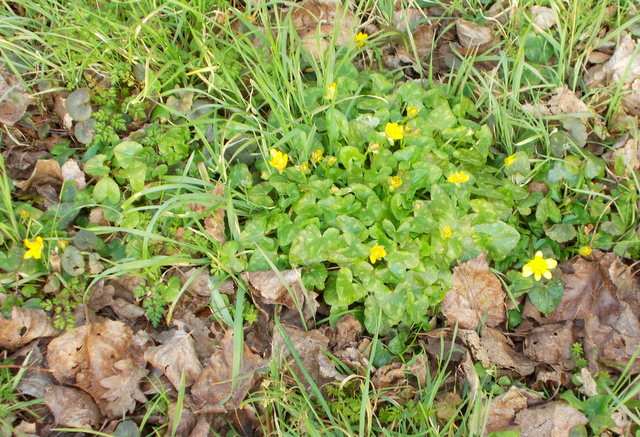
…and so are the Lesser Celandines (Ranunculus ficaria).

DSCN0295Primroses

The Primroses are doing well this year.

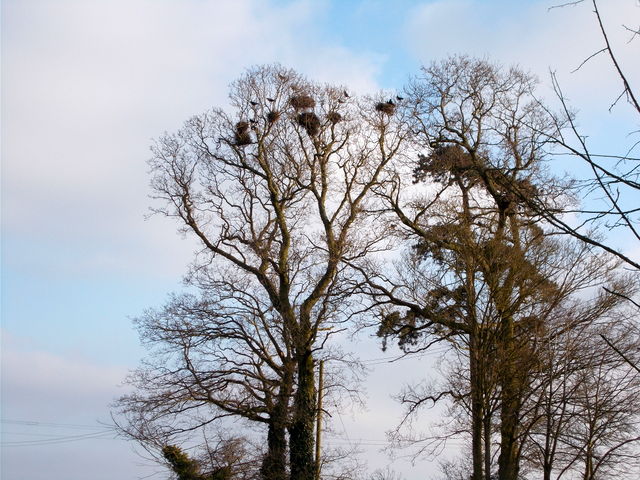
DSCN0296Rookery

The Rookery at St Margaret’s village was busy.

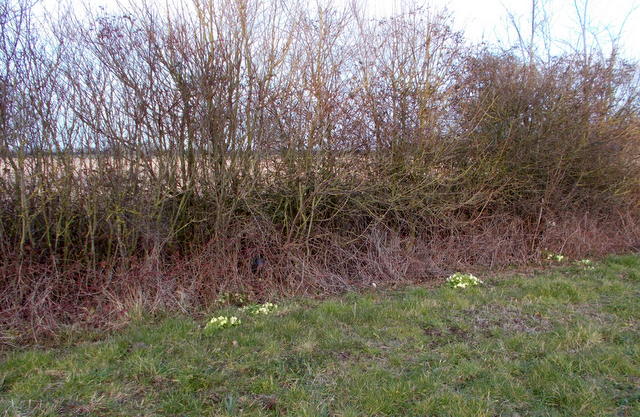
DSCN0297Primroses

More primroses under the hedge.

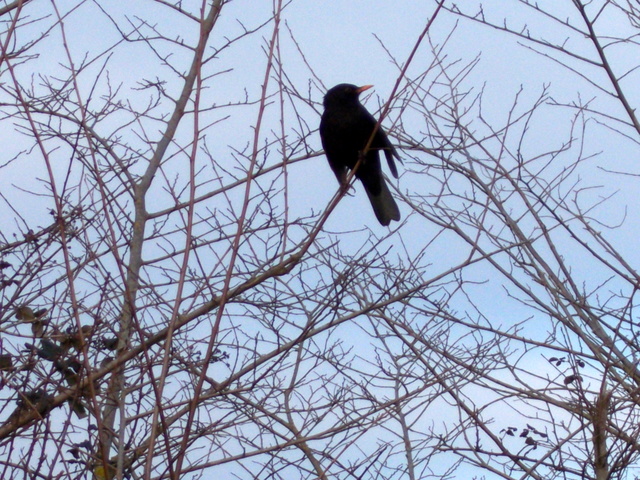
DSCN0299Blackbird

A male Blackbird (Turdus merula) sitting in a tree above my head was being blown about in the breeze.

DSCN0301 pond

These ponds appear on St Margaret’s common when we have had a lot of rain

DSCN0302Our house

This is our house as seen from the field at the back. We turned off the lane and walked back home down the edge of the field which had dried out quite nicely.

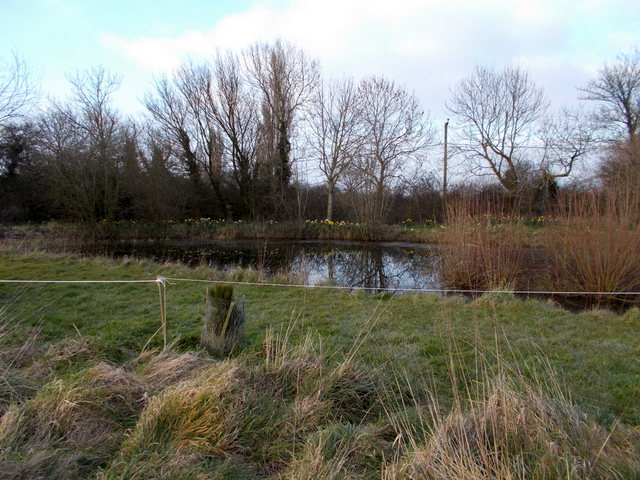
DSCN0305Big pond

Our big pond as seen from the field. The white cord is all the boundary marker we have at present.

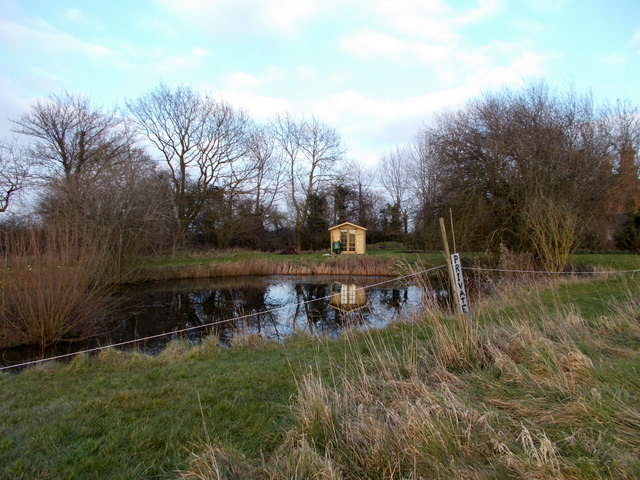
DSCN0306Big pond

A view of the rest of the pond showing where the new summerhouse is.

My choice of music today is a video of a folk music session at a Suffolk pub.

Thanks for visiting!

Spring Days

Tags

, , , , , , , , , , , , , ,

There isn’t much of interest to report – we have been busy and we are all very tired but there isn’t much to show for it all.

We have had a new suite of furniture delivered for our living room and the old sofas and reclining chair have been donated to Emmaus a charity that helps and supports the homeless.  They have a second-hand retail shop at Ditchingham, a village a few miles to the north of us which is where our furniture was taken.  The new furniture is very different but extremely comfortable.  It is also less bulky than our old furniture so our living room seems a little bigger.

Our old shed has been demolished and we have had a concrete pad laid next to the tool shed where we will put a new potting shed.  Getting rid of the old shed, which really was an eyesore, has opened up the garden at the north side of the house.  Richard has dug over the soil which was underneath the shed and will add organic matter to it to help rejuvenate it.  Eventually, he would like to plant flowering shrubs there.  He has also added compost to and dug over the soil in the vegetable beds.  The potatoes are ready for planting and Richard will begin sowing pea and bean seeds in pots soon.  The weather has been much too cold recently for anything to be planted outside and as we have an unheated greenhouse we daren’t sow seeds there just yet either.

Last week we saw quite a lot of sunshine and even though the wind was from the north-east and very cold everything seemed very spring-like.  This week there has been increasing amounts of cloud and a lot of drizzly rain so with the cold wind it feels like a return of winter.  The daytime temperature has stayed between 5 and 6 degrees C all the week.

I walked round the garden last week and took a few photographs in the sunshine.

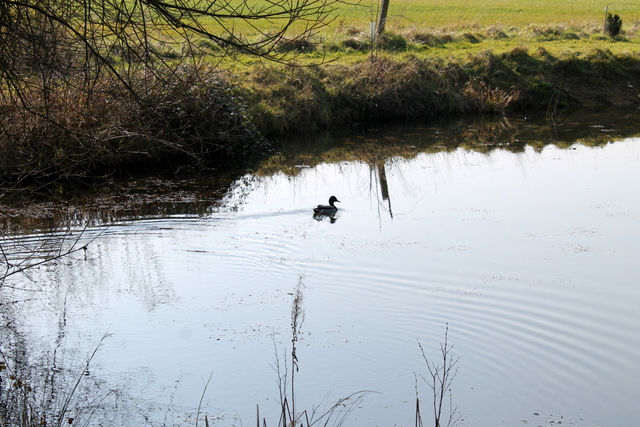
IMG_2683Mallard

A Mallard swimming on the big pond

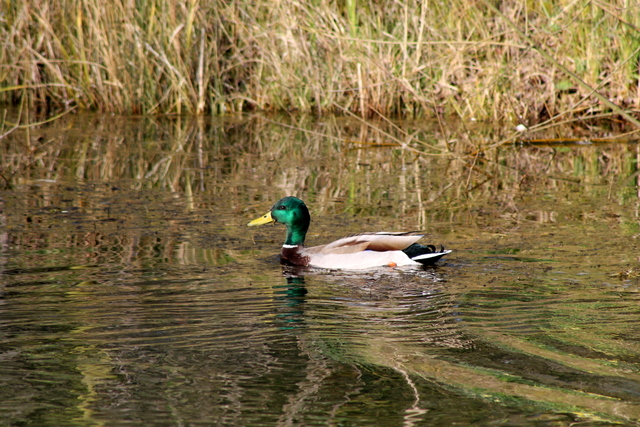
IMG_2691Mallard

Mallard drake

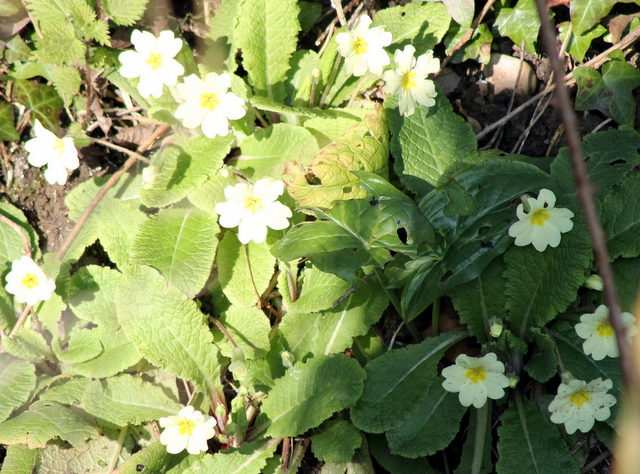
IMG_2685Primroses-001

Primroses in one of the ditches round the garden

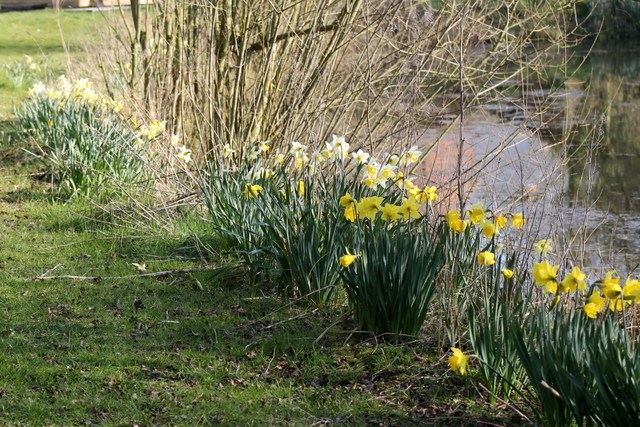
IMG_2686Daffodils

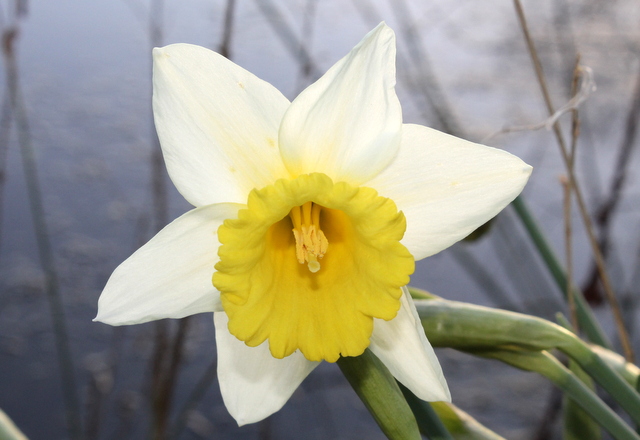
Daffodils flowering on the bank of the big pond

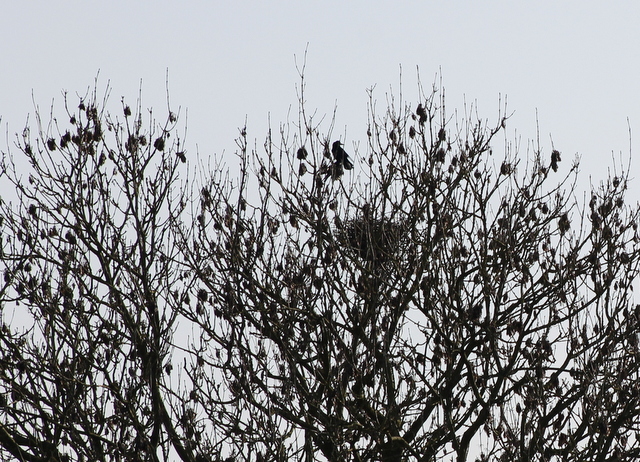
IMG_2687Rook's nest-001

A Rook’s nest being built in the Ash tree.

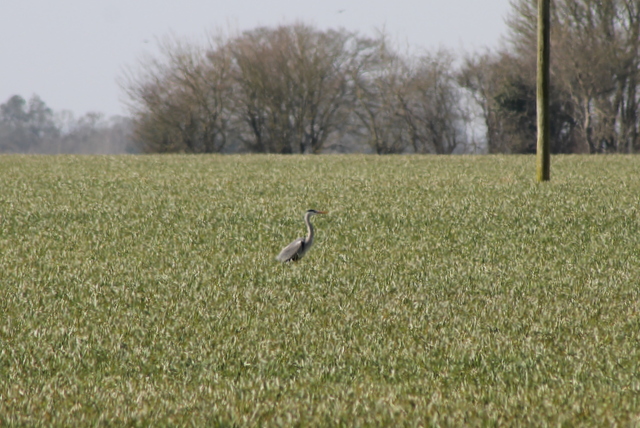
I have seen the heron in the garden a few times.

IMG_2710Heron

I tried to sneak up on the heron as it stood at the side of the pond but it saw me and flew into the field behind our house. This is a poor photo that has been severely cropped.

I found a half-eaten fish on the path round the pond which could have been left there by the heron or by the otter which is causing owners of ponds in our area to wish the otter was living many miles away!

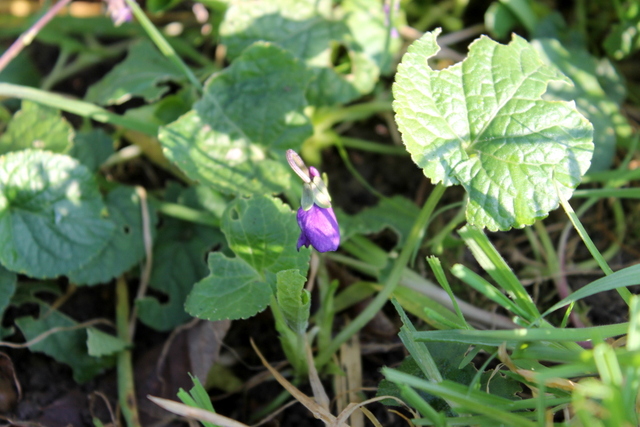
IMG_2701Sweet violet

Sweet violet

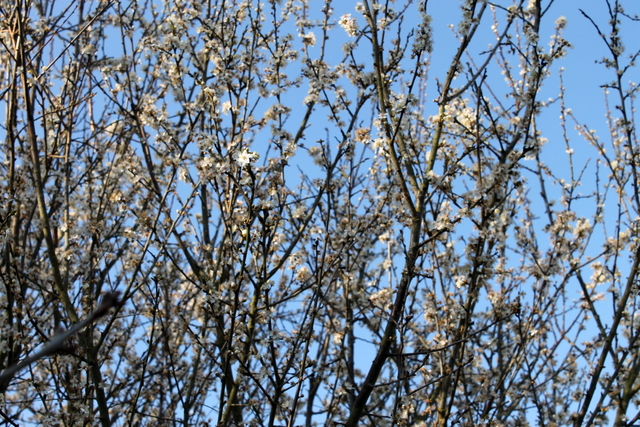
IMG_2695Cherry-plum

Cherry-plum


IMG_2696Cherry-plum

Cherry-plum

IMG_2697Cherry-plum

Cherry-plum

My choice of music for this post is Emmanuel Chabrier’s ‘Suite Pastorale’.  As soon as I hear it I think of spring days in the countryside – cool breezes, sparkling streams, flowers and singing birds.  I hope you like the music as much as I do.

Thanks for visiting!


All Change!

Tags

, , , , , , , , , , , , , , , , , , ,

We have had a very busy few weeks here with very little time for relaxation.  We are all rather tired and stressed and could do with a holiday (or a few weeks at home with nothing to do!), though there is little chance of that just yet.

All the planned work in this first phase of house renovation has been done and we are very pleased with the results.  The new windows, doors and garage doors are looking good and the house and garage are feeling much warmer.  We still have a little sorting out to do in the garage and a few more trips to the tip and charity shops with the things we no longer need.  There is a little room at the back of the garage which had a toilet and wash-hand basin in it which we never used.  We had the plumbing removed shortly after Christmas and Richard painted the room last week.  He has bought some shelves for it and we hope it will be a good storage room for the bird-seed and fruit and vegetables.  It has a window which we hope to brick up and put in a vent in its place.  For now we will put a screen against the window to prevent the light getting in.

DSCN0246

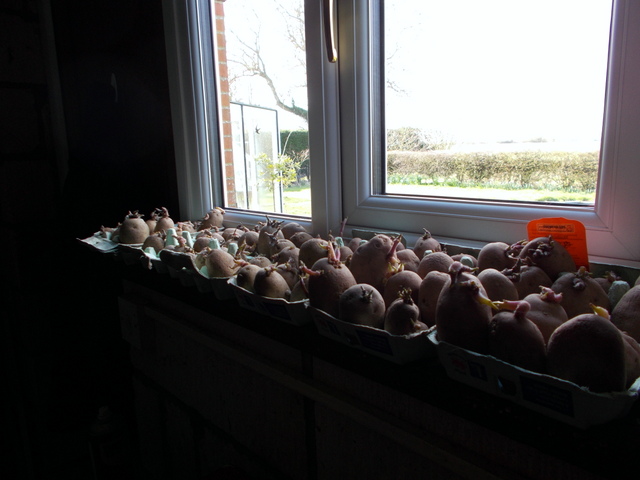
Potatoes chitting on the garage window-sill. Note the new window!

We worked very hard to get the house ready for the work and it was worth the trouble we took.  Most of the time there was just one window fitter – a very pleasant, hard-working man who was so proficient and tidy it was a pleasure to have him here.  He let us know which rooms he would be working on during the following day so we prepared by moving furniture and covering everything we could with dust sheets.  While he worked on one room we got the next ready and so we progressed round the house.  He was here for five days and on his last day with us he was joined by a colleague and together they replaced the Velux window in Elinor’s room.  It was unfortunate that the weather wasn’t very nice that day with snow, sleet, hail and rain showers and it took some time for Elinor’s room to warm up again.  We supplied the men with plenty of hot tea to help them keep warm!

I washed, dried and ironed lots of pairs of curtains and also took the opportunity to launder other furnishings too.  I feel I made a good start to my spring cleaning!

Elinor took her two mock maths GCSE exams the same week that we had most of the window work done.  (She is re-taking her maths because the grade she got last year wasn’t good enough).  She also handed in her art project work that she had been working on since Christmas.  She got a pass mark for the art (there are only two marks she could have got – a pass or a referral) and she got a ‘C’ for her maths which has pleased us all.  If she gets a ‘C’ grade when she takes her exams for real in the summer it will mean she has the minimum grade all colleges and employers demand.  She won’t ever have to go to a Maths class again or take any more maths exams.  (A sigh of relief from Elinor!)

DSCN0207Crockham Hill

View from Crockham Hill churchyard.

I now feel I must say how much I appreciated all your kindnesses when I spoke of the death of my aunt – I was most touched; thank-you.  The funeral went very well and was a very satisfying celebration of her life.  It was good to see my brother, sister and all my cousins and their families and to re-visit Kent and Crockham Hill, the village where my Aunt Marie and Uncle Fred lived for so many years.  Aunt Marie had moved away into sheltered accomodation after Uncle Fred died.

12644851_937276086327968_6429599727916884182_n

Aunt Marie and Uncle Fred

It was sleeting and snowing as I set off for my brother’s house that morning and that continued until my brother had driven us to the Suffolk/Essex border when the clouds began to break up.  When we got to Westerham in Kent where we stopped for coffee, the sun had come out.  My cousin had arranged a lovely buffet meal for us all after the funeral in The Royal Oak, Uncle Fred’s local pub.

The Fens in Cambridgeshire seen from the window of the train I took to Sheffield.

I travelled to Sheffield by train so that I could see Alice in her production of Agatha Christie’s ‘And Then There Were None’.  The play was excellently performed by all the cast and I enjoyed it very much.  I stayed at Alice’s house overnight and met one of her housemates and also Alice’s cat, Mona.  Alice and I breakfasted in the city next morning before I caught my train back home.

DSCN0221Peterborough

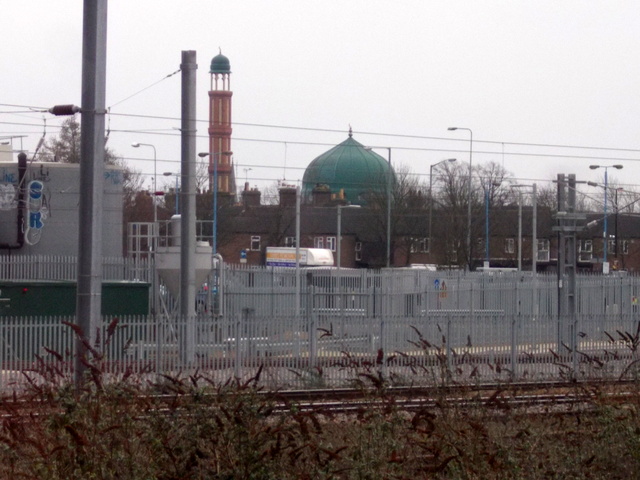
The Mosque in Peterborough seen from the train

DSCN0208Norwich Station

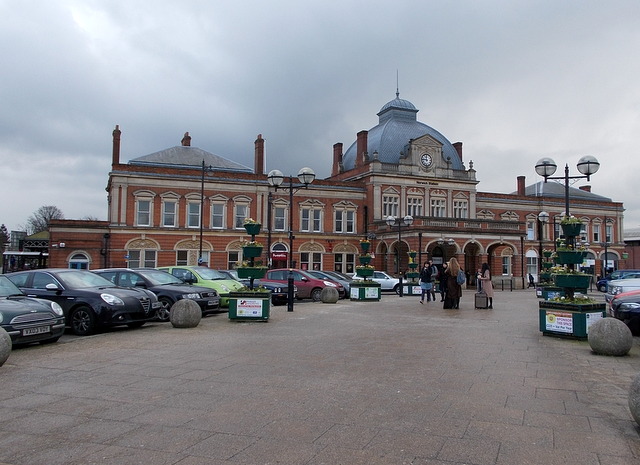
Norwich Railway Station

DSCN0211Norwich Station

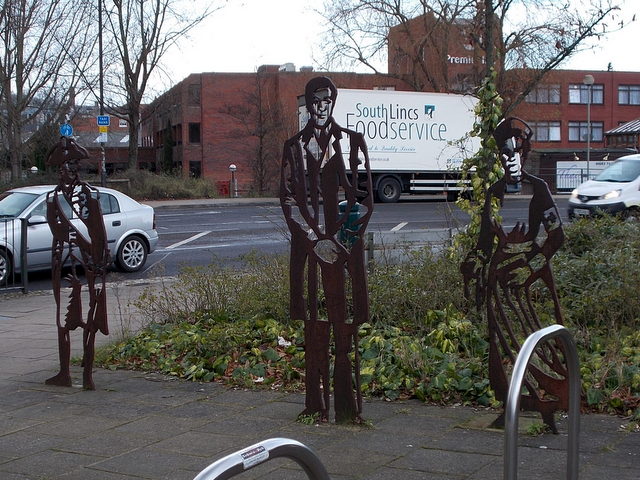
These life-size figures stand outside the station and are rather a disparate group.  Admiral Lord Nelson on the left; born in Norfolk and was a great Naval commander during the Napoleonic Wars and was killed during the Battle of Trafalgar – Edith Cavell; born in Norfolk and was executed during WW1 for helping allied soldiers escape from occupied Belgium – Stephen Fry; born in London though grew up in Norfolk and is an actor, writer, presenter, activist and ‘National Treasure’.

I saw quite a lot of my mother during the middle of February as she had a number of appointments to keep ( two hospital appointments in Norwich and two with her local doctor) and a fair amount of shopping to do.  Elinor and I had a meeting at her college to discuss her support needs for her next academic year and to deal with any support problems she has this year. I had been looking forward to Elinor’s half-term holiday but as the window replacement carried on into that week and as we had other duties to perform it wasn’t as restful as I’d hoped.  Elinor had a hair appointment on the Thursday and we had planned to go with her and have lunch out in the city.  Unfortunately, I woke with a migraine and had to spend most of the day in bed.  Richard took Elinor to Norwich and they had lunch in a café.  Richard brought me back a lovely couple of presents.

DSCN0227My presents

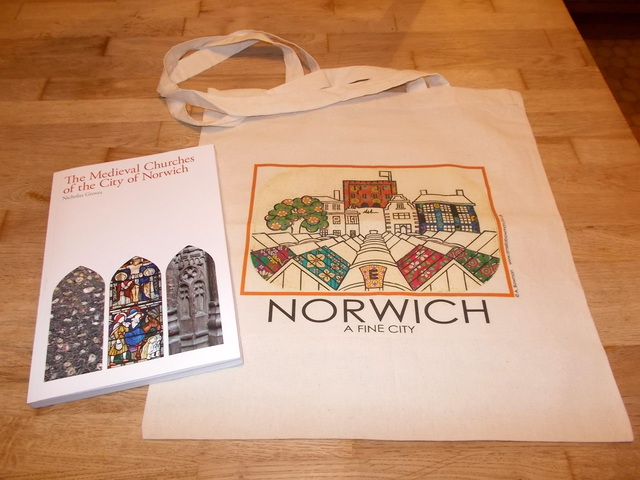
My presents!

I love the design on the tote bag!  It is by the artist Amelia Bowman and is a view across the roofs of the market towards the castle. The book is also just what I need for my visits to the churches in the city.

We have managed two short walks; one at the RSPB reserve at Minsmere and the other in Tyrrels Wood which lies to the north of Diss and Harleston in Norfolk.  Neither of the walks were particularly interesting but we were out in the fresh (very fresh and cold!) air and were taking some exercise.

IMG_2611Minsmere

Richard at Minsmere

IMG_2621Minsmere

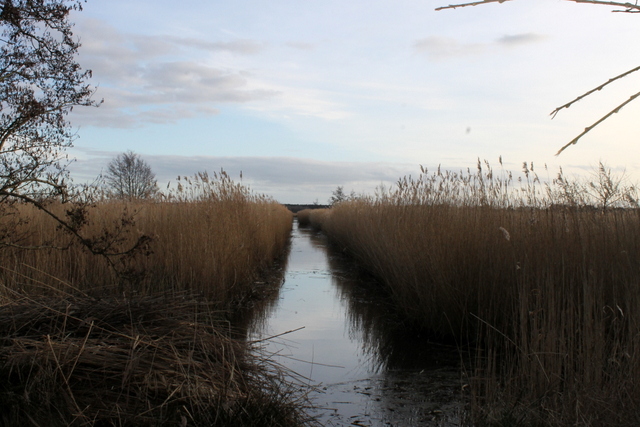
Minsmere reedbeds

A slideshow of some small but quite interesting things!

This slideshow requires JavaScript.

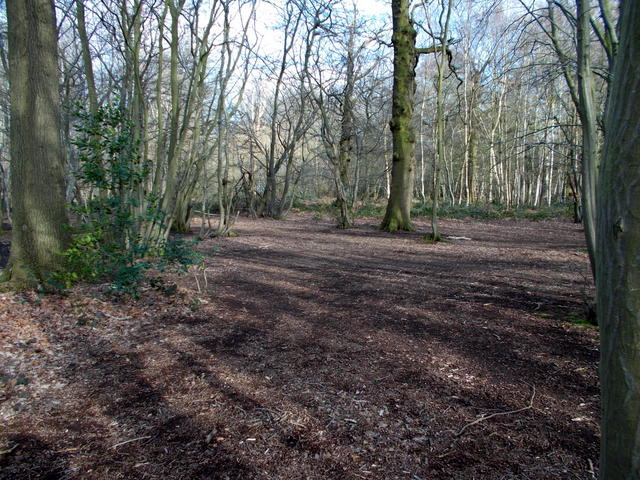
Our walk in Tyrrels Wood was less pleasant as it was so very muddy and we were disappointed by the state it was in.  There was a quantity of litter in the wood, especially near the entrance and it was obvious that the wood is used by dog-walkers.  We had to watch where we walked!  In this country it is illegal to allow one’s dog to foul a public area and not clean up after it.  I am surprised that a large organisation like the Woodland Trust is happy to leave the wood in this condition.

DSCN0247

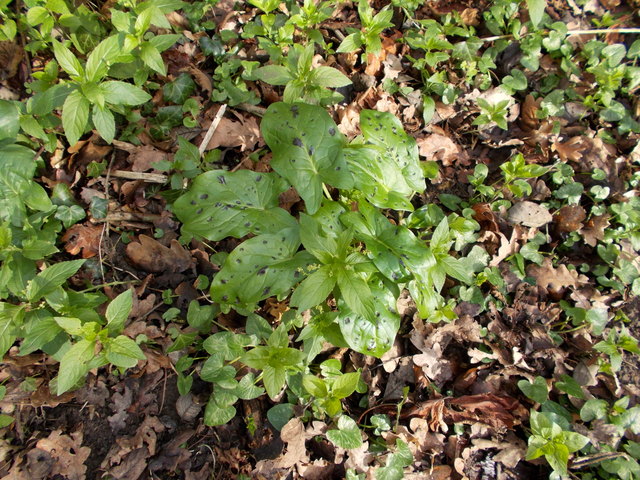
The spotted leaves of Lords and Ladies/Jack-in-the-Pulpit (Arum maculatum) next to Dog’s Mercury (Mercurialis perennis)

DSCN0248

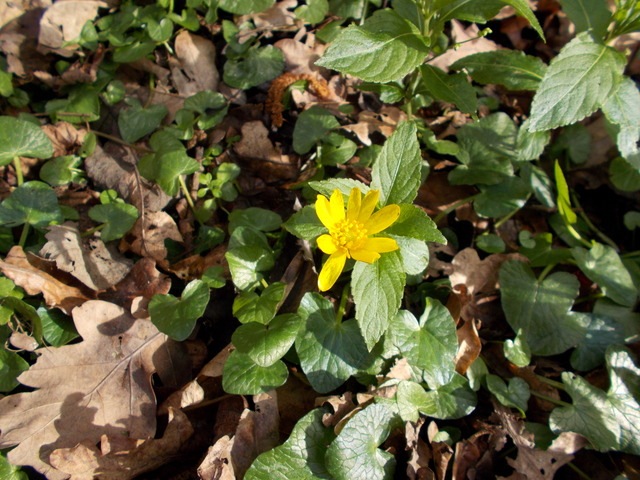
Lesser Celandine (Ranunculus ficaria) also with Dog’s Mercury

DSCN0250

Tyrrels Wood

DSCN0251

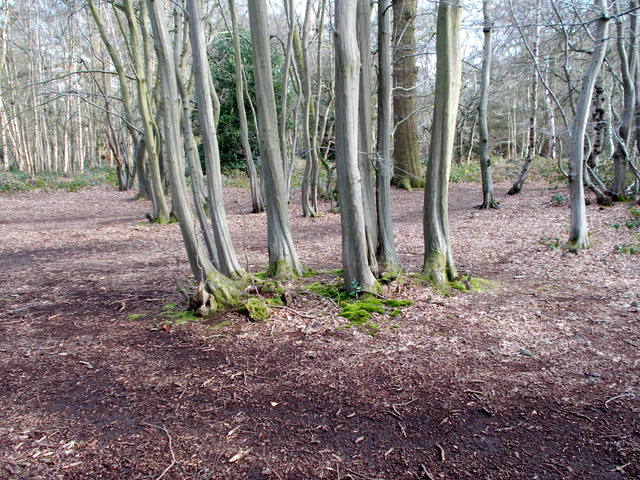
An ancient coppice stool. This group of trees was once one tree but through repeated coppicing (cutting back the tree to near ground level to let new shoots re-grow) it has become a group of trees with a shared root system.

DSCN0254

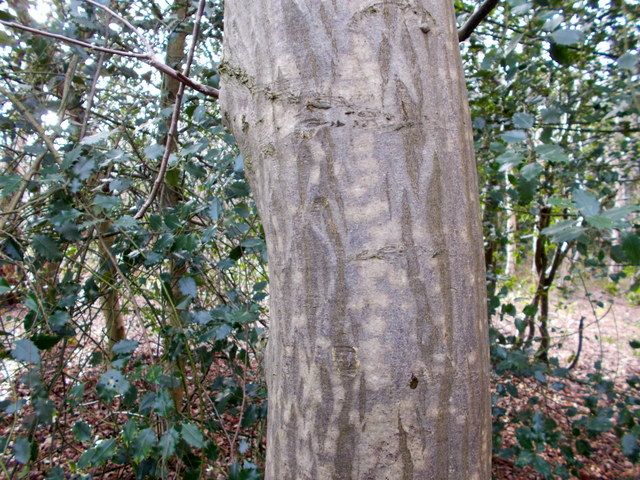
The bark patterns on this tree are interesting.

And now for my music selection!  A little trip down memory lane to the summer of 1978 when I was nearly 20 years old and fancy-free.

Thanks for visiting!

Garden-work

Tags

, , , , , , , , , , ,

IMG_2640Witch-hazel

Daffodils and crocuses

I managed to do some work in the garden on Sunday; the first time in many weeks that I have spent more than a couple of minutes outside.

Some weeks ago I moved three tubs of spring bulbs – snowdrops with Tete-a-tete daffodils in two tubs and little blue crocuses in the third – from their winter-quarters behind the greenhouse to the front of the house under the kitchen window.  They were ready to bloom and they have brightened up the area near the front door.  On Sunday I moved the rest of the pots and tubs away from the back of the greenhouse either to the front of the house or to the rear near the conservatory.

IMG_2681Daffodil

The area round the greenhouse has become very wet and waterlogged and the pots were sitting in puddles.  Richard and I had a talk about how to solve this problem and I suggested a French drain ( a trench filled with gravel) immediately round the greenhouse and then we discussed again our idea of putting flagstones round the greenhouse to make it nicer to walk on than muddy grass.  We have a plastic compost bin near to the greenhouse and a lidded water-butt behind the greenhouse –  the water-butt will then go on the flags and so will the compost bin.  The water-butt keeps sinking into the ground despite the bricks and flints it is standing on (there must be quite a collection under the water-butt by now).  Also, we often get rats, mice and/or voles getting into the compost bin and having the bin on hard-standing would stop that little game!  They dig tunnels that come up under the bin and then make themselves at home amongst the potato peelings and weeds.

IMG_2675Daffodil

One of the daffodils that have started blooming round the big pond

We also discussed where we would put the new potting shed.  We have a very old tumbledown shed in the middle of the garden.  It is rotting and disintegrating very quickly and we need to replace it and we don’t want to use the same site for the new shed.  We have a very nice tool shed near the greenhouse so the new potting shed with a large window and bench will go next to the tool shed.  This will keep all the out-buildings together in one place and will save us a lot of time walking from one side of the garden to the other.

IMG_2665Witch-hazel

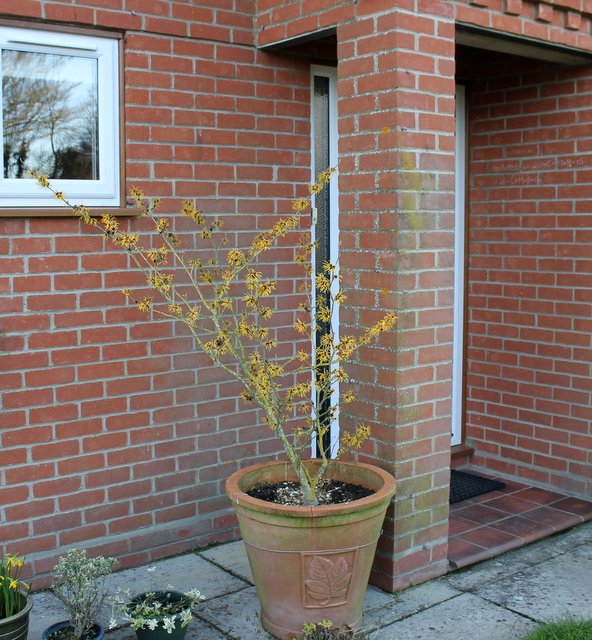
Witch-hazel by our front door

I am considering drawing a plan of our garden as it is now and scanning it so that I can include it in this blog.  When we make changes to the garden I can then update the plan.

IMG_2649Summer house

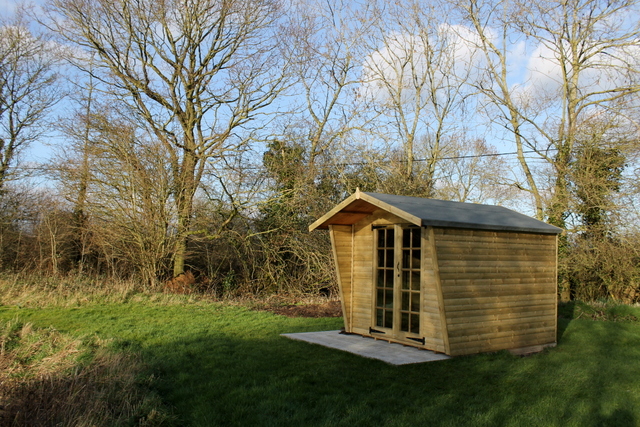
This is our new summer house

I mentioned in a former post that our old summerhouse was demolished and the base was extended in readiness for a replacement.  The new building arrived and was put up during a gale on 8th February and is just what Richard wanted.  He has been enjoying his room with a view and often sits inside it looking out over the big pond.

IMG_2652Hazel

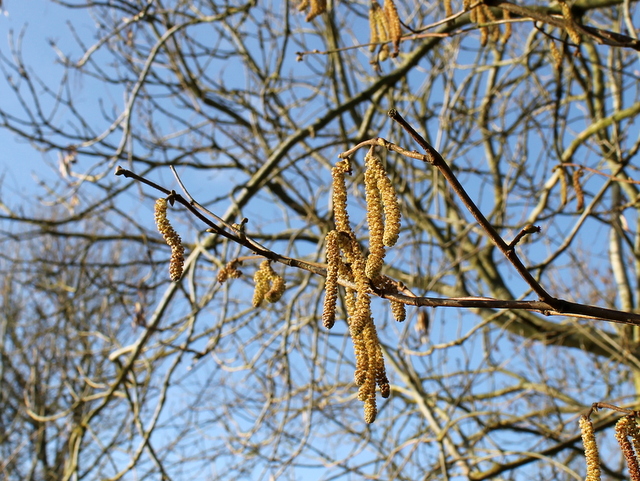
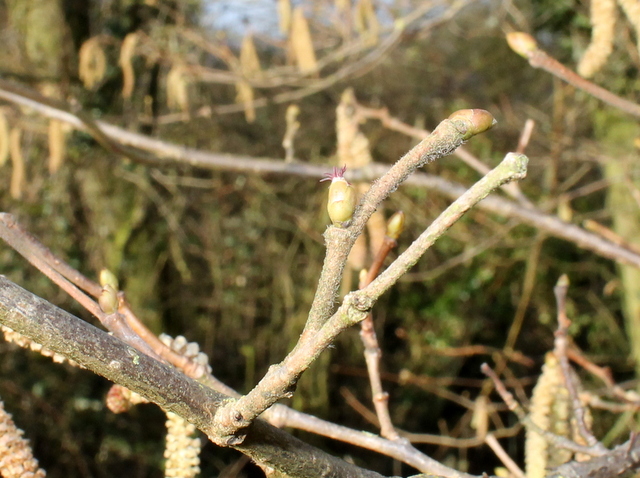
Hazel catkins on one of our Hazel trees

IMG_2650Hazel

A poor photo of a female hazel flower. You can just see the little red tuft at the top of the bud-like object in the centre of the photo

Behind the summerhouse (you can’t see it from the angle the photo was taken from) is our large open compost heap where we put our bulkier garden clippings and waste.  Next door’s chickens are often here turning it over for us and kicking it about and in the summer Richard often finds Grass Snakes sleeping in its warmth.  Richard doesn’t like snakes.

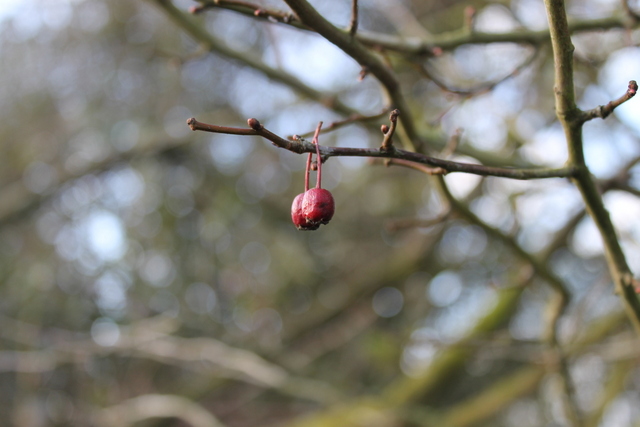
IMG_2657Hawthorn berries

Not all of the Hawthorn berries have been eaten yet. These two had fallen from an overhanging Hawthorn branch above and caught on this Elm twig

I have also mentioned in former posts that the garden is large and is mainly laid to grass.  There are a couple of vegetable beds near the summerhouse and another mixed vegetable and flower bed half way up the garden.  I had started to use this mixed bed when we moved in to this house but I haven’t had the time to do much to it since my father died and Elinor started suffering so badly with anxiety.  Most of my plants there have died and couch grass and ox-eye daisies have taken over.  Richard is using part of the bed for his dahlias and chrysanthemums and there is a rhubarb plant and some blackberry canes there too.

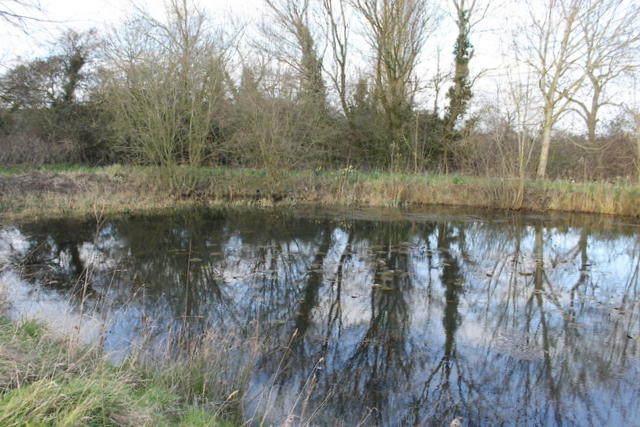
IMG_2659Big pond

The big pond

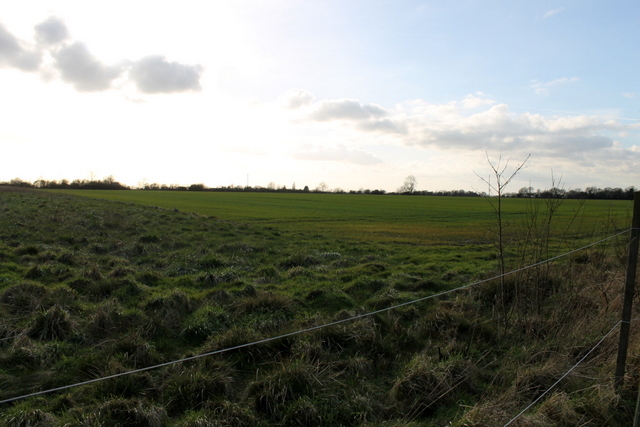
IMG_2660Field

The arable field to the rear of our house

There is an old rose arbour next to the mixed bed and on this side of the arbour Richard has made a flowerbed for his favourite flowers.  He has also started to make a shrubbery fairly near to our septic tank.  We have a large gas tank close to the house and I have made a small flowerbed on the northern side of it and filled it mainly with spring flowers.  I haven’t weeded it recently and this will be a project for the next time I get outside.

This slideshow requires JavaScript.

There are narrow flowerbeds most of the way round the house which I look after and I have also started to landscape the area to the south of the house.  I had made a flowerbed near the hedge at the rear of the house but again, I had to abandon this when Dad died and Elinor started to need more support and I had much less free time.  Many of my plants are in pots and tubs waiting to find a proper home.  I hope to make a gravel garden at the front of the house with paths through it from the front door to the drive way.  I bought the gravel for this project eight years ago!

IMG_2661Hedge

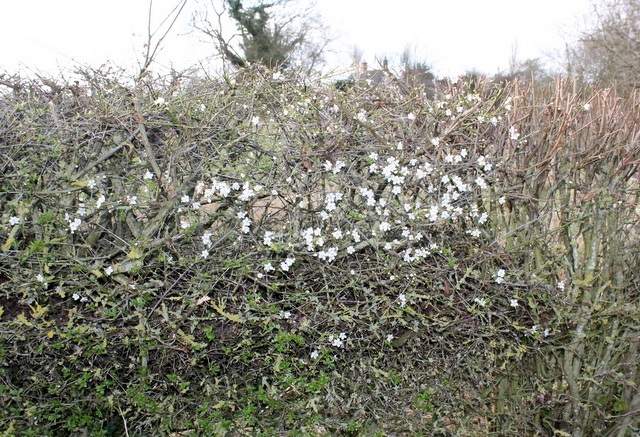
Cherry-plum blossom in our hedge

IMG_2662Cherry plum in hedge

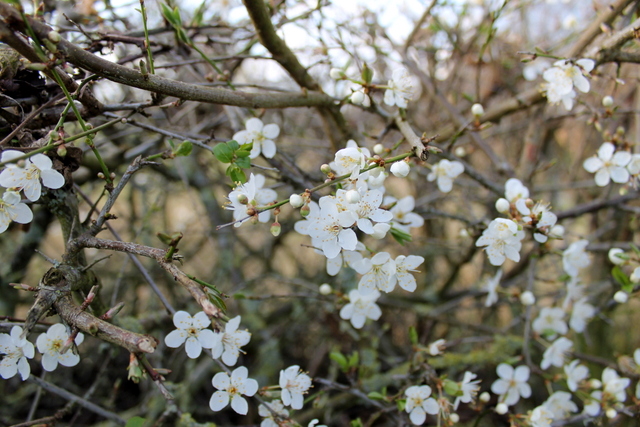
Cherry-plum blossom

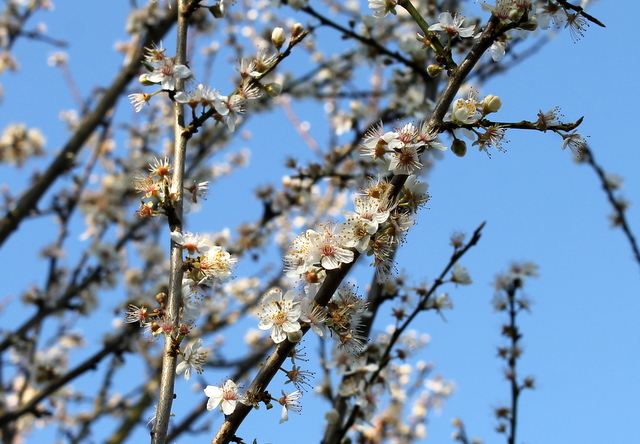
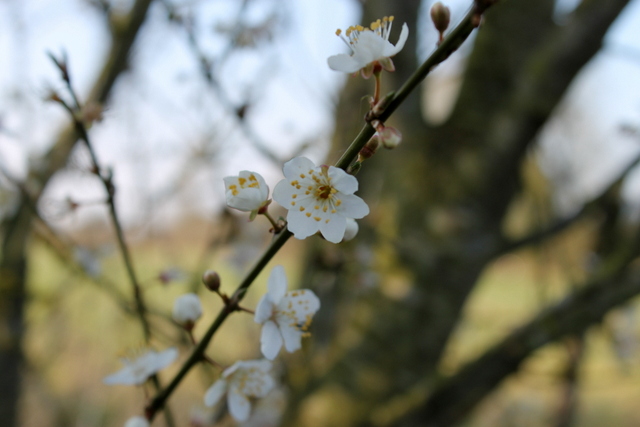
Cherry-plum or Myrobalan Plum (Prunus cerasifera) is not a native tree but has become naturalised here and is often found in hedges.  It is often confused with Blackthorn or Sloe (Prunus spinosa) but the Blackthorn flowers open before the leaves come out and the Cherry-plum’s flowers and leaves open at the same time.  The cherry-plum isn’t so spiny as Blackthorn.

IMG_2668Corner pond

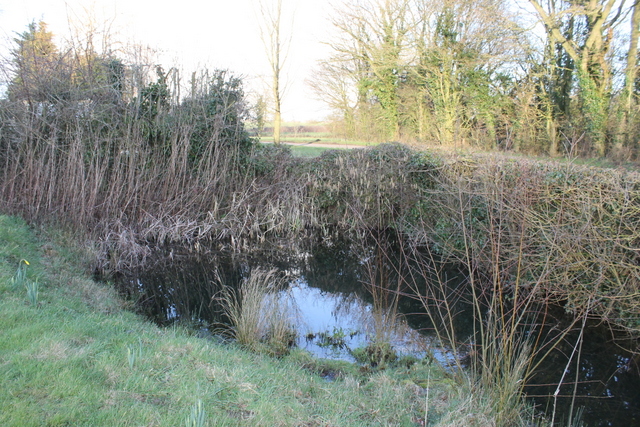
The corner pond at the front of the house.

My music choice today is a song written by B A Robertson and Mike Rutherford shortly after the death of their respective fathers.  It is sung by a favourite singer of mine, Paul  Carrack, whose father died when Paul was eleven years old.  It is a song about the regret we have when we lose a relative and realise all the things we should have said to them when they were alive.  I am so glad I was able to tell my father how much I loved him and appreciated the love he had for me.

Thanks for visiting!

By Pope! Uncle Ben and Voltaire are Linked to the JNU Incident!

I recommend this post from Knowallsbox

Know-All's avatarKnow-All's Box

Photo source: http://blogs.economictimes.indiatimes.com/et-commentary/government-should-have-allowed-jnu-to-resolve-the-issue/ Photo source: http://blogs.economictimes.indiatimes.com/et-commentary/government-should-have-allowed-jnu-to-resolve-the-issue/

The best thing about blogging…No one gives a damn about what I feel about an issue. But, it’s my blog…and I have the freedom to express ANYTHING I want!

Freedom to express ANYTHING? Really?

Which brings to my topic for this post. for the second time in my blogging career, I am writing about a topic which is political in nature…and this one has divided the nation like no other in recent memory!

If you have been in India last couple of weeks, it’s very unlikely that you have not seen or heard about the events which took place in the Jawaharlal Nehru University(JNU) campus in New Delhi.Considering the fact that many of my fellow bloggers are not from India, I think it’s necessary that I give a brief background. However, if you are aware about the incident, you can skip the next 2 paragraphs.

Our story…

View original post 1,688 more words

Norwich – Chapel Field

Tags

, , , , , , , , , , ,

I took this short walk in Norwich on a dull cold day last spring.  I began my walk near the Assembly House.

IMG_4208The Assembly House Restaurant

This building was designed and built by the architect Thomas Ivory in 1794 and, as its name suggests, was a place where the local gentry could assemble and be amused and entertained by recitals, displays and dances.  One notable ball was in celebration of Nelson’s victory off the Cape of Trafalgar in 1805.  A waxworks exhibition from Madame Tussaud’s was hosted here in 1825 and Franz Liszt the composer gave a concert in 1840.  The building incorporates the layout of a previous building – the medieval college of St Mary in the Field.

IMG_4209The Assembly House Restaurant

The Assembly House – some more renovation work was in progress at the time of my photograph

It has been used as a dance academy, a cinema and, during the Second World War, it was an army office.  It was restored in 1995 but almost immediately afterwards was severely damaged by an electrical fire.  With the aid of photographs taken at the instigation of a trustee during WW2, the house was reconstructed and today it appears exactly as it did when it was first built.  It is used as a restaurant and hosts exhibitions, concerts, conferences and weddings, almost the same kind of use it was put to in its heyday.

IMG_4205The Forum

The Forum

Opposite the Assembly House is the Forum, though the large entrance seen in the photo above is on the further side of the building.

Norwich’s Central Library was located on this spot until it was destroyed by fire in 1994 and this new building, designed by Sir Michael Hopkins, not only gave the library a new home but also was built to mark the Millennium in the East of England.  The main section of the building is an enclosing horseshoe shape.  It is made from hand-made load-bearing bricks and has many windows.

As well as The Millennium Library (the public library) the Forum houses a children’s library, the Norfolk Heritage Centre, the Norfolk Record Office and a business library.  The 2nd Air Division Memorial Library is also here; it pays tribute to the thousands of American airmen who were based in East Anglia during WW2.  There are over 4000 books covering all aspects of American life and culture with a specialist section dedicated to the 2nd Air Division.

Many other organisations have a base in the Forum.  BBC East has its studios in part of the building; there is a Forum shop, a café bar and a pizza restaurant.  The Tourist Information Centre is here, as is MINT – a charity which helps young people gain the skills and contacts they need to find employment.  MINT is run by City College Norwich where my daughter studies.  ‘BBC Voices’ provides film-making and radio-editing workshops throughout the Eastern Region for free.  There is a digital gallery – the Fusion Screen – which gives free screenings of work by artists, and a 120-seat auditorium called The Curve.  The Forum runs regular events and there is a venue hire facility.

IMG_4211Entrance to Chapelfield Gardens

Entrance to Chapelfield Gardens.

Not far from The Forum is Chapelfield Gardens which takes its name from the chapel of St Mary in the Field.  The chapel (built where the Assembly House is now) was founded in the 13th century by John le Brun and soon acquired many generous benefactors.  It became a college and the premises were expanded.  In 1406 the citizens of Norwich claimed 4.5 acres of ground that belonged to the Chapel and this land began to be called Chapel Field.  In the 16th century it was leased with its cherry yard and dove house to notable citizens and then, after a proclamation in 1578 it was used as an open area for mustering the trained bands, archers or the artillery.  It was the ‘fit place’ to charge guns with shot and powder for the exercise of shooting.  The Lord Lieutenant had his ‘City Tent’ there for the general musters and the yearly reviews of the city regiment took place there in the 17th century.

IMG_4212Crocus and daffodils

Crocus and daffodils in Chapelfield Gardens

The Field was first surrounded by fencing in 1707 and the main walks were laid out by Sir Thomas Churchman who leased the land in 1746.  The tree planting began then too.  A large water reservoir (about 300 yards in circumference) was dug in part of the Field in 1792 and was filled in again in 1854 when larger reservoirs were built elsewhere by the newly established Waterworks Company.  The reservoir in the Field had been used as a skating pond by the people of the city and it was much missed when it went.  For a few years the Field declined into a rough area where children played, washerwomen hung out their linen and where sheep were grazed.  Eventually, new iron palisades were erected in 1866 and in 1877 a landscape gardener was employed to make the Field into a beauty spot.  The newly laid-out gardens were opened by the mayor in 1880.

IMG_4210Bandstand

The bandstand

This lovely Victorian bandstand in the middle of Chapelfield Gardens is still in use.  During WW2 Glenn Miller visited Norwich and gave a concert here in 1944.

IMG_4213Roman Catholic Cathedral

The Roman Catholic Cathedral is close to Chapelfield Gardens

I then walked along Chapel Field Road which follows the line of the old City Walls.  As you can see from these photos the new and the old rub shoulders in Norwich.  The weather had also improved by this time!

Building work on the City Walls began in 1294 and took 50 years to complete mainly due to complaints about the cost being levied for their construction.  They were completed in 1343 after a very generous donation by a Norwich tradesman, Richard Spynk who was rewarded by the Corporation by being ‘quit all tallages, tasks and costs’ for both he and his heirs forever.  When the walls were completed they had 12 gates, now all gone.  Ber Street gate – taken down in 1807, Bishop’s Gate – taken down in 1791, Brazen Doors or Newgate, taken down in 1793, Conisford Gate, at the south end of King Street – taken down in 1793, Heigham Gate or Hell Gate – fell down in the 18th century, Magdalen Gate – taken down in 1808, Pockthorpe Gate – taken down in 1792, St Augustine’s Gate – taken down in 1794, St Giles’ Gate – taken down in 1792, St Martin’s or Coslany Gate – taken down in 1793,St Stephen’s or Nedham Gate – taken down in 1793, Westwick or St Benedict’s Gate – taken down in 1793.

IMG_4216Cornus mas

A beautiful Cornus mas growing in a garden on the opposite side of the road to the City Walls was in flower

IMG_4217Houses in The Crescent

A row of attractive houses in a private road (The Crescent) off Chapel Field Road

The houses were built in about 1820 and are a mixture of terraced, semi-detached and detached houses, many of which are listed.

IMG_4207St Stephen's Church

St Stephen’s Church which is next to Intu Chapelfield – a large shopping mall.

St Stephen’s church has it’s tower over the porch on the side of the church.  I hope to visit this church later in the year and write about it in more detail as I also hope to write about the RC Cathedral.

Thanks for visiting!


Nothing In Particular

Tags

, , , , , , , , , , , , , , , , , ,

IMG_2583Snowdrops

Snowdrops under the crabapple tree

As the title of this post states, this is about nothing in particular.  Since Christmas we, as a family, have been nowhere and have done nothing except the usual chores of housework and shopping and driving – and in Elinor’s case, going to college.  Richard has just returned from three nights away in Manchester staying with his brother and enjoyed a visit to a mining museum and a trip to Bury Market and the East Lancashire Railway.  Elinor and I stayed at home.

IMG_2586Hellebore

A Hellebore flower

We have found the changeable weather a little trying but fortunately for us we haven’t had to deal with flooding, just lots of deep puddles and mud, mud and yet more mud!  My car was half brown and half blue and the mud had oozed into the car round the doors, so just before he went away Richard hosed it down for me and restored it to its original blue-all-over colour.

IMG_2587Hellebore

Another Hellebore

The next two weeks will be very busy as we are beginning on our house renovations.  The new garage doors were fitted today and most of the windows and doors in the house will be replaced next week.  I am not looking forward to the disruption at all but when it is done the house will be warmer and more secure.

IMG_2594Snowdrop-001

Snowdrop flower. Please excuse the horrible red finger!

One of my aunts died last Sunday 24th January and I will be travelling to Kent with my brother tomorrow for her funeral.  Richard will be staying at home and will be driving Elinor to and from college.  It will be good to see my cousins again despite the sad occasion.   My aunt was my late father’s older sister and she was the last of Dad’s siblings.  I have six first cousins on Dad’s side of the family and I am hoping to see most of them tomorrow.  Andrew (my brother) and I will be meeting up with Francesca (my sister) when we get to the church.

IMG_2602Orchid

Phalaenopsis Orchid

I am also going to visit Alice in Sheffield on the 12th of February and I will be watching her perform in another play, ‘And Then There Were None’ – an adaptation of the book by Agatha Christie.

Here is the trailer they have made for the play.  I think you will be amused!

IMG_2603Christmas Cactus

All my Christmas Cacti are re-flowering. Perhaps these are now Candlemas Cacti?

It is Candlemas today.  We had a Eucharist service at Rumburgh on Sunday and celebrated the festival early.  At Candlemas we remember three things; the presentation of the child Jesus, Jesus’ first entry into the temple and the Virgin Mary’s purification.  Traditionally, candles are also blessed at Candlemas and Richard our priest gave us two new altar candles.

My choice of music today is Mozart’s Serenade for 13 Winds in B-flat major.  My first introduction to this piece was when I was nearly 14 years of age and I was on a music course in the Austrian Tirol.  I was lucky enough to be given the first (lead) clarinet part and I loved the whole experience – the great responsibility, the team-work, the music itself.  I will never forget that feeling of euphoria as we played through the whole piece together!  As soon as I hear the opening bars of music I am transported back in time to Austria, I am 13 years old and full of hope and excitement.  This was my first ever trip abroad and I and a friend travelled there with our clarinet teacher and Kerry Camden the bassoonist who drove us from London all the way to the Tirol with a stop overnight in the Ardennes.  I had a one-year passport and my parents had given me £15 spending money!

Thanks for visiting!
 

Calling all new writers/authors looking to publish their work…

Any budding authors might be interested in Happy Meerkat’s news